



Abstract
Guided by boundary work, this study aims to investigate how lifestyle journalism’s boundaries are changing in response to the rise of creator culture. Specifically, this study seeks to understand how lifestyle journalists define and perceive new creators in their profession and what kind of boundary-making strategies they enact in reaction to such new actors. Through 31 interviews with Singaporean lifestyle journalists, the findings show that there is currently a dynamic and evolving ecosystem of distinct digital lifestyle players comprising lifestyle journalists, digital natives, bloggers, key opinion leaders and influencers, and that the journalists perceive a complex ‘frenemy’ relationship with these actors. Lifestyle journalists engage in a combination of expansion, expulsion and protection of autonomy boundary strategies to guard their profession’s boundaries against the incursions of these new lifestyle actors, but there is a clear shift towards expansion-led strategies. Lifestyle journalists seem to be increasingly welcoming of both newer social media actors and practices into their profession, signalling that lifestyle journalism now exists in a digital reputation economy where online visibility, above all else, serves as the foremost marker of professional success.
Introduction
The accelerated development of social media platforms, especially in the last decade or so, has heralded the expansion of creator culture, where anyone with access to social media can fashion themselves into a social media creator through generating original content and building large online communities (Craig, 2022; Cunningham & Craig, 2021). Creator culture has also affected the journalism profession, where individuals like newsfluencers (Hurcombe, 2024) raise questions about how these audience-turned-producers have impacted traditional understandings of what is journalism and who is a journalist. A common framework to investigate this issue is the concept of boundary work, which, at its core: deals with identifying the exact contours of journalism – that is, who can be considered journalists, what practices can be considered journalistic, and what are the normative values, beliefs, and norms of journalism (Cheng & Chew, 2024, p. 373).
Guided by the boundary work concept, this study aims to understand how lifestyle journalists perceive new creators in their profession and what kind of boundary-making strategies they enact in reaction to such new actors.
While lifestyle journalism has been somewhat understudied in broader journalism scholarship, scholars have noted that it is precisely in the realm of such ‘soft news’ spanning topics like fashion, travel and food where new online creators have been particularly successful in encroaching on the boundaries of the field (Maares & Hanusch, 2020). Through 31 interviews with Singaporean lifestyle journalists, the findings show that there is currently a dynamic and evolving ecosystem of digital lifestyle players comprising lifestyle journalists, digital natives, bloggers, key opinion leaders (KOLs) and influencers. Lifestyle journalists perceive a complex ‘frenemy’ relationship with each of these actors (Cheng & Chew, 2024), but also admit that some of these actors have already surpassed their journalistic capabilities.
Lifestyle journalists engage in a combination of expansion, expulsion and protection of autonomy boundary strategies (Carlson & Lewis, 2019) to guard their profession’s boundaries against the incursions of these new lifestyle creators. However, there is a distinct shift towards expansion-led strategies, where lifestyle journalists seem to be significantly more welcoming of both newer actors and practices into their profession. This speaks to the inherently ‘softer’ boundary of lifestyle journalism (Perreault & Hanusch, 2024) that is perhaps more amenable to external transformations. It is also indicative of the necessity of lifestyle journalists to recalibrate the boundaries of their profession given the undeniable success of these new lifestyle creators.
Literature Review
The Rise of Creator Culture
Social media creators are so prevalent in today’s media that they have become a new industry and culture (Cunningham & Craig, 2021), economy (Duffy et al., 2024), area of study (Craig, 2022) and, for some young people, exemplars of a dream career (Duffy, 2019). While some scholars have argued for using the term creator to encompass these social media cultural producers, other terms have also been interchangeably used, including influencers, KOLs, microcelebrities, bloggers, vloggers, zhubo and wanghong (Abidin, 2016; Craig, 2022; Cunningham & Craig, 2021; Duffy et al., 2024). Such creators engage in creative labour on social media that typically involves them showcasing their everyday lifestyles online, portraying a curated authenticity where they seem to be ‘paid just for being themselves’ (Duffy, 2019, p. 379). Craig (2022) notes that a distinctive element of such creators is their ability to build large online communities, which can then be commodified. Creators make money mainly through ‘selling (digital) audiences to advertisers’ (Duffy, 2019, p. 378).
Duffy et al. (2021) stated that ‘social media content creation is a category of labor that – while novel – bears a marked resemblance to work in the legacy media and cultural industries’ (p. 2). The journalism industry has been particularly affected by creator culture, with Vos et al. (2012) writing that ‘the journalistic field is perhaps now more than ever subject to transformation because of the influx of new agents in the age of the internet’ (p. 852). In earlier scholarship, scholars examined how citizen and participatory journalism, which broadly refer to the practice of ‘the people formerly known as the audience’ (Rosen, 2012, p. 13) creating news content themselves, dismantled the notion of journalists being the sole gatekeepers of news (Lewis et al., 2010; Singer et al., 2011). More recently, Hurcombe (2024) introduced the term newsfluencers to refer to ‘platformatised creators who operate according to the economic and cultural logics of online influencers to produce news content for participatory audiences’ (p. 2). Particularly for younger audiences, newsfluencers might increasingly become the dominant source of news over traditional journalism (Hurcombe, 2024).
With the emergence of these new players in the journalism field, how do we decide what exactly constitutes journalism? The boundary work concept is particularly relevant here as it ‘primarily deals with identifying who is and who is not a journalist, and what is and what is not journalism’ (Cheng & Tandoc, 2022, p. 1215). It provides a more systematic framework to better understand the myriad ways traditional journalists might be reacting to new entrants in news work.
Boundary Work in Journalism
Boundary work ‘conceives of journalism as emerging from the interactions of various actors and their alignments, all competing to define what journalism is’ (Carlson & Lewis, 2019, p. 125). The concept is especially suited for the study of journalism, because the boundaries of journalism are inherently porous (Carlson, 2015). The journalism field possesses no formal barriers to credentials or knowledge for entry, making it a rather unstable entity that is highly susceptible to the forces of new introductions (Lewis, 2012). Therefore, the boundary work concept has been used extensively by scholars to analyse how digital technology has reconfigured the journalism field (Carlson & Lewis, 2019).
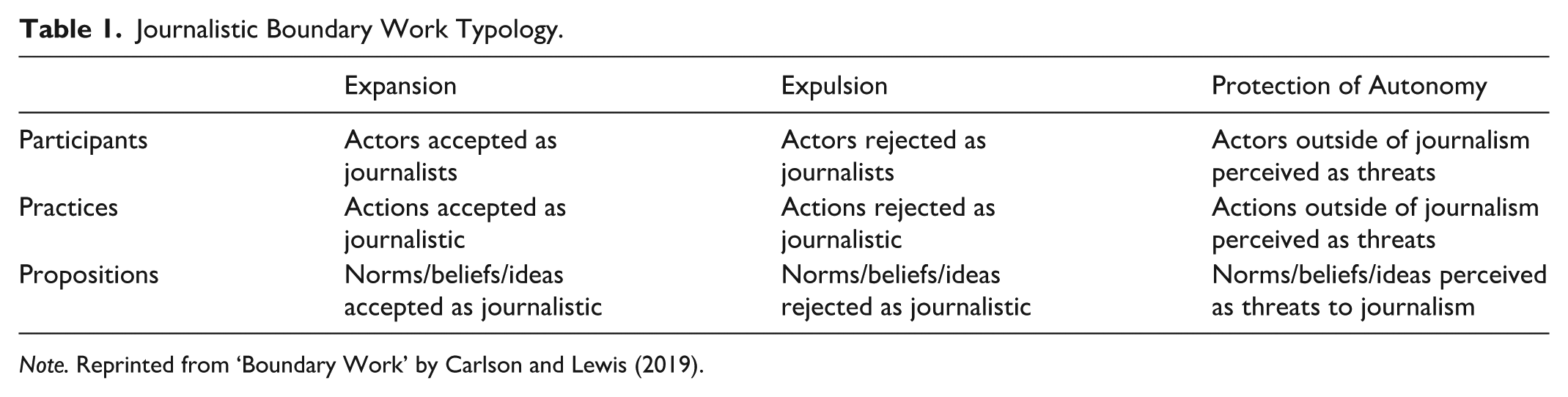
Individuals such as newsfluencers (Hurcombe, 2024) challenge the profession and spur discussions on what constitutes journalism. Because journalists stake their public legitimacy and validate their profession through the control of information, these new actors can be conceived as threats to the existing journalism field (Carlson, 2015). The trend, then, is for journalists to reassert their profession’s boundaries and protect it against the incursions of such non-journalists (Lewis, 2012). To better understand the variety of strategies journalists use to demarcate and guard their profession’s boundaries, Carlson and Lewis (2019) proposed a typology of journalistic boundary work that helps to conceptualise boundary work in journalism more systematically (see Table 1).
Journalistic Boundary Work Typology.
Note. Reprinted from ‘Boundary Work’ by Carlson and Lewis (2019).
Carlson and Lewis (2019) first break down journalism into three distinct categories: participants refer to who and who are not journalists; practices refer to what types of actions can be considered journalistic; propositions refer to the core beliefs of journalism. Next, the process of boundary work can be divided into three categories: expansion would involve journalists extending the boundaries of their profession; expulsion would involve journalists explicitly expelling anything and anyone deemed to be deviant and protection of autonomy would involve journalists defending their sovereignty in demarcating the boundaries of their profession. While expansion and expulsion involve the extension or contraction of boundaries, protection of autonomy is more about journalists retaining the internal authority to set the standards and rules for what belongs within journalism’s boundaries (Carlson, 2015).
It should be noted that these categories are not mutually exclusive – boundary work can occur simultaneously across any number of these areas or cells in the matrix (Carlson, 2015). What is important is to find out where is the emphasis of the boundary work taking place (Carlson, 2015). While many studies using the boundary work concept have focused on traditional hard news journalism, less is known about the boundaries of lifestyle journalism (Cheng & Chew, 2024).
Lifestyle Journalism’s Boundaries
Maares and Hanusch (2020) contend that with regard to the emergence of creators, it is the lifestyle journalism space that is especially affected, as it is here that a vast range of new actors have transformed established practices. Taking fashion as an example, scholars have chronicled the rise of fashion bloggers and influencers and how they have managed to challenge the gatekeeping power of fashion journalists and question their authority as the arbiter of fashion knowledge (Pedroni & Mora, 2023; Rocamora, 2012). In response, Cheng and Tandoc (2022) found that while fashion journalists expel fashion bloggers from the field, they simultaneously perform a protection of autonomy strategy by stressing their professionalism through aligning themselves with ideal-typical values of journalism (e.g., public service, immediacy).
Similarly, Perreault and Hanusch (2024) found that lifestyle journalists in Austria and the United States engaged in boundary work against Instagram influencers mainly via protection of autonomy. Meanwhile, in their study on Singaporean lifestyle journalists, Cheng and Chew (2024) found that they are expanding their field’s boundaries ‘by incorporating new media practices, through adopting a more intimate and personal branding utilised by most influencers, and becoming more prominent on social media themselves’ (p. 385). While the above studies are useful in advancing our knowledge of evolving lifestyle journalism boundaries, there are a few limitations. Perreault and Hanusch (2024) noted that their findings might not be wholly applicable to national contexts outside of the Global North; additionally, the study focused on lifestyle journalists’ perceptions of Instagram influencers only. Cheng and Chew (2024) also acknowledged that because the study had an overrepresentation of interviewees from women’s magazines, the findings are more strongly associated with Instagram influencers who, like magazines, are more visually oriented.
To address these limitations, this study will focus on the national context of Singapore, a country in the Global Southeast, and investigate a wider variety of lifestyle journalists so that the findings will hopefully be applicable beyond a narrow sub-type of creators. Guided by Carlson and Lewis’s (2019) typology of journalistic boundary work, this study asks:
RQ1: Who do Singaporean lifestyle journalists believe are the creators in the field of lifestyle journalism, and what do they think of such actors?
RQ2: What are some of the boundary work strategies that Singaporean lifestyle journalists have adopted in reaction to such creators?
Method
A total of 31 interviews with Singaporean lifestyle journalists were conducted in March and April 2022 (11 in-person, 20 via Zoom). Contributing to ongoing efforts to de-Westernise journalism scholarship (Hanitzsch et al., 2019), Singapore is used here as a relevant case study to examine evolving lifestyle journalism boundaries given that local lifestyle creators have gained such significant popularity that they ‘have progressed to become Southeast Asia’s most lucrative, impactful, and long-standing microcelebrities’ (Abidin, 2017, p. 159). The country’s high internet and social media penetration rates have resulted in a robust creator scene, where some popular creators have become so prominent that organisations – including the government – routinely seek them out for marketing and communication purposes (Pang et al., 2016; Tan, 2020).
The in-depth, semi-structured interview format allowed for an ‘informed grounded theory’ approach (Thornberg, 2012) where the research was guided by sensitising concepts from the literature but was open to emergent themes that surfaced in interviewees’ responses (Tracy, 2013). To recruit participants, Singaporean publications that publish lifestyle content were identified, and the journalists from these publications were contacted via their publicly available work email addresses. Passive snowball recruitment was also utilised, where interviewees were asked to recommend further potential participants. Efforts were made to ensure as diverse a sample as possible that included interviewees working across the whole editorial hierarchy (Hanusch et al., 2017) and across different types of publications and lifestyle beats (Banjac & Hanusch, 2023).
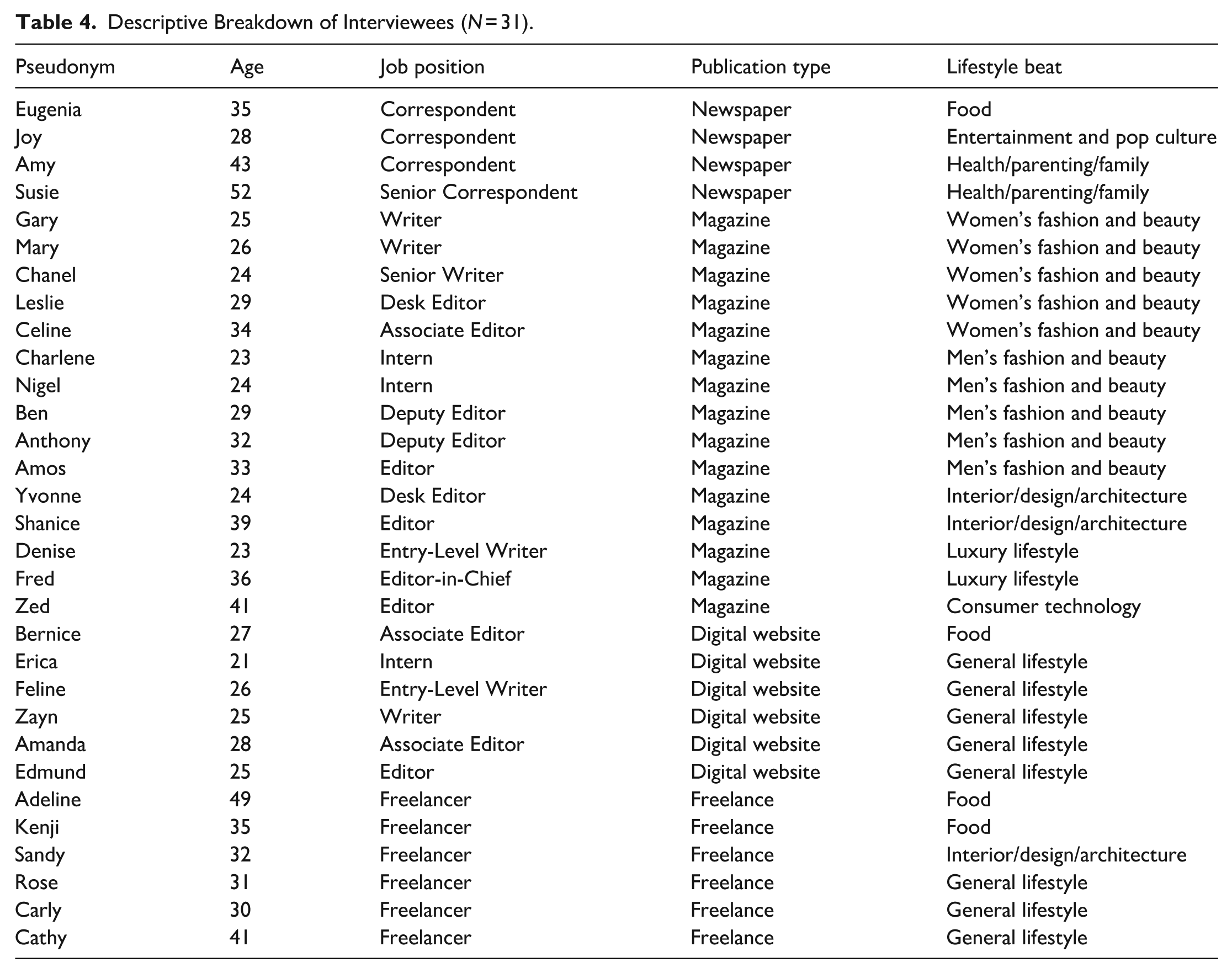
Interviewees’ ages ranged from 21 to 52 years old, with 21 females and 10 males. Four work at newspapers writing for lifestyle-related beats, five work at women’s fashion magazines, five work at men’s fashion magazines, two work at luxury lifestyle magazines, two work at interior/design/architecture-focused magazines, one works at a consumer technology-focused magazine, five work at online-only lifestyle websites, one works at a food focused online website and six are freelancers (see Table 3 in Appendix). The interviews lasted between 61 and 125 min, averaging 92 min. All interviews were recorded and then transcribed. To ensure the anonymity and confidentiality of interviewees, they will be given pseudonyms in the results section (see Table 4 in Appendix).
A constant comparative approach was used to analyse the transcripts (Glaser & Strauss, 1967), following an iterative process where codes were continuously refined as they emerged inductively (Tracy, 2013). Coding followed a two-step process, where a close reading of the transcripts was first conducted to identify and generate first-level codes, which were then compared and grouped into broader conceptual categories that addressed the research questions (Tracy, 2013).
Results
New Players in Lifestyle Journalism
RQ1 asked: Who do Singaporean lifestyle journalists believe are the creators in the field of lifestyle journalism, and what do they think of such actors? Interviewees’ responses suggest that the major players in lifestyle journalism can be split into five groups: journalists, digital natives, blogs, content creators/personalities/KOLs and influencers. These groups can be placed on a spectrum that measures how journalistic each actor is, with lifestyle journalists on one end and influencers on the other (see Figure 1).

Spectrum of lifestyle creators.
I just don’t think that you can compare an influencer and a media publication. A media publication is comprised of many different people and entities, and an influencer represents one person and one perspective. (Zayn)
Influencers are likened to microcelebrities (Abidin, 2016, 2017), that is, popular individuals who employ their online identity as a branded product through strategic and personable interactions with their audiences (Khamis et al., 2017). Interviewees described influencers as celebrities who embody a ‘cult of personality type business’ (Bernice) or a ‘Kardashian kind of relationship’ (Mary) with their followers. Interviewees stated that, unlike journalists, most influencers are ‘monetarily driven’ (Zayn) with the end-goal being the successful commodification of their content and self-branding.
Bloggers . . . actually have a website . . . influencers just post on IG . . . they themselves will tell you this difference . . . because there is rivalry between them . . . bloggers were also untouchable at some point when they first started . . . so when the influencers came in . . . It’s just like us, we say they [bloggers] don’t have proper content, right? They will say that the influencers have no proper content.
Again, this suggests that while creators have been alternatively dubbed as influencers, bloggers, and many other terms (Cunningham & Craig, 2021), there is a case to be made for more nuanced distinctions between these labels.
I would even consider them mainstream media now actually, things like Mothership, Smart Local, because they are just so popular now and they are even on par with The Straits Times . . . and run quite well, run like a company also, they have an organisational structure and they are huge.
While digital natives are more similar to journalism, interviewees – particularly those that work at legacy media – perceived start-up content as of a lower quality. Adeline commented that in ‘the younger media, the job is so much easier [because they are] not shackled by the older ways’. Digital natives are typically young, independent and shaped by ‘diverse approaches to journalism’ that might not adhere to the ‘trappings of traditional journalism’ (Usher, 2017, p. 1118). Interviewees brought up two concrete examples of such ‘diverse approaches’ – Eunice, who works at a newspaper, stressed that unlike start-ups, she ‘cannot write stories on speculation’; Anthony noted that start-up content is ‘super chillax’ with frequent usage of casual jargon and slang not seen in traditional media.
A Fluid Spectrum
It should be noted that indeterminate lines exist between all these actors, reflecting a complex web of dynamics that ‘reflects a level of instability within lifestyle journalism’ (Perreault & Hanusch, 2024, p. 3781). Singaporean lifestyle journalism can be interpreted as a ‘complex new media ecology’ (Deuze, 2008, p. 858) with constantly shifting and evolving players. Interviewees reported that actors on the non-journalistic end of the spectrum can move closer to the journalistic end, and this primarily happens when bloggers, KOLs and influencers take on bureaucratic tendencies, such as the division of labour (e.g., hiring of staff). As Gary observed: They have really become businesses, they have realised that there is money to be made from this . . . so, a lot of them have expanded, they have started teams.
However, this evolution is a process, and hence, it can often be difficult to place these actors on the spectrum in their transitional phases. For example, there is the ‘tricky line between blogs and publications’ (Rose) when a blogger starts to hire a team of writers. Thus, while an attempt has been made to draw up a matrix (see Table 2) to better categorise the characteristics of these lifestyle creators, it should be reiterated that the overlapping boundaries between these actors are fluid.
Characteristics of Lifestyle Creators.

A ‘Frenemy’ Relationship?
Interviewees’ responses reflected a ‘frenemy’ dynamic between themselves and the other creators, where the latter ‘embody both collaborative and competitive characteristics’ (Cheng & Chew, 2024, p. 385). That is, these creators ‘can be both friend and foe according to the situation’ (Cheng & Chew, 2024, p. 385), weaving in and out of lifestyle journalism’s boundaries, although the interviewees also suggested that these creators might have moved beyond competition as certain aspects of their work have already surpassed that of journalists.
Furthermore, journalists’ lack of ‘one-to-one interaction’ (Erica) with the audience, especially in comparison to influencers and KOLs (Abidin, 2017), is seen as a detriment. Denise said, . . . people want to see real life content created by regular people and not necessarily journalists or specialists or experts . . . traditional media . . . can’t compete with the authenticity of . . . the friend-influencer.
Finally, social media creators are seen as ‘very powerful’ (Susie) competition for advertising revenue. With their limited marketing budget, advertisers are likely to ‘just go directly to these influencers’ (Celine), as they tend to be cheaper to collaborate with than traditional media.
Moreover, interviewees pointed to particular KOLs who are producing content that is of comparable – or sometimes even better – quality. This is to the extent that these individuals have become ‘something that we can learn from, so they’re also inspiration’ (Carly). Anthony, who covers watches, said: . . . he is our reference, like an expert. I mean, this guy has been in the industry for long enough in watch journalism . . . It has grown from a hobby-slash-blog into now, a proper digital publication, and they have gone into print as well . . . They suddenly became this trusted source of information.
These KOLs are now a reference point to emulate, where they have become ‘amateur experts’ (Arriagada & Ibáñez, 2020, p. 97) existing beyond lifestyle journalism’s boundaries. Such KOLs are similar to newsfluencers who, unlike amateur citizen journalists, represent a successful hybridisation of professional journalistic characteristics and online creator practices (Hurcombe, 2024).
Safeguarding Shifting Lifestyle Boundaries
RQ2 asked: What are some of the boundary work strategies that Singaporean lifestyle journalists might have adopted in reaction to such creators? Interviewees’ responses indicate that while they engage in various boundary strategies against new actors in their field, there seems to be a growing emphasis on expansion strategies, signalling a loosening of lifestyle journalism’s boundaries. Simultaneously, interviewees engage in protection of autonomy by stressing their allegiance to normative journalistic values, even if, ironically, lifestyle journalism has been criticised precisely because of its non-conformity to such core journalistic principles (Perreault & Hanusch, 2024).
Expulsion
Influencers are perceived as being reluctant ‘to do the hefty work . . . the journalistic part of it’ (Carly) compared to journalists who are committed to providing high-quality and extensive research, interviews and writing. Even bloggers who produce long-form articles have ‘atrocious’ writing and ‘questionable’ (Celine) content and interviewees might feel ‘very indignant about being lumped together with bloggers’ (Cathy), while digital natives ‘pisses off a lot of people . . . especially mainstream media’ (Eugenia). Essentially, the argument is that only ‘journalists’ work reflects a degree of professionalism not found among influencers’ (Perreault & Hanusch, 2024, p. 3777). To reinforce this segregation between themselves and deviant others, interviewees underlined how they are held up to higher standards and expectations by external parties (e.g., public) who perceive journalists more ‘seriously’ (Nigel) and expect ‘proper content’ (Eugenia) from them.
Expansion
Social media creators have been thought to engage in aspirational or tacit labour that is ‘understated and under-visibilized’ (Abidin, 2016, p. 10) to present a form of effortlessness in ‘doing what they love’ (Duffy, 2016, p. 441). Indeed, interviewees acknowledged the ‘amount of work they’re putting in to uphold that image and to create content on the daily’ (Charlene) which usually goes unseen and might even cite their own journalistic work as comparatively ‘pretty chill’ (Mary). Here, interviewees expressed sentiments of admiration and respect for the hidden ‘immaterial labour’ (Duffy, 2019, p. 379) creators engage in 24/7, arguing that the stigma and stereotype of them being vain and shallow ‘is not a good representation of the industry of today’ (Amanda). However, it should be noted that this positive evaluation is only doled out to KOLs and not influencers. This reflects a form of ‘cherry-picking’ (Cheng & Chew, 2024, p. 383) where interviewees select who to include and exclude within the lifestyle journalism field.
This cherry-picking was most clearly exemplified when interviewees discussed collaborations with creators, which are often a requirement for advertising projects and thus difficult to refuse. To retain their authorial position in the journalist–creator dynamic, interviewees would be very selective and only work with ‘interesting personalities that you will not find on general social media’ (Charlene) or ‘real people [rather] than people who just influence on social media’ (Amos). Publications then act as a ‘springing-off platform’ (Ben) for these unknown individuals to gain fame. Cheng (2020) argued that this can be interpreted as a strategy for journalists to ‘“claim” influencers and their practice . . . and hence preserve their dominant status by exerting control over the influencer narrative’ (pp. 85–86).
While interviewees did not deny that they tap into creators’ social capital, they usually framed such collaborations as ‘mutually beneficial’ (Yvonne) and ‘the best of both worlds’ (Carly), which can be perceived as journalists ‘downplaying the dependent aspect of their relationship with influencers by highlighting how they endow influencers with benefits too’ (Cheng & Chew, 2024, p. 380). Again, this helps journalists retain the upper hand – or at least an equal footing – in the ‘power struggle’ (Gary) with creators. Although creator collaborations signify an expansion of lifestyle journalism’s boundaries, the terms of this expansion are strictly dictated by journalists to safeguard their dominant position. As Gary theorised: . . . because they are competition, legacy media still tries to find ways to stay on top of them. The best way to stay on top of someone is to hire them. It is to essentially gatekeep them.
Social media has made journalists ‘more accessible to the public’ (Adeline) when previously ‘traditional media has always been one-sided’ (Zed). This has led to a shift with audiences looking more for ‘personality’ rather than ‘authority’ (Charlene) or personal instead of expert trust: The way people consume media now is, I don’t just trust you because you are Straits Times . . . I trust you because I know who you are and through social media, I kind of like you. (Zed)
Interviewees stressed the importance of not becoming ‘invisible’ (Adeline) through cultivating an ‘intimate’ (Anthony) connection with readers by, for example, sharing ‘their own personal photos’ (Leslie). Here, interviewees are clearly conforming to the practice of visibility as a main marker of professional success in social media cultural production (Duffy et al., 2021), and, like creators, are ‘using their own personalities as their currency’ (Vodanovic, 2020, p. 44). The lines between the two actors are now ‘blurred’ (Anthony, Celine), as lifestyle journalists ‘are also in some form or way influencers as well’ (Amos).
This pressure ‘to make journalists become personalities’ (Cathy) can stem from management, as interviewees discussed how they are increasingly forced to have a social media presence. Companies might enforce the tagging of journalists’ social media handles to their stories or might ‘tend to look at . . . your presence and your work on social media’ (Nigel) during hiring processes. There is a growing acceptance that cultivating a ‘personal branding’ (Amos, Yvonne) is crucial for journalists to be ‘indispensable’ (Leslie), as it can help to ‘open up more opportunities’ (Amanda), where, for example, publications might ‘pay some journalists more if they already have books and followings and they go on TV shows’ (Edmund). However, some interviewees prefer to ‘draw a clear line’ (Celine) between their personal and professional lives on social media, signalling their reluctance to engage in online visibility labour (Duffy et al., 2021) that they perceive to be outside of their job scope as journalists.
Cheng and Chew (2024) found that lifestyle journalists working for digital natives ‘tend to be more accepting toward influencers’ and attributed this to how such organisations are ‘more social media- and audience-centric’ (p. 385) than legacy media organisations. Indeed, interviewees from digital native sites described how ‘their business model was influenced by the influencer model’ (Amanda) where many of the employees ‘do double duty’ (Bernice) or ‘have a hybrid role’ (Amanda) where they are part of the editorial team but also actively perform as social media creators for the publication. This is a formalised strategy, as such individuals usually receive ‘a different contract’ (Amanda) than regular editorial employees. Bernice described how the creator mechanism functions in her organisation: We also do stuff like casting calls . . . talent searches . . . if they’re suitable, we onboard them and then we use our expertise to help grow their brands, and then . . . we push them to clients . . . When they get clients, we get a cut . . . It’s a whole thing. It’s like a machine.
Unencumbered by traditional journalistic norms and routines, digital news start-ups are faster at ‘adapting to new tools, mediums and social media platforms’ (Chew & Tandoc, 2024, p. 201). Compared to legacy media, digital natives are more willing to fully incorporate social media creator practices into their organisational strategy.
Protection of Autonomy
Interviewees engaged in the protection of autonomy boundary strategy by first using their authority as journalists to outline what ought to be the guiding norms and values of journalism, then stressing that while they conform to these long-standing journalistic standards, others do not. Interviewees often used adjectives such as ‘unbiased’, ‘impartial’, ‘balanced’ and ‘neutral’ to describe themselves as legitimate journalists but used adjectives like ‘biased’, ‘subjective’, ‘one-sided’ and ‘opinion-based’ to describe others. Yet, lifestyle journalism has been criticised precisely because of its comparatively subjective nature as opposed to political journalism (Costera Meijer, 2001), and this irony did not go unnoticed: ‘With how opinionated posts or publications can be, there’s influencers, there’s lifestyle publications, and there’s news’ (Erica).
Next, interviewees would underline how being a journalist requires formal training and education to uphold a ‘journalistic rigour and standard’ (Gary). They pointed out that most social media creators have not had such training or education and thus have ‘no real understanding’ (Amos) of the profession. Interviewees also stressed the importance of journalistic fact-checking in their work, while noting that creators ‘are under no obligation to be factual’ (Erica). Because of their lack of these qualities that interviewees deemed as vital to journalism, interviewees classified creators as ‘not real writers’ (Rose), ‘not really a journalist’ (Eugenia) and ‘more for entertainment rather than being informed’ (Zayn). This is somewhat ironic given that providing entertainment has been considered a core function of lifestyle journalism which sets it apart from hard news (Hanusch & Hanitzsch, 2013).
Finally, interviewees stated that essential to journalism is a separation of editorial and business interests. While they did not deny that lifestyle journalism is influenced by commercial pressures (Hanusch et al., 2017), they pointed out that as journalists, they know to at least produce a balanced mix of both original editorial content and sponsored content. When describing creators’ content, however, interviewees observed how ‘their entire feed is just advertising products’ (Susie) and how their ‘main job is just selling products through sponsorships’ (Chanel). Moreover, while creators’ content often sounds ‘like a sales pitch’ (Chanel), interviewees said that as journalists they would at least editorialise sponsored content by including an ‘additional angle’ (Chanel) or a ‘rounded view’ (Denise).
Interviewees also stressed the importance of ‘editorial integrity’ (Celine) in being transparent about paid and sponsored content as journalists. Conversely, they perceived that creators are ‘a lot more willing to give up their own pride for the money’ (Denise) as they frequently provide false positive reviews or not declare paid sponsorships to maintain a good relationship with advertisers. However, some interviewees recognised the double standard being imposed on creators given that lifestyle journalism has also been found to be dishonest regarding paid content (Cheng & Tandoc, 2023): . . . who are we to judge . . . we also do sponsored content. (Kenji) . . . it’s the same thing that we do, but then I wouldn’t trust it very much either. (Yvonne)
Lifestyle journalists’ invocation of a protection of autonomy strategy is largely ironic, as they are relying on normative standards of journalism to distance themselves from creators. Yet, lifestyle journalism has often been criticised precisely because of its non-adherence to such standards (Perreault & Hanusch, 2024).
Discussion
Using Singapore as a case study, this study set out to investigate lifestyle journalists’ perceptions of new creators in the field, and the boundary work strategies instigated against these actors. With the proliferation of social media creator culture (Craig, 2022), the contestation for lifestyle journalism’s boundaries is happening online (Maares & Hanusch, 2020), where there exists a complex, shifting digital ecosystem of creators in lifestyle journalism (Deuze, 2008). Lifestyle journalists perceive these creators as journalistic to different extents, and as such they can be placed on a spectrum measuring how journalistic they are, with lifestyle journalists on one end, followed by digital natives, bloggers, content creators/personalities/KOLs and influencers on the other end. Influencers, defined as those who have gained sizeable followings on social media (Abidin, 2016, 2017), are seen as the least journalistic, as they are typically individual – rather than organisational – operations focused on establishing a personable self-branding that can be monetised (Khamis et al., 2017).
KOLs, meanwhile, are deemed as more journalistic because their content is thought to be more content-centric (showcasing their deep passion for and knowledge of a certain topic) rather than me-centric (selling themselves). As such, KOLs are comparable to newsfluencers (Hurcombe, 2024) in that they seem to embody both social media and journalistic characteristics. The most distinct trait separating influencers and KOLs is the latter’s seeming lack of economic motivation in monetising their passion. Crucially, this signals a departure from the general scholarly understanding of social media creators as those that engage in entrepreneurial platformised cultural labour where the end goal is to be paid for doing what they love (Duffy, 2016). Lifestyle journalists confer more legitimacy to KOLs whom they see as more authentic, less profit-driven and with better content quality than influencers (Cheng & Chew, 2024). While creator has tended to be used as a catch-all term in creator studies (Lin & Craig, 2025), this finding suggests a need for distinguishing between certain terms such as influencer and KOL, at least in relation to lifestyle journalism.
Next on the spectrum are bloggers, who are considered more journalistic because although most bloggers have also established themselves on social media, they still, unlike social media creators, engage in long-form content via their websites. Finally, digital natives are seen as the most journalistic, as these digital news start-ups are organisations producing content similar to legacy media. All these actors combine to make up a dynamic ecosystem of lifestyle journalism players that is constantly changing – individual creators, for example, can start to take on organisational characteristics (e.g., hiring of staff) when they get more successful (Cheng & Tandoc, 2022).
Singaporean lifestyle journalists perceive a frenemy relationship with these new actors – while the journalists see such actors as formidable competition for speed, relatability and advertising revenue (Cheng & Tandoc, 2022, 2023), they also see such actors as complementary, as they might all appeal to distinct target audiences and can fulfil their needs differently, allowing for an amicable co-existence. However, a notable finding from this study is that the journalists also pointed to cases of very successful creators who have already surpassed them in terms of popularity and content quality, such that they no longer require validation from journalists and in turn have become a reference point to emulate. This indicates that lifestyle journalism is now operating in a digital reputation economy where online visibility is now the foremost marker of professional success (Duffy et al., 2021).
Unlike Perreault and Hanusch (2024) who concluded that lifestyle journalists mainly engage in protection of autonomy to protect lifestyle journalism’s boundaries against Instagram influencers, this study found that Singaporean lifestyle journalists engage in expulsion, expansion and protection of autonomy simultaneously. The placement of creators on a spectrum can be conceived as a participant-expulsion strategy itself (Carlson & Lewis, 2019), as it is an othering discourse (Banjac & Hanusch, 2023) where such actors are clearly placed outside of lifestyle journalism’s boundaries. Expulsion was most clearly levied on influencers at the end of the spectrum, who are frequently deigned as shallow, only interested in selling their image and heavily monetised (Perreault and Hanusch, 2024). Simultaneously, lifestyle journalists engaged in a protection of autonomy strategy where they defended their profession’s boundaries by using their authority as journalists to outline what are the norms and values of journalism (i.e., objectivity, formal education) and then stressing only they abide by these long-standing journalistic standards. However, this is ironic, as lifestyle journalists themselves have been derided for not adhering to these standards that are largely derived from ideations and practices of political journalism (Perreault and Hanusch, 2024).
Most significantly, there is a clear shift towards expansion-led strategies, signalling that the boundaries of Singaporean lifestyle journalism are softening considerably as the journalists accept both newer actors and practices into their profession. Commonly, lifestyle journalists are incorporating creator-led social media strategies into their work, with many modelling themselves into social media creators by similarly practising self-branding (Vodanovic, 2020). Notably, this study found that not only are individual journalists increasingly valuing the accumulation of social capital and seeing it as a marketable skill, but news organisations are also now demanding online visibility from their employees, suggesting an institutionalisation of digital reputation as a formal requirement in lifestyle journalism.
While Cheng and Chew (2024) found that lifestyle journalists mostly engaged in expansion through incorporating social media creator practices into their work, this study found that Singaporean lifestyle journalists are also progressively extending the boundaries of lifestyle journalism to include creators themselves. Specifically, the lifestyle journalists expressed admiration and respect for KOLs, validated their work and recognised the immaterial labour they perform (Duffy, 2019). However, this positive evaluation is only reserved for KOLs, and thus implicit in this is still an expulsion of other deviant actors – particularly influencers – who have not gained the journalists’ approval.
Overall, the findings reveal a complex new media ecology of shifting digital players and evolving boundaries in Singaporean lifestyle journalism. It is likely that with rapidly progressing technological developments, market changes and newer forms of content distribution, the digital players and boundary strategies mapped out here will not remain static. Future studies should continue to chart the evolution of lifestyle journalism’s boundaries to better understand how the field is continuously transforming in tandem with creator culture.
Footnotes
Appendix
Descriptive Breakdown of Interviewees (N = 31).
| Pseudonym | Age | Job position | Publication type | Lifestyle beat |
|---|---|---|---|---|
| Eugenia | 35 | Correspondent | Newspaper | Food |
| Joy | 28 | Correspondent | Newspaper | Entertainment and pop culture |
| Amy | 43 | Correspondent | Newspaper | Health/parenting/family |
| Susie | 52 | Senior Correspondent | Newspaper | Health/parenting/family |
| Gary | 25 | Writer | Magazine | Women’s fashion and beauty |
| Mary | 26 | Writer | Magazine | Women’s fashion and beauty |
| Chanel | 24 | Senior Writer | Magazine | Women’s fashion and beauty |
| Leslie | 29 | Desk Editor | Magazine | Women’s fashion and beauty |
| Celine | 34 | Associate Editor | Magazine | Women’s fashion and beauty |
| Charlene | 23 | Intern | Magazine | Men’s fashion and beauty |
| Nigel | 24 | Intern | Magazine | Men’s fashion and beauty |
| Ben | 29 | Deputy Editor | Magazine | Men’s fashion and beauty |
| Anthony | 32 | Deputy Editor | Magazine | Men’s fashion and beauty |
| Amos | 33 | Editor | Magazine | Men’s fashion and beauty |
| Yvonne | 24 | Desk Editor | Magazine | Interior/design/architecture |
| Shanice | 39 | Editor | Magazine | Interior/design/architecture |
| Denise | 23 | Entry-Level Writer | Magazine | Luxury lifestyle |
| Fred | 36 | Editor-in-Chief | Magazine | Luxury lifestyle |
| Zed | 41 | Editor | Magazine | Consumer technology |
| Bernice | 27 | Associate Editor | Digital website | Food |
| Erica | 21 | Intern | Digital website | General lifestyle |
| Feline | 26 | Entry-Level Writer | Digital website | General lifestyle |
| Zayn | 25 | Writer | Digital website | General lifestyle |
| Amanda | 28 | Associate Editor | Digital website | General lifestyle |
| Edmund | 25 | Editor | Digital website | General lifestyle |
| Adeline | 49 | Freelancer | Freelance | Food |
| Kenji | 35 | Freelancer | Freelance | Food |
| Sandy | 32 | Freelancer | Freelance | Interior/design/architecture |
| Rose | 31 | Freelancer | Freelance | General lifestyle |
| Carly | 30 | Freelancer | Freelance | General lifestyle |
| Cathy | 41 | Freelancer | Freelance | General lifestyle |

Ethical Considerations
This research was approved by the University of Sydney Human Research Ethics Committee (HREC) [2021/808].
Consent to Participate
Participants provided written informed consent to participate in this research.
Funding
The authors disclosed receipt of the following financial support for the research, authorship and/or publication of this article: This research is supported by the Ministry of Education, Singapore, under its Social Science Research Council (SSRC) Graduate Research Fellowship (GRF); an Australian Government Research Training Program (RTP) Scholarship and a University of Sydney Faculty of Arts and Social Sciences Doctoral Research Travel Grant Scheme.
Declaration of conflicting interests
The authors declared no potential conflicts of interest with respect to the research, authorship and/or publication of this article.
Data availability statement
The data sets generated during and/or analysed during the current study are available from the corresponding author on reasonable request.