




Abstract
With Roland Barthes’ 1968 essay ‘Death of the Author’ as its touchstone, this article reflects critically on the hashtag #ripjkrowling that trended on Twitter in September 2020. Through a thematic content analysis of the top 100 tweets from this hashtag, it will examine celebrity author J.K. Rowling’s reputation amongst fans and wider audiences. Rowling’s history of disseminating transphobic rhetoric online as well as the news her 2020 book contains transphobic messaging will be considered. When Barthes called for the ‘death’ of the author, he highlighted the importance of understanding texts as independent from authorial intention and biography. As this case illuminates, when fans cannot reconcile Rowling’s values with those of her creation they pronounce her ‘dead’. Exemplified through this hashtag, in this post-Barthesian world of celebrity authorship, the author is being revived only to be killed off again. This paper seeks to examine why Potterheads, in response to Rowling’s controversies pertaining to LGBTQIA+ issues, are pronouncing her ‘dead’. From there, this article explores a broader public relations inquiry into what this means for public relations practice when media products and brands belong to the fans, especially politically and socially active ones like Potterheads. Mainstream participatory culture logics on Twitter such as hashtag and fan activism will be reflected on to understand their role in how modern fans separate art from their artists, and implications for Rowling’s authorship, Harry Potter readership and public relations.
Why #RIPJKRowling trended on Twitter
Thanks to her global best-selling series Harry Potter, J.K. Rowling is one of the most successful authors of the 21st century. Starting as a children’s author, Rowling has become the face of a world-leading transmedial 1 entertainment property and thus a literary celebrity. Today however, Rowling’s use of social media networking sites, most notably Twitter, has resulted in her once pristine reputation becoming tainted with controversy. With the rise of the Twittersphere where mainstream participatory culture logics continue to evolve, the relationship between fans and authors continues to transform as fans become empowered to engage in hashtag and fan activism. These forms of engagement indicate a movement, caused by convergence culture and contemporary notions of celebrity authorship, towards a post-Barthesian world where authors are being revived on social media. Today, these previously invisible, ‘dead’ authors are being brought to life and visibility in the public sphere to the extent that some, like Rowling, have become brands having attained celebrity status (Myers, 2016). This shift directly conflicts and complicates Barthes’ famous 1968 theory and essay ‘The Death of the Author’ where he signalled how to restore writing to its future: ‘overthrow the myth: the birth of the reader must be at the cost of the death of the Author’ (Barthes, 1968/1977: 146). Barthes’ assertion that the birth of a reader can only be attained by an author accepting their theoretical death highlighted the importance of understanding texts as independent from authorial intention and biography (Barthes, 1968/1977). However, when fans cannot separate Rowling’s opinions and ethics with those of her creation, as evidenced by Potterheads 2 sending the hashtag #ripjksrowling trending on Twitter in September 2020, they pronounce her ‘dead’. As this hashtag suggests Harry Potter readers are declaring Rowling dead, Barthes’ idea of the ‘death of the author’ appears to have been reversed by social media, where an author’s relevance persists, however now does so in an altered form. This highlights the role of the reader, who, according to Barthes was birthed at the author’s death. With this new brand of celebrity authorship, created alongside a vocally active readership, both readers and authors are now very much alive thanks to social media and posing a new challenge for public relations.
Although public relations have been quick overall to grasp social media, social media’s impact on public relations practices remains underexplored (Thurlow, 2019). As social media sites like Twitter continue to provide a venue for fan/author interactions in addition to fan activism, these relationships need to be analysed from a public relations perspective. Accordingly, this article conceptualises how Harry Potter belongs to its fans and will inquire what this means for public relations when a media product/brand belongs to consumers. In particular, when vocally active fans like Potterheads are using social media platforms such as Twitter to engage in activism for social movements and justice such as for trans and LGBTQIA+ rights, despite these diverging politically from the author of the Harry Potter universe.
For many millennials who grew up escaping to Hogwarts, the Harry Potter books and films forced open their minds to the idea that those who are different are not less. Hogwarts was a visually diverse place where the theme of heterogeneity echoed. Within its magical walls Rowling told a story where students of all shapes, sizes, races, and nationalities came together in an epic battle to fight a dark lord hell-bent on attaining absolute power and control. Many thanked Rowling for making them feel less alone and allowing them to believe they were part of something bigger. To these fans everything Rowling touched turned to gold, until suddenly, everything seemed to tarnish. Perhaps it was fools’ gold all along? Just maybe, all that glitters is not gold.
Rowling’s reputation crisis started out by her liking and retweeting a couple of transphobic tweets in 2017 (Madani, 2020). Nonetheless, Rowling’s public relations representatives maintained these were ‘clumsy and middle-aged moments’ and that ‘this is not the first time she has favourited by holding her phone incorrectly’ (Duffy, 2018). However, this behaviour continued and began its crescendo in June 2020 when Rowling published a tweet in which she mocked a headline for using gender inclusive language when referring to menstruation. A couple of days later Rowling posted a lengthy blog post detailing her ‘reasons for being worried about the new trans activism’ (Rowling, 2020). In July, Rowling tweeted a comparison of ‘young people who are advised toward hormone therapy to “conversion therapy”’ (Madani, 2020). By September 2020, the hashtag #ripjkowling began trending on Twitter despite Rowling being very much alive. Fans collectively agreed to ‘cancel’ the author after uncovering her newest book, Troubled Blood, features a male serial killer who disguises himself in female clothing to murder women (Lopez, 2020). Today in 2023, Rowling is often referred to as transphobic and ‘TERF’ (trans-exclusionary radical feminist) in the Twittersphere and by Potterheads.
Transgender people are constant targets of toxic language on social media, however not all verbal abuse is explicit. Within transphobic groups are trans-exclusionary radical feminists who are ‘critical of the notion of gender, and position the existence of trans women as antithetical to “womenhood”’ (Lu and Jurgens, 2022). TERF groups uphold an active presence on social media sites and remain a frequent source of transphobia as their masked rhetoric is not always recognised by current hate speech detection models (Lu and Jurgens, 2022). Because interacting with TERF individuals can be materially harmful, trans communities and allies continue to establish lists of TERF accounts to block and help trans people avoid abuse online (Lu and Jurgens, 2022). In regards to JK Rowling, the announcement that she was publishing a book with underlying transphobic messaging was made in an already precarious context of active public dissatisfaction with Rowling pertaining to highly contentious current transgender and LGBTQIA+ issues.
In response to Rowling’s engagement in transphobic discourse online and new book, Rowling’s fans took to Twitter to express their discontent by creating the hashtag #ripjkrowling. This hashtag echoes Barthes’ argument in his essay ‘The Death of the Author’, as it suggests Potterheads are claiming their Barthesian right as readers to ‘kill’ Rowling. In doing so, vocally active Potterheads have seemingly decided to liberate Rowling’s creation and claim her Wizarding World for themselves confirming that they have become ‘prosumers’ (both producer and consumer) free to actively create new meanings (Sugihartati 2020: 307). This new trend of hashtag and fan activism highlights the implications of new communication technologies and this ever-changing environment of converged media forms and cultures on contemporary author and fan relations. Accordingly, this article seeks to contribute by updating and expanding literature on modern notions of authorship by reflecting critically on Barthes’ idea of the ‘death of the author’. This article will explore how the author’s relevance continues to persist, but does so now in an altered form having been reframed by social media creating both a new brand of celebrity authorship alongside a vocally active readership. From there, this article investigates a broader public relations inquiry into what this means for public relations practice when media products and brands belong to the fans, especially politically and socially active ones like Potterheads. This will be executed via a thematic content analysis of the top 100 tweets from the trending hashtag #ripjkrowling. These top tweets engaged with by fans and wider audiences will illuminate whether Potterheads have decided to declare Rowling dead and separate the author from her works so that they may continue enjoying and engaging with her beloved fictional world. The implications of this on Rowling’s authorship and the popularity and readership of the Harry Potter franchise, as well as who the transmedial world belongs to now, will be examined.
Potterheads, transphobia, new age fan activism and public relations
At Harvard’s 2008 graduation Rowling said: ‘we do not need magic to change the world, we carry all the power we need inside ourselves already: we have the power to imagine better’ (Rowling, 2008). In this address aimed at a generation of students who not only grew up reading Harry Potter but actively engaging with the world, Rowling highlighted the essence of her story: morality. Based on this underlying theme and message throughout Harry Potter, it is unsurprising that it produced one of the most active and innovative fandoms of the 21st century. Not only did Potterheads create, debate, rewrite and perform Harry Potter, they developed new media platforms and innovative practices to engage in fan activities and behaviours (Jenkins, 2012). Fans have often related their favourite works to real-world issues such as discussions regarding gender, sexuality and race; with real-world discussions often arising as unintended consequences from conversations about fictional worlds (Kligler-Vilenchik, 2015). Everyday connections were made from popular culture passions and social issues both on and offline. The Harry Potter fandom’s extensive history and obsessive interest in LGBTQIA+ content and activities are therefore unsurprising. Collectively, they have created innumerable amounts of slash (homoerotic) fanfiction and have actively engaged in ‘fan activism’ for the LGBTQIA+ community. According to Jenkins and Shresthova (2012: 7) fan activism is: Forms of civic engagement and political participation that emerge from within fan culture itself, often in response to the shared interests of fans, often conducted through the infrastructure of existing fan practices and relationships, and often framed through metaphors drawn from popular and participatory culture.
These indicators of fan activism are epitomised through Potterhead’s formation of ‘The Harry Potter Alliance’ (HPA). An icon of fan activism, this non-profit organisation founded in 2005 spreads across six continents, has over 200 volunteer chapters, and focuses on seven major points of activism: LGBTQIA+ equity, gender equity, media reform, racial justice, climate change, education and libraries, and youth advocacy (Carriere, 2018). Rowling’s previously mentioned speech where she encouraged this idea of a socially engaged imagination was a key source of inspiration for members as they believed the notion brought together their love of her fictional world with their passions for social justice (Carriere, 2018). As of June 8th, 2021, HPA have officially changed their name to ‘Fandom Forward’ (FF). Voted for by their supporters, this decision was made to reflect the movement’s inclusion of multiple fandoms and stories in their effort to rally fan activists to use their ‘passion and creativity to make the world a more loving, equitable place’ (Fandom Forward, 2021).
Evident by organisations such as HPA/FF, social media has played a key role in spreading support for these activist and advocacy groups (Adi, 2018). According to Adi (2018), beyond these groups effective use of social media sites to connect and amass support, their successful antics are always a result of excellent communication and public relations, though not public relations in a traditional sense. Public relations scholars concur that although public relations historically existed before it become a ‘corporate service’. Scholars have identified that albeit unknowingly public relations (at least in the USA) started out with progressive reform movements and grew with social movements like feminism, environmentalism, consumer and gay rights (Adi, 2018). For public relations practitioners working for corporate bodies, activism is being treated as a practice and is encouraging more ethical behaviour.
Hashtags 3 , specifically their function for hashtag activism, have been a key tool used by Potterheads to engage in fan activism. A major component of this hashtag activism has been boycotting. In the Web 3.0 age, boycotting via hashtag activism has equated to the ‘cancelling’ of problematic celebrities and brands who draw attention to bad acts. Defined by Bromwich (2018), ‘cancel culture’ is ‘an act of withdrawing from someone whose expression — whether political, artistic or otherwise — was once welcome or at least tolerated, but no longer is’. Cancel culture is situated amidst Habermas’ idea of the public sphere, which argues that public discourse is formed in the realm of the elites (Clark, 2020). According to Ng (2020), cancel culture displays how content circulation through social media platforms enables instant and widespread responses to acts deemed to be problematic, and frequently empowers marginalised groups in doing so. In consequence, cancel culture points to a dearth of thoughtful debate and loss of nuance and complexity in digital dialogue (Ng, 2020). Clark (2020), supports this notion, concluding that ‘the absence of deliberation in chastising bad actors, misconstrued as the outcome of cancel culture, is a fault of the inability of elites to adequately conceive of the impact social media connectivity has for shifting the power dynamics of the [networked] public sphere’ (p.92). Because hashtags and hashtag activism thrive in the digital landscape, public relations practitioners can no longer rely on traditional strategies such as one-way models of communication for successful relationship management (Hutchins and Tindall, 2021). Two-way communication methods to build and manage relations must therefore be utilised to help minimise potential reputational threats posed by fans online in this new cancel culture environment driven by fan and hashtag activism.
The ever-haunting ghost of J.K. Rowling: Authorship, Twitter, literary celebrities and human brands
Modern notions of authorship and whether contemporary audiences are viewing authors as separate entities from their works remains an ever-evolving debate. As modern audiences become increasingly empowered to separate the author from their texts, they not only deny the spirit and identity of the author, but the author themself (Hardin, 2009). In so doing, audiences today are enthusiastically embracing Barthes’ belief that ‘the birth of the reader must be at the cost of the death of the Author’ (Barthes, 1968/1977: 146).
Despite this initial zeal for the theoretical death of authors, Barthes’ later works such as his 1974 book The Pleasure of the Text, did however indicate a more conflicted and complex perspective on authorship that considers the possibility of a perverse desire by readers for the author (Barthes, 1974/1975). Despite knowing the author to be dead, this ‘perverse desire’ Barthes discusses manifests in the social media engagements with celebrity authors we see today.
Sean Burke drew attention to Barthes’ self-contradiction in his 1992 ‘The Death and Return of the Author’ where he concluded that Barthes’ works should be considered together and accumulatively include space for the ‘dead’ author’s return. This nuanced understanding of authors and readers explains modern notions of authorship and desires, where some readers seek relationships with authors whilst respecting the author’s theoretical death (Gallop, 2011). Altogether, Barthes stipulates a theoretical context for the contemporary movement from the author’s function to an object of desire that we can see exemplified in modern-day literary celebrities and their use of Twitter (Hardin, 2009).
Now, in the public sphere these putatively dead, invisible authors have been brought to life and visibility so much so that some, like Rowling, have been pronounced literary celebrities (Myers, 2016). The media convergence and rise of social media have created new means by which readers and authors can interact. In consequence, there has been an industry shift from Barthes’ preliminary desire for authors’ deaths to authors now proactively looking for new ways to gain celebrity status via social media (Myers, 2016). Doing so has proved to aid authors in establishing a profile by acquiring attention capital (Spiers, 2016). This new industry need highlights the commercialisation of modern authors into a ‘brand’. Literary scholars, particularly Tavares, argue that an author’s Twitter feed has now become an authorial product (Ravy, 2016).
Twitter, one of the leading and most powerful social networks, has been a cataclysmic tool in transforming relationships between fans and celebrities. Through Twitter facilitation of two-way communication, fans are now able to have direct and instant access to these objects of their adoration (celebrities) (Kowalczyk and Pounders, 2016; Giles, 2017). Inversely, social media has also provided authors with the opportunity to directly develop their authorial persona, engage with fans and manage their reputation and public relations. According to Fitch (2017) however, scholars have neglected research around celebrity public relations, and as a result there is a lack of knowledge regarding the everyday practices of public relations practitioners working for celebrities, which this article seeks to fill. In despite of these practices being in direct contradiction to Barthes’ ‘death of the author’, social media use, especially Twitter, has now become obligatory within the industry (Ravy, 2016). This explains Rowling’s considerable online presence and Twitter use. Nevertheless, scholars such as Goodman (2015) are concluding that despite this, creators still do not have creative control over their fictional works. Whilst scholars like Schiller (2018: 105) are viewing this issue as even more complex and are calling for ‘new narrative models and concepts for collective forms of authorship … [to] be developed, to address the convergence of the traditionally separate roles of authors, industry, and consumers’. In summary, social media has complicated the relationship between authors and fans as it creates opportunities for two-way communication and relationship building that complicate Barthesian notions of authorship. As the Twittersphere empowers the birth of readers/fans whilst enabling the author to persist in the form of celebrity, the consequence of this appears to be the two sometimes remaining in conflict.
Further complicating Rowling’s authorial rebirth is the reality of her attained celebrity status. As with all celebrities, Rowling’s status as a literary celebrity has resulted in her coming to life as a human brand/media product (Centeno and Wang, 2017). According to Centeno and Wang (2017: 133), celebrities ‘performances on- and off-stage, off- and online, public or private, are marketing and branding exercises. Their everyday choices and values are intrinsically private but performed in public. These actions create brands and brand identities. A brand can be defined as ‘a product, service or concept that is publicly distinguished or differentiated from other products’ (Pluntz and Pras, 2020: 832), while a brand identity is the ‘unique set of brand associations that the brand strategist aspires to create or maintain’ (Aaker, 1996: 68). A human brand, is the unqiue associations that are intinsically connected to an individual that transfers to equity (Pluntz and Pras, 2020). Human brands like celebrities sell products via endorsements and persuasions through personality qualities and promote consumption by being an idealised consumer (Centeno and Wang, 2017). Nonetheless, Muniz et al. (2014: 69) argued that to do so, brands ‘need to read and adapt to the culture in which they are embedded’. Thus, for a human brand like Rowling it is imperative to gain legitimacy from stakeholders, however this can only be done when her brand embodies the cultural norms that her stakeholder or fans value. Indeed, Bourdieu (1992) states that legitimacy is a symbolic form of authority. However, this authority stems from the alignment of a brand identity with the socially constructed system it is built within (Suchman, 1995; Pluntz and Pras, 2020). Evident in this case with Rowling, Rowling’s political and social movement divergence online from her brand so innately intwined with Harry Potter has resulted in a damage to her reputation and relationship with prosumer fans, ultimately encouraging them to claim their Barthesian right to kill Rowling and take her works for their own.
Research methods
This article presents a thematic content analysis of the top 100 tweets from the trending hashtag #ripjkrowling. The research aim is to identify and examine the most frequent and prominent issues and themes raised in both Potterhead and wider audience tweets about Rowling, her reputation, vocally active readership, and recent works.
Thematic media content analysis
An inductive thematic analysis is essential to efficacious communication research (Baek et al., 2011). Accordingly, a content analysis was chosen to analyse the key themes that emerged throughout the hashtag’s top tweets. An inductive thematic analysis was conducted to examine the top 100 tweets from the trending hashtag #ripjkrowling during September and October 2020. Because irony and sarcasm are prevalent on Twitter, to minimise human error within the data coding process tweets were filtered for ‘English only’ to ensure accurate interpretation (Reyes et al., 2012). These decisions were specifically made to aid in creating credible research to help understand the perceptions of fans and wider publics about Rowling in our current mediatised networked culture.
Data collection
A search of the top tweets from the hashtag #ripjkrowling throughout September and October when the hashtag trended was conducted via the ‘Twitter advanced search’ function on Twitter’s site. The hashtag ‘#ripjkrowling’ was inputted, and the dates ‘01 September 2020’ to ‘31 October 2020’ and ‘English only’ were selected. As this timeframe covers the peak of this trending hashtag it was chosen to ensure all data was assessed. From the ‘Top’ page tab, the first 100 tweets with the most likes were collected. These tweets were selected as the top 100 most liked tweets as they are more likely to denote the popular sentiment of fan opinions of Rowling. Despite the hashtag trending mid-September, I chose to collect data from the months of September and October as the hashtag was still highly used throughout this time. This extended timeframe also provided the opportunity to gather more well-rounded and complete data of the Twittersphere and Potterheads’ opinions of Rowling and her authorship.
Data coding and analysis: Mixed methods approach
Due to a lack of recent empirical literature relating to Rowling’s recent controversial tweets, a general inductive approach was used to identify the main themes that emerged organically during the coding process.
Since a mixed methods research design creates more detailed results, both qualitative and quantitative assessments were made (Smith et al., 2018). A qualitative assessment was used to identify and critically analyse key themes regarding opinions of Rowling following news reports that her new book contains ‘transphobic messages’. A quantitative assessment was also made to examine the frequency of each key theme. The results from the quantitative analysis were rounded to the nearest percentage and taken into consideration when assessing the Twittersphere’s perception of Rowling.
Findings
Tweet themes
As illustrated in Figure 1, six primary themes emerged inductively from the data: ‘against hashtag’, ‘stop supporting JKR’, ‘humour and memes’, ‘insulting and anti JKR’, ‘supporting JKR’ and ‘Rowling’s transphobic’. Tweets within the themes ‘against hashtag’ and ‘supporting JKR’ (42% of the tweets) contained content that was of a sentiment mostly ‘for’ Rowling, her book and beliefs. Tweets within the rest of the themes ‘stop supporting JKR’, ‘humour and memes’, ‘insulting and anti JKR’ and ‘Rowling is transphobic’ (58% of the tweets) were mostly negative in sentiment towards Rowling. Results for theme of tweets from September to October 2020.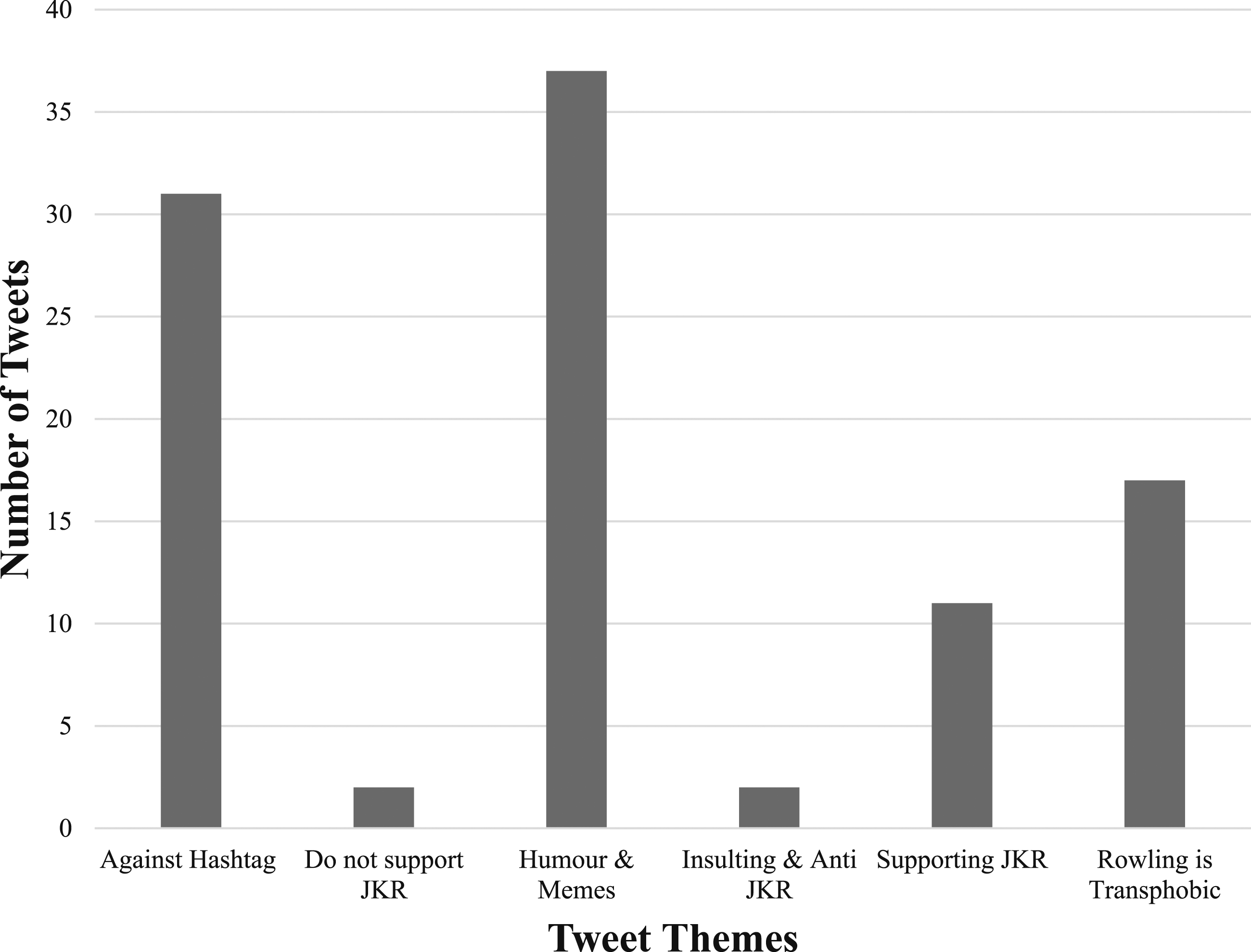
Humour and meme (n = 37)
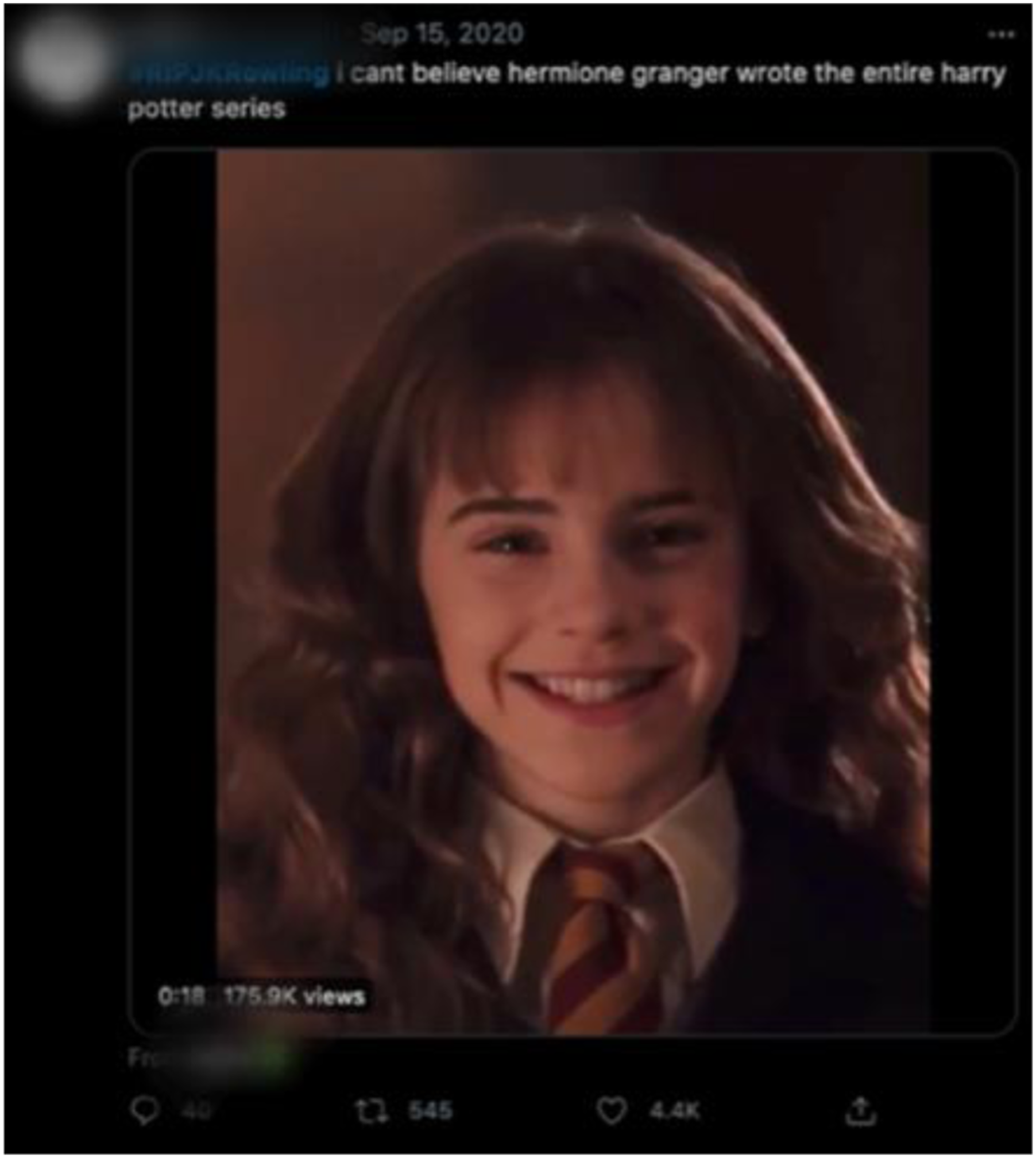
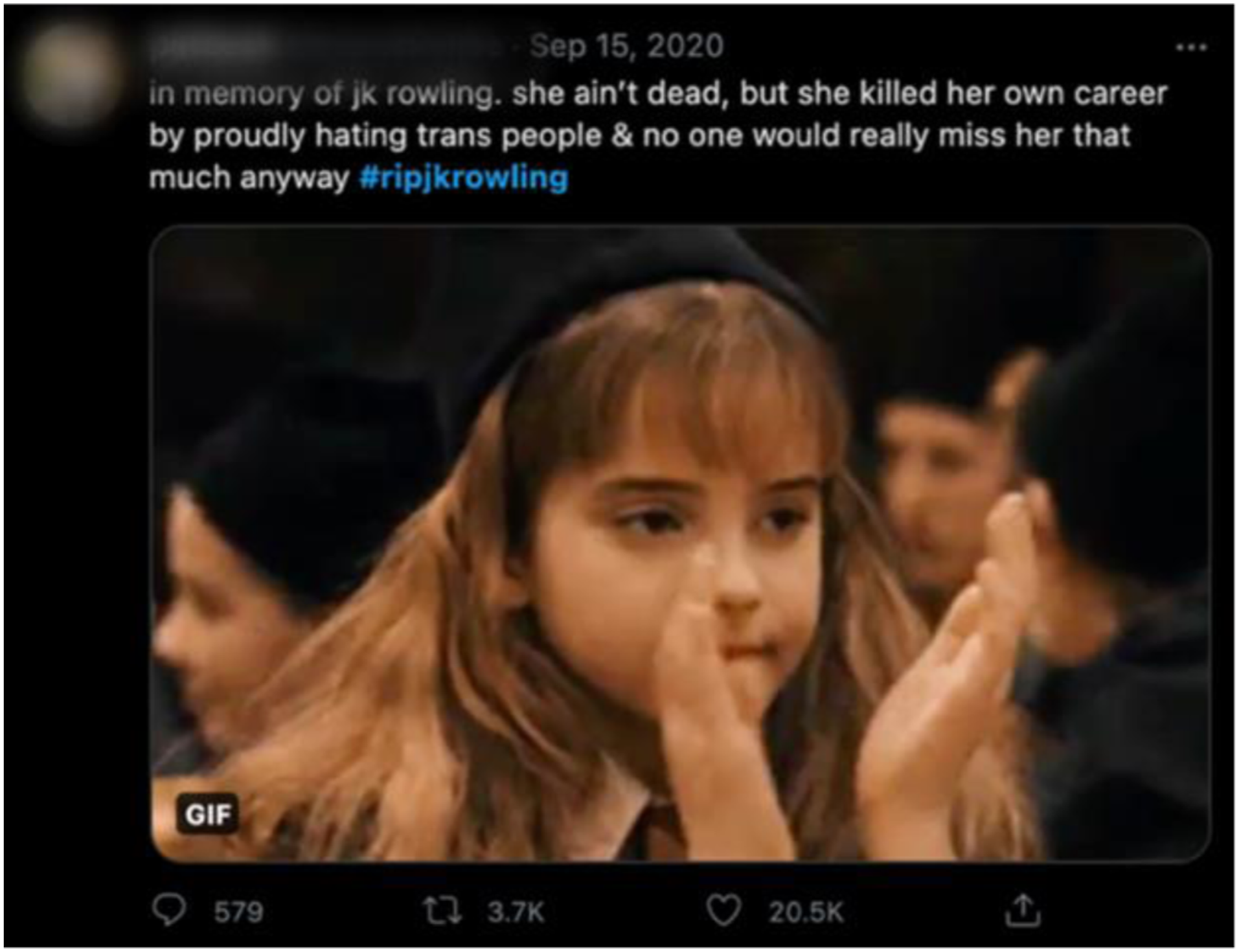
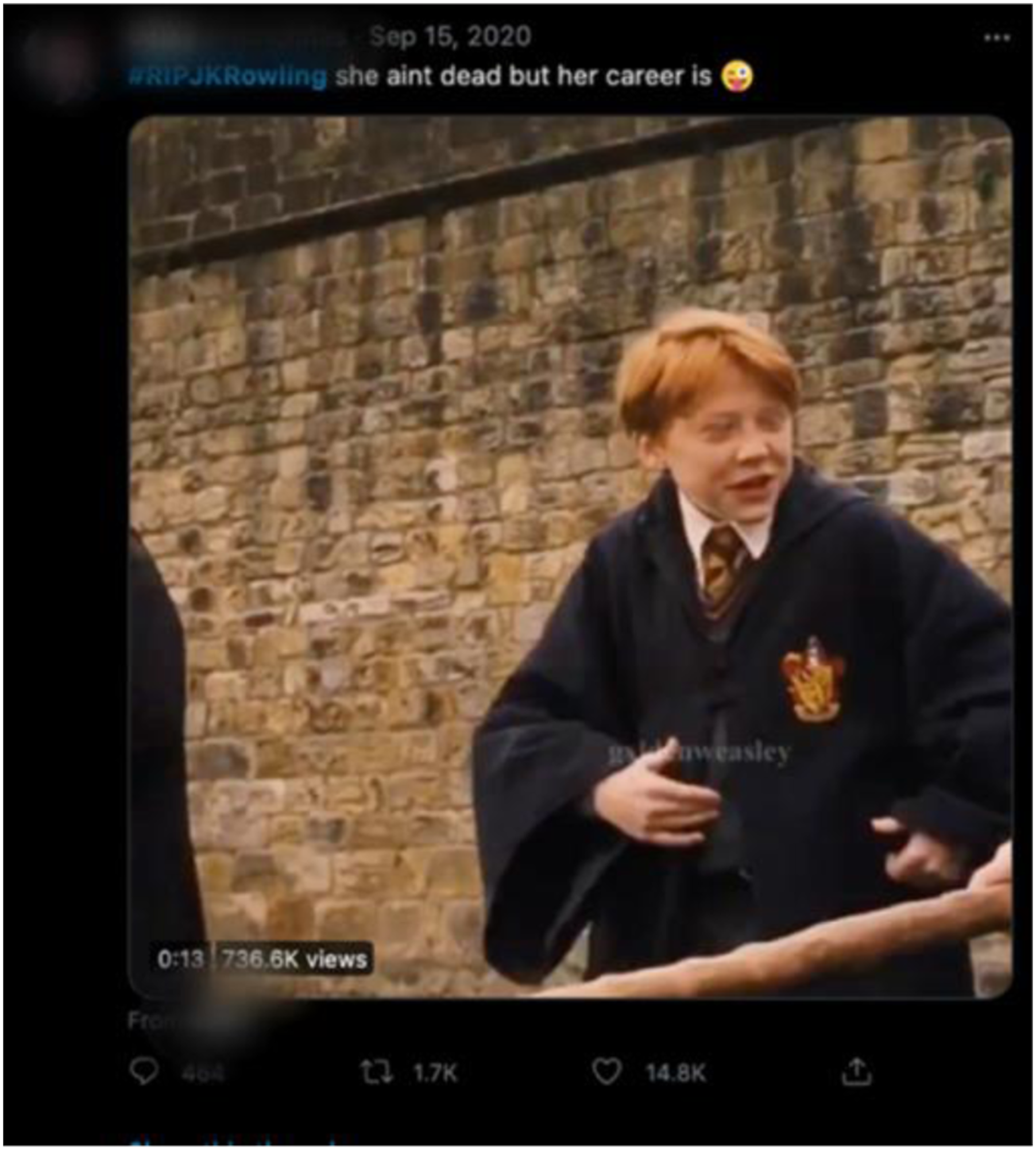
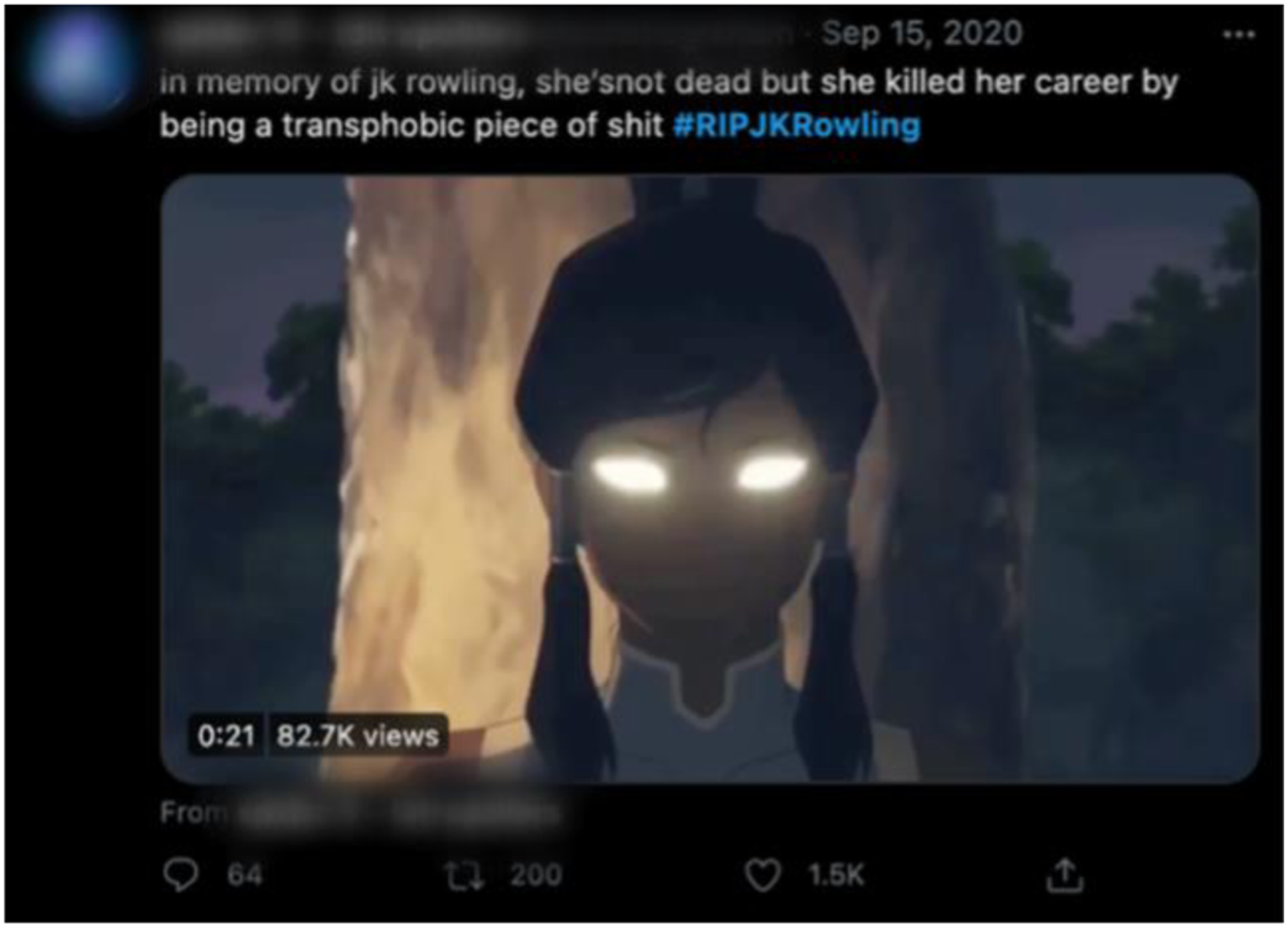
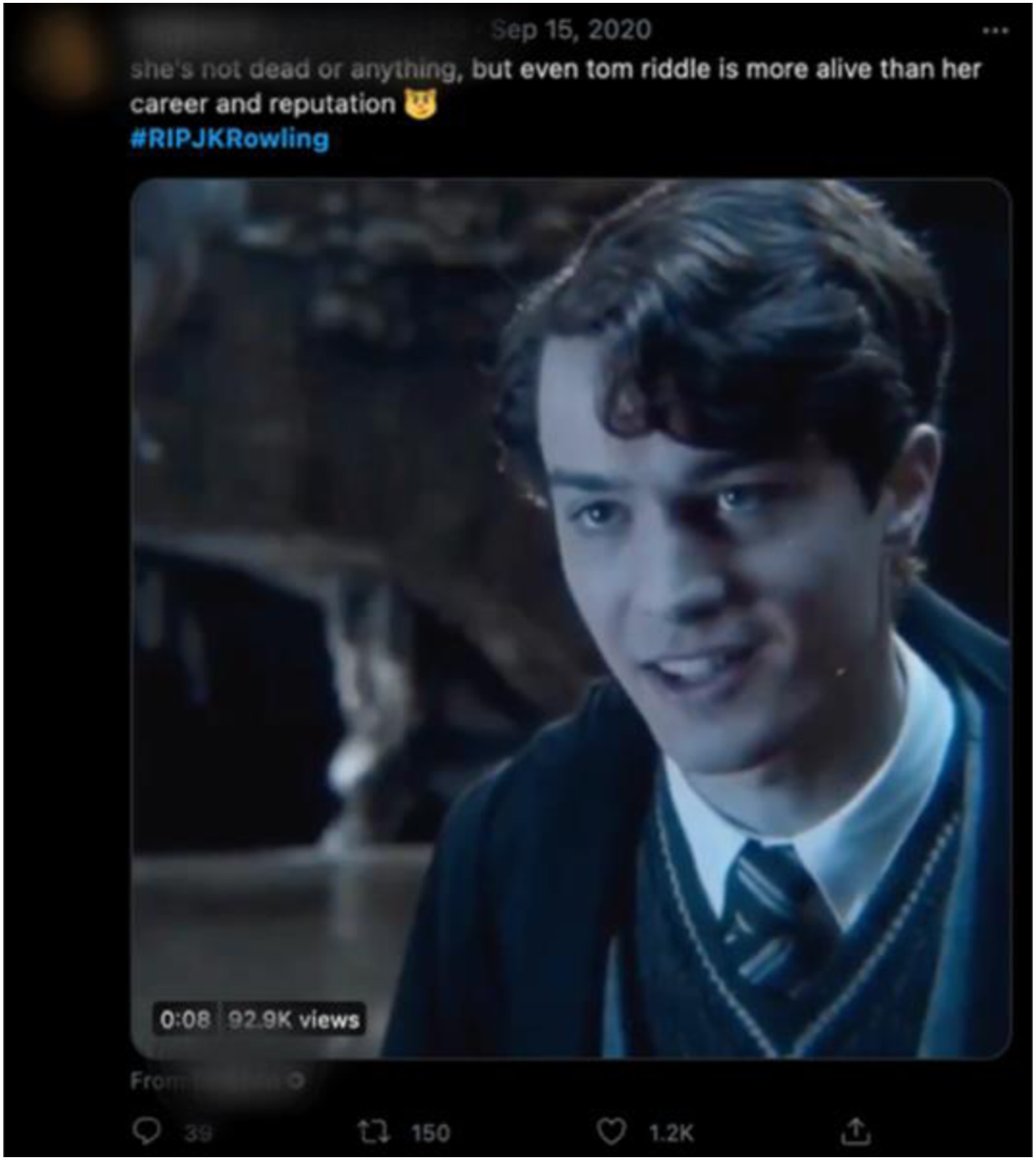
The most common theme was ‘humour and meme’. These tweets were catalysts in the hashtag #ripjkrowling trending. All of these tweets were created as humour and jokes at the expense of Rowling, and most communicated an explicitly ‘anti-Rowling’ sentiment. Several of these used meme templates to format their jokes. Markedly, all these humour-based tweets received several thousand likes and performed in terms of engagement (likes, retweets and comments) the best out of all 100 tweets and themes. A number of these tweets made jokes denying Rowling’s existence as an author and pretended that Rowling never wrote Harry Potter (see Figures 2 and 3). These tweets indicate that fans agree with Barthes notion of the death of the author as this appears to be the source of the humour. When Barthes argued for the author’s death, it was really the death of their authority and power, and agency as creators he believed must be relinquished. These jokes all in different ways highlight this; for instance, suggesting that as a star author Rowling is just another fabricated character or mediated image in the marketplace, a star image that can easily be replaced by others. Another noticeable portion of these tweets that received high volumes of likes included memes about Rowling not actually being dead, but rather, her career (see Figures 4, 5, 6, and 7). A considerable number of tweets that received thousands of likes utilised the memetic phrase: ‘in memory of jk rowling’ followed by a gif or image used in a sarcastic way to celebrate her theorical death. Examples of these include Figure 4 which received 20.5 thousand likes, and Figure 6 which gained 1.5 thousand likes. Sample 1 of top fan response tweets. Sample 2 of top fan response tweets. Sample 3 of top fan response tweets. Sample 4 of top fan response tweets. Sample 5 of top fan response tweets. Sample 6 of top fan response tweets.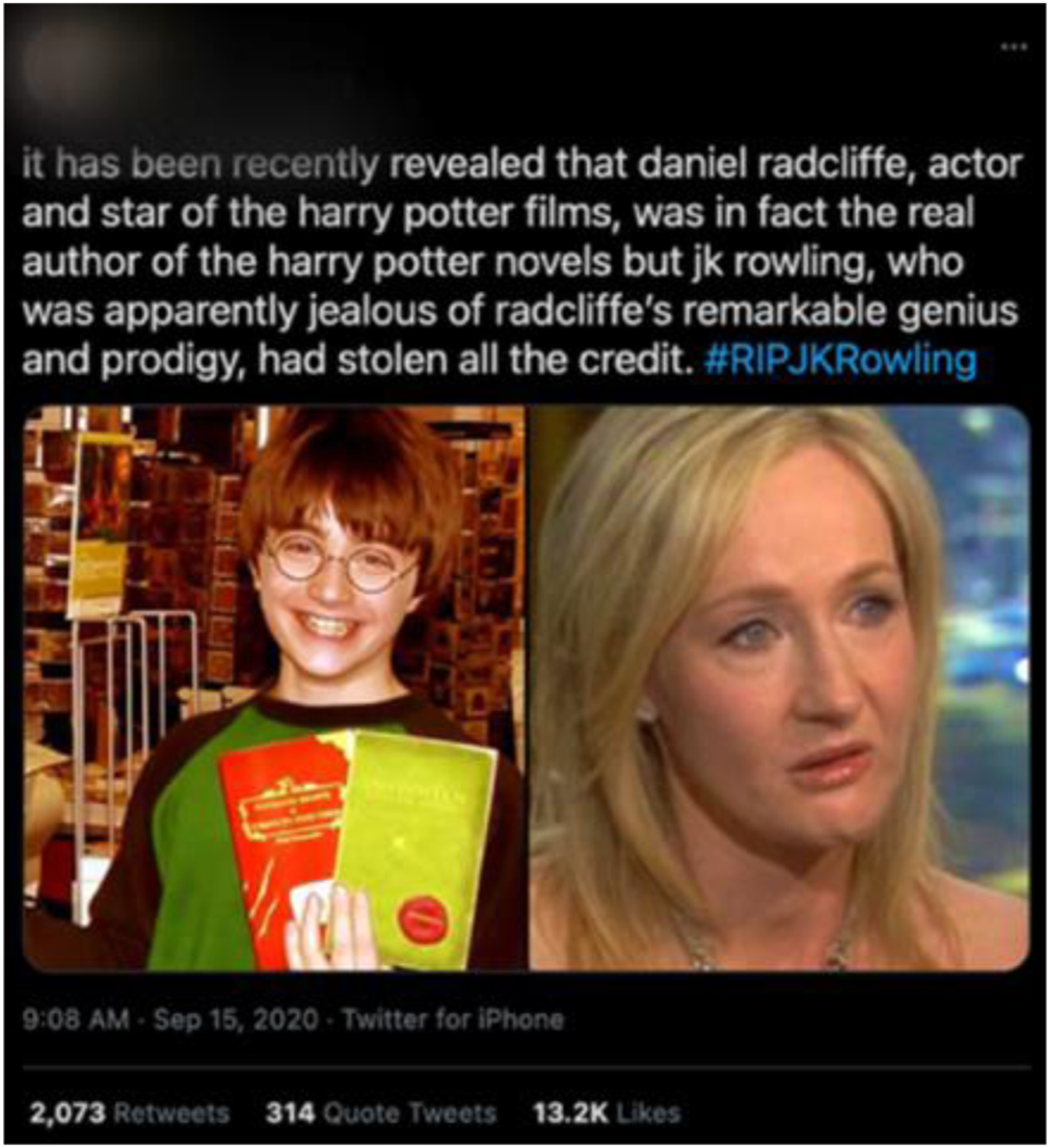
Against hashtag (n = 31)
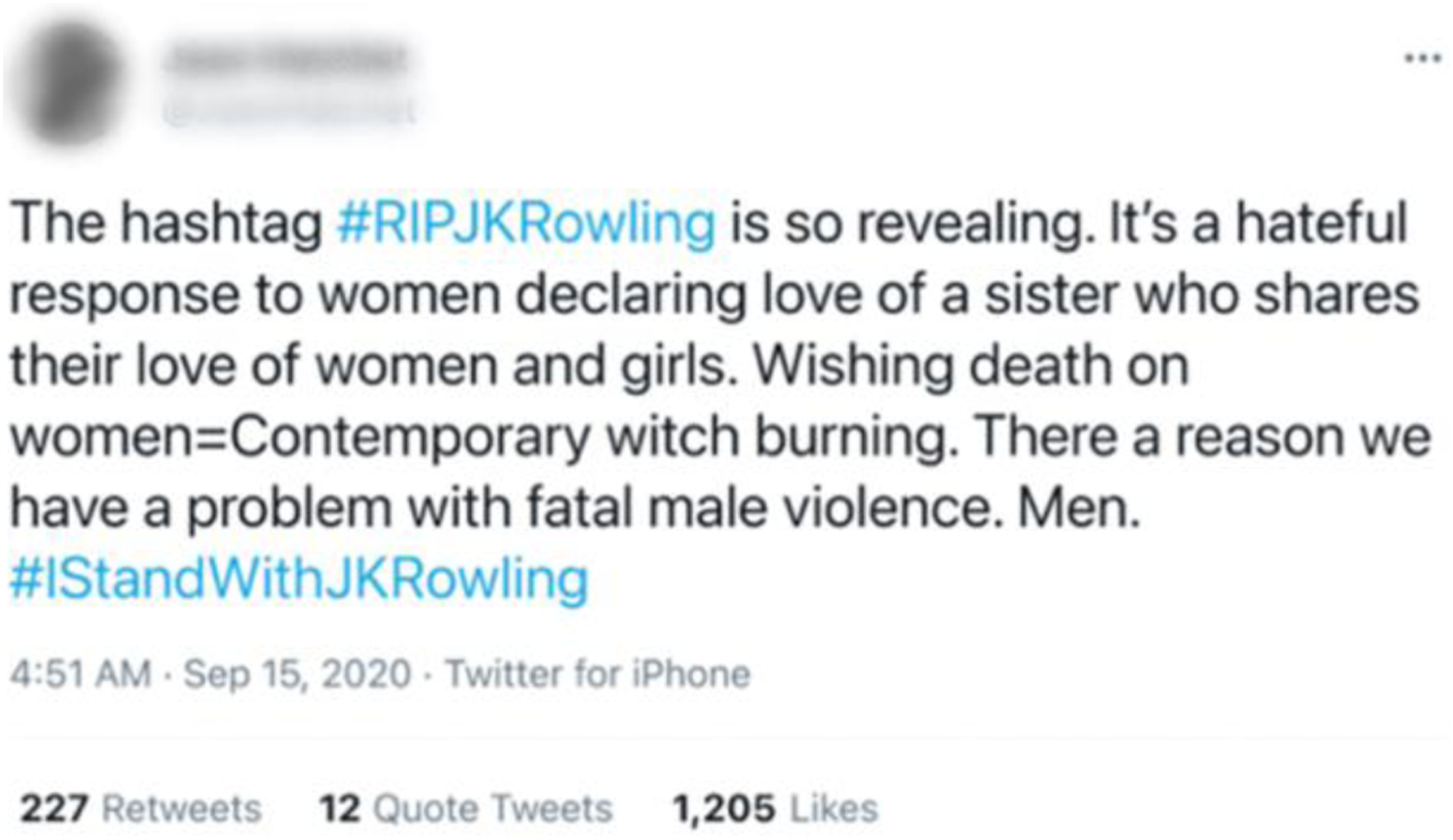
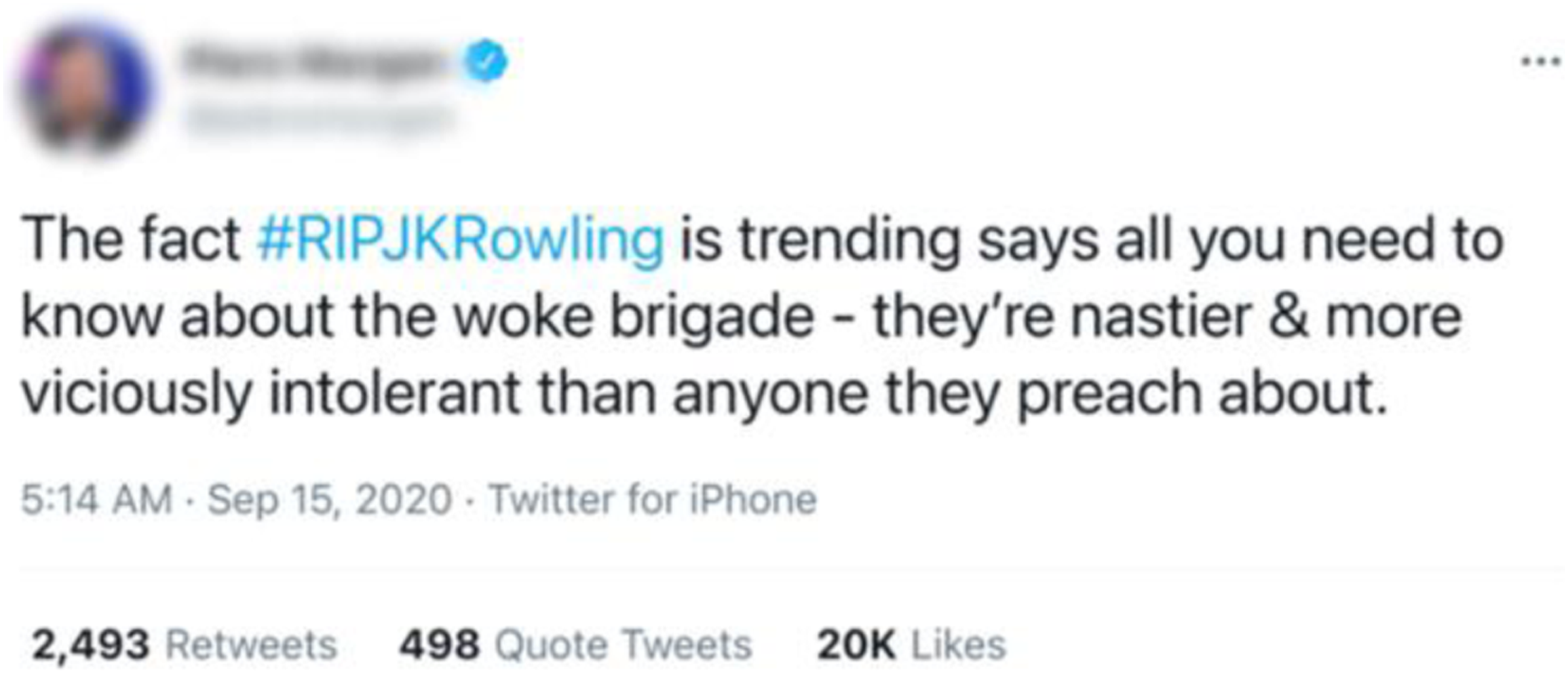
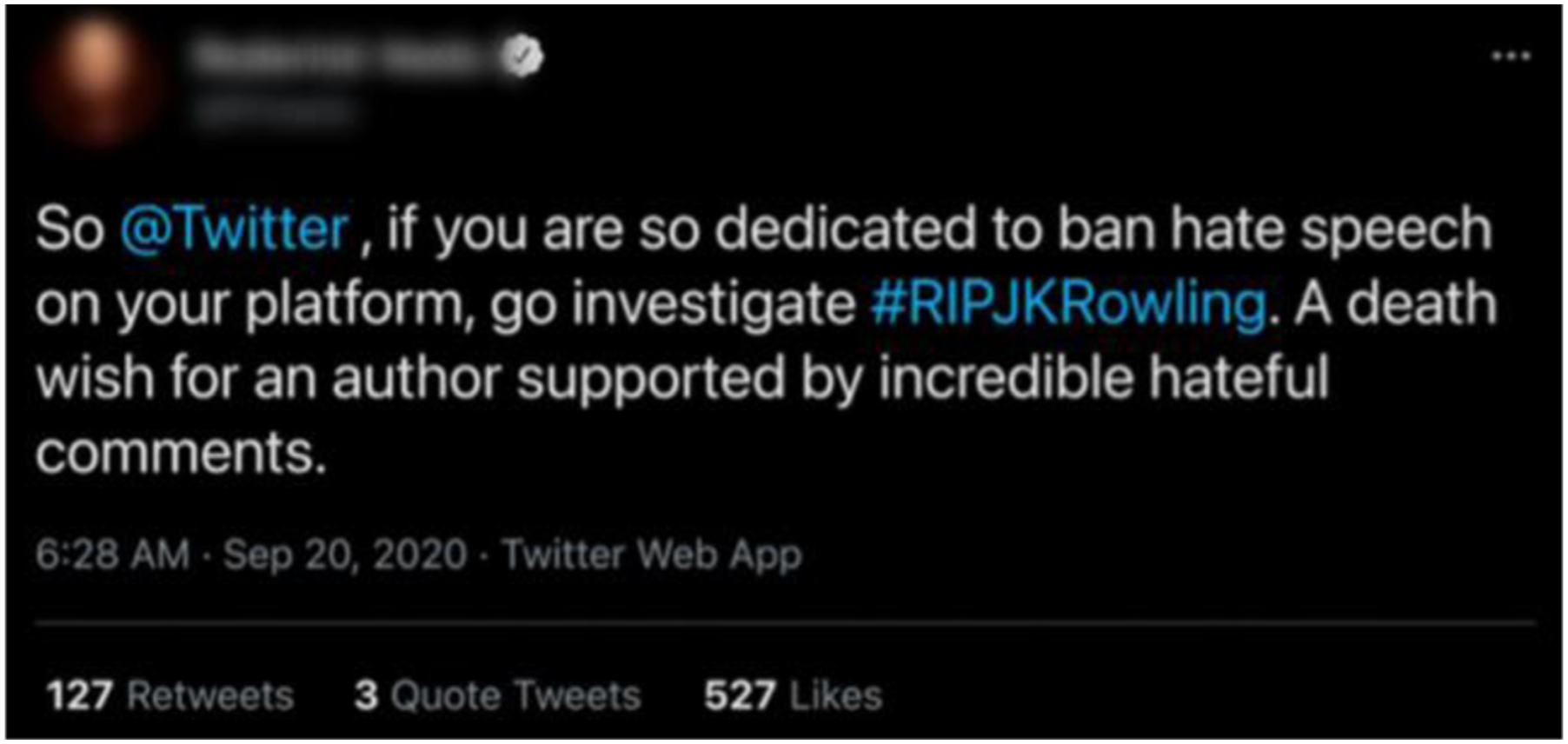
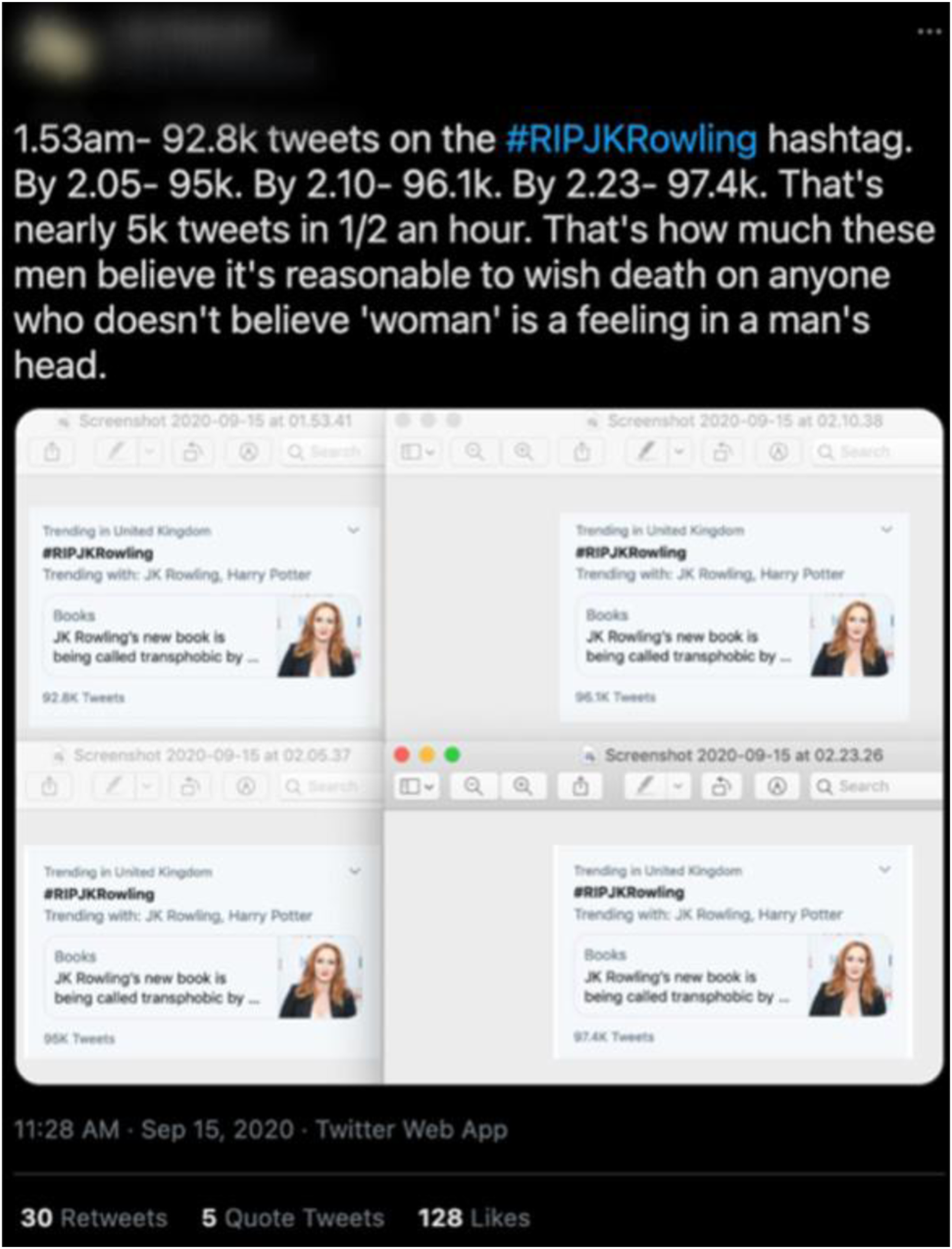
The second most frequent theme was Twitter users challenging the hashtag #ripjkrowling itself, and that fans were so engaging with the hashtag in such high volumes it began trending. According to their tweets, most of this audience’s issues with the hashtag was the insinuation of death. Some went so far as to argue they were death threats. The remaining Twitter users in this theme tweeted their displeasure with Twitter itself as a social networking platform for allowing a hashtag about/falsely implying ‘death’ to trend, regardless of the memetic usage of the term ‘rip’ for humour purposes, not denotative. These tweets highlight that to some fans Rowling seems to have become something other than just a star image or even a mythic site of textual authority, but rather, a concretely real person (Moran, 2000) (Figures 8–12). Sample 7 of top fan response tweets. Sample 8 of top fan response tweets. Sample 9 of top fan response tweets. Sample 10 of top fan response tweets. Sample 11 of top fan response tweets.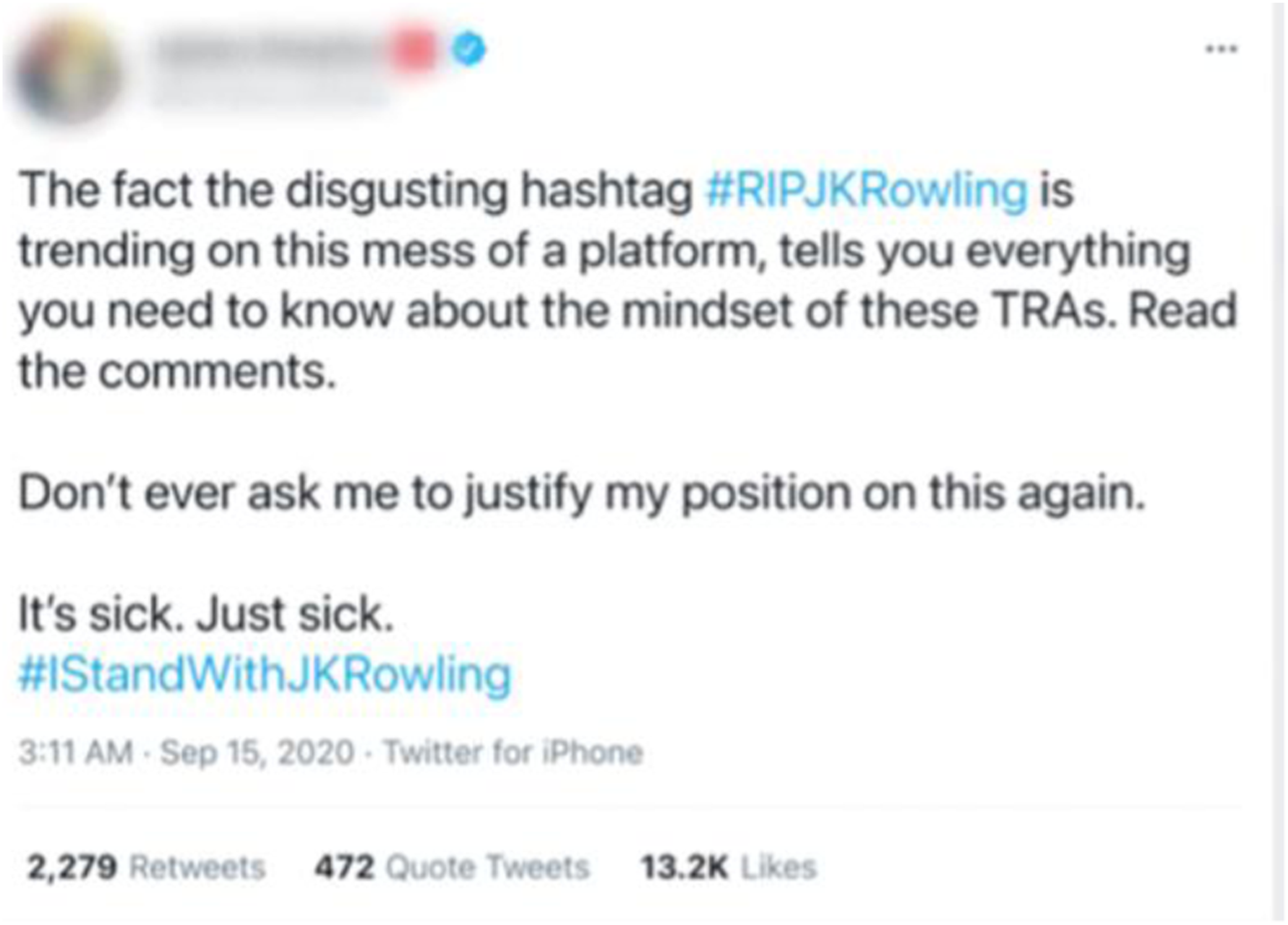
Rowling is transphobic (n = 17)
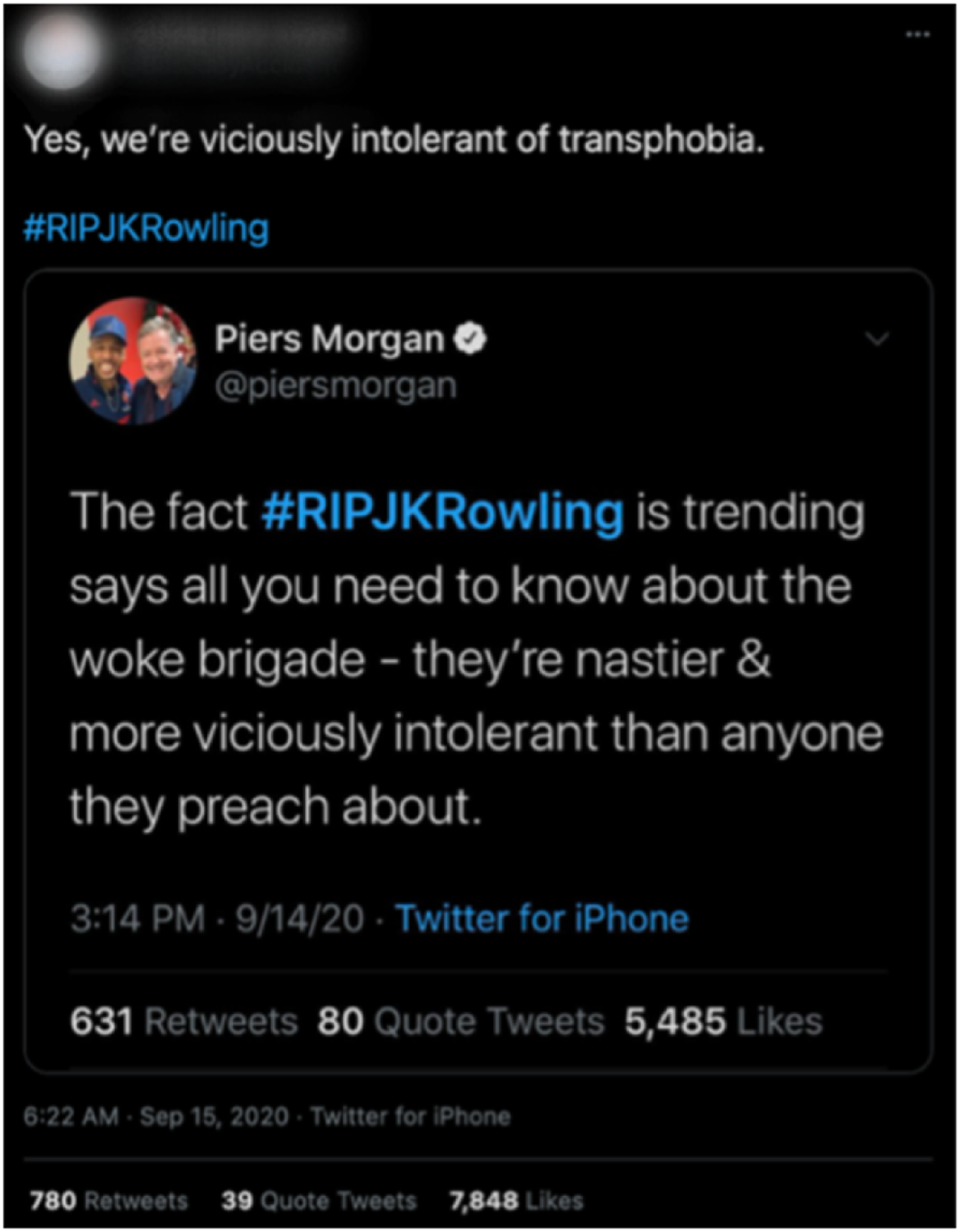
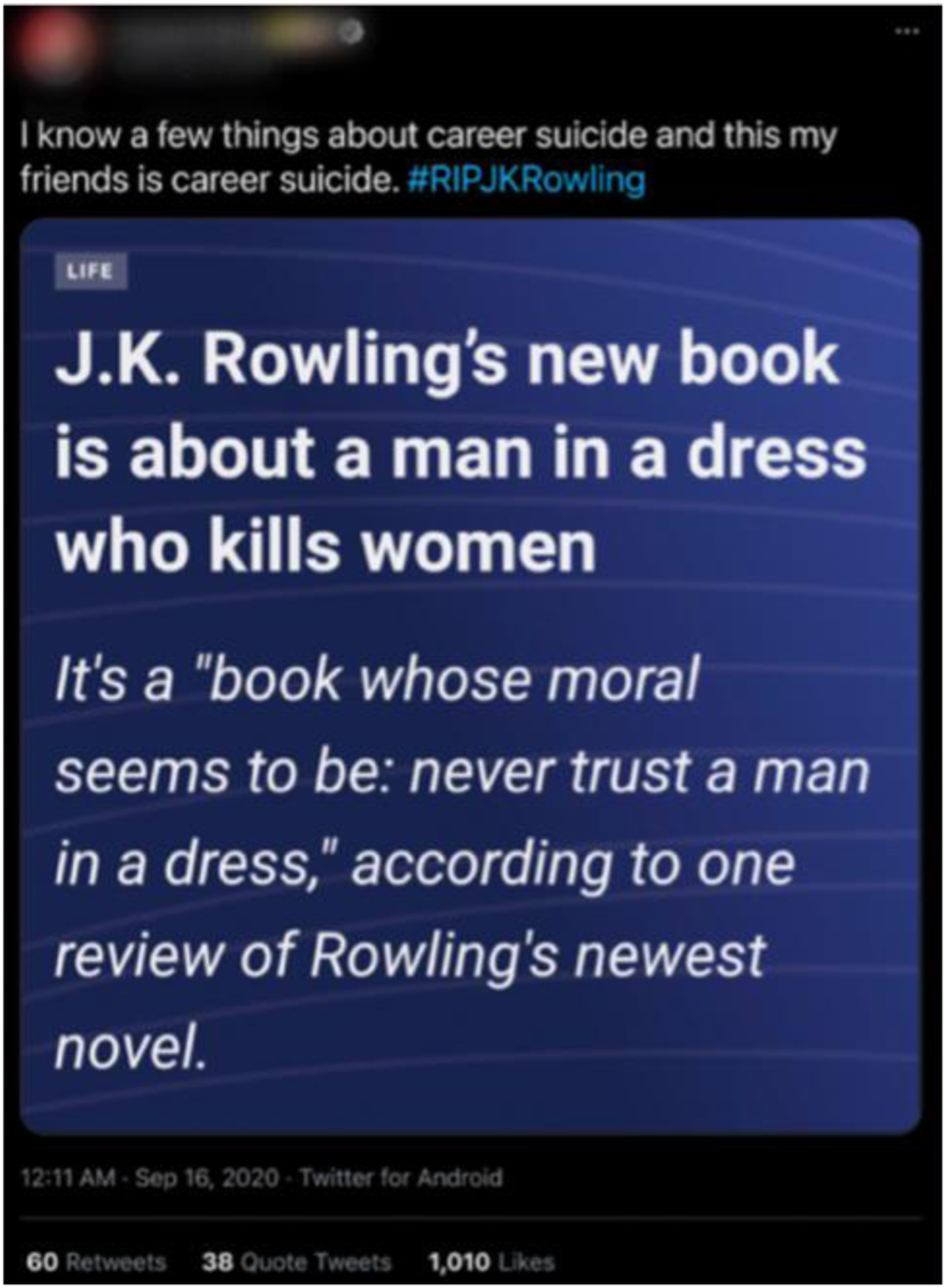
The third most frequent theme in tweets was the accusation that Rowling, her book, and her publicly disseminated messages were transphobic (Figures 13 and 14). Some tweets coded into this theme commented that they believed Rowling’s actions and messages were ‘career suicide’ (see Figure 15). Sample 12 of top fan response tweets. Sample 13 of top fan response tweets. Sample 14 of top fan response tweets.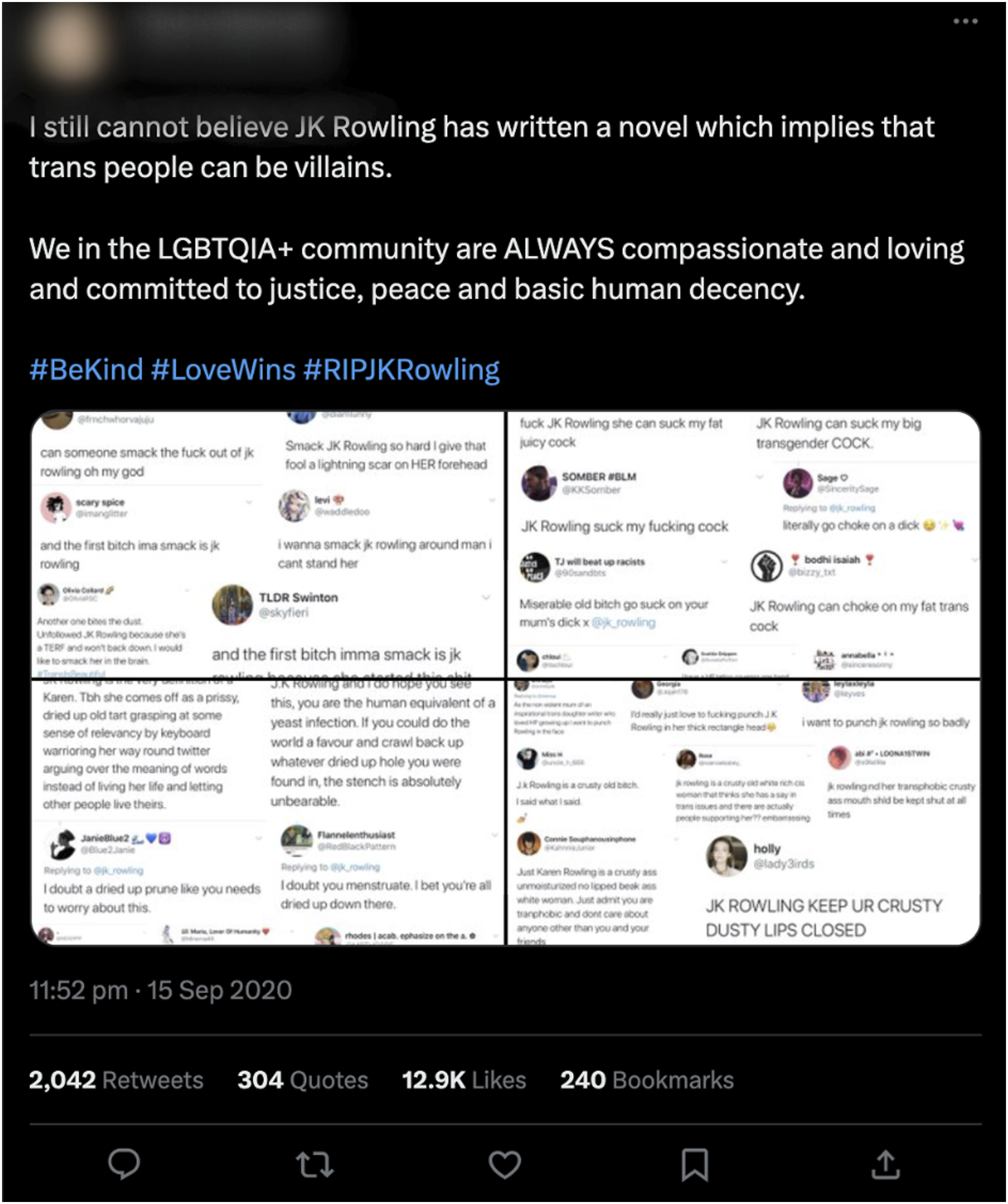
Supporting JKR (n = 11)
The fourth most common theme were tweets expressing their support of Rowling. These few users tweeted their support of Rowling due to either their distaste in the hashtag itself, they shared similar beliefs on transgender people, or they strongly believed in Rowling’s right to free speech (Figures 16–18). Sample 15 of top fan response tweets. Sample 16 of top fan response tweets. Sample 17 of top fan response tweets.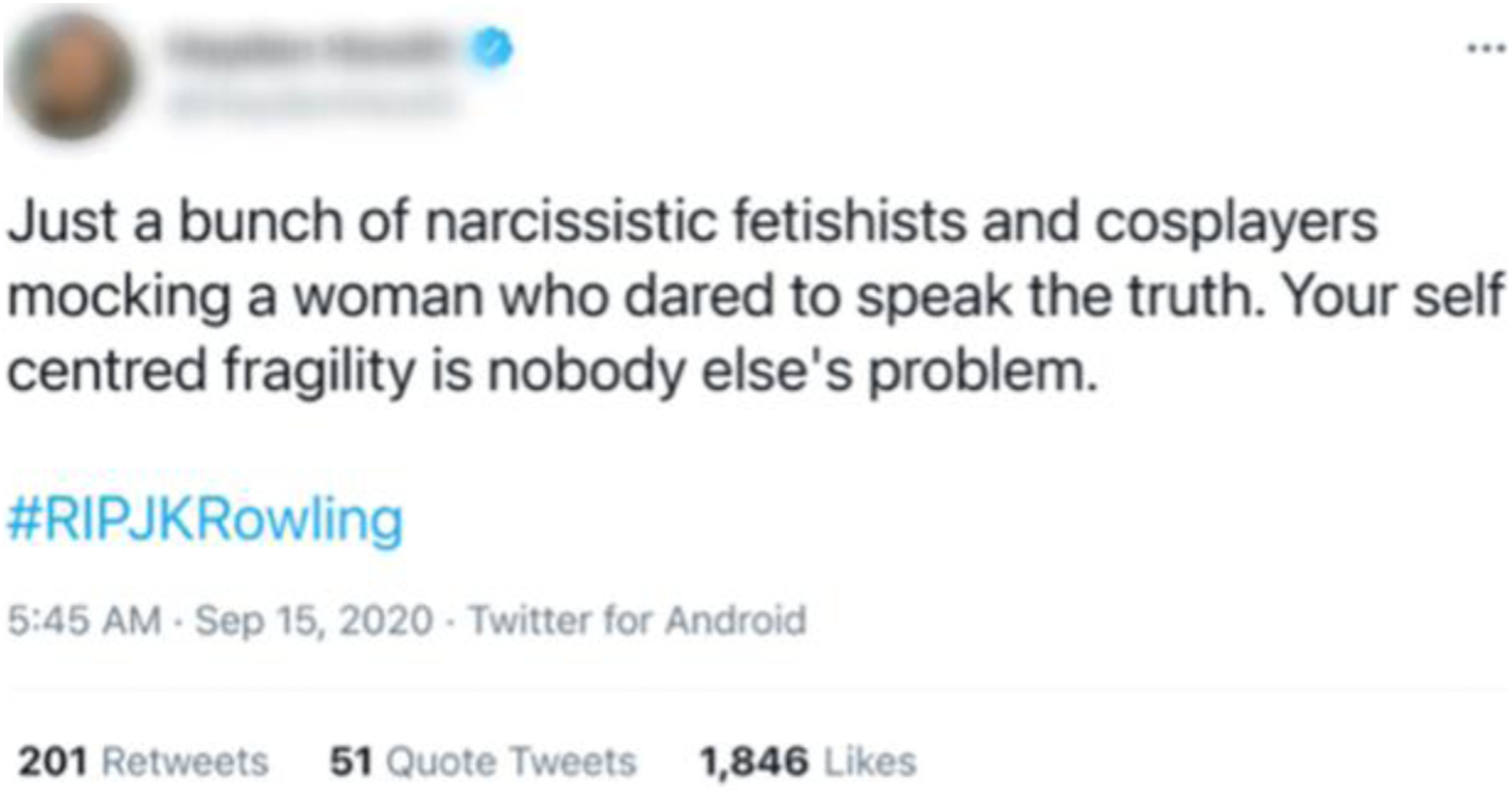
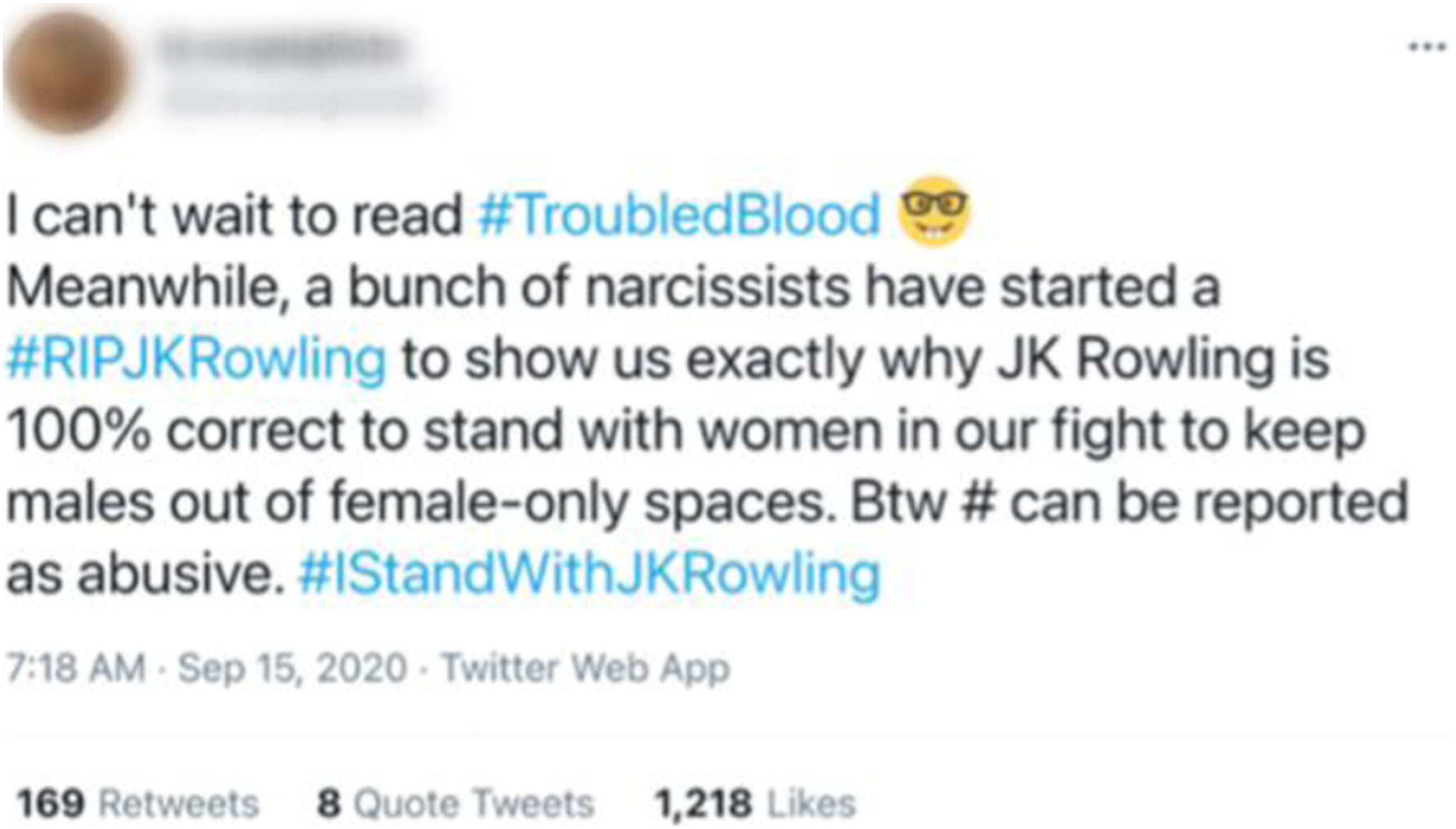
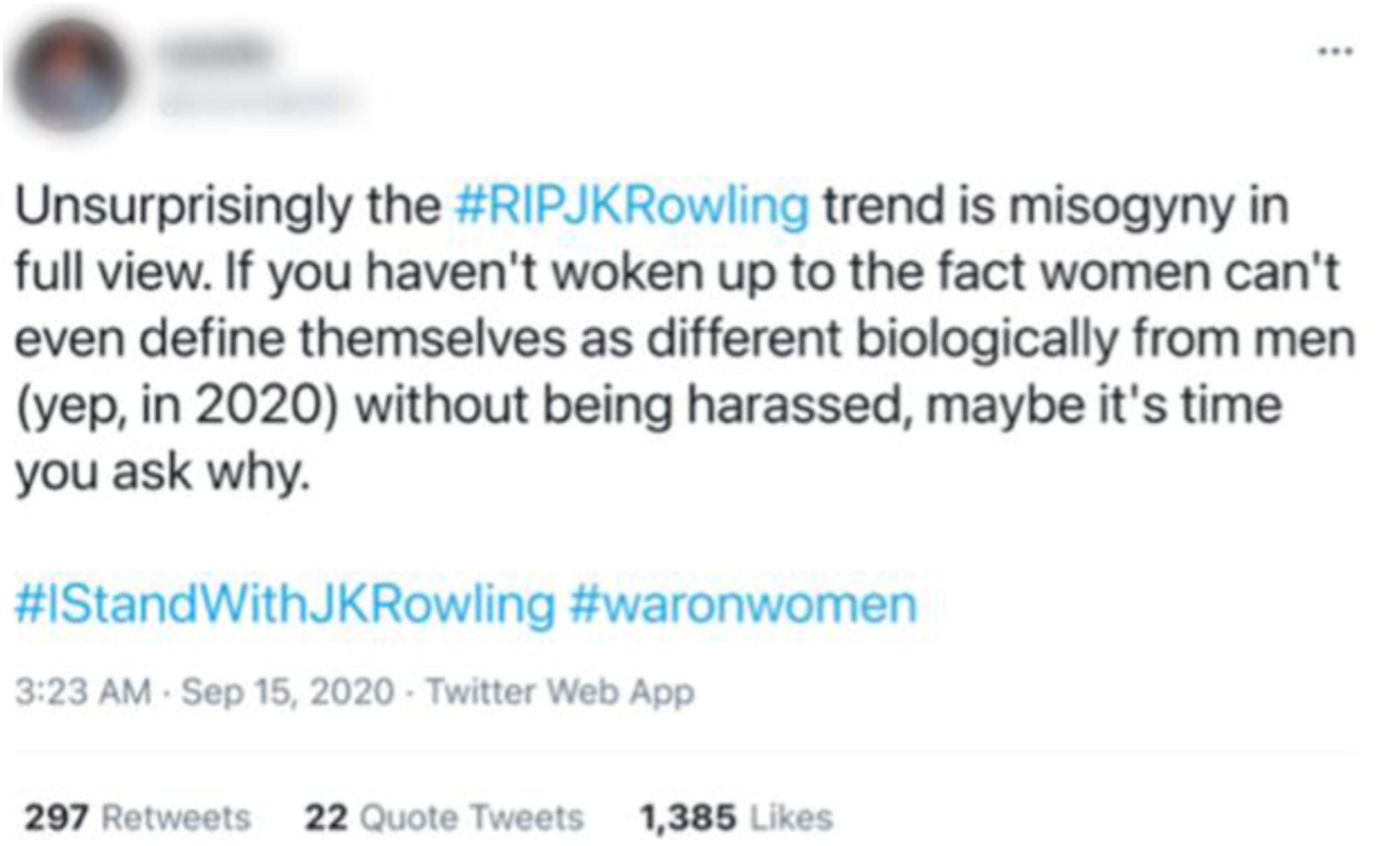
Insulting and anti JKR (n = 2)
Two tweets stood out as being created exclusively to insult Rowling and voice their distaste in her opinions and actions regarding transgender people. One tweet, see Figure 19, stated ‘fuck jk rowling and the horse she rode in on’. Sample 18 of top fan response tweets.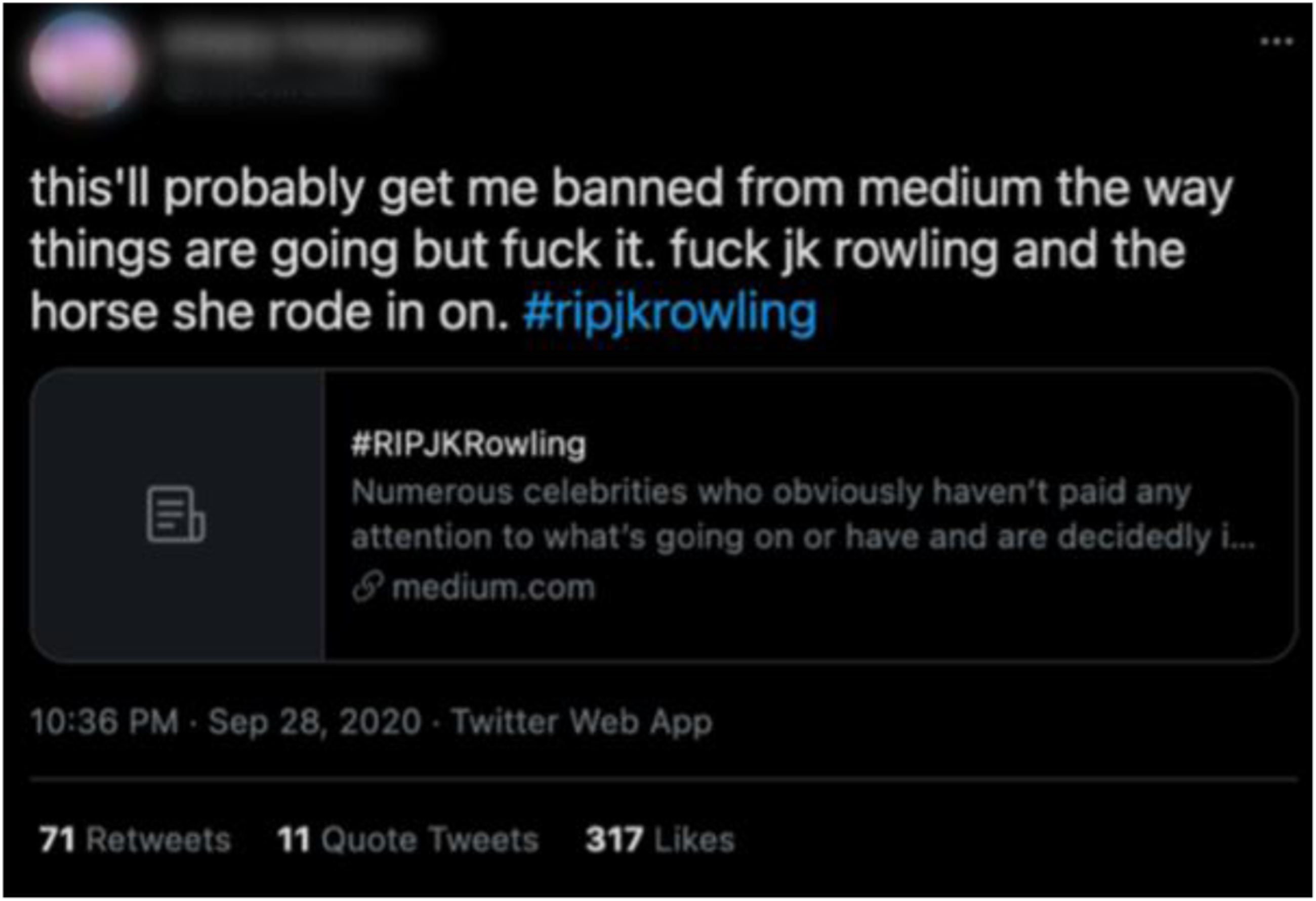
Stop supporting JKR (n = 2)
Finally, two tweets carried a theme expressing their beliefs that instead of the public financially supporting Rowling, they should support transgender people and other non-transphobic authors. This imploring for other fans and audiences to stop supporting Rowling both financially and personally could have detrimental effects on Rowling’s future ventures and demonstrates that Rowling is already ‘losing’ some of her previously supportive fans (Figure 20). Sample 19 of top fan response tweets.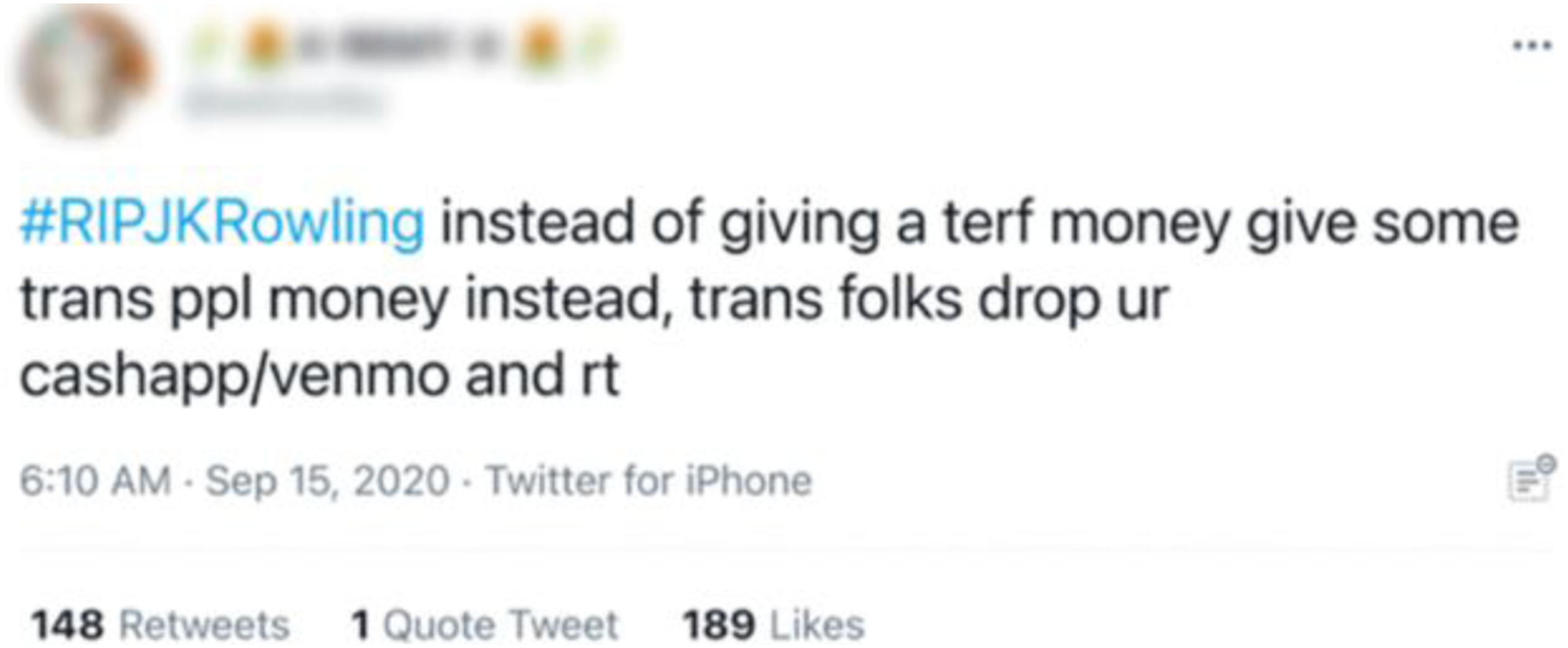
Discussion
Is J.K. Rowling really dead?
After a comprehensive analysis of the data where each tweet was examined and coded for dominant themes, the Twitter users who disseminated each tweet were then categorised into either ‘fans’ or ‘wider audiences’ based on the theme and content encoded within their tweet. Because the tweets within the ‘humour and meme’ theme largely referred to Harry Potter and inside jokes within the fandom, it was deduced that these users were more likely fans of Rowling and her works. This assumption was substantiated through the frequent use of self-created images and gifs in these tweets, as these align with common fan activities and practices; particularly those amongst Potterheads. These online behaviours emphasise a shift in fan-author relations following the media convergence as digital fandoms have begun engaging in activities such as creating these memes, subsequently becoming ‘prosumers’ (both producers and consumers) (Sugihartati, 2020: 307). This term coined by Toffler (1980) describes how fans are not simply consuming entertainment, but actively participating in the production of its meanings by producing and circulating their own cultural texts amongst each other (Sugihartati, 2020: 307). It is through these behaviours that we can differentiate fans from ordinary consumers and position these participating audience members as prosumers co-creating meanings. Accordingly, the content and themes from these top liked humour and meme tweets are more than likely representative of fan opinions on Twitter surrounding Rowling’s recent messaging and behaviours. In fact, all the tweets expressing negative sentiments towards Rowling were likely to be created by fans of Rowling and her works (Potterheads) to express their displeasure with Rowling’s ‘transphobic’ messages and new book.
On the other hand, based on the content within the tweets from the themes ‘against hashtag’ and ‘support Rowling’, it is likely that these tweets were alternatively created by wider audiences on Twitter who agreed with Rowling’s opinions on gender, believe in ‘free speech’ or disagree with Twitter and Potterheads allowing this hashtag inferring ‘death’ to trend. This was presumed as most tweets within these categories did not contain content that explicitly supported Rowling as an individual they admire and are a fan of, but rather indicated that they supported her message or disagreed with the hashtag. This high portion of supportive tweets (42%) was unsurprising however given the managed form of user participation ‘brand communities’ (Jenkins, 2006). Spearheading research on this subject, Muniz and O’Guinn (2001: 412) in their foundational article defined brand communities as ‘specialised, non-geographically bound community, based on a structured set of social relationships among admirers of a brand’. This shift on social media to brand communities where consumers are not only committed and active, but loyal, has gone together with a rise in marketing strategies focused on ‘cult’ and ‘emotional branding’ to create value through managing consumers desires, commitments, and engagement with the brand (Jenkins, 2006; Muniz and O’Guinn, 2001). Over two decades of relationship management and building with consumers of Harry Potter and Rowling as a brand, explains the high volume of Twitter users that took to Twitter to support Rowling and her opinions or defend her against what they considered to be an uncouth trending hashtag. The data from this analysis of the trending hashtag #ripjkrowling therefore aids in understanding how outrage and activism can manifest on Twitter, and how citizens may spring to the defence of a brand/celebrity they are loyal to.
Moreover, evident by the theme ‘against hashtag’ there was a significant portion of these Twitter users (31%) who instead of explicitly supported Rowling’s actions and messages, took to Twitter to denounce the hashtag in her defence. An explanation for this based on the content coded within the tweets, is that these users, rather than truly supporting Rowling, simply just did not ‘get’ the hashtag. These tweets exemplify Thornton’s (1996) concept of subcultural capital whereby fans earn social standing among each other via fandom identity evaluation. As a result of stratifying identities within the fandom, the consequent fracture segregates audiences into ingroups and outgroups (Thornton, 1996). This dynamic amongst fans from subcultural capital indicate a superior ingroup embodied by being ‘in the know’ versus the outgroup (Thornton, 1996). The use of specific inclusive language and potentially forced participation to contribute to the vast array of meme/humour tweets is particularly reminiscent of Thornton’s (1996) proposal and indicate these were most likely created by the ingroup (Potterheads). This distinction between the two explicates the Twittersphere’s engagement in this hashtag #ripjkrowling and why ‘against hashtag’ may have been the second most frequent theme. Accordingly, it can be inferred that it was this ingroup of vocally active readers and prosumers of Harry Potter who created this hashtag and its memes, whilst the Twitter users against this idea of rhetorically pronouncing Rowling dead are simply the outgroup who did not get the hashtag nor its true Barthesian meaning.
Nonetheless, as fans have become integral to public relations strategy, Potterheads are Rowling’s key stakeholders and vital for her financial success and longevity (Navar-Gill and Stanfill, 2018). Prosumer fan engagement is now being recognised as ‘promotional labour’ for brands and celebrities. However, as demonstrated by this hashtag, fans may withhold this labour and even anti-promote on social media when they disagree with these brands. In consequence, these valuable fans can become dangerous when they turn against the brand (Navar-Gill and Stanfill, 2018). Twitter hashtag activism is one particularly effective form of protest being used as a space for everyday people and fans to engage in collective and visible counterspeech (Navar-Gill and Stanfill, 2018). Evident by 58% of tweets from the hashtag #ripjkrowling, Potterheads appear to be actively exploiting social media and specifically Twitter hashtag activism to express their dissatisfaction with Rowling as an author. It is therefore important that Rowling attempts to manage and rebuild her relationship with these Twitter users who are utilising this hashtag to express their disenchantment with Rowling and to attempt to ‘cancel’ and ‘kill’ her career and brand. This specific hashtag choice has also revealed that Potterheads, in response to Rowling’s rhetoric online and new book, have begun attempting to separate Rowling from Harry Potter by pronouncing her dead.
A future without Rowling?
Rowling’s decision to utilise Twitter as her primary communication tool to connect with fans is in line with public relations strategy proven best practices for literary celebrities and producers (Ravy, 2016). Considering the impact of social media on participatory culture, Jenkins et al. (2013) argued that this emphasis on participation has replaced the focus from producers’ resistance. Despite lines starting to blur as highly engaged prosumer fans create content and new meanings whilst media producers embrace this participation, these producers and authors nonetheless continue to shape and direct fan participation into forms they believe best serve their interests (Jenkins et al., 2013). In so doing, this resistance by authors towards fan participation complicates this notion of ‘participation’ which implies affiliation or collective identity (Jenkins et al., 2013). Barthes’ notion itself seeks to balance this hierarchical relational gap between readers and authors, and create a more participatory culture of readership, which social media facilitates.
Rowling’s frequent use of Twitter and social networking sites exemplifies a conscious decision to reject her Barthesian authorial death. Barthesian notions of authorship pose that an author must die so that readers may interpret the remaining text. In fact, Barthes (1977: 147) went so far as to argue that to ‘give a text an Author is to impose a limit on that text, to furnish it with a final signified, to close the writing’. This idea is epitomised by Rowling as her active Twitter communication regarding her text highlights an apparent attempt on her behalf to ‘impose a limit’ on Harry Potter. Despite this, empowered by Barthes’ ‘final signification’ of the text where he suggested readers can enter the frame and have the space and freedom as fans to re-direct and create new meanings and interpretations, it appears Potterheads on Twitter are trying to defy Rowling’s ‘limit’. Nonetheless, as modern literary celebrities like Rowling are demonstrating, some authors have chosen to refuse their rhetorical death. From here, it is now up to fans whether they can, despite the author, claim the text for themselves and separate the art from the artist by ‘killing’ the author themselves. The question as to whether this can and is being done is illuminated by Potterheads creating the trending hashtag: #ripjkrowling.
Within the theme ‘humour and memes’, there was a memetic trend of fans making jokes that Rowling never wrote the beloved Harry Potter series. Most of these jokes, as highlighted in Figure 3, claimed that characters such as Hermione actually wrote them, facetiously separating Rowling from her Wizarding World. These tweets in particular stand out not only because they deny Rowling’s existence as the author, but because each of these meme-formatted tweets received thousands of likes. This demonstrates that whether jokingly or not, fans appear to be willing and already denying Rowling’s existence as an author and separating her from the world of her book. This further indicates that perhaps in order for Potterheads to remain fans of Harry Potter, those who disagree with Rowling’s ‘transphobic’ messages, must separate Rowling from Harry Potter to continue enjoying her works. Tweets within the theme ‘Rowling is transphobic’ (Figure 15) expressed the belief that it was not the fans who killed Rowling, but rather Rowling herself as a consequence of going against the values of her imagined world and transmitting transphobic messaging. These fans expressing the opinion that Rowling writing a transphobic book was ‘career suicide’, highlight the nature of online ‘cancel culture’ and confirms that modern fans can and are willing to kill off authors as alluded to in these meme formatted tweets.
Was Rowling brought to life as a brand, only to destroy her own reputation?
As a result of Rowling’s use of Twitter, she was able through liking, retweeting and tweeting transphobic rhetoric, to damage her reputation. Without this history built from her Twitter use it is unlikely that the news regarding her most recent book having a controversial and ‘transphobic’ storyline would have instigated outrage and backlash to the extent it did, triggering the hashtag #ripjkrowling to trend on Twitter. The choice of fans to use this hashtag indicates that fans seem to have separated Rowling from her creation in order to continue enjoying the world she created without supporting Rowling and her beliefs personally.
Amongst these tweets coded in the theme of ‘transphobia’ were several tweets by fans expressing their disappointment with Rowling. In one of the top liked tweets one user quoted and posted a link to an interview with actress Cynthia Nixon. Quoting Nixon’s interview, the Twitter user stated: ‘the books seem to be about championing people who are different, so for her to select this one group of people who are obviously different and sort of deny their existence, it’s just … really baffling’ (Hills, 2020). The Twitter user then followed this by adding: ‘JK Rowling’s words [were] “really painful”’. These sentiments expressed by fans highlight that Potterheads were particularly upset with Rowling’s statement because to them, she was the one who taught readers that being their true selves was the good and right thing. By Rowling tweeting ‘transphobic statements’ and creating a novel with an underlying message perceived as transphobic, to fans she contradicted and betrayed the previous reputation she had built in fans eyes. In consequence, fans appear to have dexterously chosen to theoretically kill Rowling and claim their Barthesian rights of readership. Rowling’s reputation and what this position has done to her brand identity, and how this complicates public relations must therefore be examined.
In public relations it is understood that whilst a good reputation takes time, patience, hard work and consistency to build, it can be destroyed in a moment (Langham, 2019). Given that research on social media and LGBTQIA+ online practices has illuminated social media’s, especially Twitter’s powerful role in facilitating transgender activism on and offline, Rowling’s choice to engage in this broader debate surrounding transgender discourse and representation in our networked public sphere indicates how ‘out of touch’ Rowling appears to be with her fan base (Williams, 2020). In fact, the increasing visibility and debates on trans issues nowadays has resulted in an amplified advocacy for the community online (Jackson et al., 2018). This key issue here for Rowling in terms of public relations and her relationship with Potterheads is that her communication on Twitter seems to contradict the brand image and identity Rowling build through her creation of Harry Potter. Harry Potter inspired a generation of socially and politically active fans passionate about social justice and reforms, who are also extremely active in their online advocacy for the LGBTQIA+ communication. In stark contradiction to this is Rowling’s recent dissemination of transphobic messages. As a result, Rowling’s actions seem to have tarnished the legitimacy and authenticity of Rowling’s brand identity and in doing, damaged her reputation. In terms of public relations and relationship building with her fans, Rowling has failed to deeply understand her key stakeholders and their values. Twitter and social media sites have proven their tremendous capabilities for vocally active fandoms and social justice movements such as those for trans and LGBTQIA+ rights, however as Rowling is demonstrating, it can also be a media product’s downfall when actions contradict an established brand. From a public relations perspective, the hashtag #RIPJKRowling is demonstrating the missed opportunity for Rowling to strategically exploit social media sites to enhance her own brand and reputation amongst Potterheads.
In terms of her books, Rowling has been careful with the use of her name as it pertains to her reputation. Interestingly, Rowling published her new book about a cross-dressing serial killer under the nom de plume Robert Galbraith. Whether Rowling chose to write under this pseudonym to protect the reputation of her name amongst those uninformed is debatable. An undeniable truth however is that through Harry Potter and its theme of diversity, ‘love, acceptance and support’ have become part of Rowling’s brand. Despite these allegations of transphobia, Rowling has maintained through her online communications on Twitter and her blog that she ‘knows and loves trans people’ (Rowling, 2020). Nonetheless, a tweet from the theme ‘transphobia’ brought to light that this pen name Rowling chose is the same name as an American psychiatrist who ‘experimented on a gay individual through the process of gay conversion theory … [claiming] that homosexuality could be “cured”’ (see Figure 21). Rowling is yet to comment on this correlation, however according to tweets from this hashtag fans appear to not believe this name similarity was mere coincidence. Sample 20 of top fan response tweets.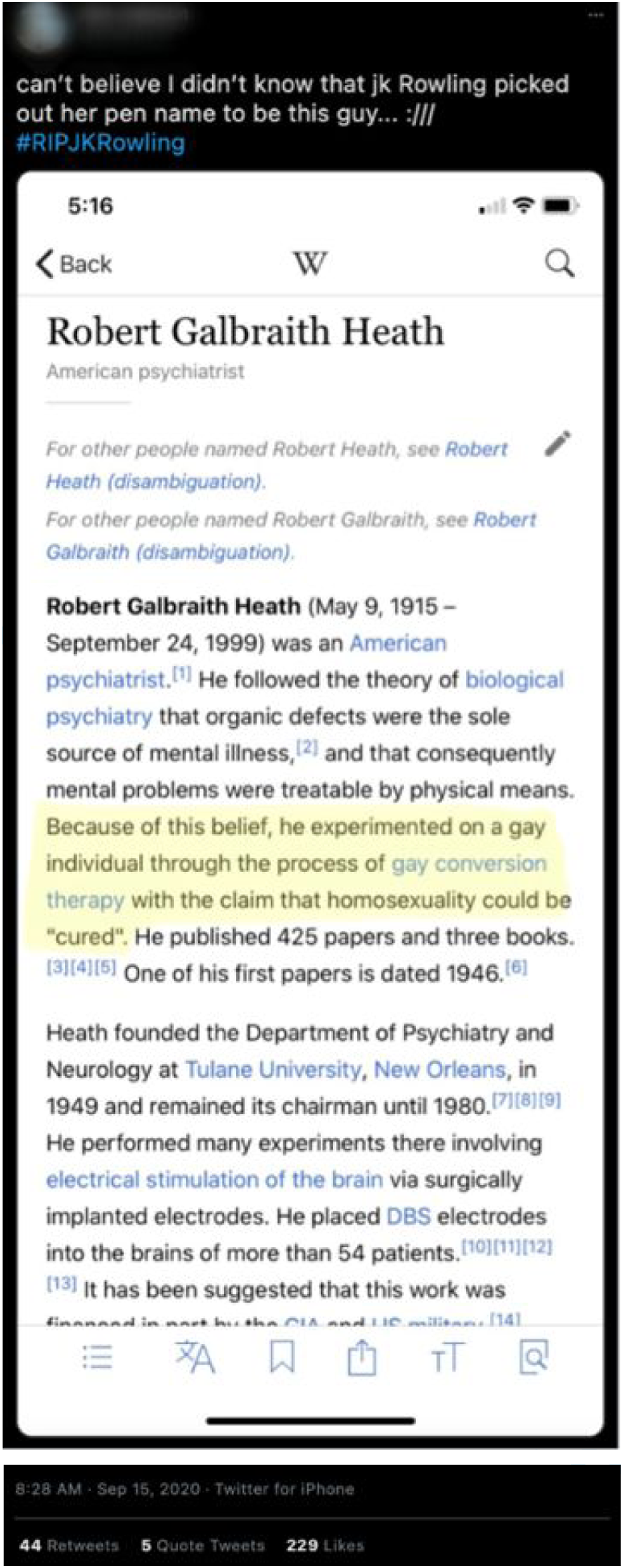
In fact, Rowling has remained mostly silent regarding these allegations of transphobia since posting an essay to her blog in June 2020. Rowling did however recently reply on Twitter to a pipe bomb death threat tweet in July 2021 (Sheidlower, 2021). In her response Rowling stated: ‘to be fair, when you can’t get a woman sacked, arrested or dropped by her publisher, and cancelling her only made her book sales go up, there’s really only one place to go’.
These discrepancies between Potterhead’s perceived ‘old’ reputation of Rowling and her recent actions and social media messaging appears to have damaged Rowling’s reputation, triggering Potterheads to pronounce Rowling ‘dead’ as evidenced by the hashtag #ripjkrowling. Through this hashtag, Twitter appears to have empowered Potterheads ardent about social justice around trans and LGBTQIA+ rights who felt betrayed by Rowling’s online communications, to speak out against the author and reclaim her fictional world for themselves by in Barthesian terms, killing her authorship.
Further to this, this discrepancy or gap can be explained by the formula of John Doorley, a pioneer in reputation management

Doorley and Garcia (2020), highlight that a distinct and key factor to this formula is what they coined the authenticity factor. Doorley and Garcia (2020) argue that this authenticity factor is the genuine measure of how true an organisation is being compared to its intrinsic identity; in other words, what it stands for. ‘If the organisation stays true to what it stands for, it is whole, and the AF is one: The sum of performance, behaviour and communication, that is, reputation, is undiminished (Doorley and Garcia 2020). The validity of this formula can therefore perhaps be evinced in this case study of J.K. Rowling. As pondered above, Potterheads fashioned an idea of who they believed Rowling was based on her fictional creation and arguably shallow understanding and knowledge of who she really is and what she stands for. In consequence, when Rowling revealed her social and political stance on LGBTQIA+ issues, the authenticity factor of her messages and own reputation became distorted as fans struggled to comprehend which is truly authentic: the Twitter statements, or the messaging in her fictional universe. The hashtag #ripjkrowling seems to fortify the conclusion made by fans in this reputation formula battle: that Rowling was in fact inauthentic in the message of inclusion and love in her wizarding world. As a result, Potterheads chose to claim their Barthesian right to kill Rowling and preserve their naive reading and reputation of Harry Potter.
Ultimately, Twitter’s power to provide a global platform for vocally active fans to engage in social movements and activism, as well as communicate with previously ‘dead’ authors has resulted in fans reconsidering Rowling’s authorship after her beliefs were shown to diverge from their own. Apparent through the trending hashtag #ripjkrowling, Barthes’ idea of the ‘death of the author’ is being reframed by social media as it creates a new brand of celebrity authorship alongside a new vocally active readership who are ostensibly eager to claim their Barthesian rights to theoretically ‘kill’ authors through hashtag activism when they disagree with their actions and online communications. In so doing, fans have demonstrated the legitimacy of cancel culture online today and how they have reclaimed Harry Potter for themselves. So, what does this mean for Rowling’s damaged reputation and public relations more broadly? This case study acts as a tell-tale sign for public relations practitioners working with social media sites like Twitter and brands/media products by exposing the power of prosumers and cancel culture and consequence of an individual being perceived as betraying their fans and brand identity.
The deadly truth
The hashtag #ripjkrowling trending on Twitter following Rowling’s public relations and reputation issues, suggests that fans are pronouncing Rowling as a ‘dead’ author. Rowling’s apparent death therefore raises questions regarding the implications of this on the success and readership of the author’s future ventures, especially the Harry Potter franchise. The new Fantastic Beasts era of the Harry Potter franchise began approximately around the time Rowling’s controversies pertaining to LGBTQIA+ issues started escalating. Fantastic Beasts and Where To Find Them released in 2016 earned $814 million worldwide, whilst the subsequent second Fantastic Beasts film The Crimes of Grindelwald (2018) earned only $655 million (down 19%) (Siegek and Abramovitch, 2020). This was then followed by the most recent Fantastic Beasts film The Secrets of Dumbledore (2022) which continued this trending decline by earning a mere $400 million worldwide (down a further 39%) (Mendelson, 2022). Consequently, The Secrets of Dumbledore is now the least successful film in the Harry Potter franchise, whilst Harry Potter and the Deathly Hallows: Part 2 (2011) continues to remain the most successful bringing in $1.342 billion worldwide (Mendelson, 2020). While it is impossible to confirm that this significant decline in sales and popularity was a direct result of Rowling’s ‘transphobic’ tweets and discourse, the shifting relationship between Rowling and her fans exemplified through the #ripjkrowling hashtag cannot be ignored. Today, numerous media outlets and fans on Twitter have now begun speculating that due to Fantastic Beats 3’s poor box office performance, the likelihood of Warner Bros. continuing to create and release Fantastic Beasts 4 and 5 seems unlikely. Whether this series will continue with the release of Fantastic Beasts 4 and 5 will no doubt shed light on this potential correlation and the future of the franchise, including Rowling’s future authorial relation to Harry Potter. However, this decline in popularity and success of the previously record-breaking successful franchise is already evident.
Conclusion: Can neither live while the other survives?
This analysis of why the hashtag #ripjkrowling went trending on Twitter after news broke that author Rowling’s newest book contained underlying transphobic messages, revealed that Potterheads have begun claiming their right as readers in Barthesian terms to theoretically kill Rowling, with some even denying her existence and authorship. Maybe, if Rowling utilised public relations strategies to better align her brand image and identity with fans, the damage to Rowling’s reputation and authorship could have been prevented. Nonetheless, this fan and hashtag activism speaks to social media’s role in the shifting relationship between fans and authors, and has illuminated Rowling’s status in this ongoing debate as to whether readers and fans can separate an author from their art.
At the London film premier of the final Harry Potter film Deathly Hollows Part 2 on July 7th, 2011, Rowling promised that ‘whether you come back by page or by the big screen, Hogwarts will always be there to welcome you home’ (Warner Bros. Pictures, 2011). For the most part Rowling upheld her promise. Rowling wrote a book series that made an entire generation feel safe and happy within the magical walls of Hogwarts, the pages of the books and scenes of the movies. However, as Potterheads are highlighting through the trending hashtag #ripjkrowling, maybe the second her books hit the bookshelves they no longer belonged solely to Rowling, but perhaps belonged to the fans just as much. Rowling might legally own Harry Potter but what is a transmedia brand without its fans? Rowling wrote the books, but what this trending hashtag #ripjkrowling seems to have revealed is that maybe fans, in spite of the changing mediascape, are claiming their Barthesian right to kill an author and take their works for their own. Maybe, Harry Potter belongs to the fans now. Always.
Footnotes
Acknowledgements
I would like to thank my PhD supervisors Dr Amanda Howell and Dr Monique Lewis for their advice and edits on this article, for their unending support I am eternally thankful. Furthermore, I would also like the thank the anonymous reviewers of this article for their generous and supportive comments, I am exceptionally grateful for your help.
Declaration of conflicting interests
The author(s) declared no potential conflicts of interest with respect to the research, authorship, and/or publication of this article.
Funding
The author(s) received no financial support for the research, authorship, and/or publication of this article.

Notes
Author biography