



Abstract
Social media has redefined traditional mourning spaces, enabling new forms of digital mourning that challenge established emotional norms. While existing studies often focus on digital mourning within public social media platforms, less attention has been given to the semi-public platforms. This study takes China’s WeChat Moments as a case study to explore how individuals narrate and reflect on their digital mourning practices, specifically how they interpret platform affordances, navigate emotional tensions, and develop media strategies in response. It conceptualizes the imagination and appropriation of social media and the emotional restraint practiced to avoid conflicts as “mediated emotional repertoire.” This concept reflects individuals’ management of private emotions in the digital sphere, highlighting the complex interplay between social media platforms, cultural norms, and interpersonal interactions.
Introduction
Over the past decade, social media has challenged traditional taboos surrounding death and mourning, turning private rituals into public, accessible expressions of grief (Giaxoglou & Döveling, 2018; Walter, 2014; Walter et al., 2012). During the COVID-19 pandemic, online collective mourning practices became even more prominent (Asgari et al., 2025; Chen, 2024; Yang et al., 2025). Hashtag-based mourning, online death announcements, digital memorial pages, and commemorative communities have proliferated (Bingaman, 2020; Murrell et al., 2021; Navon & Noy, 2021, 2023). Digital mourning is no longer isolated but has become an integral part of everyday life (Dula et al., 2023; Moyer & Enck, 2020). It expands mourning practices temporally, spatially, and socially (Brubaker et al., 2013), offering a space for expressing grief and for those deprived of the right to mourn (Aguilar et al., 2024; Gil-Egui et al., 2016; Hatfield, 2024). However, sharing private emotions publicly has sparked debates over mourning norms.
Digital mourning norms are often extensions and reconstructions of offline practices (Fakhruroji, 2021; Giaxoglou, 2014). These norms guide individual expression and reflect emotional sharing and interactive negotiations among participants (Brubaker et al., 2019). Depending on the context, mourners are expected to follow norms of use, content, and form, as well as reactions on social media (Wagner, 2018). Existing research has focused on public platforms, including Facebook (Cabañero & Guison-Bautista, 2025; Navon & Noy, 2023), X (formerly Twitter) (Akhther & Tetteh, 2021; Uwalaka, 2023), Instagram (Abidin, 2022; Gibbs et al., 2014), and Weibo (Chan, 2025; Zhou & Zhong, 2021), often overlooking how emotional norms vary in different platform structures. Platforms have profound implications for how mourning is expressed and how normative negotiations unfold (Fakhruroji, 2021; Navon & Noy, 2021; Uwalaka, 2023). On semi-public platforms where privacy boundaries blur, users must develop nuanced emotional etiquette to express grief (Dayes et al., 2023). In China, WeChat Moments exemplifies this semi-public alternative space (Guo, 2017). Its blend of strong and weak social ties intensifies tensions between emotional expression, social interaction, and impression management.
This study addresses these gaps by focusing on digital mourning practices in semi-public platforms. It uses media ideologies (Gershon, 2010), domestication theory (Silverstone, 1994), and media repertoire theory (Hepp, 2020) to develop an analytical framework of “mediated emotional repertoire.” This framework examines how users reflect on and narrate their experiences of using WeChat Moments for digital mourning: how they interpret the platform’s affordances, navigate tensions between platform features and cultural norms, and adopt strategies to manage emotional visibility. The restrained emotional expressions seen on WeChat Moments highlight how individuals publicly manage private emotions, revealing the intricate interplay of platform structures, cultural norms, and interpersonal dynamics.
Literature Review
Mourning Norms on Social Media
In Western societies, industrialization and urbanization shifted mourning practices from collective family and community rituals to more private, individualized expressions, with privatization becoming the dominant mode of grief management in the 20th century (Walter, 2014). Social media has reintroduced these private experiences of death into digital spaces, providing new avenues for emotional sharing and mutual support (Bingaman, 2020; Yang et al., 2025). These platforms provide technological and social resources for grief expression and also enable mourners to maintain and reconstruct their relationships with the deceased, turning mourning into a continuous process (Akinyemi & Hassett, 2023; Irwin, 2015). Moreover, social media has transformed death into a visible, shareable, and participatory cultural event, shifting mourning from private to public (Akhther & Tetteh, 2021; Uwalaka, 2023).
As an extension of offline mourning, digital mourning reshapes traditional practices in multiple ways (Christensen & Gotved, 2015). Social media expands mourning content across time, removes geographical boundaries, and connects diverse social groups (Brubaker et al., 2013). Moreover, traditional mourning customs may be adjusted or overlooked through social media (Hamid et al., 2019; Irwin, 2015). Digital mourning is better seen as a reconfigured rather than an entirely new form of mourning practice (Giaxoglou, 2014). Meanwhile, social media mourning is governed by specific norms. Abidin (2018) argues that online mourning adheres to digital grieving etiquette, encompassing rules for managing grief and identifying legitimate mourners. Wagner (2018) identifies the appropriateness of social media use, content, form, and reactions, emphasizing that these norms result from dynamic negotiation.
Recent academic research has focused on three main aspects of mourning norms on social media: legitimacy, content, and boundaries. First, the legitimacy of mourning addresses the rights and qualifications to mourn. Like offline mourning, online mourning involves implicit norms regarding who is qualified to express grief and participate in mourning rituals. Social media also provides a more inclusive space, allowing emotional expressions that were traditionally illegitimized (Aguilar et al., 2024; Hatfield, 2024; Hu & Jiang, 2025). Second, content refers to the appropriateness of mourning expressions. Online mourning is used to commemorate the deceased, express emotions, share information with the community, and mark significant moments (Moyer & Enck, 2020; Yang et al., 2025). These expressions are constrained by cultural and social norms as well as platform affordances (Dayes et al., 2023; Navon & Noy, 2021), with appropriateness shaped by motivations, emotional authenticity, identity, relational closeness, and impression management (Giaxoglou et al., 2017; Murrell et al., 2021; Selfridge & Mitchell, 2020). Finally, boundaries highlight the conflicts and risks of digital mourning. While it offers spaces for emotional support and memory construction, it also introduces stress and conflict (Blower & Sharman, 2021; Kern & Gil-Egui, 2016; Pennington, 2017). Moreover, social media’s visibility and anonymity amplify affective vulnerability and reputational risks, resulting in phenomena like emotional rubberneckers (Chudzicka-Czupała & Basek, 2019), grief policing (Gach et al., 2017), and grief trolls (Phillips, 2015).
Currently, research on mourning norms has primarily focused on public contexts within Western social media platforms. However, different cultures shape distinct mourning practices. While Facebook is globally used for expressions of grief, in cultural contexts where personal identity is interwoven with social and relational ties, commonly referred to as collectivist cultures, digital mourning is not merely individualized but deeply embedded in collective narratives and rituals of communities (Cabañero & Guison-Bautista, 2025). With the rise of mobile apps, researchers have begun to examine variations in subspaces within platforms. For example, Babis (2020) distinguishes between Personal Digital Grief, performed on personal Facebook walls, and Communal Digital Grief, which unfolds in private Facebook groups. Similarly, Navon and Noy (2021) analyzed the affordances of Facebook sub-platforms (profiles, groups, pages), highlighting the various resulting social practices and dynamics that they enable. These findings underscore the importance of exploring how cultural and platform-specific affordances shape mourning norms, contributing to a deeper understanding of the complex emotional practices in digital mourning.
Emotion Expressions and Norms in Digital Mourning
Mediatization, alongside globalization, individualization, urbanization, and commercialization, forms a meta-process of social life (Krotz, 2009). In daily life, media plays a central role in constructing emotions. It not only permeates emotional expressions but also creates and shapes grief (Christensen & Gotved, 2015). Different modes of presentation further mediatize death as both a cultural and social phenomenon (Sumiala, 2022).
As an emerging space for emotional expression, social media’s sociotechnical features profoundly shape digital mourning. This construction is mediated by interactions among platforms, digital spaces, and communities, which regulate the use of social media’s features and mourning expressions or attitudes (Fakhruroji, 2021; Hutchings, 2017). For example, algorithmic intimacy on platforms connects distant mourners, allowing them to challenge traditional norms within perceived safe spaces (Eriksson Krutrök, 2021). Meanwhile, users can also creatively navigate the limitations and opportunities these platforms afford to express grief appropriately. The concept of platform vernacular, proposed by Gibbs et al. (2014), highlights how social media users adapt to each platform’s unique style, grammar, and logic, forming platform-specific expressive modes and norms. On TikTok, for example, users express death and mourning through humorous short-form videos that blend absurd character performance, dark humor, and emotional confession, reshaping grief as both a personal and communal experience (Eriksson Krutrök, 2025).
Differences in platform characteristics shape the boundaries of mourning expressions. Public memorial pages and bereavement-related social groups often serve as emotionally supportive spaces where users can express grief, share negative emotions, and maintain bonds by posting stories about the deceased (Christensen et al., 2017; Döveling, 2014). In contrast, the boundaries of mourning on personal social media spaces are more ambiguous, which can easily lead to controversy. Thus, normed mourning practices involve complex emotional management. According to Hochschild (1979, 1983), individuals’ feelings and emotional expressions are socially and culturally constrained, with rules guiding appropriate management in interpersonal interactions. Mourning, as a highly ritualized activity, requires strict regulation based on the context.
Social media is not simply a free space for expression; individuals should navigate private and public boundaries. When a mourner’s expression appears inappropriate, it may undermine self-presentation. Unlike public memorial spaces with anonymity and hidden participation, mourning on personal walls is closely tied to self-presentation. Furthermore, previously separate social circles, now see the same information, making it hard for mourners to manage contextual boundaries, increasing the risk of context collapse (Donath & boyd, 2004; Marwick & boyd, 2010). This misalignment of visibility exposes private grief to social relationships where it may be inappropriate, heightening identity misinterpretation and emotional discomfort.
In digital contexts, mourning may take on a performative dimension. Through expressions, individuals reconstruct the deceased’s identity and memory while shaping their sense of community and social identity within platform norms (Aguilar et al., 2024; Selfridge & Mitchell, 2020). When users share images of the deceased to express grief, they should balance genuine emotion with social expectations (Al Sheikh, 2025). Murrell et al. (2021) also found that online death announcements on Facebook, Instagram, and Twitter are not simply private sadness but social performances aimed at one’s network. Abidin (2022) further examined “grief hypejacking,” where users appropriate high-profile grief narratives as self-presentation and social capital tools. These findings suggest that on digital platforms, mourning expressions are intertwined with social tensions around self-presentation.
In sum, expressions of digital mourning are constructed within specific contexts, shaped by platform features and interpersonal interactions. To better understand the emotional norms that emerge, it is essential to analyze the features of the platform and cultural contexts. The following section examines WeChat Moments in China, exploring its unique characteristics within this context.
The Semi-Public Nature of WeChat Moments
WeChat, as China’s leading digital platform, is not merely a social media application but a lifestyle platform, integrating social networking, payment services, news, and other functions, demonstrating strong platform integration capabilities (Yang, 2022). As a platform-infrastructure hybrid, WeChat’s use is deeply embedded in China’s social communication, relying on close-knit networks, limited visibility, and real-name registration to create a unique expressive structure (Plantin & de Seta, 2019). These features define WeChat as a semi-public media platform (Guo, 2017). This semi-public nature blurs the boundaries between private and public spaces, making digital mourning on WeChat Moments more intimate, relational, and shaped by social negotiation compared to open platforms like Facebook or Weibo.
Specifically, original content on WeChat Moments cannot be shared by friends and is limited to likes and comments. Each account is linked to a personal phone number and has a friend limit of 5000, and only mutual friends can view each other’s Moments. Meanwhile, WeChat Moments does not support personal memorial profiles for the deceased. Although hashtags (#) highlight specific topics, they do not aggregate content. Within this platform logic, individual’s Moments are likely to embed in multiple relational networks, including interest groups, family groups, and work groups. As a result, users may face a context collapse of imagined audiences (Litt & Hargittai, 2016), where boundaries blur and relational density varies. In this case, individuals are both self-presentation architects and managers of social risks. Users should learn to engage in private yet adjustable expressions to navigate social negotiations (Guo, 2017; Vierbergen, 2025).
Existing research has primarily focused on emotional expressions of mourning in public contexts, with less attention to how individuals navigate mourning practices in semi-public platforms embedded in close-knit networks. However, a few studies have noted the tension between private and public boundaries on social media, as well as the coexistence of multiple mourning practices that emerge from this tension (Cesare & Branstad, 2017). Against this backdrop, this study investigates WeChat Moments in China, conceptualizing it as a space fusing personal narratives, public dimensions, and social expectations.
Theoretical Framework
To understand the emotional norms and expressions of digital mourning on WeChat Moments, this study develops an analytical framework of “mediated emotional repertoire,” referring to the socially acceptable modes of expression shaped by the platform. This framework comprises three components, including media ideologies, domestication theory, and media repertoires. Media ideologies explain why users see platforms as suitable venues for mourning in specific contexts. Domestication theory shows how users integrate the platform into their practices, regulating and adapting their expressions. Media repertoires reveal the structured, culturally recognized strategies of expression that emerge in digital mourning.
This study adopts the perspective of media ideologies to explore the cognitive mechanisms linking platform structures with expressive practices. Introduced by Gershon (2010), media ideologies highlight the culturally embedded assumptions individuals hold about how media ought to be used and its social significance. Media practices are not only individual daily behaviors but also products of broader social structures and cultural contexts (Couldry, 2003). From this perspective, it becomes possible to uncover how users in digital mourning contexts understand expression, adapt to appropriateness, and anticipate responses. Rather than assuming how mourning norms on WeChat Moments “should” be, this study focuses on how mourners describe incorporating platform structures, social networks, and cultural expectations into their expressive judgments, thereby developing the “mediated emotional repertoire.” The article examines how mourners navigate the tensions of whether to express, how to express, and to whom to express, revealing the ideological logic shaping these affective expressions.
The study incorporates domestication theory to understand how individuals integrate WeChat into their practices. Domestication theory, introduced by Silverstone (1994), uses the metaphor of individuals adapting to and actively using technology within family life. It focuses on how technology integrates into daily routines and user-technology interactions. Its classical model outlines “possession, objectification, integration, and transformation” four stages (Silverstone et al., 1992), while the framework was later expanded to six stages, including “commodification, imagination, appropriation, objectification, integration, and transformation” (Silverstone, 2005). These stages illustrate how technology progresses from production to acceptance and integration into daily use. Furthermore, Hartmann’s (2006) notion of triple articulation, which views media as technological artifacts, symbolic environments, and lived texts, offers a valuable lens for analyzing digital mourning. It highlights how media shapes not just communication structures but also the cultural and emotional dimensions of mourning practices.
Notably, the mourning practices on WeChat Moments explored in this study do not involve new technology introduction but instead represent adaptive expressive practices based on existing usage. These practices negotiate emotional expression, respond to social expectations, and align with platform structures. This process is understood as “re-domestication” (Huang & Miao, 2020), where the platform is reconfigured as a mediating space for extraordinary, non-routine events. Recently, domestication theory has expanded beyond television to include smartphones, social media, and gaming and has been applied to digital mourning (Pasquali et al., 2022). This framework views digital mourning as both emotional expression and individual media practice, highlighting users’ capacity to reconfigure platform functions and adapt them to specific contexts.
Media repertoire offers pathways to understand individual media use preferences and practices. It refers to “the entirety of media that a person regularly uses” (Hepp, 2020, p. 92). In deep mediatization, media repertoires are not simply lists of functional uses but practice structures interwoven with life trajectories, social relationships, and cultural identities. This study extends the analytical scope of media repertoire theory from cross-platform combinations to intra-platform integration. With the increasing functional complexity of social platforms (such as the coexistence of text, images, voice messages, hyperlinks, comment control, and visibility settings within WeChat Moments), a single platform already encompasses diverse media forms and strategic choices. Thus, users’ selective deployment of these resources within the same platform can be seen as constituting an intra-platform repertoire. It helps us understand how individuals select multiple media strategies to express and manage mourning emotions.
Based on the above, this study’s analytical framework of “mediated emotional repertoire” aims to uncover how individuals reflect on and describe their digital mourning practices on WeChat Moments, particularly how they understand, manage, and regulate emotional expressions in relation to the platform’s affordances and cultural expectations. The research questions are as follows:
RQ1. How do individuals perceive and describe their domestication of the semi-public platform of WeChat Moments for digital mourning?
RQ2. What tensions do individuals encounter between socio-cultural mourning norms and emotional expression expectations on WeChat Moments?
RQ3. What media strategies do individuals report using to negotiate and manage their emotional expressions in digital mourning on WeChat Moments?
Research Methods
The study employs two main research methods: textual analysis and in-depth interviews.
The textual analysis of user-generated content from the well-known Chinese social media Q&A platform Zhihu. Given the private and emotional nature of bereavement, anonymous answers provide valuable insights into the authentic feelings and social interactions of the grieving. The analysis focuses on a question posted on Zhihu: “What on earth do people who post the death of their loved ones on Moments think?” This question implicitly challenges traditional norms around emotional expression in mourning, aligning with Garfinkel’s (1967) concept of breaching experiments, which reveal underlying social rules through deliberate norm violations. The provocative question generated substantial responses, providing rich material for this study. As of September 15, 2024, the post had 4.74 million views and 874 responses, with the most popular reply receiving 1405 comments and 79,000 likes. All 874 responses, totaling around 150,000 words of Chinese text, were analyzed. Zhihu’s public nature and voluntary sharing make the data ethically permissible for academic research, and all responses were anonymized to protect privacy. All data analysis for this study was conducted in Chinese, including the initial coding and thematic categorization of Zhihu texts and in-depth interviews. To prepare this article for English-language publication and peer review, portions of quoted material were translated by the first author. These translations were carefully crafted to ensure semantic accuracy and enhance academic clarity while preserving the original contextual nuances and affective tone.
The second method involves in-depth interviews with 13 young adults aged 18 to 35 years, conducted between August and September 2024, yielding approximately 100,000 words of Chinese interview material. This age group, which Erikson (1980) classifies as “Young Adulthood,” during which the primary developmental task is to establish intimate relationships and avoid feelings of isolation. Individuals at this stage often experience significant life events such as the death of loved ones, which may contribute to the development of a more mature outlook on life. Meanwhile, these individuals, as digital natives, are active users of social media and likely to engage in digital mourning (Weaver et al., 2021). Five interviewees posted personal mourning messages on WeChat Moments, while eight experienced and witnessed others’ digital mourning. Interviews focused on the experiences of both groups, exploring the interactive process of digital mourning. The questions included: “What has been your experience with digital mourning on WeChat Moments? Why do you engage in or resist digital mourning on WeChat Moments?” Each interview lasted between 30 and 60 min, face-to-face or over the phone. A summary of participants’ information is provided in Table 1.
Basic Information of Interview Participants.

For the 250,000 words of collected Chinese text data, the study used MAXQDA (2020) software to conduct thematic analysis (Corbin & Strauss, 2008). Texts from different sources were coded to ensure content anonymity. Zhihu texts were numbered sequentially based on download order, such as #01, #02, up to #874, with each code representing a unique post or answer. When quoting from Zhihu, this study used the format “Zhihu text (#number)” for attribution. If publicly available information included gender, profession, or identity, these were indicated to reflect sample diversity. Otherwise, anonymity was preserved. All quotations from Zhihu are publicly accessible and were anonymized in line with academic ethical standards. Interview texts were coded as “M01” or “F03,” with “M” for male, “F” for female, and the number indicating interview order. In the main text, interview excerpts include gender, age, and profession (e.g. F13, female, 29 years old, newspaper editor) to provide context on participants’ social backgrounds. All interviewees signed informed consent forms and permitted the anonymous use of their statements. For the coding and analysis process, the researchers adopted Silverstone’s (2005) six-stage domestication model as a theoretical sensitizing framework to analyze how individuals understand and construct meaning in their use of WeChat Moments for digital mourning.
During coding, the first and second authors independently read and cross-checked 20% of the sample data over multiple rounds, achieving an initial coding agreement rate of 87%. Discrepancies were discussed until a consensus was reached, ensuring the thematic framework’s clarity and interpretive strength. The subsequent coding was completed by the first author following the agreed framework to maintain consistency. No new themes emerged in later analysis, indicating thematic saturation. Throughout the analysis, attention was paid to how participants described platform features, audience composition, and expressive boundaries to identify the underlying perceptions and cultural assumptions shaping affective expressions. This approach balanced theoretical guidance with inductive engagement, preserving the diversity and experiential complexity within the materials. Notably, this study primarily relies on participants’ self-narratives and reflections on digital mourning practices, aiming to reveal how they understand and adapt their expressions on social media platforms. Thus, the focus is not on behaviors themselves but on how individuals understand, organize, and adjust their mourning expressions in these digital contexts.
Imagination and Appropriation: The Affordances of Digital Mourning on WeChat Moments
Users creatively adapt technology to their needs and contexts, while media technologies simultaneously shape user behavior by offering possibilities and constraints through structural features (Hutchby, 2001). This reflects the notion of affordances, which means how technological features offer a range of possible actions without strictly determining them. Here, media technologies are neither neutral tools nor deterministic structures. Instead, they function as conditional frameworks activated within social practices.
Timely and Personal Medium for Emotional Release in Expressing Grief
On WeChat Moments, emotional expressions of digital mourning are characterized primarily by the interplay of timely and the intimate nature of a personal medium. It reflects how the platform’s technological and social structures collectively shape the boundaries of expression.
The sudden loss of a loved one may bring overwhelming pain, prompting many to seek immediate emotional release. For many mourners, WeChat Moments serves as a space for this release, providing a private outlet for grief. The private feature of Moments legitimizes individuals to recount memories and longings, framing it as a personal space for mourning. It highlights the platform’s personal media attributes and how it facilitates the expression of private emotions related to loss:
It is so painful, so hard to let go, but there is no way to release it. I do not want to say it face-to-face with my family or friends, so I can only post on Moments. (Zhihu Text #167, anonymous) Moments is originally a place to express your emotions, whether it is joy, anger, sadness, or happiness, people need to talk about it. (Zhihu Text #159, female)
As a form of connective media (van Dijck, 2013), social media is not merely a tool for grief expression but also provides opportunities for social connections and interactions. It parallels the socially supportive functions of platforms like Facebook, where sharing experiences enables mourners to receive emotional support and build connections within a community, reducing feelings of isolation. Moments, with its familiar networks and semi-public nature, facilitates emotional support and shared memory construction, rendering mourning increasingly networked and socialized. By leveraging convenient media interactions that connect individuals and groups, Moments allows users to express emotions within intimate relationships, enabling mourners to receive comfort, bridge the virtual and real worlds, and foster deeper emotional connections:
I posted that update, and my younger brother, whom I had not seen in a long time, replied: ‘Sister . . .’ The word alone was enough to bring tears to my eyes. I believe he could feel my sadness. (Zhihu Text #76, female)
By appropriating Moments’ media functions and social features, individuals can construct the platform as a vital medium for emotional expression and seeking comfort, creating an affective resonance within familiar networks.
The Continuation of Mourning Notifications Through Light Social Obligations
Traditionally, obituaries formally notify family and social circles of a person’s passing, intertwining social relationships, ritual norms, and emotional expression. WeChat Moments extends and reconfigures this traditional function through its one-to-many information transmission and interactive features. Unlike in-person notifications or phone calls, WeChat Moments offers greater flexibility and accessibility.
First, WeChat Moments preserves the traditional function of ceremonial notification. Its efficiency and broad reach allow information to spread quickly within close-knit social networks, actively conveying the news of a passing within intimate social circles. In China, the deaths of public figures are often announced through formal obituaries in newspapers. The visibility of WeChat Moments posts provides individuals with an opportunity to perform a ritualized act of notification, enabling brief yet emotionally rich announcements. This micro-obituary behavior reflects how digital media allow users to define their own death notification rituals:
My father was retired, and his workplace did not publish an obituary. I posted on Moments as an obituary for him. The message was simple: “Rest in peace, Dad, do not worry.” (Zhihu Text #33, female)
Second, the one-to-many feature of WeChat Moments acts as a soft notification, offering flexibility in social interactions. In traditional Chinese culture, recipients of in-person or phone notifications are expected to attend funerals and offer condolences. However, obituaries posted within the social distance ambiguity can create a strategically negotiated space that preserves the ritualistic social function while avoiding the burdens of heightened social obligations:
For neighbors or classmates, people who are not relatives, it feels awkward to call them . . . A simple message on Moments gets the information across. Those who care will naturally express their condolences, and those who are not as close also feel unobligated. (Zhihu Text #129, female, university student)
Finally, digital mourning on Moments also incorporates elements of self-explanation and relational coordination, helping to avoid misunderstandings by providing subtle disclosure of personal information. The platform’s connection to offline relationships enables mourners to express their distress, mitigating the negative consequences of social misinterpretations:
Recently, my father passed away suddenly, and I posted on Moments that day. On a practical level, I explained to my classmates why I had not been attending school (since I had projects to work on with some classmates, I felt the need to clarify). On an emotional level, I could not pretend that everything was normal, that I still had a father to rely on. (Zhihu Text #240, anonymous)
By adopting the notification function of WeChat Moments, individuals blend traditional rituals and offline relationships with modern digital emotional expression, meeting contemporary social demands. The one-to-many transmission model constructs a media space, where its digital, hierarchical, and decentralized features adapt traditional obituary practices into forms that honor cultural etiquette and contemporary emotional display.
Memory Construction in the Interplay of the Ephemeral and the Permanent
The recording features of WeChat Moments reshape the temporal structure of mourning, enabling individuals to navigate seamlessly between immediate expression and long-term memory construction. Compared to diaries or written eulogies, WeChat Moments offers portability, storage, and repeated access, serving as a personalized memory container. The affordance is not merely inherent to media technologies; it emerges through dynamic negotiations among technologies, users, and usage contexts (Evans et al., 2017). The timeline mechanism and long-term archiving capacity of WeChat Moments create a digital environment for emotional reflection and memorial writing.
Moments’ immediate recording feature allows mourners to express their grief, preserving these expressions indefinitely quickly. The timeline on Moments acts as a digital repository of one’s life, transforming mourning events into milestones or ritualistic memories that signify personal growth:
That post on Moments was my silent scream, the tears, and fear of the little girl inside me who could no longer find her father, the mark of the part of my life that was missing. (Zhihu Text #33, female) I posted on Moments not to attract attention, but to always remember this day, this moment. It was not beautiful, but it must not be forgotten. (Zhihu Text #396, male)
Moreover, mourning expressions on WeChat Moments extend beyond instantaneous records; individuals also imbue Moments with unique significance as spaces for affective re-enactment and digital memory. The platform’s content retention and autonomous access features give Moments the qualities of an extended affective space, where social media mourning spaces evolve beyond collective emotional peaks into sites for ongoing emotional expression and memory continuation (Zhou & Zhong, 2021). Through this technologically supported memory persistence, Moments facilitates digital mourning characterized by a sense of co-presence. Within this space, individuals can transform momentary emotions into continuing bonds, digitally reinscribing the presence of the deceased.
Thus, WeChat Moments provides an immediate and enduring means to restore mourning emotions, constructing a memorial space that is both expansive and inherently digital. It illustrates digital platforms have the access to intertwine with individual emotion management and the construction of collective memory.
Constructing Transcendent Dialogue Across Multiple Social Circles
Mourners have the yearn to maintain emotional and social connections with the deceased (Bell et al., 2015). As a mediating tool, social media facilitates ongoing communication between the living and the deceased (Irwin, 2015). On WeChat Moments, this dialogue unfolds across self-dialogue, dialogue with others, and symbolic dialogue with the deceased, thereby constructing a form of mourning that blurs the boundary between life and death.
Self-dialogue is an internal emotional expression, illustrating how WeChat Moments supports private monologue. Without a clear confidant, Moments can serve as an outlet for emotional release. By posting memories, longing, regrets, and introspections, individuals create a digital space to process emotions and seek emotional repair. This inward expression is supported by the platform’s familiar networks and visibility controls, allowing mourners to engage in self-directed posts within a non-public space and avoid unwanted exposure:
There are so many things I never got to say to my loved one, and now I do not even know how to convey them. I know it does not help to post publicly, but expressing it somehow eases my heart. (Zhihu Text #245, female, freight forwarding industry)
Dialogue with others occurs through WeChat Moments’ social networks, where mourners share memories and reflections about the deceased, seeking empathetic responses and social feedback within this space. Such expressions address mourners’ need for public grief sharing and foster the circulation of emotional resources and potential for collective remembrance. Thus, WeChat Moments transcends self-presentation, becoming an affective space of intimate publicity (Berlant, 2008), a site of empathetic exchange shaped by the tensions between familiar ties and digital visibility:
I keep talking about my grandmother on Moments. I want my friends or colleagues to know that I had such a grandmother, loved her, and what kind of person she was. I want to express that she has not gone and we are still family. (F13, female, 29 years old, newspaper editor)
Symbolic dialogue with the deceased shows how digital media creates a communication space that transcends life and death. Although the deceased cannot respond, mourners cling to the hope of continuing a dialogue, treating it as symbolic communication. If the deceased had been active on WeChat Moments during their lifetime, mourners might feel more confident that the platform offers a unique channel for recommunication. In particular, the platform’s timeline structure and multimodal posts create a sustained as-if presence, lending media-supported plausibility and emotional authenticity to the belief that the deceased might still be watching:
I only posted those two updates hoping maybe she could see them. Maybe she could still see that her favorite granddaughter remembers her and cares about her, no matter how long she has been gone. (Zhihu Text #261, female)
Through self-dialogue, dialogue with others, and dialogue with the deceased, Moments constructs a site of existential media practice (Lagerkvist, 2016), where individuals facing death, disorder, and uncertainty find renewed emotional connections and personal meaning through digital platforms. The visibility control and interaction make Moments more than a container for information; it becomes a socialized space that supports, guides, and shapes mourners’ emotional expressions and meaning-making.
Across these four modes of expression, it is evident that WeChat users creatively adapt platform affordances to negotiate mourning practices within social and cultural norms. It reflects not only active use of features such as visibility control, interaction, and information storage but also individuals’ agency for negotiation and meaning reconstruction in digital mourning.
The Objectification of Conflict: Tensions in Digital Mourning on WeChat Moments
Perceptions of emotional expression norms often differ from collective social expectations (Lapinski & Rimal, 2005). When personal mourning is displayed in spaces like WeChat Moments, it can trigger conflicts around the boundaries between the private and public spheres, value clashes, and tensions over emotional expression.
“To Comment or Not to Comment”: The Risk of Private Emotions Visibility in Blurred Spaces
When individuals express grief over a loved one’s passing on Moments, they expose their emotions in a perceivable but uncontrollable relational space. It renders mourning a potentially risky emotional practice, involving not only cathartic release but also navigating the gaze, expectations, and potential misinterpretations of contacts within the network.
When individuals mourn on Moments, their friends inevitably become passive observers, which may create discomfort or emotional disturbance. This discomfort arises not only from the helplessness death evokes but also from the deviation from the “perfect culture” typically expected on social media (Gill, 2023).
Within digital mourning, individuals’ sense of belonging and social boundaries are constantly negotiated. Interpersonal relationships on social media often take the form of dispersed ties, which involve bonding with familiar groups while simultaneously bridging with individual members, rather than adhering to a strict binary opposition (Bucholtz, 2018). One challenge is how to respond to mourning posts appropriately. While the platform’s interactive features, such as likes and comments, enable engagement, they often create ambiguity in mourning contexts. Liking a post may seem offensive, while commenting requires careful consideration of the mourner-deceased-observer relationship:
Sometimes I am afraid to see these posts. I had no relationship with the deceased, but I might be close to the person posting, and I do not know how to comfort them. (F12, female, 32 years old, tax consultant)
Social media’s visibility and quantifiable interactions may also bring social pressure. On Moments, comments from mutual friends are visible to others, which may generate moral pressure to engage. Those who fail to comment may be seen as indifferent to the mourner’s grief. In addition, public mourning involves further tensions around privacy exposure, emotional conflicts, and potential negative intrusions (Dula et al., 2023; Pennington, 2017). Public mourning perhaps exposes private details, making others uncomfortable and puzzled if too much personal information is shared in non-intimate relationships:
If you post too much private information, I might think it is not something I am entitled to know, so I would instinctively roll over and ignore it. (F06, female, 20 years old, undergraduate student)
In response to these concerns, common reactions include avoiding or quickly scrolling past mourning posts to escape social pressure or emotional discomfort. However, when grief is shared publicly on Moments, the mourner probably expects emotional responses. A lack of response, or an indifferent response, might deepen feelings of isolation and discouragement, prompting the mourner to reconsider posting their grief publicly. Such external conflicts can become internalized as self-doubt and feelings of shame, which are particularly pronounced for young users (Siebel et al., 2024):
You do not need to post on Moments because you will not get sympathy or positive encouragement from others. No one cares about how you are doing . . . (F07, female, 32 years old, teacher)
This statement reveals the emotional dissonance mourners experience. The uncertainty of digital interactions can lead to awkward silences, lack of responses, or misinterpretations that question the act of mourning itself. Mourners may intend to express grief to a select few, but the platform cannot fully filter out unrelated onlookers, resulting in misaligned responses and magnified misunderstandings.
In sum, digital mourning on WeChat Moments is not merely emotional expression but a practice of negotiating boundaries within the tensions between visibility and social expectations. It highlights the burden of expressing private emotions and the dynamic negotiations among multiple actors within social media environments.
“Moments Feels Like a Funeral Parlor”: Improper Multimodal Expressions Challenge the Reverence of Mourning Emotions
On WeChat Moments, mourners navigate not only whether to express grief but also how to do so in ways that align with cultural and social norms. Respect for the deceased is a core ethical principle in Chinese culture, reflected in structured ritual practices and emotional expression norms that demonstrate reverence for death. When these norms migrate to social media, they do not vanish. Instead, they continue to discipline digital mourners’ expressions through an invisible yet present evaluative framework.
Improper content perhaps is a primary concern in digital mourning. Moments, as a casual social media platform, is not always suitable for mourning expressions. When individuals share inappropriate images or videos, it may be perceived as disrespectful to the deceased and to traditional mourning rituals. Given the immediacy, visual-textual interplay, and fragmented expression typical of Moments posts, hastily published content without scrutiny can easily lead to social misunderstandings or value conflicts. Possible mistakes include sharing images or videos of the deceased, incorrect dates, mismatched text and visuals, soliciting likes, or using inappropriate music. Within this mediated environment, slight lapses in expression can be seen as flippant or disrespectful toward the deceased:
A friend of mine posted on the day his father went away. I don’t mind this. But he made a mistake with the date—he did not just get the “day” wrong; he got the “month” wrong. That is just foolish and attention-seeking. (Zhihu Text #90, female)
This commenter’s harsh critique of a seemingly minor mistake is not merely about the inaccuracy itself but rather reflects the cultural expectation that mourning must be solemn and precise. If the expressive mechanisms of Moments are seen as lacking in ritual formality, which may trigger anxieties about an imbalance between authenticity and solemnity.
There are boundaries in expressing grief on Moments. Excessive or frequent emotional outpourings may be perceived as crossing cultural expectations. Chinese culture emphasizes “节哀” (take care or condolences), encouraging mourners to moderate their emotions in the face of loss while avoiding outward displays that might disrupt social order. This cultural norm not only dictates how mourners express grief but also influences how others evaluate these expressions. Continuous mourning or repeated emotional expressions surrounding a death can impose an emotional burden on viewers and are easily interpreted as over-acting or as a form of emotional exploitation:
I really do not like it when people post their elderly relatives passing away, talking about heaven thing. Missing someone is fine, but making Moments feel like a funeral parlor is not acceptable. (Zhihu Text #214)
Mourning images not only convey emotion but also construct the mourner’s social role expectations. The excerpt above reveals not just distaste but also a form of cultural incongruity. The structural logic of Moments, such as immediate publishing, daily updates, and text-image interplay, clashes with the expected seriousness and restraint surrounding death. Individuals do not necessarily reject grief expression but are not used to using Moments as a medium for publicly re-enacting grief.
Thus, mourners’ expressions are compressed within a double bind, which means they use social media for emotional release yet must navigate moral judgments about crossing boundaries or lacking solemnity. Individuals thus face a reconfiguration of expressive discipline, as Moments amplifies the dilemma of determining the appropriateness of emotion without a ritual framework. Mourning becomes not just a question of whether to express but part of an informal yet stringent system of social evaluation.
“Who Is the Protagonist in Moments?”: Self-Performance and the Authenticity Dilemma in Ambiguous Affective Boundaries
Digital mourning is a dynamic, contextual practice involving how individuals position themselves and evaluate others’ behaviors; this process is closely tied to social roles, emotional experiences, and interpretations of networked social structures (Brubaker et al., 2019). So, it is not merely emotional disclosure but a visible expression constantly subject to the gaze of others within the network. Mourners should consider whom they are speaking for, how others will interpret it, and whether their intentions might be misinterpreted.
Traditional Confucian values in Chinese culture emphasize the principle that “逝者为大” (the deceased deserves utmost respect), advocating for respect and reverence toward the departed. However, as a personal social media platform designed for self-expression, WeChat Moments inevitably introduces the individual’s perspective and emotional structure into these expressions. The platform’s data-driven governance and identity-visualization mechanisms prompt users to present themselves as abundant but anchored selves (Szulc, 2019), blending multiple identities and highlighting negotiations of selfhood and social tensions. Giaxoglou (2022) observes that users often shift among roles of tellers, co-tellers, and witnesses, revealing the tension between personal expression and social expectations. Within a cultural framework that evaluates mourning by its focus on the deceased, expressions on Moments are easily interpreted as centering too much on the self, triggering social misreadings and complicating mourning etiquette.
Self-presentation on social media complicates the boundaries of emotional authenticity. When public sharing aligns closely with self-presentation and exceeds socially or culturally accepted mourning frameworks, it raises questions about the authenticity and depth of expressed emotions (Al Sheikh, 2025; Sabra, 2017). On Moments, if a mourner’s posts conflict with their offline persona or follow mourning posts with entertainment or unrelated content, it can be seen as persona packaging. Moreover, traditional Chinese culture holds that if individuals have cared for their loved ones during their lifetime, overt displays of grief after their passing are unnecessary. This cultural logic intensifies societal scrutiny of the authenticity of digital mourning. These judgments are not only based on individual perceptions but also rooted in collective cultural norms, such as grief entitlement and emotional moderation, which implicitly constrain the perceived legitimacy of digital mourning expressions:
Even though you can block some people from viewing your posts, sharing a mourning post publicly feels like announcing the death in a showy way. (Zhihu Text #45, female, leisure and entertainment industry) You should either spend more time at the deceased’s grave, look at photos of them when they were alive, or visit the places you used to go together. Aren’t these ways more meaningful than posting on Moments? (Zhihu Text #306, male)
When mourning becomes socially visible, it turns into a public behavior subject to legitimacy evaluations from one’s social network. The preference for silent expression or offline actions reflects a deep-seated skepticism toward digital mourning among some users. It also reveals the expression paradox of Moments. On a platform designed for self-expression, mourners inevitably have to navigate both their pain and the judgment and scrutiny of their social ties.
Overall, digital mourning on Moments faces three layers of scrutiny: whether one has the right to express oneself, whether the expression is appropriate, and how others may misinterpret the mourner’s intentions. This reveals the complexities of how Moments shapes and mediates individual grief and reflects the collision between technological affordances and traditional cultural norms.
Concealment as Genuine Emotion: Media Repertoires of Restrained Expression
Social media is not only a space for emotional expression but also a moral laboratory where users continuously negotiate what is right and good (Selfridge & Mitchell, 2020). WeChat Moments amplifies the visibility of emotional expressions while also preserving a space for self-regulated expression. Individuals primarily adopt strategies of emotional restraint, creating expressive spaces while minimizing risk and forming personalized media repertoires.
Patchwork Management of Emotional Boundary
One of the challenges for mourners on WeChat Moments is safely expressing private emotions within an uncertain social space. The social network on Moments typically includes overlapping relationships, making it difficult for individuals to predict who the actual audience will be or whether these viewers can understand or respond. In this uncertainty, mourners actively manage platform usage, employing diverse media strategies to balance emotional expression.
The visibility regulation of Moments, such as group-specific visibility and visibility for 3 days only, limits who sees one’s posts. It enables them to grieve within a defined space, reducing discomfort for others and easing the tension between public exposure and private sorrow. It highlights individuals’ strategies for media regulation and their awareness of expressive risks, as private emotions are managed to minimize their public exposure. Similar to Papacharissi’s (2012) observations of how Twitter users perform multivalent and improvised expressions before multiple audiences, WeChat users also engage in patchwork expressions within the shifting tensions of different intimacy levels and social hierarchies. Such expressions both adapt to the socialized demands of their familiar networks and serve as emotional modulation and social interaction.
In addition, mourners can refine their emotional expression through cross-platform strategies. The theory of continuing bonds (Klass et al., 1996) posits that grief is an enduring emotional state that persists in the lives of the bereaved. Posting sorrow on Moments does not mark the end of grief; it may resurface over time. Due to restrictions on the frequency and visibility of mourning posts on Moments, mourners may turn to cross-platform strategies to find new avenues for expression. Each social media platform offers unique spaces, allowing mourners to select those best suited to their emotional needs:
Besides posting on Moments, I also posted on my alternate Weibo account, for example, once a month. This gives me a relatively higher frequency of expression. (M01, male, 30 years old, administrative staff)
WeChat Moments is generally used for more restrained, formal expressions, while platforms like Weibo serve as spaces for frequent, emotionally intense expressions. By managing visibility within Moments and supplementing with other platforms, individuals can extend and release mourning emotions across multiple spaces. It demonstrates the embeddedness and adaptability of technological media in emotional expression, enabling the expansion of mourning into diverse digital environments.
This patchwork management reflects an emotion-layered management strategy based on the logic of emotional visibility. Through visibility regulation and platform switching, mourners navigate the transition from public expressions within strong-tie networks to private confessions within weaker-tie spaces, avoiding the social pressures of overexposing grief. Thus, mourning expression is the negotiated act of modulation, where individuals manage their grief between technological spaces and social expectations.
Subtle Expression to Maintain Emotional Etiquette
Digital mourning does not always involve overt, public, or direct expressions. To balance personal expression with social consideration, mourners on Moments have developed a subtle, symbolic, and indirect expressive style that mediates between affective presence and social appropriateness.
These subtle expressions are often conveyed through minor adjustments, for example, changing profile pictures, background images, or personal signatures, that do not overtly signal mourning but still carry emotional weight. Unlike public mourning posts, these tiny changes serve as a private ritual but are less likely to shock or discomfort others, preserving the mourner’s privacy. On public social media platforms, individuals also face social pressure and emotional norms, prompting them to adopt subtle and restrained expressions of grief in order to preserve emotional dignity and maintain a socially acceptable self-image. In the WeChat Moments context, the quieter and more ambiguous the expression, the more it is perceived as unpackaged and non-performative, making it more trustworthy and deserving of respect.
Mourners also use ambiguous language and specific symbols to create a form of social steganography in their expressions. Such expressions may appear nondescript to outsiders but carry recognizable meanings for those within the mourner’s relational network. Vague statements, special symbols, or specific dates serve as subtle vehicles to encode longing and remembrance. This symbolic encryption reflects how individuals adapt expressions, crafting mourning narratives while minimizing risks of emotional overexposure. By controlling the intensity of their disclosures, their grief is understood by those who should know without burdening unrelated viewers.
In addition, mourners may use symbolic visual cues to convey grief, such as partial images of the deceased (e.g. hands or silhouettes) or natural imagery (e.g. flowers, sky, sunsets) (see Figure 1 for an example). Previous studies indicate that in digital mourning, individuals typically select personal, intimate photos representing unique memories of the deceased (Abidin, 2018). However, within the context of Moments, mourners are less likely to do so, preferring more symbolic and indirect expressions. It reflects the digital mourning in the Chinese cultural context, navigating the tension between authentic affective expression and cultural restraint, and emphasizing nuanced and reserved grief.
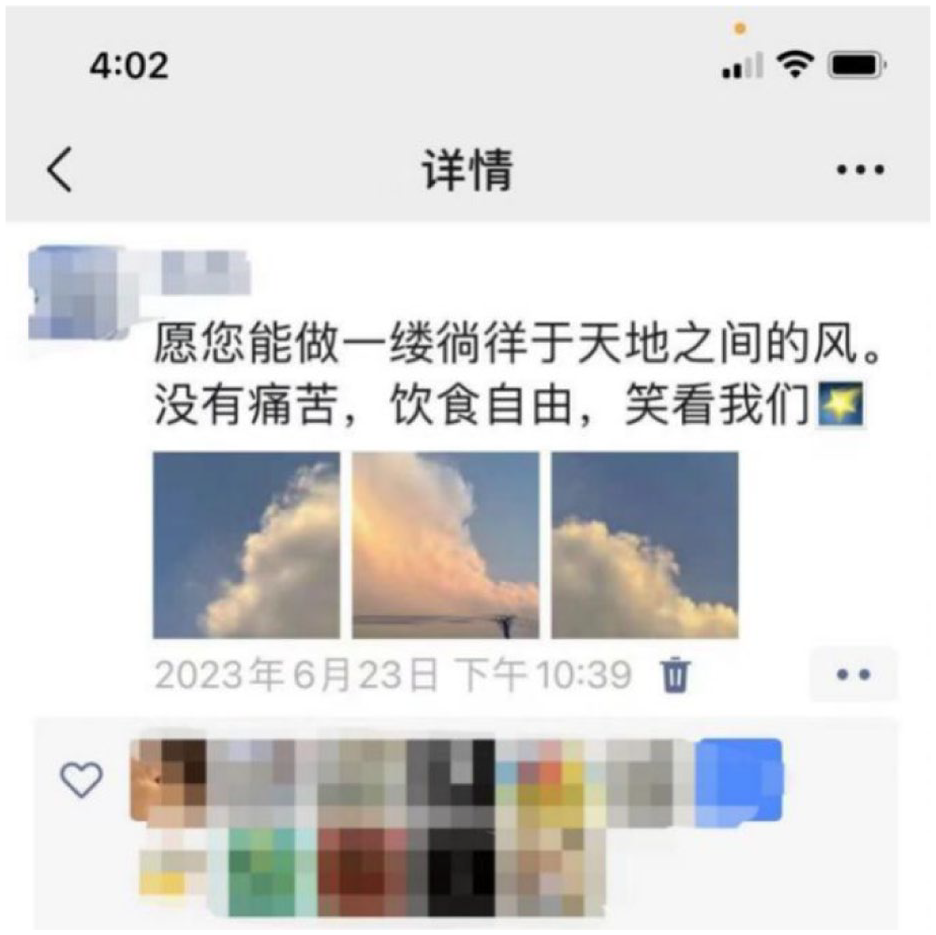
Screenshot of WeChat Moments provided by F03 (female, 32 years old, university lecturer).
Through these subtle methods, mourners skillfully tailor their emotional expression to social media norms, creating a low-impact media repertoire. It is not emotional suppression but a transformation and aesthetic reconfiguration of expression, an instance of cultural creativity that emerges in the tension between release and control.
Temporal Segmentation as a Means of Expressing Emotional Authenticity
On WeChat Moments, digital mourning is not only emotional expression but also involves anticipating potential social feedback. Users not only decide whether to express themselves but also when to do so, responding to imagined expectations and anxieties about social responses. Thus, timing becomes a crucial strategy for regulating the intensity of reactions.
Individuals can strategically manage the timing of their posts to navigate the tension between personal emotions and public presentation. Temporal segmentation manifests in the following ways.
First, individuals may delay public sharing to avoid the pressures of immediate reactions. By postponing or restricting the visibility duration of posts, they reframe life events and recalibrate linear time, gaining greater control over mourning expressions. This approach allows mourners to release emotions privately within a controlled scope while managing content dissemination to avoid unwanted attention or commentary. Here, mourners do not avoid responses altogether but moderate the social expectation of immediate reaction through deliberate delay, preserving privacy and personal pacing in expression:
I delayed making it visible to avoid a sudden influx of comforting messages. I just felt like to express myself, mark it as a specific time point, and did not want to disturb others. (F03, female, 32 years old, university lecturer)
Second, individuals often commemorate on specific dates, embedding expressions within culturally recognized temporal frameworks that legitimize the social reception of their grief. As Seligman et al. (2008) note, the distinction between daily life and ritual enhances the power and value of rituals. Individuals may choose to express mourning on culturally significant dates, such as the anniversary of death, the seventh day after death, the Qingming Festival, or other anniversaries. These temporal markers are culturally imbued with commemorative significance, reinforcing the ritual dimension of mourning and providing a “culturally appropriate time window” for grief expression. By choosing moments when audiences are psychologically prepared, mourners avoid abruptness and enhance the likelihood of understanding, making their expressions seem more natural and socially appropriate.
Finally, individuals often limit the frequency of posts. While mourning is a profound, unique emotional process, frequent posts may dilute its significance and depth. Consequently, mourners control how often they express themselves, avoiding repetitive posts that might be seen as emotional commodification or cause social fatigue. Through low-frequency, contrasting Moments updates, mourners create an image of restrained and composed expression. The scarcity and intensity of these carefully chosen expressions heighten their emotional impact on viewers, earning admiration and respect while preserving the uniqueness of mourning:
A friend posted something like “A lonely grave a thousand miles away, nowhere to speak of my sorrow” on Moments. It had been ten years since his mother passed away. It shocked me. For the past ten years, he had never expressed this emotion. I could feel his resilience, restraint, and composure in that post. (M01, male, 30 years old, administrative staff)
Behind individuals’ temporal strategies for adjusting the rhythm of mourning expressions lies a nuanced awareness of audience psychology and the social risks of emotional exposure. This approach avoids challenges to self-presentation and reinforces the authenticity and solemnity of mourning rituals. For WeChat users, expression is no longer merely instinctive; it becomes strategic management of anticipated audience responses. By treating time as a resource repertoire, they craft mourning practices that balance emotional expression with controlled social engagement.
Overall, through the regulation of spatial boundaries, modes of expression, and temporal controls, mourners achieve finely tuned management of affective expressions. This restrained strategy reveals a new ethical orientation toward visibility and authenticity in mourning. On social media platforms that encourage open expression, “the more private the emotion, the more genuine it appears.” The prevalence of emotional expression and performativity on social media has led to openly sharing grief, which may be perceived as performative social posturing (Murrell et al., 2021). In contrast, expressions that use ambiguous language, symbolic imagery, or private channels are more likely to evoke perceptions of unmanipulated authenticity and resonate with viewers. This emerging ethic of concealment as genuine emotion in digital mourning also resonates with long-standing Chinese cultural traditions of “moderated grief” and “silence as gold,” shaping a unique aesthetic on WeChat Moments.
Discussion and Conclusion
This article examined digital mourning on WeChat Moments, focusing on how individuals reflected on their use of the platform to express grief, negotiated the tensions between platform-specific features and sociocultural norms, and adopted media strategies aligned with emotional expectations. WeChat Moments not only rendered private mourning emotions publicly visible but also actively reshaped the modalities of expression. Mourning, traditionally an act of remembrance, evolved into a complex emotional performance shaped by technological affordances, social relationships, and cultural norms. Through various media facilities, individuals engaged in restrained emotional expression tailored to specific contexts. The study introduced the concept of the “mediated emotional repertoire,” which captured how individuals selected and appropriated available media functions and structures to develop expressions of grief that were culturally and platform-legitimate. The concept highlighted three key characteristics of digital mourning on WeChat Moments.
First, individuals redefined the functionality of WeChat Moments, transforming it into a space suitable for expressing digital mourning emotions. By utilizing its immediacy, privacy, and other features, they not only used the platform to convey grief but also extended and adapted its notification function. The recording feature of WeChat Moments enabled individuals to instantly capture and preserve their mourning emotions, creating a digital space for memory and commemoration that could be revisited at any time. The platform’s affordances inspired imagination, providing ongoing dialogue that transcended the boundaries between life and death. It illustrates that media, by its inherent logic, exhibits qualities of expansion, substitution, integration, and inclusivity (Schulz, 2004). It also revealed how individuals connected cultural experiences with technical tools to bridge imagination and reality, redefining emotional expression.
Second, mourning norms and emotional rules on WeChat Moments emerged from the interplay among technical features, traditional mourning culture, and interpersonal relationships. The risks associated with the visibility of private emotions in blurred social spaces, the potential for inappropriate solemnity in multimodal mourning practices, and the authenticity dilemmas of self-performance all highlighted the contradictions individuals navigated in mediating and socializing grief. In this process, the clash between platform norms and cultural norms, along with individuals’ acceptance or rejection of digital mourning expressions, collectively shaped the evolving norms of mourning on WeChat Moments.
Third, to navigate the contradictions of digital mourning on WeChat Moments, individuals have developed restrained media repertoires. Confronting the public risks of expression shaped by platform logic and cultural discipline, genuine mourning emotions were reorganized into recognizable forms of restraint. Within the semi-public social space of Moments, individuals consciously regulated the form and intensity of mourning expressions. They managed emotional boundaries through patchwork strategies, maintained etiquette through subtle expressions, and used temporal segmentation to balance authentic feelings with privacy, avoiding excessive exposure to personal grief. By doing so, individuals flexibly calibrated mourning expressions, turning them into controlled affective performances that integrated emotional moderation, cultural respect, and personal ritual.
Social media interactions facilitate emotional expression (Papacharissi, 2015), with mourning increasingly manifesting itself daily. As social media platforms have been conceptualized as spaces for displaying and negotiating death (Christensen & Gotved, 2015), this study explored how individuals mediated their emotions within such contexts. The dual nature of social media in expressing grief is evident. On one hand, supporting the free expression of emotions provides the potential to break the cultural silence around grief (Walter et al., 2012). On the other hand, community-internalized norms can reinforce new boundaries of expression (Christensen et al., 2017). However, emotional expression on these platforms remained differentiated and adapted according to the specific context. Given that society continues to expect grief to remain primarily an internal and private process (Neimeyer et al., 2014), this study argued that “the deprivation of the right to grieve” extended beyond specific death events to encompass daily digital mourning practices on social media. The normative guidance of WeChat Moments on mourning emotions reflected the subtle yet powerful influence of media ideologies (Gershon, 2010), where the platform’s technological logic, cultural norms, and societal expectations collectively shaped the modes and boundaries of individual mourning expressions.
While existing research has mainly focused on public spaces, this study has contributed by exploring mourning and memorial activities within the personal, daily context of social media. It has examined how individuals curate emotions and establish boundaries to construct mourning landscapes. A key contribution has been the introduction of the “mediated emotional repertoire,” meaning social media transforms mourning practices and shapes the emotions linked to grief. Based on studies of digital mourning norms and emotional expression, this concept has revealed how individuals digitally manage and adapt their mourning emotions. In addition, this article has offered new insights into digital mourning in Chinese society. In contrast to Western studies, WeChat Moments’ semi-public nature and embeddedness in familiar social networks provides a unique environment for emotional management and social interaction. In the evolving polymedia landscape, future research could explore platform-specific differences in digital mourning or examine variations across cultural and gendered contexts.
Footnotes
Acknowledgements
We are grateful to the anonymous reviewers for their valuable and constructive comments that helped improve this article. We also thank all interview participants for openly sharing their experiences of digital mourning and for trusting us with their personal narratives.

Ethical approval and informed consent statements
The study was approved by the Ethics Committee of the School of Journalism and New Media, Xi’an Jiaotong University (Ethical Clearance Reference Number: 20240801) on August 1, 2024. All participants provided written informed consent prior to participating including consent for their anonymized information to be published in this article.
Funding
The authors disclosed receipt of the following financial support for the research, authorship, and/or publication of this article: This work was supported by Double First-Class Funds for the Universities (no. 2025WKTD003).
Declaration of conflicting interests
The author(s) declared no potential conflicts of interest with respect to the research, authorship, and/or publication of this article.
Data availability statement
The data supporting the findings of this study are available on the Zhihu platform. However, due to privacy considerations, interested readers can access Zhihu directly.