



Abstract
Social media have transformed political campaigning by enabling direct interaction between politicians and voters, becoming a key tool for shaping public opinion. Moral language is pivotal in this dynamic as it captures attention in an overly information-saturated social media environment and wields significant influence over political opinions. Populists thrive on social media by fostering distrust in elites, using emotional language, and reducing complex issues to simple “us vs. them” binaries. We argue these factors are rooted in moral underpinnings, which may play a significant role in the appeal of populist parties and have thus far received limited scholarly attention. Consequently, this paper addresses the research question: To what extent, and in what ways, do populist parties exhibit a distinct moral-rhetorical profile on social media that sets them apart from mainstream politicians? Using Moral Foundations Theory, natural language processing, and a computational semantic network approach, we analyzed 11,205 social media posts from Dutch political parties and leaders during the 2023 Dutch election campaign across X, Facebook, and Instagram. Our findings reveal that populist parties emphasize Care and Authority over other moral foundations, while mainstream parties exhibit a different moral foundation distribution. These results align with the part of populist communication logic that frames populist actors as defenders against corrupt elites and external threats, as well as representatives of the people’s demand for sovereignty. Moreover, we found populist parties exhibit less internal consistency in their moral rhetoric across platforms than mainstream parties, suggesting a potentially higher adeptness at tailoring messages to different platforms and their affordances.
Keywords
Introduction
More than mainstream politicians, populist actors are argued to effectively leverage social media’s unique affordances, utilizing them as a direct channel to connect with the “ordinary people” they claim to represent (Arifin et al., 2019; Engesser et al., 2017; Hendrix, 2019). In their direct social media communication, they may especially use language that is morally charged to mark the simplifying boundary between the “good” in-group and “evil” elites, which is the central building block of populist rhetoric (Mudde, 2004). Despite the alleged affinity between moral values and populism’s simplifying antagonistic narrative, however, we know markedly little about how populists as compared to mainstream actors utilize moral language across social media platforms. Against this backdrop, the main aim of this paper is to explore how populist and mainstream political parties differ in their moral profiles endorsed via direct communication on social media.
Central to our puzzle is the interconnection between populist social media communication and moral framing. Morality is a fundamental pillar of groups and societies, constituting norms and social agreements that maintain order, foster trust, and create a sense of belonging within groups (Graham et al., 2013; Haidt, 2012). Accordingly, morality plays a powerful role in shaping individual identity, behavior, and social cohesion (Graham et al., 2013; Haidt, 2012; Kohlberg, 1981), and is therefore deeply intertwined with political ideology and political communication (Graham et al., 2013). At its essence, the communication logic of populists relies on an emotionally charged heuristic shortcut, 1 centered on the dichotomy between “us,” symbolizing virtue, and “them,” representing corruption or malevolence (Engesser et al., 2017; Hameleers & Vliegenthart, 2020; Hawkins et al., 2020; Stanley, 2008). This heuristic shortcut is inherently moral, drawing a clear moral boundary between the good, honest people and the corrupt, evil elite. This suggests the presence of a populist-specific moral-rhetorical profile. Consequently, with this paper we extend the heuristic framework of online populist communication by looking beyond emotional or simplifying language (Engesser et al., 2017; Hameleers et al., 2017; Widmann, 2021; Wirz, 2018), mapping how the moral underpinnings of these messages enable us to understand how populism effectively resonates with online audiences.
To map the moral profiles of populist versus established parties, we rely on Moral Foundations Theory (MFT; Graham et al., 2009), which originally posited that human moral reasoning is rooted in a set of psychological foundations, namely Care/Harm, Fairness/Cheating, Loyalty/Betrayal, Authority/Subversion, and Sanctity/Degradation. Left- and right-leaning political party families have been linked to emphasizing different moral foundations in their rhetoric, shaping their distinct appeal to voters (Davis et al., 2017; Graham et al., 2009). However, this association has been questioned and debated, particularly regarding its dependence on methodological approaches (see, for example, Kraft & Klemmensen, 2024). This study employs a comprehensive methodological approach to investigate whether a moral-rhetorical differentiation is evident in the social media rhetoric of populist parties, which is a dimension largely overlooked in prior research on moral party communication.
Our study advances previous research that has focused on the two-party system in the United States (Hackenburg et al., 2023) or relied on a more restricted moral dictionary (Bos & Minihold, 2022). By applying a semantic network approach using the Moral Foundations Dictionary 2.0 (MFD 2.0; Frimer et al., 2019), we analyze social media posts within the Dutch multiparty context to explore populist moral rhetoric across the left–right political spectrum, allowing us to identify commonalities that appear detached from the host ideology. 2 Furthermore, our study is the first to exclusively examine the populist–mainstream moral-rhetorical divide.
In addition, unlike previous studies which focused exclusively on X (formerly Twitter), we expand the scope of existing research by incorporating the influential social media platforms Facebook and Instagram into our analysis. Given the diverse nature of social media platforms and their affordances—particularly regarding audience behavior and technical features—it is essential to examine how platform-specific characteristics shape political communication (Bossetta, 2018; Stier et al., 2018), while also assessing the extent to which moral-rhetorical differences are generalizable across platforms. This study therefore explores whether various social media platforms, each serving distinct audiences and enabling diverse modes of communication, provide differing contextual frameworks for populist and mainstream moral expression. Considering the global rise of populism through social media (Postill, 2018), evidence of platform-specific adaptations of moral rhetoric could provide deeper insights into this phenomenon.
Taken together, our study contributes to the refined understanding of populist communication by offering a framework to potentially distinguish it from mainstream discourse based on differential moral profiles, a complex task as rhetorical boundaries become increasingly blurred (Fernández-García & García Luengo, 2020; Hameleers & Vliegenthart, 2020; Mudde, 2004).
Theoretical framework
Moral-rhetorical patterns reveal essential appeals to political ideologies
MFT describes how morality influences human behavior, particularly in politics (Graham et al., 2009; Haidt, 2012). MFT identifies five innate moral foundations: Care/Harm, emphasizing empathy and protection from suffering; Fairness/Cheating, focusing on justice and reciprocity; Loyalty/Betrayal, related to group cohesion; Authority/Subversion, concerning respect for hierarchy and tradition; and Sanctity/Degradation, reflecting purity and the avoidance of contamination (Haidt & Graham, 2007). Research has shown that people of different political orientations prioritize these differently (Graham et al., 2009; Hatemi et al., 2019; Hopp et al., 2023; Walter & Redlawsk, 2019). Moral framing is a powerful persuasive tool, as it evokes emotions that enhance the perceived righteousness of a stance (Clifford, 2018). Messages that align with the prioritized moral foundations of their audience are more likely to influence attitudes and shift them toward the sender’s perspective (Feinberg & Willer, 2019).
Politicians frequently employ moral rhetoric to evoke emotions, mobilize supporters, and sway their opponents (Jung, 2020). Consequently, by examining how different political factions emphasize different moral foundations, researchers can gain valuable insights into the moral basis of political ideologies (Graham et al., 2009; Janoff-Bulman, 2023). For instance, liberals are found to focus more on harm and fairness, while conservatives rely on all five foundations equally (Davis et al., 2017), making liberals more persuadable through harm or fairness framing, and conservatives also through the additional foundations (Davis et al., 2017). Thus, the moral rhetoric of a political group reflects the values resonant with its followers. Research indicates that populists frequently employ negative moral-rhetorical appeals, particularly on social media (Bos & Minihold, 2022; Engesser et al., 2017; Widmann, 2021). However, the specific patterns of moral foundations they utilize in their communication remain uncertain, as initial studies have yielded mixed findings (Bos & Minihold, 2022; Hackenburg et al., 2023), leaving this significant aspect of the populist appeal underexplored and in need of further research.
MFT provides both methodological and theoretical benefits for this study. Methodologically, by providing a list of moral terms that are categorized into broader moral values, it serves as a practical tool for identifying moral language in texts, thereby enabling large-scale analysis of party rhetoric (Frimer & Skitka, 2018; Graham et al., 2009). Another advantage of MFT is that it facilitates comparability across different studies, providing a common framework for analyzing moral language in diverse contexts. Theoretically, it builds on prior studies of moral language in politics (Graham et al., 2013; Hackenburg et al., 2023), making MFT a valuable foundation for exploring the relationship between moral language and political rhetoric.
Populism as moral heuristic
Heuristics are mental shortcuts that reduce cognitive load in decision-making (Gilovich et al., 2004). MFT posits that individuals rely on intuitive moral foundations as heuristics in moral dilemmas and social interactions (Haidt, 2001; Harper & Rhodes, 2021). For instance, the immediate urge to return a dropped wallet stems from the Care/Harm foundation, reflecting automatic moral judgment. Messages aligned with moral foundations resonate through heuristic processing, shaping attitudes and behaviors (Feinberg & Willer, 2012). On social media, where attention is scarce, users increasingly depend on heuristics—likes, shares, or passive consumption—to avoid cognitive overload in an overburdened setting (Kahneman, 2011; Pennycook & Rand, 2019). In this environment, moral foundations act as heuristics, triggering automatic, emotionally resonant responses that align with viewers’ values.
This understanding of moral foundations aligns with how populist language shapes perceptions of reality. Following up on earlier research defining populism as a thin ideology (Stanley, 2008), rhetoric (Bos & Brants, 2014), style (Block & Negrine, 2017) and discourse (Hawkins, 2009), Engesser et al. (2017) synthesized various concepts of populism as a communication logic rooted in fundamental heuristics, forming what they describe as the “heuristic model of populist ideology.” Central to this model is the pursuit of political sovereignty by the people, who are depicted as the rightful rulers obstructed by corrupt elites wielding illegitimate power (Engesser et al., 2017; Hameleers & Vliegenthart, 2020; Hawkins et al., 2020; Stanley, 2008). The populist actor positions themselves as the challenger to these elites, promising to reclaim authority on behalf of the deserving people. Furthermore, elites are often portrayed as aligning with out-groups that threaten the people’s power, thereby casting these groups as external threats that must be removed. We build on their model by arguing that these heuristics are inherently moral in nature, grounded in distinct moral foundations. This suggests that populism operates using its own unique moral foundation profile, much like liberal and conservative parties often do (Davis et al., 2017). However, it is still unclear which particular moral terms from which foundations are emphasized the most within populist communication. Populist rhetoric might, for example, prioritize Authority over other foundations by stressing the revocation of authority from the common people. Supporting this, populist far-right messaging has been found to normalize authoritarian narratives by portraying themselves as defenders of the popular will. They invoke the language of rights and freedoms to reframe sovereignty in exclusionary terms, morally justifying restrictive policies as necessary protections against elite corruption and liberal decline (Alekseev, 2021; Krzyżanowski & Ekström, 2022).
This study empirically tests whether populist parties exhibit a distinct moral profile by examining whether they rely on a unique set of moral terms that overlaps only minimally with that used by mainstream parties. Thus, using network analysis, we analyze across social media platforms, how often each party uses each individual moral term. This enables us to see whether the word frequency patterns of populist parties are more internally similar than externally similar to other parties. Furthermore, we classify the word counts according to their corresponding moral foundations to gain insight into the specific type of moral dimensions that potentially differentiate populist parties from their mainstream counterparts. By conducting these analyses, we aim to understand whether populist parties use their own moral language and whether this language appeals to particular moral foundations that reveal a different emphasis than that of mainstream parties. Identifying a distinct moral language or a unique pattern of moral foundation use would suggest that morality plays a significant role in the appeal of populist parties. Such a finding would indicate that morality serves as a key differentiator from mainstream parties, and, given its persuasive power (Clifford, 2018), may be central to the effectiveness of populist communication.
Two recent studies highlight populists’ distinct moral profile: Bos and Minihold (2022) found greater emphasis on Loyalty and Authority in populist tweets, whereas Hackenburg et al. (2023) observed Trump’s unique use of negative Fairness appeals. Given these inconsistent findings, we refrain from predicting specific foundations but hypothesize the following:
Furthermore, this study explores the nature of the moral–rhetorical profile of populist actors. Consequently, we formulated the research question:
Populism and social media affordances
Recent studies indicate that political actors adapt their messaging to align with platform-specific norms and affordances, such as character limits, audience expectations, and algorithmic biases (Bossetta, 2018; Stier et al., 2018). These adaptations may influence how politicians emphasize ideology-specific moral foundations, which are key to understanding political discourse (Graham et al., 2009). Certain platform features may align more closely with populist communication logic than others; for instance, X’s unique character limit favors concise, emotionally charged messaging, which aligns with the populist communication logic (Engesser et al., 2017). As discussed earlier (see H1), we anticipate differences between populist and mainstream parties in their rhetorical use of moral foundations on social media. Given the distinct features of prominent platforms such as X, Instagram, and Facebook, we aim to refine our investigation to determine whether these differences persist across platforms or are amplified or diminished by platform-specific dynamics.
In this context, we define consistent messaging as the extent to which populist and mainstream parties use similar patterns of moral foundation endorsements across social media platforms. Consistency refers specifically to the degree to which parties emphasize the same moral foundations—such as Care, Fairness, or Loyalty—regardless of platform-specific constraints or affordances. This allows us to assess whether parties adapt their moral rhetoric strategically depending on the platform or adhere to a stable moral narrative across channels. Specifically, we formulate the following research question:
Methods
The study design, hypotheses, and analysis plan were pre-registered on the Open Science Framework before data collection. 3
Data collection and preprocessing
The data for this study includes the textual content from the official Instagram, Facebook, and X accounts of major Dutch political parties and their leaders, defined as those elected to parliament in the 2023 national elections. We gathered posts from 22 July – 22 November 2023, allowing us to capture the political discourse during the height of campaign activity, 4 ensuring that the language analyzed predominantly reflected content relevant to politics and elections. In total, we analyzed 11,205 posts from 16 parties—five populist and 11 mainstream (PopuList classification, Rooduijn et al., 2024). Of the total, 5961 posts (53.20%) stem from populist parties. Data for Facebook and Instagram were obtained via CrowdTangle (Garmur et al., 2019), while X data were extracted using Octoparse (n.d.). 5 Table 1 details the populist/mainstream classification, party family, corresponding party leader(s) during the period July–November 2023, and election outcome. Table 2 contains the number of posts per party by social media platform. Data preprocessing in Python (version 3.12.4) involved removing stop-words, punctuation, and emojis using NLTK (Bird et al., 2009) and regular expressions. After preprocessing, the dataset contained 212,938 words (M = 19.00 words per post, SD = 19.42).
Parties Included in Our Analysis With Populist Classification, Party Family, Corresponding Party Leader(s) During the Period July–November 2023, and Election Outcome.

Note. The selection of party families follows the classification outlined by Laméris and Grohmann (2024), which is based on the criteria established by Armingeon et al. (2023). In addition, we utilized data from PolitPro (n.d.) for both classification support and election outcomes. The populist classification vs. mainstream classification was retrieved from Rooduijn et al. (2024).
Number of Posts per Party by Social Media Platform.
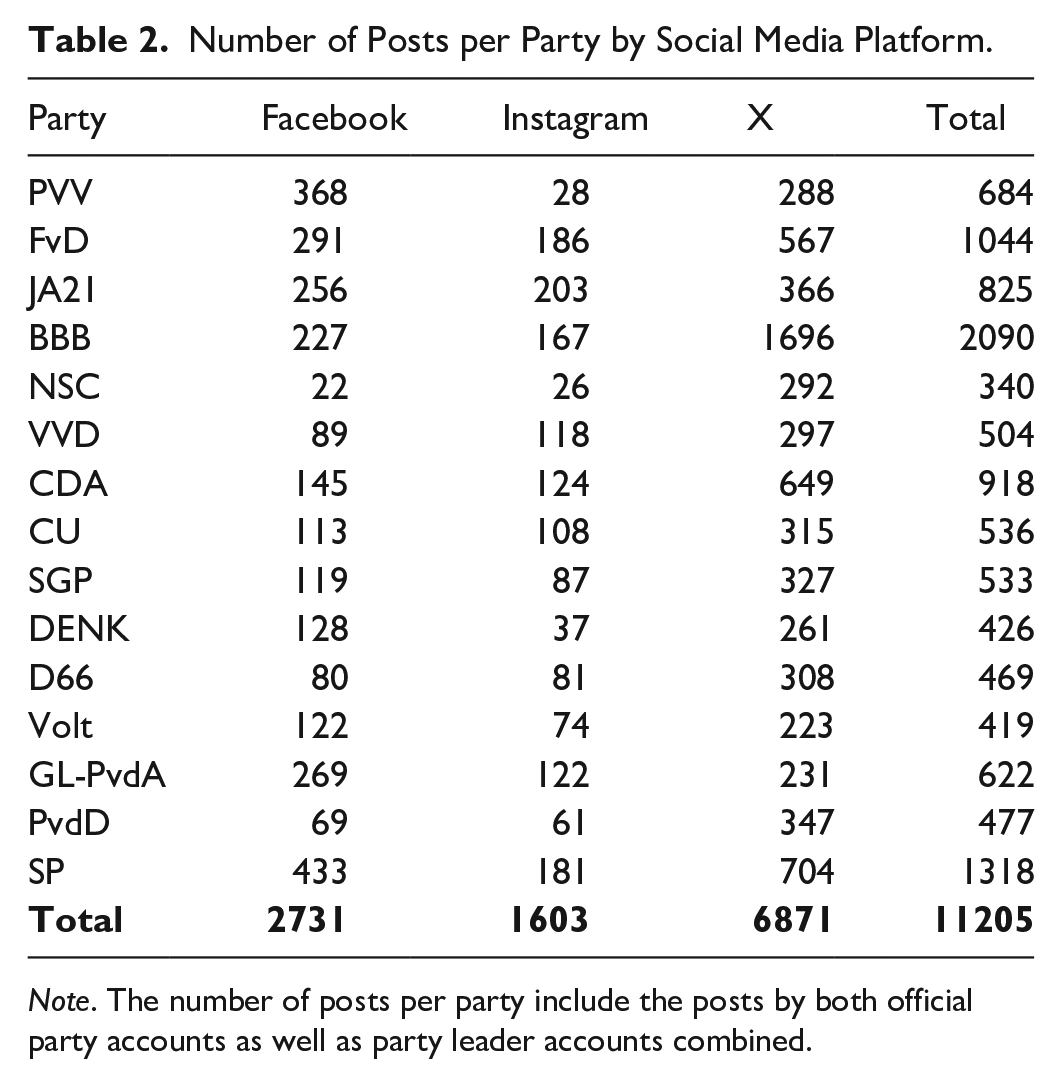
Note. The number of posts per party include the posts by both official party accounts as well as party leader accounts combined.
Variables
Our dependent variable was the prevalence of moral words (see following section), calculated for each political party and for each of the five original moral foundations: Care/Harm, Fairness/Reciprocity, Ingroup/Loyalty, Authority/Respect, and Purity/Sanctity. We also calculated the sum of identical individual moral words for each pair of political parties. The independent variables included political affiliation (populist vs. mainstream) and the social media platform where the posts were published. Control variables accounted for whether the post originated from a party leader or an official party account, as well as the classification of the Socialist Party (SP), which was either included or excluded from the populist category due to its unique status.
The classification of populist parties followed Rooduijn et al. (2024). While all these parties are considered populist, they vary in other aspects. The Partij voor de Vrijheid (“Party For Freedom” or PVV), the largest party in the 2023 elections, is an established populist radical right party, while Forum voor Democratie (“Forum for Democracy” or FvD) and Juiste Antwoord 21 (“Right Answer 21” or JA21) are newer and smaller. BoerBurgerBeweging (“Farmer Citizen Movement” or BBB) is also populist but began as a one-issue party focusing on farmers’ interests. Recently shifting further right, it is seen as more moderate than PVV, FvD, and JA21, and classified as “borderline far right” by Rooduijn et al. (2024).
The SP is the only left-wing populist party and is categorized as a borderline populist case. Initially more populist with the slogan “Vote Against, Vote SP,” it shifted in 2002 to “Vote For, Vote SP,” marking a move away from blatant populism. Since the 1990s, the SP has also been considered borderline far left due to its adoption of democratic socialism (Rooduijn et al., 2024). Given its unique position, analyses were conducted with and without the SP in the populist category to test result robustness.
Development and refinement of the Dutch Moral Foundations Dictionary 2.0
The original MFD, developed by Graham et al. (2009), entails words that correspond to the moral foundations. The underlying assumption is that these words signal the presence of moral concerns. As such, the MFD serves as a heuristic tool, relying on the connection between specific words and moral considerations, established by experts in the field of morality (Graham et al., 2009). We based our study on Frimer et al.’s (2019) MFD 2.0. This updated version includes about 210 words per foundation (up from 32) and was validated by asking over 1000 participants across 58 countries to write essays on the different foundations. Analysis looking at word density of words corresponding to the foundations in these essays showed the revised dictionaries had stronger validity than earlier versions (Frimer et al., 2019).
We developed the Dutch Moral Foundations Dictionary 2.0 (DMFD 2.0) by translating and adapting the original MFD 2.0 (Frimer et al., 2019) to suit the Dutch cultural context. Our translation process prioritized cultural relevance and made necessary grammatical adjustments. We addressed polysemy 6 manually by reviewing translations and removing words with double meanings. While a few moral terms were excluded for their ambiguity, this likely had minimal impact on the analysis due to their rarity. Lemmatization 7 was also done manually, reducing words to their base forms and using wildcards to group variations with the same stem. In line with the approach by Hackenburg et al. (2023), we validated the dictionary using Zipf’s (1949) Law, then refined it by excluding low-frequency words and applying a tf-idf (term frequency–inverse document frequency) weighting scheme, reducing it to 346 terms (318 unique). This approach allowed us to filter out non-informative terms and sharpen the focus on relevant moral language in Dutch political discourse. We provide detailed steps and the full list of adjustments in the Supplementary material (under point 7). 8
In addition to the division into moral foundations, the dictionary is also categorized into virtue and vice terms. Virtue words reflect traits or actions that uphold a given moral foundation and are generally regarded as morally positive (e.g., loyal, fair, kind), whereas vice words denote traits or actions that violate a moral foundation and are considered morally negative (e.g., betray, cheat, cruel). To give a clearer sense of the dictionary’s structure and content, Table 3 presents examples from the final dictionary used in our analysis, showing virtue and vice terms for each moral foundation (translated back into English).
Examples of the Final Dictionary Used in the Analysis of Virtue and Vice Terms per Moral Foundation (Translated Back to English).

After data pre-processing, we applied a function that extracted all moral words from the posts. This resulted in the creation of a moral word-count matrix, where each column represents an individual moral word and each row corresponds to a political party. The values within the matrix indicate how often each moral word appeared in the posts of each party.
The network approach
For our analysis, we use a network approach for its ability to uncover deeper patterns in moral discourse. Specifically, it offers three key advantages over alternative analyses: it reveals how moral terms cluster together, forming distinct discursive communities; it shows which parties are embedded within these clusters; and it highlights the degree of separation or interconnectedness between them. In contrast, simple frequency counts of words or moral foundations only measure how often parties use certain language, which is capturing just one dimension of what network analysis can reveal. By focusing on structural relationships rather than raw counts, network analysis provides a richer understanding of how moral language operates within and across political groups. For detailed explication of our analytical procedure, please see the Supplementary material (under point 9).
Results
After the refinement and tuning of the DMFD 2.0 to fit the specific context of our study, we identified 11,824 moral words within the dataset, equaling 5.55% of all words from all posts we collected. Of these moral words, 58.05% originate from mainstream political parties. Furthermore, 28.05% are vice words, representing negative moral appeals (e.g., “corrupt”). Within the moral language used by mainstream parties, 24.33% are vice words, while for populist parties, 33.22% of their moral terms are vice words. Populist parties consistently used more vice-related words compared to mainstream parties, a pattern reflecting negativity bias that has been well-documented in prior research (Hameleers et al., 2020; van Bavel et al., 2024). To simplify our complex network analyses (see Figures 1, 3, and 4), and to enhance interpretability while focusing on moral values rather than the already well-established vice/virtue distinction, we chose to combine vice and virtue terms within each moral foundation for our three main networks.

Bipartite text network.
Before we move on to the test of our first hypothesis, we want to briefly reflect on an unexpected pattern in the data. Contrary to our expectations, populist parties appeared to moralize slightly less than mainstream parties: 5.03% of their content contained moral language, compared to 6.01% for mainstream parties. Notably, while the five populist parties published more posts (N = 5925) than the 10 mainstream parties (N = 5240), their total word count was significantly lower: 98,706 words (46.36%) versus 114,193 words (53.64%). On average, populist posts contained 16.66 words (SD = 15.84), compared to 21.79 words (SD = 22.50) for mainstream parties.
Although it is beyond the scope of this paper to explain this unexpected finding, one plausible interpretation is that populist parties may rely more heavily on visual media (e.g., images, memes, videos) to convey moral appeals, which may not be fully captured by text-based analysis. Nevertheless, the fact that populist parties moralized at levels nearly comparable to mainstream parties (despite using significantly fewer words) suggests that our text analysis remains a meaningful tool for capturing populist moral expression.
The moral word clusters of populist versus mainstream parties
To test our first hypothesis, that populist social media accounts form a distinct cluster with unique moral word frequency patterns, we followed the basis of Hackenburg et al.’s (2023) approach. We constructed a bipartite network with moral terms and political parties as nodes. An incidence matrix was created from the frequency of moral terms in posts, forming a weighted bipartite network where the use of a moral term by a party established a weighted edge 9 between the party and the term (see Figure 1). Connections between parties were mediated through shared moral terms, with undirected edges representing bidirectional relationships.
We visualized the network using the Yifan Hu layout (Hu, 2005) for effective visualization in smaller bipartite networks. The Louvain community detection algorithm initially yielded low consistency (Average Adjusted Rand Index [ARI] = 0.19 across 10 runs), so we applied the Leiden algorithm, which offers more stable partitions. At a resolution of 0.95, the Leiden algorithm achieved high stability (ARI = 1.0 across 10 runs) but with a modularity score 10 of Q = 0.25, indicating weak community structure and blurred divisions. We visually distinguished clusters by coloring nodes, so that all nodes in the same cluster share a color. To enhance clarity, populist party labels are displayed in red font and underlined with a dashed line.
As shown in Figure 1, the network does not reveal clear clustering between populist and mainstream parties. Right-wing populist parties (FvD, PVV, JA21, BBB) do not form a distinct group separate from mainstream parties, and the left-wing populist SP is embedded in the central region with no clear separation. However, JA21 and FvD do form a community together with the mainstream right-wing party VVD. Within this cluster, the two populist parties JA21 and FvD do show distinct spatial separation. Moreover, the PVV stands out, positioned furthest from the center and forming its own community.
These findings do not support our first hypothesis. The moral-linguistic patterns of populist parties are not distinct enough to form separate clusters from mainstream parties, as indicated by the low modularity score and substantial overlap in moral term use across the spectrum. However, some populist parties do stand out, such as the PVV with its unique position and the community of JA21 and FvD.
Reconstructing the network using only party leader or official party accounts did not significantly improve modularity. JA21 and FvD formed a community in the party account-only network, while PVV remained isolated in both configurations (see Supplementary material under point 1 for these robustness checks).
Differences in moral foundation endorsement between populist and mainstream parties
To explore Research Question 1, concerning the differences in moral foundation endorsements between populist and mainstream parties on social media, we conducted independent-samples t-tests comparing the average prevalence of each moral foundation per post between the two groups.
As shown in Table 4 and Figure 2, mainstream parties used language related to all five moral foundations more frequently than populist parties. The largest differences appeared in Loyalty (Mainstream: M = 0.28, SD = 0.74; Populist: M = 0.14, SD = 0.46) and Purity (Mainstream: M = 0.29, SD = 0.68; Populist: M = 0.13, SD = 0.44). Despite this general trend, the moral profiles of populist and mainstream parties were distinct: populists emphasized Authority (M = 0.21, SD = 0.59) more than Purity and Loyalty, while mainstream parties used Authority (M = 0.27, SD = 0.66) nearly as frequently as Purity and Loyalty, distributing their moral language more evenly across foundations, with a relative de-emphasis on Fairness (Mainstream: M = 0.17, SD = 0.56; Populist: M = 0.08, SD = 0.35).
Average Moral Foundation Prevalence and Standard Deviations per Social Media Post for Mainstream and Populist Parties.

Note. Asterisks (*) indicate significant differences in moral foundation usage between mainstream and populist parties after adjusting for multiple comparisons, with the specific statistical values reported in the text. All marked differences achieved significance at p < .001.

Bar plot of average moral foundation prevalence and standard error per social media post for mainstream and populist parties.
To assess the significance of these differences, t-tests were conducted for each moral foundation, showing significant distinctions between populist and mainstream parties across all foundations: Care: t(10228.06) = –3.24, p = .001; Fairness: t(8739.93) = –9.67, p < .001; Loyalty: t(8554.40) = –11.79, p < .001; Authority: t(10574.13) = –4.13, p < .001; and Purity: t(8741.33) = –13.95, p < .001. As a robustness check, we reran the t-test under three different conditions: including only party leader accounts, including only official party accounts, and excluding the SP party. These adjustments did not notably impact the results. An analysis including populist and mainstream right-wing parties alone confirmed that differences in moral foundation use were still present based on the populist-mainstream distinction and thus do not solely depend on the left-right orientation (see Supplementary material under point 2 for details).
In summary, all five moral foundations contributed to differences in moral language, with populist parties generally using moral language less frequently than mainstream parties. The largest gaps appeared in Purity and Loyalty, with populists showing significantly lower usage. Importantly, populists prioritized Authority and Care over Loyalty, Purity, and Fairness, while mainstream parties balanced Loyalty, Purity, and Authority equally.
Consistency of moral foundation endorsement by populist and mainstream parties across social media platforms
To address our second research question (RQ2) on the consistency of moral foundation endorsements for populist and mainstream parties across social media platforms, we adapted Hackenburg et al.’s (2023) cosine similarity network approach. Instead of examining candidates, we analyzed similarities across platforms, categorizing rhetoric as mainstream or populist. We constructed a one-mode network connecting parties based on their use of specific moral foundations on each platform.
We created 30 documents, each representing moral language for a specific foundation on a platform, split by populist and mainstream parties. Pairwise cosine similarity scores 11 were calculated for each foundation-platform combination (e.g., “populist Facebook Harm” vs. “mainstream Facebook Harm”), resulting in 90 total scores across group comparisons (within and between populist and mainstream parties). Table 5 shows that mainstream parties have slightly higher internal consistency in moral language across platforms than populist parties, distributing their moral language more evenly. Both groups show strong internal consistency (average cosine similarity ⩾ 0.85), although direct comparisons reveal lower similarity between groups (0.71 to 0.75), indicating different platform-specific moral priorities.
Average Cosine Similarity for Populist and Mainstream Moral Foundation Endorsement Across Social Media Platforms.
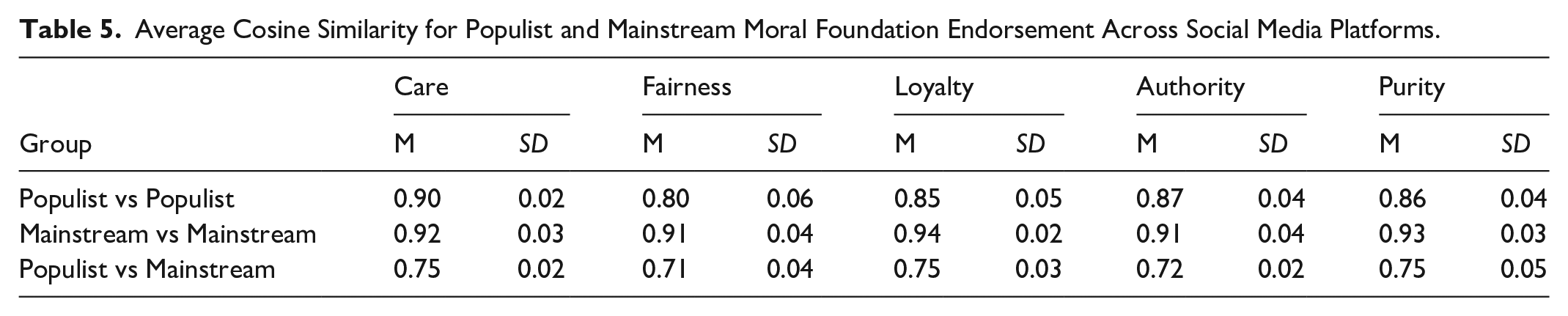
Cosine similarity scores served as weighted edges to build a fully connected network (see Figure 3), with nodes representing platform-specific groups (e.g., “populist X”) connected by edges weighted by moral foundation similarity. To improve visual clarity, we display only the two strongest connections per node pair and applied a 0.801 threshold for between-group edges, highlighting consistently used moral foundations within and between groups. The network was visualized using the Yifan Hu layout (Hu, 2005) to reveal structural relationships. Distribution analysis showed a slight positive skew and low kurtosis, indicating generally consistent cosine similarity scores without extreme outliers (see Supplementary material under 4.2).

Cosine similarity network illustrating the relationships within and between populist and mainstream parties based on their endorsements of the five moral foundations—care, fairness, loyalty, authority, and purity—on Facebook (FB), Instagram (IG), and X.
The network reveals several patterns. First, mainstream parties show the highest internal consistency across platforms, with tightly connected nodes on Facebook, Instagram, and X, particularly for Purity, Loyalty, and Fairness. This suggests mainstream parties maintain a more uniform moral narrative across platforms compared to populist parties.
In contrast, populist parties have slightly weaker connections across platforms, indicating a stronger tendency to adapt moral messaging to platform-specific characteristics compared to mainstream parties. Connections between populist and mainstream groups are generally weaker, appearing only for the highest between-group similarity (cosine similarity ⩾ 0.801). This visually highlights distinct moral priorities or rhetorical strategies between the groups, with populist and mainstream parties overlapping less than within each group.
Platform-specific differences also emerge, with populist parties aligning more on Purity and Loyalty on Instagram and Facebook than on X, where they align more on Authority and Care. Mainstream parties, however, use Fairness consistently across all platforms. This underlines that populists show greater variation across platforms, suggesting a more adaptable approach to moral messaging, while mainstream parties prioritize more uniformity. 12
To further explore these platform-specific differences in moral rhetoric, we constructed two new two-mode networks—one for mainstream party communication and one for populist party communication—grouping words by their associated moral foundations. These networks resemble the initial bipartite network (Figure 1), but use moral foundations and social media platforms as nodes instead of individual words and parties. Each network includes three party nodes and five moral foundation nodes. The visualization of the networks can be found in the Supplementary material (under point 5). Although this step was not pre-registered, we consider it valuable for revealing the practical implications of the earlier findings in Figure 3. While the similarity network showed how platforms differ in moral rhetoric overall, this second step pinpoints which moral foundations are emphasized more on each platform by mainstream and populist parties.
The Louvain community detection did not identify strong modularity in either network. The modularity scores were extremely low (0.02 for populist and 0.03 for mainstream networks). Moreover, the ARI, comparing Louvain clusters with a baseline classification (foundation vs. platform), was slightly negative in both cases (−0.04). Substantively, this implies that both populist and mainstream parties use moral foundations in a broadly overlapping and cross-platform manner. That said, some conclusions still can be drawn from the detected clusters. For mainstream parties, Facebook and Instagram are used in highly similar ways, forming one moral cluster, while X stands apart with proportionally greater emphasis on Care and Authority, forming a distinct moral cluster of its own. For populists, we found that vice care words (i.e., harm-related moral words) and authority virtue words, which are the most frequently used moral terms by populist parties, are most prominent on Facebook, making Facebook a separate cluster from its Meta-relative Instagram and from X.
Exploring the moral word clusters of populist versus mainstream parties
Although we did not observe a clearly distinct clustering of populist and mainstream parties when constructing a two-mode network of individual words and parties (testing hypothesis 1), we did find notable differences between the two groups when summarizing the parties into the broader categories of populist and mainstream, and organizing the moral language by the five moral foundations (answering RQ1 and RQ2). This suggests that populists and mainstream parties do, in fact, use moral language differently (even when accounting for left/right political orientation, see Supplementary material under point 3). Although this is not revealed when summarizing the moral word profiles of the different party families, the differences in morality become apparent when we look at separate indicators of moral values. We considered whether this discrepancy between our initial network and our other analyses could be due to the parties within each category (populist/mainstream) prioritizing different words, despite emphasizing the same moral foundations.
To investigate this further, we constructed a new two-mode network, this time grouping individual words according to their corresponding moral foundations. The network is almost the same as the initial one (Figure 4), but instead of using individual words as nodes, we used moral foundations as nodes. As a result, the network consisted of 20 party nodes and 5 moral foundation nodes. It is important to note that while this analysis step was not pre-registered, it remains focused on the same hypothesis and research question (RQ1), using an alternative approach to constructing the networks to explore the observed discrepancy in findings between our two initial analyses. Figure 4 shows the newly constructed bipartite text network displaying the moral-rhetorical community structure when grouping individual words according to their corresponding moral foundations. Please refer to the Supplementary material (under point 6) for details on the network.

Bipartite text network illustrating the moral-rhetorical community structure of 15 major Dutch political parties.
From the network shown in Figure 4, it is evident that all five populist parties (BBB, FvD, JA21, PVV, and SP) cluster together, forming a distinct community centered around the Care and Authority foundations. This indicates that these populist parties prioritize these two moral foundations to a different extent than other parties do. Interestingly, two mainstream parties (VVD and NSC) are also part of this network, suggesting that while populist parties largely differentiate themselves in their use of moral foundations, there is not a complete distinction from the mainstream. We ran the network analysis 100 times to observe changes within the Louvain community structure, and in each iteration, the populist parties consistently clustered together. In contrast, certain mainstream parties, particularly VVD, PvdD, and Denk, frequently switched between communities. This instability among mainstream parties likely explains the weak community structure reflected by the low modularity score (Q = 0.08), while populist parties consistently form a stable cluster. Considering the distribution of moral foundations (see Figure 2), we conclude that populist parties form a distinct cluster of moral language by distinctly prioritizing Care and Authority, whereas mainstream parties distribute their use of moral foundations differently.
Context analyses of harm/care and authority/subversion
To get an idea about the substantive context in which populist parties use their emphasized moral foundations, we generated word clouds presenting the most frequent words in social media posts that contain either a harm/care-related or authority/subversion-related term using the “wordcloud” package in Python. Word clouds visually represent text data, with the size of each word indicating its frequency in the dataset, where larger words appear more frequently. To enhance interpretability, we removed common filler words (e.g., “such as,” “have to,” “making”), general political terms (e.g., “government,” “politician”), pronouns, names, and slogans. A complete list of excluded terms and their translations can be found in the Supplementary material (under point 8.2), as well as all word clouds we analyzed.
Our comparison focused on right-wing populist parties (BBB, FvD, PVV, JA21) and their non-populist, right-wing counterparts (VVD, NSC), allowing us to isolate the influence of populism from broader ideological positioning. This design minimizes the effect of issue ownership linked to general left–right divides and better highlights how populist versus non-populist actors from an otherwise similar political direction differ in their moral framing. From each word cloud, we extracted and translated the ten most prominent terms, as presented in Table 6.
List of Terms That Most Frequently Co-Occur With the “Care” and “Authority” Moral Foundations in Social Media Posts by Right-Wing Populist and Mainstream Parties, as Identified Through Word Cloud Prominence.
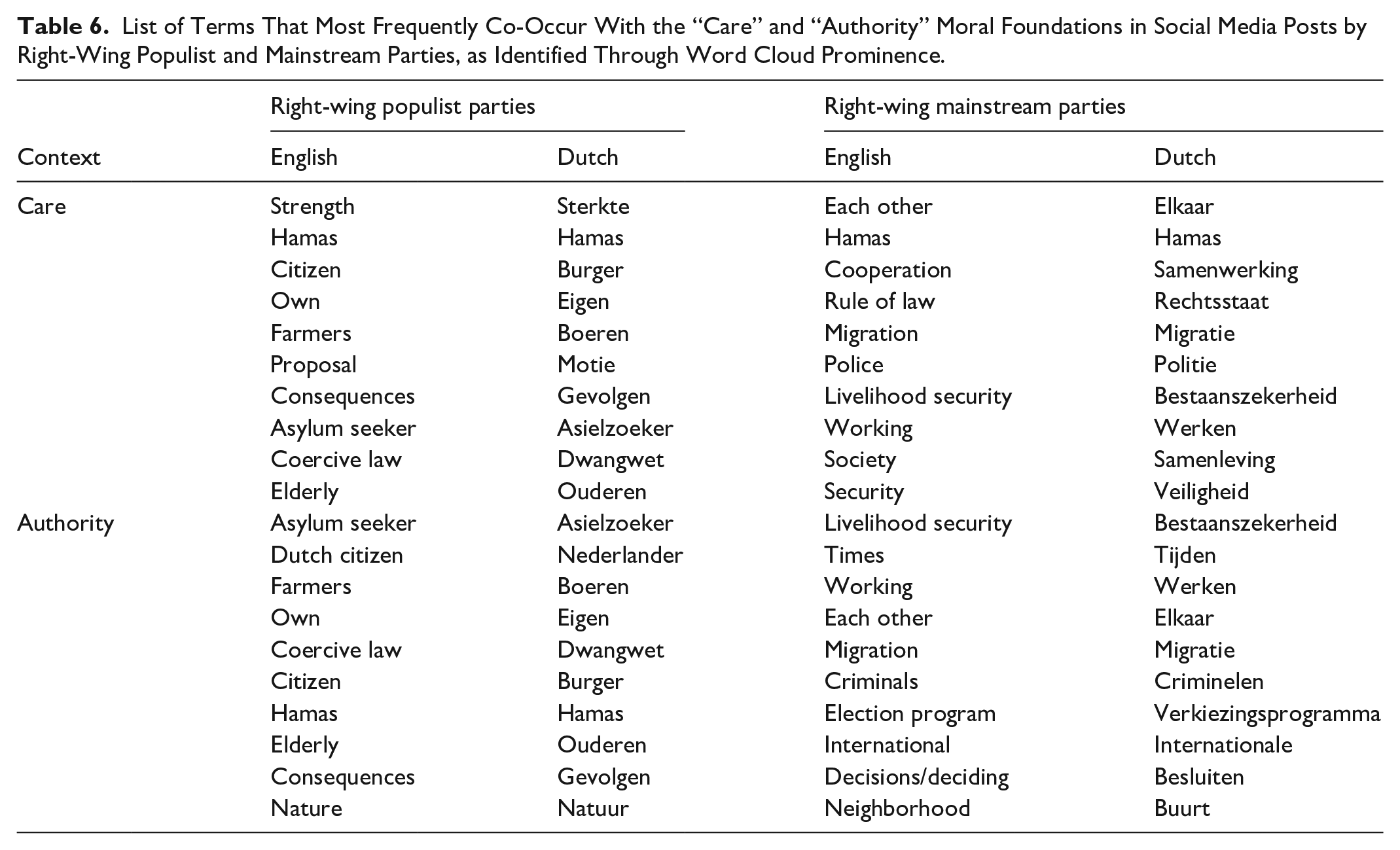
Right-wing populist parties often pair moral harm/care language with in-group references such as “citizen,” “own,” and “farmers,” emphasizing national identity and protection from perceived external threats or harm (e.g., “Hamas,” “asylum seeker”). Terms like “coercive law” and “consequences” suggest opposition to current policies, while mentions of “elderly” reflect concern for vulnerable in-group members. Similarly, their authority/subversion rhetoric seems to be combined with themes of nationalism and resistance.
In contrast, mainstream right-wing parties use harm/care language in combination with terms suggesting social cohesion and institutional trust, through terms like “cooperation,” “society,” “rule of law”, and “livelihood security.” Their authority discourse co-occurs with law-and-order themes, referencing “criminals,” “decisions,” and “neighbourhood.”
Additional analyses show that populist parties connect fairness and loyalty to economic terms like “business owner,” while purity overlaps with care and authority but also includes topics like “nuclear power.” The left-wing populist party (SP) links care and authority to health care, with frequent use of terms like “health care provider” and “elderly.” Full word clouds are available in the Supplementary material (see point 8.1).
Finally, to illustrate how harm/care and authority/subversion rhetoric can be employed in practice by right-wing populist and right-wing mainstream parties (NSC and VVD), we present concrete examples from the data corresponding to different moral foundations (see Table 7). Terms corresponding to the respective moral foundation in the table are highlighted in bold. Although not representative, these excerpts complement our quantitative analysis by demonstrating how moral rhetoric can manifest in practice.
Examples of Right-Wing Populist and Mainstream Party Posts Entailing the Harm/Care and Authority/Subversion Foundation.

Note. The examples were selected by focusing on posts that included moral language from the foundation-specific dictionaries, while also aiming to showcase a variety of social media platforms, account types, and political parties. Terms corresponding to the respective moral foundation are underlined and highlighted in bold. The posts can be found in original language in the Supplementary material under point 9.
Discussion
Social media have transformed political campaigning, helping populists thrive through the spread of emotional, binary “us vs. them” messages (Engesser et al., 2017; Saldivar et al., 2022; van Bavel et al., 2024). Yet, despite the centrality of such antagonistic language, we knew markedly little about the role moral foundations play in shaping the divide between us and them. We analyzed the occurrence of moral rhetoric in populist versus mainstream parties’ social media using MFT (Graham et al., 2009).
Our findings show that while populists do not use a sharply distinct moral vocabulary, they exhibit a unique moral-rhetorical profile by prioritizing different moral foundations than mainstream parties do. Specifically, populist parties particularly emphasize the moral foundations of Care and Authority, whereas mainstream parties, including those on the right, prioritize moral foundations differently based on their specific political orientation. This partially aligns with Bos and Minihold’s (2022) findings that populists emphasize Loyalty and Authority more than their mainstream counterparts on Twitter, but contrasts with Hackenburg et al. (2023), who found Trump uniquely used negative Fairness appeals. This difference may stem from their narrower focus on a single populist candidate, whereas our study examined five populist parties and leaders across three social media platforms, providing a more varied dataset.
Our context analyses reveal that right-wing populist parties employ moral harm/care and authority/subversion language in combination with national identity, sovereignty, and external threats themes, which suggests that moral rhetoric is used especially to express resistance to existing political structures. In contrast, mainstream right-wing parties tend to frame these moral foundations around themes of social cohesion, institutional trust, economic stability, and security. This distinction suggests that populist and non-populist actors engage moral rhetoric with different primary emphases—one reactive and exclusionary, the other integrative and system-oriented.
This suggests that the interplay between the harm/care and authority/subversion moral foundations and narratives of sovereignty and nationalism constitutes a key pillar of populist communication logic. This moral-rhetorical strategy enables populists to position themselves in two distinct but complementary ways. First, they present themselves as strong, decisive leaders who staunchly defend national and popular sovereignty. Second, they portray themselves as empathetic protectors of the “common people” (the in-group), shielding them from perceived harm posed by elites and out-groups. This interpretation aligns with research suggesting that right-wing populist discourse is tailored to resonate with individuals inclined toward authoritarian values, emphasizing the importance of strong leadership to maintain order and security (Fuchs, 2018). Furthermore, far-right populist messaging often normalizes authoritarian narratives by framing narrators as guardians of the popular will. They strategically appropriate the language of rights and freedoms to recast sovereignty in exclusionary terms, morally legitimizing restrictive policies as necessary responses to elite corruption and liberal decline (Alekseev, 2021; Krzyżanowski & Ekström, 2022). Importantly, these findings underscore how populist rhetoric is rooted in emotionally resonant moral narratives that appeal to audiences who share these foundational values. In this context, morality simplifies complex political issues into emotionally charged binaries of “good versus evil,” framing the populist agenda not merely as a political project, but as a moral imperative.
In our second bipartite network, which categorized moral language by the five moral foundations, the right-leaning mainstream parties VVD and NSC clustered with the populist parties, though less consistently and with more distance from the populist core. This suggests that mainstream parties adapt their rhetoric to their populist counterparts, and/or the other way around. Interestingly, populist parties clearly prioritize care and authority over loyalty and purity, which are foundations typically associated with the right (Koleva et al., 2012). We theorize that this shift may help them distinguish themselves morally from mainstream competitors and could partly explain their electoral success. Without this distinction, their appeal might blur with that of traditional right-wing parties. In support of this theory is a study by Marcos-Marne (2022) who found that traditional and conformist values (which are closely overlapping with purity and loyalty), typically associated with right-wing orientations, were found to reduce support for both left- and right-wing populists. Conversely, a lower emphasis on universalism (protection and tolerance for all beings) and a stronger focus on security were linked to right-wing populist voting. To what extent the distinct moral-rhetorical populist profile found in the current study, however, is reflected in support for Care and Authority among the Dutch populist electorate is up to future research.
Building on previous research (Lohmann & Zagheni, 2020; Stier et al., 2018), we hypothesized that social media platform differences influence the expression of ideology-specific moral foundations. To test this, we examined whether variations in moral language among populist and mainstream parties were more pronounced on some platforms than others. Although platform coherence was generally high, populist parties showed less internal coherence across platforms than mainstream parties. Populists displayed the highest coherence on Meta platforms (Facebook and Instagram), particularly in Loyalty and Purity, while Authority and Care were most consistent between Meta platforms and X. However, coherence between Meta platforms and X was weaker, likely due to differences in audience behavior: X fosters public conversation and polarized discussions, especially on politics (Engesser & Humprecht, 2015; Urman, 2019), while Meta emphasizes private interactions and community-building (Haman et al., 2022). In addition, X attracts real-time news seekers, particularly journalists (Rath et al., 2018), whereas Meta enables more in-depth engagement through longer posts and videos (Vidal-Alaball et al., 2019). For mainstream parties, moral coherence was more consistent across platforms. We tentatively conclude that populist parties are more likely to tailor their moral rhetoric to specific platform characteristics than mainstream parties, possibly to engage distinct audiences. While our study focuses on platform coherence rather than specific moral emphasis, it provides a foundation for exploring how moral priorities shift across platforms and the motivations behind these strategies. In our exploratory analysis, however, we did find that populist parties most frequently use harm-related moral language (vice care) and authority-related virtue terms, particularly on Facebook, which is interesting, as Facebook’s user base seems to align most with the characteristics of the populist voter base, which is predominantly middle-aged and slightly more male (Ipsos, 2023). In contrast to Facebook, Instagram skews more female and younger (Shane-Simpson et al., 2018). X, though slightly male-dominated, caters to professional and urban audiences, a demographic mismatch with PVV voters, who are primarily medium to low educated and not typically urban professionals (Ipsos, 2023).
While our primary focus was the moral-rhetorical divide between populist and mainstream parties, we also aimed to test the applicability of Hackenburg et al.’s (2023) novel network analysis method for detecting moral-rhetorical patterns in a multiparty system, as opposed to the two-party system in the US. Our findings indicate that the multiparty landscape in the Netherlands shows considerable overlap in specific moral vocabulary, making it challenging to clearly distinguish political factions along populist versus mainstream, conservative versus liberal, or left versus right lines. We recommend that future research on moral language in multiparty systems focuses on broader word categories rather than individual words, as this approach is likely to produce more stable and interpretable network structures. This recommendation may also be beneficial for studying other language types, such as emotional language.
Our study has several implications. By integrating natural language processing with network analysis, we mapped the dynamics of moral rhetoric in online discourse, enabling us to connect and differentiate Dutch political parties. The Netherlands, with its diverse populist party landscape, offers an ideal setting to contrast populist and mainstream parties in a multiparty system, providing a more nuanced view of moral values than in two-party systems like the United States. Moreover, unlike prior studies (e.g., Bos & Minihold, 2022; Hackenburg et al., 2023), which focused only on X/Twitter, our analysis includes Facebook and Instagram, yielding a fuller picture of online political discourse. In addition, we contributed a Dutch translation of the MFD 2.0, adaptable for various research needs, and outlined a course of action that can be replicated for other languages.
Our study also has limitations. Focusing solely on textual analysis overlooks significant content, especially on visually oriented platforms like Instagram and Facebook, where moral cues in images, videos and sounds are missed. In addition, the DMFD2.0 relies on a fixed set of moral terms, which may not fully capture the fluid, context-dependent nature of moral reasoning (Hopp & Weber, 2021; Sagi & Dehghani, 2013). This lexical approach risks missing nuances in real-world moral language, particularly in informal or social media contexts (Huang et al., 2025). Expansions like the extended Moral Foundations Dictionary (eMFD) attempt to address these gaps through crowd-sourced annotations (Hopp et al., 2020). Adapting the eMFD to the Dutch context would not have been feasible for our study. Moreover, it was developed using long-form news content and lacks coverage of important terms, particularly religious language relevant to Dutch political discourse. While automated lexicon-based text analysis may introduce biases (Lyu et al., 2023), it remains the most effective way for providing a standardized framework, ensuring reproducibility and consistency in comparative studies, and consistently detecting meaningful results on the aggregate as dozens of papers have demonstrated (Garten et al., 2018).
Moreover, our study is based on MFT, which relies on predefined moral categories. While useful, this approach may oversimplify moral diversity and overlook cultural and contextual variations (Davis et al., 2017; Graham et al., 2013). Future research should explore integrating alternative theories of morality, such as Morality as Cooperation (Curry, 2016), into the logic of populist communication to determine whether they offer a different perspective on the moral-rhetorical profile.
In addition, while this study adds to previous research by quantitatively showing that Dutch populists construct moral narratives distinct from non-populist parties, we can only theorize about how these values are used exactly to craft a moral narrative. A deeper understanding of the specific content and framing requires future qualitative research.
In conclusion, our study shows that Dutch populist parties have a distinct moral-rhetorical profile, emphasizing Care and Authority, whereas mainstream parties distribute moral appeals differently. These findings align partly with prior research, indicating that populists use moral language to position themselves as protectors against corrupt elites, appealing to voters seeking stability. In addition, populist parties demonstrated less internal coherence in moral rhetoric across social media platforms compared to mainstream parties, suggesting that populist politicians may be more adept at tailoring moral messaging to different platforms and audiences. As digital platforms increasingly shape political discourse, understanding these dynamics is essential for the future of political engagement and democratic health.
Footnotes

Ethical considerations and Consent to participate
The research complies with the guidelines formulated by the Ethics Review Board (FMG-UvA), University of Amsterdam, The Netherlands, and has been approved by the aforementioned Ethics Review Board on 03-06-2024. Reference number: FMG-9614.
Author contributions
Anna Wickenkamp: Conceptualization, Methodology, Formal analysis, Writing—Original Draft, Investigation, Visualization, Software
Frederic R. Hopp: Conceptualization, Validation, Writing—Review & Editing; Funding acquisition, Project administration, Supervision
Michael Hamleers: Conceptualization, Writing—Review & Editing, Supervision, Project administration
Linda Bos: Conceptualization, Writing—Review & Editing, Supervision, Funding Acquisition
Funding
The author(s) disclosed receipt of the following financial support for the research, authorship, and/or publication of this article: This project was funded by the Dutch Research Council under the Open Competition (NWO-M) Scheme.
Declaration of conflicting interests
The author(s) declared no potential conflicts of interest with respect to the research, authorship, and/or publication of this article.