



Abstract
Despite online risks and child labor concerns, Indian kidfluencers appear to thrive as they amass followers and engage in brand collaborations, thus significantly contributing to India’s influencer industry. I studied and analyzed selected kidfluencers’ profiles and their most popular videos and found that their parents manage their accounts and direct their content. This content often reflects dominant Indian culture using language, the portrayal of religious identities, and the enactment of family values. This strategy increases their follower counts but also exposes them to online risks and reinforces cultural stereotypes. Kidfluencers face exploitation as they scale their presence—that is, get more followers on a specific platform and get multiple accounts across platforms—on social media, especially in India where regulation is lacking. Abuse, bullying, and mental health issues are prevalent, necessitating urgent policy and advocacy efforts.
Kidfluencer craze
If you have come across short videos of cute children with charming personalities unboxing the latest toys or sharing updates about brand collaborations, you already know what a kidfluencer or kid influencer is. Despite online risks (Livingstone & Stoilova, 2021) and concerns over platformized child labor (Clark & Jno-Charles, 2025; Hudders & Beuckels, 2024), the kidfluencer craze refuses to subside. Indian kidfluencers, too, are becoming more popular and generating widespread interest on the internet, having amassed millions of followers, brand collaborations, television shows, and film deals. One report estimates that India has millions of influencers on Instagram with more than 75,000 of them being kidfluencers (Bagai, 2025).
Some of these kidfluencers have amassed millions of followers on Instagram. Below is a list of selected Indian kidfluencers (identities protected) with more than 500,000 followers (Table 1). My method and analysis are inspired by digital ethnography and visual analysis resources popularly used to study Instagram influencers and content (Pink et al., 2015; Sloan et al., 2016; Varis, 2015). Specifically, I first started following some of these kidfluencers in 2023–2024. I also searched lists available online on sites like Agency Masala, GRY NOW, and FeedSpot in 2025 to expand on the list, resulting in a purposive dataset of eight kidfluencers whose accounts are public and open. I manually collected information via screen grabs and observation notes about their content practices and dynamics by studying their Instagram profiles, and analyzing some of their most popular videos, known as Reels on Instagram.
List of Selected Kidfluencers in India with 500 K+ Followers.
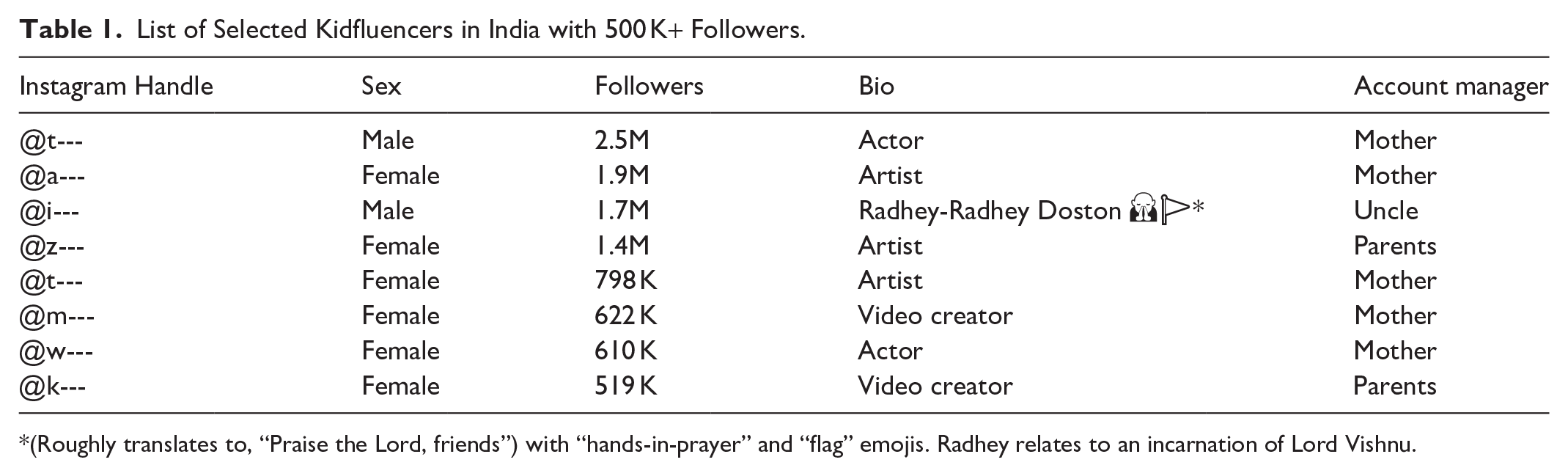
(Roughly translates to, “Praise the Lord, friends”) with “hands-in-prayer” and “flag” emojis. Radhey relates to an incarnation of Lord Vishnu.
By following trends like lip-syncing the latest songs or dialogues; trying on fashion and make-up looks; or recommending trending dance routines, books or recipes (Alexander, 2024; Singh, 2024), these kidfluencers are contributing through brand collaborations, advertising and sales to India’s influencer marketing industry, which is “estimated to reach INR 3,375 crore by 2026” (ETBE Staff, 2024). India is such a massive and attractive market, that global creators often fly down and collaborate with Indian influencers to capitalize on the growth that these markets and audiences provide (Joe, 2024).
It comes as no surprise that kidfluencers’ content is often commercialized, with their activities and personas being used to market products. This commodification of their everyday lives and activities is available on platforms for their followers and subscribers to view and interact with. It fuels consumption of products they are selling or promoting. For example, some Indian kidfluencers have their own online shops to sell the looks—that is, fashion pieces—that they have curated or products from brand collaborations, raking in millions while policies and laws are still playing catch-up (Vats, 2022). However, there is also another layer to be unpacked within these commodification and consumption patterns: that of how dominant culture is perpetuated through these kidfluencers’ content.
Themes of dominant culture
Drawing on Senft’s (2013) concept of “microcelebrity,” Abidin’s (2015) work on “micromicrocelebrity” has been one of the earliest and foundational contributions to scholarship on babies and toddlers becoming internet famous because of their parents. We see similar trends in India where children as young as 6-months-old are starting out as kidfluencers, in part due to their parents who desire for them to become—or already are—digital content creators, actors, or models (Muskan, 2024), or managers of their kids’ social media accounts.
It is obvious that the parents and adults—and not the young children—are making decisions about the content that is published on kidfluencer accounts. In fact, even as these kids become tweens and teens, the parents who become their managers retain control of their accounts. Often, these parent managers are mothers of their children and referred to as “momagers.” They make choices about content production, brand collaborations, and contracts such that their kidfluencers’ audiences and earnings keep growing (Abidin, 2023; Archer & Delmo, 2023; Van den Abeele et al., 2024).
In the Indian kidfluencer context, I observed that parents often use specific language and linguistic norms that are part of the dominant culture (i.e. Hindi) or use language considered to be aspirational (i.e. English); they may also switch between the two using Hinglish (i.e. Hindi and English) (cf. Mohanty, 1994; Parshad et al., 2016; Ranjan, 2021). Kidfluencers content also tends to focus on specific religious identities, predominantly Hinduism. They use family values and relationships like living with multiple generations in the same house, respect for elders while maintaining a patrifocal family ideology and the religious customs to be followed in everyday life like prayer to further the perpetuation of dominant culture. These dimensions of Indian culture have been found to have implications extending to influencer marketing in the Indian context (Banerjee, 2008; Stoddard et al., 2023). I discuss these three major themes below.
Language and linguistic norms
Per my analysis, most of the popular kidfluencers on Instagram in India use English, Hindi, and Hinglish in their content. English is still a marker of the elite and privileged class in Indian society (Highet, 2021; LaDousa, 2014). Generally, those who have received education in a private or public-aided school of high standard can speak English comfortably, and often with a posh accent which many of these children demonstrate. Another common language used by these young people online is Hindi, which is widely spoken in the North of India and accepted as lingua franca over the regional languages and dialects (Chand, 2011; Khan & Jayaraj, 2024). The incumbent Bharatiya Janata Party (BJP) has been accused of imposing Hindi in other parts of India, which is concerning in a country with more than 700 languages (Ellis-Petersen, 2022).
There have been instances where popular platforms like TikTok—now banned in India—have appeared to support regional vernacular cultures to flourish (Sarwatay et al., 2023). Other Indian-based social media and short video platforms like ShareChat, Josh, Moj, or Chingari—all of which became popular when TikTok was banned—also allow these regional cultures to thrive. While these local apps remain popular, global apps like Instagram allow most major kidfluencers to build millions of followers and accumulate more mainstream visibility. This is why they flock to these platforms and use English, Hindi, and Hinglish more prominently. Linguistic norms govern the language in which kidfluencers present their content, and the next section is about what that content consists of.
Focus on specific religious identities
Some kidfluencers share content of a spiritual and/or religious nature, mostly capturing the dominant Indian Hindu culture. For example, kidfluencers will appear in Reels while lip-syncing popular prayers and songs with symbols like the “tilak”—a mark on the forehead, usually red in color, which signifies Hindu affiliations—and traditional Indian attire like long, flowy, colorful tops and matching bottoms. Stories and songs from Indian mythology, depiction of and participation in religious ceremonies, or practices like yoga and meditation are also featured. This is an attempt to present their own identities as curated by their family backgrounds and parental nudges. Another reason for this presentation of themselves online is to celebrate popular Indian festivals and religious customs. The figure below (see Figure 1) is an AI-generated image based on screengrabs I have captured from a kidfluencer’s Reels page, depicting him with hands joined in prayer, donning traditional Indian Hindu attire, and wearing the “tilak.”
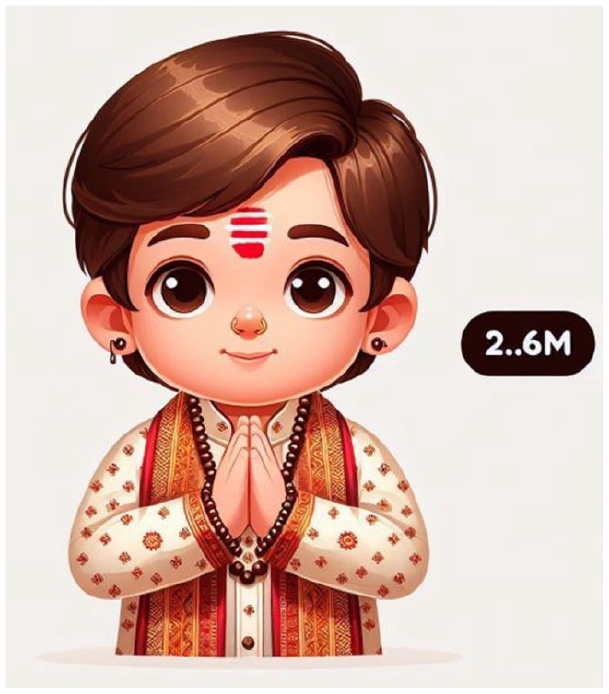
Image depicting a kidfluencer’s Hindu identity. Image by author using Microsoft Copilot to protect child’s identity.
It is notable that this kidfluencer’s content contains lip-syncing to prayers, celebrating Indian festivals, and participating in religious customs. He has managed to capitalize on his fame as a kidfluencer and is now also a child actor who acts in popular Indian television serials. He has recently been cast in a religious drama on television and sometimes includes behind-the-scenes videos or promotional content from the shows on his Reels page. As such, he is widely considered a success story. It is concerning to see children so young displaying religious attributes in their content. In a country that is supposed to be secular and diverse but that currently has a right-wing party in power, content like this becomes subsumed in Hindutva narratives. Hindutva is a political ideology that advocates for establishing Hindu nationalism and dominance in India. While religious identities form one part of their self-presentation, another aspect focused on is their family life.
Family values and relationships
Nearly all kidfluencers’ journeys start with their parents showcasing their family values and the relationships of kidfluencers with parents, siblings, relatives, and friends. Often, it is the parents’ lives that are presented through the lens of the kidfluencers’ online presence. For example, the lived realities of mothers’ pregnancies are framed in posts of the kidfluencer announcing that “I’m going to be a big brother/sister,” or deaths in the family are announced with the kidfluencer declaring that “I will always miss you grandpa/ma.” This is an attempt to display authenticity and relatability by showcasing family life, events, and relationships that resonate with their followers and audiences. Parental involvement in kidfluencers content also generates engagement and trust as it comes across as family sanctioned, supervised, and approved. This is also attractive to many brands who want to engage with family-oriented audiences and seek out collaborations with these kidfluencers. In my observation of the selected kidfluencers, leading child-oriented multinational companies like Mattel, FirstCry, and Kinder Joy, are some of the brands that have collaborated with Indian kidfluencers.
Parents also lead kidfluencers content generation to focus on celebrating family bonds in everyday life, like cooking and eating together, commemorating family events like birthdays, and vacationing or shopping together. Most kidfluencers’ videos portrayed a close-knit family dynamic. They showed positive, educational content, for example, reading and learning from books, managing anger and disappointment, and celebrating their kids’ achievements. Videos portrayed kidfluencers growing up in an Indian family that works and plays together, which are very appealing qualities to Indian audiences.
However, this also means that they might reinforce stereotypes that are normally prevalent in Indian society like gender roles (i.e. mum cooks for me and dad goes to work) and even perpetuate typical gendered practices (i.e. girl kidfluencers producing fashion and make-up content and boy kidfluencers producing gaming content). While there is nothing inherently wrong with fashion or gaming content, perpetuating the idea that a certain genre or type of content is specifically for girls and boys respectively is problematic. This can limit the scope of interest and activities that children feel are acceptable for them to pursue, restricting individual expression, impacting self-esteem and socialization, and influencing career aspirations. The AI-generated image below (see Figure 2) is based on screengrabs I have captured from a kidfluencer’s Reels page, depicting content where she is seen with her family in Indian attire and celebrating a family day together.

Image depicting a kidfluencer with her parents. Image by author using Microsoft Co-Pilot to protect child’s identity.
This kidfluencer creates funny sketches dressed up like an Indian woman to represent typical Indian mothers and how they behave with their girls. In these sketches, her parents often direct her content to show funny arguments between mother and daughter based on “typical” everyday situations, with the kidfluencer role-playing both parts. In other videos where the kidfluencer is featured with her mother, they are shown vacationing abroad, shopping, and spending time with the family.
Kidfluencers as directed by parents and other adults find themselves in Instagram Reels that perpetuate these three themes of dominant culture in India. This strategy works as I observe their followers grow in number over time. Kidfluencers also create multiple accounts across platforms increasing their presence online. This expanding online presence also leads to their increased exposure to abuse online and other perils of fame. For example, kidfluencers may become too preoccupied with content creation; feel stressed about delivering on commitments; experience a blurring of reality between the family life they are living in juxtaposition to impressions in the social media posts; and face trolling or harassment online when dealing with followers (Bhowal, 2024; Bhuyan, 2024). Questions with regards to cultural hegemony and its challenges are important of course, but what happens to these kidfluencers as their content becomes more popular and the demands of the “job” outweigh the joys of digital exploration and socialization?
Implications
Across the globe, children have become entangled with social media commerce (Abidin, 2023). From their days of watching adult influencers on platforms, children are now dreaming of and becoming kidfluencers themselves (Abidin, 2015, 2017; Hudders & Beuckels, 2024; Hudders et al., 2024). Kidfluencers and commodification go hand in hand as they scale up their platform presence—that is, grow follower counts—and create multiple accounts across different platforms. We now see a convergence of several traditional and new media industries becoming potentially exploitative of young people’s aspirations to establish careers in the influencer industry (Lee et al., 2024). This exploitation is compounded in contexts like India where we have barely scratched the surface on regulating influencer labor (Katrak & Kulkarni, 2025). News media is reporting on the abuse and the bullying that some kidfluencers in India have to “bear” as the “cost” of fame and the mental load of being constantly online (Bhowal, 2024; Bhuyan, 2024). Unfortunately, there is not yet substantial research, advocacy, or policy for kidfluencers in India barring a few calls. For example, a recent call for a national policy on social media for young people—as correspondence regarding young people’s mental health—and another for framing regulatory policies, parental advisories and critical digital literacy and media education programs (Sarwatay & Raman, 2022; Suhas, 2025). This needs to change if we want to protect our next generation’s future.
Footnotes

Funding
The author(s) received no financial support for the research, authorship, and/or publication of this article.
Declaration of conflicting interests
The author(s) declared no potential conflicts of interest with respect to the research, authorship, and/or publication of this article.