



Abstract
Since social media influencers have become popular and monetize their content with the help of advertising deals, they have been associated with morally questionable, deceptive behavior. The list of misconduct is long. It includes, for example, not disclosing sponsored content, withholding negative experiences with promoted products, buying fake followers, and promoting false ideals of beauty. Building on the concept of “dirty work” as a theoretical framework, this article asks which strategies influencers use to soften this moral taint. Qualitative interviews with influencers living in Germany show that they are aware of their negative image in public and use various stigma management strategies. This article offers a perspective that has not yet played a role in the ethics debate about influencers. It asks how influencers, who are often associated with morally questionable practices, immunize themselves against this negative image and find a positive work identity.
Introduction
Social media influencers (hereafter called “influencers”) are persons who produce photos, videos, or texts and distribute their content successfully with the help of social media platforms. Influencers often start as ordinary internet users sharing self-produced details of their lives and subsequently become prominent by building a large audience of followers. In addition, they often appear as experts on specific topics, such as beauty, fashion, fitness, food, or gaming. Unlike traditional celebrities, influencers have built their fame on social media without being known to the public beforehand. According to Abidin (2015, Influencer Mother section, para. 2), influencers are “ordinary internet users who accumulate a relatively large following on [. . .] social media through [. . .] the narration of their personal lives and lifestyles.” While traditional stars “keep their private lives private and rarely have their photographs taken outside of official events” (Jerslev, 2016, p. 5238), influencers usually celebrate the private self and build a very close relationship with their followers. Because of the influencers’ reach on social media and their close relationship with their followers, marketing professionals became interested in influencers as strategic tools to promote commercial messages (Gerhards, 2019; Hudders et al., 2021; Lou & Yuan, 2019; Ye et al., 2021). Influencers began to “leverage their online popularity in exchange for money, goods, and services” (Ebben & Bull, 2023, p. 2), generating revenue and turning what they did into a profession.
Since influencers have become popular, they have come “under public scrutiny due to their questionable practices and ethical concerns” (Grgurić Čop et al., 2023, p. 1), such as not labeling advertising cooperations correctly, deceiving their audience about the commercial nature of their content, buying fake followers, withholding negative experiences with promoted products, or reviewing products they have not tested at all. The list of moral misconduct and scandals is long (see, e.g., Leban, 2022; Michaelsen et al., 2022). Regardless of whether the individual influencer actually behaves immorally, influencers as an occupational group are suspected of using unethical practices. This critical view of the morality of influencers’ work is not limited to scholarly research: population surveys also underline the negative image of influencers in the public eye—only 6% of British above the age of 15 years trust influencers to tell the truth, thus making them the least trusted of all occupations (Ipsos MRBI, 2021). Another study, which questioned more than 22,000 people in 16 countries, even concluded that an influencer is one of the least respected professions: the profession of influencer ranked 20th, near the bottom of the 24 ranked professions worldwide (Smith & Ballard, 2021); only the occupations of factory worker, truck driver, call center worker, and miner were ranked worse than influencer. However, the survey by Smith and Ballard (2021) also shows that there are country-specific characteristics regarding the image of influencers. As the study highlights, being an influencer, as a profession, garners very little respect in Spain, France, Italy, the United Kingdom, Denmark, and Germany; in Mexico, Sweden, the United States of America, and Australia, the profession is also poorly respected, but its reputation is not as bad as in the countries mentioned previously. In contrast, being an influencer is highly respected in the United Arab Emirates, Indonesia, India, China, and Singapore (Smith and Ballard, 2021).
Clearly, being an influencer is an occupation that seems to be highly tainted in some countries. Influencers are suspected of working with deceptive methods and acting in a morally questionable manner (Hudders & Lou, 2022; Kozinets et al., 2023; Leban, 2022). In sociology, there is a term for occupations that have such image problems and a bad reputation: “dirty work.” The concept of dirty work was created by the American sociologist Everett Hughes in the 1950s and offers a theoretical framework for analyzing tainted occupations. Sociological studies and the management literature have examined various occupations, including jobs in the media and communication industry (e.g. public relations managers; Hoffjann et al., 2023; Sommerfeldt & Kent, 2020), with the help of this concept. However, the author is not aware of studies that have examined influencers through the lens of this approach. Digital labor studies have applied the lens of dirty work to professions such as commercial content moderators (Steiger et al., 2021) or online sex workers (Siegel et al., 2022) but not to influencers and their stigma in purportedly using deceptive, unethical methods. Other digital labor studies that have focused on the influencer profession have mainly analyzed the economically precarious aspects (“hope labor”; Duffy et al., 2024) or negative health effects of the algorithm-driven pressure of visibility (Duffy et al., 2021; Schöllhammer & Gretzel, 2024), but they have not taken the image of influencers in the public eye into account or used the dirty work approach (with its moral dimension) as a theoretical framework.
This article investigates influencers as dirty workers. Dirty work is meant here in a moral sense. In countries where influencers have a good image in the public eye, the dirty work issue does not play a role. It can be assumed, however, that in countries where the image of influencers is negative, many influencers might have to deal with it in one way or another. This article focuses on influencers living in Germany. As several cross-country studies have highlighted, Germany is a country in which the public is particularly critical of influencers (Ernst & Young, 2024; Smith & Ballard, 2021). Against this backdrop, this article explores two research questions:
RQ1. To what extent are influencers aware that their public image is negative?
RQ2. If influencers are aware of their negative image, what kinds of strategies do they use to soften the taint and give their work a positive meaning?
Exploring these research questions, this study aims to provide new impulses for influencer research and theoretical frameworks to analyze influencers’ work in countries where the image of influencers is negative in the public eye.
The remainder of this article is divided into four sections. A literature review is presented that focuses on the moral aspects of the work of influencers. This section also explains the concept of dirty work, and the specific stigma management strategies of tainted workers are identified. The study then asks how influencers deal with the fact that their profession is often perceived negatively by the public. To answer this question, semi-structured interviews were conducted with influencers from Germany (n = 14). After describing the process of recruiting the influencers, the content of the interview guide, and data analysis, the findings of the explorative interviews are presented. The final section discusses the findings. The theoretical and practical implications of the findings are also outlined, the limitations of the study are illustrated, and the implications for future research are considered.
Literature review
Moral misconduct typically committed by influencers
This section provides an overview of the limited research on influencer ethics and identifies the key forms of moral misconduct mentioned in the literature. Studies that focus on moral aspects of influencers’ work or systematically examine the ethics of the influencer industry are scarce. The scholarly literature has identified different practices that make influencers appear morally dubious. Morally questionable behavior can be systematized by differentiating which of an influencer’s stakeholders are affected in terms of audience-related, brand-related, and society-related behavior (Grgurić Čop et al., 2023).
Audience-related behavior
Studies that address audience-related moral issues have focused in particular on the covert nature of embedded commercial messages in influencers’ organic content, which makes it difficult for consumers to discern commercial from non-commercial content (Abidin & Ots, 2015; Van Driel & Dumitrica, 2021). Non-disclosure violates existing regulations and consumers’ moral right to be informed when they become targets of persuasion. It is unethical behavior if influencers hide the commercially persuasive nature of sponsored content, because their followers perceive them as peers and, in this role, as authentic and credible sources of information. As a result, the audience “may be less resistant toward their endorsements compared to brand-originated marketing communication and sources” (De Veirman et al., 2019, p. 6). In practice, non-disclosure is widespread among influencers, and paid partnerships with brands are often masked to appear as non-sponsored content. According to a recent study commissioned by the European Commission and surveying influencers from 24 European countries, only 20% of influencers label their commercial posts (Reuters, 2024).
However, as some studies have highlighted, misconduct occurs not only among influencers but also among marketers and agency professionals. Davies and Hobbs (2020) interviewed representatives of public relations agencies and described that it is common practice to instruct influencers to create paid endorsements that look natural so that the commercial intent is hidden (for the audience). As Davies and Hobbs (2020) note, industry codes or guidelines are usually not communicated to influencers. With the help of an influencer survey, Gerhards (2019) also shows that many influencers often experience agency professionals or marketers instructing them not to label sponsored content correctly.
It is also a moral concern if influencers promote products that they have not tested at all (Grgurić Čop et al., 2023) or only endorse products because they are compensated for doing so (Wellman et al., 2020). In each case, authenticity is violated. According to Wellman et al. (2020, p. 74), authenticity should be interpreted as a moral concept because “accepting a deal strictly for compensation is viewed as an ethical misstep.”
To avoid the covert and deceptive nature of advertising integration, some scholars have formulated ethical principles that influencers should follow. Cocker et al. (2021), for example, define five moral responsibilities for influencers: honest and unbiased reviews, organic content overcoming sponsored content, substantial value of the content, avoiding oversaturation with the same brand, and endorsement of products they genuinely use and like. Kozinets et al. (2023) demand that influencers should always be truthful and never use unverified claims or exaggerate product claims. Borchers and Enke (2022) add further ethical principles that both influencers and brands and agencies should follow.
As public figures with a certain reach, influencers are role models for their audience, especially for their young fans and followers (De Veirman et al., 2019). Some recent studies have shed light on influencers’ negative impact on the wellbeing of their followers. Barari (2023) and Schmuck (2021), for instance, show that following influencers increases a specific social media-related mental problem called fear of missing out. This mental problem is characterized by the desire to stay continually connected with what others are doing and can lead to diminished wellbeing. Another issue is the beauty ideal often propagated by influencers, which might negatively affect the wellbeing of followers. Goetz (2020), for instance, found with the help of a representative study with German female teenagers that the vast majority compared themselves to female influencers and tried to imitate their propagated idealized beauty standards (for instance, to be as slim as possible). “Furthermore, exposure to influencers may evoke envy among followers as they often flaunt a lavish and luxurious lifestyle” (Hudders & Lou, 2022, p. 154). In a two-wave survey study, Chae (2018) examined how female consumers compare their lives with those of influencers, concluding that upward comparison leads to envy and lower self-esteem among followers.
Brand-related behavior
Buying followers has also been mentioned in the literature as a frequently occurring misbehavior among influencers (Alipour et al., 2024). According to Gerhards (2021), who surveyed representatives of agencies about their experiences and expectations regarding “good” influencer behavior, it is a common practice for influencers to buy followers and deceive both their cooperation partners (agencies and brands) and their audience about their true reach. Influencers know that their reach numbers correlate with their attractiveness for brands and advertising deals; thus, “they intentionally inflate their metrics” (Baklnanov, 2020, influencers involved in fraud in Germany section, para. 3). Baklnanov (2020), who analyzed more than 100,000 accounts of German influencers on Instagram, concludes that half of the influencers with more than 20,000 followers were involved in fraud cases, which means that they had bought followers.
How brands and marketing professionals can protect themselves against influencer deception has been the subject of a small number of studies. McMullan (2023), for example, offers a checklist for marketers to avoid pitfalls when working with influencers. Kintu and Ben-Slimane (2020) analyze how companies responded communicatively to a scandal caused by an influencer with whom they had cooperated. According to Reinikainen et al. (2021), influencer betrayal can negatively affect consumers’ perception of a brand that an influencer has endorsed.
Society-related behavior
As Borchers and Enke (2022) and Grgurić Čop et al. (2023) have shown, society expects people with high influence, particularly over young people, to be role models and behave accordingly. Research has suggested that influencers often do not fulfill this function. Scholars highlight misconduct such as the glorification of a superficial, materialistic, consumer-driven behavior, the propagation of stereotypical gender roles, and false beauty ideals (Hudders & Lou, 2022; Klicksafe, 2023). Furthermore, influencers have been criticized for promoting harmful products that have negative effects on audiences and society. These include unhealthy food products, meaning foods high in fat, salt, or sugar (De Jans et al., 2022; Potvin Kent et al., 2024). The European Consumer Organisation (BEUC) has therefore demanded that the promotion of certain products and services by influencers should be prohibited (European Consumer Organisation [BEUC], 2023, p. 24). The list of harmful products includes aesthetic surgery and cosmetic procedures, electronic cigarettes, sports betting sites, and financial products and services.
In summary, research has identified several forms of moral misbehavior typically committed by influencers (see Table 1).
Morally Questionable Behavior Associated With Influencers.

How influencers deal with morally questionable aspects of their work
There have been very few studies that focus on the influencer perspective and ask what strategies influencers use to handle moral issues. Grgurić Čop et al. (2023) used role theory as the theoretical framework for examining how influencers perceive their role in relationships with brands, followers, and society. In their brand-related roles, influencers feel that they are expected to be billboards and should represent a brand positively; in their follower-related roles, they are expected to be close friends, entertainers, and reliable reviewers; and in their society-related roles, they should behave as role models. Faced with three sets of expectations from different stakeholders, influencers are confronted with different moral dilemmas. As Grgurić Čop et al. (2023) emphasize, most dilemmas come from the conflict between influencers’ commitment to a brand and followers’ expectations of getting authentic content. Faced with such role conflicts, influencers use different strategies to decide how to handle moral dilemmas.
One strategy is to downplay the follower-related role. For example, if influencers promote products that they have not tested, they downplay the issue and assume that their fans recognize in the influencer’s tone and choice of expressions “whether they are (dis)honest about product experiences and sponsorship deals” (Grgurić Čop et al., 2023, p. 11). Another strategy to solve moral dilemmas is “customizing a role,” which means that influencers who withhold negative experiences with promoted products justify the content omission by saying that their bad experiences might be isolated cases. Seen from this angle, withholding negative experiences with products/brands can be reinterpreted as being authentic. The follower-related role is thus customized.
The latter strategy to solve moral dilemmas is also described by Wellman et al. (2020, p. 75), who interviewed travel influencers, destination marketers, and other stakeholders in the travel industry. They argue that influencers “rely on ethics of authenticity when navigating” (p. 69) through moral dilemmas between the different expectations of brands and followers. Travel influencers usually keep quiet when they have had negative experiences with brands (e.g. hotels).
Leban et al. (2021) interviewed high-net-worth influencers and asked them how they reconcile ethicality and living an unbelievably luxurious life. They also identified specific strategies influencers use to reduce moral dilemmas. For instance, high-net-worth influencers compare themselves with other influencers and strictly distance themselves from the nouveau riche, who, in their eyes, act immorally when they boast about their luxury. Another strategy for reducing moral dilemmas is that influencers who live extremely luxurious lives use their lifestyle to support charity events.
Previous research examining moral issues from the influencers’ perspective has primarily investigated how they solve moral dilemmas that arise from the expectations of different stakeholders, with a focus on how influencers react to the divergent expectations of followers, brands, and society and how they find strategies to justify moral misbehavior. No attention has been paid to the question of how influencers deal with the fact that they practice a profession that has a negative public image in many countries. As shown in the literature review, several studies have highlighted that influencers use ethically questionable methods that can negatively affect the audience, cooperation partners, or society. It can be assumed that this morally dubious behavior is responsible for the negative external perception of influencers in many countries (as manifested in surveys: see, e.g., Ipsos MRBI, 2021; Smith & Ballard, 2021). The negative public image of influencers, however, is usually not the focus of research interest. Accordingly, the extent to which influencers are aware of their negative image, and, if they are aware, what kinds of strategies they use to immunize themselves against the negative public image have been under-researched. These questions are explored in this article, which uses the dirty work approach as a framework.
The next section first introduces the dirty work approach. The results of an interview study with influencers are then presented, and the strategies they use to immunize themselves against outside perceptions are explained.
The dirty work approach and stigma management strategies
The aim of the dirty work approach is not to ask how influencers deal with the expectations of different stakeholders and solve moral dilemmas, to explore the dangerous effects of moral failings on the audience, or to develop ethical guidelines. The dirty work concept asks which strategies dirty workers use to immunize themselves against negative external perceptions and to create a positive work role identity.
Hughes (1951) invoked the phrase dirty work to refer to tasks and occupations that are likely to be perceived as dishonest or even disgusting. Dirty work is work that is physically, socially, or morally tainted (Hughes, 1958). Physical taint occurs where an occupation is directly associated with garbage, death, effluent, and so on (e.g. garbage collector, butcher, and funeral director) or is thought to be performed under dangerous conditions (e.g. miner and soldier). Socially tainted work means that the occupation involves regular contact with people or groups that are themselves regarded as stigmatized (e.g. prison warden and psychiatric ward attendant). Moral taint occurs when an occupation is generally regarded to be “somewhat sinful or of dubious virtue” (e.g. striptease dancer, casino manager) or where the occupation is thought to use methods that “are deceptive” (e.g. tabloid reporter, paparazzi, and used car salesman; Ashforth & Kreiner, 1999, p. 415). “Because contact with dirt is believed to be contaminating, individuals who perform dirty work come to be seen literally as dirty workers. In the eyes of the public, they are what they do” (Ashforth et al., 2007, p. 149).
Management studies in particular have examined dirty work occupations. How dirty workers deal with the stigma of their occupations has been well explored for various occupations such as abortion clinic medical staff, animal researchers, online sex workers (moral stigma), criminal lawyers (social stigma), and morticians (physical stigma; Ashforth et al., 2007; Siegel et al., 2022). Media and communication studies, however, rarely focus on dirty work. If scholars examine dirty professions in the media and communication industry, they tend to focus on public relations and advertising, both occupation fields with a morally tainted, negative image (Bridgen, 2018; Grandien, 2017; Hoffjann et al., 2023; Sommerfeldt & Kent, 2020; Thurlow, 2009). It is the persuasive character of the messages that evokes “suspicion and distrust in the eyes of the public” (Grandien, 2017, p. 74): People think that spokespersons, public relations managers, and advertisers “lie, twist or spin the truth” (Thurlow, 2009, p. 255) and use deceptive methods. That is why they are perceived as dirty workers.
According to the dirty work approach, tainted workers use certain strategies to normalize occupational taint and immunize themselves against their negative image. Ashforth et al. (2007) and Ashforth and Kreiner (1999) identified 13 different stigma management strategies (see Table 2).
Dirty Work Stigma Management Strategies.

Note. Adapted from Ashforth et al. (2007, p. 159).
One strategy is reframing, which means that the positive values of a dirty, stigmatized occupation are highlighted to neutralize the negative value, for example, “[e]xotic dancers and prostitutes claim that they are providing a therapeutic and educational service, rather than selling their bodies” (Ashforth & Kreiner, 1999, p. 421). Another strategy is refocusing, which means that “the centre of attention is shifted from stigmatized features of the work to the nonstigmatized features” (Ashforth & Kreiner, 1999, p. 423). For instance, it is refocusing if tabloid reporters and paparazzi, thought of as morally tainted workers (Ashforth & Kreiner, 1999, p. 415; 2014, p. 87), draw satisfaction from their flexible hours or enjoy being outdoors while waiting for the right shot of a celebrity. The strategy of recalibrating can make “an undesired large aspect seem smaller and less significant, and a desired but small aspect seem larger and more significant” (Ashforth & Kreiner, 1999, p. 422). For example, although paparazzi rarely succeed in taking pictures of world-famous celebrities, they might define themselves in the heroic light of world stars.
The social buffer strategy means that “distinctive in-groups provide a bulwark against identity threats” (Ashforth et al., 2007, p. 158). It is also a strategy to “confront public perceptions of taint” by “extolling values and/or rebutting specific issues” (Ashforth et al., 2007, p. 158). Tabloid journalists, for instance, could confront the public with the fact that they, and not only quality journalists, uncover political scandals and thus play an important socially relevant role. Another strategy is avoiding behavior. This is a strategy that allows “one to evade attributions of dirt” (Ashforth et al., 2007, p. 158). For example, if paparazzi label their job “photojournalist,” they use a non-stigmatized term to describe their occupation and evade negative attributions. In addition, dirty workers can soften the taint with the help of dark humor “that acknowledges the taint, thereby revealing tension” (Ashforth et al., 2007, p. 158). The strategy of accepting means “resignation that one cannot affect certain events” (Ashforth et al., 2007, p. 158) or tolerating the status quo stoically.
Social comparison means that members of dirty work occupations may compare themselves to others perceived as worse off. It is social comparison, for instance, if a German tabloid reporter compares himself with British tabloid reporters, who might have an even worse reputation. Another way in which individuals may defend themselves against the derogatory perceptions of others is by condemning their condemners. In doing so, dirty workers try to impugn the legitimacy of their critics. Blaming and distancing from clients is another strategy that pinpoints the clients of the dirty workers as the cause of stigma (Ashforth et al., 2007, p. 159). For instance, paparazzi use this strategy if they accuse media companies and their audiences of demanding lurid and scandalous photos. Distancing from the role means that dirty workers try to separate themselves from stigmatized aspects of their work.
The stigma management strategies conceptualized by Ashforth and Kreiner (1999) and Ashforth et al. (2007) are the guiding framework used here to analyze how influencers deal with the fact that their work is tainted in the public eye.
Methods
Recruitment and participants
The influencers were solicited through a mix of personal contacts and cold calls. Many of these were the author’s own personal contacts (due to organizing professional conferences on influencer marketing, for example), while others were based on the personal networks of 15 marketing students in a master’s degree program, who were involved in the influencer recruitment process as part of a teaching research project in summer 2022 and summer 2024 at Hochschule Düsseldorf—University of Applied Sciences (Germany). The influencers were contacted directly or through their managers. The potential candidates were contacted through email, website contact pages, or Instagram direct messages. A snowball sampling technique was also applied, asking potential influencers to recommend other candidates. In addition, the German Influencer Marketing Association (Bundesverband Influencer Marketing), which has 22 agency members, distributed the influencer recruitment call to some of its members (particularly artists’ management agencies) who have influencers under contract. Many inquiries remained unanswered, but, despite these challenges, 14 influencers were recruited. The number of interviewees might be low, but previous researchers interested in influencers’ moral behavior have reported meaningful findings with similar or even lower sample sizes (Grgurić Čop et al., 2023; Leban et al., 2021).
Based on their number of followers, influencers can be categorized as mega-influencers (with more than 1 million followers), macro-influencers (with 100,000 to 1 million followers), micro-influencers (with 10,000 to 100,000 followers), and nano-influencers (under 10,000 followers; Campbell & Farrell, 2020). In this study, the selection criterion for choosing the influencers was that they had at least 10,000 followers on a social media platform. Nano-influencers were excluded, as it can be assumed that they often see being an influencer as a hobby rather than a profession and have little experience of monetizing their content. In the present study, six persons belong to the category of macro-influencer and eight are micro-influencers. Mega-influencers could not be acquired, as it is particularly difficult to reach this group due to their fame. When contacting and selecting the influencers, it was ensured that they covered different topics of interest (see Table 3). The author did not pre-define any specific topic areas that should be represented. When recruiting the influencers, it was simply ensured that they had different thematic interests. As the aim was to gain insights into the experiences of influencers in general and not influencers from a specific topic domain, the interviewees covered a wide range of interests (including lifestyle, fashion, beauty, fitness, mental health, cars, and attentiveness). Male influencers are represented only marginally in the sample; only one interviewee described himself as male. This low number is probably due to the fact that women very clearly dominate the influencer industry, accounting for 75% of influencers (Collabstr, 2024). All participants’ names have been pseudonymized.
Participant Profiles.

Interviews, data collection, and data analysis
Interviews with the influencers were conducted online. Online interviews are usually divided into synchronous interviews, which are conducted in real time (e.g. via a video conference tool), and asynchronous interviews, which take place when the researcher and the participant are not online at the same time (e.g. via email). In this study, 13 synchronous interviews were carried out with the help of a video conference tool, and one interview was conducted asynchronously in written form. The German Influencer Marketing Association received the interview questions in written form (as a survey link) to send to their artist manager members, who could forward the request to influencers. This recruitment method explains why one interview was conducted asynchronously and is only available in written form.
The guide for the semi-structured interviews consisted of two parts. The first part asked for general information (main social media platform, number of followers, topics of interest, age, gender). The second part consisted of nine questions (the first three were taken from the questionnaire created by Ashforth et al., 2007, p. 173): (1) If you were at a party and a stranger asked about your (social media) job, how would you describe it? (2) What do your family/friends think about your job (on social media)? (3) Do you worry about what others think about your job on social media? How do you deal with it? (4) What advantages does being an influencer have in contrast to other jobs? (5) What image do you think influencers have in the public eye? (6) Current studies demonstrate that being an influencer, as a profession, has quite a negative image in the public eye. Why do you think that is? (7) What do you think about sustainable influencers? Do you count yourself among them? (8) Do you think that your job as an influencer is helpful for your future career goals? (9) What do you think the image of influencers will be in 5 years?
The interviews with the influencers were conducted between 5 May and 30 June 2022 and between 21 February and 6 June 2024. In 2022, only five participants were recruited. Further interviews were therefore carried out in 2024. All interviews were conducted in German. Influencers who were recruited by the author were also interviewed by the author. Those influencers who were acquired by trained students were interviewed by these students after receiving a detailed introduction to interview techniques. Ranging from 15 to 46 min in duration, all synchronous interviews were audio-recorded and fully transcribed.
The answers were analyzed with the help of content analysis, which was conducted by the author. The procedure used was mainly deductive. In other words, a priori categories were developed that represent the research purpose and its questions (RQ1: To what extent are influencers aware that their public image is negative? RQ2: If influencers are aware of their negative image, what kinds of strategies do they use to soften the taint and give their work a positive meaning?). The two main topic categories therefore were “image of influencers” and “strategies.” The image of the influencers’ category was divided into the subcategories “assessment of the image,” “explanations for the image,” and “reactions of family and friends.” The strategies category contained 13 subcategories corresponding to the stigma management strategies conceptualized by Ashforth et al. (2007) and Ashforth and Kreiner (1999) (see Table 2). In a second cycle, the data were screened to see whether there were statements that could not be assigned to the predetermined categories but helped to form new categories (an inductive approach). During this process, for instance, the strategy subcategory “refocusing” was further subdivided to include all statements in this area. These new subcategories included “advantages of self-employment,” “monetary aspects,” and “access to extraordinary events and people.” The transcripts were initially coded in German; sections of the transcripts were then translated into English for the purposes of this article.
Results
The image of influencers
All interviewees were aware that their job as an influencer is highly associated with negative attributions in the public eye. Sara (female, mid-20s) captured this in one sentence: “People think pejoratively about us.” Some interviewees said that it is the older generation in particular who perceives influencers negatively. For example, The public is somewhere between accepting and rejecting. Generation Z understands influencers. The older ones, however, reject us. In their eyes, being an influencer damages your reputation and gives you demerit points. (Melanie, female, mid-20s) You have to differentiate between young people and people over 30 years old. Older people view influencers critically and think influencers do nothing and get paid for it, they are unprofessional, not authentic, they deceive people, they promote products that are not needed [. . .] and they advertise products that society does not approve of. (Laura, non-binary, early 30s)
The participants identified three main reasons for the negative image of influencers in the public: the morally dubious way influencers integrate advertising into their content, their focus on superficial topics, and the fact that being an influencer is not a traditional apprenticeship. Most of the interviewees underlined that the influencers’ bad image is mainly due to the poor integration of advertising: It’s a huge problem that many influencers advertise products they have not tested at all. They do it simply to make money. This behavior is responsible for our negative image in public. [. . .] Many influencers promote shitty products. They even promote products they even have no expertise about. Additionally, their accounts are overcrowded with advertising. (Fred, male, early 20s) Responsible for the negative image of influencers are those who have become famous just because of their good looks. Usually, they promote any shit they can get money for and hold it up to the camera. These are trashy influencers, and rather alarmingly, there are still many of them. (Melanie, female, mid-20s)
As these quotations show, the interviewees identified moral misconduct as an important reason for the poor public image of influencers. The examples mentioned by the interviewees relate to two stakeholders—misbehavior that affects the audience (promoting products that have not been tested at all; only endorsing products because influencers have been compensated in doing so) and misbehavior that affects society (promoting products that society does not approve of).
However, the interviewees also thought that more than moral misbehavior was to blame for the negative image of influencers. Some interviewees believed that the image of influencers is so negative because the profession is not a traditional occupation. Jana (female, late 20s), for example, noted: You don’t need any education or a degree for the job of influencer. You just promote make-up every day and finally become successful. This makes us seem very superficial and dubious in the public eye.
Whereas traditional occupations are usually regulated and only accessible with specific qualifications, becoming an influencer is possible for anyone. The lack of a traditional professionalization pathway and the fact that shared content is often banal are blamed for the influencers’ negative image.
All influencers said that their friends perceived the job of influencer positively. Three interviewees noted that their families were critical of their social media job, mostly because they did not see it as a respected and well-established profession. John (trans, non-binary, late 30s) added another aspect and explained that the increasing online hate with which influencers and online persons in general are confronted made his family worried about his job.
Stigma management strategies
The following sections discuss the stigma management strategies identified in the interviews with the influencers.
Reframing
As Ashforth and Kreiner (1999, p. 421) noted, “perhaps the most common justification for dirty work is to describe the occupational mission [. . .] in value-laden terms.” Influencers also use uplifting values. For example, I always scrutinise my content [. . .] and check what added value I can offer people with it. How can I help my followers [. . .] or give them a good overview of certain topics? (Jana, female, late 20s) You can really make a difference as an influencer [. . .]. I can help people not to feel alone with their problems. I know that our reputation in the public eye is negative, but what we do has added value. Period. (Hanna, female, late 20s) I want to create meaning with my content. I pursue an overarching goal with my creator activities and want to make social diversity visible. (John, trans, non-binary, late 30s)
Moreover, many influencers reframed their work by saying that they see themselves as sustainability influencers. Shifting away from the negative image of superficiality to a more sustainable attitude is a stigma management strategy used by the influencers. Even Fred (male, early 20s), who runs a TikTok account with a focus on cars, wants to become more sustainable and said: The automotive topic makes it [. . .] hard to become sustainable. In my TikTok videos, I am driving luxury cars nobody needs any more in the face of the climate crisis. But I am thinking of also running an Instagram account where I could post content that is sustainable.
Fred’s quote demonstrates that influencers are aware of the social dimension of their work and seek ways to handle the moral pressures they feel to follow commonly shared values that may clash with their initial content strategy. Some interviewees (Sara, female, mid-20s; Laura, non-binary, early 30s) emphasized that they see themselves as activists and use their role as influencers to promote specific topics for social and political change. This also underlines that influencers are aware of the social dimension of their work, even more—they describe themselves as spearheads of social change. Even those who did not label themselves as activists or sustainable influencers felt that their work has an impact on society. Hanna (female, late 20s), for example, noted: We influencers can have a huge impact on political topics or raise the issue of climate change. We can initiate petitions, share events, encourage people to do something or open their eyes to certain things. We can do this much more effectively than traditional news providers. [. . .]. I wish that influencers had existed when I was a teenager to show me that I am not the only one who is concerned about certain issues.
Refocusing
Another strategy influencers use is emphasizing aspects of the work that are not tainted. The interviewees mentioned various aspects that make their work as influencers attractive: the advantages of self-employment, the opportunity to earn good money quickly, the access to extraordinary events and people, the acquisition of free products, and the possibility of using the job as a stepping stone for a future career. For example, A great advantage is that you are your own boss and decide for yourself when you work [. . .]. Time flexibility is pure freedom. [. . .]. Additionally, working as an influencer is a door opener to get jobs in the model industry. (Sara, female, mid-20s) As an influencer, you have the freedom to do what you enjoy and earn money with it. [. . .]. I can visit places and events that normal people don’t have access to. [. . .]. It also helps to get good new jobs—for instance, creating advertising content for brands, not in your role as influencer but as a talent in graphic design. (Laura, non-binary, early 30s) It’s great that you can get lifestyle products or other products for free. [. . .]. The best is to get free products and discounts in restaurants. There is a specific app called Freachly just for influencers that makes it possible. (Melanie, female, mid-20s)
Two aspects were mentioned particularly often by the interviewees: the freedom to decide when to work and the possibility of earning good money quickly. Doing so, the influencers highlighted only the benefits of being self-employed and ignored its negative sides. These include, for instance, the uncertainty of acquiring enough advertising partners to monetize the business and make a living from it. This precarious aspect of the influencers’ work (“hope labor”), which has been well examined in research (Duffy, 2017; Duffy et al., 2024; Van Driel & Dumitrica, 2021), was not mentioned by the interviewees at all. This uncertainty about the next advertising deal is, however, precisely the reason why influencers might feel pressure to accept advertising offers that may clash with moral standards. This “dark side” of self-employment was not mentioned by the interviewees. Instead, they shifted the focus solely to the positive aspects.
Social buffer
According to Ashforth et al. (2007), dirty workers have a great need to network with others in their stigmatized group and create a social buffer against the negative outside. Franca (female, early 20s), for example, highlighted the strong bonds among influencers: TikTokers in Germany are like a school class. We see ourselves as a group. We know each other. And it’s great to see them all at events. In other influencers I find people with whom I can really talk. I can talk with them if something worries me or if I just want to let off some steam. Other influencers are people who understand me. For example, if I advertise for a client and he wants a change for the tenth time, then only another influencer can understand my anger. [. . .] We stick together very strongly.
Other interviewees also emphasized their strong need to exchange ideas, share experiences, and network with other influencers. One could assume that organized events and meetups would play an important role in strengthening the group feeling among influencers, but, interestingly, many interviewees were ambivalent toward creator events (usually organized by social media platforms, agencies, or brands). Laura (non-binary, early 30s), for example, described such meetups in the following words: On the one hand, the exchange with other influencers at events is very important. But on the other hand, you can see at such events how ruthless some influencers are and that many of them have a wicked tongue. Clearly, it’s a cut-throat competition: why does he have the campaign, and I don’t? It is a lot about envy at such meetups. Interpersonal relationships do not last long. The exchange with other influencers is very superficial. Nevertheless, there is a need for exchange. (Laura, non-binary, early 30s)
In Germany, influencers have not yet built structures to organize themselves as a collective. This might be one reason why only a few interviewees felt strong bonds with other influencers. The major creator events are usually organized by brands, agencies, or social media platforms, but not by influencers. Furthermore, influencers have not yet formed a formal association which systematically organizes group meetups and supports a social buffer strategy.
Confronting public perceptions
Another strategy for dirty workers is to confront public perceptions and extol the value of the work or rebut specific issues. Influencers do this by emphasizing how labor-intensive their job is, for example, Producing the photos and videos for social media is hard work. Then there’s all the interaction with the community and the cooperation agreements with brands. [. . .]. It’s more than just holding clothes up to the camera and looking pretty. We really work hard. But nobody sees that in public. (Sara, female, mid-20s) We work a lot. Being an influencer means a lot of creativity and work. It also means constantly reinventing yourself. It’s not just about holding up a camera and saying something, we also invest in production equipment and develop and produce the content. (Laura, non-binary, early 30s) Many people think that being an influencer is not a real job. They know nothing about our everyday work. I created three videos today in the morning, each 30 seconds long. It took me three and a half hours. Most people don’t see how labor-intensive our job is. (John, trans, non-binary, late 30s)
The interviewees made clear that their work is more complex than only performing in front of a camera but includes additional roles and tasks with labor-intensive workloads. These additional roles and tasks behind the camera remain largely invisible to the public. As some of the interviewees said, it is a characteristic of their work that they are a performer/actor, a producer, an editor, a texter, a community manager, and an entrepreneur at the same time. Being an influencer means taking on different work roles, each of which is labor-intensive. Furthermore, to become and stay successful, influencers must produce and distribute a large number of videos, photos, and caption texts every day, often across several platforms, because only regular and high-frequency posting leads to high visibility on social media.
By emphasizing the high workload of their job, the influencers tried to make clear that they work as hard as people in other professions and expect the same appreciation. This strategy, which confronts public perception with the influencers’ complex work behind the camera, goes hand in hand with an avoiding behavior strategy, in which the interviewees avoided the term “influencer” and preferred instead a term that better emphasizes their creative, labor-intensive activities.
Avoiding behavior
Interestingly, nearly all interviewees avoided the term “influencer” when describing their job title. Instead, they labeled themselves “content creators” or “self-employed persons in the media industry.” For example: I have never used the term “influencer” because of its negative image. For me, “influencer” stands for beauty bloggers who hold products up to the camera. [. . .]. If I were to introduce myself to strangers at a party, I would tell them that I work as a content creator. (Fred, male, early 20s) I call myself a content creator. The word is not as negative as “influencer.” When people think of influencers, they immediately have all the prejudices in their heads: “Those are the people who are super superficial and only care about fashion and beauty.” The term “content creator” implies more substance, more value. (Jana, female, late 20s) I would describe myself as a content creator [. . .]. The term “influencer” implies that you influence someone. “Content creator” means that I create content, and people can decide for themselves whether they want to do anything with it. (Nele, female, mid-20s) The term “influencer” has negative connotations [. . .]. I do more than just influencing, holding a product up to the camera and saying, “buy it.” I’m also a videographer, I produce content, I edit it all myself. (Franca, female, early 20s)
The interviewees rejected the term “influencer” because it implies that the primary value lies in persuading the audience to buy products rather than producing content. By choosing the term “content creator” instead, they placed the stress on the production dimension of their work, which includes different aspects such as content development, video and photo shooting, editing, writing caption texts, distribution planning, and community management. Whereas “influencer” implies a one-dimensional role focused solely on purchasing an audience to buy products, “content creator” connotes producing content and includes artistic-creative aspects.
Interestingly, the etymology of “influencer” shows that the term (in its current meaning with its social media reference) was coined by marketers who first used it in the mid-2000s (Gerhards, 2022; Oxford English Dictionary, 2023). Since then, the term has come to express what marketers expect from persons who have become successful on social media—the ability to influence people’s purchasing behavior. In its original meaning, which was created in the 17th century, however, “influencer” referred to people with institutional power (particularly heads of state and church leaders) that influence others (Gerhards, 2022; Oxford English Dictionary, 2023). Today, the term refers to persons who use social media celebrity “to endorse, promote, or generate interest in specific products, brands, etc., often for payment” (Oxford English Dictionary, 2023, Additional sense section, para 2).
By avoiding the term “influencer,” the interviewees tried to take control of their job title and emancipate themselves from appropriation by marketers and advertisers—true to the motto: those who control the terms can influence how others perceive them. Using this strategy, the interviewees made clear that they do much more than simply influencing audiences to buy products. In addition, by shifting to “content creator,” they can align themselves with other creative professions (e.g. filmmakers, photographers, and media designers) and solidify the true value of their work.
It is also avoiding behavior if influencers use the technological functions of the platforms to hide negative voices from outside. Confronted with negative comments under their social media posts, some influencers used special filter functions on the platforms to make them invisible. In addition, some interviewees blocked people by whom they felt attacked (Maria, female, early 20s). These technological options for keeping unwelcome comments and followers away were only mentioned sporadically in the interviews. The clearly dominant form within the avoiding behavior strategy is avoiding the term “influencer.”
Gallows humor
Gallows humor is also a stigma management strategy and helps to relieve tension. The interviewees made very sporadic use of this strategy. Melanie (female, mid-20s) said at one point in the interview: “Hey, we are those people who are uneducated and have no brains,” which can be interpreted as self-irony or gallows humor. Franca (female, early 20s) described how she deals with negative comments on her posts. Because she has realized that it is always the same people who leave negative comments under her posts, she has decided to take it with humor (“Oh, it’s Harry again. What has he come up with today?”). Humor allows influencers to distance themselves emotionally from something that they perceive as unpleasant or even stressful. Laughing is also a way of telling critics that they have no power over you. For good reason, in psychology humor is described as a central component of resilience to manage challenging circumstances (Oosthuizen, 2021).
Social comparison
Social comparison is a strategy that is very popular among the interviewees. Melanie (female, mid-20s), Fred (male, early 20s), and Laura (non-binary, early 30s), for example, draw a sharp line between themselves and those influencers whom they identified as being responsible for the bad image of influencers in the public eye: There are many influencers who hold products up to the camera without knowing anything about these products. I would never do that. (Fred, male, early 20s) You can’t put all influencers under the same umbrella: I am totally different from beauty bloggers, who just look beautiful but have no brains. [. . .]. I stay away from influencers in the scene who are more fake than real. Many influencers are toxic. When I see them, I say to myself: Make sure that you never become like them. (Melanie, female, mid-20s) There are black sheep in every industry. Influencers are no exception. There are always those who try to make a quick buck, even at the expense of ethics. For me, on the other hand, it’s important to create added value. (Laura, non-binary, early 30s)
For some of the interviewees, there is a specific type of influencer who symbolizes everything negative in a nutshell—the beauty influencer, who promotes products they have not tested at all, integrates too much advertising, and stands for superficial topics. Even the only beauty influencer in the sample (Helen, female, late 20s) named a popular German beauty influencer as an example of a black sheep from whom she distanced herself. As Laura (non-binary, early 30s) shows in the quote above, social comparison and a reframing strategy can go hand in hand. Laura also expressed concern that beauty influencers might become overpowering on social media in the future, as Instagram introduced an opt-out function in February 2024 for users to limit recommendations of political content from people they do not follow. In Laura’s eyes, this could mean that influencers like her, who produce activist content, might become invisible, depending on how Instagram defines “political content.” When the interview was conducted, Laura did not know that the opt-out function would be canceled by Meta a year later, in January 2025.
Condemning condemners
Another strategy is to condemn the critics. Some interviewees used this strategy and accused critics of being envious of the influencers’ (monetary) success: People who talk negatively about influencers are often envious of our success. Many of us do not have any education or diploma but earn a lot of money. [. . .]. Many critics do not grant us this success. (Jana, female, late 20s) I believe that influencers are devalued out of envy because they show their beautiful lifestyle and generate money from it. The negative image has a lot to do with envy. (John, trans, non-binary, late 30s) The critics think: “I work 40 hours a week and get paid very little for it. An influencer drinks coffee all day, takes a few pictures and earns a whole month’s salary in one day. [. . .].” They begrudge us the success. (Maria, female, mid-20s)
In this strategy, the stigmatized profession is taken out of the line of fire by drawing attention to the critics. The interviewees defend themselves against others’ derogatory perception by condemning their condemners, “thereby impugning the condemners as a valid source of criticism” (Ashforth & Kreiner, 2014, p. 93). As Maria’s quote suggests, the envy of the critics is driven by their ignorance of how labor-intensive the influencers’ job is. Here, two strategies—confronting public perception and condemning the condemners—are combined.
Distancing from the role
Influencers usually share something from their private everyday life (Abidin, 2015; Van Driel & Dumitrica, 2021). Fred (male, early 20s) is the only interviewee in the panel who totally refuses to share anything private on his social media accounts. Instead of using settings from his private life, Fred’s images are always depicted against neutral backgrounds or in publicly accessible locations. As Fred explained, this was a deliberately chosen and consistently pursued strategy to leave out everything private. In terms of stigma management strategies, Fred’s behavior can be interpreted as distancing from the role. Fred described it this way: I strictly separate my influencer role and my private life. I would never post something private like many other influencers do. For example, I have never shown my girlfriend on social media, nor do I tell my followers what products I use for styling my hair.
By hiding everything private, Fred distances himself from the typical influencer role. He also tries to set a tone in his content that is atypical for influencers: he presents cars in a way reminiscent of car testers in journalistic television car magazines. Like them, he visits motor shows, takes test drives, and describes the specific details or functions of new car models. By omitting insights into his private life and referring to a content style usually associated with journalistic car testers, he creates a new context for himself.
Concluding discussion
Previous research on influencer ethics has primarily investigated how moral misconduct affects influencers’ stakeholders. The negative effects on the audience (Barari, 2023; Chae, 2018; De Veirman et al., 2019; Goetz, 2020; Schmuck, 2021) have been analyzed, as well as the effects on society (De Jans et al., 2022; Hudders & Lou, 2022) and on cooperation partners such as brands (Gerhards, 2021; Kintu & Ben-Slimane, 2020; McMullan, 2023). However, research that takes the influencers’ perspective and asks how they deal with moral concerns is scarce. Initial insights have been provided by Grgurić Čop et al. (2023), Leban et al. (2021), and Wellman et al. (2020), and these studies ask which strategies influencers use to solve moral dilemmas if they want to fulfill the expectations of different stakeholders. They illustrate that the tensions influencers feel when confronted with the expectations of followers, society, and brands are alleviated by special strategies that reduce moral dilemmas. This research introduces a new aspect from the influencer’s point of view by asking how influencers, who are associated with morally questionable behavior, immunize themselves against negative perceptions from outside and “draw positive meaning from their job” (Ashforth & Kreiner, 2013, p. 130).
This study found that influencers are aware that their occupation has a negative image and is often associated with morally questionable behavior. It also illustrated that influencers use many different stigma management strategies. According to Ashforth et al. (2007), dirty workers use specific strategies to soften the negative attributions so that they can create their own meaning from their work. Stigma management strategies allow “people to take pride in their work” (Bridgen, 2018, p. 69). Almost all the strategies that Ashforth et al. (2007) conceptualized were found in the interviews with influencers. There were only four strategies—recalibrating, confronting clients’ perceptions, accepting, and distancing from the clients—for which no examples were found. What stood out in the interviews was the vehemence with which many participants rejected the term “influencer.” This finding illustrates that this job title is highly contaminated with negative attributions, which led influencers to use the term “content creator” instead. According to the interviewees, the label “influencer” implies a one-dimensional role focused solely on selling products and stimulating people’s purchasing behavior. By shifting to “content creator” and focusing on the complex production dimension of their work, they tried to free themselves from a job title that was not coined by influencers themselves but rather by marketers. Furthermore, by shifting to “content creator,” they contextualized themselves in a new setting and could align themselves with other creative professions. Some literature has already pointed out that influencers avoid the term “influencer” (Grey Ellis, 2019), and the current study contextualizes this by interpreting this avoiding behavior as a stigma management strategy within a broad portfolio of such strategies (see Table 4).
Influencers’ Stigma Management Strategies.
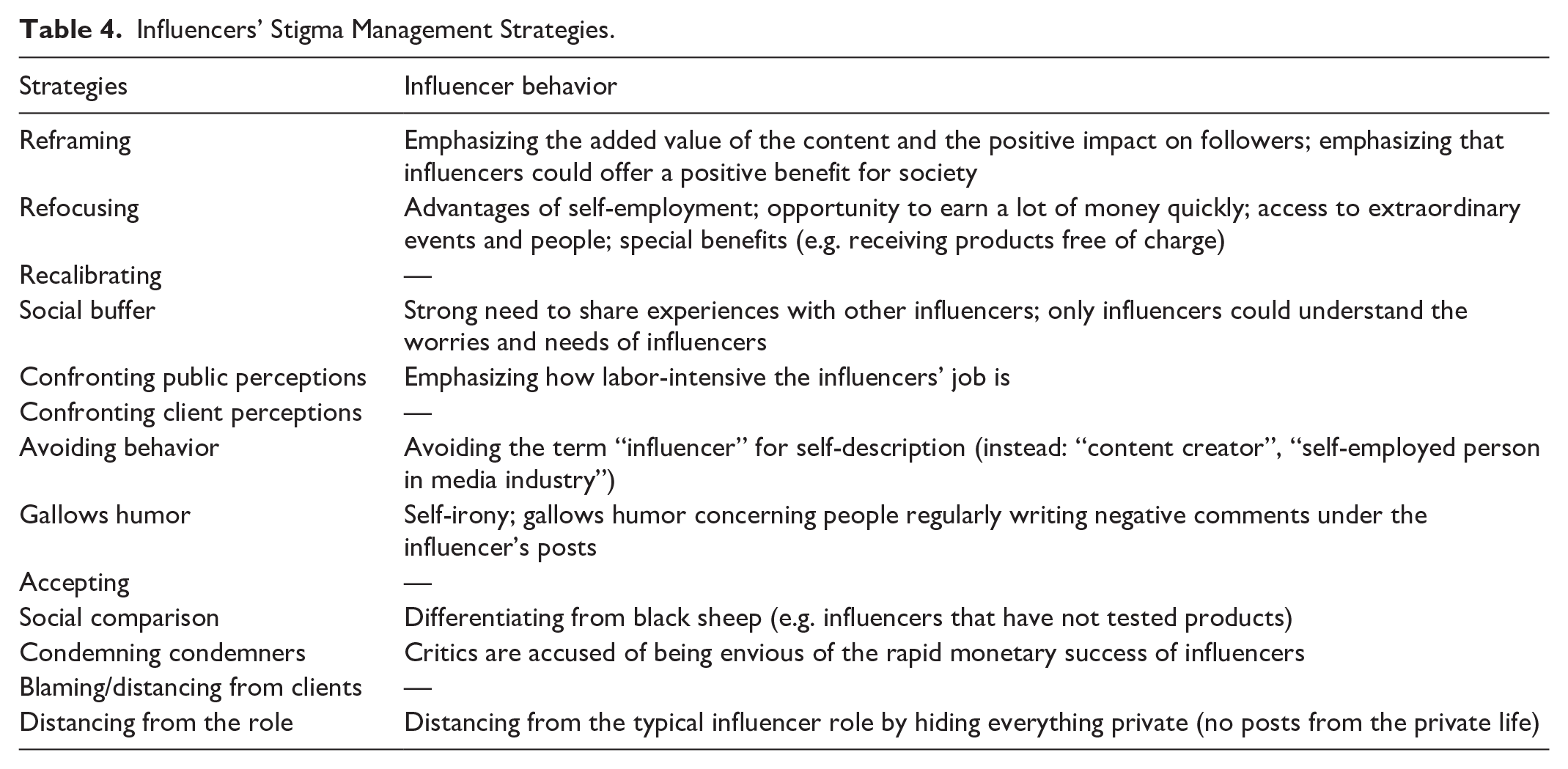
Most of the strategy examples described in Table 4 have not yet been mentioned in influencer research. These include the strategy of social comparison, which played an important role for the interviewees. Nearly all participants in the study were keen to differentiate themselves from those influencers they perceived as black sheep in the industry. Ethical misconduct was identified as the behavior of individuals and not as being representative of the whole occupation. In distancing themselves from these individuals, the problem is removed from the occupation itself: the blame is shifted onto individual people. Furthermore, all interviewees used the refocusing strategy and emphasized non-tainted aspects of their work. In doing so, they highlighted only the positive sides of being self-employed and ignored its negative aspects, which may lead to morally questionable advertising integrations. In the confronting public perception strategy, the interviewees also underlined how labor-intensive their work is, particularly during the production and postproduction process. With the help of the confronting public perception strategy and the avoiding behavior strategy, the interviewees put the focus on the creative, labor-intensive production dimension of their work and could thus enhance their value by contextualizing themselves with other creative professions.
The reframing strategy was also popular among the participants. Nearly all influencers emphasized that their content includes added value for their followers. Some of them made clear that they are aware of the social dimension of their work and search for ways to fulfill the expectations of society. A few of the interviewees described themselves as activists or sustainability creators. Previous research has already pointed out that sustainability influencers have been in vogue in recent years: “Sustainability is used to brand account holders and products as morally superior, show correct choices and life altering planet saving solutions for everyday practices” (Degen & Simpson, 2022, p. 160). The current study, however, shows that this is not just a trend but part of a broad portfolio of strategies that serve to valorize dirty work.
Many influencers emphasized how important exchanges with other influencers are to them and described their need to share experiences with others in their occupational group. Interestingly, only one interviewee (Franca, female, early 20s) highlighted that the bonds among influencers are so strong that they perceive themselves as a collective (the social buffer strategy). Other interviewees did not exactly describe this bonded community feeling but described creator events as shark tanks instead of helpful group-bonding meetups. As Meisner (2023, p. 4) points out, influencers have not yet “followed other groups of platform workers” (such as food delivery drivers) “in forming collectives as a class of workers”: They have not yet formed a coherent unity. Accordingly, no major networking events are organized and hosted by influencers nor is there a professional association founded by influencers that represents the influencers’ demands toward their stakeholders (such as brands). Major creator events are organized by brands, agencies, or media companies but not by influencers themselves. This lack of a formed collective might explain why the social buffer strategy is not very well developed. Nonetheless, most of the stigma management strategies conceptualized by Ashforth et al. (2007) were confirmed in the interviews with influencers. It is noticeable that none of influencers interviewed failed to use at least one stigma management strategy; all 14 participants combined several strategies.
Theoretical and practical implications
The findings of this study add to the literature on influencer ethics. The dirty work approach provides a new perspective on the influencer ethics debate. With its concept of stigma management strategies, it illustrates how influencers deal with the tainted image associated with immoral, deceptive behavior.
In addition, this study is of benefit for research that examines the new vulnerabilities produced by social media-dependent labor (Meisner, 2023). Studies that examine the working conditions of social media–based creative workers usually put the focus on the algorithmic-driven pressure of visibility that causes new vulnerabilities (Duffy et al., 2021, 2024; Schöllhammer & Gretzel, 2024). This includes, for example, that social media–dependent workers such as influencers are at high risk of burnout as the platform algorithms force them to share content regularly and interact almost daily with their community. The constant pressure for visibility also leads to a “high propensity for receiving hate and harassment” (Meisner, 2023, p. 4). Discovering the vulnerability of workers dependent on social media visibility leads to the question of how they can strengthen their resilience and develop strategies to shield themselves from external pressure sources, and what is missing from current research in this field is a description of how influencers deal with external pressure. This is where the dirty work approach could provide added value. With its broad portfolio of strategies, it shows how occupational groups could handle outside pressure.
Moreover, adding the dirty work lens allows us to see the complexity of the challenges influencers have to deal with. Yet research on the working conditions of those dependent on social media visibility has ignored the fact that influencers, as dirty workers, are constantly confronted with a negative image with which they must contend. If research looks at the external perception, it looks only at the extremes caused by visibility—online hate and harassment against influencers (Duffy et al., 2024; Valenzuela-García et al., 2023). Scholars have not yet mentioned that influencers must carry a double burden: as dirty workers associated with deceptive behavior and as visible workers who, due to their permanent online presence, are the special focus of a critical, even hateful public.
This study also offers meaningful practical implications. Influencers should start to organize themselves in professional associations to strengthen their stigma management strategies. To date, influencers have left it up to advertisers and agencies to determine the rules of the influencer business instead of setting up institutionalized organizations to represent the influencers’ interests. With the help of a professional association, influencers could, for example, institutionalize the social buffer strategy and create social events that are not organized by brands and agencies but by themselves, thus strengthening their group bond. More importantly, such an influencer association could help to counter brands’ demands not to label advertising correctly and to blur the line between the influencer’s personal, authentic content, and commercial messages (Gerhards, 2019). As shown above, it is the use of deceptive methods that turns influencers into morally tainted workers. A professional influencer association could, for instance, initiate a code of conduct and award prizes for best cases in which influencers find creative solutions for integrating commercials. Furthermore, a professional association could institutionalize the social comparison strategy and identify the black sheep among influencers who behave morally dubiously. In sum, the founding of a professional influencer association could be a helpful instrument to promote a better image of influencers in public.
For marketers and brands, however, it is important to understand that influencers have a massive image problem in some countries. If marketers praise the covert nature of influencer marketing and see it as a positive thing that influencers “combine non-commercial and commercial posts, making it difficult for their audience to distinguish between personal and sponsored posts” (Boerman & Müller, 2022, p. 7), they do influencers no good. Here, again, a powerful alliance of influencers could be a good instrument to initiate a reconsideration among brands. Moreover, talent management agencies should strengthen influencers to expand their stigma management strategies. They could, for example, develop new business fields around the question of how resilience strategies for influencers can be professionalized and offer influencer workshops to develop these skills.
Limitations and future research
This study has some limitations that offer directions for future research. First, only 14 influencers were interviewed to obtain information about their stigma management strategies. A larger sample would have been desirable. Second, the interview sample did not include mega-influencers with more than one million followers; it focused only on micro- and macro-influencers. Mega-influencers might provide a different experience of using stigma management strategies. Due to their increased visibility, they are likely to be confronted with even more extreme forms of negative feedback than influencers with lower reach. Third, the question of whether online hate is an issue for influencers and, if so, how they deal with it was not part of the questionnaire. Future research on stigma management strategies should integrate this aspect. It should also investigate whether and to what extent moral misbehavior can lead to online hate. There is only marginal scholarly research on this topic (Valenzuela-García et al., 2023). Fourth, this study, with its two research questions, was conceptualized and conducted in Germany, a country where the profession of “influencer” garners little respect (Smith & Ballard, 2021). The results of the study are therefore limited to this country context. The research questions would probably be answered differently by influencers living in other countries and cultures, because the creators may not be aware of their negative image or there may not be any image problem at all. It would therefore be interesting for future research to conduct an international study and include creators from other countries and cultures. In addition, why influencers in certain countries do not have any image problem at all should also be examined (Smith & Ballard, 2021). Fifth, the stigma management strategies used as a guiding framework in this study were conceptualized in a pre-internet area. Future research should investigate whether new, technology-driven stigma management strategies have emerged in the context of social media–dependent work. For example, this study classified the use of specific filter functions of the social media platform to make negative comments invisible as avoiding behavior using Ashforth and Kreiner’s (1999) typology. Further development of the dirty work approach with a greater focus on digital working contexts could, for example, conceptualize new, technology-driven stigma management strategies. However, the aim of this article was to apply the existing typology of stigma management strategies to influencers and not to develop the approach itself further.
Footnotes
Acknowledgements
The interviews with the influencers were carried out in the context of two teaching research projects in summer 2022 and summer 2024 with students enrolled in the master’s program “Communication, Multimedia and Market Management” at Hochschule Düsseldorf—University of Applied Sciences. The author thanks Michelle Böntgen, Mora Eggert, Katharina Fiegen, Meret Folten, Alica Hoogstraat, Marie Jansen, Julian Klein, Nele Klümpen, Julian Kühn, Awa Malakloo, Lena Päseler, Jule Prescher, Julia Ruthmann, Meret Schule, and Nele Weigelt for their support to recruit the influencers and to conduct and transcribe some of the interviews. In addition, the author thanks the anonymous reviewers for providing exceedingly useful feedback on earlier versions of this article.

Funding
The author(s) disclosed receipt of the following financial support for the research, authorship, and/or publication of this article: The author received financial support from the Hochschule Düsseldorf—University of Applied Sciences for the publication of this article.
Declaration of conflicting interests
The author(s) declared no potential conflicts of interest with respect to the research, authorship, and/or publication of this article.