



Abstract
We advance communication theory on the relationship between online dating and psychological well-being with a nationally representative, two-wave panel survey of dating app users (N = 521) that investigates individuals’ motives for dating and their perceived success. Results from an autoregressive structural equation model revealed people felt lonelier when they used dating apps for social approval, but not when they used them to pursue relationships. Perceived success was linked to psychological well-being: people felt lonely and less satisfied when they believed they were not attracting partners and better well-being when they felt successful. Gender differences were observed where women reported being more successful and less lonely but also more anxious about dating than men. However, men were observed to have higher life satisfaction when experiencing higher success. Our findings contribute evidence for the importance of motivations and perceptions in communication technology use and psychological well-being.
Dating apps are a hallmark of modern romance, having overtaken face-to-face interactions and peer connections as the primary way that individuals meet, flirt, and fall in love (Wu & Trottier, 2022). A recent Pew survey found that one in 10 American adults in committed, long-term relationships met their current significant other through dating apps and online services like Match, Hinge, OkCupid, or Bumble (Vogels & McClain, 2023). Indeed, dating apps offer tangible benefits to individuals searching for their next romantic or sexual connection. For instance, they allow people to connect with a broad pool of potential partners, to peruse dozens of profiles at once, and to “put their best foot forward” when curating a profile for themselves (Ellison et al., 2012; Hancock & Toma, 2009). In this study, we focus on dating apps as part of the contemporary online dating landscape, which aligns with affordances established in social media research, such as visibility, editability, reachability, and searchability (Coduto & Fox, 2024; Ronzhyn et al., 2023). However, we acknowledge that the affordances specific to dating apps—such as algorithmic matching (Sharabi, 2022), swiping mechanisms (Rochat et al., 2019), and mobile accessibility (Konings et al., 2022)—create distinct user experiences that may not fully align with earlier literature on dating websites.
However, although dating apps affordances provide opportunities for people to meet other interested individuals, they also introduce people to heightened risks of insecurity and rejection. Prior research has explored why people turn to online dating (Chin et al., 2019; Ramirez et al., 2015; Timmermans & Alexopoulos, 2020), and how they navigate the self-presentational challenges of communicating on online dating platforms (Ellison et al., 2006; Huang & Hancock, 2022). However, only a handful of studies have explicitly tested how participation in online dating can come to affect people’s psychological well-being—in contrast to the hundreds of studies that have examined the impact of social media use on well-being (Hancock et al., 2022; National Academies of Sciences, Engineering, and Medicine, 2024). Given that online dating experiences often involve sensitive, intimate self-presentations that can both promote meaningful connection and profound rejection, scholars like Toma (2022) have called for more research that examines the relationship between online dating experiences and diverse indicators of well-being, such as individuals’ sense of loneliness and life satisfaction.
Evidence from a small, but growing, body of research indicates that online dating can both improve and undermine psychological well-being, especially over time in terms of emotional exhaustion and inefficacy (Sharabi et al., 2024). In a study of predominantly heterosexual young adults using Tinder, Her and Timmermans (2021) found that using dating apps in a compulsive or uncontrolled manner was associated with worse psychological outcomes. Namely, people who felt a need to spend more and more time on dating apps to fulfill their desire for relationship success tended to feel more sad and stressed. Similarly, Holtzhausen et al. (2020) found that people who were actively using dating apps tended to feel more anxious, stressed, and depressed. However, the same study also found that online daters also had higher self-esteem, which was theorized to be a product of the positive validation they were obtaining from others who were expressing interest in them romantically.
Examining why people use dating apps and how successful they feel they are in their experiences may help explicate these ambiguous effects. After all, people vary substantially in their motivations for using dating apps. While many people use dating apps in a “conventional” manner to seek out relationships in the long or short-term, others turn to dating apps as a means of obtaining social approval in the form of likes, matches, and dates. When people interpret signals of attraction on dating apps of signals of their desirability or self-worth, investing more time and energy into their dating app use may have negative implications for their psychological well-being (Her & Timmermans, 2021; Kallis, 2020; Timmermans & De Caluwé, 2017). Therefore, understanding the motives that drive dating app use is important because individuals’ perception of their ability to achieve their goals may have implications for their psychological well-being.
Potential effects of dating app use on psychological well-being may also depend on how successful people feel they have been. Research suggests that feelings of achievement come from positive feedback on dating apps and connections that form online (Her & Timmermans, 2021), which can improve daters’ affect. However, people may feel worse if they perceive themselves to be unsuccessful if they receive rejections in the form of unreciprocated interest, radio silence from potential matches, and ghosting if connections abruptly lose interest (LeFebvre et al., 2019; Navarro et al., 2021). Indeed, more than a third of users reported that they had deleted their dating app because they felt they were unsuccessful (LeFebvre, 2018). This experience of failure in receiving social approval or meeting relational needs could have serious consequences for users’ psychological well-being, particularly for individuals who stake much of their self-worth on the external validation of others (Burwell & Shirk, 2006; Crocker & Wolfe, 2001).
The current literature on the relationship between experiences with online dating and psychological well-being may therefore be enriched by considering not only how much time individuals spend on apps like Tinder and Bumble but also how people conceptualize their success with respect to their motives for participating in the online dating pool. Considering these subjective experiences may help us explain the conditions under which dating app use is beneficial or harmful to daters’ well-being. In addition, there is a need for longitudinal research that allows us to examine how changes in online dating experiences relate to changes in individual well-being, with respect to potential bidirectional or reciprocal relationships.
In this study, we conduct a short-term longitudinal investigation of online dating app use on psychological well-being using a two-wave, nationally representative panel study of 521 dating app users in Germany. In a systematic review (Bonilla-Zorita et al., 2021), the authors highlighted the lack of longitudinal research, noting that two studies have utilized a short-term longitudinal design to examine the problematic use of dating apps, focusing on relationship outcomes rather than individuals’ psychological well-being (Jung et al., 2019; Paul, 2014). A recent study has utilized four waves across 12 weeks to test dating app users’ burnout experiences (Sharabi et al., 2024). Bonilla-Zorita et al. (2021) emphasize that “further studies are needed in the form of longitudinal designs that would help establish the causes that affect the quality of relationships initiated via online dating services (p. 2261).” In addition, the authors point out that “the research should consider longitudinal approaches to help establish the direction of causality.” We therefore examine not only the time that individuals report spending on online dating but also their motivations for doing so and their perceived success on the platforms, in relation to their life satisfaction and loneliness.
Online dating and psychological well-being
We first define our conceptualization of psychological well-being. In line with Houben et al. (2015) and Luo and Hancock (2020), psychological well-being refers to a broad, multifaceted construct that assesses the psychological health of an individual with respect to positive indicators, such as their level of positive affect and satisfaction with their lives, in addition to negative indicators, such as their experience of feelings of loneliness or depression.
Given this heterogeneity, prior theory and research on the relationship between communication technology use and psychological well-being have emphasized the importance of considering how individuals’ experiences with communication technologies relate to not only changes in affect (i.e. feelings of happiness or sadness; Her & Timmermans, 2021) but also to individuals’ eudaimonic and relational well-being. Eudaimonic well-being is a holistic construct that refers to how good people feel about their lives as a whole (Dienlin et al., 2017; Houben et al., 2015; Ryan & Deci, 2001), for which the most commonly used measure asks people about their satisfaction with their life as it is now. In comparison, relational well-being refers to the health and strength of individuals’ interpersonal relationships (Hancock et al., 2022; Houben et al., 2015). An important indicator of poor relational well-being is loneliness, a negative emotional state that is tied to feeling a sense of aloneness, due to a perceived lack of fulfilling social connections (Peplau & Perlman, 1982). While both loneliness and life satisfaction are based on interpersonal and intrapersonal dynamics and processes (Girme et al., 2023), loneliness is typically considered domain satisfaction focused on social relationships, while life satisfaction is a more stable measure of one’s happiness (Dienlin et al., 2017).
Examining both outcomes is relevant in the context of online dating experiences (Dienlin et al., 2017; Hancock et al., 2022). It should not be surprising that dating apps can influence how people feel, given the importance that many individuals and societies place on not only being able to find a suitable match but also being seen as suitable to others. Finding companionship and social approval are often discussed as two of the most important developmental tasks for adolescents and young adults (Bakken & Romig, 1992). Indeed, foundational theories such as Erikson’s (1994) stages of psychosocial development emphasize that a foundational part of adulthood involves navigating intimacy and isolation. The ability to find and maintain romantic connections with potential partners is strongly tied to individuals’ well-being, as they learn not only about themselves but also how others see them—a set of intrapersonal and interpersonal processes that may have important implications for psychological well-being (Toma, 2022).
Unpacking individual motivations for online dating
Scholars have established that people hold diverse motives for using dating apps (Lutz & Ranzini, 2017; Timmermans & DeCaluwé, 2017). While popular portrayals often frame dating apps as centered around short-term connections (Timmermans & Courtois, 2018), individuals also use these apps to connect with potential partners who share their interests, values, or long-term goals, with the ultimate goal of forming meaningful, lasting relationships (Sharabi et al., 2019). Simultaneously, however, dating app users may actively engage with the app’s features to gain likes and matches, interpreting these cues as indicators of their desirability and self-worth in the context of dating culture (Her & Timmermans, 2021). Therefore, it is evident that there are two primary motives underlie individuals’ use of online dating apps: (1) relational motives focused on obtaining short- or long-term partnerships and (2) social approval motives focused on obtaining validation or attention from others. Notably, these motives are not necessarily mutually exclusive or constant at the individual level. People may use dating apps as a means of obtaining social approval, while still looking for a relationship, and may change their motives over time. Therefore, this study examines both processes in parallel, and we discuss them as emphasizing two interconnected dynamics for dating app use.
Due to the long-term perspective of the study, we focus on the motives that may drive sustained engagement with dating apps over time. While sexual experience can be an important factor in online dating, it is often a more immediate or short-lived motive. In contrast, relational motives (such as seeking long-term love) and social approval motives (such as validation from matches or peers) are likely to contribute to continued app usage. This approach aligns with empirical evidence suggesting that users prioritize long-term connections over casual encounters. For instance, one study demonstrated that rather than engaging in casual sex, the primary reason for meeting in person with a match was the pursuit of a long-term romantic relationship (Harrison et al., 2022). In addition, many empirical studies on motivations for using online dating apps show that sexual experience motivation has lower average scores in contrast to relationship-seeking or social approval motives that score higher (Timmermans & Alexopoulos, 2020; Timmermans & De Caluwé, 2017).
Theory and research on relational development indicate that using dating apps for relational motives may be associated with improved psychological well-being. When people use dating apps to focus on relationship formation, finding love, and building meaningful connections with potential partners, they may feel better about their lives—and less lonely—because they are leveraging a technological tool to pursue a need that is important to them (Kallis, 2020; Stephure et al., 2009; Sumter et al., 2017). This aligns with theory and research on agentic social media use, which theorizes that people obtain greater benefits from their experiences with social technologies when they use them to pursue personally meaningful goals and when the affordances of the platform align with the intentions of the user (Lee et al., 2023). Furthermore, greater pursuit of relationships on dating apps may also manifest in long-term interpersonal attachments and relationship maintenance may reduce loneliness (Baumeister & Leary, 1995). Therefore we predict:
Similarly, using online dating as a means of obtaining social approval may have implications for individuals’ life satisfaction and loneliness. According to sociometer theory, individuals measure their perceived social value through positive interactions and feelings of acceptance—something that online dating applications may not have intentionally been designed to signal but have come to represent (Huang et al., 2022; Leary, 2005). On many swipe-based online dating apps, such as Tinder (Her & Timmermans, 2021), people interpret metrics like the number of likes, matches, and messages they get as indicators of social approval or validation. Receiving positive feedback—such as having many messages from interested individuals—has been tied to increased self-validation (Bonilla-Zorita et al., 2021) and higher self-esteem (Holtzhausen et al., 2020).
Prior research in the field of social media use with a focus on Instagram and public profiles has demonstrated that users with a higher need for social approval experienced more positive outcomes (Sciara et al., 2023). In the context of online dating, Her and Timmermans (2021) found social approval motives to be related to joviality. Due to a need to be liked and judged positively, dating app users with higher motivations for social approval may engage in profile presentation strategies aimed at eliciting desired connections. However, profile setup is an iterative process shaped by meaning-making, real-life feedback, and authenticity concerns (Ellison et al., 2012; Toma & D’Angelo, 2017). While social validation may contribute to psychological well-being in terms of fulfilling the need to belong (Hillman et al., 2023), its effects are likely influenced by these broader online dating dynamics. According to the agentic social media use theory, individuals with a clear purpose in using dating apps—whether for social approval or relationships—are more likely to experience enhanced well-being over time, provided that they actively engage with the platform in a goal-directed manner. We therefore hypothesize a positive association with well-being:
Understanding perceptions of dating success
Conceptualizations of “success” are integral to how many people think about their experiences with online dating (Huang et al., 2022). Whether people think of the online dating pool as like a “tournament” to be won or a “market” to be browsed, people often want to feel successful in their experiences on the apps—meaning that can feel confident in achieving their desired outcomes, whether this involves the pursuit of their relational goals or their need for social approval (Alexopoulos & Timmerman, 2021). In line with sociometer theory’s prediction that people will experience improved psychological well-being when they feel valued, perceived dating success may help explain why dating apps can boost well-being for some people and harm well-being for others (Leary, 2005). We define perceived dating app success as a subjective assessment of an individual’s positive experiences and outcomes on dating apps (Alexopoulos & Timmerman, 2021). Based on Nascimento et al. (2024), online dating success involves “receiving attention from attractive partners online (i.e. being liked back, having online interactions that result in face-to-face dates) and achieving one’s own online dating goals” (pp. 12782–12783). Similar to the concept of establishing romantic confidence (Aubrey & Taylor, 2009), perceived dating app success reflects the extent to which users feel they receive romantic or sexual interest and positive attention from potential partners. This perception is based on users’ evaluations of their desirability and reciprocity in interactions.
Perceived dating app success reflects both short-term indicators (e.g. receiving matches and responses) and users’ broader sense of desirability on the platform. It should not be surprising that positive experiences with romantic or sexual encounters can, at least in the short term, provide benefits to individuals’ self-esteem and psychological well-being. Feeling successful—in finding love or in seeming desirable—may support more positive self-views, which may facilitate greater satisfaction with one’s life (Fastame et al., 2017). Although online dating constitutes a relatively specific context in which one can be successful, the intimacy involved in “putting themselves out there” may heighten the benefits of feeling desired, as well as the consequences of feeling rejected. Indeed, research on self-worth contingencies emphasizes that people can derive much of their sense of self-worth from the perception of success in particular facets of their life (i.e. their work, their family, their dating life) (Crocker & Wolfe, 2001; Dijkhuizen et al., 2018). Therefore, we predict:
Perceptions of success may also influence loneliness by corresponding with actual success, such as finding more connections, having more dates, and being more likely to find a romantic partner. In the language of social capital theory, people who believe that they are more successful in online dating may be receiving more short-term positive feedback through the app features that is in line with bridging social capital (Ellison et al., 2014) and cultivating more long-term connections in line with bonding social capital (Ellison et al., 2014). Therefore, we predicted that people who believe that they are more successful will feel less lonely because they have obtained more social approval and more chances at meaningful connections:
Testing reciprocal relationships between online dating experiences and psychological well-being
While the literature has predominantly adopted a media effects approach to examining the presumed impact of social technology use on psychological well-being, a growing body of research indicates that the opposite may be true. Indeed, there are numerous instances where changes in individuals’ psychological well-being have explained changes in their social media use. For instance, a cross-lagged, two-wave study showed that people who were more lonely tended to use Facebook for more social purposes (Teppers et al., 2014). Similarly, Hood et al. (2018) found a similar relationship, where loneliness predicted individuals’ intentions to use social media. However, given that prior work on this reciprocal relationship has focused predominantly on social media, more research is needed to examine the potential for bidirectional relationships in the context of online dating.
We draw on Luo and Hancock’s (2020) framework regarding the bidirectional relationship between social media use and psychological well-being to understand the potentially reciprocal relationships between online dating and psychological well-being. Just as they noted that people may self-disclose on social media more when they are experiencing worse psychological well-being, we also theorized that people’s reasons for participating in online dating and their perceived success may vary depending on their current psychological state. For instance, people who already feel lonely may turn to online dating apps in an effort to alleviate their loneliness, or they may also feel more lonely as a result of using online dating apps. To address these possible relationships, we propose a research question:
Considering the role of gender
Gender has emerged as an important moderator in many studies of the relationship between social technology use and psychological well-being (Orben et al., 2022) as well as an important factor in online dating affordances (Kettrey et al., 2024). At the population level in general, women consistently experience more internalizing symptoms, such as feelings of depression and anxiety, than do men (National Academies of Sciences, 2023)—a discrepancy which may influence how they engage with and respond to their experiences with online dating. According to evolutionary theory, motivations for dating vary across gender, with men being more inclined toward short-term relationships and women showing a preference for long-term relationships (Abramova et al., 2016). This perspective is rooted in the idea that reproductive strategies have shaped different mating behaviors in men and women over time. Men may benefit from seeking multiple short-term partners to maximize reproductive success, whereas women, who invest more in offspring due to pregnancy and child-rearing, tend to prioritize partners who demonstrate long-term commitment.
Applying this framework to online dating, scholars indeed find gender differences in various aspects of online dating, including attitudes toward casual sex, relationship goals, and patterns of communication. For instance, men tend to display greater openness to casual encounters and short-term flings, whereas women are more likely to seek committed relationships through dating apps (Abramova et al., 2016; Vrangalova, 2015). Furthermore, research suggests that men are more proactive in initiating conversations and sending messages, reflecting traditional gender norms in courtship dynamics (Abramova et al., 2016). Women, on the contrary, tend to be more selective, often receiving a higher volume of messages but responding less frequently, which aligns with evolutionary theories of mate selection.
More specifically, prior studies on self-presentations and deceptive practices on dating apps have revealed meaningful differences between heterosexual men and women (Hancock et al., 2007). For example, in a study of predominantly heterosexual individuals, Hall et al. (2010) found that men are more likely to misrepresent their relationship goals, whereas women are more likely to misrepresent weight. Similarly, scholars like Sumter et al. (2017) and Vrangalova (2015) have identified gender differences in men and women’s motivations to engage in casual sexual activity over time. Women also face greater self-presentation concerns, but the unequal supply and demand of matches and messages received on online dating apps suggest that women may have greater perceived success (Abramova et al., 2016; McClain & Gelles-Watnik, 2023). Empirical research further suggests that not all users feel equally successful on mobile dating apps. Notably, dating app success appears to differ by gender, with heterosexual male users reporting more frustration over a lack of matches (Hobbs et al., 2017) and expressing concerns about their ability to attract desirable partners online (Zytko et al., 2014). Based on this theoretical and empirical evidence, we ask:
Method
Procedure and participants
We conducted a two-wave, nationally representative survey of 876 participants from Germany. The panel survey sampled participants using quotas based on the distribution of age, gender, and education in the German population. Individuals were recruited to take part in a study on online dating as part of a larger project examining dating app use and well-being. 1 Data were collected through an online access provider between August and October 2022 (August to September for Time 1; September to October for Time 2). Approximately 1 month elapsed between Time 1 and Time 2. This time interval was based on Dormann and Griffin’s (2015) suggestion that shorter time lags in two-wave surveys are more effective, with 1.6 months better capturing changes in psychological outcomes than longer intervals. To account for changes in app use and relationship status while maximizing participant retention, we opted for a 1-month interval between surveys. All participants provided informed consent and were compensated for their participation. Procedures were approved by the Institutional Review Board of the Deparatment of Communication at the University of Vienna.
Participants were screened out in the first wave if they indicated they had never used any dating applications; thus, only participants who indicated using dating apps were eligible to take part in the study. We excluded individuals who failed two attention check questions (“My birthday is on February 30” and “To show that you are still paying attention, click on “5—very often”) hidden within the questionnaire (nTime1 = 248) or completed the survey inordinately quickly (i.e. one-third faster than the median speed, nTime1 = 42, nTime2 = 14).
Our final sample included NTime1 = 876 participants in the first wave who were active dating app users. To understand which dating apps and services participants were active on, we asked them to select the ones they had used. In response, 44.6% indicated Tinder, 7.2% selected OkCupid, 15.4% chose Bumble, 19.5% reported using Badoo, and 6.8% stated they had used Lovoo. Approximately 50.2% of the participants identified as male, 49.3% identified as female, and 0.5% identified as another gender. Regarding sexual orientation, the vast majority of our sample reported being heterosexual n = 755 participants (86.2%) in Wave 1, n = 87 (9.9%) participants in Wave 1 stated they were LGBTQIA+ and 34 (3.9%) participants did not want to answer this question; they were coded as missing cases. We also assessed participants’ relationship status at Time 1, where 64.8% indicated they were single, 31.3% were partnered, and 3.9% preferred not to answer. With regard to participants’ educational background, approximately 24.5% had completed lower secondary or vocational school, 30.9% had completed upper secondary school, and 44.6% had completed upper secondary school and/or university. For the second wave of data collection, our final sample consisted of NTime2 = 521 dating app users between the ages of 18 and 40 (Mage = 30.21, SDage = 6.21). The attrition rate from the first to the second wave was 40.53%.
To examine if there were differences in participant characteristics between the two waves, we conducted chi-square and Welch’s t-tests. We found small differences for age, t(730.88) = −3.49, p = .001, Cohen’s d = −.24 and education level (low education, χ2(1) = 8.57, p = .003, Cramer’s V = .10; high education, χ2(1) = 8.02, p = .005, V = .10). Relative to the final sample, participants who dropped out after the first wave had a higher ratio of low educational level (29.6% vs. 20.9%) and a lower ratio of high education level (38.9% vs. 48.6%), and were slightly younger (M = 28.51, SD = 6.55 vs. M = 30.05, SD = 6.19). No significant differences were found for gender, χ2(1) = 0.02, p = .883, V = .05, medium education, χ2(1) = 0.11, p = .746, V = .01, and relationship status, t(840) = 0.25, p = .801, d = .02. Regarding our study variables, we found no differences across two samples in life satisfaction, t(520) = 0.21, p = .834, d = −.04, loneliness, t(520) = −0.52, p = .604, d = −.05, perceived dating app success, t(520) = −0.23, p = .819, d = −.02, motivations to use dating apps for relational goals, t(520) = 0.69, p = .491, d = .01, and motivations to use dating apps to obtain social approval, t(520) = −0.34, p = .729, d = −.03.
Measures
Independent variables
Motivations for dating app use
We assessed the extent to which individuals were motivated to use dating apps to fulfill relational goals (i.e. finding a partner) and to obtain social approval (i.e. by receiving positive attention). Motivations to use dating apps for relational goals were measured with a three-item scale assessing whether their use was driven by an intention or desire to find a longer-term partner (Brym & Lenton, 2001, as modified by Gibbs, 2006). Individuals were asked to indicate whether they used dating apps (1) for long-term dating, (2) to meet a special person with whom to establish a committed relationship, and (3) to find a possible life or marriage partner. Response options were scored on a 5-point Likert-type scale (1 = does not apply to me, 5 = applies to me a lot). Overall, using dating apps to find a committed relationship was common in our sample, and the measure demonstrated good internal reliability (T1: Cronbach’s = .89, M = 3.43, SD = 1.13; T2: = .91, M = 3.42, SD = 1.15).
Motivations to use dating apps to obtain social approval were measured with a three-item scale examining whether their use was driven by a need or desire for validation from potential partners (Timmermans & De Caluwé, 2017). Individuals completed items about their use of dating apps to (1) get an “ego-boost,” (2) get self-validation from others, and (3) get attention. Response options were scored on a 5-point Likert-type scale (1 = does not apply to me, 5 = applies to me a lot). Using dating apps for social approval was slightly less common but still common, and the measure had good internal reliability (T1: = .86, M = 2.54, SD = 1.12; T2: = .89, M = 2.57, SD = 1.16).
Perceived dating app success
To assess individuals’ perception of their success on dating apps, we administered a four-item scale adapted from the Romantic Confidence on Dating Apps Scale (Alexopoulos & Timmerman, 2021; Aubrey & Taylor, 2009). Participants were asked to indicate the extent to which they felt that they received positive attention and romantic/sexual interest from potential partners they encountered on mobile dating apps (e.g. “Other people are attracted to me on a mobile dating app” and “People whom I like on a mobile dating app tend to like me back”). Response options were scored on a 5-point Likert-type scale (1 = does not apply to me, 5 = applies to me a lot). On average, participants indicated moderate degrees of dating app success, with high between-person variance, on both occasions (T1: = .83, M = 2.95, SD = .87; T2: = .86, M = 2.98, SD = .89).
Dependent variables
Psychological well-being
In line with conceptualizing psychological well-being as a broad, multifaceted construct (Hancock et al., 2022; Houben et al., 2015), we measured two indicators of well-being including life satisfaction and loneliness.
Life satisfaction was assessed as a measure of eudaimonic well-being, using the Satisfaction with Life Scale (SWLS; Diener et al., 1985). Participants completed three questions asking about whether they (1) felt that their life corresponded to their ideals in most areas, (2) were satisfied with their life, and (3) felt their life was excellent. Response options were scored on a 5-point Likert-type scale (1 = does not apply to me, 5 = applies to me a lot). Participants reported moderate amounts of life satisfaction (T1: = .82, M = 3.25, SD = .87; T2: = .84, M = 3.29, SD = .87).
Loneliness refers to the perception of feeling isolated or alone (Tiwari, 2013). We assessed loneliness using the UCLA Loneliness Scale (Hughes et al., 2004), a widely used four-item measure where participants are asked to indicate the extent to which they (1) felt isolated from others, (2) felt left out, and (3) did not feel that they had enough company. Response options were scored on a 5-point Likert-type scale (1 = does not apply to me, 5 = applies to me a lot). On average, participants indicated moderate amounts of loneliness (T1: = .71, M = 2.40, SD = .87; T2: = .75, M = 2.44, SD = .92).
Control variables
Dating anxiety was included as a covariate that refers to concerns that individuals may hold around social rejection in the process of dating others. According to Toma (2022), anxiety is a relevant predictor of online dating that can influence well-being. To measure dating anxiety, participants completed three items from Joiner and Metalsky (2001) asking if they (1) felt afraid that their date will find something wrong with them, (2) felt concerned about the impression they would make during a date, and (3) worried that their date did not think much of them (1 = does not apply to me, 5 = applies to me a lot, T1: = .88, M = 3.02, SD = 1.12).
In addition to participants’ age, we controlled for gender using two dichotomous variables (1 = female; 0 = male and non-binary; and 1 = non-binary; 0 = female and male); relationship status with a single dichotomous variable (1 = partnered, 31.3%; 0 = single, 64.8%); and education with two dichotomous variables (1 = low; 0 = high and medium and 1 = medium; 0 = high and low). We also controlled for participants’ reported frequency of using dating apps by asking them to indicate how often they used any of the following dating apps: Tinder, OkCupid, Lovoo, Badoo, or Grindr, ranging from 1 = “never” to 10 = “more than 2 hr per day,” M = 4.91, SD = 2.39, Mdn = 5, at Time 1.
Data analysis
To test our hypotheses, we first conducted an autoregressive structural equation model (SEM) using the lavaan package in R (Roseel, 2012). We employed maximum likelihood robust estimation (MLR) and full information maximum likelihood (FIML) estimator to account for missing data in the second wave (attrited participants). To determine the acceptable model fit, we relied on the comparative fit index (CFI) and the Tucker–Lewis Index (TLI) values that are between .90 and .95, the chi-square to degrees of freedom ratio (χ2/df), and the root mean square error of approximation (RMSEA) values between .05 and .08 (Byrne, 2001). Second, to examine gender moderations, we specified an additional multigroup SEM model in which we removed gender as a control variable and estimated paths for each gender simultaneously and conducted multigroup analyses where coefficients were constrained to be equal across groups.
To account for potential demographic differences, in both models, we controlled for age, education, relationship status, 2 and dating app use frequency as observed variables at Time 1. In addition, we controlled for dating anxiety as a latent variable. Finally, we controlled for all autoregressive latent variables using their baseline measures (i.e., life satisfaction at T1 as a control variable of life satisfaction at T2). The data set and R script are available on Open Science Framework (OSF): https://osf.io/jwnc2/.
Results
Measurement invariance
First, we tested for metric longitudinal measurement invariance to confirm that the psychometric value of our key constructs of interest retained the same meaning over repeated measurements. We constrained all factor loadings of the same items across two measurement points. The model revealed a good fit: CFI = .97; TLI = .96, χ2/df = 2.09; p < .001; RMSEA = .04; standardized root mean squared residual (SRMR) = .05; 90% confidence interval (CI) = [.03, .04]. A nested model comparison of the constrained and the unconstrained measurement model showed no significant difference (χ2 = 26.97, df = 23, p = .257). These results indicated that observed changes were not due to shifts in the meaning of variables over time.
Structural equation modeling
Next, we tested the hypothesized model. As shown in Figure 1, results indicated acceptable model fit: CFI = .94; TLI = .93; χ2/df = 2.34; p < .001; RMSEA = .04; SRMR = .06; 90% CI = [.04, .05]. Tables 1 and 2 report the correlations and results of the hypothesized SEM, respectively.

The results of the hypothesized model.
Zero-Order Correlations Between Dating App Use Motivations, Perceived App Success, and Psychological Well-Being.
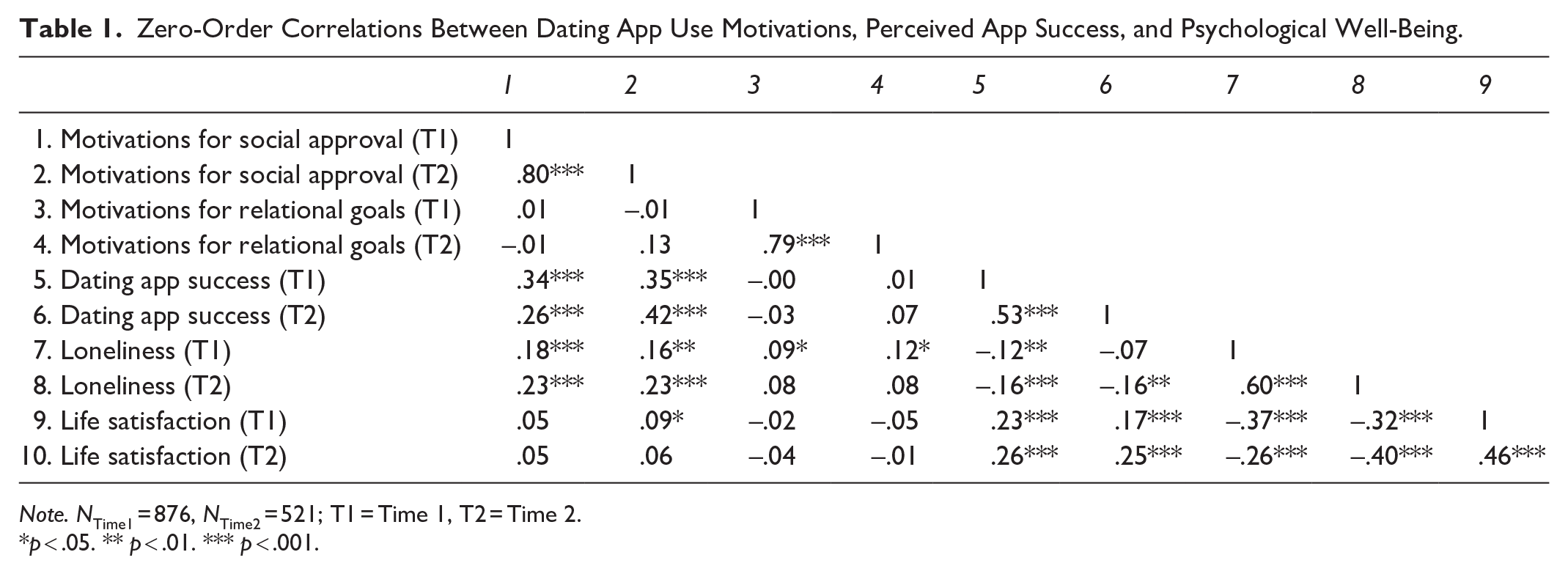
Note. NTime1 = 876, NTime2 = 521; T1 = Time 1, T2 = Time 2.
p < .05. ** p < .01. *** p < .001.
Results of the Structural Equation Model Based on the Full Maximum Likelihood Estimation.

Note. NTime1 = 876, NTime2 = 521; T1 = Time 1, T2 = Time 2.
p < .05. ** p < .01. *** p < .001.
We first examined the paths between motivations for using dating apps and psychological well-being to test H1 and H2. In contrast to our predictions for H1b, people who used dating apps to obtain social approval at Time 1 tended to feel more lonely at Time 2 (b = .17, SE = .05, p = .001). However, there was no significant association between using dating apps for social approval and life satisfaction between the two waves (b = −.05, SE = .04, p = .229). Similarly, the results revealed that motivations to use dating apps for relational goals at Time 1 also did not significantly relate to life satisfaction at Time 2 (b = −.03, SE = .03, p = .363) nor to loneliness at Time 2 (b = −.00, SE = .04, p = .944). Together, these findings indicated that certain motivations for using dating apps can influence certain facets of psychological well-being but not others.
Next, we examined how people’s perceptions of their success in online dating apps related to their well-being at Time 2. In line with H3, the results from the autoregressive SEM model indicated that people who felt more successful in their dating app use at Time 1 felt more satisfied with their lives at Time 2 (b = .17, SE = .06, p = .003), in addition to feeling less lonely at Time 2 (b = −.14, SE = .06, p = .026). These results support our hypothesis that people’s subjective interpretations of their experiences on dating apps are meaningfully related to psychological well-being.
With regard to our first research question, we explored the potential for bidirectional or reciprocal relationships where an individuals’ psychological well-being influenced their motivations for dating app use and their perceived success. Results indicated that people who felt greater psychological well-being would feel more successful or be motivated to use dating apps in particular ways. The findings showed that neither loneliness (b = .09, SE = .07, p = .204) nor life satisfaction (b = .06, SE = .07, p = .343) at Time 2 significantly predicted dating app success at Time 2. Similarly, no significant relationships were found for the prediction of motivations to use dating apps for obtaining social approval and/or relational goals over time. Therefore, these results are consistent with a media effects interpretation where dating app use explains variation in psychological well-being, rather than an individual’s psychological state driving their dating app use.
In the hypothesized model, a further analysis of covariates showed that relationship status was significantly related to dating app success at Time 2 (b = .14, SE = .07, p = .045), revealing that dating app users who were in a relationship had higher success than single dating app users over time. In addition, relationship status was significantly related to loneliness at Time 2 (b = −.22, SE = .09, p = .015), revealing that dating app users who were in a relationship had lower levels of loneliness than single dating app users over time. Finally, higher frequency of dating app use at Time 1 predicted higher motivations for relationship goals at Time 2 (b = .05, SE = .02, p = .004).
Given the substantial attention on gender differences in online dating experiences, we tested if gender moderated the hypothesized relationships between dating app use, motivations, perceived success, and psychological well-being at Time 2. The multigroup SEM analysis showed a good model fit: CFI = .95; TLI = .94, χ2/df = 1.71; p < .001; RMSEA = .04, SRMR = .07, 90% CI = [.04, .05]. The results presented in Table 3 revealed gender differences for three hypothesized relationships, indicating that the relationships between dating app experiences (motivations and perceived success) and psychological well-being over time did vary significantly between men and women. We found that women experienced greater loneliness due to higher motivations for social approval (b = .19, SE = .06, p = .002). However, women also experienced lower levels of loneliness due to higher dating app success (b = −.21, SE = .10, p = .034), while men experienced higher life satisfaction due to high dating app success (b = .20, SE = .08, p = .011).
Multigroup SEM Analysis.

An exploratory analysis of men and women’s overall experiences with dating with Welch’s t-tests at Time 1 revealed that in general, women tended to feel more successful in their online dating experiences, t(874) = −5.49, p < .001, Cohen’s d = −.37, but also experienced greater dating anxiety, t(874) = −3.13, p = .003, d = −.21. However, men tended to feel more satisfied with their lives than women, t(874) = 2.08, p = .038, d = .14.
Discussion
The present study investigated the implications of online dating for psychological well-being focusing on loneliness and life satisfaction. We conducted a two-wave panel survey with a 1-month time interval among active dating app users, who were asked to indicate not only how often they used dating apps but also their motivations for online dating and their perceived success in the dating scene. In doing so, we accounted for potential bidirectional relationships by testing if psychological well-being is a predictor, or an outcome, of motives for dating app use and perceived dating success. Finally, we examined the role of gender in the experiences with online dating and as a potential moderator of the proposed relationships.
Key implications of our study suggest that examining the platform-specific context of online dating apps highlights the role of technological affordances in shaping user perceptions and well-being. Unlike traditional online dating websites, dating apps introduce features such as swiping, reciprocal ephemeral interactions, and algorithmic matching, which likely influence users’ goals and experiences. Furthermore, dating apps gamify perceived success and social validation, reinforcing engagement patterns that can impact users’ psychological well-being in the long run.
Motivations for dating app use relate to specific kinds of psychological well-being
Our findings build upon prior work indicating that people are motivated to use dating apps to pursue meaningful relationships and to obtain social approval from potential partners (Stephure et al., 2009; Timmermans & DeCaluwé, 2017) by examining how these motives relate to psychological well-being. Overall, we found that participants tended to use these apps to form relationships more often than they used them to seek social approval, in line with earlier studies of online dating (Stephure et al., 2009). However, this finding differs from recent studies on the motivations for dating app use and personality traits that found that social approval motivations were more common, especially among neurotic types (Timmermans & Alexopoulos, 2020; Timmermans & DeCaluwé, 2017). In addition, it underscores the importance of examining how different motivations relate to individuals’ well-being, highlighting the need for further research in this area.
Although people in our study frequently used dating apps with the intention of reaching relational goals, we found no significant link between these relational motivations and their psychological well-being between the two waves. This suggests that merely seeking connections through online dating apps may not necessarily enhance one’s life satisfaction or have an impact on loneliness. Instead, it could be the case that the quality of subsequent offline social interactions, following these motivations, plays a more crucial role in influencing psychological well-being (Ramirez et al., 2015). Therefore, it is relevant for future research to understand not just why people use these apps but also how their interactions on and off these platforms affect their overall well-being.
Contrary to our assumption, we observed that individuals who reported higher motivations for using dating apps to gain social approval tended to experience increased feelings of loneliness after 1 month. In terms of loneliness as a domain satisfaction outcome, having an individual-oriented goal does not benefit a social outcome that is focusing on connectedness; instead, higher levels of isolation are prevalent. This result challenges the assumption of the social compensation hypothesis in the context of online dating (Toma, 2022), which suggests that individuals might turn to online dating as a means to alleviate their loneliness. Our finding therefore implies that the mere use of online dating apps may not be sufficient to establish the meaningful social interactions necessary to alleviate one’s feelings of loneliness. Future research should focus on whether that is still the case once social interactions migrate to offline dating.
Dating app success and well-being
Controlling for the frequency of dating app use as well as dating app anxiety, the study demonstrated a positive outcome of perceived success of one’s dating app experiences on reducing feelings of loneliness over time, confirming a positive social-oriented goal achieved through online dating app use. This finding highlights the importance of outcomes in how people view the relationship between online dating and their well-being. In particular, people who perceive their online dating experiences as successful tend to experience an improvement in their psychological well-being and a decrease in feelings of loneliness. An individuals’ perceptions of their online dating experiences matter, indicating that it is not merely the use of dating apps but the way in which users evaluate their own success that can have a beneficial impact on their psychological well-being, as shown in previous research regarding decrease in sadness and anxiety (Her & Timmermans, 2021).
Indeed, there were other positive outcomes that were driven by perceived dating app success. As expected according to sociometer theory, we found that perceived dating app success increased life satisfaction after the course of 1 month. This finding confirmed a positive individual-oriented goal that is achieved through online dating app use. Moreover, our study takes into account the temporal dynamics of this relationship. In examining the reciprocal influence between life satisfaction and perceived dating app success, we found that life satisfaction did not have an influence on perceived dating app success; thus, the reverse relationship was not confirmed. This suggests a clear temporal order in the outcomes of dating app use. In other words, individuals’ perceptions of success on dating apps appear to precede and drive subsequent changes in life satisfaction.
Similarly, when examining reciprocal relationships, the results did not show loneliness to be a predictor of either the motivations for dating app use or the perceived dating app success. Thus, our study put an emphasis on motivations for online dating app use and perceived dating apps success as predictors of psychological well-being over a shorter period of time.
Our findings can be applicable to different dating apps that share similar design features and user interaction patterns. Many dating apps operate on comparable features such as profile-based swiping, suggesting that the behavioral trends and user experiences we observed are likely relevant across multiple platforms. In addition, as dating app users often engage with more than one platform, the dynamics we identify may reflect broader digital dating behaviors rather than being confined to a single app. Within this broader landscape, our findings contribute to a more comprehensive understanding of dating app experiences across different platforms.
Online dating and gender
Contradicting previous research on dating apps that found no association between gender and well-being outcomes (Her & Timmermans, 2021; Strübel & Petrie, 2022), we found gender-related differences in the motives for online dating and psychological well-being in line with the evolutionary theory for reaching short- versus long-term relationship goals. Given that women receive more messages and reciprocal interactions on dating websites than men, and men initiate more conversations while receiving less replies (Abramova et al., 2016), we were able to expand on these findings and show the outcomes of different interaction patterns that are relevant for well-being of both genders. The differences found in our study reflect how men largely benefit from their interactions once they become successful in terms of acquiring online matches and having interactions, while women start with a lot of success that makes them feel less lonely but not satisfied. When women lack social approval through dating apps, it might be detrimental to their well-being. Women also reported higher dating anxiety than men that is in line with prior research on social anxiety and gender differences regarding online dating motives and use of computer-mediated communication before meeting face-to-face (Abramova et al., 2016; Lenton-Brym et al., 2021). This pattern suggests that despite their success, women tend to experience greater dating anxiety than men, and we can only speculate that gaining more success and social approval could be the reason for their higher motivation to benefit from the use of online dating sites. Further research on gender differences is needed to understand how the relevance of different motives relates to well-being.
Limitations and future research
The results of our study should be interpreted with respect to its limitations. First, we note that our study asked participants to self-report their dating app use, as well as their motives for using the apps and their perceived success. While self-reported measures are well-suited to assessing individuals’ perceptions of their experiences with online dating (i.e. if they felt successful, why they chose to engage), we were unable to examine the actual behaviors they enacted on their dating apps or to obtain a logged measure of their use. Comparing perceptions of dating app success against behavioral data (i.e. the number of matches they had, the number of conversations they engaged in) is an important future direction, as emerging work indicates that people can make sense of the same online interactions in substantially different ways (Parry et al., 2022). For instance, one individual may view obtaining five matches on a dating app as “successful,” whereas another who is more sensitive to rejection may instead focus on the ratio of likes sent to matches received as an indicator of their success. Still others may instead focus on the time it takes for individuals to respond positively to their interest, such as the pace at which their potential partners feel comfortable to exchange contact information or meet in person. Understanding how different people define success on dating apps, with respect to the myriad ways individuals can operationalize signals of interest, can advance theorization on online dating and inform efforts to explicate the person-specific effects of use on well-being (Valkenburg et al., 2022). Therefore, we must be cautious when interpreting the results since we are not able to generalize our results to the general population. One important limitation regarding our sample is that missing data in the second wave (dropouts) were likely not missing at random. It is plausible that participants who successfully formed a relationship were more likely to drop out, potentially introducing bias and limiting the generalizability of the findings. In addition, our study did not account for external factors such as life events or cultural differences that may affect dating app use and well-being. Future research should consider incorporating these factors to gain a more comprehensive understanding of the dynamics at play.
Second, our research design involved a two-wave panel survey with a 1-month interval between occasions of data collection. Critical consideration of the alignment of the measurement interval with the theorized time scale of media effects, in this case of dating app use on psychological well-being, is essential to interpreting this work and its limitations (Nesselroade et al., 2007). The longitudinal nature of our data and month-long interval were well-suited to examining the associations between online dating app usage and psychological well-being with respect to within- and between-person changes in loneliness or life satisfaction, which are broader, more holistic well-being constructs where change tends to unfold over longer periods of time (Houben et al., 2015; Teppers et al., 2013). We acknowledge that users’ motivations for dating app use can shift daily and that individuals may pursue multiple motivations simultaneously. While our study captures key motivations, it does not fully account for their fluidity over time. Future research could employ longitudinal designs or experience sampling methods to better capture these dynamic changes.
However, we note that more granular, rapid, and regular assessments of psychological well-being would be required to track the potential impact of dating app use on well-being outcomes that change over shorter time intervals, such as positive and negative effects (Valkenburg et al., 2022). On the contrary, we relied on the relatively short time interval between the two waves that deems our study as a short-term longitudinal investigation. Longer-term data collection that follows participants over the course of multiple months, if not years, would allow us to examine the cumulative effects of dating app use on individuals’ ability to achieve important relational milestones, such as whether they successfully entered a relationship or not and what changes that brings (Huang & Hancock, 2022). To capture these dynamics thoroughly, intensive research designs including both longer and shorter time intervals with numerous measurement points are necessary to uncover bidirectional relationships between online dating experiences and well-being. Future research should also deploy lab and field experiments to investigate the causal impacts of perceived dating app success on psychological well-being, and vice versa.
Finally, future research should consider differences in how individuals perceive and engage with different kinds of dating apps. Although our sample was nationally representative, we were not powered to examine differences in the experiences of individuals who identified as being LGBTQIA+ (Licoppe, 2020). In our sample, most of the participants reported being heterosexual (86.2% in Wave 1). Therefore, we must be cautious when interpreting the results since we are not able to generalize our results to the LGBTQIA+ population. Research should replicate the results with diverse samples. More generally, the proliferation of online dating means that there are now dozens of different apps with different affordances that support diverse individuals in finding connections of a romantic, sexual, and/or platonic nature (Van de Wiele & Tong, 2014). While our study indicates that individuals’ motives for using dating apps are related to some indicators of well-being, a more granular approach of specific dating app types and features, with respect to diverse communities, is warranted.
Conclusion
Taken together, the results of this short-term longitudinal panel study shed light on the multifaceted nature of online dating app use and its influence on users’ feelings of loneliness and life satisfaction. Our findings attest to the importance of considering not only how individuals use online dating applications but also their motivations for doing so and their perceived success in achieving their goals. Furthermore, they emphasize the need to investigate the relationship between online dating experiences and diverse indicators of psychological well-being. Understanding the ways in which participation in the online dating pool can come to either enhance, or harm, individual well-being is an important direction for research, as dating apps become more and more important to modern romance and relationships.
Footnotes
Acknowledgements
The authors thank the Advertising and Media Psychology research group for their support throughout this project. We are particularly grateful to Professor Jörg Matthes for providing resources to support data collection, and to Dr. Alice Binder and Dr. Marina Thomas for their valuable feedback.

Funding
The author(s) received no financial support for the research, authorship, and/or publication of this article.
Declaration of conflicting interests
The author(s) declared no potential conflicts of interest with respect to the research, authorship, and/or publication of this article.