




Abstract
This three-wave longitudinal study (n = 1341) examined between- and within-person effects linking fear of missing out (FoMO) and social media use to psychological need satisfaction and well-being over time. As such, this study tests the premise that FoMO can be understood as a self-regulatory limbo, arising from deficits in psychological need satisfaction and/or lower well-being. This limbo is suggested to lead to reciprocal relations between these constructs, yet no study so far has formally put this to the test. At the between-person level, all variables were related. At the within-person level, part of a reciprocal trajectory for FoMO and social media use was found. FoMO at T1 predicted social media use at T2, which subsequently predicted FoMO at T3. The results provide partial evidence of a self-regulatory limbo and raise questions about current theorizing in which such a process is believed to arise from deficits in psychological need satisfaction and psychological well-being.
Keywords
Introduction
Social media provide a constant awareness of alternative social activities taking place, such as notifications and updates on what friends are doing (Hayran and Anik, 2021). However, it is impossible to participate in all of these activities. As a result, some people experience an aversive feeling of missing out on familiar but non-participatory experiences. This is referred to as the fear of missing out (FoMO; Przybylski et al., 2013).
FoMO is posited as an explanation for the observed relationships between psychological well-being and social media use, which is the subject of ongoing discussion and societal concerns (Elhai et al., 2021b). It is commonly believed that individuals already grappling with deficits in psychological well-being may be drawn to social media due to FoMO. Moreover, the use of social media could potentially amplify the feeling of FoMO, leading to further deficits in psychological need satisfaction and well-being (Elhai et al., 2021b). In line with these concerns, FoMO has been conceptualized as a self-regulatory limbo or loop by Przybylski et al. (2013), resulting from deficits in psychological need satisfaction and/or psychological well-being. Przybylski et al. (2013) hypothesized that this limbo creates reciprocal relations between FoMO, psychological need satisfaction, psychological well-being, and social media use.
While the literature widely embraces Przybylski et al.’s conceptualization of FoMO as a self-regulatory limbo (for a review, see Tandon et al., 2021), empirical testing remains lacking. Despite extensive research on the relations between psychological well-being, FoMO, and social media use since Przybylski et al.’s work, existing studies primarily use a correlational approach limiting the examination of reciprocal dynamics central to this limbo (e.g. Elhai et al., 2021b; Tandon et al., 2021).
Therefore, the main objective of this study is to provide a causal account of how these constructs are related over time in a longitudinal study using a random-intercept cross-lagged panel model (RI-CLPM). By doing so, this study addresses various calls in the literature to emphasize the need for longitudinal research in investigating FoMO and its hypothesized antecedents and consequences: psychological need satisfaction, psychological well-being, and social media use (e.g. Elhai et al., 2021b; Tandon et al., 2021).
Antecedents and consequences of FoMO
According to Przybylski et al. (2013) who were first to empirically define and operationalize this psychological phenomenon, FoMO refers to “a pervasive apprehension that others might be having rewarding experiences from which one is absent, [. . .] characterized by the desire to stay continually connected with what others are doing” (p. 1841). According to the authors, FoMO can best be viewed as an individual disposition, arising from the feeling that others are having rewarding experiences one is absent from. Przybylski et al. explores FoMO from a motivation-based perspective, using self-determination theory (SDT; Deci and Ryan, 1985) as a theoretical lens. SDT argues that individuals’ goal-directed, or agentic, behavior is motivated by three inherent psychological needs (Deci and Ryan, 2000). These needs are considered “innate psychological nutriments that are essential for ongoing psychological growth, integrity, and well-being” (Deci and Ryan, 2000: 229), and individuals seek to satisfy in relation to others (Lemay et al., 2019), namely, the needs for autonomy, competence, and relatedness. Autonomy involves the necessity to initiate, make decisions, and engage in desired behavior, competence the capability to make effective decisions and take actions, whereas relatedness involves the ability to establish and maintain meaningful relationships and connections with others. These three needs must be continuously met to function in an optimal and healthy manner (Deci and Ryan, 2000). By applying SDT to FoMO, Przybylski et al. (2013) suggest that FoMO is a negative emotional state resulting from deficits in one or more basic psychological needs. Przybylski et al. tested these assumptions in a survey, which revealed that deficits in psychological need satisfaction are indeed positively associated with FoMO.
FoMO is not only believed to stem from deficits in psychological needs but also from lower psychological well-being (Przybylski et al., 2013). This premise is based on the literature linking various indicators of psychological well-being to (excessive) social media use, including affective indicators of subjective well-being, such as mood, and also cognitive indicators such as life satisfaction (Bailey et al., 2020, e.g. Turkle, 2011; Wortham, 2011, in Przybylski et al., 2013). General mood refers to how people in general are feeling, which is often gauged by the experience of positive affect in comparison to negative affect (Diener and Emmons, 1984). Life satisfaction pertains to the mental evaluation of the quality of one’s life (Diener and Emmons, 1984). There are studies suggesting that people are more likely to gravitate toward social media when they experience a stronger deficiency in these forms of well-being (e.g. Şentürk et al., 2021). As explained by Przybylski et al. (2013) FoMO links deficiencies in psychological well-being to social media that are offering an outlet for (emotional) frustrations experienced in life. Those who experience diminished general mood and lower life satisfaction, perceive their own lives are less fulfilling or meaningful. This perception is hypothesized to lead to heightened sensitivity to the activities and experiences of others, especially those shared on social media platforms.
Hence, Przybylski et al. (2013) hypothesizes that individuals who report lower need satisfaction and/or lower levels of general mood and life satisfaction report more FoMO and, subsequently, more social media engagement. According to Przybylski et al. (2013), this occurs because social media use is an attractive behavioral strategy for finding relief from feelings of anxiety stemming from the thought of missing out on activities. This found resonance by other scholars including Milyavskaya et al. (2018), who argues that social media use may serve as a coping strategy for FoMO, that is, people who fear being left out may, for example, post pictures of themselves doing something fun to feel better about themselves. Following this line of thought, Przybylski et al. showed a significant relation between life satisfaction and general mood, on one hand, and FoMO, and between FoMO and social media use, on the other. These associations are interpreted as evidence for the idea that psychological well-being is an antecedent of FoMO, although this has not been formally tested by longitudinal research. Cross-sectional studies that followed reported significant associations between indicators of psychological well-being and FoMO (e.g. Milyavskaya et al., 2018; Oberst Wegmann et al., 2016; Reer et al., 2019; Wegmann et al., 2017), as well as between FoMO and social media use (for an overview see Elhai et al., 2021b), but were not able to demonstrate any causal links due to correlational study designs (e.g. Elhai et al., 2021b; Tandon et al., 2021).
Reversed causal effects
Because social media platforms stimulate the sharing of social experiences, FoMO may also arise from the use of social media. Przybylski et al. (2013) suggest the possibility of such a reciprocal relationship in the discussion of their results. “Because time is limited, [. . .] people must also miss out on a substantial subset of potentially rewarding experiences made salient by social media use” (p. 1846). Several scholars support this idea. For example, Milyavskaya et al. (2018) argue that, although FoMO can be experienced across a range of situations and contexts, social media use may induce FoMO by increasing the likelihood of finding out about activities that one is missing out on. Elhai et al. (2021a) support this view by stating that “[. . .] in the digital age through SNS one can instantly learn of rewarding experiences being missed” (p. 688).
Hence, scholars are not unequivocal about what occurs first; FoMO or social media use. While some (e.g. Beyens et al., 2016; Reer et al., 2019) argue that people high in FoMO feel compelled to permanently stay online to stay in touch and continually be informed about others’ activities, others argue that social media use may lead to FoMO, as checking one’s social media may exacerbate the perception of missing out (e.g. Elhai et al., 2018; Oberst Wegmann et al., 2016). Until now, research on FoMO has relied on cross-sectional data, which does not allow for any conclusions about the causality of FoMO (Milyavskaya et al., 2018). Therefore, it remains unclear whether FoMO is an antecedent or a consequence of social media use, or whether it is best captured by a process consisting of mutually reinforcing relationships.
A similar inverse relationship has been suggested for psychological well-being and FoMO. Although Przybylski et al. (2013) tested whether reduced psychological well-being leads to social media use, mediated by FoMO, their theoretical underpinnings may also suggest an inverse relationship. For instance, they argue that social media distracts people from experiences in the here-and-now (Turkle, 2011) and that FoMO may lead to a negative mood or depressive feelings (Wortham, 2011). Studies have also hypothesized that psychological well-being follows, rather than precedes, FoMO (e.g. Buglass et al., 2017; Dhir et al., 2018). Stead and Bibby (2017) found that FoMO was a negative predictor of overall well-being, emotional well-being, and relationship well-being. The more participants feared missing out, the less satisfied they were with their lives. Milyavskaya et al. (2018) showed that more frequent FoMO experiences were associated with several indicators of psychological well-being, including increased stress and negative affect. Again, given the cross-sectional nature of FoMO research, no causal inferences can be made regarding the directionality of this relationship.
Furthermore, although Przybylski et al. (2013) argue that a situational or chronic deficiency of psychological need satisfaction may trigger FoMO, they only examined this relationship in a cross-sectional study. The current study suggests that the relationship between psychological need satisfaction and FoMO may also be reciprocal. This is inspired by research on ostracism, which shows that feelings of exclusion can thwart basic psychological needs. In a meta-analysis of 120 studies, Hartgerink et al. (2015) showed that ostracism strongly threatens an individual’s need to belong, self-esteem, and sense of control over one’s environment, typically measured by need satisfaction scales. Holte et al. (2022) argue that these constructs show conceptual overlap with autonomy, competence, and relatedness, and, in an experimental study show that FoMO does indeed predict basic need satisfaction: Individuals with higher levels of FoMO reported lower levels of satisfaction with the need to belong and control. Holte et al. (2022) interpret these findings as initial evidence that FoMO is a construct similar to the “need for relatedness” and “autonomy.” Hence, the literature hints at the presence of reverse causal effects of FoMO on psychological need satisfaction.
The current study
In summary, although Przybylski et al. tested a model in which individual differences in psychological need satisfaction and psychological well-being lead to social media use mediated by FoMO, their theoretical underpinnings suggest that the relationship may also be reversed, such that social media use leads to differences in psychological need satisfaction and psychological well-being, via FoMO. In line with the presence of such a reciprocal relationship, Przybylski et al. (2013) describe FoMO as “a self-regulatory limbo arising from situational or chronic deficits in psychological need satisfactions” (p. 1842). Limbo implies “an intermediate state or condition,” which suggests that because one is anxious to miss out on socially rewarding experiences, this person wants to be constantly connected through social media. Consequently, social media use makes one aware of what one is missing out on, which could further trigger feelings of FoMO and cause reduced psychological well-being. Although theorized as a process consisting of mutually reinforcing relationships, such dynamics have not been put to formal testing.
Using a three-wave longitudinal design, this study aimed to examine the causal relationships between psychological need satisfaction, general mood, and life satisfaction as antecedents of FoMO and its consequences for social media use according to how FoMO was theoretically introduced by Przybylski et al. (2013), as well as reverse causal effects. All these antecedents and consequences are still used today as a starting point in the FoMO literature. However, the causality between the antecedents and consequences has not been fully explored since Przybylski et al.’s pioneering work in 2013, as most studies to date have used cross-sectional designs.
It is also unknown whether effects are expected to operate at the between- or within-person level. FoMO is originally suggested to differ from individual-to-individual (trait-like; e.g. Przybylski et al., 2013), but is more recently also argued to vary within individuals across time (state-like; e.g. Milyavskaya et al., 2018). Indeed, research seems to indicate that FoMO may fluctuate over time, influenced by contextual factors such as social media use (cf. Milyavskaya et al., 2018). Hence, to advance our understanding of the causal relations between the constructs, it is necessary to disentangle these two sources of variance, that is, trait-like between-person differences versus within-person change over time. Otherwise, one runs the risk of drawing erroneous conclusions about whether their longitudinal relationship is driven by within-person change or more stable between-person differences (Geiser et al., 2015). RI-CLPM are particularly suitable for disentangling between-person variance from within-person variance (Hamaker, 2023; Lucas, 2023). Such a model also responds to calls to study FoMO using longitudinal survey designs, targeting the sample at multiple instances over predetermined time periods to measure the temporal stability of FoMO and related constructs (Elhai et al., 2021b; Tandon et al., 2021) and to use more sophisticated statistical procedures to gain insight into FoMO’s antecedents and consequences (Lai et al., 2016).
This study responds to this call, by adopting a longitudinal design, over a period of 6 months using bi-monthly repeated-measures panel data and using a RI-CLPM to examine the reciprocal relationships between psychological need satisfaction, general mood, life satisfaction, FoMO, and social media use. We hypothesized that:
H1a. At the between level: deficits in psychological need satisfaction and FoMO are positively related.
H1b. At the within level: deficits in psychological need satisfaction and FoMO are reciprocally related, such that more deficits in psychological need satisfaction than usual results in higher levels of FoMO than usual over time, and higher levels of FoMO than usual result in more deficits in psychological need satisfaction than usual over time.
H2a. At the between level: general mood and FoMO are negatively related.
H2b. At the within level: general mood and FoMO are reciprocally related, such that more positive general mood than usual results in lower levels of FoMO than usual over time, and higher levels of FoMO results in less positive mood than usual over time.
H3a. At the between level: life satisfaction and FoMO are negatively related.
H3b. At the within level: life satisfaction and FoMO are reciprocally related, such that higher levels of life satisfaction than usual result in lower levels of FoMO than usual over time, and lower levels of FoMO than usual result in higher life satisfaction than usual over time.
H4a. At the between level: FoMO and social media use are positively related.
H4b. At the within level: FoMO and social media use are reciprocally related, such that higher levels of FoMO than usual result in higher levels of social media use than usual over time, and higher levels of social media use than usual result in higher levels of FoMO than usual over time.
Method
We preregistered the hypotheses, measures to be used, and analysis plan on AsPredicted. This registration as well as the survey, dataset, codes for the analyses, and output files are available on the Open Science Framework (see: https://osf.io/z9bk4/?view_only=866286b0408b4d4b9a0317e113d2726d). 1
Participants and procedure
Hypotheses were tested using data collected by a market-research company from an online panel study of [*nationality] citizens aged 18–70 years. The data were collected at three time points, between March and July 2021, with a 2-month time interval between each wave. An invitation email was sent to a panel of 10.226 members, representative for [*nationality] citizens regarding gender, age, education level, and location (urban/rural). Invitees had a week to complete the questionnaire. Participation was voluntary, anonymous, and confidential. Study procedures were designed in accordance with the European research ethical guidelines and participants had to give their informed consent prior to participation. 2363 respondents completed the first questionnaire (RR = 23%). Respondents were excluded for not meeting the inclusion criterion of using social media (n = 185). Wave 1 was completed by 2178 respondents, wave 2 by 1725 respondents (79.2%) and wave 3 by 1472 respondents (67.6%). We excluded respondents who did not correctly answer an identity check item used to match responses to earlier reported background variables (n = 110). The final sample consisted of 1341 respondents who completed the questionnaires for all three waves.
Measures
Means, standard deviations, and reliability measures for each measure, at each wave, are summarized in Table 1.
Descriptive statistics and correlations of measures in all waves.
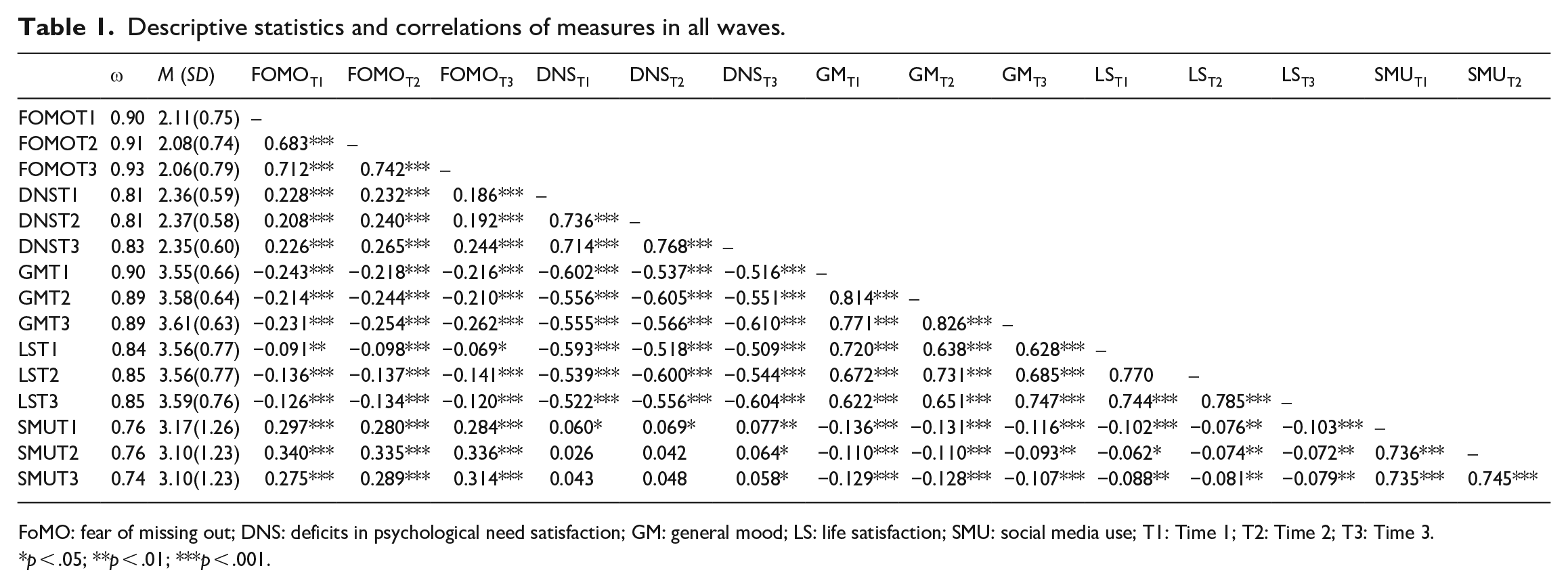
FoMO: fear of missing out; DNS: deficits in psychological need satisfaction; GM: general mood; LS: life satisfaction; SMU: social media use; T1: Time 1; T2: Time 2; T3: Time 3.
p < .05; **p < .01; ***p < .001.
Social media use
Participants were briefed that social media use includes both the use of social networking sites (e.g. Facebook, Instagram) and messaging/chat services (e.g. WhatsApp, Facebook Messenger). Social media use was assessed with two questions (cf. Du et al., 2018), Reflecting on the past 2 months, how many minutes per day do you spend on average per day on social media?’’ (1 = less than 30 minutes, 2 = 30–59 minutes, 3 = 1–2 hours, 4 = 2–3 hours, 5 = 3–4 hours, 6 = more than 4 hours); “Reflecting on the past 2 months, how often on average did you use social media per day?” (1 = less than once a day, 2 = once a day, 3 = 2–3 times a day, 4 = once an hour, 5 = 2–3 times an hour, 6 = more than 3 times an hour). We calculated one score for social media use by averaging the scores of the two items, with higher scores indicating higher levels of social media use.
Fear of missing out
FoMO was assessed with the Fear of Missing Out Scale (FoMOs; Przybylski et al., 2013). The scale consists of 10 statements, including items such as “I fear others have more rewarding experiences than me” and “It bothers me when I miss an opportunity to meet up with friends” (1 = “not at all true,” to 5 = “extremely true of me”). Scores are computed for each participant by averaging across all 10 items with greater scores indicating higher levels of FoMO.
Deficits in psychological need satisfaction
Deficits in psychological need satisfaction were assessed with the Basic Psychological Need Satisfaction Scale (La Guardia et al., 2000; cf. Przybylski et al., 2013). This nine-item scale addresses need satisfaction in interpersonal relationships by assessing three forms of need satisfaction: (1) autonomy (e.g. “I have a say in what happens and can voice my opinion”), (2) competence (e.g. “I feel very capable and effective”), and (3) relatedness (e.g. “I feel loved and cared about”; 1 = “not at all true” to 5 = “very true”). Participants’ deficits in psychological need satisfaction scores were computed by reverse scoring positively worded items and subsequently averaging the responses. A high score indicates a higher level of deficits in psychological need satisfaction.
General mood
General mood was measured using an adapted nine-item version of the Emmons Mood Indicator (Diener and Emmons, 1984; cf. Przybylski et al., 2013). Participants were asked to reflect on the past 2 months and rate nine emotion adjectives in terms of to what extent they experienced each emotion (1 = “never” to 5 = “always”). Responses to negatively worded adjectives (e.g. angry and depressed) were reverse scored. Higher scores indicate a higher positive general mood.
Life satisfaction
Life satisfaction was measured with an assessment that tapped into life satisfaction across four areas: (1) physical health, (2) emotional health, (3) personal relationships, and (4) life as a whole (Przybylski et al., 2013). Participants were instructed to indicate for each area how satisfied they are currently with their life (1 = “not satisfied at all” to 5 = “very satisfied”). A higher score indicates higher life satisfaction.
Data analysis
Data were analyzed using RI-CLPMs (Hamaker et al., 2015). For a visualization, see Figure 1. This model extends the traditional cross-lagged panel model (CLPM) by separating variance into a stable between-person component and a within-person component, which assesses changes from one’s mean level at ti (e.g. FoMO) as a function of changes in one’s means level of the other two variables (e.g. deficits in need satisfaction and social media use) at t1 (Figure 1) (Hamaker et al., 2015).
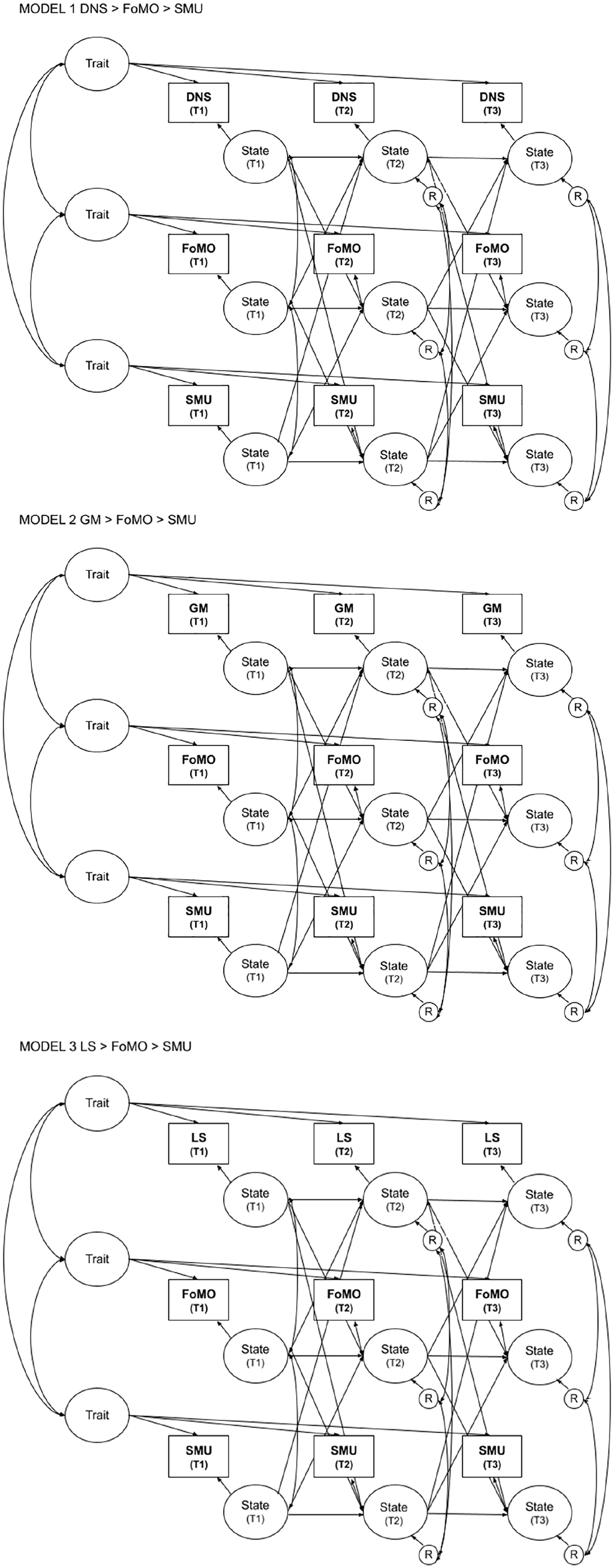
Theoretical random-intercept cross-lagged panel models.
First, we evaluated intraclass correlations (ICCs) to gain a sense of the variation that can explain stable differences between persons (cross-sectional) versus the variance described by fluctuations across time within persons (longitudinal). Second, the RI-CLPM was fit to identify bidirectional relationships between FoMO, psychological need satisfaction, psychological well-being, and social media use. We tested hypothesis H1a, H2a, H3a, and H4a by correlating the random intercepts, which represents’ individual mean scores across all three waves (between-person effects). We tested H1b, H2b, H3b, and H4b by correlating respondents’ within-person variance at ti which captures their specific deviation at ti from their overall score. Testing the RI-CLPM, we used mean scores following the procedure by Mulder and Hamaker (2020) and relied upon a one-tailed approach given directional hypotheses. Regarding the auto-regressive and cross-lagged paths, constrained and unconstrained models were compared using χ2 differences test and common criteria as described by Kline (2023 [1998]). Considering different fit indices, the unconstrained model fitted the data well for all three RI-CLPMs (see Figure 1): Model DNS: X2(6) = 6.711, p = .348, confirmatory factor analysis (CFA) = 1.00, root mean square error of approximation (RMSEA) = .009, 90% CI = [0.00, 0.04], standardized root mean residual (SRMR) = .01; Model GM: X2(6) = 5.780, p = .448, CFA = 1.00, RMSEA = .000, 90% CI = [0.00, 0.04], SRMR = .01; Model LS: X2(6) = 7.772, p = .255, CFA = 1.00, RMSEA = .015, 90% CI = [0.00, 0.04], SRMR = .01. Model comparison indicated that the unconstrained model significantly outperformed the other models in all the three RI-CLPMs (Mulder and Hamaker, 2020). As per our pre-registration, we opted for an unconstrained model since the data were collected during the global COVID pandemic with lockdown measures possibly differing across waves.
Results
Descriptive statistics and ICC
We first analyzed the variables’ bivariate relations. All variables associated with the hypotheses showed correlations that were in line with our theoretical rationales (see Table 1). The ICC for FoMO was .72, indicating that 72% of the variance in the three measures of FoMO over time is explained by differences between persons (i.e. stable trait level).
Most of the variance was explained by between person differences in other variables as well, with ICC’s of .74, .73, .80, and .77 for social media use, psychological need satisfaction, general mood, and life satisfaction, respectively.
The remaining variance of 28% is explained by within person fluctuations over time. Regarding the longitudinal associations, inspection of the autoregressive effects reveals that within-person deviations in FoMO Time 1 predicted within-person deviations in those same variables on Time 2, but not from Time 2 to Time 3 (see Tables 2 to 4).
Parameter estimates obtained in the RI-CLPM 1 DNS > FoMO > SMU.
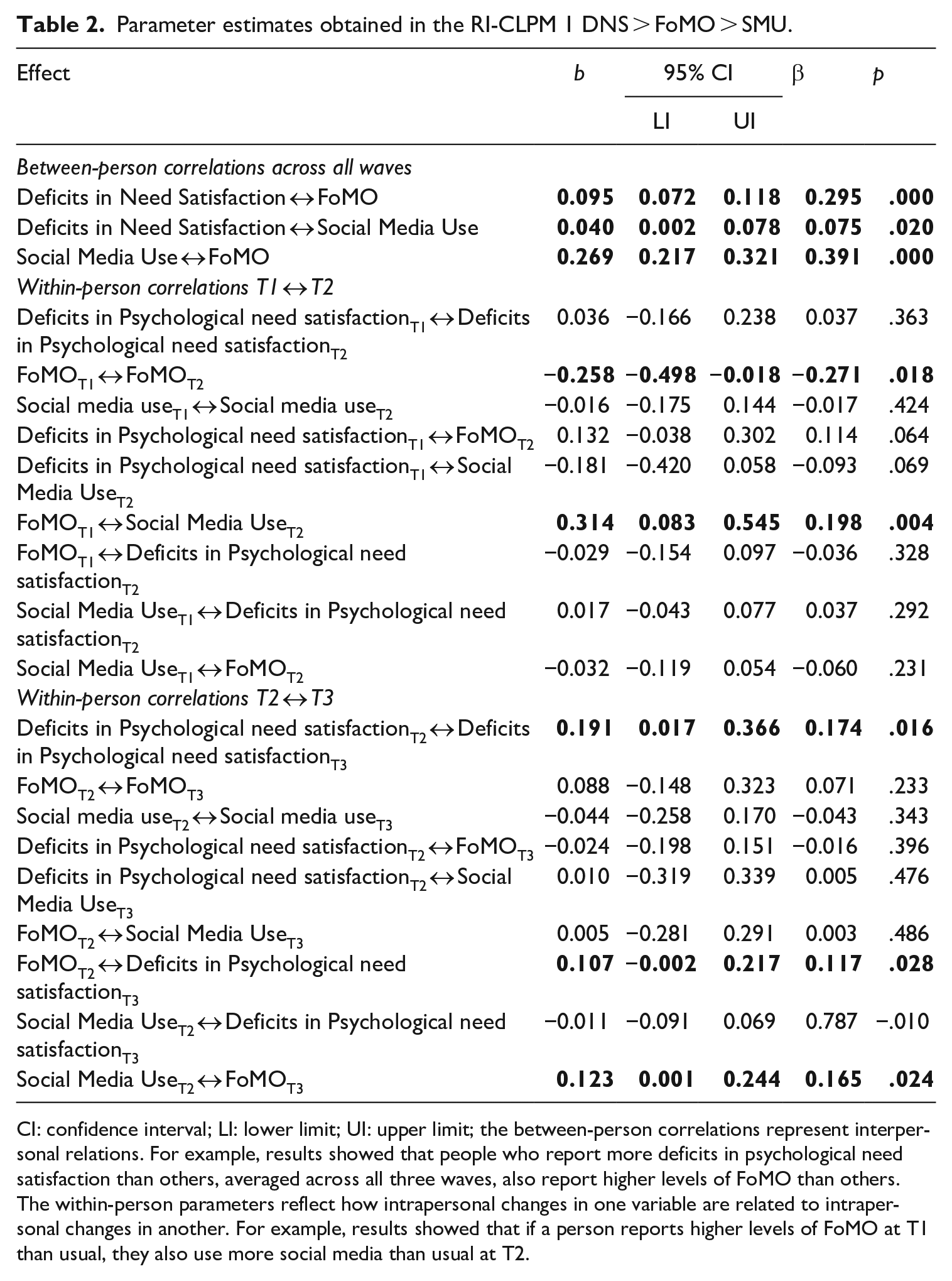
CI: confidence interval; LI: lower limit; UI: upper limit; the between-person correlations represent interpersonal relations. For example, results showed that people who report more deficits in psychological need satisfaction than others, averaged across all three waves, also report higher levels of FoMO than others. The within-person parameters reflect how intrapersonal changes in one variable are related to intrapersonal changes in another. For example, results showed that if a person reports higher levels of FoMO at T1 than usual, they also use more social media than usual at T2.
Parameter estimates obtained in the RI-CLPM 2 GM > FoMO > SMU.
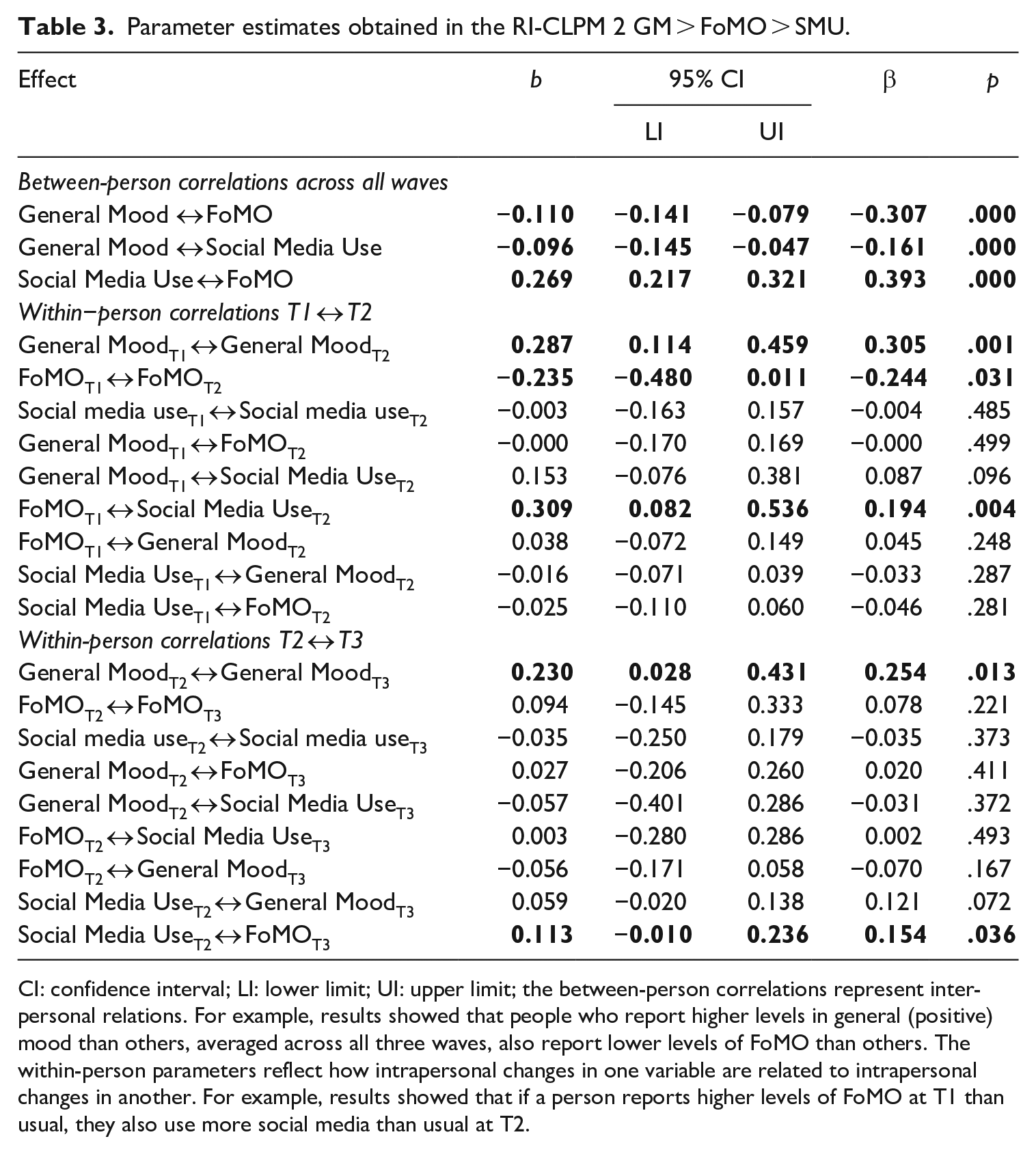
CI: confidence interval; LI: lower limit; UI: upper limit; the between-person correlations represent interpersonal relations. For example, results showed that people who report higher levels in general (positive) mood than others, averaged across all three waves, also report lower levels of FoMO than others. The within-person parameters reflect how intrapersonal changes in one variable are related to intrapersonal changes in another. For example, results showed that if a person reports higher levels of FoMO at T1 than usual, they also use more social media than usual at T2.
Parameter estimates obtained in the RI-CLPM 3 LS > FoMO > SMU.
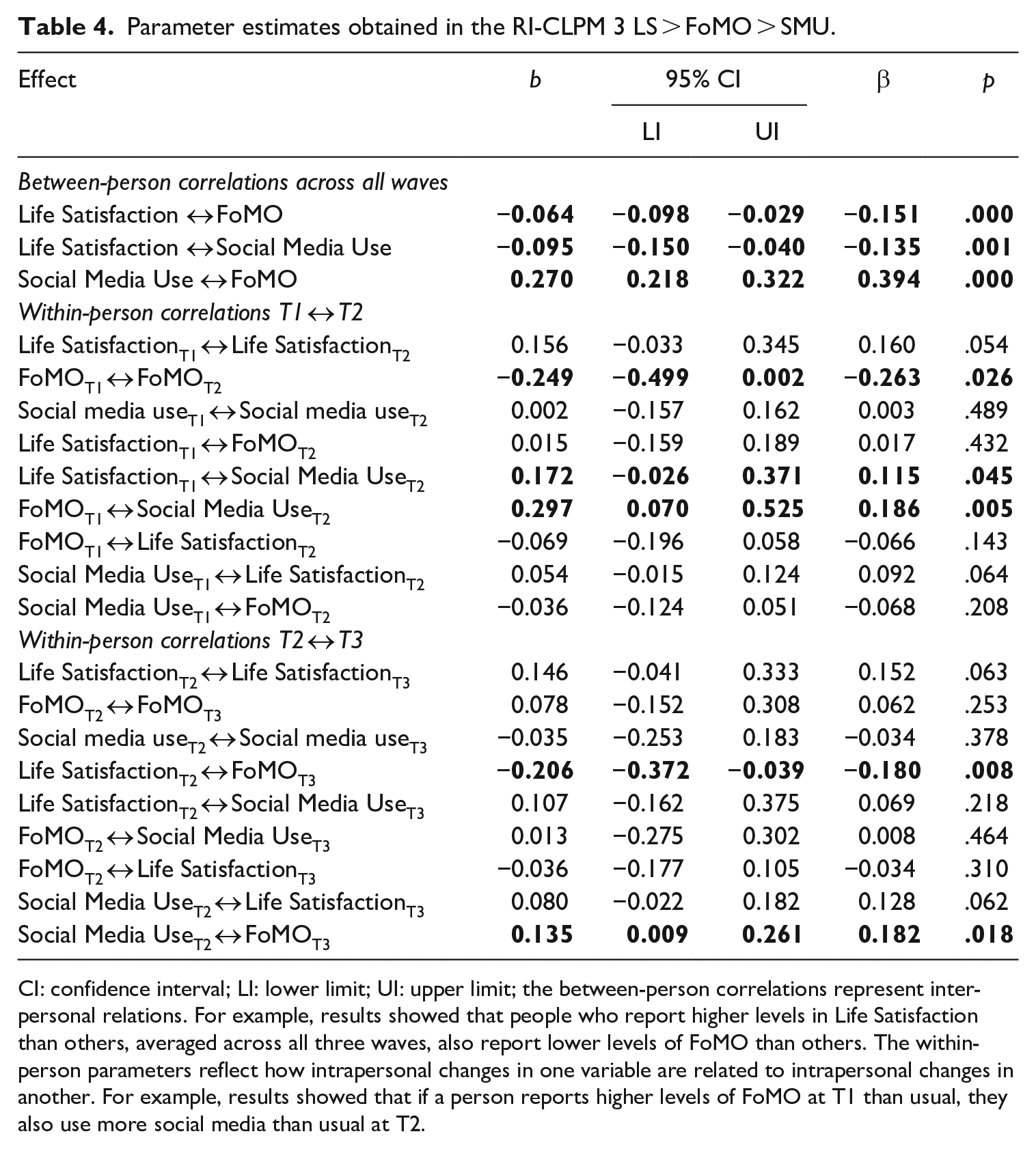
CI: confidence interval; LI: lower limit; UI: upper limit; the between-person correlations represent interpersonal relations. For example, results showed that people who report higher levels in Life Satisfaction than others, averaged across all three waves, also report lower levels of FoMO than others. The within-person parameters reflect how intrapersonal changes in one variable are related to intrapersonal changes in another. For example, results showed that if a person reports higher levels of FoMO at T1 than usual, they also use more social media than usual at T2.
Reciprocal model for deficits in need satisfaction and FoMO
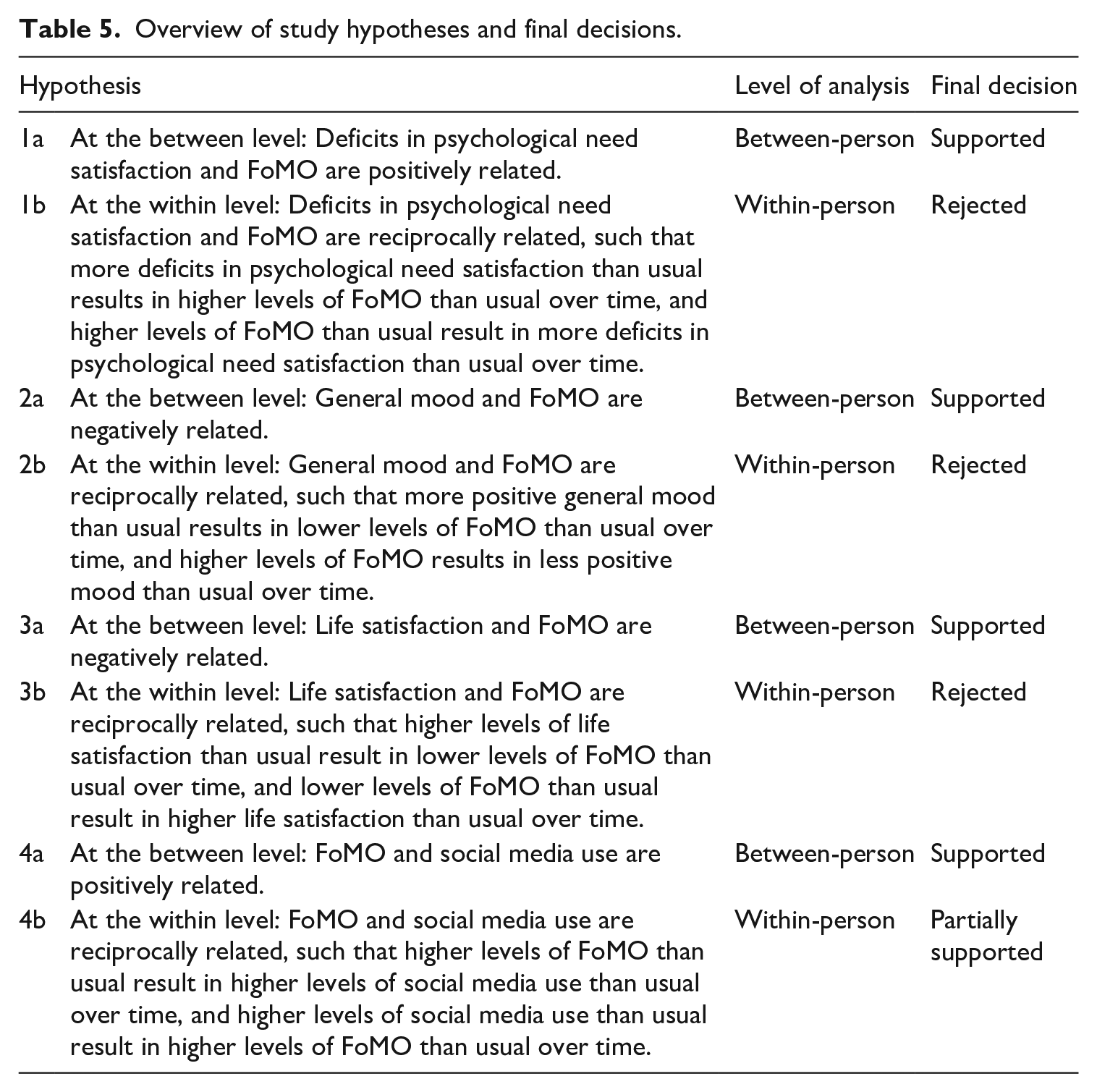
Hypothesis 1a predicted that deficits in psychological need satisfaction and FoMO are positively related. Random intercepts of the two variables show a positive association (β = 0.295, b = 0.095, 95% CI = [0.07, 0.12], z = 7.98, p < .001). Respondents who—on average across all three waves—experienced more deficits in psychological need satisfaction than others also experienced more FoMO, confirming Hypothesis 1a.
Hypothesis 1b proposed that deficits in psychological need satisfaction and FoMO are reciprocally related, such that more deficits in psychological need satisfaction than usual results in higher levels of FoMO than usual over time, and higher levels of FoMO than usual result in more deficits in psychological need satisfaction than usual over time. Results revealed that only FoMO levels at T2 positively predicted deficits in psychological need satisfaction at T3 (β = 0.117, b = 0.055, 95% CI = [−0.00, 0.22], z = 1.92, p < .05), indicating that FoMO above the participant’s mean at T2 was associated with more deficits in psychological needs satisfaction in the following 2 months, controlling for deficits in psychological need satisfaction levels at the previous time point. The results provide no support for Hypothesis 1b.
Reciprocal model for general mood and FoMO
Hypothesis 2a predicted that general mood and FoMO are negatively related. The results revealed a negative association between the two variables on the between-person level (β = −0.307, b = −0.110, 95% CI = [−0.14, −0.08], z = −6.87, p < .001). Thus, people who—on average across all three waves—reported higher levels of positive mood relative to the rest of the sample, were more likely to report lower levels of FoMO. The results, therefore, support Hypothesis 2a. Hypothesis 2b proposed that general mood and FoMO are reciprocally related, such that more positive general mood than usual results in lower levels of FoMO than usual over time, and higher levels of FoMO results in less positive mood than usual over time. The results did not reveal a significant effect on any time point, thereby rejecting Hypothesis 2b.
Reciprocal model for life satisfaction and FoMO
Hypothesis 3a stated that life satisfaction and FoMO are negatively related. Results indeed showed a negative between-person association between the two variables (β = −0.151, b = −0.064, 95% CI = [−0.10, −0.03], z = −3.61, p < .001). In other words, when averaged across all three waves, people with higher levels of life satisfaction than others were less likely to experience FoMO. Hence, the results support Hypothesis 3a. Hypothesis 3b proposed that life satisfaction and FoMO are reciprocally related, such that higher levels of life satisfaction than usual result in lower levels of FoMO than usual over time, and lower levels of FoMO than usual result in higher life satisfaction than usual over time. Results showed only a within-person correlation between life satisfaction at T2 and FoMO at T3 (β = −0.180, b = −0.206, 95% CI = [−0.04, 0.18], z = −2.42, p < .01), indicating that life satisfaction above the participant’s mean at T2 was associated with lower FoMO levels in the following 2 months, controlling for life satisfaction at the previous time point, thus rejecting Hypothesis 3b.
Reciprocal model for FoMO and social media use
Hypothesis 4a stated that FoMO and social media are positively related. Results indeed showed a positive between-person association between the two variables across models across all three RI-CLPMs. In other words, across all three waves, if people reported more FoMO than others, they were more likely to report more social media use, thus supporting Hypothesis 4a. Hypothesis 4b proposed that FoMO and social media use are reciprocally related, such that higher levels of FoMO than usual result in higher levels of social media use than usual over time, and higher levels of social media use than usual result in higher levels of FoMO than usual over time. All three models did indeed reveal a positive and reciprocal relationship between the two variables (see Tables 2 to 4), suggesting that if respondents report more FoMO at T1 than usual, they would also report more social media use at T2 and, subsequently more FoMO at T3. However, the results did not show a relationship between social media use T1 on FoMO T2 and subsequently on social media use T3. Since we found some support for a reciprocal relation, we conclude that the results partially support Hypothesis 4b. The partial support for Hypothesis 4b underscores the complexity of the relationship under investigation and emphasizes the importance of interpreting them with caution.
Table 2 presents an overview of the results of Model 1 (DNS >FoMO > SMU), Table 3 of Model 2 (GM >FoMO > SMU), and Table 4 of Model 3 (LS > FoMO > SMU). Table 5 summarizes all hypotheses and the final decisions based on our study findings.
Overview of study hypotheses and final decisions.
Discussion
According to the literature, FoMO can be understood as a self-regulatory limbo, arising from individual differences in psychological need satisfaction and lower psychological well-being. People who experience deficits in basic psychological needs or lower psychological well-being (i.e. lower general mood and life satisfaction) are hypothesized to be more anxious about missing out on socially rewarding experiences (FoMO), and hence, feel a stronger urge to be constantly connected through social media. As social media makes users aware of alternative social activities taking place, they are hypothesized to increase feelings of FoMO, which subsequently increases deficits in basic psychological needs or decreases psychological well-being (e.g. Wegmann et al., 2017).
Although this process has been proposed to consist of reciprocal relations between FoMO, psychological need satisfaction, psychological well-being, and social media use, no study to date has formally tested such causal dynamics over time. Our study aimed at addressing this gap. Using 3-wave panel data from a representative sample of social media users, we conducted RI-CLPM’s, which allowed us to separate the observed scores into two components; a time-invariant between-person part that varies between individuals (referred to as “trait-like”), and a time-variant part that fluctuates within individuals over time (referred to as “state-like”) (Basińska and Gruszczyńska, 2020). We draw four main conclusions.
First, when looking at between-person effects, we found support for associations between all of the variables examined. The strongest associations were the between-person associations between FoMO and social media use. Individuals who experienced more FoMO across the three time points than others were also more likely to engage in social media use across the three time points than others, and vice versa. In addition, we found between-person associations between FoMO and deficits in psychological need satisfaction, general mood, and life satisfaction, and vice versa. Individuals who experienced more deficits in psychological need satisfaction across the three time points than others were more likely to experience more FoMO across the three time points than others and vice versa. Similarly, individuals who experienced a more positive mood or more life satisfaction across the three time points than others, were less likely to experience FoMO across the three time points than others, and vice versa. Thus, at the between-level, the results showed strong relationships between the time-invariant components of FoMO, social media use, deficits in psychological need satisfaction, general mood, and life satisfaction.
The between-person effects support the view of FoMO as a dispositional trait. FoMO has been proposed as a relatively stable individual characteristic indicating the extent to which someone has a general FoMO on something (Przybylski et al., 2013). By performing RI-CLPM’s, the current study was the first to decompose time-invariant “trait-like” differences between individuals from within-individual “state-like” changes over time, and to show that FoMO exhibits more trait-like stability relative to individual variation around typical levels of this variable. This was also confirmed by the finding that the between-levels explained most of the variance in FoMO. Recognizing FoMO as a dispositional trait with trait-like stability emphasizes the importance of individual differences in understanding the phenomenon and underscores its potential as a long-term characteristic that influences individuals’ behaviors and experiences. This understanding can inform media literacy interventions to specifically to target individuals exhibiting high trait-like FoMO to enhance their well-being.
Second, the results of the current study also provided support for the idea that FoMO can be viewed as a temporary state that may vary within a person as experiences and situations change over time (Milyavskaya et al., 2018). In our study, the autoregressive effects captured the within-person carry-over effects of FoMO over time. The negative values of the autoregressive effects from T1 on T2 implies that an individual who experiences more FoMO relative to his/ her mean score, is likely to experience less FoMO levels relative to his/ her mean score 2 months later. However, the autoregressive effects from T2 on T3 were not significant. The non-stable nature of the autoregressive effect, particularly the diminishing carry-over effect from Time 2 to Time 3, implies that FoMO manifests itself through dynamic fluctuations within individuals in addition to stable trait-like differences over time (Hamaker, 2023; Lucas, 2023).
Moreover, although we did not find full within-level reciprocal effects, we did observe part of a reciprocal trajectory for FoMO and social media use: FoMO at Time 1 had a positive effect on social media use at Time 2, which in turn had a positive effect on FoMO at Time 3. Individuals who experience more FoMO at a certain time point compared with their usual level reported increased social media use 2 months later, leading to further increases in FoMO in subsequent months. The observed effects were all above .12, which Orth et al. (2022) consider as large in cross-lagged models. These findings provide partial evidence for the existence of a self-regulatory limbo between FoMO and social media use.
Thus, this study adds to the literature that has primarily theorized FoMO as an antecedent of social media use and has spent only scant attention to the reversed causal effect. For this reason Buglass et al. (2017) call for research on the impact of social media use on FoMO. Indeed, our findings suggest that social media use may also be a driver of FoMO, thereby giving rise to a loop in which FoMO may lead to social media use and social media use may lead to more FoMO. Future research should examine whether the nature and strength of the components of this reciprocal relation are contingent on the type of platform and the type of content consumed. For example, when individuals scroll through their social media feeds and see posts from their friends attending a social gathering or event to which they were not invited to, they may experience feelings of anxiety about missing out on the experience. Thus, effects may be tied to exposure to socially rewarding activities.
Recognizing FoMO as a state that fluctuates within individuals over time suggests that situational factors and life events can influence its intensity. This understanding can also guide the development of moment-specific interventions and strategies to help individuals manage their FoMO during critical life transitions.
Third, although this study provides partial support for a self-regulatory limbo, we found little support for the theoretical premise that this limbo would stem from deficits in basic psychological needs and/or lower general mood and life satisfaction (Przybylski et al., 2013), at least at the level of within-effects. Consistent with Przybylski et al. (2013), results showed that lower levels of life satisfaction preceded FoMO. However, this evidence only emerged from T2 to T3. For general mood and psychological need satisfaction, the current study observed no effect on FoMO over time. Contrary to what has been hypothesized in the literature based on SDT, the results of the current study do not provide support for a mechanism by which deficits in psychological need satisfaction cause FoMO over time. However, the results did provide some support for the hypothesized reverse causal effect between FoMO and deficits in psychology need satisfaction. This finding is consistent with research on ostracism, which shows that feelings of exclusion can negatively impact psychological human needs (cf. Holte et al., 2022). However, we must be cautious in interpreting this effect, as the effect of FoMO on psychological need satisfaction was only observed from T2 to T3.
Future research is recommended to explore the value of ostracism as well as other theories to explain within-person fluctuations in FoMO. Currently, the theoretical embedding of FoMO is predominantly rooted in SDT, which suggests that psychological well-being results from the satisfaction of autonomy, competence, and relatedness needs (Deci and Ryan, 2000). However, the results of the current study suggest that SDT may be less suitable for explaining fluctuations in FoMO within individuals over time. Although Przybylski et al. (2013) have hinted at the possibility that FoMO might fluctuate over time depending on contextual factors such as social media use, and other researchers have emphasize this as well (cf. Milyavskaya et al., 2018), no other theoretical explanation for experiencing FoMO has been empirically examined to date. However, scholars have identified associations between FoMO and other concepts that may provide guidance for additional theoretical underpinnings of FoMO. For example, Reer et al. (2019) found relatively strong associations between FoMO and social comparison, from which they conclude that FoMO is—at least partly—based on social comparison processes and that these processes are useful for understanding the foundation of FoMO.
Limitations
The data were collected during the COVID-19 pandemic, which may have affected social media use, FoMO, and psychological well-being, even if the restrictions were lenient at the time of data collection in the second quarter of 2021. Although this is an important caveat, we have reason to believe that our findings are largely robust, as research by Hayran and Anik (2021) showed no significant increase nor decrease in FoMO during the pandemic, even with social distancing at home. Furthermore, they found that FoMO was negatively associated with psychological well-being, consistent with previous research (e.g. Baker et al., 2016; Milyavskaya et al., 2018).
Another limitation refers to the time-interval. A 2-month time interval was selected in line with prior research indicators of social media use (e.g. Van den Eijnden et al., 2016) and psychological well-being (e.g. Turliuc and Candel, 2022). While shorter assessment intervals may fail to capture meaningful changes, longer intervals may introduce recall bias (Caruana et al., 2015). However, the task of participants retrospectively reporting on their abstract states over the last 2 months might have been challenging, especially when dealing with complex psychological dimensions assessed over an extended period. Future research could explore different time intervals to validate and extend our results, considering the trade-offs between recall accuracy and capturing dynamic changes over time.
Furthermore, while our findings provide initial support for FoMO as a relative dispositional trait, they also partially support the notion of a self-regulatory limbo in which social media use exacerbates feelings of FoMO. However, trait and state effects may be sensitive to different time intervals. Future research should disentangle within- and between-person effects based on data obtained at different time intervals to replicate our findings and determine whether trait or state effects become more or less pronounced. Finally, we used data from the general population. Therefore, the results may not be generalizable to other types of populations, such as adolescents.
Even though we a priori formulated our hypotheses, which were grounded in theory and findings derived from prior literature, as with any model that includes various associations, there is the risk of capitalizing on change. Although all observed effects were all above .12, which Orth et al. (2022) consider as large in cross-lagged models, we advise future research to further explore and validate these relationships. Moreover, the pre-registration did not predefine criteria for accepting or rejecting the hypotheses. For future studies, it would be beneficial to a priori clearly delineate the criteria or conditions determining support or rejection.
Despite these limitations, our findings provide an initial causal account of how psychological need satisfaction, psychological well-being, FoMO, and social media use are related over time. We recommend that scholars follow this route in future research.
Footnotes
Acknowledgements
Special thanks to Dr Philipp K. Masur for his helpful feedback during the data analysis.
Declaration of conflicting interests
The author(s) declared no potential conflicts of interest with respect to the research, authorship, and/or publication of this article.
Funding
The author(s) disclosed receipt of the following financial support for the research, authorship, and/or publication of this article: This work was supported by a grant from Rotterdam University of Applied Sciences to Ellen Groenestein. The funders had no role in study design, data collection and analysis, decision to publish, or preparation of the manuscript.
