



Abstract
Adolescents’ self-presentation on social media as an expression of identity development is influenced by personal norms and perceived social norms of relevant others. Snapchat is popular and widely used by adolescents to express themselves. A Bitmoji, as an alternative to a traditional profile picture, offers a wide range of self-presentation options through an avatar editor, including body stature and pose, individual facial features, and (branded) clothing. Based on 53 in-depth interviews with adolescents between the ages of 11 and 16, we investigated how Bitmojis are used for self-presentation and where the underlying action-guiding norms come from. Our study revealed the high perceived relevance of Bitmojis among adolescents who consciously use their Snapchat avatar to express themselves. True self-behavior is essential for some adolescents, evidenced by single, regular, or daily changes to Bitmojis’ hairstyles and clothing. Others engage in false self-behavior, displaying an ideal self to hide disliked body features or showing a false self to experiment with their digital identity. The perceived social norms of the peer group play an important role for adolescents as their personal norms.
Keywords
Among adolescents, Snapchat enjoys high popularity (Vogels et al., 2022). By providing specific socio-technological features, the platform expands adolescents’ everyday lives and offers diverse communication opportunities for networking, participation, and self-presentation (e.g., Grieve, 2017; Taber & Whittaker, 2018). Instead of profile pictures (Jiang et al., 2023), Bitmojis are personal, customized avatars (Snap Inc., 2023) that enable diverse online self-presentation through various physical characteristics and poses. However, they can be used as stickers in chats or on the Snapmap, which displays other users’ locations around the world. Bitmojis are created with an editor allowing customization of body size, posture, facial attributes, and (branded) clothing.
Because they provide a multitude of options for adolescents’ self-presentation, Bitmojis are a potential tool for expressing their identity. Especially in adolescence, identity development is a crucial developmental task characterized by experimentation with different roles (Erikson, 1968) and identity states (Marcia, 1980) in multiple social contexts. That also means trying out possible selves (e.g., S. Choi et al., 2020; Higgins, 1987; D. Shulman, 2022), which “provide an evaluative and interpretative context for the current view of the self” (Markus & Nurius, 1986, p. 954). In adolescence, the social context is important for identity development, and, therefore, self-presentation in the context of Snapchat’s Bitmoji is based on socially shared ideas about how one may and wants to present oneself to whom. Social norms (Yau & Reich, 2019), negotiated offline and online with relevant others such as peers (Geber & Hefner, 2019; Hurrelmann & Bauer, 2018), are set through typical behaviors (descriptive norms) or spoken (in)direct standards of action (injunctive norms). Both contribute to developing adolescents’ personal norms (Schwartz, 1977) and are thus part of self-presentation as an expression of identity development.
While adolescents’ self-presentation on other social media, such as Instagram, has already been much researched (e.g., Yau & Reich, 2019; Zillich & Riesmeyer, 2021), Snapchat has been little studied (e.g., T. R. Choi & Sung, 2018). Bitmojis, in particular, have received little attention to date (e.g., Jiang et al., 2023), although previous studies on comparable phenomena such as Animoji (e.g., Herring et al., 2020a) or profile avatars (e.g., Vasalou et al., 2008) illustrate their relevance for online self-presentation as part of identity development. In addition, studies often focus on (young adults’) behavior but rarely question where this behavior comes from, that is, what norms underlie it.
Our study addresses these desiderata and focuses on adolescents’ socially negotiated self-presentation on Snapchat via Bitmojis. We conducted in-depth interviews with adolescents aged 11 to 16 as part of the research project “Norms of Visual Self-Presentation in Adolescents’ Identity Development (NoViS),” funded by the German Research Foundation (DFG-RI 2578/3-1). We addressed the self-presentation of Bitmojis and aimed to shed light on which possible selves are expressed via the Bitmoji–and how personal and perceived social norms shape this.
Identity development through self-presentation
Identity development is a central developmental task involving self-discovery and social integration to form a cohesive sense of identity (Erikson, 1968; Havighurst, 1972). Adolescents explore their values, beliefs, and interests and experiment with different identity aspects (Markus & Nurius, 1986; Siegler et al., 2019). Especially during adolescence, identity crisis due to a self that is still developing (Baumeister, 1986; Harter, 2012; Marcia, 1980) and identity experimentation (Erikson, 1968; Hurrelmann & Bauer, 2018) are particularly prominent. Social media such as Snapchat provide adolescents with spaces to experiment and develop an identity, and their online self-presentation may differ from their offline self-presentation (Kim et al., 2011).
Self-presentation refers to the deliberate and conscious presentation of oneself to others to convey a specific image or identity (Goffman, 1956). It involves a strategic communication of personal attributes, values, beliefs, and characteristics to shape other’s perceptions (Leary & Kowalski, 1990). In a digital world, adolescents use social media to express their identities through all available features such as text, images, videos, and interactions (likes and comments) (e.g., Fullwood et al., 2016; Hernández-Serrano et al., 2022; Riesmeyer et al., 2021; Zillich & Riesmeyer, 2021). Thus, self-presentation highlights one’s personality, interests, or values while meeting social expectations (e.g., Geber & Hefner, 2019). It is a complex process strongly influenced by cultural influences and personal and social norms (Yau & Reich, 2019) and shaped by relevant others in adolescents’ social environments (Mummendey, 1983).
Self-presentation: between online true and false self-behavior
Online, the possibilities for self-presentation are manifold due to the different socio-technological features social media offers (DeVito et al., 2017). As adolescents engage in online self-presentation, they show possible selves (T. R. Choi & Sung, 2018; Higgins, 1987; Michikyan, 2022; Rogers, 1951). Harter et al. (1996) examine a continuum of self-presentation ranging between true self-behavior and false self-behavior. True self-behavior is defined as the opposite of false self-behavior. A comparative perspective is applied to the true self to describe the level of truth or equality with self-behavior in different social contexts. The concepts are value-neutral and merely represent a level of comparison between the true self and the false self (as a non-true self). Researchers have shown that possible selves can be visible at different times and places and can mix with a person’s self-image (Harter et al., 1996; Michikyan et al., 2015). The desire for a particular self-presentation is relevant to choosing a specific social medium (T. R. Choi & Sung, 2018).
True self-behavior refers to those actions that correspond to the true self, are guided by authentic and true feelings and attitudes, and are internally motivated (Harter et al., 1996). The literature assigns several possible selves to true self-behavior, whereby different meanings are ascribed to them. These include the actual self, which Higgins (1987) describes as “representation of the attributes that someone (yourself or another) believes you actually possess” (p. 320) and that one expresses to others. In contrast, the true self consists of inner feelings and thoughts expressed outwardly in manifested feelings and self-presentation (Harter et al., 1996). It is seen as a central part of identity not fully expressed to others offline (Bargh et al., 2002; Hu et al., 2021). Previous research shows that the true self “is more accessible in memory during internet interactions, and the actual self more accessible during face-to-face interactions” (Bargh et al., 2002, p. 33), which is why we focus on the true self.
False self-behavior, on the contrary, refers to the extent to which one’s self-presentation is inconsistent with one’s genuine person or personality (Harter et al., 1997). The term “false” is not negatively connoted in the literature. It is merely a comparison with the true self and the extent to which it is presented online. It’s not necessarily about deliberately deceiving the other person but also about trying out and experimenting with identity. The false self includes self-presentation inconsistent with one’s true character, beliefs, and values (Gil-Or et al., 2015) and does not correspond to the true self. Therefore, it “is a more defensive, protective self that hides one’s ‘true self’” (Gil-Or et al., 2015, p. 1). The false self is expressed through false information (inappropriate traits), experimentation (trying out different selves via self-presentation), or expectancy confirmation (desire to impress others) (Harter et al., 1996). Online, false self-behavior can be expressed using various socio-technological features, for example, filters that lead to a virtually modified self (called “transformed self,” Javornik et al., 2022). Another domain of the self, which also describes self-presentation “in ways that do not reflect one’s true self as person or the ‘real me’” (Harter et al., 1996, p. 360), is the ideal self. It involves the display of characteristics that a person would ideally like to possess (Higgins, 1987; Meeus et al., 2023) and is an expression of desires and (future) visions of the self (Rogers, 1951). Expressing the ideal self means, among other things, displaying physical characteristics in a way that corresponds to one’s own wishes (and not necessarily to reality).
Norms of self-presentation
Adolescents’ self-presentation is guided by socially shared ideas about how one may and wants to present oneself visually and to whom. Norms, defined as “shared beliefs [. . .] about expected or desired behaviors in a given situation or circumstance” (Braxton, 2010, p. 243), serve as rules for action (Yau & Reich, 2019). Adolescents’ personal norms reflect their values, beliefs, and moral concepts and help to define who they are. Social norms, on the contrary, represent socially negotiated, perceived, and context-dependent rules of action (Interis, 2011; Rimal & Lapinski, 2015). Personal and social norms are closely interconnected.
Personal norms
Personal norms primarily develop in childhood, rooted in values and social norms internalized during primary socialization (Schwartz, 1977; Schwartz & Howard, 1981). They embody individual beliefs about behaving in particular situations and express personal standards and moral principles (Parker et al., 1995; Schwartz, 1973). As internalized standards, they guide a person’s behavior and are closely linked to self-concept (Bamberg et al., 2007), influencing what is considered right or wrong. Adhering to personal norms is motivated by the anticipation of self-related feelings like regret or guilt rather than fear of social sanctions. Conformity to norms fosters self-worth, security, and pride (Schwartz, 1973, 1977).
Shaped by adolescents’ experiences, attitudes, and cultural backgrounds (Thøgersen, 2002), personal norms differ from social norms as they represent internal demands rather than externally imposed rules (Kallgren et al., 2000).
Social norms
Social norms are socially negotiated and context-dependent rules of action (Rimal & Lapinski, 2015). The role of perceived social norms (Chung & Rimal, 2016) in self-presentation is of particular importance, as they guide adolescents’ actions. These include descriptive norms, which “serve an information function (e.g., social proof) and help to define the typical behavior in a given situation” (H. C. Shulman et al., 2017, p. 1209), indicating what others typically do in a given situation (Rimal & Real, 2003, 2005). Individuals frequently utilize these norms as a foundation for their actions to circumvent social conformity pressures and preserve interpersonal relationships. In contrast, injunctive norms refer to what is ideally expected behavior and constitute rules for morally approved conduct (Cialdini et al., 1990, 1991). They create the perception of pressure to conform to appropriate behaviors (Rimal & Real, 2003) and provide sanctions (such as social feedback) for noncompliance by group members (Lapinski & Rimal, 2005; Rimal & Real, 2003), whereas descriptive norms usually do not entail sanctions (Cialdini & Trost, 1998).
Peers: reference group for self-presentation
Adolescents negotiate social norms with reference groups (Hurrelmann & Bauer, 2018), which can be proximal (e.g., peers and family) and distal (e.g., social media influencers), depending on the closeness between the adolescents and the reference group. Through social interaction with them, adolescents learn acceptable behaviors and norms in their immediate environment. Therefore, the process of identity development is often determined by those norms with which adolescents compare themselves as individuals and which are considered in decision-making regarding various actions (Kemper, 1968).
The closer a reference group is to the adolescent, the more powerful its normative influence on action and the more probable it is that noncompliance with social norms will be sanctioned (Geber & Hefner, 2019). Peers are proximal reference groups with whom the adolescent has direct, virtual, and non-virtual contact (Geber & Hefner, 2019). During the middle adolescent phase (ages 14 to 16), peers gain importance as a reference group (Hurrelmann & Bauer, 2018) by setting descriptive and injunctive norms for adolescents’ self-presentation, such as the expectation to appear attractive on Instagram (Yau & Reich, 2019). Nevertheless, adolescents occasionally defy these social norms in favor of fidelity to their personal norms, even if it entails imposing sanctions from their peers, such as withholding approval (Zillich & Riesmeyer, 2021).
Bitmojis: avatars on Snapchat shaping self-presentation
Social media platforms influence self-presentation by defining a framework of action for users through their socio-technological features that enable (or do not enable) different self-presentation and that are perceived by adolescent users and allow for different self-presentations in specific contexts (see also the affordances approach, e.g., DeVito et al., 2017; Evans et al., 2017). Thereby, research on self-presentation on Snapchat is limited. Few studies have examined self-presentation among (young) adults, e.g., in relation to the temporal affordance of Snapchat content (S. Choi et al., 2020) and in the context of privacy concerns (T. R. Choi & Sung, 2018) or purchase intentions (Flecha-Ortíz et al., 2021).
Self-presentation on social media begins with the creation of a profile, which often combines text and images. Like the profile, avatars play a central role in online environments (e.g., Messinger et al., 2019; Waddell & Ivory, 2015), as they are often the first point of contact and nonverbal component of communication with others. Snapchat was one of the first social media platforms to use avatars instead of photographs as profile pictures. Bitmojis are personally created, picture-like avatars (Snap Inc., 2023). The body’s or face’s physical characteristics can be set via the editor, from hairstyles and skin colors to piercings and cosmetics, such as lipstick and eye shadow, wrinkles, glasses, and body stature. In addition, users can set a personal background and make the Bitmoji stand in a specific pose. A wide selection of individual clothing items is available for the outfit—from Snapchat fashion to branded clothing from famous companies. Bitmojis are intended not only as avatars or profile pictures but can also be used to communicate with others via Snaps (images or videos). When users write in the text input field, matching Bitmojis are suggested. Snapchat calls the combinations of a user’s Bitmoji with those of their friends “Friendmojis.” In addition, on the Snapmap, the Bitmoji presents the geographic location where a user and others are (e.g., Jiang et al., 2023).
Thereby, self-presentation from images that do not show the bodies and faces of the people who share them has been little studied. Tiidenberg and Whelan (2017) examine these “not-selfies,” that is, self-presentation in the absence of the embodied self, including third-party images such as screenshots from TV series or movies and images of animals but also gifs (see also Tolins & Samermit, 2016). Other studies are dedicated to avatar-based environments, including gaming environments such as SecondLife (Ducheneaut et al., 2009; Messinger et al., 2019) or World of Warcraft (Ducheneaut et al., 2009; Waddell & Ivory, 2015), but also social media (e.g., for Yahoo; Vasalou et al., 2008). Other studies take a look at similar features to the Bitmoji: Herring and colleagues (2020a, 2020b, 2020c) investigate Animojis 1 (iPhone-based, customizable emojis), focusing on gender differences, the relationship-specific use of Animojis, or spoken behavior in Animoji video clips. Bitmojis themselves have hardly been a central subject of research to date. An exception is the case study by Jiang and colleagues (2023), who investigated reciprocity and homophily in the context of adults using Bitmojis.
We follow up on the desiderata by looking at adolescents’ use of Bitmojis and ask:
RQ1: To what extent do personal and social norms shape adolescents’ Bitmoji creation?
RQ2: To what extent do adolescents express true or false self-behavior through their Bitmoji, and what role do personal and social norms play?
RQ3: How do personal and social norms shape what adolescents use their Bitmoji for?
Method
We chose a qualitative approach to answer these research questions, allowing for an in-depth and contextual examination of adolescents’ experiences and perspectives (Flick, 2023). The qualitative interviews are part of the research project “Norms of Visual Self-Presentation in Adolescents’ Identity Development (NoViS),” funded by the German Research Foundation (DFG-RI 2578/3-1).
Category system and interview guide
We translated our research interest into a category system (Kuckartz & Rädiker, 2023), which was used to form the “interview guide” (Flick, 2023, p. 204) as well as for the category-guided analysis to enable the comparison of the individual statements of each participant and to identify patterns between all interviews. We mixed theory-guided and evaluative categories on presentations of self and norm perception with thematic and natural categories on self-presentation via Bitmojis (Mayring, 2022). Bitmoji self-presentation was translated into three categories: Bitmoji as profile avatar (creation, similarity, and editing), Bitmojis in chats, and Bitmojis on the Snapmap. We added categories of possible selves and norm perception (personal and social norms and social feedback). The category system with dimensions can be found in Table 1.
Category System and Examples Questions.
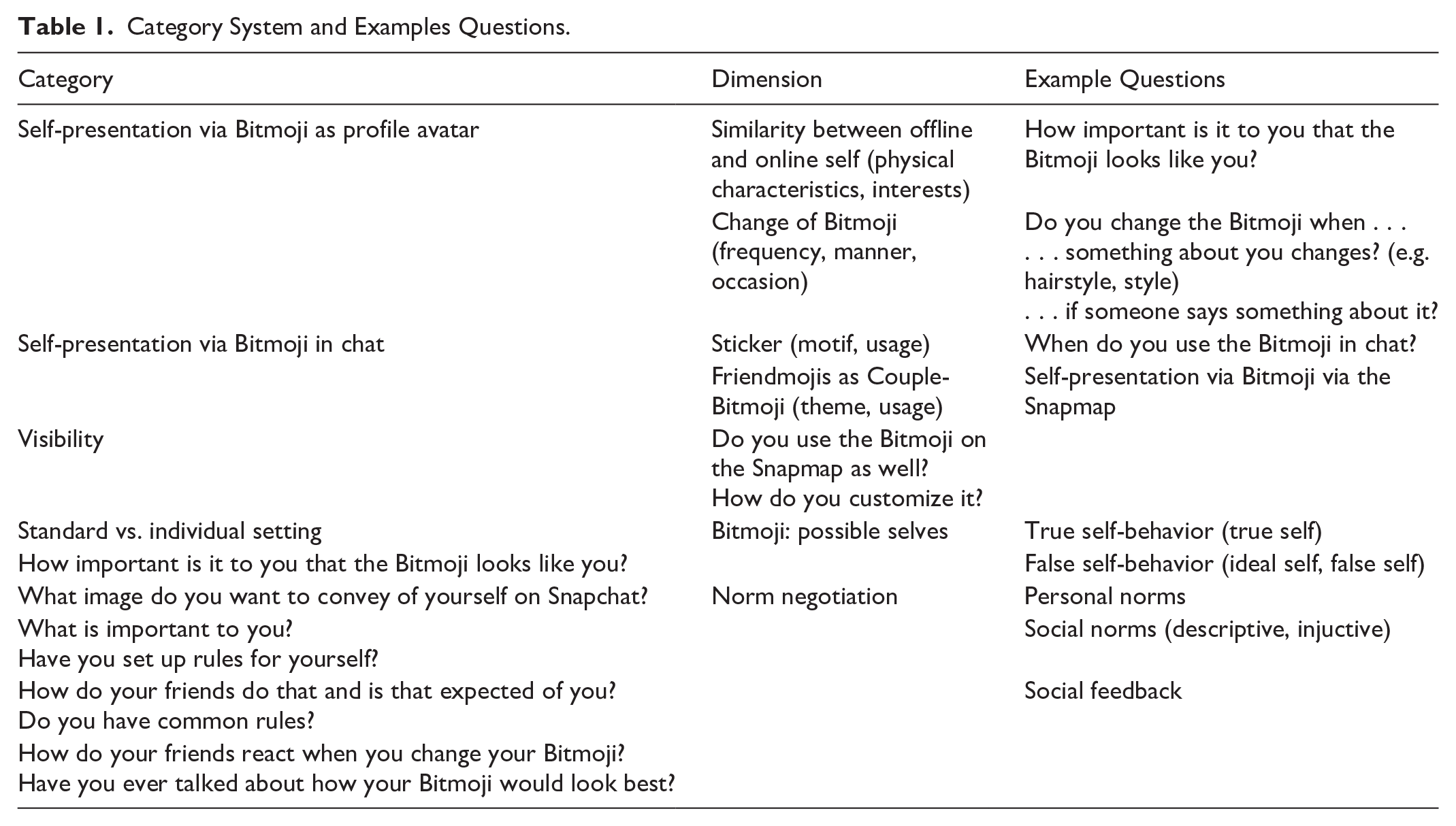
These categories served to develop the interview guide (Flick, 2023). It was structured into several question blocks. In addition to an introduction to the research project and an icebreaker question, the interview guide included questions about Snapchat use in general, the Bitmoji as a profile avatar, its use in chat and on the Snapmap, as well as questions about the typical behavior of others, behavioral claims, and social feedback. All interviews were based on a common interview guide, which contained all the questions to be asked during the interview and whose order and formulation could be adapted to the course of the interview. At the same time, asking open questions allows for spontaneous answers and articulating thoughts. The interview guide was pretested and adapted based on the feedback. The changes related to the wording of the questions to make them understandable to the young interviewees. Sample questions can be found in Table 1.
Ethical approval
We considered research ethics in the data collection and analysis and applied the research ethics evaluation by the Film University Babelsberg KONRAD WOLF ethics committee. It was approved with a positive vote. The application for ethical approval included information describing the research design, methodological approach, interview guide, and data management plan. We addressed considerations about the underage sample, which is considered vulnerable.
Data collection and sample
The data collection was part of a larger research project, “Norms of Visual Self-Presentation in Adolescents’ Identity Development (NoViS).” In this research project, we asked 20 adolescents between the ages of 14 and 15 about their self-presentation on Instagram and Snapchat. We paid attention to an equal distribution according to gender (10 boys, 10 girls), age (10 adolescents aged 14, 10 adolescents aged 15), and education (11 students at grammar school, eight at secondary school, one at lower secondary school). In addition, the 20 adolescents were allowed to name two peers who we also interviewed.
For this study, we drew a subsample of all adolescent Snapchat users. The total sample is 53 adolescents aged 11 to 16, including 25 female and 28 male participants. The wide age range can be explained by the fact that these peers could be younger or older. The respondents live in different regions of Germany. The respondents reported using Snapchat for between 1 and 6 years, spending an average of 54 minutes daily using the app (ranging from 5 to 358 minutes). 2 An overview of the sample characteristics can be found in Table 2.
Sample.


Note: The details of the 20 adolescents who formed the starting point for the sampling are highlighted.
Before the interviews, the adolescents received detailed information about the research project, and the informed consent forms were handed out. The data collection followed receipt of the participants’ and parents’ informed consent. Interviews were conducted in person in a familiar setting for the adolescent. Depending on the adolescents’ abilities to articulate and reflect, the interviews ranged from 34 to 103 minutes. 3 After training several times, the interviews were conducted by the study’s two authors. After the interviews, the interviewees received an expense allowance of 20 Euros. After data collection, all interviews were transcribed word-by-word, anonymized, and pseudonymized to protect participants’ privacy.
Data analysis: translation of the category system into a MAXQDA code system
We chose qualitative content analysis to evaluate the qualitative material. According to Mayring (2022, p. 98), “qualitative content analysis aims to analyze texts systematically by processing the material step by step with category systems developed on the material in a theory-guided manner.” The categories established deductively as a basis for the interview guide were tested against the material and supplemented with inductive categories. Thus, we added dimensions for the use of the Bitmoji in chat, specifically as a sticker or Friendmoji, and for motives for use. We translated the categories into a code system implemented in MAXQDA. For this purpose, we mapped the categories as codes and the dimensions as sub-codes. Subsequently, the code system was pretested, discussed with the project team, and readjusted.
The used approach has the advantage of aiming at a truthful description without bias due to the researcher’s prejudices and understanding the material in its terms (Mayring, 2022) because each interview can be analyzed word by word and assigned to the appropriate categories (possibly multiple times; Flick, 2023). In addition, both authors initially coded together and discussed the coding (step 1). Each author then coded one interview transcript (step 2). Afterward, the authors discussed the respective coding to achieve agreement (step 3). The final coding of all interviews was done by one author (step 4). Afterward, both authors systematically compared the coded transcripts to recognize repeating patterns (step 5; e.g., Miles & Huberman, 1994).
Results: self-presentation via Bitmojis between the true and the false self
Our research questions focused on how Bitmojis are designed by adolescents (RQ1 and RQ2) and what they are used for (RQ3). The interviews showed that adolescents attach great importance to creating Bitmojis in different ways. They use Bitmojis as profile avatars to present themselves and communicate with others and on the Snapmap. Regarding the appearance of Bitmojis, the perceived social norms of the peer group are often evident: that is, some adolescents base the creation of the Bitmoji on their (Snapchat) peers and their behavior (descriptive) or their expectations (injunctive). Personal norms are essential for others: they are guided by their offline norms. In some cases, adolescents also place personal norms above those of others, even if the group norm is contrary.
Starting with Snapchat: the first creation of the Bitmoji (RQ1)
Three different ways of creating a Bitmoji were evident in the interviews. First, adolescents often create the Bitmoji based on their personal norms of self-presentation. They create Bitmojis according to their own ideas and on the basis of their personal values, that is, they themselves determine what their Bitmojis look like. Second, some also report inspiration from and feedback from others, which can be an observation of others’ Bitmojis (descriptive) or actively expressed injunctive norms, that is, if there is a group rule for a particular outfit or possible self (friend groups’ norm to dress according to offline self aka. true self). Third, surprisingly, some adolescents have Bitmojis created by friends or siblings (as with Ignaz, 11 years, who said, “My sister just helped me with it,” or Olivia, 15 years, who stated, “I was not the one who created my Bitmoji, but my friend. Because she thought it was essential”). If there is no personal experience with Bitmoji creation and self-presentation via Bitmoji, role models contribute to the formation of personal norms through their behavior as descriptive norms and their guidance (including explicit injunctive norms, for example, by saying what the adolescent’s Bitmoji should look like).
Patterns of Bitmoji self-presentation and triggers for editing (RQ2)
Looking at self-presentation through a Bitmoji, the interviews revealed five patterns that are not exclusive. Some adolescents follow several patterns (see Figure 1) because they experiment with their self-presentation at different times and, if necessary, adapt it to the ideas of the reference groups. Therefore, these patterns are influenced by personal and social norms, representing both the baseline and short-term triggers for changing the Bitmoji. These can be seen in two dimensions: while some adolescents show true self-behavior, others express false self-behavior.
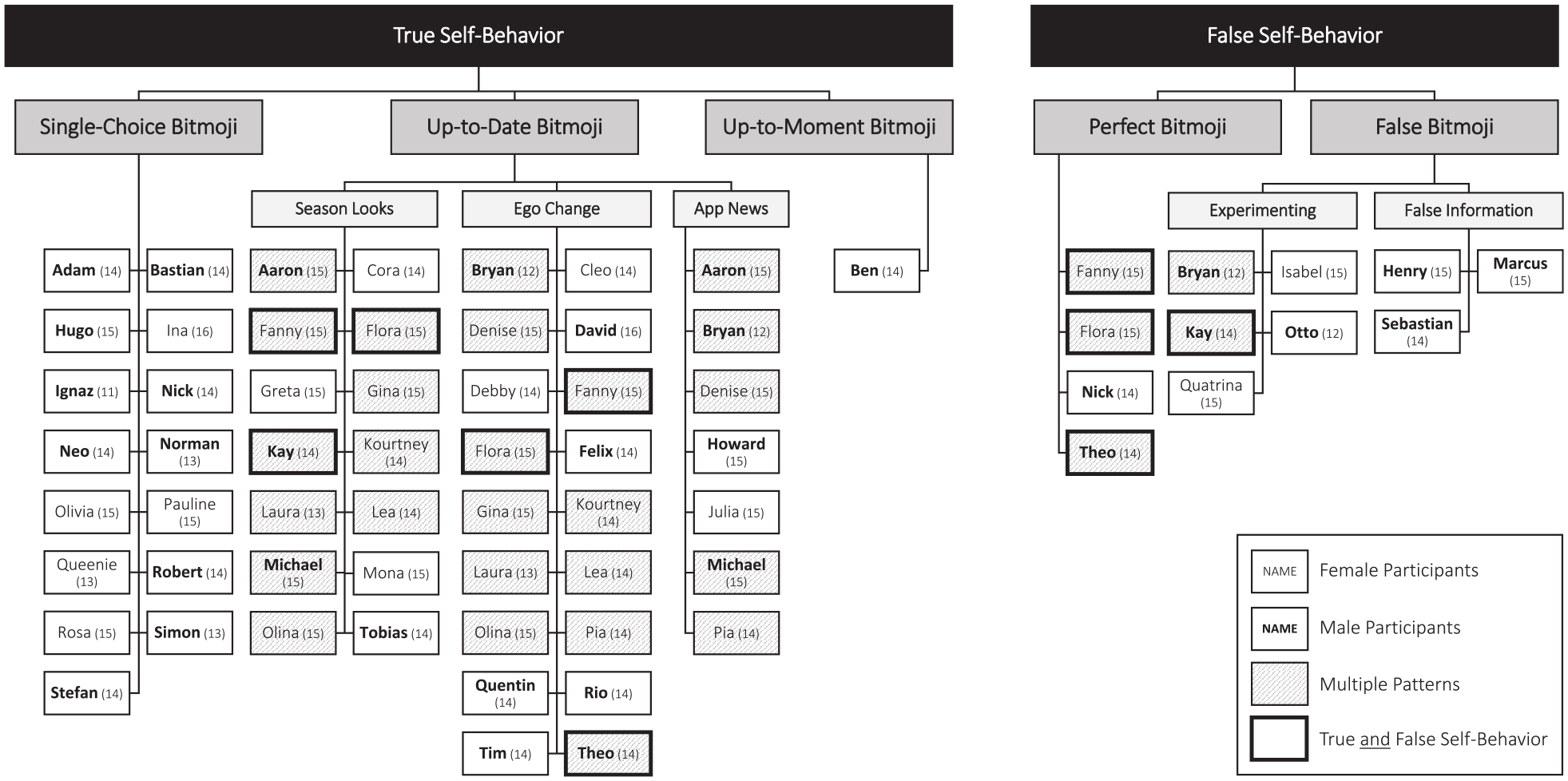
Patterns of Bitmoji self-presentation.
True self-behavior: between one-time to daily adaptation to the current self
For most adolescents (47 adolescents mentioned this pattern), an essential point in creating the Bitmoji is as high a resemblance to themselves as possible: they express their true self via true self-behavior. Personal norms shape their self-presentation: Bitmojis should resemble the original characters because they aspire to authenticity and do not seek to create an entirely new persona. Furthermore, they are motivated by a desire to be recognized. For example, Claudia (14 years) said, “I tried to make it look as realistic as possible,” and Pia (14 years) argued that the Bitmoji must suit her: “Even if it is just an app, I don’t want to create another personality for myself that isn’t me.” Ben (14 years) also expressed this opinion but pointed out the technical limitations (“It just doesn’t look quite like you, even if you try”). Bitmojis are also adapted to the true self for making new contacts, which is justified by not wanting to create false expectations about appearance. For example, Effie (15 years) said, “It is senseless making the Bitmoji all pretty, and then someone sends a Snap, and then I don’t actually look like that.”
For these adolescents, true self-behavior is also promoted by observing others’ Bitmojis: It appears in their circle of friends and is perceived as typical behavior and therefore as a descriptive norm. Furthermore, friends within a group often have similar expectations of each other’s behavior, and therefore set injunctive norms. For example, Emilia (15 years) said, “I would already say that others so actually expect you to create it the way you are.” If the norm of matching the Bitmoji to one’s true self is violated, adolescents express feedback directly via Snapchat in one-on-one chat and offline in face-to-face communication. Emilia (15 years) reported, “For example, I cut my bangs during Covid and then changed the Bitmoji. Many people wrote to me, ‘Hey, do you have bangs now?’”
Regarding true self-behavior, different patterns become apparent, whereby two poles can be identified: faithful to appearance in general (style and typical external features) and faithful to daily appearance (concrete external features, such as current clothing).
Pattern 1: single-choice Bitmoji
Fifteen adolescents (10 males and five females) created resemblances to themselves when creating the Bitmoji for the first time, limiting themselves to general features. For example, Cora (14 years) said, “It is more of a normal Bitmoji and not something that I would style myself completely,” while Tim (14 years) said, “It looks like me. Moreover, it is wearing a soccer jersey because I also wear them privately.” They also set the background once according to their interests (e.g., soccer or nature and plants). They express a less strong personal norm: Their Bitmoji is less important to them than others and consequently must be authentic in its main characteristics, but not daily. They stated that they observe the Bitmojis of others less often (which leads to fewer perceived descriptive norms) or perceive fewer injunctive norms in the form of social expectations toward their Bitmoji.
Pattern 2: up-to-date Bitmoji
Others changed their Bitmoji periodically and customized it. Three different triggers showed up here: One of the often-mentioned triggers was an externally prompted moment, such as changing the Bitmoji according to the season. Fourteen adolescents mentioned this pattern (4 males and 10 females). For example, Tobias (14 years) mentioned that he changes the Bitmoji-clothes as follows: “In the spring, a pair of shorts and a sweater. In the summer, everything is short. Bathing shoes, sunglasses, and a cap.” Female adolescents like Emilia (15 years) also reported this: “In the summer, for example, just shorts and in the winter long pants.” Such seasonal looks were not always actively attributed to social norms, suggesting an origin in personal norms. Second, another trigger was when a (physical) feature or taste changed. Eighteen adolescents (7 males and 11 females) mentioned this pattern, including Effie (15 years): “If I take off a distinctive thing, such as glasses, then I change that, too. If my style changes, I also try to change the outfit that way.” The personal norm of the Bitmoji self’s similarity to the offline self was more evident here. Also, adolescents reported, that their peers would sanction not changing the Bitmoji as they would give (negative) feedback if the Bitmoji no longer fits. Third, triggers were initiated by Snapchat itself, such as an avatar editor update (mentioned by four males and three females). In this way, the Bitmojis were set to look even more similar, and the clothes were adapted to current tastes. For example, Aaron (15 years) reported, “When something new comes in on Snap, I check at it. And if I like it, I just wear it.”
Pattern 3: up-to-moment Bitmoji
One male (Ben, 14 years) even told us that he changes his Bitmoji every morning and dresses it according to his outfit for the day to ensure similarity between himself and his avatar. He justified this with a strong personal desire to be recognized offline by peers of the opposite sex to make new contacts. Other adolescents also reported that they used to make daily changes to their Bitmoji earlier, which shows a shift in personal norms. For example, Pauline (15 years) said, “I used to think it felt kind of stupid every week, and I always wanted new clothes and stuff. But now, I have not changed it for ages.”
False self-behavior: experiencing the unknown
While most adolescents show true self-behavior, others are likelier to display false self-behavior. Two specific patterns became apparent:
Pattern 4: perfect Bitmoji
Four adolescents (two males and two females) admitted to being dishonest about all aspects of their Bitmojis, showing an ideal self through a perfect Bitmoji. Robert (14 years) reported from his Snapchat environment, distancing himself: “In any case, there are people like me who try to imitate it as well as they can. However, some design it the way they might want to look [. . .]. With girls, for example, who somehow say, ‘Yo, yeah, I am fat’—then they make themselves thin. It’s okay if you want to do that, but I don’t.”
In particular, in the case of dissatisfaction with themselves (i.e., personal characteristics they did not view positively), the Bitmoji is designed according to the desired characteristics. They create an ideal Bitmoji self to meet expectations of themselves (personal norms) and others (injunctive and descriptive norms). Fanny (15 years), for example, presents herself as tanned and with solid eyelashes. Theo (14 years) explained his perfect Bitmoji trough perceived descriptive norms: “The body figure I chose slightly differs from what I actually am [. . .]. You could make the Bitmoji thicker, but I don’t think that would fit. Because everyone has a normal body figure, why would I have a chubbier figure? No, I have a normal body figure like everyone else.”
Pattern 5: false Bitmoji
Others play with their self-presentation in their Bitmojis, displaying false selves and changing the nuances and characteristics of their offline identities. This false self-behavior is driven by two main reasons: First, three male and two female adolescents stated that they experiment with their Bitmoji selves to determine how a style change would look. Based on personal norms, this includes trying out a different hair color or clothing style. For example, Isabel (15 years) changed her hair color (“I just went with short purple hair [. . .]. I kind of thought it looked cool”). Second, false information is spread. Three male adolescents mentioned that they changed the nuances of the Bitmoji, while female adolescents did not spread a false Bitmoji. Kay (14 years) said this would be funny: “Either I put on some weird costume or something else for fun.” These adolescents said they do not care whether their Bitmoji truthfully presents their offline identity in all facets (personal norms). In making such changes, they receive feedback from others who know their offline selves and can match it to the Bitmoji. Bryan (12 years), for example, tested a false hair color (red) and wore branded clothing as a Bitmoji (ideal self). As a result, he reported that his friends “have often said, ‘That does not look like you at all, undo that.’ Yes, and then I undid it.” This example demonstrates that adolescents defer personal norms in favor of perceived social norms and that their peers negatively sanctioned non-conforming behavior. On the contrary, Bryan (12 years) also gave positive feedback: “Even if it [someone else’s Bitmoji] looks cool, I say, ‘Hey cool, looks really good like you. If you want, you can buy it. Then it looks really good like that.’”
Others form an utterly false identity to provoke. Thus, physical limitations that do not exist in reality (e.g., using a wheelchair or being obese) are visualized. Marcus (15 years) said, “I have always put together something that makes absolutely no sense [. . .] I sit in a wheelchair, have white hair, a halo, and a swimsuit.” We also found that adolescents often have a common framework of action (i.e., set descriptive and injunctive norms), especially in peer groups, so even this kind of false self-behavior is not necessarily sanctioned within the group. For example, Henry (15 years) reports that his entire group of friends has a Bitmoji that does not correspond to their true self (e.g., different hair color, size of the nose) “because we thought it was funny.”
Outside a close group of friends, provocative behavior is noticed. For example, Laura (13 years) noticed this pattern in others, especially in the behavior of male friends (“Some boy from class, he always makes his hair green, but actually [my friends] already do as they look”). Sometimes, this behavior is discussed within their circle of friends. However, the adolescent in question is not directly sanctioned since sanctions tend to be pronounced within the adolescent’s close circle of friends rather than within a broader circle of friends.
Areas of Bitmoji usage (RQ3)
The adolescents affirmed the importance of Bitmojis on Snapchat, as they reflect their personalities and should be embodied on Snapchat. The avatar serves as the first point of contact with (new) friends. Therefore, the Bitmoji is not only important as a profile avatar. The Adolescents also reported that they use Bitmojis as stickers in one-to-one communication. In doing so, they often resort to the response reactions suggested by Snapchat, such as a laughing Bitmoji: “If you want to thank someone, there is, like, a Bitmoji that says, ‘Thank you’ [. . .]. That is when I used a sticker” (Kourtney, 14 years). Some adolescents also reported using the so-called Friendmojis, which show two Bitmojis together to emphasize friendship. That was mainly reported by female participants, such as Isabel, 15 years (“With my very best friends, we send each other Bitmojis like this—just Bitmojis of us”) or Effie, 15 years (“Someone who also has a Bitmoji, and then we just try to create any Bitmojis together”). Theo (14 years) also said he uses them for fun: “Sometimes I send a kiss emoji or a Bitmoji to my cousin—just for fun, it is so humorous.” Overall, Bitmojis in chat were not found to have high usage and importance for most adolescents (personal norms) or their peers (descriptive and injunctive norms).
However, the Bitmoji on the Snapmap was found to be even more important. This interactive map tracks users and displays their Bitmojis (and the adolescents themselves) at their current locations. In addition, some adolescents reported expressing their Bitmoji according to their current activity. For example, the Bitmoji can be shown playing sports or eating ice cream. Theo (14 years) attached particular importance to his Bitmoji: “When I go to the gym, I make my Bitmoji lift weights.” Others, such as Olina (15 years), permanently show their hobbies, such as listening to music (her Bitmoji wears headphones). Bitmojis are adapted to the current hobby and change depending on the activity. It serves to express personal norms (i.e., the desired expression of one’s personality on one hand and the desire for the Bitmoji to be up-to-date and accurate on the other hand).
Discussion
With this study, we gained new insights into the relevance and importance of Bitmojis in adolescents’ everyday lives, especially for their self-presentation as part of their identity development. We investigated how adolescents use Bitmojis for self-presentation, what Bitmojis are used for on Snapchat, and the extent to which personal and social norms guide true and false self-behavior. Our study was based on in-depth interviews with 28 male and 25 female German adolescents aged 11 to 16.
We add to the quantitative view of Jiang and colleagues (2023) on the usage of Bitmojis across a network with the question of motivations and where they come from. To this end, we assessed the norm negotiation process from different perspectives. We show that adolescents attach great importance to Bitmoji’s creation (RQ1) and use on Snapchat via the Snapmap, but not in the chat (RQ3) and that personal and social norms influence how and for which purpose a Bitmoji is used (RQ2). In addition to the relevance of peers’ social norms, which has been proven in previous studies (e.g., Yau & Reich, 2019; Zillich & Riesmeyer, 2021), we included personal norms as a counterpart and interpretation aid to social norms, and at the same time take a look at the framework that Snapchat sets (e.g., via new Bitmoji design options).
By using the broad understanding of true and false self-behavior based on Harter and colleagues (1996), we extend the idea of clearly delineated forms of the self, namely the true, ideal, and false selves. Our five patterns of self-presentation are not clear-cut: adolescents show more than one pattern, even true and false self-behavior. The Bitmoji is often used as a reflection of the true self, with varying degrees of truthfulness and authenticity. On the contrary, the Bitmoji can also be used for false self-behavior, which shows a perfect idea of the self or is different in some or all aspects. Therefore, situations, personal norms, and social norms play a crucial role in finding patterns for Bitmoji-self-presentation.
Adolescents are guided in the creation and further design of Bitmoji by personal norms that emerge from their beliefs and values, and at the same time, they are provided with an interpretative framework for perceived social norms. We show that adolescents often need to express their “real me” via Bitmoji because they want to be perceived as authentic and honest, and it is important for them not to pretend to be fake. We identified three patterns, ranging from Single Choice to Up-to-Date to Up-to-Moment changes. Male adolescents are more likely to report creating the Bitmoji once. Female adolescents in particular want their Bitmoji to be up-to-date: They are more likely than male adolescents to change the Bitmoji when personal (physical) characteristics or clothing style changes (seasonally). This suggests that it is important for them to portray their current true self. At the same time, adolescents adopt the behavior of others into their own through the descriptive observation of the behavior of others (e.g., seasonal looks). Similar findings have been examined by Herring et al. (2020a): They show both the importance of true self-behavior for adults when creating an iPhone-specific Animoji (mostly single-choice self-presentation) and adults’ experimentation with self-presentation, as well as the importance of relevant others.
The interplay of personal and social norms is also evident in the context of false self-behavior. The Perfect Bitmoji pattern is shaped by adolescent’s personal norm of the desire to project an idealized image that aligns with societal standards and perceived injunctive norms by peers. It suggests that while adolescents strive for authenticity and a true self, they sometimes feel compelled to present a curated version of themselves that meets external expectations, reflecting identity crises during adolescence. Conversely, the False Bitmoji pattern indicates a more playful and experimental approach to self-presentation, where adolescents use their Bitmojis to explore multiple identities and styles without concern for strict accuracy. This pattern underscores the importance of social norms set by peers as there are often underlying shared rules for experimenting or false information. Concrete injunctive norms guide self-presentation that occurs together in the group (e.g., sharing false information such as physical characteristics). It shows how close friendships can create a safe space for exploration, where behaviors that might be considered inappropriate in broader contexts are accepted as part of the group’s identity. Male adolescents, in particular, reported that their own Bitmoji showed false information. That indicates that group norms are more important to them for their identity development than the perception and evaluation by others outside their close group of friends. In contrast, female adolescents only reported observing this behavior among male Snapchat friends from an external perspective, which did not influence their behavior.
In addition, our study contributes to understanding changes concerning self-presentation and underlying personal and perceived social norms. During the interviews, the adolescents reflected on past behavior and its causes. They recalled the beginning of their Snapchat use and compared what they did back then with how they presented themselves currently. It became clear that, in some cases, the social norms of others were more relevant for self-presentation at the start of their Snapchat use, whereas currently, these adolescents tend to follow their ideas. That shows what is also theoretically expected: identity development is a developmental task, a process influenced from both inside and outside.
However, we must emphasize that our findings are not generalizable, as our sample was limited to 53 adolescents aged 11–16 years from Germany who use Snapchat less or more intensively. That applies not only to comparability with other age groups but also to the fact that we surveyed a wide age range, so our statements are not statements for a specific age but present an insight into identity development via Bitmojis during adolescence.
To address these limitations and contextualize our findings, a quantitative follow-up survey would be helpful, as would a follow-up observation of actual usage situations to understand when and how Snapchat use, especially Bitmoji use, occurs and changes over time. Another limitation of our research is our specific age group. Since norm negotiation is a process that begins in adolescence but continues throughout life, expanding our sample to include a broader age group would also allow for age group comparisons. In this regard, a panel study could assist. In this context, one could see a development of the person’s identity and recognize patterns in this respect. Furthermore, this article focuses mainly on a single technical feature of Snapchat. However, there is a further analysis of other Snapchat features (e.g., Snap Streaks and Round Snaps) as well as a focus on Instagram as part of our research project “NoViS,” which offers an interesting comparative perspective on self-presentation. Future research could use a comparison of the two platforms to reveal how possible selves present themselves on various social media and what specific opportunities and limitations arise for visual self-presentation.
Conclusion
This study is the first to examine the negotiation of personal and social norms in adolescents’ identity development in the context of self-presentation via Bitmojis on Snapchat. The results demonstrate the relevance of Bitmojis on Snapchat and illustrate how they convey different aspects of the self, both true and false self-behavior. Adolescents utilize distinct patterns of self-presentation through the use of Bitmojis. The findings contribute to a more comprehensive examination of self-presentation, allowing for a multidimensional understanding of the true self and thus advancing the state of research and theoretical understanding.
For adolescents, the creation and design of Bitmojis is a complex process shaped by personal and social norms. Self-presentation via the Bitmoji can contribute to the new development and consolidation of personal norms, but perceived social norms of peers also play a central role in self-presentation. The social environment, such as friends and siblings, plays an active role in identity development by providing role models through descriptive norms and being directly involved in shaping self-presentation by formulating rules and demands perceived as injunctive norms. Both descriptive and injunctive norms serve as a guide to help adolescents navigate their social groups. This highlights the importance of social interactions and feedback for identity development during adolescence.
In addition to the theoretical and research implications of the study, we present practical implications. Adolescents base their self-presentation on personal norms but are also influenced by social norms, which contribute to forming and consolidating personal norms. Therefore, parents and teachers, as proximal reference groups, must contribute to the identity development process. That requires that they are knowledgeable, supportive, and engaged.
Footnotes
Acknowledgements
The project “Norms of Visual Self-Presentation in Adolescents’ Identity Development (NoViS)” was conducted with PD Dr. Arne F. Zillich (Ludwig-Maximilians-University Munich, Germany) and Annika Wunderlich (Film University Babelsberg KONRAD WOLF, Germany). The authors thank their invaluable guidance and recommendations in planning and executing this study.

Funding
The author(s) disclosed receipt of the following financial support for the research, authorship, and/or publication of this article: The German Research Foundation funded this research (grant no. DFG-RI 2578/3-1).
Declaration of conflicting interests
The author(s) declared no potential conflicts of interest with respect to the research, authorship, and/or publication of this article.