



Abstract
The author of this article contends that current digital research methodologies tend to extract and commodify knowledge in ways that can replicate social, cultural, racial, economic, and global inequities. This article presents an Indigenous approach to digital methodology, including examples of posts to Facebook, Instagram, and Bluesky, as well as algorithmic search results. Finally, the author discusses new opportunities within Indigenous methodologies as approaches for performing more inclusive digital research beyond settler colonial research paradigms.
An introduction and an introduction to Indigenous methodologies
I am Cindy Tekobbe, an enrolled member of the Choctaw Nation of Oklahoma. My mother was Helen Jane, and my grandmother was Esther Belle. My ancestors walk with me. I grew up in an extended matriarchal family who taught me traditional Choctaw values, including “faith, family, and culture.” I am from Arizona, home to 22 federally recognized Native American tribes and even more tribal communities, where Native culture is visible and integral to public life.
1
This traditional Indigenous introduction I have offered locates me within a kin network, a culture, and an epistemology. Kovach explains that: Indigenous researchers will situate themselves as being of an Indigenous group . . . They will share their experience with culture, and/or they will identify their Indigenous epistemology (or epistemologies) of their research. Often, they will culturally locate in all three ways . . . For many Indigenous peoples, this act is intuitive, launched immediately through the protocol of introductions. It shows respect to the ancestors and allows community to locate us. Situating self implies clarifying one’s perspective on the world (Hampton, 1995; Meyer, 2004). This is about being congruent with a knowledge system that tells us that we can only interpret the world from the place of our experience. (Kovach, 2009, p. 110)
By introducing myself this way, I signal that I employ Indigenous storytelling, relationality, reciprocity, respect for the experiential and the metaphysical, and an activist decolonial agenda as my methodological paradigm. This article is composed as a series of stories and uses storywork as its primary methodology. I write this article from my experience as a Choctaw feminist researching the digital platforms and networks that inform and underpin modern life. Like other researchers, I find that oppression and marginalization are hard-coded into this digital life (Daniels, 2009; Noble, 2018; Noble & Tynes, 2016; Steele, 2021). However, by applying decolonial and Indigenous research methods, I find that these networks and platforms create opportunities for the historically underrepresented and erased to claim space and make visible peoples, epistemologies, cultures, and lands. These decolonial Indigenous methodologies work against traditional digital research methods that tend to extract and commodify knowledge in ways that can replicate social, cultural, racial, economic, and global inequities. As a scholar using Indigenous methods, when I write about the perils of western empiricism and its “objectivity” that obscures contextual details and research ideologies, I know that I, too, am not objective. I am an activist and work in reciprocal relationships with my accomplices and partners to support their objectives. My research interests are in historically underrepresented and erased communities and identities. My own identity is of a cisgender woman of Indigenous and European heritage. Because I am not yet tenured, I must produce single-authored research to support my career. However, my Indigenous lifeways and worldviews require me to see life holistically and situated within its creatureness (Deloria, 2023, p. 89), knowledge-making collaboratively, and relationships reciprocally. I ask the reader to keep the limitations of single-authorship and humanness in mind while reading this work.
With my application of Indigenous frameworks, I invite the reader to think about this article in two ways. First, writing is an act of storytelling. Storywork is an Indigenous method for sharing knowledge, making new knowledge, and synthesizing culture and knowing (Archibald, 2008; King, 2003; King et al., 2015; Kovach, 2009; Riley Mukavetz, 2021; Tekobbe, 2024; Windchief & San Pedro, 2019). Second, this article is framed as a collaboration between the storyteller and the reader, where I share my stories with an audience aware that storytelling to share knowledge is a collaborative ceremony. In an Indigenous framework, “research is ceremony” (Wilson, 2008). This means that knowledge-making practices are ceremonial and spiritual in nature. Knowledge is sacred and made between humans and the more-than-human world; it is not the product of one person relaying what is known to another. Rather, the making is collaborative and includes the context within, the land 2 upon, the metaphysics between, and the time among the knowledge makers in reciprocal relation to each other (Harjo, 2019; Killsback, 2013; Rifkin, 2017; Smith, 2021; Tekobbe, 2024). I begin here with a story, then I explicate an Indigenous digital framework through more stories, and finally, I offer recommendations for more inclusive and sustainable approaches to decolonizing digital research.
Storywork as digital methodology
My first story is a story I told in my 2024 book, Indigenous Voices in Digital Spaces. In that text, I describe reality as “subjective” and the western study of knowledge-making, or what is known, as an “interrogation of an agreed upon reality” (p. 6). Once, my friend Daniel saw a fox while taking a walk in the countryside. He posted on Facebook, telling his social network about the encounter and asking what it meant to see a fox cross your path. His friends responded collectively, making jokes and sharing stories about “The Fox (What Does the Fox Say),” a 2013 release by the Norwegian duo Ylvis that went viral and has been seen on YouTube more than a billion times. Some thought the fox might be lucky. Some told him to stay away from the fox because foxes can carry disease, making the fox a threat. In my book, I describe that in western knowledge, the fox is settled as a member of the Canidae family and that foxes do not speak—they do not say anything. Still, for music fans, Fox and what it says is social currency. Daniel’s social network thought foxes were lucky, diseased, and wild. In some North American Indigenous cultures, Foxes can be cultural tricksters, teaching lessons and dealing consequences. “What does it mean when a fox crosses your path?” is an ontological question, and we can see in the case of Daniel’s Facebook post that his friends arrived at a collective meaning. For Native American peoples, foxes are our relatives; seeing them may mean different things at different times. For the Choctaw, my people, foxes may speak. Foxes may bring messages, are associated with shadows, and perhaps move between worlds: . . . Fox delves into the dark things that Choctaw know about life, afterlife, souls, and the nature of good and bad. Fox is both frightening and reassuring that this is a deep and wide life—it is challenging and is not comfortably contained in one idea—Fox strains at the boundaries of meaning. Fox is definitely not settled, and it does not matter to the Shadows if Fox is classified by westerners as canine. (p. 6)
What the fox says is an ontological question. What a fox is is an ontological question. But the knowing of fox, in an Indigenous paradigm, can never be settled, and thus, the knowledge of fox is not colonized. The meaning Daniel made with his friends is collaborative, made in a network, and has no need to be settled if we get comfortable with the decolonial paradigm of unsettled knowing.
Intersectional feminist and digital methodologies represent a way of looking at research that provides some agency and authority to the research subject (Collins & Bilge, 2016). Intersectional ethnography embraces storytelling, which grounds the recording of the experiential as data. In Thick: And Other Essays, Cottom (2019) argues that telling evocative stories becomes a “problem for power” (p. 28). She writes that those who fall outside of hegemonic whiteness, Black women specifically, but also Others are “social issues to be solved” (p. 9). She reminds us that personal essays are data because “as far as authoritative voices go, the self was the only subject men and white people would cede to us” (p. 22). These methodologies go a long way toward making visible and legible underrepresented voices and experiences. However, they do not entirely address the western need to settle knowledge—to fix it in the amber of what is known and knowable. They do not deal directly with the colonial extraction paradigm or the conceptualization of knowledge as a moral asset in a capitalist system. This intersectional situatedness, with its agency for the marginalized self, is a reframing that undermines but does not break the extractive processes of research and does not get at the fluid nature of decolonized knowledge and its associated meaning-making practices. It also partially severs the lifeways in which knowledge is situated and understood. It erases the collaborative identity work that precedes meaning-making. This is why I constructed a framework of digital Indigenous methodologies that are explicitly decolonial, resist cultural extraction, reject the settler who settles knowing, decline to view knowledge as an asset, and honor the relationship between land and people.
This article demonstrates Indigenous research methodologies that step away from treating knowledge as an extractable resource and one that is subject to taxonomy or the organization into the frozen knowable that western meaning is built on. Universalized notions of Indigenous knowledge are reductionist. However, Indigenous methodologies do have some commonalities. Kovach defines Indigenous methodologies as having the following qualities: “(a) holistic epistemology, (b) story, (c) purpose, (d) the experiential, (e) tribal ethics, (f) tribal ways of gaining knowledge, and (g) an overall consideration of the colonial relationship” (44–45). This epistemology emphasizes the “non-fragmented, holistic nature, focusing on the metaphysical and pragmatic, on language and place, and on values and relationships” (57). The purpose here is not to create a linear methodological process or juxtapose western research methodologies against Indigenous methodologies as if there was a one-to-one relationship, nor is it to suggest that decolonization can be achieved solely by shifting research methodologies (although that would be a start).
Indigenous digital methodology
In my work in methodological design, there are five important features of digital decolonial methodology: storytelling, taking an approach that is relational, designing studies that are reciprocal, holding respect for the experiential and metaphysical, and confronting the colonial project. The first feature is storytelling that I have described, and I will continue to return to in the rest of this article. The second feature of digital decolonial methodology is that it is directly engaged in disassembling the colonial project. In colonized scholarship, the researcher evaluates the subject and then aggregates the conclusions of their analysis of the subject into “findings.” As the fox is colonized as Canidae, so then are the subjected knowledges contained in that classification. When I wrote about Indigenous bitcoin entrepreneur, Payu Harris, and the cryptocurrency and mainstream press around his project of introducing a bitcoin variant, MazaCoin to the Pine Ridge Oglala-Lakota, I had to sort through many colonial media representations of Harris as a lone noble warrior of the past transported to the present to once again battle the mighty federal government (Tekobbe & McKnight, 2016). In that writing, I described a well-meaning and thoughtful journal editor who wondered if Harris was partially responsible for the colonial fantasy the press presented because Harris talked about his tribal history and lineage in interviews. As I have already said, it is commonplace and appropriate to situate oneself within their kin network. While I understood the concern that Harris invoked the images of Sitting Bull and other Sioux traditions in his interviews with the media, Harris’ story was his own, and I would not subvert his agency by assessing who was ultimately responsible for the colonial fantasy imagery the cryptocurrency and mainstream media embraced. They embraced this representation because white “possessive logics” rationalize discursive meanings about the nation, who owns stories, and who makes social conventions (Moreton-Robinson, 2021). In short, white audiences own Harris and his story as they integrate it into their national mythology. This is especially true when analyzing social media because the platforms and algorithms themselves are built on whiteness, and then the social discourses are engaged in re/constructing whiteness recursively. So, the first task of a decolonial digital researcher and storyteller is to relay authentic stories from the positionality of the research partner. Rather than analyze the stories as data and then report findings on that data, we cede to the partners’ agency in their own stories.
The second and third features of decolonial digital methodology are that they are relational and reciprocal. The researcher must be a participant in the research. The researcher brings a holistic self to the project and marks their awareness of this self by including: [A]ll my strengths; physical, emotional, intellectual, and spiritual. I also bring my personal skills and experiences, my hopes, my dreams, my visions, and my ancestral endowments, including the wisdom that my ancestors share with me while I sleep, as well as the knowledge my many teachers have imparted to me. (Kahakalua, 2004, as cited in Walter & Andersen, 2013, p. 61)
Kahakalua is sharing here an Aboriginal Hawaiian epistemology. However, this inclusion of strengths, skills, dreams, and visions is well-taken by researchers doing decolonial work. Reporting one’s hopes, dreams, and gifts can be confounding to western researchers because we have been trained as researchers to solve research questions and to find ways to “understand” these solutions—the “who/what/when/where/whether/why/how” (Booth et al., 2008, p. 46). But this holistic sharing of the self is another way of saying that we are whole people who cannot be separated from our experiences that are integral to how we understand our place in this more-than-human world. In my research notes, I record my own responses alongside my research partners’ responses. I record notes about the relationship I am building with my partner(s) because the relationship is the foundation upon which reciprocity is built. Reciprocity means joining communities and supporting the agenda and outcomes of those communities. It means being vulnerable and approachable. It means removing oneself from the observer position and placing oneself in the participant position. It means capturing a screenshot and recording in my notes how it makes me feel, how it inspires me to hope, what my research partners said and felt about it, and what impulses made me take the screen capture in the first place.
The fourth feature is respect for the experiential and metaphysical. I think this feature asks a lot of us as researchers because, as I noted, we are taught to think about a physical world in a series of solvable problems and identifiable unknowns. Respecting the experiential and metaphysical means seeing the world from a position of wonder and then retaining elements of that wonder while identifying and solving. My earlier story about the fox includes this wonder when it muses about the meaning of seeing a fox on a walk. Fox is canine, but fox may also speak into my life with messages from the ancestors, or she may teach me with her tricks. In my 2024 monograph, I included traditional Choctaw stories of speaking and teaching creatures alongside my case studies to sustain the sense of the metaphysical throughout the book. I am also doing it in this article with my writer’s voice as I embody Indigenous research practices that are personal, experiential, and present. This Indigenous feminist voice I use to tell research stories retains nuance and the personal, which I argue are at least as important as the answers to the who/what/when/where/why questions because the personal emerges from and constructs the storywork and identity work that underpin knowledge creation.
The fifth feature is confronting the settler colonial project, particularly through reflection and self-awareness, but also in material conditions. One example here is thinking about the language we use when we extract digital artifacts to study by taking screen captures of those artifacts. We use the words screen capture or screenshot; both terms are taken from photography, where a photographer shoots a photo or captures an image with her lens. The Oxford English Dictionary (OED) lists a number of uses for the word shoot, as in a plant shoots up, a star shoots across the sky, or a projectile shoots from a ship. The OED also reports that the word “shoot” is closely related to the word “choice.” The OED’s uses for “capture” are much narrower, suggesting seizing something or someone involuntarily, often as a prize. While these words are not necessarily martial, they carry the colonial implications of seizing or taking possession. And in fact, when we “capture” examples from our screens, we are extracting those examples from their context or their situatedness within their communities. In a decolonial digital framework, I recommend that the researcher maintain her awareness of what she is claiming and what she is removing from its context. And that this claim changes the way she perceives the sample. In Figure 1, I share a screen capture from an image of a Native American with braided hair dressed in a hoodie and holding up an eagle feather with the caption “still here.” I shared this image on Instagram from N8tive Made, a Native-owned online fashion store selling hoodies, hats, and stickers. When I found this store, I ordered a hoodie and a sticker of this image, and then I saved the image to my hard drive. I wrote in my notes, “we are still here” and “thank you.” I also noted being proud of Lily Gladstone in Killers of the Flower Moon (2023), who won the 2024 Golden Globe for lead female actor. These notes seem disconnected, but they reflect the interrelatedness and reciprocity of my research in that I purchased goods from the store, and I connected my own skills and hopes to the image. Finally, I recorded my sense of wonder at my ancestors who survived genocide, as well as the wonder and dreams of seeing a Native woman nominated for and winning so many awards that resonate with me when I see this image and reread these notes. The image itself is an important sample in my research on Native identity, but rhetorically it connects me to my ancestors and kin across Indian Country, and those feelings of wonder are data points worth collecting. These notes resist colonizing logics because they are reflective and self-aware.
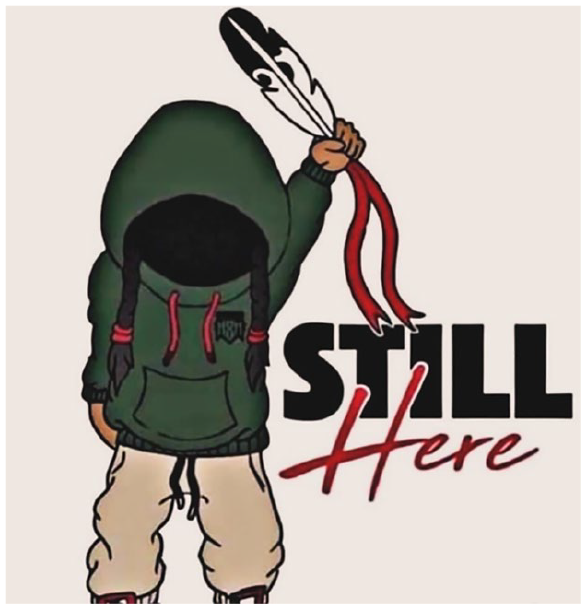
Image of sticker from N8tive Made.
Another example of this activist decolonial agenda can be found in “Reclaiming the First Person Voice,” by Emma Lee. Lee includes tebrakkunna country as a coauthor of her chapter (county, Lee, and Evans, 2022, pp. 137–150). tebrakkunna country is the Aboriginal land Lee’s people originally called home. Her coauthorship with the land is an acknowledgment of her Indigenous identity inextricably tied to the land. By acknowledging the land as coauthor, Lee is decolonizing academic scholarship, exposing the scaffolding of land that permeates Indigenous knowledge practices, and reminding us that land was stolen. Lee argues that having to prove our Indigenous existence contains a “special tension” in decolonization because, first, existence counters the argument that Indigenous people are extinct, and second, demonstrating and reclaiming our identities is the first step in making positive change to undermine the colonial project. To acknowledge our land, identities, and existence is to rupture the genocidal silence of absence from public spaces, epistemologies, discourses, and cultures. I argue here that not only is decolonial scholarship important to halt the persistent genocide of Indigenous peoples in the writing of knowledge narratives that exclude us, but also Indigenous knowledge can provide important insights into how we know the more-than-human world and our relationship with it and its peoples, land, and creatures. Equally important is the call to justice encompassed in decolonial scholarship. Yes, Indigenous peoples want the land back. We want the water protected. We want traditional languages and customs restored. We want careful stewardship of the environment and its relatives. We want an accounting of the crimes against us, including an accounting of all who were lost to residential schools and whose murders, particularly those of Indigenous women, go uninvestigated. And engaging our knowledge practices can not only assist with these aims, but it can also rupture the critiques, dualisms, adversarial positionalities, and skepticism that come encoded in traditional Western research methods.
Embracing spirit through reciprocal relationships
In this section, I will share stories that explore the interdependent and intertwined aspects of relationality, reciprocity, and respect for the experiential. I share these stories because while I delineate these three aspects in the methodology, because spirit imbues human and more-than-human alike, these methodological aspects are interdependent and must be represented together.
Relationality
This is the story of when I told my digital social justice students that water is life. I was giving a brief introduction to the story of the Dakota Access Pipeline (DAPL) 3 construction and the 2016 and 2017 protests that took place at the Water Protectors’ camp at Standing Rock in alliance with the Standing Rock Sioux Tribe and other Native bands of the Dakotas to prevent it. The protests were meant to prevent the construction of the oil pipeline across sacred waterways and burial grounds. I explained that #NoDAPL and #WaterIsLife were hashtags used by the protestors. I showed slides of private security, local law enforcement, and the National Guard harassing and breaking up the camp. When I broached the discussion of water, I asked the students to describe its significance in my story. They told me that the Earth is mostly water, and humans are mostly made up of water. They told me that water is teeming with life, like fish and insects. They told me animals depend on water to live and reproduce. So, this is what the protestors meant when they said, “Water is life.” And yes, these are arguably some of the things the protestors meant, but they also meant that Water is life. Water is our relative; we are its kin. Water is a lifeform and one with which we live in reciprocal community. We depend on the water to keep us alive, and we defend the water that depends on us for that protection. As a decolonial researcher, when you accept that Water is life, you accept the knowing of the interdependency of ecologies and that communities are organized around care for and the unity of life (Deloria, 2023, pp. 88–89). Effectively, accepting that Water is a living entity that carries spiritual significance decolonizes the process of thinking about whether a pipeline should pass through North Dakota, South Dakota, Iowa, and Illinois. Pipelines do not have rights, but living entities do, and crossing a sacred living entity with an oil pipeline requires a very different kind of thinking about water. This thinking decommodifies the water and renders it more than an obstacle to the economic asset of oil production. As I wrote earlier in this piece, thinking reciprocally and holistically leads to making knowledge collaboratively “to include the context within, the land upon, the metaphysics between, and the time among the knowledge makers in reciprocal relation to each other.” Here, Water is life, and this knowledge contains deep and multiple relational and spiritual meanings.
Reciprocity
I have worked with two Indigenous artists: the late Jeffrey Veregge of the Port Gamble S’Klallam peoples and Bree Island of the Anishinaabe peoples. In 2020, I interviewed Jeffrey for my 2024 book. In that interview, we covered a wide range of topics, including our educational backgrounds, our religious beliefs, our activism for Indigenous causes, and our social media interests and uses. Bree is the artist whose beautiful work graces the cover of that 2024 book. I purchased a giclée artist’s print of Jeffrey’s piece, Seduction of the Moon in 2021. From Bree, I purchased an artist’s print of the cover piece for my 2024 book called ᐊᑎ ᓃᑳᐣ ati-nîkân ~ in the future, as well as two additional prints, Winter Ready Bears and Fox at Twilight. Bree also gifted me two small reprints from her collected works. These pieces hang in my university office and my home. In addition, I have gifted Bree’s work to a dear friend and found family member, introducing Bree to my kin network. Reciprocity requires an exchange between the researcher and participant, which can take many forms, and all forms must be culturally appropriate. Sometimes ceremonial gifts or tobacco and cedar are given, sometimes the exchange is of one’s own time, and other times financial compensation is offered. My initial move as a researcher in thinking about reciprocity was to parallel it with the compensation of money and labor, but in an Indigenous paradigm of reciprocity and relations, this grew complicated, and I eventually decided “compensation” as a sole approach was misguided because compensation alone does not account for the necessary sustained relationships and ceremony in an Indigenous research paradigm.
Furthermore, when I began developing Indigenous frameworks for digital research, I thought about conventional strategies for recruiting and compensating participants. It is commonplace, and even preferred in quantitative research, to use blind surveys, tests, and trials. Compensation and confidentiality are often thought of as bias reduction. We use confidential instruments in qualitative digital research, like online tools such as SurveyMonkey, affordances like the Ask box feature on Tumblr that allows users to submit anonymous questions to the Tumblr blog owner, and the confidential and anonymous features of Qualtrics. I have already argued that the complete objectivity of the researcher is impossible because of the relationship between knowledge and power and knowledge and culture, citing several feminist and Indigenous scholars. In Davis and Craven’s (2023) discussion of compensation, they write that upfront monetary funds may not entirely compensate for the involvement of the participant, arguing that participation could span long periods of time and include multiple instances of data collection and analysis (pp. 141–143). In addition, they point out that giving back can take forms such as raising awareness of the participants’ issues and concerns and lending their labors to social movements. Finally, offering too much financial compensation may act as a coercive, incentivizing participation in vulnerable populations due to the scarcity of resources in that population. I considered all these options in the context of reciprocity and worked to delineate the difference between reciprocity and compensation.
Reciprocity, in its most general form, means mutual exchange, and exchanging labor for cash is the basis of capitalism. I believe that the Indigenous creatives 4 I work with should be paid for their work (rather than simply extracting their labor), and I should promote their artistry. Circulating their creative work in public and private spaces does important culture work. However, in Indigenous terms, reciprocity also carries relationality along with it. When we reciprocate, we form those important social bonds between researcher and participant significant to Indigenous peoples—those bonds hold us accountable to each other. This accountability means that I also share the innovative work my partners are creating and lend my labors to their efforts to promote both the traditional art forms and the innovative art of Indigenous resilience. Participating in my research binds us, and we are accountable to each other. Jeffrey was most known for his science fiction subjects drawn in the traditional formline style. Bree also works in traditional and futuristic styles—the cover of my book is of a futuristic Indigenous woman. Artistic innovations represent Indigenous resilience, and the display of this art circulates this resilience. Reciprocity enables me to support my partners in complex ways. It works against knowledge extraction by not removing the research from its cultural context and avoiding treating the research like an asset by centering the partner’s agenda.
The typical exchange of cash and gift cards effectively ends the relationship between the researcher and the participant. We have completed our data collection, and ideally, we want the relationship to end because we think maintaining or developing relationships with research participants can bias the analysis. We do not want the relationship to end in the Indigenous paradigm because we value relationality, are in community with each other, and are accountable to each other. We acknowledge the bias in relationality because this is good relations. If the art represents the artist’s expression, as Candace Linklater, known online as the Relentless Indigenous Woman, says in Figure 2, then by displaying that art, I am sharing that expression in my home and office. The art is Spirit; everything is Spirit. That display symbolizes the sustained social bond between us and the Spirit that imbues all of creation.

Relentless Indigenous woman on Facebook July 17, 2024.
Respect for the experiential and the metaphysical as methodology
I bristle when I hear someone talk about “creation myths,” as if the collective knowledge of civilizations can be dismissed as mythology because they are in the realm of the metaphysical. Entire cosmologies have been sacrificed on the western altar of reason. I am not writing about general reason but a specific Enlightenment-era Reason where what is knowable can be reduced to “rational” truth through the scientific method and where feelings, perceptions, desires, and the unknowable are stripped away, leaving only the “objective” bedrock. Poststructuralism introduced the instability of objective knowledge and exposed the power embedded in the perception of the knower. However, even today, research is approached primarily from the positionality of the skeptic. We are skeptical until we find proof. And since the metaphysical cannot be proven, it is largely not considered in the data. Robin Kimmerer (2013) writes, In Western tradition, there is a recognized hierarchy of beings, with, of course, the human being on top—the pinnacle of evolution, the darling of Creation—and the plants at the bottom. But in Native ways of knowing, human people are often referred to as “the younger brothers of Creation.” (p. 9)
As I have described, in an Indigenous framework, knowledge is not reducible to line items and lists—it is not standardizable even when we want it to be and even if we think we have the authority to decide because we are on top of the hierarchy.
Questioning to unsettle: research questions
Next, I will share short stories and demonstrate the problems of looking to research and research questions primarily to solve problems and fix knowledge. Indigenous peoples sometimes refer to North America as Turtle Island because there is a recurring story across some North American Indigenous peoples about the continent floating on the back of a turtle as one of the origins of people. Thomas King (2013) writes, There is a story I know. It’s about the earth and how it floats in space on the back of a turtle. I’ve heard this story many times, and each time someone tells the story, it changes. Sometimes, the change is in the details. Sometimes in the order of events. Other times, it’s the dialogue or the response of the audience. But in all the tellings of all the tellers, the world never leaves the turtle’s back. And the turtle never swims away (p. 1).
The earth upon the turtle’s back is what we would call a creation myth because, obviously, the earth spins around the sun, and there is no floating turtle. Discarding the floating turtle as fact also discards distinct knowings such as, we all share the same land, we are all related by the same origin, we are all kin and creature, and we all live in the embrace of the natural world. The audience knows there is knowledge in the telling of the story, first, because I conveyed it as a storyteller for the purpose of sharing knowledge, and as an Indigenous woman and storyteller, I have that agency (tebrakkunna country and Emma Lee, pp. 137–139). Second, because the story serves as cultural binding for uniting many peoples. Third, but not finally, because the story contains the identity of the people who tell it to each other. What we tell each other becomes who we are, or as Thomas King writes, “The truth about stories is that that’s all we are” (p. 2). We are our experiences, and those experiences have some element of the metaphysical, even if it is only in our dreams for our common futures.
Turtle Island is a rich knowing of culture, people, land, time, and water. Turtle Island is the land and home of Indigenous North Americans, and as the turtle floats on and is dependent on the water, so are we as residents of the island in relation to the water. The concept dates back to our origins, yet it is also widely used today, knowledge that has not been lost to genocide. Turtle Island is a unifying concept reminding us that we are all related. Hashtagging a post on Bluesky with #TurtleIsland invokes this knowing and frames the post as Indigenous knowledge, as well as Indigenous activism. User Winter Soldier on Bluesky describes themselves as of Anishinaabe heritage. On December 10, 2024, they shared a meme which is the post in Figure 3, featuring an image of right-wing pundit Tucker Carlson and a quote asserting that “immigrants must not replace the original cultures and values of this great land.” The meme also contains the image of a woman in what we might assume is Native clothing with a feather in her long hair, an image that may seem on its surface stereotypical and perhaps even generated by AI. However, long hair has cultural, ceremonial, survivance, and sacred implications. This is why residential schools cut Native students’ hair when they entered these boarding schools—to separate the children from their culture and their religious beliefs. In Native culture, feathers are typically gifted at a significant moment in a person’s life and carry cultural and spiritual implications. The woman with the long hair and the feather responds with “Oh, really? I’ll help you pack your shit so you can leave.” On its surface, this is a quippy meme responding to the irony that the descendants of American immigrants are invoking settler culture and values as “original” to this “great land.” When recording research notes for a meme like this, it is important to note the hashtag and the quotation, but it is equally important to understand and record the cultural, spiritual, and survivance implications of this image, especially as it was shared by someone declaring Indigenous heritage.

Bluesky post December 10, 2024 quotes right-wing pundit Tucker Carlson.
I used to be a computer programmer. I am an orderly person; I like lists and categories. I like my laptop and my label maker. The logic of computer programming appeals to my affinity for order. However, the computer programs we use employ hierarchical logic to organize data in ways that erase Native America because of the racial biases encoded in their programs, and the racial biases internalized by the users of these programs. The binary oppositions, dualisms, and hierarchies are inherently colonial technologies (Smith, 2021, p. 58). Both the algorithms and the users are programmed to collapse data into generic hierarchical categories. I sometimes tell the story of how I stopped constructing my identity as a maker of technologies and began constructing myself as an Indigenous scholar. In that story, I point out that in settler colonial capitalism, we are all producers in an economy. This is our identity, and this is how others know who we are and how to locate ourselves within the capitalist hierarchy. A simple example of this is when we first meet each other and exchange names; we ask each other what we do for a living (Tekobbe, 2024, pp. 10–11). This is distinctly different from the Indigenous paradigm, in which we locate ourselves in our kin, culture, and epistemological networks. However, as I wrote earlier, Indigenous peoples are living in resistance to settler colonialism today, and we are actively making scholarship, culture, art, and language. I argue that technology and metaphysics need not be juxtaposed and that we can be and are simultaneously both machine and dream.
Figure 4 is the top three results of a Google search for “Navajo Voter Turnout” that I executed on November 8, 2020. I was interested in reading news coverage of the Arizona tribe’s voting because Arizona had flipped Democratic for Biden when it had been a Republican stronghold for more than three decades. The Navajo refer to themselves as Diné, and so that is what I will call them here, even as the news media refers to them as Navajo. You will note that the article from azcentral.com, the website of the Arizona Republic, mentions the Native turnout numbers. The Navajo Times headline represents the fact that Diné voters overwhelmingly voted for Biden in a state where those votes mattered, as Biden won by roughly 10,000 votes. The Washington Post, however, ran a story about how the Diné rode to the polls on horseback. In addition, by looking at the URL, we can see that the Washington Post posted the story to the Lifestyle section, whereas the Arizona Republic and the Navajo Times featured these stories in their election coverage. The Post story details the ride-to-the-polls efforts of Diné activists without a deeper discussion of the significance of horses and land to the Diné people. It overlooks that horses are relatives and not mere transportation and that the land is sacred, and crossing it on horseback represents a cultural act of survivance. It is important to note that the search engine algorithm in this case is tuned to me, someone who regularly reads Native American news sites and Arizona news coverage. There is no clear way to know why these stories are ordered in the search results the way they are, yet it seems telling that they are sorted the way I would sort them. In this case, the reporters erased the Diné knowledge and survivance practices, not the search algorithm. But we know that generative Artificial Intelligence (AI) programs are trained on internet news stories, and generative AI cannot “learn” about that which it is not given. Erasing unique cultural Native stories online erases them from inclusion in generative AI products used daily in schools, journalism, and business.
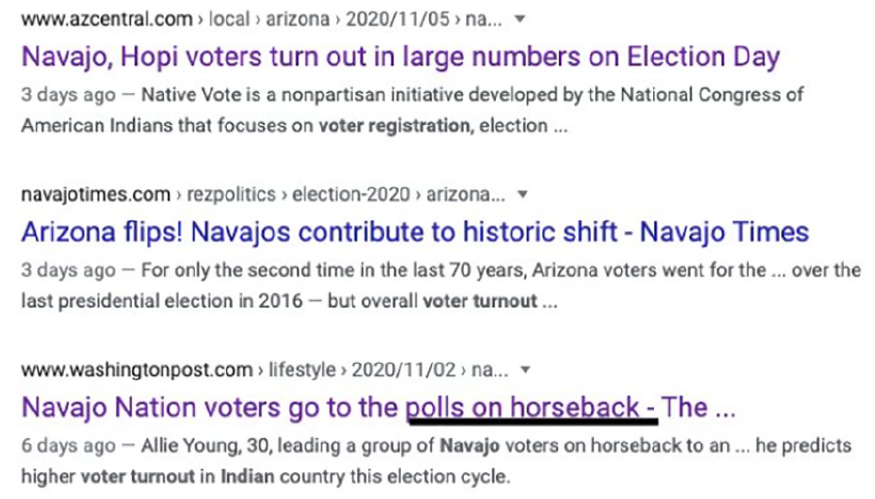
Results of a Google search on “Navajo Voter Turnout” posted by Me to Facebook on November 8, 2020.
Taking the danger of data hierarchies further in the 2020 election, CNN reported on the demographics from the exit polls on November 3, 2020. Figure 5 is an image that CNN displayed during the discussion of those polls listing the following percentages of voters by demographic: White 65%, Latino 13%, Black 12%, Something Else 6%, and Asian 3%. This image sparked outrage in Native communities across the United States, who had invested so much into voter turnout in key states. This is the same election in which six Native Americans were elected to Congress, which is more than ever before. CNN apologized for the image, but Native America responded both ironically and negatively that the erasure of Native peoples continues when data are aggregated.

Native Americans as “Something Else” image taken from CNN broadcast on November 3, 2024.
The era of big data and the training of AI with large data models increase the potential for marginalization. AI can only “know” from the data it is trained on, and we know these data at times erase Native peoples. The problematic nature of AI and its environmental impacts are beyond the scope of this article; however, I note here that conversations around AI must include Native voices if we are to protect the environment and preserve our water supply from the massive resource consumption of AI (Crawford, 2024; Gelles, 2024; Hodgson, 2024). Decolonial research uses mixed methodologies because including ethnographic observations and participants’ experiences in their own stories can add nuance to the data. And this nuance can include those knowings we do not traditionally understand as science or “reality.” For example, social hierarchy can have metaphysical implications in an Indigenous kin network. Ancestors are active members of the kin network. When Indigenous peoples speak of their ancestors, they are often speaking of people who are still with them, still teach them, still support them, and still protect them because, for many Indigenous cosmologies, life does not end at the death of the body. I recently gave a land acknowledgment at an event celebrating graduates of the Department of Gender and Women’s Studies at the University of Illinois Chicago. In that acknowledgment, I said, “We are the embodied dreams of our ancestors, and we are the justice our ancestors pray for” (Tekobbe, 2024). Earlier, I said I was Helen Jane’s daughter and Esther Belle’s granddaughter. The first reason I named my ancestors was to identify my kin network. I also did it to indicate their active role in my epistemology—how I understand my life and what I make of it. When you select methodologies, select those that allow for capturing the ephemeral, the wonder, and the metaphysical of your research partners.
Conclusion: doing decolonial methodologies
I began this article by writing that Indigenous methodologies include storytelling, relationality, reciprocity, respect for the experiential and the metaphysical, and an activist decolonial agenda. I outlined three problems I see with conventional digital research methodologies: the objective to settle knowledge, treating knowledge as an extractable resource, and conceptualizing knowledge as an asset. I demonstrated instances where traditional approaches to research do not account for the diversity of knowledge systems, especially those of Indigenous peoples whose knowledge-making is collaborative and kin- and community network-situated. I mentioned pressing contemporary problems of climate change and resource extraction. Indigenous futures imagine a community-centric world, including earth and its ecologies in its communities, repatriating land into the stewardship of its relations, and deconstructing the colonial gender binary. I also began this article by saying I would provide approaches for more inclusive and sustainable research. Here are a few suggestions:
Read and actively deploy the scholarship of Indigenous and intersectional methodologists. I cited Deloria, Wilson, Kovach, Smith, King, Gubele, Anderson, Archibald, Windchief, Wilson, Riley-Mukavetz, and others in this article. There are, of course, many more.
Decolonize yourself and your work. Reject paradigms that extract knowledge and reinforce oppressive hierarchy. For example, cisnormativity and the modern gender binary are western constructs, and pre-contact Native societies did not organize in patriarchal and heteronormative systems, and many cultures had more than two genders. If you study gender, provide more options and work against transantagonisms (Mack, 2024).
Center the Land and the Water in research design. A mere acknowledgment of the land does not honor the centrality of lands in Indigenous cosmology, and it does not get at the very real fact that we only have this one land upon which to grow, and therefore, we need to defend and protect it. The land is sacred and is in community with the people who live and lived there in the same way that water is life. Where cosmology is collapsed into the metaphysical and then abandoned there as irrelevant data, retrieve it. We have a responsibility to the land, and protecting it protects us all against environmental calamity. Allocate some of your resources to support land back movements and know about and work against the extractive drilling, mining, and manufacturing processes that displace people.
Be in reciprocal community with your research partners. Find out what they value in exchange for their cooperation and then offer that. Treat your partners as sacred relations. Build and sustain those relationships. They are kin. We are all related.
Honor and defend the sacred. As I wrote earlier, research is ceremony and knowledge is sacred. When my mother taught me how to embroider, she taught me the same way her mother taught her. My grandmother learned to embroider at the hands of Christian missionaries in a Choctaw boarding school. Know the stories of the sacred knowledge that is shared with you and the cultural significance it carries with it. I know I carry, for better and for worse, the legacy of the Indigenous boarding school system.
Work toward more sustainable futures. Replace your technology less often and resist its planned obsolescence. Know the amount of resources you are using when you engage a search engine or query an AI.
Tell research stories and let knowing be layered and complicated; let the fox speak and the turtle float.
Footnotes
Acknowledgements
I wrote the original draft of this article during a July 2024 writing retreat sponsored by the Institute for Research on Race and Public Policy at the University of Illinois Chicago. I am grateful for the Institute’s support. I greet and thank Bree Island, Candace Linklater, and the family and community of Jeffrey Veregge, whose work I discuss. I also thank the reviewers whose careful and attentive comments contributed greatly to this project.

Ethical considerations
The Institutional Review Board at the University of Alabama approved the interview with Jeffrey Veregge (approval 19-08-2606) on August 22, 2019. Veregge gave written consent for review and signature before starting interviews.
Funding
The author(s) disclosed receipt of the following financial support for the research, authorship, and/or publication of this article: While no financial support was provided, this article was primarily drafted during a writing retreat sponsored by the Institute for Research on Race and Public Policy at the University of Illinois Chicago.
Declaration of conflicting interests
The author(s) declared no potential conflicts of interest with respect to the research, authorship, and/or publication of this article.