



Abstract
Social virtual reality (VR) platforms have unleashed new possibilities to reimagine Marshall McLuhan’s classic idea of the “global village” in the digital era. We situated our inquiry in the case of identity negotiation between Chinese mainlanders and diasporas in VRChat, a popular social VR platform. Through a 2-year-long digital ethnography and interviews, this study revealed how Chinese mainlanders and those living abroad have confronted, separated, and integrated each other in identity negotiations. The results highlight the good, bad, and ugly sides of social VR as a novel convergence of VR, Massively-Multiplayer-Online-Role-Playing Games, and social media, particularly how the immersive experience of VR embodiment, avatars, and real-time voice chat may rejuvenate intercultural communication. These findings also illuminate a possible alternative global village enabled by social VR that not only has inherited certain violence from intercultural conflicts but also pioneering new paths to restore constructive communication.
With the rapid development of virtual reality (VR) in recent years, this technology has been applied not only to games, films, exhibitions, and educational settings but also to social connections. Encompassing VR, massively multiplayer online role-playing games (MMORPGs), and various other media forms, social VR platforms can be viewed as an emerging form of social media that prioritizes immersive visual and verbal communication. This technology is unleashing new possibilities to reimagine Marshall McLuhan’s classic idea of the “global village” in the digital era. Over the decades, the “global village”—enabled by the World Wide Web, particularly global social media platforms—has exhibited its good, bad, and ugly sides, from facilitation of cultural exchanges and mutual understanding, to threats from digital nationalism, hate speech, and discrimination crystalized in user-generated texts, memes, pictures, videos, and other multimedia forms (Schneider, 2021).
Will social VR become an alternative global village distinct from existing mainstream social media? Will it inherit the global village’s violent side or offer new possibilities for more constructive intercultural communication? This study sheds light on the particular case of identity negotiation in VRChat, a popular social VR platform with 8.2 million users worldwide (MMO Stats, 2024). Compared with the legacy virtual world Second Life (Boellstorff, 2015) and Silicon Valley giants’ metaverse applications (e.g., Horizon Worlds; Meta, 2021), VRChat places a particular emphasis on the affordance of a technologically open environment to which users can upload their self-created avatars and virtual worlds through third-party software—such as Unity, Blender, and Maya (Bredikhina et al., 2020; Roquet, 2023)—and real-time voice chat. These features have laid an important foundation for user-oriented construction of environments for intercultural communication. We situated our research on intercultural communication mediated by social VR in a particular context of Chinese overseas identity negotiation. Given the distinctive Chinese internet ecosystem, which is disjointed from the global digital landscape (Zhao & Fang, 2023), VRChat provides an unusual opportunity for ordinary Chinese mainlanders who have few overseas travel experiences to encounter, verbally communicate with, and visually interact with Chinese overseas. Being raised and acculturated in different geopolitical and sociocultural environments, Chinese overseas have very different understandings of Chinese culture and identity compared with Chinese mainlanders (Ang, 2005; Wong, 1986). This study is interested in how Chinese mainlanders and diasporas communicate and negotiate their Chinese identities with each other in VRChat, and how it reflects social VR’s potential as a novel form of social media in creating the global village’s alternative landscape and ethical practices.
Moreover, this study responds to the question of “the good, the bad, and the ugly” in social media raised by Stromer-Galley et al. (2023), who used the metaphor from a classic 1966 western film of the same name that depicted three American cowboys’ individual destinies and choices during the Civil War to interrogate not only social media’s positive and negative sides but also its nondichotomous complex and gray areas. Thus, through a qualitative investigation, we aimed to reveal social VR’s intricate dynamics and its users based on its good, bad, and ugly sides.
Revisiting the “global village” through immersive social media VRChat
McLuhan (1994) coined the term “global village” in the 1960s as an imagined image to describe the worldwide development and interconnectedness of electronic media technologies. In the early internet era, the World Wide Web promised a utopian vision as an extraterritorial space for the global village, which, nevertheless, encountered not only political interventions by national governments but also cultural and political conflicts among people from different geographical locations as an extension of real-life politics (Manjikian, 2010). In retrospect, it can be said that McLuhan did not actually envision the global village as beautiful or innocent, or as a starting point for a better world in the first place (Schneider, 2021), but rather warned of its violent side, with disputes, hate, and nationalism crossing borders. In an interview, McLuhan (1977) remarked, When people get close together, they get more and more savage, impatient with each other. Village people aren’t that much in love with each other, and a global village is a place of very arduous interfaces and very abrasive situations. (n.p.)
He used the example of full-time butchering sports in tribes to illustrate violence as a quest for one’s identity.
To explore social VR’s new potential in reconstructing an alternative landscape of the global village, this study aims to understand social VR as a novel form of social media with highlighted features of immersive experience based on VR embodiment, avatars, and real-time voice chat. From the perspective of media convergence highlighting new meaning-making based on integration of multiple media forms in one device (Jenkins, 2004), social VR can be conceptualized as a convergence of VR, MMORPG, and social media platforms. MMORPGs provide a more first-person-perspective immersive interface for avatar embodiment, with both visual and verbal synchroneity. In particular, the visual immersiveness based on avatars’ spatial and social presence in virtual worlds differentiates social VR from traditional social media. According to Lee (2004), presence can be defined as “a psychological state in which virtual objects are experienced as actual objects in either sensory or nonsensory ways” (p. 27). The experience of presence in social VR facilitates formation and visualization of virtual communities. Meanwhile, unlike MMORPGs, social VR’s core is not designed game routines or rules, but rather an infrastructurized platform on which people can connect and socialize with each other, thereby complying with the fundamental notion of social media that emphasizes social facts, social actions, social relations, and community (Fuchs, 2021; Plantin et al., 2018).
Leo-Liu and Wu-Ouyang (2024) have demonstrated extended reality’s potential in converging with other forms of media (e.g., AI agents and anime characters) to create unexpected new meanings and user experiences. Thus, this study is interested in how social VR—as a result of VR, MMORPG, and social media convergence—can reshape the imagination of the global village in a possibly different way. To clarify, this article does not aim to follow McLuhan’s (1977) position on the grand narrative of technological determinism. Instead, it manifests the individual agency reflected in people’s strategic and creative use of new and emerging media technologies to navigate their identity negotiation process.
Identity negotiation and acculturation in the virtual community
Identity can be conceptualized as one’s self-concept originated from one’s sense and knowledge of belonging to a group based on classic social identity theory (Tajfel et al., 1979), which highlights in-groups and out-groups’ differentiation. When identity negotiation is situated in an intercultural context, it can be conceptually congruent with acculturation theory through its emphasis on intergroup changes. Acculturation describes the level of cultural and psychological change occurring between two cultural groups or among multiple groups (Arends-Tóth & Van de Vijver, 2006; Berry, 1997), which can be reified by specific activities, such as changing food habits, different language uses, and acceptance of new social values and ideologies (Berry, 1997). Acculturation has been studied widely in multicultural development to understand migrants’ acculturation conditions, orientations, and outcomes. The framework of acculturation variables demonstrates the interplay among different acculturation steps. Two general migrant acculturation orientation strategies are adoption of mainstream culture in the society of settlement and maintenance of ethnic culture (Arends-Tóth & Van de Vijver, 2006). Based on these two directions, Berry (1997) classified strategies into four types: assimilation (high adoption, low maintenance); integration (high adoption, high maintenance); separation (low adoption, high maintenance); and marginalization (low adoption, low maintenance).
Acculturation can be applied not only to physical migration from one culture to another but also to virtual world contexts. When people join virtual communities in VRChat, a global VR social platform that operates as an MMORPG, they need to acculturate themselves in a virtual environment that has distinctive cultural norms and communication patterns (e.g., Brailas et al., 2015; Ward, 2010). Although a US company developed VRChat, the acculturation process examined in this article is not simply a transition from other cultures to American culture. Instead, it can be multidirectional, as the mainstream culture in VRChat is not static or settled, but is constructed and reconstructed continuously within itself or through multiple cultures’ influence. For example, Japanese anime girl avatars are popular among both male and female users from different countries in VRChat (Bredikhina et al., 2020). In intercultural communication with people from different cultural backgrounds in VRChat, people need to adjust themselves constantly to cope with unfamiliar cultures, norms, and values.
Migrants’ acculturation orientations are shaped by various acculturation conditions and make a profound impact on such migrants’ overall acculturation outcomes. Among several acculturation conditions, language use has been identified as crucial in influencing migrants’ social connectedness and psychological well-being (e.g., Wu & Liu, 2024). In VRChat that prioritizes real-time voice chat as the main communication method, language has been an important clue in the recognition and negotiation of identities. The present study is interested in how Chinese Mandarin speakers from different cultural backgrounds, particularly Chinese overseas and mainlanders, negotiate their identity in their acculturation process in the virtual VRChat community. In our study, acculturation is not treated as a rigid, deterministic process, but rather as a dynamic and context-dependent phenomenon. For example, VRChat’s immersive and performative nature introduces new dimensions to acculturation, such as avatar embodiment and real-time voice interactions, allowing users to experiment with identity negotiation in ways that transcend traditional offline and online spaces. Therefore, by using acculturation within social VR, we can expand the theory’s applicability to VR environments.
Identity negotiation in the Chinese context
According to Franceschini and Loubere’s (2022) “Global China as Method,” with China’s increasing penetration of and impact on the global socioeconomic system, the nation is no longer an isolated and external force based on one nation, but rather a global conglomeration of political power dynamics, economic development, and cultural exchanges. The negotiation of Chinese identity has been an important research area in cultural studies, given the large ethnic Chinese population and its wide distribution worldwide. The categorization of national, ethnic, and cultural identities under Chinese discourse is rather complicated (Tan, 2013) and involves ethnic Chinese (Huaren), Chinese nationals (Zhongguoren), overseas Chinese (Haiwai Huaqiao, usually referring to Chinese sojourners) or Chinese overseas (Haiwai Huaren, usually excluding Chinese sojourners), Chinese diaspora (Huayi), and Chinese mainlanders (daluren). Among these, the term “ethnic Chinese” is viewed as the broadest term to describe people who share a common Chinese ancestry, origin, or cultural background, while Chinese nationals narrowly refer to citizens of China as being in a state that “necessarily evokes obligations and loyalties of political affiliation and the myth of the Middle Kingdom” (Tu, 1991, p. 22). The Chinese national identity has encountered turbulence and disputes in the regions of Taiwan, Hong Kong, and Macau, which comprise the “Greater China” area together with mainland China. As ex-colonies of the United Kingdom and Portugal, respectively, Hong Kong and Macau returned to the People’s Republic of China (PRC) as special administrative regions in 1997 and 1999, while Taiwan, officially self-claimed as a Republic of China, has remained a controversial territory outside of PRC governance. Given the PRC’s growing global impact and the intensified political and even military tension between mainland China and Taiwan in recent years, Taiwanese self-identification as “Chinese nationals” increasingly has destabilized the island and upset residents, particularly young people, who have less-direct affective and social connections with mainland China than older generations (Ho & Li, 2023). Although academic works focusing on Chinese migrants in North America and Europe often have applied the term “Chinese diaspora” to Chinese overseas, Southeast Asia scholars have disagreed because they believed “diaspora” implied no roots and center-peripheral hierarchy (Tan, 2013). Moreover, Witteborn (2019) also suggested that diasporic groups were formed based not only on their displacement status but also on the shared experience of loss (e.g., family, home, and hope of returning to the homeland). According to Cohen (2022), descendants born as local citizens and who have found their roots in their societies of settlement, strictly speaking, should not be viewed as diasporic groups. Under such circumstances, this study has applied the terms “Chinese mainlanders” (daluren) and “Chinese overseas” (haiwai huaren). Chinese overseas comprise not only residents of Hong Kong, Macau, and Taiwan but also broader Chinese ethnic groups living in Southeast Asia and other regions (Tan, 2013).
The controversies surrounding these identity labels have revealed ongoing contentions and constant reconstructions of Chineseness. According to Ang (2005), Chineseness is a “discursive construct [that] entails a disruption of the ontological stability and certainty of Chinese identity” (p. 227). This position challenges essentialist conceptions of Chinese identity and culture beyond geopolitical boundaries (Ang, 2005; Tu, 1991) argued that Chinese overseas treated as the “periphery” should have the privilege of destabilizing and reconstructing “Chineseness” in a different way than the “center” (Ang, 2005; Wong, 1986). Aligning with this, he proposed a differentiation between “cultural China” and “political China” to recognize Chinese cultural meanings outside of mainland China that do not necessarily require a particular state’s warranty and legitimization (Tu, 1991), that is, this differentiation can be understood as an attempt to globalize Chineseness and define it as a co-construction by ethnic Chinese people worldwide.
Chinese migrants’ reconstructions of Chineseness can imply tensions between different acculturation strategies depending on cultural adoption and maintenance. This study assumed that Chinese overseas who still use and speak Chinese languages maintain Chinese culture to a certain degree. Nevertheless, their own understandings of Chineseness have diverged based on different sociocultural contexts. Thus, through intercultural communication, the cultural difference can be very focused on such different interpretations of Chineseness. When diasporas encounter and interact with Chinese mainlanders and each other, the tension over their acculturation in VRChat is not on assimilation or marginalization, but rather on the separation or integration of their respective Chineseness in this virtual Sinophone community. This conceptual assumption plays a vital role in guiding this study’s thematic analysis.
In the digital context, intercultural communication between Chinese overseas and domestic Chinese mainlanders (without overseas experience) through social media has been limited largely by China’s distinctive digital ecosystem (Zhao & Fang, 2023). It requires Chinese overseas to use China’s domestic social apps or use domestic Chinese mainlanders’ apps when using virtual private networks (VPNs) to enter foreign social platforms. A famous relevant case is the “Diba expedition,” a cyber-nationalistic event organized by Chinese netizens who use VPNs to visit Facebook and other international platforms to post comments against Taiwanese independence (Yang, 2019), epitomizing a violent side of the global village mediated by current mainstream social media that comprise texts containing massive hate and conflict. Will social VR inherit such a violent image of current social media? Our study aims to help fill this literature gap by concentrating on more mundane, contingent, and everyday communications in social VR, an immersive and intercultural virtual space in which sovereignty, locality, and authenticity seem blurred. Thus, the following research questions guided this study:
Research Question 1 (RQ1). How do Chinese mainlanders and diasporas negotiate their Chinese identities in VRChat?
Research Question 2 (RQ2). How does identity negotiation in social VR reflect an alternative landscape and ethical practices of the global village?
Methods
The study’s data were derived from the first author’s 2-year digital ethnography and 78 in-depth interviews with VRChat users. Both authors processed the data and extracted themes later. As this study primarily focused on Chinese identity negotiations, we focused on 21 interviews with users who were either Chinese overseas or Chinese mainlanders and shared their experiences with identity negotiations. This study applied Boellstorff’s (2015) ethnographic practices in Second Life and Fine’s (1993) methodological guidance on informal interviews and self-reflection on positionality. The first author conducted the participant observations dynamically by not only watching how other people communicate with each other but also proactively joining in mundane chats with them. Boellstorff (2015) explained how to conduct ethnographic research in virtual worlds, which mostly entail MMORPGs in comparison with text-based social media and website environments. Thus, the data collection methods used were more varied, comprising conversations with not only informants but also their avatars amid world scenes, virtual activities, and many different cues.
After becoming acquainted with potential interviewees, the first author sent friend requests to them within VRChat’s social system. The “friend status” allowed him to visit their virtual locations directly and expand his networks further with friends’ friends and related communities through a snowballing strategy. Participants for informal and formal group and individual interviews were told to check the researcher’s personal information, the introduction to the research, and the consent form links in the researcher’s VRChat profile. The need to screen-record for data collection purposes also was stated in the profile, and participants were informed of this when they confirmed their consent. The researcher’s initial casual chats with participants often constituted informal individual or group interviews (Fine, 1993). Informed by Hermanowicz’s (2002) interview advice, after disclosing his position, the researcher started interview-like casual chats with introductory easy-to-answer “warm-up” questions, such as “Have you met other ethnic Chinese people?” “What are your feelings about them?” “Have you learned anything new from them?” and “Did any good or bad things happen in your interactions with them?” Following these initial inquiries and their answers, the first author tailored his inquiries further to in-depth questions on participants’ experiences with sharing, political or cultural conflicts, perceptions of Chineseness, etc. The interviews were screen-recorded after the informants had provided consent.
Overall, our 21 interviewees comprised 14 males and 7 females—10 from mainland China, 5 from Taiwan, 5 from Malaysia, and 1 from Indonesia (see Table 1). All interviews were conducted in Mandarin Chinese, with a small amount of English. To protect the informants’ privacy, pseudonyms were used. For more information, please see Table 1. After data collection, the authors watched the screen videos together and developed detailed notes to identify and confirm representative cases in relation to themes (Saldaña, 2008/2015). For each theme, certain excerpts were analyzed critically through close reading for detailed descriptions by both authors (Geertz, 2008). The relevant descriptions from our informants were translated into English. The local university’s research ethics committee supervised this study.
The List of Informants.

Results
The results were organized based on three themes: confronting; separating; and integrating identities. These themes were developed based on constant interactions and integrations between the data and our conceptual base of acculturation strategies (Arends-Tóth & Van de Vijver, 2006). The first theme focused on how the participants disclosed and introduced their identities to each other when they first met ethnic Chinese people from different geopolitical and cultural backgrounds, while the other two themes—separation and integration—were two different acculturation strategies they adopted in response to the negotiation of Chineseness. We unpacked and explained each theme through examples of efforts by Chinese overseas to differentiate themselves from Chinese mainlanders through continuous verbal articulations in VRChat, reclaim Chinese authenticity through construction of a separate virtual world with multiple symbols that destabilize Chineseness, and reconcile identity conflicts through certain cross-border friendships.
Confronting identities: fluid avatars, but identifiable languages
In August 2022, the first author met John and Karl, who were chatting in Mandarin in an Indonesia-themed virtual world in VRChat. Both used Japanese anime-style girl avatars, although their voices were both masculine, reflecting the aforementioned prevalence of Japanese anime avatars (see Figure 1). The researcher spoke Mandarin to them, asking whether they were Chinese nationals (zhongguoren). John answered, “We are Asians, but we are not Chinese nationals.” Later, they explained that they were Malaysian Chinese. They encountered such inquiries and made such explanations to articulate their different identities repeatedly in VRChat. In March 2023, when the first author had the chance to interview John and other Malaysian Chinese again, they expressed their concerns about the Sinocentric beliefs of some Chinese nationals whom they met in VRChat: Some mainland Chinese people just don’t know about the existence of Malaysian Chinese in the first place. They don’t know the differences between Chinese nationals [zhongguoren] and ethnic Chinese [huaren]. They also don’t know the differences between overseas Chinese nationals [huaqiao] and people of Chinese descent [huayi]. When I explain that I am Malaysian Chinese, they think I am still a Chinese national, just working or studying in Malaysia. Some people are simply innocent and without relevant knowledge, but others are ignorant by insisting on their judgment. They think you must be a Chinese national if you speak Mandarin. They think we are cheating them.
John clarified this in English, stating, “The uses of ‘I am from China’ and ‘I am Chinese’ are actually very different, and many people misunderstand them. I understand that China is, indeed, a large country, so we need to explain our identity clearly.” John’s claim reflected the tension between political and cultural China, as suggested by Tu (1991), as “being Chinese” can involve both Chinese nationals and ethnic Chinese overseas, as well as being associated with cultural China at large, instead of the specific state for political China. Some of our mainland Chinese informants also agreed that they did not know much about the existence of other ethnic Chinese people overseas. Nick, a 21-year-old man studying in the United Kingdom, said he had an ambiguous impression of ethnic Chinese people overseas. The first time he encountered Malaysian Chinese people, he was surprised by how good and authentic their Mandarin language skills were. This can be attributed to the Malaysian Chinese community’s strong preservation of Chinese cultural values and languages, as well as the overall pro-China environment in Malaysia today (Tien & Bing, 2021).

The avatars used by John and Karl.
Bran, a 22-year-old man studying at a top university in Shanghai, shared these feelings and found that some Chinese festival traditions were better preserved in Malaysian Chinese communities. He also said he was surprised by how strictly the time to conduct certain festival rituals was followed. By comparison, people in his own hometown treated these customs less and less seriously.
Many of our Taiwanese informants shared a similar concern, but in a more complex and contentious manner. Kane, a young man from Taiwan, said, If you ask if we are Chinese nationals [zhongguoren], of course we are, but which nation of China? The Republic of China or the People’s Republic of China? In fact, I find that many Chinese mainlanders don’t even know that the Republic of China still exists.
This statement is aligned with the idea of “One China, respective interpretations” (yi zhong ge biao), which Taiwan’s delegates proposed in 1992 and which the PRC government currently opposes (Chen, 2014). By claiming sovereignty over the island of Taiwan, the PRC refutes all other claims, including acknowledgment of the Republic of China as an alternative to China or Taiwan as an independent state (Qiang, 2020).
To sum up, the theme of confronting identities describes moments when people encounter strangers with unidentifiable avatars and mutual languages, but later realize their differing self-identities. In a technologically open environment, users’ avatars can be highly fluid, and their styles can be extremely diverse and fantasized, from humans to nonhumans and from real life to cartoons. By inheriting the “good” side of social media, particularly in its early stage (e.g., Turkle’s “Second Self on the Screen,” 2005), such a fluid avatar affordance liberated users further from fixed, visually identifiable gender, racial, and national identities. If a user wishes, they can even modify their voices’ gender cues through real-time AI voice-changing software. Nevertheless, the specific language that people speak can hardly be changed or translated into voices synchronically. Even though there are many multilingual users online, most are monolingual. Thus, languages become the main identifiable cues that disclose initial identities. For example, the first author accidentally encountered John and Karl following this cue. However, shared languages do not guarantee fully mutual identities.
After identifying each other’s mutual language use, some people tend to separate their identities. When languages cannot be separated, they separate virtual worlds and avatars. In the following section, the tension between political and cultural China is intensified in the case of Chinese Bars, which manifest how certain Chinese overseas differentiate themselves from mainland Chinese people and reconstruct meanings of Chineseness through establishment of different virtual worlds and the use of politically symbolic avatars.
Separating identities: “traditional Chinese Bar” or “anti-China Bar”?
The “Chinese Bar” is a popular world in VRChat, with hundreds of users visiting it simultaneously. The Chinese Bar’s translated name is Zhongwenba, which literally means “Chinese language bar.” This world’s information page indicates that the creators used simplified Chinese and describes it as a gathering place for nationals (guoren jujidi). Nevertheless, this statement has left many ethnic Chinese who use traditional Chinese languages feeling unrepresented. Another world, the “Traditional Chinese Bar” (Fanti Zhongwenba; see Figure 2) was created as an alternative to the Chinese Bar, with multiple symbols that destabilize Chineseness. Its abbreviated name, Fanzhongba, coincidentally shares the same pronunciation as “Anti-China Bar.” This alternative world aims to cater to the needs and preferences of those who identify with traditional Chinese characters and seek a space that better resonates with their cultural and linguistic backgrounds, such as those of Chinese from Hong Kong, Taiwan, and Malaysia. This world’s profile statement was written in both traditional Chinese and English (Figure 2). The traditional Chinese part reads, Welcome to the Standard Chinese language (Traditional Chinese) Bar, a place of freedom and happy laughter. [. . .] These are traditional Chinese characters with a history dating back thousands of years. Don’t forget. Don’t lose them. Remember to join Discord. Watch traditional Chinese characters because they are very good Chinese. Standard Chinese is very good.

The public page of traditional Chinese Bar.
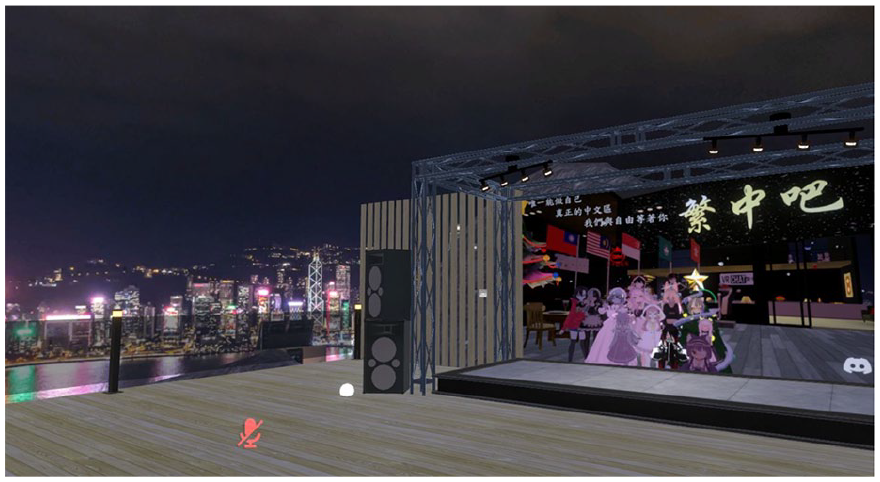
This world’s main location is a two-floor building (see Figures 3 and 4). In front of the entrance is a display of red duilian, which are traditional Chinese poetry art decorations placed on both sides of doors. Furthermore, five flags representing Malaysia, Singapore, Taiwan, Hong Kong, and Macau can be seen from left to right, with the PRC’s flag notably absent. On the roof is a stage adorned with scenery from metropolitan Hong Kong Island as the background image. A large picture on the stage contains this statement: “The only one that can be the true self. The real Chinese language zone. We and freedom are waiting for you.”

The virtual world of traditional Chinese Bar.
The internal structure of traditional Chinese Bar.
Within these materials, several discourses and symbols are embedded to reclaim notions of Chineseness. First, the claim of “the real Chinese language zone” and the use of standard Chinese characters (zhengtizi) in recognition of traditional Chinese in this world’s introduction mark a renegotiation about the center, authenticity, and orthodoxy of not only the Sinophone community in VRChat but also the notion of Chineseness. The long history of traditional Chinese characters is emphasized, valuing cultural China’s significance compared with political China. Second, the representation of five regions, including Singapore and Malaysia, is intriguing, but controversial, because these two countries’ Chinese communities officially use simplified Chinese in a way similar to how it is used in mainland China. The inclusion of their flags can be interpreted as an effort to foster solidarity among Chinese overseas, rather than the objective segregation of communities based on the use of simplified and traditional Chinese. Third, this world’s title includes the two-letter abbreviations of each region sarcastically (see Figure 3). As mentioned above, the five flags that hang in this world do not include that of the PRC. However, the code for the PRC (usually CN) is stated in the world’s title, but with a mistake: It is usually written as “CN/MO,” but instead is written as “CNM/O.” As “CNM” often is used as abusive slang on the Chinese internet (translation: “f*** your mother”), whether it is an unintentional mistake or intentionally aimed at the PRC is questionable.
From the conceptual perspective of acculturation, the Traditional Chinese Bar epitomizes the acculturation strategy of separation. It manifests strong segregation between mainland Chinese and ethnic Chinese in other regions. In a virtual world without border control, an artificial border is built up through differentiation of worlds and their themes. Nevertheless, this segregation did not unify ethnic Chinese outside of mainland China for long. By April 2023, when the related interviews were conducted, the Traditional Chinese Bar’s popularity was low. Most of the time, fewer than five people can be found in this world, compared with the Chinese Bar, where hundreds of people usually gather.
During the ethnography, the first author came across four Taiwanese users in the Traditional Chinese Bar. They shared their frustration over conflicts with mainland Chinese people who accused them of pro-independence separatism and rejection of their Chinese identity. They also agreed that not all mainland Chinese people were politically aggressive. Owen believed that the ratio of friendly-to-unfriendly mainlanders was 50:50, while Kane believed it was 80:20. Ryan shared his experiences clashing with mainland Chinese users. He often used the avatar of a soldier holding a gun and said he might join the police force in Taiwan very soon. Being anti-communist himself, Ryan, with a group of likeminded Westerners, once “invaded” the Chinese Bar using an avatar with the Republic of China’s flag symbol and other anti-communist symbols. This act was viewed as their way of seeking revenge against the “little pink,” or nationalistic, young Chinese mainlanders (Fang & Repnikova, 2018). Ryan explained that they encountered instances in which mainland nationalist individuals also would enter the Traditional Chinese Bar and other worlds to “harass” Taiwanese users.
William, who was one of the long-term key informants, not only introduced the Traditional Chinese Bar to us in the first place but also offered us many of his video recordings of the conflicts between Chinese users from the mainland and Taiwan that took place in 2022. Intense quarrels erupted between mainland and Taiwanese Chinese in both the Chinese Bar and the Traditional Chinese Bar despite some attempts at rational discussions and opinion exchange. In a video of an anti-China rally in the Chinese Bar, users applied self-made avatars of a big coronavirus and a PRC flag, on which five stars were modified into five virus symbols. Furthermore, several political memes were added, including Donald Trump’s presidential election campaign banner and hat, which resonated with Ryan’s description (see Figure 5). This can be interpreted as an expression of right-wing political stances and animosity toward Chinese mainlanders among avatar users (Wang & Catalano, 2022). Although we have yet to find concrete evidence that such right-wing racism is widespread across the entire VRChat platform, it is reasonable to speculate that similar political and cultural conflicts exist among various groups and communities. Avatar embodiment has been examined widely in media and game studies, human-computer interactions, and psychology (e.g., Gonzalez-Franco & Peck, 2018). Yee and Bailenson (2007) used the term “Proteus effect” to refer to changes in people’s self-representations and online/offline behaviors. From this perspective, avatar embodiment with these politically aggressive symbols is likely to radicalize disputes further.

Recording of anti-China invasion in Chinese Bar in 2022 (shared by William).
William witnessed these things happen as both an outsider and something of an insider. An Indonesian citizen of Chinese descent on his mother’s side, he could speak fluent Mandarin despite having an accent and had two cousins who were working in China at the time. He was pro-communist and anti-United States. He wanted to immigrate to China and join the Chinese Communist Party, but he did not identify as Chinese because it did not bring any actual benefits to him, such as the convenience of immigration. He compared this to Italy’s policy, which allowed those of Italian descent to apply for Italian citizenship. He said he wished that China had made a stronger effort to wipe out US influence in Southeast Asia, so a shared interest existed. His case offered another form of separating Chineseness: He valued political China more than cultural China, unlike most of our informants from Malaysia and Taiwan.
This section illustrates how VRChat remediates the battlefield of real-life ideological conflicts and the separation of identities in an immersive environment, seemingly prolonging the already-polarized and politically violent social media environment. The tension between traditional and simplified Chinese writings was affected by the free construction of virtual worlds. Given the MMORPG features of social VR and the particular openness of VRChat, users can be creative in making their own avatars and virtual worlds for intercultural and ideological battles in the form of immersive visual communication. Nevertheless, over time, we observed the possibility of cross-identity friendship established through the platform. For example, Ryan said that he once had been banned from the Chinese Bar and was removed by the manager the previous year due to his “invasion” of the Chinese Bar. Nevertheless, several days after the interview, the first author encountered him again in the Chinese Bar. He said he was hanging out with his mainland friend. In the following section, we examine a different acculturation strategy, which is how identities can be integrated during interactions between different ethnic Chinese.
Integrating identities: cross-border friendship and reconciliation
Although our Malaysian Chinese informants outlined their difficulties in explaining their identities to mainland Chinese users, they also shared great experiences in developing cross-border friendships and connections with the Sinophone community in VRChat. For the Malaysian Chinese informants, their Chineseness was constructed in relation not only to political China but also political and ethnic Malaysia. Our informants complained about how the Malaysian government had introduced policies that privileged the Malay people and disadvantaged ethnic Chinese. John and Kevin told us about a VRChat world called Melayu Kampung, a community of local Malaysian language users. Although they could speak Malay, they visited this world less frequently. In comparison, John preferred to spend time with Mandarin speakers, including many from mainland China: “We all speak Chinese, so it’s easy to understand each other. If I use another language, there will always be something different to explain eventually.” John joined a VRChat Chinese virtual dancing club, Ling Jing, which organizes events every week. Furthermore, John, Kevin, and Kathy all used WeChat, China’s most popular social media, and played popular Chinese mobile games, such as Honor of Kings. The mainland Chinese digital ecosystem and lifestyles firmly penetrated their lives, which further facilitated their frequent interactions with their mainland Chinese friends in a multiplatform environment beyond merely VRChat.
Similarly, Kane’s story also denotes the cross-strait friendship between mainland and Taiwanese Chinese people. Kane expressed a high level of awareness of political sensitivity in conversations with Chinese mainlanders. When another Taiwanese friend, Kristine, asked the first author, “Which term is it more polite to call you: ‘Chinese mainlander’ [daluren] or ‘Chinese national’ [zhongguoren]?” Kane immediately replied to Kristine, “Of course, calling him a Chinese mainlander is more polite.” He shared his previous experience with a friend’s friend, a Chinese mainlander, who interrogated on his acceptance of his Chinese national identity. He acknowledged himself as a Chinese national, as he wished to avoid any trouble or controversy as much as possible. To make the most neutral statement without disclosing any political and identical stances, his VRChat profile only states, “I can speak Chinese.” “If I need to explain my origin, I will say I am from Taiwan, not ‘I am Taiwanese [taiwanren].’” In his opinion, the word “Taiwanese” implies a stronger political stance.
Kane, who claimed that 80% of the mainland Chinese users he encountered in VRChat were friendly, had many mainland friends who had enhanced his understanding of the mainland. He started to use WeChat and send messages to his VRChat mainland friends in a small group chat every day. He was surprised by the omnipotence and prevalence of WeChat compared with Instagram and LINE. On the second day, the first author encountered him hanging out with many of his mainland friends (Felix, Mia, Fanny, Ann, and Brenda) in the Japan Shrine world. Felix, Fanny, and Mia shared how they had developed a solid friendship with Kane. Mia suffered from depression under the weight of pressure from her parents and studies. Two months before this interview, she had endured a month of intensive and concentrated studies and was in very poor condition. She said she cried and was burned out every day, but she gained power from Kane, Felix, and Fanny, who built up a small WeChat group with her, asked her to update her situation and share her emotions every day, comforted her, cheered her up, and even ordered food deliveries for her. They helped her get through this and recover from depression. “I could literally say, without them, I wouldn’t be here today.”
In her story and narrative, articulations of Chineseness, the mainland, and Taiwan are less visible. The identity attached to any group did not matter. Instead, they treated each other merely as human beings with empathy and became friends to share their feelings and life stories. Kane, Mia, and Felix expressed similarly politically apathetic attitudes at the nation-state level concerning contentions between mainland China and Taiwan. They believed that these larger national narratives had limited relevance to the everyday lives of ordinary people and that it was enough that everyone lived a good and happy life. With this apathetic attitude, they discussed topics such as games, pets, food, and trips, but eventually and inevitably, they encountered some political issues, from feminism to political events in mainland China, Hong Kong, and Taiwan. Kane was careful in positioning himself and always tried his best to offer factual or multidimensional references. Felix was willing to listen to Kane sharing, even if some facts and opinions were beyond his perceptions and knowledge. After listening to Kane sharing, Felix said he later used VPN to search for relevant information to broaden his worldview, such as how people in Taiwan think of Chinese unification and the situation surrounding the Hong Kong protests. Generally, Felix believed that young people had more open and inclusive minds, and he wanted to learn about these new issues. Kane, Owen, and even Ryan agreed that interactions among different ethnic Chinese were becoming more and more peaceful in VRChat over time.
Beyond the Chinese Bar and Traditional Chinese Bar, we found that the Japan Shrine virtual world was a central plaza for people with different cultural backgrounds, particularly ethnic Chinese and other Asian people (see Figure 6). Almost half of our interviews took place at the Japan Shrine. The Japanese world always had been ranked as one of the most popular worlds on the VRChat (2023) trending world recommendation list for years, and it had recorded an accumulated 15 million visitors. Although this world was themed as a traditional Japanese religious place, its creator was actually Korean, and its visitors were not dominated by Japanese users, but rather users from Asia, Europe, America, and many other places. Most of our informants, particularly those from Malaysia and Taiwan, loved to visit the Japan Shrine instead of other trending worlds, often designed as restaurant bars or clubs, which were popular mainly among Western users. They said they enjoyed this world’s relaxing scenery and cultural diversity. Although many intercultural quarrels took place, several intercultural friendships also started here. Kane believed this was because visitors to this world tended to be more open-minded and inclusive in the first place than those who only entered the Chinese Bar or Traditional Chinese Bar.

The chat among Kane, Mia, Fanny, and Felix in Japan Shrine.
It may sound ironic that Chinese identity was integrated and bridged in the Japan Shrine, given the history of war carnage and pains suffered by ethnic Chinese in Asia from Japanese military invasion and expansion under the name of the Greater East Asia Co-Prosperity Sphere during World War II. Nevertheless, as time has passed, Japanese anime and pop culture have spread across Asia and the world, and this hatred and the seriousness of politics and history have been diluted among younger generations as a result of established Japanese soft power worldwide (Miyamoto et al., 2023). The Japan Shrine is perceived only as a symbol of a virtual tourist spot and a place where people encounter, exchange, reconcile, and play with each other. From the perspective of Global China (Franceschini & Loubere, 2022), integration of not only Chinese mainlanders and diasporas but also global ethnic Chinese and Japanese culture, signifies an increasing inclusivity, convergence, and dissolution of diverse identities and stances. This might point to the emergence of a new hope for a potential alternative global village.
Discussion: an alternative global village?
The empirical findings led us to rethink the alternative digital landscape of the global village. Admittedly, our findings indicate that VRChat has inherited many violent remnants of tribal brutality, as McLuhan suggested, with people doing what they have done online for decades, that is, quarrel, curse, and abuse each other verbally and visually. However, we also witnessed changes and potential shifts toward more constructive communication, that is, immersive conversations in VRChat enable a sense of genuineness that facilitates possible mutual understanding between people with different social, cultural, and ideological backgrounds. According to Rogers (1957), genuineness is the presentation of one’s true thoughts and achievement of congruence in interpersonal communication—one of the best communication practices. We gained this insight not just from further discussions that crystalized into friendships among our Malaysian, Indonesian, Taiwanese, and mainland Chinese informants. In particular, Frank, a young mainland Chinese man who was William’s friend, shared his remarkable thoughts, which we can use to encapsulate this perspective: In the past, I always wanted to persuade others on the Internet. Later, I realized that it was totally meaningless without face-to-face talking. You may persuade them today, and they might change their opinions again tomorrow. I used to be nihilistic about all online communications, but later, VRChat really influenced me, which helped me know more people, including foreigners, such as William. They made me rethink the meaning of online talk. If you find that other people’s stances are different, it’s not because they are stupid, but because there are different environments.
He also specified how VRChat is different from other social media platforms: When you only type text, you may be fearless and express yourself in the most aggressive way. However, when you are face-to-face, you may need to be very careful and control your words. VRChat is between text-based online comments and face-to-face communication, since you speak, but it’s to a virtual avatar.
Similarly, Felix expressed his trust in Kane’s information sharing about the situations in Taiwan and Hong Kong because he knew Kane was not a bot or a suspicious account reduced to a profile picture and a bunch of text, but was an actual living person who communicated with him in real time. The affect from conversations coincides with a greater sense of authenticity.
Such conversations’ immersiveness is enabled through real-time voice chats mediated by user-created virtual entities. The virtual worlds of the Chinese Bar, Traditional Chinese Bar, and Japan Shrine offered initial spatial affective attachment to users and avatar bodies, which are more about nurture than nature, generating face-to-face conversation scenarios further. Finally, words uttered verbally reclaim their value in this text-dominated digital world. Harold Innis (2022), another important thinker from the Toronto School, along with McLuhan, highlighted oral communication’s characteristics compared with written communication through a historical review of the ancient Greek oral tradition, exemplified by democratic debates in which meanings are never fixed, negotiations are constantly underway, and rationalism is actualized. Turkle (2016) conceptualized conversations as communication behaviors that fully present oneself to another and allow individuals to experience the joy of being heard and understood, enhance self-reflection, and develop their capacity for empathy—a cornerstone of interpersonal and intercultural communication. She believed that social media and digital tools deprived meaningful conversations of real life, causing a crisis of loneliness and empathy in the name of “alone together.” Following her inquiry and call for intervention, we note the potential of social VR epitomized by VRChat as a platform for constructing an alternative landscape of a more genuine global village.
Admittedly, at first glance, it seems reasonable to adopt a Habermasian approach to conceptualizing this intercultural communication in VRChat, as virtual worlds offer a new “public sphere” that allows people to communicate in the pursuit of rightness, truthfulness, mutual understanding, and identity recognition through various speech acts (Habermas & MacCarthy, 2007). Nevertheless, according to Illouz (2007) and Wahl-Jorgensen (2019), who argued for the affective turn in the social sciences, one limitation of Habermas’ public sphere is assumed rationality, impartiality, and objectivity in the communication process, as well as neglect of emotions, affections, and subjectivity. It is paradoxical to argue that an ideal form of communication is fully nonaffective. As we can see from the case of both separating and integrating identities, no matter how much hostility is generated or how many genuine conversations take place between different cultural groups, they are induced by strong ingroup or intergroup affective conversations at the personal level. In other words, VRChat functions as an alternative media that constitutes what Fraser (1990) called “subaltern counterpublics,” which are “parallel discursive arenas where members of subordinated social groups invent and circulate counterdiscourses, which in turn permit them to formulate oppositional interpretations of their identities, interests, and needs (p. 67).” The different forms of interpretations afforded by this space create new possibilities of negotiations beyond the Habermasian narratives (Venema, 2024).
As such, this alternative landscape and ethical practices within the global village of social VR necessitate a reevaluation of the ethical question of “the good, the bad, and the ugly” in social media research, as proposed by Stromer-Galley et al. (2023), drawing on the metaphor of the classic 1966 film of the same name, which examines three American cowboys’ individual destinies and choices during the Civil War. They investigated not only the positive and negative sides of social media but also the nondichotomous and gray sides that lie in between. This theoretical perspective helps illuminate the further evolution of identity negotiation afforded by immersive social technology. Our results’ second and third themes, separating and integrating identities, respectively seem to reflect the bad and good sides of social VR for intercultural communication, particularly the good side that facilitated more genuine and affective immersive conversations between people from different countries. Nevertheless, when we took a more holistic approach by probing our informants’ individual experiences and struggles, the ugly side of social VR could be seen. The ugly side here does not necessarily mean a negative and unpleasing effect, but rather is formed by the complex dynamics between the good and the bad—just like Tuco Ramirez, the character representing “the ugly” in the classic film The Good, The Bad, and The Ugly. Tuco was selfish, cunning, and comically silly but also wary and resilient. He was neither purely bad, nor apparently good, but rather a secular bandit coerced by his environment, as indicated from the famous dialogue he had with his brother, a priest: Where we came from, if one did not want to die in poverty, one became a priest or a bandit! You chose your way. I chose mine. Mine was harder! [. . .] You forget that when you left to become a priest, I stayed behind! (Leone et al., 2005, n.p.)
Similarly, we also observed this ambivalent and complex experience among our informants—namely, a Taiwanese Chinese user who previously “invaded” the Chinese Bar and later hung out with his mainland Chinese friends there; a Malaysian Chinese user who wished to differentiate himself from Chinese nationals, but also engaged with the large Sinophone community; and a half-Chinese Indonesian who did not identify himself as ethnic Chinese, but had a strong belief in the Chinese Communist Party’s political ideology. What they reflect may not be described as ugly, but rather as a complex bricolage of different voices, intentions, and identical senses, which could hardly be captured in conventional social media, but have formed into a visible shape in this novel social VR.
However, this study has several limitations that call for future research. First, as a case study, its scope is limited to the social context of Chinese identity negotiation and VRChat’s technological context, even though these contexts have proven to pose significant theoretical and social implications. Certain findings and arguments from this qualitative study can be testified and generalized further through quantitative surveys or computational data-scraping methods. We welcome future research to examine different sociocultural communities and episodes of intercultural communication (e.g., people with extremely distinctive cultures, accents, dialects, and language skills), as well as different social VR platforms, such as Meta’s Horizon Worlds, Resonite, and ClusterVR. Second, within the scope of global China research, the present study includes only Asian users from mainland China, Taiwan, Malaysia, and Indonesia. Given the wide dispersion of ethnic Chinese worldwide, more ethnic Chinese people who have settled in different places should be approached. Moreover, this study can be replicated in other intercultural contexts to understand the wider implications of social VR in affecting intercultural communication.
Overall, this study makes a considerable contribution by exploring an alternative landscape of the global village through the case of how people negotiate identities in VRChat. The results were organized into three themes: confronting; separating; and integrating identities. The results demonstrate the good, bad, and ugly—that is, complex—sides of social VR compared with traditional social media, particularly how the immersive experience of virtual embodiment and real-time voice chat may rejuvenate intercultural communication. These findings illuminate a possible alternative global village that has not only inherited certain violence from intercultural conflicts but also is pioneering new paths to restore constructive conversations.
Footnotes
Acknowledgements
All authors have agreed to the submission and that the article is not currently being considered for publication by any other print or electronic journal. We are grateful to the editors and reviewers from Social Media + Society and the committee members of the Chinese Internet Research Conference 2023.

Funding
The author(s) disclosed receipt of the following financial support for the research, authorship, and/or publication of this article: This study was funded by The Chinese University of Hong Kong. This study was also partly funded by The Education University of Hong Kong.
Declaration of conflicting interests
The author(s) declared no potential conflicts of interest with respect to the research, authorship, and/or publication of this article.