



Abstract
Local short video platforms in India such as Moj and Josh have encountered mixed success in wooing talented creators and new users to their platforms. Some of the challenges they have faced suggest the limits of aspirational politics which is entangled with aspects of authenticity and relatability as well as the political economy of start-up apps and platform capitalisms. I endeavor to understand TikTok’s success in India and also comprehend in what ways Indian short video platforms tried to replicate TikTok’s algorithmic logics and creator/talent acquisition strategies within the cultural context of vernacular creativity in India. The article connects discussions of the popularity of short video platforms with recruitment strategies to tap influential content creators in provincial India. The article contends that while theorizing aspirational politics, it is not enough to study (in isolation) how creators aspire to be more successful and gain more followers and influence. Aspirations are also actively fashioned and nurtured by the platform’s talent scouts, content directors, and studio heads. The Indian government along with corporations also creates aspirational discourses. I conceptualize aspirational politics and entrepreneurial limits in these slippages and ruptures across individual desires and state-corporate-platform discourses of aspiration and entrepreneurship.
Naina and Saif are dancing together to make a short video for the platform Moj, which has brought them together in the hilly and picturesque Dehradun as part of Moj Madhouse, a collaborative workshop for important emerging content creators of the platform (Meet Moj’s Hit Jodi Saif and Naina, 2022; see Figure 1). Moj app’s parent company is Mohalla Tech, which started ShareChat, the first regional user-generated content sharing based social media platform in India so that new-to-mobile Internet users could find entertainment in languages other than English. Noticing that English-only BuzzFeed jokes and Game of Thrones memes were meaningless and rather unfriendly to their “neomobile” users (often referred to as new-to-mobile phone vernacular/provincial users), developers at ShareChat decided to remove English as a primary language of content from their app (Bagchi, 2016). The short video platform Moj started soon after TikTok exited India following a ban by the Indian government in June 2020, citing purportedly territorial and geopolitical disputes with China. TikTok had done much to raise the profile of Dalit/ Bahujan influencers in India and finally giving rural women their due online recognition by making them social media stars, but the platform suffered because geopolitical struggles, as Jack Qiu (2023) writes, are increasingly being related to digital platforms in the “post-global” era.

Creators Naina and Saif at Moj Madhouse (AajTak).
Moj Madhouse, this collaborative initiative of Moj, is being showcased for some publicity through the popular TV channel Aaj Tak. Naina recounts her life struggles growing up in Sabalgarh in the Morena district of the state of Madhya Pradesh. She notes how her family supported her taking dance classes and then working as a content creator, but the wider society in small town Sabalgarh casted aspersions about her profession. She emphasizes that Moj provided a platform for her ambitions and today she can take care of her mother and father. Naina is described as an “internet sensation” given her large number of followers on the Moj app (and on TikTok before that) and for her successful viral videos (see Figure 2). She stresses that “Moj ne hi meri life badli hain” (Moj is the one which has changed my life), and throughout the interview at various stages reiterates, “whatever I am today, it is because of my family and Moj.” This is a framed story of small-town girl Naina’s aspirations coming true through her upwardly mobile journey enabled by Moj.

Naina described as “Internet Sensation” (AajTak).
The “vernacular creativity” of Naina Sisodiya, and many like her in small towns and rural hinterlands of India (often termed “Bharat”) has been platformized by TikTok (and later Moj and Josh) as content creators’ work practices have witnessed increasing formalization and professionalization (Burgess, 2006; Mazumdar, 2022). While there has been significant discussion of local micro-celebrities as being key participants and creators for TikTok in India, less appreciated has been the role of talent scouts who find and recruit local talent for these platforms and apps. I found talent scouts’ everyday work involved bridging “managerial and creative roles” as they acted as “cultural intermediaries” between creators and platform studio heads, influencers and content directors (Barnett, 2014, p. 125). Sometimes the roles of the content creator, talent scout, and the content director blurred into one another.
In late 2016, the entry of Jio and its offer of 4G (fourth-generation) services, guaranteeing free voice calls and “unlimited” data streaming services brought 200 million new mobile phone users (Mukherjee, 2019). This “Jio effect” catalyzed the growth of indigenously designed vernacular apps (like ShareChat, Gaana, Dailyhunt) and Chinese platforms (such as TikTok and Kwai) in India. When TikTok left India, “homegrown”/“local” short video platforms like Moj and Josh tried to replicate TikTok’s success among new smartphone users in regional tier 2 and tier 3 towns of India (where YouTube and InstaReels had not yet captured the market) by cloning the TikTok interface and trying to match TikTok’s machine learning algorithms. They employed talent scouts and content directors to enlist local creators for their platforms.
Based on my interviews with talent scouts and creative teams working for Moj and Josh, I argue that they should be considered a key part of not only the production and distribution ecology of streaming video apps in India, but also their role in propagating discourses of professionalization, aspiration, and entrepreneurship should be carefully studied. Drawing on scholarship related to “entrepreneurial labor” (Zhang, 2023) and “aspirational work” (Duffy, 2017), I analyze efforts made by talent managers and content directors to link brands and micro-influencers, float discourses of microentrepreneurship among small and medium business enterprises in rural hinterlands, and brainstorm ideas about content with creators maintaining a balance between local relatability and aspirational visions. The article connects discussions of the popularity of short video platforms with recruitment strategies to tap influential content creators in provincial India. The article contends that while theorizing aspirational politics, it is not enough to study (in isolation) how creators aspire to be more successful and gain more followers and influence. Aspirations are also actively fashioned and nurtured by the platform’s talent scouts, content directors, and studio heads. The Indian government along with corporations also creates aspirational discourses. The Narendra Modi government’s Ministry of Skill Development and Enterpreneurship has shaped National Skills Training Institutes where young people are not only trained in technical skills but also provided a sense of life skills such as emotional regulation and self-confidence that shape their “embodied dispositions and habits of being” thus bolstering their “aspirations of social and spatial mobilitiy” (Desai, 2023, pp.10-11). I conceptualize aspirational politics and entrepreneurial limits in the slippages and ruptures across individual desires and state-corporate-platform discourses of aspiration and entrepreneurship.
I will begin with a section on conceptual framework relating platformization and aspirational politics, providing a historical context regarding the increasing circulation of vernacular music and the rise of neoliberal discourses in India since the 1990s. This specific context helps clarify why Moj and Josh made a case for investing in short video platform space in India after the Indian government’s TikTok ban. I will then explain how content directors and talent scouts recruited talented creators to make videos for the short video platforms. Moj and Josh have encountered mixed success in wooing talented creators and new users to their platforms. Some of the challenges they have faced suggest the limits of aspirational politics, which is entangled with aspects of authenticity and relatability as well as the political economy of start-up apps and platform capitalisms. I endeavor to understand TikTok’s success in India and also comprehend in what ways Indian short video platforms tried to replicate TikTok’s algorithmic logics and creator/talent acquisition strategies within the cultural context of vernacular creativity in India. In doing so, I negotiate what the editors of the special issue note as the tensions between focusing on transnational/transregional linkages and delineating regional/national path dependencies. While comparisons with China proliferate in the Indian start-up app landscape, and while there are indeed some shared experiences, it is important to note that these two countries have many differences with respect to socio-historical contexts and techno-infrastructural trajectories. Such differences help explain why short video platforms like Moj and Josh have struggled in India after some initial success. This article contributes toward new understandings of inter-Asian transnational borrowings and differences in examining platform content and labor.
Conceptual framework and research methodology
This article concerns itself with aspirational work and entrepreneurial labor on short video platforms, and their entanglements with vernacular creativity and shifting industry discourses about authenticity and relatability. At one level, drawing from the scholarship on “vernacular creativity,” the article examines “creative practices” of new-to-mobile phone digital influencers in India emerging from particular regional “non-elite contexts and communicative conventions” (Burgess, 2006, p. 206; Mazumdar, 2022). Here, the article delves into the aspirations that shape and are shaped by everyday cultural production undertaken on digital platforms. At another level, the article explores how platforms interested in formal capture (and monetization) of such creative practices (that once existed in the domain of informal sociability and exchange) are also projecting particular aspirational arcs for content creators through the platform’s technical affordances and creative teams (including internal and external talent agents).
Writing about platform capitalism in India, Athique and Parthasarathi (2020) note that platforms are increasingly getting integrated with the country’s informal economy and are permeating through intimate everyday life. Influencers on short video platforms are being asked to engage in entrepreneurial pursuits beyond content creation: makeup artists and fitness trainers are encouraged to advertise their services or lend their brand/popularity to products as part of video commerce.
Discourses regarding enterprising citizens and aspirational subjects did not suddenly appear in India of 2010s with the growth of the platform economy. They had an earlier beginning during the neoliberalization (opening up of the economy) of the country in the 1990s, when there was an active promotion of self-management of “enterprising selves” (Gooptu, 2013, p. 8). The platform economy is a continuation (and in some cases, intensification) of these ideologies of self-governed and self-regulated individuals, where mobile phone apps are presented as part of self-development tools that purportedly help individuals self-propel themselves toward being successful entrepreneurs.
The term “vernacular” has been used in earlier scholarship to mean the native speech of the populace against official language (Burgess, 2006). Given India’s regional and linguistic diversity, in some cases the “vernacular” has been deployed to understand how songs and music videos, previously propagated through CDs/DVDs/memory cards in a particular regional dialect (e.g. Bhojpuri) are far more popular among local communities (in Eastern Uttar Pradesh and Western Bihar) than content in official language (Hindi) (Tripathy, 2012). A regional audience base habituated to vernacular songs and music videos (thanks to erstwhile pirated CDs and memory card circulations) was already present, ready to be tapped by TikTok, Moj, and Josh once people in rural India started having stable mobile Internet connections capable of streaming short videos (Sundaram 2022).
Both Burgess (2006, pp. 206–207) and Tripathy (2012) emphasize that “contemporary vernacular” is not separate from but very much a part of “commercial popular culture,” and that they mutually shape one another. The vernacular and the popular fuse together in case-studies discussed in this article: in the name of capturing these vernacular regional audiences (beyond the urban middle class) who had now access to mobile phones with Internet connections, Moj and Josh pitched themselves to venture capital investors as viable start-ups. The platforms’ talent scouts and creative teams were tasked with finding content creators and micro-influencers in rural locales who were conversant with regional linguistic inflections to make relatable content.
In terms of a research methodology, I follow a multimethod approach. I draw on my own open-ended and in-depth interviews with talent scouts, talent agents, content creators, influencer marketers, and tech journalists. In some cases, I have stayed in touch with at least two content directors, talent scouts, and journalists, and have interviewed them multiple times over the course of research spread over 4 years (2020–2024), asking them to reflect on changing industry trends and creator practices. About half of the 14 interviews were conducted via Zoom meetings and WhatsApp phone conversations, while the other half took place in locations such as Delhi, Mumbai, Ranchi, Kanpur, and Bengaluru. I also undertake qualitative analysis of online videos, some of which include public interviews at conferences and as part of public TV appearances by content creators and tech start-up CEOs. The analysis provided in this article is based on extensive reading of newspaper articles, technology magazines, and industry periodicals.
Finally, while theorizing aspirational politics, I draw attention toward the specificities of aspirational discourses propagated by the Indian state. The government has drawn connections between people who have newly acquired mobile phones (“neomobiles”) and people who are inching closer to becoming the new aspirational middle class (“neo-middle class”). Finance ministers pronouncing budget policies talk about “aspirational India” for the “neo-middle classes,” an emerging group who have broken the shackles of poverty, but have not yet stabilized into the middle class. In this case, it is not income but the “capacity to aspire” that is perceived to be crucial to being counted as middle class (Jaitley, 2019). Thus, aspiration is not just part of creator subjectivities, but also conditioned by structural forces of state-corporations.
Short video pitch and regional users in “Bharat” India
The pitch for investors whose backing Moj and Josh needed to kickstart their short video platforms was that the global duopoly of Facebook and Google may not have the eye and the ear for local cultural specificities to make intrusions into regional India with its variety of languages and ethnicities. This scenario was also compared to China, where Facebook and Google are not ascendant. Rather it is the homegrown Chinese apps and video platforms from companies like ByteDance and Tencent that dominate. The start-ups hoped that India would over time continue to develop and have the kind of “consuming economy” (with consumers having the propensity to spend) that China had already reached. This is how Umang Bedi, CEO of VerSe Innovation, which started running the news aggregation site Dailyhunt and later the short video platform Josh, described the situation. Bedi was former head of Facebook India operations and then left Facebook to launch his own company. This is an excerpt from his speech at the “Global Disruptors Series—Media for the Masses in the Digital Age” panel of the India Global Forum: In any market where the global duopoly of Google and Facebook are present, they dominate other than China where they are not present . . . When we thought of this model . . . India, in the next 7-8 years [with growth of GDP], in mimicking China in being a consuming economy. The funny part about India is we like to communicate in local language. We like to consume content in our local language. I may speak English but trust me, in my past time, I am watching a Bollywood flick, or a Punjabi movie or web series, listening to regional genre of music. Duopoly of Google and Facebook probably not best served to understand the users and their distinct needs. (Bedi, 2021)
Bedi goes on to emphasize the need for local content for those living in small towns and villages of India, who make up a large population of potential subscribers and consumers. This regionally diverse vernacular India is described by Bedi as “Bharat,” the Sanskrit term, adding to the authenticity of “real India”—an earthy India purportedly in touch with its roots. Bedi differentiates tier 1 cities (mostly urban metropolises) from tier 2 and tier 3 cities (smaller towns and peri-urban areas): There is a need for really bringing in local content tuned to local needs telling the real life of a billion people that really constitute our society . . . If you look at consumption in tier-2, tier-3 . . . India, it supersedes the consumption in tier-1 India . . . We felt that we are best positioned to understand “Bharat” or the real India versus you know multinational(s). (Bedi, 2021)
In their outreach efforts to tier 3 cities and rural hinterlands, Josh experimented with sending mobile stages on canter vehicles so as to create spaces of performance for villagers to showcase their talent. These efforts are aimed toward attracting the new segment of regional users in “Bharat” India (often referred to as “neomobiles”), many of whom communicate in and understand only non-English “vernacular” Indian languages like Bengali, Kannada, and Tamil.
While discussing the history of outreach efforts to tap local talent, it is important to note that in its initial years starting from 2008, YouTube branded itself as providing a platform for independent artists from diverse regions of India. Lately, independent performers have difficulty approaching YouTube without affiliating themselves with multi-channel networks (Desai-Stephens, 2022; Mehta, 2020). However, given its early lead in the streaming video revolution, YouTube (and now YouTube Shorts) remains popular across all segments of Indian society and among all different tiers of cities.
Some of the talent acquisition is conducted not just in-house by these short video platforms, but also by dedicated firms such as Celebrity Face. In such recruitment events, the Indian youth wait for their chance to be called in to audition not in front of a film/television recording equipment but facing a flashlight accompanied by a smartphone holder attached to a tripod stand (Poonam & Bansal, 2019). Some talent management happens in-house within short video platforms, but there is an increasing trend of content creators going to talent management agencies who help them stitch brand deals, handle their paperwork, and plan media integrations (Bagai, 2025).
The influence of TikTok
Many venture capitalists, app developers, and tech journalists I met after the TikTok ban in India said that TikTok had been able to nurture creative aspirations in India at such a scale where the country was about to see the next wave of influencers rise up in small towns. The ban had blocked this pathway for young influencers in small towns. Some maintained that there could not possibly be another app which could replicate TikTok’s success, while others believed it would take at least 2–3 years for TikTok clones to be able to replicate that kind of success.
The TikTok history in India should be seen within the context of the popularity of several social video and live streaming apps from China and Singapore, which since 2016 have been aiming at new (mobile) Internet users in India, especially those from small towns. Short video platforms, such as Kwai and LIKE, and live streaming apps, such as BigoLive and LiveMe, gained popularity. By the time these platforms had reached India, there was already a consolidated industry for such platform companies in China with talent agents and content creators (Shaikh, 2019). With that experience in China, TikTok and BigoLive actively tried to woo talented content creators to produce content or host sessions for their platforms in India. Indian content creators, some eager and some others reluctant to perform in these yet untested platforms, were getting used to being paid based on contracts or performance targets (Shaikh, 2019). Bigo recruiters not only trawled the Internet for talented hosts who could mimic Bollywood actors but also took to the streets and frequented dance academies in search of talent (Christopher & Bansal, 2020).
Tech journalist Shadma Shaikh, who wrote extensively on the entry of Chinese apps in the Indian platform ecosystem, told me in an interview that she had taken trips to China to understand how Chinese social video platform companies viewed India as a market. App entrepreneurs with whom Shaikh conversed in China found parallels between what was happening in India post-Jio launch in 2016 and what had happened in China around 2010–2011, when Internet prices dropped and there was a rise of content apps. Chinese platform companies were using their past experience with “neomobile” users to woo new-to-mobile-phone customers in India. A Chinese app professional described his experience in the following manner to Shaikh: When users come on the Internet for the first time, what they are looking for is entertainment. Of course, they are looking for to communicate with people, but that is something that a feature phone might also offer them. When they have Internet, the first thing they want is entertainment. (Interview Excerpt, Shaikh, 4 August 2019)
It is not surprising then that for TikTok, platformed sociality is organized less around interpersonal connections and more around entertaining content. TikTok’s algorithm prioritizes “creative interaction” (i.e. interaction related to commenting on or imitating a video feature style, edit, filter) over “discursive interaction.” TikTok users are not being encouraged to deliberate on a topic (Zulli & Zulli, 2022, p. 1873). Moj also follows TikTok’s lead in designing their algorithms, which value content and creative interaction over personal interconnections and discursive interaction. Moj’s head Ankush Sachdeva stresses that Moj users are shown recommended content based on their preferences, viewing history, and real-time usage (feed ranking algorithm). This kind of recommendation algorithm is different from Facebook and Twitter, where most of the content that individual users see is based on who they follow or are friends with (Vengattil, 2021). Moj, like TikTok, prioritizes an entertaining content-based sociality. In February 2022, Mohalla Tech, Moj’s parent company, acquired MX TakaTak, another popular short video platform previously owned by the Times Internet. This strategic merger made Moj the largest short video platform in the country (Ramachandran, 2022).
Talent scouts, content directors, and post-TikTok futures in India
Raghuvendra Prajapati, who was hired by Moj to help with talent acquisition and content direction, still does some content creation himself. His Moj creator handle “Kanpurwala Raghav” gestures toward his local authenticity as hailing from the tier 2 city of “Kanpur.” His content’s unique selling point is the way he deploys the colloquial idiom of the Hindi dialect spoken in Kanpur (see Figure 3).

Raghav trying Kanpuria (local) accent (left) and “Kanpurwala Raghav” Moj handle (right). (Courtesy: Raghuvendra Prajapati).
Prajapati began as a content creator on Roposo, an Indian social video-sharing app, but could not earn much. Coincidentally, when Prajapati was looking for a job, Moj was also searching for people to join their creative team to help with talent acquisition. When they looked at Prajapati’s resume, they were impressed that Prajapati had a background in theater and had traveled around India in trains as part of the college theater troupe, performing for audiences in various states of the country.
Several new content creators have been discovered because of Prajapati’s theater contacts: in fact, Prajapati says that those in theater are major content creators for Instagram Reels as well. Prajapati is an avid traveler and has encountered talented creators walking on the streets and traveling on trains, something which he documents at times (Figure 4). Chatting on trains, if he finds somebody narrating a compelling story or uttering a comedic punchline, he asks for their contact phone number, sharing them with his creative team at Moj, who then onboard them as content creators after a couple of rounds of interviews.

Raghav interacting with content creators on trains (Courtesy: Raghuvendra Prajapati).
Prajapati uses the Hindi/Urdu word “atrangi” (connoting something “unusual”) to explain what he looks for while discerning talent—how he is able to find people who seem to be doing something out of ordinary, or, put another way, out of the box. This is how he describes the process of spotting talent: main roadside pe paidal bahut chalta hoon. Uss waqt bhi koi atrangi karte huin dikh gaya . . . road pein aisi geendein ucchal raha hain . . . phir main usko bol diya ki why tum iss tarike ki cheez kyun nahin try karte ho (“I often walk by the roadside. At that time, if I see somebody doing something unusual, like juggling balls in a certain way, then I ask them to consider trying this new thing (to be a content creator”). (Interview Excerpt, Prajapati, Delhi, 21 December 2022)
Suruchi Mazumdar (2022) has argued that the potential and drive for entrepreneurship and professionalization have continued since the TikTok days, and perhaps even increased further in the short video platform space. Prajapati explains how he narrates the sequential steps toward professionalization and entrepreneurship to the newly initiated or onboarded content creators: the way to gain followers, the prospects of earning income from content creation, and the ways to build relationships with brands. Various reputational and financial rewards are promised to newly recruited talent, and the rewards differ depending on how talented the content creators are. A whole aspirational trajectory is laid out for the recruited content creator so that they know about the future rewards they can receive if they perform well. Some newly enlisted creators are promised brand deals if they can consistently produce 20–30 videos a month or 5–7 videos a week. Each branding deal can earn them Rs. 5000, as well as products from the brand that they endorse. Some deals involve brand endorsement trips, and creators look forward to such travel opportunities to international destinations like Dubai or local hill stations such as Manali. While some talented creators in tier 2 and tier 3 cities are immediately put into contracts of Rs15,000 per month (an amount that in some small towns can cover the cost of monthly rent and food), others are told they can earn from brand deals and should consider the platform a way to become famous. For some creators, it is neither the money nor the brand deals that count most. As one talent scout put it to me, it is the “desire to become famous” (“famous hone ki lalsa”) that matters for them. This talent scout’s onboarding talk addressed to content creators includes promises such as: “tumhe viral kar denge, tumhara article chapayenge” (“We will make you go viral, we will publish article about you”). Content creators I spoke with also mentioned collaborations with Bollywood celebrities as important opportunities that had come their way. Simran Jain, a content creator from the tier 2 city of Agra with a large following on both Instagram and Moj, noted how she was selected among 12 Moj influencers to collaborate with Bollywood actor Akshay Kumar to promote his film Bachchhan Paandey through the campaign #BachchhanPaandeyKiMoj.
Beyond fame and visibility for themselves, content creators stressed that what kept them going was acknowledgment from their fans and followers that they were making a difference in their lives by bringing them joy and hope, entertaining and encouraging them. Simran Jain, who has created a unique niche for herself through her motivational shayaris (poetry), emphasized to me that she is inspired to continue with the motivational core because it allows her to add “value” not only to her own life, but also to other people’s lives. She added, “unki life . . . thodi hi sahi kahin meri baton se behter ho sakti hain . . . uske liya maine e genre select kiya” (“even to a limited extent in some ways, if my words can improve their (fans/followers) lives, that is why I have selected this genre (motivational poetry)”).
I have provided these examples to suggest that aspirations of many short video platform content creators are indeed greater fame, increased visibility, and more monetization opportunities, but these aspirational targets may not be end-goals in themselves. Rather, they can be stepping stones for some influencers to make other kinds of socio-political, professional, and interpersonal impacts—such as improving their followers’ lives or nurturing and honing their acting skills over time to land a leading role in a Bollywood film. For some hyperlocal tier 2 micro-influencers, attaining fame and visibility entails representing themselves as well as the regions they hail from, thus entangling individual aspirations and regional affiliations. Sagorika Singha (2023, p. 333) argues that social media micro-celebrities from the North East region of India are not only self-promoting through social media publicity but also putting an “imprint of the geographical region they belong to.” This region has been obscured from the Indian national imagination because of mainstream media apathy.
Beyond Moj, other short video platforms such as Josh and Chingari are also working to make themselves an accessible destination for talented content creators. In an interview with me, Seher Bedi, who heads the Josh Studio, explained the platform’s initiatives to nurture and scale talent from the hinterlands. Bedi mentioned sending mobile stages set on canter vehicles to the deep interiors of India for creator recruitment as part of the initiative called “World Famous.” The canter vehicle had these words inscribed: “Talent Dikhao, Famous Ho Jao”: “Show Talent, become Famous” (Figure 5). “World Famous” travels through various states of India. While the semi-finals and finals take place in state capitals, the mobile stage on canter moves through many small towns across the length and breadth of states like Gujarat and Rajasthan.
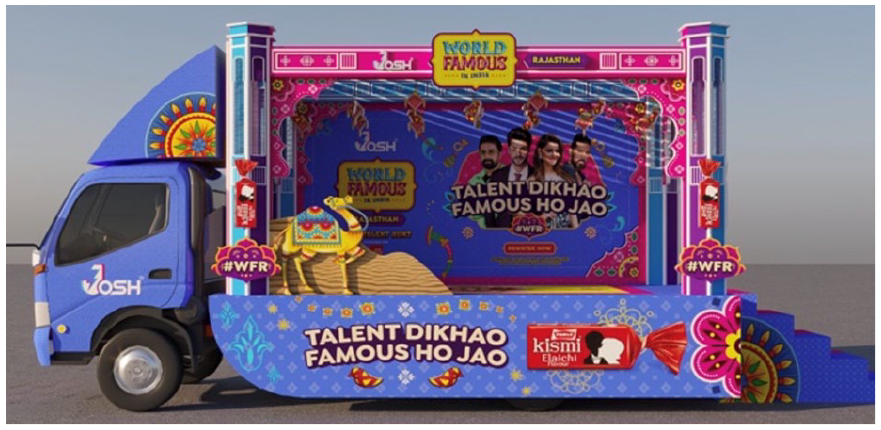
Mobile stage on canter vehicles “show talent, become famous” (Courtesy: Seher Bedi, Josh).
These stages on mobile trucks became the venue for local talent from tier 3 cities to perform. The mobile stages help to swiftly conduct auditions in small towns, which lack theater spaces, cinema halls, and shopping malls. During the interview, Bedi declared that she would have remained ignorant about dynamic talents and new genres of expression like “shayari” (reciting poetry), had she decided to remain within Mumbai. She emphasized creating “1 million stars of Bharat” as a way to differentiate “Bharat” from urban elite “India,” which goes well with the rhetoric of outreach (away from Mumbai) toward the hinterlands, where the essence of India resides.
Everybody is sitting in Bombay and Delhi and looking for talent out here. In places like [small towns of] Gujarat and Rajasthan, it was young talent . . . they were passionate . . . when we came to them, they came to us in hordes. We had footfall of 1-2 lakhs when we did hinterland and we could not believe. Not only were they displaying the talent, they came just to see this . . . Canter . . . was easy way of you know getting auditions. Earlier we used to set up booths . . . [but] . . . how far can you . . . places can give malls/halls, tier-2 and tier-3 cannot go. (Seher Bedi, Interview Excerpt, 10 January 2023)
Both Josh and Moj create retreats and workshops where talented creators can meet each other and collaborate. Josh has various events like NachBabyDance, for finding the next dance icon, with the contest being judged by celebrity choreographers such as Prabhudeva and dancers like Malaika Arora. The short video app also has an influencer fest called Josh Wakao, as well as JFlix, a vertical video short film festival initiative that asked for 1-min film entries to challenge long narrative storytelling practices. The finale involved an award ceremony featuring Bollywood superstars who recognized the Josh short video film winners. The short film festival was advertised as an opportunity for content creators to collaborate with mentors; Bollywood directors would provide a master class and exchange ideas with influencers.
Bedi emphasized the aspirational dimension of the encounters between the content creator and the celebrity they look up to that are facilitated by Josh through creatorthon events: “So, aspirational of course because they get to meet people in their dreams they don’t think they are going to meet, and then how their career sort of takes a leap because of that sort of collab” (Seher Bedi, Interview Excerpt, 10 January 2023, Author). Bedi recounted the aspirational journey of rapper Vejeeta from a small town Karnal in the state of Haryana who got a chance to work with Badshah, one of India’s leading rap artists. This was made possible because of Josh’s creatorthon, an initiative pairing content creators with their mentors (or gurus) for a collaboration. Some of the examples that Seher Bedi and Raghuvendra Prajapati mention regarding the collaborations between newly recruited creative talents and famous musical/Bollywood celebrities may have worked because there was an organic chemistry between the performers or thematic parallels in the art they pursued. However, when I discussed with content creators about what they thought of these collaborations (or “collabs,” as they are called) I got a mixed response which pointed to some of the ruptures in the kind of aspirational discourse propagated during talent acquisitions.
Some influencers saw collaborations as an opportunity to be seen with a big celebrity or a chance to add new followers by being associated with another influencer. However, there were other influencers I spoke with who felt that such collaborations were at times less guided by artistic resonances and had to do more with market monetization logics. Kajal Chauhan rose up as an influencer from Kanpur, writing and acting in comedic situations involving a mother and her children, and gossiping neighbors. She worked with local short video platforms and Instagram. Kajal now has 600K followers on Instagram. Throughout her short video platform journey, Kajal felt at times that she was being forced by both talent agents and influencer brands to attend events with celebrities to grow her network. Some of the collaborations with other influencers she was asked to undertake did not make any sense to her as an artist because she did not share any “personal connection” or “vibe” with the other performer/actor. Kajal felt that merely a joint appearance on a video/reel or selfie together would not cause her followers to grow suddenly. Kajal did not like the “influencer” tag, as it seemed dominated by marketing logics. She preferred the “artist” description for herself, someone who could choose with whom to perform/collaborate based on artistic considerations.
Yeh sikhaya jata hain ki jaise mere 600K, agar aapke samne 1 million wala influencer hain toh tum unse milon, unke saath content banao . . . uske followers mere pass aa jaye. Mujh se yeh hota hi nahin hain. Mujhe aap mat batao ki mujhe kya karna hain. Mera unse vibe hi match nahi hua toh . . . main artist hoon na, mujhe mann hoga toh main milongi, nahi hoga toh nahin miloonge. (We are taught that like I have 600K and if someone next to you has 1 million followers, then you meet them and start making content with them . . . their followers will then come to me. I cannot do this. You do not tell me what to do. If our vibes do not match then . . . I am an artist, if I feel like it I will meet them. If I do not feel like it, I won’t meet them). (Kajal, Interview Excerpt, 20 July 2024, Author)
Kajal felt that as an “artist” she needed to work on her craft of writing and spend more time rehearsing her acting performances, but the expectations from an influencer were about attending promotion events. Such events at times distracted her from being able to perfect her craft, and she wanted to prioritize her acting and writing because eventually these would determine her success and her fan base, not promotion deals and selfies with a Bollywood star. This might seem idealistic, but there is also here a criticism of the kind of aspirational values that short video platforms are propagating. Kajal mentioned how this year some influencers from India funded themselves to visit Cannes just to show they were living a grand lifestyle, but she would never do so to just show off. She emphasized that such a lifestyle was unrelatable for her small-town audiences. The aspirational limits of platform capitalism are unraveled in the ruptures between Kajal’s articulation of her individual goals and the aspirational targets set by marketing brands and short video platforms. Kajal’s refusal to engage in the performative networking events is a challenge to the self-representations of the influencer industry, which, borrowing from the work of Hemangini Gupta (2024), one could draw a parallel with efforts of women entrepreneurs to not play by the rules of masculinist entrepreneurship’s rituals and practices that misleadingly promote dense networking and neoliberal flexibility.
Beyond these collaborative events, talent managers and content directors working in creative teams with content creators regularly brainstorm ideas about how to make content that is at once localized and relatable to platform audiences/users and at the same time serves aspirational visions for both the audience and the creator. This tenuous balance between creating relatable authentic content and the aspirational dimensions of creative labor involved has been written about in other contexts in terms of “aspirational realness” (Duffy, 2017; Findlay, 2019). Not every content creator taking to video platforms as a side hustle (or full-time job) can charm their way into people’s social media feeds or self-brand themselves in an appealing way to be perceived as viable for monetization. There is a vulnerability and flexibility to this labor, which can be both empowering and exploitative, making scholars characterize such labor as “precarious playbour” alternating between play and labor, fun and work subject to demands of pleasure and career (Zhou & Liu, 2021).
Almost all of these short video platforms have a small group of what are called “managed creators”: they are contractually paid creators who are picked from the hinterland and different parts of India to become faces of the platform. The platform’s expectation from the managed creators is that they will set trends which can be mimed and replicated with small differences. Based on their considerable TikTok follower base, several such key influencers after the TikTok ban had been recruited with exclusive contracts by Moj and Josh. Such a contract, while it varied from influencer to influencer, on average involved being paid around Rs 50,000 (approximately $160) per month for making 30 videos. This contract, while being exclusive, actually encouraged these influencers to also necessarily cross-post at least 10 videos to Instagram Reels as a way to bring traffic and users from Reels to Moj or Josh (Saha, 2023). While such lucrative contracts were being plentifully distributed through the year 2021, the downturn in fundraising encountered by several short video platforms lead to cancelation of these exclusive deals by December 2022. Being cash-strapped and unable to find sustainable monetization models, Moj and Josh canceled contracts with several influencers. By the end of the year 2022, the homegrown short video platforms and their influencers were navigating a difficult terrain, which brings us to the discussion of the limitations of the discourses about aspiration and entrepreneurship that are propagated by the short video platform industry in India.
Aspirational and entrepreneurial limits
Aspiration could be about many things and need not involve always a desire for socioeconomic mobility or a craving for the lifestyle of the upwardly middle-class. Some journalistic accounts suggest that a group of non-elite/working-class creators and influencers who had found a venue for sharing their short video performances on TikTok could not successfully migrate with their followers (post-TikTok ban) to Instagram because they never felt at home with Instagram Reels. Yashraj Sharma (2021) writes that “unvarnished” “depictions of village life” in India on TikTok seem to have been replaced by curated “bland” images of “aspirational” middle-class lifestyles on Instagram Reels.
Since Sharma wrote this in October 2021, it seems that InstaReels has reached out to tier-2 and tier-3 cities, and at the same time, content creators in these towns and smaller cities have also emerged with innovative tactics of cross-posting across platforms. While maintaining a follower base on short video platforms like TikTok and Moj, these creators cross-post to InstaReels because Instagram is a platform that could get them key branding/promotion deals. Shudeep Majumdar, working with the influencer marketing firm Zefmo, told me that some of the homegrown short video platforms inspired by TikTok have gone for vernacular reach and localization but they are still not as good as Instagram and YouTube.
According to Majumdar, influencer marketing is not Moj or Josh’s forte. Content creators who are paid by Moj and Josh definitely create content for them as part of their contractual obligation. They then also re-post the same videos created for Moj and Josh in InstaReels and YouTube in hopes of monetizing their content and being noticed by key brands. In doing so, Majumdar explains that these creators are able to reduce the risk of their content not being seen by sponsors and marketers. Majumdar’s opinion indicates that homegrown short video platforms have simply not been able to reach the kind of popularity TikTok enjoyed before it was banned in India. Despite Moj propounding to have invested extensively in AI and machine learning tools, Majumdar is skeptical about how much Moj’s algorithms are able to learn about their users. Majumdar’s views are corroborated by other skeptics who note that Moj, Josh, and Chingari have not been able to fill the vacuum left by TikTok. These platforms have a problem of retaining users and they have also had to lay off workers (Ahluwalia, 2022). In financial year 2023, Mohalla Tech posted losses amounting to 4064 crore rupees (Bera, 2024). VerSe Innovation, the parent company that operates Josh, saw its losses rise from 808 crore rupees in 2021 to 2563 crores at the close of 2022 (Goenka, 2022).
Some Moj and Josh officials emphasized to me in interviews that other successful monetization options exist, including livestreaming opportunities where micro-influencers and their fans/followers could meet. Here, both product placements (of advertisers) happened and fans contributed small monetary amounts as gifts to these micro-celebrities. This arrangement allowed micro-influencers to earn money on Moj and Josh, and also provided neomobile users to participate and feel included through a shift from parasocial to potentially social interactions (Marwick, 2015). Television, with extended viewing times, created a way for a fan and a celebrity to have an imagined closeness called “parsocial relationship,” which Alice Marwick notes was further amplified by social media with the scope for emotional interactions into “potentially social” relationships. Content creation ranges across genres, and even occupations. Influencers can vary based on their talents or specialization, and include fitness experts, skincare consultants, fashion bloggers, and makeup artists. Some sing, lip-synch, and do comic skits to entertain; others are motivational speakers, while some create self-help instructional videos. It would be a generalization to presume they all desire or pursue similar aspirational goals and lifestyles.
Such a variety of genres, formats, and occupations also indicates the potential for influencers and content creators to be entrepreneurs, or perform, to use Lin Zhang’s (2023) term, “entrepreneurial labor,” through short video platforms. The hoopla around the dynamicity of entrepreneurship in corporate discourses for some time now has significantly eschewed the precarity and duress of lived experiences that laboring bodies undergo. Zhang (2023, p. 2) writes that “entrepreneurialism is the dominant ideology of global financial capitalism” and that “post-Mao China appropriated the discourse of entrepreneurialism after the country’s gradual reintegration into global capitalism.” Zhang’s conceptualization of “entrepreneurial labor,” and more specifically, her analytic of the “labor of entrepreneurial reinvention” in China, inserts socio-material and cultural specificity of labor into universalizing discourses of entrepreneurialism so as to trouble it. Her conceptualization also examines the particularity of this moment of platform capitalism where there is indeed a blurring of boundaries between the figure of the laborer and that of the entrepreneur.
Moj entered into multi-year tie-ups with e-commerce firm Flipkart to bet big on “live commerce”: this kind of “video commerce” or livestreamed commerce is much prevalent in China and the United States but has not picked up yet in India to that extent. While influencer marketers are still not sold on the viability of homegrown short video platforms to advertise corporate (and political) campaigns, these platform company CEOs such as Umang Bedi of Josh continue to suggest that “vernacular advertising” can “engage users effectively and authentically” (Inc42 BrandLabs, 2022). Over time, much more is being asked by short video platforms from their content creators and influencers who are advised to become entrepreneurs. And, that is not all; entrepreneurs are also being asked to become creators and post content regularly. Content creators have been made to be not just brands promoting products as part of live commerce and in-app purchases, but also entrepreneurs (or microentrepreneurs), whom Sharechat and Moj CFO Manohar Singh Charan (2022) notes as those who are running “their businesses or brands with minimal investment and limited resources.” Charan’s recommendation is that the blurring of creators and microentrepreneurs can be leveraged through regional social media and short video platforms (like Sharechat and Moj) directed to regional/vernacular audiences in tier 2 and tier 3 cities.
“Micro-entrepreneurs can build their business as creators on social media,” Charan notes, and then follows that up with an example of a makeup artist in tier 3 city expanding their business in their local region by audiences/followers becoming potential consumers. He suggests that the success of this entrepreneur-turned-content creator can be ensured “by regularly posting content on their work and techniques in interesting ways, engaging audiences with beauty tips, home remedies, etc” (Charan, 2022). This can be read as a call from a platform company for more Indian citizens (mobile netizens) to be entrepreneurs (or micro-entrepreneurs). These suggestions from Moj’s CFO are consistent with broader corporate and political brand promotions where a symbolic association between entrepreneurial pursuits and mobile phone in an Indian citizen’s everyday life is forged.
The Indian government, along with corporations, has been keen to create “10 million digitally enabled microentrepreneurs”: Rajiv Chandrashekar (2022), Minister of State for Electronics and Information Technology and Skill Development and Entrepreneurship, suggests this way of generating jobs as inevitable. Indeed, in several countries like the United States and China, the trend of self-employment through entrepreneurial pursuits has been accepted as the norm. Lin Zhang (2023) writes about Premier Li Keqiang launching a nationwide campaign in 2014 to encourage individuals from various socioeconomic backgrounds to espouse entrepreneurship and thereby lay the ground for bottom-up innovation.
The Indian government also likes to suggest an economic model of growth and development based on “a combination of thousands and millions of individual entrepreneurs, their aspirations and their energy” (Chandrashekar, 2022). While the start-up and venture capitalist funding represent one kind of entrepreneurship in Indian metropoles, the mass entrepreneurship of the hinterlands of tier 2 and tier 3 cities is envisioned as a vast collection of microentrepreneurs rising from the ground. Although one can keep speculating, and in some cases, betting on the future potential of India’s vast underbelly of potential microentrepreneurs, there needs to be more sustained growth in delivery supply chains, network infrastructures, and consuming capacity of netizens in rural India to have anything comparable to villagers setting up handicraft stores on popular e-commerce platform Taobao in China that Zhang (2023) discusses. Most villages in India do not have the supply chain network and Internet bandwidth (broadband) to sustain e-commerce like the Taobao villages (Padaki, 2022). So, while the Indian government may tout that “entrepreneurship is deeply engrained in the DNA of India,” there are entrepreneurial limits because of limitations of consuming capacity and supply chain infrastructures (Chandrashekar, 2022). Mitali Nikore (2021) explains that due to social norms, rural women entrepreneurs working in the Micro, Small, and Medium Enterprises (MSME) sector have to first do domestic unpaid work, thus having less time to devote toward training in digital tools, which affects their ability to use e-commerce platforms or engage in social media-based marketing. Such entrepreneurial limits also explain why Moj and Josh have not been able to create sustained monetizable models and a dedicated user/subscriber base.
Craig et al. (2021) note the highly advanced e-commerce integration on platforms as being key to the success of Chinese livestreamers and many Indian entrepreneurs were inspired by the success of China’s live e-commerce industry. However, these entrepreneurs had to downsize their expectations because the average revenue per user in India is much lower than that in China or the United States, and with such small transaction sizes, it became difficult to meet logistical costs and payments to influencers. Live e-commerce became further unviable because of Indian customers’ propensity to return products (Christopher, 2023).
Conclusion
The aspirational trajectories of ordinary individuals do not always overlap with neat templated narratives that Moj and Josh set as part of their start-up pitch decks for venture capital funding to capture the next billion users. Aspiration does not only connote individual ambition and hope for development. State and corporations also actively participate in prescribing particular aspirational targets for consumer-citizens. Talent agents working for talent management companies, helping content creators find work, and short video platforms’ talent scouts looking to recruit content creators provide them with aspirational targets of greater fame, visibility, brand endorsement deals, and monetization opportunities. These aspirational targets have limitations: content creators can at times be uncomfortable with the influencer tag and want to be perceived as skilled actors and performers instead. As this article documents, content creators see themselves adding value to other peoples’ lives in many ways beyond just entertaining them and being famous. This could include being a motivational speaker offering self-improvement exercises. I listened to creators who felt that short videos on platforms like Moj or Instagram were constraining and wanted to experiment with long form videos on YouTube. They believed long form videos allowed them more time and space to experiment with their storytelling and acting skills, and demonstrate them in front of a discerning audience.
The special issue call asked contributors to find relations across individual subject making and large-scale industrial formation in their study of platform economies in digital Asia. Throughout this article, while conducting research and analysis across the individual (creator/micro) and platform (macro) levels, I connect individual subjectivities, desires, and media practices of content creators with the political economy of platform start-ups in India. These start-ups are backed by the state’s “Digital India” mission, which paints particular discourses of aspiration and authenticity (Mukherjee, 2019). I have argued that these relations across macro-and-micro levels have some overlaps and continuities, but are also marked by gaps, asymmetries, and incongruities in terms of perspectives, power, resources, and positionalities.
I have emphasized the similarities to be found between what had unfolded in China with the rise of content apps when Internet prices dropped around 2010–2011 and what was happening in India since the launch of Jio enabled mobile data plans in 2016. These parallels explain why Chinese platforms such as TikTok and BigoLive were successful in targeting regional audiences of India through local talent acquisition strategies. Talent acquisition drives by short video platforms like Moj and Josh were part of building post-TikTok futures in India, garnering participation of hyperlocal micro-influencers in tier 2 and tier 3 cities by sending mobile stages on canter vehicles into the rural hinterlands of “Bharat” (India). Such hyperlocal influencers speaking in regional dialects are relatable and trustworthy for new-to-mobile audiences/consumers, exert influence on consumer choices, and help in overcoming the hesitancy of “neomobiles” to engage in mobile commerce. However, these efforts by themselves are not enough.
There are aspirational and entrepreneurial limits to this narrative of the short video brigade. To some extent, vernacular advertising and outreach helps to build trust as the English online space might seem estranged and also difficult to navigate for first-time users of mobile Internet in rural India, not conversant in written English. That said, the problems of villagers not being able to trust buying new and expensive products online because the delivery is slow and then having to travel far to get it repaired or serviced later are concerns that cannot go away simply by communicating in regional languages. Considering these infrastructural dimensions points to the limits of inter-Asian borrowings, even though such comparisons as this article demonstrates are important while thinking of local vernacular creativity in such heterogeneous countries. Entrepreneurial limits as a concept gestures toward infrastructural limitations as well as the inability of platform start-ups to reconcile the contradictions between their projected aspirations and the desires and struggles of their content creators and users.
This is also where one could locate the irony of the self-perpetuating platform economy as it unfolds in India as a continuation of neoliberalization. The self-managed influencers are entrained to cultivate an enterprising culture, where they cannot blame political systems or lack of infrastructural resources; rather, they continue to attempt to make more appealing and spreadable videos, hoping for a better future. After all, neoliberal diktat proposes that these influencers should know well that they (alone) are responsible for managing risks that come their way.
Footnotes
Acknowledgements
Thanks to the editors, and to Suruchi Mazumdar, Raghuvendra Prajapati, and Seher Bedi for conversations and for sharing insights.

Funding
The author(s) disclosed receipt of the following financial support for the research, authorship, and/or publication of this article: Penn SAS Deans Funds.
Declaration of conflicting interests
The author declared no potential conflicts of interest with respect to the research, authorship, and/or publication of this article.