



Abstract
Launched in December 2019, the European Green Deal (EGD) represents the European Union’s (EU) ambitious policy framework to achieve climate neutrality by 2050. This study employs a sentiment analysis of 582,156 tweets from the beginning of 2020 to April 2024 to understand the evolution of public sentiment toward the EGD. Grounded in Social Representations Theory and Framing Theory, we analyze sentiment trends, topic distributions, and the impact of key policy and external events (e.g. COVID-19 spread) on public sentiment. The results reveal predominantly neutral sentiment (61.68%), with more positive (28.26%) than negative (10.06%) sentiment overall and a substantially stable trend over time. EU-affiliated accounts showed higher positive sentiment compared to non-EU-affiliated accounts. Sentiment trends were correlated with key policy announcements and global events, demonstrating the intricate relationship between policy communication and the formation of public opinion. The study identified key themes and specific initiatives driving positive sentiment, including those linked to the first EU climate law and climate targets, Farm to Fork, and New European Bauhaus. Conversely, economic concerns, challenges in policy implementation challenges, ecosystem conservation status, and food system, and energy security issues appeared as associated with negative sentiment. The findings highlight the importance of targeted communication strategies, transparent response to skepticism, communication of policy processes, and stakeholder feedback collection tool enhancement to leverage public sentiment in support of the EU green transition, paving the way for future research to explore regional nuances and sentiment monitoring.
Keywords
Introduction
Announced in December 2019, the European Green Deal (EGD) is the European Union’s (EU) flagship initiative to achieve climate neutrality by 2050, addressing climate change and environmental degradation (European Commission (EC), 2019, 2020c). Given the evolving nature of this policy framework and the influence of broader geopolitical and economic events (Oberthür & von Homeyer, 2023), systematic monitoring of public sentiment is crucial for securing robust support of climate policies (Capstick et al., 2015).
Social media platforms, particularly Twitter (now X), offer real-time data on public sentiment and discourse, complementing traditional surveys with a more comprehensive and timely perspective on policy issues such as the EGD (Cody et al., 2015; Giachanou & Crestani, 2016; Reyes-Menendez et al., 2018; Yu et al., 2022). Several studies illustrate the value of social media analysis for capturing broader societal views on sensitive and often polarizing policy topics like climate and environmental policies (Kirilenko & Stepchenkova, 2014; Rocca et al., 2020). Nevertheless, while prior research addresses various aspects of the EGD—ranging from its implementation requirements to potential impacts (Claeys et al., 2019; Siddi, 2020)—fewer studies have examined its longitudinal perception via social media. In this regard, Janik et al. (2021) and Tosun and Mišić (2020) underscore the need for real-time analyses of EGD-related public sentiment, highlighting a critical gap in understanding how citizens perceive this ambitious policy over time.
This study offers a multi-dimensional perspective on how green transition policies, exemplified by the EGD, are interpreted, framed, and processed by social media users in the EU, focusing on an extensive Twitter/X dataset. The article proceeds as follows: Section “Materials and methods” introduces the methodology, including the theoretical framework and data analysis steps; section “Results” presents the results, detailing sentiment trends, topic distributions, and the influence of key policy announcements and global events on public perception; section “Discussion” discusses policy communication implications; and finally, the conclusions highlight limitations and avenues for future research.
Context
The EGD is a comprehensive policy framework aiming to make the EU the first climate-neutral continent by 2050 (Marelli et al., 2025). Public support is critical for its success (Oberthür & Dupont, 2021), making the interpretation of public sentiment paramount for policymakers. Traditionally, the EC (2021) has relied on Eurobarometer surveys, which consistently show high levels of support for environmental protection; for instance, Special Eurobarometers 501 and 550 (EC, 2020d, 2024 1 ) report that over 90% of EU citizens endorse environmental action. Yet, closer scrutiny reveals more complexity: a slight drop in citizens viewing climate change as a serious problem (from 93% in 2023 to 92% in 2024), coupled with rising personal concern (EC, 2020d, 2024; Spence et al., 2012). Such shifts may signal emerging trends that warrant careful monitoring, consistent with ebbs and flows noted in earlier studies (Poortinga et al., 2019).
External factors, including geopolitical tensions and energy crises, and the disparity between high public support and expert concerns about insufficient policy coherence, add another layer of complexity to understanding public sentiment toward climate policies (Institute for European Environmental Policy, 2024; Kulin et al., 2021; Zimmermann & Gengnagel, 2023). While energy and mobility initiatives garner strong backing (88% support for renewable energy), agriculture and food systems appear less successful in meeting EGD goals (European Scientific Advisory Board on Climate Change, 2024). This discrepancy underscores the need for a nuanced, multifaceted view of public sentiment (Tosun & Mišić, 2020).
Literature review
Understanding public sentiment on the EGD through social media is increasingly crucial, as these platforms can capture nuanced views beyond what traditional surveys reveal. Balcarova et al. (2024) highlight both support and skepticism toward the EGD on Twitter/X. Ejdys and Szpilko (2022), in a systematic literature review focusing on the EGD, stress the need to integrate social perception and sentiment analysis, pointing out that public sentiment significantly shapes policy acceptance and the effectiveness of communication strategies. Wolf et al. (2021) further argue that the EGD, beyond aiming for climate neutrality, is also a far-reaching economic strategy requiring substantial public investment, thus raising concerns about costs and potential job losses in traditional sectors.
Methodologically, approaches to sentiment analysis of EGD discourse vary from Support Vector Machines and Naive Bayes to more advanced deep learning models like RoBERTa-LSTM (Munawaroh & Alamsyah, 2023; Naifan et al., 2023; Tan et al., 2022). Cross-platform comparisons show differences in how sentiment is expressed on Twitter/X versus Facebook (Ali et al., 2021; Niu et al., 2021). Temporal analyses, such as those by Kahanek et al. (2021) and Zhou et al. (2022), track how sentiment shifts following specific policy announcements or major events. Attention is also turning to the role of misinformation in shaping EGD perceptions (Boon-Itt & Skunkan, 2020; Samuel et al., 2020).
Despite these insights, several challenges remain, including representativeness—given that social media users do not fully reflect the general population—and linguistic barriers across the EU (Gheuens, 2023). In addition, the brevity of Twitter/X posts can oversimplify nuanced opinions, risking binary classifications of complex sentiments (Carducci et al., 2019).
Research questions
Despite their value, traditional survey methods have inherent limitations in capturing the full dynamics of opinion formation, especially in real-time (Lenschow et al., 2020). The Eurobarometer surveys, while providing periodic snapshots, are insufficient for fully understanding the social perception of the EGD for several reasons. First, their infrequency limits continuous monitoring of public sentiment. Second, pre-designed questions may not capture emerging concerns or nuanced opinions (Haverland et al., 2015). Third, potential biases in question framing and response options may influence results (Höpner & Jurczyk, 2015). Most significantly, these surveys cannot capture rapid shifts in public opinion in response to events or policy changes (Capstick et al., 2015).
Combining Eurobarometer data with social media sentiment analysis might offer several advantages. Social media platforms, particularly Twitter/X, provide real-time data on public sentiment and discourse (Giachanou & Crestani, 2016; Reyes-Menendez et al., 2018). This approach allows for capturing rapid shifts in public sentiment as events unfold, providing a more dynamic and nuanced picture (Kirilenko & Stepchenkova, 2014) than infrequent survey snapshots. Furthermore, social media posts represent organic, unprompted views, potentially reducing the risk of bias introduced by survey question framing (Cody et al., 2015; Yu et al., 2022) to identify emerging issues as they arise in public discourse beyond pre-determined survey topics (Rocca et al., 2020). In addition, the vast amount of data available on social media platforms can provide larger sample sizes than traditional surveys, offering greater statistical power and more robust insights (Singh et al., 2022).
Building on an integrated theoretical framework, this study provides an analysis of longitudinal public sentiment perspective toward the EGD as it has been expressed on Twitter/X from the beginning of 2020 to the end of March 2024. It highlights primary themes driving sentiment to finally provide insights for refining climate- and green policies-related communication. In fact, this paper addresses the following research questions: (1) How has public sentiment toward the EGD evolved between 2020 and 2024? (2) What key events or policy announcements have influenced public sentiment of the EGD? (3) What are the primary themes driving positive, negative and neutral sentiment toward the EGD?
Materials and methods
This study integrates several complementary theories from social sciences, communication studies, and policy research to provide a comprehensive understanding of how public sentiment of the EGD is formed, expressed, and evolves over time on social media platforms. A mixed-method approach is applied to analyze public sentiment of the EGD through Twitter/X data. After introducing the theoretical framework (section “Theoretical framework”), this section will present the methodology (section “Methodology”) in four steps: data collection and pre-processing (section “Data collection and pre-processing”), sentiment analysis (section “Sentiment analysis”), temporal trend analysis (section “Temporal trend analysis”), and thematic analysis (section “Thematic analysis”).
Theoretical framework
The approach adopted is grounded in Social Representations Theory (SRT), first developed by Serge Moscovici in the 1960s and later expanded (Moscovici, 2008). SRT explains how abstract concepts—such as climate change and the EGD—become integrated into everyday understandings within social groups. Despite its roots several decades ago, SRT remains highly relevant to contemporary issues, including analyses of public opinion on complex policies like the EGD (Kim, 2024; Zeng, 2022). Recent studies show its enduring value in elucidating how abstract concepts are transformed into shared social understandings (Fan et al., 2023). Consequently, SRT is particularly pertinent for examining how public sentiment toward the EGD forms and evolves over time. The key steps in applying SRT are as follows: (1) anchoring, whereby unfamiliar ideas (e.g. EGD policies) are compared with familiar concepts; (2) objectification, turning abstractions like the “circular economy” into more tangible images; and (3) social influence, emphasizing how social interaction—such as discussions on Twitter/X—shapes collective understanding and potential support or opposition.
While SRT explains how complex concepts become integrated into public understanding, Framing Theory (FT) (Entman, 1993; Scheufele, 1999) illuminates how these concepts are presented and interpreted in public discourse. Building on SRT, we employ FT to explore how the EGD is portrayed in public sentiment, focusing on how certain aspects of an issue—its problem definition, causal interpretation, moral evaluation, and recommended solutions—are highlighted or downplayed. For instance, Balcarova et al. (2024) demonstrates how different framings of the EGD on social media, comparing both European (“European Green Deal”) and North American (“Green New Deal”) perspectives, can influence public perception, echoing earlier work on media framing’s power (Jakopović, 2017). In addition, framing renewable energy in terms of job creation and economic growth tends to elicit more positive sentiment than framing it solely as environmental protection. Cultural resonance is particularly relevant in the EU context, where alignment with shared values can reinforce SRT’s anchoring process. Following Tasoulis et al. (2018), we operationalize both SRT and FT in our sentiment analysis of EGD-related discourse on Twitter, examining how various framings correlate with shifts in public sentiment over time.
These complementary perspectives provide a comprehensive view of EGD perception formation. While SRT explains how the public makes sense of a complex policy, FT highlights how various framings of the EGD influence public interpretations and levels of support (Mondragón et al., 2016). SRT operates at the societal level and FT at the message level, revealing how collective understandings are shaped by media framing (Bauer & Gaskell, 2008; Zawadzki et al., 2020). By integrating these theories, our study examines not just what sentiments emerge around the EGD on social media, but also why they form and how they evolve over time, thus enriching the interpretation of sentiment trends within broader societal and media narratives.
Methodology
This study employs a mixed-methods approach to analyze EGD-related Twitter/X data, integrating natural language processing (NLP) and qualitative methods in four steps: data collection and pre-processing, sentiment analysis, temporal trend analysis, and thematic analysis. An EGD-specific query retrieved tweets via Application Programming Interfaces (APIs), which were then processed before sentiment analysis. Leveraging NLP allows the efficient transformation of large, unstructured social media text into a structured format suitable for analysis (Cambria & White, 2014). While numerous NLP methods can illuminate public perception—such as opinion mining (Solangi et al., 2018), emotion analysis (Anwar et al., 2021), and discourse analysis (Masroor et al., 2019)—we employed sentiment analysis for its straightforward classification of text into emotional tones (Liu, 2012). This approach effectively captures broad sentiment patterns and mood shifts over time, aligning with our goal of identifying the public’s attitudes toward the EGD. Subsequently, the results are qualitatively contextualized regarding internal and external factors potentially influencing public sentiment, and each sentiment category is further examined for thematic trends and emerging topics.
In analyzing publicly available Twitter data, we remain mindful of the unique ethical implications inherent in social media research (Ahmed et al., 2017). Although these data are publicly accessible, user posts often contain personal expressions that warrant careful handling to protect privacy and prevent re-identification. Accordingly, all data were anonymized, aggregated, and analyzed in line with institutional guidelines and platform policies, striking a balance between the public nature of social media discourse and the obligation to uphold data protection standards and respect user rights.
Data collection and pre-processing
To retrieve EGD-affiliated tweets, a query incorporating keywords related to the EGD was defined—(“European Green Deal” OR “EGD” OR “EU Green Deal” OR “EUGreenDeal”) since 1 January 2020 until 26 March 2024—and executed within Twitter’s Full-Archive Search API using Swagger UI 2 Tweets and their metadata were retrieved using Python programming language. Tweets matching only “EGD” were manually validated to avoid false positives. The dataset is limited to English-language posts—aligned with the EC’s main communication language for EGD matters (Drewski, 2023; Lönz, 2014; Modiano, 2022; Phillipson, 2018)—but this restricts nuanced regional perspectives across EU member states. Recent changes to Twitter’s API also constrain geolocation data, making regional sentiment analysis financially unfeasible for many institutions (Calma, 2023).
After removing empty records, the remaining 582,156 tweets were divided into EU-affiliated (23,413) and non-EU-affiliated (558,743) accounts using a predefined list of official EU institutional accounts. Although tweets from EU-affiliated accounts may offer useful insights, they do not necessarily represent formal EU positions, as individual user accounts (e.g. Commissioners, MEPs) can reflect personal views. To gauge the influence of automated (bot) activity, we conducted a bot analysis on 733 randomly sampled accounts using the Botometer X API, which computes a bot-likelihood score (0–1) based on posting frequency, network connections, and profile details (Yang et al., 2020).
Before applying sentiment analysis and topic modeling, the text was lowercased, special characters (except hashtags) removed, and URLs replaced to reduce interference. Stemming or lemmatization was deemed unnecessary for our sentiment model (Symeonidis et al., 2018). Stop-word removal was retained for sentiment analysis (to preserve contextual nuance) but applied in topic modeling to clarify extracted topics. All data processing was performed in Python.
Sentiment analysis
We applied sentiment analysis to the entire, processed dataset of EU-affiliated and non-EU-affiliated tweets using a roBERTa-base model, trained on over 58 million tweets and fine-tuned for sentiment analysis via TweetEval (Barbieri et al., 2020). Run in Python (v3.6) with the Transformers library, the model classified tweets as neutral, positive, or negative. These classifications were then integrated into the original dataset, alongside additional attributes such as user type, to support subsequent temporal and thematic analyses.
To validate the automated results, we conducted human coding on a representative random sample, covering both user types and all sentiment categories (positive, neutral, negative). Three independent coders assigned sentiment labels following a standardized guide, achieving high intercoder reliability (Krippendorff’s alpha), indicative of consistent coding (Hayes & Krippendorff, 2007). This human-coded dataset confirmed the automated analysis and helped refine any discrepancies. Because double negatives can obscure true sentiment (e.g. “I don’t disagree with the EGD’s goals”), an additional manual check was performed in parallel with topic modeling (Chaudhry et al., 2021; Sullivan et al., 2020). This extra step mitigated misclassifications and ensured more accurate interpretation of complex language, ultimately preserving the reliability of sentiment trends.
Temporal trend analysis
We conducted a qualitative temporal trend analysis to examine how EGD-related sentiment evolved over time and in response to global events. Four distinct phases reflecting the EGD’s policy cycle were identified: the Announcement phase (beginning 2020), the Delivering phase (end 2020–mid 2022), the Acceleration phase (mid 2022–end 2023), and the Finalization phase (end 2023–mid 2024). The Announcement phase covers the EGD’s introduction and early formulation, including key Commission “Communications” such as the Biodiversity Strategy. The Delivering phase encompasses major policies aiming for climate neutrality by 2050 and a 2030 interim target (−55% GHG emissions from 1990 levels), culminating in the first-ever EU “Climate Law” endorsed by the European Parliament and Council in December 2020. In the Acceleration phase, the Fit for 55 package plays a central role by introducing a series of legislative proposals to meet the 2030 climate targets—such as new CO2 emission performance standards for vehicles, an expanded Emissions Trading System, higher carbon removals via LULUCF (Land Use, Land Use Change, and Forestry), and revised energy directives (e.g. the proposal for more ambitious renewable energy targets following the Russian invasion of Ukraine, along with an updated Energy Performance of Buildings Directive). This phase also includes other key initiatives, such as the Nature Restoration Law, the Critical Raw Material Act, the first EU SDG Voluntary Review, and participation in COPs. The Finalization phase marks the conclusion of the policy cycle for most pending files, with formal adoption of Fit for 55 measures, the Nature Restoration Law, and the Energy Performance of Buildings Directive—contextual milestones essential for understanding shifts in public sentiment.
Thematic analysis
We applied topic modeling to identify the primary themes driving positive, negative, and neutral sentiments toward the EGD on Twitter. This provides a structured view of recurring issues shaping public discourse. Specifically, we used a two-step process combining BERTopic—a transformer-based method leveraging Sentence-BERT embeddings (Medvecki et al., 2024)—with hierarchical clustering. BERTopic’s ability to group semantically similar short texts proved crucial for tweets’ high variability and brevity. After applying dimensionality reduction via UMAP (Allaoui et al., 2020) to simplify the embedding space, we employed agglomerative clustering to merge the initial topics into broader, more interpretable categories, arriving at 10 clusters per subset (e.g. EU-affiliated vs non-affiliated users, positive/negative/neutral sentiment). This refinement was essential for grouping-related sub-themes and enhancing interpretability (Ezugwu et al., 2022). Overall, this combined approach provided deeper insights into the thematic drivers of public sentiment and how they evolve alongside policy developments and broader societal changes.
Results
The analysis encompassed 582,156 tweets related to the EGD that met the search criteria, comprising 127,792 original tweets and 454,365 retweets, posted or re-tweeted by 89,328 unique users. Non-EU-affiliated accounts make up the majority, contributing 558,743 tweets (93% of the dataset) compared to 23,413 from EU-affiliated accounts.
A bot analysis of a randomly sampled subset of Twitter accounts showed that most accounts demonstrated low bot scores, indicating minimal automated activity and a predominance of authentic human engagement. While a few accounts—such as official EU dissemination channels like @EUGreenWeek—scored higher due to frequent posting patterns, the dataset primarily reflects organic engagement. Figure 1 illustrates the temporal distribution of tweets, highlighting fluctuations in tweet volume across the study period and distinguishing between original tweets and retweets as well as types of accounts.

Distribution of tweets and retweets over time from January 2020 to April 2024 for EU-affiliated and non-EU-affiliated accounts. Authors’ elaboration via www.app.flourish.studio.
Sentiment analysis
Among the 582,156 tweets analyzed in the sentiment analysis, 359,087 tweets were classified as having neutral sentiment (61.68%), 164,525 as positive (28.26%), and 58,544 as negative (10.06%).
The sentiment analysis of EU-affiliated accounts showed that they demonstrated significantly higher positive sentiments (35.71%) and lower negative sentiments (3.19%) while maintaining similar neutral sentiments (61.10%) compared to the entire dataset and non-EU-affiliated accounts (27.95% positive, 10.34% negative, and 61.71% neutral sentiments, respectively). A more detailed breakdown shows that among EU-affiliated accounts, 35.34% of retweets and 38.87% of original tweets were positive, while only 4.33% of retweets and 1.57% of original tweets were negative. In contrast, non-EU-affiliated accounts showed 30.87% of retweets and 27.92% of original tweets as positive, with 11.67% of retweets and 9.52% of original tweets classified as negative. Figure 2 illustrates the sentiment distribution for both user types, distinguishing between original tweets (color bubble chart) and retweets (gray bubble chart).

Sentiment distribution of tweets related to the EGD, divided by EU-affiliated and non-EU-affiliated accounts, for both tweets and retweets. Authors’ elaboration based on sentiment data (2020–2024) via www.app.flourish.studio.
Validation of the automated sentiment analysis was conducted through a human-coded sample of tweets, selected to represent all sentiment categories (positive, neutral, and negative) and both user types (EU-affiliated and non-EU-affiliated). Three independent coders reviewed the sample, applying sentiment labels according to a standardized coding guide to ensure consistency in sentiment interpretation. The human-coded sample achieved high intercoder reliability, with Krippendorff’s alpha calculated at 0.82, reflecting substantial agreement across coders (see Supplementary Material).
Temporal trends in sentiment analysis
The analysis of sentiment trends from 2020 to 2024 reveals a dynamic public response to the EGD, reflecting the complex interplay between policy announcements, global events, and public opinion formation resulting in certain “momentum.” Figure 3 displays the overall volume of EGD-related tweets over time, with key policy events and phases annotated. Figure 4 offers a more nuanced view by comparing sentiment trends between EU-affiliated and non-EU-affiliated Twitter/X accounts.
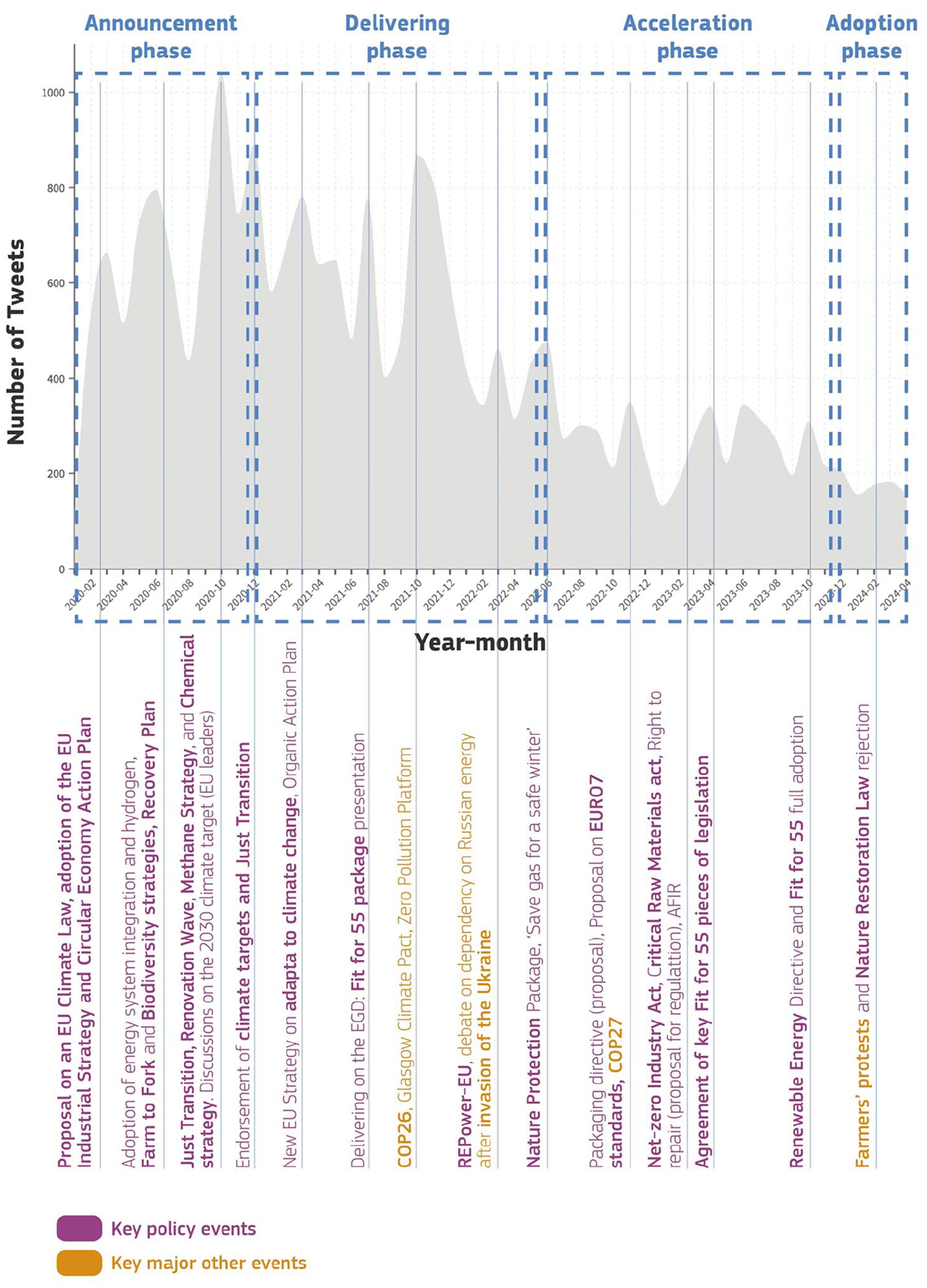
EGD-related tweets over time with key policy milestones and major events in the EGD evolution phases. Author’s elaboration.

All tweets’ (EU-affiliated + non-EU-affiliated accounts) sentiment evolution over time in relative terms. Authors’ elaboration via www.app.flourish.studio.
The announcement phase
Regarding the Announcement Phase, the EGD unveiling marked a period of cautious optimism. The initial announcement in December 2019 saw a modest but significant increase in positive sentiment from 26% to 29%. When the European Climate Law was proposed in March 2020, an increase in neutral sentiment from 59% to 63% emerges. In May 2020, when the EC released Communication documents on the Biodiversity Strategy and Farm to Fork Strategy, an increase in the volume of EGD-related tweets can be highlighted (EC, 2020a, 2020b). During Q2 2020, coinciding with the initial impact of the COVID-19 pandemic, we observed a temporary decrease in the overall number of EGD-related tweets. However, among the tweets that were posted, the proportion expressing positive sentiment remained relatively constant at around 28% (Figure 4).
The delivering phase
Looking at the Delivering Phase (End 2020–Mid 2022), the endorsement of the EU Climate Law in December 2020 generated significant public interest. In February 2021, the EC presented its new Climate Adaptation Strategy. This coincided with an increase in the volume of EGD-related tweets, suggesting heightened Twitter/X discussion around this topic. A notable shift occurred with the announcement of the “Fit for 55” package in July 2021. This corresponded with a significant increase in the number of related tweets, with an observed rise in the proportion of tweets expressing positive sentiment from 27% to 32%. In May 2022, one might observe a slight increase in tweets categorized by negative sentiment, from 9% to 11%. In fact, this period coincided with growing concerns about energy security, following the Russian invasion of Ukraine and consequent launch of the RePowerEU plan as a response to this.
The acceleration phase
As for the Acceleration Phase (Mid 2022–End 2023), the proposal of the Nature Restoration Law in June 2022 corresponded with an increase in the number of EGD-related tweets. The Critical Raw Materials Act in March 2023 highlighted the EGD’s economic dimensions, sparking discussions on sustainable industry. This period coincided with heightened discussions on social media about the interconnectedness of climate action, economic transformation, and sustainable development—key themes of both the EGD and global sustainability agendas, as mirrored by the full adoption of the “Fit for 55” in October 2023. This led to a stabilization of sentiment; neutral sentiments dominated (60%—65%), positive sentiments stayed between 25% and 30%, and negative ones between 10% and 15%. The EU’s participation in COP28 and the Global Pledge on Renewables in December 2023 saw a slight increase in positive sentiment (to 33%).
The adoption phase
The strenuous legislative journey of the Nature Restoration Law in early 2024 led to temporary spikes in both positive (37%) and negative (18%) views at different times. A significant challenge emerged with widespread farmers’ protests in early 2024. This led to a spike in negative sentiment (15%–22%), with non-EU-affiliated accounts displaying pronounced negative sentiment spikes in the occasion of the Russian invasion of Ukraine in February 2022 and the farmers’ protests across Europe (see Supplementary Material), during which the negative sentiment overcame the positive one (Figure 4).
Thematic trends in sentiment
The topic modeling analysis of Twitter/X discourse surrounding the EGD highlights diverse themes reflecting varied public sentiment and distinct perspectives based on user affiliation (EU- vs non-EU-affiliated). A more detailed analysis is recalled in the Supplementary Materials, complemented by sentiment word clouds.
Regarding Tweets associated with positive sentiment, EU-affiliated tweets often emphasize structured policy frameworks and initiatives such as “Fit for 55,” EU Climate Pact, and “Farm to Fork” strategy, aligning with the EGD targets for climate neutrality. Non-EU-affiliated accounts reflects a similar pattern, where climate advocacy emerges. The analysis also reveals a focus on social and cultural dimensions of the EGD, illustrated by frequent mentions of the NextGenerationEU recovery fund and New European Bauhaus initiative. A specific emphasis is visible in the mobility and food system domains, with frequent mentions to the “Farm to Fork” and Biodiversity strategy initiatives. The analysis of neutral sentiment tweets emphasizes public engagement, information dissemination, and transparency surrounding the EGD.
Tweets associated with negative sentiments (Figure 5) detected around the EGD reveal distinct thematic focuses between EU-affiliated and non-EU-affiliated accounts. Among EU-affiliated accounts, the negative sentiments are more often directed at the challenges of meeting ambitious EGD goals. Key themes include calls for “urgent” ambitious climate action in selected domains like pollution, waste management, food system transformation challenges, climate adaptation to face “extreme events,” and energy. Biodiversity and ecosystem health also feature prominently, with tweets voicing apprehension over issues like pesticide use and pollinators. Rising energy costs and reliance on gas are recurring themes, impacted by the energy crisis due to the war in Ukraine.

Word cloud of negative tweets from both EU- and non-EU-affiliated accounts. Authors’ elaboration.
Key themes by non-EU-affiliated accounts focus on energy policies, agricultural practices, and perceived environmental injustices. Agriculture-related topics such as farming subsidies, pesticide use, and Common Agricultural Policy (CAP) feature prominently, often tied to concerns about biodiversity, food security, and “nature restoration (law).” Mentions of MEPs appear in relation to their legislative roles in specific policy domains.
Discussion
This section discusses the results of the sentiment analysis for public sentiment on the EGD by overall sentiment distribution, temporal trends linked to key events, and thematic findings. It also encompasses a paragraph highlighting concrete implications for policy communication.
Overall sentiment distribution
Figure 4 highlights the evolution of sentiment over time in relative terms, suggesting that the number of tweets linked to the EGD has been decreasing over time. The Acceleration phase overlaps with Elon Musk’s acquisition of Twitter, which was finalized in late 2022, bringing major changes to the company’s business model, its ethos and staffing (Hickey et al., 2023). Given Twitter/X’s importance for public communication, this may have affected our findings. In fact, this event has influenced digital environmental information sharing on social media and impacted environmental advocacy voices, as there is evidence (Chang et al., 2023; Hopke, 2024) that millions of environment-related accounts abandoned the platform at that time. Figure 4 also unveils no significant variance in sentiment apart from the two mentioned moments in which negative sentiment overcame the positive one by non-EU-affiliated accounts’ tweets. This points out a certain stability of positive sentiment over negative and public buy-in. Overall, the analysis revealed a predominance of neutral sentiment, accounting for 61.66% of tweets related to the EGD on Twitter/X. A review of related keywords and content (see Supplementary Materials) across the dataset indicates that many of these neutral tweets were posted primarily for information dissemination, underscoring the role of social media in promoting public understanding and engagement with policy initiatives. This finding highlights the importance of clear and accessible communication to foster transparency, build trust in the policy-making process, and strengthen public acceptance of the EGD multifaceted goals. Indeed, as Lenschow et al. (2020) observe, such a high level of neutral sentiment may also reflect a partial or ambiguous understanding of the EGD implications among the public. This provides a valuable opportunity for policy communicators, who may be able to shape public opinion toward proactive environmental engagement and increased awareness of the EGD potential benefits.
At the same time, the neutrality in sentiment may reflect a degree of disengagement or indifference among segments of the population, presenting a potential barrier to the EGD “just and inclusive” transition. Moser (2010) refers to this as “psychological distance,” a perception that large-scale policy initiatives may be abstract or disconnected from individuals’ immediate concerns. Bridging this gap and making the EGD relevant to people daily lives could foster stronger engagement with its goals.
The breakdown by retweet and original tweet reveals additional patterns in sentiment distribution. Retweets, which tend to amplify and reinforce specific messages, show significantly higher positive and negative sentiments compared to original tweets, especially among non-EU-affiliated accounts. Non-EU retweets had a positive sentiment rate of 28.12% and a negative sentiment rate of 10.65%, compared to 27.88% positive and 10.31% negative in original tweets. This suggests that non-EU users may be selectively amplifying sentiments, with a slight leaning toward highlighting positive and negative viewpoints. EU-affiliated accounts showed similar tendencies, with higher proportions of positive (34.29%) and negative (4.37%) sentiments in retweets than in original tweets (32.50% positive, 1.99% negative). These results imply that retweeting, particularly among EU-affiliated accounts, may serve as a vehicle for reinforcing official or pro-EGD messages.
While positive sentiments were more frequent (28.26%) than negative ones (10.06%) across the entire dataset, caution is needed in interpreting this disparity. As Capstick et al. (2015) note, favorable attitudes do not necessarily translate into support for specific policies or behavior changes. This disconnect, often called the “value-action gap” (Blake, 1999; Essiz et al., 2022; Portus et al., 2024), is a common challenge in environmental psychology and highlights the difficulty of translating general support for sustainability into concrete public action. From a SRT perspective, the prominence of neutral sentiment may suggest that anchoring and objectifying processes—whereby the public integrates complex EGD concepts into their broader understanding of sustainability, economic progress, and social welfare—are still ongoing. Effectively communicating the EGD’s objectives in accessible terms that resonate with the public could support this integration and foster more robust engagement.
However, the manual sentiment validation also revealed challenges in interpreting sentiments, especially within the negative category. Some tweets featured double negatives or complex expressions, such as “not without impact” or “no time to waste” that can carry context-dependent or implicit meanings. These phrases present unique challenges for conventional sentiment models, which may classify such language as negative despite its nuanced or affirmative undertone. For example, a phrase like “no time to waste” conveys urgency aligned with the EGD’s goals rather than opposition, while “not without impact” implicitly acknowledges the EGD’s efficacy in addressing environmental issues. These findings underscore a limitation in sentiment models, as they may struggle to accurately interpret complex language structures or detect underlying support in ostensibly negative expressions.
Temporal trends and key events
Sentiment patterns closely mirrored major policy announcements and global events. The EGD journey began with cautious optimism in early 2020, evidenced by a modest increase in positive sentiment following the European Climate Law proposal announcement in March 2020. This initial reception corroborates Ossewaarde and Ossewaarde-Lowtoo’s (2020) findings on the importance of framing in the early stages of policy introduction. The related increase in neutral sentiment might specifically be related to policy announcement communication, without being linked to an increase in neutral sentiment among the public necessarily. However, the occurrence of complex language patterns, such as double negatives, was notable in public reactions during these key moments, complicating sentiment interpretation. Expressions like “not without merit” or “cannot ignore” often imply reluctant support or acknowledgment rather than outright criticism. For example, phrases of cautious approval became particularly common during the “Fit for 55” announcement in July 2021. While these were categorized under negative sentiment, the language often reflects an acceptance of EGD goals, albeit with reservations. Such instances underscore the need for nuanced sentiment categorization methods that can capture implicit support or constructive criticism expressed through complex language.
The “Fit for 55” package announcement in July 2021 marked a significant milestone in the EGD implementation, with positive sentiment rising from 27% to 32%. This might be linked to public preference or greater understanding of tangible measures (Skjærseth, 2021) in narrower fields. FT is relevant here as well, as the clear and actionable nature of the package likely framed the EGD in a way that was more accessible and compelling to the public, thereby increasing positive sentiment. However, the introduction of the REPowerEU plan as a response to the energy crisis in May 2022 highlighted the complex interplay between climate policy and energy security. This shift might reflect the challenge of policy coherence in the face of major geopolitical events (Goldthau & Sitter, 2020). Through the lens of SRT, this shift can be seen as the public struggling to reconcile the immediate energy security needs with the longer-term environmental goals of the EGD, causing a tension in the social representation of the policy. It highlights the need for flexible, responsive communication strategies that can address emerging concerns while maintaining a focus on the EGD long-term, goals.
The EGD role as a comprehensive model for sustainable development was particularly evident during COP28 in December 2023, which saw a slight uptick in positive sentiment from 31% to 33%. This event underscored the EU global leadership in integrating environmental, economic, and social policies, with the EGD serving as a blueprint for holistic sustainable transition, as it aims to turn the EU in the first climate-neutral continent by 2050. However, the farmers’ protests in early 2024 and the associated temporary increase in negative sentiments underscores the need for careful consideration of sector-specific impacts and inclusive dialogues in policy implementation to give concrete actualization to the concept of just transition (Newell & Mulvaney, 2013) and “leave no one behind” which are central to the EGD. This further highlight the challenges of balancing environmental goals with economic and social concerns across different sectors and stakeholders. Notably, negative sentiments around these protests often contained double negatives like “can’t afford to lose” or “not unimportant,” implying concerns over social impacts while still recognizing the EGD’s value. Such constructs add depth to public sentiment, highlighting expectations for inclusivity rather than outright rejection of EGD initiatives.
Thematic findings
The topic modeling analysis of Twitter/X discourse surrounding the EGD reveals a multifaceted landscape of public sentiment, shaped by varied perspectives across EU-affiliated and non-EU-affiliated accounts.
Positive sentiment has been staying almost stable and reflects broad support for the EGD, with a focus on its potential to drive climate resilience, sustainable economic growth, and social well-being. The popularity of structured policy frameworks (such as the “Fit for 55” package and “Farm to Fork” strategy) represents an anchoring process as described by SRT, where complex goals like emissions reduction and sustainable food systems are contextualized within familiar policy tools, helping the public relate to these broad aspirations. Reference to “hydrogen,” “solar power,” and “wind energy” objectify the EGD energy initiatives, turning abstract goals into concrete actions (Moscovici, 2008). This positive discourse from EU-affiliated accounts aligns with FT as well, which underscores the power of specific terminology in shaping public perceptions of policy (Entman, 1993). Non-EU-affiliated accounts mirror this positive sentiment but adopt a more community-oriented framing, with frequent references to grassroots climate advocacy, sustainable finance, and social justice. Urgency to fight climate change is shared by EU-affiliated tweets, but here come with a focus on public mobilization rather than policy initiatives. This difference demonstrates how anchoring within SRT allows non-EU accounts to frame the EGD within global environmental narratives, emphasizing urgency and grassroots action (Moscovici, 2008). In addition, themes such as sustainable finance underscore a growing interest in the economic underpinnings of sustainability, aligning with Essiz et al. (2022) on the public’s shifting awareness toward systemic issues underlying environmental policies.
Negative sentiment highlights perceived limitations and potential trade-offs of the EGD, reflecting critical engagement with specific policies and economic sustainability challenges specifically in non-EU-affiliated accounts. Discourse on ecosystem conservation status, coupled with broader waste management concerns, suggests a strong sentiment in the public health domain. Among EU-affiliated accounts, negative sentiment centers on the feasibility of fully implementing the EGD goals and challenges in specific domains, like the food system, energy security, and waste management. SRT’s anchoring process explains that as criticisms are grounded in familiar policy topics, with critiques suggesting that existing efforts may fall short in protecting Europe’s ecological resilience (Lenschow et al., 2020) and the urgency to face environmental crisis. Non-EU-affiliated accounts demonstrate a more extensive critique of the EGD, often questioning its socio-economic impacts in specific domains. Certain public apprehension about food security, farmers’ income, and environmental degradation emerged. Notably, expressions involving double negatives, such as “not without impact” and “no time to waste,” underscore the nuanced nature of negative sentiment. As Fan et al. (2023) observe, such language often reflects public demands for more ambitious policy action, aligning critique with support for policy goals.
Neutral sentiment predominantly reflects an informational tone. EU-affiliated accounts focus on sharing technical details, policy priorities, and policy process updates across areas like food system, sustainable finance, and the digital transition. Phrases such as “public consultation,” “join us,” and “help us” and bottom up-related initiatives (e.g. “green deal going local,” “citizen voice”) indicate certain effort to encourage public participation and transparency. According to FT, such language supports an open communicative strategy aimed at enhancing public understanding without directive appeals, providing clarity on policy objectives while fostering trust in the EGD implementation (Entman, 1993). Terms like “green recovery” and “circular economy,” as well as the recurrent focus on the agriculture domain, reflect interest in the economic dimensions of the EGD, with neutral discourse focusing on informing rather than inciting particular viewpoints. This approach aligns with the concept of transparency in SRT, where EGD topics are presented as accessible information that enables the public to evaluate policies on their own terms (Lenschow et al., 2020).
Implications for policy communication
The findings presented might suggest some implications for future communication on the EGD and environmental policies. Strategies should leverage positive sentiment momentum beyond the initial stages of new policy cycles, where the political debate is notably more animated. Implementing the EGD will require endured efforts and effects cannot always be visible in the immediate term. The comparably higher negative sentiment in non-EU accounts suggests that concerns should be addressed in a targeted way. In this regard, amplifying positive narratives and success stories could reinforce and expand supportive attitudes. Furthermore, systematically monitoring the public sentiment on the EGD (and, therefore, on the EU green transition policies) via social media analysis, beyond annual sentiment reporting based on surveys, could help highlight key topics driving negative sentiment, anticipating them, and creating strategic ad hoc communication campaigns. In this regard, focusing on the long-term tangible benefits of pursuing the green transition rather than solely focusing on the costs of inaction could help build positive and more engaging narratives.
Despite being conceived as the new EU “growth strategy” in 2019, the EGD also implies transformative changes in specific production and manufacturing sectors (e.g. the ban on new combustion engine cars from 2035) as well as everyday life habits (e.g. dietary shifts, repair and reuse rather than buy new, recycle). These changes might find certain resistance from stakeholders and further fuel existing barriers (e.g. “range anxiety” for electric cars). In addition, most of the concerns by non-EU-affiliated accounts regard the economic sustainability of the envisaged transition. In addition, negative spikes in sentiment trend appeared exclusively in non-EU-affiliated accounts. Communication strategies should not neglect or underestimate these concerns, but rather acknowledge and inform in a transparent way to elaborate targeted responses (e.g. demonstrating that current ranges by electric vehicles are enough to cover most of EU drivers’ daily needs). Furthermore, campaigns might show progress in specific sectors (e.g. the growth of the charging infrastructure), possibly within a local and site-specific perspective (e.g. progress in the charging infrastructure in a specific region) and in response to context-specific concerns. For this, more granular insights on sentiment territorial patterns would be needed. In addition, different groups of citizens might be targeted via specific campaigns in terms of contents, styles, and channels of communication. For instance, young people’s stronger interest in climate change could be leveraged to further promote policy initiatives and engage the public.
Finally, certain interest emerged specifically over few specific policies and their relevant cycles, namely, the EU Climate Law, Carbon Border Adjustment mechanism, Biodiversity Strategy, “Farm to Fork” and CAP, Alternative Fuel Infrastructure, and Nature Restoration Law. These policies have polarized the discourse on the EGD, which, however, encompasses an unprecedented number of policy initiatives in many other domains, supported by strong financial tools like the NextGenerationEU and the post-COVID-19 recovery plans. Communicating properly the evolution of the policy cycle for pieces of legislation could result in higher societal engagement, more transparency as well as better understanding of EU legislative bodies and democratic institutions’ roles, consolidating a foundation for public acceptance based on awareness, knowledge, participation, democracy, and trust. In turn, this could boost societal support for EU institutions and the rule of law. In this perspective, communication efforts should aim to create an inclusive and engaging environment for citizens to participate in the policy-making process. To achieve this, existing tools that promote democratic participation should be leveraged. For instance, as required by the Better Regulation (EC, 2023), stakeholder consultations are opened online by the EC when proposing new laws. Opinions on roadmaps, inception impact assessments, and public consultation questionnaires are combined into one document. Stakeholders’ opinions are usually gathered on the Have Your Say portal, anonymized and made public for the purposes of transparency. Interestingly, in our database around 11,000 tweets only contain the keywords “Have your say” or related hashtag (less than 800 from EU-affiliated accounts). Promoting participation via such tools and enhancing the audience of consulted citizens might have several positive implications and result in a livelier and inclusive discussion on the EU green transition.
Conclusion and future research directions
The EGD is a highly ambitious environmental policy package, and public consensus is needed to realize the green transition. According to our analysis, interest on Twitter/X from 2019 to 2024 has decreased while becoming increasingly focused on specific policy initiatives, such as GHG emission reduction, the food system, biodiversity, and nature restoration. The findings highlight that positive sentiment has remained relatively stable and has even surpassed negative sentiment, although neutral sentiment remains the most prevalent overall.
Correlations between major policy announcements, geopolitical events (e.g. the Russian invasion of the Ukraine, the resulting energy crisis and policy measures to overcome it—such as the RePowerEU) or multilateral engagements (e.g. the COPs) and peaks in public interest emerged. Shifts in sentiment have been registered as well, with negative sentiments overcoming positive ones in specific circumstances (e.g. the farmers’ protests in early 2024). The analysis also revealed key themes driving sentiment in positive and negative ways (e.g. energy crisis, urgency to act, food security, just transition, financing, ecosystem restoration).
The generalizability of our findings requires careful consideration due to several methodological and data-related factors. According to Eurostat (2024), 59% of EU citizens (being around 450 million people) participate to social medias, with high regional variations. Between February and July 2024, there were an average of 67 million active logged in users of X in the EU, with a peak of 112 million users in the period February—June 2023 (Statista, 2025). It should be also acknowledged that, since Musk’s acquisition of X in late 2022, the platform has experienced a continuous decline in its user base across the EU. In fact, in compliance with the Digital Services Act of the European Union (2022), X has been publishing quarterly transparency reports, including the most recent update covering October 2024. Recent data indicate that the average number of monthly X users in the EU has dropped from 111.4 million in the 6 months leading up to January 2024 to 106 million in the 6 months leading up to July. A closer examination of X’s transparency data reveals that user numbers have fallen in 25 of 27 EU member states over the past year, with only Germany and Finland experiencing a slight increase (Euronews, 2024). This report confirms that while the decline in EU user numbers has continued, the rate of decrease has slowed compared to previous reporting periods (X, 2024). Therefore, the exclusive reliance on Twitter/X data introduces biases in representation and should not be considered representative of wide societal opinion. Twitter/X users tend to be younger, more educated, and more politically engaged than the general population (Mellon & Prosser, 2017). In the European context, Blank (2017) found that Twitter/X users are more likely to be male, younger, and have higher incomes compared to the general population. This demographic skew may result in an overrepresentation of certain perspectives on the EGD. The focus on English-language tweets potentially underrepresents views from non-English speaking Twitter/X users, a significant limitation given the linguistic diversity of the EU and its member states. However, English is the primary language for EGD communication and a predominant medium for cross-national discourse on EU policy on Twitter, engaging users across member states and international audiences. This focus thus captures the most accessible and widely shared segment of public sentiment. Furthermore, recent API restrictions by Twitter have affected access to detailed user metadata, particularly geolocation information. This limitation prevents regional analysis, which could have enhanced the study’s insights into region- or country-specific sentiment trends. Furthermore, reliance on social media data inherently excludes populations with limited internet access or those who do not engage with social media platforms (e.g. rural, elderly, or economically disadvantaged populations in the analysis) (van Deursen & van Dijk, 2019). Finally, Twitter/X specific format encourages certain types of communication (e.g. briefs, immediate reactions) that may not fully capture the complexity of public opinion on policy issues (Waterloo et al., 2018).
To address these limitations and expand the understanding of public sentiment toward the EGD (or future policy packages in the EU), future research could pursue several directions. Incorporating additional EU languages and data from various social media platforms, with more accessible geolocation options, could provide a more comprehensive view of sentiment across the region, in turn relevant to shape region-specific communication strategies and overcome X API limitation. Understanding how perceptions vary across member states is crucial given the EGD EU-wide scope, and cross-national comparative studies could explore how national contexts, including energy mix, economic structure, and cultural values, influence public attitudes toward different aspects of the EGD. The development of sentiment models sensitive to complex language structures, including double negatives, would also improve sentiment analysis accuracy in capturing nuanced public reactions to the EGD. Employing more advanced NLP models, such as those capable of emotion analysis, could further refine this approach by identifying specific emotional tones—such as fear, hope, or optimism—associated with distinct policy events or actions. This refinement would enable a more granular interpretation of public sentiment, revealing not only overall attitudes but also the specific emotional dimensions shaping public sentiment on the EGD. In addition, combining social media analysis with traditional survey methods could bridge the gap between online discourse and offline opinions, helping to provide a more representative picture of public sentiment toward the EGD. Finally, tracking the evolution of public sentiment over extended periods through longitudinal studies could reveal how attitudes toward the EGD and its various policy areas shift over time, particularly as implementation progresses and impacts become more tangible. By addressing these limitations and pursuing these research directions, future studies can provide a more comprehensive and nuanced understanding of public sentiment toward the EGD and the green transition pathway in the EU.
Supplemental Material
sj-docx-1-sms-10.1177_20563051251337404 – Supplemental material for Perceptions of the European Green Deal: Understanding Public Sentiment
Supplemental material, sj-docx-1-sms-10.1177_20563051251337404 for Perceptions of the European Green Deal: Understanding Public Sentiment by Steve Borchardt, Matteo Trane, Stefano Cisternino and Luisa Marelli in Social Media + Society
Footnotes
Acknowledgements
The authors would like to thank you the reviewers for the highly valuable feedback. Conceptualization, M.T., S.B., S.C., L.M.; Data curation, S.B.; Formal analysis, S.B., S.C., and M.T; Investigation, S.B., S.C., and M.T.; Methodology, S.C., S.B. and M.T.; Software, S.B. and M.T.; Supervision, M.T. and L.M.; Visualization, M.T.; Writing—original draft, S.B., S.C., and M.T.; Writing—review & editing, S.B., M.T., S.C., and L.M.

Funding
The author(s) received no financial support for the research, authorship, and/or publication of this article.
Declaration of Conflicting Interests
The author(s) declared no potential conflicts of interest with respect to the research, authorship, and/or publication of this article.
Supplemental material
Supplemental material for this article is available online.
Notes
Author biographies
References
Supplementary Material
Please find the following supplemental material available below.
For Open Access articles published under a Creative Commons License, all supplemental material carries the same license as the article it is associated with.
For non-Open Access articles published, all supplemental material carries a non-exclusive license, and permission requests for re-use of supplemental material or any part of supplemental material shall be sent directly to the copyright owner as specified in the copyright notice associated with the article.
