




Abstract
This article examines the role of European cultural networks as cultural intermediaries in the green transition within European Union context, where climate action is being mainstreamed in all policy fields, including culture. It contributes to discussions on environmental sustainability in the cultural and creative sectors, the contemporary cultural politics of the environment and the expanded social and political roles of cultural intermediaries. Methodologically, the study combines a review of materials produced by the networks with interviews with 16 network representatives. The article expands the concept of cultural intermediation by identifying three modalities in relation to the green transition – proactive, reactive and passive – and the parameters that shape them. It shows that these modalities should not be understood merely as varying degrees of enthusiasm in relaying policy priorities but also as political stances towards a highly contested agenda and the evolving social roles expected of cultural intermediaries. The analysis argues that intermediation is fundamentally a balancing act – between policy imperatives, funding dependencies, constrained resources and expertise, competitive peer dynamics and individual agency – and provides insights into the negotiated social roles of cultural intermediaries.
Keywords
Introduction
Beyond Bourdieu’s (1984) original conception of cultural intermediaries as tastemakers mediating between production and consumption, recent scholarship highlights a broader range of intermediation practices. These not only shape the structures and opportunities sustaining cultural work and creative production (Comunian and England, 2022) but also help address social challenges (Campbell et al., 2022; Noonan and Brock, 2022; Perry et al., 2015). European cultural networks, which operate transnationally to connect organisations with similar scopes or within specific cultural and creative sectors (CCSs), occupy a strategic position as cultural intermediaries in the European cultural landscape. While their origins were rooted in broader sociopolitical ambitions – such as promoting transnational cooperation and advocating for the role of culture in the European integration process (Autissier, 2016; Pehn, 1999) – they have become influential actors within European Union (EU) cultural governance mediating between EU agendas and diverse cultural practices, supporting the CCS and informing policy conversations (Littoz-Monnet, 2013; Magkou, 2021; Scioldo, 2024). At the same time, they increasingly operate in a context shaped by pressing global challenges – climate change among them.
Recent years have seen growing momentum around the environment within the CCS, with researchers both highlighting the sector’s potential to address climate change (Oakley and Banks, 2020; Pyykkönen and De Beukelaer, 2025) and critiquing the growing ‘greening’ imperative imposed upon it (Rodrigues, 2024; Rodrigues and Ventura, 2024). Despite this growing attention, research has overlooked how meta-organisational cultural actors, such as European cultural networks, navigate their role as intermediaries in the context of the green transition. In this article, we argue that in the European context, this role is shaped by a constellation of parameters operating both from above and from below – namely, through policy frameworks, funding priorities, the heterogeneous needs of their members and implicit forms of peer-pressure within the CCS. These dynamics also result in varied intermediation modalities that we describe as proactive, reactive and passive. Rather than examining how this role is operationalised through specific outputs (e.g. toolkits, training, or advocacy), our focus is on understanding the parameters that define these modalities among several intermediaries with similar characteristics. This focus is crucial precisely because the social roles attributed to and expected from cultural intermediaries cannot be assumed to be unanimously accepted.
The article is structured as follows: we first draw on existing work on intermediaries to situate European cultural networks within this category, then discuss climate change in relation to the CCS and outline the evolving EU policy landscape. Understanding the policy context is central in our article, as it reveals how environmental agendas generate varying levels of engagement among cultural networks. We then explain the methodology and present the intermediation modalities that European cultural networks enact. This leads to a discussion about the delicate balancing act they are faced with and a call for rethinking the social role of intermediaries as an ongoing negotiation that conditions different levels of engagement. In the conclusion, we further propose future research avenues specifically on cultural networks and the green transition.
This article makes a twofold contribution to cultural studies. First, it contributes to the ongoing – yet incomplete – conversation about the environment within the field, as reflected in seminal works that have emphasised the environment’s relevance to cultural studies (Pezzullo, 2008, 2013) and the contemporary cultural politics of the environment (Goodman et al., 2016). Second, it enriches debates on intermediaries, a key notion within cultural studies scholarship (Smith Maguire and Matthews, 2012), and especially on their social and political dimensions.
Rethinking cultural intermediaries: economy, society and policy
The term ‘cultural intermediaries’, introduced by Bourdieu (1984) in Distinction, has since evolved into a multifaceted concept used by scholarship in different yet complementary ways. Bourdieu’s work positioned intermediaries as a type of cultural profession associated with cultural commentary holding strong curatorial and gatekeeping functions between artists and consumers (Negus, 2002). Since then, as boundaries between culture-making, mediation and consumption have become more fluid, the meaning and functions of cultural intermediaries have evolved not only through academic reinterpretation but also through changing professional practices and organisational realities, giving rise to a more diverse set of roles and relationships embedded in new economic spaces (Molloy and Larner, 2010). Scholarship has viewed how cultural intermediaries shape value and bring forward issues of agency and negotiation (Smith Maguire and Matthews, 2012: 2), while others focus their role around a ‘value-chain’ analysis that takes account different stages of production and consumption (De Propris, 2019). Scholars further underline their role in influencing the structures and opportunities that support creative production (Comunian and England, 2022), providing creators with skills, contacts and resources (Rantisi and Leslie, 2015), managing conflicts (Virani, 2019), structuring economic and policy effects (Vinodrai, 2014), while connecting actors from different fields and acting as incubators (O’Connor, 2013).
A strand of literature extends the economic and infrastructural reading of cultural intermediaries by positioning them at the intersection of culture, society and economy. This perspective highlights their contribution in advancing broader social agendas, such as diversity and inclusion (Campbell et al., 2022) or access to culture (Hadley, 2021). In that context, intermediaries can reinterpret and change dominant policy imaginaries (Jakob and Van Heur, 2015) and shape the circulation of power across institutional, social and cultural spheres (Noonan and Brock, 2022). They also hold positions that enable them to engage with policy at local, national and international levels (Comunian and England, 2022). Scholarship has further underlined the need to acknowledge the inherently political dimensions of their work, by stressing what intermediaries do and how they do it must connect with debates about political choice and path dependency (Taylor, 2015), or by pointing out that the integration of culture and economy inherently requires intermediaries to exercise political agency (Cronin and Edwards, 2022). Our research positions itself within this body of literature that emphasises the social and political dimensions of cultural intermediaries.
Here, it is important to frame European cultural networks as intermediaries. As explained, they have become key actors in EU cultural governance, promoting integration and cultural diversity while acting as soft policy instruments for European cultural policy (Magkou, 2023; Scioldo, 2024). They play a key role in documenting trends within the CCS and responding to the needs of professionals, while simultaneously acting as advocates in relation to EU cultural policies development (Magkou, 2021). The way they support the development of transnational ecosystems (Magkou, 2024, 2025) and infrastructure ‘togetherness’ (Marthe and Landau-Donnelly, 2025) position them rightfully as intermediaries. At the same time, they respond to the economic framing of cultural intermediaries as they often function as pivots and distributors of economic resources, either through supporting financially their members directly through open calls to participation in different initiatives or by enabling access to EU funding opportunities. At the same time, they actively support the CCS in Europe and beyond by fostering international collaborations, providing resources and expertise and facilitating the exchange of practices. They also help shape the sector’s collective thinking and practice around key social challenges – climate change being a key example. They may receive support through a dedicated EU budget line for networks within the Creative Europe programme or benefit from project-based EU funding, making the EU the primary source of financial support for most of them. Increasingly these networks are expected to play a stronger role in policy – a shift made explicit in the latest Creative Europe funding call, which emphasised activities representing sector interests, contributing to policy development and addressing cross-cutting key priorities, such as ‘greening’ the CCSs. 1
The climate emergency, CCS, and European (cultural) policies
To examine the intermediary role that cultural networks play in the green transition, it is necessary to understand how the climate emergency has permeated the CCS in recent years. This shift is evident in the growing number of cultural and artistic projects focused on environmental sustainability, which has now emerged as a thematic priority for funders who underline the sector’s vital contribution to reimagining and communicating the transformative visions needed to address the climate crisis (Gielen, 2014; Maggs and Robinson, 2020). It also aligns with the growing momentum and effort for ‘greening cultural policy’ (Maxwell and Miller, 2017) and mainstreaming environmental sustainability criteria across public policy funding frameworks, as a response to a sense of urgency around ecological degradation (Rodrigues, 2024). There is also a surge in reports, toolkits and initiatives aimed at raising environmental awareness and encouraging action among practitioners in the CCS. 2 Simultaneously, various sub-sectors begin to acknowledge their contribution to climate change and strive to ‘walk the eco-talk’ (Pulido et al., 2022) by greening their value chains, adopting sustainable practices (Carras, 2023; Müller and Grieshaber, 2024; Taxopoulou, 2023) and investing in sustainability reporting (Borin, 2023; Dodds et al., 2020). Researchers, nevertheless, have underlined the controversies that arise with the greening imperative and the realities in the sector (Glesner, 2025; Rodrigues and Ventura, 2024). We would like to note that in this article, we deliberately avoid the term environmental sustainability and instead use greening and green transition. This choice reflects both the terminology adopted by European institutions, but also a recognition that within the CCSs, sustainability is often used primarily to denote financial and organisational resilience rather than environmental concerns (Power, 2021).
At the European level, the European Green Deal, launched in late 2019, marked a decisive moment of a strategy aiming to make Europe the first climate-neutral continent, targeting a 55 percent CO2 reduction by 2030 and carbon neutrality by 2050. At the same time, it called for the mainstreaming of climate action across all policy areas, including culture. In this field, key initiatives include the report on the cultural dimension of sustainable development (European Commission, 2023), the Open Method of Coordination focused on the topic (Council of the European Union, 2024), Voices of Culture (2023) on greening the CCS and the European Commission’s Structured Dialogue with the CCS. Together, these have positioned climate change as a sectoral challenge and advocated for a more systemic role for culture in achieving EU’s climate goals. Most recently, the European Commission’s Directorate General for Education and Culture published the ‘Greening the Creative Europe programme’ report (Kruger and Feifs, 2023) which both acknowledged existing bottom-up initiatives within the CCS aimed at reducing their environmental footprint and highlighted cross-sectoral efforts that need to align with the European Green Deal. Being the European Commission’s main cultural policy instrument aimed at fostering a shared European cultural space (Vos, 2022) while strengthening the CCS’ broader economic and sociopolitical contribution (Kandyla, 2015), Creative Europe has been positioned as a key instrument for advancing the CCS’ contribution to Europe’s green transition. ‘Greening’ appeared as a thematic priority in the 2020 calls and became a central requirement by 2023, with applicants expected to actively contribute to EU climate goals, including with the cultural networks funding strand. This shift aligns Creative Europe with the EU strategy of investing 30 percent of its budget to support climate-related objectives.
Methodology
As our aim was to explore a practice-informed understanding of how European cultural networks perceive their intermediary roles in advancing the green transition within the CCS, we opted for a qualitative approach. Our methodology first involved reviewing initiatives undertaken by various European cultural networks to address the green transition. This review helped identify potential interviewees, leading to 16 semi-structured interviews with the heads of the networks’ staff (such as Secretary General or Managing Director), or individuals specifically tasked with following policy development or projects related to the green transition. In line with standard research ethics, all interviewees have been anonymised. Given the small size of the network secretariats and the potential for individuals to be easily identified, we have chosen not to attribute quotes to specific interviewees.
Interviews were conducted by the first author between April and October 2024 primarily via Zoom and focused on understanding how networks perceive their intermediary role in advancing the green transition and the influence of policy imperatives on their work. Interviews were transcribed and manually analysed using an inductive thematic analysis to identify key themes and connections in the data. While coding and analysis were conducted by the first author, findings were discussed with the co-author to ensure analytical rigour and to minimise individual bias. In addition, the research draws on observations from direct engagement with various initiatives. Notably, the first author has collaborated with three of the networks studied (PEARLE*, ETC, and ENCATC) in recent years, attending events and contributing to sector-wide conversations about the green transition.
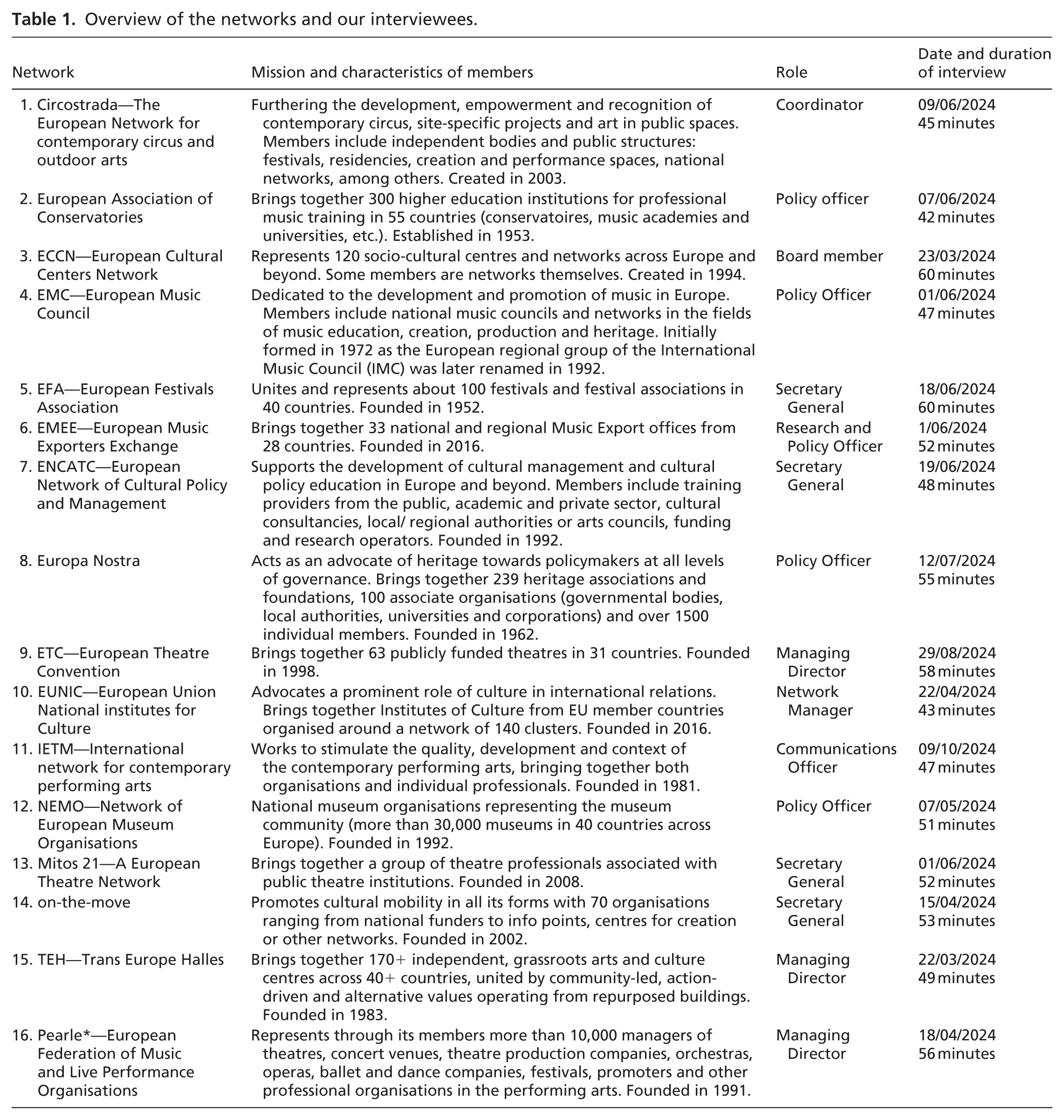
Table 1 provides an overview of the key objectives and membership profiles of each network, the role of the person interviewed and the interview’s date and duration. We should note here that from the networks interviewed, only two do not receive Creative Europe funding from the networks strand: Mitos21 and PEARLE*. As they explained, they have sufficient resources from their membership base and prefer not to compete with other networks on this structural European funding.
Overview of the networks and our interviewees.
Findings
Over the past few years, the green transition has become an integral part of the interviewed networks’ work. They have engaged in various efforts, including member consultations (AEC—European Association of Conservatoires, 2024), the compilations of best practice, 3 conducting research (Baltà Portolés and Van de Gejuchte, 2023), producing guidelines (European Theatre Convention (ETC), 2024), ‘translating’ policy developments (Lalvani, 2023) or establishing dedicated green working groups or committees. Interviewees underlined that these efforts grew after Covid-19, which revealed a pressing need for more caring and equitable practices within the sector and have intensified with the European Green Deal and Creative Europe funding requirements. Nevertheless, depending on how cultural networks position themselves within the green transition imperative, we have distinguished three different intermediation modalities, namely, (1) proactive intermediation, (2) reactive intermediation and (3) passive intermediation. These modalities capture how networks mediate between EU policy imperatives and funding frameworks related to the green transition and sectoral practices on the ground, while also foregrounding different parameters influencing the intensity of their standing point, ranging from controversies in the green transition discourses to the limits associated with their organisational actorhood.
Proactive intermediation
Some of the networks interviewed emerged as pioneers in relation to the green transition as early as the 2010s. Several interviewees attributed this interest to their UK members, influenced by Arts Council England’s 2012 requirement for funded organisations to report environmental impacts and implement carbon-reduction action plans (also mentioned by Taxopoulou, 2023: 14). Interviewees noted that sustainability discussions intensified before the 2015 Paris climate change agreement, when many cultural organisations joined broader discussions on culture and the Sustainable Development Goals (Kangas et al., 2017). Networks proactive in these early efforts advocated for a ‘cultural’ response to climate change, preceding the Green Deal and its mainstreaming into cultural policy. For these networks, the inclusion of ‘green’ criteria in Creative Europe’s funding was seen as an opportunity to deepen their engagement and strategically position their approach. Furthermore, they acknowledged that discussions on the green transition emerged organically among their members, who had time to engage carefully in dialogue curated by the networks. Throughout the years, they have also developed specific expertise on the topic or developed self-certification processes and dedicated training for their members.
Over the years, proactive networks have enhanced their capacity to articulate critical viewpoints on the challenges posed by the green transition on the sector. This includes adopting a lens of climate justice (Baltà Portolés and Van de Gejuchte, 2023). Their early engagement has further enhanced their legitimacy and advocacy role in related discussions with arts and mobility funders and policy makers and cultural organisations across Europe, as explained by one interviewee: There is a strong role that networks now play towards policymaking at a European level, and I would say, even more importantly, at the national and local level in nuancing this discourse and forms of action related to environmental sustainability.
Furthermore, a form of proactive intermediation can be observed in the joint initiative by several networks to develop a shared eco-certification tailored specifically for them through the ERASMUS+funded SHIFT
4
project. Interviewees framed this initiative both as a protective and strategic move, strengthening internal capacities through knowledge exchange and skills development, while also enabling them to anticipate and shape future funding requirements on their own terms. Another policy officer interviewed noted, It really came from us, but we also felt we wanted to be one step ahead. We could sense that the development from funders is going into this direction. We rather wanted to set an example and maybe already establish a standard that we have more control of and power over – that it works in a way that makes sense for us.
SHIFT has attracted significant attention, with networks proudly communicating their certification as a key achievement, and an increasing number of networks joining the initiative. Furthermore, proactive networks are often acknowledged through European Commission actions.
Reactive intermediation
For some, particularly more recently established networks, the green transition only became a significant focus after the introduction of green criteria in Creative Europe calls. Interviewees noted they are still adapting their own operational approach to the green transition while facing increasing pressure to address environmental concerns, both from the policy level and from their members that ask for guidance on how to address this issue in their own context. Some networks found the new Creative Europe funding requirements challenging, as they imposed the development of new workstreams for which they were not prepared. One interviewee noted that their 2021 application did not substantially address environmental issues, yet it did not impact their funding. However, for the 2023 application, they changed their focus: We want to follow the guidelines and align with the principles of the European Bauhaus
5
focusing on aesthetics, green practices and inclusive communities. The green is not yet so embedded in our work . . . We are asked to do more on this level and to support the whole green transformation of the sector.
Interviewees within the reactive intermediation spectrum emphasised that developing a green transition work strand was essential to remain competitive for EU funding. Although drafting funding applications typically falls to staff and leadership, interviewees stressed the need to actively involve their members to ensure relevance and ownership. This creates a key challenge for network managers: translating policy ideas into practices that members genuinely engage with. In an interviewee’s own words: As head of the network, it is important not to disconnect from our members. So, for me, I always try to bring innovation, but I must do it in a way that is bottom up and not top down. Otherwise, it does not work.
Unlike proactive networks, reactive ones have focused less on shaping policy agendas and more on adjusting their strategies to comply with new regulations and cultivating a green transition ethos among their members. Interviewees emphasised a strong commitment, framing their involvement as an enactment of their social responsibility to stimulate and sustain debate within the CCS around the climate emergency, and yet underlined their own environmental illiteracy (Rodrigues, 2024). As an interviewee from a network that recently introduced the green transition in its work mentioned: We’re all resource constrained. I think that’s the problem. We are doing many things not very well ourselves, because we don’t have the money to buy in to the actual expertise.
We could argue that in the case or reactive networks, the green transition has been treated mostly as a taken-for-granted good, a social role to be managed and complied with, rather than fully owned or redefined, while putting extra pressure on networks to develop expertise in a field that goes beyond their initial scope.
Passive intermediation
A small subset of interviewees took on a relatively passive position regarding their intermediation role. This position does not imply they disregard the policy framework or the urgency of the green transition, but rather that their own perspectives may differ from EU policy expectations. Nevertheless, rather than openly contesting the policy framing of the green transition, they opt to do the minimum necessary not to impact their chances for funding, while avoiding a more vocal engagement with climate change agendas.
This stance stems from scepticism about the CCS’ responsibility in the green transition. Interviewees mainly questioned whether cultural networks should be tasked with setting standards or offering guidelines for climate adaptation and mitigation. They highlighted the limited discussion on the CCS’ actual impact on the climate crisis, particularly given the sector’s modest environmental footprint compared to other industries. Some expressed doubts about the effectiveness of guidelines or toolkits, due to the dynamic and rapidly evolving nature of climate change science. One interviewee explained, If the EU requires us to sign SHIFT, I’ll sign it to secure funding for the important work I am convinced we are doing [as networks]. But if I am not obliged by policymakers to do certain things, I will not self-censor or limit the network – or the sector – over something that evolves so rapidly in scientific terms.
The same interviewee further underlined that an emphasis on best practices could unintentionally produce hierarchies within the network, placing the spotlight on certain members in comparison with others and creating a two-speed reality of ‘forerunners or followers’. This perspective aligns with critiques raised by Taxopoulou (2023) and Rodrigues (2024), who highlight the limitations of self-regulation within the sector and advocate for more systemic changes to address climate change effectively. Importantly, this mode of passive intermediation and ‘minimal compliance’ rather than mere resistance to change gestures towards a more fundamental ambivalence about the notion of ‘green transition’ itself and a degree of distance from a policy discourse that increasingly treats it as a consensual horizon. One interviewee underlined that whenever they have the opportunity, they try to explain their reservation to policymakers and officials. Overall, this passive stance has been further explained by interviewees as a way to protect their members from overcommitting to what they perceive as underdefined and politically loaded expectations.
Parameters influencing the intermediation role of networks
The three intermediation modalities further reveal a set of parameters that shape how cultural networks understand and enact their expected social role in the green transition. The first is their position regarding specifically the ‘emotional appeal’ of the European Green Deal (Lynggaard, 2016) and the call for a collective commitment to advance green practices in the CCS. Several interviewees noted that they had never observed such broad enthusiasm and active engagement from the sector on any other topic, making the proactive role of some networks largely uncontested. Those taking a reactive approach emphasise both the moral obligation to prepare members for policy and funding demands, and the need to quickly develop expertise on issues that, as one interviewee noted, ‘affect us all’. In contrast, networks that take a more passive intermediation stance do so precisely because of scepticism towards the conceptual clarity and political neutrality of the green transition, which leads them to prefer not to actively promote a direction they perceive as overly prescriptive and disconnected from the lived realities of their members. The same contested nature of the green transition pushes networks at the proactive end of the intermediation spectrum to be more vocal on issues such as the need to avoid engaging instrumentally with the green transition and instead adopting a justice-oriented approach, including a more nuanced understanding of cultural mobility restrictions for climate-related criteria.
The second parameter is their organisational capacity and dependence from EU funding. Interviewees were critical of the policy expectations to the ‘greening’ of the sector, particularly given their small teams and their ‘environmental illiteracy’ (Rodrigues, 2024). Others highlighted the shifting landscape of policy priorities, the emergency of other policy agendas, such as well-being and equality, and further expectations on networks to provide multiple services simultaneously: collecting data on current practices, brokering knowledge among members, consulting the European Commission on sectoral needs and giving guidance to members on the green transition – all often without additional resources to develop the required expertise or bear the additional costs associated with ‘being green’. As one interviewee explained, They [European Commission] don’t tell you what to do, but you need to show in your application that you focus on green activities. Yet, they do not give you more money to implement these policies. And this is the challenge: there is no correlation between the additional cost that sustainability brings to networks, or anyone trying to be green . . . It’s much more expensive being sustainable than not being sustainable.
Despite these peer-pressures, some networks maintain strong commitments to climate change independent of funding attachments. At the same time, all networks emphasised that knowledge production, awareness-raising and capacity building around the green transition remain largely contingent on European financial support, given the scarcity of national and local funding. As one interviewee remarked, ‘You need some support to engage in that kind of transitional thinking’. A few interviewees further warned of the potential instrumentalisation of Creative Europe, originally intended to foster European cultural cooperation, and explained that attaching additional political agendas, such as climate action, risks overburdening networks. One interviewee noted, The European Commission guides organisations toward a specific path by saying, ‘This is the direction we’re indicating, here’s the policy, here’s the vision’. Then, they ring-fence money towards that direction. Basically, they’re instructing them: if they want to receive funding and continue to exist, they must follow this direction. And if they don’t have independent funding, they have little choice but to adapt.
At the same time, interviews highlight that this funding dependency creates a peer pressure among networks, which we would identify as a third parameter. While they frequently collaborate (see, for example, the SHIFT initiative) and share advocacy spaces, networks are also embedded in competitive relationships to access EU funding, symbolic visibility and policy influence. This ‘competition’ among networks generates a form of peer pressure, often resulting in an effort to align with policy discourses while simultaneously constraining the extent to which some networks are willing to publicly articulate dissenting or critical positions.
A fourth parameter is related to the preparedness of networks’ members. Network management teams operating from the headquarters need to translate EU policy imperatives around the green transition into actionable guidance for their members, while responding to diverse capacities, contexts and expectations and thus tailoring their interventions to the organisational size, geographic location, and their members’ level of expertise. An interviewee explained, We need to provide them with something that is reachable. Not this big master plan of a million things to do, but small steps that are achievable so that they don’t lose their motivation. It cannot be something that comes top down from Brussels. It must be scalable and responsive to whatever they need in the different contexts they are.
In this case, the intermediation modality depends on the network’s ability to adapt EU policy goals to local realities, maintaining relevance and credibility among members, navigating peer dynamics among their members to avoid comparisons and encouraging knowledge sharing while avoiding homogenised solutions that may not fit every member.
Finally, as our research has concentrated on interviews with the networks’ representatives, we see that these individuals exercise significant discretion in interpreting and operationalising EU policy frameworks and addressing the practical realities of network members. This individual agency, which we identify as a fifth parameter, determines how messages are framed, and the extent that members are encouraged towards a ‘green transition’ practice. Their own positioning can either enable proactive intermediation – by clarifying policy priorities, offering guidance, and fostering critical reflection – or, in cases of uncertainty or scepticism, reinforce passive intermediation to protect members from overcommitting to unrealistic expectations. As one interviewee explained, I understand that the conversations in which I am involved are not the same as those of our members . . .. That is the number one challenge: I am the translator of the European priorities expressed through the Creative Europe call, and the interpreter of the members’ needs . . . Typically, if they don’t understand, it’s either because I didn’t explain it well or because I went too fast.
The agency of key individuals at the management level (fifth parameter) is key, as they take a gatekeeping role by being the ones that are closer to European policy discourses. Recognising this human dimension highlights further the negotiated and context-sensitive nature of cultural intermediation in the sector’s green transition. At the same time, their agency interacts with both the emotional appeal of the green transition (first parameter), the network’s organisational capacity, including funding dependencies (second parameter), peer pressure among networks (third parameter) and the good understanding of the members’ capacities and limitations (fourth parameter), ultimately shaping whether networks adopt proactive, reactive or passive stances.
Cultural intermediation in the green transition: the balancing act of a social (and political) role?
As collective actors with significant agenda-setting and dissemination capacities, we have seen that European cultural networks occupy a strategic intermediary position between EU green transition imperatives and the everyday practices of the CCS. In this ‘active process of transformation and translation’ (Virani, 2019: 5), they shape how the green transition is understood and discussed within the sector, thereby influencing the pace and direction of change towards greener practices. In doing so, they extend the economic role traditionally attributed to cultural intermediaries to constructing categories of social engagement, policy relevance and cultural legitimacy (Smith Maguire and Matthews, 2012). However, as this role unfolds within a policy environment shaped by the European Green Deal and is associated with EU funding schemes, cultural networks find themselves being required to perform a balancing act: they are mediating top-down environmental policy objectives while simultaneously negotiating their meaning and applicability on the ground, while considering their organisational capacities and the positionalities of those managing the networks. From this perspective, the three intermediation modalities identified should not be understood merely as varying layers of enthusiasm in relaying policy priorities, but also as political stances vis-à-vis a highly contested agenda and the – often uncomfortable – social roles increasingly assigned to cultural intermediaries.
While scholars have called for closer attention to the morally and socially grounded roles of cultural intermediaries who operate between diverse cultural, creative and social worlds (Perry et al., 2015), in our research, we see that this ‘social’ dimension cannot be assumed as taken-for-granted. Rather, the social and the political are inseparable, and intermediary roles are best understood as involving a continuous balancing act shaped by ongoing negotiation. This negotiation aspect has been emphasised in studies on intermediaries and the equality and diversity social agenda, showing how economic, cultural and social logics are deeply entangled and require constant recalibration (Campbell et al., 2022) or how cultural intermediation within policymaking and social agendas unfolds as a negotiated process structured by knowledge, capacity, creative outputs and relational dynamics (Noonan and Brock, 2022). Research engaging explicitly with the political aspects of cultural intermediation has further demonstrated how intermediaries navigate tensions between market-oriented practices and political or civic objectives, shaping meanings, forms of participation and collective agency in the process (Cronin and Edwards, 2022).
Building on this literature, our study demonstrates that the social role of intermediaries does not emerge naturally but is instead shaped by a constellation of structural and relational parameters. We show that, at least in the EU context – where the intermediaries under study are largely dependent on EU funding – the social and the political dimensions of intermediation cannot be dissociated. Furthermore, as this social role is rendered largely political and in this case to a large extent instrumentally constituted, it remains fragile, with its durability uncertain should institutional priorities or funding agendas shift, or if this expanded intermediary role is not accompanied by adequate capacity building, relevant financial resources and enough backing and legitimacy from the networks’ member organisations.
Conclusion
Drawing on the notion of cultural intermediaries as a heuristic, in this article, we built on scholarship that has reclaimed the term to make visible the socially embedded nature of intermediary work, focusing on climate change as a key new arena in which this social role unfolds – albeit unevenly across the networks under study. We have framed European cultural networks as intermediaries between EU policy priorities and their members across Europe and beyond, highlighting the potential of their contribution to the circulation of a green transition ethos and greener practices in the CCS. Their structural dependence on EU funding and their transnational character but also the contested climate change agenda makes them a compelling case for examining how intermediation roles in the CCSs on social issues emerge and are negotiated. By identifying diverse intensities of intermediation modalities in the case of climate change, this study foregrounds the cultural politics of intermediation: the negotiated processes through which social and value-based roles of intermediaries are configured across organisational, sectoral and policy scales. We have shown that, rather than emerging organically, intermediation roles associated with the green transition – and, by extension, other social agendas – often develop in response to policy priorities and funding requirements, prompting intermediaries to assume roles that are not always aligned with their original missions or organisational capacities.
This article contributes to debates on the social role of cultural intermediaries (Campbell et al., 2022; Noonan and Brock, 2022) by conceptualising this social dimension not as a natural and neutral function, but as a relational, interpretative and politically situated practice, shaped by policy imperatives, sectoral needs, gatekeepers’ individual agency, and peer pressure. Top-down policy can accelerate the uptake of social agendas, foster capacity building and optimisation of resources, but also risks instrumentalisation and intensifying competition among intermediaries, especially when policy ideas are coupled with funding. When policies fail to acknowledge the complex, negotiated nature of intermediation, they risk reducing networks to mere delivery mechanisms for social agendas. At the same time, bottom-up dynamics require processes of recognition and validation of this expanded role to enable intermediaries to act responsibly with sufficient autonomy to represent their members’ voices and respond to their needs.
The three modalities of intermediation identified in this study should not be understood as fixed or mutually exclusive positions. Rather, they reflect a contingent pendulum between an effort to align with policy priorities, funding dependencies and sectoral mandate. We should, however, acknowledge that a key limitation of our study is that it offers limited insight into how networks’ member organisations and cultural practitioners themselves interpret, contest or engage with the concept of the ‘green transition’ and how their views and experiences may shape – or resist – the forms of intermediation identified. Furthermore, while we have identified some parameters that shape this balancing act for cultural intermediaries that are meta-organisations in relation to the green transition, it would be interesting to investigate whether the same parameters apply to other social and political agendas to which intermediaries are increasingly expected to contribute. Finally, precisely because these balancing act alignments are provisional, the positioning of different intermediaries may change over time. For this reason, future research adopting a longitudinal perspective would be well suited to examine whether these intermediation practices of cultural meta-organisations, acting as intermediaries in the green transition, consolidate into more durable forms of social engagement or recede as policy priorities move elsewhere, and to assess the extent to which these efforts translate into tangible changes among cultural practitioners on the ground.
Footnotes

Funding
The authors received no financial support for the research, authorship, and/or publication of this article.
Declaration of conflicting interests
The authors declared no potential conflicts of interest with respect to the research, authorship, and/or publication of this article.
Data availability statement
Data sharing is not applicable to this article as no datasets were generated or analysed during the current study.