



Abstract
Examining how different forms of climate protest affect social media debates is critical to understanding their role within societal climate policy discourse. This study compares debates surrounding disruptive and non-disruptive movements on Twitter/X, asking to what extent they lead to ideologically and affectively polarized networks. We analyzed debates around two prominent German climate movements—Fridays for Future and Last Generation—using automated content and network analyses (N = ~5,000,000) and manual content analyses (N = 2,830) of data compiled during 2022 and 2023. In doing so, we identified the types of events, (extreme) frames, users, and interactions that shape the structure of the online debates. The results reveal polarized networks in both debates, with the climate protesters’ antagonists driving discursive polarization. The Last Generation debate, however, has a significantly higher number of antagonistic users, more extreme frames, more toxic cross-group interactions, and less diverse network clusters. Last Generation generated higher individual user engagement, suggesting that debates about disruptive protests are effective at attracting attention, albeit at the cost of distracting from climate policy and expanding antagonistic networks. This debate was more polarized than that around Fridays for Future, dividing users into opposing camps, with fewer political and journalistic actors being on the protesters’ side. Thus, the disruptive protests unleashed two types of connective action: a supportive network that defended the protesters and their goals more extensively than during non-disruptive protests, and an antagonistic backlash network driven by what we term “connective counteraction.”
Introduction
Globally, the climate emergency is intensifying by the day, with increasingly frequent and extreme natural disasters underscoring the need for broad and deep emission reductions. Governments have not adequately prioritized climate change mitigation, adaptation, and other responses that have been called for by the IPCC and others (IPCC, 2023). With the issue of inaction on climate change having “one of the highest mobilization capacities across Europe” (Buzogány & Scherhaufer, 2022, p. 2), it is no surprise that climate protest movements have grown massively in recent years, employing a variety of strategies to achieve their goals.
Protesters, as extra-parliamentary political actors with significantly limited or no access to governments and policymakers, rely heavily on media visibility to influence political processes and actions (Uldam, 2019). “Social media activism” (González-Bailón, 2015) allows protest actors to bypass media gatekeepers, initiate “connective action” (Bennett & Segerberg, 2012), and become visible through various forms of protest that can be located on a spectrum between “reformist” and “anti-systemic” tactics (Uldam, 2019). Reformist movements, such as Fridays for Future (FFF), utilize actions within the existing structures of governance. As a result of their alignment with established power structures, they are typically more effective in generating positive social media visibility and broader journalistic coverage. By employing conventional activist tactics (such as organizing registered mass demonstrations or indirectly lobbying at the annual United Nations Climate Change Conferences), the reformist approach of FFF positions it as an established, accepted, and deeply embedded movement within civil society and political parties (Haunss & Sommer, 2020). Despite their political impact, some within the broader climate justice movement argue that such reformist approaches are ineffective in achieving visibility to oppose existing power structures. In response, other movements employ “anti-systemic” action, as exemplified by Extinction Rebellion in the United Kingdom and Letzte Generation (“Last Generation,” LG) in Germany. The objective of these groups is to fundamentally challenge existing political structures through the use of “anti-normative” and “disruptive” (Shuman et al., 2021) forms of civil disobedience (e.g., blocking streets or occupying buildings)—actions deliberately designed to achieve “social media visibility” (Uldam, 2019). Such disruptive, anti-systemic protests frequently achieve high visibility on social media platforms due to their supposedly radical, confrontational, and visually striking nature. However, they are often framed negatively by mainstream media outlets, which can result in increased repression and control by authorities (Uldam, 2019). Thus, it is central to ask which types of visibility are ignited by the different types of protest actions.
Climate change and climate protest-related online debates often result in backlashes and “discursive polarization” (Brüggemann & Meyer, 2023) that may extend to a broader societal perception of climate action: Considering the current climate emergency, paired with the inaction of governments, one might reasonably expect that all these protest endeavors—and, consequently, the crucial climate policy measures for which they advocate— would garner increasing support from civil society. However, polls in Germany contradict this assumption (More in Common, 2023). Notably, the decline in popular support not only concerns disruptive climate protests but extends to all forms of these protests. Media representations of climate movements, e.g., on social media, are central to these societal perceptions (Goldenbaum & Thompson, 2020). Although Twitter/X represents only a limited portion of the media landscape and population, it plays a significant role in contemporary journalistic and political discourse, particularly on issues such as climate change (Gilardi et al., 2022). The specific composition of highly relevant and influential users on the platform, along with cross-media dissemination and coverage of its content, make analyzing debates on Twitter/X significant for understanding how different types of climate movements are perceived and negotiated publicly.
Assuming that different types of protests generate different types of social media visibility that directly affect their societal evaluation, this study aims to explore the social media communication surrounding two movements in Germany that differ markedly in their degree of disruptiveness: FFF and Letzte Generation (LG), which has been known as Neue Generation (“New Generation”) since February 2025. These two civil society actors utilize markedly different strategies concerning how they organize, execute, and communicate their protests. While LG is perceived as disruptive, potentially radical, and enjoys less approval from the German population (Göllert, 2023), FFF is viewed as an established and accepted movement (Haunss & Sommer, 2020).
Thus, through a combination of automated and manual content analyses, along with automated network analyses of posts collected in 2022 and 2023, we identified the issues, actors, and networks that shape the debates around climate protests on Twitter/X, aiming to answer the following overarching research questions:
The results demonstrate that while both debate networks are polarized and align along two distinct ideological clusters comprising protest supporters or antagonists, LG generates a considerably larger action network than FFF. Nevertheless, our findings indicate that the considerable levels of “connective action” (Bennett & Segerberg, 2012) initiated by LG give rise to a reaction that we define as “connective counteraction.” While the FFF-related debate is dominated by supporters, the LG debate’s structure is almost evenly divided between both camps. Approximately half of the online network consists of climate protest antagonists who more frequently engage in attacks against LG and its supporters, often using extreme frames and engaging in toxic interactions. This results in a higher degree of “discursive polarization” (Brüggemann & Meyer, 2023).
State of research
Climate activism, digital media platforms, and connective action
In the age of “social media activism,” digital technologies provide protesters with better tools to organize their actions and reduce organizational costs (González-Bailón, 2015), while simultaneously allowing activists to be (self-)represented and challenge “traditionally dominant voices” (Chen et al., 2023). Activist material, from hashtags to images and eyewitness reports, can be easily transmitted, empowering activists to narrate their own stories, articulate their demands, and disseminate information to supporters (Poell & van Dijck, 2015). FFF and LG exemplify this form of activism through organizing global strikes and demonstrations, demanding climate policy changes online, and successfully drawing attention to the climate emergency and related issues (Chen et al., 2023)—while being aware of platform logics (Sorce, 2023).
Platformed protest communication may take the form of self-organizing networks. For instance, protest debates on platforms such as Twitter/X become hybrid: they function both as spaces of public negotiation and as decentralized communicative spheres of “connective action” (Bennett & Segerberg, 2012). Such network structures are not only tools for sharing and organizing, but become “organizational agents” (Segerberg & Bennett, 2011, p. 212) that are continuously formed through the individual sharing of user content. Such action networks—being “flexible organizations in themselves”—can, as in the case of Twitter/X through commenting and retweeting, “scale up rapidly through the combination of easily spreadable personal action frames and digital technology enabling such communication” (Bennett & Segerberg, 2012, p. 753). Such frames are then not necessarily and explicitly associated with one particular movement. Instead, such messages might resonate with individual concerns of a broader audience concerning the climate crisis, and can as such be personalized and distributed through various social media channels to encourage broader participation and visibility.
Moreover, representation on digital media platforms comes with additional trade-offs for activist groups: Uldam and Askanius (2022), among others, showed that political actors and legacy media often failed to reflect or amplify more critical climate action frames of civil society actors in European Twitter debates. Also, while the interlinkage between visibility and surveillance on digital media platforms enables users to monitor political and economic actors’ public statements, calling them out on misconduct when needed, it simultaneously leaves activist groups vulnerable to (corporate) efforts to criticize them (Uldam, 2018). Consequently, platformed protest debates do not seem to take the shape of a unified public sphere, but rather become a fragmented arena.
Measuring the discursive polarization of climate protest debates
On online platforms, ideologically homogeneous communities are produced through networked processes of “gatekeeping” (Gallagher et al., 2021; Segerberg & Bennett, 2011). The dismissal of ideologically-oppositional content and simultaneous amplification of ideologically aligned content within these networks can then lead to ideological polarization online (Barberá et al., 2015). Research showed that this polarized alignment can also be found in Twitter/X debates on climate change, with networks exclusively sharing either calls for action or narratives of delay and climate change denial content (Meyer et al., 2023). However, while online platforms do foster the formation of homophilic networks, they rarely create isolated spaces where users are entirely cut off from ideologically opposing perspectives. It may even be the partial permeability of such networks that fuels online polarization: Climate change deniers and antagonists of climate protesters attempt to interact disproportionately with online mainstream debates that emphasize the reality and urgency of climate change, intending to co-opt these discussions (Kaiser & Puschmann, 2017; Meyer et al., 2023). Such cross-group interactions are often observed to be highly uncivil or toxic, fostering the affective polarization of online climate change debates (Van Eck et al., 2020).
Thus, oppositional networks fight for interpretive sovereignty within a disrupted online sphere. Brüggemann and Meyer (2023) introduce a multi-dimensional framework to measure such disruptions in platformed debates. They define “Discursive Polarization” as the interplay of ideological and affective polarization, emerging not only from media content itself, but also from the networked interaction of the users who disseminate it.
From a content perspective, discursive polarization begins with, and then extends beyond, the examination of (a) polarized framing of issues as an indicator for ideological polarization. Drawing on Entman’s (1993) understanding of different frame elements, discursive polarization is defined by ideologically aligned frames as “interpretative packages” that indicate polarized epistemic perceptions. “If, within a debate, these elements diverge starkly between different groups, we would find polarized frames” (Brüggemann & Meyer, 2023, p. 136). Entman emphasizes the dynamic nature of framing, wherein various aspects of an issue are selectively highlighted and given prominence to strategically select and communicate distinct dimensions of the subject matter (definition of problems, diagnosis of causes, moral evaluation, treatment recommendation). This perspective can help understand how different groups perceive the same issue in different ways and construct potentially divergent, polarized frames (Brüggemann & Meyer, 2023). Supporters of climate activists may frame protests in terms of the urgent need to act and address climate change, while their opponents may frame it in terms of the disruptions and dangers caused by the protest actions. Such divergent framing can lead to fundamentally different evaluations of and recommended responses to the same events, resulting, for example, in either calls for climate protection or calls for action against protesters.
Interactional perspectives then come into play: (b) polarized issue- and group-related networks are formed through amplifying and sharing ideologically aligned content within distinct sub-networks. Users in discursively polarized networks would then amplify “extreme frames from one side of a conflict” (Brüggemann & Meyer, 2023, p. 137), while pushing out moderate and alternative viewpoints, a process further amplified by algorithmic logics. Such polarized, ideologically homogeneous networks often feature central figures or amplifiers, such as protesters, (partisan) media, politicians, and political organizations (Gallagher et al., 2021). By examining these central actors and their statements within amplification sub-networks, the level of discursive polarization between communities can be assessed.
In addition, as discussed earlier, scholars have convincingly argued that polarization dynamics on social media platforms stem not only from ideological disagreements about issues but also from dismissive interactions with dissenters. Brüggemann and Meyer (2023) therefore identify another property of discursively polarized online networks, asking whether “communicative exchanges across camps [are] hostile, dismissive interactions” (p. 138). Thus, discursively polarized networks are also characterized by (c) interactions with out-groups that are generally more hostile or toxic.
Methods
Operationalization
To uncover discursive polarization in debates concerning the German climate networks LG and FFF, we examined differences in the overall patterns of activity and debate structure from 1 January 2022 to 1 June 2023. We viewed (re-)tweets as an indicator of (amplified) debates on climate protests and conducted automated toxicity and network analyses (N = ∼5,000,000 posts) as well as a manual, quantitative content analysis of the 1415 most retweeted posts per movement (N = 2,830).
Initially, we conducted basic metric analyses to examine how posts about the two protest movements fluctuated over time and how they related to real-world events, to answer the first research question:
However, we illustrated that engagement metrics should not be the only signifier of the relevance of online debates (Gallagher et al., 2021) and may even be an indicator for highly contested or polarized discourses (Garimella et al., 2017), guiding us to the second research question:
Acknowledging the multi-dimensionality of discursive polarization emphasized by Brüggemann and Meyer (2023), we investigate the process along three dimensions, rooted in a combination of network and content analysis: The first relevant dimension asks whether the two distinct debates on either FFF or LG culminate in oppositional and extreme framings of events.
The inquiry should not be confined to mere content, but should also consider its exclusive amplification within distinct communities. We will therefore investigate the degree to which this content is associated with the formation of ideologically homogeneous sub-networks, composed of oppositional frames and antagonistic user types.
We also explore whether debates on FFF and LG yield differences in the toxicity of posts across ideological communities.
By combining manual and automated content analyses of extreme frames, user networks, and toxic interaction, we thus identify the overall structure of the two distinct debates and their degrees of discursive polarization.
The data sample and its processing/analysis
We gathered data via Twitter’s Academic Research API, utilizing two identifiers for each debate: The primary hashtag associated with the movement and the leading account disseminating information in Germany: “#fridaysforfuture,” “#letztegeneration,” “@FridayForFuture,” and “@AufstandLastGen.” We periodically collected German-only posts from 1 January 2022 to 1 June 2023 and then merged them with a comprehensive post-collection of the entire dataset to ensure that most deleted posts were included with the most recent engagement metrics. To address RQ1, we then utilized basic frequency and text analyses: The data were divided into tweets, replies, quotes, and mentions (which serve as indicators of attempts to directly interact with other users, potentially across groups), as well as uncommented retweets (which serve as indicators of amplification and support, cf. Barberá et al., 2015; Meyer et al., 2023). In addition, activity spikes were investigated in regard to which real-world events occurred during these times of high activity. This processed data was then also used to identify the most retweeted posts of each year for manual coding, the prevalence of frames over time (RQ2.1), and to generate interaction data for the network analysis (RQ2.2, RQ2.3).
Network analysis
We then conducted a network analysis of uncommented retweets to identify distinct communities (RQ2.2) that amplify each other and can be separated from others through their communication patterns. We utilized different algorithms within Gephi (Jacomy et al., 2014) for analysis and depiction: The ForceAtlas2 algorithm determines the position of user profiles (nodes) in a network based on their relationships (edges) with each other. This force-driven layout mimics physical systems to spatially organize interactions, uncovering amplification through proximity. Next, we computed community modularity per node based on the density of interactions with other users (Blondel et al., 2008). This approach attributes a specific community (as value) to each user based on their interaction patterns, which could then be paired with data from our manual and automated content evaluation to uncover connections between the frames that were amplified and the types of users that posted these frames. For a more comprehensive analysis, network visualizations were filtered using the k-core parameter to expose closely connected components. In addition, we cross-referenced the findings on retweet-based modularity classes with evaluations of @mention/reply practices across communities to measure the extent of (toxic) contact between different sub-networks (RQ2.3).
Multi-modal manual coding of frames and users
To address RQ2.1, we manually analyzed 2,830 posts related to FFF and LG. For each movement, we coded the 1000 most retweeted posts from 2022 and the 415 most retweeted posts from the first 5 months of 2023 to ensure proportional representation of content from both years in our data, while also capturing potential shifts in the debates that may have occurred in the first half of 2023. This was done to identify (extreme) frames (RQ2.1) and their potentially homogeneous distribution across ideological communities (RQ2.2).
As indicated in the theory section on discursive polarization, our analysis is based on Entman’s (1993) seminal work on framing and its distinct dimensions. Our approach did, however, use these elements as orientations and did not understand them “as an orthodoxy defining the ultimate and only list of possible frame elements” (Brüggemann & Meyer, 2023, p. 135). Also, we do not necessarily adhere to a combination of all these components within our evaluative framework. Instead of developing generic frames, we have identified what de Vreese (2005) refers to as “issue-specific frames.” These are not broadly applicable across societal domains but are selected parts and framing elements concerning stances and contexts surrounding climate protests.
Manual analysis at times allowed us to decipher highly contextual and often implicitly delivered messages regarding the climate movements. This enabled us to include multimodal framing through the analysis of linked pictures, memes, or videos containing vital information. In addition, our comprehension of framing required knowledge about discussions on climate change (protests) that extended beyond the automated analysis of textual data. The final codebook was established by four coders. Starting with an inductive approach, but considering the previously identified framing elements as a conceptual orientation, the coders used samples from both discourses to establish the coding framework. Through an iterative coding process, the team was then able to establish reliable frames and sub-frames (average Krippendorff’s alpha for FFF/LG: 0.85/0.87). Following the analysis and insights derived from the coding process, four researchers engaged in interpretations about the extremity of each sub-frame, considering problem dimensions of epistemic facts (e.g., science denialism), evaluations (e.g., labeling the protesters as terrorists or murderers, or seeing the world as doomed), or demands for supposed solutions (e.g., calls to violently stop protests or violently disrupt society). A moderate sub-frame was characterized by a rational and reasoned tone when expressing support or criticism of climate protests. To classify the user types, we first identified the 200 most prominent accounts per debate via retweet count. Two coders then proceeded to manually code each user, following the same inductive, reiterative approach as taken for coding the frames, establishing a final codebook based on the last twenty tweets and retweets of each user, who they follow, and their profile description (average Krippendorff’s alpha for FFF/LG: 0.95/0.96).
Toxicity-analysis
We employed a transformer-based, pre-trained model to automatically identify (highly) toxic content (german-cased-toxic-comments; ML6 Team, 2022). Trained on five German datasets labeled with concepts such as “abuse,” “hate speech,” and “offensiveness,” this BERT model classifies texts as either non-toxic or toxic. Examples of posts identified as toxic in our data include instances where protesters are called “filthy fascists,” “dumb fucks,” or “a disease to society.” Combining these results with those from the network analysis, we assessed the fluctuation in toxicity levels during interactions between protesters, their supporters, and their antagonists (RQ2.3). The validation of our model was achieved through a comprehensive multi-step coding procedure, comparing the toxicity classifications assigned to a random sample of 1000 posts by two human coders with those determined by the automated classifier (simple agreement: 0.86, Krippendorff’s alpha: 0.71).
Findings
Attention to protest (re-)actions
Our analysis showed that LG generated 10 times more posts than FFF. Overall, the Twitter/X debate around FFF is much more homogeneous in terms of activity spikes than the LG debate (see Figure 1). Throughout the 17 months, there are rather few peaks of traffic, and these are almost evenly distributed across each temporal third of the data. In addition, the distribution between original tweets and retweets is nearly balanced, with 209,090 retweets and 236,721 self-authored tweets, quotes, or replies. Activity was very low at the beginning of 2022 (though already equal to, if not above, FFF traffic) and then surged, remaining high from October 2022 through to June 2023.

Discourse activity comparison between the two datasets (top: FFF, bottom: LG).
The nature of engagement with FFF contrasted starkly with that of LG. Where posts about FFF consisted nearly equally of original tweets and their respective retweets, the discourse surrounding or directed at LG’s main user account consisted of twice as many original posts as retweets (1,782,527 retweets and 2,762,902 tweets). This suggests that significantly more users were engaging directly with more disruptive climate protesters: While communication costs are relatively low when retweeting a post, self-formulated posts imply more efforts to engage in dialogue that potentially goes beyond one’s own cluster.
Furthermore, the spikes observed in the debates around FFF and LG are closely linked to offline events, though they were generated by different types of events. In the case of FFF, these spikes predominantly align with their own protest actions, resulting in notable surges in March and September 2022 and in March 2023, which coincide with global climate strikes organized by FFF. In contrast, the LG debate was largely fueled by external reactions from institutional actors and events not necessarily related to the disruptive actions (see Figure 1). The activity graphs exhibit spikes at the end of 2022, which can be attributed to a tragic accident involving a cyclist’s death in Berlin. Certain media outlets attributed the cyclist’s death to the actions of LG activists blocking a nearby highway. In addition, at the end of May 2023, LG garnered attention following an order from the General Prosecutor’s Office in Munich, which suspected LG of being a criminal organization. This led to another raid on activists’ homes following the initial court-ordered raids in December 2022. In the interim period between the Berlin accident and the second wave of court-ordered raids, LG managed to maintain users’ online activity through various protest efforts.
Hence, attention spikes associated with FFF appear to be orchestrated, correlating with announced events and strikes, whereas LG did not consistently maintain control over the discursive escalations associated with them. Despite this, LG debates did not only generate more posts, but also showed increased cross-group interaction among online users. Nevertheless, as previous research and a cursory examination of the most prominent peak events indicate, it is essential to delve deeper into the debates’ frames and interactional structure to ascertain the nature of such interactions.
Polarized frames of (disruptive) climate protest
To answer RQ2, we will outline the central frames that each debate applies to protesters and their actions, as well as the debates’ network structures in relation to these (extreme) frames, user types, and (toxic) interactions across ideological sub-networks:
Types of (extreme) frames
The data analysis reveals a framework of 8 frames and 18 sub-frames characterized by an oppositional or antagonistic division, wherein each side actively engages with and challenges the points raised by the other side. As a result of this oppositional dynamic, frames were either supportive of or antagonistic toward activists’ actions and demands; for example, some framed climate change as a problematic issue that needs to be addressed, while others framed climate activists themselves as the problem that needs to be tackled (see Table 1).
Supportive (Left) and Antagonistic (Right) Frames Identified in the Debate, With Extreme Frames Indicated in Italics.

In line with the main goals of both climate movements, supporters frame the debate through calls for climate action. The moderate sub-frame climate change reality/urgency stresses the scientific reality and impact of the climate crisis, while the more extreme sub-frame doomsday scenarios expresses supposedly inevitable dystopian disasters such as the “extinction of mankind” or “ecocide.” In addition, supporters disseminate calls for policy action to tackle climate change, often directly addressing and criticizing politicians or fossil fuel companies for their (in)actions. Whereas supporters highlight climate change as the central threat, antagonists actively reject calls for policy action—oftentimes through narratives of climate delay such as whataboutism, or technological solutionism—denying the urgency to act. Moreover, antagonists fundamentally call the protest efforts into question through the denial of climate change reality, or through a more moderate frame, rejection of doomsday scenarios, that highlights the (in their view) counterproductive notion that the world is ending.
To highlight the need for climate action, supporters call for activism, urging people to support or join the movements. The more extreme sub-frame, calls for disruptive activism, entails a call to participate in disruptive protest action, targeting critical infrastructure (e.g., blocking streets or airports). Such calls for (disruptive) activism are countered by calls for legal action against activists, urging politicians to strengthen legal measures against protests, or even to ban them altogether. Some of the antagonists even call for violent action against activists, while glorifying videos and reports of them being physically attacked during protest actions.
Offline events such as unjustified legal measures and violence against activists are discursively countered by supporters who call attention to these injustices and emphasize that activist actions are democratic, for example by stating that “peaceful protest is a fundamental right.” Such arguments are delegitimized by the antagonistic discourse through framing protests as too disruptive/dangerous (e.g., preventing ambulances from passing through and thus unwittingly tolerating the possibility of people dying). In a more extreme form of delegitimizing discourse, antagonists claim that activists are criminals or even extremists/murderers by, for example, stating that the German domestic intelligence agency (the Bundesamt für Verfassungsschutz) must act against “weekly crimes and harassment of citizens,” or by using hashtags such as #climateterrorists. Further defamatory out-group constructions involve framing activists in other strongly negative, collectivizing ways (e.g., as privileged, spoiled children or as members of a corrupt or sectarian movement attempting to impose its ideology), such as calling them “a bunch of kids whose parents pay their bills” or “spoiled brats” with “no real problems.” Defamatory out-group constructions from the supporters entail framing the anti-protesters as “climate destroyers” or “SUV drivers.”
Supporters and antagonists alike criticize the anti- or pro-activist debate from an overall perspective. The supporters expressed this through highlighting negative stereotypes prevailing in the public discourse, as well as criticizing reporting that was perceived as rushed or biased. Notably, certain tweets, particularly targeting the German newspaper “Die Bild,” address concerns about inciting hate, potentially leading to violence against activists. Antagonists argue that the movements should not receive so much (appreciative) visibility in public discourse (e.g., frequent invitations of climate activists to talk show formats).
Distribution of (extreme) frames
Our analysis revealed substantial variations in the use of frames between the Twitter/X debates surrounding LG and FFF. These variations encompass not only the quantitative aspect, i.e., the frequency of positive or negative frames employed, but also the extremity (see Figure 2).
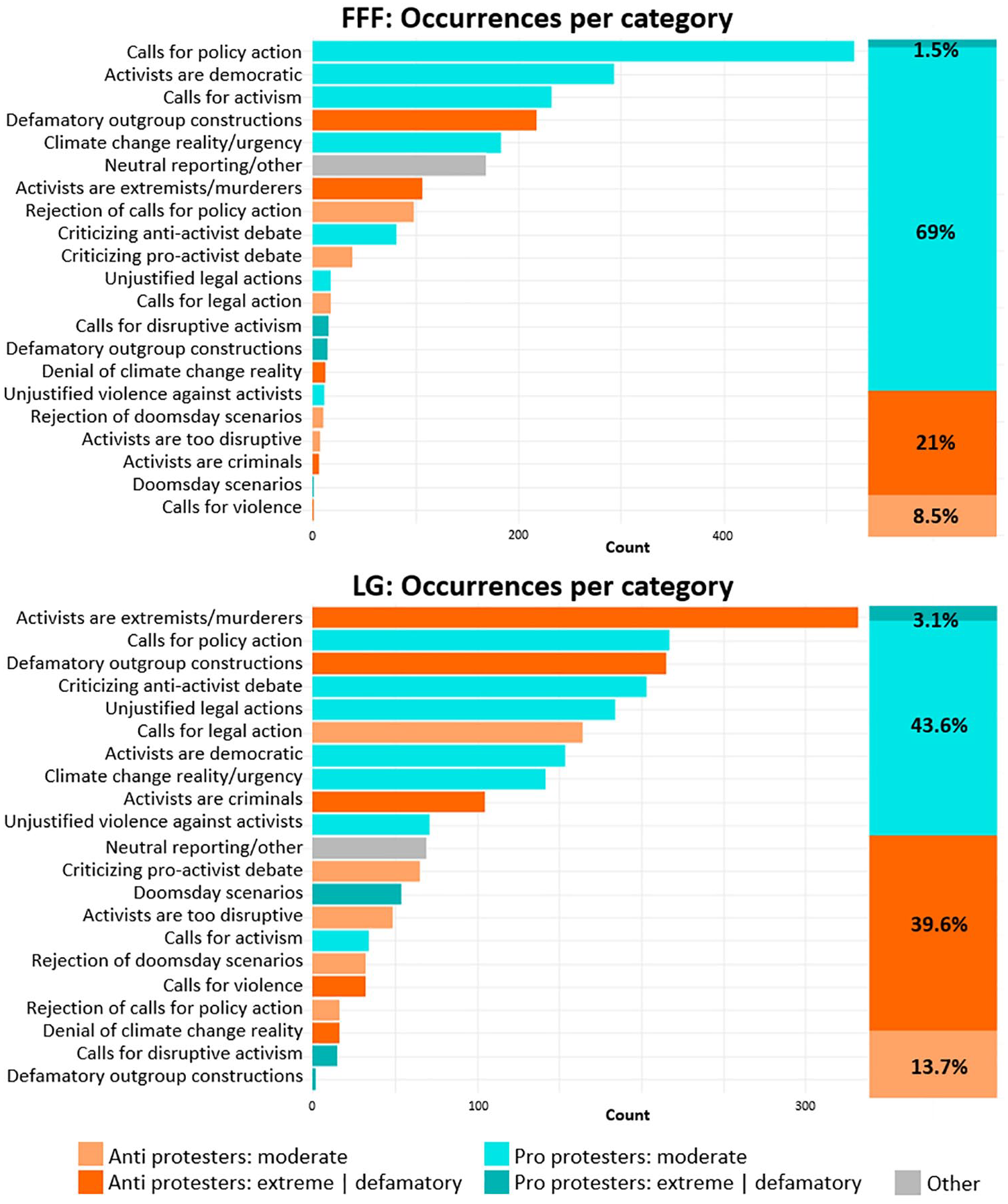
Distribution of frames in the two datasets’ most amplified posts (N = 2,830). Multiple coding was possible.
Seventy-two percent of the FFF discourse is characterized by supportive frames, while the majority of the LG discourse (53%) features antagonistic (extreme) frames, often labeling protesters as terrorists or criminals. Thus, the discourse surrounding FFF encompasses more supportive frames than that surrounding LG.
In the debate surrounding FFF, several frames emerge among its supporters, including calls for policy action, highlighting the democratic nature of protest, and stressing climate change urgency, with a comparatively lesser emphasis placed on doomsday scenarios. Interestingly, in comparison to the LG discourse, FFF supporters tend to use fewer framings that criticize legal measures taken against activists or even violence inflicted upon them. The FFF discourse showed no calls for violence against climate activists, whereas the LG discourse entailed tweets that either glorified or incited vigilante justice against them. Overall, the usage of extreme antagonistic frames in the FFF context appears to be less frequent compared to that of LG. Nevertheless, asymmetrically extreme frames still hold a considerable presence in their antagonistic discourse.
In the discourse surrounding LG, the lack of a common ground becomes even more apparent, with an almost equal distribution of supportive and antagonistic frames. However, the degree of discursive polarization is—again—predominantly asymmetric on the dimension of extremity: Extreme frames are primarily disseminated by protest antagonists, while supporters tend to adopt more moderate positions, contending, for instance, that climate activism constitutes an integral aspect of democratic negotiation processes. Conversely, the antagonistic network frames LG activists as criminals, terrorists, or murderers, portraying their actions as illegitimate. The illustrated polarization of frames may be best described as a pro- and an anti-protest call for action, one calling for reformist or anti-systemic activism and for the implementation of climate change policies, the other for legal or even violent action against the protesters. Thus, two very different forms of connective (counter-)action become visible (see Discussion and conclusions section).
Given the substantial influence of online and offline events on engagement with and evaluation of protest movements, our analysis also explores temporal patterns (see Figure 3). Two noteworthy observations emerge from this analysis.
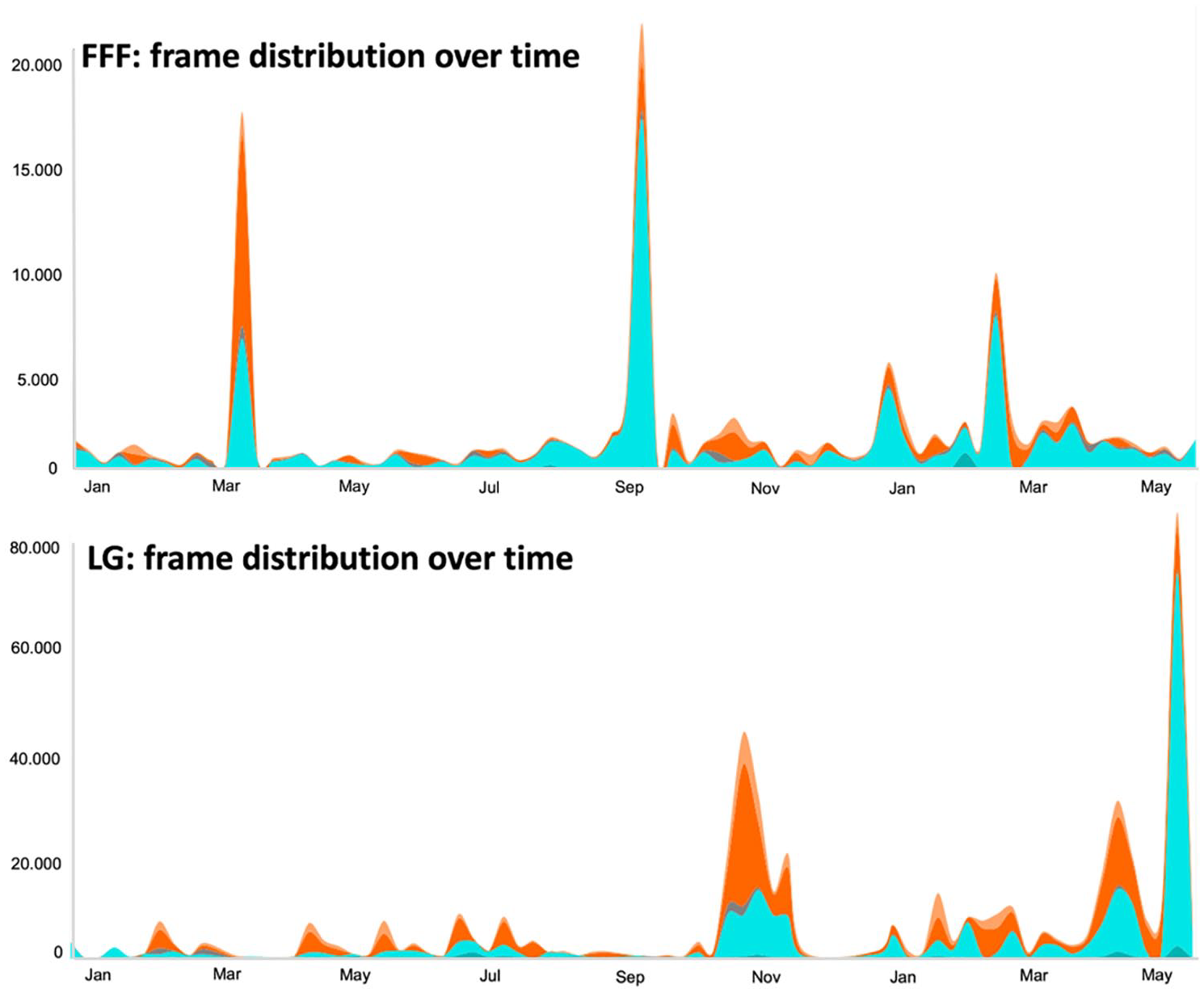
Distribution of frames in the two datasets’ most amplified posts (N = 2,830) from January 2022 to May 2023.
Concerning the FFF debate, a notable spike of extreme, antagonistic frames can be observed toward the end of March 2022. This increase coincides with FFF’s mobilization, promotion, and staging of a global climate strike. In contrast, the LG discourse exhibited relatively low activity during the same timeframe. Consequently, it can be inferred that the negative sentiments directed toward LG were displaced and manifested in the discourse surrounding FFF. This observation is further corroborated by a closer qualitative examination of the relevant coded data in this particular timeframe, which suggests a discursive linkage between the two climate movements, e.g., referencing to both movements simultaneously as “idiots” or “mentally lost idealists.” This connection was established in light of ongoing discussions regarding whether FFF was also undergoing a process of radicalization, thus indicating a “spill-over” of extreme frames from one debate to the other, e.g., claiming that the “#greenparty is just pushing their ideology with #FridaysForFuture and #LastGeneration activists.”
Concerning the LG debate, while a majority of posts criticized the movement, a noteworthy change occurred by the end of May 2023, marked by an increase in support. This shift seems to correlate with the decision by the district court in Munich to prematurely accuse LG activists of forming a criminal organization, even before a court ruling had been issued. Subsequently, public solidarity with the movement and advocacy against the general criminalization of climate protests surged. These events highlight the significant impact of real-world events on shaping online discourse—and potentially, the reciprocal influence as well. Connective action may be triggered either by the protest movements themselves—as illustrated by the attention peaks orchestrated by FFF in the results section addressing RQ1—or by external events, as demonstrated by the support clusters’ criticism of the premature legal action taken by a German federal state attorney against LG.
Polarized network structures
To address RQ2.2, we conducted a network analysis of uncommented retweets. The resulting networks clearly illustrate polarized amplification structures in both debates (see Figure 4). Both show a noticeable fragmentation into two sub-networks, each marked by increased interaction within its own group.

Network visualization of the amplification structure of both discourses, illustrating the alignment of automated community detection, the distribution of frames, and user types. Filtered by K-Core 5; node size reflects betweenness centrality. In the third visualization, node size is emphasized; FFF/LG excluded. Colors in first visualization represent algorithmically detected clusters.
The online debates surrounding both movements seem to result in a tight-knit network cluster of supporters, with the respective protest organizations’ user accounts serving as the most central users with the highest in-degrees within these supportive communities. The opponents were more decentralized, yet internally homogeneous, with the algorithm only detecting one antagonistic cluster per debate, which barely amplified the protest movements’ posts (see Figure 4). The FFF debate appeared to attract supporters from a broad range of external communities: 80% of the FFF network comprises eight different communities that were automatically detected. In comparison, for LG, this major portion of the network is already reached when looking at the two main communities alone. These separations further highlight the stronger disruption of the LG debate: both supporters and antagonists are nearly equally divided (41% versus 42% of the users being assigned to one of the two main clusters), whereas the FFF supporting community is considerably larger (41% versus 26%, without considering the various external clusters that amplified much more FFF content).
Both debates thus seem to exhibit greater polarization than general climate change debates, featuring a significantly higher number of antagonists (e.g., Meyer et al., 2023), which underscores that both online spheres are highly contested. However, for the LG debate, the antagonistic network becomes equally as prominent as the support network.
Alignment of (extreme) frames, users, and network structures
We measured the amplification of frames within the networks through uncommented retweeting, making it possible to expand manual coding to the classification of ~19,000 user accounts for FFF and ~180,000 user accounts for LG debates.
Our analysis showed that for both networks, participants within the same clusters were aligned by ideology (FFF: χ²(11) = 129.25, p < .001, φ = 0.641; LG: χ²(9) = 151.36, p < .001, φ = 0.682) and tend to reproduce and amplify similar frames. Antagonistic and supportive frames have significant association with respective community clusters that were automatically generated, thus showing that the two oppositional network clusters in fact represent oppositional frame usage (see Figure 4). In terms of the political-ideological positioning of the main actors involved in each discourse, a balanced distribution is observed. For the LG discourse, slightly over a third of the manually-coded accounts (N = 200 of the most amplified accounts per debate) can be categorized as left-wing progressive (38%) or right-wing conservative (38%). For FFF the distribution shows that 52% can be categorized as left-wing progressive and 25% as right-wing conservative. While centrist-ambivalent accounts are present in both clusters of the networks, left-wing progressive accounts are exclusively found in the supportive clusters. On the other hand, right-wing conservative accounts are solely confined to the cluster of protest antagonists.
Findings unequivocally illustrate that users’ frame usage and political-ideological positions strongly relate to the network they are situated in. It is striking that the alignment of users stays very similar, no matter whether it is FFF or LG being discussed. Both types of climate protests appear to produce sub-networks in which moderate conservative politicians align with right-wing extremists on the one side, and NGOs and Green politicians align with the left-wing progressives on the other side. Our manual coding of accounts from both clusters (N = 200 of the most amplified accounts per cluster) showed that while both the left-leaning FFF and LG clusters showcased prominent NGOs such as “Umwelthilfe,” “Oxfam,” or “Bund Naturschutz,” we found no NGO accounts in the right-leaning clusters. Concerning politicians, we found that in both the LG and FFF debates, there was more activity of political accounts in right-leaning clusters (FFF 6%, LG 11%) than in left-leaning clusters (FFF 3%, LG 3%), with this trend being particularly amplified for the LG cluster. All political accounts aligned with the ideological stance of the respective cluster they were found in. The most prominent users in both right-leaning clusters were politicians from either the Alternative for Germany (AfD), the Christian Democratic Union (CDU/CSU), or the Free Democratic Party (FDP). For the left-leaning clusters, all accounts were either from the Green Party or the Left Party.
Within the supportive clusters, debates surrounding FFF include more institutional climate protest accounts (23% vs. 16% for LG; see Table 2), while the LG debate is composed largely of individual activist accounts (43% vs. 11% for FFF). The FFF debates thus appear to be shaped more by organizational coordination.
Distribution of Collective/Organizational Group Activist and Individual Activist Accounts Within the Supportive Clusters of the Top 200 Accounts Per Debate (N = 400).

When comparing the positioning of media outlet accounts within the two debates (see Table 3), both illustrate a distinct separation of media outlets into either the left-leaning or right-leaning cluster, the latter of which also featured right-wing fringe media such as “Junge Freiheit.” However, within the LG debate, we identified significantly more outlets in the “antagonistic” and “ambivalent” clusters. This indicates that journalistic actors find it easier to amplify content posted by FFF (or their supporters), while media outlets seem to be somewhat torn on how to take a stance within the LG debate.
Community-Belonging of All Accounts That Could Be Attributed to a Media Institution Within Automatically Generated Clusters of the Top 200 Accounts Per Debate (N = 400).

Thus, we argue that two types of network action are at work: on the one hand, there is “connective action,” triggered by protest movements and their posts, while on the other hand, an antagonistic backlash network emerges that we term “connective counteraction.” LG debates seem to trigger an increase in both individualized connective action and its counterreaction to a higher degree than FFF debates.
Toxic cross-group interactions between the networks
Tension was observable not only through the extreme frames posted in ideologically homogeneous communities, but also became apparent in interactions across these groups. Overall, the frequency of mentioning and replying to users was significantly lower in the debate surrounding FFF (42%) than in that surrounding LG (67%). However, this increased interaction frequency in the LG debate should not be conflated with a deliberative and productive exchange of opinions. When protest movements are mentioned, or when users from the antagonistic community cluster address users that amplify their position, toxicity levels rise (see Figure 5). Supporters of the protest movements display significantly less toxicity. This trend is consistent across both protest debates, with the FFF debate showing the lowest levels of toxicity. The high toxicity in LG debates could be linked to the generally more negative discussion around the protest movement, potentially leading to more frequent expressions of toxicity. For cross-cluster interaction, comparing out-group with in-group communications of both supporters and antagonists, the levels double for posts where the protesters’ antagonists engage with supporters. For the LG debate, cross-group posts from antagonists even exhibit nearly twice the toxicity observed in posts from FFF antagonists (rising from 8% to 14%). Conversely, supporters consistently display one third as much toxicity when addressing their peers or antagonists. Thus, actions and posts of more disruptive movements trigger online engagement and interactions across ideological network clusters. However, this engagement is significantly more hostile when directed by antagonists toward the movement and its supporters.

Degrees of toxicity from ideologically aligned user clusters when addressing the own (left) versus the opposing community cluster (right) via mentions or replies.
It is crucial to note that the algorithm this study used is trained to detect extremely hostile and uncivil language and is exclusively text-based. Thus, these tweets might be interpreted as the most uncivil ones, yet they only serve as a proxy for a broader trend that likely goes beyond the posts that were labeled as toxic. This observation supports the overall finding that LG protest debates seem to significantly increase one-sided processes of asymmetric discursive polarization on Twitter/X, with the network of “connective counteraction” attacking the other side to a significantly higher degree.
Discussion and conclusions
This is the first study to examine the networked interplay between ideologically aligned, extreme user clusters (ideological polarization) and their affective intergroup interactions in the context of climate protests. In doing so, we make four key contributions to the existing research on polarization and protest debates.
First, we introduced a methodological pipeline that reveals discursive polarization as a process that takes place within statements and networked interactions. We showed how manual content analysis, automated classifiers, and network analysis can be combined to uncover such multi-dimensionality, providing a new method of measuring polarization in social media debates.
Second, we contribute to the understanding of climate protest discourse in general. Our results demonstrate a clear pattern across both discourses: frames that discredit the policy goals of protesters or portray activists as dangerous, extremist, or criminal are predominantly utilized within (extreme) right-wing conservative clusters. Conversely, frames that emphasize the perils of climate change or imply the peaceful nature of protests are predominantly employed within the left-wing progressive cluster, uncovering the networked division of two oppositional camps. In both debates, extreme frames were nearly exclusively employed by right-wing antagonists of the climate protest movements. In addition, toxic cross-group interactions of climate protest antagonists doubled in comparison to in-group communication when addressing the supporter network of the climate protests—no matter the movement’s disruptiveness. This is evidence of an asymmetric discursive polarization of one side of the network. Thus, “reformist” and “anti-systemic” actions (Uldam, 2019) of climate movements appear to stimulate the discursive polarization of online debates.
Third, we demonstrated that both protest and communication strategies yield fundamentally different outcomes in terms of how protesters generate and maintain attention within online media structures. Debates surrounding FFF (and their online supporters) create a more organization-centered network with numerous accounts relevant to the movement and, proportionally, greater support for their cause, while experiencing fewer extreme and toxic attacks from antagonists. While Uldam and Askanius (2022) demonstrate that European civil society actors generally struggle with having journalistic actors amplify or adopt their—potentially more radical—frames regarding climate policy issues, these difficulties are, in our analysis, notably more pronounced for the more disruptive movement. A significant portion of journalistic and media accounts position themselves within the supporting network of FFF, while they are mostly situated between the two opposing network communities in debates surrounding LG. However, this also comes with a higher degree of connective engagement in the online debate surrounding LG compared that surrounding FFF: In the timespan investigated, our data comprised of ten times more posts concerning LG, with far more individual accounts supporting the movement. Therefore, while both organizations triggered “connective action” online (Bennett & Segerberg, 2012), uniting loosely connected hashtags and topics on climate change and climate policy issues, the LG debate represented a much bigger action network.
Fourth, we show that this huge action network that is fueled by LG may also have a dark side that took on a life of its own. That is, that the massive personal participation in the debate comes with a price: a process that we term “connective counteraction.” Dynamically self-organized attacks by an anti-protest “alliance of antagonism” (Kaiser & Puschmann, 2017) demonstrate what it means to “become participants in political networks that diminish the boundaries between public and private” (Bennett & Segerberg, 2012, p. 752). Potentially resulting from the anti-systemic, disruptive protest actions such as road blockings (Uldam, 2019), antagonists tried to actively engage within online attacks and called for juridical or even violent actions against the protesters. We thus showed that debates surrounding disruptive protests result in higher degrees of discursive polarization. It is particularly one group, the antagonists of the protests, that is the driver of the ideological and affective components that are central to polarization online (Barberá et al., 2015; Brüggemann & Meyer, 2023), illustrating that polarization does not necessarily occur equally across camps. Consequently, our results show that, while climate protests in general polarize networked online debates, disruptiveness seems to trigger connective counteraction of protest antagonists that then further polarize debates that are already highly contested.
Whether this is to be normatively evaluated as harmful, counterproductive, or beneficial remains to be determined. Climate movements like LG employ anti-systemic protest tactics with the explicit aim of causing societal disruptions. They acknowledge that they may not necessarily be popular, but their primary goal is to generate visibility and be heard. However, this strategy is inherently risky and has already led to adverse consequences. We demonstrated that LG activists have been accused of extreme acts, including murder and terrorism. This framing has manifested in legal actions, such as the investigation of the group as a potential criminal organization. It is precisely such externally-driven, non-organized escalations of actions and events, such as the discussion following the death of a cyclist in Berlin, that illustrates the contrasting dynamics between FFF and LG. While FFF predominantly garners attention through orchestrated events, LG locates itself within a broader, less controlled, and more partisan debate. This dynamic, however, may lead to partial “spill-over” effects, with extreme frames from the debates surrounding LG partially being adopted in discussions related to FFF.
Ultimately, more disruptive protest efforts may be necessary in response to the inevitable disruptiveness of climate change. One has to consider whether the attention these protests attract outweighs the risk of further polarizing already contentious debates about climate protection measures. Social cohesion and unified political action remain critical to tackling climate change. However, this responsibility may not be appropriate for climate protest movements, as civil disobedience, by definition, aims to raise questions and initiate discussion rather than solve the problem.
Footnotes
Acknowledgements
We wish to thank Alexandra Herdt and Gesche Gertz, who contributed to the project by dedicating many hours to meetings, coding, and validating material. Additionally, we would like to thank the reviewers and editors of this special issue—among them Julie Uldam—for their highly constructive and helpful feedback during the writing and revision of this article.

Ethical Considerations
This study did not involve human participants or sensitive personal data and therefore did not require ethical approval.
Consent to Participate
This study did not involve human participants or sensitive personal data and therefore did not require informed consent.
Funding
The author(s) received no financial support for the research, authorship, and/or publication of this article.
Declaration of conflicting interests
The author(s) declared no potential conflicts of interest with respect to the research, authorship, and/or publication of this article.
Data availability
The data that support the findings of this study are available from the corresponding author upon reasonable request.