



Abstract
Emotional communication, especially through social media platforms, has become a contemporary populist threat. While this phenomenon has been studied in for example news media and social movements, we know less about its influence on civil society organizations, despite their pluralism being a centerpiece in a vibrant democracy. More specifically, we do not know if social media make civil society organizations more isomorphic and thus decreasing the diversity of their emotional communication over time. This question is relevant given the broad range of organizational fields that civil society engages in, as well as the documented push toward especially extreme positivity on social media platforms. Given this background, the article explores the use of positive and negative sentiment, as well as of sentiment intensity, over time in the social media communication of different organizational fields of civil society. We employ sentiment analysis to analyze approximately 100,000 organizational posts on Facebook from 125 Swedish nonprofit organizations during 2015–2020. We find that the pluralism of civil society organizations across different fields, as regards emotional communication, is retained over time, thus not threatening the pluralism of civil society in this way. In addition, emotional communication, and especially positivity, increases over time in all fields in absolute terms. However, considering post length, the relative amount of emotional communication exhibits less of an increase. Rather, across all fields there is an unexpected isomorphism relating to posts becoming longer, while enticing less user engagement. This development, rather than the lack of pluralism, raises democratic concerns.
Keywords
Introduction
An emotional turn has taken place in many fields of social science, increasingly acknowledging the relevance of emotions for the organization of society (Bericat, 2016; González, 2017). Not least, recent work has raised the question of the role of emotions in liberal democracy (Illouz, 2023), pondering the current populist turn and attributing some of this development to the proliferation of organizing taking place on social media (Gustafsson & Weinryb, 2020). While much of this research has centered on the political discourse in and of itself (Papacharissi, 2015; Wahl-Jorgensen, 2019a), as well as on news media and social movements (Cammaerts, 2021; Wahl-Jorgensen, 2019b), we still lack a more comprehensive understanding of these developments for the more formally organized elements of civil society. Writing more than a decade before the advent of social media, Diamond (1994) emphasized the importance of a diverse and vibrant organized civil society to counteract authoritarian tendencies. But what does such a pluralism mean today, when many civil society organizations conduct much of their communication on a small number of commercial social media platforms?
Illouz (2007, 2008) has written extensively about emotional capitalism and the commodification of emotions. In Manufacturing Happy Citizens (2019), Edgar Cabanas and Illouz (p. 172) describe a society where individuals are driven to construct a self-image on social media, dominated by a “tyrannical positive attitude.” Other scholars have specifically noted this positivity discourse in social media (Wahl-Jorgensen, 2018), as well as the ensuing risks for hyper-individualization and populism in society. An overreliance on strong emotional language in social media communication may threaten the diversity of civil society, with organizations increasingly adopting similar tactics in their efforts to boost user engagement, which in turn drives donations, volunteer participation, and influence (Bail et al., 2017; cf. Blum & Uldam, 2024).
Civil society organizations are active in many different contexts, and their pluralism contributes on an aggregated level to liberal democracy (Diamond, 1994). Also predating the proliferation of social media, Salamon and Anheier (1996) attempted to classify the richness of organized civil society across many different countries. They found a range of categories including education and research, health, social services, environment, development and housing, as well as international engagement. These categories may be viewed as different organizational fields (DiMaggio & Powell, 1983), with their own norms and values regulating interactions and communication. However, as civil society organizations transfer some or most of their communication to social media platforms, separate fields are suddenly subjected to a more homogeneous, and commercially underpinned, communication infrastructure, where much of the traffic is predicated on emotional cues.
Given this background, we aim to explore how the emotional impetus of social media has affected the pluralism of civil society organizing over time. More specifically, we here operationalize emotions as sentiments and ask: How has the use of positive and negative sentiments influenced civil society organizations’ social media communication across a range of organizational fields?
Civil society organizing and emotional communication on social media platforms
Previous studies have shown how civil society organizations may utilize social media platforms to share information, create and sustain communities, mobilize volunteers, and solicit donations (Lovejoy & Saxton, 2012). For example, civil society organizations that rely on fundraising may use social media platforms to reach and interact with potential and existing individual donors (Bhati & McDonnell, 2020; Saxton & Wang, 2014). However, social media are also described as posing significant challenges to civil society organizations, as they compete for attention among individuals who are constantly exposed to a plethora of digital stimuli (Guo & Saxton, 2018, 2020). One strategy to attract attention is to use emotional forms of communication.
Research from multiple literatures indicates that content published on social media is typically emotion-laden (Papacharissi, 2015; Wahl-Jorgensen, 2019a; Waterloo et al., 2018), ranging from a massive use of emojis (Riordan, 2017) to organizational storytelling (Bell & Leonard, 2018) and individuals’ sharing of personal experiences (Köhl & Götzenbrucker, 2014). Messages that provoke an emotional response are more likely to be shared (Berger & Milkman, 2012). Such emotionally charged forms of communication—“the expression of emotion as a speech act,” following Wahl-Jorgensen (2019a, p. 9)—can potentially have profound implications for civil society organizing, as emotional expressions in social media posts have consistently been shown to have substantial effects on attention and user engagement (Berger & Milkman, 2012; Jaakonmäki et al., 2017; Kite et al., 2019; Klassen et al. ., 2018; Schreiner et al., 2021). For example, reactions to content may increase when using emojis (cf. Stark & Crawford, 2015).
The architecture of Facebook is said to favor positivity to make users stay on the site and be as active as possible, to facilitate collecting user data and creating better targeting for sponsored contents and ads (Wahl-Jorgensen, 2018). In addition, interpersonal communication on Facebook has been found to reward the expression of positive sentiments (Reinecke & Trepte, 2014; Schreurs & Vandenbosch, 2021), although this might not necessarily hold for other social media services, such as X/Twitter (Masciantonio & Bourguignon, 2023). A positivity bias on Facebook has been observed in users posting more positive content than negative (Luo & Hancock, 2020).
In sum, previous research shows that social media, and especially Facebook, has an “emotional architecture” (Wahl-Jorgensen, 2018, 2019a), where the platform is designed to make users react to emotional cues. This means that platforms in and of themselves have some kind of influence on the nature of emotion-laden communication, but that positive and negative sentiment could have diverse effects depending on choice of platform and organizational field of activity. Yet, despite a proliferation of civil society studies of social media, there is a lack of research delving specifically into the emotional aspects of this communication and its implications for the pluralism of civil society organizing.
Operationalizing the study of organizations’ emotional communication
Emotional communication is not a new aspect of civil society organizing. It predates, and exists separately from, social media platforms (Andreoni, 1990; Bremner & McCutcheon, 1996; Merchant et al., 2010; Paxton et al., 2020). Nevertheless, as discussed above, social media offer new interactive modes of emotional communication, using both language and symbols. In addition, social media platforms may pose risks to the pluralism of civil society organizing, as organizations that in the past were active on diverse organizational fields now are forced to compete and interact on the same, commercially underpinned arenas (Caplan & boyd, 2018).
While we lack studies comparing different fields of civil society organizations’ emotional communication on social media, we can draw on insights from adjacent studies. Comparing across a range of organizational fields, Paxton et al. (2020) performed a sentiment analysis on the mission statements of a large number of US civil society organizations, showing that their communication often contains emotional expressions, and that these are associated with performance indicators such as donations and volunteers. They found that many civil society organizations, especially those in fields connected to social bonding—such as education, sports, and culture—were successful in using positivity in their communication to attract donations and volunteers. On the other hand, a combination of negativity and positivity was found to be useful for organizations that focus on social problems, such as in fields like the environment or civil rights. However, a singular focus on negativity in communication was not conducive to attracting donations or volunteers. The study by Paxton et al. (2020) indicates differences across organizational fields in non-social media-based emotional communication. Looking specifically at civil society organizations’ communication on social media, albeit not comparing across fields, Bail et al. (2017) used a tool developed for sentiment analysis to measure trends in the use of emotional and cognitive language in posts and comments from the Facebook pages of US advocacy organizations focused on social problems. They found that organizations that use so-called phase shifts, that is, emotional language after a period of high cognitive content in discussions and cognitive language after a period of high emotional content in discussions, can lead to more comments, indicating that social media may influence civil society organization’s emotional communication over time.
Sentiment analysis, as employed by Paxton et al. (2020) and Bail et al. (2017), is commonly used for detecting whether a text expresses a positive or negative sentiment and provides a robust tool to study the emotional communication of civil society organizations on social media. Sentiment here refers to the mood or mentality expressed in a block of text, which can be classified as positive, negative, or neutral (Yue et al., 2019). Whether a word should be coded as positive or negative, as well as whether it is very positive or only a little positive, or neutral, is ultimately decided by human coders. By annotating each word, it is possible to create a dictionary which can be used to measure the sentiment of a text.
Inspired by the work of Paxton et al. (2020) and Bail et al. (2017), and addressing the lack of knowledge on civil society organizations’ emotional communication on social media when comparing across organizational fields and over time, we here perform a sentiment analysis to address these gaps. We believe that such an analysis will help us understand how the push for emotional communication on social media has affected the pluralism of civil society organizing over time, speaking to the larger conundrum of the role of civil society organizations in the current emotional, and increasingly populist, landscape of contemporary democracies.
Design and methods
To address our aim, we collected Facebook data from Swedish civil society organizations. This choice is pertinent for several reasons. First, Sweden has a strong civil society with many large organizations operating across a range of organizational fields (Selle et al., 2019). Sweden has historically been characterized by the cooperation between civil society and state, foremost the labor movement, but has also been described as a truly popular democracy with free associations (Trägårdh, 2007). Second, Sweden has high levels of social and political trust, high voter turnout, and high levels of volunteering and membership rates in civil society organizations (Carlander, 2023; Henriksen et al., 2019; Österman & Brännlund, 2024). Third, levels of charitable giving are high in Sweden, especially toward causes not supported by the welfare state, such as funding for cancer research and foreign aid (Vamstad & von Essen, 2013). Finally, social media use in Sweden has historically been high and Facebook has been the most widely used social media platform (cf. Internetstiftelsen, 2023). In sum, Sweden has many characteristics that indicate that a pluralistic, vibrant, and formally organized civil society (Diamond, 1994) is central to its liberal democracy, and at the same time the Swedish population has a strong pre-disposition for social media usage, making it ideal for the purposes of our study.
We specifically investigated how Swedish civil society organizations utilize emotional appeals in their social media communication by analyzing posts from the Facebook pages of Swedish Fundraising Association members. As the largest umbrella organization of its kind in Sweden, the Swedish Fundraising Association represents a wide variety of organizations, including major international charities such as the Red Cross, Save the Children, and UNICEF, alongside smaller national entities.
Data were collected via the CrowdTangle application, which retrieves page posts along with metadata such as full text, links, image, and video details, as well as engagement metrics like comments, likes, and shares (CrowdTangle Team, 2024). 1 The sample includes 125 Facebook pages from the Swedish Fundraising Association’s member organizations, with follower counts ranging from a few hundred to several hundred thousand, and post frequency varying between 65 and over 1500 posts during the study period. We gathered all organizational page posts (excluding community posts or comments) made by administrators between 1 November 2015 and 31 October 2020.
Given our ambition to analyze the effects on pluralism that emotional social media communication may have on various fields of civil society organizing, we categorized all organizations according to “The international classification of nonprofit organizations” (Salamon & Anheier, 1996). Two of the authors independently classified the organizations in the sample and subsequently calibrated their coding (see Table 1). A complete list of the organizations, including field assignment and descriptive statistics for Facebook posts, can be found in Appendix 1.
Summary of Posts Per Organizational Field.

Salamon and Anheier’s (1996) classification contains 12 organizational fields, which we applied to the Swedish case: Culture and recreation, with sports and culture organizations such as the Swedish Parasport Association; Education and research, including educational organizations such as Teach for Sweden; Health, with organizations combating illnesses and addiction, such as the Fund for Mental Health; Social services, with organizations such as Bris—Children’s right in society; Environment, which includes, for example, Keep Sweden Clean; Development and housing, including community development services and training such as Mentor Sverige; Law, advocacy and politics, with advocacy organizations such as The Christian Peace Movement; and International, which includes organizations mostly working internationally such as the Swedish Red Cross. Four fields in the original classification system were not found in our sample: Philanthropic intermediaries and voluntarism promotion; Religion; Business and professional organizations, unions; and Not elsewhere classified.
Sentiment analysis
Using sentiment analysis (Mohammad, 2016; Nandwani & Verma, 2021), we quantified several measures of emotional expressions in the selected posts and performed time series analyses of them. Specifically, analysis was undertaken in Python using the AFINN Lexicon (A. Gustafsson, 2017; Nielsen, 2011). Below, we explain the design in detail.
Sentiment analysis refers “to the task of automatically determining feelings from text, in other words, determining valence, emotions, and other affectual states from text” (Mohammad, 2016, p. 201). With the advent of large volumes of communication becoming available through the internet in general and social media in particular, big data approaches to sentiment analysis have sprawled (Martínez-Cámara et al., 2014; Mohammad, 2016).
Sentiment analysis can be described as taking a text and then analyzing it word by word by checking how those particular words have been coded in a dictionary. For instance, it is very common in sentiment analysis to measure the valence of a textual unit. Valence in this sense means whether words are positive or negative (Martínez-Cámara et al., 2014; Tausczik & Pennebaker, 2010). In the dictionary, one way of coding words is to assign positive or negative values to them. Positive expressions get positive values, and negative expressions get negative values. In this way, words can range in valence from very negative over neutral to very positive. Of course, “neutral” in this sense only means that the word has been coded as neither positive nor negative, which does not mean that the function a word can have in a specific sentence is necessarily neutral. Other ways of coding words in dictionaries include grouping them into different emotional categories, such as anger, fear, and joy. The dictionaries can be based on human coding or machine learning approaches. We choose here to use a lexicon based on human coding, and one that only codes for negative or positive sentiments, a method that has been proved to perform well (Nandwani & Verma, 2021).
The AFINN Lexicon is one of the most widely used dictionaries for sentiment analysis (Anandarajan et al., 2019; cf. Mohammad, 2016). For our purposes, it has valence ratings (from 5 for very negative to +5 for very positive) for over 2400 words and phrases in Swedish, and includes common swear words and internet slang (such as LOL) (A. Gustafsson, 2017).
Variables
The dictionary-based AFINN sentiment analysis provided negative and positive valence scores (−5 to +5) for matching post words and emoji descriptions. These scores were summed up for each post, thereby resulting in an overall valence measure of the post. In this way, a post that contains a lot of positive-coded words, such as “wonderful” and “fantastic,” will be coded as more or less positive, whereas a post containing a lot of negative-coded words, such as “horrible” or “bad,” will be coded as more or less negative. In addition, a sentiment intensity measure was calculated as the squared valence, likewise with scores summed up for each post (cf. Larsen et al., 2008). Sentiment intensity makes use of the fact that the words in the AFINN dictionary are assigned valence values on a scale: a post containing a lot of words with a high positive or negative valence (e.g., “best,” “marvelous,” “worst,” “horrible”) will be assigned a higher value on this scale than a post containing words with lower values (e.g., “good,” “nice,” “bad,” “annoying”).
The user engagement variable was constructed as a summative index variable consisting of number of post likes, comments, shares, and reactions (love, anger, joy, etc.). In addition, we measured the number of followers at the time of posting and the date of posting.
Results
We analyzed just under 100,000 Facebook posts from the 125 official Facebook pages of the organizations. The Facebook pages range from Missing People Sweden, with over 600,000 followers on average during the examined period, to Freezonen Women’s Victim Support, with around 700 followers on average (see Appendix 1). A summary of our results can be found in Table 1.
Cross-sectional analysis of organizations and organizational fields
Since previous research (cf. Bail et al., 2017; Paxton et al., 2020) has indicated that the use of emotions in communication can have valuable effects for civil society organizations, for instance, to create attention, user engagement, donations, and membership, we expect the civil society organizations in our sample to use emotions on their official Facebook pages. Paxton et al. (2020) found differences between organizational fields in how positive and negative sentiments, respectively, were used in mission statements. Following this, we expect a difference in the use of positivity across different organizational fields in our sample. If so, we should see higher rates of positivity in some fields, such as Education and research, and Culture and recreation, and higher rates of negativity in others, such as Law, advocacy, and politics. This is confirmed by our analysis.
On an organizational level, the Facebook pages in our sample have a positive mean valence value, indicating that on average, most civil society organizations have a positive tone in their messaging. This is perhaps an indication that Facebook indeed has an emotional architecture that favors positivity (Wahl-Jorgensen, 2019a). There are, however, large differences in the use of emotions between individual organizations, as well as between organizational fields, both concerning our measures of valence and sentiment intensity. The Facebook page with the highest mean valence is the Children’s Diabetes Fund (7.45), whereas the page with the lowest mean is Amnesty International Sweden (−1.64). That Amnesty International Sweden has a negative mean valence value means that a majority of posts use more negative than positive sentiment words.
The large difference between the Children’s Diabetes Fund and Amnesty International Sweden can be interpreted by examining differences in their mission statements. The Children’s Diabetes Fund’s primary mission is to collect donations for research on type 1 diabetes and provide information about diabetes to society and affected families. A typical Facebook post contains success stories about funding or information about living with diabetes, in a very positive and upbeat tone, usually coupled with a call for further donations. Amnesty International Sweden, on the contrary, tends to use its Facebook page for providing information on atrocities around the world, usually coupled with a call for signing a petition, and more seldom calls for donations. Both organizations are trying to address societal problems, but they use different strategies. This finding is in line with Paxton et al.’s (2020) work on civil society organizations’ mission statements, where health-related organizations used positivity most extensively, whereas civil rights organizations focused on social problems used negativity most extensively.
We also find large differences in sentiment intensity, that is, how extreme positive and negative sentiments are used in social media communication. Whereas the use of both positive and negative sentiment would cancel each other out considering valence, sentiment intensity captures the use of sentiment regardless of direction. For instance, the Facebook page with the highest mean sentiment intensity value is also the Children’s Diabetes Fund (121.34), indicating that not only does this organization use positive sentiment, but it also uses a lot of it. Having a permanently high level of intensive positivity might have beneficial effects in terms of donations and volunteers, but could also potentially lead to emotional overload (Bail et al., 2017), in which case we would see decreasing levels of user engagement despite high levels of emotional communication. At the other end of the spectrum, we find Parasport Sweden (8.29), an organization dedicated to developing and promoting sports played by people with physical disabilities. Since this is an organization in the Culture and recreation organizational field, we would expect a heavy use of positivity in its communication, but this is not evident from the data. However, the social media communication of an organization might not necessarily merely reflect its organizational field: we can also expect idiosyncrasies due to local culture and communicators. For this reason, we turn to the organizational field level to see if we can find field alignment between sentiment and mission, as found in Paxton et al. (2020).
The three organizational fields with the highest mean valence (i.e., highest rates of positivity in their posts) are Culture and recreation, Education and research, and Development and housing (Table 1). These fields represent organizations that all belong to what Paxton et al. (2020) refer to as social bonding: organizations that stress community building and interaction, such as sports associations, the Scouts, organizations providing homework help for school children or offering training programs. Conversely, Law, advocacy and politics, International, Health, Social services, and Environment all have lower mean valence, with Law, advocacy and politics having the lowest mean valence. Overall, these fields still produce posts that are on average more positive than negative, but they are less positive than the fields associated with social bonding. As mentioned above, Paxton et al. (2020) refer to these types of organizations as working with social problems (such as poverty, injustices, pollution), using more negative emotions in their communication.
Furthermore, the organizational fields that have the highest levels of positive sentiment also have the highest mean sentiment intensity of posts. This indicates that if there is a drive toward positivity in civil society organizations’ communication on social media, it is foremost driven by organizations that focus on social bonding. This also confirms the findings from Paxton et al. (2020), but in a social media setting. In this sense, there is no clear evidence of a uniform push toward increasing positivity (Cabanas & Illouz, 2019) for civil society organizations brought about by social media—instead, differences between organizational fields in the use of emotional communication seem to be rooted in their mission statements.
In Figure 1, we present our results in a different manner, as a series of boxplots. This allows us to consider that social media data often have a lot of extreme values, since some individual posts might go viral. The boxplots confirm the results indicated in Table 1, and we can additionally see variation across organizational fields. For example, the field of Culture and recreation has a higher level of variation in the use of positivity than does Law, advocacy, and politics (though there are still differences between the fields). Here, we also add two new measures: mean word count, which is the average length of a post in words, and sentiment intensity relative to word count, which measures the affective content in a post relative to its length. The word count boxplot shows that Culture and recreation generally has shorter posts than other fields, with Development and housing being at the upper end of the scale. As is visible from the sentiment relative measure, when word count is considered, the differences between organizational fields become less pronounced.
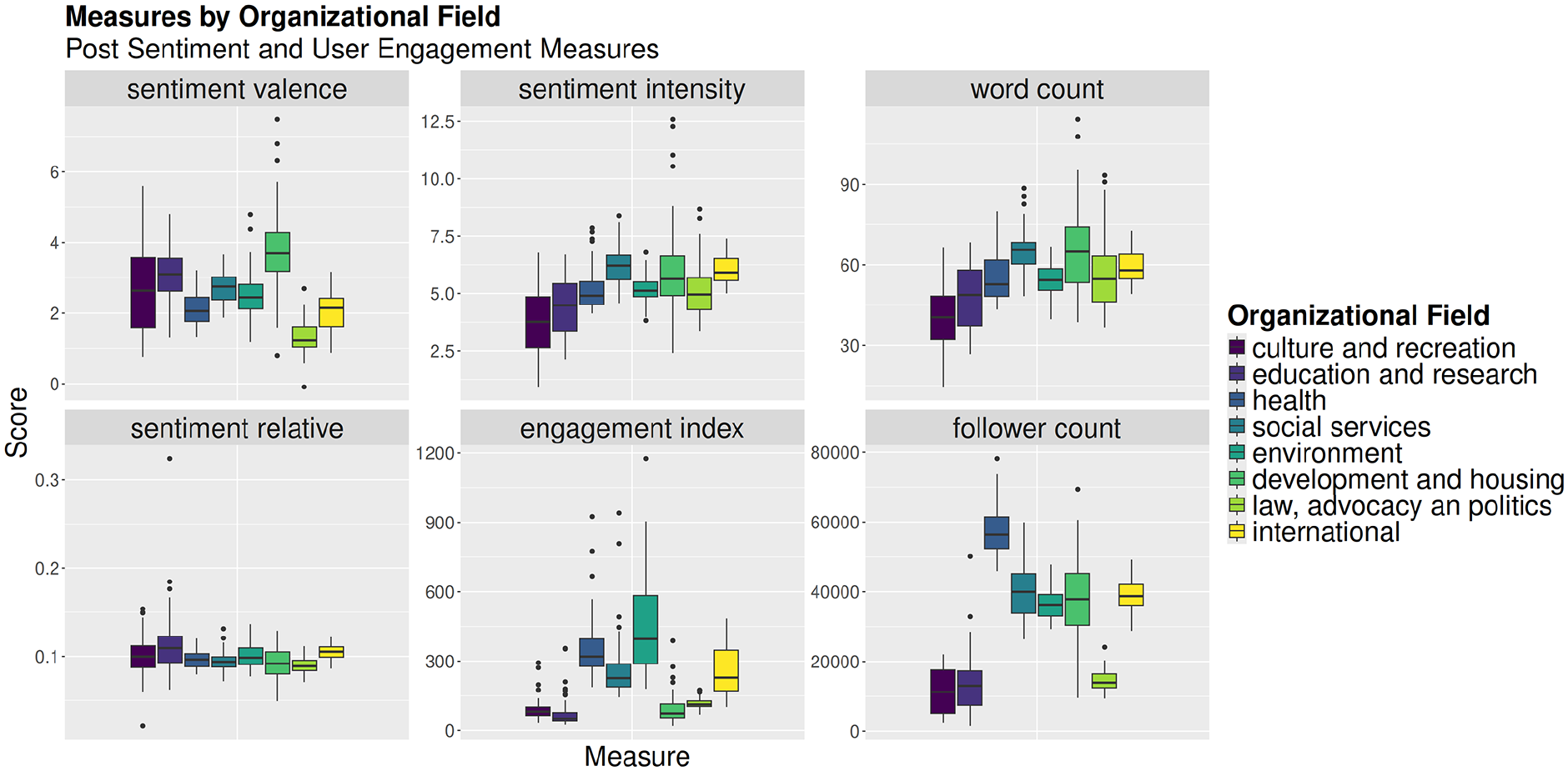
Sentiment measures, word count, user engagement, and followers per type of organization.
In sum, from a cross-sectional perspective, similarities or differences between organizational fields of Swedish civil society organizations become a matter of how you slice the cake: a long Facebook post with a lot of positive words still contains a higher absolute volume of emotion, and thus the post can be said to be more emotionally loaded than a shorter post with the same average level of emotion. We will return to this finding below, examining its development over time.
Longitudinal analysis of organizations and organizational fields
To facilitate visualizations of how the measures of interest developed over the studied period, each measure was aggregated over time to produce mean values for each consecutive month. These aggregated data were then used to visualize the overall development through scatter plots with a corresponding regression line. As can be seen in Figure 2, all measures of interest except user engagement exhibit positive trends over time. This clearly demonstrates that the use of emotional expressions has increased in civil society organizations’ communication on social media, suggesting social media having effects on organizations’ emotional communication.

Development over time. The first panel shows mean valence (i.e., positivity) over time; the second panel shows mean sentiment intensity (i.e., squared valence) over time, the third panel shows mean word count per post over time, the fourth panel shows sentiment intensity relative to word count, the fifth panel shows user engagement over time, and the sixth panel shows the number of followers over time.
In addition, there is a small tendency toward increased positivity over time, which would, again, tentatively support claims (Wahl-Jorgensen, 2019a) that the emotional architecture of social media specifically favors positivity. Unless we believe that civil society organizations have good reasons for becoming more positive over the period, for example, due to positive developments in society, the most likely explanation would be that the organizations adapt their tone over time as a result of experience or mimicry (cf. Caplan & boyd, 2018; DiMaggio & Powell, 1983). In some instances, there are also possible contextual explanations. If we look at, for example, the first panel, showing mean valence (positivity), we can see that there seems to be a Christmas effect, as the month of December consistently exhibits high positive values. An even stronger pattern is increased sentiment intensity, which indicates more positivity and negativity in the posts. Although there appears to be a consistent rise across the period, there are small highs at the beginning and end of the study, possibly corresponding to engagement around the European Refugee Crisis in 2015 and the COVID-19 pandemic in 2020 (cf. Weinryb et al., 2021). This is also visible in the development of mean user engagement for posts, which shows a rather steep decline over time, with spikes in late 2015 and in 2020. In contrast, Bail et al. (2017) also found temporal variance in the use of emotional communication but did not relate it to exogenous events. We here find a possible indication that civil society organizations use emotional communication in times of heightened excitement related to societal events. This is much in line with Gerbaudo’s (2016) work on social movements during the tumultuous year of 2011 (cf. Gustafsson & Weinryb, 2020).
However, there is also a clear tendency that posts tend to get longer over the studied period. Although a longer post could imply additional emotional expressions, as has already been discussed, it is nevertheless interesting to see whether the mean rate of emotional expressions per post is constant or if it changes. If a post becomes longer but the absolute number of emotional expressions remains the same, this means that the mean rate of emotional expressions falls, and vice versa. For this reason, the third panel shows the development of word count of posts in different organizational fields, and the fourth panel shows the development of sentiment relative to word count. In the cross-sectional analysis above, we could see that differences between organizational fields became much less pronounced when comparing the relative use of sentiment intensity. Similarly, when we look at the relative content of sentiment in posts over time, the clear trend of increased use of sentiment seemingly evaporates. The civil society organizations in our sample appear to publish longer posts containing emotional expressions over time, but there is no clear pattern in terms of a relative increase of emotional communication in posts.
Yet, as we have seen, the use of positive and negative sentiment differs between organizational fields when seen from a cross-sectional perspective. For this reason, it is relevant to examine their development over time. Figure 3 shows a series of scatterplots estimating the development over time for different organizational fields concerning valence (positivity) and sentiment intensity (first and second panels, respectively).

Development over time by organizational field.
From the first panel of Figure 3, we learn that there are diverging patterns in how organizational fields exhibit positivity in social media communication over time. Three fields have increasing means of positivity: Culture and recreation, Development and housing, and Education and research. Incidentally, these are also the three fields with the highest rates of positivity as well as the highest rates of sentiment intensity cross-sectionally. This indicates that civil society organizations associated with social bonding (Paxton et al., 2020) not only have the highest use of positive sentiment but also tend to increase this positivity over time. The fields of organizations associated with social problems, on the other hand, show a decrease in positivity in their communication.
At the same time, not only are organizational fields associated with social problems using less positivity and more negativity, but they also seem to use stronger sentiments in their communication. As we have seen above, this ostensible affect spiral (cf. Walter & Bruch, 2008) is in part due to posts getting longer across the board. Yet, the fourth panel shows that the rate of emotional expressions is increasing for one field, Education and research, which means that in this field posts are getting longer, more positive, and become more sentiment intensive. We learn from the fifth panel that the decrease in user engagement seen in Figure 2 is more pronounced for some fields. User engagement is decreasing for all fields but with the steepest slope for environmental organizations. Likewise, and finally, the sixth panel shows diverging trends in followers over the 5-year period, with environmental organizations losing the most followers.
In sum, we see that there are differences between organizational fields over time when it comes to the use of emotional communication and positivity, in line with Paxton et al. (2020), although these differences are less pronounced when taking the length of posts into account. There is thus a divergence rather than a uniform effect of the emotional architectures of social media platforms leading to increasing levels of positivity across the board. In the next section, we return to the question what implications the results have for civil society pluralism and for liberal democracy.
Concluding discussion
In this article, we have explored how the emotional impetus of social media has affected civil society organizations over time. Informed by research preceding the advent of social media (Diamond, 1994), emphasizing the relevance of a diverse civil society for a vibrant democracy, we have tried to tease out how emotional communication on a commercial platform (Facebook) may matter for the pluralism of civil society organizing.
Inspired by research that indicated a dominance of positivity on social media platforms (Reinecke & Trepte, 2014; Wahl-Jorgensen, 2018), as well as by work on civil society organizations’ increased social media usage (Guo & Saxton, 2020; Lovejoy & Saxton, 2012), we set out to study how the use of positive and negative sentiments influenced civil society organizations’ social media messaging across a range of organizational fields. While our results are complex, they do tell us several things about the emotional communication of the formal part of civil society and its pluralism in the age of social media. First, our analysis at the organizational level reveals that a majority of the posts, when considering their total count, are positive. We also find, like Paxton et al. (2020), that organizational fields differ in their emotional communication, with fields related to categories of social bonding being more positive than those dealing with social problems. Second, when looking over time, these trends of positivity and intensity of emotional communication and initially seem to hold, similarly to the work of Bail et al. (2017). However, we also find that posts become progressively longer. In fact, when controlling for the length of posts, the increases in positivity and intensity become less pronounced. Nevertheless, differences between organizational fields remain.
Our study thus indicates that social media—in this case, the commercial platform of Facebook—do seem to create an overall increase in positivity and intensity of emotional communication for civil society organizations, but that these trends (1) differ between organizational fields and (2) are not clear when controlling for the length of posts that also increase over time. This means that contrary to the research indicating a “tyrannical positive attitude” on social media (Cabanas & Illouz, 2019, p. 172), this trend does not seem to eradicate differences between organizational fields, not in and of itself threatening the pluralism of civil society, if analyzed through the prism of emotional communication. However, the surprising result that posts on average became longer, with more emotional communication in absolute terms due to the increase in length of posts, at the same time indicates strong isomorphic tendencies across all organizational fields examined in the study (Caplan & boyd, 2018; DiMaggio & Powell, 1983). Accompanying this trend, we also found that user engagement went down across the fields over time, at the same time as the length of posts increased. Whereas lower rates of user engagement for organizations on Facebook has been noted and attributed to algorithmic changes (Meese & Hurcombe, 2021; cf. Blum & Uldam, 2024; Roose, 2021), a general increase in post length has not been observed to our knowledge. Possibly, it might reflect a heavier reliance on storytelling (Bell & Leonard, 2018).
Thus, while we see neither a decrease of civil society pluralism by looking at a homogenization of emotional communication when comparing across organizational fields, nor a relative increase in positivity over time when considering length of posts, we see isomorphism across the fields in the development of the post format, becoming longer, and accompanied by decreased user engagement. Taken together, this is also an indication of social media driving the communication on the platforms, albeit in an unexpected manner in relation to previous research (Guo & Saxton, 2020; Reinecke & Trepte, 2014), pushing civil society organizations into similar behaviors, despite maintaining differences across fields (cf. Blum & Uldam, 2024).
What do these results mean for the pluralism of civil society at large and its role in liberal democracy in the age of social media? While previous research has shown how the emotional communication on social media has affected news media and social movements (Cammaerts, 2021; Wahl-Jorgensen, 2019b), with implications for populist tendencies, we here show that also formal civil society organizations are influenced by the emotional architecture of such platforms. This finding is important in and of itself, as it indicates that the organized part of formal civil society is largely, and across the board, changing its communication to chase user engagement through longer posts with emotional content. While the relative amount of emotional content per post does not change much over time, the absolute amount does, making civil society organizations communicate more and more while engaging fewer and fewer users. In the long term, this may become problematic for civil society organizations at large as it devalues their messages and creates an inflation in communication on social media. At the same time, we do see maintained differences between fields of organizations, indicating that we may worry less about the pluralism across fields as regards emotional communication, and more about the inflation of communication at large for formalized civil society as a whole.
Our findings leave us with the insight that emotional communication in civil society organizing is influenced by social media, and that its long-term effects change civil society communication at large, albeit not necessarily threatening differences across fields. While civil society’s organizational pluralism may thus be upheld despite the proliferation of social media communication, the devaluation of its communication and loss of engagement is a different and perhaps larger problem for democracy at large. If formalized civil society incrementally loses the ability to communicate with beneficiaries and donors, its role in a liberal democracy may be weakened, despite patterned differences between fields being maintained.
Our study contains some important limitations that we hope future studies may elucidate. For example, a major problem with longitudinal social media studies is that algorithmic changes, for the most part, remain hidden to researchers. Also, a more nuanced operationalization of sentiment, aided by natural language processing techniques, would enhance our understanding of how content affects user engagement. In addition, we were constrained by limitations of data access, now exacerbated due to the untimely discontinuation of CrowdTangle. If there were a way to get better metadata, we could study longer time series. Finally, a similar study that would compare social media platforms, and look at other empirical settings, would be valuable.
Footnotes
Appendix

| Organization/Facebook page | Organizational field | No. of posts | Mean engagement index | Engagement index sd | Mean valence | Valence sd | Mean sentiment intensity | Intensity sd | Mean no of followers | Followers sd |
|---|---|---|---|---|---|---|---|---|---|---|
| Friluftsframjandet | Culture and recreation | 493 | 173.18 | 454.25 | 5.92 | 5.15 | 61.47 | 97.47 | 33,490.01 | 6,286.52 |
| kfumsverige | Culture and recreation | 704 | 18.93 | 24.27 | 1.86 | 3.19 | 13.63 | 31.82 | 2,811.74 | 193.62 |
| parasportSWE | Culture and recreation | 730 | 75.73 | 65.83 | 1.55 | 2.43 | 8.29 | 17.53 | 4,736.68 | 613.2 |
| scouterna | Culture and recreation | 901 | 105.4 | 233.44 | 4.04 | 4.46 | 36.15 | 65.73 | 19,195.23 | 619.53 |
| Sportfiskarna | Culture and recreation | 644 | 151.08 | 403.59 | 2.51 | 4.15 | 23.54 | 59.61 | 14,315.17 | 3,182.79 |
| FairtradeSverige | Development and housing | 784 | 200.61 | 360.36 | 2.82 | 3.73 | 21.84 | 49.74 | 111,179.06 | 1,258.11 |
| mentorsverige | Development and housing | 653 | 48.86 | 70.85 | 2.84 | 5.31 | 36.19 | 112.99 | 8,747.41 | 1,096.65 |
| RaoulWallenbergAcademy | Development and housing | 527 | 98.39 | 188.98 | 2.85 | 5.27 | 35.82 | 89.52 | 7,810.8 | 843.09 |
| reachforchangeorg | Development and housing | 824 | 16.94 | 19.67 | 6.08 | 6.9 | 84.5 | 187.53 | 10,451.76 | 457.86 |
| berattarministeriet | Education and research | 880 | 47.85 | 55.13 | 3.27 | 4.65 | 32.33 | 82.47 | 5,640.29 | 1,164.36 |
| foreningenfuruboda | Education and research | 1,179 | 46.07 | 50.84 | 2.02 | 3.58 | 16.9 | 85.36 | 2,074.06 | 636.76 |
| Laxhjalpen | Education and research | 696 | 20.25 | 16.9 | 4.57 | 4.98 | 45.64 | 129.69 | 2,153.84 | 346.67 |
| lillabarnet | Education and research | 144 | 109.59 | 459.37 | 4.11 | 5.21 | 43.85 | 108.83 | 2,510.2 | 202.16 |
| Mattecentrum | Education and research | 1,146 | 59.45 | 89.76 | 3.52 | 3.91 | 27.62 | 64.19 | 25,031.7 | 2,281.47 |
| TeachForSweden | Education and research | 626 | 21.99 | 18.08 | 3.84 | 4.81 | 37.76 | 93.08 | 3,180.63 | 896.53 |
| Teskedsorden | Education and research | 286 | 53.91 | 57.99 | 1.41 | 6.38 | 42.54 | 78.09 | 5,120.26 | 293.8 |
| WikimediaSverige | Education and research | 570 | 34.01 | 108.91 | 2.94 | 4.58 | 29.54 | 92.89 | 2,824.34 | 1,803.25 |
| worldschildrensprize | Education and research | 270 | 792.31 | 2102.12 | 2.64 | 6.1 | 44.05 | 87.87 | 14,3251.16 | 2,073.82 |
| BirdLifeSverige | Environment | 971 | 159.02 | 236.71 | 2.51 | 4.85 | 29.8 | 121.99 | 13,579.86 | 2,208.42 |
| djurskyddet | Environment | 883 | 251.47 | 409.12 | 1.75 | 4.39 | 22.34 | 91.19 | 27,072.27 | 1,693.26 |
| forskautandjurforsok | Environment | 341 | 299.12 | 353.17 | 2.12 | 5.74 | 37.39 | 214.38 | 67,307.82 | 2,559.71 |
| hallsverigerent | Environment | 614 | 292.15 | 730.87 | 1.3 | 3.19 | 11.85 | 33.52 | 21,252.26 | 5,629.01 |
| Nordensark | Environment | 517 | 239.68 | 273.44 | 3.16 | 4.21 | 27.68 | 55.7 | 19,762.67 | 828.68 |
| rightlivelihood | Environment | 539 | 43.58 | 203.04 | 2.37 | 6.74 | 51.01 | 106.84 | 13,498.38 | 1,270.23 |
| savetheorangutan.sverige | Environment | 1,181 | 248.34 | 274.26 | 4.91 | 5.52 | 54.57 | 98.81 | 9,449.83 | 1,203.02 |
| viskogen | Environment | 472 | 806.33 | 943.54 | 3.5 | 4.61 | 33.49 | 66.9 | 53,655.01 | 9,048.02 |
| WorldAnimalProtectionSverige | Environment | 1,262 | 1018.28 | 1334.48 | 0.96 | 4.51 | 21.25 | 42.19 | 85,681.24 | 10,013.07 |
| Alzheimerfonden | Health | 254 | 236.78 | 187.56 | 1.75 | 4.46 | 22.85 | 55.48 | 8,829.92 | 341.91 |
| AMREFNordic | Health | 149 | 35.11 | 148.34 | 1.99 | 4.53 | 24.32 | 59.49 | 1,057.93 | 67.86 |
| barncancerfonden | Health | 1,445 | 607.29 | 637 | 2.71 | 4.46 | 27.23 | 53.25 | 111,042.37 | 19,777.16 |
| barndiabetesfonden | Health | 753 | 254.81 | 506.39 | 7.45 | 8.12 | 121.34 | 204.96 | 12,882.94 | 3,926.04 |
| brostcancerforbundet | Health | 911 | 180.7 | 253.23 | 2.5 | 4.63 | 27.65 | 94.59 | 4,875.51 | 1,654.56 |
| cancerfonden | Health | 1,149 | 1427.49 | 3254.47 | 1.99 | 3.79 | 18.32 | 36.51 | 152,398.99 | 11,865.91 |
| celiakiforbundet | Health | 350 | 105.47 | 142.55 | 0.69 | 2.91 | 8.94 | 29.19 | 11,783.34 | 1,591.62 |
| Diabetesfonden | Health | 65 | 154.42 | 353.22 | 2.66 | 3.88 | 21.89 | 56.59 | 6,380.97 | 80.08 |
| fondenforpsykiskhalsa | Health | 109 | 32.8 | 124.78 | 1.37 | 2.92 | 10.34 | 29.66 | 1,240.71 | 194.05 |
| friskfri | Health | 1,069 | 54.76 | 61.04 | 2.23 | 6.48 | 46.94 | 105.16 | 5,201.38 | 1,108.07 |
| hjarnfonden | Health | 1,262 | 351.98 | 691.08 | 2.37 | 4.81 | 28.77 | 139.6 | 2,2519.4 | 8,595.54 |
| Hjartebarnsfonden | Health | 738 | 165.56 | 215.63 | 4.75 | 6.22 | 61.24 | 115.54 | 7,657.91 | 443.23 |
| hjartlungfonden | Health | 815 | 138.69 | 382.53 | 2.16 | 3.93 | 20.1 | 38.52 | 37,859.57 | 1,183.13 |
| iogtnto | Health | 825 | 162 | 210.31 | 0.76 | 3.26 | 11.18 | 30.39 | 10,521.36 | 1,318.33 |
| lakareivarlden | Health | 569 | 58.62 | 98.88 | 0.79 | 4.66 | 22.28 | 92.41 | 4,760.17 | 917.84 |
| lakareutangranser | Health | 1,272 | 779.18 | 2533.48 | -0.5 | 3.71 | 14.01 | 33.58 | 386,301.44 | 7,224.8 |
| mindsweden | Health | 943 | 232.52 | 419.26 | 0.85 | 3.88 | 15.77 | 32.96 | 22,751.79 | 6,398.6 |
| neurosweden | Health | 518 | 72.73 | 104.13 | 1.55 | 4.22 | 20.2 | 41.09 | 15,792.74 | 308.45 |
| Njurfonden | Health | 161 | 131.02 | 270.47 | 2.68 | 5.61 | 38.42 | 105.83 | 1,055.81 | 273.74 |
| nonsmokinggeneration | Health | 1,063 | 40.3 | 47.73 | 1.49 | 4.01 | 18.27 | 42.05 | 5,119.72 | 290.52 |
| operationsmilesverige | Health | 982 | 589.69 | 805.25 | 4.14 | 5.18 | 43.9 | 89.88 | 24,605.99 | 4,568.43 |
| Reumatikerforbundet | Health | 1,137 | 99.83 | 96.4 | 1.34 | 3.76 | 15.95 | 41.7 | 10,907.23 | 633.67 |
| RiksforbundetHjartLung | Health | 752 | 113.09 | 142.41 | 2.57 | 4.24 | 24.59 | 53.86 | 6,618.44 | 4,822.72 |
| suicidezero | Health | 263 | 450.58 | 549.82 | 0.93 | 6.18 | 38.88 | 100.02 | 64,008.13 | 2,312.06 |
| ActionAidSweden | International | 680 | 61.69 | 215.26 | 0.74 | 5.55 | 31.3 | 83.27 | 13,759.15 | 1,420.06 |
| actsvenskakyrkan | International | 1,040 | 245.89 | 428.19 | 1.77 | 3.94 | 18.62 | 37.1 | 1,9163.4 | 5,192.57 |
| Afghanistankommitten | International | 899 | 126.7 | 249.5 | 1.96 | 4.55 | 24.55 | 57.21 | 14,307.73 | 4,328.89 |
| Afrikagrupperna | International | 286 | 60.31 | 107.69 | 1.11 | 4.37 | 20.25 | 55.48 | 10,479.93 | 779.79 |
| Barnfonden | International | 819 | 122.28 | 545.05 | 3.3 | 4.63 | 32.3 | 58.38 | 2,7980.3 | 588.52 |
| ClownerutanGranser | International | 1,141 | 151.88 | 171.96 | 6.22 | 6.36 | 79.1 | 123.98 | 13,600.51 | 2,235.25 |
| diakonia.se | International | 464 | 116.2 | 267.92 | 1.53 | 3.74 | 16.3 | 34.61 | 21,924.22 | 826.32 |
| imsweden.org | International | 1,435 | 89.8 | 234.54 | 1.78 | 4.64 | 24.67 | 51.14 | 12,939.64 | 2,517.34 |
| IslamicReliefSverige | International | 1,523 | 71.57 | 186.05 | 2.89 | 5.54 | 39.01 | 82.25 | 14,959.82 | 2751 |
| kvinnatillkvinna | International | 1,082 | 273.14 | 1686.41 | 0.53 | 5.54 | 30.98 | 71.6 | 41,220.62 | 6,492.72 |
| Lakarmissionen | International | 231 | 301.31 | 831.36 | 3.52 | 5.09 | 38.19 | 70.5 | 26,709.81 | 230.52 |
| Latinamerikagrupperna | International | 169 | 25.36 | 25.94 | 0.46 | 4.35 | 19.04 | 65.14 | 6,663.14 | 20 |
| nhjalp | International | 230 | 30.28 | 70.75 | 1.78 | 3.89 | 18.26 | 66.57 | 2,333.61 | 814.02 |
| oxfamsverige | International | 670 | 196.85 | 586.01 | 0.07 | 4.85 | 23.48 | 44.36 | 13,310.01 | 2,986.42 |
| PlanSverige | International | 1,162 | 653.44 | 1120.8 | 1.05 | 5.62 | 32.69 | 79.16 | 57794.61 | 8,784.3 |
| PMUfb | International | 790 | 105.32 | 192.08 | 2.3 | 4.39 | 24.53 | 60.28 | 5,628.11 | 1,228.16 |
| raddabarnen | International | 862 | 963.22 | 2741.99 | 0.6 | 5.28 | 28.25 | 46.09 | 156,626.83 | 1,7387.1 |
| raddningsmissionen | International | 1,327 | 97.81 | 137.02 | 6.52 | 8.72 | 118.57 | 770 | 12,551.52 | 1,740.09 |
| rodakorset | International | 851 | 837.22 | 1176.03 | 0.52 | 3.81 | 14.75 | 30.92 | 154,582.93 | 16,987.95 |
| sosbarnbyar | International | 956 | 168.26 | 314.14 | 3.06 | 5.34 | 37.89 | 67.59 | 44,470.25 | 2,237.2 |
| starforlifeofficial | International | 297 | 63.87 | 63.15 | 4.86 | 6.53 | 66.13 | 166.48 | 8,765.29 | 298.99 |
| sverigeforunhcr | International | 1,132 | 384.05 | 666.16 | 1.71 | 4.49 | 23.04 | 48.06 | 65,812.08 | 11,779.81 |
| thehungerprojectse | International | 980 | 20.21 | 23.16 | 1.76 | 4.09 | 19.81 | 45.33 | 4,421.66 | 1,508.67 |
| UNICEF-Sverige | International | 955 | 1111.97 | 3250.36 | 1.7 | 5.18 | 29.66 | 54.39 | 30,6713.9 | 12,509.4 |
| warchildsverige | International | 738 | 29.38 | 36.96 | 3.56 | 5.31 | 40.87 | 77.52 | 3,307.28 | 1,458.46 |
| wateraidswe | International | 995 | 78 | 198.77 | 2.07 | 4.66 | 26.01 | 53.8 | 7,213.34 | 2,984.03 |
| weeffect | International | 525 | 240.19 | 700.03 | 2.21 | 4.28 | 23.15 | 56.46 | 64,381.99 | 6,554.56 |
| AmnestySverige | Law. advocacy and politics | 971 | 618.28 | 864.43 | -1.64 | 5.16 | 29.25 | 64.39 | 9,3597.2 | 5,602.07 |
| AnhorigasRiksforbund | Law. advocacy and politics | 941 | 50.93 | 67.99 | 1.45 | 4.41 | 21.56 | 117.36 | 1,731.23 | 749.1 |
| astmaallergiforbundet | Law. advocacy and politics | 983 | 93.15 | 112.3 | 1.46 | 3.43 | 13.92 | 41.25 | 11,449.06 | 3,129.47 |
| autismaspergersverige | Law. advocacy and politics | 818 | 276.36 | 284.71 | 1.63 | 3.69 | 16.28 | 43.49 | 23,747.98 | 3,208.58 |
| barnrattsbyransverige | Law. advocacy and politics | 316 | 77.62 | 61.06 | 3.29 | 5.6 | 42.16 | 88.28 | 2,815.83 | 532.32 |
| civilrightsdefenders | Law. advocacy and politics | 712 | 103.81 | 484.43 | 1.11 | 7.04 | 50.69 | 105.38 | 41,217.31 | 10,022.14 |
| FNforbundet | Law. advocacy and politics | 1,011 | 73.67 | 198.56 | 1.46 | 3.61 | 15.12 | 34.08 | 13,871.89 | 2,362.45 |
| HRFriks | Law. advocacy and politics | 1,358 | 67.41 | 65.38 | 2.07 | 4.23 | 22.18 | 43.11 | 3,316.66 | 726.28 |
| HRWSweden | Law. advocacy and politics | 727 | 5.52 | 8.36 | -1.43 | 4.65 | 23.58 | 49.69 | 1,148.72 | 526.29 |
| kristnafreds | Law. advocacy and politics | 1,225 | 25.56 | 24.5 | 2.23 | 4.75 | 27.55 | 65.34 | 2,343.06 | 227.32 |
| palestinagrupperna | Law. advocacy and politics | 482 | 88.78 | 128.5 | 0.61 | 6.29 | 39.83 | 285.08 | 7,636.94 | 543.69 |
| prostatacancerforbundetsverige | Law. advocacy and politics | 170 | 197.89 | 176.35 | 2.07 | 3.28 | 14.96 | 34.37 | 24,279.66 | 1,593.16 |
| Psoriasisforbundet | Law. advocacy and politics | 545 | 58.15 | 48.85 | 2.58 | 3.81 | 21.13 | 58.61 | 5,470.1 | 299.81 |
| rburiks | Law. advocacy and politics | 1,097 | 107.01 | 136.34 | 1.02 | 2.8 | 8.86 | 26.44 | 3,544.66 | 932.37 |
| rfsl.forbundet | Law. advocacy and politics | 1,253 | 141.51 | 300.17 | 1.84 | 5 | 28.31 | 90.15 | 16,334.21 | 3,378.31 |
| rfsu.se | Law. advocacy and politics | 621 | 158.4 | 950.38 | 1.69 | 5.43 | 32.3 | 131.98 | 15,730.48 | 1,576.04 |
| SLMK.1981 | Law. advocacy and politics | 958 | 44.63 | 55.2 | 1.02 | 3.49 | 13.18 | 25 | 1,819.98 | 252.87 |
| svenskafreds | Law. advocacy and politics | 1,275 | 103.28 | 165.3 | 1.26 | 5.56 | 32.49 | 100.51 | 12,021.34 | 1,364.47 |
| Blomsterfonden | Social services | 212 | 33.76 | 36.94 | 1.46 | 2.72 | 9.51 | 22.04 | 1,346.52 | 46.21 |
| BRIS | Social services | 935 | 246.89 | 623.56 | 1.99 | 4.36 | 22.95 | 46.16 | 86,262.01 | 5,668.69 |
| childhoodsverige | Social services | 378 | 454.92 | 642.4 | 1.12 | 6.8 | 47.37 | 83.1 | 22,032.76 | 761.27 |
| EcpatSverige | Social services | 477 | 410.32 | 510.96 | 1.24 | 4.89 | 25.41 | 49.41 | 30,949.94 | 4,173.21 |
| emmausstockholm | Social services | 973 | 31.28 | 65.83 | 1.6 | 4.28 | 20.87 | 52.89 | 3,223.26 | 491.96 |
| Erikshjalpen | Social services | 1,104 | 59.92 | 83.86 | 2.21 | 3.98 | 20.71 | 48.79 | 11,736.16 | 1,525.86 |
| eskilstunastadsmission | Social services | 450 | 112.52 | 128.93 | 3.6 | 4.32 | 31.6 | 60.36 | 5,198.74 | 241.56 |
| fralsningsarmen | Social services | 1,795 | 477.39 | 1003.66 | 1.5 | 3.29 | 13.06 | 30 | 18,428.56 | 4,771.77 |
| FreezonenKvinnoTjejochBrottsofferjour | Social services | 240 | 15.76 | 32.11 | -0.55 | 6.07 | 36.95 | 119.27 | 724.81 | 143.91 |
| fryshuset | Social services | 323 | 27.48 | 31.73 | 2.75 | 4.49 | 27.68 | 65.63 | 11,025.63 | 297.14 |
| GbgStadsmission | Social services | 1,392 | 111.35 | 274.45 | 4.16 | 6.02 | 53.61 | 152.87 | 9,628.61 | 1,534.02 |
| hela.manniskan | Social services | 538 | 67.46 | 222.34 | 0.99 | 2.79 | 8.72 | 78.38 | 1,581.19 | 805.24 |
| kalmarstadsmission | Social services | 1,122 | 77.1 | 78.03 | 2.42 | 3.71 | 19.61 | 54.41 | 3,307.87 | 1,103.27 |
| linkopingsstadsmission.fb | Social services | 1,588 | 50.84 | 94.84 | 2.71 | 4.77 | 30.09 | 75.98 | 4,936.91 | 990.48 |
| minstoradag | Social services | 832 | 1079.75 | 2291.1 | 4.62 | 6.11 | 58.63 | 126.46 | 86,494.54 | 9,610.88 |
| MPSweden | Social services | 159 | 2000.22 | 3142.28 | 2.5 | 5.01 | 31.21 | 100.37 | 630,712.94 | 35,602.02 |
| organisationen.man | Social services | 817 | 149.78 | 240.03 | -0.48 | 5.9 | 34.99 | 99.8 | 16,909.88 | 3,856.92 |
| sjoraddning | Social services | 1,034 | 471.63 | 460.31 | 2.82 | 4.25 | 26 | 52.95 | 66,985.21 | 5353 |
| skanestadsmission | Social services | 1,185 | 155.84 | 168.28 | 2.78 | 4.33 | 26.47 | 66.46 | 8,341.26 | 2,364.79 |
| spadbarnsfonden | Social services | 190 | 96.58 | 180.04 | 3.6 | 5.94 | 48.01 | 95.56 | 7,288.82 | 163.56 |
| stadsmissionen | Social services | 1,001 | 227.83 | 633.78 | 2.7 | 3.88 | 22.39 | 47.81 | 24,082.07 | 5,844.93 |
| stadsmissioniorebro | Social services | 613 | 65.71 | 87.64 | 3.06 | 4.02 | 25.49 | 60.11 | 3,756.41 | 461.89 |
| StiftelsenFriends | Social services | 811 | 712.43 | 4860.73 | 0.52 | 5.07 | 25.98 | 69.84 | 72,514.42 | 7,689.76 |
| svenskalivraddningssallskapet | Social services | 524 | 85.96 | 133.6 | 1.89 | 3.51 | 15.83 | 43.24 | 32,147.31 | 304.7 |
| sverigesstadsmissioner | Social services | 631 | 28.67 | 27.21 | 1.01 | 4 | 17.04 | 44.88 | 1,620.16 | 144.76 |
| Tjejzonen | Social services | 524 | 66.72 | 114.5 | 4.54 | 6.84 | 67.38 | 126.74 | 5,156.98 | 984.37 |
| ungcancer | Social services | 1,151 | 437.13 | 940.11 | 2.2 | 6.54 | 47.53 | 103.77 | 151,239.65 | 1,160.86 |
| uppsalastadsmission | Social services | 1,334 | 82.82 | 144.69 | 4.31 | 4.31 | 37.14 | 60.64 | 3,948.21 | 1,258.89 |
| vasterasstadsmission | Social services | 762 | 68.16 | 230.66 | 3.25 | 5.26 | 38.18 | 111.04 | 5568.8 | 636.76 |
Acknowledgements
The authors would like to thank two anonymous reviewers for valuable insights.

Ethical consideration
The study is based on secondary data that is publicly available. The primary level of analysis is the communication of organizations in their official social media channels measured in aggregated form. Engagement by private individuals in relation to this communication, while also being publicly available in these channels, is analyzed and expressed on an aggregated level in terms of number of likes, comments, and shares following a social media post.
Ethical approval and informed consent are not required. Care was taken to ensure no personal data was used in the article.
Consent to participate
Not applicable (see above).
Funding
The author(s) disclosed receipt of the following financial support for the research, authorship, and/or publication of this article: This research was supported by Handelsbankens forskningsstiftelser (grant number P19-0021).
Declaration of Conflicting Interests
The author(s) declared no potential conflicts of interest with respect to the research, authorship, and/or publication of this article.