



Abstract
Drawing on figured worlds and geographies of selves frameworks, we use critical ethnographic methods to explore three Latina teenagers’ experiences and ideas about social media and identity that were expressed throughout a Youth Participatory Action Research (YPAR) project. While their discussions show a clear awareness that these sites are often inaccurate and biased, teenagers still admit to comparing themselves with others online and feeling disconnected. By sharing stories about racial and linguistic discrimination in virtual spaces, participants highlight how many social inequities are being reproduced online. However, they also express optimism that social media has potential to offer new ways to connect with their communities and express multifaceted identities. Their experiences highlight a need for intentional opportunities in our schools and communities to critically reflect on ways that technology positions us and explore our power to redefine these roles.
A group of eight Latinx bilingual teenagers huddled around a table in a community center in central Texas, scrolling through TikTok, YouTube, and Instagram. As a part of a Youth Participatory Action Research (YPAR) project, they critically analyzed the content on their feed or the personalized stream content recommended by social media algorithms. They analyzed ten social media posts on their favorite platforms, paying attention to who was posting (i.e., race, gender, and age when available), what topics were addressed, and what languages they heard. As one student, Gigi, scrolled through her TikTok account, she continued to count “otro [video], otro, otro en español” with pride. Another student, Cristal, asked about this:
Why do you think that [you’re getting so many videos in Spanish]?
I think I like a lot of Spanish people.
I didn’t get one person of color.
In this exchange, we can see that Cristal’s critical awareness of representation on social media has been heightened. She seems surprised by the lack of content from Black, Indigenous, and People of Color (BIPOC) users on her feed and questions why this might have happened. This discussion was part of a larger project on how social media impacts our lives, exploring both the potential positive and negative effects of its use. In this case, we discussed algorithms and how social media sites use information about us to recommend new content. We discussed how these algorithms often make assumptions about who we are, impacting our experiences online. Cristal seems troubled by how she was positioned online and how she sees herself. While she identifies as Mexican, her comments reflect that she feels tension with this identity as she suggests that the content she sees does not reflect that part of herself. Cristal returned to this feeling of being a nepantlera, a person who lives between worlds, later in our group discussion (Anzaldúa, 2015).
I have no Mexican knowledge, it’s so bad, I have no knowledge about my culture.
Do you speak Spanish?
I do speak Spanish, but that’s the bare minimum.
This vignette illustrates how students’ identities and issues online often reflect issues they are navigating in the real world. While her struggle with identity is not confined to social media, these websites magnify this tension. However, her question about why Gigi saw so much Spanish content, combined with our discussions about how to change our algorithms, suggests that Cristal also recognizes that she might be able to use social media in the future as a positive tool to learn more about her culture. By following more social media accounts with Latinx authors, could she expand her own ideas about Latinidad and become more confident in her own identity?
Whether teenagers recognize it or not, their consistent use of digital tools such as social media can have a huge impact on how they both express their identity and are perceived within the world. With 97% of teenagers reporting daily internet use, including social media sites, it is important to examine how digital spaces have the potential to offer adolescents opportunities to define themselves or, conversely, how it might reinforce or create conflict as they grapple with who they are (Office of the Surgeon General, 2023; Vogels et al., 2022). We assert that whether adolescents are creating content or just passively consuming it, these platforms play an important part in how they see themselves and those around them.
There is a long tradition of research on social media and teenage identity development using qualitative methods (Gill & Francois-Cull, 2023; Watkins & Cho, 2018). When exploring Latinx youth’s use of social media, research often centers the immigrant experience (Katz, 2010; Levinson & Barron, 2018). While these narratives are important, the majority of Latinx bilingual youth in the United States were born within the country, and other facets of the Latinx online experience also need to be explored (Sanchez, 2017). Using critical ethnographic methods to analyze bilingual Latinx students’ participation in a YPAR project, this exploratory study investigates how Latina’s unique perspectives and experiences related to race, language, and gender can illuminate ways to make social media more culturally relevant and inclusive. Their unique perspectives enhance our understanding of how social media is an integral part of our lives, a digital shadow of our physical interactions. From certain angles, it can both reflect and expand the systemic obstacles we see in our day-to-day lives. Findings underscore how important it is to provide guided opportunities for teenagers to critically reflect on social media’s impact on their communities, understand how these sites influence them personally, and make informed decisions about their future use.
Theoretical Framework
This article explores identity development by leveraging Holland et al.’s (1998) concept of figured worlds and Anzaldúa’s (2015) theory of geographies of selves. Both Holland et al. (1998) and Anzaldúa (2015) posit that identity is relational and malleable, as we constantly look to each other and the world around us to help shape our idea of where and how we stand within it. As Anzaldúa (2015) describes, We discover, uncover, create our identities as we interrelate with others and our alrededores/surroundings. Identity grows out of our interactions, and we strategically reinvent ourselves to accommodate our exchanges. Identity is an ongoing story, one that changes with each telling, one we revise at each way station, each stop, in our viaje de la vida (life’s journey). (p. 75)
Each framework underscores that identity is co-constructed and influenced by historical and cultural understandings of the world (Anzaldúa, 2015; Holland et al., 1998). Holland et al.’s (1998) concept of figured worlds, or socially and culturally constructed spaces defined by artifacts and language, recognizes that our identities are multifaceted. They assert that our identities are positional, dependent “on the others present, of her greater or lesser access to spaces, activities, genres, and, through those genres, authoritative voices, or any voice at all” (p. 152). As a result, we may experience greater social position in some spaces but have less power in others. Anzaldúa’s (2015) framework aligns with this, and it could be inferred that the nepantleras she describes, or those located in the cracks between worlds, would be able to access and move between figured worlds in ways that others would not. However, their “in-betweenness” could position nepantleras in ways where they feel like outsiders. For example, Cristal, in the opening vignette, identifies as Mexican and American, allowing her access to different cultural worlds. Her unique position allows her to disrupt traditional concepts of culture and forge a new path that defies historical boundaries. Nevertheless, by being able to exist in multiple worlds, her comments suggest that there may be a tension in feeling like she fully belongs in certain spaces. In this case, she questions whether she embodies what it means to be Mexican online and offline.
Anzaldúa (2015) asserts that questioning binaries or boundaries and imagining new futures is activism and healing. She also recognizes the power of working through issues and trauma in community. She states, “To be in conocimiento with another person or group is to share knowledge, pool resources, meet each other, compare liberation struggles and social movements’ histories, share how we confront institutional power, and process and heal wounds” (Anzaldúa, 2015, p. 91). This idea of conocimiento aligns well with the overarching YPAR study design as Latinx teenagers sought to make sense of digital spaces and imagine new futures together.
While Holland et al. (1998) recognize the potential of figured worlds to be applied to digital spaces such as video games, additional research using their framework would support a deeper understanding of how technology impacts the way we relate to one another (Brown, 2017; Buck, 2017; Ellison, 2014). This study explores how digital figured worlds of social media are often inseparable from our day-to-day lives, impacting how we navigate life and relationships through physical spaces. Online and offline, our interactions with people are used to judge our social position and standing. The results of these interactions do not stay in separate worlds, as what we do online can impact our social capital offline and vice versa.
By combining Holland et al. (1998) figured worlds with Anzaldúa’s theory of geographies of selves in this context, we explore how social media might disrupt or potentially uphold the traditional figured worlds we have access to and influence our positions or identities within them. Drawing from collective understanding built through YPAR workshops, these frameworks highlight that the worlds we live in have expanded across time and space and that our intersectional identities are constantly in a process of “becoming,” influenced by both established and emerging modes of communication.
Teenagers, Social Media, and Identity Development
Internet use among teenagers is high regardless of demographic factors, with 97% of teenagers in the United States going online daily (Vogels et al., 2022). However, despite increased overall access to the internet, there continue to be disparities by race and economic status, leading some populations to be underconnected or have less access to stable internet and online data (Rideout & Katz, 2016). This could lead to differences in how teenagers use the internet, as children in lower socioeconomic statuses are less likely to use technology to explore their interests (Rideout & Katz, 2016).
Though there are differences in access, social media has become a ubiquitous part of adolescent’s lives. A 2022 Pew Research report found that 95% of teenagers use at least one social media platform (Vogels et al., 2022). Teenagers’ social media use is primarily to connect with friends, extend and strengthen existing offline relationships, and for personal entertainment (Roehl & Stewart, 2018; Torrijos-Fincias, 2021). Literature also finds that social media can play a part in their identity formation, an important part of adolescence (Dennen et al., 2020; Gardner & Davis, 2013; Roehl & Stewart, 2018; Torrijos-Fincias, 2021). Dennen et al. (2020) find that social media is a space where teenagers can explore their identities and reflect on themselves.
This aspect of social media might be even more important for historically marginalized populations, such as BIPOC and bilingual communities. Research suggests that social media allows many users to express their multifaceted identities in ways other systems do not. Magro’s (2018) study on Latinx immigrants’ social media posts found that social media sites allowed users to express their unique identities: “Rejecting US racial categorization and claiming the Latinx/Hispanic (ethnic) category as the only valid option that identifies them racially, the identities displayed by the participants reflect the complexities of race among Latinxs” (p. 234). Social media can also help users cope with discrimination experienced offline, such as G. H. Miller et al.’s (2021) findings that Black Americans in Texas used social media to support racial and ethnic identity development, to find social support, and to express anger/confront racism. In these examples, social media supported BIPOC users in resisting and navigating the systemic racial stigmas and categories promoted by mainstream society.
However, social media use may also cause problems for identity development. The use of social media can impact self-esteem and identity development, especially among girls, as messages often portray specific ideas about beauty standards (Dennen et al., 2020). Torrijos-Fincias’ (2021) study on social media use with Spanish teenagers found that many users were concerned with how others perceived them online and their public image. Gill (2021) emphasizes that women on social media feel an intense pressure to be perfect, are subjected to feelings of being watched and judged, and often reference a fear of “getting it wrong.” White et al. (2024) highlight that social media can be both empowering and anxiety-provoking as women negotiate their intersectional identities (i.e., race, gender, class) to share their “authentic” selves by combining digital visual literacies on social media.
Analyzing many of these issues, Gardner and Davis (2013) suggested that social media use is correlated with an aversion to risk-taking and often inhibits deeper connections between peers. They also highlight that increased social media use often causes negative feelings, as teenagers perceive that others are happier than them. Roehl and Stewart (2018) also underscored the fact that teenagers report that their online identity does not reflect their real identity and question “if the energy spent creating, and time spent maintaining an inauthentic online identity, has a detrimental impact upon teen development” (p. 39). Supporting these findings, Gill and Francois-Cull (2023) report that women often do not feel represented in the media, emphasizing that narratives frequently privilege positive, “perfect” images of women that are intertwined with Whiteness and oppress intersectional identities.
For teenagers of historically marginalized communities, these negative impacts may be highlighted. For example, Tynes et al.’s (2013) investigation of social media use among Black and white college students found that Black students faced more discrimination online through microaggressions and microassaults by their peers. boyd (2013) documented how “White flight” was happening online at a Boston school, as white students began to talk about Myspace as “ghetto” and moved their conversations to Facebook, reproducing racial inequities that were present offline. Harlow’s (2015) study of comments on news websites finds that when readers comment on race, they are most likely commenting about Latinx individuals. Comments about the Latinx community also tend to be the most negative, often using racial slurs even when the article does not. Brough et al.’s (2020) research supports that this behavior is also on social media, with Latinx youth reporting that sharing ethnic identities was “either not acceptable on social media or at least not rewarded—and in some cases subject to online expressions of racism” (p. 8). This online discrimination can impact students’ stress, motivation, and sense of belonging.
As seen in many of these narratives, social media has positive and negative impacts on our lives. However, research narratives still often spread polarizing perspectives on the technology by framing these sites as exclusively “good” or “bad” (Gill & Francois-Cull, 2023; Schmeichel et al., 2018). As D. Miller et al. (2016) say, social media is not inherently good or bad; people adapt it in positive and negative ways. In general, social media users would agree. Anderson and Jiang (2018) found that 45% of teens believe that social media is neutral—that it has neither a negative nor a positive effect. Schmeichel et al. (2018) challenged researchers to expand existing research narratives by building “on studies that go beyond reporting out what adolescents are doing on social media and give considerable attention to myriad reasons that help us to understand why they are doing it” (p. 11). They find that there are considerably more quantitative studies on social media and call for more qualitative perspectives to help fill these gaps in social media within the literature.
Another issue with current research, specifically research regarding communities of color, is that Watkins and Cho (2018) found that it often spreads a dominant deficit narrative focused on what technology users lack, focusing on negative aspects of social media. BIPOC communities have been on the cutting edge of technology, creatively using it to express their ideas and identities (Villa-Nicholas, 2019; Watkins and Cho, 2018). Instead, research needs to adopt an asset view of technology and examine the unique ways that communities of color have harnessed these digital tools.
By examining how Latina participants critically reflected on their experiences with these platforms and dreamed of how they could improve them, this YPAR project seeks to present a full picture of social media in their lives that transcends positive and negative binaries. Participants frequently acknowledge these platforms are going to be around. As a result, this project seeks to find ways to make social media apps equitable and supportive spaces that build up, rather than limit, the diversity of its users.
Methods
This study uses critical ethnographic methods to explore Latina teenagers’ unique perspectives and experiences within a YPAR project (González et al., 2019; Jimenez et al., 2024). Critical ethnography is driven by the ethical responsibility to address unfairness by highlighting voices and working toward restorative justice (Madison, 2020). Differing from traditional ethnography, critical ethnography moves from describing what is to imagining what could be, aligning with YPAR’s foundational commitment to supporting systemic change (Madison, 2020; Mayan, 2016).
YPAR is a qualitative methodology designed to highlight young people’s voices in research (Cahill, 2007; Mirra et al., 2016). It is a collaborative process where youth identify community issues, collect data, and propose and act on potential solutions (Ozer, 2017). Committed to social justice, YPAR research seeks to create social change by working within the community to support equity through a wide variety of means (i.e., informing others of problems, highlighting community resources, creating new programs, protesting problematic programs). It is not meant to reproduce traditional research methods but rather to disrupt positivist and historically harmful research practices. Many researchers highlight that, in these ways, YPAR is unique because it is a pedagogical tool to foster critical consciousness (Cammarota & Fine, 2008). It seeks not only to explore issues but also to teach specific research skills that can be used to disrupt systems of oppression.
This critical ethnography reports insights from a YPAR study working to explore the impact of social media on our lives and envision how to improve it. Through interviews, focus groups, artifact collection, and observations, we seek to highlight their voices. In this way, we draw on González et al.’s (2019) conception of YPAR as the heart of the project, while critical ethnography is overlaid for additional insights from adult researchers, as pictured in Figure 1.
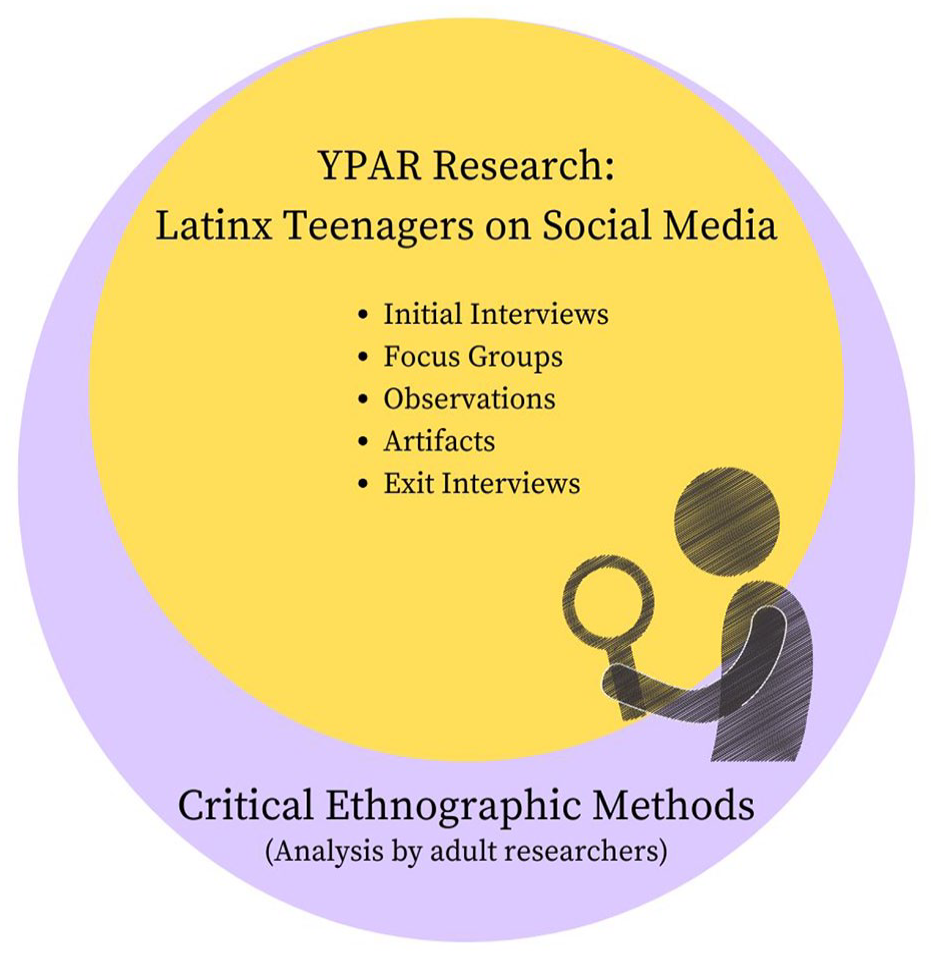
Critical ethnography of a YPAR project.
Within this figure, we place the ethnographic methods that helped us explore the teenagers’ contributions in the center circle. We saw these methods not only as key sources of data but also as learning activities to collectively build a greater understanding of social media in our lives. For example, while students’ responses in focus groups enhance our (adult researchers’) understanding of their social media experiences, the focus group was designed to support students in identifying issues for future investigation. Although we draw on data from these ethnographic methods for our analytic purposes, we clarify that they were designed to support the greater YPAR project by encouraging participants to critically reflect on social media in new ways. The Appendix includes a table to describe our YPAR sequence.
This study focuses on three 16-year-old Latina participants: Gigi, Cristal, and Perry. These three participants met the purposive sampling criteria for the larger study by identifying as Latinx bilingual teenagers who use social media. Perhaps due to being among the eldest in the larger group, these three women had more developed opinions about social media than some of the younger participants. In addition, their unique position as young Latinas on social media is a perspective that researchers frequently overlook but provides essential understandings of the ways that race, language, and gender interact online. By exclusively focusing on these participants, we were also able to reach saturation for developing code meanings and more fully explore their experiences online (Hennink & Kaiser, 2022).
These participants have unique identities, opinions on social media, and background experiences that provide various entry points to the discussion. We explored their social media use across a variety of platforms, as participants were encouraged to investigate the sites they interacted with the most rather than focusing on a specific platform. This decision supported our group in building a greater understanding of social media as a whole and how they can navigate within it. Table 1 provides a brief overview of who they are and their opinions about/use of social media. By highlighting their narratives about identity and social media throughout the YPAR process, we hope to inform and inspire future research on equity, education, and social media.
Participant Demographic Information.

Data Collection and Analysis
This critical ethnography uses data collected from the larger YPAR project, including (1) an initial interview to learn more about participants’ unique experiences with social media, (2) a focus group at the beginning of the project to share beliefs and ideas as a group, (3) observations from six YPAR workshops, (4) artifacts form students’ work, and (5) exit interviews. These data were coded on MAXQDA, a mixed-method data analysis software, to explore emerging themes. Following Braun and Clarke (2006), iterative thematic analysis was employed to explore how the three Latina student researchers talked about social media in terms of identity. Initial codes such as technology benefits and issues, friends, language, and race were noted across the corpus of data before being consolidated into three main themes: (1) self-comparisons with unrealistic social media content, (2) race and language on social media, and (3) YPAR design outcomes.
Working with this data, we followed several of Mertens’ (2019) and Miles et al.’s (2019) recommendations to ensure the quality of qualitative analysis. First, we ensured prolonged engagement with the data, working with participants over several months and taking time to familiarize ourselves with the data through various phases of transcriptions and analytic memos. In addition, the first author performed member checks within meetings by summarizing findings along the way and after the project by sharing preliminary results to ensure that students’ voices were at the center of this project. Member checking was also an important process to ensure students’ voices were the center of this project, as YPAR involves research about our research with participants (Mirra et al., 2016). Their voices are the cornerstone of this project, and we seek to amplify them in the research narrative. Finally, findings were triangulated by looking for themes across interviews, workshops, and participants’ projects. We present these themes in detail below.
Picture Perfect? Comparison to and Recognition of Unrealistic Social Media Content
Speaking about how social media made them feel at the start of the project, our three focal students shared an awareness that social media could be misleading or unhealthy, aligning with Gill and Francois-Cull’s (2023) assertion that women have highly developed critical digital literacies. While there is an awareness that the digital narratives that we see are not always the full picture, it does not stop teenagers from comparing themselves to the content catered by social media accounts.
Sometimes I feel happy but sometimes I feel bad. Not bad, but not happy. Sometimes you get too caught up with other people’s lives and you lose track of your own happiness. You see people on social media and are like I’m so jealous, and start losing like your own experience kind of.
Too focused on other people?
Like if you see rich people on TikTok you’re like I wish that was me, like my life is so bad, but it’s really not.
. . .
It [social media] shows you what you want to see . . . I always forget that people on TikTok, like this girl, is super healthy and runs and goes to this school, that’s awesome. But I forget she’s only showing what she wants to show of her life and she’s also like a person.
Cristal and Perry show it is easy to forget that the posts and stories they see are only a part of people’s lives. This could lead social media users to build unrealistic expectations of how life, and they themselves, should be. Even these participants, who demonstrate heightened critical digital literacies by questioning online content and recognizing that not all digital content is true, can fall prey to this trap.
At times you could love what you’re seeing, but at times social media is bad for you and just bad over all because people can be critical and negative and instead of lifting you up, they could lift you down, and just not feel how you used to feel about yourself.
Similar to Cristal and Perry’s comments, Gigi underscores the importance of recognizing the impact that seeing negative content on social media can have on mental health. However, as Perry mentioned in her introductory interview, “Everyone has it, so you can’t get rid of it completely.”
Their reflections emphasize how important it is to have consistent and critical conversations about these sites. This may be especially true for members of the global majority, such as these Latinx teenagers, who are often confronted with discrimination online, as we discuss below. As these teenagers recognize, for better or for worse, social media sites are not completely going away.
Race and Language in Digital Figured Worlds: Authoring and Embodying Complex Identities
Anzaldúa (2015) reflects that “My body is raced; I can’t escape that reality, can’t control how other people perceive me, can’t de-race, e-race my body, or the reality of its raced-ness” (p. 66). Participants’ comments in this study reinforce this. Though our physical features cannot always be easily indexed through social media platforms, all of our participants shared that they had seen or experienced discrimination online due to race or language. They expressed their frustration about Latinx stereotypes and pointed to social media as a large culprit in spreading these tropes.
I feel like social media, I don’t know . . . I feel like people have a set stereotype about Latino people. Like they’re loud and have a big butt. I think that’s their only idea at this point, and I think social media makes it worse.
Cristal discusses social media’s culpability in magnifying stereotypes surrounding race and, though not explicitly named, gender. It is notable that the stereotypes that she perceives about Latinas are generally negative, focusing on their physical form and often seeing them as sexualized and/or overly vocal. These findings support the idea that Latina teenagers are aware of how they are often negatively positioned in the media. While the group theorized that social media could disrupt stereotypes by highlighting dynamic Latinx identities, as referenced in Cristal’s opening vignette, they also recognized barriers as they tried to find social media accounts that accurately reflected their culture.
I don’t see a lot of Spanish-speaking influencers though.
Yeah, it depends . . .
Sometimes I come across some TikToks and I click on their page and they have like 3 million followers. It’s not like they’re just some random people. But like, it’s not, like normal here.
In these participants’ experiences, content created by BIPOC social media users is not shared or recommended frequently enough both for themselves and their communities. As Perry reflects, when she does see Spanish content, she will often look at who is posting and find that the authors are hugely popular influencers with millions of followers. Cristal’s comment recognizes how this lack of exposure to Latinx content presents a very narrow view of a rich and diverse culture and highlights how social media algorithms contribute to this issue. Perry emphasizes how this lack of exposure has personally affected her:
Like I speak Spanish, I listen to Spanish music, I participate in my culture, but they don’t see that because I’m pale and not her color. I feel like certain amounts of people don’t understand. They’re not exposed to enough Hispanic people to understand. Like another, a lot of people in Texas are from Mexico mostly, but I’m Cuban. And I’m pale. And they’re like no, she’s not Hispanic. She’s so whitewashed. But no, I just don’t participate in the same cultural things . . .
This narrative highlights the tension Perry feels as she works to express herself authentically; she feels like people frequently question whether she is Latina due to how she looks and acts. Perry’s comments are personal, reflecting on her own experiences with racism and describing how people judge her and her friends based on the color of their skin. She also attributes objectification and stereotyping to a lack of exposure and understanding of the diversity within the term Latino and pushes back against assumptions. Perry is Latina and fair-skinned. She highlights that she can be both—it should not be either/or (Anzaldúa, 2015). These identities are expressed physically and mapped onto her skin, and they also play a role in the way she authors herself online and in person.
While participants’ narratives highlight that they see Spanish as a cultural asset, they also describe how it is also used for oppression. Gigi verbalized this connection in an initial focus group, sharing firsthand knowledge about how language is often used as an index for race (Rosa, 2019).
At times, people have like very rude ways to, um, to show what language they like. Because like, you could be speaking Spanish online, and people can comment like speak English, you don’t belong here, go back to your country, and all that. And that just isn’t right for them to be saying, but that’s just how people view us sometimes.
As one of the participants who is most committed to using Spanish in our group and online, Gigi’s comment explicitly connects our conversation about racism online to language. The comment, “Go back to your country,” expresses this racism. While the commenter might not have been able to perceive race visually, the author’s language was used by their audience as a basis for racial discrimination. As Gigi mentioned this comment, no one in the group seemed surprised, signaling that the teenagers were aware of this oppressive behavior.
Extending these critical discussions about race and language, the YPAR group then critically reflected on the ways they used language online, with some reporting only using English while others mixed their languages. This was often directly reflective of their offline language choices, as we can see in the following discussion:
Would it be negative if you posted in Spanish?
No . . .
No, it’s just like you really have to, you have to adapt to your audience. Like if I’m in class I’m not going to start speaking Spanish.
I do. I don’t care.
Gigi does. Gigi will be in a group full of white people and she’ll start speaking Spanish and they’re like (makes confused face)
And I don’t care. Because that’s the language I speak and if they want to learn it then learn it. It’s not my problem.
We see here that a lot of what students do online is in response to audiences and the anticipated rules or accepted scripts of operating in these spaces. In Gigi and Perry’s conversation, they know how the “white people” at their school will react and make decisions accordingly, both online and offline. For example, Perry related her actions online to how she would behave offline, anticipating her peers’ reactions to seeing/hearing another language. While Perry says that Spanish is not viewed as negative, she acknowledges that it is not as socially accepted by her peers, and she often makes the choice not to use it. This can also be a decision to make sure that her predominantly English-speaking friends are able to follow what she is doing. Gigi takes a different stance. She disrupts the idea that these spaces should be English only and shares her pride in her heritage language. If others do not know it or do not speak it, she acknowledges that it is “their problem.” She is actively disrupting monoglossia online and offline through these policies.
When asking the others what would encourage them to use Spanish more often online, one student pointed to Perry and Gigi in a focus group, prompting everyone to laugh. Their connections through this research were a source of strength. Many had previously reported not having many chances to use Spanish at their high schools, as they found that their school did not have a large Latinx population. Through the YPAR project’s social media research, they found comunidad in shared experiences—they were not alone. This community provided encouragement as they thought about trying on new identities, supporting each other to question the world around them and reflecting on their roles within it. Their culminating YPAR projects directly build on these experiences, seeking to make social media more culturally relevant and supportive spaces.
YPAR Design Outcomes: Highlighting Dynamic Identities on Social Media
Through this YPAR experience, participants were pushed to imagine new spaces that fit their idea of how the world should work and where they could be who they truly wanted to be. While these three Latinas began this project with advanced critical literacies, recognizing that social media was not always a truthful space and promoted stereotypes, the YPAR process built critical consciousness of the systems that often limit the identities expressed and seen online. Working from these understandings, they dedicated their project to researching how to make social media a more inclusive space where everyone felt like they belonged.
Their subsequent work, reflecting on this question and brainstorming how to improve social media sites in their final project, seeks to ensure that everyone feels that they belong and are welcome in these digital spaces and to highlight diverse voices. The culmination of this study resulted in their planning for an Instagram page and a podcast to share what they had learned about these spaces and make social media more inclusive. Within our final meeting, participants created lists of influencers to follow who spanned different interests and identities—including soccer players, authors, and musicians that they viewed as cultural icons.
It was interesting to note that teenagers were very positive about social media when their collected data could be viewed negatively. For example, they discussed that 60% of their peers reported feeling connected to their race online and believed that to be a huge benefit for social media, whereas the researcher heard that and had initially focused on the fact that 40% of teenagers do not feel connected to their race. However, many of the participants had reported not feeling connected to their culture or race at schools and shared that they were the only Latinx bilingual students in a variety of spaces. This likely contributed to their positive perception of social media as an inclusive space. For a group of participants who overwhelmingly did not find that racial/ethnic connection within their school communities, the statistic that 60% report feeling connected online is an improvement from the norm. The text on their Instagram post (Figure 2) supports this: “Social media can be an outlet for people to feel included within their own racial and ethnic groups, whereas they might not feel as connected within their community in real life.” This unique perspective highlights how important it is to allow the research to be led and interpreted by the student participants.

Social media post design—creating connections.
Through these conversations, students were able to shine a critical light on these apps and build a fuller picture of the role they can play not only in their lives but also in the lives of those around them. Their reflections show that social media can influence how they express their identity, use language, connect to their race and culture, and imagine new ways of being. The decisions they make as they post online, the content they share, and who they share it with are aspects of themselves that are often strongly tied to their lived experiences off-screen. However, as we researched social media, students built critical consciousness and began to disrupt practices they saw as inequitable. Through highlighting diverse voices and accounts on social media, they can burst the algorithm filter bubbles or echo chambers in which we often find ourselves and work to make sure more people see their dynamic racial/ethnic identities, languages, and interests, accurately represented online.
Conclusion
As Anzaldúa (2015) observes, Today, the division between the majority of “us” and “them” is still intact. We are nos / otras. This country does not want to acknowledge its walls—its limits, the places some people are stopped or stop themselves, the lines they’re not allowed to cross. (p. 81)
While social media might blur some lines and allow access to new figured worlds, this study finds that, in general, social media reproduces or reflects many of the same power structures that we see offline, as seen in Cristal’s opening vignette. Participants’ reflections captured within this critical ethnography point out that while apps such as Instagram, YouTube, and TikTok often act as unique digital figured worlds with particular rules and uses, their impacts are not only felt online. We are often stereotyped based on how we look, what languages we use, and who we are friends with, both online and offline, with these unique experiences building from each other. In this way, there cannot truly be distinct “offline” and “online” identities. We need to break down binaries and highlight how the decisions we make on social media and in our day-to-day lives are deeply related. We have multimodal, complex identities that must be explored holistically and represented in digital spaces.
Social media sites are a huge part of how these teenagers relate to each other, learn new things, and move about the world. Most participants were united in seeing social media as a necessary and often positive component in their lives. Scrolling through their social media posts throughout this project, these teenagers often laughed and smiled as they relived the memories and milestones they had shared or saved online, emphasizing the joy they could offer. However, participants also recognized that there were potential negatives as well as social played a part in reproducing stereotypes that acted as online and offline barriers. As Latinas, they highlighted how they felt that they were generally portrayed in stereotypical ways related to physical appearance and behavior. This aligns with White et al.’s (2024) findings of how today’s communication processes are increasingly visual and embodied, with women being sexualized and working to define themselves as “authentic” as they express and negotiate identity.
In our discussions of how social media may reproduce or disrupt these stereotypes, students’ narratives emphasize that language is inextricably intertwined with race (Rosa & Flores, 2017). As supported in Perry’s reflections, Cristal’s opening vignette, and Gigi’s reflections on language and race, speaking Spanish was a huge part of their Latinx identity. Though Latinx people speak (and do not speak) a variety of languages, the ability to speak Spanish in this group was a way to signal or prove that they were Latina and often referenced when discussing moments when their identity was questioned. Through these discussions of language and race online, participants also observed that these sites often did not frequently recommend diverse content from BIPOC creators, which influenced narratives about what it meant to be Latinx. This returns us to Cristal and Gigi’s original conversations, in which social media can contribute to teenagers’ identity development by fostering cultural connections or limiting how teenagers see themselves. Through these critical conversations, participants were able to grow in their understanding of how social media can influence them and make more informed decisions about their activity on these apps.
Even teenagers such as Gigi, Perry, and Cristal, with a heightened awareness of how social media impacts their self-image, often compare themselves and struggle with the content they see online. Their narratives highlight how important it is to have discussions about these platforms. Their experiences navigating race and language online and offline also highlight how important these critical conversations might be to our BIPOC students, who, as this YPAR experience suggests, might not see themselves reflected accurately or at all on social media. Action research, such as YPAR, offers a unique outlet to begin these conversations and think through how to improve these platforms in the future. By interrogating what they see on these platforms and why, teenagers build critical consciousness as they become more aware of the hidden agenda and real-life consequences of social media use. Participants’ choices in topics, questions, and solutions also offer a unique perspective on their online experiences, which research and social media sites should consider.
As these teenagers’ research addresses, each of us deserves to feel like we belong, both online and offline. As nepantleras, their experiences highlight how social media can both recreate social divisions and disrupt them. However, they are also hopeful for the future; many participants see social media as a way to connect and grow. By becoming more aware of technology, we can redefine ourselves and work to overcome barriers, moving between new figured worlds and imagining new futures.
Limitations and Future Directions
This study reports exclusively on the experiences of three participants, although the overarching project included eight students. This choice was intentional to highlight and more fully explore Latina voices within research- a population that has frequently been absent in social media research. As the literature reinforces, their language, race, and gender provide them a unique perspective that can inform us on how to improve these sites (Brough et al., 2020; Dennen et al., 2020; Magro, 2018). By focusing on such a small sample, we do not make any claims to fully represent the Latina experience online but rather aim to represent these three diverse participants accurately. While previous research shows that coding saturation can be reached with smaller sample sizes in qualitative research, we encourage future studies to explore these themes with a larger population to capture a wider breadth of experiences (Hennink & Kaiser, 2022).
Footnotes
Appendix
YPAR Social Media Workshop Sequence.

| Overarching Topic | Activities | |
|---|---|---|
| Workshop 1 | What is research? How do we conduct it? | The group defined YPAR before exploring and comparing six different research methods. We also discussed how to be safe online. |
| Workshop 2 | Social Media Content: What do you see online? | Participants learned about algorithms and filter bubbles. The group also critically analyzed their own social media accounts, exploring how to code/analyze data at the same time. Afterward, we summarized our ideas about social media and discussed the research question in groups. |
| Workshop 3 | Data Collection Planning: How will we answer our research question? | Participants decided that they would interview and survey peers to answer their research question. They began creating questions to ask and explored ways that technology could support this process. |
| Workshop 4 | Finalizing Data Collection Plans: What information do we want? | Participants reflected on the data collection process and debated which questions would be better asked through surveys and which would be better in interviews. They also worked to ensure all research questions were available in Spanish and English. |
| Workshop 5 | Analyzing Data: What did we learn? | Participants shared initial findings from surveys and interviews, planning how they would like to move forward to make a difference. |
| Workshop 6 | Taking action: How can we make a difference? | In a final celebration, participants shared their main takeaways: that people need spaces where they belong online. To meet this need, they planned their own social media page to share accounts that people could follow based on their interests and culture. They also began scripting a podcast to discuss their findings about social media with peers. |
Note. These workshops were tailored to the project’s needs and responsive to participant–researcher requests. For example, the project was originally planned to be completed within four sessions, but optional extra sessions were added after considering our group goals. Prior to the workshops, there were initial interviews and focus groups for students to identify issues to guide our research. At the end of the project, students had the option to participate in an exit interview to reflect on what they learned throughout their investigation.
Declaration of Conflicting Interests
The author(s) declared no potential conflicts of interest with respect to the research, authorship, and/or publication of this article.
Funding
The author(s) received no financial support for the research, authorship, and/or publication of this article.
