




Abstract
While legacy media have received increasing attention in the literature on media and corruption in recent years, the role of digital media and, in particular, social media is still an open question in corruption and anti-corruption studies Through this study, we aim to partially bridge the existing gap in literature by focusing our attention on the study of a corruption scandal, namely the Qatargate scandal. We will demonstrate that the affordances of platforms could exacerbate the instrumentalization of corruption scandals, emphasizing the contrast of positions and creating new (and reiterating old) biases in the narrative of a corruption case.
Introduction
While legacy media, particularly journalism and the press, have received increasing attention in the literature on media and corruption in recent years, the role of digital media and, in particular, social media platforms is still an open question in corruption and anti-corruption studies (Berti et al., 2020). Given the features of the current media ecosystem, it is insufficient to solely focus on legacy media and journalism in research pertaining to media and corruption. It is imperative to expand research to encompass the broader spectrum of digital media, and in particular social media platforms, to comprehensively understand the role of the media in the representation and social construction of corruption. Data on citizens’ media consumption in recent years indicates that online platforms and social media, in particular, have surpassed print media and even television, including in Italy, a country historically centered around television (Newman et al., 2023). Online platforms, social media, and digital news outlets have gained prominence, providing individuals with a diverse range of sources and perspectives. The accessibility and interactive nature of these platforms have allowed for greater citizen participation. In the current media ecosystem, although professional journalism continues to play a central role in shaping public discourse and information dissemination, it is important to consider a plurality of diversified information sources that contribute to the definition of the public debate. The growth of the role of social media platforms has unavoidably resulted in an increase in the number of voices and messages, as well as a loss of validity and low levels of trust among citizens for conventional media (Van Aelst et al., 2017; Weimann & Brosius, 2016). Social media platforms have intensified a process of disintermediation in which, alongside the work of professional journalists, new kinds of journalism from below have evolved that are less susceptible to political/economic conditioning. The capacity to disseminate information on the internet has given rise to new information providers, permitting the distribution of corruption news that would not otherwise have entered the public discourse (Goel et al., 2012). Furthermore, it is important to consider that social media platforms today have a significant influence on shaping public discourse and the agenda-setting processes of traditional media outlets (Rogstad, 2016).
So far, there have been limited studies on the relationship between social media platforms and corruption. Although some studies have investigated the relationship between the internet and corruption, they have primarily focused on non-democratic contexts where the limited freedom of the press affects the work of journalists and newspapers, reducing the possible initiatives to combat corruption that journalism can put in place (Enikolopov et al., 2020; Frolova et al., 2017). These studies have examined how Information and Communication Technologies (ICT) can be utilized by civil society as a tool to fight corruption (Kossow, 2020). For example, they have highlighted the role of ICT in organizing public protests against the corrupt activities of government officials and politicians, given its low cost and rapid communication capabilities (Mattoni, 2017, 2020). In addition, some studies have explored the use of ICT in e-government initiatives (Bertot et al., 2010; Lio et al., 2011). Other research has analyzed the relationship between internet penetration and perceptions of corruption (Andersen et al., 2011; Goel et al., 2012; Zhuravskaya et al., 2020). However, few studies consider social media platforms and their ability to bring corruption to the center of the media agenda.
Through this study, we aim to partially bridge the existing gap in literature by focusing our attention on the study of a corruption scandal, namely the Qatargate scandal. The case unfolded in December 2022 with Belgian authorities discovering large sums of money in the offices and residences of European Parliament members. Key figures involved, many of whom belong to the European Parliamentary group of the Socialists and Democrats, included Eva Kaili (Greek Vice President of the European Parliament), Antonio Panzeri (former Italian Member of the European Parliament (MEP) turned lobbyist), and Francesco Giorgi (long-time collaborator of Panzeri and also the life partner of Vice President Kaili). Panzeri was accused of leading a network promoting the interests of Qatar and Morocco within the European Union in exchange for money, particularly during the controversial FIFA World Cup hosted by Qatar in 2022. While Qatar sought to improve its reputation amid criticism of human rights violations, Morocco also had interests in Europe related to migration control and fishing. The investigation primarily remained within the European Parliament, implicating only a small number of MEPs, with some resignations, suspensions, and partial confessions.
Analyzing this case is not only relevant for its cross-national dimension but also because it allows to observe the dynamics of online discussion of a corruption scandal that goes beyond the borders of a country. This is even more important in countries where scandals are integral to media coverage of corruption, as in the case of Italy (Mincigrucci & Stanziano, 2017). Analyzing the Qatargate, therefore, allows to verify if, in the case of a cross-national corruption scandal, the same dynamics as those that emerged for domestic corruption cases are repeated. Typically, they are seen as a crucial element in stimulating public outrage and social oversight over political decision-makers (Brenton, 2019; Ettema & Glasser, 1998). However, the coverage of scandals can be biased due to external factors such as media capture and the manipulation of news by political and business entities (Gerli et al., 2018). Such biases, well-documented in legacy media, can be exacerbated by social media platforms, introducing new or reinforcing old distortions in the narrative of corruption scandals (Marchetti & Stanziano, 2024). While some aspects of social media platforms, such as disintermediation (Chadwick, 2013) and expansion of actors with the ability to intervene in the public debate, may support anticorruption efforts, others, such as platforms affordances that fuel polarization, may further fuel the instrumentalization of scandals, promoting polarization and serving various particular interests of actors who have voice on these platforms (Nordbrandt, 2023; Settle, 2018). This is especially true in contexts with high political polarization, particularly when professional journalism, rather than serving as an impartial umpire, reflects this polarization itself, as in the Italian context, where the corruption issue is highly susceptible to being instrumentalized (Mancini et al., 2017; Vannucci, 2020) and the public debate is highly polarized (Mancini, 2013). Polarization is not only an inherent feature of politics, but is also a criterion that guides the (social) media’s selection of news. A theme that creates contrasts between different actors is newsworthy and engages social media users (Arora et al., 2022; Prior, 2013).
The structure of the article is as follows: the first section explores the limitations of social media platforms toward corruption-related phenomena. Drawing from this literature, in the second section research hypotheses are formulated and the methodology is explained. Subsequently, the data analysis and conclusions of the study are presented.
A Biased View of Social Media Platforms
As mentioned earlier, numerous studies on corruption-related scandals covered by legacy media have highlighted various criticisms regarding the actual deterrent role-played by the legacy media in relation to corrupt practices (Gerli et al., 2018; Ledeneva, 2006; Örnebring, 2012). In Eastern/Southern Europe, where media ownership is concentrated, media outlets can serve the economic or political interests of certain individuals or organizations (Marchetti et al., 2017; Zielonka, 2015). Scandals related to corruption are sometimes instrumentalized by media outlets to target competitors or align with specific political agendas. In highly polarized contexts, media coverage of scandals can be partisan, with outlets selectively highlighting or downplaying corruption based on political affiliations (Mancini et al., 2017). This suggests that media–political relationships influence scandal coverage, leading to biased reporting and selective outrage.
However, these phenomena have been observed in relation to legacy media, especially in contexts where the media market is composed of a limited number of actors who possess substantial media assets and thus have significant power to influence the public agenda. The few studies carried out so far on corruption and social media suggest a change, opening up new opportunities for a healthier and more diverse debate on corruption. Social media platforms offer opportunities for ordinary citizens to take a leading role in issues related to the fight against corruption: thanks to social media, citizens can support the fight against corruption since the increased number of social media users means a wider audience for victims of corruption, and at the same time, people may feel more motivated to act on that information to be supportive of their friends and family (Hussain, 2014; Jha & Sarangi, 2017). When discussing social media or digital media in general, the concept of the “disrupted public sphere” is often referenced (Bennett & Pfetsch, 2018). This concept highlights how the proliferation of communication channels has inevitably led to a multitude of voices and messages and, most importantly, a partial loss of power for traditional media outlets. With a greater number of actors, one could expect more possibilities for control and watchdog activities in relation to corruption. This is because the interests of a few tycoons or partisan media outlets would be dispersed within a much more varied and diverse arena. On social media platforms, alongside journalists and news outlets, there are a multitude of diverse actors who participate, including in the discourse surrounding corruption. In addition to these “traditional” actors, we also find ordinary citizens or new influential figures, such as nano or micro influencers with a narrow but faithful following or influencers with millions of followers.
A limitation of many of these studies is their adoption of a techno-deterministic approach. In particular, there are two biases that lead to this limitation. The first bias concerns an excessive emphasis on the active role of citizens in online discussions (Nielsen, 2006). Within social media platforms, in fact, not only “ordinary citizens” are involved but also a wide variety of other actors, some more authoritative, others less reliable. While social media platforms has the potential to shift the control of the discourse away from institutionalized actors, it is uncertain whether the actors who gain more prominence are exclusively ordinary citizens free from partisan influence. The diversity of interests that characterize the actions of different types of actors makes online discussion spaces complex and adaptable to different goals. The second bias is to consider social media platforms as an alternative source of information to legacy media (newspapers, television, and radio) or professional journalism (Charron & Annoni, 2021). This distinction can lead us to consider legacy media as the places where information professionals are present and social media platforms as alternative sources of information. However, along with accounts of ordinary citizens or alternative media, within social media, we also find information professionals. Social media platforms, in fact, host official pages and accounts of news outlets and individual journalists, which essentially form a subset of what we call social media rather than an alternative to them. When we talk about social media, we are also referring to legacy media because information professionals are widely present on social media platforms, using their accounts to reach their audience and give more visibility to the articles they author.
These biases led to underestimate the complexity of social media platforms, reducing them to a contrast with legacy media. Our goal is to try to break into the “black box” of social media platforms and shed light on which actors are involved and what dynamics are at play. Specifically, this article provides a contribution to the emerging field of digital media’s role in corruption and anti-corruption studies, with a focus on the Qatargate scandal. By exploring how social media platforms, particularly Facebook, have opened new spaces for public debate, we offer critical insights into the expanding role of non-institutional actors in discussions about corruption. As we will see through our data, the role of legacy media, in fact, deserves consideration because their agenda-setting power remains strong despite the proliferation of actors. Whether this multitude of voices and messages has brought improvements to public discourse is still an open question, and through the analysis of our case study, we aim to provide some insights into this phenomenon.
Research Hypotheses
In recent years, multiple studies have indicated that traditional media are experiencing a decline in their capacity to shape the public agenda and subsequently influence the prevailing opinion climate (Van Aelst et al., 2017; Weimann & Brosius, 2016). The internet’s capacity to facilitate information sharing has given rise to new information providers, intensifying competition in the information landscape and enabling the dissemination of corruption-related news, even when certain media owners may attempt to suppress it (Goel et al., 2012). Social media platforms provide a wider audience for addressing the issue of corruption, giving voice to individuals and groups who are often marginalized in mainstream media. If traditional media tend to prioritize the perspectives of institutional actors such as politicians, journalists, and judges (Mancini et al., 2017), the digital media landscape allows for a greater diversity of participants, including non-institutional actors such as alternative media outlets, collective actors, and everyday individuals. However, the role played by legacy media is not secondary, even if they change the way citizens use it. According to the Reuters Institute (Newman et al., 2023), news is increasingly reaching citizens directly through their social media accounts rather than via newspaper websites or Google. It is no coincidence that newspapers and journalists themselves have been using social media platforms for some time now. First and foremost, as mentioned earlier, a variety of actors does not necessarily mean that the old players in the agenda-building process, such as the press and politicians, completely disappear. In social media platforms, for instance, information professionals, namely official accounts of news outlets or individual journalists’ pages, are highly active and have significant visibility. They use social media to enhance the circulation of content primarily produced for legacy media (print or digital news outlets, pieces of news reporting, and so on; Djerf-Pierre et al., 2020; Laor & Galily, 2020). Similarly, social media accounts have long since entered the toolbox of political actors, even in Italy (Bentivegna et al., 2022). We assume, therefore, that the institutional actors continue to have an important role in the discussions online, including in the case of Qatargate.
Although social media studies often refer to the fact that there are different types of actors on the platforms, we rarely find empirical analyses to verify which actors are involved and what is their weight in online discussions.
H1a. Social media platforms allow a plurality of non-institutional actors to intervene in the public debate.
H1b. Traditional institutional actors (political and media actors) continue to play an important role in shaping the agenda of online discussions.
Similar to what has been observed in traditional media, social media platforms have the potential to escalate the political instrumentalization of corruption as a means to target political adversaries. Far from being the cause of polarization, we believe that social media platforms can be viewed as a factor capable of exacerbating an already prevalent phenomenon in society (Kreiss & McGregor, 2024), which, as noted by Sartori (2005), is especially common in Italy. This phenomenon is further driven by the disintermediation of information, as discussed by Chadwick (2013), and the inherent features of social media platforms that may contribute to polarization, as emphasized by Settle (2018). Within this context, we witness a polarization of the corruption issue characterized by a specific animosity toward the “other.”
We can expect that this partisanship is replicated on social media platforms as well. Indeed, on social media platforms, political actors, leaders, and even parties’ official accounts, together with news outlets and journalist accounts, present opportunities to instrumentalize a scandal, pushing toward a framing of events that is favorable to them to gain political advantages, such as the downfall of an opponent (Kubin & Von Sikorski, 2021; Prior, 2013).
Considering what has been said, our second hypothesis is as follows:
H2. Institutional (political and media) actors contribute to generate a biased and occasionally instrumentalized narrative of the phenomenon within social media platforms.
Social media platforms allow for an expansion of actors who have a standing in the media; however, a wide diversity of actors can also mean a great variety of specific and sometimes partisan interests coming into play.
The polarization dynamics mentioned before can be fueled by factors such as party identification, ideological divisions on policy matters, and the dynamics of in-group and out-group relationships, as explored by Peterson and Iyengar (2021). This applies not only to institutional actors like news outlets and politicians but to a wide variety of actors. Social media platforms do indeed provide the opportunity for a wide range of actors to engage in the debate. These are non-institutional actors who previously did not have access to the agenda-setting process. Among these, it is important to consider ordinary citizens, who, thanks to social media platforms, can express themselves both individually through their personal profiles and in an organized form within thematic groups. However, even these non-institutional actors are not free from partisan interests, and the affordances of the platforms drive them toward affective polarization. In particular, social media platforms make it particularly easy and cost-effective for malicious actors (such as disinformation pages or clickbait-focused news sites) to contaminate the debate or manipulate it (Giglietto et al., 2020a) for purposes that are not aimed at fighting and denouncing corruption. Malicious actors use websites or social media platforms to spread ideas while concealing their true identities and intentions. They are frequently used to manipulate online political discussions and increase politicians’ followers to create false impressions of popularity or to impersonate fake social media accounts to disrupt online public discourse and divert attention away from contentious issues (Marwick & Lewis, 2017).
H3. Social media platforms provide non-institutional actors (citizens, alternative media, disinformation accounts, and so on) with opportunities to polarize and/or contaminate the debate on corruption aimed at unintelligible interests.
Through this study, we will see how, in the case of Qatargate, the expansion of actors participating in the corruption debate effectively multiplies the interests at stake, leading to new forms of polarization and instrumentalization of the discourse and effectively limiting the ability of social media platforms to increase public awareness of corruption.
Data and Methods
To verify our research hypotheses, this study intends to investigate the dynamics of the discussion about Qatargate on Facebook from 9 December 2022, to 31 January 2023, in Italy. We analyzed all the posts published by public Facebook pages and groups mentioning at least one of a set of keywords related to the Qatargate case. 1 We collected a total of 14,321 posts (9,550 and 4,771 posts published, respectively, on public pages and groups) through CrowdTangle, which generated a total of 1,948,693 interactions. 2
To test our research hypotheses, we first analyzed which actors addressed the Qatargate case on Facebook to verify if social media platforms allow a multiplicity of actors to intervene in the public debate. To do this, it was necessary to classify all the unique entities that have published Qatargate-related posts in the considered period. The Facebook page and group classification process started with the classification proposed by CrowdTangle, 3 which was later checked and reworked by researchers. In the case of Facebook pages, three macro-categories (politics, media, and other actors) have been identified for a total of 15 categories of actors (see Table 1). Within these categories, we have distinguished between actors who would easily have a standing in the media (politicians, political parties, institutional sources, the traditional news outlets and journalists themselves, celebrities/influencers, and organized associations) and actors who, on the contrary, would not be able to have it (supporters/opponents, bloggers, communities, alternative media, and ambiguous sources already identified as sources of disinformation by debunking sites). In the case of Facebook groups, however, we distinguish between supporters/opponents, communities, and disinformation. “Politics” entities (including supporters/opponents) have also been classified according to their political orientation: a qualitative analysis of the description, the user name, and the cover photo has been conducted to identify references to different political parties.
Facebook Pages’ and Groups’ Classification.
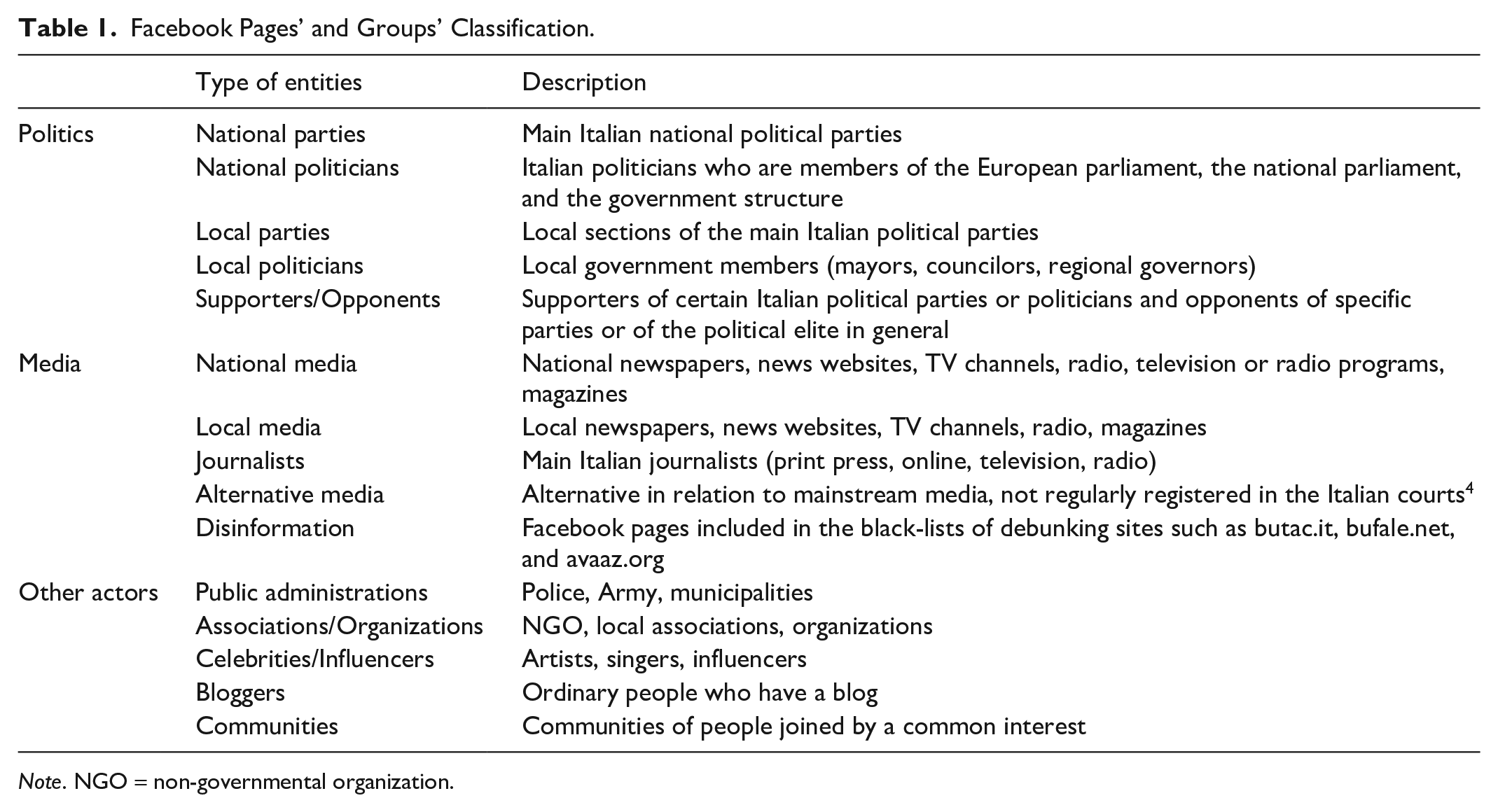
Note. NGO = non-governmental organization.
After evaluating actors, we thus analyzed the sources used by these actors within individual posts. In other words, we selected all the posts published by pages and groups containing “external” links to Facebook to analyze their domains and understand the origins of the news posted, whether they were sourced from “institutional” or “non-institutional” media outlets. Following the actor’s classification, we classified sources as described in Table 2.
Post’s External Link Classification.
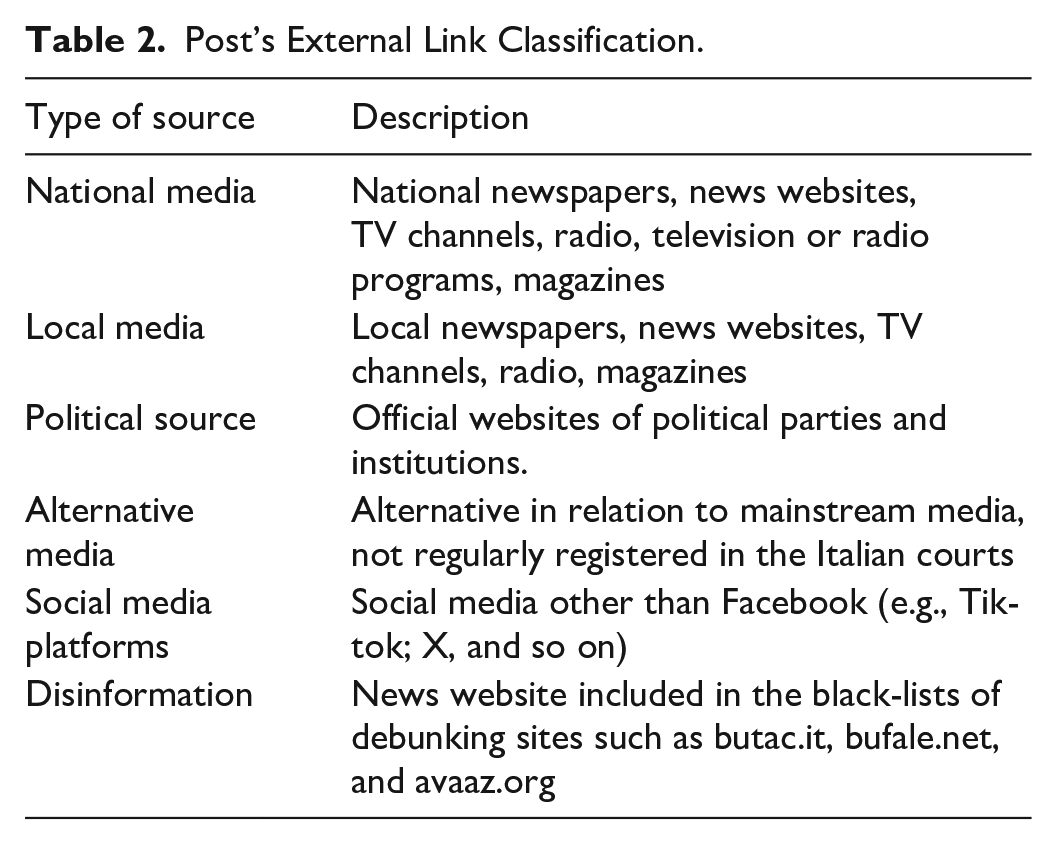
In total, we analyzed 7,271 posts containing links external to Facebook (1,791 for groups and 5,480 for pages). To verify potential forms of partisanship and instrumentalization, we carried out a network analysis on corruption-related posts to understand the discussion dynamics of the Qatargate case on Facebook. To conduct this network analysis, we have adopted a methodology used to identify coordinated link sharing behaviors (CLSBs; Giglietto et al., 2020b). CLSB refers to the coordinated sharing of the same news articles in a very short time by networks of entities composed of Facebook pages, groups, and verified public profiles. Social media actors employ this tactic in an effort to increase the visibility of content and manipulate the algorithm responsible for distributing the most popular posts (Giglietto et al., 2020a). Since our goal was not solely to analyze episodes of disinformation but rather the dynamics of post sharing regarding corruption, we adapted this methodology to conduct a network analysis without using very tight coordination intervals. Specifically, we used CooRnet, 5 an R package (Giglietto et al., 2020b) that, given a set of URLs, allows for a network analysis of the entities that share the same URLs identified in the posts related to the Qatargate case and outputs the network of entities that performed such behavior. The coordinated networks are identified by grouping just the entities that repeatedly shared the same news story. The parameters we used for network identification are (a) a coordination interval of 2 days (Devineni et al., 2017) and (b) a minimum of four repetitions. In other words, the networks under examination include accounts that have shared the same link at least four times within a 2-day period (percentile edge weight: 0.99). Regarding the choice of the percentile edge weight, we adopted a criterion commonly used in studies employing Coornet, which typically range between 0.90 and 0.99 depending on the size of the cluster (Giglietto et al., 2020b). The percentile is based on the number of times the same link is shared: a lower percentile allows for the creation of clusters with a larger number of accounts but a smaller number of co-shared links (e.g., accounts that have co-shared a link only once or twice), resulting in a less homogeneous group. Conversely, a higher percentile reduces the number of accounts within the cluster, as it includes only accounts that have shared a greater number of identical links (in our case, four times). Essentially, we chose a very restrictive criterion (four shared links) to ensure that the clusters were homogeneous and included accounts that genuinely have the habit of sharing similar content, rather than accounts that may have coincidentally shared the same link. The outputs of the analysis are elaborated in Gephi.
The conversational networks were identified to reconstruct the clusters created among the users. Specifically, the identified conversational networks are composed of 320 entities grouped in 44 clusters. To better understand the characteristics of each cluster (including entities and content), we have adopted a GPT-3.5 Turbo-assisted labeling approach utilizing the OpenAI API. This API returns a descriptive label for each cluster auto-generated by the GPT-3.5-Turbo OpenAI model. 6 Since the number of clusters was too low for statistical validation, we manually reviewed the label of each cluster to verify and improve its accuracy. Once we identified the conversational network, we carried out a qualitative analysis to identify: (a) the composition of clusters by analyzing the types of actors that comprised them and (b) the main narratives emerging from the posts shared by multiple actors within each cluster. Ultimately, we investigated the presence of polarized behaviors within each conversational network. For this purpose, we analyzed, for each entity, username, profile picture, description, and the content of the post emerged from the CLSB analysis. The qualitative analysis was carried out on the top 10 most numerous clusters in terms of entities (Facebook pages and groups), and, for each cluster, the top 10 most shared contents were analyzed to identify the presence of polarization.
Findings
The Actors Participating in the Debate
Some hints regarding the first hypothesis, actor expansion, arise from the data on Facebook groups. Indeed, the presence of non-institutional actors participating in the discussion is evident from the initial data on Facebook groups in our case study. The presence of 4,771 posts on the Qatargate case published by 1,447 unique Facebook groups (see Table 3), that are predominantly composed of common people who express their thoughts in discussion groups in which they participate spontaneously already shows the first evidence that social media platforms allow ordinary citizens to intervene in the public debate. Looking at our research hypotheses, it is also important to highlight that around 40% of the Facebook groups (unique entities) that post on the Qatargate case are politically aligned.
Facebook Groups’ Classification: Posting Activity.

A deeper examination is necessary to fully grasp who the people engaging in the Qatargate discussion are. According to the classification of Facebook pages (see Table 4), the types of actors who intervene in the public debate are expanding. Delving into the Facebook users that participated in the debate, we notice a great variety of actors who have new opportunities to intervene in the discussion through social media platforms. These include several actors, such as supporters/opponents, alternative media, disinformation sources, bloggers, and communities, who rarely occupy much space in legacy media and yet represent 30.5% of the unique entities that posted on Qatargate and that produce around 30.0% of the total posts published on Facebook pages.
Facebook Pages’ Classification: Posting Activity.

Our first hypothesis is therefore confirmed. In fact, if we look at the number of unique entities and the number of posts published, it emerges that 62.8% of the unique entities (pages and groups) who intervene on Qatargate, publishing 51.6% of posts, are composed by actors who do not usually have access to public debate (H1a).
At the same time, however, from Table 4, it also emerges that institutionalized political (national/local parties and politicians) and media (national/local media and journalists) actors represent, respectively, 26.9% and 36.3% of the unique entities that posted on Qatargate and that produce around 14.2% and 55.6% of the total posts published on Facebook pages.
These data demonstrate that institutional actors, both media and political actors, still have an important role in shaping the agenda of online discussion, producing 48.4% of the total posts published in the analyzed period on Qatargate (H1b). This influence, at least for media actors, becomes even more apparent when analyzing the sources used in posts containing external links to platforms (see Table 5).
Facebook Groups’ and Pages’ Link Classification (%).
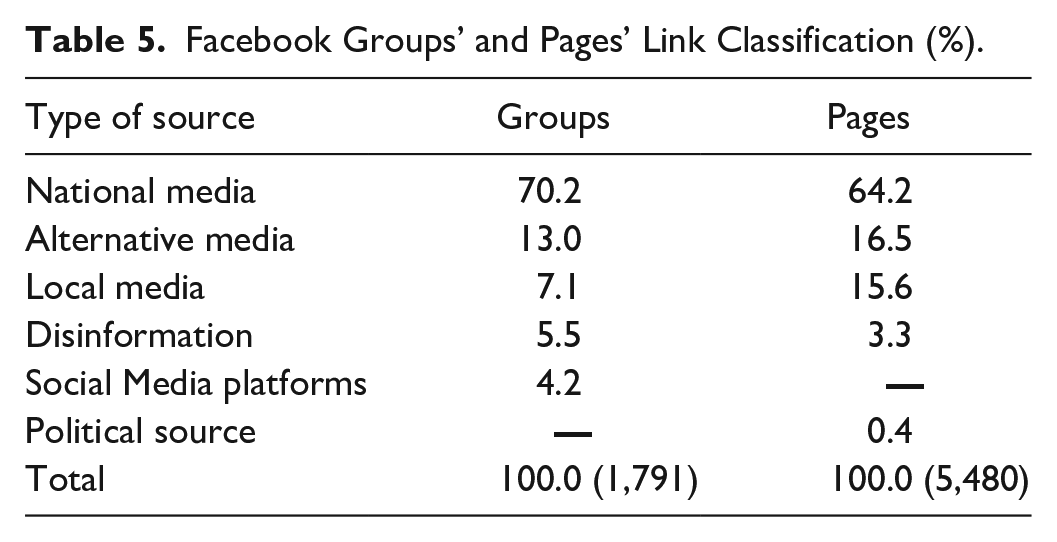
From Table 5, it can be observed that institutional media, particularly national and local media, are the most frequently used sources in posts containing external links (70.2% and 7.1% for groups, 64.2% and 15.6% for pages).
The overall analysis on actors (H1a and H1b), therefore, provides us with a multifaceted picture of the situation. On one hand, it is correct to state that social media platforms allow a multiplicity of actors to intervene in the public debate, including a multitude of alternative media, sometimes even linked to the world of disinformation. On the other hand, it is important to consider that institutional actors continue to play an important role, and their agenda-setting power is still widely acknowledged.
New Spaces for Instrumentalization
The expansion of actors involved in discussions about corruption introduces new forms of political parallelism and instrumentalization, facilitated by platform affordances that promote polarization. Facebook, known as the most polarized social media platform (Settle, 2018), amplifies polarization, particularly on contentious topics such as corruption scandals involving various actors (institutionalized and non-institutionalized). To understand this phenomenon, it is crucial to analyze the dynamics of the discussion on Facebook, including who shares or re-shares posts, common narratives, and instances of information disorder. Network analysis of shared links within posts reveals these dynamics (see Figure 1).

Visualization of the network analysis of URLs sharing.
Figure 1 displays the networks of accounts that shared the same link at least four times within a 2-day period. A summary of the top 10 clusters with the most accounts within them is reported in Table 6.
Summary of the Top 10 Clusters.

Note. 5SM = Five Star Movement; DP = Democratic Party.
As evident from Table 6, the top 10 clusters in terms of accounts have a clear connotation, with many of them being easily identifiable as political factions. We refer to Clusters 5 and 13. Within these politically aligned clusters, we can observe the presence of official accounts of partisan media outlets as well as various posts from national politicians that are reshared within the groups. Going deeper into each cluster, the largest one, namely Cluster 2, represents a network of accounts that clearly support the Five Star Movement (5SM) and Giuseppe Conte, the former Italian Prime Minister belonging to 5SM (see Figure 2). In this cluster, the official account of the newspaper Il Fatto Quotidiano is also present since various accounts within the network have shared links to articles from this newspaper. Similarly, Cluster 1 consists of accounts associated to Silvio Berlusconi’s party, Forza Italia. Cluster 13 can be considered aligned with Matteo Renzi and Italia Viva. In this cluster, we also find the official account of the online magazine Open, directed by Enrico Mentana, a well-known anchorman in the Italian journalistic landscape who is also the director one of the most followed newscasts in Italy (Tg La7). Cluster 5 is connected to the Article 1 political party and the left-wing faction of the Democratic Party. In this cluster, we can find the official account of the Article 1 political party.

Examples of accounts in Cluster 2 (5SM).
Other accounts, such as those of Clusters 4 and 6, are less identifiable with a single political party. However, their political orientation is quite clear: Cluster 4, for example, includes accounts that sympathize with Matteo Salvini (leader of the right-wing League’s party) and his political party, as well as others that profess right-wing and sovereigntist ideas. Similar to Cluster 2 (pro-5SM), we find numerous accounts from national news outlets: La Verità, TGCom24, Libero, and Il Giornale. These are all right-leaning newspapers, and in the past, it had already been shown that they tended to polarize the corruption debate (Mancini et al., 2017).
Cluster 6 consists of accounts affiliated with extra-parliamentary political groups or far-left ideologies. The narratives from these clusters are highly partisan, aiming to damage specific political figures or parties. Similarly, Cluster 5 focuses on self-defense, as Articolo 1, a left-wing party, has members involved in the scandal. Corruption scandals can irreparably damage reputations and are often used as political weapons to discredit opponents and gain public support. These narratives resemble “assassination campaigns” (Mancini, 2018), where media networks create extensive campaigns to attack politicians involved, or suspected of being involved, in corruption to harm their careers. Non-institutional actors play significant roles, but institutional actors navigate these campaigns effectively.
The clusters described above highlight a certain polarization in the discussion surrounding Qatargate: each cluster interprets the corruption case based on its own needs, emphasizing only the aspects that are most convenient for them or denouncing and defending individuals based on their political affiliation. What is particularly interesting is that the narratives emerging within these clusters are largely shaped by mainstream media articles or content, as well as posts created by institutional actors; it is precisely some of these posts that generate the most discussion and are widely shared. Notably, the most contentious and polarizing content receives the most shares. As previously said, Italian newspapers are fundamentally partisan: they have always expressed their point of view, which frequently aligns with a certain political group. What is unusual about social media is that these contents may be exacerbated by certain groups of accounts that are quite homogeneous among themselves and utilize these material and posts to strengthen their political stances. This provides support to our hypothesis (H2), which states that institutional actors on social media platforms have more opportunities to create a biased and occasionally instrumentalized narrative of corruption.
As we have extensively discussed before, the majority of the accounts identified through network analysis do not primarily involve institutionalized actors, such as national politicians, official political parties, or journalists, who already have a presence in traditional media. Instead, they encompass a more diverse range of individuals, many of whom would not have the opportunity to express their opinions publicly outside of social media platforms.
As shown in Figure 3, institutionalized actors are a minority compared to non-institutionalized actors. Confirming the data presented above, the analyzed networks are predominantly composed of accounts classified as “supporters/opponents” and “communities.” These accounts are engaged in activities on Facebook that involve supporting favored political actors, criticizing and attacking disliked figures, or discussing specific interests. Indeed, these actors, without social media platforms, would have limited access to public discourse. Social media platforms have provided them with a means to participate, express their opinions, and engage in discussions that they may not have had access to otherwise. However, within these groups, non-institutional actors circulate and comment on posts from legacy media, especially those that are more partisan and polarized.

Clusters’ account classification. 8
The contribution of non-institutional actors to the discussions on corruption often fails to diversify viewpoints or encourage genuine participation in the debate. Instead, it tends to replicate dynamics seen in legacy media, sometimes worsening polarization and partisanship. The analysis of the most shared links within the different clusters reveals significant in-group/out-group dynamics driven by both institutional and non-institutional actors. This reinforces their own identities while fostering a hostile environment toward outsiders. The Qatargate scandal, primarily involving center-left, Socialists, and Democrats European group members, becomes a tool for partisan narratives, attacking political opponents or defending their sides (mainly Clusters 1 and 2). Social media platforms exacerbate polarization and partisanship as actors exploit platform mechanisms for partisan objectives, including damaging opponents or opposing policy measures.
The instrumentalization of corruption on social media platforms often involves the circulation of news that can be considered problematic, contributing not only to the polarization of the debate but also to confusion and misinformation among the public regarding the phenomenon. Indeed, a closer analysis of the content within Cluster 17, consisting of pages that publish misleading articles for clickbait purposes (see Figure 4), and Cluster 3 (see Figure 5), which comprises accounts associated with conspiracy theories and conspiratorial content, clearly highlights the issue. These clusters demonstrate how certain actors utilize deceptive tactics to attract clicks or intentionally share false information, which ultimately contributes to the spread of disinformation.

Examples of click-baiting posts (Cluster 17).
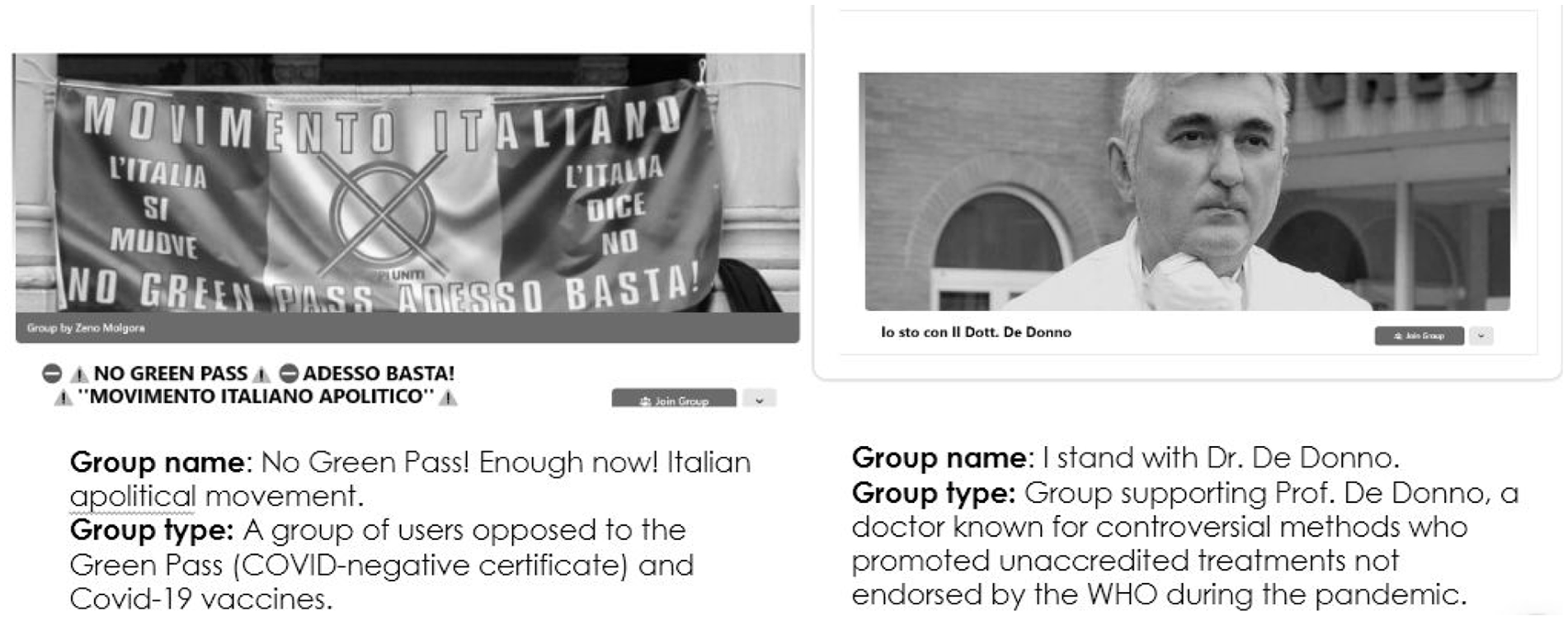
Examples of anti-vaccine, anti-government, and conspiracist account (Cluster 3).
The examples above allow us to confirm our third hypothesis, namely that social media platforms provide non-institutional actors (citizens, alternative media, disinformation accounts, and so on) with opportunities to polarize and/or contaminate the debate on corruption aimed at unintelligible interests. These are different interests: political, economic, or hardly identifiable, as in the case of disinformation accounts.
Discussion and Conclusion
The investigation into the “Qatargate” scandal presents an intriguing case that delves into the intricate relationship between social media, corruption scandals, and public discourse. Our research delving into the Qatargate case underscores the complexity of the matter. It demonstrates how digital media has amplified the voices of ordinary citizens and alternative actors, who have historically been marginalized in legacy media. This study also reveals that the influx of non-institutional actors and a broader array of perspectives into the public discourse through social media platforms do not inherently mitigate the biases and partisan tendencies that have plagued traditional media. Instead, these biases can be amplified and exploited on social media platforms, leading to new forms of polarization and manipulation of the narrative.
Returning to our research hypotheses, we can indeed assert that while it is true that social media platforms allow non-institutionalized actors to intervene in public debate on a case of corruption such as the Qatargate (H1a), it is also true that traditional institutional actors (political and media actors) continue to play an important role in shaping the agenda of online discussions (H1b). Our data, moreover, leave no doubt about the expansion of actors who have the opportunity to voice their opinions on the subject. However, these actors are unable to dilute the partisan interests at play, and both institutionalized and non-institutionalized actors find new opportunities to polarize and instrumentalize the debate. The analysis of Facebook pages and groups and the actors categorization not only enriches our understanding of how digital media is transforming the public debate on corruption but also underscores the importance of studying these spaces further.
The H2, namely, “institutional (political and media) actors contribute to generate a biased and occasionally instrumentalized narrative of the phenomenon within social media platforms,” finds confirmation not only in the more “political” clusters, which are easily identifiable with a specific political faction, especially Clusters 2, and 4, but also Clusters 1 and 13. Indeed, these clusters provide a highly partisan frame aimed at discrediting political opponents, very similar to what used to happen in the debate within legacy media. Within these clusters, the official accounts of certain legacy media indeed appear: Il Fatto Quotidiano for Cluster 2, a newspaper considered close to the 5SM; Tgcom24 (a news outlet of the Berlusconi family); La Verità and Libero for Cluster 4, which are right-wing leaning publications. These newspapers provide a highly partisan view of events in general, and the Qatargate scandal is no exception. This pattern also holds for many political actors. For instance, in Cluster 5 related to the Democratic Party and the Articolo 1 party, certain party accounts and politicians’ profiles are integral parts of the networks. In other cases, however, their posts are reshared within partisan groups. Through social media platforms, institutional actors find new avenues to amplify the partisanship of the debate as they encounter new actors ready to share their worldview and circulate their content.
But above all, it confirms our third hypothesis, which is that “social media platforms provide non-institutional actors (citizens, alternative media, disinformation accounts, and so on) with opportunities to polarize and/or contaminate the debate on corruption aimed at unintelligible interests.” Our case study indeed confirms that social media platforms have expanded the scope of participation, allowing ordinary citizens, interest groups, and non-institutional actors to join the conversation. This amplification, however, comes with a caveat: there is also an amplification of interests at play, some of which are not noble or constructive. This result is particularly evident from the high number of posts shared by these actors across all clusters or from the narratives that emerged within Clusters 17, 3, and 20. Indeed, these clusters are populated by accounts that can be considered “problematic.” Some of these have been classified as “disinformation” by debunking websites and fact-checkers (see, for example, Cluster 20). Others, although not actual disinformation pages, are accounts that produce information disorder. Cluster 17, for example, consists of pages that publish low-quality news with misleading headlines and images to encourage people to click and generate advertising revenue. Cluster 3, on the contrary, is composed of conspiracy-related accounts that use corruption to fuel dissatisfaction and outrage toward institutions.
In conclusion, our research underscores that the public debate on corruption that unfolds on social media platforms during a scandal is not all that different from what we have already observed in legacy media. The dynamics of the discussion become much more complex: a wider variety of actors, different frames at play, sometimes even challenging to map and reconstruct. However, despite this proliferation of actors, the outcome remains unchanged. Legacy media continue to play a significant role in shaping the agenda. Above all, they have a crucial role in producing a partisan and sometimes instrumentalized narrative. While the literature on scandals and legacy media (Gerli et al., 2018; Stetka & Örnebring, 2013) suggested that partisan biases in the coverage of a scandal mainly occurred due to external influences such as commercialization, media ownership concentration, and resource constraints, in social media platforms, it is the affordances of the platforms themselves that fuel the instrumentalization of a corruption case. This holds true even for a unique case like Qatargate, which involves the European Union and a specific political faction. The suitability of a case like Qatargate for instrumentalization can be attributed to several common factors found in media studies, including political objectives and economic motives. However, in the realm of social media platforms, there are additional and often unexplored factors that come into play, especially regarding disinformation pages or attempts to create informational disorder around the topic. These platforms offer unique affordances that make it easier for actors to manipulate and amplify certain narratives for their own purposes.
This work is a step toward filling the research gap on the role of social media platforms in corruption narratives, offering fresh perspectives and setting the stage for future inquiries in this rapidly evolving field. This work put forward the myth that social media platforms are intrinsically alternative to legacy media and that, as a result, citizens are particularly active in denouncing corruptive events. In fact, we have seen that within social media platforms, dynamics that were already present in the specific social context of reference, such as the polarization and instrumentalization of corruption scandals for political purposes, can be reproduced in new ways thanks to the platform’s affordances. Rather than being a panacea, social media presents a new set of complexities that demand attention and thoughtful analysis to ensure a more informed and balanced discourse on corruption.
Footnotes
Declaration of Conflicting Interests
The author(s) declared no potential conflicts of interest with respect to the research, authorship, and/or publication of this article.
Funding
The author(s) disclosed receipt of the following financial support for the research, authorship, and/or publication of this article: This publication is funded by the European Commission’s Horizon Europe Programme for Research and Innovation, Grant Agreement number 101132483 (Project: BridgeGap). Views and opinions expressed are however those of the author(s) only and do not necessarily reflect those of the European Union or the granting authority, the European Commission. Neither the European Union nor the granting authority can be held responsible for them. The publication is also funded by the research project PRIN 2022 PNRR—P2022YRFWS: SOMMOSSA. SOcial media and civic Mobilization as MOnitoring toolS in the SociAl construction of corruption. Funded by the EU—Next generation EU.
