



Abstract
Webtoons optimize interactivity and participation of media users in the world of digital media by consolidating a unique digital culture. This article examines the role of users in interactive media by exploring the case of webtoons in the context of a changing global political economy and cultural dominance. Korean platform monopolies have established a new business model for webtoons and developed it as a center of Korean creative power. While webtoons have increasingly expanded and attracted the global market and the global audience, some persistent social issues remain, including the precarious labor structure, monopolistic power in the industry, and ideological dominance in content. Although webtoon viewers are often recognized as cultural intermediaries and powerful agents for their contributions to interactive creativity, their role has fluctuated according to changing political-economic structures and industrial strategies. In the course of expanding to the global market and to new business areas such as intellectual property (IP), webtoons have evolved in new fashions while disclosing the ambivalent nature of participatory media and digital interactivity. This article elucidates the double faces of interactive creativity focusing on viewers’ participation in webtoon production in the context of changing webtoon industry and growing partnership with global media.
Keywords
Introduction
Webtoons refer to digital comics (with the term combining the words web and cartoon) that originated on digital platforms in South Korea (Korea hereafter). Webtoons have attracted attention from diverse perspectives insofar as the medium constitutes a novel digital culture in combination with business success, while having widely spread to the world in a relatively short time. The market size of webtoons has grown to over a billion USD, 1 continuously increasing by an annual average of 30% in the domestic market and doubling in the global market for the last 5 years (Y. Choi et al., 2023; Dino, 2020). It is not only the economic prowess but also the cultural significance of webtoons that draws academic attention. Webtoons are seen to have established a new digital culture, known as “snack” or “binge” culture (Jin, 2023; Nam & Jung, 2021), with other applicable descriptions being that the culture is one of cultural intermediaries (Shim et al., 2020; Yecies et al., 2019) or is an interactive culture (J. Baek, 2022; Pyo et al., 2019). These studies elucidate the role of webtoon users in webtoon culture. Because viewers not only consume webtoons but also engage in interacting with creators and other viewers, users and fans are considered cultural intermediaries (Yecies et al., 2019) or main agents of interactive communication, meaningfully impacting content-creation cycles. The seeming contradiction between snack and binge culture of webtoon consumption (Jin, 2019) equally demonstrates the integration of webtoons in the daily lives of viewers. Studies confirm webtoon viewers’ significant influence on production processes.
As these previous studies illustrate, webtoons exemplify a unique digital culture in their reliance on two-way communication between producers and users and in their propagation of user influence on production processes. However, it is debatable how to view the increasing role of webtoon users due to persistent social issues such as social inequality, the labor structure, industrial power, and ideological dominance. This study examines the political-economic structure and cultural power involved in webtoon production and explores motivations and consequences of users’ participation in digital media. Diverse theories of political economy and cultural studies including those of Bourdieu, Foucault, and post-colonial theories are adopted to examine the changing structure of webtoon production and the rising role of users in digital media.
Genealogy of the Webtoon Industry and the Changing Political Economy of Media Production
The webtoon industry has been discursively established by involvement of multiple layered power including global media production, government policies, industrial power, and digital fandom culture. It demonstrates a genealogical process that webtoons have been gradually evolved to the present form of an industry out of discretion while the grand plans of Korean government and the industry originally geared toward adjusting to the shift of global animation production and strengthening the domestic animation industry. While the Korean animation industry was ranked as high as third in the world market following the United States and Japan until the early 2000s, it was frequently argued that there was no Korean animation (Han, 2004; Moon et al., 1998). This was mainly because the Korean animation industry largely relied on original equipment manufacturer (OEM) production of foreign companies including Hollywood and Japanese companies (Yoon, 1998). Korean animation industry revenue was mostly derived from exporting cheap labor to these foreign companies through OEM production, and creativity in domestic animation remained weak. The OEM production system fostered a precarious labor structure wherein large numbers of workers were seasonally hired by global companies for low wages with no job security (Kalleberg, 2013; Yoon, 2023a). In addition, workers were required to comply with the specific orders of host companies. In OEM production systems in general, supervisors from host companies are physically present, mandating detailed orders for every line of drawing and coloring in larger projects (Yoon, 1998). There was little room for Korean animators to practice creativity while meeting the intensive hand labor requirements of the OEM system. In this way, the skilled artists of the Korean animation industry were effectively dependent on host companies without having any chance to foster self-directed creativity for a generation.
The Korean animation industry sought to find an alternative to OEM production when OEM host companies started to leave Korea in search of cheaper labor in other parts of the world in the Global South beginning in the late 1990s. Korean comics and the animation industry encountered a turning point in 1998 when the government established a new policy for supporting the media content industry. The Ministry of Culture, Sports and Tourism (MOCST) promulgated a 5-year plan for enhancing content industries, designating animation as a leading area for content enhancement. In 1998, for example, only 5.5% of animation on network TV was Korean production, whereas 94.5% was foreign (MOCST, 1998; Yoon, 2021). As a part of the 5-year plan, MOCST required network TV stations to increase domestic animation programming up to 50% within 5 years (Korean Broadcasting Institute [KBI], 2000; MOCST, 1998; Yoon, 2021). Korean government proposed additional policy plans for supporting domestic comics and the animation industry, including providing subsidies and training creators. As a part of policy initiatives, comics and animation education institutions increased: approximately 100 comics departments at the college level in addition to a handful of animation-specific high schools were established. Since then, around 2,000 students have graduated annually with animation degrees (KBI, 2000; Korea Creative Contents Agency [KOCCA], 2006; Yoon, 2005).
Nevertheless, Korean government policies to enhance the animation industry and domestic comics encountered major obstacles. One issue was that creators with comics and animation degrees were reluctant to enter into the industry. Because major animation companies specialized in OEM production focusing on labor-intensive work at in-between drawing and coloring stages of production, creators with college degrees were rarely interested in working for the mainstream industry. Instead, they devoted themselves to creating their own original works, preparing for competitions at festivals or other artistic events.
Although the animation industry took the lead of demanding governmental supports to enhance creative abilities, major companies continued to perform previous OEM production behaviors. In addition, the manhwa (print comics) industry had been played limited roles in industry change by relying on greater than 90% importation of Japanese comics. 2 Public policy initiatives were mainly oriented toward supporting the animation industry due to its industrial strength although it was based on OEM. While government plans were not successfully fulfilled due to the OEM structure of animation and industrial weakness of print comics, well-credentialed creators were interested in creative works on the margins of the industry rather than in acting within the industry (E. Choi, 2006; B. Suh, 2006; Yoon, 2005).
Diverse efforts were made to apply qualitative animation skills to works of creativity in the media at the time. Advertising pioneered the way by incorporating creativity of animation in customer-targeted media, while films such as Life is Cool (directed by Choi Ikhwan, 2008) attempted—unsuccessfully—to merge animation into live action. Animators also made efforts to find additional outlets for their creative endeavors. Emulating Japanese original video animation (OVA) was one such outlet, and Korean creators attempted to make Korean OVA—which also turned out to be unsuccessful. There were only a couple of exceptions, including Noodle Noodle (1998), an anthology of erotic animation made by distinguished creators.
Webtoons were initiated out of these efforts to utilize comics and animation arts in media. Naver and Daum, two of the major digital platforms in Korea in the early 2000s, began to include a few cuts of comic strips in their webpages as a form of advertising (Sung & Kim, 2023). Because these initial webtoons attracted viewers’ attention, Naver and Daum decided to open up separate webtoon sites. Daum started by publishing a web version of popular comics, including Love Story (Kang Full) in 2004. The following year, Naver set up a webtoon site.
The webtoons of Naver and Daum invented the digital format of viewing comics online such as vertical scrolls. One distinctive invention of webtoons above all was intended to advantage interactive digital media by adopting a competition system among content. On webtoon sites, anyone can debut as a professional webtoon creator as long as they receive a certain number of views on the webtoon sites. Naver, for example, introduced Challenge Comics on its webtoon site, within which any creator can upload their art pieces for a chance to emerge as a professional if they attract a certain number of views.
The market size of webtoons grew 20-fold in the decade from 2010 to 2020 in Korea, and Naver and Kakao have expanded to the global market by establishing branches in the United States, Japan, and Europe (Y. Choi et al., 2023; Jin, 2015; S. Kim & Lee, 2021; Sung & Kim, 2023). As shown in Table 1, the ratio of global sales of Naver webtoons to total sales in 2021 was 66%, and that of Kakao webtoons was 56% in the same timeframe.
Naver and Kakao Webtoon Sales. 3

Source. Naver, Kakao, and Mirae Asset annual reports.
Among global sales, Korean webtoons are most popular in Japan, with over 89% of Kakao global sales coming from Japan in 2021 (S. Kim & Lee, 2021).
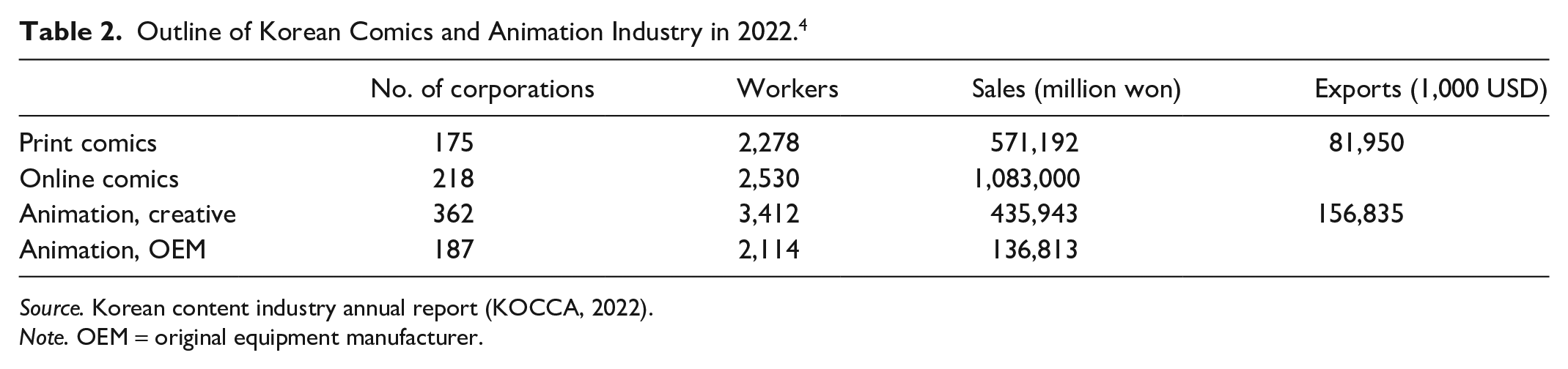
Despite increases in domestic animation and creative values of webtoons, however, a significant number of workers are still laboring for OEM production. According to a recent annual report from KOCCA (2022), 40% of workers in the animation industry are involved in OEM production for global companies. Statistics also indicate that animation records a higher amount of exports than the amount of online (including webtoons) and print comics together, as illustrated in Table 2.
Outline of Korean Comics and Animation Industry in 2022. 4
Source. Korean content industry annual report (KOCCA, 2022).
Note. OEM = original equipment manufacturer.
The report discloses that online (mainly webtoon) sales occupy over 40% of total sales in the comics and animation industry, which drastically increased to 100% in 2022 in comparison to the average 30% increase in the previous 5 years. Yet, Korean animation contributes to exports more than webtoons, according to Table 2. This demonstrates that OEM production takes a significant part in global sales of Korean animation though domestic animation, such as with Pororo occupying the top stratum of exporting animation (Yoon, 2021).
The genealogy of Korean webtoons demonstrates multiple layers of power involved in media production. According to Foucault’s framework of genealogical analysis, enlightenment thoughts and scientific knowledge emerged as new mechanisms of control in modern societies, that is, a way of more effective control, “to punish less, but certainly to punish better” (Foucault, 1977, p. 82). The history of criminology demonstrates a more effective way of controlling people in the society through science and knowledge compared to torture and bodily coercion in the pre-modern era. Foucault (1977) chases the genealogy of establishing the effective mechanism of punishment in the modern era, such as a sophisticated surveillance system and training docile bodies using the new framework of science and enlightenment knowledge. Nevertheless, Foucault finds the presence of persistent control and legacy of power in the new ways of deploying power.
Similarly, establishment of the webtoon industry discloses a genealogical process involving diverse power practices, such as the shift in global media production, government policies, creative efforts of comic writers, digital platform monopolies, and fandom culture among webtoon viewers. Formation of the webtoon industry was a complex and mundane process wherein diverse powers were in conflict with one another, gradually evolving to the industry in its present form. Although planning and narratives were attempted on a grand scale in terms of government policies and the power structures of media production, these goals were not accomplished without modification through continuous attempts, failures, and the intervention of daily practices of ordinary people such as creators and users.
Moreover, genealogical analysis of the webtoon industry reveals that the legacy of power persists as Foucault emphasizes in his framework of knowledge/power (Foucault, 1980). As global animation production has been restructured, Korean animation has gradually replaced the OEM system with creative production. Webtoons have emerged as a matter of course, consequently promoting creative ability during the post-OEM period. As Table 2 illustrates, however, OEM production remains a significant aspect of labor in the animation industry.
More importantly, webtoon production still employs a precarious work system with no job security and low payment similar to OEM production. Naver Webtoon, for example, normally releases about 10,000 pieces at a time on its platform, and 140,000 new challengers are queued up on the platform to bid for selection as contract workers (Lee, 2019). These challengers must attract a certain number of views to be selected by platform managers as professional webtoon creators with regular pay. As challengers, the majority of creators effectively remain free labor for the platform, receiving minute payment for submitted content that the platform subsequently uses and owns (Cho, 2021; S. Park, 2015). Creators are willing to offer free labor for this unpaid or very low-paying job. Such free labor can also mean another definition of free labor, which is opposed to slave labor (Lause, 2015) because webtoon creators are self-motivated to engage in the work. Hesmondhalgh (2010) addresses the growing role of free (unpaid) labor in contemporary cultural industries while challenging Marxist criticism against it as exploitation. Jenkins et al. (2013) also argue for the growing need of free labor in digital media because of its nature of spreadable media. Even compared to other digital and creative industries, the webtoon industry is prevalent in terms of taking advantage of free labor since webtoons involve pervasive free labor across the entire industry instead of being limited to a part (e.g., a short-term internship in the cultural industry as in Hesmondalgh’s example) or to a certain role (e.g., viral spread by fan communities as Jenkins illustrates).
In addition, intensive labor is a defining feature of webtoon production similar to OEM production. Contract creators are required to draw 60–70 cuts a week, with up to as many as 80 cuts for popular creators (M. Kim, 2022). Although new challengers may prefer these demands to working for free, the overall environment of webtoon production belies an exploitative system inherited from precarious labor structures in OEM production. One major difference between OEM and webtoon production is that webtoon creators are intrinsically motivated to labor without compensation by the valorizing of creativity and automatic view counts, an interplay that is similar to the dynamics of Foucault’s genealogical framework.
The majority of webtoon creators, including new beginners and challengers, are not, in fact, novice. Currently, about 60% of webtoon creators at any level are known to have graduated from schools related to comics and animation, with some having art and design training (M. Kim, 2022; Sung & Kim, 2023). Some webtoon creators, such as Kang Full and Yoon Taeho, have transferred to webtoons from print comics. Despite diversity in their professional experiences, the majority of webtoon creators have educational backgrounds related to comics and animation. Regardless of creators’ educational and career backgrounds, all webtoon creators must start as free labor and break through three conventional steps to become contract workers (e.g., in the case of gaining contract work with Naver Webtoon, the three steps are challenger, best challenger, and feature creator). Only a few established creators, including Kang Full, are notable exceptions to this process.
Major digital platforms have dominated the way in which webtoon production systems have developed. Webtoon production is a merit-based system, and one that provokes fierce competition among creators. Under this system, webtoon platforms have, in large part, maintained free labor because most creators are willing to create and submit content without compensation in hopes of gaining contract work based on view counts. Because major platforms originally launched webtoons for PR and advertising purposes, initial webtoon models relied on a free-to-view system. In adopting pay services in 2012 (Daum) and 2014 (Naver), after a decade of free-to-view systems, the free view and pay view services were mixed. Currently, Naver and Daum run a dual system for their webtoons, combining a premium model for pay views and a “wait and free” option for free views in cases where users are willing to delay views (E. Baek, 2022; Jin, 2023). The dual system is a business strategy targeting two groups of users: one group is accustomed to having had free views for a decade, and the other group is willing to pay for advent views. By employing a dual system, major platforms can maintain free labor with financial compensation for a smaller segment of creators.
Given these aspects of webtoon production, creativity is oriented toward eye-catching, sensational stories to grab and hold viewers’ attention. Erotic romance, boys’ love (BL), fantasy, horror, and survival games are popular genres, which are often repeated by webtoon creators (Jang, 2023; Jun, 2023). 5 While creators compete with one another for distinction and creativity, popular webtoons tend to blend together into typical stories with predictable patterns and images.
Under the fierce competition of the system, webtoon creators desperately seek viewers’ attention. Despite the webtoon industry’s contribution to enhancing interactive communication between users and producers and to promoting creativity through a merit-based system, the webtoon industry still features a precarious labor system similar to OEM production. Although webtoons have emerged as new opportunities for Korean comics and the animation industry during the post-OEM period, the industry has not resolved certain persistent issues of political-economic power. Arguably, these issues have deepened as the scale of free labor has expanded due to the intense competition in webtoon production.
Digital Creativity in Webtoons: Cultural Intermediaries or Cultural Appropriation?
Among interactive media, webtoons are a strong example of fandom culture and viewer participation. Webtoon viewers adhere together, forming a kind of community that shares a subcultural ethos while actively participating in activities on webtoon sites. Webtoon platforms further boost viewers’ participation by leaning into the competition system. Under this system, viewers play a strong role not only by consuming the product but also by influencing the production process through comments and suggestions that reach creators and platform administrators.
Interactive Media and Ambivalence of Cultural Intermediaries
The active role of webtoon viewers renders them cultural intermediaries in reference to Bourdieu’s theory, or powerful agency according to Giddens’s theory (Shim et al., 2020; Pyo et al., 2019). In terms of affective, cognitive, and behavior frameworks, the relationship between webtoon creators and viewers is also categorized as parasocial interaction (Baek, 2022; Horton & Wohl, 1956). These notions stress the importance of interactive communication and the meaningful influence of viewers on the production process in the webtoon industry. Webtoon viewers not only give feedback to creators but also virtually work as translators and word-of-mouth promoters of their favorite webtoons to spread the webtoons’ popularity worldwide. A big data analysis of webtoon viewers finds that 50,000 volunteers work in translating webtoons in 32 countries (Other studies demonstrate how viewers’ comments and criticism are directly incorporated in webtoon texts (Nam & Jung, 2021; E. Suh, 2022). Studies confirm the strong role of webtoon viewers in actively influencing the production process and mediating consumption and production in the industry.
Functioning as cultural intermediaries and exerting powerful influence, however, can be a double-edged sword for media users. Bourdieu addresses the ambivalent nature of designation as cultural intermediaries, which is often overlooked by followers (Hutchinson, 2017; Negus, 2002). Bourdieu (1993) emphasizes that a structure within which power strata are intermediated by social groups is a way of consolidating the power hierarchy rather than liberating the powerless. Using the notion of cultural intermediaries, Bourdieu reveals the deepening power of the dominant class, whose expansion is allowed beyond economic and social dimensions into cultural and symbolic domains. Bourdieu elucidates both sides of the coin in cultural intermediaries: while they appear to have autonomy from social norms and capitalist motives in prioritizing artistic practices and avant-garde aesthetics in the realm of culture, the flip side is that cultural intermediaries are working within the larger context of the capitalist system, thereby legitimizing the proclivities of the dominant class. In this sense, Bourdieu (1984) designates cultural intermediaries as the “new petite bourgeoisie,” who ultimately contribute to fostering the social dominance. While conducting a social survey of consumption during the 1960s to early 1970s in his book Distinction, Bourdieu illustrates cases of cultural intermediaries such as producers, critics, and journalists as well as artists (Brienza, 2010; Maguire & Matthews, 2010). They are seen to consolidate stratification of society rather than to unfetter it from social inequality.
David Hesmondhalgh (2006) builds on Bourdieu’s notion of cultural intermediaries and addresses the problem by applying it to mass media while Bourdieu focuses on “small cultural production” or high culture. Although Bourdieu does include media professionals such as critics and designers in his group of cultural intermediaries, Hesmondhalgh points out that Bourdieu’s schema has limitations in explaining “grand cultural production” (or mass culture). Hesmondhalgh also addresses the problem of misusing the notion of cultural intermediaries by proponents who inadequately apply the term to their studies of mass culture (Benson, 1999; Maguire & Matthews, 2010).
However, Bourdieu (1996) deliberately focuses on arts and literature (or high culture) because these endeavors represent bourgeois culture, while at the same time validating autonomy and resistance against the mainstream and dominant ideology. Cultural producers and creators in art and literature make claims for new values and creativity by challenging pre-existing beliefs and the dominant mode. Autonomy in artists and cultural producers is vital and an integral aspect of cultural intermediaries. Nevertheless, Bourdieu sees that their autonomy is bound to the larger social system even when they challenge dominant norms and modes. In this sense, Bourdieu’s position is different from other critical theorists who validate the autonomy of artists and producers by asserting that the ultimate power of art is to transform society (Adorno, 1941/1973; Gibson & Rubin, 2002). In a lecture at Ecole Normale Superieure, Bourdieu (1992) clearly points out that autonomy of artists is a constraint to the existing power hierarchy and the rules of society, or what he calls the “field.” He sees that the challenges and resistance instigated by artists or cultural intermediaries play within the acceptable rules of society’s games, or what he calls the “habitus” of artistic activities (Bourdieu, 1984). Bourdieu maintains a critical position against cultural intermediaries who only appear to be autonomous and to challenge the existing values of society. He focuses on high art because it goes without saying that mass culture serves existing power structures and capitalist reproduction.
Bourdieu’s notion of cultural intermediaries has been expanded to encompass mass culture and to explain consumption behaviors in the digital age since the development of interactive technology, wherein media audiences and ordinary consumers increasingly influence production processes in the form of prosumers, online influencers, and/or fandom (Baruch, 2021; Zwick et al., 2008). In the case of Webtoon, the strong influences of viewers in production are frequently identified with cultural intermediaries (Shim et al., 2020; Yecies et al., 2019). Although the role of media users is increasingly impactful due to interactivity and direct participation through digital media, whether users play the role of cultural intermediaries, which by definition rely on an element of autonomy according to Bourdieu’s theory, remains unclear.
Above all, the role of media users is influenced by the changing structure of the media industry instead of maintaining their autonomy. As the business scale of webtoons has increased and globally expanded, the webtoon industry has transformed its production system accordingly. Webtoon platform companies increasingly intervene in creative processes. Results of in-depth interviews with webtoon creators reveal that collaboration is now so extensive that production sections are specialized by separate creators, and the entire process is managed by professional producers hired by webtoon platforms ( M.Kim, 2022; J. Kim & Yu, 2019). For example, the division of labor has progressed in webtoon production, with writing and drawing treated as discrete processes by separate teams of creators. Professional producers manage the entire creative process according to findings from marketing research and analysis of viewer feedback.
Global Expansion of Korean Webtoons and Cultural Appropriation
Webtoons have expanded their business not only by exploring new markets but also in new areas. Webtoons have emerged as the leading IP business in Korea by selling stories to other media such as episodic TV, films, and games. From 2006 to 2012, 62 TV dramas, 28 films, and 10 animated films were made based on webtoon stories (S. Kim & Lee, 2021). The IP business of Korean webtoons continuously grows, with over 100 TV dramas remade from webtoon originals in 2022. Webtoons have also become a reliable source for successful Korean films. Although the proportion of IP revenue in total webtoon sales is 12%—for comparison’s sake, sales from pay views and subscription fees comprise over 60% of total webtoon revenue (Yoo et al., 2023)—IP business is promising for creators by offering generous incomes. The growing IP aspect of the webtoon industry encourages many challengers to create attractive stories for transmedia with dreams of becoming millionaires like the creators of Along with the Gods (Joo Ho-min) and Moving (Kang Full). The reality, however, is that the average monthly income of webtoon creators is less than $1,000 USD (M. Kim, 2022; Lee, 2019), a calculation that includes the wages of a handful of millionaire creators. This means that most challengers in the webtoon business still experience the exploitation of free labor.
Disparities of income in the webtoon industry and fierce competition among creators have increased since global OTT companies have begun to partner with webtoon IP in the industry. Many Netflix and Disney+ originals from Korea are based on webtoon stories. Since the production of Kingdom (2017–2018), Korea’s first Netflix original inspired by a webtoon, about 20 Netflix originals have been made based on Korean webtoons through 2022. Disney+ also actively extracts stories from Korean webtoons, with the popularity of Moving prompting the company to raise its subscription fee to 40% in Korea. 6
Out of all the possible Korean webtoons on which to base original series, global OTT companies tend to select stories with aspects of horrific violence and cruelty in exotic environments. For example, Kingdom features zombies in Korean historical settings (see Figure 1) drawn from the webtoon called Land of the Gods (Yang Kyongil, 2015). The top show on Disney+ among Korean productions features X-men-type mutants, fusing stories of North Korea espionage and KCIA (Korean Central Intelligence Agency) agents based on Kang Full’s webtoon Moving (2017).
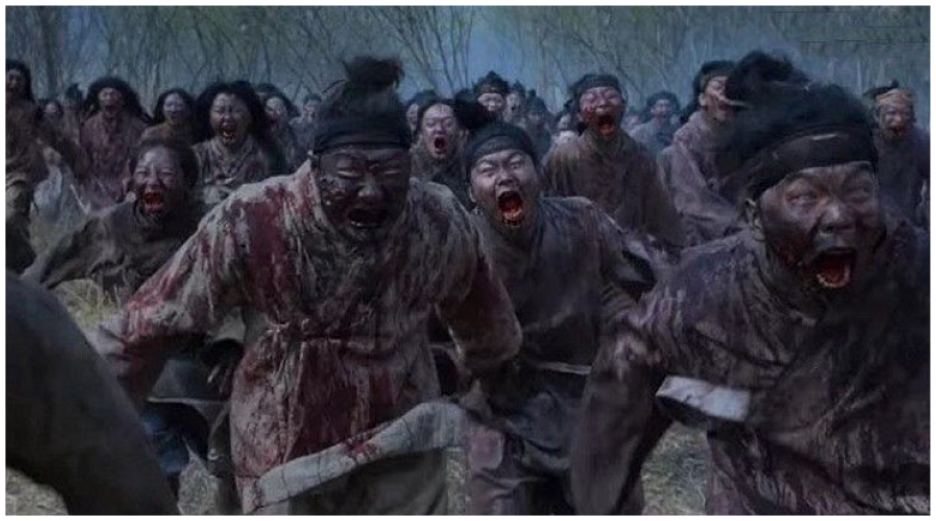
Zombies in the Netflix series Kingdom (2017).
Similarly, IP from over 20 other webtoons that have been remade for global OTTs emphasizes extreme violence and dark fantasies in exotic environments. Netflix originals from Kingdom (2017), DP (2021), and Hellbound (2021) to Our School Now (2022–2023), as well as Korean productions for Disney+ including Connect (2022) and Moving (2023) all feature monstrous cruelty and catastrophic disasters set during the end times. While focusing on different plots and characters, Korean collaborations with global OTT commonly portray eccentric stories in dark and apocalyptic settings. 7
These trends in global OTT channels are quite distinctive from original hits based on webtoon stories previously featured in Korean media, such as the film Moss (directed by Kang Wooseok 2012) and TV drama Incomplete Life (TvN 2014).
Previous Korean hits demonstrate social criticism by dramatizing aspects of realistic portrayals of society. The TV drama Incomplete Life, for example, received wide sympathy from young viewers by touching on the social issue of precarious labor in Korea. The film Moss depicts the pathological psychology of collectivism in remote areas in the Korean countryside, as shown in Figure 2. Popular Korean TV dramas based on webtoon stories continuously involve themes of poetic justice and humanism like in Itaewon Class (JTBC, 2020; Yumi’s Cells TvN 2021, 2022), and Nabilera (TvN 2021), as illustrated in Figure 3. In contrast, global OTT channels consistently depict monstrous creatures and exotic surroundings. 8
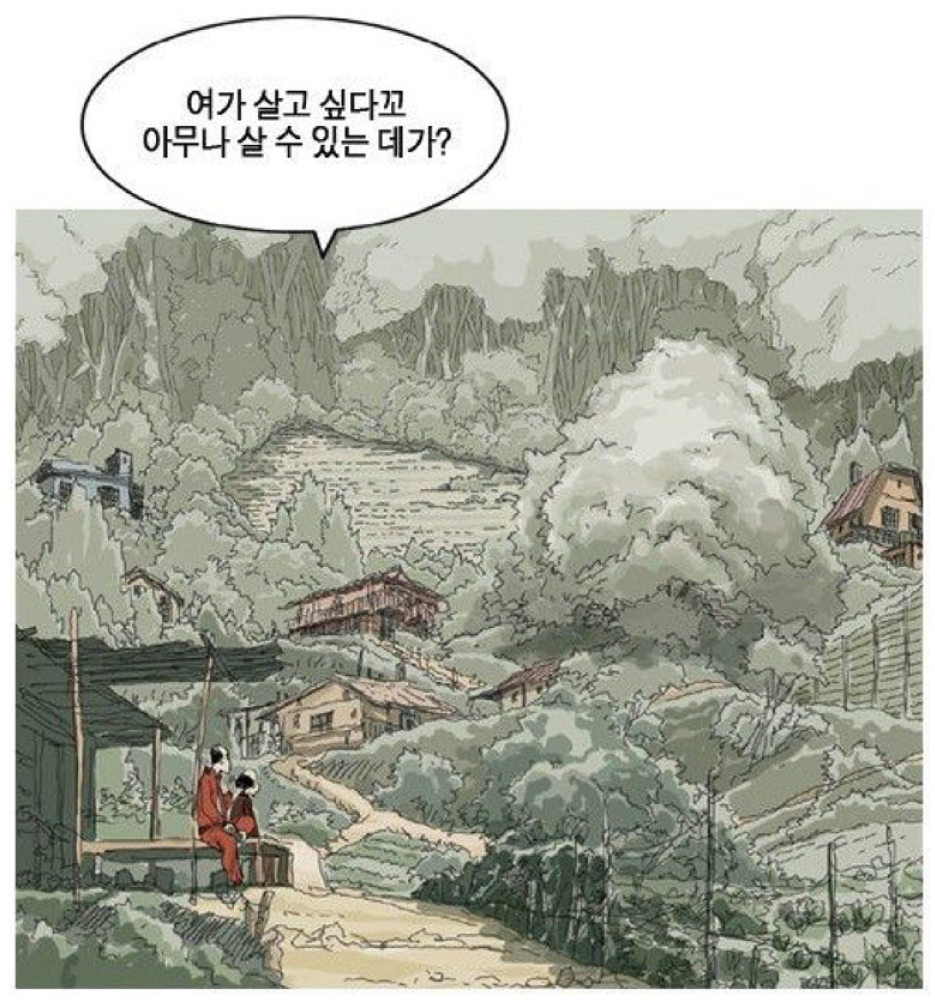
Totalitarian surveillance community in a remote countryside portrayed in the webtoon Moss.

Webtoon Itaewon Class and TV series Itaewon Class (JTBC, 2020), featuring the story of a young man’s revenge against the malicious enemy of his father and his achievement of true justice.
Original IP is evidently transformed in the process of traversing distinct media. One intentional transmedia strategy that derives new narratives from original narratives is known as the spin-off strategy (Jang, 2023; Jenkins, 2003; Kang, 2022). Korean webtoon Cheese in the Trap, for example, which has been remade for both TV (TvN) and film, demonstrates a solid spin-off strategy by adjusting different aspects of the story to different media: the TV series emphasizes action and romance, while the film portrays thrills and crimes (Jin, 2023; Yecies et al., 2019). Even the hit film Along with the Gods is a spin-off, provoking criticism among the story’s original webtoon fans.
As global OTT companies increasingly adopt webtoon stories, IP business is directed toward a new pattern distinctive from the general trend of transmedia storytelling to become popular films and TV dramas such as Guests o Feast (Huh Youngman, 2003) and Full House (Won Suyeon, 2004). On the industry side, copyright issues are ignited as the stakes of IP business rapidly increase due to the relationship with global OTT. Webtoon IP rights are not properly acknowledged, and creator compensation can be lacking because platforms usually monopolize IP at the expense of creators’ rights. The Korean government intervened to mitigate such unfair conduct of webtoon IP businesses but have not yet resolved all such issues, particularly in relation to global partnership. 9
On the cultural side, global OTT companies further spin off strategies by perpetuating certain images of Korea that fit stereotypes of Asia as a dark and exotic place. Post-apocalypse and creature genres that are currently booming in popularity are often cited among creators to meet the interests of global OTT as illustrated in Figure 4. 10

Post-apocalypse themes in webtoon IP-based Netflix original Sweet Home (2023).
Although Korean webtoons have in the past explored various genres such as eroticism, horror, fantasy, and queer baiting in line with viewer interests, webtoon content currently leans toward distinctive trends intended to appeal to global OTT. Accordingly, Korean webtoon pieces reproduce Asian stereotypes and almost exclusively portray monstrous creatures and characters in primitive and superstitious environments.
Webtoon IP in global OTT channels is seen to demonstrate a pattern of cultural appropriation from the perspective of cultural studies. The term cultural appropriation describes a global power engaging in cultural exchanges among nations or ethnic groups, resulting in negative effects on local cultures due to an inevitable imbalance between the global power and the powerless groups. Cultural appropriation refers to “the use of a culture’s symbols, artifacts, genres, rituals, or technologies by members of another culture, which is inescapable when cultures come into contact” (Rogers, 2006, p. 474). Conceptually, cultural appropriation is negatively considered to be a way of distorting or dominating other cultures (Penaloza, 2001; Varman & Belk, 2009). Cultural appropriation often contrasts with another notion of cultural exchange—namely, cultural appreciation. In accepting cultural differences, cultural appreciation is a valorizing act of cultural adaptation (Cruz et al., 2023; Lenard & Balint, 2020). A meaningful difference between the two concepts depends on whether inequity and unfair conduct is exercised in an initial cultural exchange between differing groups. Cultural appropriation involves exploitative relationships between the powerful and the powerless, thereby harming the cultural practices of the marginalized and locals (Matthes, 2016; Oh, 2023; Rogers, 2006, 2007).
Cultural appropriation is often used as an analytical term in sociology of music. The history of pop music includes cases of cultural appropriation from blues to hip-hop, all of which demonstrate that music in Black communities has been appropriated by the mainstream culture. Cultural appropriation results in blurring and damaging cultural identities of marginalized groups, in addition to economic exploitation. Hip-hop music is frequently cited as an example of cultural appropriation. Potter (1995) addresses cultural appropriation in the context of hip-hop by analyzing how hip-hop music has been appropriated by mainstream producers (mostly white people), while Black musicians have struggled to protect their rights and musical quality by holding independent concerts and finding smaller music labels, which have frequently ended up failing. Cases of world music, including reggae and calypso, also illustrate cultural appropriation by mainstream and commercialized segments (Frith et al., 2001). Currently, Korean pop music (K-pop) is drawing attention as the target of debates on whether it constitutes a case of cultural appropriation (Cruz et al., 2023).
Korean webtoons demonstrate another case of cultural appropriation insofar as global OTT companies are increasingly involved in webtoon IP. Compared to the cases of world music, webtoons demonstrate a more complex process of cultural appropriation because the industry is largely maintained by local companies. The webtoon industry is different from cases of hip-hop and world music in which mainstream producers acquired small operations and directly managed their music production. In contrast, in the case of webtoons, Korean companies maintain leadership in the global market by establishing global branches and/or leading the industry in deciding to circulate products through global platforms. Because the webtoon business was initially founded by strong platform monopolies in Korea, these companies have maintained stable positions and still play central roles in the global market.
While Korean platform companies have remained dominant in business, cultural appropriation of Korean webtoons occurs on another level in the creative sphere. Because global OTT companies partner with webtoons for IP and offer promising rewards and chances of global recognition, many webtoon creators try to meet global demands for the sake of being selected. While Korean webtoons have achieved tremendous business success and fandom culture through attributes of versatility and responsiveness, these characteristics open the door to vulnerability at the hands of external power. Versatility in webtoons leaves them easily susceptible to cultural appropriation by global OTT for the sake of strengthening IP-based partnerships, as evidenced by redundancies of certain genres and images in global OTT series.
Conclusion
Webtoons are frequently cited as a symbol of Korean cultural power (or Hallyu), along with K-pop and K dramas and films, which are increasingly globalizing and getting popular over the world (Jin, 2023; KOCCA, 2020; Yoon, 2018). Webtoons in particular have attracted academic attention because of their theoretical implications. Among digital media, webtoons optimize interactivity and participation of users through versatility and responsiveness insofar as content is selected and promulgated mainly according to users’ reactions. Interactivity in webtoon production fosters users’ participation and fandom activities.
However, the high interactivity and strong fandom culture of webtoons demonstrate the ambivalent nature of digital culture. The birth of webtoons and their evolution demonstrate a genealogical constitution of the industry and involvement of complex and extensive power practices from diverse sources, including global media production, political initiatives, creative competition among writers, and fandom activities of media users. The genealogy of the webtoon industry insinuates that the political-economic base and cultural practices are both sides of a coin affecting one another. This genealogical analysis regarding formation of the webtoon industry, contribution of digital fandom culture to interactive creativity, and its fluctuation in the context of changing global production systems demonstrate theoretical implications that link the perspective of cultural practices and the context of political economy. On the political-economic side, the webtoon industry was initially established according to business interests and policy initiatives under the pressure of a changing global economy in the post-OEM period in Korean animation. While evolving into a premier creative industry, legacy of the previous OEM production remains for webtoons—most specifically, the precarious labor structure and job insecurity for creators. Intense competition in the industry and active participation of viewers have enlarged the scale of free labor in webtoon production rather than mitigated the labor issues.
On the cultural side, webtoons have drawn academic attentions distinctive from K-pop and other Korean media products that are often targets of theoretical debates pertaining to cultural identity. Some critical scholars assert that K-pop is an emulation of Western music and its systems of production (Lie, 2012; Yoon, 2023b). Notions of hybridity and mimicry are frequently used in reference to post-colonial theories to explain issues of cultural identity and the nature of K-pop and Korean media (Kraidy, 2005; Yoon, 2018). Webtoons, on the contrary, have remained insulated from such criticism because creators and viewers involved in webtoon production are so abundant that a certain degree of diversity has been maintained. Webtoon communities are comprised of an immense number of members, including countless viewers that are reacting to numerous pieces online at a time. Accordingly, webtoons offer narratives in so many diverse topics and stories that multiple traditions and ways of life coexist with one another in the same digital space.
The webtoon industry is, however, entering a new phase as it expands to the global market and to new business opportunities. Webtoon production is increasingly managed by platform monopolies based on big data analysis of markets and viewers (J. Park et al., 2019). In addition, global media have begun to affect creative aspects of webtoons, just as webtoons have emerged as a major source of transmedia and engines of IP. Korean webtoons tend to merge into certain genres and stories, regularly portraying violent and primitive images against plot lines involving total catastrophes in end times for the sake of appealing to global audiences and being selected by global OTT for IP partnerships. While Korean webtoons are evolving into a major source of transmedia and IP business, diversity and autonomy in webtoon communities appear to be decreasing. Recent changes in the webtoon industry reveal cultural appropriation by global powers, which heralds the stereotyping of local cultures and the blurring of cultural identity of Korean traditions.
Footnotes
Declaration of Conflicting Interests
The author(s) declared no potential conflicts of interest with respect to the research, authorship, and/or publication of this article.
Funding
The author(s) received no financial support for the research, authorship, and/or publication of this article.
