




Abstract
Social media are an important source of news during crises such as terrorist attacks. However, how news media and their audiences make sense of terrorism on social media is subject to bias, for example, given their differential treatment of terrorism by right-wing versus Islamist extremist perpetrators. In this study, we analyze how incident- and perpetrator-related characteristics of terrorist attacks are associated with bias in public debates about terrorism on YouTube. We focus on selectiveness in which attacks are covered (gatekeeping bias), how attacks are covered (presentation bias), and how audiences react to coverage (audience bias). Methodologically, we employ a manual and an automated content analysis of terrorism coverage by five international broadcasters on YouTube (N = 643, 2018–2020) and related user comments (N = 193,721). Our findings illustrate how sociocultural contexts shape news bias in terrorism coverage, both in the form of gatekeeping bias and presentation bias—but we conclude with less evidence for audience bias in public reactions to terrorism, at least on social media. Consequently, journalists should critically question working routines in covering crises to avoid reinforcing power imbalances, especially those from Western contexts.
Keywords
Introduction
In December 2020, terrorists attacked several ethnic communities in Ethiopia, killing more than 200 civilians (Start, 2020). In comparison with previous, less fatal attacks in Western countries, these incidents did not receive much attention from news media or citizens across the world. Similar asymmetries in public attention to terrorism are well documented (Avdan & Webb, 2019; Sui et al., 2017). This differential treatment illustrates that public debates about terrorism are subject to bias: Due to in- and out-group thinking, public debates often downplay violence perpetuated against out-groups, such as citizens in culturally or politically dissimilar countries. Researchers have found ample evidence of bias in how much attention news media give to terrorism (Sui et al., 2017), how they cover terrorism (de Veen & Thomas, 2022), and, relatedly, how audiences react to terrorism (Avdan & Webb, 2019).
While bias in public debates on terrorism has long been studied, the issue has been amplified, and thus become more pressing, due to the emergence of social media. Today, digital platforms like YouTube are a key access point for news (Newman et al., 2023), especially during rapidly unfolding crises. On social media, however, news media have partly lost their grip on gatekeeping the flow of news as they are torn between providing urgent information and fighting misinformation (Konow-Lund & Olsson, 2017). Meanwhile, citizens grapple with finding accurate information and making sense of acts of violence (Hohner et al., 2022).
In today’s crisis-ridden societies, bias in public debates about political violence can exacerbate societal polarization, as illustrated most recently by Russia’s attack on Ukraine (Soares et al., 2023). Some of the consequences of terrorist attacks and, relatedly, biased social media debates include outbursts of hate speech (Czymara et al., 2023) or shifts in citizens’ policy preferences (Godefroidt, 2023). More generally, public debates about terrorism reflect “which groups society is willing to protect, and what kind of violence it is willing to tolerate” (Fisher, 2017, n.p.). As such, the way in which news media portray terrorism and audience reactions to it has profound implications for policy agendas (Kantorowicz et al., 2023).
However, research on public debates about terrorism is limited. Existing studies have primarily focused on either bias in journalistic coverage (de Veen & Thomas, 2022; Sui et al., 2017) or citizens’ reactions (Avdan & Webb, 2019; Krutrök & Lindgren, 2018), with little attention given to how these are intertwined. As news media have considerable agency in shaping citizens’ threat perceptions (Feick et al., 2021) and set the public agenda in the aftermath of attacks, even on social media (Yang & Sun, 2021), studies should simultaneously consider bias in journalistic coverage and citizens’ reactions. In addition, existing studies have focused on coverage by Western outlets (but see Chan et al., 2023) and neglected the uptick of White supremacy violence, especially since the Christchurch attacks in 2019 (see critically Hase, 2023). When studying social media debates, studies further focus on single, sensationalized attacks (see critically Krutrök & Lindgren, 2018).
To address these gaps, we analyze bias in how news media and citizens discussed global terrorist attacks between 2018 and 2020 on YouTube. Specifically, we study how perpetrator- and incident-related characteristics of attacks shape news coverage and audience reactions on social media. We disentangle different types of bias, focusing on gatekeeping bias (i.e., which attacks are covered), presentation bias (i.e., how are attacks covered), and audience bias (i.e., how audiences react to attacks). Methodologically, we employ a manual content analysis of news coverage by international broadcasters on YouTube (N = 643) and an automated content analysis of user comments (N = 193,721).
Theoretically, we advance research by shedding light on different types of bias in public debates about terrorism, including the entanglement of gatekeeping, presentation, and audience bias. Empirically, we extend existing work on perceptions of terrorism on social media beyond singular attacks. Practical implications of our study include appeals to journalists to carefully scrutinize bias that emerges in news coverage related to their social identities, given that these may have downstream effects on citizens’ perceptions of and reactions to terrorism.
Terrorism: A Catch-22 Situation?
Although “terrorism” is a contested concept without a consensus definition (Saul, 2019), scholars mostly conceptualize it as the (threatened) use of violence for political goals (Weinberg et al., 2004). The Global Terrorism Database (GTD), an open-source database at the University of Maryland that includes information on terrorist attacks, defines terrorism as “the threatened or actual use of illegal force and violence by a non-state actor to attain a political, economic, religious, or social goal through fear, coercion, or intimidation” (Start, 2020, n.p.). However, especially, governments often attach the label for strategic reasons, including advancement of their own agendas (Hase, 2023).
Due to this ambiguity, news media are faced with a conundrum when covering terrorism. The relationship between terrorism and the media is often called a “symbiosis” (Miller, 1982), albeit others have argued that “parasitic” might better describe this asymmetric power relation (Rothenberger, 2023). Given their democratic function, news media are expected to inform citizens about unfolding crises. However, news media cannot cover the entirety of acts and actors of political violence across the globe, making coverage necessarily selective. By only bringing specific terrorists and their actions to the limelight, news media offer these actors visibility and shape citizens’ often selective perceptions of terrorism (Feick et al., 2021).
Citizens’ reactions toward terrorism are similarly consequential: After all, “public perception is the instrument targeted by terrorists to achieve their political goals” (Kantorowicz et al., 2023, p. 1). Not only are perceptions of terrorism selective (Huff & Kertzer, 2018), they can, also mediated by news, affect citizens’ policy preferences (Godefroidt, 2023). Through public pressure, citizens’ policy preferences may then be transformed into policy responses.
Much like other crises, terrorist attacks, therefore, constitute essential moments of power redistribution. By giving a voice to some actors (but not others) and depicting actors as (ill-)legitimate, both news media and citizens (de-)incentive terrorists to pursue further attacks and policymakers to (dis-)engage in conflict resolution.
Bias in Public Debates About Terrorism
To understand power redistribution during crises—here, how news media and citizens shape public perceptions of and, by extension, reactions to terrorism—we adopt the conceptual lens of bias (Entman, 2007; van Dalen, 2012). Specifically, we focus on news bias (selectiveness in how news media cover terrorism) and audience bias (selectiveness in how audiences react to terrorism and related coverage).
Entman (2007) defined news bias as “consistent patterns in the framing of mediated communication that promote the influence of one side in conflicts” (p. 166). News bias can manifest in different forms (for an overview, see D’Alessio & Allen, 2000), including gatekeeping bias (selectivity in which attacks are depicted) and presentation bias (selectivity in how attacks are depicted, with sub-dimensions like framing). Researchers frequently rely on the concept of bias to understand terrorism coverage (Chan et al., 2023; de Veen & Thomas, 2022).
Conceptually, we distinguish news bias from audience bias (selectivity in how audiences react to attacks). As most individuals do not witness attacks firsthand but are informed about them through the news, “the media has significant agency in shaping how the public comes to classify violent events” (Huff & Kertzer, 2018, p. 69). As such, terrorism coverage—including news bias—can impact audience bias, for example, perceptions of what constitutes terrorism (Huff & Kertzer, 2018) and perceived threats (Feick et al., 2021).
However, the concept of bias is not uncontested (Hackett, 1984), similar to definitions of “terrorism” (Saul, 2019). By adapting this conceptual lens, we neither argue that journalists can objectively mirror an objective reality of terrorism nor that citizens are irresponsible in taking up selective perceptions of terrorism. Instead of understanding bias as “distorted” depictions or reactions, we focus on how sociocultural contexts shape debates about terrorism: When covering terrorism, news media “reflect and reinforce dominant ideologies, values, and power structures in a society” (Ghazi-Tehrani & Kearns, 2023, p. 1284), similar to citizens (Kantorowicz et al., 2023). Through our study, we make these power structures more transparent.
Gatekeeping Bias: Selective News Media Attention to Terrorism
As selective attention news media give to terrorism, gatekeeping bias is understood to result from news values. As a concept (Galtung & Ruge, 1965), news values describe how aspects of events, for example, the proximity of terrorist incidents or negativity like fatalities increase the newsworthiness of attacks and, thus, coverage. There is ample evidence for news media only covering between 2% and 3% of attacks (Hase, 2023; Sui et al., 2017). Such gatekeeping bias stems from both incident- and perpetrator-related characteristics. With regard to incident-related characteristics, coverage is often higher if citizens are attacked or the course of incidents is prolonged, for example, due to perpetrators being hunted and arrested, attacks lasting several days, or series of attacks (Hase, 2023; Kearns et al., 2019). More closely connected to news values, coverage also focuses on proximate attacks (Sui et al., 2017), as journalists and news audiences identify more strongly with similar victims. In addition, the lethality of attacks is a predictor of media attention (Hellmüller et al., 2022; Sui et al., 2017). However, perpetrator-related characteristics also play a role. Indeed, attacks by Islamist extremists receive more coverage (de Veen & Thomas, 2022; Kearns et al., 2019), especially compared to violence perpetuated by right-wing extremists (Völker, 2023)—at least from Western news media. In scholarship, the term “Islamist extremism” is used to delineate actors who claim a religious, Islam-inspired motivation, with the goal of establishing a divinely ordained order. Right-wing extremism is associated with racism and fascism, with the goal of establishing an order alongside ethnic groups or nations (Abbas, 2017; Federal Office for the Protection of the Constitution, 2024). Across ideologies, attacks can be perpetrated by groups (e.g., the so-called Islamic State for Islamist extremism, the Nordic Resistance Movement for right-wing extremism) and lone actors.
Existing research on gatekeeping bias is limited in two ways. First, existing studies have rarely employed comparative perspectives, especially beyond Western news media (for a recent exception, see Chan et al., 2023). Second, studies have analyzed terrorism coverage during the height of the Islamist attacks after 9/11 and in the mid-2010s, despite potential shifts in journalistic routines given the recent increase in violence by right-wing extremists. Focusing on global coverage and more recent years, we hypothesize:
Presentation Bias: Selective News Media Portrayals of Terrorism
Studies have also revealed presentation bias in the way in which news media portray terrorism (de Veen & Thomas, 2022). In line with social identity theory (SIT), such bias is often bound to socioculturally acquired perceptions of in- and out-groups. Following Tajfel (1974), individuals derive parts of their identities from (perceived) group memberships—a categorization that is partly activated under threat (Godefroidt, 2023). During terrorist attacks, journalists rely on in- and out-group thinking, for example, by downplaying violence by in-groups (e.g., domestic citizens) and exaggerating violence committed by out-groups (e.g., ethnic minorities) (de Veen & Thomas, 2022; Hase, 2023).
First, presentation bias manifests in journalistic labeling of acts (or actors) as “terrorism.” In fact, Chan et al. (2023) called this “the most powerful framing device that news media have at their disposal” (p. 2). Whether news media portray attacks as illegitimate by calling them “terrorism” is dependent on incident- and perpetrator-related characteristics. Apart from the role of civilian targets or the prolonged course of incidents, for example, due to series of attacks (Hase, 2023), news media portray attacks as terrorism if they occur in Western countries, include more fatalities, and are perpetrated by Islamist extremists (de Veen & Thomas, 2022) although this pattern is less pronounced for non-Western news media (Chan et al., 2023). We hypothesize:
Second, presentation bias manifests in whether journalists offer a single interpretation of incidents. According to Schlesinger et al. (1983), journalists can offer a single frame in categorizing an attack (e.g., the incident is clearly a terrorist attack, the incident is clearly an act of war) or several contesting frames (e.g., the incident could be a terrorist attack, or it could also be a mental health incident or a crime). Since there is no consensus definition of terrorism (Saul, 2019) and information on perpetrators’ motives is often absent, news media could make diverging interpretations transparent. However, studies have shown that at least Western news outlets tend to rely on single interpretations for attacks in Western countries (El-Nawawy & Elmasry, 2017) or attacks by Islamist extremists (de Veen & Thomas, 2022). In contrast, it is unclear whether journalistic interpretations are associated with fatalities (Ghazi-Tehrani & Kearns, 2023). We ask:
Cross-National Coverage of Terrorism: Similarities or Differences in News Bias?
While the idea of global journalism has received some attention, especially in the context of crises (Berglez, 2008), it is unclear whether global news media are homogeneous in their coverage of terrorism. As Gerhards and Schäfer (2014) pointed out, news outlets act in globalized contexts, which may lead to more standardized coverage. However, attacks affect specific audiences, thus “fostering nationally embedded interpretations of what constitutes and how to react to political violence” (Hellmüller et al., 2022, p. 36). Similarly, news values and social identities are shaped by political, cultural, and societal contexts (Jungblut et al., 2024). While some news values are shared across the globe, how they manifest varies across sociocultural contexts (van Dalen, 2012). For example, in- and out-group thinking is influenced by who is considered an in- or out-group across countries, suggesting that incident- and perpetrator-related characteristics are interpreted differently.
Related to gatekeeping bias, Chan et al. (2023) found evidence of homogeneity rather than heterogeneity in global coverage. News outlets across the world give more attention to Islamist extremists than right-wing extremists, consistent with findings of Gerhards and Schäfer (2014) and Abdul Rehman and Salma (2024). Related to presentation bias, studies have highlighted at least some dissimilarities. For example, Gerhards and Schäfer (2014) illustrated differences in how broadcasters across the world frame terrorist attacks, much like journalistic use of the terrorist label (Abdul Rehman & Salma, 2024; Chan et al., 2023). Given these mixed findings, we ask:
Audience Bias: Selective Reactions Toward Terrorist Attacks
According to terror management theory (Greenberg et al., 1986), citizens employ coping mechanisms in times of crisis, including terrorist attacks (Fischer-Preßler et al., 2019; Kaskeleviciute et al., 2023). In the face of an existential threat, they long for a validation of their worldview. Audience reactions toward terrorist attacks, therefore, include in-group solidarity in the form of a rally-around-the-flag effect and out-group hostility (Godefroidt, 2023). In the aftermaths of attacks, citizens employ such coping mechanisms on social media by sharing information, expressing solidarity, and engaging with others to make sense of crises (Fischer-Preßler et al., 2019)—although in some cases they might also engage in perpetuating hate speech (Czymara et al., 2023; Hohner et al., 2022). Importantly, news media still play a central role in shaping social media debates (Yang & Sun, 2021), and so news bias in journalistic coverage may flow downstream and affect citizens’ reactions to terrorism. For example, sensational coverage or framing could influence audience perceptions of terrorism (Feick et al., 2021).
Research has shown that, similar to news media, “not all terrorist attacks move the public opinion needle” (Avdan & Webb, 2019, p. 99). According to Western studies, citizens feel more compassion for culturally or geographically proximate victims—for example, citizens in nearby versus far-away countries (Avdan & Webb, 2019; Knupfer & Matthes, 2021). Moreover, and consistent with studies on news bias, Western citizens are more likely to consider attacks by Islamist extremists as terrorism (Huff & Kertzer, 2018) and demand more rigid policy responses (Kantorowicz et al., 2023). However, research on social media, which may include reactions of more global audiences, has often focused on singular attacks (see critically Krutrök & Lindgren, 2018), thereby limiting the generalizability of the results. We ask:
Method
Data
We analyze bias in how international broadcasters cover terrorist attacks on YouTube and how YouTube users react to coverage. In the Supplement (https://osf.io/a7wb8), we provide details on the manual content analysis, including codebooks (Element A1), full regression models (Element A2), and our R code (Element A3). We cannot share data due to copyright issues.
Case Selection
As terrorism is a global phenomenon, international broadcasters play an important role in its coverage. Correspondingly, a large strand of research has focused on how broadcasters shape public debates about terrorism (e.g., Abdul Rehman & Salma, 2024; Gerhards & Schäfer, 2014). To understand coverage and audience reactions, we choose to study popular international broadcasters’ coverage on YouTube, which has become an important platform for news consumption (Newman et al., 2023). Moreover, YouTube is an important dissemination platform for broadcasters. Thus, we analyzed coverage by international broadcasters with the highest global reach (European Commission, 2013; Newman et al., 2023), also on YouTube: Al Jazeera English (AJE), BBC News (BBC), CNN, DW News (DW), and Sky News (SKY). 1 Surprisingly, existing research indicates limited differences between Western and non-Western outlets, likely due to “a homogenizing, globalized media marketplace” (Chan et al., 2023, p. 19). Correspondingly, our selection resembles a most similar design of Western-centric, popular international broadcasters.
Data Collection
Using the tuber package (Sood et al., 2020) and the YouTube API, we retrieved videos associated with the terms “terrorism,” “terrorist,” or “terror” broadcasters published between 2018 and 2020. We started with 2018 to observe potential changes following the Christchurch attack in 2019. We ended with 2020, as it was the last year for which background information on global attacks was available in the GTD (Start, 2020). As such, our sample includes all videos including tags—and, in turn, excludes videos without tags or those deleted before data collection. We reflect on potential biases emerging from our use of the YouTube API for such a sampling (see similarly Rieder et al., 2015, 2018) in the limitations. Our data collection led to a preliminary sample of N = 2,568 videos and related popularity metrics (views, comments).
Measurements
For an overview of the measurements used in this study, see Table 1.
Variables.

Note. Descriptive statistics based on relevant YouTube videos (N = 643), except for Reporting, which relates to all attacks in the GTD (N = 26,828).
Dependent Variable
Gatekeeping Bias
To determine whether news media selectively reported on attacks, we conducted a manual content analysis. For every attack in the GTD (N = 26,828; 2018–2020), Reporting indicates whether news media covered the attack. We followed a standardized procedure established elsewhere (Hase, 2023, see codebook in the Supplement, Element A1.1). Following an intercoder test (N = 128 videos), four coders coded the preliminary sample for whether videos mentioned any attack (α = .97) and, if this was the case, which attack was mentioned (Holsti = .76). 2 This led to a final sample of N = 643 videos in which N = 287 attacks, or 1.1% of all attacks mentioned in the GTD between 2018 and 2020, were covered (see Table 2).
Sample.

Note. “Unique attacks covered” describes the absolute/relative number of attacks in the GTD (2018–2020) covered.
Presentation Bias
To determine whether news media were selective in how they covered attacks, we conducted a second manual content analysis of all N = 643 relevant videos. After an intercoder test (N = 59), two coders annotated videos for whether journalists called incidents “terrorism” (Labeling as Terrorism, α = 1). Similar to Schlesinger et al. (1983), we also coded whether videos offered a single interpretation of attacks, for example, concerning underlying motives (Single Interpretation, α = .9; see codebook in the Supplement, Element A1.2).
Audience Bias
To determine whether YouTube users were selective in their reaction to attacks, we measured out-group hostility in English-language comments below videos (N = 193,721). 3 We retrieved comments via the YouTube API and detected English-language content via the textcat package (Hornik et al., 2023). As such, our sample includes all English-language comments below videos on terrorist attacks but, for example, excludes comments in other languages or comments which were deleted before data collection. We reflect on potential biases of this sampling approach (see similarly Rieder et al., 2015, 2018) in the discussion. For classification, we relied on Google’s Perspective API as a convolutional neural network classifier to categorize aspects of toxicity. On a scale ranging from 0 to 1, Perspective’s sub-category “identity attack” describes whether comments are hateful by “targeting someone because of their identity” (Google, 2024), such as their ethnicity or religion. Using the peRspective package (Votta, 2019), we classified comments as containing out-group hostility if they scored above .7 on “identity attack,” as recommended by Google (2024). Out-Group Hostility in Comments describes the share of comments for each video that include out-group hostility. While Perspective’s classification has been used similarly (Czymara et al., 2023) and, according to Google (2024), performs well with an area under the curve of .97, we decided to validate results in light of potential measurement error (Rieder & Skop, 2021; TeBlunthuis et al., 2024). After reassuring reliability (α = .79, N = 300, see codebook in the Supplement, Element A1.3), two coders annotated N = 1,500 comments. Validity scores were acceptable (F1 = .7).
Independent Variables
As an incident-related characteristic, Western Countries describes whether attacks occurred in Australia, Canada, New Zealand, or Western Europe according to the GTD. Fatalities (log) describes the logged number of fatalities for attacks. As a perpetrator-related characteristic, Ideology describes perpetrators’ ideologies based on an existing database (Hase, 2023), which we updated for this study (see codebook in the Supplement, Element A1.4). Attacks were coded as following an “Islamist extremist,” “right-wing extremist,” or “other/unknown ideology.” We thereby drew on our definition of Islamist extremists being groups or lone actors who claim a religious, Islam-inspired motivation (e.g., the so-called Islamic State), while right-wing extremists are associated with racism and fascism (e.g., the Nordic Resistance Movement).
Control Variables
Moreover, we created four incident-specific control variables often correlated with gatekeeping, presentation (Chan et al., 2023), and audience bias (Huff & Kertzer, 2018). Civilian targets describes whether attacks targeted individuals, the public in general, public places, or tourists according to the GTD. Arrested describes whether perpetrators were taken into custody, which may increase coverage due to the prolonged course of incidents. Extended describes whether attacks lasted several days. Series indicates whether attacks were part of an attack series. In addition, we created coverage-specific controls based on our manual content analysis of YouTube videos. As sensational coverage influences audience perceptions (Feick et al., 2021), Sensationalism describes whether videos included sensational elements, such as depictions of violence (α = .96). Given the effect of episodic versus thematic framing on in- and out-group thinking (Boyer et al., 2022), Episodic Framing indicates whether news coverage focused on singular attacks or placed them in broader contexts (α = .83; see codebook in the Supplement, Element A1.2).
Analysis
Related to H1, we regressed Reporting on independent variables and incident-specific controls using logistic regression. Here, the unit of analysis was every attack in the GTD. Since we observed five outlets that could report on each attack, we had repeated measurements across outlets. We accounted for this fully crossed design through random intercepts for attacks (N = 26,828) and fixed effects for outlets (N = 5). For H2 and RQ1, we used the same nesting to regress Labeling as Terrorism and Single Interpretation on independent variables and incident-specific controls. Here, the unit of analysis was every attack covered by outlets. Related to RQ2, we reran models for H1, H2, and RQ1 as null models to estimate outlet-specific probabilities for Reporting, Labeling as Terrorism, and Single Interpretation. For RQ3, we regressed Out-Group Hostility in Comments on independent variables and incident- and coverage-specific controls using linear regression with fixed outlet effects and robust standard errors due to heteroscedasticity. Here, the unit of analysis was every video covering any attack. We estimated average marginal effects (AMEs) to ease interpretation.
Results
Gatekeeping Bias (H1)
We found that outlets cover a minority of attacks across the globe, specifically N = 287 or 1.1% of attacks between 2018 and 2020. Table 3 illustrates that attacks in Europe and the United States receive extensive coverage but that, to some extent, attacks outside of Western countries are also reported. In terms of media attention, the three attacks receiving the most attention are a right-wing attack on a mosque in Christchurch in 2019, a series of attacks on churches in Sri Lanka in 2019, and an attack on the London Bridge in 2019. In terms of the effects of incident- and perpetrator-related characteristics on the probability of attacks being covered (see Figure 1a), we found that if attacks occur in Western countries, the predicted probability of coverage increases, although the effect is small (AME = .003, p < .01). The higher the number of deaths, the more likely it is that news will cover incidents (AME = .001, p < .001). The ideology of the perpetrators was less important. Attacks associated with right-wing extremists are neither more nor less likely to be covered than attacks by Islamist extremists (AME = .001, p = .312). Overall, our results provide support for gatekeeping bias related to the location of attacks (H1a) and their lethality (H1b) but not their ideology (H1c).
Media and Audience Attention to Attacks.

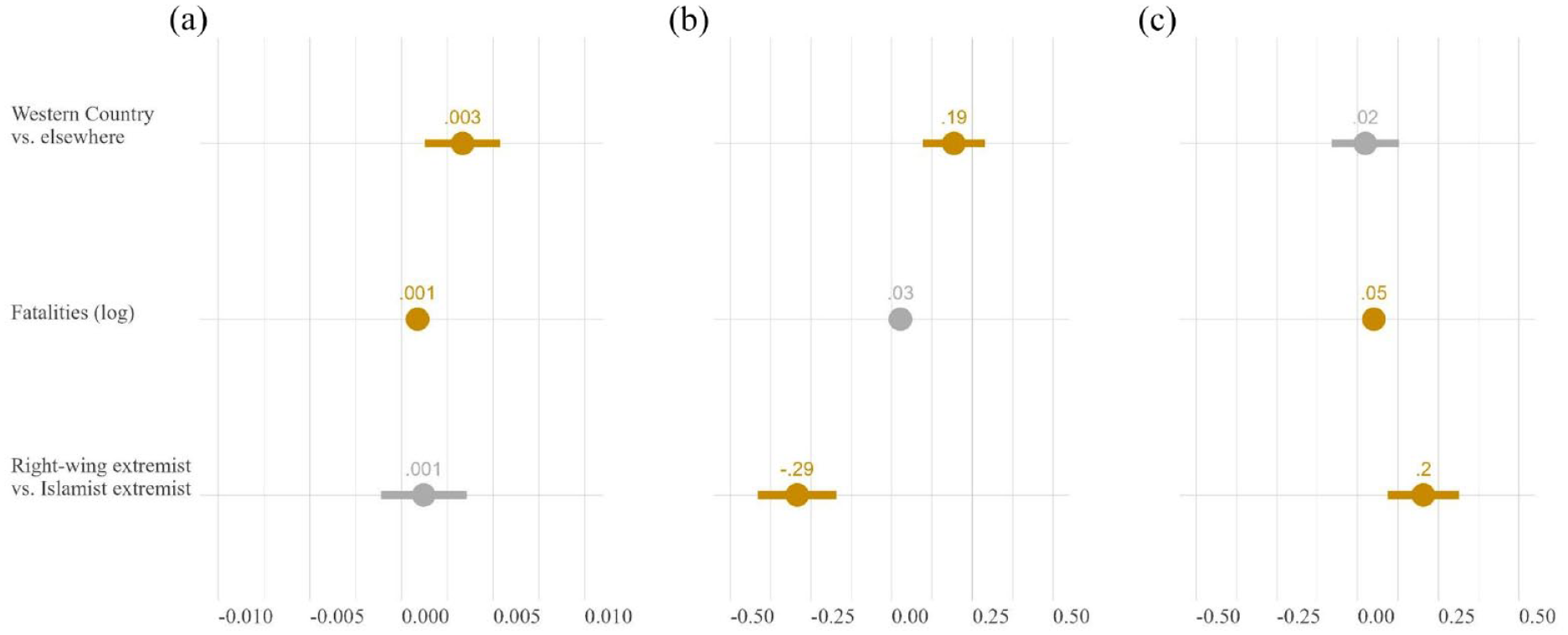
Gatekeeping and presentation bias.
Presentation Bias (H2, RQ1)
In terms of presentation bias (H2, RQ1), outlets frequently label attacks as “terrorism” (60.2%) and offer single interpretations (55.5%), for example, related to the motives behind the attacks. Figure 1b and c illustrates that attacks in Western countries are more likely to be covered as terrorism (AME = .19, p < .001). In contrast, effects on whether news included several interpretations are inconsistent (AME = .02, p = .649). Fatalities resulting from attacks are also not consistently associated with journalistic use of the label “terrorism” (AME = .03, p = .056) but with whether coverage includes a single interpretation of events (AME = .05, p < .001). Finally, attacks by right-wing extremists are less likely to be covered as incidents of terrorism compared with those committed by Islamist extremists (AME = −.29, p < .001) but more likely to be covered with a single interpretation (AME = .2, p < .001). If attacks are associated with right-wing extremists rather than Islamist extremists, the probability that they will be labeled “terrorism” decreases by 29%. However, the probability of a single interpretation of attacks increases by 20%. This is likely because the covered right-wing attacks mostly occurred in Western countries, and so news outlets could quickly gather information to “agree” on a single interpretation. Most commonly, this interpretation is that attacks by right-wing extremists constitute “hate crimes” or “mass shootings” rather than “terrorism”—when offering a single interpretation of attacks in Western countries, news media only use the “terrorism” label for 56.4% of attacks by right-wing extremists, compared with 87.5% of attacks committed by Islamist extremists.
Overall, results provide partial support for presentation bias based on the location of attacks (H2a, RQ1a) and their fatalities (H2b, RQ1b) as well as strong support related to effects of perpetrators’ ideologies (H2c, RQ1c).
Cross-National Differences in News Bias (RQ2)
Related to outlet-specific differences in news bias, Table 4 illustrates consistent but small differences in the probability with which outlets cover attacks (RQ2a). Overall, the predicted probability for an average attack to be covered is close to 0%—with only Al Jazeera English having a slightly higher probability (0.001%). We found more apparent differences concerning presentation bias (RQ2b): Sky uses the label “terrorism” more frequently (90.6%) (predicted probability for other outlets: 63.1%–76.3%). With a predicted probability of 61.6%, CNN is comparably less likely to offer a single interpretation of attacks (predicted probability for other outlets: 68.7%–76.5%, although confidence intervals partly overlap). Overall, we find partial support for outlet-specific gatekeeping bias (RQ2a) and strong support for outlet-specific presentation bias (RQ2b).
Outlet-Specific Differences in News Bias.

Note. Percentage of attacks covered (Reporting), covered as “terrorism” (Labeling as Terrorism), or covered with a single interpretation (Single Interpretation) [95% CI], *p < .05, **p < .01, ***p < .001, here indicating whether probabilities can be predicted consistently. For interpretation, differences between outlets are significant if their confidence intervals do not overlap—for example, the predicted probability of AJE versus BBC using the terrorist label is not significantly different as confidence intervals overlap.
Audience Bias (RQ3)
Table 3 shows that audience attention differed from media attention. Frequently viewed videos on terrorist attacks include a school shooting by a right-wing extremist in Florida in 2018, a suicide bombing targeting soldiers in Kashmir in 2018, and a mass shooting by an Islamist extremist in Texas in 2019. Related to out-group hostility in comments (RQ3, see Figure 2), we found that, on average, only 0.57% of the comments exhibit out-group hostility (M = 0.57, SD = 2.55). Overall, neither the location of attacks (AME = −.31, p = .22) nor their fatalities (AME = −.01, p = .899) are correlated with out-group hostility. While user comments more often display out-group hostility when attacks are committed by Islamist extremists (AME = .5, p < .05), this effect is small and not robust. 4 In addition, the effects of attacks by right-wing extremists are inconsistent (AME = .29, p = .411). Overall, our results do not support audience bias due to the location of attacks (RQ3a) or their lethality (RQ3b) but partial, though very limited effects for perpetrator ideology (RQ3c).

Audience bias.
Discussion
In this study, we analyzed bias in how news media and citizens discuss terrorist attacks on YouTube. Our findings illustrate news bias in the form of selective news coverage of attacks, with the predicted probability of an average attack to be covered being close to 0%. In contrast, we find less evidence for audience bias in public reactions to terrorism.
Evidence of News Bias in Cross-National Coverage of Terrorism
Overall, international broadcasters only reported on 1.1% of terrorist attacks across the globe (see similarly Hase, 2023; Sui et al., 2017), often using the label “terrorism” (60.2%) and offering a single interpretation of attacks (55.5%). While incident- and perpetrator-related characteristics predict selectivity in the degree of media attention (gatekeeping bias) and the content of coverage (presentation bias), thereby indicating news bias, there are differences in how these characteristics shape bias. As aspects more clearly related to victims, the locations of attacks and associated fatalities were more strongly associated with whether (H1a–b) but less with how outlets covered attacks (H2a–b, RQ1a–b). In contrast, perpetrators’ ideology played a stronger role in how (H2c, RQ1c) but not whether attacks were covered (H1c). In short, in- and out-group thinking related to victims may shape whether attacks make the headlines, while aspects related to perpetrators are associated with how attacks are depicted.
While our findings on incident characteristics align with existing studies on gatekeeping bias (Kearns et al., 2019; Sui et al., 2017) and presentation bias (de Veen & Thomas, 2022; Ghazi-Tehrani & Kearns, 2023), those related to perpetrator characteristics are somewhat surprising. Attacks by Islamist extremists did not receive more coverage (contrary to findings for Western news media; see de Veen & Thomas, 2022; Kearns et al., 2019). Here, the recent uptick of right-wing violence could have an impact on journalists increasingly considering right-wing extremists to be at least equally as threatening as Islamist extremists (see similarly Hase, 2023)—although this seemingly only influences shifts in whether and not how journalists cover attacks.
Moreover, our results revealed outlet-specific differences in gatekeeping bias (RQ2a) and presentation bias (RQ2b), although the latter was more pronounced (see similarly Abdul Rehman & Salma, 2024; Chan et al., 2023; Gerhards & Schäfer, 2014). However, these differences did not follow clear patterns across sociocultural contexts, for example, when comparing outlets with a stronger Western focus (BBC, CNN, Deutsche Welle, and Sky) and those with less of a Western focus (Al Jazeera English). Similar to Chan et al. (2023), we believe that because our outlets, including Al Jazeera, constitute “outward-facing non-Western media [that] compete in the global user market, they have a higher propensity to be homogenized among themselves” (p. 19). Overall, we find homogeneity rather than heterogeneity in international broadcasters’ terrorism coverage.
Limited Evidence of Audience Bias in Reactions Toward Terrorism
Moreover, we conclude with very limited evidence of audience bias. While incident- and perpetrator-related characteristics seemingly shape news bias, they are less influential in relation to out-group hostility as a reaction to coverage (RQ3). This is surprising in light of earlier studies that confirmed assumptions of terror management theory (Fischer-Preßler et al., 2019) and the role of out-group hostility following terrorist attacks (Godefroidt, 2023). Out-group hostility as a reaction to attacks was not only comparably low (see similarly Czymara et al., 2023) but also not consistently correlated with incident- and perpetrator-related characteristics.
Our findings indicate that predictors of news and audience bias may differ. In contrast to news media, attacks that received the most attention from social media users were shootings in public places, targeting, for example, schools or supermarkets. Other incident-related characteristics (e.g., whether victims were children and, as such, different indicators of perceived similarity to victims) may serve as stronger predictors of affectedness and, thus, audience bias (Knupfer & Matthes, 2021). Relatedly, and as indicated by results presented in the Supplement (Element A2), news bias may serve as an additional predictor of audience bias—something we controlled for but did not explicitly test.
Limitations and Outlook
Our results should be interpreted in light of limitations. First, our study is subject to Western-centric bias, seeing that we studied outlets with a focus on Western audiences and English-language comments. For future studies, we recommend including non-Western news outlets such as China’s CGTN or India’s Zee News and multi-lingual comments.
Second, our results cannot be generalized beyond YouTube and may be subject to bias: Opaque platform infrastructures shape our samples and measurements, where “blackboxing [. . .] is a real issue when it comes to assessing the merit of findings” (Rieder et al., 2015, p. 7). Related to the YouTube API (Rieder et al., 2018), errors of representations may emerge due to the API not returning relevant videos or comments, for example because of rate limits. While we split our search into smaller subsets and repeated data collection to circumvent this issue (initial data collection in spring 2022; checked again for missing data in summer 2022), the exact methodology behind the API remains a black box. In addition, YouTube may have deleted comments with higher out-group hostility, leading to an underestimation of this measurement (see similarly Knöpfle & Schatto-Eckrodt, 2024), or outlets may have restricted the ability to comment on videos they expect to lead to hate speech.
Third, and relatedly, our measurement of out-group hostility was conservative, especially considering that automated classifications yielded higher precision than recall. For example, classifications could not capture implicit criticism of out-groups (e.g., sarcasm). Moreover, the Perspective API likely operationalizes out-group hostility in an imperfect way compared with theoretical conceptualizations (Rieder & Skop, 2021; TeBlunthuis et al., 2024).
Fourth, and finally, our findings related to audience bias do not necessarily indicate that such bias does not exist, as studies including Western populations have overwhelmingly pointed to such bias (Avdan & Webb, 2019; Huff & Kertzer, 2018). It may merely be that audiences do not openly voice such bias on YouTube—or that they do, but not in comments below coverage.
Notwithstanding these limitations, our study illustrates that news media debates about terrorism are subject to both gatekeeping and presentation bias, with potential effects on their audiences. Consequently, we recommend that journalists reflect on their role as agenda setters and gatekeepers, especially given their influence on public agendas during crises (Yang & Sun, 2021). Journalists should critically question working routines based on news values and socioculturally contextualized perceptions of social identity to avoid reinforcing power imbalances, especially those from Western contexts.
Footnotes
Acknowledgements
We want to thank Yi Xu and Jingyuan Yu from TU Ilmenau, our team of student assistants who participated in the manual content analysis of videos, and Luisa Kutlar who helped in validating the automated content analysis.
Declaration of Conflicting Interests
The author(s) declared no potential conflicts of interest with respect to the research, authorship, and/or publication of this article.
Funding
The author(s) disclosed receipt of the following financial support for the research, authorship, and/or publication of this article: This work was supported by the German Research foundation (grant number 512640851).
