




Abstract
Roles of various social media influencers—ranging from health and beauty to security—in our society have increasingly become essential topics in the study of social media. However, little is known about the rise of religious influencers in the Global South and the way they negotiate the idea of religious authority in today’s society. To address this gap, this study investigates the way in which religious influencers project their authority through the visual means of Instagram. This study collects Instagram posts (n = 9,801) from three Islamic religious influencers in Indonesia—the largest Muslim-populated country and the third largest democracy in the world—with a combined follower count of 30 million people. Content analysis is then used to uncover the main strategies in which a sense of authority is visualized in their posts. The findings demonstrate that Indonesian religious influencers mainly used a close-up approach—friendly and informal appearance—to negotiate their visual authority as opposed to the rigid, more distant approach of traditional religious figures. However, to mitigate the risk of becoming too close and losing the respect and veneration of their followers, they adopt strategic distancing through the use of visual versus textual contrast, setting, and focus. The results extend scholarly discussion on religious influencers in the Islamic faith and their visual authority enactment on social media.
Introduction
In this time, where a rising number of individuals gain visibility and fame via persistent self-disclosure and performance of self in the social media environment (Mohamad, 2021), the notion of social media influencers is becoming a more common phenomenon. As a specific genre of internet celebrity, social media influencers are commonly addressed as influencers.
Abidin (2018) defines influencers as an individual who can attract and maintain a sizable following on their social media platforms through highly engaging and personalized content production, which can be used as conduits of information to amplify messages. Since the term influencer started to become popular in the mid-2010s, scholars have developed and extended the term into a more diverse context like marketing, finance, and even the security industry (Benson, 2021; Downing & Dron, 2020; Zhong, 2021).
This research focuses on and extends the specific sub-set of influencers: religious influencers, as theorized by Beta (2019a), along with the idea of religious entrepreneurs by Mecham (2017) and Arifianto (2020). Religious influencers can be defined as social media accounts with a high number of followers and micro-celebrity status, which combine their calling for self-cultivation, commercial interests, and socio-political concerns under the umbrella of daʾwa—the Arabic term for preaching (Beta, 2019a, 2020). Here, she adopted Abidin’s (2015, 2016, 2018) work on Instagram influencers as one specific form of internet celebrity and applied it to the context of religious figures. It concentrates on a particular group of Islamic religious preachers in Indonesia—the largest Muslim-populated country and the third largest democracy in the world—who were relatively unknown before they started using social media but then managed to gain a massive following on Instagram, arguably becoming more popular than the figures from established Islamic institutions.
Moreover, this research argues that visual authority—that is, utilizing images to construct, reaffirm, and project authority—is one of the main strategies for the emerging religious influencers in Indonesia to establish their names across the Indonesian religious landscape. This becomes important because, traditionally, Indonesia’s Islamic religious landscape was dominated by preachers whose authority was based on ties to established institutions such as Nahdlatul Ulama and Muhammadiyah (two of the biggest Islamic institutions in the world, with membership of 40 million and 30 million people, respectively; Barton, 2014) and/or a formal education in Islamic studies, through mainstream and traditional Islamic education institutions (Slama, 2017). Most new religious influencers usually lack these two things, so social media platforms provide them with the opportunity to compensate for their lack of connection with established religious authority and traditional level of education by utilizing visual images to construct and project a sense of credibility and authority to their audiences.
Literature Review
Islam and Digital Media in Indonesia
As Indonesia’s socio-political, economic, and technological development progresses, scholars observe the ongoing and gradual transformation of Indonesia’s religious authority landscape along with it (Beta, 2019b; Fakhruroji, 2019; Husein & Slama, 2018). Within this context, the rise of religious influencers who challenge the authority of the established religious figures is not created in a vacuum, but rather a continuation of previous generations of emerging figures who contested traditional authority with the support of the respective emerging technologies and media at the time (Rakhmani, 2017; Watson, 2005).
Around the Muslim world, from Iran to Indonesia, media and technology have always been influential in spreading Islamic beliefs. Pre-revolutionary Iran saw how sermons and preachings from the then-exiled Ayatollah Khomeini were circulated through audiocassettes (Anderson, 2003). Sermons by popular Islamic preachers in Egypt were played in taxicabs and shops, resulting in the alteration of listening habits (Hirschkind, 2001). On the other hand, several scholars also explored how the adoption of this modern technology brings a fragmentation of the religious preachers’ authority in Islam (Anderson, 2003; Hirschkind, 2001; Hoesterey, 2007, 2012; Turner, 2007). It reflects a broader debate about how digital media challenged the traditional and central religious authority and allowed basically anyone to construct their authority (Campbell, 2022; Patel, 2022).
In Indonesia, prior to this new generation of social media religious influencers, the public became familiar with emerging preachers who used audio cassettes, radio, and television and managed to reach bigger audiences than established and traditional preachers. For example, Liddle (1996) observed that in the 1960s and 1970s, the influence of Islamic preachers was usually limited to the local communities in which they preached. However, Watson (2005) and Rakhmani (2017) contend that the rise of Indonesian television and radio allowed local preachers to reach large and varied audiences.
This phenomenon is best illustrated by the rise of two hugely popular and tech-savvy preachers at that time. First, Zainuddin M.Z. dominated the Islamic preacher landscape throughout the 1980s and 1990s. With his extensive use of radio and television to preach to millions of people, he is arguably one of the first Indonesian Islamic preachers to achieve celebrity status (Rakhmani, 2017). His popularity propelled him to earn the nickname of “preacher of a million Muslims” or kyai sejuta umat. Second, Abdullah Gymnastiar, also known as Aa Gym (Big Brother Gym, in Sundanese), who dominated the popular Islamic preaching landscape in the 2000s. Aa Gym’s activities led Time magazine to refer to him as Indonesia’s holy man.
The rise of these two preachers ushered in the era of Da’wahtainment (Rakhmani, 2017), a combination of da’wah—which means proselytize—and entertainment. Similar to the phenomenon of televangelism in the United States (Thomas & Lee, 2012; Watson, 2005), this form of da’wah is entertaining, filled with humor, and easy to listen to. While some praise this approach as innovative, helpful to bring Islam to larger audiences, and make it more popular (Fakhruroji, 2019; Hasan, 2009; Howell, 2008; Muzakki, 2008), it also received a similar critique that would later be addressed to the social media religious influencers: they bring a popular and practical style yet have a rather superficial knowledge of Islam (Slama, 2017; Watson, 2005).
When social media started gaining momentum in Indonesia in the latter part of the 2000s, it was not long before social media preachers emerged. Within this context, the study of Islam and social media in Indonesia is growing. Instagram is essential here because of its emphasis on visual content. This platform brings new rich data compared to the already saturated research on more textual social media such as Facebook and Twitter (Highfield & Leaver, 2015). Moreover, as Golan and Martini (2019) suggested, more investigations are needed on the relationship between religious authority and visual images beyond the context of the Judeo-Christian tradition. This is where this research contributes to the literature on this topic by examining visual authority in the context of Islamic faith in the Global South and within the rise of these religious influencers.
Images and the Social Construction of Authority
Images have a long and established history as important media texts amenable to research and analysis. They have become vehicles to construct meaning on all issues, including political and social ones (Gamson et al., 1992). For some theorists, images are important because they are a mental picture of something not real, present, or virtual (Gamson et al., 1992).
In contrast with Gamson, other scholars have seen images as a direct representation of reality. Thus, they are perceived as more credible than other abstract forms of communication, such as words (Messaris & Abraham, 2001). One key characteristic of photographic images is their indexicality, which is defined as their true-to-life quality. Grabe and Bucy (2009) echo the idea that images are a direct depiction of physical objects and events in the non-mediated environment, whereas words are abstract symbols that have no physical likeness to their referents. This indexicality of images lends an inherent evidential quality to a story (Messaris & Abraham, 2001) and could affect spectators’ perceptions of news events (Zillmann et al., 1999). Moreover, Knappett (2002) extended the discussion by showing that photographic images can be both symbolic and indexical. Indeed, there is this inherent tension between what is real and not real, especially with digital images that can be much easier to doctored or framed in various ways.
This research situates images—especially those that are strategically crafted with the goal of persuading others—as an essential strategy for the creation of a brand persona, which is the image that the human brand seeks to project (Smith, 2009; Speed et al., 2015). As a part of the brand persona, images are not always grounded in reality, but they can be a tool to construct a certain quality in the perception of their audiences. With this idea of images central to audiences’ perception, public figures such as politicians often incorporate them into their visual communication strategies. For example, studies by Lalancette and Tourigny-Koné (2017) and Page and Duffy (2018) show that politicians have increasingly turned to social media to engage in a wide range of image-making activities, from projecting their power, trustworthiness, and prestige or even sharing a slice of their private life in an effort to present a more humanized—and relatable—version of themselves. An exploratory study by Lindholm et al. (2021) further elucidated the importance of visual images in shaping audience perceptions. In their study of the effect of visual self-personalization by Finnish political leaders on Instagram, Lindholm et al. (2021) found that Instagram photos that depict professional settings drew more attention and were more effective in shaping trait impressions than photos showing politicians in private life.
Instagram, arguably, is today’s prime platform for projecting images. Started as a photo-sharing app, Instagram now has more than 2 billion users and more than 1.3 billion photos uploaded everyday (Aslam, 2024). While platforms like Facebook and Twitter are still robust but relatively declining, Instagram continues to grow. In Indonesia, in 2019, the quarterly growth of Instagram users was higher than that of Twitter and Facebook. In that period, Instagram grew 5.1%. In 2014, the number of new Instagram users was higher than that of new Facebook, Twitter, and Pinterest users combined (Knibbs, 2014).
As Instagram is a social media platform that relies heavily on visual elements, it is not surprising that it is becoming a vehicle for impression creation and management. Through photos and videos, visual image framing permeates all aspects of digital communication strategies and affects the dynamics of public impression creation and management (Marland, 2012). Paraphrasing Lalancette and Raynauld (2019), various personalities such as politicians and religious influencers have turned to social media like Instagram to push out visual content to their followers—and the population in general—to create, maintain, and strengthen a strategically crafted public image. To reiterate, images are the focus of this content analysis because images are important in communication strategies, especially on a social media platform like Instagram. In an increasingly cluttered media landscape competing for eyeballs, images have greater visibility and gain much more attention and examination than they did in the past.
Religious Influencers and Visual Authority
While there is a plethora of studies that investigate how celebrities or politicians use a social media platform like Instagram to craft their public images, perceptions, or credibility, there are limited studies that interrogate the way in which this is done by religious figures, especially in the context of Islamic faith in the Global South. Most existing studies focus on investigating how religious leaders in the Western world, like Pope Francis of the Catholic church, use Instagram to build their brand and authority (Zijderveld, 2017) or how megachurch pastors in the United States construct their authority on Twitter as part of their multimodal communication strategy to create a personal brand identity (Cheong, 2016).
While the textual aspect of Instagram is important, this study focuses on addressing the gap in understanding the relationship between religious influencers and visual authority in an Islamic context. Therefore, it concentrates on examining Instagram images posted by Islamic religious influencers in Indonesia. It assumes that these religious influencers—as the image manufacturers—generate meaning to construct and reaffirm a sense of religious authority through the images they publish on Instagram.
This chapter develops a framework adapted and extended from Lalancette and Raynauld’s (2019) conception of image-making and management strategies and image-mediated charisma by Golan and Martini (2019). Lalancette and Raynauld (2019) define image-making as a strategic development and use of symbolic devices that can be fashioned with visual and verbal messages. It is important to understand the image-making strategies utilized by these religious influencers because, in essence, image-making provides a shorthand cue to audiences for the identification and enhancement of specific attributes of an individual, an organization, a phenomenon, or a cause (Strachan & Kendall, 2004, p. 135). In this context, image-making management and strategies by religious influencers help them to provide cues to their audiences that they are a credible and authoritative figure in religious issues and all other related topics.
Meanwhile, the idea of image-mediated charisma by Golan and Martini (2019) explains four important facets that facilitate the construction and affirmation of religious authority by means of strategic management of leader distance: hierarchical positioning, geographical locale, haptic engagement, and a leader’s visual focus. By anchoring these four facets to the theory of leader distance—the idea that proximity and level of interaction between leaders and their followers affect the impression of authority—image-mediated charisma helps to unpack how religious influencers use Instagram images to project a sense of authority.
Building upon these two concepts, this research develops a framework (Figure 1) to investigate how religious influencers construct and project visual authority to their audiences. This framework concerns itself with four visual strategies:
Setting: the background and places where these religious influencers appear.
Casting: with whom these religious influencers appear and interact.
Distance: how these religious influencers position themselves relative to their audiences; close-up versus distant leadership styles can be achieved through hierarchical positioning and visual focus.
Artifacts: physical interaction shown in the images, whether religious artifacts or attributes are being displayed or not.

Visual authority framework.
Data and Method
This article unpacks the visual strategies used by Islamic religious influencers in Indonesia to manufacture and project their visual authority. To do that, this study first curated a list of 10 Instagram accounts of influential religious influencers in Indonesia. This study then selected three religious influencers based on several factors: (1) their popularity and numbers of followers on Instagram; (2) the diversity of their backgrounds, though they are all Islamic preachers, each of them has differences in their core audience target; (3) gender, while Islamic preaching in Indonesia is heavily dominated by males, one of the most popular figures in the list is a female preacher named Oki Setiana Dewi.
All in all, the three chosen preachers have more than 30 million followers with almost 10,000 posts spanning 8 years (from 2012, when their first post was recorded, to mid-2020, when this study commenced). They are listed in the Figure 2 below.

List of three Indonesian religious influencers.
From 9,801 Instagram posts collected from these three religious influencers, 374 Instagram posts were selected for content analysis based on a simple random sampling formula (95% confidence level, 5% margin of error). Two coders were trained to code the sample according to the coding categories. To ensure the integrity of the coding categories, an intercoder reliability test was conducted, and it achieved at least 75% agreement, which is considered reliable. Manual content analysis provides a much-needed empirical finding that helps to articulate the discussion of visual authorities.
Findings
Visual Authority: Setting
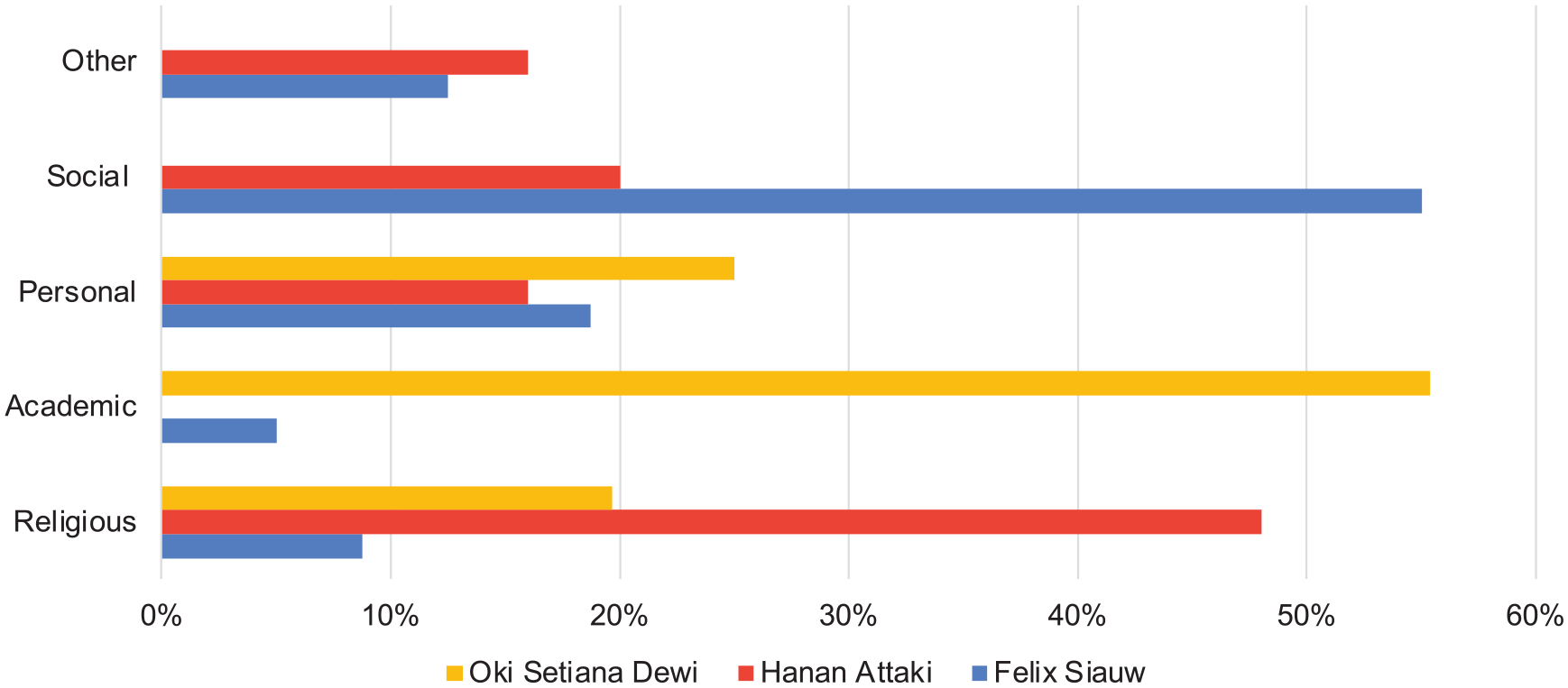
Within the framework of visual authority, setting refers to the physical context in which the religious influencers are represented in Instagram images. I treat the physical space where these religious influencers are as an important element because it is not merely a backdrop in which the process of communication occurs. More than that, according to Shome (2003), in her investigation of the relationship between space and communication, it needs to be recognized as a central component in that communication process. Setting, as a physical context, can function as a means and medium of power that is socially constituted through material relations that enable the communication of specific ideas, including authority. Setting in this context is divided into five major places: religious, academic, personal, social, and other.
Data show that all three preachers have different loci represented on their Instagram posts (Figure 3). For Siauw, the most dominant place where he appears is in the social places that are open to the public, such as restaurants, shopping centers, parks, or common areas and buildings. Meanwhile, Attaki mostly posts himself in religious settings in 48% of his posts. For Dewi, the most dominant geographic locales on her Instagram posts are academic places, in 55% of her total posts.
Setting composition.
Visual Authority: Casting
The second element of the visual authority framework on Instagram involves who strategically appears in the image. It is significant because, as Lalancette and Raynauld (2019) pointed out, depending on with whom the users of Instagram appear, they can project different qualities and values. Here, casting is divided further into three subcategories:
The main subject of the images: this includes the self-image of religious influencers, religious influencers with other people, other people only, or non-human subjects.
Affiliation: the affiliation of the people who appear in the images with these religious influencers. It includes politicians, academics, businesspeople, NGOs, families, other Islamic preachers, people from other religions, and ordinary people.
Gender: the traditional gender role of the people who appear in the images with these religious influencers. Specific to this context, it can be male, female, or both.
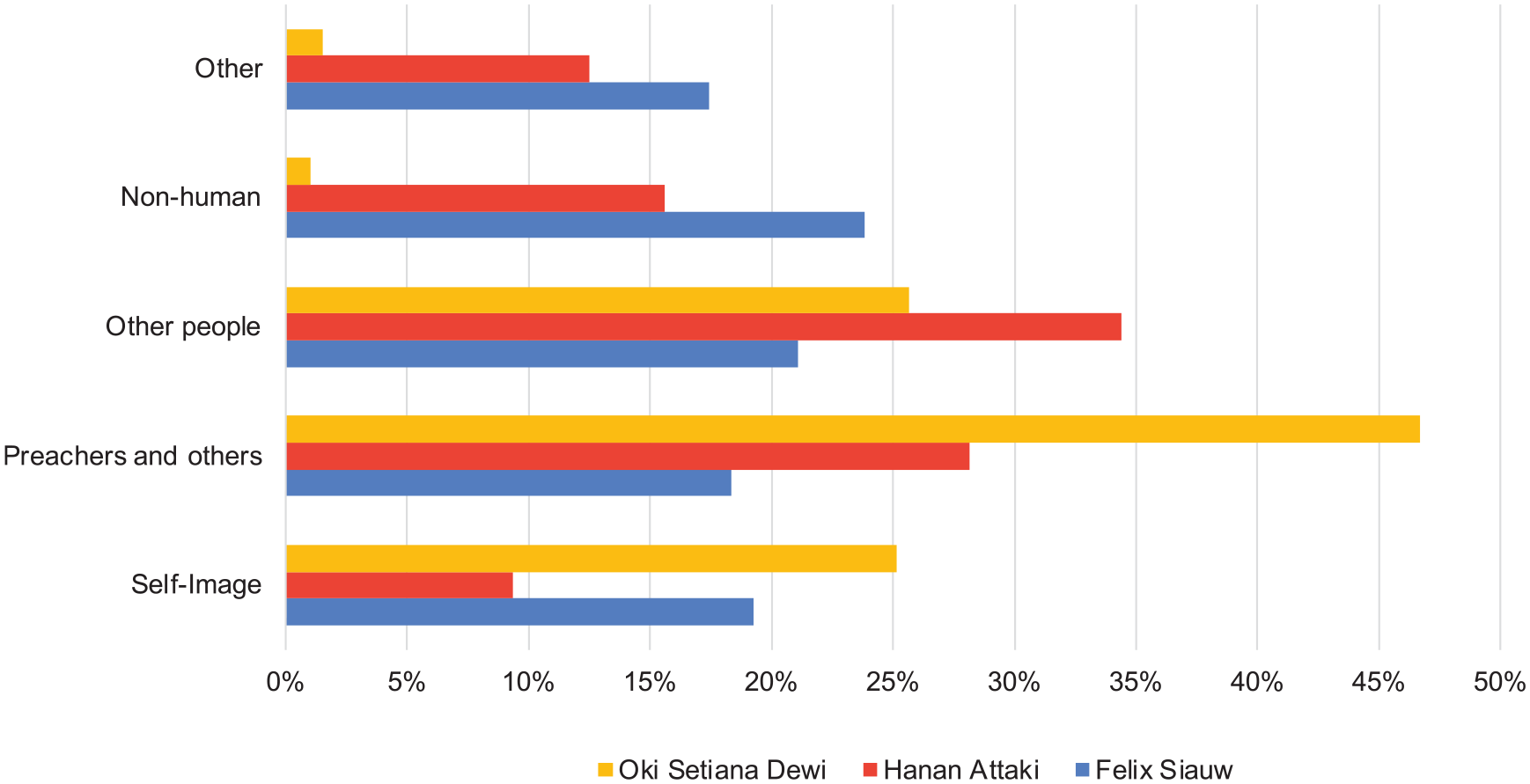
The data from these three Indonesian religious influencers show that the most popular format is having a post where the preachers are in the frame with another person (Figure 4). For example, 47% of Dewi posts consist of an image of her with at least one other person. Attaki uses this approach for 34% of his posts, while Siauw has the least with 21%.
Casting composition.
Besides that, having only the preacher appear on the post is also a popular approach. In this case, Dewi has the highest percentage of self-image, where the posts only contain a visual of herself. In the case of Dewi, 25% of her posts are a self-image, followed by Siauw with 19% and Attaki with the least self-images of only 9% of his posts.
Overall, if we consider the percentage of posts where the preachers themselves appeared, either by themselves or with at least one other person, Dewi appears to be very dominant in using this visual subject approach. Dewi appears in 72% of her posts, either by herself or with at least one other person. From this, it can be deduced that Dewi’s visual subject strategy is mostly posting visuals containing images of herself.
Meanwhile, two other preachers use different patterns. Siauw is the most diverse and balanced preacher in the context of visual subjects appearing on his Instagram posts. For Siauw, the visual subject on his Instagram is distributed almost evenly between himself as the subject (19%), himself and at least one other person (18%), other people (21%), non-human visual subjects such as landscape, an architecture-related image, or even foods (24%), and other categories (18%). Meanwhile, Attaki is the least likely to post a self-image (9%). He primarily uses other people as the visual subject of his Instagram (34%).
To further investigate the relationship between images and the projection of authority, other elements of visual authority such as gender-based interaction and power-affiliation interaction are examined. The gender-based interaction highlights the traditional gender role of the people with whom the religious influencers are shown interacting on their Instagram, while power-affiliation interaction focuses on understanding the affiliation of people with whom these preachers interact.
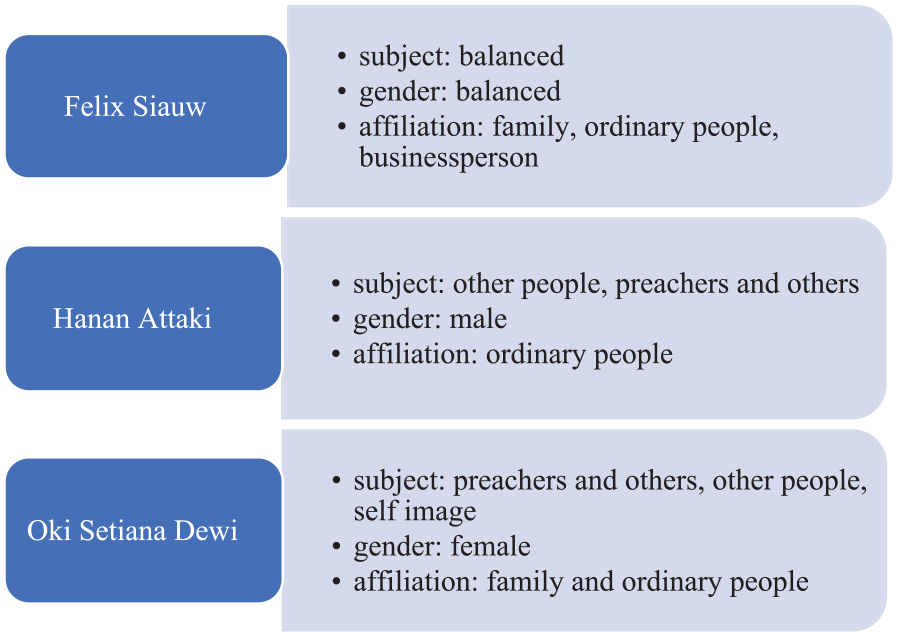
Looking at the data in Figure 5, we can immediately see how these three preachers differ regarding their gender-based interaction. For Attaki, 82% of his Instagram posts feature males only. On the other end of the spectrum, Dewi—the only female preacher in this study—is the opposite. On her Instagram posts, 61% of her visual interaction is with another female.

Casting-traditional gender composition.
Compared to the other two preachers, Siauw had the most balanced visual interaction regarding gender. Data show that Siauw interacts evenly with males and females in his Instagram posts, at 47% and 40%, respectively.
Meanwhile, in terms of power-affiliation interaction, these three preachers also show different results (Figure 6). Attaki is one of the preachers who has a consistent pattern. In most of his posts, about 70% of people who appear and interact with him are categorized as ordinary people, meaning that these people are just his regular followers and do not have any specific background, such as politicians, business people, or celebrities. Interestingly, there is also a tiny percentage—no more than 5%—where Attaki shows his interaction with his own family. It stands in contrast with the other two preachers, who have pretty extensive interactions with their families on Instagram.

Casting-affiliation composition.
Dewi, for example, seems to be the most family-oriented in her Instagram interactions. Data show that she has about half of her interactions on Instagram showing her with her family. Meanwhile, Siauw’s interactions on his Instagram posts are distributed evenly between his family and ordinary people, with 34% and 39%, respectively. The content analysis also reveals another interesting finding about Siauw. That is, even though his Instagram captions tend to be political, his visual strategies contrast this. In the visual aspect of his Instagram posts, Siauw rarely appears with political figures. In other words, while his Instagram’s textual elements are heavily political, Siauw’s visual elements on Instagram are relatively apolitical. All in all, Figure 7 summarizes the casting-related findings.
Casting, who appears on the three religious influencers’ posts.
Visual Authority: Distance
The third element of the visual authority framework on Instagram focuses on distance leadership—the relative proximity and level of interaction between leaders and their followers. Extending the concept of image-mediated charisma (Golan & Martini, 2019), distance in visual authority interrogates how these religious influencers manufacture a sense of distance within the images. This sense of distance is projected through two facets that play a dynamic role in the construction and affirmation of religious authority: hierarchical positioning and the leader’s visual focus. Therefore, this chapter examines these two facets of distance from these three religious influencers in the following section.
Two facets of distance in visual authority:
Hierarchical positioning, examining two aspects of dominant positioning of these religious influencers: (1) distant/authoritative positioning or (2) close-up/friendly positioning.
Visual focus, examining three dominant visual focuses of these religious influencers, whether it is toward (1) their online followers (Instagram users), (2) their offline followers (people who appear together in the images with religious influencers, or (3) transcendental (looking at the faraway distance or praying).
Hierarchical positioning
Expanding the concept of social distance by Fujita et al (2006), the idea of hierarchical positioning relates to the online representation of institutionalized authority figures in a way that serves to delineate the power structure that binds them. I suggest that hierarchical positioning is about how individuals create and play with the idea of distance to create a sense of authority. Furthermore, the construal level theory of leadership by Trope and Liberman (2010) involves using multiple forms of interrelated social-psychological distance. Golan and Martini (2019) found that social media, particularly Instagram images, can manipulate social distance, allowing the coexistence of different and even contradictory orientations (near/far, warm/cold).
This article uses this dual-distance approach to see how Indonesian religious influencers utilize the idea of distance in their relationship with their audiences. More specifically, this section investigates how these preachers establish their hierarchical positioning between the idea of an authoritative figure, that is, positioning themselves far away from their audience through the use of symbolic imagery like wearing formal religious attire to differentiate themselves from a layperson or distancing themselves through preaching by creating a barrier with their audience through the use of an elevated stage, for example, and the idea of a casual and welcoming leader. In contrast with this authoritative positioning, this study also translates the idea of how religious influencers might use an opposite strategy of a close-up distance approach with their audience. This approach focuses on creating a sense of a friendly and approachable leader through the use of relatable symbolic imagery like wearing casual attire or showing their daily, casual, and non-preaching activities.
Content analysis results show that the three preachers—Felix Siauw, Hanan Attaki, and Oki Setiana Dewi—consistently use the same approach: friendly hierarchical positioning on their Instagram posts (Figure 8). Attaki’s posts show the symbolic imagery of a friendly preacher who is close to his audience. Similar results also applied to Siauw, where 98% of his Instagram posts are also geared toward a friendly hierarchical positioning, compared to 2% following the authoritative hierarchical positioning.

Hierarchical positioning.
Dewi has slightly different numbers but still adheres to the overall strategy of friendly hierarchical positioning. The majority of her posts, 86%, use a friendly hierarchical positioning, with 14% of her posts following the authoritative hierarchical positioning approach. In this regard, it is interesting how she uses a more authoritative hierarchical positioning approach than the other two preachers. It is hard to ignore the role of the traditional gender in Indonesian society. As this article has discussed, all three religious influencers have experienced criticism and rejection due to their unusual background as preachers. However, only Dewi has been petitioned to forgo her title as a preacher. It is quite ironic, especially when we use the academic background as an indicator; Dewi is actually the one with the highest formal education compared to the other two male preachers, as she holds a Doctor degree—the equivalent of a PhD—in Islamic studies.
Leaders’ visual focuses
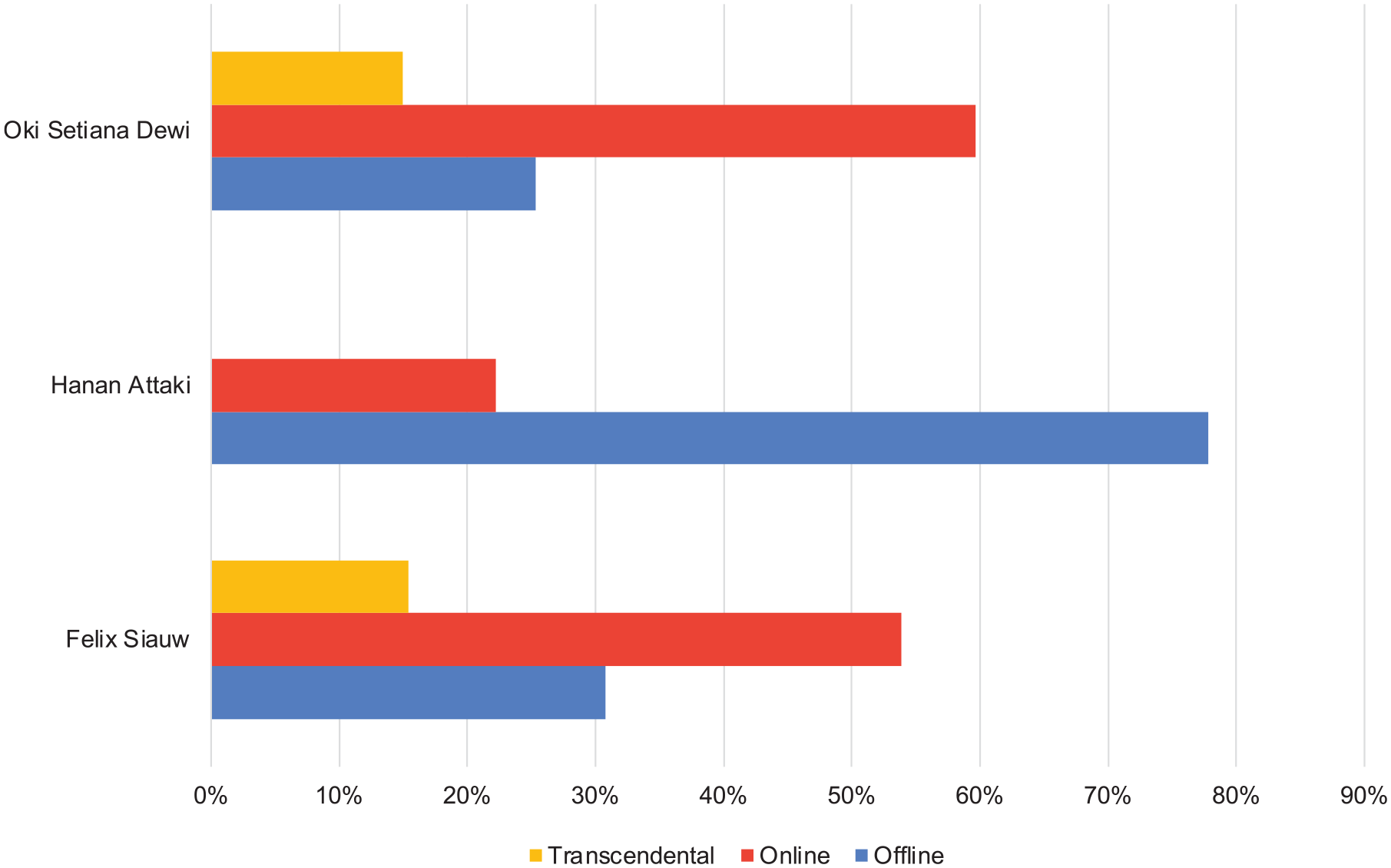
The second facet of the visual authority framework of distance is a leader’s visual focus (Figure 9). It refers to the captured gaze of the preachers in a particular image. In other words, it describes what the preacher is looking at. Here, three different ways of gazing can help to create a sense of distance between these religious influencers and their followers.
Visual focus composition.
First, looking toward their offline followers—people who appear in the images with the religious influencer. Second, the transcendental, conveyed by a contemplative posture or looking at a faraway distance. These first two visual focuses help to provide a distance—awe-invoking images oriented toward the transcendental—between these religious influencers and the people who follow them on Instagram. Meanwhile, the third visual focus is looking toward the online followers or people who follow these religious influencers on Instagram, signified by the moment when these religious influencers are breaking the fourth wall, recognizing the camera, and subtly engaging the online audience.
For Siauw, the most dominant type of visual focus is online follower visual focus, with 54% of his total posts. Attaki’s posts are dominated by offline follower visual focus, with 78%. Meanwhile, online follower visual focus dominates 60% of Dewi’s Instagram posts.
Visual Authority: Artifacts
The fourth and final element of the visual authority framework is artifacts. The haptic engagement or direct physical contact of these religious influencers in the images was analyzed here. It is to see whether they prefer to be portrayed as interacting with religious symbols or artifacts (such as the holy book Qur’an, or other religious symbols associated with Islam, such as the image of the Crescent and Star or Islamic calligraphy of the word Allah) or with non-ritual artifacts, or with their followers.
Figure 10 reveals that two of three preachers have little direct physical interaction on their Instagram posts. Siauw and Attaki, respectively, have 56% and 74% of their total Instagram posts showing no direct physical contact with their followers or objects. When their posts involved direct contact, they were mostly dominated by non-ritual objects.

Artifacts composition.
Dewi has different haptic engagement patterns. Her Instagram posts contain more physical interactions than the other two preachers. Sixty percent of her posts contain some form of physical interaction, with the most common one being interaction with a non-ritual object (24%), followed by her interaction with family (17%), ritual objects (10%), and other people (9%).
Discussion
All three Indonesian religious influencers—Felix Siauw, Hanan Attaki, and Oki Setiana Dewi—use the close-up approach as their primary visual authority strategy. Although all three have unique positioning and differences, they all project an image of a welcoming and casual religious leader and ultimately invoke warmth and friendliness. Essentially, through the use of elements of visual authority—setting, casting, distance, and artifacts—these religious influencers are able to use Instagram to shorten the affective distance between them and their online followers.
First, in terms of casting, all three preachers show different visual strategies. Attaki and Siauw, for example, adopt contrasting visual strategies in relation to their main messages on Instagram. While Attaki uses a consistent approach to weave his main messages and his visual strategies, Siauw uses a contrasting approach between his main messages and his visual strategies. Meanwhile, Dewi emphasizes a gender-based approach to her visual representation. While she promotes messages about entertainment industries, Islamic values, and Islamic education, her visual strategies focus more on balancing her role as a female preacher and the expectations of a relatively patriarchal Indonesian society (Kull, 2009).
Attaki’s visual strategies, for example, are mainly consistent with his overall messages. Attaki’s messages are focused on portraying Islam and young people as a fun and compatible community while simultaneously presenting himself as a cool preacher and friendly to youth. This approach is also reflected in his visual representation strategies. The visual subjects who appear and the visual interaction with Attaki shown on his Instagram are heavily dominated by regular people and how Attaki interacts with them (Figures 11 and 12).

Example of Attaki’s casting, he mostly appears with youths, male, and ordinary people.

Example of Hanan Attaki’s casting: fun and happy young people gather together to hear his preaching.
It strengthens the observation of Attaki’s preaching style on Instagram. Attaki focuses on presenting a more friendly approach to Islam toward young Muslim groups. It is supported by the findings in this article that show Attaki’s consistency between textual and visual representation strategies to push community-based messages about the cool and fun Islam.
In this context, Siauw uses a different approach than the other two preachers (see Figure 13 and Figure 14). While his messages are heavily political, the visual strategies that Siauw use suggest a paradoxical approach. Siauw, for example, rarely appears and interacts with people with political affiliations. He mainly appears with his family, showing an ordinary interaction with his wife or children. Upon a closer look, this is a strategy commonly used by Siauw on his Instagram; visually, he might show an ordinary picture of a landscape or interaction with family, but in the same post, he discusses political issues textually in the caption.
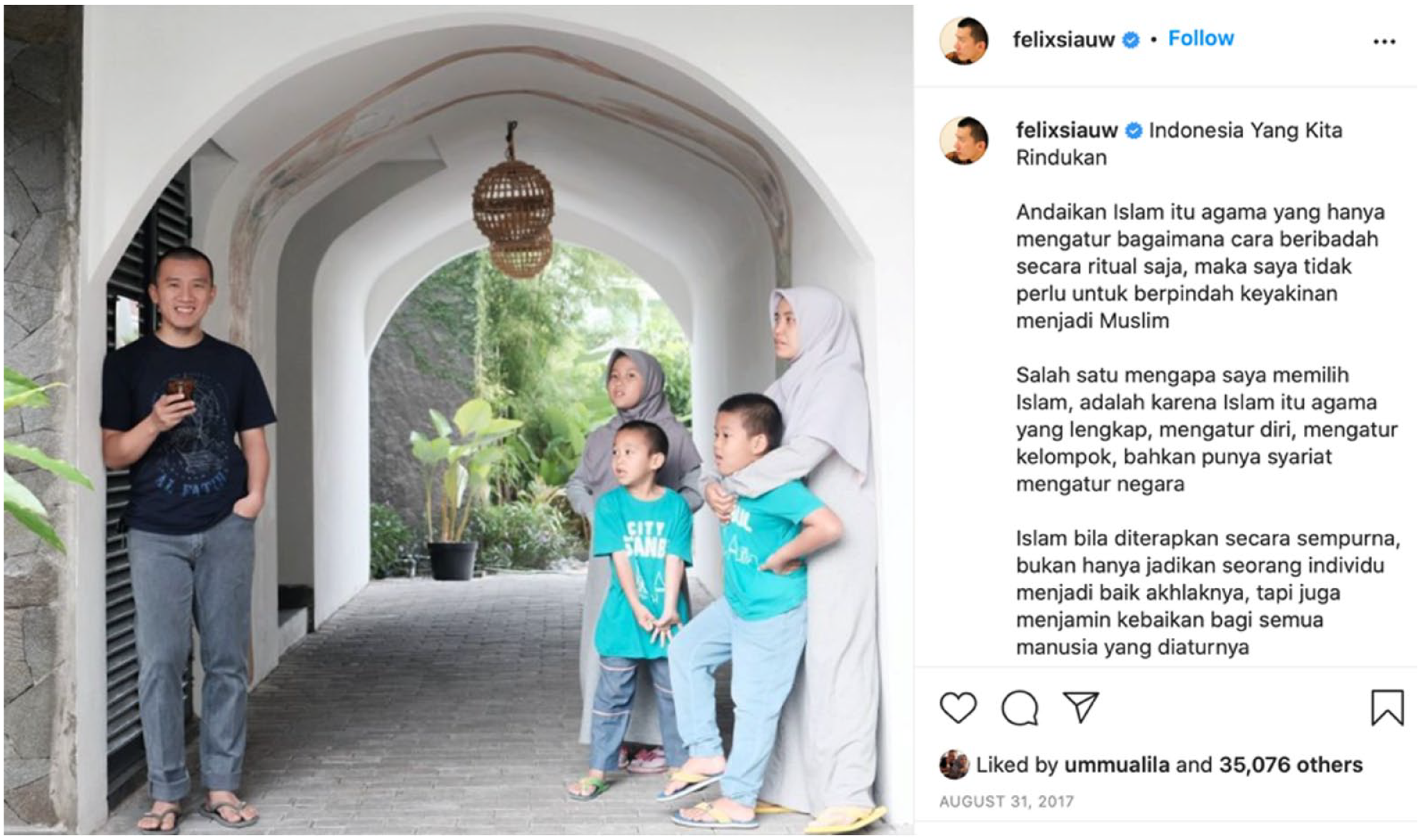
Example of Siauw’s casting. The image shows he appears with his family giving impression of just another family photograph. However, the textual caption discusses political message about Indonesian’s Constitution and an Islamic caliphate.
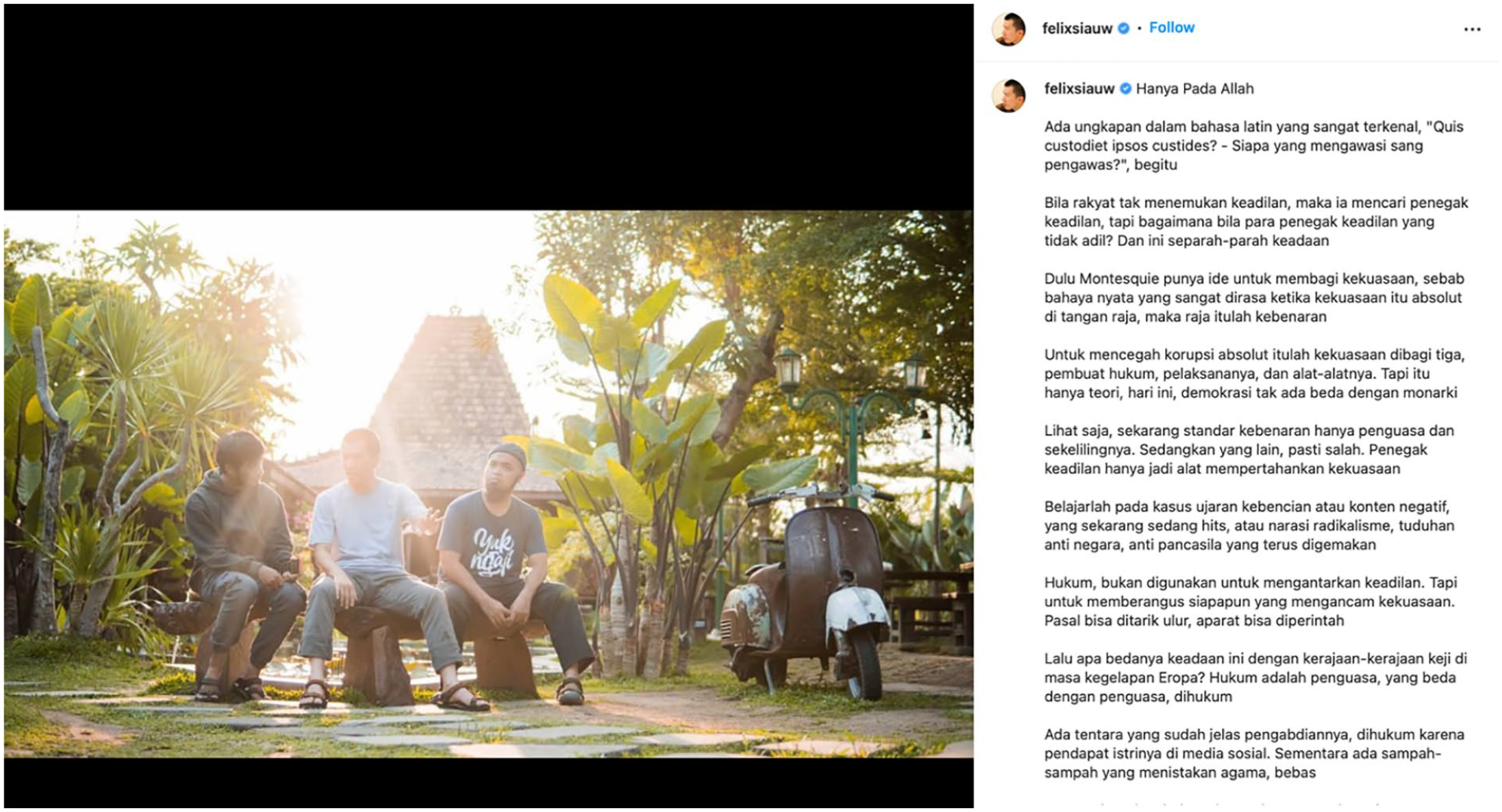
Felix Siauw’s casting; an example. Appearing with other ordinary people that have no clear affiliation. Textual captions discuss topics such as democracy, blasphemy against Islam, and criticism against Indonesian “ruler” treatment toward Islam.
There appears to be a disjuncture between Siauw’s textual and visual messages on Instagram. This result confirms the idea of beautiful da’wah or beautiful preaching, which was put forward by Hew (2018) to analyze Siauw’s visual preaching strategies on Instagram. According to Hew, Siauw’s preaching juxtaposes various contradictions by blurring the distinctions between politics and religion, online and offline, radical and popular, visual and textual, and public and private, without sacrificing his strong ideological commitment. Hence, Siauw’s Instagram visual approach and his textual approach focus on the tension and contradiction between the visual and textual elements of his messages.
Finally, for Dewi, a different focus can be observed. Dewi’s main messages on her Instagram are about her passion for promoting Islamic values through entertainment industries such as film and fashion and highlighting the importance of Islamic education. As a former actress, Dewi strategically appears on her Instagram visual by publishing her self-image or image with other people, primarily her family (Figure 15). It can be interpreted as the act of balancing her message as a female preacher and the expectations of a relatively patriarchal Indonesian society where the idea of gender harmony and keluarga sakinah (pious family) are on the rise (Beta, 2019a; Wieringa, 2015). This idea argues that, ultimately, pious Muslim women know and maintain that they need to ask for their (future) husbands’ permission for every activity and prioritize child-rearing practices.

Oki Setiana Dewi with her children, promoting Islamic heroes’ series for her children’s clothing brand.
Going further, Beta (2019a) observes one underlying principle often promoted by female religious influencers: the need for women to make their families the number one priority. Therefore, any position of authority outside the domestic sphere—including becoming a religious influencer—remains secondary to women’s natural role as mothers and wives (Beta, 2019a). This idea is also endorsed by Dewi herself, as can be seen in her Instagram posts (Figure 16), where she quotes and talks about the importance of a woman only doing something after she gets permission from her husband.
Getting your husband’s permission and support in all your activities is very important for every wife. A wife must not do any activity outside of her house if the husband does not permit it. (Excerpt from Dewi Instagram posts, 2016.)

Dewi’s message for women to gain permission from their husband in every activity. Her message is juxtaposed with an image of her own fashion show.
Finally, it is essential to highlight that strict gender representation and separation still exist in all these preachers’ visual interactions. For Attaki and Siauw, the interactions shown in their visual images are predominantly male-based. Where there are female interactions, most of the time, these are with their own families. The same thing can be observed in Dewi’s Instagram posts, where her interactions with her own family are chiefly with female members.
Setting, Distance, and Artifacts
Besides casting, these three religious influencers also applied various visual strategies to establish distance, setting, and artifacts in their Instagram posts. Manual content analysis of all these elements shows that these religious influencers strategically align themselves with socio-psychological framings of distance (Berkovich & Eyal, 2018; Trope & Liberman, 2010).
In essence, this dynamic framing of distance helps individuals create a sense of leadership and legitimacy through different levels of proximity and interaction between leaders and their followers. There are two common ways for a leader to be perceived as more charismatic in this context:
Distance leader, where legitimacy and appreciation from followers are built by creating a sense of distance leadership. In this case, by applying a certain distance from their followers, there is a potential for the leader to attain a romanticized and meaningful image among the followers, where the leader can be seen as having “larger than life” characteristics (Shamir, 1995). As Golan and Martini (2019) put it, the lack of familiarity and information regarding the leader’s performance serves as a dynamic that upsurges their charismatic attraction.
Direct leader, where legitimacy and appreciation from followers are built, creating a sense of close distance and relationship between the leader and the followers. In this context, the leader is continuously evaluated for his demeanor and assessed on his inspirational modeling.
Each of the three Indonesian religious influencers in this study—Felix Siauw, Hanan Attaki, and Oki Setiana Dewi—has a slightly different approach to creating their sense of authority and legitimacy through a different level of proximity and interaction with their followers.
For a starting point, all three religious influencers adopt close-distance leadership with their followers. It is represented by their tendency to appear as a friendly preacher—for example, by wearing casual clothes instead of formal religious garb or positioning themselves as equal and close with their followers. Attaki, consistent with his fun and casual approach to preaching Islam, strategically positions himself without any hierarchy with his followers. The same approach can be seen with Siauw. They rarely appear in formal religious clothes or a formal and distant preaching position.
Dewi, while also positioning herself as a close and friendly preacher, tends to show an authoritative and far-distance hierarchical positioning with her followers. She projects herself as able to properly balance her role in Indonesian patriarchal society as a female preacher and her more expected domestic role as wife and mother. This article argues that to be respected, Dewi, as a female preacher, is more likely to be pressured to appear as an authoritative figure than her male counterparts in this research. Hence, while still dominated by a friendly approach, her hierarchical positioning leans heavily on also showing authoritative positioning.
The same pattern can be observed within the setting of these three preachers’ Instagram visuals. While Siauw and Attaki appear in diverse settings in their Instagram visuals, in social, personal, or religious places, Dewi is the only one with a high percentage of visuals projecting herself in the academic setting. Again, consistent with the previous result and the patriarchal context of Indonesia, there are more pressures for Dewi as a female preacher to prove to her followers that she is a capable and legitimate religious leader. From a geographic locale’s perspective, appearing in academic places can be one strategy to gain this legitimacy.
Their physical interaction with artifacts or non-artifact objects also shows similar pattern. For Siauw and Attaki, there is almost no visual representation where they interact with religious objects such as the Qur’an, while Dewi is more likely to engage with religious objects, which most likely is in order to boost her legitimacy as a religious leader.
Finally, these preachers’ approaches to their visual focus are also slightly different. Among these three religious influencers, Siauw is the one who is more balanced in all of his visual focuses, showing that he is well distanced from his followers in the context of visual focus. For Attaki, this is the only facet of the visual authority framework where he appears to set a farther distance from his followers, whereas in all the other facets, he is dominantly projecting himself as a close leader to his followers. Meanwhile, Dewi appears closer to her followers in this context than in other visual authority framework elements.
Conclusion
This article starts by focusing on the strategies employed by three religious influencers in Indonesia to manufacture their visual authority—that is, to construct, reaffirm, and project a sense of credibility and authority through visual images. As three of Indonesia’s most popular religious influencers with millions of followers, they are significant figures in understanding how religion is practiced and implemented in this digital era. Although they are relatively new, young, and emerging figures, their ability to attract millions of people on Instagram should not be considered as something trivial. In a country in which almost 100% of its population considers religion as important (Pew Forum, 2018) and, at the same time, depends heavily on social media like Instagram, the rise of these religious influencers marks a crucial point in understanding religion and social media.
I examined how they use Instagram images to project themselves as authoritative figures in Indonesia’s religious landscape. This article does not intend to measure the influence or effectiveness of these religious influencers’ messages in changing the behavior or the way their audiences think. Instead, this research unpacks the communication strategies used by these preachers to construct, reaffirm, and implement the impression that they are indeed authoritative figures in the issue of religion and beyond.
Overall, all three Indonesian religious influencers tend to have a close-up approach to project their visual authority. It is in line with the very essence of their positions as religious influencers, where they depend heavily on digital technology, and in this context, with social media like Instagram, to build their authority in the religious landscape in Indonesia. Previous research has highlighted the capability of digital technology to allow leaders of organizations to shorten social distance. This chapter extends this idea and emphasizes different ways a visual social media platform facilitates the alteration of leader distance (Golan & Martini, 2019; Lalancette & Raynauld, 2019).
However, although a close-up leadership approach is dominant in these three religious influencers’ preaching, it does not stop there. There is a dynamic interplay between maintaining close and far-distance impressions. Each of these preachers still provides specific measures to mitigate the risk of becoming too close and friendly, which can result in losing respect and veneration from their followers. Hence, this research shows different strategies on how each preacher retains respect from their followers. Hanan Attaki, who projects himself as an amiable and approachable figure, still strategically maintains some distance from his audiences through a visual focus that is mostly directed at his offline followers rather than his online followers.
Felix Siauw’s strategy—to create a sense of a close yet non-accessible figure—is done mainly by providing tension and disjunction between his Instagram textual captions and visual images. Oki Setiana Dewi, as a female preacher in the male-dominated religious landscape, tends to have more pressure to project some distance—thus constructing a more capable and authoritative image as a preacher—with her followers. She does this through a strategic move to appear more often in religious and academic settings and position herself hierarchically more as an authoritative figure than her male counterparts in this study.
All in all, social media platforms like Instagram provide an opportunity for relatively young and new Muslim figures—those without formal and strong religious education or relationships with established Islamic organizations—to be involved in da’wah activities, and it has enabled the emergence of religious influencers.
It is important to note that visual skills and communication strategies are pivotal to sustaining the existence of authoritative figures of religious influencers. Indonesian religious influencers like Felix Siauw, Hanan Attaki, and Oki Setiana Dewi strategically deploy visual communication strategies to project an image of a credible and authoritative religious preacher to their followers by strategically maintaining a sense of distance—close up yet still far away—with their audiences. Using the lens of visual authority, this research examined the visual communication strategies that helped to catapult their names as authoritative figures in the contemporary Indonesian religious landscape. It extends the discussion on influencers, visual strategies, distance leadership, and specific Islamic faith—which has a unique attitude toward image veneration, where it should be in accordance with Islamic guidelines.
Recommendations for Future Studies
Further research into this growing topic needs to be developed, be it on religious influencers themselves or their followers and audience. As a recommendation for future study, two different research areas could be explored to help further our understanding of religious influencers. One is to scrutinize emerging influencers from a more established institution and background—to respond to these established groups, realizing they might lose their relevance. Another critical locus that could be further advanced is testing the visual authority framework on a different medium, such as TikTok with its focus on the short video format.
Footnotes
Declaration of Conflicting Interests
The author(s) declared no potential conflicts of interest with respect to the research, authorship, and/or publication of this article.
Funding
The author(s) disclosed receipt of the following financial support for the research, authorship, and/or publication of this article: I acknowledge the support I have received for my research through the provision of an Australia Awards Scholarship from the DFAT Australia. This article is being published open-access with the support of the Wenzhou-Kean University Internal (Faculty/Staff) Start-Up Research Grant (ISRG2023017).
