




Abstract
With the rapid growth of TikTok in the last few years, we have seen the emergence of global influencers from diverse backgrounds, whose popularity is enhanced by TikTok’s specific content-based algorithm. In North America, the meta-hashtag #NativeTikTok has become a sharing space for a diverse Indigenous online community. Among these, several young Inuit women have acquired a large fanbase, allowing them to display their culture to a vast public, as well as to bring awareness to issues relating to the Arctic. In this article, we analyze how TikTok became a scale-shifting media for contemporary self-affirmation and displaying of Inuit culture. Drawing data from a case study of six Inuit influencers and an online thematic analysis of their content, we discuss definitions of Inuit authenticity on digital screenscapes, before presenting an analysis of content shared by young Inuit influencers to better understand specific forms of storytelling on TikTok and tensions pertaining to authentic cultural self-presentation. We argue that the TikTok platform provides an efficient tool for young Inuit women to engage with, learn about, and display their culture in their own terms, self-presenting as diverse and modern, in contrast with colonial Inuit imageries.
Introduction
We are still here and we are stronger than ever [raised fist emoji]
This caption accompanies a TikTok video shared in 2021 by Shina Novalinga (@shinanova), a young Inuk influencer with more than 4 million followers. At the moment of this writing, the video has been viewed 27 million times and liked by over 4 million users. It features Shina and her mother throat-singing in a microphone, standing face to face in a white hallway. While Shina is wearing a white, pink, and gray parka with fur, her mother is wearing a zebra-patterned blouse. Both wear colorful beaded earrings. Although they do not speak during the video, defiling captions of text explain how the tradition of throat-signing was almost lost due to a religious ban, stating that “today we are stronger [and] we throat-sing for those who couldn’t” (shinanova, 2021a).
Shina Novalinga is one of the best-known influencers from #NativeTikTok (also known as #NativeTok), a fast-growing and incredibly diverse Indigenous community on TikTok in North America. The exponential growth of TikTok since the beginning of the COVID-19 pandemic in 2020 has shifted the ways creators from diverse backgrounds can express and perform identities, form communities, join a common cause, or shape new sub-cultures (Bhandari & Bimo, 2022; Boffone, 2022; Gerlieb, 2021; Hautea et al., 2021). In this context, the existence of an Indigenous community on TikTok is not surprising in itself. Yet, Shina Novalinga clearly recognizes that “still being here” in the modern-day present as Indigenous despite continuous colonial occupation of lands is remarkable. As Corr (2018) states, “the very survival of Aboriginal people can be viewed as resistance to the structure of genocide built on colonial assumptions, frontier warfare, and assimilation policy” (p. 493).
Being “still here” on TikTok also means to be visible in mediated public space, self-represented on their own terms and recognized as subjects, which is the fundament of social existence (Deluca & Peeples, 2002; Honneth, 1996; Millette, 2015; Voirol, 2005). For Inuit creators more specifically, visibly occupying a global, digital space such as TikTok challenges enduring stereotypes still highly associated with them. Inuit tend to be represented in popular media as romantically primitive, traditional, pre-colonial (thus pre-technological), remote from Western culture both historically and geographically (Raheja, 2007; Searles, 2006). Such stereotypes also circulate in research, where pervasive biases toward smaller communities and traditions have influenced generations of ethnographers to expect certain forms of Inuit identity over others. Most notably, survival skills on the land are consistent with a particular form of heroic narrative that fit dominant expectations of both Arctic landscapes and people, and ethnographers have long focused their gaze on “Inuit whose competence on the land and whose ability to endure hardship and duress were exceptional, even superhuman” (Searles, 2006, p. 95). This results in a dominant narrative where what gets counted as “authentic” Inuit imageries over-valorizes male traditional hunters, while overshadowing women, youth, LGBTQ2+, and Inuit who live in urban settlements (Arnold, 2010; Bodenhorn, 1990; Rodgers & Scobie, 2015; Wachowich, 2006; Wachowich & Scobie, 2010). These dominant imaginaries not only ignore modern existence of Inuit, they also alienate diversity within Inuit culture and limit Inuit access to self-present as “regular,” contemporary people inside and outside of the Arctic.
Is online presence incompatible with Inuit cultural authenticity? Although digital screenscapes do not fit with dominant “authentic” Inuit imageries, media technologies are commonly used by Inuit of all ages (Castleton, 2014; Hawkins & Silver, 2017; Rodgers & Scobie, 2015). As argued by Wachowich and Scobie (2010), digital storytelling can be understood as “the latest genre of a long trajectory of storytelling among Inuit,” which they view not as a rupture in cultural traditions, but as the continuation of traditions with the appropriation of new technologies (p. 86). In other words, cultural authenticity is not threatened by digital media, it is rather enhanced and empowered by it (Hopkins, 2005).
Moreover, digital media do provide practical, useful tools for Inuit in their everyday lives. Because Inuit communities are very geographically remote to one another and from urban centers, communication technologies and social media have provided useful ways to overcome distance in both personal and political contexts in the last decade (Young, 2017). Facebook, for example, is widely used to keep contact at a distance (Castleton, 2014); YouTube opened possibilities for creative storytelling by youth (Wachowich & Scobie, 2010), while Twitter (now X) has provided a space of concerted political resistance (Arnaquq-Baril, 2016; Hawkins & Silver, 2017; Rodgers & Scobie, 2015). In this article, we add to emerging research on social media use by Inuit by analyzing the specific opportunities of TikTok as a scale-shifting media for contemporary self-affirmation and displaying of Inuit culture. Which specific forms of storytelling emerge from #NativeTikTok? How do young Inuit influencers showcase their realities on TikTok, and how do they challenge dominant Inuit imageries?
We argue that the TikTok platform provides an efficient tool for young Inuit women to engage with, learn about, and display their culture on their own terms, self-presenting as diverse and modern. Drawing data from an online thematic analysis of six Inuit influencers’ content, we describe how specific TikTok features compare with other platforms in terms of visibility and formation of hashtag publics as community. Second, we discuss definitions of Inuit authenticity on digital screenscapes, before presenting an analysis of content shared by young Inuit influencers. This analysis allows us to better understand specific forms of storytelling on TikTok as well as tensions that arise in presentation of authenticity online.
Visibility, TikTok, and #NativeTikTok
While self-presentation online is not necessarily a political act, making oneself visible to the public is a condition for social recognition (Honneth, 1996; Voirol, 2005). This is especially true in the case of historically marginalized groups, who have either been misrepresented or invisible in the mediated public sphere (Millette, 2015). We could define visibility as the state of being seen and heard by the public. In a context of mass media, dominant media acted as gatekeepers as to what became visible or not, and with which narrative frames (Voirol, 2005). The reality of invisibility is suffering as it implies a lack of recognition that contributes to social inequities. As Deluca and Peeples (2002) argue, “media are not mere means of communicating [. . .]; media produce the public sphere and public screen as primal scenes of Being” (p. 132). In other words, existing on the media is a requirement for social existence (Voirol, 2005); to exist, one must be confirmed and recognized by their peers as a valuable subject with a legitimate voice and deserving respect (Honneth, 1996). We understand media as “spaces from which epistemologies and ontologies emerge” (Deluca & Peeples, 2002, p. 132). Issues related to visibility thus not only relate to a lack of visibility but also to an inadequate, stereotypical visibility. It is the case for Indigenous peoples who have not been fully invisible from dominant mediascapes and have indeed been recognized by the larger public as distinctive social groups. Yet representations of Indigenous peoples that have dominated global imaginaries have consistently exoticized them, placing them outside of modern ways of being: “Native Americans in mass media have occupied a twilight zone existence in which they are both hypervisible in ways overdetermined by popular and nostalgic representations and completely invisible” (Raheja, 2007, p. 1171). In other words, influential but erroneous visibility occludes the vast diversity of contemporaneous Indigenous ways of being. Such stereotypes place Indigenous peoples in a romanticized past and remote landscapes; their current social existence is not recognized—or when it is, it tends to be depicted as damaged, unhealthy, or doomed (Raheja, 2007; Searles, 2006). Thus, hypervisibility (a surfeit of erroneous representation) and invisibility (a lack of representation) both deny the social existence of Indigenous peoples and prevent socio-political recognition (Le Blanc, 2009).
It is important to acknowledge that self-presentation comes with a certain degree of risk. Increased visibility enhances exposure to hate and harassment, particularly for women and members of a marginalized community (Duffy & Hund, 2019). While public visibility may enhance one’s social and political recognition, there are important limits to social media affirmation. Women who express themselves on the Internet receive sexist or hateful comments, and this is exacerbated when these women belong to identity groups that have been historically marginalized (Ging, 2023). This is particularly true for Inuit women who expose elements of their culture that may be frowned upon by international audiences, like hunting and eating meat, for example (see Battistini, 2018). In this context, while self-representation allows individuals to rectify dominant narratives by circulating positive narratives which allows them to exist socially in the present, it comes with a high degree of risk and exposure.
Despite these problems, digital media platforms remain a space for different people to gain increased public visibility and social recognition (Millette, 2015; Millette & Maillard, 2023). Emerging research on TikTok suggests that TikTok renders content available in new ways compared to other networking sites (Masciantonio et al., 2021). Unlike social-oriented platforms such as Facebook or Instagram where users decide whose content they wish to engage with, TikTok’s algorithm and “For You Page” (FYP) automatically recommend content to viewers. Rather than privileging celebrity, the FYP algorithm suggests content based on user’s interests and past interactions, which makes it easier for creators with very few followers to “go viral” and be seen by a larger audience (Bhandari & Bimo, 2022; Gerlieb, 2021; Hautea et al., 2021; Weimann & Masri, 2021).
TikTok’s algorithm is both effective and transformative in terms of potential visibility for creators, as well as user experience and motivations (Bhandari & Bimo, 2022; Blanco Borelli & moore, 2021; Gerlieb, 2021; Weimann & Masri, 2021). Previous social media platforms function as spaces where users gather with friends, relatives, and influencers they choose to follow. On TikTok, this “social” dimension is downplayed. Comments sections are disorganized and hard to navigate, the chat software is little used, and users no longer need to follow creators to engage with their content (Rochford & Palmer, 2022). Most often, then, users browse through algorithmic suggestions instead of researching or selecting content. This results in a transformation of user motivation and experience with the platform, adopting a more passive form of navigation for entertainment purposes (Masciantonio et al., 2021).
While TikTok offers a different kind of user experience, it organizes content and audiences in familiar ways. Hashtags, for example, are used on TikTok, as on X (Twitter), to play an aggregative role and also help to build ephemeral hashtag publics around certain topics, news, or causes (Bruns & Burgess, 2011; Rocheleau & Millette, 2015). While these language tags come across on the same level, popular hashtags such as #NativeTikTok act as unifying “meta-hashtags” (Rocheleau & Millette, 2015) for Indigenous, Métis, and Inuit users. By including this meta-hashtag in their content, creators contribute to situate their stories within a certain community, while simultaneously building audiences with the creation and circulation of attached hashtags. Many different hashtags co-occur under the meta-hashtag #NativeTikTok, indicating the multiple layers of meaning and sub-themes embedded in one post, and contributing to the online visibility of the content to different publics. As Hautea et al. (2021) demonstrate, TikTok’s affordances and specific culture, particularly multimodality, repetition, and mimesis, encourages the formation of affective publics around common sentiments, themes, and social causes.
Each social media platform comes with specific cultural codes which influence audience expectations regarding content, aesthetics, and discourse (Millette, 2011). Platform design structures influence style and user engagement, and creators must conform to these cultural norms to build an audience and be accepted in the community (Reade, 2021). On TikTok, specific features enhance storytelling practices: most notably, the layering of text, video, sound, and images help convey multi-layered messages in short video format. The platform is also defined by its highly dialogical features such as “duetting” with other creators’ videos or the reproduction of similar content by multiple creators through “trends” (Ebbrecht-Hartmann & Divon, 2022). Indeed, Zulli and Zulli (2020) identify mimesis and reproduction as “the basis for sociality on the platform” (p. 1880). Repetitive use of sound effects and actions define how creators appropriate and reproduce similar storylines, which contribute to form “mimesis” patterns on the platform (Zulli and Zulli, 2020). Other studies have identified the central role of irony (Gentry, 2022), intimacy (Gerlieb, 2021), intercultural education (Rochford & Palmer, 2022), or political dimensions (Divon & Ebbrecht-Hartmann, 2022; Hautea et al., 2021) of TikTok as clear cultural markers for creators to engage with their public. We add to this research by examining audience expectations of authenticity from TikTok creators.
Material, Cultural, and Embodied Authenticities
The concept of authenticity connotes a vast array of meanings and views, depending on contexts and disciplines. Most often, authenticity is defined in dichotomy with artificiality, as in “genuine” or “real,” an association which is authoritative in that it “continues to hold that the original is better than the copied or modified versions” (Chhabra, 2012, p. 499). We talk, for example, of original artwork as authentic. While subject to multiple perspectives, definitions of material and cultural authenticity have been institutionalized by authoritative figures such as historians and museum curators who hold positions to decide what is authentic and what is not (Chhabra, 2008).
In an analysis of ethnographic museums, Durand (2010) argues that museums seeking artwork fitting with traditional art forms perpetuate romantic essentialist biases toward Indigenous cultures in reproducing exotic frames of reference that value primitive way of life in an idealized past, thus denying cultural continuity into the present. The same bias has been identified in ethnographic film (Raheja, 2007) and anthropology research (Wachowich, 2006). This suggests that Indigenous cultural authenticity tends to be institutionalized and defined in similar ways as artifacts: as genuine objects reminiscent of a romanticized past. This cultural objectification is thus subject to be assessed according to essentialist notions of “pure” authenticity, “or, if they do not conform to exotic images, are seen as not indigenous enough” (Durand, 2010, p. 258). When asked to define authenticity, however, many Indigenous artists speak of the dynamic nature of culture and of the interweaving of tradition and modernity, arguing “that their cultural continuity, while based on past traditions, implies the constant creation of new knowledge,” thus rejecting essentialist notions of Indigenous culture (Durand, 2010, p. 253).
Speaking of authenticity as aligned with one’s experience of reality points to another conception of authenticity, which is the embodied and performative “real” self (Chhabra, 2012; Marwick & boyd, 2011; Reade, 2021). On social media, authenticity has at times been understood as relational coherence between online and offline selves, but this dichotomy is increasingly considered to be a false duality: it fails to recognize the embeddedness of online/offline spaces in everyday life. Recent research instead points to authenticity as performative and reflected in “choices users make to appear ‘real’ to others” (Reade, 2021, p. 537). Authenticity is here defined as the performance of truth, yet choices made to appear real vary greatly with contexts and audiences. What we consider authentic constantly changes to adapt to different contexts, spaces, or audiences, and may not look the same online, at work, or with friends, for example. As stated by Marwick and boyd (2011), “the authentic is a localized, temporally situated social construct that varies widely based on community” (p. 124). Authenticity thus cannot be discerned without considering the very localized context, audience, and expectations of what being “authentic” means in a particular space such as TikTok. Each specific social media platform promotes distinct notions of authenticity, and influencers need to address their self-presentation performances if they are to be perceived as true or authentic by their audiences (Marwick & boyd, 2011). Online self-presentation thus comes with a certain pressure to appear “real.” Duffy and Hund (2019) demonstrate that women, in particular, increasingly face audience “authenticity policing” and have to find a perfect balance between aestheticism and unfiltered realness when creating content about themselves (p. 4988). We would argue that Indigenous creators face the even greater challenge of self-presenting as real in a mediated world filled with misrepresentations of them.
Aesthetics of authenticity on TikTok
On TikTok, the notion of authenticity is understood as non-fake, unfiltered representations of reality and day-to-day life. Appearing authentic is a crucial component of TikTok and permeates the aesthetic style adopted by influencers on the platform, who self-present as “regular people” not doing “anything ‘extra’” (Martinez, 2022, p. 44). Boffone (2022) sees TikTok as “a space where users portray an authentic, unfiltered, and incredibly public view of the reality of their lives,” adding that “[t]his unfiltered, public social media activity lends itself to the vulnerability of being silly, honest, and real—elements that are part of the aesthetic and attraction for TikTok” (emphasis added; p. 6). The mundanity of TikTok content is in clear contrast with other social media platforms such as Instagram, defined by a highly curated visual aesthetics and common use of filters. Instagram is increasingly criticized for being fake and imposing untenable standards, particularly for women (Banet-Weiser, 2021). In comparison, sharing mundane, everyday content on TikTok provides more intimacy between creators and their audience, a relationship becoming more grounded in trust that the content is more real, more “authentic” (Gerlieb, 2021).
Understanding the localized nature of authenticity on TikTok is a clear indicator of audience expectations. According to Reade (2021), “authenticity may [. . .] be considered as a ‘communicative process’, enacted through negotiations between producers of content and audience members” (p. 537). In other words, the performative nature of authenticity is fluid and will directly address audience expectations of what “real” looks like. For Inuit creators, these two apparently conflicting definitions of authenticity seem hard to reconcile. On the one hand, material conceptions of Inuit culture still present Inuit as traditional, heroic figures set in a romanticized past and geographically remote landscapes. On the other hand, TikTok’s specific culture of authenticity demands depictions of the mundane and ordinary—decidedly non-heroic.
Methods
In this study, we have adopted a holistic approach that considers social media platforms as inextricable from real-life context and inequities (Luka & Millette, 2018). As Baym and boyd (2012) argue, “offline contexts permeate online activities, and online activities bleed endlessly back to reshape what happens offline” (p. 327). In doing so, we endeavor to avoid the blind spot of studies that focus on big data without a sense of “the embeddedness of communication processes into society as a totality” (Fuchs, 2017, p. 40) in its focus on big data and lack of social theory. This calls for careful contextualization of digital content within offline social structures, in which social media data is “multiply embedded in diverse frames of activity and meaning-making” (Hine, 2015, p. 87).
In addition, as non-Inuit researchers, we approached this study with careful consideration for ethics. Complex historical relationships between Inuit and researchers as well as rise of collaborative methodologies result in growing research fatigue for Inuit communities (Goldhar et al., 2022; Moffit et al., 2015; Sluyter, 2001). This case study (Yin, 2003) is part of a larger project in which we seek to document how and where Inuit voices and stories are shared willingly, with self-determination and on a diversity of forms and platforms (see Frenette, 2023). Thus, online data collection of influencer content, shared with clear expectations of publicity, was mobilized as “a form of unobtrusive method” (Hine, 2015, p. 17). We use a multimodal approach that mixes “small” and “thick” data in which we combine observations on TikTok with press interviews by creators (Luka & Millette, 2018).
We conducted a multiple-fold qualitative research, where each stage informs the next one. Preliminary observations were made using an ethnographic observation method (Hine, 2015) in which the researchers looked at hundreds of TikTok videos for about 30 non-consecutive hours, between February and September 2022, taking systematic notes of material engaged with. At first, data were accessed using the platform’s research function to find content using variations of the meta-hashtags (Table 1) and walking through the app’s suggestions and comments sections. There, preliminary observations helped identify trends and popular themes. We identified all recurring accounts (n = 62) and completed observations by looking at each account’s personal page. From these, we selected a sample of 14 accounts, based on their relevance for this study. After a first round of analysis, we restricted our sample to six creators to constitute the case study. These creators are consistent in terms of activity on the platform and number of followers. 1 They were also selected based on the existence of interviews given in the media, which was a clear indicator of their expectation of publicity and visibility beyond #NativeTikTok. We adopted an informed approach when selecting creators, making sure of their intention to be seen and heard by the public, and selecting only those who had clearly stated that they wanted their message to be circulated beyond their community. This selection was made in clear recognition of our place as non-Inuit researchers and to sustain an ethical standpoint.
Hashtags Researched.

The accounts we selected for analysis are presented in Table 2. All six creators identify as Inuit women, and most reside in urban centers in southern Canada. We used document analysis of media interviews with these creators to better understand each’s experience and motivations to be a TikTok influencer.
Creators’ Details.

As of December 2022.
We then selected a controlled corpus of 60 videos (10 videos per account) for thematic analysis. Videos were selected based on their pertinence for research questions and for being representative of the account’s general content. We left aside all videos in which children were visible. Thematic analysis was conducted using emerging, non-exclusive coding to help identify recurring themes in video content (Table 3) and format (Table 4).
Themes, Subthemes, and Occurrence in Corpus (n = 60).

Themes were identified based on recurring topics in preliminary observations. An absence of certain themes in the corpus is not to be understood as its absence from TikTok.
Descriptive Categories and Occurrence in Corpus (n = 60).

Online Presence and Offline Impacts
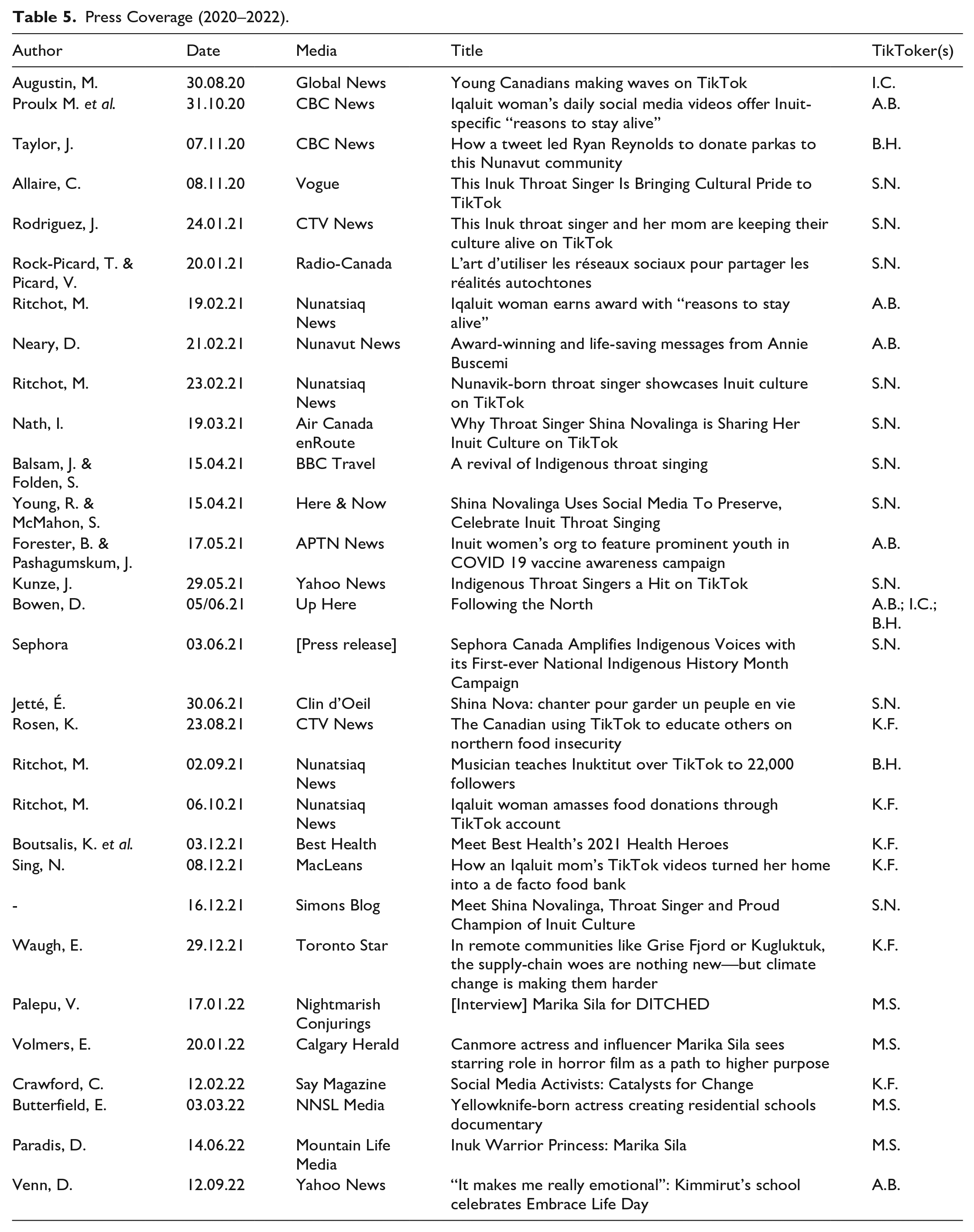
Our analysis shows that motivations evolve with popularity, as access to broader audiences instills in Indigenous creators a stronger sense of responsibility to use their visibility to inform, educate, and actively militate for the better good of Inuit, as well as to generate positive impacts for (offline) communities. In interviews given to the media (Table 5), all influencers speak of their newly gained visibility as an opportunity to support their community. Not only does the platform help educate non-Inuit about the culture and spread awareness, but it is also a space where fans can be mobilized to offer “offline” help through fundraisers and donations (Butterfield, 2022; Proulx et al., 2020; Ritchot, 2021a). Shina Novalinga explains that helping others is part of Indigenous culture: We think about our people and think of ways to help our community, ways to support each other and since we just grew this platform very recently, we though “why don’t we use it for a good cause?” [. . .] It’s an important part of our values. (In Rodriguez, 2021)
For example, Novalinga and her mother launched a fundraiser in 2021, amassing $285,000 to buy bicycles to children in their home community in Puvirnituq (Ritchot, 2021c). On TikTok, they said they wanted to send bicycles to “promote physical and mental well-being” (shinanova, 2021b).
Press Coverage (2020–2022).
Similarly, Kyra Flaherty, whose videos helped raise awareness on issues related to food security and grocery prices, said in an interview that “my mind’s been wrapped around how I can help the community for a long time now” (Ritchot, 2021a). As her TikToks gained more visibility, fans started asking how they could help: “Some asked me if there were petitions to sign or an organization they could donate to [. . .]. But the most common show of support was people sending boxes up here.” In a sudden and “absolutely insane” movement of support, cash and material donations started pouring in, filling her home with boxes sent from fans (Sing, 2021). She helped distribute goods to families in need in the community, while also starting a fundraiser to buy winter boots for children.
For creator Annie Buscemi, real-life impacts of her TikTok content are evident in interactions she has with people. She started receiving messages from Inuit and non-Inuit to thank her for her videos, and people in her community have started recognizing her and telling her how they appreciate her videos. As she said in an interview, “people are so grateful it makes my heart full [and] it just makes me want to keep going” (Ritchot, 2021b). Her work was formally recognized when she was awarded the “Young Inuk Woman of the Year” title by Pauktuuit Inuit Women of Canada in 2020; she has also been invited to schools to speak to Inuit teenagers about suicide (Venn, 2022).
In their press interviews, all creators identify TikTok as a way to gain a public voice and speak for their communities. This means that, although TikTok content is mainly individual work, newly gained visibility is understood as a responsibility to provide collective benefits, self-present as a spokesperson for Inuit, and bring awareness to political issues. This shift is visible on TikTok, as influencers tend to “specialize” on certain issues and keep their general discourse aligned with them. For example, Kyra Flaherty’s food security awareness videos have marked a shift in the general content that she shares on her TikTok page, different from early makeup videos and taking a more engaged, political stance as her fanbase increasingly expected that type of content from her. This means that creators are sensitive and adaptable to their audience in the stories that they share.
TikTok Storytelling
Mundane Stories: Mimesis and Indigenized Trends
As observed in other studies, TikTok’s trends contribute to create a specific landscape characterized by mimesis, dance movements, and lip-synch (Ebbrecht-Hartmann & Divon, 2022; Gentry, 2022; Zulli & Zulli, 2020). Videos we engaged with were fitting with these specific forms of storytelling. A great majority of our sampled TikToks were set in selfie mode (55/60), and indoors (49/60), most often at home (42/60), with no special filters, effects, or montage (39/60).
Video styles differ from one account to another: while some creators mainly post videos where they speak to the camera about various issues, others would mostly dance or engage in trends. In each account, we found repetition in content shared, either with the same video being remade (e.g., Kyra Flaherty’s multiple editions of grocery price montages; arcticmakeup, 2021a), a sound effect being used more than once (e.g., shinanova, 2022), or appearing in the same background in most videos. This repetitive format can sometimes build into a longer form of iterative, editorial strategy to develop a powerful narrative. Annie Buscemi, for example, posted a new “Inuk-specific reason to stay alive” every day, for more than 100 days. In almost all these videos, she appears in the same background—which is probably her bedroom—and the same music is playing. All videos are made exactly the same, starting with her saying “Ullaakuut, good morning! Happy day (. . .). Today I think we should stay alive for . . .” in a soft voice, while subtitles defile on screen.
While engaging in TikTok trends, creators use affordances to appropriate them. For example, a recurrent sound meme on TikTok is a skit on a short dialogue:
- But you don’t look gay
- Oh, I’m sorry, let me just . . .
Then, a music starts, and the creator appears in a disguise, or acting according to stereotypes associated with them, appropriating the trend to their own identity. Building on mainstream gay stereotype and connotations, this popular trend was shared in many Inuit accounts, with humorous depictions of what an Inuk should look like including being in an igloo, riding a polar bear, or wearing traditional clothing (e.g., arcticmakeup, 2021b). In other cases, trends such as dances and challenges are “indigenized” to better fit with Inuk identities, most often with use of traditional clothing, accessories, or music (e.g., thatwarriorprincess, 2022).
Funny Stories: Irony as Political Resistance
Humor, irony, and sarcasm was the most recurring form of storytelling we observed on TikTok and in our case study. As hinted in the previous section, humor was one way to address stereotypes and challenge common misconceptions about Inuit culture without addressing them clearly, but rather by ridiculing them or over-playing them: dancing in an iglu (arcticmakeup, 2021b), joking about being too cold to go outside in the winter (thatwarriorprincess, 2021). In another example, Annie Buscemi jokingly reconciles heroic Inuit hunter narratives with the banality of modern life, using a common Internet joke about men and applying it to stereotyped Inuit: Today I think we should stay alive for the Inuit that are able to spot camouflaged animals, pretty much in the middle of nowhere [vastly open land], but can still see that tiny, little moving speck, like really far in the distance, but are still the same Inuit that can’t find the ketchup bottle even though it’s in completely plain sight. [laughs]. (annieneevee, 2020)
Humor and irony allow creators to directly embrace stereotypes and point to the absurdity of having to fit both characters—the Inuk and the TikToker. Possessing both identities at once, because of the colonial opposition of tradition to modernity, is thus shown to be absurdly impossible. We have observed the same ironic point of view from other Indigenous creators, where the use of humor to sarcastically “show” what stereotypes would really look like is a way to challenge and deconstruct dominant colonial narratives.
These performances are fitting with what Gentry (2022) names “mindful sardonicism,” which he defines as “a sincere critique delivered through cleverly playful performance, a means of delivering uncomfortable truths in cannily coded ways” (p. 2). Funny stories are used not only as resistance to stereotypes, but also to convey political messages. Similar use of lighthearted tone to convey political messages was also observed by Cervi and Divon (2023), which they describe as “playful activism.” Playful, ironic, and sarcastic skits about colonization are common in our sample as well as in #NativeTikTok more generally. Echoing a familiar TikTok genre, a lip-synch skit featured the sound of a movie 2 dialogue, but cleverly showcasing Canada in conversation with Indigenous people. In skit videos, tiktokers play both roles in staged montage, with or without disguise.
Why do we fight?
I don’t know, it makes no sense at all!
It makes no sense.
When we get in a fight, look in my eyes and let’s remember this moment right now, and know that we never have to fight.
But you’re such a dick sometimes.
I know I am a dick sometimes. People think I’m so nice but I am such a dick.
Thank you for admitting that.
And you get so mad at me, I feel like you want to kill me.
Oh my gosh I do want to kill you! (shinanova, 2020).
Humor allows creators to playfully challenge dominant narratives and stereotypes. Irony is thus a form of political resistance; with humor, creators can deconstruct preconceived ideas, educate the public about their reality, and occupy screenscapes from which they have been symbolically and effectively denied access. With skits, reproduction, and mimesis, they get to appropriate hurtful narratives and make them their own, while keeping the lighthearted tone that is expected by TikTok publics (Divon & Ebbrecht-Hartmann, 2022). The fact that funny sounds and skits are re-used within the same meta-hashtag also indicates that common causes—such as colonization—are an important aspect of online solidarity and community-building on the platform. This solidarity is emphasized by the fact that Indigenous influencers engage with each other’s content by liking, duetting, referencing, or collaborating with one another.
Silent Stories: Juxtaposition and Emotion
Using TikTok’s lip-synch and sound effects as a background, another interesting form of storytelling emerged in our observations, which was the use of silence. In the majority of our sampled videos (40/60), TikTokers did not speak to the camera, relying instead on captions of text (20/40), music lyrics or recorded dialogue (10/40), if it was not completely wordless, when dancing, for example (10/40).
Silence has multiple functions on TikTok. In some cases, it efficiently helps overcome the shortness of videos by superposing an action with text: in Shina Novalinga’s throat-singing videos, she often writes captions that explain what throat-singing is, or what the song is called. As observed elsewhere (Hautea et al., 2021), this strategy is aligned with the multi-layered and juxtaposed nature of TikTok’s video format.
In other cases, silence helps communicate emotion. With the short format of TikTok videos, no specific narrative is needed, yet meaning is conveyed in creative ways. In this case, silence is a form of being speechless. Preliminary observations for this research were conducted during the year that followed the recovery of the remains of 215 children found on the site of a former residential school in British Columbia in May 2021, after which thousands of other bodies were also found all over Canada (Lewis & Srivastava, 2022). These recoveries made the news, and some Indigenous TikTokers posted videos of themselves watching news on TV, crying or staring into their camera. In these cases, the short format of TikTok videos allowed for emotion to make for entire stories, without the need for explanation.
In one example, emotion is displayed with juxtaposition. Using the same format as most of her videos in which she teaches Inuktitut words, Becky Han (koonoo.han, 2021) very emotionally explains the expression she chose that day: So this morning I took a photo of my kids because it’s their last day of school. And like, there was a lump in my throat. Because they get to come back home today. And . . . yeah . . . that term in Inuktitut, Qiaga iggianniittuq, like that’s . . . the only thing I can . . . I can . . . say today. (koonoo.han, 2021)
While she is not silent, captions of text appear on the image, first to refer to “those hundreds and hundreds of children didn’t get to come back home,” and later to state “Feelings are too big for words. I am so heartbroken for those 751 souls and their families.” The video only lasts 58 seconds, yet the layering of visual, sound, and text makes a powerful message. The audience clearly understands what is said and unsaid in the dialogue, as well as the context and complex emotions that come with it.
Silence can also be used as a form of resistance on TikTok. It is recurrent to see trends of creators dancing while words of violence, insults, or hateful comments appear on screen. In one such videos, we see Shina Novalinga and her mother eating beluga as captions such as “Poor beluga whale” and “I would never eat that” defile Then, on an upbeat music, Shina and her mother start smiling and bouncing their heads on new captions: “More for us; Good for our hair/skin” (shinanova, 2021c). In this example as in many others, choosing not to speak is a form of resistance and is used as integral part of the story. In reacting silently to captions of text, then reclaiming control over what is said with a more positive turn, creators claim power over otherwise uninformed comments.
Conclusion
In this study, we have identified three main forms of narratives that are made possible through TikTok-specific features: the mundane, funny, and silent stories. Trends, fast pace, and short format of TikTok videos thus influence storytelling in favorizing repetition and mundanity, as well as playful engagement with stereotypes, emotion, and resistance. In only one case in our sample did we find a traditional Inuit legend (koonoo.han, 2020). While more traditional forms of storytelling forms do exist on TikTok, they are much less frequent.
Aesthetics of authenticity on TikTok is formed by creators showing their “real” unfiltered life and self. Inuit creators adhere to this “mundane authenticity” on TikTok by producing videos in line with general TikTok trends, features, and style, which allows them to share bits of mundane, non-heroic moments of their everyday life. TikTok mundanity can also be seen in the way influencers showcase elements of their culture as they engage with it in their everyday life—at times partially, from afar, to the best of their ability. In their stories, Inuit creators refuse to engage in romantic stereotypes because they fully acknowledge the embeddedness of Inuit culture and modern life, disrupting dominant dichotomies of tradition and modernity. Just as Becky Han eats her traditional maktaak (raw narwhal skin) like sushi: wrapped in seaweed, with wasabi and dipped in soy sauce (koonoo.han, 2022).
For Inuit creators in our corpus, TikTok is a space of resistance, visibility, and community. It provides opportunities to develop a diversely “authentic” identity, for non-Inuit audiences to learn about a little-known culture, and for creators to participate in community-building through solidarity.
The rising popularity of young Inuit women as influencers suggests that digital media use opens new spaces of resistance by Inuit on the global scale. However, being more exposed to the public also means being more vulnerable to hateful comments, social pressure, and fatigue (Bowen, 2021; Proulx et al., 2020). Visibility is not always beneficial, especially for racialized women (Duffy & Hund, 2019). A further study involving in-depth interviews with content creators to consider their experience and relationship with their audience would help broaden our understanding of TikTok as a social space. Furthermore, it would be interesting to consider the audience’s point of view on Indigenous content on TikTok, by considering comments in research.
It also needs to be said that TikTok is evolving very fast, and its landscape might soon be completely transformed with the emergence of new trends. The vast array of content on TikTok seems—from our perspective—to be increasingly politically engaged, and there are interesting research opportunities regarding Indigenous youth engagement online.
Footnotes
Acknowledgements
We would like to thank research assistants Caroline Tessier and Benjamin Dacquet for their helpful input into our research.
Declaration of Conflicting Interests
The author(s) declared no potential conflicts of interest with respect to the research, authorship, and/or publication of this article.
Funding
The authors disclosed receipt of the following financial support for the research and authorship of this article: This work was supported by the Canada Graduate Scholarships—Doctoral (CGS D) program of the Social Sciences and Humanities Research Council of Canada (grant number 767-2020-1736).
