



Abstract
Despite young Black women’s high rates of social media use and risks for victimization at the nexus of sexism and racism, the relationship between these variables remains under researched in this segment. We surveyed 354 Black American women aged 18–30 to explore the associations between two aspects of social media use—time spent daily on social media platforms (i.e., Facebook, Instagram, Snapchat, TikTok, Tumblr, Twitter, and YouTube) and type of social media engagement (i.e., active social use, active non-social use, and passive use)—with four different types of online victimization (i.e., general online victimization [GOV], online sexual victimization [OSV], online individual racial victimization [OIRV], and online vicarious racial victimization [OVRV]). Results indicate that more time spent daily on Tumblr was significantly associated with more experiences of GOV, OSV, and OIRV. More time spent daily on Instagram was significantly associated with more experiences of OVRV, while more time spent daily on Facebook was significantly associated with fewer experiences of OVRV. Active non-social use was significantly associated with more experiences of GOV and OIRV. Snapchat, TikTok, Twitter, and YouTube use, active social use, and passive use were not significantly associated with any categories of online victimization. We provide implications for researchers as well as mental and behavioral health practitioners seeking to enhance Black women’s safety and well-being on social media platforms.
Online victimization (also cyber victimization) refers to harmful social interactions facilitated via technology, such as email, phone, or social media (Tynes et al., 2010). Based on their social locations that render them vulnerable to sexism and racism, Black women are suggested to be at risk for online victimization (Amnesty International, 2018; Francisco & Felmlee, 2022). A study of Twitter (since branded “X”) found that Black women were 84% more likely than White women to be mentioned in tweets that were hostile and promoted identity-based violence (Amnesty International, 2018). Given their distinctive experiences with online victimization, Tynes et al. (2010) introduced four categories of online victimization faced by racialized communities: general online victimization (GOV; i.e., general bullying or harassment), online sexual victimization (OSV; i.e., gendered sexual harassment or solicitation), online individual racial victimization (OIRV; i.e., direct hurtful experiences with racialized images and social interactions), and online vicarious racial victimization (OVRV; i.e., vicarious hurtful experiences with racialized images and social interactions).
Preliminary evidence suggests that online victimization contributes to adverse mental health, health, and body image outcomes among young Black women (Matsuzaka et al., 2022; Volpe et al., 2023). Thus, young Black women’s social media use in relation to risks for online victimization must be better understood to promote their safety and well-being in digital spaces. This includes examination of not just how much they are using social media platforms (i.e., time spent daily on social media platforms), but also how they are engaging in content-based activity and social interactions on social media (i.e., types of social media engagement). Thus, the current study explores the associations of time spent daily on social media platforms and types of social media engagement with online victimization.
Theoretical Framework: An Integrated Intersectional Ecological Systems Framework
Developed by Black feminist scholar-activists, intersectionality frames our understanding of Black women’s oppression at the intersections of sexism and racism or gendered racism (Crenshaw, 1990; Essed, 1991). Intersectionality has been used as a guiding framework in numerous studies examining Black women’s victimization in offline and online spaces (Cheeseborough et al., 2020; Debnam et al., 2022; Leath et al., 2021; Matsuzaka et al., 2022). For instance, Black women contend with gendered and racialized forms of violence targeting aspects of their appearance, such as facial features, hair texture, and body shape (Lewis & Neville, 2015). Black women also experience sexual violence based on gendered racial stereotypes of Black women as hypersexual (Cheeseborough et al., 2020; Leath et al., 2021; Matsuzaka et al., 2022). A study examining aggression toward women of color on Twitter found that tweets targeting Black women were commonly focused on the stereotype of hypersexuality (Francisco & Felmlee, 2022). Taken together, intersectionality is useful for understanding how young Black women’s lived experiences online are shaped by gendered racist structures in the broader social environment (Crenshaw, 1990).
Intersectionality has notable overlaps with the ecological systems framework that describes individual development and functioning as shaped by the goodness-of-fit between a person in their social environment (Bronfenbrenner, 1977; Germain & Gitterman, 2008). According to the perspective, people negotiate various systems in their social environment, including the microsystem (i.e., most immediate system influencing the individual, such as family, peers, and work), mesosystem (i.e., the interactions between different microsystem entities), exosystem (i.e., policies, media, and community resources), and macrosystem (i.e., cultural ideologies, attitudes, and social conditions; Bronfenbrenner, 1977; Germain & Gitterman, 2008). In contemporary society, where social media platforms are a central location for young people’s social interaction (Pew Research Center [PRC], 2024), there is a need to expand on traditional conceptions of how and where people interact to incorporate digital contexts. This may be particularly relevant among young Black women who are suggested to have high levels of emotional investment in and incorporation of social media use in their daily lives (Matsuzaka et al., 2023).
In the current study, we apply an integrated intersectional ecological systems framework for understanding young Black women’s social media-based risks for online victimization (see Figure 1). In doing so, we consider social media platforms as entities in the exosystem and digital contexts for social interactions that occur at the microsystem and mesosystem levels. According to this framework, online victimization is a type of harmful social interaction experienced by an individual (e.g., direct bullying by a peer) or experienced vicariously (e.g., observing sexual harassment between peers or observing racial bias in media coverage related to violence against Black women). Applying intersectionality, we recognize that Black women’s social positioning may relate to their vulnerabilities for online victimization within broader macrosystem contexts, such discourses on racism and sexism (Volpe et al., 2021a). Furthermore, at the individual level, time spent on social media platforms and type of social media engagement may further influence risks for online victimization.

An integrated intersectional ecological systems framework for exploring young Black women’s social media use and online victimization.
Young Black Women’s Social Media Use Risks for Online Victimization
Time Spent on Social Media Platforms
A report on Americans’ social media use found that, with some exceptions (e.g., Facebook), 18 to 29 year olds have higher rates of social media use across social media platforms (PRC, 2024). Young adults have a particularly high frequency of Instagram, Snapchat, and TikTok use relative to other age cohorts (PRC, 2024). As for gender, women are more likely than their male counterparts to use popular social media platforms, such as Facebook, Instagram, Snapchat, TikTok, Tumblr, and YouTube (PRC, 2024). Relative to their White counterparts, Black Americans are shown to have higher rates of social media platform use specific to Instagram (46% vs. 43%), TikTok (39% vs. 28%), Twitter (23% vs. 20%), and YouTube (82% vs. 81%; PRC, 2024). To our knowledge, studies with probability samples have yet to examine rates of platform use at the intersections of age, gender, and race. On the other hand, a study involving young Black women aged 18–30 suggested that the integration of social media use into social routines was higher in their sample than in a nationally representative sample of American adults (Bekalu et al., 2019; Matsuzaka et al., 2023). Another earlier study reported frequent use of Facebook and Instagram in a sample of young Black women aged 18–30 (Stanton et al., 2017). Taken together, given discrete data on social media use by age, gender, and race (PRC, 2024) and prior findings about social media use in samples of young Black women (Matsuzaka et al., 2023; Stanton et al., 2017), we can infer that young Black women likely have high rates of social media use across multiple platforms.
Preliminary research suggests that more time spent on social media increases risks for online victimization among adolescents and young adults (Korchmaros et al., 2014; Volpe et al., 2023). In a majority-White sample of adolescents, more time spent online daily was associated with more experiences with online victimization (Korchmaros et al., 2014). In another study with Black, Latinx, Asian, and multiracial college-attending young adults, more time spent daily across Facebook, Twitter, Instagram, and Snapchat was associated with more online racial/ethnic victimization (combination of individual and vicarious racial/ethnic victimization) in bivariate associations (Volpe et al., 2023). Platform-specific features may increase risks for online victimization, such as the ease of creating an anonymous account (e.g., Instagram), the public visibility of posts (e.g., Twitter/X), and policies, such as allowing users to follow public accounts without approval (e.g., Tumblr; Fansher & Randa, 2019). Thus, more research is needed on young Black women’s risks for online victimization and how these risks may be amplified based on the time spent on social media platforms.
Type of Social Media Use Engagement
Scholars have identified three types of social media engagement: active use, active non-social use, and passive use (Gerson et al., 2017; Trifiro & Gerson, 2019). Active social use involves using social media for content creation and consumption as well as direct social interaction, with related behaviors, such as creating and sharing content, commenting on, or liking content, and sending messages (Gerson et al., 2017). Active non-social use involves the use of social media for content creation, but not direct social interaction. Active non-social behaviors include creating and tagging friends in content, but not commenting, liking content, or sending messages (Gerson et al., 2017). Finally, passive use involves the use of social media for content consumption, but not content creation or social interaction (Gerson et al., 2017). Passive use has been characterized as involving the surveillance of others’ social media content without leaving comments, liking content, or sending messages (Gerson et al., 2017).
Prior studies have examined the associations between types of social media engagement and well-being, generally hypothesizing that active use is associated with increased well-being and passive use is associated with decreased well-being (Trifiro & Gerson, 2019; Valkenburg et al., 2022; Verduyn et al., 2021). Yet, studies have reported conflicting findings (Liu et al., 2019; Yin et al., 2019).) or no support for these hypotheses (Valkenburg et al., 2022). Scholarly debates on this topic are limited by focusing on data from predominantly White samples. Thus, this study contributes knowledge about active social, active non-social, and passive uses in a sample of young Black women. Furthermore, despite online victimization being associated with decreased well-being in racially diverse adolescent and young adult samples (Rose & Tynes, 2015; Tynes et al., 2010; Wang et al., 2023), to our knowledge, the literature has yet to clarify the associations between active and passive forms of social media engagement with online victimization. It is conceivable that more active use of social media with content creation renders users vulnerable to negative social feedback or online victimization of all forms. Comparatively, passive use may involve fewer risks for direct victimization, while vicarious forms of victimization remain plausible. The current study seeks to clarify these relationships.
The Current Study
Young Black women are vulnerable to online victimization with implications to their mental health, health, and body image (Amnesty International, 2018; Matsuzaka et al., 2022; Volpe et al., 2023). To better promote Black women’s safety and well-being in digital spaces, there is a need for research examining how specific aspects of Black women’s social media use may be associated with various types of online victimization. Guided by an intersectional ecological systems framework, this study sought to explore how young Black women’s time spent daily on social media platforms (i.e., Facebook, Instagram, Snapchat, TikTok, Tumblr, Twitter, and YouTube) and type of social media engagement (i.e., active social, active non-social, and passive) were associated with four types of online victimization (i.e., GOV, OSV, OIRV, and OVRV).
Informed by prior research involving the online victimization experiences of majority-White (Korchmaros et al., 2014) or racially diverse (Volpe et al., 2023) samples of adolescents and young adults, we first hypothesized that more time spent daily on all social media platforms (i.e., Facebook, Instagram, Snapchat, TikTok, Tumblr, Twitter, and YouTube) would be associated with more experiences with GOV, OSV, OIRV, and OVRV (H1). Given the act of content creation that is featured in active use of social media and related risks for negative social feedback (Gerson et al., 2017), we next hypothesized that both active social use (H2) and active non-social use (H3) on all social media platforms would be associated with more experiences with GOV, OSV, OIRV, and OVRV. Given its non-social characteristics without content creation or social interaction (Gerson et al., 2017), we hypothesized that passive use would be associated with more experiences with OVRV only (H4). Given research indicating that sexual minorities are highly vulnerable to online victimization (GLSEN Inc, 2013) and almost a quarter of our sample identified as sexually diverse, we controlled for sexual orientation.
Method
Participants and Procedure
Our sample included 354 Black American women (Mage = 24.34 years, SDage = 3.70). The majority identified as cisgender (99.7%, n = 353) with one participant (0.3%) identifying as a transgender woman. The majority identified as heterosexual (75.1%, n = 266), followed by bisexual (17.5%, n = 62), gay/lesbian (4.8%, n = 17), and queer (0.8%, n = 3). Seven participants (1.7%) chose to self-describe their sexual orientation. The majority identified their ethnicity as African American (72.6%, n = 257), followed by 10.2% as Biracial or Multiracial (n = 36), 9.0% as African (n = 32), 5.4% as Afro-Latina (n = 19), and 2.8% as West Indian/Caribbean (n = 10). The median household income of our sample was US$25,000–US$34,999. Overall, our sample was well-educated with 37.9% (n = 134) having graduated from high school, 25.9% having obtained an undergraduate college degree (n = 92), and 6.0% (n = 21) having completed a graduate school program. Approximately, one-third of our sample was currently enrolled in college (n = 120). The majority reported working full time (37.3%, n = 132) or part time (20.6%, n = 73) and over one-third of the participants were unemployed, either as full-time students (17.8%, n = 63), non-students (17.5%, n = 62), or as stay-at-home parents (6.8%, n = 24).
Participants were recruited by Qualtrics Panels after the research team received institutional review board approval at a large southeastern university. Data for this study were collected in March–April 2022 as part of a larger cross-sectional study that investigated young Black women’s digital media use, identities, and mental health. Inclusion criteria for this study involved being between the ages of 18 and 30, and self-identifying as a Black woman. Qualtrics Panels recruits geographically diverse samples across the East, Midwest, South, and West regions of the United States, and only includes participants with complete surveys. This study focused on young Black women aged 18–30 given young adults’ high rates of social media use (PRC, 2024) and to extend prior research on young Black women’s social media use (Matsuzaka et al., 2023; Stanton et al., 2017) and online victimization experiences (Matsuzaka et al., 2022; Volpe et al., 2023). Prior to taking the Qualtrics-hosted survey, participants reviewed a brief study description and completed an informed consent form. The approximately 25–min survey included multiple attention checks to increase engagement in the study. Upon survey completion, participants reviewed a debriefing form and were compensated directly by Qualtrics Panels in an amount undisclosed to the research team. To recruit high-quality samples, Qualtrics Panels partners with select panel organizations to recruit participants and manage the compensation process, including providing participants with different compensation options, such as gift cards, game points, cash, airline miles, and other options (Boas et al., 2020).
Measures
Time Spent on Social Media Platforms
Time spent daily on social media was assessed by asking participants to indicate how often per day they used Facebook, Instagram, Snapchat, TikTok, Tumblr, Twitter, and YouTube (Lee et al., 2022) on a 5-point scale: 1 = 10 min or less per day; 2 = 11–30 min per day; 3 = 31–60 min per day; 4 = 1–2 hr per day; and 5 = more than 2 hr per day. Higher scores indicated more time spent daily on social media platforms.
Types of Social Media Engagement
We used an adapted version of the 13-item three-factor Passive and Active Facebook Use Measure (PAUM; Gerson et al., 2017) to assess three different types of social media engagement: active social use, active non-social use, and passive use. The three subscales of the PAUM, included a five-item index of active social use (e.g., “Posting status updates” and “Browsing the newsfeed actively—liking and commenting on posts, pictures, and updates”), a four-item index of active non-social use (e.g., “Tagging photos and videos” and “Posting videos”), and a four-item index of passive use (e.g., “Looking through my friends’ profiles” and “Browsing the newsfeed passively—without liking or commenting on anything”). We adapted the PAUM to assess users’ active and passive social media use across different social media platforms. Participants indicated how frequently they performed different activities on social media, generally and without specificity to platform, on a six-point scale (1 = never/ 0% of the time to 6 = very frequently /close to 100% of the time). Mean scores were computed with higher scores indicating higher engagement in active social, active non-social, and passive social media use. In its original validation study, the three factors of the PAUM were shown to be distinct but correlated, and the subscales showed discriminant validity by a lack of correlation with measures that assess negative affect, satisfaction with life, and eudaimonic well-being (Gerson et al., 2017). The subscales of the PAUM showed adequate internal reliability with an American sample (αactive social = .80; αactive non-social = .78; αpassive = .70; Gerson et al., 2017). In the current study, the subscales demonstrated good internal consistency (αactive social = .80; αactive non-social = .86; αpassive = .77).
Online Victimization
The 21-item four-factor Online Victimization Scale (OVS; Tynes et al., 2010) was used to measure participants’ self-reported experiences of online victimization. The OVS includes an eight-item index of GOV (e.g., “People have said negative things about how I look, act, or dress online”), a six-item index of OSV (e.g., “I have received unwanted sexual SPAM, e-mails, or messages”), a four-item index of OIRV (e.g., “People have threatened me online with violence because of my race or ethnic group”), and a three-item index of OVRV (e.g., “I have witnessed people saying mean or rude things about another person’s ethnic group online”). Participants indicated how frequently they experienced GOV, OSV, OIRV, and OVRV in the past year using a 5-point scale (0 = never to 4 = every day). For each of the four subscales, a mean score was computed with higher scores indicating higher levels of GOV, OSV, OIRV, and OVRV. In the original validation study, the OVS was shown to have convergent validity given the scale’s positive associations with measures of anxiety and depressive symptoms and negative associations with measures of self-esteem and satisfaction with life (Tynes et al., 2010). The subscales demonstrated good to excellent internal consistency in a study involving Black women (αGOV = .95, αOSV = .89, αOIRV = .89, and αOVRV = .87; Matsuzaka et al., 2022) and in this study (αGOV = .95, αOSV = .89, αOIRV = .90, and αOVRV = .89).
Control Variable
Sexual Orientation
Participants indicated their sexual orientation within the response categories: (1) heterosexual, (2) gay/lesbian, (3) bisexual, (4) queer, and (5) prefer to self-describe (with a write-in option). This variable was coded, such that, 0 = heterosexual and 1 = sexual minority.
Results
Preliminary Analyses
See Tables 1 and 2 for descriptive statistics and bivariate correlations between the demographic control variable, time spent daily on social media platforms (i.e., Facebook, Instagram, Snapchat, TikTok, Tumblr, Twitter, and YouTube), type of social media engagement variables (active social, active non-social, and passive), and the four online victimization variables (GOV, OSV, OIRV, and OVRV).
Descriptive Statistics for Variables of Interest.
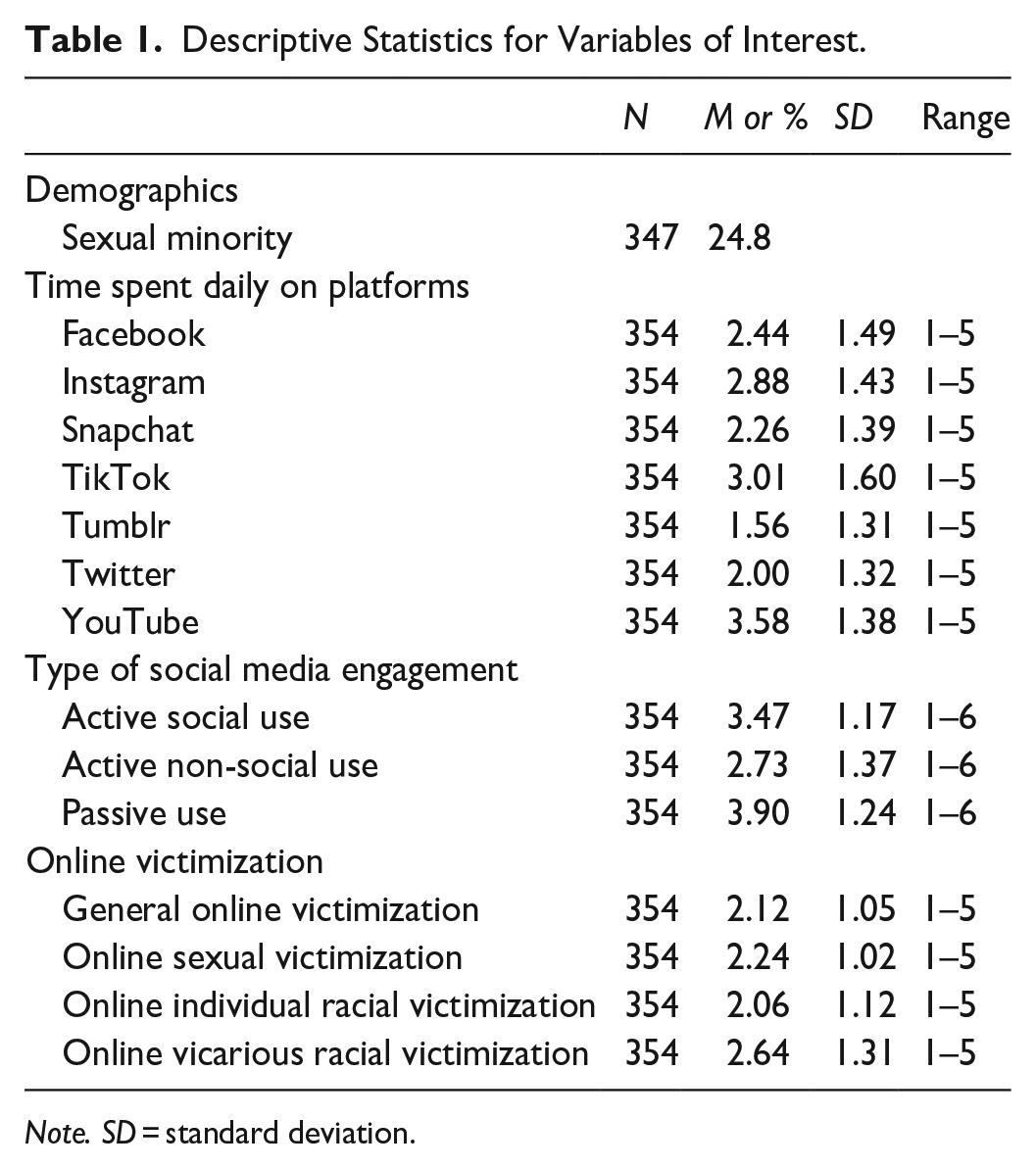
Note. SD = standard deviation.
Bivariate Correlations among Covariate, Time Spent Daily on Social Media Platforms, Type of Social Media Engagement, and Online Victimization.
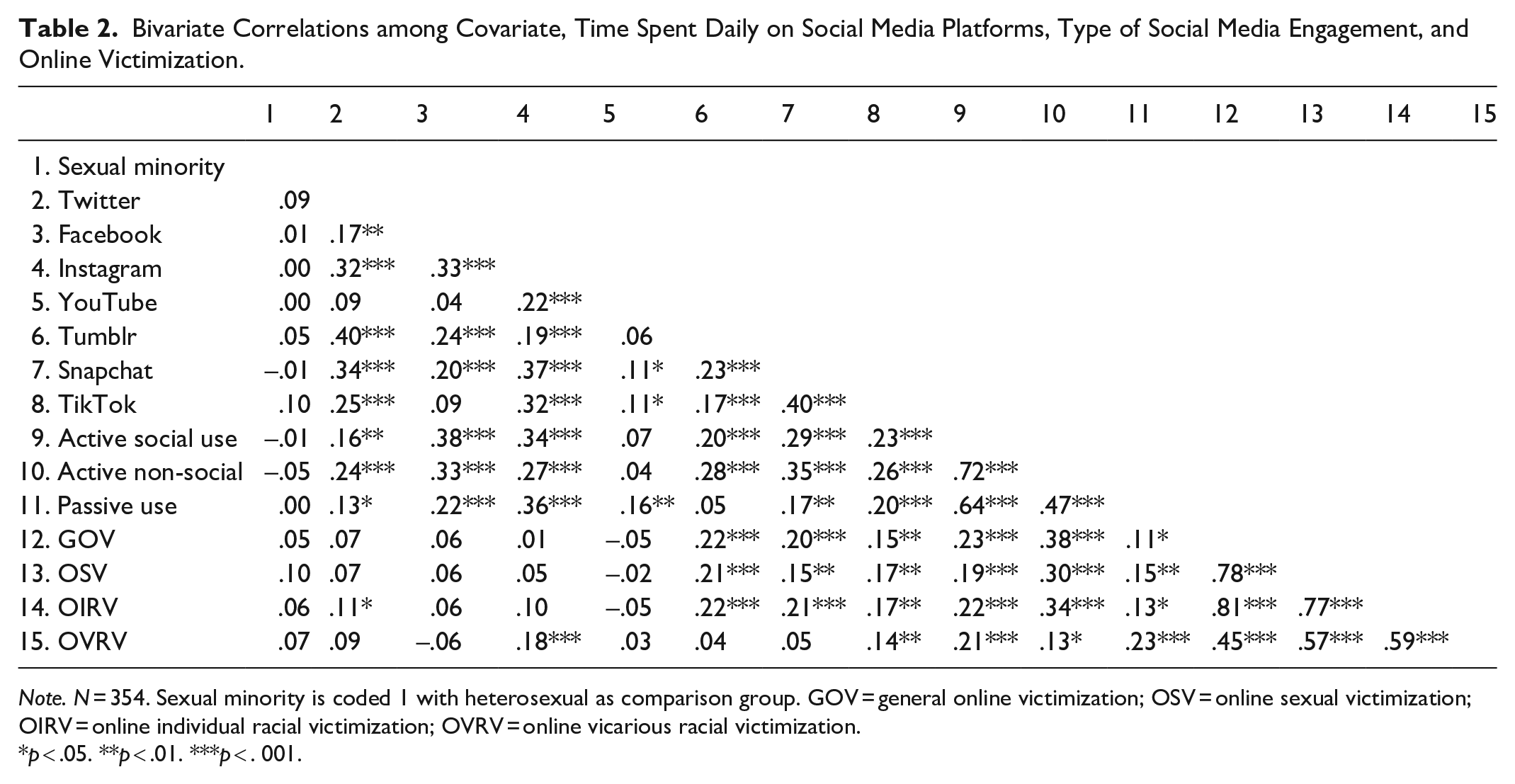
Note. N = 354. Sexual minority is coded 1 with heterosexual as comparison group. GOV = general online victimization; OSV = online sexual victimization; OIRV = online individual racial victimization; OVRV = online vicarious racial victimization.
p < .05. **p < .01. ***p < . 001.
Hypothesis Testing
We used hierarchical multiple regression analyses to test our hypotheses. The covariate of sexual orientation was entered in the first step; the time spent daily on social media platforms variables were entered in the second step; and the social media engagement type variables were entered in the third step (see Table 3).
Final Multiple Regression Model of Covariate, Time Spent Daily on Social Media Platforms, and Type of Social Media Engagement Predicting Four Categories of Online Victimization.

Note. N = 347–354. SM = social media; sexual minority is coded 1 with heterosexual as the comparison group. Adj. = adjusted; GOV = general online victimization; OSV = online sexual victimization; OIRV = online individual racial victimization; OVRV = online vicarious racial victimization.
p < .05. ** p < .01. *** p < .001.
In the first step, sexual orientation accounted for .00% of the adjusted variance in GOV, F(1, 352) = .86, p = .35; .01% of the variance in OSV, F(1, 352) = 2.81, p = .10; .00% of the variance in OIRV, F(1, 352) = 1.00, p = .32; and .00% of the variance in OVRV, F(1, 352) = 1.03, p = .31. The inclusion of the time spent daily on social media platforms variables in the second step explained a significant proportion of the variance in GOV, F(8, 345) = 4.52, p < .001, ∆adjR2 = .07; in OSV, F(8, 345) = 3.70, p < .001, ∆adjR2 = .05; in OIRV, F(8, 345) = 4.13 p < .001, ∆adjR2 = .07; and in OVRV, F(8, 345) = 2.60, p < .001, ∆adjR2 = .04. Adding the social media engagement type variables in the final step accounted for a significantly greater proportion of the variance in GOV, F(11, 342) = 7.72, p < .001, ∆adjR2 = .10; in OSV, F(11, 342) = 4.98, p < .001, ∆adjR2 = .05; in OIRV, F(11, 342) = 5.88, p < .001, ∆adjR2 = .06; and in OVRV, F(11, 342) = 3.73, p < .001, ∆adjR2 = .04.
Discussion
The current study examined how young Black women’s time spent daily on social media platforms and type of social media use engagement were associated with four categories of online victimization. Our results showed that more time spent daily on Instagram and Tumblr, and active non-social use was significantly associated with more experiences with online victimization. More time spent daily on Facebook was the sole platform to be associated with fewer experiences with online victimization specific to OVRV. Snapchat, TikTok, Twitter, and YouTube use, as well as active social use and passive use of social media were not significantly associated with any categories of online victimization. Guided by an integrated intersectional ecological systems framework, this study begins to illuminate how young Black women’s risks for online victimization may be related to individual social media characteristics, such as time spent daily on Instagram, Tumblr, and Facebook, and active non-social use of social media.
Time Spent Daily on Social Media Platforms
Our first hypothesis that more time spent daily across social media platforms would be associated with more experiences with online victimization in all categories was partially supported. Our findings indicated that more time spent daily on Tumblr was associated with more experiences with GOV, OSV, and OIRV. Tumblr was the only social media platform that was significantly associated with online victimization categories that were directly/personally experienced, rather than vicariously experienced. Of interest, we found that our sample spent the least time daily on Tumblr relative to the other platforms, which was expected as Tumblr use has declined in recent years (Statista, 2022). This said, our results suggest that the minimal time participants reported spending on Tumblr (approximately 10 min or less per day) still may pose a threat to their safety. Conversely, it could be that time spent on these platforms specifically does not matter, such that, any degree of duration of use can engender exposure to online victimization. For instance, in one investigation, more exposure to online racial/ethnic victimization was associated with worse sleep quality, but this association was not exacerbated by the duration of social media use (Volpe et al., 2023). We speculate that personal forms of online victimization are enabled on Tumblr given their profile-based and publicly accessible content that provides a greater capacity for anonymous interactions (Zhu & Chen, 2015).
As expected, more time spent daily on Instagram use was associated with more experiences with OVRV. This finding aligns with research suggesting that consumers of Instagram engage in surveillance of others’ content (Sheldon & Bryant, 2016). Also, given Black women’s use of Instagram to counter harmful narratives about Black women, engage in community-building, and perform Black feminist activism in response to experiences with online and offline gendered racism (Peterson-Salahuddin, 2022), we speculate that this might increase the likelihood that Black women might be exposed to harmful commentary directed at their peers’ content. Contrary to our expectations, we found that more time spent on Facebook was associated with fewer experiences with OVRV. This finding aligns with a prior study suggesting that some Black women use Facebook to access social support to navigate their experiences with oppression (Miller et al., 2021). It may also be that young Black women’s Facebook social networks are tighter and more tightly controlled than Instagram networks or engagements, given that profile content posted on Facebook is more extensive (e.g., information about marital status, employment, education; groups one belongs to and pages they follow; life events). Some research does indicate that Facebook is often used to share events from one’s private life, especially within already largely existing networks of contacts (e.g., old school friends) that were forged offline (Laor, 2022). Although Instagram also allows users to share aspects of their lives, the speed of accessing the visual format of posts has also made Instagram a site for engagement with brands and entertainers/celebrities (Laor, 2022). Perhaps using Instagram may feel more public than using Facebook, such that, greater use of Facebook allows for less vicariously victimizing content to enter users’ feeds. Facebook also provides a wider host of privacy and sharing settings than Instagram, so that, young Black women may more judiciously restrict their social networks to protect against vicarious exposure.
Given the popularity and widespread use of Snapchat, TikTok, Twitter, and YouTube (PRC, 2024), we were surprised that use of these platforms was not significantly associated with any categories of online victimization in our sample. It is possible that Snapchat features involve a more intimate network of known social contacts, which may have reduced risks for online victimization (Kishore et al., 2022). While our sample reported spending the most time daily on TikTok and YouTube at 31–60 min per day relative to other platforms, we speculate that users may have fewer opportunities to interface with others on a personal level on these two platforms given their content-based nature (Zhu & Chen, 2015). In other words, on TikTok and YouTube, negative commentary may be framed specific to the video content, rather than the content creator. This explanation is complemented by prior suggestions that video-based platforms may be less oriented to social interactions (Masciantonio et al., 2021). However, this does not explain why use of these platforms was not associated with vicarious online victimization. It may be that these platforms’ content moderation policies, at the time of data collection, were relatively stronger than those of other platforms.
Given prior studies illuminating risks for gendered racial violence on Twitter (Amnesty International, 2018; Francisco & Felmlee, 2022), we were surprised that time spent on Twitter was not significantly associated with any categories of online victimization. Qualitative research has illuminated Black women’s use of adaptive strategies on Twitter to reduce risks for online victimization, such as posting less content, being more intentional about what they post, and using mute or block features to avoid conflict (Peterson-Salahuddin, 2022). Black women on Twitter may also seek to reduce risks for online victimization by seeking to exclusively engage in discussions with members of their social communities (Peterson-Salahuddin, 2022). For instance, scholars have discussed Black women’s cultivation of Twitter communities by using Black feminist hashtags (e.g., #SayHerName, #BlackGirlMagic, #OverheardWhileBlack; (Jackson et al., 2020; Peterson-Salahuddin, 2022). Future studies examining the associations between Twitter use and online victimization among Black women should seek to incorporate measures for these protective behaviors into the study methodology.
Type of Social Media Engagement
In partial support of our third hypothesis, young Black women’s active non-social use was associated with more experiences with GOV and OIRV, but not OSV or OVRV. Our findings provide an important contribution to the literature as active non-social use is a relatively new typology for social media engagement, and thus, its effects have largely been understudied (Gerson et al., 2017). These findings corroborate prior studies suggesting that online bullying, harassment, and racist individual encounters may be common occurrences among Black women regardless of how actively they engage with social media (Amnesty International, 2018; Volpe et al., 2023). Although we did not test for causal relationships, we wonder whether young Black women’s prior experiences of online victimization may be informing how they choose to engage on particular social media platforms. For instance, for Black women with prior experiences with sexual victimization or racial victimization on social media platforms, we consider whether their active non-social use might reflect a decision to engage less actively on certain social media platforms where they anticipate risks for sexual or racial victimization. Further research can use both quantitative and qualitative approaches to understand the experiences of young Black women who use social media platforms as well as those who do use social media platforms.
Contrary to expectations, we found that active social use was not significantly associated with any categories of online victimization. This was surprising given prior research suggesting that women’s active engagement on social media platforms may put them at an increased risk for online victimization (Fansher & Randa, 2019). On the other hand, prior research indicates that active social use may be linked with increased social capital and self-esteem (Gerson et al., 2017). In support of this proposition, research on Black young adults’ activism on social media suggests that active use of social media can promote agency and be empowering for Black users, despite its risks (Mwangi et al., 2018). Conversely, perhaps active social use may lead to positive experiences online if young Black women agentically and iteratively curate and prune their social networks to create a safe and affirming experience. For instance, in one study, young Black social media users reported seeing positive discussions about Black people online relatively frequently (Volpe et al., 2023). As the measure we used for online victimization relies on participants’ self-report of online victimization in the past year, those with higher social capital and self-esteem may have not recognized or mentally registered personal experiences with online victimization as significant enough to merit recall. Given literature that highlights coping strategies that racially/ethnically marginalized adults use for managing distress from online racism (Keum & Volpe, 2023), it could be that these experiences were already coped with, such that, they are not as salient. Future studies are recommended to control for self-esteem and social capital or further examine coping strategies when testing associations between active social use and online victimization.
Our finding that young Black women’s passive use was not significantly associated with more experiences with OVRV was unexpected. Overall, we suspect that our null findings may reflect debates regarding how active and passive uses are conceptualized and measured (Kross et al., 2021; Valkenburg et al., 2022). Specifically, studies suggest that active and passive uses may share conceptual similarities and thus be more interactive than previously thought (Kross et al., 2021; Valkenburg et al., 2022). As such, it may be hard for empirical studies to disentangle the effects of these constructs on outcomes, including online victimization (Kross et al., 2021; Valkenburg et al., 2022).
Limitations and Future Directions
Several limitations should be considered when interpreting these results. First, given the study’s cross-sectional nature, we could not determine causality between the variables. We recommend longitudinal studies that test whether prior experiences with online victimization may predict active or passive use of social media and the duration of using particular social media platforms. Second, as prior research suggests that Black women’s social media use may vary according to a variety of personality, sociodemographic, and motivational characteristics (Feng et al., 2019; Sheldon & Bryant, 2016), studies should consider how to meaningfully analyze these factors to better capture how Black women’s multidimensional identities and experiences influence their social media use and online victimization. In addition, given their high levels of social media use and risk factors for online victimization (GLSEN Inc, 2013), research might explore Black sexual minority women’s experiences with social media use and online victimization at the intersections of heterosexism, racism, and sexism. Given our exclusively cisgender sample, we further note that Black transgender women or non-binary femme experiences are not represented in this study, thus warranting future-related studies that are inclusive of women with expansive gender identities. Taken together, while Black women may have similar experiences with online victimization at the intersections of their racial and gender identities, their experiences using social media platforms may vary by other sociodemographic identities. Future research could explore within-group differences in the ways Black women are motivated to use social media and experience risks of online victimization.
Third, there are a few measurement factors that future studies should address. As this study measured active social, active non-social, and passive uses as discrete categories, future studies are needed to understand whether and how users are engaging both actively and passively across different social media platforms. In addition, as we did not examine the associations between the types of social media engagement across social media platforms, future studies should examine these relationships. In addition, prior studies note how social media use is assessed in a variety of ways and that few validated measures exist to assess social media use type (Trifiro & Gerson, 2019). The measure we selected for social media use (Lee et al., 2022) does not allow us to separate non-daily users from low daily users. Future research should explore if this distinction is important for online victimization outcomes. In addition, this measure conflates the response categories for time spent daily on the social media platforms, with overlap in the two higher response categories (i.e., 60 min and 1 hr). This measure was selected because it was the most parsimonious measure of daily social media use that incorporated mention of multiple platforms. It was designed and used with a sample of young adults with a relatively large proportion of Black young adults compared to previous studies, thus lending greater confidence in its appropriateness for the current study (Lee et al., 2022). For these reasons, despite its limitations, it was selected for use in the current study. Finally, in their systematic review of social media use studies, Escobar-Viera et al. (2018) highlighted that although social media platforms share similar features, how users engage with each other using these features, who they engage with, and why they engage, may differ across platforms. In this way, future studies should explore how specifically young Black women use social media platforms that are shown in the current study to be significantly associated with more experiences with online victimization (i.e., Instagram, Snapchat, and Tumblr).
Our fourth limitation is that we did not measure structural aspects of online information transmission, platform design, and larger goals, policies, and values of technology corporations as drivers of exposure to online racism writ large (Volpe et al., 2021a). Indeed, social media platforms vary in the extent to which they regulate potentially harmful content and protect against harmful social interactions (Gillespie, 2018). For instance, in 2018, Tumblr banned adult content (particularly sexual content) on its platform (Statista, 2022). On the other hand, Tumblr’s features allow for all posts and profiles to be publicly visible by default, unless specified as private. Tumblr also has limited requirements to set up an account, allowing for anonymous engagement. It was not an explicit intention of our study to examine the technological design features of social media platforms. Future studies might seek to interrogate the ways that platform design perpetuates risks for violence against young Black women, in particular to drive recommendations for technology engineers and user experience designers to mitigate these risks. In addition, we recommend studies explore the role of community media activists and technology policy-makers in shaping risks and protective factors for young Black women online.
Practice Implications
Our findings highlight the need for psychologists, counselors, social workers, and other practitioners to work with young Black women to increase their knowledge, skills, and access to resources to better promote their safety and well-being on social media. First, when assessing young Black women’s experiences with victimization, practitioners should consider online as well as offline contexts. This might involve inquiring about the role of social media in the client’s daily life, including specific to what platforms they engage in, how they engage, and what benefits and risks they perceive associated with social media use. Our results suggest that practitioners ought to be cognizant of the potential risks involving Tumblr use for GOV, OSV, and OIRV exposure, and Instagram use for OVRV exposure. Following assessment, practitioners might apply a trauma-informed anti-oppressive approach to empowering young Black women to identify resilience factors to reduce risks for and adaptively cope with experiences of online victimization. This might include efforts to enhance young Black women’s critical media literacy and use of adaptive strategies to reduce risks for online victimization, such as using blocking features, being intentional about content creation and posting, cultivating safe spaces online, and engaging in discernment regarding appropriate online self-disclosure (Bailey, 2021; Keum & Volpe, 2023; Peterson-Salahuddin, 2022; Volpe et al., 2021b). Finally, application of a non-judgmental and non-pathologizing approach to practice with young Black women experiencing online victimization is critical. This includes considering how the platforms themselves (and the people running them), need to be accountable for their practices and policies that inadequately protect young Black women from harmful content and social interactions (Gillespie, 2018).
Footnotes
Declaration of Conflicting Interests
The author(s) declared no potential conflicts of interest with respect to the research, authorship, and/or publication of this article.
Ethical Approval
Ethics approval was received from the University of Virginia Institutional Review Board. Informed consent was obtained online from all participants prior to their starting the study.
Funding
The author(s) received no financial support for the research, authorship, and/or publication of this article.

Availability of Data and Material
The data supporting the findings of this study are available from the corresponding author, upon reasonable request.