




Abstract
Audiences for messages divide attention among a variety of media outlets, sources, and venues. Such segmentation creates a challenge for message creators to (re)engage audiences’ attentional capacities. This research investigates how domain elites may curate emergent attentive publics for public affairs content by engaging in processes of domain crossing to potentially redirect audience attention. Conceptually, we contribute to historic and contemporary understandings of how societal leaders attempt to build engaged and attentive publics for their messages. Methodologically, we employ large data and network analytic methods to study the creation of emergent publics online around a pseudo-event. We illustrate how leader-directed domain crossing could overcome audience challenges in a fragmented media ecology.
Audiences for messages divide attention among a variety of media outlets, sources, and venues (Tufekci, 2013; Webster, 2014). Yet, this segmentation creates challenges for message creators to (re)engage audiences’ attentional capacities, particularly across content domains. This challenge is quite apparent regarding public affairs content, where attention can be focused within the “political” domain based on partisan selective exposure, as well as directed across domains toward entertainment-based spaces (Prior, 2007; Stroud, 2011). Directing and focusing attention is a prerequisite for attitude change (Zaller, 1992), potential future public action (Wells et al., 2020), and an expression of power for societal leaders (Scacco & Coe, 2021). How message creators navigate audience segmentation becomes important to understanding contemporary democratic and policy processes.
This research investigates how public officials, including political leaders, can curate emergent attentive publics for messaging content by engaging in the strategic communication process of domain crossing to attempt to redirect the attentional foci of audiences. Contemporary research has focused on the dynamics of digital publics (e.g., boyd, 2010; Papacharissi, 2015; Wells et al., 2020; Zhang et al., 2018). The present project assesses how some attentive publics may emerge through elite-driven attention focusing. Domain crossing entails an individual messaging beyond a primary sphere of influence to include topics, individuals, or symbols in a secondary domain. Such messaging may encourage audiences to form cross-domain emergent publics ready for future action. Given the increasing practice of political leaders disseminating messages in entertainment-based settings, cultural figures in sports and entertainment invoking political topics as a focus of activism, as well as the hybridization of content between political and non-political forms, creating attentive publics for content may increasingly involve finding audiences in one domain (e.g., sports) amenable to the messages and values of a seemingly separate domain (e.g., politics) (Butterworth, 2022; Chadwick, 2017).
This work makes several contributions. By extending research regarding the nature of attentive publics, we conceptualize domain crossing as a communicative process that creates the initial messaging infrastructure for potential future mobilization. The process incorporates historic and contemporary understandings of how societal leaders use their power to direct, change, and (re)position audience attention (Wells et al., 2020). Building on work regarding attention-focusers (Tufekci, 2013), we offer a multilevel framework to understand how some audiences may become attentive publics. We shift the focus from elite-driven, autonomous communication practices to how interdependent communication messaging among domain elites can create attention infrastructure to engage potential publics. Methodologically, we employ large data and network methods to study the creation of emergent attentive publics online around a pseudo-event. Practically, we focus on the implications of how elite-driven domain-crossing practices could confront challenges to attention in a fragmented media ecology.
Emergent Attentive Publics
Building upon existing research on how publics are formed through mediated channels, we explore the creation of emergent attentive publics (Wells et al., 2020; Zhang et al., 2018). These emergent publics are driven by latent “interests, social relationships, and values” (Van Leuven & Slater, 1991, p. 169). Emergent publics also display attentiveness in how they respond to initial messaging cues associated with an event (Wells et al., 2020). These responses may include intentional decisions such as choosing to connect with or follow new individuals in digital spaces (Zhang et al., 2018), a phenomenon sometimes referred to as audience transfer (Chen & Liebler, 2022). Initial attention-based decisions establish the groundwork for the future actions that constitute mature publics (e.g., conversations and behaviors around a public issue; Livingstone, 2013).
Previous work focusing on attentive publics—as well as their more developed affective (Papacharissi, 2015), networked (boyd, 2010), and refracted (Abidin, 2021) qualities—highlights such entities in particular content domains associated with activism, politics, public affairs, or culture. Research on attentive publics by Wells and colleagues (2020), for instance, focuses on politics. Issue publics are commonly understood as a product of public affairs contexts (see Kim, 2009). Fan publics, as expressions of fandom, are associated with organizational, cultural, and celebrity-based domains (Krishna & Kim, 2016). Yet, prior work also finds some domain-based heterogeneity among followers in attentive publics (e.g., apolitically oriented individuals following political leaders; see Zhang et al., 2018). We build on this prior work to examine the intentional ways attentive publics may form across seemingly separate content domains.
How emergent publics form as a result of cross-domain strategic communication efforts warrants greater attention. On the supply side, the contemporary media system centers hybrid content. This media ecology blurs domains or spheres of information (Chadwick, 2017). Moreover, media platforms and technological affordances are structured to continually (re)direct audience attention (Webster, 2014; Wells et al., 2020). Yet, on the demand side, contemporary audiences have numerous opportunities to sort based on relative content interests, including those for entertainment or public affairs (Prior, 2007). Although there is some debate about the degree to which audiences exercise agency and segment by traditional and digital media (Webster, 2014; Weeks et al., 2016), such sorting dynamics exist for some audiences.
The absence of audience motivation to attend to particular content in a high media choice environment reduces both intentional and incidental exposure to public affairs content (Stroud et al., 2022). Contemporary audiences for the public speeches of some political leaders, including the President of the United States, are smaller and more politically partisan than in broadcast-only media ecologies (Kernell & Rice, 2011). In addition, some individuals may prefer domain-specific content due to psychological characteristics such as tolerance for ambiguity (Young, 2020). Nonetheless, to reach audiences that may sort by domain, prominent elite figures in culture and politics venue trespass outside of their primary domains and remix content that has personal, professional, cultural, and political tones for audiences (Scacco & Coe, 2021). Such elite-led efforts may curate emergent publics derived from audiences in a variety of societal domains. Documenting these processes may offer insight into the relative effectiveness of some strategic communication efforts.
To understand how message creators curate these emergent publics, we conceptualize the communicative process of domain crossing.
Conceptual Components of Domain Crossing
A refocusing of attention patterns undergirds domain crossing. Attention consists of individuals’ cognitive foci and is dependent on time and topic. Audience members’ agency interacts with the structural affordances of media to determine how attention is (re)focused. Importantly, attention is the currency of contemporary media systems (Zhang et al., 2018). Domain crossing processes may aid in such attention direction and change.
Domain crossing is a multilevel process. On one level, domain elites communicatively signal across genre divisions in media content. Domains represent “distinctions between categories, between people, and between concepts” (Young, 2020, p. 161). These distinctions are established through discursive patterns unique to content categories (Kreiss et al., 2018). Elite figures—for instance in politics or sports—have attention-commanding abilities in their respective domain(s) with established direct connections to audiences (i.e., networks) and patterns of action and messaging. On another level, audiences’ interests for these figures, associated concepts, and symbols (Webster, 2014; Zhang et al., 2018) indicate where their attentional capacities are directed in particular domains. Indeed, audience attention for particular actions and messaging are essential to elite power in a domain (Chadwick, 2017). The act of elite figures crossing domains attempts to refocus audience attention patterns. The resulting emergent space creates new interdependent networks of shared, overlapping connections that can constitute attentive publics.
Such domain crossing processes can be initiated by a variety of organic or strategic events. More organic groundswell events, such as some protest and social movements, can bring together audiences from differing domains. Black Lives Matter protests, for instance, gained visibility due to a set of triggering events (i.e., police brutality against persons of color). Elite figures from different domains (e.g., sports, politics, and culture) then attempted to channel this audience attention with cross-domain message signaling to organize subsequent issue publics (Freelon et al., 2018; Jackson et al., 2020). In such cases, elites respond to organic events.
Strategic events organized by domain elites, called pseudo-events that are designed to increase visibility and influence (Boorstin, 1971), can also bring together elite figures from different domains. These events can include a series of related messaging acts across different media platforms. The visibility of such events—from leader speeches to press conferences to award ceremonies—may attract individuals’ attention based on shared values, interests, and identity (Bolsen & Leeper, 2013; Han, 2014).
Elite-driven domain crossing is an increasingly prominent feature of strategic communication processes. Sports figures sometimes use their cultural visibility as a pathway for societal and political activism (Butterworth, 2022). Music, movie, and television celebrities also adopt political postures toward particular causes (Van Krieken, 2018). Political leaders, in an attempt to find receptive audiences, frequent entertainment-based venues like late-night comedy or sporting events for strategic communication (Farnsworth & Lichter, 2019; Scacco & Coe, 2021). The present research examines these elite-driven strategic communication processes.
Organizing Figure
A domain elite, associated with one primary domain, organizes a set of referent figures that embody symbols from other domains with the goal of (re)focusing audience attention. The organizing figure strategically selects and positions symbols from differing domains to meet a particular agenda. In addition to the ability to draw audience attention through expressive or affective components (Bennett & Segerberg, 2013; Papacharissi, 2015), familiar symbols in one domain carry particular meanings and attachments to identities, issues, or causes. The organizing figure in the context of a different domain can curate these meanings. For instance, in pluralistic democracies, political leaders increasingly speak to and constitute groups and identities in their messaging (Kreiss et al., 2020; Scacco & Coe, 2021). When then-President George W. Bush honored baseball player Hank Aaron with the Presidential Medal of Freedom, Bush noted during the ceremony Aaron’s “excellent” sports career as “one of the first Black players.” Group identities reconstituted in a different domain hold communicative value, as they serve as conduits for organizing figures’ message cues and capturing attention. Bush’s messaging illustrated how he, as an organizing figure in the political domain, signaled to and affiliated with particular identities and values to audiences (e.g., Aaron fans) who may have been outside the political domain. This signaling and affiliation may have (re)directed the attention of some Aaron fans toward the president and his administration’s agenda.
Attention Conduits
Attention conduits, or what Tufekci (2013) calls “attention-focusers,” are one set of visible and valuable referent symbols. Attention conduits are visible, in part, because of their networked eminence. These networked individuals can directly “access networked [audiences] as a central part of their ability to command attention” (p. 850). Attention conduits are valuable in terms of what they personify, as mentioned previously. Baseball player Hank Aaron had a particular cultural meaning to audiences who followed his sports career. As a part of domain crossing, attention conduits’ multilevel connections are most valuable to an organizing figure.
Prior to the pseudo-event, domain elites engage in autonomous communication practices to capture their audience’s attention (Wells et al., 2020), building independent audience networks. However, attention is not curated solely by a single message creator or extracted from a single pathway to public attention. When invited to domain cross by the organizing figure, these domain elites may interact as they gain and maintain their visibility while becoming attention conduits for the organizing figure to access attention. The interdependent network among the domain elites, specifically the organizing figure’s and attention conduits’ overlapping audiences, can constitute the space where emergent attentive publics may be curated by the organizing figure. These networks can form from direct and indirect connections.
Attention conduits, like the organizing figure, have direct connections to their respective audiences. Although these begin as independent networks, the organizing figure attempts to initiate interactions with and among attention conduits through a pseudo-event, bringing with it more interdependence among the networks. The pseudo-event inherently forms direct connections among the attention conduits and organizing figure. However, they are also indirectly connected by their overlapping audiences. Prior to an event, these domain elites may already be indirectly connected via their overlapping audiences (Zhou, 2019). Yet, the pseudo-event may prompt audiences to follow new attention conduits across domains and become newly attuned to other domain elites, including the organizing figure. The present study examines the extent to which attention conduits strengthen their indirect connections with the organizing figure after the event.
The patterns of direct and indirect connections create network structures that constitute the attention environment. Consider the structure of the direct connections between attention conduits and their audiences; there is an asymmetry (Van Krieken, 2018). Far more people will recognize an attention conduit than the attention conduit can recognize among their audience (Ferris, 2010). Celebrities, political leaders, and sports figures are quintessential attention conduits with clear asymmetrical relations with their audiences. This is due, in part, to their use of media affordances (Tufekci, 2013) and access to news media (Thrall et al., 2008). Equally so, there can be asymmetries among attention conduits’ indirect connections where the amount of audience overlap varies. The President of the United States, or another prominent political figure, for instance, may share a large overlapping audience with other political elites but less so with some domain elites in more cultural spheres. In cases with less audience overlap, domain crossing can be advantageous to an organizing figure who can attempt to position themselves favorably in a network structure to achieve strategic communication goals (Saffer et al., 2019). Such positioning can include creating new attention pathways by affiliating with other attention conduits to tap pre-existing attention networks. Figure 1 visually describes the domain crossing process before and after a pseudo-event.

Domain crossing model.
Explicating Domain Crossing
The organizing figure (center icon) convenes the pseudo-event with a set of attention conduits from various domains, thus allowing for a set of direct interactions (not shown) between the figure and attention conduits. For instance, the host of a late-night comedy show (organizing figure) features well-known guests (attention conduits) from the entertainment, political, religious, or science domains. The host is directly connected to their own audience (not shown) and indirectly connected to each well-known guest by pre-existent shared audiences before the event (dashed lines). The nature of the shared audience between the organizing figure and attention conduits before and after the event is important to assessing domain-crossing processes.
Attention conduits, the colored icons representing their domains in Figure 1, are directly connected (solid lines) to their audiences within the outer lines. They are indirectly connected (dashed lines) to each other by their shared audiences. The pseudo-event initiates a process where attention conduits’ audiences become directly connected to the organizing figure (solid lines), changing the degree of shared audiences between the organizing figure and attention conduits (dashed line width). After the pseudo-event, the attention conduits may have varying degrees of indirect ties given a change in their audience overlap (varying line widths).
The pseudo-event results in direct and indirect connections between the organizing figure, attention conduits, and audiences. Ideally, this change reorients audience attention toward the organizing figure and creates new connections between the organizing figure and the emergent attentive public. These newly formed connections, along with the connections prior to the event, constitute the communication infrastructure that the organizing figure may use in the future. For example, the comedy show host (organizing figure) now has access to an emergent attentive public that they could reach given the new sets of connections after the pseudo-event.
We assess three indicators to identify whether domain crossing and subsequent emergent public creation occur: (1) initial attention direction across domains; (2) change in attention direction after the event; and (3) positioning of the organizing figure to exercise future influence.
Attention Direction of Audiences
An important step in the formation of emergent publics, and ultimately publics, is the direction of audiences’ attention (Wells et al., 2020). Domain elites have pathways to audiences and their attention. Members of an audience can choose, based on their interests, to focus their attention toward a domain elite by following an organizing figure and/or attention conduit online (Wells et al., 2020; Zhang et al., 2018). Importantly though, individuals can direct their attention to multiple domain elites that may cross domains. For example, a member of a movie celebrity’s audience may also choose to follow a political official. To understand where audiences direct their attention prior to the pseudo-event, we first ask:
Research Question 1 (RQ1). To what extent do audiences focus their attention toward domain elites within and across domains prior to a pseudo-event?
Change in Attention of Audiences
Should an organizing figure or attention conduit’s audience domain cross with them following a pseudo-event, we expect a refocusing of the audience’s attention. This process represents how domain crossing could create the infrastructure of the emergent public. Strategic use of symbols (i.e., selecting a set of domain elites as attention conduits) by an organizing figure may (re)focus the attentional capacities of the attention conduit’s audience. Such signaling would create affinity between the organizing figure and some audience members. Where an audience member may follow a celebrity and an activist, the event may prompt members of an audience to begin following the organizing figure as well. The ties between the audience member and attention conduits are direct; however, the audience member indirectly connects the organizing figure and attention conduits.
Domain crossing can be seen in such indirect connections among attention conduits. In network terms, attention conduits are indirectly connected, and the strength of that connection can be determined by the size of their overlapping audiences. If effective, the pseudo-event would change the overlapping tie strength among the attention conduits and the organizing figure. Given our domain-crossing process conceptualization, we investigate the extent to which overlapping tie strength among attention conduits and the organizing figure change after a pseudo-event.
Research Question 2 (RQ2). What contribution, if any, does a pseudo-event have on where audiences focus their attention within and across domains?
Positionality of Organizing Figure Among Attention Conduits
In the process of domain crossing, an audience member affiliated with one elite may affiliate with another elite in the same or different domain. This changes the overlap in audiences among domain elites (i.e., indirect connections), as explained in the previous section, and it changes the post-event network structure. The patterns of connections among domain elites will vary, with some having greater overlapping ties (i.e., overlapping audience) than others. Importantly, these changes will position domain elites more or less favorably and impact their ability to access the emergent public for future advocacy and messaging.
Take for example the organizing figure who staged the pseudo-event. By identifying and bringing together the attention conduits, the organizing figure ideally will have greater audience overlap with the attention conduits following the event. If this is the case, the strengthened connections between the organizing figure and attention conduits will position the organizing figure favorably. A favorable position would be one that is more central in the network, creating the core to the overall structure, and potentially commanding greater amounts of attention. With a core position, the organizing figure will have the necessary positionality via their connections to reach the greatest proportion of the overlapping audience.
From a strategic communication standpoint, a key central position in the emergent attentive public is a goal for the organizing figure from a domain-crossing event. As Chadwick (2017) argues, a communicator’s ability to “redraw boundaries” across domains is a marker of power in current hybrid digital content ecosystems (pp. 18–19). A central position allows for maximal attention coordination via messaging with a network that spans multiple domains, contributing to the communicative power an organizing figure could have with the new attentive public. Thus, the position of the organizing figure and attention conduits in the network after the event is a marker of the overall value of the strategic communication event.
Research Question 3 (RQ3). Does the organizing figure take a key position in the network after a pseudo-event?
The Case
To assess the domain-crossing process, we focus on the Presidential Medal of Freedom awards ceremony. This case was chosen for several reasons. First, as a key organizing figure for public communication events in the United States, contemporary presidents—while still associated with a primary political domain—also frequently message across cultural and other nonpolitical domains to create a seemingly ubiquitous presence for new audiences (Scacco & Coe, 2021). Presidents, and other prominent political leaders, face mounting audience attention challenges amid domain segmentation (Kernell & Rice, 2011). Cross-domain ubiquity is cultivated via events like organizing and leading the Medal of Freedom ceremony, important opportunities for building emergent publics for presidential content.
Second, the Medal of Freedom honors individuals who make “exemplary contributions” in a variety of areas, including the national interests of the United States, international efforts toward peace, and cultural life (“President Biden Announces,” 2022). Given its explicit focus—a political figure bestowing honors on “exceptional” individuals in cultural domains (e.g., religion, entertainment, sports)—we may see domain-crossing processes occur among particular audiences. The award increasingly honors cultural (i.e., sports, music, arts) and social (i.e., activists, religious) leaders over time compared to political leaders (Scacco & Coe, 2021). The event also affords presidents the opportunity to associate their agenda’s political values, symbols, and identities with elite figures in and outside the political domain (i.e., attention conduits).
The ceremony itself is part of a broader strategic communication campaign that includes the official announcement prior to the ceremony, as well as supplemental promotion via a variety of media platforms. The specific case in this analysis is the July 2022 Medal of Freedom event where President Joe Biden honored 17 individuals who “demonstrate the power of possibilities and embody the soul of the nation” (“President Biden Announces,” 2022). Honorees spanned domains including politics, military, religion, sports, movies and film, and activism. The recipients included the late Senator John McCain, current gun violence activist and former Congresswoman Gabby Giffords, Olympic gymnast Simone Biles, Women’s World Cup soccer player Megan Rapinoe, the late Apple, Inc. co-founder Steve Jobs, and film actor Denzel Washington. Highlighting the identity and domain signaling that can characterize this pseudo-event, Biden described soccer player Megan Rapinoe as “A champion protecting the rights of fellow LGBTQI+ Americans. A leader on the U.S. Women’s National Team, perhaps the most dominant of any team, in any sport, in their successful fight for equal pay” (“Remarks by President Biden,” 2022). As part of a week-long campaign, the event was announced by the White House on July 1, 2022 through a variety of legacy and digital media platforms, the ceremony was held on July 7, 2022, and promoted for a 10-day time frame.
Method
The Twitter follower lists from the relevant domain elites (seven Medal of Freedom recipients with active accounts and three accounts associated with President Joe Biden) were gathered in August 2022. 1 Our sampling strategy ensured that we were able to study the extent of domain crossing after the pseudo-event. Data analytics firm, twtData, gathered complete follower lists for each account a month after the ceremony. The raw dataset contained followers’ username, creation date, number of followers, number of accounts followed, and verification. Following previous procedures for domain classification of elite public figures (Scacco & Coe, 2021), each domain elite was categorized based on the descriptor of the awardee located on Wikipedia (e.g., “Olympic gymnast” would be in the sports domain). Table 1 contains descriptive information about the organizing figure’s and attention conduits’ Twitter accounts.
List of Attention Conduits’ Accounts, Attributes, and Descriptives.
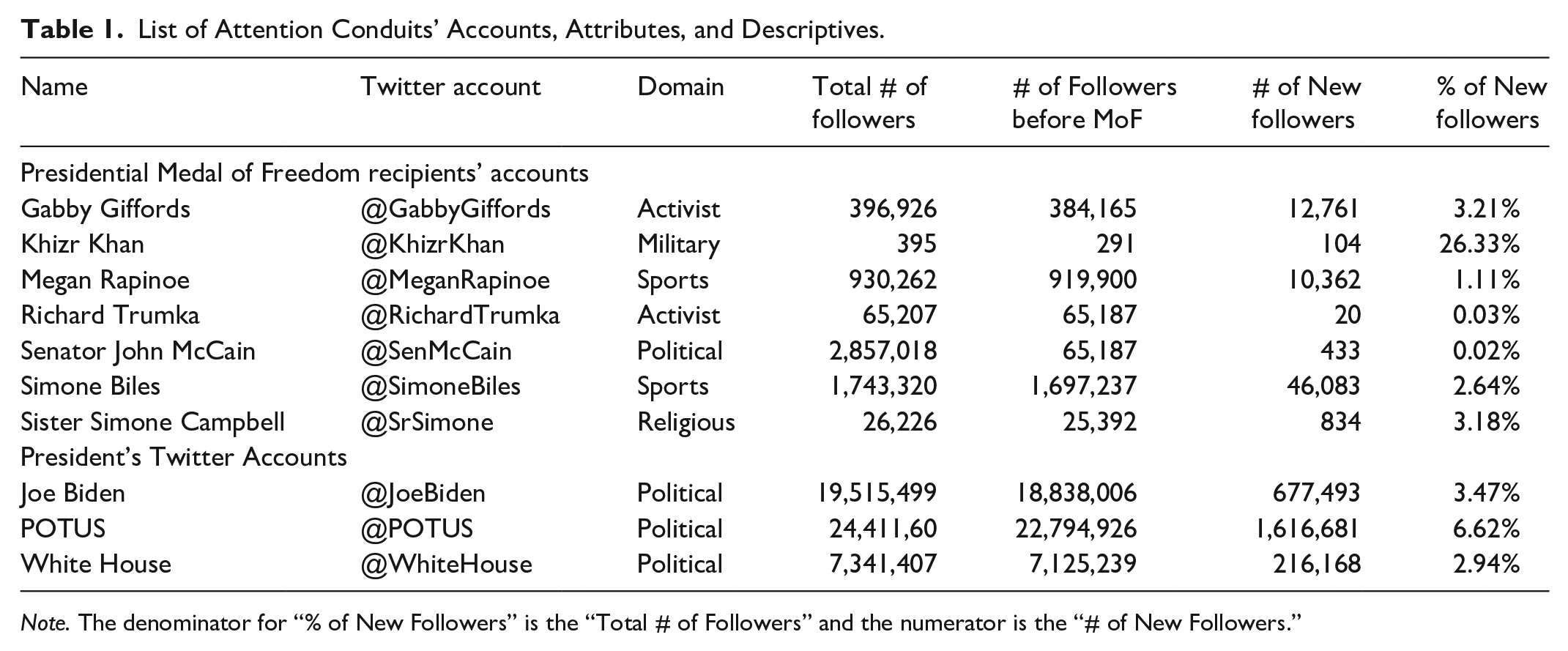
Note. The denominator for “% of New Followers” is the “Total # of Followers” and the numerator is the “# of New Followers.”
Several data-processing steps were completed prior to data analysis. First, each domain elite’s follower list was separated by those who began following before or after the medal ceremony (pseudo-event). We focused on the month prior to the event (May 14–June 13, 2022) and the month after it as the analytic frame (June 14–August 9, 2022). The exact date an account followed an elite was not provided in the data. However, the order in which an account followed an elite was chronologically listed. As a proxy for when an account started following an elite, we looked to each follower account’s creation date. We then identified within each elite’s followers list the earliest account creation date to find a referent account to act as the cutoff point for pre- and post-ceremony time points. June 14, 2022, was selected as the cutoff point (three weeks prior to the Medal of Freedom ceremony) where those listed above the referent account in the list were post-ceremony followers. Accounts listed between referent accounts created on May 14 and June 13, 2022, were pre-ceremony followers. Second, to remove potential bots and inactive accounts, all followers needed to follow at least two domain elites’ accounts, have one follower, and tweet at least once. This process created two bipartite edgelists (follower × attention conduit) for pre-event and post-event. There were 324,738 shared followers (the unit of analysis) among the organizing figure and attention conduits.
Measures
We operationalized domain crossing with specific network metrics. Specifically, we define the network metrics used to assess the attention direction of audiences, changes in attention direction of audiences, and positionality of domain elites.
Audiences’ Attention Directions and Changes
The first two research questions concern the extent to which audiences initially focus their attention toward elites within and across domains (RQ1), and whether the pseudo-event changes their attention focus (RQ2). Who an individual follows on Twitter leaves trace data of their attention direction (Zhang et al., 2018). Recognizing that individuals have the capacity to focus attention toward multiple actors within and across domains, we assessed audience members who directed their attention to two or more domain elites of interest. We operationalize this by transforming the two bipartite edgelists (follower × attention conduit account) into two 1-mode matrices where the domain elites are connected by their shared followers.
Overlapping Tie Strength
The first metric, overlapping tie strength, determined where audiences were focusing their attention. The number of shared followers of two domain elites determined their overlapping tie strength. For instance, in the month prior to the event, @MeganRapinoe and @JoeBiden had 52 followers in common, whereas @JoeBiden and @WhiteHouse had 125,523 shared followers. For the month after the ceremony, those account pairs had 354 and 848 shared followers, respectively.
E-I Index
We assessed the extent to which audiences directed their attention within and across domains by classifying the organizing figure and attention conduits into one of five primary domains (see Table 1 for domain classification). With domains as nodal attributes, we used the E-I index, which calculates the proportion of external ties relative to the number of internal ties for a network (Borgatti et al., 2013), to assess the diversity of connections between and among nodes (e.g., domain elites). The calculation produces a normalized value ranging from −1.0 (only internal relationships to the same domain) to +1.0 (only external relationships to a different domain) (Krackhardt & Stern, 1988). When attention conduits only have ties to other attention conduits in the same domain, the index would be −1.0, and vice versa. For instance, the ties between @SrSimone in the religious domain and @SimoneBiles in the sports domain are external ties while the ties among @SimoneBiles and @MeganRapinoe were internal given both are in the sports domain. Applied here, an increase in the E-I index between the pre-event and the post-event networks would indicate greater domain crossing among the followers of these accounts.
Positionality of Domain Elites
The final indicator of domain crossing identifies which domain elites are situated at favorable network positions following the pseudo-event (RQ3). Recall that domain elites are connected by their shared followers. Therefore, if the pseudo-event leads more followers to focus their attention toward certain domain elites, those connections may situate those domain elites favorably at the network’s core. The organizing figure—the domain elite who staged the pseudo-event—should be “core” to the resultant network or it would be a strategic communication shortcoming. A key player analysis was run to identify which domain elites were core to the post-event network structure.
A key player analysis attempts “to identify the set of network nodes that is most crucial to diffusion or cohesion in a network by calculating network-level measures of cohesion or fragmentation and then detecting the set of nodes that contributes the most to improvements in these measures” (Bohnett et al., 2022, p. 90). Using the “keyplayer” R package (An & Liu, 2016), and following Bohnett and colleagues (2022) selection of network nodes in key player analyses, we instructed the program to identify three key nodes. The diffusion parameter was used as it assesses each node’s “ability to disseminate information through all the possible paths” (An & Liu, 2022, p. 4). In alignment with our conceptual argument about the importance of interdependence among domain elites, the key player analysis reveals those domain elites (i.e., nodes) relative to all others in the network that were “core” to keeping a network structure where diffusion was most possible (i.e., not a fragmented network).
Results
The analysis of shared follower relations compared attention direction and change toward the organizing figure and attention conduits within and across domains and to assess the organizing figure’s position in the network. The first two research questions concern where audiences focus their attention. Here, we examine the pathways domain elites have with their audiences and whether such pathways cross domains after a pseudo-event. The remaining question explores whether the organizing figure and attention conduits are situated in ways that impact their abilities to disseminate messages to the resultant attentive public.
Direction and Change in Attention
RQ1 asked whether audiences focused their attention within or across domains prior to a pseudo-event. At that time, the organizing figure and attention conduits’ accounts had an average of 12 shared followers (SD = 2.39). As anticipated based on the dynamics of political selective exposure, most of the shared followers were among @JoeBiden, @POTUS, and @WhiteHouse (political domain accounts). In terms of the domain crossing among followers, the E-I index calculation returned a value of .33. Considering the patterns of all connections as measured by the number of shared followers within and across domains, this suggests some tendency toward directing attention across domains prior to the event.
RQ2 turns the focus to where audiences directed their attention after the pseudo-event. The average number of shared followers among the organizing figure and attention conduits increased by 3 to 15 (SD = 3.15). Descriptively, this shows an increase in overlapping audiences among domain elites. Importantly for the conceptual model, we found a substantial increase in domain crossing when looking at whether the increase in shared followers occurred within or across domains. The post-ceremony E-I index calculation increased to .55, suggesting that audiences directed their attention toward accounts in multiple domains to a greater extent than before the ceremony. Nearly a third of the shared overlap was between political and sports domains after the ceremony. The 3,527 overlapping followers between the president’s accounts, @MeganRapinoe, and @SimoneBiles illustrate the most sizable amount of new shared overlap (see Table 2). Notably as well, approximately one-sixth (14.76%) of all the post-event overlapping followers were between political and activist accounts (reported in Table 3). Given the increase in shared followers among the organizing figure and attention conduits in different domains, the event coincided with indicators of domain crossing.
Percentage of Total Overlapping Followers Before and After the Event by Attention Conduits.


Note. Overlapping followers are defined as those who follow two or more accounts within and/or between domains. The percentage of total overlapping followers between accounts prior to the pseudo-event appears above the diagonal, and the percentage of total overlapping followers between accounts following the pseudo-event appears below the diagonal. In the month prior to the pseudo-event, there were 194,112 total overlapping followers, with 99.20% of overlapping followers occurring among @JoeBiden, @POTUS, and @WhiteHouse accounts. For the month after the pseudo-event, there were 10,383 total overlapping followers with greater dispersion among accounts in the sports, activist, and political domains. Accounts are organized and shaded by the domains. Rel. = religious, Mil. = military.
Percentage of Total Overlapping Followers Before and After the Event by Domains.
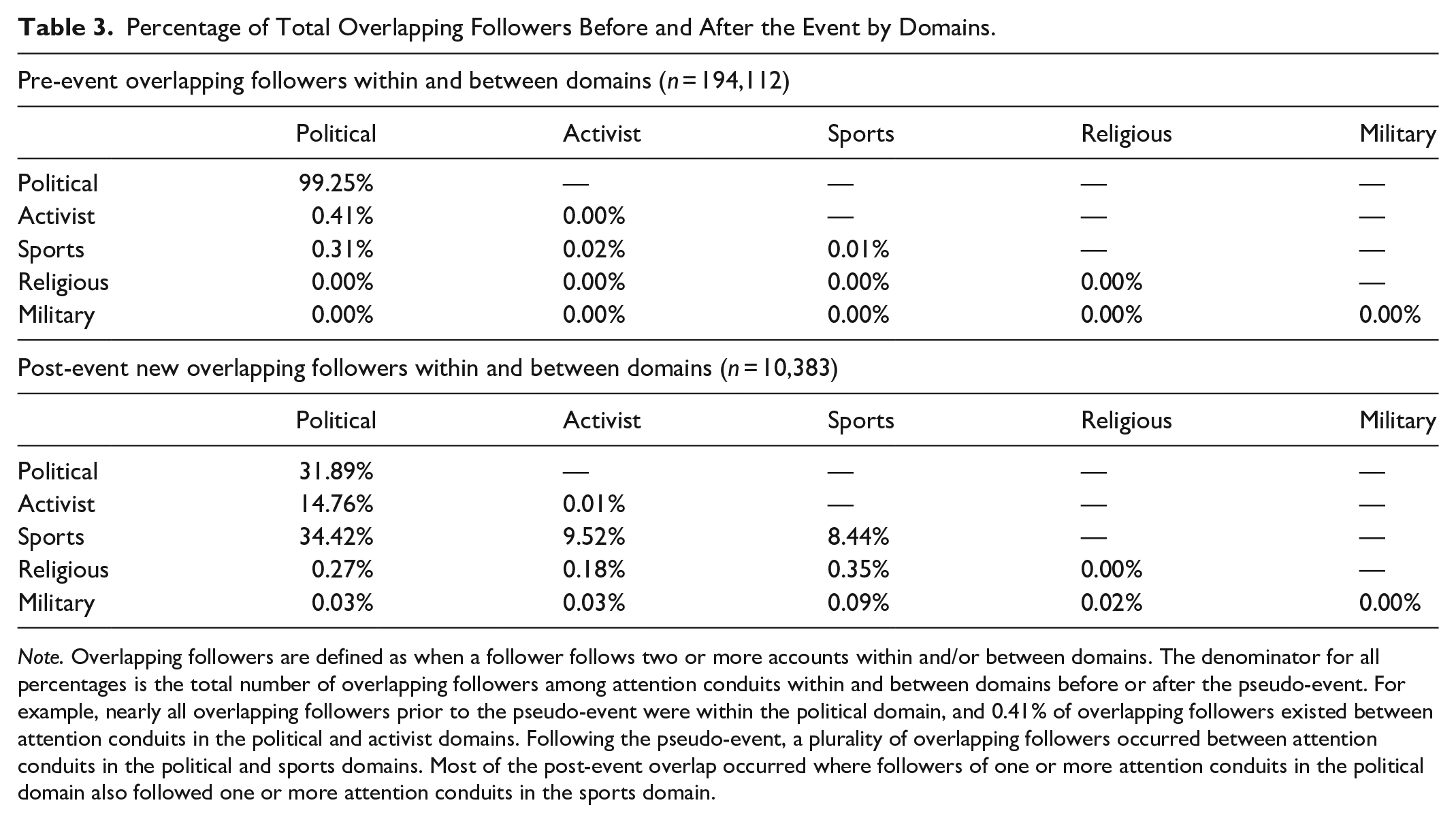
Note. Overlapping followers are defined as when a follower follows two or more accounts within and/or between domains. The denominator for all percentages is the total number of overlapping followers among attention conduits within and between domains before or after the pseudo-event. For example, nearly all overlapping followers prior to the pseudo-event were within the political domain, and 0.41% of overlapping followers existed between attention conduits in the political and activist domains. Following the pseudo-event, a plurality of overlapping followers occurred between attention conduits in the political and sports domains. Most of the post-event overlap occurred where followers of one or more attention conduits in the political domain also followed one or more attention conduits in the sports domain.
Positionality of Attention Conduits
The final research question asks whether the strategic communication efforts via the pseudo-event favorably position the organizing figure (i.e., President Joe Biden). The analytic technique we used selected the group of domain elites that were key to the network. The results of the key player analysis identified @POTUS, @SimoneBiles, and @WhiteHouse as the accounts who had the core ability to disseminate information to the emergent attentive public following the event. As expected, the organizing figure’s official governing Twitter accounts were two of the key players. Yet, becoming a key player in the network is dependent on a third account in a different domain—Simone Biles. This is a point we expand upon in the discussion.
Discussion
This research aimed to assess the current potential for elite-driven attention focusing. Specifically, this study examined whether and how strategic communication processes that aim to cross domain with audiences may create emergent attentive publics. The findings reveal a means by which emergent publics could be curated digitally by political and cultural leaders, using a pseudo-event to cross domains in an attempt to (re)focus audience attention. Not only did the newly formed attentive public after the Medal of Freedom ceremony include a significant number of new shared connections between domain elites in politics as well as non-political domains, but the network structure also included the connections for the organizing figure (the president) and attention conduits (event honorees) to continue to shape attentional efforts at later points around shared interests, identities, and values.
By examining changes in domain attendance before and after the pseudo-event, this research documents how a strategic communication event can assist in (re)focusing attention on prominent leaders associated with the event. Generally, previous studies have examined audience attention within a particular context or genre, such as news (Stroud, 2011; Webster, 2014) or entertainment (Prior, 2007). Information selectivity processes—including repertoires, selective exposure, and general preferences—can limit the attentional choices individuals make. In showing how individuals may direct attention to follow societal leaders across domains, we illustrate how domain crossing can expand the bounds of competition for attention beyond a particular context.
The domain-crossing process reveals the intentional nature by which attentional pathways are curated via elite-driven strategic communication. Such processes can be multi-leveled, meaning that the elites involved in the strategic communication event play differing (but supportive) roles. Prior research assessing networked attention related to activism and celebrities (Tufekci, 2013) as well as politics (Zhang et al., 2018) offers critical insights into the nature of such pathways. These works illustrate the direct connection to pre-existing networks associated with prominent leaders engaging in autonomous communication practices. By joining previous research on attention-based public formation (Wells et al., 2020), our research shifts this focus to understanding the creation of attention infrastructure and how societal elites are interdependent.
This research documents how an organizing figure in one domain intentionally curates a set of symbols as part of a pseudo-event. These symbols include a set of attention conduits in another domain that are tied to a particular set of identities, interests, and issues. Such symbols may encourage audiences to refocus attention across domains. In theory, the result of such coordinated efforts is the organizing figure increases attentional pathways for future messaging, as well as positions themselves more prominently as a key player in the emergent public. Specifically, we found the organizing figure—the President of the United States—occupied a key network position after the event due in part to a new shared following with an attention conduit in a different domain (Simone Biles). President Biden benefited from affiliating with prominent sports figures like Simone Biles and Megan Rapinoe for the Medal of Freedom ceremony. Similarly, Biles also derived important benefits from the strategic communication event, including becoming better positioned in the network through domain crossing, where she also could engage in potential advocacy messaging. This study offers some evidence that such interdependence among political and cultural elites may derive attentional benefits and, more broadly, shape the interplay of symbols within a communication system (Zhang et al., 2021).
This work also builds on perspectives related to the formation of emergent publics (Wells et al., 2020; Zhang et al., 2018), as well as provides an understanding of how different types of publics may be curated. As prior work has noted (Zaller, 1992), elite figures use their positions not only to command attention and visibility but also to curate publics for favorable messaging in hopes of pushing issue advocacy agendas. As Wells and colleagues (2020) observed in a political context, some election campaign events can induce increased attention (in the form of increased Twitter follows) to a public figure such as a presidential candidate. Our study shifts to examining the shared followings and the attention infrastructure necessary for societal elites to send message cues to an emergent public. The results herein extend such perspectives to strategic governing communication and point to the possibility that some elite-led messaging events can (re)focus audience attention in some circumstances, including who individuals follow as well as how elite actors are positioned to draw future public attention.
Future research can extend our argument on this emergent attentive public by assessing the makeup of the interdependent space created among the organizing figure, attention conduits, and overlapping audience—a space we argue has the potential to take on characteristics of a full public. Understanding explicitly expressed interests and identities in the content of social media posts of the overlapping audience may offer further insight into the nature of this emergent attentive public. The emergent public observed in this research has made particular choices to attend to elite figures (organizing figure and attention conduits) due to interests, identities, and/or issues in tandem with—and as a potential consequence of—such pseudo-events.
Although the shared connections among attention conduits may form organically, as noted in instances associated with social movements, the present work documents the intentional ways in which emergent publics may come to be and how elites may lean upon attentional infrastructure for later message dissemination. For instance, the emergent public documented after the event included a sizable percentage of overlapping followers between political and activist accounts. Such attention infrastructure could serve to diffuse messaging cues at future moments in this emergent public when the president attempts to align governing goals with social movement activism. Networks of individuals united by a similar set of interests and issues may be called to action via future strategic communication. Such publics may draw on issue-based (Bolsen & Leeper, 2013; Kim, 2009), affective (Papacharissi, 2015), and/or networked (boyd, 2010) dynamics in participatory engagement. This engagement can include discussions and disagreements as well as outright advocacy and activism (Bennett & Segerberg, 2013).
Furthermore, based on research by Kreiss and colleagues (2020) on identity ownership, as well as observations from the data in this study, we anticipate identity-based dynamics function with these attentive publics as well. For instance, Simone Biles, in being a prominent Black woman and Olympian, also was described during the event as someone who “speak[s] up for justice and the wellness of body and mind” (“Remarks by President Biden,” 2022). Megan Rapinoe is not only a Women’s World Cup soccer player but also a “prominent advocate for gender pay equality, racial justice, and LGBTQI+ rights” (“President Biden Announces,” 2022). In illustrating how domain crossing via a pseudo-event can curate the attentional infrastructure of an emergent public, we unearth an important step in how later types of publics (well documented in the prior research) may operate when signaled via identity as well. Future inquiry should consider such possibilities.
This study is not without a few limitations. First, the domain-crossing dynamics assessed are based on an analysis of Twitter data (before the platform became X). Although the platform is integral to presidential as well as celebrity communication (Scacco & Coe, 2021) and the interplay between domains, we also note that such strategic communication dynamics should be examined on other platforms where similar interplays may occur. Audience attention (re)direction is influenced by both individual agency and technological structure (Wells et al., 2020), the latter of which will vary by platform. Recent work calls for more cross-platform analyses (Kreiss et al., 2018), an effort that would test the validity of the dynamics conceptualized and empirically observed in the present project.
Second, further exploration of when such domain-crossing efforts are more or less successful for organizing figures is important given the possibility of negative reactance by some individuals to genre hybridity. Young (2020), for instance, notes that tolerance for ambiguity interacts with political ideology to contribute to beliefs in the appropriateness of celebrities speaking about political topics. Negative reactance could include instances where a domain elite is criticized to “stay in your lane,” meaning the domain in which the elite is most known or visible. Multi-methodologically testing the variation in which domain crossing resonates with individuals (from political and psychological perspectives) is a next research step.
Finally, we are cautious about claiming the findings represent a causal link between the Medal of Freedom pseudo-event and the changes in connections documented. Other factors may exist, including external news events (Wells et al., 2020), that could contribute to the re(arrangement) of shared followings. The conceptual framework outlined supports causal linkages, opening future lines of inquiry. Experimental or time series methods, for instance, could more conclusively test some of the causal mechanisms. Our methods employed herein, using digital trace data representing user behavior (attention), find evidence to support domain crossing in conjunction with an event. The correspondence between the event and the changes conceptualized suggests such strategic communication efforts can be meaningful in contributing to the outcomes documented.
As the attention environment continues to evolve—alongside media, audiences, and societal elites, elite-directed strategic communication events will play a prominent role in understanding how audience attentional capacities are influenced. The attention challenges that confront political leaders like the President of the United States (Scacco & Coe, 2021) also impact cultural and business leaders (Krishna & Kim, 2016) and social movement organizers (Freelon et al., 2018) as well. Consequently, the interdependence of elite communicative actions—including the coordination of messaging among elites via domain crossing—will be of continued interest in assessing attention dynamics. Such interdependence also may precipitate counter discourses related to perceived domain trespassing by elite figures. These challenges and opportunities will be of continued importance to societal leaders, audiences, and researchers.
Footnotes
Acknowledgements
The authors would like to thank the Media & Politics research group at the University of Minnesota including Sid Bedingfield, Matt Carlson, Dan Myers, Benjamin Toff, Emily Vraga, and Alvin Zhou, as well as Jianing Li at the University of South Florida and Andrew Pilny at the University of Kentucky for their comments on earlier versions of this manuscript. The authors would also like to acknowledge the anonymous journal reviewers who offered detailed and substantive comments on this article.
Declaration of Conflicting Interests
The author(s) declared no potential conflicts of interest with respect to the research, authorship, and/or publication of this article.
Funding
The author(s) received no financial support for the research, authorship, and/or publication of this article.
