




Abstract
As social media continues to integrate into people’s everyday lives, some sites provide a space for people to present their work and connect with others. This study seeks to understand how Dribbble.com (hereafter, Dribbble), a site created in 2009 for visual designers to showcase their work, plays a role in the transformation of the visual design industry. We use practice theory perspectives to interpret 30 semistructured interviews with active Dribbble users. We find that the niche site Dribbble, along with the constellation of sites around it, is changing professional design practices, in both positive and negative ways. In this study, the focus looks at the ways the work of design professionals unfolds. Our participants, professional designers on Dribbble report that the site changes how they find inspiration to solve design problems, give and receive design feedback from/for other designers, and look for jobs. Our work suggests that by being a primary source of inspiration for many designers, Dribbble may be influencing trends in the wider industry. In addition, Dribbble may be nudging the design industry into a more global stance with respect to hiring designers. Our work contributes to social media studies by showing a link between a design site such as Dribbble and changing practices in the design industry. It also contributes to the literature by looking beyond Twitter, Facebook, and Reddit into practices on smaller social media sites.
Introduction
As social network sites continue to become part of many people’s everyday lives (Perrin, 2015), they provide a space for people to connect with others and, specific to this study, showcase their creative work. The changes that these social media platforms offer designers are significant, creating opportunities for the industry to evolve along with technology. Previously, the rise of the internet allowed designers to self-promote their services through customized websites that spoke about their philosophies, areas of expertise, and type of clients, and acted as a portfolio site. Social media platforms have given designers the ability to build and maintain a presence on a network of sites (e.g., Dribbble, Instagram, Behance, and others), each with different features, strengths, and weaknesses. Each also allows access to different networks of clients, employers, colleagues which can span the globe. These new networking techniques give designers an exponentially greater reach and more opportunities.
In a creative field such as visual design (e.g., graphic design, illustration, UX/UI), being able to showcase one’s work to a broad audience is a crucial part of attracting freelance or full-time work opportunities. Dribbble.com (hereafter, Dribbble), a social networking site (Boyd & Ellison, 2007) created in 2009 for designers to network, share, and get feedback on their work, is one place that allows designers to get their work noticed. It bills itself as the “leading destination to find & showcase creative work and is home to the world’s best design professionals” (Dribbble, 2021). Indeed, past research (Hemsley & Kelly, 2019; Hemsley & Tanupabrungsun, 2018; Marlow & Dabbish, 2014; Scolere, 2019) has noted that many in the visual design space claim that having a Dribbble presence is a necessary element in a successful design career. As such, Dribbble and sites like it may impact how, and for whom, visual design work gets done (Marlow & Dabbish, 2014), which may impact the wider design industry in various ways, both positive and negative.
In this work, we seek to understand how a site like Dribbble may be changing design practices and the larger design industry. To do this, we use practice theory perspectives (Nicolini, 2013) to interpret 30 interviews with professional designers on Dribbble. Taking designers’ practices as the unit of analysis, practice theory perspectives foreground the ongoing constitution of social reality through the sayings and doings of people (Kuijer, 2017; Schatzki et al., 2001). Thus, we examine what our 30 participants say they are doing on Dribbble and how these new practices contrast with traditional practices in the larger design industry. Between what our participants tell us and what we can infer from their practices, we make a case for how Dribbble is impacting the industry.
Specifically, we find that while Dribbble does seem to be facilitating changes in the ways designers gain inspiration, solve design problems, find jobs either through easier access or algorithmic management, and present their work, many pre-Dribbble practices continue within the design industry. As such, we believe a large-scale shift in the design industry (Laurell & Sandström, 2016) is being negotiated between traditional practices and emerging ones. Our work contributes to studying social media by looking beyond the often-studied sites of Twitter, Reddit, and Facebook by focusing on the niche design site, Dribbble. While such a move only shines light on a corner of social media, it should help us understand the larger ecosystem (Scolere, 2021). Finally, we hope that our work will benefit those seeking to understand the changing design industry.
Background
Overview of Dribbble
Dribbble is a social media site in the niche space of visual design. According to its tagline, the platform is the “leading destination to find & showcase creative work and home to the world’s best design professionals” (Dribbble, 2021). The site uses nomenclature based on basketball and provides affordances for players (users) to network with other designers, comment and like others’ work, and follow each other. Many users claim to use this platform as a place to brand themselves (Hemsley & Kelly, 2019). Research has suggested that the site curates players’ shots (posts) in an effort to attract potential employers and that players compete for attention (views and followers) in an effort to land work opportunities (Hemsley & Kelly, 2019). Freelance work has always existed in the design industry, but over time, Dribbble has introduced features that facilitate job matching between players and companies, which is one-way Dribbble could impact design industry norms.
In general, design platforms shape design industry norms in notable and distinct ways. Scolere (2021) suggests the emergence of a digital inspirational economy, wherein networked creative professionals leverage each other’s work to inspire their own work. Creatives in a digital inspirational economy engage in practices that not only enable them to find inspiration but also inspire others. These practices take place across design platforms as creatives employ a constellation of sites such as Bēhance, Instagram, and Dribbble. While this zoomed-out approach illuminates broad practices, a zoomed-in approach is also useful to unpack specific ways the political economy of specific sites shapes broader practices (Gillespie, 2010). We turn our attention to Dribbble to investigate how the site is shaping not just inspiration but design industry norms.
Few studies have focused on design-related sites (see Scolere & Humphreys, 2016 for notable exceptions), and fewer have focused on Dribbble as a platform to study. Marlow and Dabbish (2014) look at how graphic designers use the site for social learning and professional identity development. Another study (Wachs et al., 2017) found that male users got more attention than female users. By analyzing various features of male and female designers’ work, the researchers claim that part of the discrepancy is due to how women and men position themselves on Dribbble. Hemsley and his colleagues (Hemsley & Kelly, 2019; Hemsley & Tanupabrungsun, 2018) wanted to understand if and how the phenomenon of virality takes place on Dribbble. They showed that users did think something like virality did happen and that what spread were design trends, like a line quality or style or set of color combinations. More recent work (Chen et al., 2020) uses computational approaches to help designers tag their UI designs, in an effort to help designers more quickly find examples of others’ design solutions. None of the above studies examines the impact that Dribbble may bring to the design industry. This present study leverages practice theoretical perspectives and attempts to explore Dribbble’s impacts on the design industry.
Practice Theory in Design
Practice theory attempts to explain social life by taking practice as the unit of analysis (Shove et al., 2012). Reckwitz (2002) defines practices as “a routinized way in which bodies are moved, objects are handled, subjects are treated, things are described and the world is understood” (p. 250). Through practices, we come to understand how human actions generate the norms and structure which in turn govern them as they are upheld by a society (Giddens, 1986; Sovacool & Hess, 2017). Importantly, practice theory is not one singular theory; instead, it encompasses a range of theoretical frameworks to understand people’s social life (Nicolini, 2017; Pouliot & Cornut, 2015). These perspectives essentially decenter (not remove) individual agency by attending to power (e.g., Michel Foucault, 2012), social structure (e.g., Bourdieu & Bourdieu, 1977), and culture (e.g., Ortner, 1984), to name a few.
Practice theory has been applied in various fields to guide empirical research. Scholars have used practice theory to explore entrepreneurship as well as transnational entrepreneurs’ internationalization strategies (Johannisson, 2011; Terjesen & Elam, 2009), and as a lens to investigate strategy making and knowing in practice (Feldman & Orlikowski, 2011), and to understand information literacy and information sharing (Lloyd, 2010; Pilerot & Limberg, 2011). But to the best of our knowledge, practice perspectives have not been used to understand the relationship between sites like Dribbble and changes in the design industry. More specifically, we zoom in on Dribbble as a design platform to ascertain the ongoing practices that in turn shape the design industry (Nicolini, 2017).
We draw specifically on Shove and colleagues’ (2012) configuration of practices as a constituent of three elements: meanings, competencies, and materials. While meanings are the understandings that people ascribe to the practices, competencies refer to the skills required to enact practices. The third element, materials, refers to the artifacts, tools, and stuff that people use when they engage in practices. As an example, then, one could consider the practice of drawing as a configuration of (1) the meaning that people associate with drawing, (2) the competencies they employ when they draw, and (3) the materials they interact with when they draw. Regarding meaning, drawing could be associated with leisure for one person and work for the other. In terms of competencies, drawing may require one to know how to blend colors, lines, and shapes. Relatedly, drawing may take advantage of materials such as digital pens, charcoal, or even sand. The different configurations of these elements enable us to understand situated practices of drawing.
According to Kuijer (2017), there are four main ways that theories of practice are applied in design research. First, practices serve as analytical guides for situated performances. These forms of studies take practice as a unit of analysis by relying on user research methodologies such as observation, surveys, and so on. Second, practices are traced as entities in time and space. Kuijer (2017) notes that this stream of research foregrounds historical accounts and nonmainstream practices. The third application of practice perspectives in design research takes practices as a unit of design, aiming to reframe and redefine problems and solutions. Finally, practice theory enables a reflection on professional and organizational practices of design. For example, Kimbell (2011) used practice perspectives to critique the hype around design thinking as a dominant mode of designerly practice. Despite several studies on the practices of designers (see Kuijer, 2017; Scolere, 2021; Scolere & Humphreys, 2016), to the best of our knowledge, none specifically look at practices on Dribbble. Using a practice perspective, this present study explores the impact of Dribble on the design industry, including its professional and organizational practices.
Design Industry
The design industry has recognized the ongoing effects technology has had on all aspects of “visual communications design” (Graphic Artists Guild [GAG], 2010). It acknowledges the “labor saving-devices” that technology has brought to the profession, but this has also generated an abundance of “electronic and online businesses” that threaten to disrupt the industry (GAG, 2010). In 2008, graphic design researcher and educator Meredith Davis (2008) noted that design education, which provides labor for the design industry, has its head in the sand when it comes to technology’s influence on design education. She expressed her concern that by continuing to teach the old practices, design educators are no longer able to train designers of the future to face the onslaught of new emerging practices.
Leaders in the design industry have, with increasing frequency, expressed concern that the current focus on design-focused technology (software in this context) skills could shift visual design into a trade/skill category. They note that what is being glossed over is the thinking behind the design (Heller, 2003). Problem-solving has always been seen as key (Buchanan, 1992), but the current focus seems to be shifting to software technical skills. The design industry has tried to establish itself not as a trade but as a liberal-arts, with an understanding of the concepts and theories around design. That is, to have a reputation as “highly trained professionals” rather than “an expendable commodity” (GAG, 2010, p. 70). However, since the advent of new, online learning options, the focus has shifted strongly toward just skills, leading to advertisements for design jobs specifying software skills and lower wages, and in some cases not looking for design education principles and practices (GAG, 2001). Thus, online learning technologies appear to have impacted the design industry.
Beyond learning, sites like Dribbble also shape the organization of design work. Scolere and colleagues (2018) discuss how designers must brand themselves to make a living. Crucially, designers must customize these branding strategies for distinct platforms. In this way, design work is not exempt from the broader changes in the labor market that require job seekers to become brands (Gershon, 2017). Indeed, many designers need to constantly (re)design and (re)package their portfolios across different platforms (Scolere, 2019). Sites like Dribbble afford the networks, connections, and tools that designers leverage to create their work. In turn, this recursive process shapes design work in significant ways. For example, before sites like Dribbble, practices around design-related job seeking included asking friends, getting personal recommendations, etc. Yet, today, many designers find jobs on Dribbble and other design-centric sites as part of the growing trend of finding work via online platforms (Jarrahi et al., 2020). Some online platforms are changing some of the ways work gets done across many industries (Nash et al., 2018) and workers are increasingly untethered from place (Hemsley et al., 2020). The growth of these digital platforms may even be a driver of globalization (Erickson, 2010; Hemsley et al., 2020; Jarrahi et al., 2020).
Given these trends, we proposed the following research questions:
RQ1: What practices do our participants employ on Dribbble?
RQ2: How do Dribbble users see their practices on a design platform such as Dribbble impacting the design industry?
Methods
Participant Recruitment
Since our interests were around understanding Dribbble user’s practices (Reckwitz, 2002), and how they saw their practices impacting the design industry, we developed a semistructured interview protocol (Creswell, 2002; Krathwohl, 2009), approved by our institution IRB, geared toward helping us answer our research questions. In total, we conducted 30 interviews with active Dribbble users.
The participants were recruited through emails and snowball sampling and were rewarded with a $20 Amazon E-gift card after completing an hour-long interview. To maximize the diversity of our participants’ job titles, three researchers collected the first 20 users whose work was displayed on the Popular and New and Noteworthy pages (see Figures 1 and 2) on Dribbble between June to July 2020, giving us 120 users in total. We chose these tabs because the Popular tab shows the work of designers who are deemed as popular, which tends to have thousands of likes from other users, while the New and Noteworthy tab captures the work of users who are new to the website and just started to gain recognition. We would like to point out that Dribbble’s algorithms play an important role in deciding what gets displayed on the tabs, but unfortunately, there is no accurate documentation from Dribbble on how their algorithms work. The “Discussion” section will talk more about the relation between Dribbble’s algorithms and our interviewees’ practices in-depth.

Dribbble’s popular page.
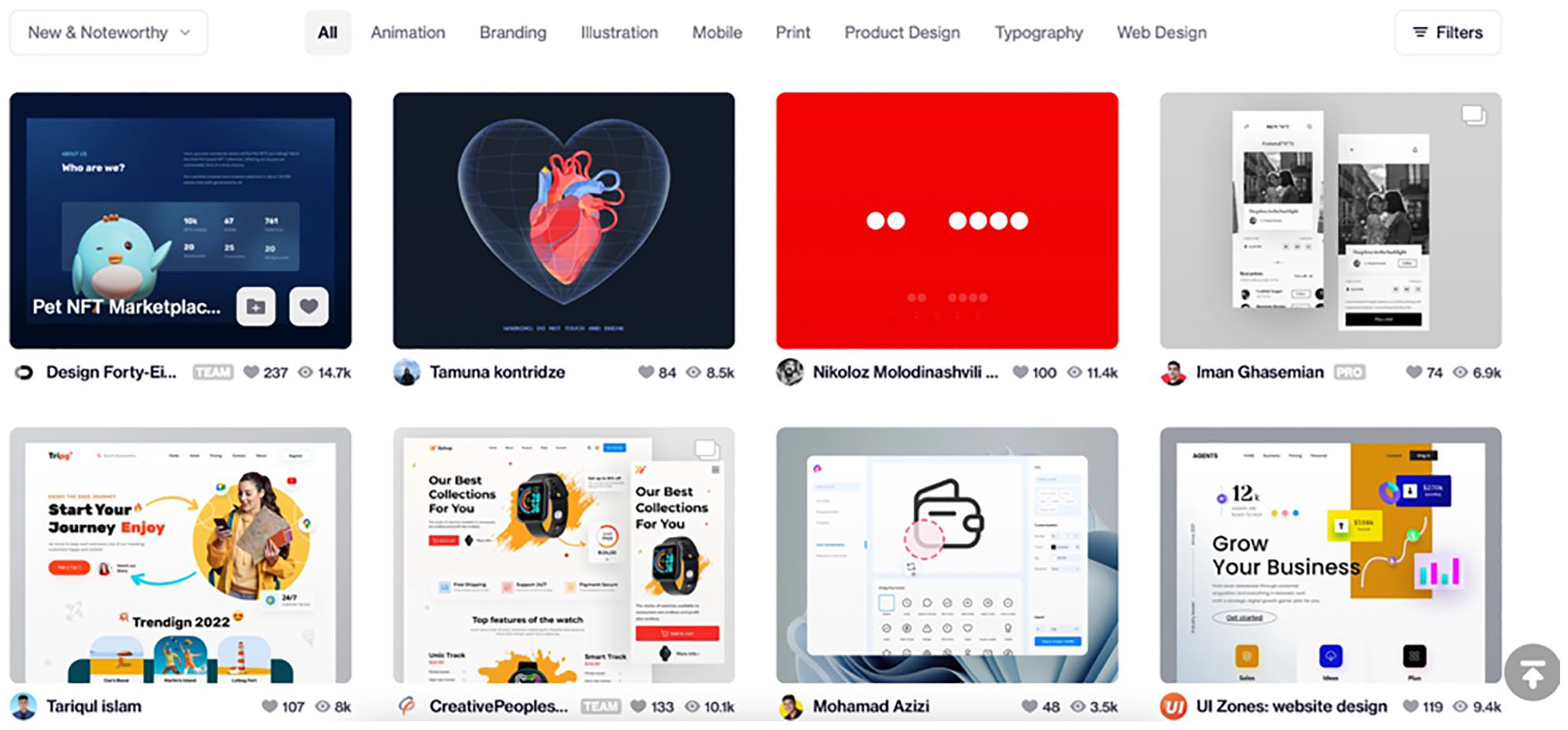
Dribbble’s new and noteworthy page.
Our intention in choosing users from these two tabs was to get a mix of participants that ranged from established to just starting on Dribbble. Over 4 weeks, we collected 260 usernames and contacted them. We also asked each person we interviewed for other names of Dribbble users they thought would be interested in interviewing with us. Dribbble allows users to use any name or picture that follows the website’s rule for their profile; therefore, it is difficult to know the gender of the users when they do not explicitly mention it on their personal page. However, we would like to point out that gender does play a role in determining who gets more attention on Dribbble, according to Wachs et al. (2017)’s study.
We contacted users either through email or social media (e.g., Twitter or Instagram), depending on what information they provided on their profile page. Ultimately, 14 participants directly replied to the original recruitment email, and they referred another 16 participants for this study, giving us a total of 30 participants.
The age of our participants ranges from 21 to 42 years old (M = 30.3), with 7 (23%) being female and 23 (77%) being male. Our interviewees describe themselves as graphic designers, UX/UI designers, and illustrators. Fourteen interviewees were full-time freelancers, while the rest had full-time jobs at corporations (10), design agencies (4), universities, or hospitals and did freelance design work on the side. The length of time they have been using Dribbble varied from one to nine years, but most of the informants had been using Dribbble for more than 2 years. The participants were also geographically dispersed. The US metro areas were home to 19 of our informants. The rest were based in Asia, Europe, and the Middle East. Since Dribbble is an English-based website, we suspect that knowing proficient English helps users who are based outside of English-speaking countries to establish their Dribbble pages and gain work opportunities.
Interview Analysis
Our 30 interviews varied from 30 min to 2 hr and were conducted via Zoom and recorded for later transcription. We provided written consent forms to the participants before each interview to ask permission to record the interview. Our methods and interview protocols were approved by our institution’s IRB office. The first part of interviews included basic demographic questions, and the second half probed into interviewees’ thoughts about Dribbble. For example, in the first section, we asked the interviewees about how long they have been working in the design field, and in the second section, we asked them about how they have been using Dribbble, as well as their opinions on Dribbble’s possible impacts on the design industry.
After each batch of two to four interviews, the research team passed the recordings to a professional transcriber, giving us a text file for each interview. To find emerging themes in these transcripts, three researchers analyzed the transcripts using qualitative open coding and axial coding to guide the process of reading and documenting their reflections about the same transcripts (Charmaz, 2014). Qualitative coding and axial coding are flexible and can be used along with a theoretical foundation (Charmaz, 2014). All researchers came up with some initial themes from the transcripts. In regular meetings, we compared themes and looked for connections and ways to collapse themes. The final step of exploring the themes was to categorize the themes under the two research questions.
Reflexivity Statement
To evaluate the validity of this research, reflexively understanding the authors’ professional background may provide certain assurance to this research (Schlesinger et al., 2017). One of the authors is a professor at a U.S. university and has been researching social media for more than a decade. Another has been working as an educator at a U.S. university and within the design industry for over 20 years, with both a bachelor’s and terminal master’s degree in design. This practitioner has been working with a wide client list of internationally reaching Fortune 500 companies while working for both large- to medium-sized agencies, and as a partner in a firm for over 18 years. One is a PhD student who has a master’s degree in anthropology and has done numerous semistructured interview studies. Another is a PhD student who studies entrepreneurship as a form of design practice and has used several qualitative methods including participant observation, interviews, and diaries.
Findings
As design platforms proliferate, they are significantly facilitating the professional and organizational practices of design work (Kuijer, 2017). Platforms such as Dribbble position themselves as a site where the world’s best design professionals can find and showcase their creative work (Dribbble, 2021). To this end, the Dribbble platform offers features meant to enable users to connect with other design professionals as they find and showcase their creative work. Our participants report using Dribbble and a constellation of other sites for their design work in distinct ways. In particular, we center our results on the emergent themes of our participants’ use of Dribbble involving their daily practices. In response to RQ1: “what practices do our participants employ on Dribbble?” we uncover three main themes that our interviewees mentioned relating to their practices on the platform: looking for design inspirations, critiquing design work, and finding design jobs. These three themes emerge from the relations between our participants’ competencies, the meanings they attach to their actions, and the material affordances of Dribbble as a platform (Shove et al., 2012).
Design platforms shape practices across different platforms (Scolere, 2021). While the three practices result from a zoomed-in approach, we also find from a zoomed-out manner that the design platform is shaping the design industry. We contrast the practices our participants discuss with traditional industry practices to show how the niche site Dribbble may impact the design industry. This responds to RQ2 regarding Dribbble’s perceived impact on the design industry. Overall, these practices help to illuminate the shifting practices among designers and the design industry amid evolving technological changes. We detail the practices in the subsequent sections.
Looking for Design Inspiration
Inspiration work is a core element of design work. Particularly on design platforms, designers do not only seek inspiration for their work from other designers, but they also share their work to inspire other designers (Scolere, 2021). We find that the practice of seeking inspiration is very common among our participants. All but one of our 30 participants described looking for design inspiration as one of the most common themes they engage in on Dribbble. To accomplish this goal, designers primarily searched for examples of other designers’ work on the platform, often collecting other’s work into buckets, a feature that allows users to group posts they want to reference in the future. The designer may then refer to these buckets of shots to inform their own approach to solving similar design problems. For example, Participant 29 describes how he finds inspiration in this way: They (Dribbble) have buckets where basically you can make collections or categorize posts that you like so I use, I have a package one, a web design one, lettering, you know I just categorize everything. So every time I start a project and either the client specifies I think that say a monocline illustration is what they’re looking for I have kind of a bucket I can go through and gather inspiration quickly. (Participant 29)
Based on what Participant 29 told us, we can infer that Dribbble facilitates users looking for inspiration mainly through the bucket feature. From a practice perspective, this material feature is critical to the emergent practice. In terms of the meanings that designers attach to inspiration, we find that participants look for inspiration not only to inform their own work but also to take a break from their own work. In this way, seeking inspiration takes on a different meaning. Some of our participants described “mindlessly” browsing through Dribbble as a way to seek inspiration. Unlike the previously discussed approach to seeking inspiration which tends to be purposeful, this form of seeking inspiration allows for serendipity and creativity to emerge in unlikely ways. Participant 27, a branding designer describes the practice in this way: Yeah I definitely use [Dribbble] as a form of inspiration. I use it a lot too if I get stuck in a rut or something, or sometimes I make a lot of graphics or fun just to keep creative cause I’ll be so into a project that I kind of need a break or just to make something mindless which is absolutely ridiculous. So, I look at Dribbble quite a bit. Animation is something I play around with very basic animation and I’ve just been looking at a lot of that and it kind of gives me ideas of oh I can make this, or just kind of inspiration for new projects and things. (Participant 27)
Our participants also informed us that they use Dribbble to compare their new work to existing work to make sure what they are creating is not already overly done or cliche. This can be seen in Participant 7’s statement: I’ve been posting like one or two times per week pretty much, yeah. For inspiration for every project I normally take a little bit longer . . . Sometimes if I get stuck or if I have like a design and I need to or want to see if it’s something similar I try to have a quick look on Dribbble to see if my design is more unique or if it’s something repetitive. (Participant 7)
Traditionally, designers used industry-focused magazines such as Communication Arts, 1 trade books, and other print media as a primary source of inspiration (Galvan, 2020; Keller et al., 2006). However, finding inspiration on Dribbble is a theme that nearly all our participants mentioned. To be more specific, looking for inspiration includes nuanced practices such as specific searching, grouping posts for references, browsing without a goal in mind, and checking posts for repetitiveness. In terms of competencies, seeking inspiration involves skillful searching, categorizing, and sorting of designs, in service of creating new designs and breaking the monotony of design work. Specifically, Dribbble’s bucket feature enables and supports designers as they find inspiration for their work.
Critiquing Design Work
Historically, designers have relied heavily on feedback from multiple perspectives to polish their work (Kim et al., 2017). Even earlier studies of Dribbble suggest that participants posted work-in-progress to receive feedback and critique from other designers (Hemsley & Tanupabrungsun, 2018; Marlow & Dabbish, 2014; Wachs et al., 2017). It was expected that as the designer engaged with this feedback, incorporating some and rejecting others, the overall design would improve. The practice of critiquing design work, then, embodied distinct meanings of improvement.
However, our participants suggest that Dribbble has transitioned to a portfolio site where designers tend to postfinished work. This stands in contrast to how Dribbble was once a site for feedback, supporting traditional design practices that show work in progress. Participant 20, an early user of Dribbble, described it this way: . . . In the beginning, it was very much like a work-in-progress site, so it was meant to be like put something up and bounce it back and forth between people, that’s why it was called Dribbble. It was supposed to be like here’s something I’m working on, someone else reacts to it and gives you feedback and then quickly it just became a portfolio website . . . (Participant 20)
Adding to Participant 20’s story, Participant 25 states that “now people use it as a showplace type thing where they only post final work,” and notes that finished pieces are what attract most users’ attention: “Like they’re going to post the finished piece because that’s what most people like to click on . . . .” The action of just posting finished work shows the norms that once were popular on Dribbble have changed.
At the same time, as Participant 27 illustrates below, showcasing finished pieces could lead to devaluing designers’ creative work, which shows that the change of a practice could impact the meaning of a norm. Without seeing the labor that designers put into their creative work, clients could be unaware of designers’ efforts. Seeking to save as much money as possible, potential clients offer to compensate designers with relatively low values compared to their labor.
I think that [not showing process] kind of devalues, I don’t think that people understand the whole process that goes into it with the upfront thing. Like designing, I would argue, or like at least most of my workload is not the design part, it’s the whole discovery, it’s the whole vision board and everything in goals and ruling out what won’t work before we can even find what will work kind of thing. (Participant 27)
We find that the meanings associated with critiquing design work have changed from one of improving design work to one of showcasing design work. From a practice perspective, these shifts in meaning shape the design competencies as well. On the one hand, we see that the competencies of designers on Dribbble come to be undervalued by clients as explained by Participant 27. On the other hand, colleague designers on the platform may also undervalue design work by offering simple platitudes instead of substantial feedback. For example, Participant 11 said, “Dribbble is not a great source for feedback.” She and others note that since most of the posts show finished work, the feedback tends to be simple platitudes, for example, “nice!”, or “great work”, which, while supportive, does not help designers improve work or grow in their profession.
On a similar note, Participant 26 mentioned that he used to provide and receive constructive feedback on Dribbble, but more recently, users get and provide much less actual feedback and more simple praise: So I do remember getting constructive feedback and giving it too. But over time, the platform . . . became kind of this unspoken expectation that now it’s a platform to publish polished finished beautiful work which it has its positives and negatives . . . I think what it ended up doing was giving this vibe like you’re not looking for feedback, you’re just looking for praise, but again there’s still constructive feedback given here and there but I’ve experienced far less probably in the past five or six years. (Participant 26)
Participant 9 noted that users on Dribbble may not like to receive critical feedback and may respond in a standoffish way compared to when he first started using Dribbble. Participant 9 told us that he has become reluctant to provide constructive feedback on Dribbble: I think that some people get offended if you try to critique their work (on Dribbble). Say they post something and you say hey this doesn’t look quite right; have you tried this. Some people will post something and they’ll ask for feedback but then when you provide feedback they get standoffish, and you’re like well you asked for feedback like I’m giving you what you asked for you know. That makes me just not want to comment on people’s things because then they’re turned off or unreceptive to feedback. (Participant 9)
Putting what our participants told us together about critiquing practices, on Dribbble, we can see three shifts in the practice of critiquing design work. First, the current practice is that designers on Dribbble post finished work, not in-progress work, which implies they need to exercise different competencies than before just to post their work. More specifically, designers have to spend more time polishing their Dribbble posts which arguably requires more in terms of competence. Second, posting only finished work makes design look easy and cheapens it. Third, the value of any feedback on the site is reduced because the work is already finished, and the feedback is simple platitudes rather than constructive feedback.
Finding Design Jobs
Designers have traditionally found design jobs through conventional approaches, including word of mouth, university graduate placement programs, searches through trade publications, and networking through school alumni among others (Craig, 1992; Crawford, 1998). With the rise of design sites like Dribbble, much of the job-seeking process takes place online. Indeed, Dribbble positions itself not only as a site to find inspiration, but also as a site to gain job opportunities. As expected, our participants note that they leverage Dribbble to find jobs. More importantly, this practice of finding design jobs is changing as a result of sites like Dribbble.
First, the site materially enables designers to create an open and accessible online portfolio to attract potential clients. In the design field, having a portfolio to showcase one’s work is essential for a designer to get their work be seen by other designers and potential clients (Scolere, 2019). However, the site is also set up for clients, with tools that enable them to do sophisticated searches and see many images all at once. From there, these clients click on images that interest them, visit profiles and connect with designers. In this way, Dribbble is a marketplace of portfolios where designers can network with other designers as well as clients. If a client sees a portfolio they like, they click a “hire me” button to contact the designer. Participant 6 described this as a “warm lead”: . . . they come [as] warm leads, they’ve already checked out your work, they like what they’ve seen, and they contact me asking specifics, if they’ve seen a Lego design they’ll talk about that particular Lego design and say why they like it and then the conversation leads on from there. I’ve seen client inquiries two or three times a month but that’s slowly rising as I start to become more active on that. (Participant 6)
Dribbble used to be an invite-only platform but has become more inclusive and allowed users without invites to join since 2021. The platform materially provides several features for potential clients to identify and hire designers. Arguably, the initial invite-only feature endowed the site with attributes of uniqueness and community which in turn shaped the way designers find jobs. While some were warm leads as in the case of Participant 6, others evolved into full-time jobs as in the case of Participant 11, an illustration designer, and 16, a creative designer: I have gotten freelance work just through people who have messaged me directly (on Dribbble) or I’ve interacted with. Yeah, so that’s really cool. Actually, the job I’m at full time now they reached out to me just like they had seen something I had posted, reached out to me, I had never seen their stuff before or anything and started a freelance relationship and then that turned into an actual job this year. (Participant 11) I worked for a company called [removed for privacy], they found me through Dribbble, that was down in New York City, they’re like [description removed for privacy]. That was great because they’re very design heavy. I mean just having New York City in my profile made it super, super searchable and this was well before, this was probably six years ago when I first moved here. I just had several people reaching out to me saying hey I see you’re in the New York City area from Dribbble. So, all that said, I mean Dribbble has brought me to the place that I am and given me the experience that I needed and let me be found to get pushed to places that I didn’t expect and that was when I was publishing. (Participant 16)
Second, the network of designers and clients could also make it easier for students to figure out the job opportunities available in the design industry. For instance, as a design school graduate more than a decade ago, Participant 18 found it challenging to find a job. He notes that he lacked connections to other design industry professionals, and he suggests that Dribbble enables a new form of the practice of finding jobs: I mean it’s easier now because of the internet and it’s so much easier to connect with people, but I remember when I graduated, I had no idea what jobs were even available because there was no venue unless you interned which I wasn’t doing, because I was spending all summer training. There was no way to find out what was even there . . . I just knew I wanted to be an artist, but I didn’t know what was available. I went to a great program in terms of the way it trains you, but it doesn’t, at least at the time, it didn’t really connect me with industry professionals. So, I think the more connecting you can do as students with people that are actually working the better because I didn’t get that and it took me eight years to get to California to find a job that actually worked. (Participant 18)
Here, we see an expansion in the meanings related to finding jobs from one of advertising oneself as a potential worker to one of knowing about the job market. Put another way, the practice of finding design jobs on Dribbble includes the way the site enables users, especially students, to become aware of the design job market. According to Participant 18, it was difficult for college students to know what job opportunities existed because the venues that hosted that kind of information 10 years ago were not as accessible as they are now on Dribbble. Interning at a design agency seemed like the only means to familiarize oneself with what the design industry may offer. However, with the emergence of digital platforms such as Dribbble, it is increasingly becoming easier for students and designers to make connections with professionals in the design industry.
This marketplace of design portfolios means that geographic boundaries are less important than before (Demirel et al., 2021). From our non-US-based participants (11/30), we learned Dribbble’s portfolios are available to a global audience, which means opportunities can come from anywhere. Again, as mentioned in the method section, we suspect that knowing proficient English is key to establish Dribbble pages and gain work opportunities for Dribbble users who are based outside of English-speaking countries. Traditionally, designers from Asia, for example, would have very limited access to the U.S. market. With Dribbble, however, self-taught designers without formal training or network connections can also now showcase their design work in front of a global audience. One interviewee made a detailed example to share her thoughts on Dribbble, the design industry, and globalization: I think they’ve (Dribbble) really globalized the industry, so like before these platforms existed like an agency in rural Illinois would never really have the resources to find a Taiwanese illustrator whose work they loved unless maybe that illustrator was aware of an American magazine they could submit to. (Participant 19)
In sum, our participants indicate that Dribbble enables designers to receive warm leads and land jobs from clients in diverse industries ranging from sports, music, etc. These jobs may be one-time gigs or may even turn into full-time roles. College students could also use Dribbble to figure out the design industry in terms of jobs in a way that is distinct from what the design industry was like before the invention of Dribbble. The globalized design industry that Dribbble facilitates is also a change that our participants describe.
Findings Summary
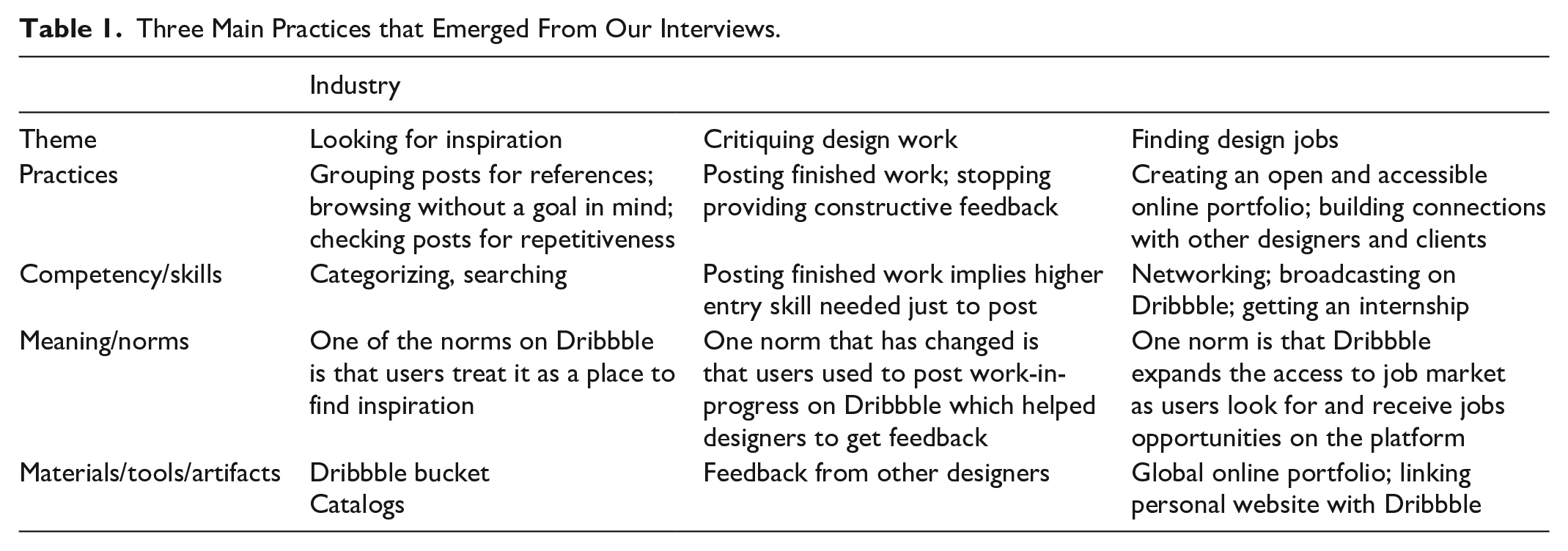
These design-oriented practices, looking for inspiration, critiquing design, and finding jobs, are enacted as distinct practices on Dribbble relative to the three elements that configure practices: competencies required, the meanings ascribed, as well as the materials that are used to enact said practices (Shove et al., 2012). For additional clarity, we provide Table 1 that breaks down the three practices that emerged from our interview data. Each row of our table reflects one of the elements that configure the practices we mentioned earlier.
Three Main Practices that Emerged From Our Interviews.
Discussion
In the following section, we first discuss what practices our interviewees see and employ on Dribbble, then we review the ways in which users’ practices on Dribbble could impact the design industry through the lens of practice theory.
Emerging Practices of Design Professionals on Dribbble
RQ1: What Practices Do Our Participants Employ on Dribbble?
Three main themes emerged through the 30 interviews we conducted with designers using Dribbble: looking for inspiration, critiquing design work, and finding design jobs. These practices are understood to have different norms and meanings, enabled by and demanding different competencies, and performed with different tools and artifacts (Shove et al., 2012). That is, each different practice can be thought of as a different configuration of meanings/norms, competencies/skills, and materials/stuff in place and time. In other words, the practices we have discussed in the findings section are relationally configured between the features of the Dribbble platform, the meanings that users and clients endow on the platform, and the competencies that enable those intended meanings (Shove et al., 2012).
In our context, the material is the Dribbble site and its various features. When players search the site for inspiration, they exercise searching skills and the search features of Dribbble. Sometimes they categorize the shots they find into buckets, using categorization skills and the buckets feature, a material feature of the site. To be inspired is to have “a feeling of enthusiasm you get from someone or something, that gives you new and creative ideas.” 2 So, for designers, the meaning of this practice relates to the creative nature of their work. Certainly, this practice has long been part of the design process and has shifted in light of digital platforms (Scolere, 2021). What our study highlights is the distinct ways in which Dribbble users leverage the platform’s features to find and use inspiration. The material site of Dribbble facilitates searching and categorizing, as well as acts as a massive, on-demand portfolio aggregator to find inspiration for work or use inspiration to simply take a break.
Dribbble offers options for players to provide feedback on other players’ shots, but most of our participants were frustrated by the inane nature of comments on their shots. Participants noted that in the last decade or so, Dribbble has shifted from a work-in-progress site to a profile aggregation site. That is, over some players’ tenure on the site, the material site of Dribbble has changed, which in turn requires different skills (from providing feedback to developing one’s profile). It is unclear but possible that this shift might be related to prior work on surveillance and hiring on social media platforms (Robards & Graf, 2022). For example, the comments Black individuals post on social media shapes how they are evaluated for jobs (Howard et al., 2020). Given that Dribbble facilitates job seeking for its users, it is possible that this practice of giving and receiving feedback could be shaped by sensitivities toward the online job market. This could also explain why some participants feel offended when other designers attempt to critique their work.
Although our participants were focusing on the practices they enact on Dribbble, it is also important to acknowledge the role that the platform itself plays in shaping our participants’ practices. Two of the three main themes—looking for inspiration and finding design jobs, match two of the five tabs displayed on Dribbble’s homepage—Inspiration and Jobs. In other words, there is a match in what the users practice and what the platform offers. As a few of our interviewees mentioned, they use different tabs of Dribbble for different purposes. We cannot conclude whether it’s the users’ ways of using the platform that influence how creators of Dribbble design the platform or the platform’s design impacts what kinds of practices that the users generate, but we would like to point out that the platform Dribbble itself is important when discussing our interviewees’ practices.
Overall, the above findings provide an answer to RQ1: What practices do our participants employ on Dribbble? We find that our participants’ main practices on Dribbble are: looking for design inspirations, posting finished work instead of work-in-progress pieces, and seeking work opportunities. Each of these practices includes its own competencies, meanings, and materials (Shove et al., 2012). Importantly, the design of the Dribbble platform itself is relationally implicated in these practices. In turn, these distinct practices shape how design work is organized and enacted (Kuijer, 2017).
Dribbble and the Design Industry
RQ2: How do Dribbble Users See their Practices on a Design Platform Such as Dribbble Impacting the Design Industry?
People follow certain rules or social norms in their daily lives (Giddens, 1986). Using Shove and colleagues’ approach to practice theory (2012), we suggest that Dribbble’s features facilitate new practices that may influence the design industry by changing its professional and organizational practices (Kuijer, 2017). The site claims that it has over 6 million active users, a sufficiently sized population within the Design industry such that if design norms are changing on Dribbble, then they could be sending ripples of shifts in the broader industry (Hemsley & Tanupabrungsun, 2018). Such a view is consistent with the practice theory approach of zooming in to zoom out (Nicolini, 2017). One key contribution of the platform, Dribbble, itself to the design industry is that it provides a place that aggregates three key design practices: seeking inspiration, critiquing design work, and finding jobs. This aggregation arguably places Dribbble at the center of the constellation of sites that designers use for their work. Users of Dribbble may not need to hop to different platforms for different purposes; instead, they could use Dribbble like a one-stop shop as the main practices that a designer does (looking for inspirations, finding work opportunities, and building portfolios) can be found on this platform.
Also, it is important to acknowledge the design of Dribbble itself; the algorithms and how Dribbble is presented impact how users employ their practices. Algorithms are referred to as “encoded procedures for transforming input data into a desired output, based on specified calculations” (Gillespie et al., 2014, p. 167). Although algorithms play a key role in determining what gets presented to a user, how they are exactly designed are often opaque. Our participants are somewhat aware of Dribbble’s internal algorithms, which play a gatekeeping (Barzilai-Nahon, 2008) role in what other players see, and thus, a role in what trends in the industry. In our study, only two participants mentioned how designers can manipulate rankings and algorithmic influence to raise their portfolio rankings on Dribbble. Beyond ranking, these algorithms can also determine who benefits financially, which in turn has the potential to also change hiring processes in the design industry (Gillespie, 2017; Van Dijck, 2013).
Prior work has proposed the emergence of a digital inspirational economy (Scolere, 2021). Our work finds that this economy thrives on the aggregation of abundant and free digital resources that transcend geographic boundaries. Sites such as Dribbble provide access to inspirational content and current trends within the design industry. These resources are a byproduct of what our participants describe as Dribbble’s strength as a portfolio site; a way to get their work seen by others. None of our interviewees mentioned that they use print materials for inspiration or keeping up with trends, which were the prevalent practices before the emergence of digital design platforms (Craig, 1992). Instead, users are searching and surfing Dribbble for inspiration, which they find in other users’ work. As users use this inspiration in their work, they are shaping industry trends—what is popular or novel arises out of new work (Hemsley & Kelly, 2019).
Some of our participants have also found work on Dribbble. Dribbble’s marketplace of portfolios along with its “hire me” button feature, and other networking features, means that design consumers can find designers and hire them from within Dribbble. This is, of course, different from more traditional routes to work, such as in-person interviews, getting hired through educational connections, or who you know. These pathways still exist, but Dribbble offers an alternative. In addition, the portfolio marketplace is global such that designers can still get design jobs in the U.S. even if they live and work in Russia, Morocco, and the Philippines. Of course, the gatekeeping algorithms of the site means Dribbble is playing a direct role in who is getting hired.
The heightened competition for design jobs elevates the use of Dribbble as a portfolio marketplace in the digital inspirational economy (Scolere, 2021). While the site used to be place where players posted work-in-progress so they could get feedback, (Hemsley & Tanupabrungsun, 2018; Marlow & Dabbish, 2014; Wachs et al., 2017), now posts on the site are what our participants called “finished work.” Expectedly, our participants note a few problems with this and how those problems might impact the industry. First, since customers do not see what goes into design work, they seem to undervalue the design process and are not willing to pay for the work. Also, new designers are not developing the skills of getting and giving feedback, which hones their skills. Finally, participants note that since customers are only seeing popular or pretty work, they do not see or value that design is actually a problem-solving skill set. Relatedly, the potential spread of this trend across Dribbble could impact the overall quality of work on the site. At the same time, a higher quality of work means that the competition for design jobs is intensified. And given the global reach of the platform, such a competitive ethos could increase cost advantages and precarity for international designers (Demirel et al., 2021).
Overall, the above findings answer RQ2: How do Dribbble users see their practices on a design platform such as Dribbble impacting the design industry? We note from our participants that the practices that existed before Dribbble are ongoing within the industry, but that Dribbble is facilitating a shift in the way designers gain inspiration, solve design problems, find jobs, and present their work. In this way, Dribbble as a platform is facilitating new organizational and professional design practices. Thus, we believe a large-scale disruption in the design industry (Laurell & Sandström, 2016) is being negotiated between traditional practices and emerging ones (Kuijer, 2017).
Limitations
Given that we have 30 participants, out of millions of Dribbble users, our work has limited generalizability. Given the nature of interview studies (Leung, 2015), interviews allowed us to understand our participants’ practices and how they saw them impacting the design industry. Thus, our goal was not to produce generalizability but to explore a specific case in a focused context (Dosono & Semaan, 2019). As mentioned in Section 5.2, the design of the platform itself also impacts how the users employ this site, but we do not have access to. We also acknowledge that each of the practices we identified could merit their own detailed investigations. We hope that our work inspires future work to not only identify more practices, but to dive also deeply into how specific practices unfold on platforms such as Dribbble. Relatedly, future work could examine how different practices shape each other.
Conclusion
This study sought to understand how users on the site Dribbble saw their practices on the site impacting the design industry. To do this, we used practice theory perspectives (Nicolini, 2013; Shove et al., 2012) to interpret and discuss how users’ practices on the site could be facilitating changes in the design industry. Our data consisted of 30 interviews with active Dribbble users where they described why and how they used the site. We find that while Dribbble appears to facilitate changes in the ways designers gain inspiration, solve design problems, find jobs, and present their work, many pre-Dribbble practices continue within the design industry with some changed norms, such as not many users seem to show work-in-progress on the platform anymore. As such, we believe Dribbble symbolizes a steady 10 plus year transformation around some of the practices of interaction in the design industry.
One contribution of our work is that it examines the current practices that some Dribbble users enact as well as considers the role the platform itself plays in shaping our participants’ practices. Although our participants’ quotes mainly reflect what practices they employed on Dribbble, it is important to acknowledge the role that Dribbble plays in impacting the practices of our interviewees, as there is a match in Dribbble’s design and practices our participants mentioned. In this way, our study broadens the way of viewing practices as merely something people do; our study advocates for considering the environment that practices are situated in as well. Another contribution of our work is that it looks beyond the often-studied sites of Twitter, Reddit, and Facebook by focusing on the niche design site, Dribbble. While such a move only shines light on a corner of social media, it should help us understand the larger ecosystem. Relatedly, this study also contributes to practices-oriented design research by describing several distinct design practices on Dribbble and how that shapes the organization and profession of design (Kuijer, 2017). Finally, we hope that our work will benefit those seeking to understand the changing design industry.
Footnotes
Acknowledgements
We would like to express our gratitude to our interviewees for their precious time and help. We would also like to thank our transcriber and her teams for their contributions to this study. We also want to say thank you to the two reviewers who provided very constructive feedback to us in shaping this article. This research is partially supported by our university’s grant.
Declaration of Conflicting Interests
The author(s) declared no potential conflicts of interest with respect to the research, authorship, and/or publication of this article.
Funding
The author(s) disclosed receipt of the following financial support for the research, authorship, and/or publication of this article: Syracuse University.
