




Abstract
This research applies a perceived affordance approach to examine the distinctive role of social media technologies in shaping (mis)perceptions of political polarization. We argue that users’ perceptions of platform affordances influence both (a) their self-participation in uncivil political discussion on social media and (b) perceptions of others’ engagement, which eventually shape their perceptions of polarization. Our analysis of US survey data found that perceptions of lower privacy and stronger network association on Facebook are related to perceptions of a higher level of uncivil discussion by other users, which in turn predicts greater perceived polarization. Perceptions of higher anonymity relate to higher self-participation in uncivil discussion, which is surprisingly associated with perceptions of reduced polarization. Our follow-up experimental study illustrated that participants with more frequent engagement in uncivil discussion, irrespective of interacting with civil or uncivil comments, showed consistently higher levels of intrapersonal reflection, which reduces perceived polarization.
Keywords
Americans often overestimate the magnitude of political polarization in the United States (Heltzel & Laurin, 2020). A recent survey found that Democrats and Republicans assume 55% of their rival partisans hold extreme views on policy issues, yet merely 30% do so in reality (Yudkin et al., 2019). As the (mis)perception of polarization may influence one’s political attitudes and participation (Yang et al., 2016), there has been increasing attention from the field of communication to its antecedents, including news consumption (e.g., Levendusky & Malhotra, 2016; Yang et al., 2016). However, only a few studies have examined how social media use, such as exposure to uncivil comments and negative posts (Banks et al., 2021; Hwang et al., 2014), shapes perceived polarization, despite the prevalent position of social media in political communication.
Furthermore, perceived polarization is associated with individuals’ inferences about others’ political attitudes, which can be influenced by their assessment of others’ political communication behaviors. Social media enable diverse forms of political talk, including uncivil discussion which tends to be extreme and polarizing; although some users do not participate in these interactions, they may still assess others’ engagement. Nonetheless, past research has insufficiently addressed what shapes perceptions of others’ engagement in social media discussion and, subsequently, perceived polarization.
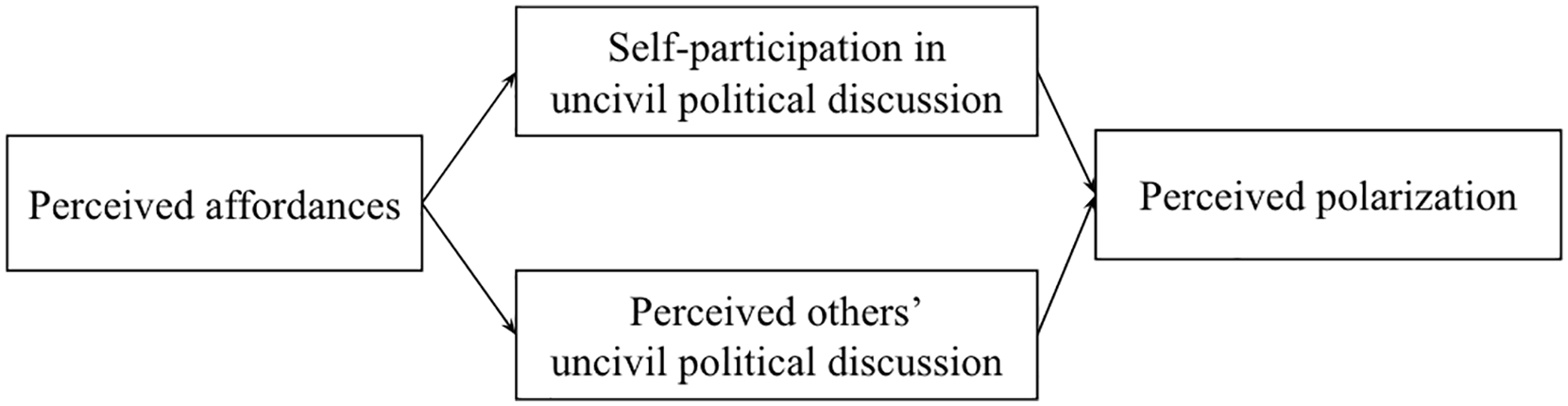
Given these research gaps, we investigate the relationship between social media use and perceived polarization with a perceived affordances approach. Defined as perceived action possibilities, perceived affordances address the association between people’s cognitions and the technological setting they interact with (Evans et al., 2017). This approach helps clarify which properties of social media technologies relate to perceived polarization (Flanagin, 2020), in contrast to the sole focus on social media content (e.g., uncivil comments) from previous research. We argue that users’ perceptions of three affordances, namely, anonymity, privacy, and network association, influence (a) their self-participation in uncivil political discussion on social media and (b) perceptions of others’ uncivil discussion engagement, which eventually shapes their perceptions of political polarization (see Figure 1).
Conceptual model.
Perceived affordances have an effect on online expression and communication, according to prior computer-mediated communication (CMC) research (Evans et al., 2017; Fox & McEwan, 2017). Applying this concept to the political context, we investigate how perceived affordances influence users’ participation in uncivil political discussion on social media, which eventually shapes perceived polarization. Uncivil political discussion, characterized by insulting and disrespectful expressions targeting political opponents, potentially influences individuals to infer a more polarized opinion climate (Hwang et al., 2014). Moreover, users may expect others to leverage platform affordances for engagement in uncivil discussion (Sude & Dvir-Gvirsman, 2023; Toma et al., 2018). Individuals may perceive greater polarization if they think that others frequently join uncivil discussions, given the perceived polarizing effect of uncivil talk. Thus, we propose an indirect relationship between perceived affordances and perceived polarization mediated by both users’ self-participation in uncivil political discussion and perceptions of others’ engagement.
The analysis of US survey data provided support to our hypothesized model and revealed different paths from perceived affordances to perceived polarization. However, we found that perceptions of higher anonymity relate to higher self-participation in uncivil discussion, which is surprisingly associated with perceptions of less polarization. Our follow-up experimental study illustrated that those participants with more frequent engagement in uncivil discussion, irrespective of interacting with civil or uncivil comments, showed consistently higher levels of intrapersonal reflection, which reduces perceived polarization.
Perceived Affordances and Perceived Polarization
Perceived political polarization refers to the extent to which one perceives important differences between political opponents’ positions on ideological or social issues (Levendusky & Malhotra, 2016; Yang et al., 2016). On social media, users often encounter exemplars of different political ideologies and backgrounds (Rojas, 2015), especially during political discussions, which may influence their perceptions of polarization. However, these exemplars can be biased, as extreme partisans tend to be more active in social media discussions and even use uncivil language to criticize their opponents (Heltzel & Laurin, 2020; Rojas, 2015). The biased exemplars encountered through uncivil political discussion social media may contribute to (mis)perceptions of greater polarization (Hwang et al., 2014).
The conceptual divide among scholars regarding the definition of incivility is noteworthy. Some scholars emphasize the aspect of impoliteness and disrespectfulness, which encompasses speech acts, for example, name-calling, aspersions, and vulgarities (Coe et al., 2014; Muddiman, 2017), while others adopt a deliberative perspective, viewing incivility as the aversive speech involving threats and stereotypes (Papacharissi, 2004). Our study focuses on impolite and disrespectful expressions in the context of uncivil political discussion, as past empirical evidence shows that this type of expressions is more widespread online than speeches involving threats and stereotypes, and laypeople view name-calling and vulgarities as more uncivil than other forms of expressions (Masullo et al., 2023). More importantly, impolite and disrespectful political expressions have been found to reduce media trust (Masullo et al., 2023) and prosocial behaviors toward the derogated group (Ziegele et al., 2018), and we extend the research on their social implications by studying how uncivil political discussion on social media relates to perceived polarization.
While uncivil political discussion on social media may influence perceived polarization, the underlying role of social media remains unclear. To better understand the relationship between social media use and perceived polarization, we argue for the need to take one step further to address the properties of social media, that is, affordances, which shape users’ participation in uncivil discussion and eventually their perceptions of polarization.
CMC research has employed the concept of affordances to emphasize the unique effect of technologies, distinct from specific contents or user behaviors within mediated environments (Flanagin, 2020). An increasing number of CMC scholars have adopted a relational perspective to define social media affordances as action possibilities shaped by the interaction between platform features and users’ subjective interpretations (Evans et al., 2017).
While prior studies often manipulated affordances in experiments or simply theorized the role of affordances without measuring them, some scholars suggest the need to test how perceived affordances relate to divergent behavioral outcomes, given the varied perceptions of affordances among users (Evans et al., 2017; Fox & Holt, 2018; Fox & McEwan, 2017). For example, Fox and Holt (2018) found that perceptions of stronger network association on Facebook predict less self-censorship, as users feel empowered by their networks.
Borrowing from these insights, we apply a perceived affordance approach to examine the role of social media in (mis)perceptions of polarization and hypothesize that users’ perceptions of affordances influence their participation in uncivil political discussion on social media, which eventually shapes their perceptions of polarization.
Moreover, we argue that perceptions of others’ uncivil discussion engagement also mediate the relationship between perceived affordances and perceived polarization. Individuals expect that social media features enable or constrain not only their own actions, but also other users’ activities (Sude & Dvir-Gvirsman, 2023; Toma et al., 2018). Therefore, perceived affordances potentially shape one’s inference about others’ uncivil political discussion on social media (Litt, 2012; Treem et al., 2020), which subsequently influences the assessment of others’ political attitudes and the extent of polarization.
Given that the perceptions of affordances are context- and platform-specific, our study focuses on the United States and its most popular social network site—Facebook. For affordances, we consider perceived anonymity, privacy, and network association, which are highly relevant to uncivil political discussion (Jaidka et al., 2021; Neubaum & Weeks, 2023; Sude & Dvir-Gvirsman, 2023). Figure 2 illustrates the model to be tested.

Hypothesized model.
Perceived Affordances and Participation in Uncivil Political Discussion
This section explains how the three perceived affordances considered relate to self-participation in uncivil political discussion on Facebook, the first key mediator in our model.
Perceived anonymity is the degree to which users perceive that their true identities can remain unknown in interactions (Fox & McEwan, 2017). Facebook presumably affords lower anonymity than other platforms (e.g., YouTube, Reddit) by encouraging registrations with real names and email accounts. However, some users may still feel anonymous, if they use fake identities or consider their online self as distinct from offline existence (Fox & Holt, 2018).
We hypothesize that perceptions of higher anonymity relate to greater participation in uncivil political discussion. The Social Identity Model of Deindividuation (SIDE; Spears et al., 2002) suggests that higher anonymity lowers an individual’s perceived personal identity salience on the platform, causing them to view their behaviors as deindividuated and divorced from real-life consequences. Thus, users perceiving higher anonymity on Facebook would experience a reduced sense of personal responsibility, which may increase their likelihood of engaging in behaviors that deviate from social norms in face-to-face interactions, including participating in uncivil discussion (Halpern & Gibbs, 2013). These users may feel more comfortable engaging in political discussion with personal attacks and inflammatory language, assuming they are less likely to be identified by their real-life contacts and held accountable for their uncivil expressions (Oz et al., 2018).
Perceived privacy refers to the belief that one’s interactions will be kept private and not noticed or accessed by unintended audiences (Fox & McEwan, 2017; Sude & Dvir-Gvirsman, 2023). Facebook users can customize their privacy settings and specify the audience of each post they create.
We argue that perceptions of higher privacy encourage participation in uncivil political discussion, given previous empirical evidence showing that the sense of reduced publicness of one’s interactions prompted by privacy management increases overall political engagement on Facebook (Mak et al., 2022). Users may worry about how unintended audiences, including acquaintances and professional contacts in their network, evaluate their uncivil online interactions which might be viewed as violating civil norms (Oz et al., 2018). Perceptions of high privacy may promote uncivil discussion by leading users to believe that their interactions are accessible to only a limited audience and are unlikely to be read by many real-life contacts from their weak-tie networks.
Perceived network association refers to one’s perceived connectivity among users on a platform, specifically the ease to connect and interact with other members within the social media network (Sude & Dvir-Gvirsman, 2023; Treem & Leonardi, 2013). On Facebook, users can easily join discussions by leaving comments on their friends’ posts and see who their friends are interacting with. However, some individuals may perceive low network association, as users can turn off comments and hide their friends’ lists.
The extant literature suggests contradictory possibilities about the effect of perceived network association on participation in uncivil political discussions. Perceptions of stronger network association may intensify one’s sense of context collapse on Facebook where audiences of different ideologies are brought together (Bayer et al., 2020; Fox & McEwan, 2017). This may increase users’ concern over relationship dissolution, hindering their participation in uncivil discussion. However, Fox and Holt (2018) found that users perceiving stronger network association were less likely to self-censor on Facebook, as these users believed that like-minded others would support and defend them when needed. This perceived social support stemming from strong network association may mitigate concerns over participating in uncivil discussion (Walther, 2022), despite its social undesirability.
Based on the above arguments, we propose as follows:
H1: Perceptions of higher anonymity (H1a) and privacy (H1b) relate to greater self-participation in uncivil political discussion on Facebook.
RQ1: How do perceptions of network association relate to self-participation in uncivil political discussion on Facebook?
Perceived Affordances and Perceptions of Others’ Uncivil Discussion Engagement
We argue that perceived affordances influence perceived polarization also through shaping perceptions of others’ uncivil discussion engagement. This section explains how each perceived affordance relates to perceived others’ uncivil discussion.
We hypothesize that perceptions of higher anonymity predict perceptions of greater participation in uncivil discussion by others. Previous CMC studies suggested that individuals perceive others as more capable than themselves in leveraging platform affordances for socially undesirable expressions or behaviors, such as online deception (e.g., Toma et al., 2018), which aligns with the third-person effect (TPE) framework (Hoorens & Ruiter, 1996). Testing a similar hypothesis, recent research on online incivility found that individuals perceiving higher anonymity in the comment sections of news sites (Van Duyn & Muddiman, 2022) or on social media platforms (Sude & Dvir-Gvirsman, 2023) expect higher levels of incivility in those spaces. Based on these findings, we argue that users may assume that other users would take advantage of the anonymity affordance to engage in uncivil discussion, given the lower likelihood of being held accountable or offending their contacts.
We also posit a positive relationship between perceived network association and perceived others’ uncivil discussion engagement. Those perceiving strong network association may assume that others can easily connect with different people and join various ongoing interactions on Facebook (Treem & Leonardi, 2013). Based on the TPE framework (Hoorens & Ruiter, 1996), individuals expect others, especially the strong partisans, to be more likely than themselves to leverage this strong network association to engage in uncivil discussions which are perceived to be socially undesirable. This assumption finds support in Sude and Dvir-Gvirsman’s (2023) research, which showed a positive association between perceived network association and perceived incivility on social media. Sude and Dvir-Gvirsman further explained that individuals anticipate conflict interactions, including uncivil political discussions, to spread more easily within a closely connected network, as opposing users can easily participate by leaving comments on the posts concerned. Therefore, perceptions of stronger network association may lead to an overestimation of uncivil exchanges by others on Facebook.
The relationship between perceived privacy and perceived others’ uncivil discussion engagement is debatable owing to the conflicting theoretical perspectives and insufficient empirical evidence. One perspective is that individuals perceiving higher privacy on Facebook may expect others to engage more actively in uncivil political discussion, as they might assume that others feel less concerned about offending their real-life contacts when uncivil interactions are visible to mostly like-minded network members (Neubaum & Weeks, 2023). Another opposing perspective is that perceived privacy affects one’s evaluation of others’ “opportunities” of encountering various forms of discourse, including uncivil political discussion; when the platform privacy is low, most user interactions are expected to be accessible to a wider audience rather than staying private (Treem et al., 2020). Users perceiving lower privacy may assume that others are more likely to be exposed to uncivil political discussions and subsequently join such interactions.
Building on the preceding arguments, we propose as follows:
H2: Perceptions of higher anonymity (H2a) and higher network association (H2b) relate to perceptions of higher engagement in uncivil political discussion by other users on Facebook.
RQ2: How do perceptions of privacy relate to perceived others’ engagement in uncivil political discussion on Facebook?
Uncivil Political Discussion, Perceived Others’ Engagement, and Perceived Polarization
This section introduces the final part of our hypothesized mediation model—how both forms of uncivil discussion (self and perceived others) relate to perceived polarization.
We hypothesize that users’ self-participation in uncivil political discussion on Facebook positively relates to perceived polarization for three reasons. First, political discussions on social media allow participants to directly observe how others discuss various issues (Hwang et al., 2014; Neubaum & Krämer, 2017a). Prior studies have found that exposure to online incivility contributes to the inference of greater political polarization (Hwang et al., 2014; Kim & Park, 2018), as the insulting remarks signal significant division between opposing camps.
Second, incivility in political discussion may reduce intrapersonal reflection, thereby increasing perceived polarization. Intrapersonal reflection, crucial for considering different facets of an issue and conflicting viewpoints, occurs during political conversation where issue updates and opinions are exchanged (Goodin & Niemeyer, 2003). It helps lessen the tendency to overlook diverse perspectives and overestimate differences between opposing positions (Fernbach & Van Boven, 2022). However, past research found that engaging in uncivil discussion heightens hostile perceptions of the outgroup and frustration due to poor discussion quality, thus contributing to close-mindedness (Hwang et al., 2018; Kim & Kim, 2019). Moreover, encountering uncivil attacks may provoke negative emotions (i.e., anger) along with aggressive cognitions (Chen & Lu, 2017; Rösner et al., 2016), which promote non-analytical thinking (Fernbach & Van Boven, 2022). Both close-mindedness and negative emotions triggered by uncivil discussion would hinder intrapersonal reflection, leading to perceptions of greater polarization.
Third, participation in uncivil political discussion would shape perceptions of others’ participation in uncivil discussion, which eventually influences perceived polarization. Individuals participating actively in uncivil discussion on Facebook are more likely to infer that other users also engage extensively, as their own involvement provides ample opportunities for observing others’ engagement.
We further argue that perceptions of others engaging in more uncivil discussions are associated with perceptions of greater polarization for two reasons. First, approximately two-thirds of Americans agree that social media use has negative effects, including political polarization, and online incivility was one of the most cited reasons (Auxier, 2020). Second, individuals tend to overestimate the undesirable effect of media on others, based on the literature on presumed media influence (PMI) and TPE (Gunther & Storey, 2003; Hoorens & Ruiter, 1996). Extending this line of research to social media, Tsay-Vogel (2016) found that people overestimate the effect of Facebook use on others. Thus, given the presumed polarizing effect of uncivil discussion on Facebook, we expect a positive relationship between perceived others’ uncivil discussion and perceived polarization.
Our conceptualization of perceived political polarization encompasses two dimensions: perceived polarization on Facebook and in society. We argue that self-participation in uncivil discussion and perceived others’ engagement may first shape one’s perception of polarization on Facebook and subsequently perceptions of societal polarization, as some users treat their perceptions of polarization on Facebook as heuristic cues for assessing societal polarization (Neubaum & Krämer, 2017b). It is also possible that self-participation in uncivil discussion and perceived others’ engagement directly influence perceived societal polarization; Neubaum and Krämer (2017a) found that people infer public opinion directly from social media interactions, considering social media users as representatives of the broader population.
Based on these arguments, we propose as follows:
H3: Greater self-participation in uncivil political discussion on Facebook relates to perceptions of higher engagement by others (H3a) and perceptions of greater polarization on Facebook (H3b) and in society (H3c).
H4: Perceptions of higher uncivil discussion engagement by others on Facebook relate to perceptions of greater polarization on Facebook (H4a) and in society (H4b).
H5: Perceived polarization on Facebook positively relates to perceived societal polarization.
As we are ultimately interested in the relationships between perceived affordances and perceived polarization mediated by uncivil political discussion (both self and perceived others), we ask as follows:
RQ3: Given H1-5 and RQ1-2, how do perceived anonymity, privacy, and network association relate to perceived societal polarization indirectly through self-participation in uncivil political discussion, perceived others’ engagement, and perceived polarization on Facebook?
Figure 2 summarizes all the hypotheses and research questions.
Study 1: Method
Sampling
The data were collected between 27 April and 12 May 2022 by Qualtrics, which randomly selected subjects from its online panel constructed along the geographical and demographic parameters of the country. Selected subjects were asked profiling questions to ensure that the final sample was representative of the US population. Potential respondents were given access to the survey.
The sample comprises 541 participants. Compared with the census, the sample was slightly older and better educated, with slightly more females and whites (see Supplemental Appendix I for detailed comparisons). Given our focus on Facebook, our analysis included only participants with a Facebook account (N = 445).
Measures
Perceptions of Facebook Affordances
We adapted three subscales of the Perceived Social Affordances of Communication Channels Scale (Fox & McEwan, 2017), which have been employed in past studies (e.g., Fox & Holt, 2018; Sude & Dvir-Gvirsman, 2023). We asked respondents how much they agree with a list of statements from 1 = strongly disagree to 6 = strongly agree (see Supplemental Appendix II for details). Three items measured perceived anonymity (e.g., “Facebook allows people to remain anonymous or unidentifiable if they want to,” M = 3.87, SD = 1.23; α = .78). Perceived privacy was evaluated with three other items, such as “Facebook helps keep users communication (e.g., posts, comments) private” (M = 3.57, SD = 1.29; α = .83). Perceived network association was measured with three items, for example, “on Facebook, users can easily join or interrupt their network members’ interaction in social network” (M = 3.97, SD = 1.17; α = .96).
Uncivil Political Discussion on Facebook (Self and Perceived Others)
Respondents reported how often they have been in a political discussion on Facebook, involving (a) name-calling, (b) personal attacks or aspersions, and (c) vulgarities or pejorative words for speech from 1 = never to 6 = frequently (Graf et al., 2017). The three items measured self-participation in uncivil political discussion on Facebook (M = 2.29, SD = 1.63; α = .96). The same items were adjusted to measure perceived others’ uncivil discussion engagement by adding an instruction “based on your perception” and replacing “you” with “general users” (M = 3.51, SD = 1.52; α = .95).
Perceived Polarization on Facebook and in Society
Adopting Yang et al.’s (2016) measurement strategy, we asked respondents how strongly they thought that (a) Republicans and (b) Democrats support or oppose (a) the right to abortion, (b) more aggressive environmental action, and (c) Medicare for All, using a scale from 1 = strongly oppose to 7 = strongly support. We calculated the absolute difference between perceived Republicans’ and Democrats’ stance on each issue, and the scores for the three issues of measured respondents’ perceptions of polarization in society (M = 2.67, SD = 2.10; α = .89). We asked the same questions again but changed “Republicans/Democrats” to “Republican/Democrat users on Facebook” to measure perceived polarization on Facebook (M = 2.52, SD = 2.15; α = .92).
Supplemental Appendix II provides the operationalization details of all the latent constructs.
Control Variables
Our control variables include age, gender, educational level, race, and monthly household income (an 8-point scale; M = 3.97, SD = 2.29, Mdn: 3 = between US$2,001 and US$3,000). We also controlled ideological extremity 1 (a 6-point scale with higher values indicating more extreme political ideology; M = 2.96, SD = 1.91), political interest (a 6-point scale; M = 3.81, SD = 1.71), traditional media use (an index averaging four items of newspaper and TV news on a 6-point scale; M = 2.96, SD = 1.32; α = .69), online media use (a 6-point scale; M = 3.61, SD = 1.77), and Facebook news use (an index averaging four items on a 6-point scale; M = 2.72, SD = 1.52; α = .88).
Study 1: Analytic Strategy
Using the lavaan package in R (Rosseel, 2012), we applied structural equation modeling with robust maximum likelihood estimation to test our model. We evaluated the model fit based on the criteria suggested by Hu and Bentler (1999): cutoff values of .95 or higher for the comparative fit index (CFI) and Tucker–Lewis index (TLI), .06 or lower for the root mean square error of approximation (RMSEA), and .08 or lower for the standardized root mean square residual (SRMR). 2 Supplemental Appendix III summarizes the correlation between key variables.
Our analysis involves two steps. First, we built a measurement model to examine whether the observed variables reflected our latent constructs. The model demonstrated a good fit: χ2(168) = 377.64, p < .001; CFI = .97; TLI = .96; RMSEA = .06; SRMR = .05. All the standardized factor loadings were above .63.
Second, we analyzed the structural model and regressed all the key variables on the control variables. 3 It showed a good fit: χ2(314) = 574.89, p < .001; CFI = .96; TLI = .95; RMSEA = .05; SRMR = .04. Figure 3 summarizes the results. We ran a collinearity analysis for every regression in the structural model. The variance inflation factor of the key predictors ranged from 1.26 to 2.35, which is far below the threshold value of 10 and indicates an unlikely occurrence of multicollinearity.

Results of the structural model.
Study 1: Results
H1 and RQ1 address the relationship between perceived affordances and self-participation in uncivil political discussion on Facebook. Figure 3 shows that perceived anonymity was positively related to participation in uncivil discussion on Facebook (β = .12, p < .05), while perceived privacy and network association had no significant relationships with self-participation in uncivil discussion. H1a is supported, while H1b is not.
Regarding the relationship between perceived affordances and perceived others’ uncivil discussion on Facebook (H2 and RQ2), perceptions of both lower privacy (β = −.35, p < .001) and stronger network association (β = .36, p < .001) predicted perceptions of higher uncivil discussion engagement by others, but perceived anonymity was not a significant predictor. H2b is supported, while H2a is not.
For the relationships between self-participation in uncivil discussion, perceived others’ engagement, and perceived polarization (H3), greater self-participation in uncivil discussion predicted perceptions of higher uncivil discussion engagement by others (β = .48, p < .001) and perceptions of less polarization on Facebook (β = −.34, p < .001). H3a is supported, while H3b is not. H3c is not supported, as self-participation in uncivil discussion did not significantly predict perceived societal polarization. Moreover, perceptions of higher uncivil discussion engagement by others significantly predicted perceptions of greater polarization on Facebook (β = .19, p < .01) and in society (β = .09, p < .05). Both H4a and H4b are supported. We also found that perceived polarization on Facebook positively relates to perceived societal polarization (β = .80, p < .001). H5 is supported.
We also ran a mediation analysis to test the indirect relationships between perceived affordances and perceived polarization mediated by self-participation in uncivil discussion and perceived others’ engagement (RQ3). We tested the mediation paths involving significant constituent paths indicated in Figure 3. Table 1 summarizes the results.
Indirect Relationships between Perceived Affordances and Perceived Societal Polarization.
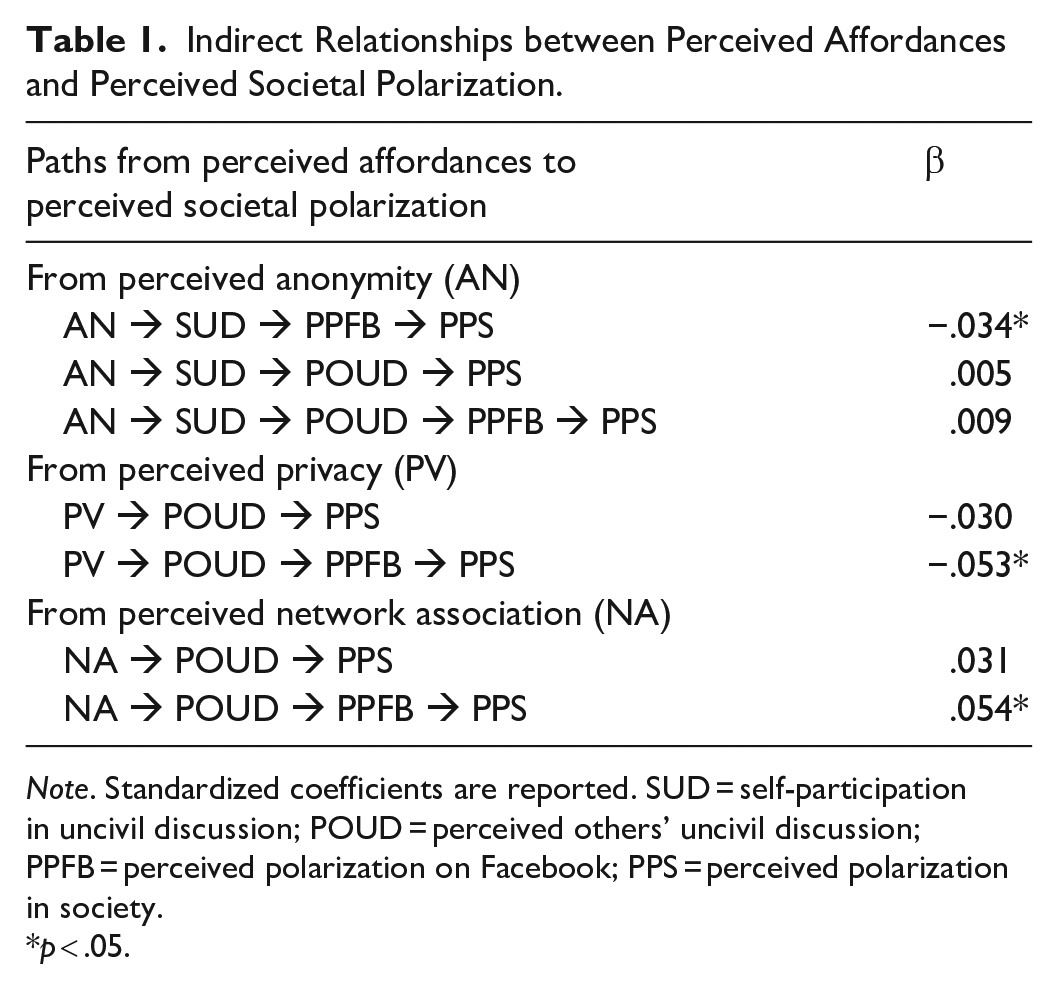
Note. Standardized coefficients are reported. SUD = self-participation in uncivil discussion; POUD = perceived others’ uncivil discussion; PPFB = perceived polarization on Facebook; PPS = perceived polarization in society.
p < .05.
Overall, we found three significant indirect paths from perceived affordances to perceived societal polarization, one for each affordance. For anonymity, the path, “perceived anonymity self-participation in uncivil discussion perceived polarization on Facebook perceived polarization in society,” was significant (β = −.03, p < .05); specifically, perceptions of higher anonymity predicted greater self-participation in uncivil discussion, which was related to perceptions of less polarization on Facebook and eventually perceptions of less societal polarization.
In contrast, perceived others’ engagement in uncivil discussion, not self-participation, served as the key mediator in the significant indirect paths involving the other two affordances, that is, “perceived privacy/perceived network association perceived others’ uncivil discussion perceived polarization on Facebook perceived polarization in society” (privacy: β = −.05, p < .05; network association: β = .05, p < .05). Perceptions of lower privacy or stronger network association predicted perceptions of higher engagement in uncivil discussion by others, which was related to perceptions of greater polarization on Facebook and eventually perceptions of greater societal polarization.
We compared our model with five alternative models (e.g., adding direct paths from perceived affordances to perceived polarization, and reversing certain paths between the key variables). The results indicated that our model was the best fit (see Supplemental Appendix IV).
Study 1: Discussion
Our findings revealed how perceived affordances indirectly relate to perceived polarization through influencing (a) self-participation in uncivil political discussion and (b) perceptions of others’ uncivil political discussion on Facebook. Specifically, perceptions of lower privacy and stronger network association were related to perceptions of a higher level of uncivil discussion by other users, which in turn predicted perceptions of greater polarization.
On the contrary, perceptions of higher anonymity on Facebook predicted greater self-participation in uncivil political discussion, which eventually relates to perceptions of less polarization; this negative relationship between uncivil discussion and perceived polarization on Facebook contradicts our initial hypothesis and past research evidence (e.g., Hwang et al., 2014; Kim & Park, 2018). It is necessary to unpack this negative path to fully understand how perceiving higher anonymity indirectly relates to perceptions of less polarization through increased participation in uncivil discussion.
A potential explanation is that some users, particularly those with experience in uncivil discussions, might perceive incivility as a norm rather than an exception on social media. For users accustomed to online incivility, uncivil political discussion may serve as an opportunity to learn about and consider different opinions, similar to civil discussion, which helps reduce perceived polarization.
To assess the validity of this explanation, we adopted two approaches. First, as suggested by one of our anonymous reviewers, we conducted a post hoc analysis to examine whether greater self-participation in uncivil discussion attenuates the positive relationship between perceived others’ uncivil discussion and perceived polarization on Facebook. Users with greater self-participation in uncivil discussion will be less likely to presume a polarizing effect of uncivil discussion on others’ attitudes, if they perceive incivility as a norm, according to our explanation. As we expected, the moderation analysis revealed that the positive relationship between perceived others’ uncivil discussion and perceived polarization on Facebook was attenuated by higher levels of self-participation in uncivil discussion (β = −.15, p < .001) and became not significant when self-participation was high (i.e., one standard deviation above the mean). Supplemental Appendix V provides the details of these results.
Our second approach is to conduct a follow-up experimental study to investigate whether uncivil political discussion can serve as an opportunity for those with much experience of incivility to consider different opinions. Our previous literature review mentions three reasons for hypothesizing a positive relationship between uncivil discussion and perceived polarization: the direct inference of a polarized opinion climate, reduced intrapersonal reflection, and increased perceptions of others engaging in uncivil discussion. These reasons, particularly the first two, are more pertinent to one-off exposure to incivility or uncivil interaction which is the primary focus of past experimental studies (e.g., Hwang et al., 2014; Kim & Kim, 2019; Kim & Park, 2018). In comparison, we measured self-reported frequency in Study 1 which implies respondents’ experience of online incivility.
Engaging in an uncivil interaction may generally reduce intrapersonal reflection, as illustrated in past studies; however, for those with frequent participation in uncivil discussion, it may serve as an opportunity to consider and reflect on diverse viewpoints (i.e., having a high level of intrapersonal reflection), similar to civil discussion. To test this argument, we conducted an experiment to examine the moderating role of prior engagement in uncivil discussion on Facebook in the direct effect of uncivil interaction on perceived polarization on Facebook and the indirect effects via intrapersonal reflection and perceived others’ uncivil discussion (see Figure 4). Perceived others’ uncivil discussion was tested again, as it was a core mediator in Study 1 explaining the relationship between self-participation in uncivil discussion and perceived polarization.

Follow-up study: hypothesized model.
Study 2: Method
We recruited participants to join our web-based experiment from 6 April to 9 April 2023 through Qualtrics based on the same sampling procedure adopted in our main study. The sample, comprising 521 participants, was slightly older, more educated, and had fewer females and whites than the census. Supplemental Appendix I provides comparison details.
Experimental Design
After reporting their demographics, Facebook usage, and engagement in uncivil discussion on Facebook, participants were randomly assigned to one of the three conditions: interacting with civil comments, uncivil comments, and the control condition. In the experimental conditions, participants first read a news post about abortion and shared their responses. 4 They were then presented with either four civil or uncivil comments attached to the post (see Supplemental Appendix VI for the stimuli). They were subsequently asked to share their responses to the comments and answer questions for the attention check (a multiple-choice question asking about which issue the comments are about), manipulation check (see Supplemental Appendix VII), and intrapersonal reflection. Finally, they completed a post-test questionnaire about perceived others’ uncivil discussion and perceived polarization on Facebook. Participants in the control condition proceeded directly to complete the post-test without engaging with any stimuli.
The sample for analysis consists of participants who passed the attention check and possessed a Facebook account (N = 424). Supplemental Appendix VIII explains the sample distribution across conditions.
Measures
Intrapersonal Reflection
We adapted three relevant items from Nabatchi’s (2007) measurement of deliberation which address essential aspects of intrapersonal reflection, including consideration of viewpoints and issue reflection (Goodin & Niemeyer, 2003). We asked respondents how much they agree with three statements from 1 = strongly disagree to 6 = strongly agree, for example, “the viewpoints mentioned in the comments were worth considering” and “the post and comments helped me consider other sides of the issue” (M = 3.35, SD = 1.43, α = .87).
Other Key Variables
We adopted the same measurements from our main study for self-participation in uncivil discussion (M = 2.1, SD = 1.55, α = .96), perceived others’ uncivil discussion (M = 3.4, SD = 1.59, α = .96), and perceived polarization on Facebook (for abortion issue only; M = 2.67, SD = 2.38). Supplemental Appendix IX explains the detailed operationalization of all the key variables.
Study 2: Results
We tested the moderated mediation model in Figure 4 with Hayes’ (2013) PROCESS macro for SPSS. We applied the Model 8 template with 10,000 bias-corrected bootstrap samples and 95% confidence intervals (CI). Given our focus on the moderating role of self-participation in uncivil discussion, ANOVA analysis on comparing perceived polarization across conditions and the results of the mediation model (with no moderation) are reported in Supplemental Appendix X. 5
We found that self-participation in uncivil discussion on Facebook significantly moderated the effect of interacting with uncivil comments on intrapersonal reflection (B = .23, SE = .10, p < .05), but not perceived polarization and perceived others’ uncivil discussion. For participants with a lower level of prior self-participation in uncivil discussion, those interacting with uncivil comments had less intrapersonal reflection than those interacting with civil comments; however, this difference was attenuated by higher self-participation in uncivil discussion (see Figure 5). 6 Furthermore, higher levels of intrapersonal reflection predicted less perceived polarization on Facebook (B = −.25, SE = .10, p < .05).
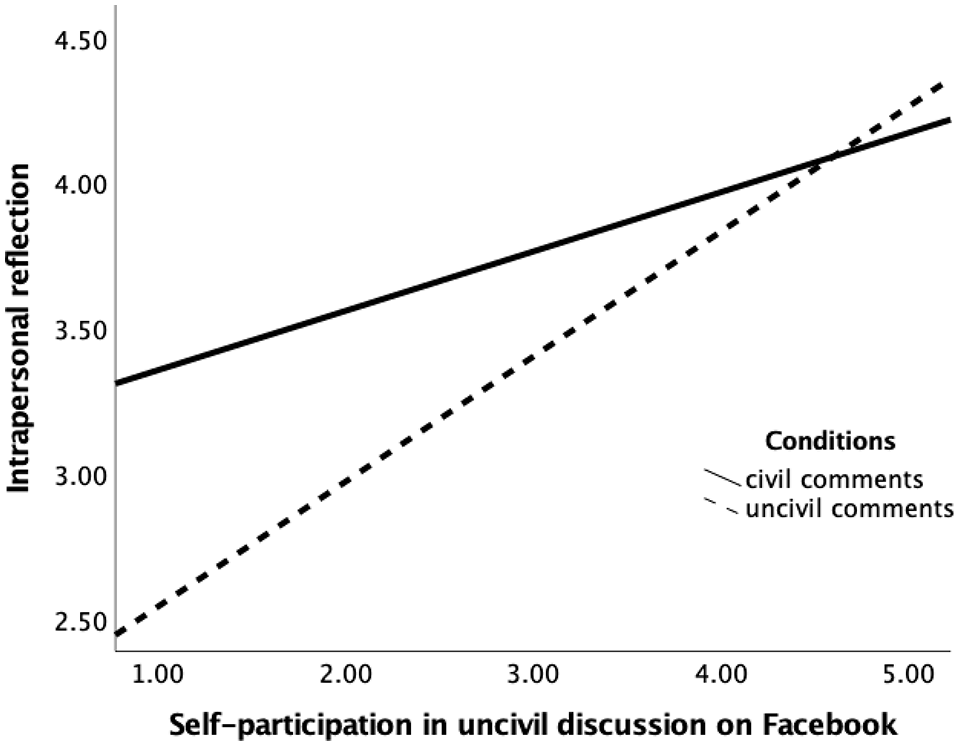
Moderation of self-participation in uncivil discussion on the effect of comment incivility on intrapersonal reflection.
Consequentially, self-participation in uncivil discussion was found to moderate the mediation effect of comment incivility on perceived polarization through intrapersonal reflection (moderated mediation index = −.057, SE = .034, 95% CI = [−.132, −.001]). Table 2 shows that the mediation path was significant only when prior self-participation in uncivil discussion was not high: interacting with uncivil comments reduced intrapersonal reflection and subsequently increased perceived polarization. However, when self-participation in uncivil discussion was high, the mediation effect was no longer significant: participants had similarly high levels of intrapersonal reflection, regardless of interacting with civil or uncivil comments (see Figure 5), which relates to perceptions of less polarization. We replicated the analysis by adding controls (e.g., demographics) and using the full sample (including non-Facebook users) and obtained similar results (see Supplemental Appendix X).
Indirect Effect of Comment Incivility on Perceived Polarization through Intrapersonal Reflection Moderated by Self-Participation in Uncivil Discussion on Facebook.

Note. Unstandardized coefficients are reported, given the binary nature of the independent variable (interacting with uncivil comments = 1; civil comments = 0). Conditions for the moderator are the minimum (1.00), mean (2.18), and mean plus one standard deviation (3.76). CI = confidence interval.
Study 2: Discussion
Study 2 revealed that participants with more frequent engagement in uncivil discussion, regardless of interacting with civil or uncivil comments, showed consistently higher levels of intrapersonal reflection, which reduces perceived polarization. This aligns with our post hoc theorization, explaining why we observed in Study 1 that individuals with greater participation in uncivil discussion perceived less polarization on Facebook.
It is worth noting that the model tested in Study 2 is not perfectly aligned with the negative path from self-participation in uncivil discussion to perceived polarization that we intended to unpack, given that self-participation in uncivil discussion was treated as a moderator rather than the manipulated or independent variable. As our self-participation variable in Study 1 is about the usual frequency of one’s engagement in uncivil discussion on Facebook, future studies should consider adopting long-term experimental designs to manipulate self-participation in uncivil discussions rather than a one-off interaction with uncivil comments.
General Discussion
Using a perceived affordance approach, we investigated in Study 1 the indirect link between perceived affordances and perceived political polarization through self-participation in uncivil political discussion on Facebook and perceptions of others’ engagement. Higher perceived anonymity was associated with greater self-participation in uncivil discussion, which relates to reduced perceived polarization. Perceptions of lower privacy and stronger network association were linked to increased perceptions of others’ uncivil discussion, which relates to heightened perceived polarization. Study 2 provided a plausible explanation about why greater self-participation in uncivil discussion predicted lower perceived polarization, highlighting the key role of intrapersonal reflection. Implications are discussed.
Perceived Affordances and Self-participation in Uncivil Discussion
Perceived anonymity was the only significant predictor of self-participation in uncivil discussion in the structural model in Study 1. This suggests users prioritize their ability to hide their identities over the privacy of their interactions or the connectivity among network members when deciding to participate in uncivil discussions on Facebook.
However, one should not simply dismiss the role of perceived privacy and network association. Some scholars suggested that the effects of perceived affordances are often confounded (Bayer et al., 2020; Fox & McEwan, 2017). For example, perceptions of high privacy may increase perceived anonymity as the belief in a smaller audience viewing one’s content or profile may foster the sense of anonymity. We accounted for this mutual influence of perceived affordances in the structural model by controlling for their covariances. Future studies may use panel surveys or experiments to examine whether perceived privacy and network association influence perceived anonymity and subsequently participation in uncivil discussion.
More importantly, self-participation in uncivil participation was found to be a significant mediator between perceived anonymity and perceived polarization. However, it surprisingly showed a negative relationship with perceived polarization. Users with more frequent engagement in uncivil interactions might have become desensitized to online incivility, processing uncivil political discussions similarly to civil ones. Through uncivil discussions they can still reflect on different opinions, which helps reduce perceived polarization. Our Study 2 supported this explanation, revealing that users who engaged more frequently in uncivil discussion, regardless of interacting with civil or uncivil comments, demonstrated consistently higher levels of intrapersonal reflection, which relates to reduced perceived polarization on Facebook.
Role of “Perceived Others”
In addition to self-participation in uncivil discussion, we also argued that perceived others’ uncivil discussion mediates the relationship between perceived affordances and perceived polarization. The results showed that perceptions of lower privacy and stronger network association predicted perceptions of a higher level of uncivil discussion by others, which relates to greater perceived polarization.
While previous CMC studies have investigated the effects of perceived affordances on perceived others’ online behaviors such as online incivility and deception (Sude & Dvir-Gvirsman, 2023; Toma et al., 2018; Van Duyn & Muddiman, 2022), this study extends the literature by highlighting the importance of “perceived others” in understanding perceived polarization. Our findings signal the need to study the dual role of perceptions of others’ behaviors as the outcome of perceived affordances and antecedent of perceived polarization.
Among the three perceived affordances, only perceived anonymity did not predict perceived others’ uncivil discussion, which contradicted previous research findings (Sude & Dvir-Gvirsman, 2023; Van Duyn & Muddiman, 2022). Unlike past studies, we included self-participation in uncivil discussion together with perceived others’ uncivil discussion in the same model. When we removed the path from self-participation to perceived others’ uncivil discussion from our model in the post hoc analysis (see Supplemental Appendix XI), the path from perceived anonymity to perceived others’ uncivil discussion became significant. This suggests that self-participation in uncivil discussion fully mediated the relationship between perceived anonymity and perceived others’ uncivil discussion; individuals’ own participation in uncivil discussion plays a crucial role in explaining how perceived anonymity indirectly shapes perceptions of others’ participation.
This also illustrates the need to simultaneously consider both users’ own behaviors and their perceptions of others’ behaviors while theorizing the effect of perceived affordances, given that past research mostly focused on either one of the two aspects (e.g., Fox & Holt, 2018; Van Duyn & Muddiman, 2022).
Significance of the Perceived Affordance Approach
Our study responded to the call from some CMC scholars to apply a perceived affordance approach to identify which properties of social media contribute to the political communication phenomenon of interest, given the overwhelming focus on contents and user behaviors in past research (Fox & Holt, 2018; Neubaum & Weeks, 2023).
In practice, a perceived affordance approach helps shed light on the implications of the design of communication technologies in shaping individuals’ political experiences in the online environment. For example, if Facebook follows Twitter to allow users to read certain content posted by the friends of their friends, users will have more opportunities to learn about diverse perspectives, which may reduce perceptions of polarization. However, such a change may also promote perceptions of lower privacy; our findings suggested that users perceiving lower privacy may expect others to be more likely to join uncivil discussion, which eventually boosts their perceptions of polarization. Given these insights, future studies may address the role of perceived affordances in different political outcomes to provide insights into the political implications of possible changes in platform features.
Admittedly, one may argue that research using a perceived affordance approach offers less direct insights than those addressing or manipulating technological features (e.g., Jaidka et al., 2021; Mak et al., 2022). However, as implied by the relational perspective in defining affordances adopted by the CMC scholars (Evans et al., 2017), behavioral and attitudinal outcomes of social media use depend on the interaction between objective technological features and users’ subjective interpretations. We believe that the two strands of research focusing on perceived affordances and technological features can provide complementary insights into the impact of social media use.
Limitations
This study has some major limitations. First, the cross-sectional survey data in Study 1 limits our ability to establish strong causality claims. Although our model fits the data better than multiple models of alternative configurations (see Supplemental Appendix IV), future research is encouraged to test our model by using panel survey data or manipulating perceived affordances in experimental settings (Chan et al., 2022).
Second, the affordances we selected are not exhaustive. Other affordances, such as persistence and editability, should be considered in future studies (Fox & Holt, 2018). Third, generalizing our findings beyond the context of Facebook requires extra caution, as perceptions of affordances are context-specific (Evans et al., 2017). It is worth exploring how the relationships between perceived affordances and perceived polarization may differ across platforms.
Conclusion
We applied a perceived affordance approach to identify the distinctive characteristics of social media in influencing perceived political polarization. By illustrating the dynamics of perceived affordances, self-participation in uncivil political discussion, and perceived others’ engagement in shaping the (mis)perceptions of polarization, we encourage future research to theorize the role of perceived affordances and “perceived others” in the impact of social media use on core political outcomes.
Supplemental Material
sj-docx-1-sms-10.1177_20563051241228595 – Supplemental material for Social Media and Perceived Political Polarization: Role of Perceived Platform Affordances, Participation in Uncivil Political Discussion, and Perceived Others’ Engagement
Supplemental material, sj-docx-1-sms-10.1177_20563051241228595 for Social Media and Perceived Political Polarization: Role of Perceived Platform Affordances, Participation in Uncivil Political Discussion, and Perceived Others’ Engagement by Macau K. F. Mak, Mengyu Li and Hernando Rojas in Social Media + Society
Footnotes
Declaration of Conflicting Interests
The author(s) declared no potential conflicts of interest with respect to the research, authorship, and/or publication of this article.
Funding
The author(s) disclosed receipt of the following financial support for the research, authorship, and/or publication of this article: This work was supported by the University of Wisconsin Foundation: (Grant No. AAA2223).

Supplemental Material
Supplemental material for this article is available online.
Notes
Author Biographies
References
Supplementary Material
Please find the following supplemental material available below.
For Open Access articles published under a Creative Commons License, all supplemental material carries the same license as the article it is associated with.
For non-Open Access articles published, all supplemental material carries a non-exclusive license, and permission requests for re-use of supplemental material or any part of supplemental material shall be sent directly to the copyright owner as specified in the copyright notice associated with the article.
