



Abstract
4chan and Reddit have often been lumped together as similar home turfs for geeky, masculine-coded, problematic communities thriving under laissez-faire governance. However, stressing these similarities may overlook not only how the platforms have drifted apart in political-economic terms but also how their similarity encourages assertions of difference between its users. In dialogue with theories on ritual opposition and platform imaginaries, I interrogate this dialectic by tracing the relationship between groups on 4chan and Reddit. How has this relationship developed over time and between subgroups? What do the fractured, fluctuating cross-site associations teach us about the collectivity of both sites? By quantitatively mapping cross-mentions in large archives of Reddit, 4chan/b/, and 4chan/pol/, I identify a lopsided rivalry: 4channers consistently employed antagonistic phrases and stereotypes of Reddit, but 4chan’s relevance throughout Reddit is waning. I moreover find that a platform imaginary of 4chan as neutral, diverse, and unfiltered contradicts with the incessant discursive hostility of its users. The text thereby demonstrates how the collectivization of online subcultures is shaped by reflexive cross-site relations that feature a complex interplay between discursive boundary work, contrasting platform vernaculars, and political resentment.
Introduction
In a team meeting following the 2014 “Celebgate” nude photo leak, Reddit’s soon-to-be CEO Ellen Pao raised a confronting question: “Are we comfortable becoming 4chan?.” To her, the answer was a clear no, citing how 4chan was “famous for fostering harassment,” being a “no-holds-barred site without accounts, much less names, without permanence, and thus without any accountability.” Agreeing with her, Reddit’s team decided to steer clear of this anarchic direction (Pao, 2017, pp. 194–195). These were no empty promises: after Celebgate, Reddit saw an uptick in subreddit bans (Ingram & Collins, 2020), its founder and current CEO Steve Huffman claimed he had “grown out” of his “snarky, libertarian” persona (Marantz, 2019, p. 175), and Redditors themselves increasingly pushed for stronger content moderation. 1 These changes did not just grow from moral concerns: over the years, Reddit has become increasingly commodified, pushed by a 2017 redesign (Pardes, 2018), amped-up marketing discourse, 2 and new monetization features. This direction regularly upset Reddit’s userbase, catalyzing in the summer of 2023 when an API-access fee led to the closure of several third-party apps—and many subreddits going dark in protest. 3 While the API protests were unmatched in scale, they marked just another step in the website’s commodification or, as some would have it, “enshittification.” 4 In so doing, Reddit has slowly moved away from its unruly, cyberlibertarian roots (see Lagorio-Chafkin, 2018; Massanari, 2015).
Meanwhile, the site that Pao dreaded Reddit to “become” unabashedly retained its no-holds-barred character. Since its inception in 2003, 4chan has hardly evolved in terms of its governance, design, or minimal business model, remaining an odd remnant of early forum culture in a time of ubiquitous platform capitalism. While its founder Christopher Poole was so morally disconcerted by Celebgate that it contributed to his eventual departure in 2015, 5 4chan’s current owner Hiroyuki Nishimura is much more apathetic and hands-off, refusing to remove racist and bigoted content even though the site’s far-right subforum /pol/ “Politically Incorrect” has inspired numerous conspiracy theories and terrorist attacks (De Zeeuw & Gekker, 2023; Ling, 2022). Instead of following Reddit’s commercialization and growth, 4chan further cultivated its status as a hate-filled cesspool at the margins of the platform economy.
While these divergent trajectories are fascinating from a political-economic perspective, this text focuses on a slightly different dimension. What was latently present in Pao’s fears was a perceived techno-cultural proximity between 4chan and Reddit, and how her ideas about Reddit were reflexively shaped by ideas about another platform. This text concerns how this dialectic manifests among 4chan and Reddit’s many users, with a focus on 4chan. 6 Where Pao’s comparison concerned a C-suite debate, it is well-observed how such reflexive cross-site associations are entwined with grassroots forms of boundary policing and identity formation (e.g., Buozis, 2021; Milner, 2016). Especially among 4channers, it is a de facto practice not only to antagonize other boards but also to scold entire platforms and online spheres to protect and negotiate subcultural mores (De Zeeuw & Tuters, 2020; Nissenbaum & Shifman, 2017; Phillips, 2015). Indeed, a cursory scroll on 4chan’s /pol/ board will quickly lead to memetic disavowals like “go back to Reddit” (Figure 1; see also Nissenbaum & Shifman, 2017; Trammell, 2014).
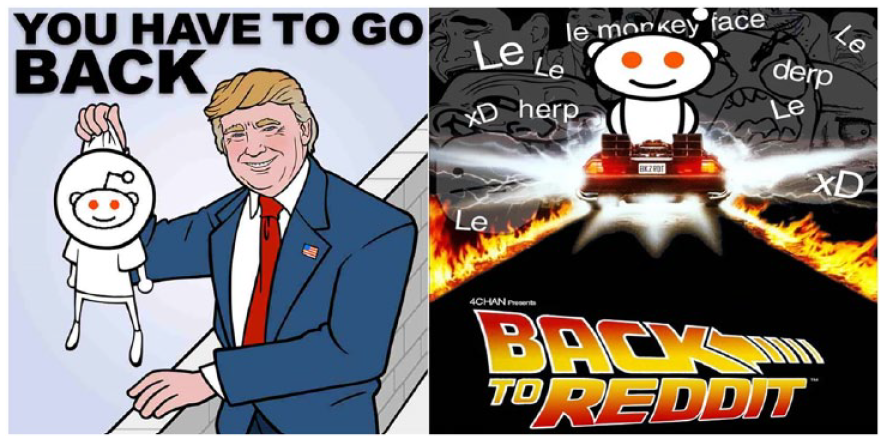
Memes ridiculing Reddit, found on 4chan/pol/.
This reflexive cross-site antagonism has often been studied as subcultural resistance against a perceived “mainstream,” for example, between 4chan and Facebook (De Zeeuw, 2019). Less attention has been paid to cross-site relations between comparably subcultural spaces. Several studies have dealt with “internal” conflicts between subreddits (e.g., Buozis, 2021; Efstratiou et al., 2022; Marchal, 2020), while other texts have touched on 4chan’s “symbiotic” relationship with Tumblr (Beran, 2019; Hagen, 2023). Yet the 4chan–Reddit rivalry has only attracted sparse scholarly attention, even though it marks a historically significant online linkage, as I will go on to show (for exceptions, see Donovan et al., 2022; Gallagher & Topinka, 2023; Trammell, 2014). Texts that do take both websites into account often group the two together as comparable sites for, among others, “toxic technocultures” (Massanari, 2017; Salter, 2018), disinformation and conspiracy theories (Marwick & Lewis, 2017; Zannettou et al., 2017), and hate speech within a “global hate ecosystem” (Zahrah et al., 2022, p. 1797; see also Mittos et al., 2020). This parity is understandable considering the websites’ comparable technocultures, both featuring a close adherence to anonymity, irony, play, and geek masculinity (Beran, 2019; Coleman, 2014; Lagorio-Chafkin, 2018; Massanari, 2015, p, 28, 2017; Milner, 2016; Phillips, 2015; Van der Nagel & Frith, 2015), as well as their overlapping “alt-right” subgroups, notably with /pol/ and the pro-Trump subreddit r/The_Donald (Donovan et al., 2022; Feinberg, 2017; Siegel, 2015; Wendling, 2018; Woolf, 2016). Despite these overlaps, this article departs from the argument that a focus on the (perceived) heterogeneity between both sites can lead to fruitful empirical insights into how online collectives reflexively imagine themselves, including radical political groups like found on /pol/.
In this text, I conduct a quali-quantitative cross-platform study that interrogates broad trends as well as granular cross-site imaginaries. I first theorize how online subcultures can be at odds with each other through intergroup differentiation and memetic logics. I then discuss how such rifts are maintained through discursive boundary work and “ritual opposition,” which foster normative platform imaginaries on how things ought to go within different online locales—even if these spaces overlap between users and cultural sensibilities. Considering the lack of basic insights into the 4chan–Reddit relationship, the first goal of the case study is an initial quantitative mapping. How has this subcultural relationship developed over time and between its subgroups? I interrogate this through mapping cross-mentions within large historical archives of Reddit and 4chan’s /b/ and /pol/ boards. Using these quantitative insights as well as a qualitative analysis of a snapshot in September 2014, I then more granularly interrogate the reflexive role of cross-site associations. What do the fractured, fluctuating linkages between groups on 4chan and Reddit teach us about their collectivization? Among other findings, I identify a lopsided rivalry—4channers have been much more occupied with Reddit than vice versa—and pinpoint myriad ways in which /pol/-users ritually oppose their idea of Reddit, including technical and pedantic differentiation as well as more serious transphobic derision. The text thereby contributes to insights into how cross-site rivalries offer a fruitful lens to study the ways in which online groups establish difference among similarity in wider media ecologies.
Differentiation Despite Connectedness
Whether it be through “flaming,” “raids,” or “online culture wars,” the history of the Web has been shaped by communities embroiled in conflict (Baker, 2001; Harmer & Lumdsen, 2019; Humphreys, 2016; Proctor & Kies, 2018). Of special relevance here is how such online antagonism is entwined with boundary policing and collective identity formation. Hostility toward outgroups through “online othering” has long worked to establish digital boundaries between a perceived “them” and, as a corollary, an articulation of an “us” (Harmer & Lumdsen, 2019). In the case of 4chan and Reddit, these reflexive discriminatory practices often took shape as harassment campaigns against women, people of color, or other often-targeted groups active on other websites. Perhaps the most well-known in this regard is the Gamergate controversy. While a clear example of harassment, to some of its instigators on 4chan and Reddit, the event also reflexively positioned their ingroup as rational and reserved, in contrast to an outgroup of emotional and belligerent “feminazis” or “SJWs” (Massanari, 2017; Massanari & Chess, 2018). Even without active harassment across websites, mere mentions of such outgroups within online communities can already erect us–them boundaries (Trammell, 2014; Tuters and Hagen, 2020). While this online othering goes hand-in-hand with age-old power hierarchies, whether it be racial, class-based, or gendered (Harmer & Lumdsen, 2019), cases like the 4chan–Reddit rivalry also raise questions on why and how online othering may manifest in a more lateral fashion between quite similar groups.
One answer to this question lies in the general socio-psychological process of “differentiation,” emerging from a desire to find a “unique place in a world of similar others” (Vivona, 2007). Social identity theory famously investigated this process on the level of groups (Tajfel, 1974; Tajfel & Turner, 1986). Notably, Tajfel’s (1970, 1974) “minimal group paradigm” explored at what point group discrimination manifests, finding that even the most minimal differences may already be enough for individuals to start signaling ingroup affinity through outgroup enmity. As a result, Tajfel (1974) stated that “the characteristics of one’s group as a whole . . . achieve most of their significance in relation to perceived differences from other groups and the value connotation of these differences” (pp. 71–72). 7 This is somewhat obvious in the case of clearly opposing camps, like political rivals, but differentiation may also be elicited by similarity, as “groups which become too similar may look for ways to discriminate against each other” (Brown, 1984). Operationalizing Tajfel’s theories in the case of Reddit, Kumar et al. (2018) indeed found that subreddits were more likely to engage in conflict when they overlapped in cultures or interests. The authors attributed this to Redditors desiring to attain “positive distinctiveness” (Tajfel & Turner, 1986, p. 23) within the subreddit’s ingroup through displaying aversion toward similar subreddits, forming a type of an intra-platform differentiation that has also been related to “echo chambers” and political polarization online (see also Efstratiou et al., 2022; Marchal, 2020). Similarly, 4chan has also known ample on-site friction between overlapping subgroups, for instance when My Little Pony-fans overwhelmed discussion on /co/ “Comics & Cartoons,” aggravated the community, and eventually split off with the dedicated “/mlp/” board (Erasmus, 2019).
Hostilities across platforms may be subject to similar differentiation processes. However, they may also be intensified by a greater difference in techno-cultural customs or “platform vernaculars” (Gibbs et al., 2015). Reddit’s inclusion of user accounts with a “karma” score, for example, is a source of frustration among 4chan’s “anons” who prize full anonymity and metric-less spontaneity (Trammell, 2014). More abstractly, such cross-site antagonisms often have to do with online connectedness and memetic dynamics. Massanari (2017) theorized how “toxic technocultures”—online groups with “retrograde ideas of gender, sexual identity, sexuality” and that “push against issues of diversity, multiculturalism, and progressivism” (p. 333)—have thrived on Reddit not only because of the site’s platform politics and affordances but also through Redditors being “reflective of and influenced by other platform cultures,” noting that “toxic technocultures propagate precisely because of the liminal and fluid connectedness of Internet platforms” (p. 341). She specifically pointed to the cross-site influence of 4chan, arguing that Reddit’s toxic technocultures may partially be “the result of the kinds of interactions these anonymous spaces seem to cultivate and prize” (p. 341). Beyond such agreeable influence, however, cross-site diffusion may also elicit antagonistic boundary policing. Milner (2016) theorized this in the context of “memetic logics,” arguing that a shared vernacular across online subcultures forms both a source for attraction and rivalry. Memes form a “lingua franca” that connect wildly different collectives but also constitute differences between online groups since their adaptation will vary per milieu. Or in the words of Milner (2016), even if “the memetic practices on these sites are similar—and even if many of the participants on [sites like 4chan, Reddit, and Tumblr] overlap—the discursive distinctions are resonant enough to appear time and again in meta conversations on the sites” (pp. 107–108; see also Miltner, 2014). Beyond signaling such distinctions, memes can form the means to establish these online boundaries, for example, by propagating imaginaries of embattled digital camps (Milner, 2016, pp. 102–108). In short, being separated by different locales but tethered by memetic threads, vernacular online communities “take part in a common digital world” yet often wish to “form and sustain unique identities” (Nissenbaum & Shifman, 2017, p. 499).
Ritual Opposition and Imaginaries Across Platforms
As Milner (2016) noted, the faux separation between online communities is not just the spontaneous outcome of memetic logics. It is also “the result of explicit boundary work” (p. 105, italics mine), also defined as “the practice of establishing symbolic and cultural boundaries between fields” (Gieryn, 1983). With both inter- and intra-site conflict, this border policing comes in many forms and is shaped by site affordances or “possibilities for action” (Evans et al., 2017, p. 36; Gal et al., 2016). On imageboards, such possibilities for action favor discursive forms of boundary work, since they lack the technical means for social policing common to other platforms, like unfollowing or downvoting. Especially relevant in this regard is a type of adversarial rhetoric that Tannen (1995) refers to as “ritual opposition.” Building on the work of Ong (1981), Tannen’s (1995) sociolinguistic studies outline how phatic language works to socialize group members, pointing to how everyday talk is filled with “conversational rituals” wherein we expect and express responses that have little to do with formal meaning (p. 142). She famously noted how workplace rhetoric was rife with polemical and stern speech which, instead of purely adversarial, was meant to establish hierarchy, initiate debate, or even signal affection. Tannen called this ceremonial adversity “ritual opposition,” referring to an agonistic form of communication used to “accomplish a range of interactional goals that have nothing literally to do with fighting” (pp. 41–42). A core part of its tacit logic is to foster a didactic environment wherein people know “their ideas will be scrutinized by others” and encourage them to “think more rigorously in advance” (p. 43). However, in so doing, ritual opposition also creates boundaries between those willing and able to play the game of ceremonial discursive combat. Tannen (1995) noted how this especially generated gendered fault lines, as ritual opposition had traditionally been part-and-parcel to masculine rhetoric. Ritual opposition thereby points to performative identity formation (Butler, 1988) as it emphasizes how social categories are subtly brought into being through linguistic conventions (a process also attributed to the power of Internet memes; see Gal et al., 2016).
How performative, masculine-coded fights establish a sense of collectivity on 4chan is well-known. Auerbach (2011) discussed how an “economy of offence” was integral to anonymous corners of the Web, where omnipresent insults are espoused as part of a logic of play. Phillips (2015) similarly observed a culture of “rhetorical one-upmanship” among trolls on 4chan’s /b/-board, which she theorized as the outgrowth of Western rhetoric (p. 10, pp. 148–153). Such discursive boundary work is also present on Reddit, despite the site featuring many technical top-down tools for community-policing. Massanari (2015) notably observed an agonistic and performative discourse among Redditors, for instance in the scolding of new users supposedly guilty of “contribut[ing] to the decline in content and discourse on the site” (p. 16, 21). This rhetoric has been linked to both 4chan and Reddit’s cultures of “geek masculinity” (Massanari, 2015; Salter, 2018), and Phillips (2015) similarly pointed to a preoccupation among 4channers with “male-gendered traits (rationality, assertiveness, dominance) over female-gendered traits (sentimentality, cooperation, conciliation)” (p. 124). Naturally, such adversarial rhetoric does not always neatly map onto gender binaries and is always subject to change, both over time and between subgroups. 8 Nonetheless, we can state that a traditionally masculine form of ritual opposition has long characterized interactions on 4chan and Reddit.
Before seeing how ritual opposition manifests between 4channers and Redditors, it is worth connecting these ritual speech acts to imaginaries on online platform cultures. Ritual dismissals like “go back to Reddit” may seem simple but point to quite complex questions of why and what conduct does and does not belong on 4chan. In line with this, Couldry (2003) outlines how ritualized deeds “turn our attention to ‘something else’, a wider transcendent pattern ‘over and above’ the details of actions” (p. 3; see also Hervik, 2019). Such “transcendental patterns” have also been referred to as imaginaries. With roots in Lacan’s writing, imaginaries refer to the normative schemes and frameworks through which we envision our being and act according to. Taylor (2002) coined “the social imaginary” as referring not to the “intellectual schemes” we associate with theory, but to the more mundane yet complex manner in which humans “imagine their social existence,” including “how they fit together with others, how things go on between them and their fellows, the expectations which are normally met, and the deeper normative notions and images which underlie these expectations” (p. 106). Such schemas regarding “how things ought to go” have correspondingly been related to the ideas that people have of online platforms and the Internet broadly. Indeed, the history of the Internet is not merely technological but also imaginative, having been subject to highly “different ways of seeing,” both through dystopian and utopian visions (Mansell, 2012). Applying these ways of seeing to platforms, Van Es and Poell (2020) coined the term “platform imaginaries,” referring to “the ways in which social actors understand and organize their activities in relation to platform algorithms, interfaces, data infrastructures, moderation procedures, business models, user practices, and audiences” (p. 3). Adding a technological dimension to the idea of imaginaries (which Taylor’s social imaginary was accused of lacking; Kelty, 2005), platform imaginaries are likewise flawed, multiple, contradictory, and strategically used (Van der Nagel, 2021). Platform-imaginative clashes may be especially fierce in the case of anonymous online spaces since a lack of real-name users encourages strong mental images of collectivist wholeness and a site as a single “thing” instead of loose and diverse network of individuals, which may stimulate conflict (Hagen & Tuters, 2019).
While the literature on platform imaginaries often concerns divergent ideas about singular platforms (see, for example, Richter & Ye, 2023; Van der Nagel, 2021), below, we will see how platform imaginaries are also reflexively shaped by differentiation across online spaces. This was already latently present in Pao’s fear of Reddit “becoming 4chan.” Similarly, to 4chan’s anonymous users, what makes “4chan” 4chan will hinge on imagined differences not only with distant and essential enemies—in /pol/’s case, most often a Jewish elite (Tuters and Hagen, 2020)—but also with online collectives that occupy overlapping roles a wider media ecology. As noted above, such reflexive identity formation may be extra intense when concerning cross-site clashes, since us-them dichotomies may be rendered especially staunch through diverging platform cultures, user demographics, and discriminatory cross-site dynamics. Or to echo Tajfel, platform imaginaries may acquire their greatest significance in relation to other platforms. Ritual opposition can act as a device for establishing cross-site differences; statements like “go back to Reddit” not only serve to fend off or socialize newcomers, but by implying “how things ought to go” (Taylor, 2002, p. 106) on one platform by contrasting it with another, also form the praxis through which platform imaginaries are reflexively established.
Methodology
While these theories on cross-site friction are compelling, their explanatory power falters quickly in empirical studies, especially with complex, volatile, and multi-layered group relations as typified by those between 4channers and Redditors. For instance, they teach us little about the size and trends of such rivalries, whether they emerge from playful jousting or actual disdain, or how they are reconfigured by contrasting infrastructures and affordances. To touch on these questions in the case of 4chan and Reddit, the twofold goal for the rest of this article is (1) to quantitatively map the relationship between groups on both sites and (2) use this mapping as a device to probe the platform imaginaries among their users, with a focus on 4chan. As mentioned in the introduction, interrogating these links differs from studies that a priori position the two sites as homogeneous communities, for example as “alt-right” or “hate speech” zones that occupy similar (problematic) roles in wider media ecologies (see, for example, Marwick & Lewis, 2017; Mittos et al., 2020; Potts & Harrison, 2013; Rieger et al., 2021; Zannettou et al., 2017). 9 Inquiries into 4chan or Reddit may moreover reach for abstracted sociological jargon or vague terms like “alt-right” which, however understandable considering the platforms’ diversity and subcultural intricacies, risks the construction of “a wholly abstract conceptual space” in which these terms “can be related to one another as subjects or objects of action without reference to people” (Smith, 2001, p. 165)—or technology, for that matter (see also Ewerhart, 2023, pp. 10–11). In other words, generalization of 4chan and Reddit as congruent zones risks the introduction of a kind of “blob ontology” (Smith, 2001, p. 166) that undermines the more complex, relational forms of identity formation on the ground.
This study is also subject to such generalizations. Doing justice to the complexity of 4chan and (especially) Reddit is troublesome due to their sheer size and variation; for every argument, there will be another board or subreddit to present a counterargument (Jokubauskaitė & Peeters, 2020; Massanari, 2017). As Proferes et al. (2021) warn in their meta-study on Reddit research, “each subreddit has their own individual norms and cultures, as well as moderation practices, meaning insights from social phenomena in one subreddit may not translate across contexts” (p. 1). Massanari (2015) has argued that we could speak of a “Reddit culture” since “larger cultural mores shape the space” (p. 14), but considering the site’s growth and diversification over the last few years, it is unsure to what extent this is still true. My response to this challenge is twofold. First, “blob ontologies” may be problematic as serious academic devices, but they also form the “distinct idiom” of imaginaries (Gaonkar, 2002, p. 10), which renders them relevant units of analysis. I aim to mobilize these totalizing depictions empirically but try to prevent their myopia from bleeding into my own representations. Here I heed Taylor’s (2022) emphasis on that imaginaries are always linked to praxis: instead of invisible specters, imaginaries are enacted through “images, stories, and legends” (p. 106) and their “practice largely carries the understanding” (p. 107). Second, I try to break down imaginaries of “4chan” and “Reddit” as singular monoliths through tracing more granular associations, specifically by mapping cross-mentions between subreddits and 4chan boards.
I opted for a quali-quantitative, cross-platform approach using large archives of Reddit in its entirety and of 4chan’s /pol/ and /b/ boards. The Reddit data concerns a complete archive stemming from the Pushshift database (Baumgartner et al., 2020). /pol/ and /b/ have over the course of 4chan’s history largely shaped the site’s broader reputation (Beran, 2019), as we will also see empirically below. Data from the far-right /pol/ concerns a complete archive from November 2013 to January 2023, collected through the 4CAT capturing tool (Peeters & Hagen, 2022). 10 The inclusion of /b/ is fairly unique: data-driven research on the board’s early days is almost absent (see Bernstein et al., 2011 for one exception), but I managed to acquire a sample of five million posts made between early April 2006 to December 2008 (see Hagen, 2021). 11 While only a small dataset, /b/’s historical data helps to mirror the early Reddit posts and elevates this study from a focus on /pol/ alone. That said, the omission of more 4chan boards is a major limitation; archives of other relevant boards exist but were either incomplete, small, or less culturally relevant. The /b/ and /pol/ data thereby provide an insightful but admittedly limited window into the larger culture of the site.
After first charting all comments on 4chan and Reddit to get a sense of their scale, I plotted cross-mentions between the sites in five ways. I first extracted and visualized all cross-mentions from /pol/ to Reddit and from Reddit to 4chan (see Table 1). To get a better sense of granular associations, I then also mapped the following cross-mention statistics:
The most mentioned subreddits on /pol/, per year
Subreddits that mention 4chan most often, per year
4chan boards mentioned on Reddit, per month
4chan boards mentioned by subreddits
For these four, I used the cross-mention datasets as a basis to extract subreddit- and board names. The first three metrics were visualized as streamgraphs and the fourth as a bi-partite network graph to get a sense of proximity between subreddits and boards. For all datasets, I used the earliest entry as the start date and 1 January 2023 as the end date (save for the older /b/ archive, which ended in December 2008). To further probe how groups on the two sites referred to each other, I conducted a co-word analysis, a method with roots in STS and actor-network theory to map associations between actors (He, 1999). Extracting word associations helped to map concrete expressions of ritual opposition as well as the “distinct idiom” of imaginaries (Gaonkar, 2002, p. 10) in contrast to more abstract results generated by other natural language processing (NLP) methods (like topic modeling or sentiment analysis; see, for example, Kumar et al., 2018). I specifically retrieved the top 10 co-words next to either “4chan” or “Reddit” on the opposing site, per year (window: 2), and visualized these as RankFlow graphs (Rieder, 2020). 12 These quantitative trends lent themselves for an analysis of when, where, and what kind of cross-site associations emerged, which I exemplified with a selection of 4chan posts.
Metadata on the Datasets Used.

These trends were insightful but only touched on more specific and granular platform imaginaries. To interrogate these, I conducted a qualitative close reading of cross-mentions from September 2014, the month that saw the events of Celeb- and Gamergate catalyze. The sample only provided a small-scale snapshot, but with controversies eliciting insightful meta-commentary (Venturini, 2010), it allowed to untangle intriguing platform imaginaries during a time of heightened debate regarding online conduct and the merits of participatory culture. 13 For 4chan/pol/, I retrieved and close-read a random sample of 200 posts. For Reddit, I did so with the 100 top-scoring comments from r/TumblrInAction and r/KotakuInAction. Many subreddits were relevant, but I chose these two because they were among the subreddits that mentioned 4chan most often and, in featuring a similarly reactionary, antifeminist bent as /pol/, offered a unique insight into how platform imaginaries manifested across similar communities. I close-read and annotated these samples via 4CAT’s Explorer, which mimics the native website environments of both sites. Heeding Tajfel’s argument that groups gain the most significance in their differentiation from other groups, I specifically focused on how users of both sites imagined and essentialized the other space, with a specific interest in meta-commentary regarding 4chan.
All datasets, together with detailed information on queries and filtering, can be found on Zenodo. 14 It should finally be noted that, even if I minimized its inclusions, the case study and Appendix B feature ableist, homophobic, and transphobic content.
Case Study
While 4chan and Reddit may have once featured a similar niche appeal and volume (Beran, 2019; Lagorio-Chafkin, 2018), a growing size disparity empirically underlines the sites’ divergent political-economic trajectories. Figure 2 notably shows how Reddit underwent a tremendous growth in terms of posting activity. By 2023, it had risen to about 250 million comments a month. In comparison, 4chan is about a tenth this size. On a board-subreddit level, numbers are closer—/pol/ features roughly thrice the volume of comments on subreddits like r/The_Donald or r/politics—but with the number of active subreddits exceeding 100,000 (Patel, 2023), we may question whether this size disparity funnels platform imaginaries of Reddit as increasingly “mainstream” and diverse, an idea long present in cynical self-observations among Redditors (Massanari, 2017, p. 58).

Total comment activity on 4chan and Reddit (top) and /pol/, r/politics, and r/The_Donald (bottom). Total 4chan counts derived from 4stats.io. /pol/ counts derived from 4CAT. Total Reddit counts and subreddit counts derived from Pushshift’s archive metrics. 15
The possible wavering of Reddit’s subcultural, “geek masculine” character (Massanari, 2015) may also be inferred from its users’ waning affinity with 4chan. Redditors have, relatively, been referring to 4chan less and less since 2009, dropping from a spike of almost 0.2% in 2009 to barely reaching 0.01% of the platform’s total comments by 2022 (Figure 3). This downward trend can also be observed on the level of specific subreddits: by 2023, r/politics only featured half the amount of relative 4chan mentions when compared with 2010, despite an increase after Trump’s 2016 win. In contrast, Reddit appears in a staggering 0.4% /pol/-comments per month; a full-length thread (around 300 comments) is thus likely to contain at least one mention of Reddit. In absolute terms, Reddit mentions on /pol/ alone are already as high as 4chan mentions on Reddit in its entirety. This cross-site obsession on /pol/ is not beholden to every platform, as Reddit is the board’s most-mentioned participatory online site, outweighing the likes of Tumblr, Twitter, and even YouTube (Appendix A).

Absolute and relative volume of cross-mentions between Reddit and 4chan(/pol/).
The waning subcultural ties from Reddit to 4chan may also be attributed to changing imaginaries of the latter. When taking the subreddits that most often mention the imageboard as a window into these associations, we see a gradual move from viral- and meme-oriented subreddits toward politically oriented ones: where around 2010, the cross-references are dominated by r/funny, r/WTF, r/pics, and r/fffffffuuuuuuuuuuuu, from 2014 onward, we see the introduction of predominantly right-wing and political spaces such as r/KotakuInAction, r/TumblrInAction, r/The_Donald, and r/PoliticalCompassMemes (Figure 4). This politicization implies a dwindling association of 4chan with meme culture and toward radical politics, a growing controversiality that may further explain the decrease in relative 4chan mentions. That said, subreddits like r/greentext and r/4chan remain popular as “best of” 4chan curations. Here you can still find a large cultural overlap between the two sites, and with it, an odd reflexive self-loathing, exemplified by the paradoxical “mission statement” of r/4chan’s moderators: “We personally severely dislike reddit and everyone who frequents it. We believe it’s a shitty, destructive echo chamber that does much more public harm than anything 4chan has ever done.” 16

Top 10 subreddits mentioning “4chan” per year, normalized. Note that subreddits outside of the top 10 are not included; for a full size image, as well as an expanded and non-normalized version, see https://oilab.eu/4chan-v-reddit.
An associative shift also occurs the other way around, albeit different in character. When looking at the subreddits most often mentioned on /pol/ (Figure 5), references around 2014 point to r/atheism, r/politics, and r/SandersForPresident, relating to prototypical imaginaries of Reddit as filled with progressive, atheist, “rational” males (Massanari, 2015, pp. 61–62). Soon after its creation in 2015, however, r/The_Donald becomes /pol/’s most-referenced subreddit—by a large margin. It was around this time that 4chan and Reddit became linked as far-right hotspots. Contextualizing the moment, Donsovan et al. (2022) argued that “far-right folks” on /pol/ and r/The_Donald “joined forces” (p. 122), a bond that was often framed in terms of viral propaganda, with r/The_Donald being labeled as a space “where many chan memes get mainstream visibility” (Marwick & Lewis, 2017, p. 24). 17 What has been less-observed, however, is the disdain on /pol/ toward r/The_Donald. As mentioned elsewhere (Hagen, 2020), /pol/-anons tended to complain that “2016” brought in “refugees” from the pro-Trump subreddit, 18 a loathing that Gallagher and Topinka (2023) observed as emerging from imaginaries of r/The_Donald as filled with mindless Trump-loyalists engaged in petty party politics, contrasting /pol/’s essentialist ethnonationalism (p. 7). /pol/-anons’ preoccupation with r/The_Donald thereby at least partially emerges from performative differentiation, with the subreddit’s far-right civic nationalism and partisanship forming a mirror image through which /pol/-anons could reflexively underline the board’s white supremacist and independent character. This fixation has been so extreme that r/The_Donald was still /pol/’s most-mentioned subreddit two and a half years after Reddit’s administrators banned the subreddit (Figure 5).

Top 10 subreddits mentioned on /pol/ per year, normalized. Note that some names are fictitious; r/ptg, for instance, refers to “President Trump General” threads on /pol/, mocked for resembling Reddit discourse and r/The_Donald’s partisanship. See https://oilab.eu/4chan-v-reddit for a full-size version.
In mapping what 4chan boards were often mentioned on Reddit, we see empirically vindicated how /b/ and /pol/ made up the imageboard’s notorious center—quite literally by occupying the middle of the subreddit-board network in Figure 6. /pol/’s Reddit fame rose around 2014, coinciding with Celeb- and Gamergate, and increased even more at the time of the 2016 U.S. Presidential Election (Figure 7). However, beyond /b/ and /pol/’s centrality, we can also observe more granular subreddit-board relations. Clearly visible in Figure 6 are linkages between topically overlapping communities. For instance, r/cars commonly refers to /o/ “Auto,” r/DeathGrips to /mu/ “Music,” and r/Pokemon to /vp/ “Pokémon.” /biz/ “Business” knows a niche cluster of investment-related subreddits, including r/wallstreetbets, whose moderators famously summarized the space through the tagline “If 4chan found a Bloomberg Terminal.” This distant analysis does not allow us to parse the finer reasons for such couplings, but some links quite clearly point to differentiation among similar-yet-different groups. For example, the proximity between the socialist r/ChapoTrapHouse and the far-right /pol/ is likely caused by an ideological opposition mixed-in with overlapping “Extremely Online” sensibilities (Jones, 2018). References between r/justneckbeardthings, which documents acts by nerdy men in search for female attention, and /r9k/, known for its incel subcultures (Beran, 2019), are likewise probably made in a mocking or dismissive fashion, with /r9k/ acting as a focal symbol to provide r/justneckbeardthings with a purpose.
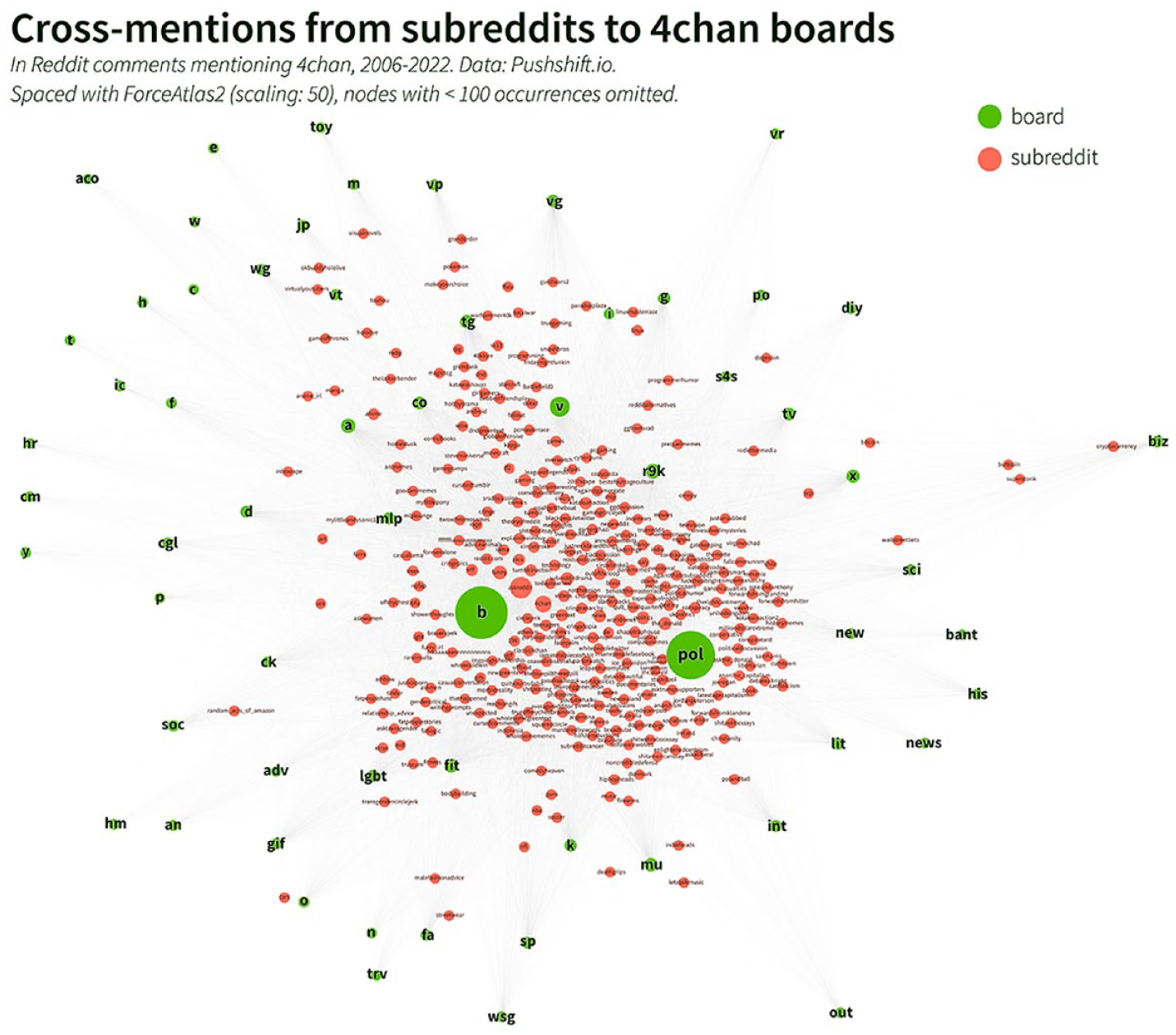
Bi-partite network graph with subreddits and 4chan boards as nodes and mentions from the former to the latter as edges. Spaced with ForceAtlas2 (scaling: 50; Jacomy et al., 2014) and then filtered out nodes with less than 100 occurrences (i.e., in- or outgoing edges). See https://oilab.eu/4chan-v-reddit for a full-size version.

Cross-mentions from Reddit to specific 4chan boards, per month. Streams normalized as a percentage of the total. See https://oilab.eu/4chan-v-reddit for a full-size version.
These trends are insightful but say little about how Reddit and 4chan were referred to. The co-words in Figure 8 provide empirical validation for both the reflexive and ritually antagonistic manner of the cross-site relation. The former is visible in the adjacency between the words “4chan” and “Reddit” throughout all three archives, meaning that talk about one website is often accompanied by a mention of the other. Such reflexivity is emblematized by discussions on meta-subreddits like r/TheoryOfReddit, which often involve quite in-depth techno-cultural reflections on the merits of content moderation, voting systems, user accounts, and other elements that influence the platform imaginaries of both sites. 19 The ritually antagonistic character emerges from other co-words. All archives consistently feature the word “back,” growing from variations of the phrase “go back to Reddit/4chan.” Considering its prominence on /pol/ in particular, the phrase may be listed alongside 4chan’s better-known adversarial formulas intended to fend off or socialize certain groups, for instance, by telling newcomers to “lurk moar” (Ewerhart, 2023; Fathallah, 2021; Hagen & Venturini, 2023; Phillips, 2015). Interestingly, this ritual opposition toward Reddit-like conduct is already present in the early /b/-sample. Around 2008, /b/-anons used the vernacular phrase “gb2 Reddit” to establish symbolic boundaries between the two sites, while decrying how “reddit and 4chan don’t mix” and lamenting how /b/ “is over” because it supposedly witnessed an influx of Redditors. 20 This hostility was sometimes succinct, other times elaborate, expressing platform imaginaries on 4chan as a chaotic and amoral void incongruent with the morally concerned “activists” of Reddit (see Appendix B). The early Reddit enmity thus loudly echoes entry number 10 of the “Rules of the Internet,” a list of quasi-ironic rules that structured much of 4chan’s early days: “If you enjoy any rival sites—DON’T.”
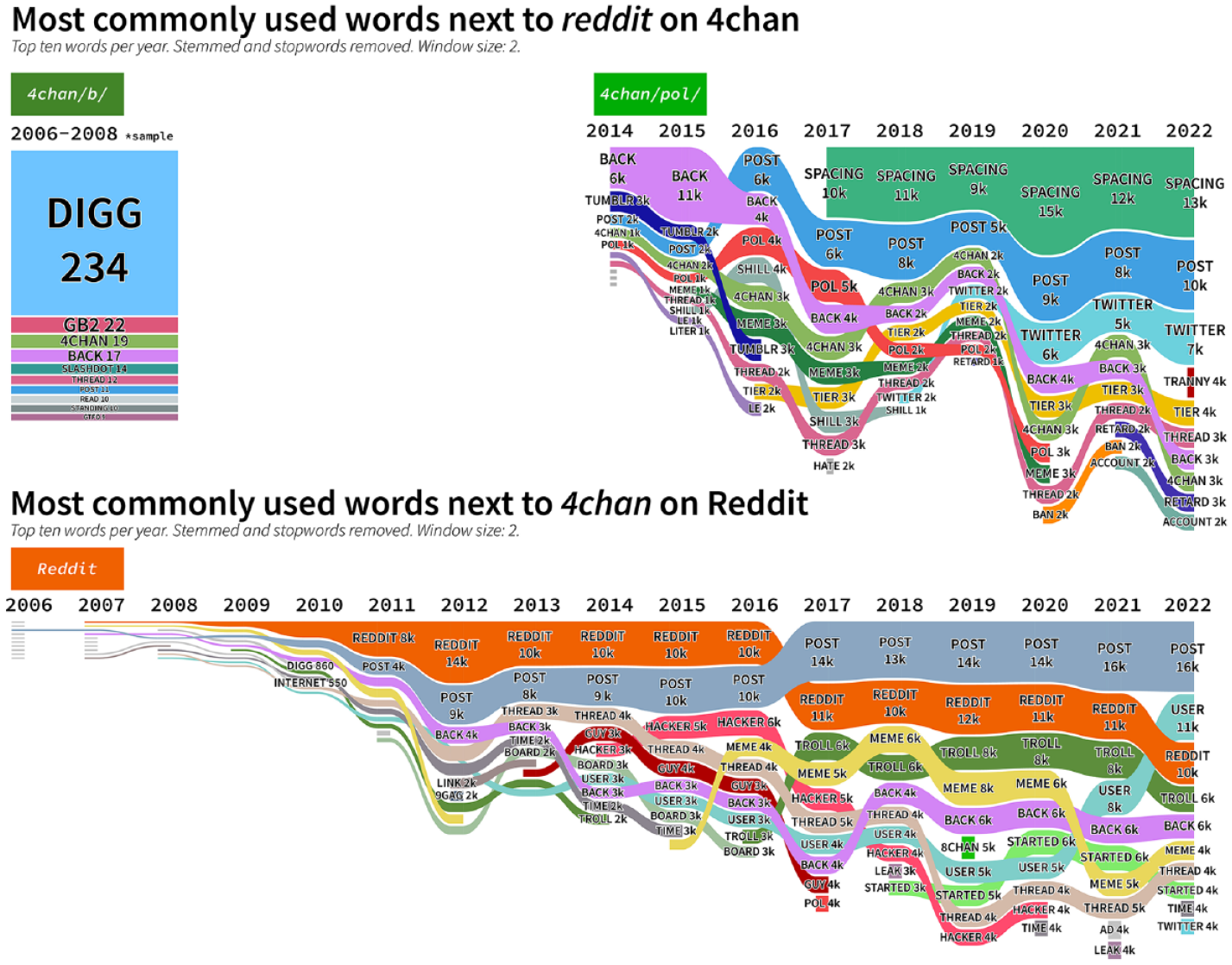
Top 10 co-words per year appearing next to “reddit” on 4chan/b/ and 4chan/pol/ (top) and next to “4chan” on Reddit (bottom). Stop words removed. Text stemmed and re-converted to a legible format. Window size: 2. See https://oilab.eu/4chan-v-reddit for a full-size version.
While both Redditors and 4channers used the “go back to x” phrase, /pol/ displays a notably higher density of co-words that express disdain and inferiority. tier refers to the phrase “Reddit-tier.” Being used to assign things on the lowly “level” of Reddit, it enacts a platform imaginary of Reddit as inferior and cringe-worthy; complaints about “Reddit-tier memes,” for example, evoke the inferiority of Reddit’s memetic practices, aligning with the platform imaginary of the site as a “meme filter” merely regurgitating 4chan’s content (De Zeeuw, 2019, p. 103). Likewise, “Reddit-tier arguments” are ritually dismissed as unworthy of any serious engagement (Figure 9). This is a clear example of 4channers’ common use of ritual opposition to make clear that “ideas will be scrutinized by others” (Tannen, 1995, p. 43)—or dismissed outright—as well as to establish a “hierarchical social order” (Tannen, 2007, pp. 24–25). The prevalence of “Reddit-tier” is moreover in line with depictions on 4chan as shaped by a “sense of superiority” (Colley & Moore, 2020, p. 25) and elitism (Auerbach, 2011).

Dismissals of arguments or memes being “Reddit-tier.” Screenshot taken from 4CAT Explorer.
While there is at least some substance to the platform imaginary of Reddit as an echo chamber (Massanari, 2015, p. 21), other forms of boundary policing by /pol/ anons are much more pedantic. The co-word spacing refers to “incorrect” post formatting that “reveals” someone is also active on Reddit. Reddit allows Markdown for commenting, which requires two newlines to generate a single line break. Since this is not the case on 4chan, a blank line in a 4chan post “gives away” someone is accustomed to Reddit’s text editor. This is then often taken as ample reason for ritual disavowals, like through the oft-repeated command in Figure 10: “Reddit spacing, you have to go back.” Here we see how 4chan’s Reddit opposition may at times have little to do with substantial outgroup resentment. Instead, “Reddit spacing” echoes the minimal group paradigm since the most minimal of differences—a white line—is taken as a reason to police the board’s narrow boundaries and display “positive distinctiveness” with the ingroup (Tajfel & Turner, 1986, p. 23). “Reddit spacing” also points to the peculiar techno-cultural knottiness of these online intergroup dynamics, as its understanding requires a substantive familiarity with Reddit, in turn suggesting that 4channers who accuse others of “Reddit spacing” may very well be Redditors themselves.
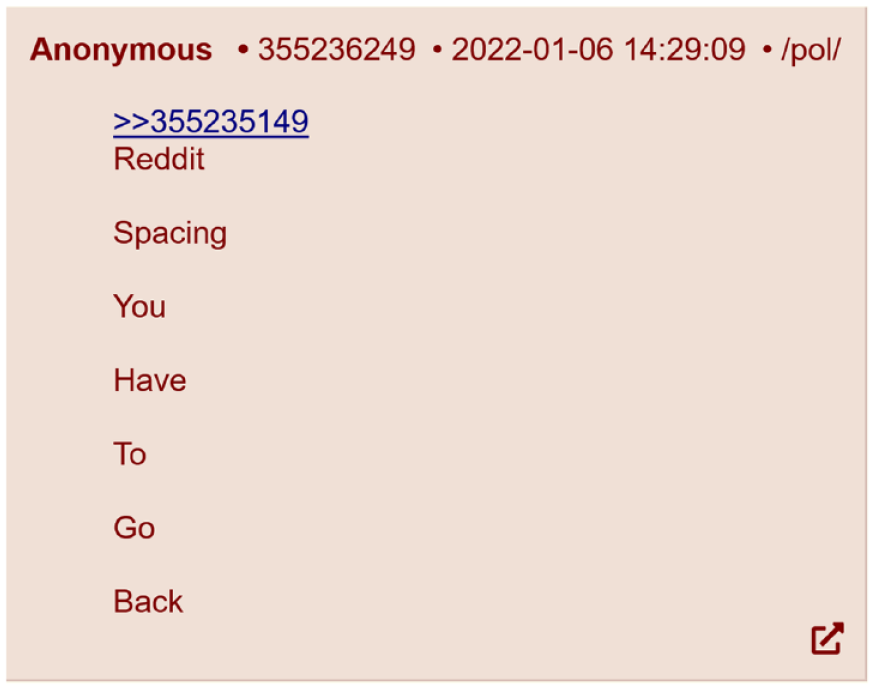
Ritual opposition through dismissing “Reddit spacing” on 4chan/pol/. Screenshot taken from 4CAT Explorer.
Where ritual opposition through phrases like “Reddit tier,” “go back to Reddit,” or “Reddit spacing” are ideologically thin, other expressions point to more serious political and gender-based derision. A 2022 entry in /pol/’s co-words is “tranny,” a pejorative term for a transgender person. By 2023, subreddits like r/gay_irl, r/actuallesbians, or r/traaaaaaannnnnnnnnns have indicated a growing gender diversification on Reddit, fitting with its expanding userbase. Yet both 4channers and Redditors alike have long been stereotyped through geek masculine tropes, for example as fedora-wearing “nice guys” in desperate, cringe-worthy pursuit for female affection, a stereotype often deployed self-deprecatingly and entwined with other “manosphere” discourse on “incels” and “betas” (Brooke, 2022; see also Figure 9). The absence of these geek masculinity-related terms in the top co-words suggests how such shared associations had not been at the forefront of the 4chan–Reddit rivalry (even if “tumblr” and “twitter” in /pol/’s co-words indicate an association between Reddit and platforms often stereotyped as feminine and “censorious”; Hagen, 2023). Yet “Reddit tranny” indicates how transphobic derision did fuel /pol/-anons’ Reddit resentment, raising questions on mutating forms of gender-based antagonism between the sites.
September 2014: “A Place Where Equality Reigns”
The rigid boundary policing on 4chan contradicts with platform imaginaries of 4chan as neutral and unfiltered, an idea at the forefront in the September 2014 sample. During this month, two of the subreddits most-occupied with 4chan were r/KotakuInAction (r/KIA) and r/TumblrInAction (r/TIA). r/KIA was self-described as “a place to discuss the drama and other crazy bullshit” in the games journalism industry, but more concretely thrived on antifeminist resentment, described by one journalist as a “smaller and more niche precursor to r/The_Donald” (Wendling, 2018, p. 66). r/TIA originated as a space to make fun of myopic social justice posts on Tumblr but eventually became similarly entwined with reactionary antifeminism (Frank & Hampton, 2021). 21 Sharing some moderators, the subreddits would form important cultural breeding grounds for the emergent alt-right movement (Massanari, 2017, p. 335; Massanari & Chess, 2018; Wendling, 2018).
The majority of the top-scoring cross-mentions on both r/TIA and r/KIA concerned a crackdown on 4chan regarding Celeb- and Gamergate content. As a result, especially on r/KIA, posters lamented that the imageboard had formed one of the last safe havens for “free speech” but now met its end. 4chan’s “domestication,” in the words of one Redditor, was likened to “when the Wild West finally died.” Another took 4chan’s Gamergate-ban as a sign to conclude that “the major forums of the old internet are dead,” while yet another poster claimed that 4chan had “become the antithesis of itself” for having been “infiltrated by SJWs.”
22
One r/KIA-contributor imagined the 4chan of yore as follows:
You go to discussion threads and everyone has a voice. Everyone. It doesn’t matter if you are white, black, male, female, straight or gay. You say your mind and they judge you purely on the content of what you say. Then they proceed to call you f***got even if they agree with you. Hell, it is the only place on the internet that such a thing is possible. Isn’t it funny? The SJW’s ideal of a place where equality reigns is 4chan itself.
In line with this, one contributor argued that 4chan “exemplified what free speech meant, no matter what you wanted to say 4chan would accept you.” While several r/TIA and r/KIA posters pointed to the more problematic aspects of such unbridled speech, the imageboard was by and large imagined as having delivered on the liberatory promises of the Web, letting “everyone” be anyone and speak freely—imaginaries drenched in well-known discourse on radical freedom and disembodied diversity in cyberspace (Gillespie, 2018). Not only that, because of its anonymity and lax moderation, 4chan was also depicted as highly diverse, described by one user as “one of the most gay-friendly sites on the Internet” and argued to be “more ‘inclusive’ than Tumblr.” One Redditor likewise pointed out a “large SANE female presence” on 4chan while another lengthily outlined how 4chan’s freedom to “be a [. . .] transgender [. . .] and you will find acceptance” contrasted with restrictive “echo chambers” elsewhere on the Web. In other words, in the September 2014 snapshot, 4chan was romantically imagined as neutral, unfiltered, and diverse, a platform imaginary that was disrupted by its administrators’ removal of problematic Gamergate content.
Discussion
Having distantly read several cross-site linkages and discussed imaginaries regarding 4chan as a neutral platform in 2014, we may now return to the initial research questions. How has the cross-site relationship between 4chan and Reddit developed over time and between its subgroups? And what do their fractured, fluctuating cross-site associations teach us about their collectivization? While the complexity and fluctuation of both sites mean I can only scratch the surface of this multi-layered relationship, some clear patterns can nonetheless be discerned.
First, the persistence of Reddit disavowals on 4chan means that differentiation with Reddit can be seen as a central, yet hitherto understudied method for anons to establish a sense of collectivity. A converse dynamic is less visible: some oppositional phrases toward 4chan appeared throughout Reddit (e.g., “back to 4chan”), and specific subreddits likely mock 4chan-boards as ideal types of toxic technocultures (e.g., with r/justneckbeardthings mocking /r9k/), but on Reddit broadly, 4chan’s relevance is waning—likely resulting from Reddit’s growth and diversification as well as changing platform imaginaries of 4chan as a far-right hotspot. While I mostly focused on /pol/, the /b/-sample showed how Reddit-averse boundary policing reached across boards and 4chan’s history. The stability of “Reddit” as a discursive outgroup thereby somewhat counters depictions of 4chan as chaotic, contingent, and resilient to “serious” antagonism. Auerbach (2011) for instance argued that within 4chan’s anonymous online culture, “a barrage [of offence] inoculates against sincere, extreme hatred by making it harder for genuinely virulent views to stand out” (n.p.). Similarly, De Zeeuw and Tuters (2020) theorized the self-deprecating ethos of anonymous spaces like 4chan as “antithetical to both the formation of a ‘stable’ system of political values and beliefs” (p. 223). In contrast, opposition toward Reddit shows how 4chan has been subject to quite stable intergroup antagonisms.
At the same time, 4channers’ Reddit adversity may not always be “genuinely virulent.” Instead, it is partially performative through ritual opposition that has “nothing literally to do with fighting” (Tannen, 1995, pp. 41–42). Even on the politically driven /pol/, petty apolitical disavowals like “Reddit spacing” point to the performative, feigned antagonism of ritual opposition, using Reddit as a shorthand to establish community norms. “Reddit-tier” similarly points to how “Reddit” has become associated with discursive markers of distinction, like through criticizing “Reddit-tier memes” as holding little subcultural capital (Nissenbaum & Shifman, 2017) or “Reddit-tier arguments” as emerging from the mindless “echo chamber” of Reddit, where like-minded users upvote socially acceptable content while downvoting posts that contrast dominant narratives, or, even worse, removing them (as alluded to by the co-word ban; Figure 8; see also Gallagher & Topinka, 2023). Yet some opposition toward Reddit on 4chan is explicitly ideologically driven, as in the case of /pol/’s white supremacist differentiation with r/The_Donald. Moreover, /pol/’s transphobic hostility shows a more serious reactionary-political bent in its participants’ opposition toward their idea of Reddit.
The gender-based othering from /pol/ to Reddit complicates equations between the two sites as featuring overlapping “geek masculine” cultures. While parts of Reddit remain marked by masculine-coded interactions, the 2022 co-words show how /pol/-anons increasingly associated Redditors with transgender people—likely partially caused by an infamous Fox News interview with the transgender moderator of r/antiwork (Needleman, 2022). The derogatory rhetoric of this association is perhaps no surprise considering 4chan’s offensiveness as well as /pol/’s fascist contingent. /pol/ users have eagerly promoted gender traditionalism by coating it with new Internet slang: virile “chads” and “alphas” stand above failing “virgins” and “betas,” while submissive “tradwifes” 23 contrast with feminists and “SJWs,” the latter which can be seen as a reformulation of the old fascist stereotype of the “too ‘modern’ woman, Americanized, independent and masculinized” (Bellassai, 2007, p. 329; see also Beran, 2019; Massanari & Chess, 2018). Such cross-site transphobia reflexively positions /pol/ as much more reactionary and orthodox compared with the “plurality of masculinities” featured on other 4chan boards (Maloney et al., 2022; Phillips, 2015, p. 75) and in “geek masculinity” and “nerd culture” more generally (Kendall, 2011; Salter, 2018). Instead, differentiation with transgender identities reflexively stimulates imaginaries of 4chan and /pol/ as rigidly adherent to conservative gender categories. /pol/’s transphobia in this sense can be read as a fascist response to the same “male ontological insecurity” that runs throughout 4chan (Maloney et al., 2022) and that has historically contributed to its users’ misogyny and self-loathing (Beran, 2019). Ironically, however, /pol/’s transphobic discourse, which uses Reddit as a reference point to affirm its own gender traditionalism, emphasizes exactly what its users ideologically mean to disavow: that gender identities are performative and discursively constructed (Fathallah, 2021; Pascoe, 2011, p. 5).
This gender-based differentiation is even more ironic considering the way in which 4chan has been associated with imaginaries of identity-lessness, neutrality, and diversity. Indeed, /pol/-anons’ transphobic derision directly counters the once-progressive idea that online, you can be both “anyone” and your “real self,” an idea that has in fact structured much of 4chan’s history (De Zeeuw & Tuters, 2020). In the September 2014 sample, we saw how the imageboard’s anonymity, barebones design, and culture of offense were seen as creating a level playing field to all who wished to participate. That these favorable platform imaginaries appeared on r/KIA and r/TIA makes sense considering the right-leaning character of these subreddits, as well as the fact that Redditors have long criticized their own site as an “echo chamber” while romanticizing “authenticity, candor, and transparency.” (Massanari, 2015, p. 52). Importantly, here we see how non-human actors and affordances shaped platform imaginaries across Reddit and 4chan, with 4chan’s horizontal and anonymous setup imagined as fostering a diversity and rationalism antithetical to the self-affirmation encouraged by Reddit’s voting system, karma scores, and content moderation. Through this vernacular dialectic, we also see an affirmation of Massanari’s (2017) hypothesis that toxic technocultures on Reddit were stimulated by the diffusion of imageboard imaginaries, wherein content moderation is considered an “unnatural” intervention (see also Allen, 2014).
Such fantasies of neutral imageboards fit in with broader imaginaries of the Internet of a free speech haven but, in Tannen’s (1995) words, fail to recognize the asymmetry in “who gets heard.” Building on Turkle’s (1995) foundational work on online communities, in the 1990s, Cushing (1996) criticized imaginaries of the Internet as equal and “non-mediated” since they were oblivious to the gendered conversational rituals at work. She specifically observed how a “focus on jockeying for position, a [traditionally] male ritual” over more feminine “mutual striving towards equality” discouraged female participation, even if the latter aligned better with the Net’s promises of community (p. 64). Research on such discursive predispositions has shown how traditional offline power dynamics could structure the anonymous and supposedly neutral realm of cyberspace (Turkle, 1995). While this contradiction is thus long known, it interestingly remained prevalent in imaginaries of 4chan even by 2014—and even when /pol/-anons policed group boundaries so narrow that it left no room for “incorrect” use of whitespace. For a site steeped in collectivizing language games (Peeters et al., 2021), vernacular theories on 4chan thus seemed ill-aware of the constitutive power of speech acts and how difference may exist after anonymity trough “exclusions embedded in the banal” (Milner, 2013, p.64). 24
The boundaries between 4chan and Reddit are not exclusively discursive, though. They also feature a material side, shaped by the infrastructures and affordances of the platforms involved. I have already discussed the techno-cultural case of “Reddit spacing,” but the medium is also visible in how on-site gatekeeping is more intense on 4chan than on Reddit. It is well-known how in online spaces that are “ostensibly free of formal gatekeepers, participants tend to police themselves, toeing the line with conformist norms,” and in the process negotiate a shared identity (Gal et al., 2016, p. 1698). On 4chan, without formal barriers of entry like Reddit’s user accounts or a sufficient karma score, discursive hostility forms one of the remaining devices with which to establish community norms. In this way, 4channers’ ritual opposition forms a kind of grassroots content moderation, incentivized by an absence of top-down intervention and technical tools for social policing (Trammell, 2014), which somewhat helps to understand the omnipresence of petty boundary work. The way in which imageboards encourage such socialization means it transcends political and historical contexts, in this study clearly visible by Reddit-differentiation already being present on /b/ around 2007. Collective identities on imageboards may thus be performative, transient, and divergent, but they also feature quite static, material, and universal elements through the structuring role of its infrastructure and affordances. Or in McLuhanesque terms, discursive ritual opposition extends the medium of the imageboard.
Conclusion
Instead of grouping 4chan and Reddit together as comparable zones for the “alt-right” or “hate speech,” this article interrogated the abrasive, changing relations between groups on both sites. I theorized how ritual opposition and platform imaginaries are employed to police the boundaries of comparable online subcultures. I then mapped cross-mentions between 4chan and Reddit using large historical archives. Among other findings, this showed how the cross-platform relationship has been rife with hostility, albeit in a lopsided fashion: /pol/-anons more consistently antagonized Reddit-like posts than vice versa. On 4chan, “Reddit” has come to stand in as a mark of inferiority, its “echo chamber” used to reflexively articulate (obviously flawed) platform imaginaries of 4chan as more rational, more critical, more authentic, and more diverse. Across both 4chan and Reddit, platform imaginaries of 4chan as open and egalitarian contradicted with the exclusionary power of such discursive gatekeeping. I thereby demonstrated how the collectivization of online subcultures is shaped by reflexive cross-site relations, featuring a complex interplay between discursive boundary work, contrasting platform vernaculars, and political resentment.
Naturally, I could not cover all the variegated types of interactions between these multi-layered spaces. Yet it is perhaps exactly this complexity that makes cross-site hostilities so prevalent: references to “4chan” and “Reddit” form convenient and reconfigurable units onto which specific, biased imaginaries can be latched. With Reddit’s commercialization, studying future developments in the 4chan–Reddit rivalry may provide fruitful insights into how change on one platform reverberates on another. Instead of as a site for nerds or a “dystopian Craigslist” (Pardes, 2018), Reddit’s CPO Pali Bat now promotes Reddit as a “product” that “should actually be for everyone” (Patel, 2023) while Huffman has envisioned the “next frontier of Reddit” as the option for subreddits “to be businesses if they choose” (Ingram, 2023). We may hypothesize how, on one hand, this commodification will evoke even more antagonism among the conservative guardians of anonymous imageboard culture. The gender diversification that Reddit’s growth also (positively) seemed to have brought along may moreover exacerbate “reactionary narratives of decline” on far-right spaces like /pol/, whose groups “mistakenly blame the loss of the Internet as a way of being on the growth in the size and diversity of the online population” (Driscoll, 2020, p. 31). On the other hand, having observed how similarity fuels differentiation, a growing disparity between the two sites may also mean a fizzled-out rivalry. Beyond 4chan and Reddit, a fruitful avenue for future research could be how imaginaries of “4chan” as a worst-case-scenario for platform governance—as Pao had articulated in 2014—affect governance elsewhere. The shakeups at Twitter (now X) have, for example, ignited narratives on how “Musk is turning Twitter into 4Chan” (Dartagnan, 2022). In this sense, we can envision a more vertical approach where the reflexivity of cross-platform imaginaries is not only used to study how online groups make sense of themselves but also how such media-ecological comparisons bleed into the ideologies that affect top-down decisions.
Footnotes
Appendix A
Appendix B
Declaration of Conflicting Interests
The author(s) declared no potential conflicts of interest with respect to the research, authorship, and/or publication of this article.
Funding
The author(s) disclosed receipt of the following financial support for the research, authorship, and/or publication of this article: The author has received a PhD in the Humanities grant from the Dutch Research Council (NWO) under grant number PGW.19.030.
