



Abstract
This text concerns conflict between users of 4chan and Tumblr, two groups said to have formed a vanguard to the ‘online culture wars’ of the last decade. Specifically, I focus on a 2014 clash known as the ‘Tumblr-4chan raids’. Predating the more infamous Gamergate controversy, I see this event as a useful alternative microcosm to study polarisation among online subcultures in the mid-2010s. Drawing from subculture studies, I first theorise cross-site clashes as puncturing a sense of ‘subcultural territoriality’ whereby an online platform is appropriated as a secluded refuge. Through a quali-quantitative archival study, I find that the raids were initiated and exacerbated by trolling 4channers rather than a clash between equal sides. I ultimately argue that the feud partially arose out of 4channers’ reactionary ‘media ideologies’ on the Internet, wherein sensitivity, empathy, and care were seen as incongruous with ideas on the online as brutal and unforgiving. Next to better-known political clashes between feminists and anti-feminists, the paper thus highlights the polarising role of media ideologies at the onset of the ‘online culture wars’ in the mid-2010s.
Introduction
In June 2014, a post on the Tumblr blog shutdown4chan proclaimed: ‘Join us on July 4th to celebrate our freedom and independence from racists by shutting down 4chan’ (Figure 1). That Independence Day, several Tumblr users answered the call. Armed with feminist arguments and socially concerned goodwill, the aim was to ‘detoxify’ 4chan, the infamous imageboard known for its trolling subcultures, shock value, and Internet memes (Phillips, 2015). According to a wildly popular YouTube video by Internet Historian (2017),
1
the efforts by the ‘Tumblrinas’ were futile, merely invoking 4chan’s retaliation consisting of a barrage of gore and hardcore porn. The ‘Independence Day Raids’ or ‘2014 Tumblr-4chan Raids’, as the event came to be known, features a dramatic twist: not a Tumblr user, but someone from 4chan’s far-right /pol/ subforum was said to be behind the shutdown4chan blog that kickstarted it all. The first post by shutdowntumblr that started the controversy. Screenshot taken from Tumblr.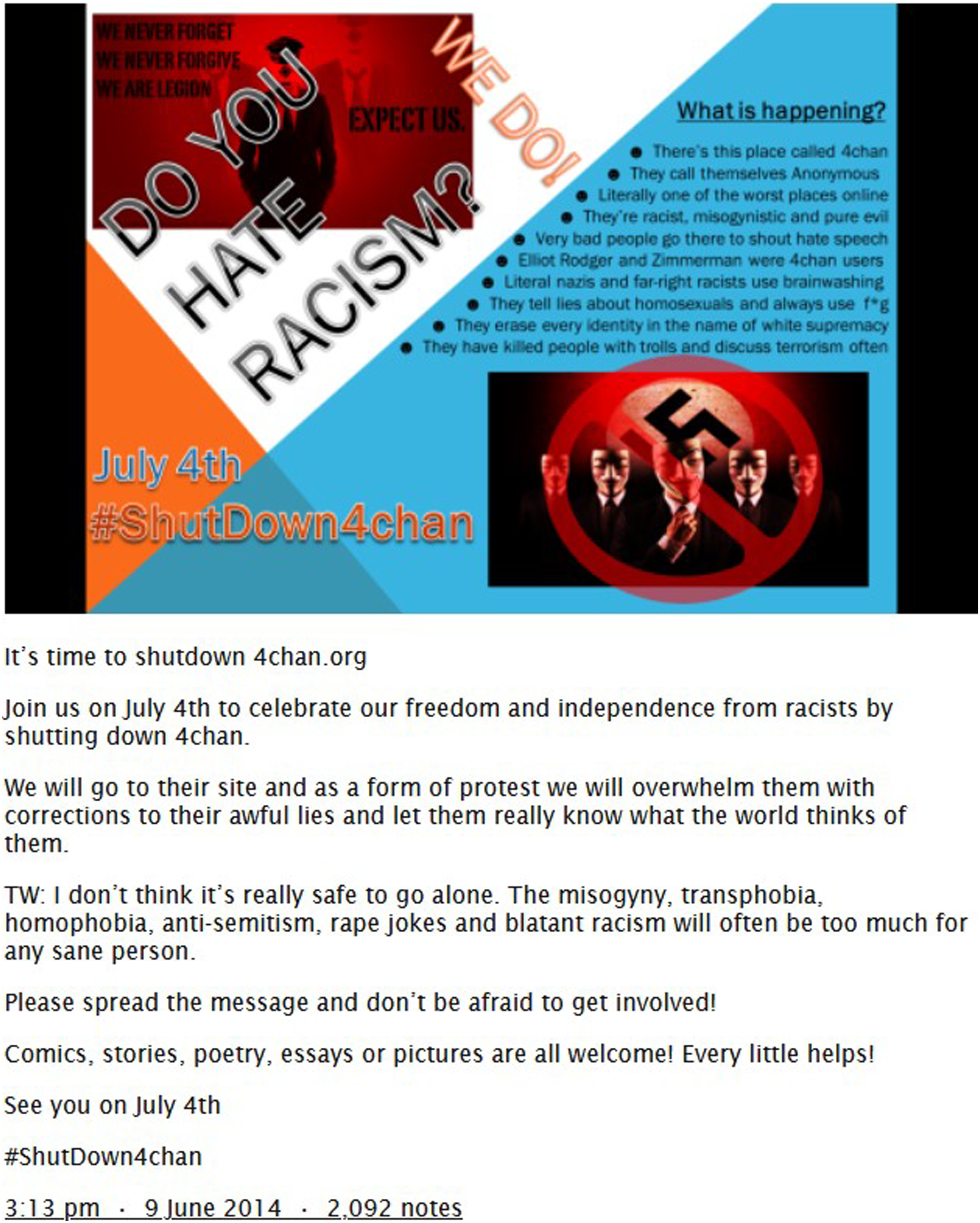
The Tumblr-4chan raids might seem like a niche feud between ‘Extremely Online’ subcultures. For a large part, they were. But looking at it differently, the conflict can be seen as a synecdoche to larger cultural and political intensification online happening from the mid-2010s onwards – labelled by some as a ‘toxic turn’ (Proctor and Kies, 2018: 127) or an ‘extremist turn of the Trump-era Internet’ (Phillips, 2019: 1). 2 This alleged ‘turn’ is said to have roots in the activity of online subcultures and fandoms, a tipping point when ‘extremely online’ youth cultures turned political. While involving a diverse array of platforms (like Reddit, YouTube, and Twitter), Tumblr and 4chan drew specific scholarly and journalistic attention as ‘ideologically opposite analogues’ (Romano, 2020: 63) forming a vanguard to a developing ‘online culture war’ (Bernstein, 2015; Beran, 2019; Donovan et al., 2022; Nagle, 2017). This was most infamously argued in Angela Nagle’s Kill All Normies, which posited these niche online clashes formed ‘the political sensibilities of a generation’ while arguing they ‘shaped culture and ideas in a profound way from tiny obscure subcultural beginnings to mainstream public and political life’ (2017: 9). Specifically, Nagle argued to much critique (e.g. Gleeson, 2017) that 4chan and Tumblr’s subcultures offered ‘equally radical’ solutions to disenfranchised adolescents and that Tumblr’s ‘intellectually shut-down’ discourse had pushed young males rightwards (2017: 68, 117–8).
Anchoring this moment was the Gamergate controversy, a much covered and contested event seen as a catalyst to the online culture wars. Incited by a raging blog post against a feminist video game developer in August 2014, some of Gamergate’s proponents claimed the campaign was an uprising against dwindling ethics in video games journalism, while others saw it as a resistance against oversensitive liberals or ‘social justice warriors’ (‘SJWs’). But the event mostly became infamous for its ‘unprecedented level of harassment, even for the Internet’ (Beran, 2019: 141), as numerous feminist developers, journalists, and critics became targeted with rape and death threats (Stuart, 2014). Gamergate’s momentum slowly petered out in 2015, but the resentment endured, capitalised upon by far-right radicals and pundits looking for a shtick. Notably, various authors have chronicled how the movement morphed and found mainstream appeal with Donald Trump’s presidential bid and the rise of the ‘alt-right’, at the time understood as a loose conglomerate of neo-Nazis, gamers, libertarians, neoconservatives, and conspiracy theorists (Beran, 2019; Bezio, 2018; Hawley, 2017; Phillips and Milner, 2021; Wendling 2018).
While Gamergate has received ample scholarly attention (e.g. Chess and Shaw, 2015; Burgess and Matamoros-Fernández, 2016; Massanari 2017; Mortensen, 2018), to the best of my knowledge, the 2014 Tumblr-4chan raids are only mentioned in one academic text (Tiidenberg et al., 2022: 220). However, I argue the event forms a useful alternative microcosm to untangle why and how in 2014, Western subcultural groups came into intensified conflict and influenced the parameters of broader political debate. Indeed, the opening paragraph already highlights many elements that would catalyse in later years, including the covert presence of far-right actors within seemingly tongue-in-cheek conflict and growing hostility towards feminism or ‘political correctness’. While I do not see the 2014 raids as a clear-cut instigator of an ‘extremist turn’ – extremism is not new to 4chan and the Web (Eatwell, 1996; Phillips, 2019), nor is Internet-pessimism a recent phenomenon (Stoll, 1996) – the event does offer a novel opportunity to clear up some of the still-foggy background to subcultural online conflicts from the mid-2010s onward.
As such, this paper’s main concern is what the 2014 Tumblr-4chan raids may retrospectively teach us about conflict between online subcultures in the build-up to Gamergate. It first sets out to more broadly interrogate the relationship between groups on 4chan and Tumblr, a peculiar rivalry that has received some attention in popular-academic books (Beran, 2019; Donovan et al., 2022; Nagle, 2017) but scant attention in more empirical and quantitative studies. To do so, I briefly outline 4chan and Tumblr’s features and cultures, theorising how we can speak of a ‘lateral subcultural relation’ between groups on both sites. To understand why cross-site conflicts like the 2014 raids are so explosive, I argue that these groups manifest a sense of seclusion and ‘subcultural territoriality’ as afforded by the site’s designs, ideas that may be punctured by the infiltration of outgroups. Moreover, I theorise how cross-site contestation may also have to do with friction regarding ‘media ideologies’ that encapsulate guiding dogmas on the ‘right’ use of digital platforms and the Internet as a whole (Brown, 1965; Gershon, 2010). I then outline the methodology and data archives used for the case study on the 2014 raids. Among other findings, I argue that the Tumblr-4chan raids were mostly a trolling campaign on 4chan’s behalf and that the enmity was not only catalysed by political-ideological contestation but also by media-ideological friction – in this case emerging from dogmatic ideas of ‘the Internet’ as a ruthless Wild West incongruent with an ethos of sensitivity, empathy, and care.
4chan and Tumblr’s lateral subcultural relation
To contextualise the subcultural rivalry between 4chan and Tumblr, this section first outlines their technical features and cultures. 4chan and Tumblr are complicated to generalise and compare: both have known fluctuating subgroups, moderation policies, and technical features. 4chan is an imageboard divided into topic-oriented subforums or ‘boards’, each containing a static number of conversational threads. The website is known for its ephemerality, as posts are deleted after a certain amount of activity, and barebones infrastructure, its interface lacking the commodified features common to larger platforms. Tumblr functions akin to Twitter. It houses a frontpage (‘Dash’) with a reverse-chronological list of new posts and reposts (‘reblogs’) from followed accounts. In contrast to 4chan, Tumblr users have profiles complete with a customisable homepage (a ‘Tumblog’). Posts can be tagged and liked, which factor into algorithmic content visibility. These technical differences exist next to important overlaps: both sites allow for (pseudo-)anonymous posting and have historically lacked far-reaching monetisation efforts and strict moderation policies regarding problematic content (at least up to Tumblr’s infamous porn ban in 2018; McCracken et al., 2020).
How these technical overlaps foster comparable cultures has been extensively outlined by others (Beran, 2019; Nagle, 2017), but here I specifically argue they encourage similar subcultural sensibilities. Groups on 4chan and Tumblr alike have historically shared a negative relation to dominant cultural hegemony and a perceived ‘mainstream’. 4chan’s anonymous users or ‘anons’ often lament their incompatibility with the behavioural norms of ordinary offline life, a world seen as filled with ignorant ‘normies’, social awkwardness, and cultural degeneracy (Beran, 2019; De Zeeuw and Tuters, 2020; Phillips, 2015). In a similar vein, Tumblr’s ‘teen sociality’ (Galvin, 2020) has historically known a negative relation to dominant cultural paradigms, instead embracing queerness, esoteric porn, or anything ill-fitting with the masculine heteronormativity ubiquitous in the offline world and elsewhere on the Web (Calhoun, 2020; Tiidenberg et al., 2022). Users of 4chan and Tumblr alike have embraced a state of being ‘alone together’ (Turkle, 2012), bringing along a ‘fetishization of negativity and self-loathing’ that exacerbated ‘nihilism, helplessness, and genuine depression’ (Tiidenberg et al., 2022: 71; see also Beran 2019).
Despite the gloominess, 4chan and Tumblr also function as ‘underground carnivals’, its users cherishing irony, play, and profane humour (De Zeeuw and Tuters, 2020; The-Cimmerians, 2020). Entwined with this is a high density of Internet memes, with both websites having formed the breeding grounds for much of the Web’s viral content (Phillips, 2015; Tiidenberg et al., 2022). This cultural creativity has often resulted in well-known subcultural cycles of commodification and resistance (Hebdige, 1979). For instance, 4channers have historically been hostile to commercial parties ‘stealing’ their memes (Phillips, 2015), while Tumblr users collectively lamented their creations ending up in Buzzfeed listicles (Romano, 2020). Despite their reputation as wellsprings of viral content, both Tumblr and 4chan have effectively been unmarketable and unprofitable, in large part because their transgressive cultures scared off advertisers – often to much glee of its users (De Zeeuw and Tuters, 2020; Tiidenberg et al., 2022). Through these deviant and counterhegemonic aspects, we do not have to look far for the ‘sub’ in the websites’ cultures, and hence we may speak of a ‘lateral subcultural relation’ when discussing the interaction between groups on both websites.
The lateral subcultural relation between groups on Tumblr and 4chan arguably grew so explosive because their congruences are opposed by fundamental incongruences. Most notable in this regard is a friction between dominant cultures of femininity and masculinity. Tumblr has fostered a welcoming space for people identifying as female, queer, or non-cisgendered, which is said to have gone hand-in-hand with an ethos of mutual empathy and curation for all things beautiful or ‘aesthetic’ (Goding-Doty, 2020; Tiidenberg et al., 2022). This contrasted the heteronormative norms of male-dominated online spaces, meaning Tumblr could grow into an alternative outlet for the marginalised and disenfranchised, whether it be queer youth, black activists, nonbinary people, people with disabilities, fetishists, or sex workers (McCracken et al. 2020, 2; Kalhoun, 2020). That said, Tumblr’s passionate fandoms and moral sensitivity also included exclusionary boundary-work and hostile ‘call-out culture’ (McCracken et al., 2020). Yet this toxicity hardly compared to the brutal behavioural norms on 4chan, known for an ‘economy of offense’ (Auerbach, 2011) and shared outgroup antagonism – in the case of /pol/ mostly directed against women, people of colour, Jews, liberals, migrants, and others (Colley and Moore, 2022; Phillips 2015; Tuters and Hagen, 2020). While female-presenting users are present on the imageboard (Fathallah, 2021), 4chan’s discourse is rife with the traditionally masculine rhetoric of insult and competitive one-upmanship (Phillips, 2015). In other words, instead of empathy and sensitivity, 4chan’s subcultures are said to have manifested a bleak Hobbesian outlook of society as brutal and composed by winners and losers (Beran 2019; Hagen and Tuters, 2021).
The similarities between groups on 4chan and Tumblr would have merely remained interesting parralels were it not for the many cross-site clashes. The skirmish that first drew headlines concerned a feud in November 2010, when 4chan anons accused Tumblr users of ‘constantly steal[ing] our memes and claim[ing] them as their own’ (Chen, 2010). As payback, 4channers instigated ‘Operation Overlord’, a plan to spam and overload Tumblr servers with Distributed Denial-of-Service (DDoS) attacks. This in turn prompted a response by Tumblr users, ‘Operation Overkitten’, meant to DDoS 4chan and, on top of this, post ‘lots and lots of kittens’ – which successfully took the imageboard offline for a few minutes (Hudson, 2010). After one 4channer noted that Tumblr ‘is filled with desperate virgin girls’ and 4chan with ‘desperate virgin guys’, 4chumblr was born, a meme representing the websites as a bickering couple in a secret romantic relationship. As subculture scholars have long observed, 4chumblr represents how lateral subcultural antagonisms could be resolved through shared symbolism and counterhegemonic tendencies (Hebdige, 1979) – or as Figure 2 depicts, a mutual aversion towards the ‘normies’ of the mainstream. While a childish quarrel at first sight, Operation Overlord was later described in the same vein as Gamergate as ‘the direct precursor to the contemporary culture war that spawned our current political situation’ (Rosenberg, 2020; see also Tiidenberg et al. 2022). A post on 4chan/b/ kickstarting the 4chumblr meme, retrieved from 4plebs.org, and art of 4chumblr by Twitter user @ClinicCase (right).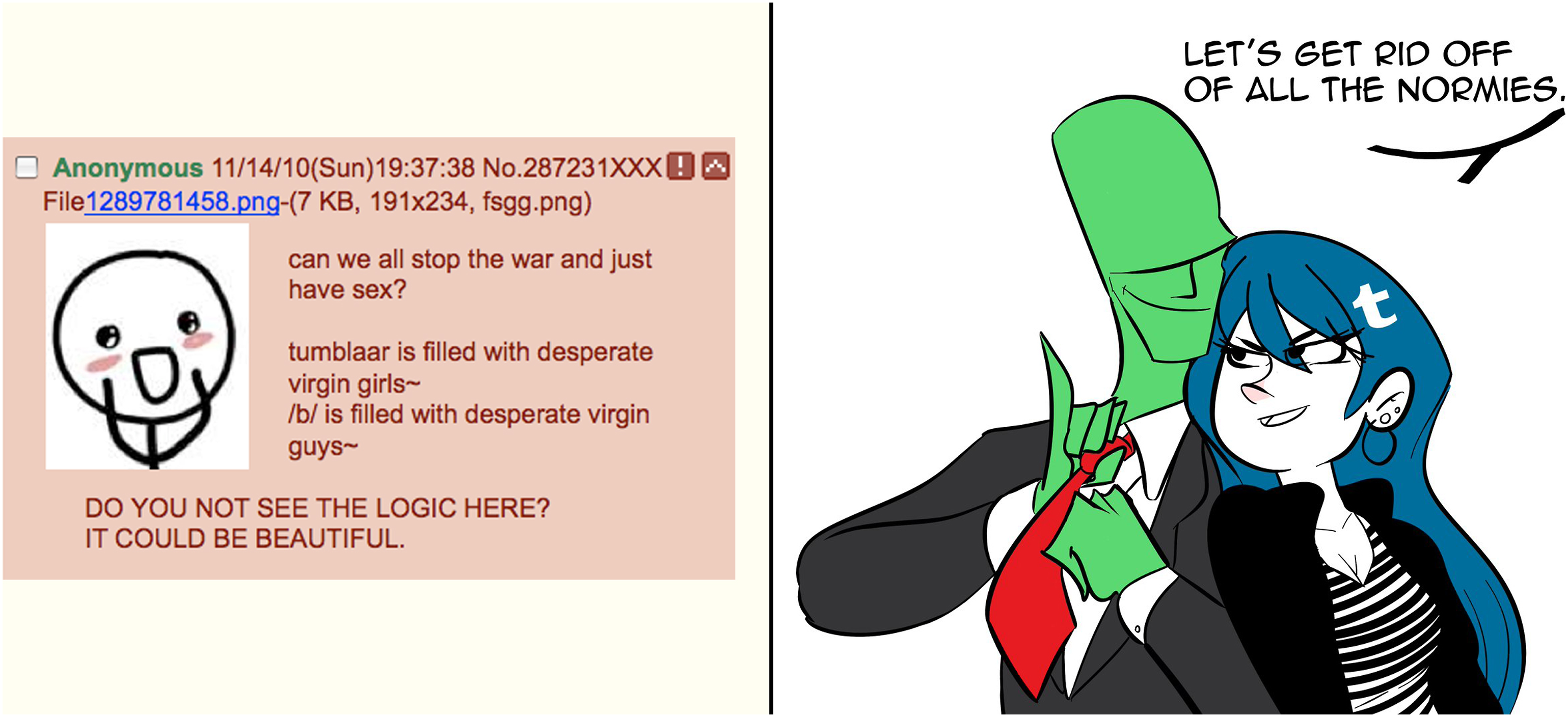
Puncturing subcultural territoriality
Why is it that, long before Gamergate, 4chan and Tumblr were already subject to passionate Internet feuds seen as prefiguring broad political conflict? It is already well-observed how 4chan and Tumblr’s ‘meta-aware’ audiences are prime candidates to be at the vanguard of political debates (Auerbach, 2011; Beran, 2019). But, as I start arguing here, such cross-site clashes may also be explosive (and alluring) because they (1) puncture the imagination of subcultural online spaces as inaccessible and secluded ‘territories’ and (2) challenge ‘media-ideological’ dogmas regarding their online locale specifically and the Internet more broadly. In this section and the next, I briefly outline these two interrelated claims respectively, before empirically interrogating how they manifested during the 2014 raids.
The field of subculture studies has long studied how material architecture co-shapes distinct but vulnerable territories for deviant behaviour. In 1925, Robert E. Park, seen as the forefather of subculture studies, highlighted the paradox between segregation and proximity with respect to urban communities. He saw the city as providing a ‘mosaic of little worlds’ for the ‘exceptional and “eccentric,”’ but also as facilitating a ‘dangerous experiment’ by allowing divergent groups ‘to pass quickly and easily from one moral milieu to another’ (40–41, emphasis original). This mobility may challenge a subcultural groups’ sense of ‘territoriality’, defined by Phil Cohen as the ‘symbolic process of magically appropriating, owning and controlling the material environment’, but where actual ownership resides elsewhere ([1972] 1997: 65). 3 The etymology here (terra) implies offline space, but we may interpret territoriality more abstractly as zones of freedom; in the words of Walter J. Ong, a ‘territory’ may refer to ‘the total space in my environs or in the universe in which I am free to move and act as I will’ (1981, 39) – which also implies the possibility of ‘moving out of one’s own space and invading another’s’ (38).
The idea of online spaces as autonomous territories has not only coloured the cyberlibertarian roots of the Internet, but also remains present in more recent imaginaries of online subcultures. As we already saw above, feuds between 4chan and Tumblr are drenched in territorial discourse, whether it be talk about ‘wars’, ‘raids’, or ‘invasions’. 4chan and Tumblr have even been depicted by its users as specific countries complete with fictionalised maps and peoples (Figure 3). Such geographical imaginaries illustrate how online platforms may not be seen as aseptic spaces or as part of an ‘anti-spatial’ technoculture (Robins, 1999), but as distinct, meaning-filled places (Malecki, 2017) intended for specific communities. While often done in jest, territorial metaphors may nonetheless cast an insightful light on how online subcultures imagine their own and other’s collective essence – or to quote Bourdieu, they reveal ‘a sense of place but also a sense of the other’s place’ (1984, 131; see also Milner, 2016).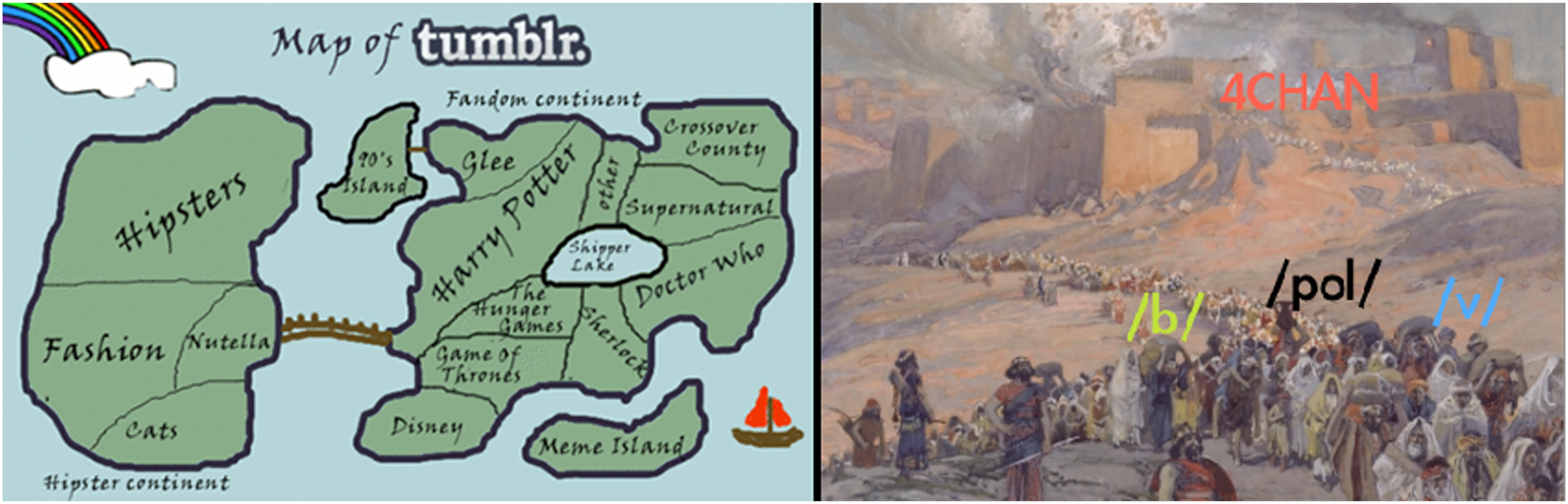
Such territoriality might seem counterintuitive for 4chan and Tumblr since both websites are, technically speaking, highly accessible, especially in contrast to the walled gardens of Facebook, Instagram, and TikTok. 4 But it is perhaps precisely this technical accessibility that intensifies subcultural territoriality, as groups on both websites have developed quite advanced methods for establishing and protecting ‘their’ online place as a secluded niche. On 4chan, this has, for instance, been carried out through ritually insulting newcomers and repetition of vernacular dogmas (Hagen and Venturini, 2023). The latter was even formalised in the ‘Rules of the Internet’, a list of semi-ironic commandments popular during the heydays of 4chan’s /b/ ‘Random’ subforum. Notably, its first entries list: ‘Do not talk about /b/’ and ‘Do NOT talk about /b/’ (see also Nissenbaum and Shifman, 2017). 5 Users of Tumblr have similarly established ‘insular, decentralized communities’ by deploying strategies that privilege ‘those already embedded within its various cultural milieux’ (Willard, 2020: 242). For instance, pseudonymous accounts and obscured tags are used to evade outside visibility or a ‘default publicness’ common to other platforms like Facebook (Cho, 2018). In this way, marginalised groups used the platform to ‘forge relationships outside the scrutiny of those who would watch, judge, and control’ (Burton, 2020: 111). 6 Tiidenberg et al. (2022) have conceptualised this visible-yet-hidden sociality as a form of ‘siloed’ collectivity (2022). Recognising this deliberate seclusion on both 4chan and Tumblr, we can understand why cross-site mingling or hostile ‘raids’ might both be appealing and enraging to its participants, as spillovers can challenge the imaginaries of delineated subcultural territories, protective spaces, and inaccessible ‘undergrounds’ (see also Thornton, 1995).
Media-ideological friction
In the case study below, I forward that the 2014 Tumblr-4chan raids were catalysed by a puncturing of subcultural territoriality, next to political-ideological contestation. But I claim the event also touches on something broader, namely, contestation surrounding media ideologies. In 1965, Roger L. Brown used this notion to refer to the ‘guiding dogmas’ (156) people hold on media, in his case pertaining to ideas on the role of mass media. Brown contrasted media ideologies to more careful philosophies and theories since they are ‘composed of judgments and evaluations, not of empirically based propositions’ (157). He moreover noted how media ideologies could collectivise groups, arguing how guiding dogmas ‘may serve to mark off those who belong to the [media] organisation, and provide an initiation test for new recruits’ (163). Adding an intergroup dimension, he claimed that ‘the importance of the in-group ideology may lie equally in the group’s perceived relationships to a range of out-groups’ (163). 7
The concept of media ideologies was later rediscovered, now not referring to ideas within the upper echelons of mass media organisations, but to grassroots media use. Notably, Gershon (2010) revived the term in her studies on how people conceive of and negotiate the ‘appropriate’ use of a communication channel, like texting or radio. In her definition, media ideologies concern ‘how people on the ground understand the ways the medium shapes the message’, informing the ‘metalanguage that emphasizes the technology or bodies through which we communicate’ (283). Since Gershon’s resuscitation of the term, a body of literature has engaged in comparative and cross-media studies of media ideologies, focusing on the (closely related) negotiations regarding (1) what media are deemed appropriate for certain communication and (2) what is deemed appropriate use of a medium. These studies stress how media ideologies are shaped by both social norms as well as a medium’s affordances (see e.g. Fernández-Ardevol et al., 2022; Ross, 2019).
Below I use ‘media ideologies’ in relation to the second focus (what is deemed appropriate use of a medium) as well as to interrogate the role of materiality and affordances in Tumblr and 4chan’s lateral subcultural rivalry. What is slightly different here, however, is how the concept can be dually applied: both to the (perceived) appropriate use of specific digital platforms as well as that of the Internet broadly. Naturally, ideological assertiveness regarding ‘the Internet’ as a singular entity is inherently dogmatic and reductionist. But as we will see, online subcultures may nonetheless lay claim on what behavioural norms ought to be central or dominant online, especially when involving long-time and enthusiast users (Driscoll, 2020). In line with studies on intergenerational media-ideological friction (Comunello et al., 2022), here I thus aim to pinpoint the contestation between ‘appropriate use’ of the Internet by one’s own group and the ‘inappropriate use’ by an outgroup. As we will see, media-ideological friction in the case of 4chan may not just relate to slightly agonistic convictions, but also fuel hostile forms of ‘online othering’ (Harmer and Lumdsen, 2019).
Methodology
Having outlined my theoretical framing, I now turn to the case study of the 2014 Tumblr-4chan raids. What does this peculiar event teach us about mid-2010s politicisation among Tumblr and 4chan users? In what way do we see subcultural territoriality and media-ideological friction manifest? To engage with these questions, I conducted a quali-quantitative cross-platform analysis using large archives. Conducting Web histories of a 2014 event already means dealing with missing data and messy archives (Brügger and Schroeder, 2017). I nonetheless managed to compile datasets for the three main spaces involved with the raids: Tumblr, 4chan/b/, and 4chan/pol/. I could rely on a full archive of /pol/ starting in late-2013, 8 but much of /b/’s 2014 activity is lost. That said, the archival site 4archive.org captured many /b/-posts of the time, running from January 2014 to May 2015. Its database dump 9 is far from complete because the website only saved user-submitted threads (see also Goriunova, 2014: 67) but still concerns a large enough sample, comprising roughly 10% of the post volumes of full archives from a year later.
Researching Tumblr also means dealing with ephemerality, as moderators and users often delete posts, catalysed by a sweep of content after a site-wide porn ban in December 2018 (Attu and Terras, 2017: 542–3; Pilipets and Paasonen, 2020). Since no full Tumblr archives are available, I had to rely on the Tumblr API, which only allows fetching still-online posts by either blogs or with specific tags. 10 I chose to retrieve posts tagged ‘4chan’, ‘/pol/’, or ‘/b/’. 11 Almost four thousand posts were returned from the month of July 2014 – enough reference points to get a sense of the historical activity. Still, recalling the ‘siloed’ sociality on Tumblr, I was wary of the fact that ‘research that relies on scraping data combined under a tumblr tag can only ever be the beginning of making sense of tumblr’ (Tiidenberg et al., 2022: 56). Because tagged posts were the direct front of the raids, however, a tag-based dataset made sense in the context of this study. Beyond this, omission of untagged posts also fit with my ethical guidelines, 12 since untagged posts may be intended for ‘publicly private’ (Lange, 2007) networks while tagged posts are ‘emically considered public talk’ (Dame, 2016: 28).
With these archives, I first plotted the number of cross-mentions over time and then sampled the data for qualitative exploration and annotation. For both Tumblr and 4chan, I initially limited the posts between 9 June, the date of the first shutdown4chan post, and 31 July, a few weeks after the raids petered out. For Tumblr, I kept only posts that concerned the raids and had a hundred or more ‘notes’ (the sum of reblogs and likes), resulting in a sample of 186 highly engaged-with posts. For 4chan I filtered for full threads wherein (1) the opening post concerned the raids and (2) at least ten comments mentioned Tumblr (capital-insensitive, pre- and suffixes allowed). Full threads were chosen over random posts because they allowed immersion in long running and granular conversations while offering a view on relevant contextual data. However, since this resulted in tens of thousands of comments, I further filtered the datasets by only keeping the threads up to and including the 4th of July. 13 This resulted in 16 threads for /b/ (5035 posts) and 27 for /pol/ (6702 posts).
Since the raids played out through detailed, implicit, and often ironic statements, I qualitatively close-read the sampled datasets. I specifically tried to ‘relive’ the raids by mimicking the immersion of digital ethnography (Pink et al., 2015). This involved close reading the posts chronologically, taking field notes, and annotating posts according to emergent categories. The latter was inspired by grounded theory (Glaser and Strauss, 1967), which advocates ‘theoretical sensitivity’ to let repeating observations and topics emerge from the data. I specifically annotated categories regarding the topics of discussion (e.g. discussions on veracity) and, to identify the media-ideological dogmas entwined with the lateral subcultural relation, marked posts expressing meta-commentary on 4chan or Tumblr. The study thus features a quantitative component, but can alternatively be seen as a microhistory of folklore that asks ‘large questions in small places’ (Joyner, 1999: 1).
Case study: Internet nationalism on a national holiday
From a quantitative perspective, the 2014 raids were indeed a significant event in 4chan and Tumblr’s lateral subcultural relation (Figure 4). The Tumblr posts with 4chan-tags show the highest spike in July 2014, though it should be noted that 2010 posts were not returned by the API. Both the /b/ and /pol/ archives also show the highest volumes of Tumblr-mentions during the 2014 raids (except for an artificial spike on /pol/ in December 2014 when 4chan’s administrator inserted a word filter causing ‘4chan’ to be translated to ‘tumblr’). Looking at the full /pol/ archive, we see how Tumblr was at the time even the most-mentioned social media platform, only to slowly fade from attention as it declined in activity, later being overtaken by Reddit and Twitter (Appendix II). Cross-mentions between Tumblr and 4chan (/b/ and /pol/).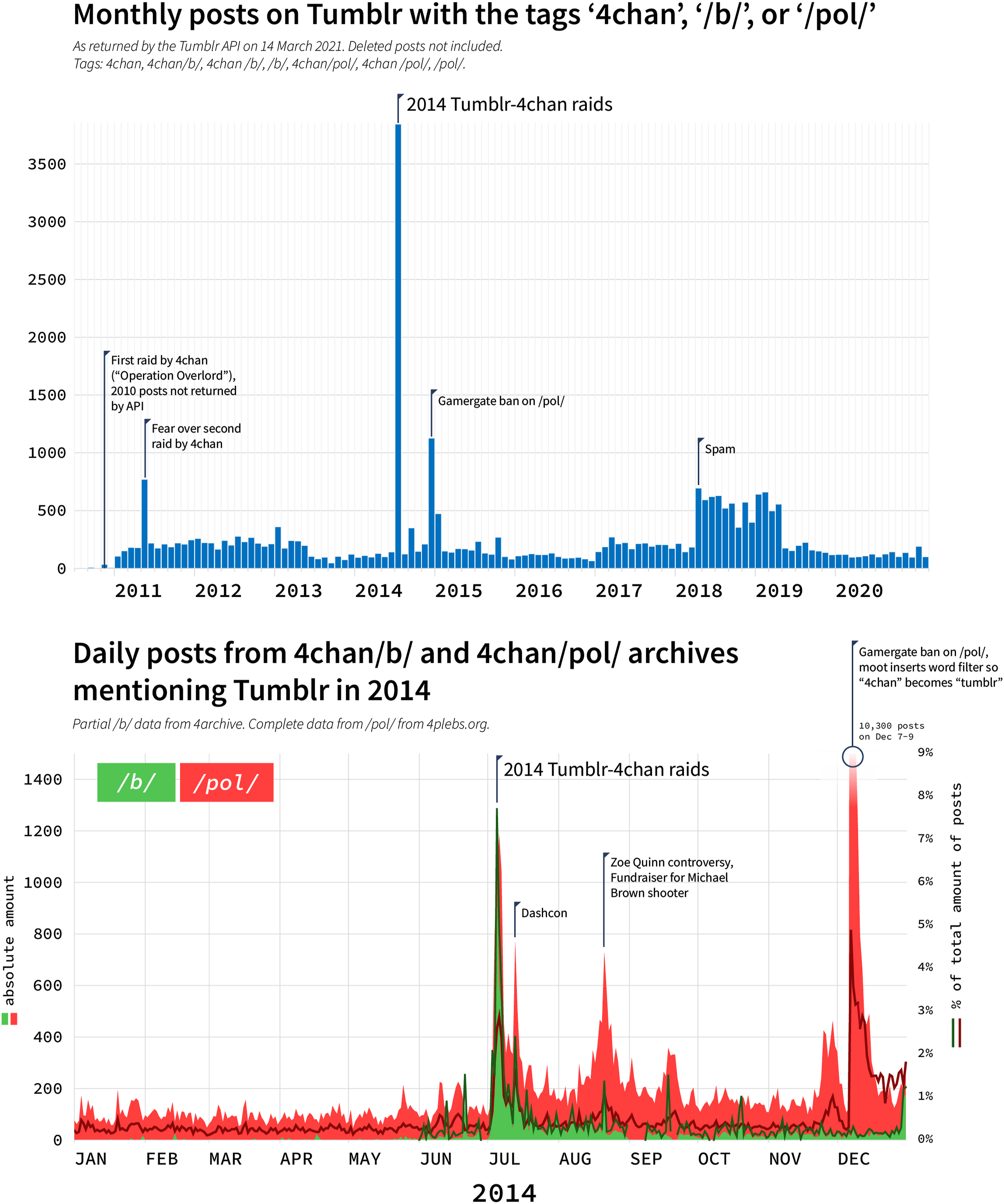
The view from 4chan
From the 4chan threads anticipating the raids, key takeaways are that anonymity and trolling incited the clash, while being catalysed by stereotyping of ‘Tumblr’ as a singular enemy. A few hours after its appearance, the shutdown4chan post already spawned a highly active /pol/-thread, 14 featuring the dominant category discussions on veracity. This category mostly pertained to the identity behind the pseudonymous shutdown4chan. Notably, the crude wording of the blog’s call to arms (Figure 1) was taken as evidence that it was an elaborate 4chan-ruse, with one 4channer for instance commenting: ‘it’s surely one of us. Subtle, but recognizable’. While no one openly revealed to be behind the blog, some archival sleuthing supports the rumour mentioned at the outset of this text: shutdown4chan was in fact a /pol/-ploy. This can be confirmed because the blog only made its first post half an hour after its accompanying image already circulated on /pol/ (see Appendix III). 15 shutdown4chan moreover started when /pol/ was actively orchestrating numerous other, highly similar trolling campaigns, including #endfathersday, #notyourshield, and allegedly even pushing the #GamerGate hashtag (Johnston, 2014). Instead of starting as a genuine subcultural clash, then, shutdown4chan likely grew out of a one-sided trolling campaign to provoke feminists.
Whether shutdown4chan was genuine or not was secondary to what it did: provide 4channers with the ideal enemy of the irrational and hysterical feminist. Several 4chan comments typified how the prospect of this antagonism took precedence over factuality. One stated: ‘I really don’t care how this started. Tumblr just seems perfect for this kinda thing’. Another equated the feud to a theatre play whereby ‘you know a pantomime villain is just an actor but you boo him just the same’. The irrelevance of veracity was also visible in various 4channers posing as infiltrating Tumblr users to further stir the pot. 16 Requests for collective action are often dismissed on 4chan (e.g. through phrases like ‘not your personal army’), but in this case were eagerly accepted, with shutdown4chan’s obscure pseudonymous identity enough reason to believe that – or act as if – Tumblr users started the quarrel. In line with descriptions of Tumblr as ‘a vast network of content to mine for 4chan’s obsessive critique’ (Donovan et al., 2022: 99), shutdown4chan formed the pinnacle of the ‘monstrous feminine’ so eagerly stereotyped by 4channers – a stereotype that through other tropes like ‘feminazis’ and ‘SJWs’ would grow into a favoured rhetorical device among anti-feminist and far-right agitators (Massanari and Chess, 2018).
This stereotype also grew because shutdown4chan’s call was equated to Tumblr in its entirety. For instance, several threads described the blog’s provocation as ‘Tumblr’s raid’ or announced how ‘Tumblr plans to fuck with us on the 4th of July /b/’. While a handful of anons would challenge this generalisation (e.g. attributing it to a ‘vocal minority of SJWs’), by and large, the raids were discursively positioned as an offence by a singular entity, afforded by the anonymous culture of Tumblr. This fits with literature pointing out how subcultural distinction often grows from gnomic information ‘heard along grapevines’ (Thornton, 1995: 109) as well as the strategic use of stereotyping ‘as a way of imposing a sense of order on the social world’ (Pickering, 2001: 3). In the case of the 2014 raids, the anonymous shutdown4chan became eagerly stereotyped to fuel a narrative of a more general ‘war’ between ‘Tumblr’ and ‘4chan’.
After discussing shutdown4chan’s call-to-arms, many subsequent 4chan threads concerned the annotated category of discussing defensive strategies. Since all posts are weighed equally on 4chan – no voting, liking, or tagging affects visibility – a potential ‘invasion’ by outsiders only requires a dedicated stream of posts. 4channers’ modus operandi for defence often entails repetitive insults and memetic patterns of aggression (Sparby, 2017; Hagen and Venturini, 2023). These methods also appeared during the raids: anyone vaguely empathetic to feminism or Tumblr was told to ‘fuck off’ and ‘go back to Tumblr’. But on /b/, anons also started discussing more advanced defensive strategies. Some toyed with the idea of ‘doing nothing’ or to feign agreement with feminist arguments. Soon, however, things turned darker. With consensus arising through sheer repetition, the dominant defensive strategy became posting gruesome images or ‘gore’ to scare off visitors. On the 4th, especially /b/ was rife with depictions of horrid bloodshed. Drenching the imageboard in gore was deemed fair game to 4channers because it dovetailed with the anons’ self-image of revelling in chaos and profanity. The sampled threads expressed this through the metaphor of 4chan and /b/ as an ‘ocean of piss’, imagining the imageboard as immune to both gore and raids since, no matter the amount of spam, the average quality of posts was equal to piss already (Figure 5).
17
These defensive strategies were also raised on /pol/, but here anons were more welcome to newcomers. Seen as potential recruits to their far-right cause, other defensive tactics aimed to ‘redpill’ and radicalise visitors. Several posters called for ‘spam[ing] facts and statistics’ on gender and race, another anon proposed to ‘suppress blatantly racist arguments in favor of more well constructed meaningful arguments’, while yet another similarly vouched for ‘planting seeds of doubt’ and warned warning that ‘by posting gore, all we did was make them even stronger in their own beliefs that we’re fucking monsters’.
18
A ‘demotivational poster’ depicting /b/ as an ‘ocean of piss’. Retrieved from imgur.com, uploaded by 4archive.org.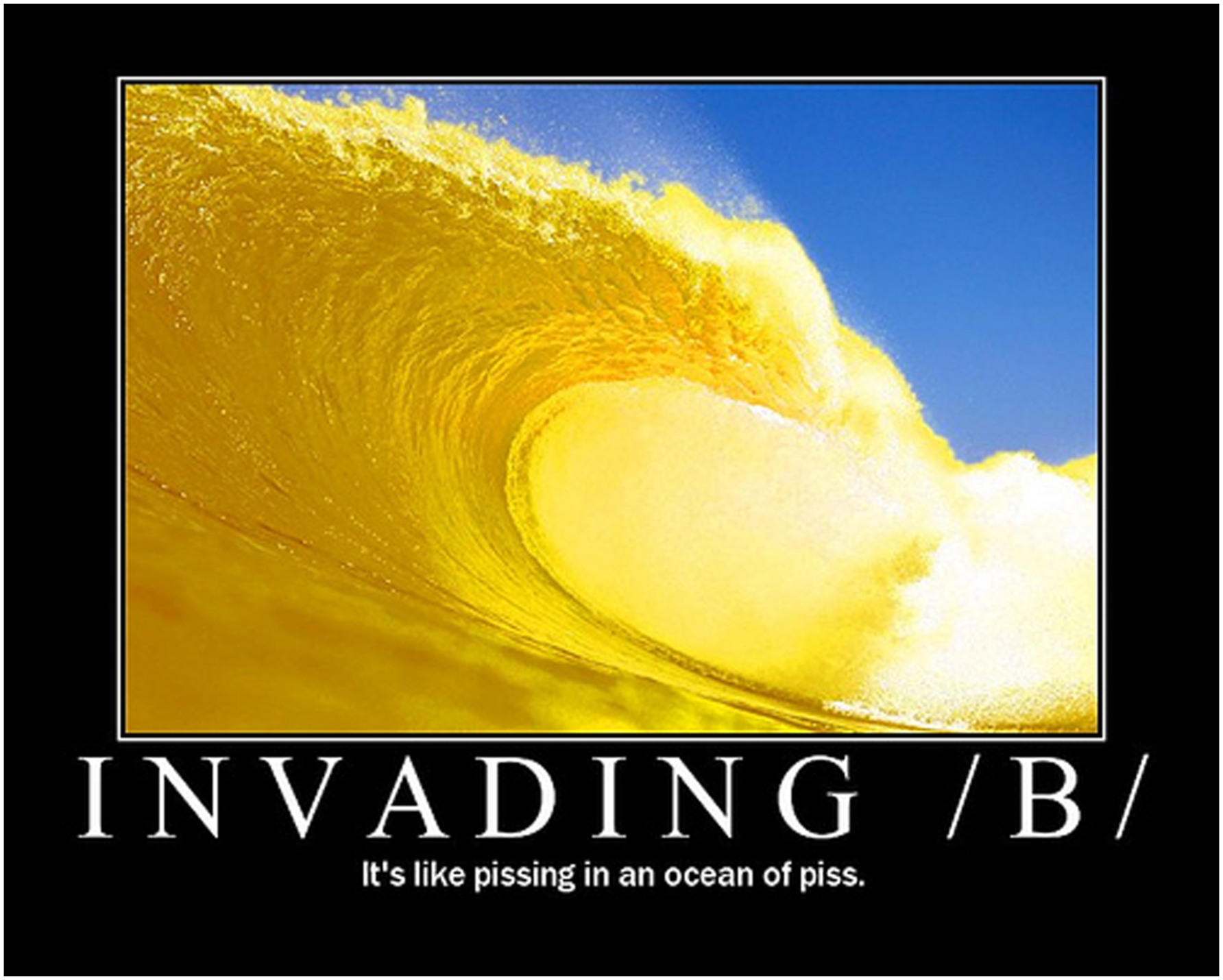
Instead of respecting the implicit boundaries of subcultural territories, 4channers soon started scheming an attack – even though I only found a handful of 4chan-threads likely made by actual Tumblr users. This category of discussing offensive strategies was historically known to 4chan, as raids were part-and-parcel during the heyday of /b/ and the hacktivist collective Anonymous around 2010 (Coleman, 2014). Anons on /b/, recalling Operation Overlord, debated the feasibility of DDoSing Tumblr, but by 2014, the method had become fairly ineffective. Several users therefore started discussing alternative platform-tailored strategies, the most common being ‘hashtag hijacking’, a practice understood as ‘to occupy, hijack, or create trending hashtags to redirect attention to another cause’ (Abidin, 2021: 6–7). Hashtag hijacking emphasises the double-edged nature of tag-based folksonomies, allowing ‘outsiders’ to repurpose and weaponize the very means of collectivisation (Renninger, 2015). When Independence Day finally arrived, 4chan anons witnessed the effectiveness of this weaponisation, as several Tumblr users posted how they forcibly witnessed gore and malicious advice under innocuous tags – posts which in turn were celebrated as championship trophies on 4chan.
While the actual impact on Tumblr was likely limited (as discussed below), this joy nonetheless fuelled the 4chan anons’ idea of reviving a dwindling trolling legacy. While the ‘ocean of piss’ metaphor might depict the space as archaic and volatile, many 4channers are actually fairly conservative regarding on-site traditions. Cultural shifts are often met begrudgingly, with /b/-users having commonly lamented a drift away from ‘old /b/’ or the site becoming a ‘bastardized version of Reddit’ (Phillips, 2015: 145–6, 171). In light of this nostalgia, the Tumblr raids were generally heralded as a return to glory, rekindling the ‘golden years of trolling’ when the imageboard was feared and revered as an ‘Internet Hate Machine’ (Figure 6; Phillips, 2015). 4chan users on /pol/ evoking parallels to the ‘old /b/’ of the ‘Internet Hate Machine’ era after raiding Tumblr. Screenshots taken from 4plebs.org.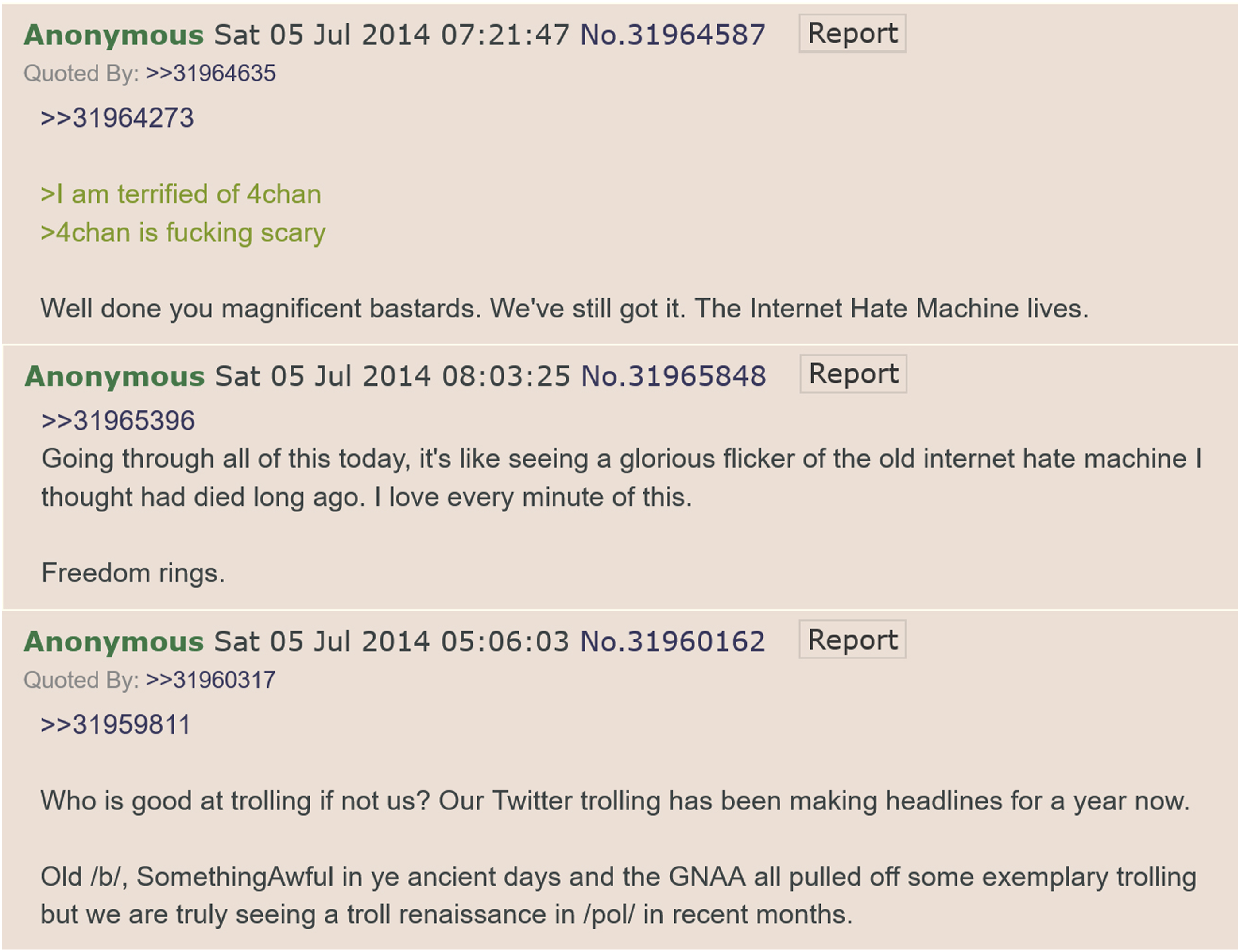
The view from Tumblr
The sampled Tumblr posts paint a radically different picture. In contrast to 4chan, none of the 186 analysed posts concerned offensive strategies. Instead of showing support to shutdown4chan’s call, 14 posts (good for thousands of notes) even actively mocked or criticised the blog and those answering its call. In addition, stereotyping of 4chan seemed less present on Tumblr than vice versa. For instance, one popular post wrote how ‘/b/ is a very small fraction of 4chan, most of 4chan is pretty damn great’ (221 notes) while another observed how ‘the entire community of 4chan is NOT attacking us. It’s just two groups, /pol/ and /b/’ (156 notes). Instead of a conflict between two equally toxic sides – a framing occurring in the famous Internet Historian video (2017) but also in Nagle’s equivalence 4chan and Tumblr’s radicalism (2017) – the 2014 raids emphasise a fairly one-sided conflict, originating as a harassment campaign orchestrated on /pol/ and adopted by /b/.
The lopsided nature of the raids is further underlined by the most common topic category in the Tumblr sample: discussing defensive strategies, appearing in a quarter of the posts (42). Using Tumblr’s networked publics, several users circulated the 4channers’ offensive plans as ‘trigger warnings’, commonly understood as warnings of content that could (re)ignite traumatic experiences. The vernacular use of ‘triggering’ was at this point already popular on Tumblr (Bell, 2013) but would become a hotly contested term outside of it in the years to come (Wendling, 2018: 97–8). Various 4channers, at this point still unfamiliar with ‘triggering’, were bewildered that stuff on the Internet could be trauma-inducing. One for instance stated: ‘those [Tumblr] b*tches have weak stomachs and minds if they can be “triggered” by some gore’. Beyond tag-based trigger warnings, Tumblr users also employed more advanced tactics to protect other users and the website’s curated culture, ranging from posting harmless content to drown out the gore (‘cleaning the tags’), warnings to stop posting selfies (to prevent Photoshopped pornographic material), and circulating lists of malicious blogs in order to get them banned.
In contrast to 4chan’s self-image as brutal and anarchic, on Tumblr we thus see protective, empathetic practices arise through the shared ‘commitment to maintaining one’s experience of tumblr as a safe space’ (Tiidenberg et al., 2022: 50). This spirit of mutual support was also explicitly articulated in several sampled posts. For instance, the second post in Figure 7 expressed how both Tumblr’s infrastructure and fandoms were united in a coordinated defence: ‘We have our wands at the ready. […] We have our BLOCK option. We are one’. The protective efforts seemed to have effect: various posts in the dataset expressed a lack of encounters with ill-intended posts or blogs. Many Tumblr users moreover saw their platform as similarly immune to raids because, reflecting 4chan’s ‘ocean of piss’ metaphor, it too was already revelling in profanity (see Figure 7). Notably, 20 per cent of the top-noted posts referenced Homestuck, a webcomic featuring violence and gore, which to some success countered 4chan’s stereotype of Tumblr as oversensitive: the question ‘what to do with the Homestucks’ appeared in several 4chan threads. Top: Defence through using and repurposing Tumblr’s mechanisms. Bottom: Homestuck and other fandoms used to evoke a sense of immunity against 4chan’s attacks.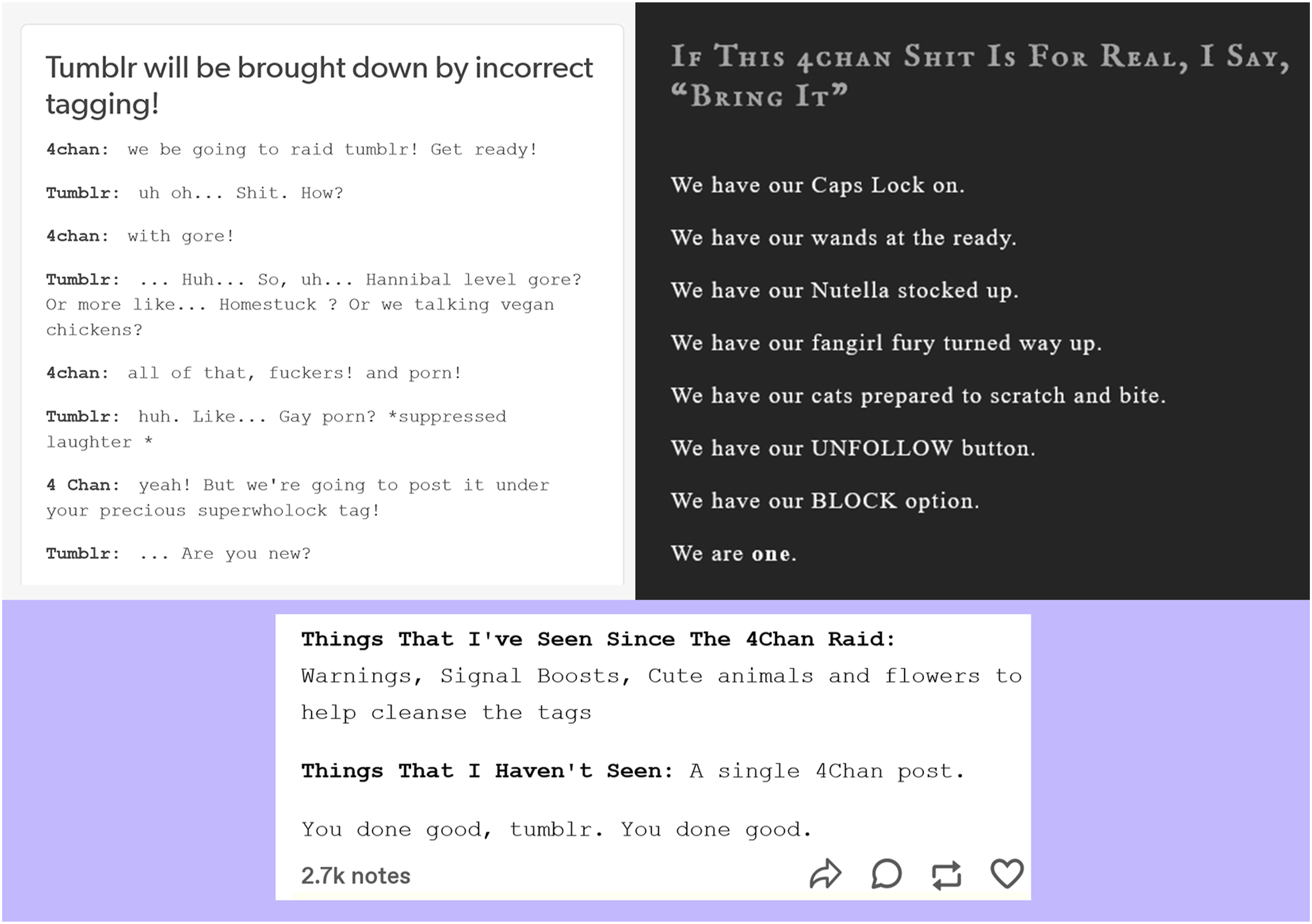
Poking the hornet’s nest
The 2014 raids would further develop after the 4th of July, but the above already lets us engage with the initial research question: what can the raids retrospectively teach us about conflict between mid-2010s online subcultures? Or, as one 4chan user put it, why did these groups go to great lengths to ‘play Internet nationalism’ on a national holiday? On 4chan, a large share of posters expressed disinterest, stating they would rather be ‘drinking and partying’. Others revealed their motivation to be boredom or ‘lulz’, that is, the joy of evoking emotional reactions from unwitting targets (Phillips, 2015). The incentive of another subgroup was explicitly political, mostly arising from the conviction that feminism had become a sexist movement itself, as epitomised by Tumblr. 19 Obscured by anonymity, shutdown4chan formed the ideal pantomime villain to act on these incentives.
That said, framing the raids as a political-ideological dispute between feminists and anti-feminists only tells part of the story. Rather, the above also shows how the feud arose from deep-rooted media-ideological friction. The 4channers’ self-image as an ‘ocean of piss’ and ruthless debate environment contrasted Tumblr’s defensive and inward focus, one expressing empathy, unity, and care. Instead of respecting this as different territorial habits, however, various 4chan posts saw Tumblr norms as unfitting with ‘right’ conduct on the Internet as a whole. Notably, moral sensitivity, trigger warnings, and weak stomachs were deemed incompatible with the free speech-absolutist and cyberlibertarian idea that on the Internet, anything that can be posted should be posted (Colley and Moore, 2022; Phillips and Milner, 2021). For example, one 4channer stated that ‘if you don’t have a thick skin, you shouldn’t put yourself out on the internet… the internet is not your friend… we’re all equal… all equal as shitlords and assholes here’ (Figure 8). Another poster put it even more bluntly: ‘if they think browsing the internet is so traumatic they should stop browsing the internet’. In other words, 4chan’s self-image as unforgiving was extrapolated to media-ideological norms on ‘appropriate’ use of the Internet more broadly. Media-ideological lamentations on 4chan/b/.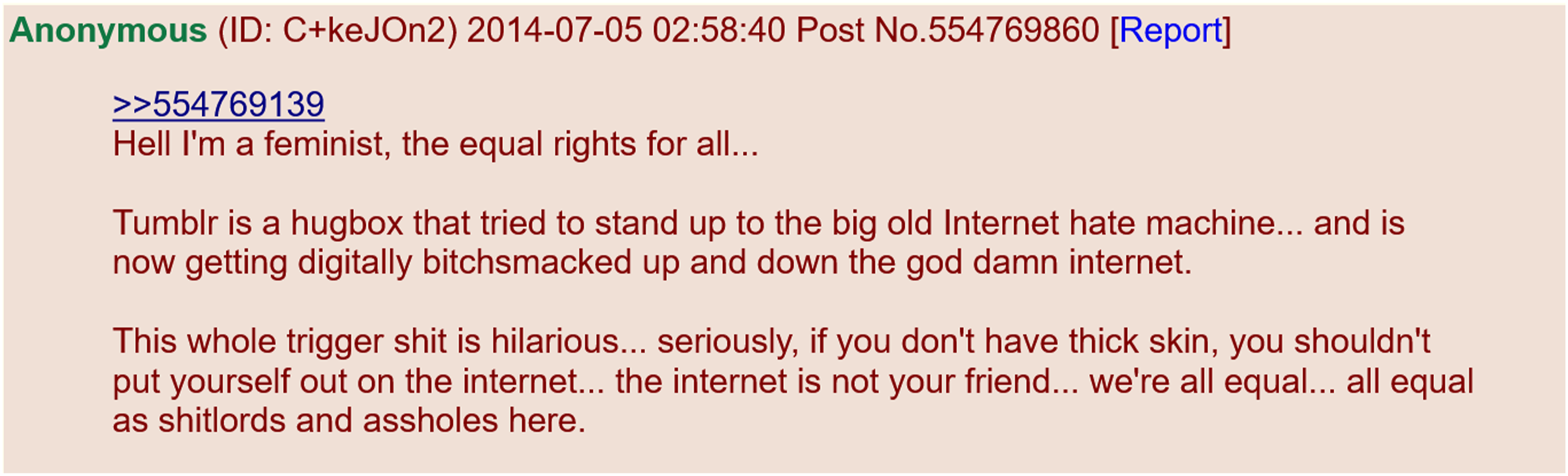
Instead of merely indicative of contrasting norms, 4channers’ media-ideological lamentations were seen as ample reason to puncture the implicit boundaries of subcultural territories online. This self-attributed license to invade can be further understood through various metaphors emerging in the sampled data. Notably, 4chan was characterised through ominous labels like ‘hornet’s nest’, ‘sleeping bear’, ‘hydra’, or the ‘final boss of the Internet’. Such analogies not only characterised the imageboard as fearsome, but also as an unmovable staple in Internet culture that, when disturbed, could easily impose its will on others. This aligns with Phillips description of a broader trolling ethos which treats the Internet as a ‘homestead’, a ‘personal playground and birthright’ where no one ‘should be able to dictate [trolls] behavior’ (a ‘technological entitlement’ she argues is ‘born of normalized expansionist and colonialist ideologies’; 2015: 123; see also Rheingold, 1993). This idea of the Internet as 4chan’s playground did not only appear in the 4chan-samples, but also in several top-noted Tumblr posts. For instance, a post with 854 notes criticised ‘idiots on tumblr [who] poke a hornet’s nest and wonder why they get stung’, while another equated enraging 4chan to ‘blowing up the walls of a prison and being surprised when all the criminals swarm out to pillage’. Instead of a coordinated harassment by 4channers, these metaphors frame 4chan’s ‘invasion’ as a logical endpoint to ‘Tumblr’s’ provocations. In the process, the former is implicitly granted the right to ‘correct’ those incompatible with its political- and media-ideological norms – indeed, as ‘bosses’ are wont to do, they impose their rules on others. This imposition was exacerbated by contrasting metaphors on Tumblr like the ‘hugbox’: a derogatory term for an overly protective environment where any form of disagreement is eschewed (see Figure 8). We can thus observe a strange paradox where 4chan’s subcultural territoriality – arising from a wish to stay secluded and distinct from other online spaces – coincides with a claim to impose their media-ideological norms across platforms. Here we also see various ingredients for Gamergate forming: a hostility towards perceived sensitivity and ‘tone policing’ online combined with media-ideological claims to authority regarding norms on ‘the Internet’.
The raids in this way suggest how the concept of media ideologies may be useful beyond systematic studies on the use of certain communication channels. In the case of 4chan, media ideologies may also refer to something more intense: highly antagonistic and exclusionary ‘online othering’, pushed by relentless adherence to ‘rules and norms concerning which individuals and groups are endowed with status and legitimated to participate [online], and those who are not’ (Harmer and Lumdsen, 2019: 2). Indeed, the raids show how trolling hotspots in the mid-2010s still operated through myopic ‘guiding dogmas’ (Brown, 1965) on the ‘appropriate’ use of the Internet – that is, an appropriate use of being inappropriate. Interwoven with more traditional disputes on feminism and ‘free speech’, political- and media-ideological resentment incited 4channers to puncture Tumblr’s sense of seclusion. Here, we may thus speak of polarisation between 4chan and Tumblr in the pejorative sense as a growing antagonistic chasm.
Still, it would go too far to see the raids as clearly indicative of an alleged ‘extremist turn of the Trump-era Internet’ (Phillips, 2019: 1). Yet the sampled data do suggest a growing affinity between /b/’s more politically ambivalent anons and /pol/’s far-right extremists. The fact that anti-feminist resentment arose on both /pol/ and /b/ suggested the political gap between both boards was at this point fairly narrow. Various /b/-posts moreover revered /pol/ for ‘tricking Tumblr’ and reviving the site’s trolling legacy, with one user even heralding ‘a troll renaissance on /pol/’ (Figure 6). But beyond this, /pol/ garnered media-ideological praise for acting upon the shared conviction that Tumblr defiled Internet etiquette and needed correcting. In the evening of the 4th, /b/-anons visited /pol/ and vice versa to congratulate each other on a successful campaign. One /pol/-user for instance applauded how ‘/b/ showed [Tumblr] to be more realistic. Based /b/’ while a /b/-user declared /pol/ to have become ‘/b/s brother board’. With /pol/ gaining the status as the cunning trickster, /pol/ was described as a ‘magical place’ where one could possibly ‘venture over sometime’ (Figure 9). While impossible to quantify, this newfound fame likely made some 4channers more sympathetic to /pol/, possibly priming them for more serious coordinated action during Gamergate a month later. Convergence between anons on /b/ and /pol/.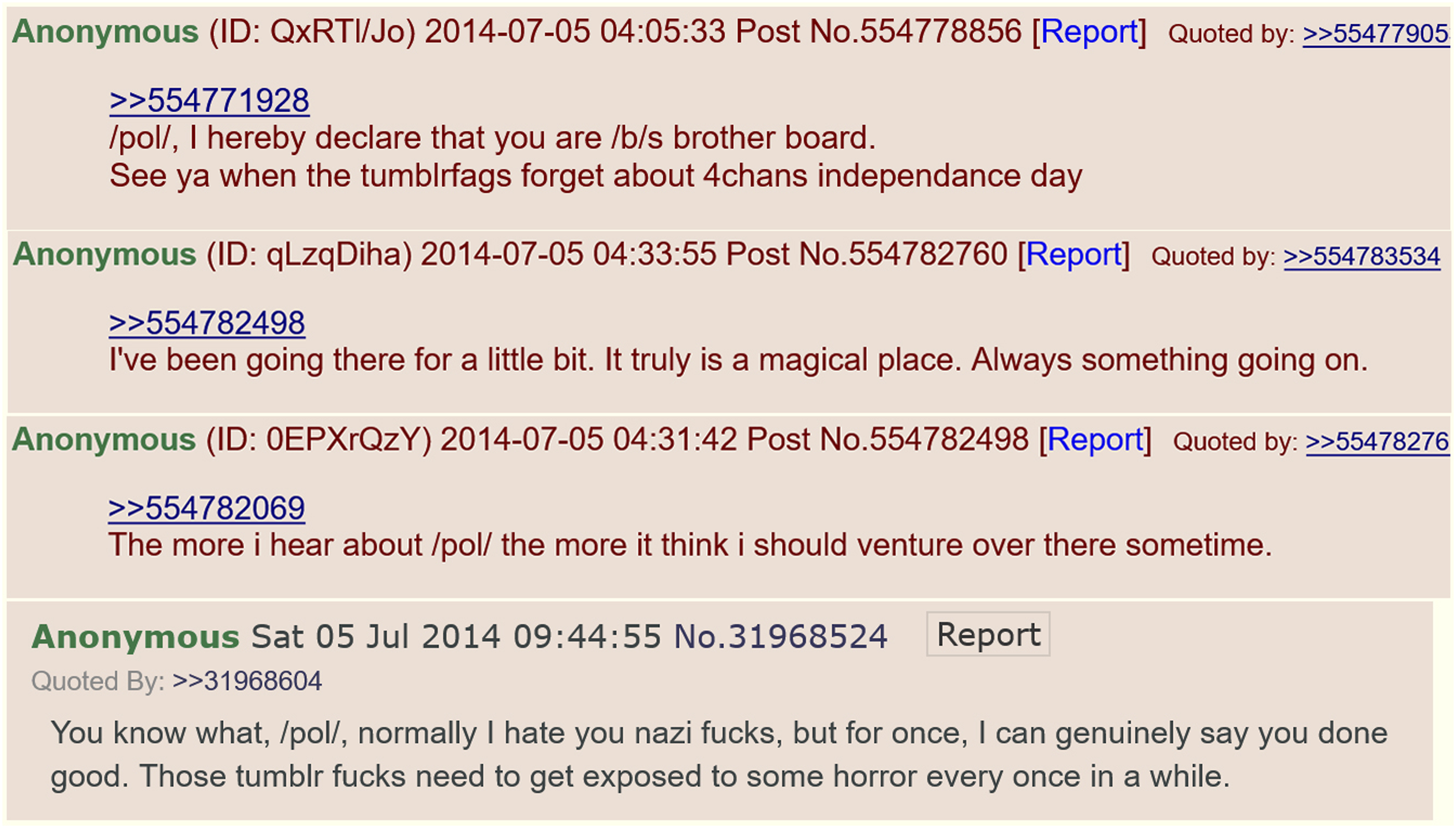
At the very least, instead of a feud between politically ambivalent youth cultures like 2010’s Operation Overlord, the 2014 raids show a decisively more political bent. Here, we may return to 4chumblr. Frequently appearing in both the /b/ and Tumblr samples, 20 the meme was met with nostalgic enthusiasm by some. However, on 4chan, even more users argued that Tumblr’s feminism had caused a schism so wide that 4chumblr’s love became untenable. As one anon claimed, the 2010 raids were ‘about stolen content. This one is about self-righteous SJW. I’d love to see a revival in 4chumblr art but it’s just not in the cards’. Another succinctly stated: ‘Ah yes. 4chumblr. Married 2010; Divorced 2014’. Having once represented a secret affection between the two camps, 4chumblr now became a symbol of polarisation.
Conclusion
At the time of writing, eight years after the raids, activity on /b/ has declined while that of /pol/ tripled, having grown into the imageboard’s most popular board. 21 Gamergate discussion remained common on /pol/, 22 with some anons alternatively reminiscing that ‘the 4th of July tumblr raid [was] when the right wing turn happened’. 23 Tumblr’s user activity sharply fell, giving rise to claims that ‘Tumblr is dead’ and ‘Twitter/TikTok is the new Tumblr’ (Nguyen, 2021). Yet, following an acquisition by Automattic in 2019, the platform remains oscillating between forgotten and vibrant: despite dwindling user activity, new Tumblr posts still circulate online, while retrospectives of its fandoms and political upheavals spark considerable interest. Some accounts even claim a ‘Tumblr resurrection’ might be looming, driven by Gen-Zers ‘in the grips of nostalgia for the early 2010s’ (Sybert, 2022). In any case, through the case study above we have seen how Tumblr and 4chan’s feuds in the 2010s were indeed prescient warnings for recent moral panics on ‘woke mobs’ and ‘free speech’ (Rosenberg, 2020).
To further untangle this peculiar moment, this paper offered a retrospective of the 2014 Tumblr-4chan raids. I argued how, instead of solely a political clash of feminists and the ‘alt-right’, the raids were also entangled with media-ideological contestation on what conduct is deemed appropriate online. In specific, 4channers’ self-image as chaotic and ruthless clashed with a view on Tumblr as sensitive and protective. The raids as such point to how predominantly masculine, predominantly white online subcultures came in touch with a more diverse array of publics claiming their space online. Evoking reactionary media ideologies and ‘online othering’, the raids can be read as emerging from broader ‘narratives of decline’ among passionate or long-term Internet users, groups holding an ‘excessively sentimental attachment to the early Internet’ as a Wild West at a moment of growing ‘mutual visibility and increased access for people of different racial and gender identities’ (Driscoll, 2020: 29). Indeed, /pol/-anons were not only applauded for rekindling 4chan’s trolling heydays, harassing feminists, and reminding Tumblr users that ‘feeling distressed online […] was a self-inflicted wound’ (Phillips and Milner, 2021: 58), but also for helping to scratch the itch of this Internet nostalgia.
Even though the online attention economy increasingly (re)positions the Internet as a fluid ‘space of flows’ (Castells, 1996; Hagen and Venturini, 2023), the raids moreover point to how territorial sentiments played an important role in the polarisation between niche online groups in the mid-2010s. While I do not argue for a return of a ‘real/virtual divide’ (Rogers, 2013: 20–1), this territoriality nonetheless underlines a lingering emic sense of the digital as composed of distinct refuges, a remnant of 90’s cyberculture also pointed out by others (De Zeeuw and Tuters, 2020). This may let us reappreciate the observations in studies of offline subcultures, who long emphasised the role of material architecture and spaces (e.g. Gelder 2007; Thornton, 1995). But this also raises the question of what is substantially new here. Instead of reinventing the wheel, we may return to Park (1925) and conclude that the raids point to how the online supercharges the ‘dangerous experiment’ of proximity and segregation among a ‘mosaic’ of communities. The Internet’s rapid pace and mobility facilitated ‘playing Internet nationalism’ on a national holiday – but also a more serious ‘networked harassment’ (Marwick and Caplan, 2018) that would intensify with Gamergate a month later.
Footnotes
Declaration of conflicting interests
The author(s) declared no potential conflicts of interest with respect to the research, authorship, and/or publication of this article.
Funding
The author(s) disclosed receipt of the following financial support for the research, authorship, and/or publication of this article: This work was supported by the Promoties in de Geesteswetenschappen, NWO (PGW.19.030).
