



Abstract
This article critically analyzes the BeReal social media platform, considering how its infrastructure enables a new kind of networked public. I utilize the walkthrough method to examine how BeReal’s “environment of expected use” and vision aims to instill authenticity as a value and ideal for users. I also employ the concept of networked public as a framework to understand how BeReal organizes attention and action through networked technologies that create both a mediated space and collection of people. From this analysis of BeReal’s digital structure, I develop the concept of a live networked public to characterize BeReal’s ability to coordinate interpersonal and global connections to a specific temporality. Furthermore, I connect live networked public to a concept of authenticity in the app’s design by arguing that BeReal’s concept of “realness” is contingent on its unique affordances. Particular features not only support the core network public on the app, but guide behaviors to encourage a particular version of “sporadic” authenticity. This version is useful for BeReal’s branding as the “most authentic” platform in competition with other social media apps. This work combines scholarship on networked publics and affordances, with that on liveness—specifically online and group liveness. Given that BeReal’s skyrocketing popularity tapered off, this study also highlights the importance of analyzing newcomers to the social media ecosystem that promise and play with new ways of being and interacting online.
Your phone chimes, and the notification reads, “Time to BeReal: Two minutes to capture a BeReal and see what your friends are up to!” Depending on your setting, you pause and pose to make your post. Maybe there are others around you doing the same. This request is brought to you by BeReal, a social media app co-founded in Paris, France by Alex Barreyat and Kévin Perreau in December 2019. Everyday BeReal sends out a notification. Users then have 2 min to generate a picture with both their front- and back-facing cameras and post to their feed. Once posted, they may see photos from their friends or from BeReal users around the world in a “Global” feed. Despite this short-lived daily act, BeReal exploded in popularity among users soon after its launch.
In March of 2021, BeReal was one of the top social media apps in France, and a year later it became popular on American college campuses (Goldsmith, 2022). By June 2022, BeReal had been downloaded 27.9 million times. In July of that year, the number of monthly active users on BeReal reached 21.6 million—a number that nearly tripled to 73.5 million by August. The surge of use in 2022 did not last long, however, with the number of monthly active users dropping to 33.3 million by March 2023 (Curry, 2023). Although the initial hype around BeReal made it an instant success, it was a one-hit-wonder, and presents an opportunity for research on forms of online sociality.
BeReal is just beginning to emerge as a topic within scholarship. Trevor Boffone (2023) locates BeReal in a broader ecosystem of social media apps in his examination of Gen Z and digital literacies. Jacques Bulchard-Gidumal (2023) considers BeReal’s relevance to the tourism industry, changing the dynamics of both travelers and companies. Jessica Maddox (2023) argues that BeReal’s strategy of spontaneity ushers in panoptic and neoliberal forms of surveillance. Across this literature, there emerges attention to the construction of authenticity on the app. Many of the articles in Flow’s special issue on BeReal focus on authenticity (Annabell, 2023; Banks et al., 2023; Highfield, 2023; Moir, 2023; Taylor, 2023; Wisnewski-Parks, 2023). Similarly, this study analyzes authenticity on BeReal by considering how it is constructed through the app’s infrastructure and through a structure of temporality.
All social media platforms articulate a vision of what constitutes “authentic” sociality through interface elements designed to structure and coordinate interaction. BeReal contrasts with other popular platforms such as Facebook, Instagram, Twitter, and TikTok in terms of its affordances and version of authenticity. To parse these elements, I utilize the walkthrough method (Light et al., 2018). Walk through methods allow researchers to systematically analyze how an app’s technological mechanisms guide user behavior. Here, I use the systematic walkthrough to examine how BeReal’s “environment of expected use” aims to instill authenticity as a value and ideal for users. Specifically, I employ “networked public” (boyd, 2011) as a framework to understand how BeReal organizes attention and action through networked technologies that create both a mediated space and collection of people. From this analysis of BeReal’s digital structure, I develop the concept of a live networked public to characterize BeReal’s ability to coordinate interpersonal and global connections to a specific temporality.
I use live networked public to refer to BeReal’s expectation that all users should co-exist simultaneously within particular temporal structures. BeReal users engage with their offline networks and a global network through this digital and temporal space. Furthermore, I connect live networked public to a concept of authenticity in the app’s design by arguing that BeReal’s concept of “realness” is contingent on its unique affordances. These features not only support the core network public on the app, but guide behaviors to encourage a particular version of “sporadic” authenticity. This version is useful for BeReal’s branding as the “most authentic” platform in competition with other apps for users attention. Rather than questioning how users understand their own performance of authenticity, this study asks how BeReal conceptualizes itself as authentic through the app’s architecture. This study does not argue that BeReal disrupts the mode of temporality on other social media platforms, but uses temporality to distinguish the sociotechnical construction of authenticity elsewhere in order to entice users. How is this version of authenticity evident in the organization of platform affordances? What is the role of temporality and liveness in this construction?
Literature Review
Since the advent of Web 2.0 less than two decades ago, scholars have considered how social media sites enable various forms of online sociality. José Van Dijck (2013) offers the concept of “platformed” sociality to describe how social media platforms mediate social activity and interactions. She maintains that social media functions as a
new online layer through which people organize their lives. Today, this layer of platforms influences human interaction on an individual and community level, as well as on a larger societal level, while the worlds of online and offline are increasingly interpenetrating. (p. 4)
While no social media platform is the same, they share several core affordances and sustain a networked public. This digital structure also lends itself to literature on liveness and authenticity, which is important for my conceptualization of a live networked public on BeReal.
Platform Affordances and Networked Publics
Jenny Davis (2020) and others (Gibson, 1982; Hutchby, 2001; Nagy & Neff, 2015) explain that affordances do not dictate behavior but encourage, constrain, and enable certain actions. Taina Bucher and Anne Helmond (2017) join them in echoing the utility of affordance theory but focus on the affordances of social media platforms, which they locate as sites of meaning making and possibility. Twitter’s 2015 change from a “favorite” to a “like” button, for example, transformed the implied meaning of the action. As Bucher and Helmond found, Twitter users preferred the “favorite” feature because it was more “neutral” than the “like,” meaning that even minor tweaks of symbols can generate grand interpretations. Platform affordances also guide behavior. Instagram’s image-centric model encourages users to post visuals over text, but does not foreclose alternative uses: Instagram captions allow users to augment images with text or post stories with on-screen text. Users navigate affordances in their everyday usage by either appropriating or rejecting the platform’s assumed norms and behaviors. Furthermore, these features and their affordances can be taken for granted as they become quotidian. The affordances of social media platforms are tools through which users connect with others in online spaces, conditioning possibilities of action and ways of relating to one another and to networked resources.
Platform affordances and the sociality they encourage enable the formation of networked publics. Danah boyd (2011) develops a foundational understanding of networked public to distinguish online interactions from the passivity of “audiences” and to describe how traditional publics are restructured by networked technologies—which can operate as both a space and a collection of people. Boyd’s analysis focuses on social network sites, and she argues that the digital architecture of these online spaces provide affordances that shape how users interact with their imagined public(s). Some of this architecture includes features such as profiles, friends lists, and tools for public communication, such as commenting. These are the mechanics connecting people via networked technology. Adding to this scholarship, others have considered how community and user identity are formed across platforms as they evolve (Papacharissi, 2009; Van Dijck, 2013). Networked publics represent one way of understanding online sociality, particularly because the term “public” foregrounds a shared, collective, and interactive sense of reality. Hannah Arendt (2000) argues that, distinct from the earth and nature, a “public” is a fabricated world that brings people together as a community. In this way, even the “extremely online” of networked publics can sustain or transform offline communities by determining what is seen and heard.
Liveness
The concept of liveness is contingent on assumptions that media (of any variety) offer faithful representations of social reality. Jane Feuer (1983) contrasted the liveness of live television programming, which seemed to be an ongoing process, with the frozen nature of recorded media such as film. Feuer’s analysis included a close reading of the “Good Morning America” television program, which she believed highlighted the ideology of liveness through distinct features such as the inclusion of the local time and use of certain camera angles to obscure the manufacturing of the show, encouraging viewers to see themselves as part of a national family partaking in the news together in real-time. She not only identifies liveness as aligned with the ontology or essence of the television medium, but also an ideology which purports its ability to bring an authentic version of reality to media users (see Anderson, 2006 who argues the same in reference to the construction of nationalism). Liveness helps us understand how a sense of community is established through engagement with various forms of media technology.
Nick Couldry (2003) builds on this work, arguing that styles of live transmission become a ritual, establishing a potential connection to shared social reality and real events rather than constructed portrayals. In this framing, liveness is a form that applies to many forms of media, including the radio and press (see also Auslander, 2012), in addition to newer technology, such as the internet and mobile phones. The latter of these technologies support what Couldry (2004) calls “online liveness” and “group liveness.” Online liveness is the “social co-presence on a variety of scales from very small groups in chat rooms to huge international audiences for breaking news on major websites, all made possible by the internet as an underlying infrastructure” (p. 356). This form operates alongside other categories of liveness. For example, breaking news reaches global audiences via television, news websites, and social media sites. Internet users and television viewers engaging with the news experience the event together in a space of simultaneity that seems to offer connection across global distance and difference. Group liveness, by contrast, describes a peer-group’s co-presence through networked communication technologies (in Couldry’s case, mobile phones via text messaging). It “enables individuals and groups to be continuously co-present to each other even as they move independently across space” (p. 357). Both online and group liveness are mediated by network technologies and enable shared attention to a reality.
Anne Kaun and Fredrik Stiernstedt’s (2014) formulation of “social media time” as a framework to analyze how Facebook structures temporal experiences, serves as an example of connecting the technological mechanisms of platforms with user behavior. Kaun and Stiernstedt conduct an analysis of Facebook’s dedicated to media memories and consider three categories of specific temporality: archive, flow, and narrative. They conclude that this ephemeral temporal experience individualizes users and undermines collectivity. Similar to Facebook, BeReal organizes social media time in particular ways to guide user attention and action. However, because different platform affordances coordinate experiences of liveness in different ways, there is no reason to assume that BeReal’s construction of simultaneity is identical to Facebook in structure or implication. By analyzing BeReal’s structure, and using networked public as a theoretical framework, I extend on this literature and explore how the app’s enactment of temporality enables a shared sense of liveness and encourages a particular version of authenticity.
Authenticity on Social Media
Notions of authenticity dictate not only the culture of social media platforms, but the behavior of its users. Sarah Banet-Weiser (2012) marks the 21st century as an age that hungers for authenticity, laments about inauthenticity, and is governed by superficiality. Logics of authenticity shape our consumption practices, especially regarding brand marketing. As social media became increasingly commercial, authenticity became crucial to social media, primarily as content creators use the available affordances to balance being “real” with their audience and the expectations of brands they collaborate with (Arriagada & Bishop, 2021; Hund, 2023; Hurley, 2019). Brooke Erin Duffy (2017) writes that “authentic self-expression . . . is widely celebrated as part of the currency of ‘realness,’ bound up with the notion of creative individualism valorized on social media.” (p. 135) These logics trickle down as average users mimic “influencers” in self-branding strategies that perform “realness” in strategic ways (Gorea, 2021; Marwick, 2013), especially on apps prioritizing images.
The status-seeking cultures of social media emphasize the importance of appearance, and the popularity of content that reproduces particular lifestyles can lead to pressures or anxieties around looking perfect (Foster, 2022). While the logics of self-promotion and branding may have different impacts on those who use social media platforms professionally versus those who use it more casually, they have the potential to affect the behavior or perceptions of all users by transforming the mediated aesthetics of authenticity. Content creators utilize appearance to compete for visibility by performing authenticity—making sure that their makeup is done, the lighting is flattering, and the view counts appear unadulterated—are editorial acts. With feeds full of such editorialized content, casual users may feel compelled to share highly curated images of themselves to align with shifting cultures of appearance. This is the social media landscape, which BeReal is not only entering, but challenging. The app claims to offer opportunities for users to present a “realer,” more authentic version of their lives by rejecting curation and staged performances of the self. The features and functions designed into the app’s environment of expected use reinforce the platform operators’ desire to stand out as a more “authentic” experience of social media than competitors are offering.
Method
To understand how BeReal’s affordances intend to interpellate users as a live networked public, I utilize the walkthrough method, developed by Light et al. (2018) for critically analyzing apps. The walkthrough method builds on science and technology studies and cultural studies, allowing researchers to establish an app’s intended purpose through systematic examination of its aesthetics and infrastructure. The walkthrough method aligns with the principles of Actor-Network Theory (ANT), which considers sociotechnical formations through the relations between human and non-human actors (Latour, 2005), and was created to fill a void in methodologies for appraising how mobile applications and interfaces privilege and constrain certain actions.
The goal of the walkthrough method is to determine the environment of expected use, describing how an app’s designers, developers, publishers, and owners expect users to receive and interact with it. The environment of expected use consists of three factors: vision, operating model, and governance. Researchers conduct a technical walk through wherein they engage with the apps’ interface from the perspective of a user. This walkthrough “involves attention to the app’s materiality, including the actions it requires and guides users to conduct, and imagining how users would perceive these as affordances or constraints” (Light et al., p. 892). By “materiality,” the authors mean an app’s mediator characteristics such as the user interface arrangement, the functions and features that mandate or enable activities, the textual content and tone, and other symbolic representations such as color and font. Data on these characteristics are collected at various stages—registration and entry, everyday use, and closure of the app—highlighting elements of the interface that users may or may not make conscious note of. In addition, the method “involves drawing on cultural discourses, such as how the app constructs conceptions of gender, ethnicity, ability, gender, and class” (Light et al., p. 892). Complimenting a material analysis with a cultural one emphasizes how platforms and other technological artifacts are entangled with larger values and ideologies (Benjamin, 2018; Brock, 2020; Noble, 2017).
The walkthrough method is similar to André Brock’s (2016) Critical Technocultural Discourse Analysis (CTDA), except CTDA also emphasizes the beliefs and practices of users themselves. Both analyze technological artifacts, framed by cultural and critical theory. The narrower scope of the walkthrough method fosters a deeper engagement with interface design elements and symbolic resources and pathways for action. This method of systematic app analysis thus addresses my research questions about how BeReal’s affordances organize a networked public through experiences of liveness and notions of authenticity. Other scholars have used the walkthrough method similarly. The original formulation by Light et al. included a brief analysis of Clue, a menstruation-tracking app, in relation to reporting of sexual activity, cultural norms of heterosexuality, and the erasure of trans identity. The method has also been applied to TikTok, another relatively new platform, both in comparison to its sister-app Douyin (Abidin, 2020; Kaye et al., 2021) and on the app’s role in shaping user behavior (Vizcaino-Verdú & Abidin, 2023; Zulli & Zulli, 2020).
The technical walkthrough of BeReal included the stages of registration and everyday use. I created an account in September 2022 using my personal phone number. I connected with 20 other accounts synched with my contact list. My observation of BeReal ended in October 2022, and included posting daily and interacting with the posts of others. This limited duration is warranted given the repetitive and routine nature of the interactions of the app and emphasizing the infrastructure of BeReal over the qualitative content of posts. My use involved creating one post per day, except for one day when I refrained from posting, and another where two notifications were sent in the same day—resulting in a total of 29 posts. 1 Collected data took the form of screenshots and notes, consisting of all aspects of the interface, including functions and features, textual content and tone, and symbolic representations. The analytical themes of my observation included (1) how users were expected to interact and post, (2) how the app organized and sustained a networked public, and (3) the importance of temporality and authenticity. In the following section, I summarize the observations of my technical walkthrough of BeReal, namely the key features and affordances of the app. I then parse through these analytical themes and conceptualize the construction of a live networked public and BeReal’s vision of authenticity.
Findings
Registration Process
Once downloaded, the app asks users for their birthday and name. It also asks for their phone number to sync their contacts. The majority black screen includes white text that reads, “let’s find your friends already posting on BeReal and discover their real life” (see Figure 1). Once a user inputs their phone number, a list labeled “Add Your Contacts” displays the profiles of accounts found in their phone’s contact list, giving users the option to request them as a friend. A tab labeled “Requests” along the bottom allows users to see who has requested them. Below the list of contacts, there is a “People You May Know” list with accounts with mutual friends that users can choose to add or remove via an “X” button to the right of profile information. Users not only input a name but can choose a username and have the option to upload a profile picture—all available on their profile page. The profile page also includes a section for “Your Memories” and at the bottom, a link to the user’s profile. When pressed, this link opens a small screen with options to share the link via airdrop, text message, email, Twitter, Pinterest and more.
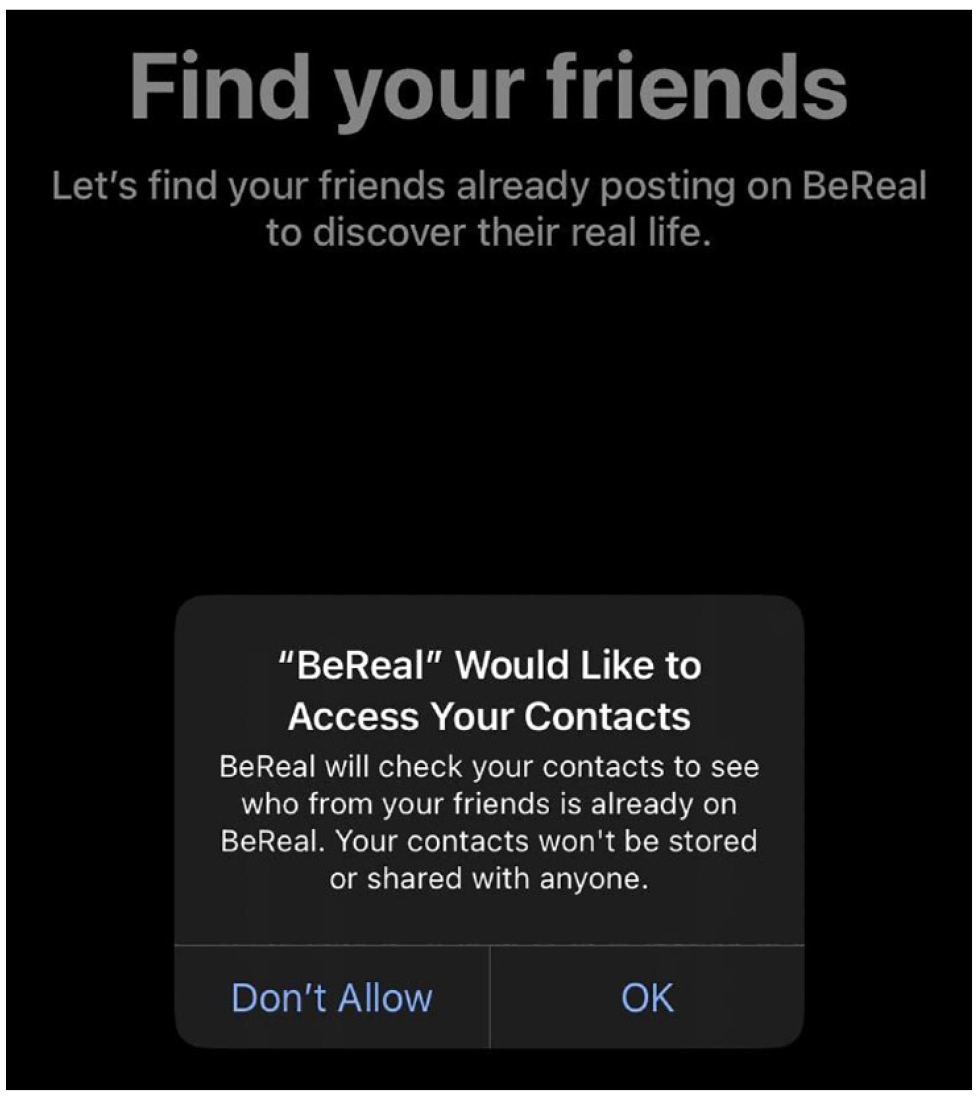
BeReal registration process, specifically the prompt to connect with your contacts list (photo courtesy of author).
Because a notification had been sent out on the day of registration, there was little else accessible in the default feed labeled “My Friends.” The feed was fully functional and labeled, but the images themselves were blurred, meaning that I could not see the posts of my newly added friends. On top of these blurred images was an icon of an eye with a line through it. The text underneath read “Post to View. To view your friends’ BeReal, share yours with them” (see Figure 2). When pressed, a button beneath that labeled “Post a Late BeReal” automatically opens the camera (whose access needs to be approved by the user) and begins a countdown as you make your first post. The camera only displays the back-facing camera and as you click the photo, there are around 3 seconds to pose via the front-facing camera. Users are given the option to retake the photo and select their “audience,” sharing to either “My Friends Only” or “Discovery,” which is sent to everyone on BeReal, as well as the choice to enable location settings. Once you have posted, your BeReal is visible on your feed and the blurred images are replaced by the BeReals of others.

Cropped image of BeReal feed when they have not posted during the alert. The posts of others are blurred (photo courtesy of author).
Everyday Use
Daily interaction with BeReal begins when the notification is sent out. The specific time is sporadic and unknown to users, with no distinguishable pattern to the timing. The notification reads: “Time to BeReal. 2 min left to capture a BeReal and see what your friends are up to!” Users can then open the app and will notice that the countdown has already begun. Once a BeReal is captured, users return to their main “My Friends” feed. At the top of the feed is their post, which users can choose to caption. If a user is the first of their friends to post, the blank feed includes a text that says, “Your friends haven’t posted their BeReal yet. Add even more friends.” Below this text is a button labeled “+ Add Friends” which, when pressed, navigates to the contacts and suggested friends page shown when users signed up (see Figure 3).

Cropped image of BeReal “My Friends” feed when a user is the first one of their friends to post (photo courtesy of author).
If your friends also post within the allotted time, their posts will be available on the main feed. Underneath their username will be the location (if enabled), and the timestamp for when the BeReal was captured, down to the second. Posts may be mere seconds apart but reflect what different friends were doing during the 2 min after the notification was sent. Some friends are out enjoying nightlife, some are at home with their pets, some are watching a movie, and some are together, evident in the similarities in their images. If a user posts after the time frame mandated by the app, their post will be marked not by the timestamp but by a signal of how many minutes or hours it was “late.”
In the inner right corner of all posts are buttons to comment or react with an emoji, called “realmojis.” The realmojis are images a user takes of themselves mirroring a set of emoticons (thumbs up, smiling face, shocked face, heart eyes, and laughing) and rolls out if a user hovers over a post without pressing the designated button. The realmoji will appear in the lower left corner of a post and users can view realmojis from friends of friends that they may not be following. A button with three dots in the upper right corner opens some statistical data on the post, including the number of comments, realmojis, and the number of retakes. The global “Discovery” feed can be accessed on the main interface screen by tapping the button labeled “Discovery” next to “My Friends.” The feeds are similar, except the comment function is disabled and the statistical data are not available on posts. Users can also report posts as inappropriate or undesirable. The discovery feed includes posts from users all over the world at the gym, cooking, watching Netflix, attending a football game, doing arts and crafts, and even driving.
Other Features: Deleting/Not Posting a BeReal
To take note of the full app functions, I also abstained from posting one day and deleted one post during my observations. Failing to post barred me from accessing the posts of others until the next alert was sent and I posted. The messaging around deletion included instructions that “You can only delete your BeReal once a day. You won’t be able to delete the next one you post,” in addition to asking for a reason why the image was being deleted (the reasons offered by the app included not liking it, capturing a bug, the post not being clear, inappropriate content, or other, which provided a field for users to type in a response). Along the bottom, users were asked if they changed their mind or wanted to proceed with deleting the post (see Figure 4). In addition, I found that though I was able to see posts of my friends, once I deleted my BeReal, the same posts were blurred with a similar messaging to “Post to View,” revoking access I previously had.

BeReal’s deletion process (photo courtesy of author).
Discussion
A BeReal Community
Much of the language and platform features of BeReal encourage users to sustain and create community with other users that they do or do not know in real life—both their offline friends and a global community of BeReal users. When prompted to input their phone number during registration, users are told they will be able to “find your friends already posting on BeReal.” Furthermore, the ability to share their profile link allows users to connect with other people across email, text message, and other social media platforms. The use of “friends” in so much of the app’s text forms a virtual community and public, which users will broadcast to. In addition, the “discovery” feed signals a global community, expressed through the icon resembling a globe positioned next to each BeReal post in the discovery feed and in the “select audience” drop down menu present when users capture their BeReals.
The functions and features of the app also sustain a networked public. Specifically, the inclusion of profiles, friends lists, tools for public communication, and stream-based updates align with boyd’s formulation.
Profiles: boyd (2011) sees this feature as central to social networking sites as it serves as a locus of interaction and representation of users. While the profile on BeReal does not function as a “wall” where users can post content and interact with others, they are still accessible, displaying the username, profile picture, and name of an account. It is thus a space for self-presentation, encouraging users to craft the ways they will be seen in a semi-public manner. The limited interactions users can have on a friend’s profile include reporting it, removing them as a friend, and sharing the profile via airdrop, text message, email, or social media.
Friends Lists: The ability to friend someone articulates and confirms ties with other users. Friends are generated based on a user’s contacts, but users are encouraged to add more friends through other means. The request mechanism also presents the ability to confirm or deny a connection with others. In addition, sharing a BeReal to friends or the discovery page allows users to engage with an imagined audience (Marwick & boyd, 2010), which determines what they post. A more intimate performance of self may be warranted for the smaller friend group, whereas behavior may change for the discovery feed where users do not control who sees their posts.
Tools for public communication: Communication within networked publics is supported by tools for public or semi-public interactions between participants such as commenting. On BeReal, the commenting and realmoji features are ways that users acknowledge each other. Realmojis provide a template of emotion that users can tap into when reacting to the BeReals of others. Comments and realmojis can be seen by users who are not friends, granting these mutual connections visibility and the opportunity to add others to their network.
Stream-based updates: Although users only post once a day, the purpose of visiting the app is to check the daily BeReal of others, as well as updating friends with yours. Like status updates, BeReal broadcasts to friends what a user is doing at various times of day, during either the mandated 2-min window or at other times of day if they post late. While these updates are not displayed on a user’s profile, they remain on the main feed until the next BeReal alert is circulated. Overall, engaging with a daily BeReal provides users with a sense of what their public is up to each day.
Within BeReal’s bounded system, the combination of the profile, friends lists, commenting and realmoji, and stream-based updates features operate as the platform architecture that sustains BeReal’s networked public. They demonstrate how the platform not only links publics together but structures and transforms their potential and properties. BeReal connects groups of people while also configuring and shaping the forms of interaction. An additional element that marks the networked public of BeReal is the emphasis of temporality.
Time-Stamped Tardiness
Temporality is a crucial component of the BeReal platform. The networked public that gathers meets during specific times of day. The notification that the app sends out asks users to take a BeReal immediately, with any post done after being marked as “late.” Not only are these posts marked “late” through language, but through the default notification settings (see Figure 5). While posts that are “on time” will bear the timestamp within the 2 min of the alert, those who are even a minute late will broadcast for all to see. Posts up to an hour late are marked by the minute, and any time after marked by hour. The default notification settings alert users when their friends post late, calling them to look at the latecomers who have failed to adhere to the intentions of the app. The same notification is not sent out about users who post within the allotted time. If the expected use of BeReal is coordinated around a mandated time, those who do not meet this expectation are marked as tardy. While users can always ignore the original notification, the declaration of their lateness to their friends serves as a penalty or mark of condemnation that users may or may not internalize.

Notification alerting users that their friends have posted late (photo courtesy of author).
BeReal as Live Networked Public
The combination of BeReal’s networked publics and emphasis on temporality contribute to my conceptualization of a live networked public. While other social media platforms allow users to engage with a public at any time, BeReal’s facilitation is determined by the time their alert is sent. The purpose of the app is to bring users together at a particular time, allowing them to share what they are doing, as well as reacting to the captured moments of others. Here is where boyd’s (2011) concept of networked publics meets liveness, especially Couldry’s (2004) online and group liveness. BeReal is a social media platform that mediates an immediate shared reality for users and peer-groups. To revisit Couldry’s definition, users’ online co-presence exists within both the small group of their friends list as well as the global community of BeReal users. BeReal’s synchronization of an individual’s contacts also allows the app to operate such as a group text message chat with everyone ideally updating each other on their day at the same time. Though users are far apart, the app offers the ability to engage in a shared immediate reality.
BeReal’s networked public is structured by a specific temporal regime—the two minutes that the alert mandates daily. The timed participation is not mandatory but encouraged. The app makes a point to mark when users fail to adhere to the alert. For the public to function, everyone must participate on equal terms. This active role differentiates the public on BeReal from more passive forms of engagement on other platforms, where users can post and scroll without such strict temporal constraints. BeReal’s live network public presents a distinct form of online sociality, not only in the mechanics of the app’s affordances, but by organizing time to facilitate a sense of “real.”
Mediating a Vision of Authenticity
Language of being “real” and authentic is common on BeReal. When adding friends from their contact list, the app states that it will help “discover their real life” (emphasis added). In addition, the inclusion of sporadic timing for alerts encourages the users to avoid curating images of themselves. The timing of BeReal alerts does not follow a pattern and thus users cannot prepare for the moment. Even if they did, the 2-min countdown makes it difficult to create the perfectly fashioned image. The timing between the capture from the back- and front-facing camera are also close in proximity, adding to the sense of urgency. Ideally, users would be “real” enough to not worry about what they look like and allow the camera to quickly snap an image of whatever they are doing. The app encourages the inclusion of certain content like a user’s face, encouraging users to smile and be seen. When capturing an image with the front-facing camera that does not include a face, a text appears on the screen asking, “Is there anyone there?” or stating that friends would appreciate seeing the user’s face.
Through the app affordances and text, users are expected to present themselves authentically without posturing or performing a self that is heavily constructed, edited, or filtered. Users can decide to ignore the app’s mandates by posting late or not showing their face, but the app will mark them as “late” and encourage them to be “realer” or include themselves in the post. The “memories” section is private but allows users to look back on what they were up to at various times of day, every day, since downloading the app. Deleting a post, an action discouraged by the app, creates a blank in the archive of memories that the app generates for users—evidence that a user took a break from being real for a day. The combination of BeReal’s affordances, highlighted in this article, is intended to motivate users to see themselves and others as being real (Kreling et al., 2022). This may be true to some degree across platforms as users adapt or shape shift (Davidson & Joinson, 2021; Marwick & boyd, 2010) but contributes to BeReal’s marketing and self-branding themself as the most authentic social media platform.
Branding “Sporadic” Authenticity
BeReal’s live networked public is intended and constructed to be an authentic one. This is evident most obviously in their name, but also in the language used on the website and within the app’s marketing claims to appeal to users. The app’s tagline “Your Friends For Real,” and their short description reiterate that users can discover who their friends “really are in their daily life,” insinuating that the app will give them new insight into their friend’s lives that are not supported by offline relationships and online interactions through texting or other social media platforms. This kind of marketing is a reaction to the assumed inauthenticity on other platforms, what Salisbury and Pooley (2017) call the “reactive dynamism” of authenticity. “Authenticity is fundamentally reactive; little wonder, then, that social media sites—whose very affordances raise calculated-authenticity doubts—respond to legacy competitors” (p. 8). Reactive dynamism describes a cycle in which new social media companies brand themselves as different from, and more authentic than, “inauthentic” competitors.
Contests over authenticity create various versions of how authenticity is branded by competing platforms. In their survey of authenticity on social media from 2002 to 2016, Salisbury and Pooley identified seven versions based on corresponding sites and apps: nominal, real-time, creative, segregated, spontaneous, anonymous, and anti-commercial. BeReal’s version of authenticity borrows from these but adds an element of surprise in what could be called as “sporadic” authenticity. Similar to nominal authenticity, BeReal users can create single profiles, but their usernames do not need to be tied to their real name or profession. BeReal similarly emphasizes temporality, but the volume of content is limited in comparison to “real-time” authenticity on Twitter. BeReal does not allow as much customization as creative authenticity, as users can only make one kind of post. BeReal also lacks the sorting of segregated authenticity, though users can post to either a friends feed or global feed. Anonymous authenticity is not enabled on BeReal, which encourages and insists on users showing themselves, even in an unfiltered manner. Finally, while BeReal supports an anti-commercial authenticity through the lack of ads, it is not the premise of their branding. BeReal’s sporadic authenticity relies on the specific temporal regime and live networked public. As the walk through analysis showed, users are expected to perform an authentic self in response to the random temporality punctuated by BeReal’s daily alerts.
The connection between BeReal’s affordances and a version of sporadic authenticity is also evident in the adoption of these affordances by other platforms. In August 2022, Instagram introduced a dual camera feature for Android and iPhone users, allowing users to take photos and videos with both the front- and back-facing camera (Aneja, 2022). A month later in September 2022, TikTok introduced “TikTok Now,” which they described as a “daily photo and video experience to share your most authentic moments with the people who matter the most” (TikTok News Room, 2022). TikTok marketed the new features as a tool for “authentic” and “spontaneous” connections, tapping into the elements of temporality and realness. These duplications by giants in the social media industry demonstrate how BeReal’s affordances engendered a particular authenticity that others sought to integrate. The failure for the changes to be permanent, however, highlights that the intense frenzy around gamed authenticity may not bear longevity in a commercialized social media landscape.
Conclusion
During the season 48 premiere of Saturday Night Live in October 2022, host and actor Miles Teller played a thief in a bank robbery gone wrong. As he and his accomplice brandish their weapons, their hostages receive a BeReal notification and subsequently refuse to hand over their phones. They explain to a very confused Teller that it’s “the only honest social media” and eventually convince him to be part of their post before the 2-min timer is up—resulting in his conviction. This sketch illustrates the type of online sociality that BeReal constructs. The hostages use features such as the front- and back-camera and notification of lateness to describe the app’s lack of postering and rejection of status. In this study, I utilize the walkthrough method to offer a comprehensive description of the app’s infrastructure and conceptualize the construction of a live networked public, which intends for users to participate in both interpersonal and global connections in a manner that is sporadic, simultaneous, and authentic. All users are expected to post at the mandated time and failure to do so is penalized through broadcasted notification to their friends. Furthermore, this form of sociality aligns with BeReal’s marketing claims that they provide users an authentic experience free from both edits and filters.
Saturday Night Live also foreshadowed BeReal’s decline. The skit ended with a spoof of an advert for the platform, encouraging viewers to download the app “before it stopped being fun.” By the time of filming, the number of active monthly users on BeReal had already begun to drop from the peak of 73.5 million in August 2022. As the sketch surmised, such attrition was likely inevitable because BeReal’s version of authenticity was its primary innovation, and this may not have been enough to sustain user interest. The app’s temporal and spontaneous sociality may have made BeReal an instant success, but it may also have made it a one-hit-wonder. As the app’s “moment” fades, BeReal has added new features in an attempt to sustain user engagement. In April 2023, BeReal started allowing users to post more than once a day (Silberling, 2023). The following month, there were reports of another feature called “RealPeople,” a feed that included posts from “high-profile” users (Roth, 2023). While they fall out of the scope of this article, these changes to BeReal’s structure retain the platform’s vision for a live networked public engaging in sporadic authenticity. Failing to post on time, for example, would prevent users from getting access to numerous posts. A feed for celebrities would promote “authentic” access to their lives. On the contrary, extra posts may lead to more curated or staged pictures, undermining the sporadic version of authenticity that BeReal encouraged through the other organization of their features.
Social media ecosystems evolve when platforms organize new forms of authenticity through socio-technical affordances. BeReal is a platform that staked its existence on sporadic engagement and liveness as a new version of the authentic self, in contrast to the “inauthentic” experiences of other platforms. However, while BeReal’s variety of authenticity is no less constructed than Facebook, Instagram, or TikTok’s, it is, the walkthrough shows, much narrower. The app’s brief status as “the new thing” likely owed to its novel organization of sociotechnical affordances and a critical mass of users momentarily charmed by its liveness, but its strict version of authenticity foreclosed more generalized use and therefore ushered in its decline in status. Users are no longer enamored by the app, but there are still millions using it every day. Future research should examine users’ perspectives on the features described here, asking what prompts some to stop using the app and, conversely, what keeps others engaged. Scholars may also use this analysis to think more dynamically about “dead and dying” platforms (McCammon et al., 2022). BeReal prompts us to stop everything and adhere to a platformed version of what it means to “be real” with ourselves, our friends, and the world. Millions of people took the platform up on this offer—or at least they did.
Footnotes
Declaration of Conflicting Interests
The author(s) declared no potential conflicts of interest with respect to the research, authorship, and/or publication of this article.
Funding
The author(s) received no financial support for the research, authorship, and/or publication of this article.
