



Abstract
This study unpacks the 2022 Brazilian Presidential campaign marked by multiple claims of electoral fraud and calls for a coup d’état by supporters of former President Jair Bolsonaro. We identify the narrative frames underpinning this insurrectionist playbook by analyzing Bolsonaro’s statements during the presidential campaign. We subsequently test the penetration of this playbook on members of the Brazilian National Congress during the campaign trail and the transition of power to the opposition candidate, when pro-Bolsonaro protesters attempted to overthrow the Federal Government. Our analyses lend support to the thesis that the coup d’état was not successful due to the dwindling support beyond the hard-core Bolsonaro base. Our results also describe an insurrectionist playbook largely centered on the blueprint of false claims of electoral fraud, a playbook that can be monitored through the public statements of elected officials. We conclude with a discussion of our findings and recommendations for future research.
Introduction
The Brazilian general elections were held on 2 October 2022 to elect the president, vice president, the National Congress, governors, vice governors, and legislative assemblies of all federative units. Much of the electoral campaign focused on the presidential ballot due to the outsized power it holds in presidential systems. The presidential race quickly narrowed to a small percentage-point gap between leftist front-runner Luiz Inácio Lula da Silva and far-right incumbent Jair Bolsonaro, an advocate of the “conservative revolution” and an open supporter of military rule (Watmough, 2021). Often referred to as the “Tropical Trump” (Weizenmann, 2019), Bolsonaro resorted to “symbolic politics” and choreographed displays of conservative sentiments to rally his base (Watmough, 2021). During the campaign trail, Bolsonaro incorporated COVID-19 denialism, adherence to conspiracy theories, and open support for anti-democratic postures (Rennó, 2022).
Lula da Silva narrowly defeated Jair Bolsonaro and was announced president-elect by the Superior Electoral Court of Brazil on 13 December 2022. Bolsonaro and his base, however, called for the annulment of votes and the contestation of Lula’s victory. In the aftermath of the election, Bolsonaro supporters camped outside army bases in Brazil urging the military to overturn the election. These encampments were critical for the mobilization and coordination of protests and calls for military intervention that ensued. Lula was eventually sworn in on 1 January 2023, but a week after that pro-Bolsonaro protesters stormed the offices of the Brazilian Congress, the Presidential Palace, and the Supreme Federal Court following an insurrectionist playbook similar to the January 6 United States Capitol attack that tried to overturn the result of the 2020 US presidential election (Keulenaar et al., 2023).
We start by defining the insurrectionist playbook as a set of framing devices used by populist politicians that can be deployed to overturn election results. These framing devices are typically distributed by strategic and well-organized grassroots activists and subsequently backed by the insurrection leadership. As such, the typical insurrectionist playbook entails the distribution of disinformation and conspiratorial narratives with messages about “yet-to-be-confirmed events” on social media, which are then publicly backed and given airtime by the insurrection leadership. We probe this playbook by modeling the temporal distribution of insurrectionist statements made by the far-right incumbent Jair Bolsonaro relative to the statements made by representatives of his party, the coalition, and the opposition. In addition to defining the insurrectionist playbook as a concept that can be explored in further research, this temporal database of insurrectionist claims also allowed us to unpack the central research question driving this study: did the coup d’état fail because of the declining support from the Brazilian political establishment?
The Playbook
Neither Lula da Silva nor Jair Bolsonaro secured more than half of the valid votes in the first round of the presidential seat, and therefore a runoff election was held on 30 October 2022, when Lula da Silva of the left-wing Worker’s Party emerged victorious with 50.90% of the valid votes over incumbent far-right president Jair Bolsonaro of the Social Liberal Party. Lula became the first president to secure a third presidential term and Bolsonaro became the first incumbent president to lose a bid for a second term in Brazil. The campaign trail was fraught with unsubstantiated claims of electoral fraud made by the Bolsonaro campaign, which eventually escalated to a request for military intervention that did not materialize.
Electoral fraud allegations are central to the insurrectionist playbook and have been a common thread in Bolsonaro’s campaigns. It was a staple in his 2018 campaign when social media platforms were flooded with claims of fake electronic ballots favoring candidates other than Bolsonaro. Forensic analysis ruled out any fraud in the ballots, with substantive evidence that the videos shared online were manipulated to spread false allegations. The Bolsonaro administration nonetheless continued to claim voter fraud (Barbosa, 2019; Takar & Freire, 2018), including public statements discrediting the electoral process and a slew of conspiratorial narratives centered on a perceived “communist threat” that would warrant a military intervention (Burity, 2021). The expert use of social media, including posting across many social platforms, would become pivotal to Bolsonaro’s electoral campaign (Ruediger et al., 2022). In July 2022, finally, Bolsonaro made several claims of vulnerability in Brazil’s electronic voting system to foreign diplomats, a set of claims rebuked by the electoral authorities (Comprova, 2020) that would eventually block Bolsonaro from seeking public office until 2030 (Nicas, 2023).
Election fraud claims picked up in volume toward the end of the campaign trail and slowly merged with calls for military intervention widely distributed across social media platforms with hashtags such as #SOSArmedForces. Bolsonaro’s rallies in the month that preceded the election were largely dedicated to advancing claims of electoral fraud, a claim that was broadly shared by his base, including the claim that the Brazilian constitution allowed for military intervention, a contested interpretation of the Brazilian constitution where the military, a neutral institution, would take over the government if pressured by popular demand (Pacheco, 2022). Shortly after the ballot, on 22 November 2022, Bolsonaro requested the Superior Electoral Court to invalidate the ballots recorded by voting machines that lacked a specific identification number, thereby invalidating several voting machines and changing the results of the election. These, along with several similar requests and appeals to invalidate the election, were rejected by the courts, who also fined Bolsonaro’s party on the basis of bad faith litigation.
Observers warned that the slew of false allegations undermined democratic institutions and could pave the way for an unfounded election result challenge or a self-coup, mimicking the insurrectionist playbook observed in the 2021 US Capitol attack (Faiola & Pessoa, 2022). Four days prior to the first round of the elections, Bolsonaro released a statement claiming to have found several flaws in the election process overseen by the Superior Electoral Court, adding, without providing evidence, that the court did not meet the requirements for election certification. These claims were dismissed by the court as “false, misleading, and meant to disturb the electoral process.” False claims of election fraud, along with voter suppression attempts, would become a campaign strategy integral to Bolsonaro’s 2022 bid for the presidency (Gonçalves & Abbud, 2022) and is the first narrative frame employed by Bolsonaro’s campaign to discredit the electoral process explored in this study.
Much like Donald J. Trump, Jair Bolsonaro was absent from the transition of power ceremony that took place on 1 January in Brasilia, but pro-Bolsonaro groups continued to express their preference for a coup d’état rather than a return of Lula da Silva to the presidency. As such, the second frame integral to the insurrectionist playbook explored in this study is the outright call for a military intervention. Following his electoral defeat, Bolsonaro leveraged his close connection to the Brazilian Army (where he served in the 1970s) to hold rallies calling for an intervention of the armed forces similar to the Brazilian coup d’état that led to the overthrow of President João Goulart by members of the Brazilian Armed Forces in 1964.
On 8 January 2023, pro-Bolsonaro supporters stormed the Praça dos Três Poderes, vandalizing the Chamber of Deputies and the Federal Senate halls of the Brazilian National Congress. They also occupied the Supreme Federal Court palace and the Palácio do Planalto, the official workplace of the President of Brazil, in a failed attempt to rally the army to overthrow the Federal Government. Bolsonaro supporters clashed with the police and the insurrection failed, with thousands of Bolsonaro supporters being arrested during the event and the Praça dos Três Poderes being cleared by law enforcement after a few hours (France 24, 2023). Unlike the events that took place when the US Congress attempted to certify the final electoral college vote, neither President Lula nor congresspeople were present when the Presidential Palace was stormed, but the insurrection of 8 January in Brazil mimics in many ways the January 6 United States Capitol attack.
Previous Work
Studies on the January 6 United States Capitol attack warned that the insurrectionist playbook employed in the Capitol attack could be interpreted as a warning about the consequences of sowing distrust toward democracy (Malkki, 2021). The January 6 United States Capitol attack was classified as an event in the fifth wave of anti-government terrorism, which also includes the failed coup plot in Germany on 7 December 2022. Terrorist attacks in this fifth wave, including the Capitol attack, were characterized by the presence of retired military and police officials. The methods employed in the Capitol attack, similar to the insurrectionist attempt in Brazil, were long set in motion against President Obama and later encouraged by President Trump (Rapoport, 2021).
Studies that explored the insurrectionist playbook have foregrounded the intersection of elite rhetoric and grassroots radicalization. This latter body of work speaks to the behavioral and psychological factors driving the radicalization of insurrectionists by applying theories of group psychology to the 6 January insurrectionists (Jackson & Hinsz, 2022). Rothbart and Stebbins (2022) argued that righteous rage constitutes an expression of political power and that emotionally charged aggression against adversaries is integral to hate groups. The Proud Boys in the United States reportedly relied on righteous rage as a force for forming, defining, and organizing their mission to overpower their adversaries and offer a central emotional identity to their social movement (Rothbart & Stebbins, 2022). This is consistent with dynamic social impact theory (DSIT), which posits that people influence and are influenced by others in proportion to their strength, immediacy, and number (Latané, 1996a)―allowing for the emergence of group-level phenomena of clustering, correlation, consolidation, and continuing diversity (Latané, 1996b).
Research that applied DSIT to the January 6 United States Capitol attack found that social influence within Trump supporters stems from a very persuasive and highly efficient communicator (the elite rhetoric dimension of the playbook), which combined with the horizontality of internet communication among his followers leads to clusters of extremifying alternative “truths” propelling some to act on those beliefs (Harton et al., 2022). Bolsonaro’s symbolic politics shares several traits with such groups, including tropes of nationalism that lack however nativist undertones (Reis, 2020). In line with social identity theory, it also leverages political identity epitomized by conservative and religious sentiments (Rennó, 2022). The righteous rage that fueled much of the January 6 United States Capitol attack is correspondingly found in the moral quest of Bolsonaro’s base against what is perceived as a communist threat, with recurring narrative frames that resort to out-group stereotyping. The othering of minorities and the wide gamut of out-group stereotyping put to effect is a relatively common thread across a range of nativist and populist movements that successfully bridged otherwise disparate far-right tendencies toward a “politics of exclusion” (Wodak, 2015).
The clustering of politically homogeneous groups leading to emotionally charged aggression against adversaries has warranted calls for the monitoring of far-right extremism whose outbursts of violence have become more frequent in the United States (Hart, 2023). Observational evidence on the reactions to the insurrection at the US Capitol found that both Trump and Biden voters reported negative attitudes toward the rioters, but those attitudes are stratified along partisan lines, with Trump voters reporting less confidence in, and satisfaction with, the election results, which correlated with more positive attitudes toward the rioters and the president (Anderson & Coduto, 2022). This sociopsychological trait was confirmed by research conducted on 101 federally indicted participants of the Capitol attack, a cohort for whom four proximal warning behaviors and one distal behavior were found to be significantly related to the individuals indicted for violent crimes (Challacombe & Patrick, 2023). Individuals who expressed approval for Trump were also found to be significantly more likely to endorse positive descriptors for the January 6 United States Capitol attack and to express support for the use of political violence (Piazza & Van Doren, 2023).
The connection between elite rhetoric and grassroots insurrection attempts is achieved by the dynamic and strategic coordination or narrative frames between political elites and grassroots activists that bypass the press. In contrast to the cascading activation model (Entman, 2003), whereby media frames are spread by political elites to a network of intermediaries and news organizations, the insurrectionist playbook leverages the logic of connective action as an organized effort to upend electoral democracy. Since its inception, the logic of connective action has been used to chart how social movements, particularly progressive grassroots movements, personalized contentious politics through the leaderless collective identity of the noughties (Bennett & Segerberg, 2013), a logic that we argue was ultimately appropriated by nativist and nationalist movements expertly exploiting internet technologies. While this body of work has historically focused on progressive grassroots movements, there is growing evidence that groups professing online conspiracy theories, often positioned right of the political spectrum, have repurposed these tactics to reactionary ends, with tangible consequences pertaining to vaccine rejection and climate change denial (Mahl et al., 2021; Schäfer et al., 2022).
The pivotal role played by network technologies, particularly social media platforms, extends beyond the Trump and Bolsonaro campaign strategies and was found to be central to the “de-marginalization” of far-right movements (Winter, 2019). The distributed architecture of social platforms allowed such groups to overcome perennial problems with recruiting and to ultimately expand their audience with a populist rhetoric (Inglehart & Norris, 2016). Social media platforms are therefore critical infrastructure for the organization of a collective identity shared by clusters of extremified supporters in the far- and alt-right. Bolsonaro supporters are particularly proficient users of WhatsApp and Telegram groups (Piaia & Alves, 2020; Recuero et al., 2022), where the filtering of politically homogeneous communication can lead to further segregation and violent behavior (Reed et al., 2019). Similarly to the use of Twitter by grassroots political organizations identified by Bennett and Segerberg (2012), whereby social media affordances like hashtags supported a more personal and fluid type of activism, far-right grassroots movements resort to “personal action frames” that facilitate the abstract circulation of affect as politics (Papacharissi, 2015).
Recent studies have sought to chart the emergence of these narrative frames. Keulenaar et al. (2023) collected posts from Twitter, Facebook, Instagram, Telegram, Gettr, and YouTube associated with the Bolsonaro presidential campaign and identified a marked spike in calls for military intervention and false allegations of electoral fraud in the aftermath of the election. The authors identified many frames leveraged by the insurrectionist playbook, including that of a “popular coup” that would legitimize a military takeover of the government. Messages exchanged by Bolsonaro supporters on instant messaging platforms feature calls for storming the Congress and preventing elected officials from being sworn in until a military intervention, an insurrection strategy that was ostensibly inspired by the coups in Sri Lanka and Thailand that similarly bypassed the press altogether. The research team also identified several calls for riots posted by politicians associated with the Bolsonaro base, and that Bolsonaro supporters expertly coordinated via Telegram while Facebook and Instagram were used for broadcasting calls to riots. Twitter and YouTube, finally, hosted content by elite politicians or pundits encouraging riots in the period leading up to the storming of the offices of the Brazilian Congress, the Presidential Palace, and the Supreme Federal Court (Keulenaar et al., 2023).
The relative disconnect between the agenda set by the press and the narrative frames advanced through the insurrectionist playbook is such that the press often struggles to cover these developments. Press coverage of the wave of attacks first referred to the assailants in Brasília as protesters, then vandals, and ultimately terrorists (Barros e Silva et al., 2023). Similarly, in the aftermath of the January 6 United States Capitol attack, the news framing employed by the press shifted from protests, riots, attacks, and finally set on insurrection as the week unfolded (Zulli et al., 2023). As such, an analysis of the insurrectionist playbook must be situated beyond the frames employed by the press to account for the narratives employed by the political campaign that cast doubt on the legitimacy of the electoral process. This can be achieved by monitoring the public statements of political elites, with previous research having effectively used Twitter to identify the discourse of Brazilian legislators and their political alignment (García-Sánchez et al., 2021).
The insurrectionist playbook also leverages practices of making, shaping, and telling that may entail a process of blurring societal memory as a means to create alternative versions (revisionist history) of lived truth, values, norms, and policies (Waymer & Heath, 2023). The January 6 United States Capitol attack exemplifies this type of blurring, in which some etched version of history comes under question through a process of blurring, erasure, or retention. Similarly, research on the social platform Parler as preparatory media for the US Capitol attack found that the narrative frames pushed by the Parler user base forged connections between disparate camps, incited participants toward violent action, and legitimized the attack as a moral or spiritual obligation. As a central component of campaign organization, preparatory media can effectively frame events, establish targets, and ultimately set the agenda of the press, thereby providing a degree of order that offsets the disaggregation of online media (Munn, 2021).
The successful implementation of the insurrectionist playbook, however, requires support beyond the radicalized base. Its fortune, as such, depends on the extent to which the political establishment is complicit with the attacks against democratic institutions (Levitsky & Ziblatt, 2019). While Trump and Bolsonaro staked much of their campaign on antiestablishment discourse that blurred the differences across opaque technocratic inefficiencies, self-serving elites, and deliberate institutional corruption, their administrations were nonetheless reliant on political parties to govern effectively. As such, the successful implementation of the insurrectionist playbook depends on securing support from the political establishment. This may however invite unintended consequences, as the application of the insurrectionist playbook can lead to counterattitudinal behavior, with the Capitol attack in the United States producing a large-scale decrease in outward expressions of identification with the Republican Party and Donald Trump (Eady et al., 2023).
This study further probes this theory by parameterizing the narrative frames advanced by the insurrectionist playbook and measuring its adoption across the political spectrum. These frames rely on savvy social media use by populist leaders, conspiracy theorizing, false claims of election fraud, and outbursts of violence by clusters of extremified denialism as observed in the United States and Brazil, and to a certain extent in Germany (Smith, 2020). In the following we discuss this in greater detail.
Research Design
This study is driven by two research objectives. The first is to define the insurrectionist playbook, with the second and more consequential question probing whether Bolsonaro’s self-coup failed due to the decline in support from the political establishment. We address the first research objective with a comprehensive database of public statements made by then-president Jair Bolsonaro that identifies elements of the insurrectionist playbook deployed on 8 January 2022. We approach the second research question by exploring Twitter communication as records of public statements made by elected officials of the Brazilian National Congress. To this end, we leveraged the Twitter Streaming API to continuously archive the timeline of messages and pronouncements of each elected Brazilian politician on Twitter and identified messages supporting a military intervention or casting doubt on the electoral process. The tweets were archived on a rolling basis from the beginning of the election campaign in August 2022 until the President was sworn in January 2023. Our expectation is that support for the self-coup d’état supported by the Bolsonaro administration failed due to dwindling support from his coalition, a thesis we explore by analyzing the official pronouncements made by representatives of his party, the coalition, and the opposition.
In other words, we expect the Centrão―a group of political parties that do not adhere to any consistent ideological orientation, but are focused instead on ensuring proximity to the executive branch to secure financial and political advantages through clientelistic networks―to echo the Bolsonaro propaganda campaign up to a critical point in time during the election campaign, after which it starts to distance itself from the insurrectionist playbook. We expect the pronouncements made by elected representatives on Twitter to reflect their partisan and political alignment, notwithstanding the exogenous pressures placed by the election campaign and the myriad ways support for the insurrectionist playbook could be expressed covertly. Given the above, we expect the analysis of the coup rhetoric to be a meaningful variable to account for whether the coup failed to garner the required political support beyond the core Bolsonaro base.
The unit of analysis in this study is therefore the statements made by Brazilian Members of Congress, with the value space of their pronouncements appearing aligned with or, conversely, perpendicular to the political value space of the insurrectionist playbook advanced by Bolsonaro. In other words, the timeline of their pronouncements indicates at which point they were aligned with the insurrectionist rhetoric or, alternatively, have moved away from this frame. This is measured by identifying two persistent narrative frames pushed by the Bolsonaro campaign. The first is dedicated to asserting false claims of electoral fraud, while the second frame entails calls for a military intervention typical of a coup d’état. These frames are integral to assertions of the Bolsonaro base, who persistently call the armed forces to monitor and eventually to invalidate the elections. The two frames are considered attempts to install a coup d’état as there is no constitutional provision backing either of these claims.
Data and Methods
We partnered with Aos Fatos (aosfatos.org) to curate a database of Bolsonaro’s public statements during the official period of the Brazilian general election. Aos Fatos is a Brazilian independent fact-checking organization similar to Chequeado in Argentina or PolitiFact in the United States. The database collated by Aos Fatos includes 728 public statements by ex-president Jair Bolsonaro that aired on TV, radio, and social media, or that were featured in press releases and interviews between August and December 2022 (see Supplementary Appendix 2—Bolsonaro statements coded). This database, and the ensuing content classification performed by our team, lends insights into the narrative frames underpinning the insurrectionist playbook, particularly false claims of election fraud driven by radicalization and partisanship, which then feeds back to an increasingly radicalized base.
We further collected the totality of tweets posted by official Twitter accounts of Brazilian representatives in the lower (Deputados) and higher houses (Senadores) during the official period of the election and its immediate aftermath. This additional database entails 208,217 observations (pronouncements) classified across nearly 50 quantitative and qualitative variables. There are in total 594 seats in the Brazilian National Congress, with 81 in the upper house (Senado Federal) and 513 in the lower house (Câmara dos Deputados). The collected data include most elected deputies and senators, as nearly 77% of Brazilian representatives use Twitter to release official statements: 74% (378 accounts) of representatives in the lower house and 79 accounts (98%) in the upper house. Just under two-thirds of these Twitter accounts are verified (293 out of 456), which we understand to be a valid proxy for validation as data collection predates the changes made to the Twitter verification system in November 2022. Informed by previous research that identified online coalitions in the Brazilian parliament (García-Sánchez et al., 2021), we annotated the data to identify user accounts affiliated with the government (GO), those of the opposition (OP), and those of the broad coalition known as Centrão (CE).
We started by applying regular expression with the pattern “ex(e|é)rcito,” “FFAA,” “urna eletr(o|ô)nica,” “militares,” “fraude,” “roubada,” and “interven(c|ç)(a|ã)o”―a set of terms that filtered content mentioning the army, voting machines, fraud, and military intervention―to select 1815 messages, or just under 1% of the entire database, that matched the criteria for content potentially supportive of a coup d’état or casting doubt on the electoral process. The data was then manually classified through a deductive and inductive coding process to identify pronouncements that supported military intervention or that cast doubt on the electoral process (Saldaña, 2016). The coding categories were first tested by separate coders on a small sample of the data, further refined to match the coding results, and then rolled out and applied to the entire database (the coding scheme and the instructions provided to coders are presented in the Supplementary Appendix 1—Coding scheme). We subsequently converted the classified messages to an ordinal scale by assigning the value 0 for messages with no problematic content, 1 for messages that cast doubt on the electoral process, and 2 for messages that in addition to casting doubt on the electoral process also carried an implicit or explicit call for a military coup d’état (see Supplementary Appendix 1—Coding scheme). The incidence of messages with frames coded 1 and 2 coincides with a period when the Bolsonaro campaign was facing an uphill battle in the opinion polls and resorted to questioning the legitimacy of the electoral process, a set of strategies that mirror the failed reelection campaign of Donald J. Trump in 2020.
The coded variable includes 100 tweets classified as 2 (casting doubt on the electoral process and openly supporting a coup d’état), and 1628 messages coded 0 (no such content, notwithstanding the incidence of terms associated with support for a coup d’état and casting doubts on the electoral process). Intercoder reliability between two coders of the research team was calculated for the entire data set, with Krippendorff’s alpha = .95 for the binary classification between F (0) and T (1 + 2) (where T includes codes 1 and 2), Krippendorff’s alpha = .91 for messages coded 0, 1, and 2, and Krippendorff’s alpha = .75 for the coding agreement between frames 1 and 2. The data set includes the official pronouncements of all members of the Congress (lower house) and Senate (upper house), with identification of accounts affiliated with the government, those voting with the government, and those of the opposition. It further identifies the set of messages in support of a coup d’état or casting doubt on the electoral process. Table 1 reports the intercoder reliability for each frame and for the entire data set.
Intercoder Reliability between Frames 0, 1, and 2.

This data set offers interesting insights into the communication strategy of the Bolsonaro administration and the government base during the attempted coup. While this data alone cannot explain why the coup failed, it can identify temporal variations in support for the coupe d’état beyond the core Bolsonaro administration. With this objective in mind, we sought to probe whether the coup d’état may have failed due to dwindling support for the Bolsonaro administration. To test this theory, we generate three temporal series: one of the government coalition group that supported the coup, another of the government base that also supported the coup, and the temporal series of official pronouncements on Twitter by all members of the Congress, including the opposition. Our expectation is that while the temporal series of the government base and that of the opposition shall remain constant during the official period of the campaign, the temporal series of representatives posting messages in support of a coup d’état, particularly those in the broad coalition known as Centrão, will decrease in volume and reach. Figures 1 to 5 show the narrative frames identified in tweets supportive of military intervention or questioning the legitimacy of the electoral process.
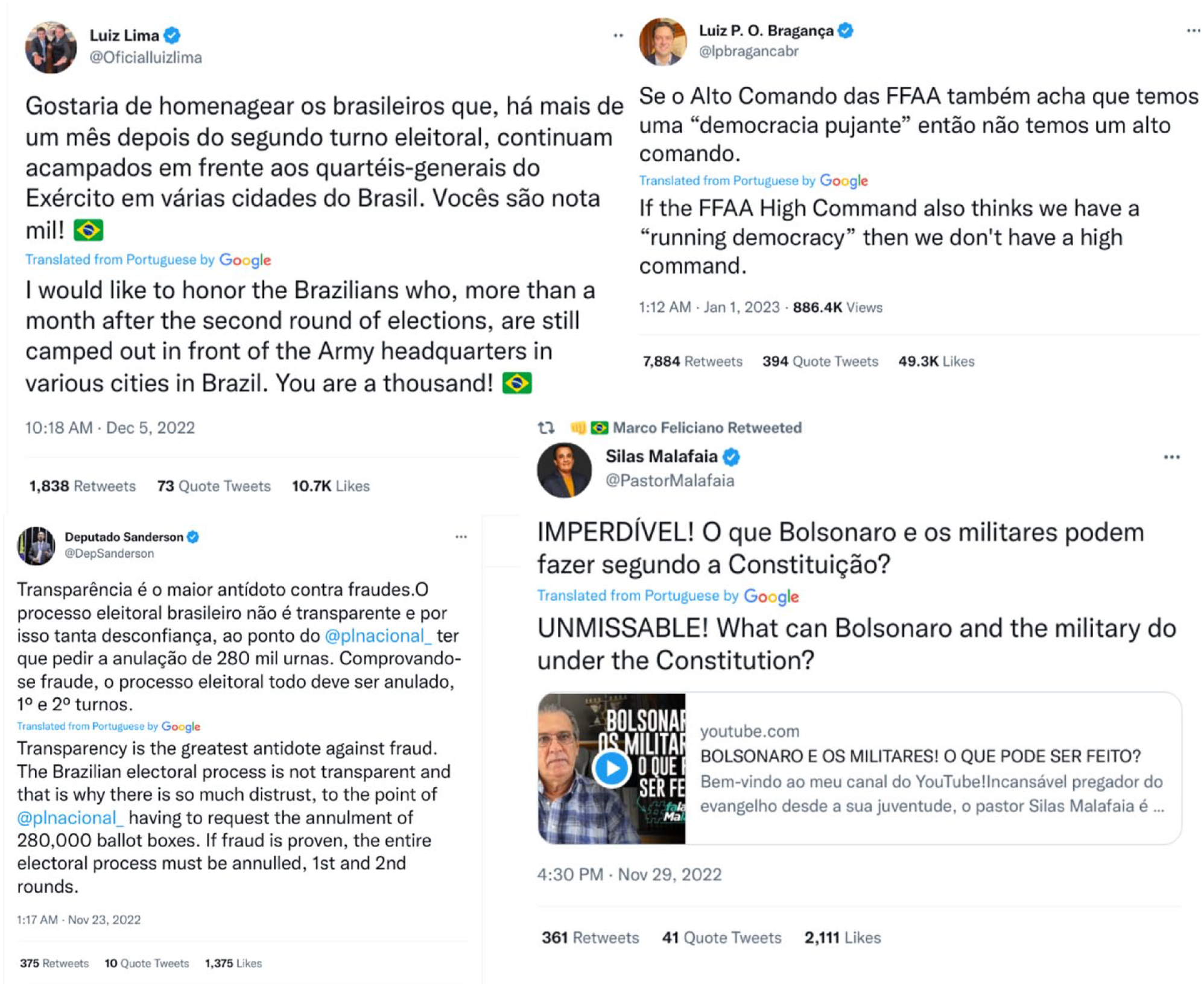
Sample of public pronouncements of elected Members of Congress coded as 1 (casting doubt on the electoral process) or 2 (supporting a coup d’état), including posts by Silas Malafaia and Luiz Philippe of Orléans-Braganza.

Sample of public pronouncements of elected Members of Congress coded as 1 (casting doubt on the electoral process) or 2 (supporting a coup d’état), including posts by Carlos Jordy and Girão Monteiro Filho.

Sample of public pronouncements of elected Members of Congress coded as 1 (casting doubt on the electoral process) or 2 (supporting a coup d’état), including posts by Alexis Steverlynck Fonteyne and Kim Kataguiri.

Sample of public pronouncements of elected Members of Congress coded as 1 (casting doubt on the electoral process) or 2 (supporting a coup d’état), including posts by Bia Kicis and Coronel Tadeu Anhaia de Lemos.

Sample of public pronouncements of elected Members of Congress coded as 1 (casting doubt on the electoral process) or 2 (supporting a coup d’état), including posts by Alex Santana and Flávio Bolsonaro.
In the following, we unpack the analysis performed on pronouncements posted by accounts identified as OP (opposition), GO (government), and CE (Centrão), which is the broader base of coalitions that supported the Bolsonaro administration but that are not part of the government core. Given the broad range of political parties in the Brazilian Congress, and the disparate political alliances they put in place at municipal, state, and federal levels, we relied on Congresso em Foco (2022), a project funded by the Google News Initiative in Latin America, to classify the Twitter accounts in the three abovementioned political blocks. Congresso em Foco (2022) relies on the share of bills voted by each representative to assign it to the opposition, the government base, or the broader alliance which the service terms “Governism,” with opposition representatives having voted with the government in fewer than 30% of the bills, CE (broader alliance) having voted between 31-60%, and the core Bolsonaro base having voted with the government between 61-100% of the bills introduced in Congress. The downside of this method to classify partisan allegiance is that the upper house tends to vote on bills that have already been read and passed through the lower house, so the upper house appears more aligned with the government in this classification system.
Results
We begin by examining the database of Bolsonaro’s public statements to identify instances of false claims of electoral fraud, broad and unqualified attacks on democratic institutions, and the out-group stereotyping of progressive groups that served as rationale for what was deemed a necessary intervention by the army and the annulment of the election (Rennó, 2022). Public statements that included no such elements were coded as 0 (no problematic content), with statements coded 1 dedicated to messages that attacked democratic institutions and indirectly framed the opposition candidate as an existential threat. Finally, statements coded 2 included explicit claims for a coup d’état. Based on this classification, we found 122 problematic statements (17%) from the universe of 728 public announcements fact-checked by Aos Fatos, with the lion’s share of this subset including indirect attacks and only two statements including direct threats or calls for a coup d’état.
Insurrectionist Frames
The analysis of Bolsonaro’s public statements reveals a series of recurrent frames that put into effect the insurrectionist playbook. These include claims aimed at further radicalizing the base or statements that may trigger political violence (see Supplementary Appendix 2—Bolsonaro statements coded). We found six central themes in the database curated by Aos Fatos: (1) Righteousness (54 statements; 44.2%): how progressive governments threaten conservative values through the imposition of gender ideology (and the false claim that progressives seek to convert children into homosexuals); (2) The communist threat (22 statements; 18%): the perceived notion that the Latin American left is associated with authoritarian regimes; (3) Corruption (27 statements; 22.1%): includes attacks to democratic institutions, such as the Supreme Federal Court or the press, both of which are portrayed as corrupt; (4) Election denialism (10 statements; 8.1%): includes attacks to the electoral process or the voting machine; (5) Historical revisionism (8 statements; 6.5%): statements in support of the Brazilian military dictatorship installed in the 1964 military coup; and finally, (6) Coup d’état (2 statements; 1.6%): open threats or calls for military intervention and justifications for a coup d’état.
These problematic and false statements appeared in interviews, debates, Facebook Live Streams, YouTube, and finally on Twitter. Indeed, all statements coded as problematic (1 or 2) by our team had been posted or featured on YouTube, an indication that visual platforms may be more effective at disseminating radicalizing content than text-based services like Twitter. Our analysis also shows that a large share of Bolsonaro’s statements employed fear-mongering tactics to stoke fear in an already radicalized and anxious base, another salient marker of a playbook optimized for rallying the base against a perceived enemy (Wodak, 2015). Bolsonaro’s statements follow a steady trend of increasing radicalization toward the election runoff. The public statements fact-checked by Aos Fatos show an uptake of 25 problematic statements in August, followed by 32 in September, and finally 65 in October when the election was held. In November, the period following the election, only one problematic statement was identified, a period after which Bolsonaro became notoriously silent. The insurrectionist playbook nonetheless follows a clear and linear upward trend that culminates in calls for military intervention. With fear-mongering being central to this playbook, the statements include on-point messaging for the Bolsonaro base that promoted distrust in the electoral process and sowed anxiety with the looming prospect of electoral defeat. Figure 6 unpacks these trends.
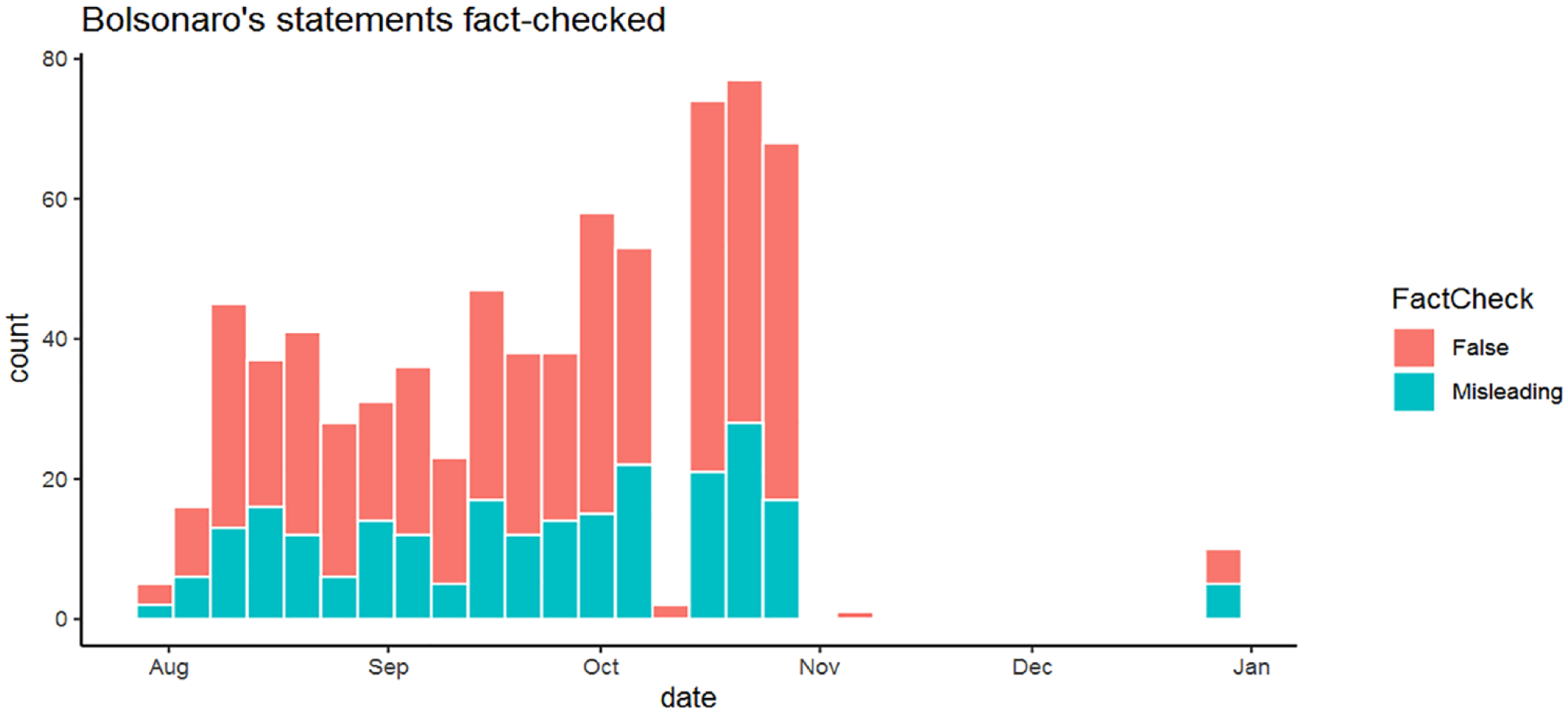
Public statements made by Bolsonaro fact-checked during the official electoral period.
The core tenets of this playbook are largely aligned with the agenda advanced by the Bolsonaro administration and typified in the set of public statements fact-checked by Aos Fatos. Centered around nationalism, religion, family, and the right to bear arms, this political value space exploits a cleavage at the heart of the Brazilian political arena by playing identity politics in what Bolsonaro supporters believe to be a global culture war against cultural liberalism (similar frames are found in the agenda advocated by Donald Trump, Viktor Orban, and Benjamin Netanyahu). Bolsonaro’s public statements consequently reflect this commitment to issues of guns, Christianity, and what is repeatedly slammed as “cultural Marxism,” “gender ideology,” and “environmental psychoses over deforestation” (Schipani, 2019).
Another common thread in the statements is the attacks on the institutions overseeing the election process, government institutions, and in particular the Supreme Federal Court. These statements challenge the independence of the electoral process and accuse judges of the Supreme Federal Court of partisanship. The manufactured notion of a constitutional military intervention and Bolsonaro’s historical revisionism (Waymer & Heath, 2023), which posits that there was no coup to establish an authoritarian regime controlled by the Brazilian military in 1964, also feature prominently in the statements. Taken together, these narrative frames are carefully crafted to stir “righteous rage” (Rothbart & Stebbins, 2022). This combination of conservative social agenda, cultural war, and insurrectionist pragmatism was effective at rallying the base, but it is unclear the extent to which it was embraced by the government coalition, a broader political group without which the Bolsonaro administration would fail to govern.
Support for the Insurrection
Next, we inspect the extent to which the insurrectionist playbook advocated by Bolsonaro was embraced by members of the Brazilian National Congress. We found that 12% of the representatives in the National Congress posted official statements on Twitter openly supporting a military coup d’état or questioning the electoral process. The classification of accounts in the lower house (Câmara dos Deputados), again according to the classification provided by Radar to Congresso, is the following: 31 representatives are classified as members of government alliance (CE), 257 are core government (GO), and 86 are opposition (OP)―with 4 Twitter accounts of representatives not featuring in the Radar do Congresso database. In the upper house (Senado Federal), given the particulars of this method detailed above, only one representative is classified as CE, with the remainder appearing as GO.
The trajectory of the coup d’état is reflected in the public announcements of congresspeople who supported the Bolsonaro administration either as members of the government or the Centrão coalition. While the campaign is marked by watershed events such as the debate broadcast by Globo TV, the steady volume of public statements is relatively constant, picking up the pace in August and peaking in September and early October, when the first round of the presidential election took place, and then toward the end of the month, when the runoff election is held and the opposition candidate Lula da Silva comes out with a victory in the presidential election.
As a result, the distribution of public statements peaks early and decreases over time, with the density curve shown in Figure 7a closely resembling a geometric distribution. The distribution of unsubstantiated fraud claims, however, follows the opposite pattern: as the campaign evolves and it becomes increasingly clear that Bolsonaro will likely fail to secure a second term, fraud claims escalate steadily (Figure 7b) and in sharp contrast to the pacing of the campaign trail (Figure 7a). Direct calls for military intervention and support for a coup d’état, finally, peaked toward the end of October when Lula da Silva was announced president-elect by the Superior Electoral Court of Brazil (Figure 7c). Figure 7 unpacks these conflicting trends and is in line with the research question driving this study.

Distribution of public statements (a), fraud claims (b), and calls for military intervention (c).
Finally, we inspected the temporal series of false claims embedded in official public statements of Government (GO) and coalition (CE) representatives. Figure 8 shows the frequency of public statements casting doubt on the electoral process or inviting a military intervention. While the Government core continues to put out official statements with false claims of electoral fraud, the broader coalition (CE or Centrão) abandons the insurrectionist playbook in early September. The government base becomes increasingly more isolated in its efforts to push the electoral fraud narrative, notwithstanding the relatively stable stream of messages with false claims about the election pushed by government core representatives in the period.

Frequency distribution of public statements casting doubt on the electoral process or calling for military intervention by government (GO) and coalition (CE) representatives.
One such case is that of Representative Pompeo de Mattos of the Centrão (CE), who during the election campaign posted public statements insinuating electoral fraud. Such messages slowly disappear in the following months, and after the attack to the government buildings on 8 January, Pompeo de Mattos put out a statement expressing utter disapproval of the attacks and subsequently became one of the signatories of the bill calling for the establishment of a parliamentary commission of inquiry into the funding and the organization of the groups that attacked Brazil’s government institutions.
Discussion
In this article, we unpacked the insurrectionist playbook exploited by the Bolsonaro campaign that drove the failed coup attempt in January 2023. We charted how Bolsonaro’s statements followed a playbook that sowed wrath against the contender Lula da Silva, further propelling his supporters to the insurgency after the elected president was sworn in. We classified and analyzed Bolsonaro’s public statements fact-checked by Aos Fatos to unpack the core campaign targets that underlie this insurrectionist playbook. This first component of our analysis allowed for identifying the most salient topics in the playbook, namely false claims that cast doubt on the electoral process and calls for overthrowing the government. Second, we identified an uptake in extremist discourse within the Bolsonaro base during the campaign trail that is indicative of broader mobilization efforts leading to the coup attempt, but these efforts may have alienated the broader government base. This proposition, finally, was found to be consistent with our data which show dwindling public support for the coup d’état from members of the broader Bolsonaro coalition, a trend that is inversely proportional to the escalating rhetoric of the Bolsonaro presidential campaign.
We defined the insurrectionist playbook as the political alignment between elites and grassroots activists that leverages social media to cast doubt on the electoral process and galvanize support for a coup d’état. While the connective action framework has been used mainly to describe how progressive social movements engage with contentious politics, we posit that far-right movements have leveraged this set of strategies and tactics to achieve reactionary ends. In doing so, they managed to connect the political and economic interests of the far-right with those of grassroots activists, a political realignment that was pivotal to the upsurge in nationalist and populist sentiments in the past decade exemplified by the election of Donald J. Trump in the United States and the Brexit referendum in the United Kingdom (with comparable developments in Brazil, India, and beyond).
The insurrectionist playbook thus provides an ideological bridge between elite discourse and populist rhetoric, a frame that often relies on class and racial resentment and is compounded by the reactionary cultural backlash exploited by populist elites (Inglehart & Norris, 2016). This unlikely alliance, referred to in the press as the “anti-globalist revolution” (Douthat, 2017), borrows from the ideologue Steve Bannon and his mission of “revolting against the corrupt and the compromised political class” (Hains, 2017). It has historically evolved from the contentious politics of grassroots activist groups like the Tea Party and Occupy Wall Street and a broad set of grievances ultimately turned against the political establishment (Inglehart & Norris, 2016). By all accounts, social media platforms have been integral to this populist upheaval by tactically providing the channels to distribute the insurrectionist frames that rally grassroots activists and coordinate elite rhetoric toward the heralded looming revolution.
The eventual collapse of the base that adopted this playbook shows that these insurrections were neither looming nor inevitable, having indeed failed in the United States and in Brazil, but the playbook is likely to continue making strides in the political landscape. While the political establishment in Brazil moved away from the narrative of election fraud and eventually from Jair Bolsonaro himself, thereby quietly but effectively preempting the self-coup d’état, much of the Republican Party in the United States embraced unsubstantiated claims of electoral fraud, with voters often choosing election-denying candidates to Congress and state legislatures. This playbook is also likely to evolve and transform over time, with the 2023 Wagner Group rebellion borrowing elements from it, chiefly the expert use of social media by a populist leader, the embracing of conspiracy theories, and of course the outburst of violence.
Conclusion
The results presented in this study describe the insurrectionist playbook and identify the dwindling support for the coup d’état from members of the broader Bolsonaro coalition. These results rely on frequency measures of support for Bolsonaro’s insurrectionist playbook from elected representatives in the lower and upper houses of the National Congress of Brazil. These results are therefore descriptive and cannot directly infer causation, with our conclusions being conditional on these limitations. Future studies should collect more granular longitudinal data to explore the intersection of elite rhetoric, media framing, and the prospects of insurrection attempts (Baum & Groeling, 2009; Groeling & Baum, 2008). Further studies can also explore how social media platforms are instrumental to the organization of the insurgency. For this insurrection in particular, but also for the Bolsonaro campaign more broadly, social media was Bolsonaro’s go-to channel to spread distrust about Brazil’s democratic institutions that would ultimately contribute to the storming of government buildings in Brasilia in protests against the newly-elected president Lula da Silva. While his statements would appear on TV and radio, the lion’s share of problematic statements fact-checked by Aos Fatos were hosted by YouTube.
Our results also echo growing concerns that the content moderation performed by social platforms remains broadly unaware of cross-platform coordinated posting. Keulenaar et al. (2023) identified several posts from Bolsonaro supporters on YouTube, Facebook, Twitter, and Instagram that included links to non-moderated, “alt-tech” platforms where content moderation is limited if at all existing, including Bitchute, Rumble, Gettr, and of course Telegram. As social platforms do not coordinate their responses, insurrectionists can evade moderation policies by hosting content outside of their servers, subsequently providing links to the external content for maximum exposure and engagement. This scholarship also identified instances of “dislocated content moderation,” whereby US-based platforms, largely unfamiliar with the Brazilian political context, are unable to proficiently detect and remove problematic content because it falls outside of their Western-oriented community guidelines (Vinhas & Bastos, 2022).
Finally, future research should seek to systematically collect data whenever the insurrectionist playbook is deployed. Consisting of narrative frames that leverage social media platforms to cast doubts on the electoral process and rally an increasingly radicalized base, the blueprint of this playbook has matured. Future research should also seek to quantify the lagged effect of social media insurrectionist propaganda on offline, real-world developments. This playbook often requires its participants to host content in fringe networks to avoid content moderation and community guidelines governing social media platforms, but the hosting of insurrectionist content on fringe networks is not intended to be permanent; invariably, it is brought over to mainstream social platforms whether by direct linking or by flooding their platforms to galvanize support through decentralized coordination. This too represents an important avenue for future research in the area.
Supplemental Material
sj-docx-1-sms-10.1177_20563051231211881 – Supplemental material for The Insurrectionist Playbook: Jair Bolsonaro and the National Congress of Brazil
Supplemental material, sj-docx-1-sms-10.1177_20563051231211881 for The Insurrectionist Playbook: Jair Bolsonaro and the National Congress of Brazil by Marco Bastos and Raquel Recuero in Social Media + Society
Supplemental Material
sj-xlsx-2-sms-10.1177_20563051231211881 – Supplemental material for The Insurrectionist Playbook: Jair Bolsonaro and the National Congress of Brazil
Supplemental material, sj-xlsx-2-sms-10.1177_20563051231211881 for The Insurrectionist Playbook: Jair Bolsonaro and the National Congress of Brazil by Marco Bastos and Raquel Recuero in Social Media + Society
Footnotes
Acknowledgements
The authors are thankful to Aos Fatos for sharing their data and to Taiane Volcan and Calvin Cousin for their important contributions to this project.
Declaration of Conflicting Interests
The author(s) declared no potential conflicts of interest with respect to the research, authorship, and/or publication of this article.
Funding
The author(s) disclosed receipt of the following financial support for the research, authorship, and/or publication of this article: This study was partially supported by the University College Dublin and OBRSS scheme (grants R21650 and R20825), the National Council for Scientific and Technological Development (grants 406504/2022-9, 405965/2021-4, and 302489/2022-3), and FAPERGS (grant 19/2551-0000688-8).

Supplemental Material
Supplemental material for this article is available online.
Author Biographies
References
Supplementary Material
Please find the following supplemental material available below.
For Open Access articles published under a Creative Commons License, all supplemental material carries the same license as the article it is associated with.
For non-Open Access articles published, all supplemental material carries a non-exclusive license, and permission requests for re-use of supplemental material or any part of supplemental material shall be sent directly to the copyright owner as specified in the copyright notice associated with the article.
