



Abstract
This article explores the role of social media in athlete activism and sport commodification through the case studies of two elite multiracial athletes who represent Japan, professional tennis player Naomi Osaka and professional basketball player Rui Hachimura. Osaka’s mother is Japanese and her father is Haitian-American, whereas Hachimura’s mother is Japanese and his father is Beninese. Employing critical discourse analysis of Twitter and Instagram, we ask: How do they use social media to amplify their voices and advocacy for race and ethnicity? How do their athlete activism and multiracial identity appeal to fans and sponsors? We argue that social media lend them various ways for resistance through defying monoracial labeling and racialized sport stereotypes, manifesting their multiracial identity, speaking up against social justice issues, and affiliating with certain sponsors. We demonstrate how their “silent activism” is subtle, situated in everyday life, and not antithetical to the commodification of their (athlete-activist) image.
Athletes have long campaigned for race and ethnicity issues, but social media have dramatically changed the game for athlete activism. Sport is, not outside of but, embedded within politics. For instance, African American athletes have for decades resisted racial injustice through boycotts, conferences, and campus rallies (Edwards, 2017). In the past 5–10 years, social media’s rise has enabled athletes to mobilize in different ways, reaching a mass audience instantaneously and visibly supporting the Black Lives Matter (BLM) movement on Twitter 1 (Black et al., 2022; Schmittel & Sanderson, 2015). Our article explores the role of social media in athlete activism and their commodification as global brands through the case studies of professional tennis player Naomi Osaka and professional basketball player Rui Hachimura, both of whom represent Japan. Osaka’s mother is Japanese and her father is Haitian-American, whereas Hachimura’s mother is Japanese and his father is Beninese. Both are racially marked as “Blasian (mixed-raced Black and Asian)” (Washington, 2017) and we will refer to them throughout our study as “multiracial.”
Osaka and Hachimura are important to study firstly as young athlete-activists who are commercially successful and advocate social justice issues online, and secondly as multiracial athletes who represent Japan on the global sporting stage. On social media, athletes have redefined activism as more subtle, nuanced, situated within their everyday lives, and allowing for greater autonomy and “availability to weigh in on social and political issues,” unlike the riskier and more overt public demonstrations by previous generations of athlete-activists (Kluch, 2020; Schmittel & Sanderson, 2015, p. 342). These shifts raise questions on whether their social media activism can enact change and if their commercial success impedes their resistance. Moreover, sportsmen and sportswomen often have “asymmetrical visibility” in terms of their perceived contributions to social movements (Cooky & Antunovic, 2020, p. 695). Our study offers insight into this by comparing Osaka’s and Hachimura’s social media athlete activism.
Although often projected as monoracial and monoethnic, Japan has multiple racial and ethnic minorities, including the Ainu, Zainichi (ethnic Korean residents in Japan), and hāfu (half)—a term used to describe someone with one Japanese parent and one non-Japanese parent. 2 Historically and in the present day, racioethnic minorities have faced discrimination from their majority jun-nihonjin (pure Japanese) counterparts. Being multiracial, Osaka and Hachimura challenge the myth of homogeneity, which stems from racialized ideologies of having a “pure” bloodline and unique culture and language—a Japanese exceptionalist discourse known as nihonjinron (theories about the Japanese) (Befu, 2001). Yet, while Osaka and Hachimura may offer alternative ways of being Japanese, they are also privileged by their global success as elite athletes. Want (2016) observes a double standard in how Japanese media portray hāfu athletes: if they are successful on the international sporting stage, “racial sameness” instead of difference becomes emphasized and they become “hailed as Japanese heroes,” regardless of their multiracial identity (pp. 90–91). Osaka’s and Hachimura’s exceptional status therefore suggests a paradox—they are role models who do not represent the lived experience of ordinary racioethnic minorities in Japan. Their complex positionality and the dearth of scholarship on multiracial Japanese athletes make them significant to study.
A four-time Grand Slam singles champion and the first Asian/Japanese player to be ranked Number 1 by the Women’s Tennis Association, Osaka has become the highest-paid female athlete since 2020 with estimated earnings of US$51.1 million in 2022 (Forbes, n.d.). Born in Osaka, Japan, she has lived in the United States since she was 3 years old when her family relocated to New York and later Florida. Despite this and being less fluent in Japanese, Osaka’s parents decided she would represent Japan. This decision would prove important in her career when in 2018, she began attracting big endorsement deals from Japanese companies like Nissin, Shiseido, Yonex, and Nissan (Newcomb, 2018). Osaka’s Black Lives Matter (BLM) advocacy began in May 2020 when she marched in Minneapolis and Los Angeles (LA) and tweeted about racial injustice, garnering backlash from Japanese conservatives. Prior to this, she had mostly avoided direct discussion about racial issues, except to acknowledge her multiracial identity (Ho & Tanaka, 2022). This careful management of Osaka’s image in her early career has perhaps allowed her to get away with activism—a longtime contentious issue for elite athletes, but especially for sportswomen whose voices are often excluded (Cooky & Antunovic, 2020; Roberts, 2022).
Unlike Osaka, Hachimura’s activism has been more muted although, as we shall discuss, this is not less meaningful. Currently a power forward for the LA Lakers, Hachimura is the third Japanese native to become a National Basketball Association (NBA) player. 3 Born in Toyama, Japan, Hachimura played basketball for Meisei High School in Sendai and led the team to victory thrice in the All-Japan High School Tournament. After being scouted to play college basketball for the Gonzaga Bulldogs, he left for the United States. In 2019, he made his debut with the Washington Wizards when he was drafted ninth overall—a feat in and of itself. In January 2023, his career reached new heights when he was acquired by the Lakers, becoming its first Japanese player. Despite these achievements, Hachimura’s earnings are more modest than Osaka’s, estimated to be US$10 million in 2019 as an NBA rookie; his endorsement deals have mostly come from Japanese companies like NEC, Casio, Nissin, and Softbank, although he also signed with Nike’s Jordan Brand (Badenhausen, 2019).
Drawing on critical discourse analysis of their Twitter and Instagram accounts, we examine the connections between their multiracial identity, activism, commodification, and self-representation. We explore these questions: How do Osaka and Hachimura use social media to amplify their voices and advocacy for race and ethnicity? How do their athlete activism and multiracial identity render them more appealing to fans and sponsors?
We argue the affordances of social media lend Osaka and Hachimura various ways for resistance through amplifying their voices and advocacy for social justice issues; defying monoracial labeling and manifesting a multiracial identity; and having agency in choosing which sponsors they wish to affiliate with. Importantly, this resistance is not impeded but fueled by sponsors looking to capitalize on these athletes’ activist image and influence. We demonstrate how rather than overt resistance, their athlete activism is silent. What we call “silent activism” denotes subtle forms of resistance that are situated in everyday life and not antithetical to athletes’ (self-)commodification. Silent activism is deeply intertwined with their identity and visibility as multiracial in Japan and the United States, manifesting in their strategic use of visuals, captions, and emoticons on social media—which allows their supporters to interpret their own meaning on these platforms—as well as endorsements and collaborations with certain brands.
Multiracial Athletes in Sports Media
Before we discuss Osaka and Hachimura, some background on race and ethnicity in sports media is necessary. A vast body of scholarship has examined the politics of Black athletes in mainstream media (e.g., Boykoff & Carrington, 2020; Cole & Andrews, 2001) and centered on Black sportswomen like tennis champion Serena Williams who has received numerous racist and sexist hate comments on social media (e.g., Litchfield et al., 2018; Schultz, 2005), although much less has been written on multiracial athletes. Focusing on multiracial athletes—especially multiracial sportswomen—gives voice to their experiences of interlocking racial, classed, and gendered oppressions. While situated mainly in the United States and Japanese contexts, our study on Osaka’s and Hachimura’s experiences bears implications for other multiracial athletes, on which very little literature exists, even within this race and sports communication scholarship. It contributes to a broader understanding of how such athletes might navigate racialized stereotypes in sports media and express their multiracial identities.
Granted, burgeoning studies on multiracial athletes in US sports media have shown how journalists’ monoracial labeling of multiracial athletes reinforces racialized sport stereotypes, such as in the case of professional golfer Tiger Woods (e.g., Deeb & Love, 2018; Washington, 2017). More recently, scholars have discussed how through the lens of misogynoir or “anti-Black misogyny,” Western mainstream media have (mis)represented Osaka as Japanese and invisibilize her Blackness (Razack & Joseph, 2021, p. 291). As compared to Williams, Osaka’s “proximity to whiteness” has important implications on how she was accepted and treated in a traditionally White sport (Roberts, 2022, p. 339), which also affects her marketability and social justice advocacy—something we discuss in the next section.
In Japanese sports media, there is a similar dearth of scholarship on multiracial and multiethnic athletes, who are known as hāfu (half). Despite a growing number of hāfu athletes representing Japan internationally, little has been written on them as compared to their jun-nihonjin (pure Japanese) counterparts. Exceptions include Christensen’s (2012) study of Yu Darvish, a Major League Baseball (MLB) player of Iranian and Japanese parentage, who emphasized his Japaneseness over his hāfu identity, adhering to mainstream media’s construction of all successful athletes as Japanese. Comparing news articles on Osaka and Kei Nishikori, a jun-nihonjin professional tennis player, Bien-Aimé and Kuwahara (2022) found that although both were treated as “Japanese first without much distinction,” journalists often justified Osaka’s Japaneseness to a Japanese readership by referencing her “Japan-born” status and multiracial identity (p. 112). This desire to integrate Osaka into an imagined homogeneous Japanese nation is apparent in Ho and Tanaka’s (2022) analysis of the pulled Nissin advertisements, where they contend the animated Osaka “reflects racialized and gendered ideologies of Japaneseness and nationhood” (p. 607). Fewer studies have so far examined how social media can empower hāfu athletes to challenge such ideologies and elicit conversation on race and sport in Japan and beyond, an important dimension of contemporary sports media, which our study offers insight on.
Sport Activism and Branding on Social Media
In recent years, social media have become valuable for athlete-activists to engage in social justice issues and promote their branding as sport celebrities. Scholarship on elite and non-elite athletes’ activism has discussed their reach and repercussions when they use their platforms to protest racial injustice, although much of this has so far focused on sportsmen’s activism in the United States, Australian, United Kingdom, and Western European contexts (Cooky & Antunovic, 2020). Despite its long history in sport, athlete activism continues to be seen as “nonnormative behavior” Kluch (2020, p. 566), exemplified by Facebook attacks on and sport governing bodies’ disciplining of US American football player Colin Kaepernick and soccer player Megan Rapinoe for their national anthem protests (Schmidt et al., 2019). Yet, scholars also extol the advantages of Twitter for voicing athletes’ opinions and raising awareness for social injustice issues, which could “stimulate important conversations about problematic aspects of sport culture specifically, and societal culture at large” (Schmittel & Sanderson, 2015, p. 342).
In the Asian context, athlete activism is much less studied, although there is emerging literature in the Japanese, South Korean, and Mainland Chinese contexts. Japanese athletes have publicly protested sexual and power harassment, such as two well-known cases in 2018 involving a gymnast and a freestyle wrestler (Takamine, 2022). Korean elite athletes with disabilities engaged in activism because their higher status gave them a voice and enabled them to challenge disability discrimination in a society that typically excludes them (Choi et al., 2019). Similarly, expatriate non-elite athletes in China who play in the roller derby league used the sport to empower women, enable feminist activism, and protest gender inequality and injustice in a society where such issues are often sanctioned (Pavlidis & O’Brien, 2017). Although these studies are important, we note that few have examined social media’s role in Asian athlete activism, which our article contributes to. Thus, studying Osaka’s and Hachimura’s social media activist strategies enables us to better understand the seemingly contradictory relationship between online athlete advocacy and brand/product endorsements in sports communication research.
Few scholars have so far examined Hachimura, but there is recent scholarship on Osaka’s advocacy vis-à-vis that of other athletes. For instance, Osaka’s activism led not to public ostracization like in Kaepernick’s case, but enhanced her image and influence in the United States (Calow, 2022). This may be attributed to Osaka’s branding as “an Asian woman first,” which privileges her over Williams and could explain the public’s and sporting world’s different reactions to their advocacy (Roberts, 2022, p. 320). Yet, this could be due to a different political climate and each person’s individual experience of race, which are not the same even for two elite sportswomen of color (Calow, 2022). Granted, Osaka does have much larger endorsement deals than Williams as heavy racialization has unfortunately impacted the latter’s marketability, despite her ranking and stellar on-court achievements (Roberts, 2022). Osaka’s commercial success constitutes what McClearen and Nishime (2023) call “zoomer cosmopolitanism,” an emergent cosmopolitan ideal developed through commodifying a global sports celebrity’s brand for Generation Z consumers. Osaka appeals to zoomers by embracing racial, gender, and national diversity and social activism through her “ability to communicate fluently in a predominantly visual mediascape” (McClearen & Nishime, 2023, p. 41). Our study extends zoomer cosmopolitanism through a comparison of Osaka’s and Hachimura’s athlete activism on Twitter and Instagram, illuminating how their resistance is simultaneously fueled by sponsors and shaped by societal discourses.
Method and Data
To understand social media’s role in athlete activism and sport commodification, we employed critical discourse analysis of Osaka’s and Hachimura’s Twitter 4 and Instagram accounts. Critical discourse analysis is an inductive method: researchers treat media texts as “constructive and constructed” and “all discourse as social practice,” embedded within people’s everyday life and their specific context (Gill, 2000, pp. 174–175). This means we approach Osaka’s and Hachimura’s content as texts open for interpretation, critically interrogating what these texts can tell us about cultural beliefs of race and ethnicity in the arena of sport. Following scholars who have conducted critical discourse analyses of sport as enacted through social media (Black et al., 2022), we examine Osaka’s and Hachimura’s activism and branding on Twitter and Instagram as elite multiracial athletes. Although Osaka and Hachimura occasionally used other platforms like TikTok or Facebook, we focused on Twitter and Instagram as they were updated more frequently and appealed more to zoomer fans. Moreover, we noted at the outset that both athletes were more active on Twitter than Instagram and their Instagram content mostly replicated their Twitter content, indicating their preference for Twitter. However, we decided to examine both platforms because there may be differences in how the athletes are using them to reach different audiences and if so, we find it useful to draw from the data across both platforms.
We obtained our data from Osaka’s and Hachimura’s public Twitter and Instagram accounts from April 1, 2020 to March 31, 2023. This timeline reflects the period just before the May 2020 George Floyd protests, when Osaka and Hachimura began to participate in the BLM movement, until the present. We coded and organized these data we collected using the following thematic categories: “Sports,” “Media” coverage of the athletes, “Endorsements,” “Products” to mean brands (co-)created by them, “BLM,” “Other Activism” like mental health and #StopAsianHate; “Travel” for leisure, and “Personal,” which includes featuring their family, partner, or outfit of the day. Coding is a process in which researchers assign a “summative, salient, essence-capturing, and/or evocative attribute for a portion of language-based or visual data” (Saldaña, 2016, p. 4). Figure 1 provides an overview over 36 months of 1,343 posts, divided into 771 (Twitter) and 266 (Instagram) for Osaka and 227 (Twitter) and 79 (Instagram) for Hachimura.
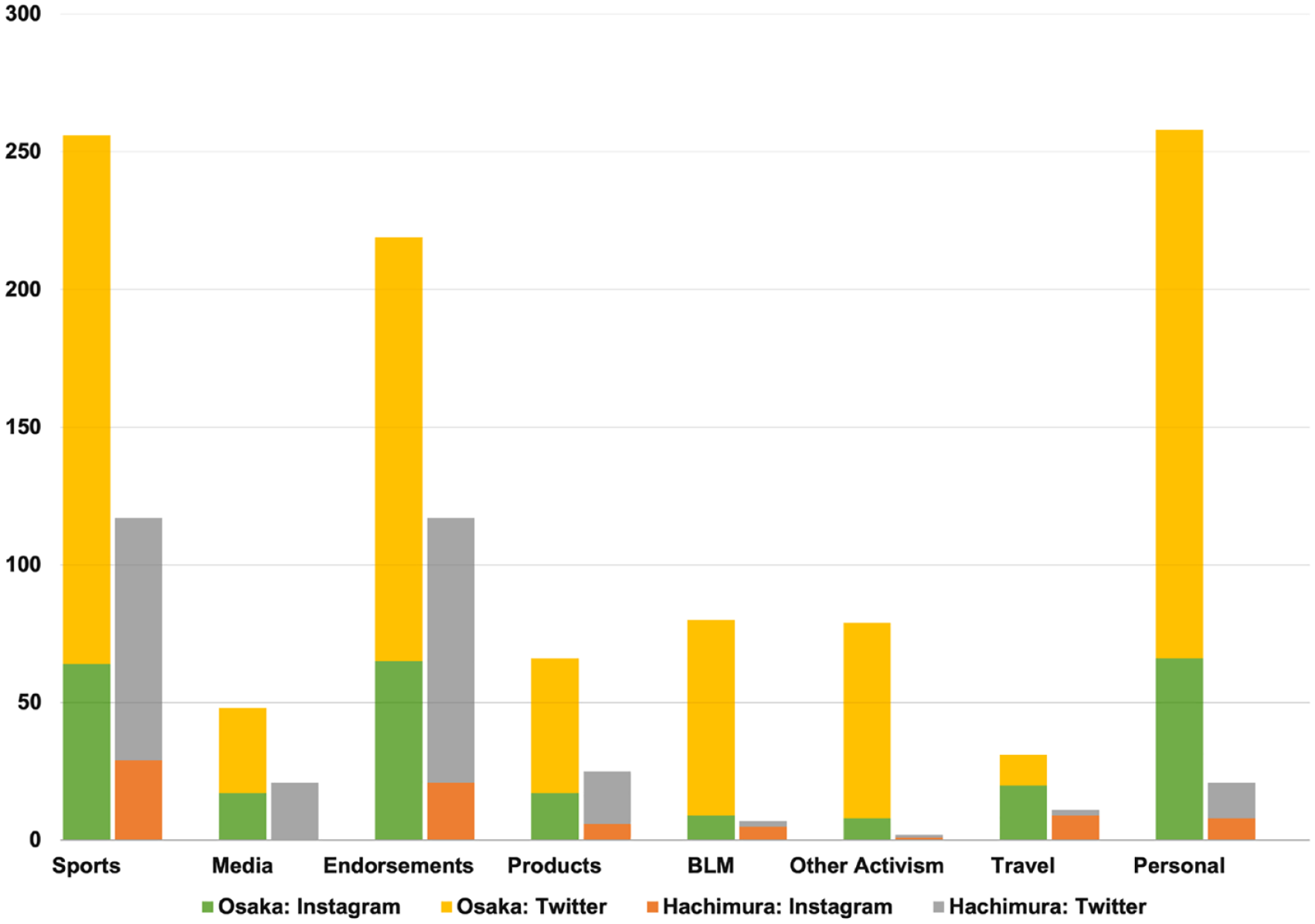
Osaka’s and Hachimura’s social media posts (April 1, 2020–March 31, 2023).
Figure 1 illustrates how on average, Osaka had more posts in all coded categories than Hachimura, which suggests her more active engagement with social media. For all categories, both athletes engaged more with Twitter than Instagram, except for Hachimura’s BLM and Travel posts, the significance of which we discuss later. Relevant to our study was Osaka’s much higher involvement in BLM and Other Activism (29% of all her posts) as compared to Hachimura (8.9% of all his posts). Despite their status as elite athletes, both had nearly as many posts on Sports as on Endorsements, except for Osaka’s tweets. The high number of posts on Endorsements shows their importance for sports celebrities and their enormous influence on selling various kinds of goods. Osaka had nearly twice the number of posts Hachimura had on Endorsements, and more than twice those on Products as him. Products constitute 14.2% of all Osaka’s posts and 16% of all Hachimura’s posts. Although Products and Endorsements are both commercial in nature and could be conflated, we decided to separate them because as we discuss later, there are differences between the athletes’ endorsement deals and the brands and products they have developed.
For critical discourse analysis, we focused on the categories of BLM, Other Activism, Endorsements, and Products and examined Osaka’s and Hachimura’s involvement in BLM. We did not compare other forms of activism as only Osaka was actively engaged in women’s empowerment, #StopAsianHate, and mental health. To supplement our analysis of social media data, we also examined a sample of news articles.
In what follows, we compare Osaka’s and Hachimura’s silent activism on their platforms. Through how they differently produce, advocate, and articulate racioethnicity, they resist monoracial labeling and racialized sport stereotypes while being privileged as Japanese on the global sporting stage. Subsequently, we discuss the two athletes’ marketability through their self-representational social media practices and endorsement deals. Osaka and Hachimura appear to have agency in affiliating with certain sponsors to bolster their activist image, which multinational corporations also profit from and is not antithetical to promoting a cosmopolitan lifestyle.
Advocating Race and Ethnicity Through Silent Activism
Osaka’s self-representational advocacy during the 2020 US Open, in which she used Instagram to share and appeal with visual images, attracted the most attention. At each of her seven games, she wore a black mask bearing the names of seven different African American victims of racism and (White) police brutality in the United States, Breonna Taylor, Elijah McClain, Ahmaud Arbery, Trayvon Martin, George Floyd, Philando Castile, and Tamir Rice. Images and videos of Osaka wearing these masks were simultaneously posted across her social media platforms and picked up by news outlets. However, the masks were most prominent on her Instagram profile, where all seven names were displayed at once, next to an image of her holding her Grand Slam trophy (Figure 2). These posts had no captions, as if she simply let the visual content speak for itself. One exception was her post on Martin, where she reflected on his death and how it shaped her fear of wearing hoodies as a child, connecting this to the continuation of Black injustice.

Osaka’s seven masks on her Instagram profile (@naomiosaka, n.d.).
Scholars and journalists have described her masking as a silent protest—raising her voice by putting on a mask—a kind of “soft power” enhanced by her platform as a Grand Slam champion (Bergeron, 2020; Calow, 2022; McClearen & Nishime, 2023). Without saying a word, Osaka was able to effectively speak out against racial injustice. On Twitter and Instagram, her followers left comments that showed they got her message, such as “BlackLivesMatter,” “Thank you for taking a stand. You are an inspiration,” and various fire, heart, clapping, and closed fist emoticons to cheer her on. One follower replied to her in Japanese, “Naomi-san, congratulations! Having fought through both tennis and racial issues (jinshu mondai), I think you are a true champion. Please keep fighting. I’m rooting for you behind the scenes.”
These responses demonstrate how Osaka’s actions speak louder than words and her mostly Generation Z followers understand her silent activism. Unlike past athlete-activists’ overt acts of resistance, she joins other zoomer athlete-activists in using social media as a vehicle for centering their activism on authenticity. Here, we draw on understandings of activism not only in terms of their actions, but also more importantly, “being open about their identities and backgrounds” and authenticity as “being true to oneself” and “providing visibility for marginalized groups and underrepresented identities” from Kluch’s (2020, pp. 579–580) study of US student-athletes’ activism. Based on this, Osaka’s silent activism appears located less in her actions than being the face of social change, which hinges on authenticity. Her authenticity stems from her visibility as someone who embraces her diverse identities as Black, Haitian, and Japanese. Her sheer presence as a multiracial woman in a historically White sport is already a form of resistance (Calow, 2022). On a visually oriented platform like Instagram, this is amplified, enabling her to illustrate her seven masks beyond the sports world—something her followers affirm in their comments. Osaka also embodies the axiom of staying true to oneself in her Personal tweets, which were as many as Sports and Endorsements tweets (Figure 1), and mostly feature her everyday life and sometimes her family and Cordae, her partner and a US American rapper. These tweets express her human side to followers, showing them who she is. Her authenticity is therefore important to her silent activism for her advocacy lies in her multiracial identity and visibility.
Silent activism is not antithetical to (self-)commodification for a few months later, consumer audio company Beats Electronics released a 30-s commercial featuring Osaka. In the commercial, she listens to music on Flex, the new Beats wireless earphones, while preparing for her next game. As she walks out of the locker room smirking, we see the words “SILENCE IS VIOLENCE” in white capital letters woven into her dark braids. Although the advertisement is meant to promote Beats’s new product, it produces another, arguably more important, message where like with her seven masks, she says nothing but makes visible her racial advocacy. Since McClearen and Nishime (2023) have already analyzed this commercial, we focus on Osaka’s tweet alongside it, As a kid I was the quiet one, I was the one that wanted to just skate by unnoticed and conflict-free. But the beauty of growing up is learning and seeing things for yourself, one of the things I’ve learned is that everyone has a platform and how they use it is their responsibility. (@naomiosaka, 2020)
Osaka’s words reflect zoomer athlete-activists’ awareness of the opportunities afforded to them—something also highlighted by Asian athlete-activists who used their platforms to enact social change (Choi et al., 2019). Being true to herself, Osaka describes herself as someone who is quiet and likes to avoid conflict, which may partly explain why she sidestepped discussions about racioethnicity early in her career. After the 2020 Floyd protests, however, she learned she had the power to speak up for others. Reinforcing this awareness in 2021 was media coverage of her silent activist efforts like her video interview after she had won the prestigious Laureus World Sportswoman of the Year Award, where she emphasized the importance of using her platform (@naomiosaka, 2021a).
As a tool of intervention, social media enables Osaka to speak up for what she believes in and disrupt mainstream media constructions of her as having a single racial and national identity. Although her activism is silent, she is not silent about the things she cares about. Through her seven masks, advertisements, and other visual content, she makes clear where she stands regarding racialized violence. Moreover, her self-representation on social media manifests her multiracial identity as someone who plays for Japan but has mostly lived in the United States and still has ties to Haiti. This defies Western and Japanese mainstream media’s frequent monoracial and mononational labeling (Bien-Aimé & Kuwahara, 2022; Ho & Tanaka, 2022; Razack & Joseph, 2021; Roberts, 2022), complicating how her fans and sponsors may differently approach her. Yet, her privilege as an elite Japanese athlete and her zoomer cosmopolitanism potentially limit how far her advocacy can go (McClearen & Nishime, 2023). Can a commercially successful sport celebrity like Osaka be taken seriously as an activist? Before answering this in the next section, we turn to Hachimura.
Hachimura’s Activism: Overt or Silent?
Little scholarship on Hachimura exists despite his status as arguably the most successful Japanese NBA player in history. His activism is contained within fewer social media posts than Osaka’s, which contradicts the asymmetrical visibility of sportswomen versus sportsmen Cooky and Antunovic (2020) observe. Figure 1 suggests Hachimura mainly uses Twitter and Instagram as public-facing platforms for promoting his image—including posting numerous advertisements—but less for personal use. Despite this, we argue his advocacy is no less meaningful. Like Osaka, Hachimura uses “speech as a form of intervention” (Kluch, 2020, p. 581), using his voice to speak about racial injustice mostly through social media.
In June 2020, Hachimura was a part of #TogetherWeStand, a player-led social justice initiative by the Wizards and Women’s National Basketball Association (WNBA) team Washington Mystics supported by their company Monumental Sports (Filyo, 2020). The initiative began with social media announcements from players encouraging followers to gather for the rally. On Instagram, Hachimura posted a poster of a closed fist imagery in black and red and “Black Lives Matter” in white with the caption, “Tomorrow 11AM 6th & G Street, NW Rain or Shine” (@rui_8mura, 2020b). On Juneteenth, a day commemorating the end of slavery in the United States, Hachimura marched on the streets with Wizards and Mystics members. Their collective efforts resulted in thousands of attendees and “over 15M impressions, 1.6M views, 562K engagements” on social media; #TogetherWeStand even won Outstanding Social Justice Initiative at the 2021 Hashtag Sports Awards (n.d.).
Hachimura simultaneously posted and retweeted black and white photos of the Juneteenth march. In one photo, he stands in the foreground with his right fist raised (Figure 3). His left hand grasps the banner with another teammate, which read “TOGETHER WE STAND” next to a DC Fist logo. He is surrounded by other people whose fists are similarly raised and who wear the same black t-shirt with closed fist imagery. In the background is the Martin Luther King (MLK), Jr Memorial. Captioning this photo were closed fist and black heart emoticons. Most of the comments to Hachimura appeared supportive, such as “Am so happy to see you at the front line,” “Cool (kakkoii),” and various heart, clapping, and closed fist emoticons. One Instagram comment in Japanese read, “There’s something wrong with the world that people aren’t treated as equals just because they have black (kuroi) skin. I’m Japanese, but I consider them brothers.”

Hachimura’s Instagram post on #TogetherWeStand (@rui_8mura, 2020a).
#TogetherWeStand might be considered an overt form of activism, loud instead of silent. Despite Hachimura and other athletes employing social media to amplify their voices, advocate racial issues, and mobilize people, they did march in the peaceful protest like past athlete-activists. Wizards and Mystics players showed by example why racial injustice was important to them, many of whom were African American. Yet, Hachimura’s activism could also be considered silent because of the high visibility he gave to the initiative, (re)posting images with scant captions to convey his message across Instagram, which he used more for BLM than Twitter. Especially to his followers in Japan where he is known as a hāfu athlete, his silent activism on the visually oriented platform was appreciated as a way of visibly embracing his multiracial identity as Beninese-Japanese and showing support for others like him without explicitly saying so. This allowed his followers the opportunity to give voice to his advocacy, which one Japanese follower did by highlighting the absurdity of discriminating someone based on their skin color. This follower’s comment reflects how such forms of racism are systemic in Japan and elsewhere.
Hachimura’s intervention is further complicated by having lived and grown up as Blasian in Japan and later beginning a career and adjusting to Black culture in the United States (Roberts, 2022). Yet, his visibility as Black in the United States and hāfu in Japan illustrates his marginalized status in both countries—albeit one who is privileged as an elite athlete—and therefore, his activism can be seen as representing people’s oppression on both sides. At the time, BLM was controversially presented in Japanese mainstream media as a US problem—backed by conservatives who maintained (anti-Black) racism did not exist in Japan—even as thousands took to the streets in major cities to protest everyday racism and xenophobia (Illmer, 2020). Hence, Hachimura’s involvement in #TogetherWeStand may have been simultaneously perceived by conservatives as radical and regarded by supporters as taking a stand against Japanese discrimination of racioethnic minorities, especially hāfu.
Aside from his distance to US Black culture, Hachimura’s cautious approach to activism including #TogetherWeStand and his decision to have fewer Personal posts (Figure 1) may have stemmed from an incident highlighted by his younger brother. In May 2021, Allen Hachimura, a basketballer at Tokai University, tweeted an Instagram hate message he received with the caption, “Although some say there is no racial discrimination (jinshu sabetsu) in Japan, some make racist remarks like these” (@allen_hachi, 2021). In the screenshot, the hater told the Hachimura brothers to die, adding they were born by mistake and were only good at basketball, using the slur kuronbo (Japanese equivalent of “nigger”). Rui Hachimura tweeted in reply, “These messages arrive almost every day.” This garnered an explosion of replies from followers, including his fans, who alternately condemned racism, chided the hater, apologized for these racial slurs, extended their support, and affirmed the brothers’ athletic abilities. One follower observed the hater was using a throwaway account, another commented the hater was just jealous of the brothers for their basketball prowess, whereas a third follower joked that at least the hater admitted they were good.
Hachimura’s response to his brother’s tweet suggests he gets numerous hate messages in private, even though he appears to receive positive comments in public. Online hate speech may have influenced how much he chooses to share about his personal life, to give haters less ammunition, and perhaps even reduced his social media use altogether. It may also account for how carefully he uses his platforms to speak about racioethnicity, opting to do so through a few chosen Instagram posts with many visuals but saying very little otherwise. A case in point was his posts for #TogetherWeStand, which did not include any personal reflection, only emoticons and details for mobilizing. His activism can therefore be considered mostly silent but overt where it needs to be.
Despite these differences to Osaka’s activism, we argue Hachimura’s activism should not be perceived as any less meaningful. Hachimura could have been following along with his teammates who orchestrated #TogetherWeStand or he could have refrained from participating in it altogether, but our view is that he chose to take a stand. In an interview, Hachimura expressed how although “it’s really hard to talk about [BLM],” he maintains there should be “one race” (Browne, 2023). What he means here is that instead of dividing people into different races, there should only be one. This shows his strong beliefs about racioethnic issues, even if he finds it difficult to communicate them, which could explain his more limited involvement in social justice issues as compared to Osaka.
While enabling anonymous racist abuse that operates to reinforce a homogeneous Japanese society, social media’s affordances also empower him to challenge such discriminatory discourses. His tweet that such messages are a daily occurrence is sufficient to raise public awareness about casual racism experienced by racioethnic minorities in Japan. This can be seen from his followers’ diverse reactions ranging from providing words of affirmation to him to reproaching the hater, even to the point of picking apart the hater’s comment. Furthermore, although an outstanding NBA player in his own right, Hachimura is less privileged than Osaka, whose higher social status and financial means augment her increased visibility and bolder form of activism (Calow, 2022). While both are multiracial athletes who are exceptionalized for their sporting achievements (Want, 2016), they possess different degrees of privilege according to their international success.
Branding Through Self-Representation
As we have seen in the last section, Osaka and Hachimura employ social media in various ways for their silent activism, which has enhanced their image and influence among zoomer fans. Contributing to their commercial success are multinational corporations who have eagerly capitalized on them as brands. Through examining some of their endorsements and products they have (co-)designed, including for well-known brands, we discuss how commercial success has impacted their athlete activism in this section. We contend the two athletes’ resistance is limited by what they show their followers on social media, including what their content reflects and which sponsors they affiliate with. This is especially so for the more privileged Osaka who embeds racial justice messages in her commercials like the Beats advertisement we examined earlier. However, Hachimura’s commercials contain no overt messaging. Does this suggest he is less of an activist, less marketable, and therefore less appealing to fans and sponsors?
We argue although Osaka is more popular and embodies zoomer cosmopolitanism more readily, Hachimura’s appeal should not be overlooked as his marketability hinges on his being a Japanese hero. This can be seen from how the Wizards started an official Japanese Twitter account in September 2019, shortly before he made his NBA debut in October 2019, which has helped to raise the team’s profile among Japanese fans. The Japanese Twitter account is similar to the one in English in terms of posting game and player updates except for the language; some of the interviews even include Japanese subtitles. The need to appeal to diverse fans corresponds with Hachimura’s social media accounts, which often has bilingual English- and Japanese-language posts.
Limited Resistance in Endorsements
With five times as much estimated earnings as Hachimura, Osaka’s endorsement deals are considerably bigger, often with international luxury brands that have nothing to do with sport. In January 2021 alone, she announced through several posts across her platforms that she was the new ambassador for luxury watch Tag Heuer, French luxury fashion house Louis Vuitton (LV) and financial management company Workday. In her LV post, she modeled a colorful asymmetrical dress and an iconic Monogram purse, her afro-textured hair loose (Figure 4). In the caption, instead of merely announcing her LV affiliation, Osaka added a personal story about buying an LV bag for her mother each year. Although such a bag would be costly and beyond what most people can afford, it enhances her authenticity as a daughter who cares to buy a gift her mother would treasure. While this advertisement appears to have little to do with her advocacy, it is not entirely unconnected. After she wore the seven masks during the 2020 US Open, her marketability would have increased, leading LV to capitalize on her as a brand.

Osaka’s LV tweet (@naomiosaka, 2021c).
Moreover, although there have been relatively few LV advertisements—the next one featuring the LV Twist bag was in August 2022—Osaka often posts “selfies” or pictures of herself casually wearing LV merchandise. Whether or not LV pays her for these non-advertisements, we may never know, but they do help to enhance the luxury brand, which is perhaps what they are really capitalizing on. On Instagram, while followers seemed delighted at her becoming an LV ambassador, several criticized her commercial leanings. One responded to her LV Twist commercial, “I remember when she won her first major, she said she wasn’t into the material things.” Another follower said, “You have the potential to be tennis legend and make history, but the commercial things and stuff are sucking up your energy.” These comments illustrate followers’ disappointment in her new attention to major endorsement deals. What may explain such criticisms is that a few months prior, she had played and lost in the 2022 French Open’s first round. They therefore attribute her poor showing to being distracted by non-tennis-related aspects. From this perspective, we interpret Osaka’s resistance as limited because her LV advertisements contain no racial justice messaging and instead promote a materialistic lifestyle.
In comparison to Osaka, Hachimura’s endorsement deals are much smaller and mainly targeted at Japanese consumers, many of which are legible to sports, such as Air Jordan, energy drink Lipovitan D, and Cannondale bicycles. While not endorsing any luxury brands, he promotes an urban middle-class lifestyle of a professional who travels often. Exemplifying this image are two different commercials by Lipovitan D and Cannondale Japan posted in August and October 2022 respectively, which feature Hachimura relaxing and traveling. Basketball is not the focus of these commercials and almost comes as an afterthought. It is symbolized in fragments of a hoop, his jersey shorts, and him holding, dribbling, or shooting a basketball. But the commercials emphasize Hachimura’s lifestyle. Indeed, his caption for the Lipovitan D post reads in Japanese, “It’s also important to enjoy your time off. Why not finish early sometimes and refresh yourself?” (Figure 5). The commercial is filmed at an undisclosed resort-like location with palmy trees, and he wears a colorful shirt but does not say a word. In the Cannondale commercial, Hachimura narrates in Japanese, beginning with a story about how he grew up in Japan riding his bicycle (Figure 6). The video then shows him cycling around LA, which many fans noted and congratulated him in their comments. The caption in Japanese reads, “When riding a bicycle, you feel unleashed from everyday life, as if you are flying in the sky. Shall we ride a bicycle together?”

Hachimura’s Lipovitan D tweet (@rui_8mura, 2022).
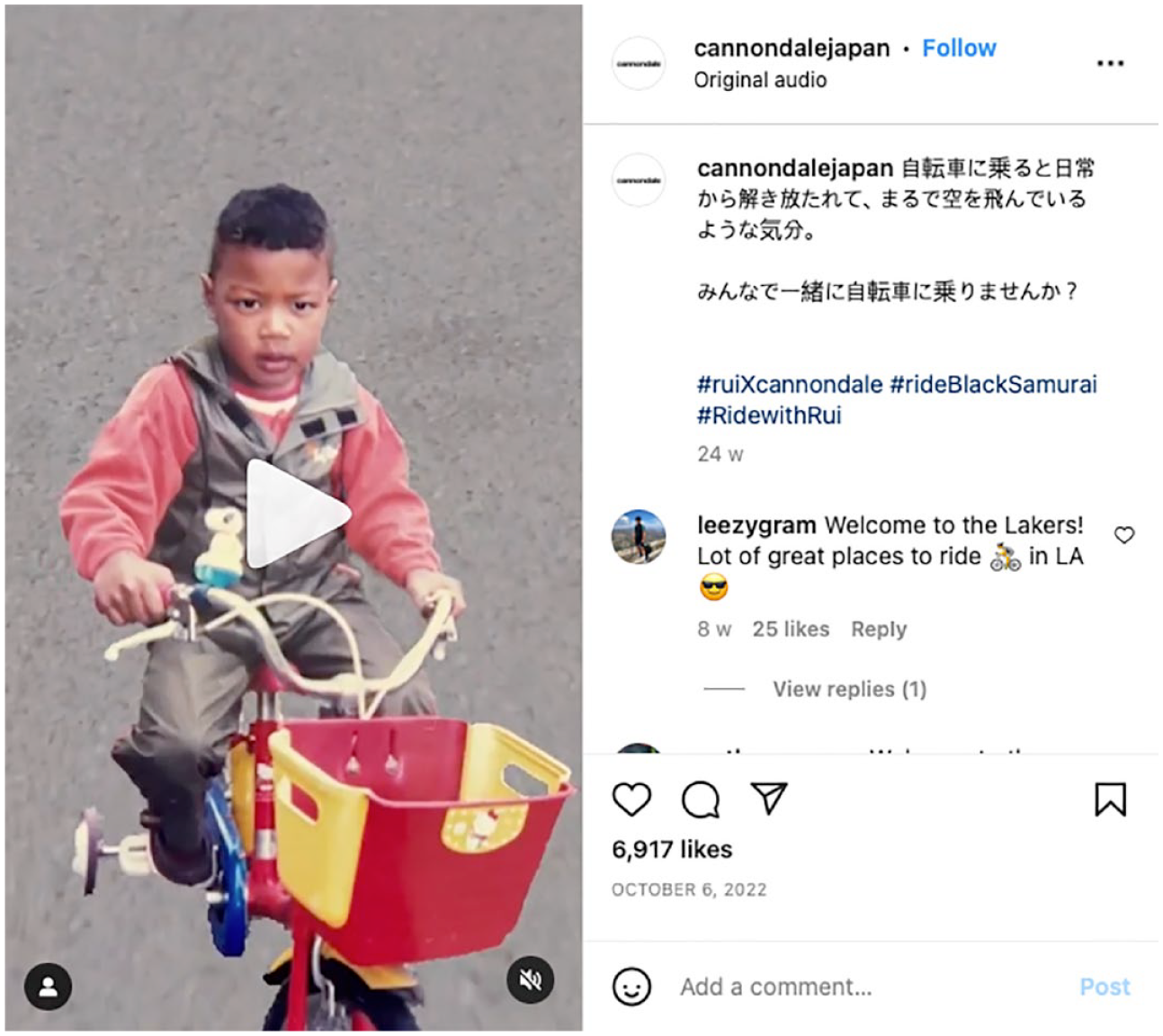
CannondaleJapan’s (2022) commercial on Instagram.
These two commercials align with Hachimura’s image as the pride of Japan and his Travel posts mainly on Instagram. In the commercials, Lipovitan D and Cannondale products are compatible with his lifestyle, which appeals to Japanese middle-class zoomers in terms of living and traveling abroad. Here, zoomer cosmopolitanism seems to be less about embracing diversity and activism than a cool (kakkoii) cosmopolitan lifestyle. His captions reference the drudgery of office life for busy Japanese professionals who cannot get away from work but wish to holiday—no doubt a privileged position. His story of growing up riding a bicycle evokes the nostalgia of childhood, during which play was possible. Hachimura’s childhood story also adds a personal touch to the advertisement, which aligns with a 2021 tweet when he first told this story after becoming a Cannondale Japan ambassador (@rui_8mura, 2021). Lipovitan D and Cannondale products are therefore advertised as allowing adults to take time off work and engage in leisure. Neither commercial contains racial justice messaging, which corresponds with how Japanese companies are typically oblivious about or reluctant to portray racioethnic issues (Fujita, 2020). From these two examples, Hachimura’s marketability stems entirely from his elite athlete status as his multiracial identity is neither acknowledged nor capitalized on. This limits his resistance in Japanese society as the status quo is merely reinforced.
Control Over Product Development
Arguably, it is in developing their own products that Osaka and Hachimura have more autonomy over their image and silent activism. Osaka is active by choice about creating her own products and collaborating with famous brands (Robert, 2021). A prominent example is KINLÒ, a skincare brand Osaka founded in 2021 to “protect and rejuvenate melanated skin tones” (@naomiosaka, 2021b). Although not explicitly advocating racial injustice issues, she is caring for individuals with darker skin tones who either overlook sun damage on their melanin-rich skin or lack suitable options in the vast skincare market (Robert, 2021). Pitched as a public health need for communities of color, KINLÒ enhances her authenticity as a multiracial woman with melanated skin who wishes to create products that can benefit them. Indeed, “KINLÒ” is named for her heritage, a combination of the Japanese “kin” and Haitian Creole “lo,” both words meaning “gold.”
In one KINLÒ promotional video posted across Twitter and Instagram, Osaka appears alongside other individuals who reflect on their melanated skin, alternately thinking of it as “a gift” from their ancestors and feeling proud and insecure about it. Osaka concludes the video by narrating, “They’re what makes us powerful. They’re what makes us glow,” and the camera pans out to show all four individuals seated with her in the center. Although the advertisement is for a skincare product, the video’s central message is about embracing one’s darker skin, protecting it from the sun, and being proud of who one is. As Osaka implies, being Black, multiracial, or a person of color makes one “glow” and “powerful.”
Osaka’s silent activism is apparent in how she visibly embeds such messages that reinforce her racioethnic identity within her brand and commercial. Despite her good intentions, promoting the use of a product to prevent melanated skin from becoming even darker also reinforces misogynoir and colorism—privileging lighter skin over darker skin—the politics of which scholars have discussed along with the intersections of race and gender (Ho & Tanaka, 2022; Razack & Joseph, 2021). Yet, Osaka also weighs in on complex issues of skin color in a more sophisticated way than before. Although she does not refer explicitly to it, the viewer is reminded of Japanese duo AMasso’s comments, who in 2019 alleged Osaka needed “bleach” (hyōhakuzai) because she was “too sunburned” (hiyakeshisugiyaro) (Chiba, 2019). At the time, Osaka had responded with a tongue-in-cheek comment about never getting sunburned because she used her sponsor Japanese cosmetics giant Shiseido’s Anessa sunscreen. Now, instead of deflecting these comments on her melanated skin, she makes a strong stand on how it empowers her, moving away from Shiseido to develop her own skincare brand.
Since 2021, Hachimura, too, has noticeably increased his brand collaborations, although they remain fewer than Osaka’s. In March 2021, he launched his own brand, Black Samurai, with a pink, lavender, and black kimono featuring Washington DC landmarks like the MLK Memorial, Lincoln Memorial, and cherry blossom trees bestowed by Tokyo in 1912. Across Twitter and Instagram, his post read, “Black Samurai—My Soul. My Roots. My Culture. My Pride.” The custom-made kimono is thus meant to symbolize his multiracial identity and honor his Beninese-Japanese heritage, which is embodied in the name “Black Samurai,” as Black and a samurai. Although the inclusion of DC landmarks pays homage to the city where Hachimura was based, he declared in a GQ Japan interview that he wanted to use his platform to show hāfu kids they could succeed, in sports or otherwise (Satō, 2021).
The meanings behind Hachimura’s brand and signature product allude to his racioethnic advocacy, situated within his everyday life. He leads by example, becoming a role model for children growing up as hāfu in Japan to succeed in anything they put their minds to. His silent activism stems from being visible for multiracial individuals who are marginalized in Japanese society and encouraging them to be proud of their “roots” and “culture.” This augments his authenticity but also aligns with his image as a Japanese hero. “Black Samurai” references Yasuke, the first Black samurai in Japanese history who fought for Oda Nobunaga, a well-known feudal lord during the Sengoku period (Lockley & Girard, 2019). Although Yasuke’s story has been told in various children’s books published since 1968 and most recently in Netflix’s 2021 anime, Yasuke, not many Japanese people knew of him (Germain, 2023). By naming his brand “Black Samurai,” Hachimura raises awareness about a lesser-known history in which Africans lived in 16th-century Japan.
Furthermore, “Black Samurai,” which is also Wizards player Bradley Beal’s nickname for him, reflects his experience now living in the United States as Blasian. This may appeal to Black and Asian communities outside Japan who identify with him. Unlike his endorsements we discussed earlier, Hachimura’s brand affords him more agency in determining the contours of his activism. His resistance stems less from being vocal on social media or the streets—although occasionally this happens as an overt form of activism like #TogetherWeStand—than from being who he is. Developing his own brand is not antithetical to his silent activism; in fact, it drives his advocacy when he dons the Black Samurai kimono or shoes on Instagram.
Conclusion
We have examined the large role social media play in Osaka’s and Hachimura’s athlete activism and sport commodification. Analyzing their Twitter and Instagram accounts, we argued these platforms’ affordances lend them various ways for resistance through defying monoracial labeling, manifesting their multiracial identity, amplifying their racioethnic advocacy, and constructing their image through certain sponsors. We found that both athletes engage in silent activism, characterized by the strategic use of visuals, captions, and emoticons on social media as well as their involvement in brand endorsements and collaborations. Rather than overt forms of resistance, which they occasionally practice, such as BLM street protests, Osaka and Hachimura are more well-versed in subtler approaches of using Twitter and Instagram as tools of everyday resistance. This is consistent with studies on zoomer athlete-activists who lead by example and reinforce their authenticity (Kluch, 2020), while simultaneously communicating a cosmopolitan lifestyle to a mass audience (McClearen & Nishime, 2023).
Yet, there are differences in how the two athletes use social media. Hachimura appears more cautious about putting out Personal posts, preferring to use his platforms mainly for publicity, whereas we find the more privileged Osaka openly posting about her family or partner. Having said that, when Hachimura developed his own brand Black Samurai, he became emboldened to give voice to hāfu children growing up in Japan, although this could arguably constitute his publicity too. Granted, his advocacy is no less meaningful than that of Osaka, who is much more visible and well-known. Sponsors have been eager to capitalize on Osaka’s fame and marketability, which also garnered some (fan) criticisms about her commercial leanings. But what impact does commercial success have on athlete activism? Based on our analysis, we contend there is limited resistance for the two athletes. On the one hand, they are constantly fielding racial slurs and hate speech as we discussed in Hachimura’s case, which may discourage them from doing more. On the other hand, their silent activism may in the future see long-term effects. Already Osaka is making waves with her stance not only on BLM, but also on mental health, #StopAsianHate, and women’s empowerment. Hence, we have much to look forward to with both athletes.
Future directions in research could include intersectional approaches of gender and racioethnicity to Osaka’s and Hachimura’s social media advocacy, such as the connections between race, beauty politics, and masculinity. Scholars could investigate the growing positive relationship between athlete activism and endorsements; Other than zoomer cosmopolitanism (McClearen & Nishime, 2023), how else can we talk about it? As Ogiso et al. (2022) have begun to do, more studies could measure the impact of athlete activism for their followers, particularly to take up action for social change. To provide more insight into how Asian athletes are using their platforms to speak about social injustice issues, researchers could also explore athlete activism in other Asian contexts. Finally, more could be written on amateur or lesser-known multiracial athletes, whose everyday experiences may productively complicate current understandings of elite multiracial athletes.
Footnotes
Declaration of Conflicting Interests
The author(s) declared no potential conflicts of interest with respect to the research, authorship, and/or publication of this article.
Funding
The author(s) disclosed receipt of the following financial support for the research, authorship, and/or publication of this article: This article was supported by a National University of Singapore Faculty of Arts & Social Sciences Start-Up Grant.
