



Abstract
Research has found that individuals may engage with emotions differently depending on social media platforms and/or social norms. Yet it remains unclear how individuals deal with emotions differently depending on whether the communication is public or private or depending on the topic. Using a 2 × 2 experimental design, we find that people engage in emotion work on social media, noting a difference in experienced emotion during the process of opinion expression and expressed emotion in the expression itself across both publicness and the topic of the message. Specifically, we find that those who express an opinion publicly or about politics in general experienced more anger than those who express an opinion privately or about COVID-19, who tended to express more anxiety. Yet patterns of emotional experience and expression were not always consistent. These results suggest individuals experience and express emotions differently depending on the publicness and topic of their communication. We discuss implications for how scholars conceptualize and study political expression on social media.
As social media have greatly expanded the opportunity for personal and political expression, research has attended to how people use platforms to these aims (O’Sullivan & Carr, 2018). In terms of opinion expression, this work has documented the role social media plays as a medium through which citizens can publicly express and discuss their beliefs on different topics and across different contexts (Parviz & Piercy, 2021).
As the boundaries between public and private communication on social media have blurred (Vitak, 2012), individuals now have more control over what information they disclose as well as how they disclose it. Appraisal theories of emotion suggest that changes in perceived control and uncertainty around communication likely influence what emotions people experience and if and how they express them (Lerner & Keltner, 2000). Likewise, research on emotional expression suggests that differences in schema and norms between topics likely affect expression (Nabi, 2003), and research on offline emotion work (e.g., Fineman, 1993) suggests that people manage their emotions depending on their present context and its associated norms.
Yet research on social media opinion expression has tended to focus on sentiment (Ceron et al., 2014) rather than discrete emotions (Hasell & Weeks, 2016) and has generally focused on public expression (Parviz & Piercy, 2021; Waterloo et al., 2018). In this study, we extend prior work by empirically examining the differences between how people manage emotions when communicating publicly and privately. We focus on the experience and expression of two emotions, anxiety and anger, which vary across social media platforms (Waterloo et al., 2018) and hold distinct consequences for democracy (MacKuen et al., 2010; Valentino et al., 2011). We explore the experience and expression of anxiety and anger, as well as the difference between the two, when individuals communicate an opinion publicly or privately or about politics in general or COVID-19 on Facebook. Using an online experiment, we find that people who express an opinion publicly or about politics in general experience higher levels of anger than those who express an opinion privately or about COVID-19, but that experiences of emotion during communication do not always match the expression of that emotion in the messages themselves.
These results hold implications for how scholars conceptualize political expression on social media. For one, these results offer further evidence that public and private expressions are different, not only in their perceived audience (Marwick & boyd, 2010) but also in the emotion work (Buzzanell & Turner, 2003) in which people engage. Second, COVID-19 and politics elicited different emotional experiences and expressions, suggesting people do distinguish between the two topics (Gadarian et al., 2021). These results also point to anger as an intensifying norm in political expression (e.g., Wahl-Jorgensen, 2019; Walter et al., 2021), specifically on Facebook (Waterloo et al., 2018), and call for research on social media and political expression to further consider how public political expression may overrepresent anger in response to topic or platform norms.
Public and Private Political Expression on Social Media
When individuals decide to express themselves, they may consider how what they say affects their self-image, an identity constructed through interactions with conversation partners (Marwick & boyd, 2010). Generally, people try to present a positive self-image to their discussion partners, or at least one that meets the norms of a situation (e.g., Waterloo et al., 2018).
Social media changes the relationship between individuals and their conversation partners. In face-to-face interpersonal situations, a person interacts with a few discussion partners and has more information about those partners (e.g., non-verbals). Thus, individuals can alter their self-presentations as their discussion partners change. Scholars have conceptualized social media audiences as “imagined” because someone who makes a public social media post does not know who will see that post (Gil-Lopez et al., 2018; Marwick & boyd, 2010). Social media users may consider the social roles of their followers (Davis & Jurgenson, 2014) and the extent to which their followers are similar to them (Kim & Ihm, 2020) when they decide how to publicly express an opinion. Social media followers may come from a variety of contexts within a person’s life (Davis & Jurgenson, 2014; Marwick & boyd, 2010). This situation, called context collapse, is considered “the flattening out of multiple distinct audiences in one’s social network” (Vitak, 2012, p. 451). In addition, social media users may consider whether their audience largely agrees or disagrees with their attitudes when deciding whether to express an opinion (Kim & Ihm, 2020).
In sum, when a person expresses an opinion in a public social media environment, a large, often heterogeneous audience may be able to access the most personal information an individual makes available (O’Sullivan & Carr, 2018). Someone who posts publicly on social media may take the full, diverse imagined audience into account when deciding how to express an opinion. Research has found that social media users do indeed reflect on their diverse audiences prior to posting and modify their expression for their imagined audience (Gil-Lopez et al., 2018; Kim & Ihm, 2020; Marwick & boyd, 2010; Vitak et al., 2015).
Prior work has largely focused on public posts, comparing variation in a person’s public social media audience to the amount and content of that person’s posts (Gil-Lopez et al., 2018; Kim & Ihm, 2020; Vitak, 2012). One strategy for avoiding potential consequences of diversity in one’s audience is to move a conversation to private digital messages (Vitak et al., 2015). In private conversations online, there is no need for an imagined audience because a person can send a message to one, carefully selected individual, giving the original message sender more control over a self-presentation. Thus, we compare the effects a public versus a private setting may have on expression.
Emotional and Political Expression on Social Media
Emotions are “internal, mental states representing evaluative, valenced reactions to events, agents, or objects that vary in intensity” (Nabi, 2003, p. 226). Emotion can be studied as experienced or expressed, that is, emotion as feelings within the individual (e.g., Hasell & Weeks, 2016) and emotions as expressed in the individual’s communication (e.g., Bazarova et al., 2015). We examine emotion in the context of opinion expression on social media for two reasons. First, scholars have shown that emotions are particularly variable across social media platforms with different emphases on public versus private messages (Waterloo et al., 2018). Second, research has shown that emotions—especially anger and anxiety—can lead to democratically consequential outcomes (MacKuen et al., 2010; Valentino et al., 2011).
Communication scholars have long considered the difference between experienced and expressed emotion as evidence of “emotion work” or “the effort we put into ensuring that our private feelings are suppressed or represented to be in tune with socially accepted norms” (Fineman, 1993, p. 3). Emotion work is tied to the idea of self-presentation. Individuals engage in emotion work out of a desire to maintain or adhere to social norms and/or to fulfill a role (Hochschild, 1979). A connection to self-presentation, Buzzanell and Turner (2003) argue, makes emotion work particularly attune to what they call the “public-private divide” (p. 43) in emotional expression, or the space between what individuals are willing to experience privately and what they are willing to say publicly. Existing research on emotion work has focused mostly on offline spaces or the use of emojis as a form of emotion work on social media (Riordan, 2017). In the context of opinion expression on social media, we are interested in if and how the publicness and topic of communication drive emotion work.
Appraisal theories of emotion are helpful in predicting how individuals may experience emotion when expressing an opinion in private or public messages. Lerner and Keltner (2000) theorize that people react to “emotion-eliciting” problems by making judgments about a situation according to several appraisal tendencies. Of particular interest in distinguishing between anxiety and anger is the appraisal tendency of control and certainty. Feelings of anxiety are elicited in situations where a person feels a lack of control over a situation and higher levels of uncertainty about the cause of a negative affective reaction. Underlying these feelings are individuals’ perceptions of risk (Lerner & Keltner, 2000). When individuals are uncertain about the risk of their expression, they may feel anxious. Applied to social media expression, we predict that, when asked to express oneself publicly, a person will experience more feelings of anxiety because it increases their perception of risk to their self-image. As described above, public social media spaces flatten diverse audiences into one “imagined” audience, wherein individuals are uncertain of the audience of their message. As a result, individuals likely feel less control over their self-images when they express publicly to these social media audiences (Lu, 2019). Research on social media expression also shows that private communication is more likely with strong ties (Bazarova & Choi, 2014), and, in turn, strong-tie communication is more likely to produce positive emotions rather than negative ones (Lin & Utz, 2015). Therefore, we expect:
Hypothesis 1 (H1). Participants publicly expressing an opinion will experience more anxiety than participants privately expressing an opinion.
In contrast, appraisal theory suggests that anger is experienced when a person feels more control over a situation and less uncertainty (Lerner & Keltner, 2000; Valentino et al., 2011). Private expression, compared to public, should give individuals more control over the audience of their communication. In turn, experiencing feelings of anger privately may be more likely than publicly expressing.
Further, research on emotion work across contexts suggests that individuals in private settings may allow themselves to experience more feelings of anger precisely because they feel comfortable expressing them. For instance, in situations where individuals feel comfortable expressing their emotions because of social norms that deem the feeling acceptable, they also tend to report feeling more of those emotions compared to other contexts (Buzzanell & Turner, 2003). In response to heightened levels of experienced anger, research suggests that individuals are also more likely to express anger when at home compared to other contexts like work settings (Bongard & Al’Absi, 2003). This may also be the case when it comes to the experience of anger when expressing an opinion online: if an individual feels anger is acceptable to express in a private context, that perception may also drive them to feel more of it.
In contrast to this theoretical expectation, research has not consistently found that private conditions are more conducive to experiences of anger than public ones. For instance, there is evidence that anger may be frequently felt when individuals engage with public information on social media (Hasell & Weeks, 2016) and that individuals are especially likely to feel anger when engaging with public social media posts (Oh et al., 2021), although a direct comparison with private modes of communication is lacking. The prevalence of experienced anger in public settings is especially true when considering anticipated feedback from the imagined audience in public contexts. When encountering political disagreement, individuals are more likely to experience anger both offline (Parsons, 2010) and on social media (Masullo et al., 2021). Research on emotion and interaction also shows that anticipated negative feedback is likely to cause anger (Butz & Plant, 2006). Therefore, it may be that if individuals anticipate disagreement from people in their imagined audience, they are more likely to feel anger when publicly expressing their beliefs.
In sum, theory and empirical evidence suggest a relationship between public/private setting and experienced anger but are in conflict regarding the direction of the relationship. Thus, we present the following non-directional hypothesis:
Hypothesis 2 (H2). Experienced anger will significantly differ between the public and private conditions.
To this point, we have approached emotion as something experienced by a person as that person expresses an opinion. Prior work on social media expression, however, has tended to focus on emotion as expressed in the language used in social media posts or private messages. Scholars have suggested that the decision to express emotion in public social media spaces is a strategic one that relies on the imagined audience of a social media message (Bazarova et al., 2015) and is dependent on network size (Gil-Lopez et al., 2018) and tie strength (Clark & Taraban, 1991). This decision is also informed by what is deemed appropriate to express on social media publicly or privately. For instance, people tend to express more higher-intensity emotions and fewer positive emotions in private compared to public messages (Bazarova et al., 2015).
The research above focuses only on the emotional language expressed in social media posts or messages and not the difference between experiences and expressions of emotion. In turn, we explore whether experienced and expressed emotion differs in public and private contexts. Further, these projects typically examine positive and negative affect, rather than discrete emotions and expressions (e.g., anger and anxiety). We build on this literature by suggesting that understanding how people may modify their expression on social media based on public or private context requires examining emotion work or a comparison between emotions experienced by individuals and those expressed by individuals. Because past research suggests emotions are variable across platforms that emphasize public versus private messages (Waterloo et al., 2018) and important for democracy (MacKuen et al., 2010; Valentino et al., 2011), we are interested in whether private versus public settings changes the emotion that is expressed in those settings.
As with experienced emotion, appraisal theories of emotion suggest that decreased control over the audience in public contexts would lead to less emotional expression in public. Prior research likewise suggests that public expression tends to display decreased emotional intensity and negativity (e.g., Bazarova et al., 2015; Gil-Lopez et al., 2018; Waterloo et al., 2018). Yet, as with experienced anger, there is also evidence that anger is both prominent and/or rewarded on social media (Gerbaudo et al., 2023). Therefore, we again pose a directional hypothesis for expressions of anxiety and, given the contrasting theoretical predictions and empirical findings about the direction of the relationship between public/private context and expressed anger, a non-directional hypothesis for expressions of anger:
Hypothesis 3 (H3). Participants expressing an opinion privately will be more likely to express anxiety in their messages than participants expressing an opinion publicly.
Hypothesis 4 (H4). Expressed anger will significantly differ between private and public conditions.
Differences Across Topics
The topic of expression may also make a difference in the experience and expression of emotion because topics carry with them their own sets of schema and discursive norms (Nabi, 2003). First, explicitly partisan political topics may have unique effects on and from expression. Expressing a political opinion should prompt feelings, and perhaps expressions, of anger. Social identity theory suggests that topics related to one’s identity can intensify emotional reactance and emotional distress (e.g., Scheepers, 2009). For instance, Hasell and Weeks (2016) find that partisan news is especially likely to prompt anger compared to other emotions and political expressions on social media.
There is evidence that expression about politics in general may also prompt expressions of anger. People uniquely reward political figures who express anger (Tiedens, 2001), and partisans are especially likely to mimic in-partisans’ expressions of anger in their own messages (Stapleton & Dawkins, 2022). Given the growing prominence of anger in political discourse from political elites and the public (Wahl-Jorgensen, 2019; Walter et al., 2021), it is possible that expressing anger about politics has become a social norm.
Second, we explore the unique effects of expressing opinions about the COVID-19 pandemic (Lin et al., 2016) compared to politics in general in the minds of the public. The pandemic’s entanglement of personal and public health has implicated negative emotional experiences and expressions about COVID-19 (Nabity-Grover et al., 2020). For example, anxiety about COVID-19 has been shown to drive misinformation sharing (Freiling et al., 2023) and risk behaviors (Wu et al., 2022). Research has also found that COVID-19 is particularly conducive to experiences of anxiety (Dam et al., 2021). Likewise, individuals were especially likely to express anxieties and fears about COVID-19 with family members during the pandemic (Hernandez & Colaner, 2021) and expressions of anxiety on social media are linked to experiences of anxiety among followers (Gruda et al., 2022).
Yet the politicization of COVID-19 raises the potential that individuals will respond similarly to both topics. Bolsen and Druckman (2015) define the politicization of scientific issues as when “an actor emphasizes the inherent uncertainty of science to cast doubt on the existence of scientific consensus” (p. 746). Importantly, those who cast doubt on science need not be political actors, although, as recent research suggests in the case of COVID-19, political actors are the most likely to do so (Zhou et al., 2023). Still, research shows that while political ideology is strongly correlated with COVID-19 attitudes, it is not perfectly correlated (Gadarian et al., 2021), suggesting that individuals do have the potential to distinguish between the COVID-19 pandemic and politics in general. Our goal in comparing emotions surrounding both topics is to assess if or how individuals respond differently to politics in general and COVID-19. Because COVID-19 has been associated with experiences (Dam et al., 2021) and expressions of anxiety (Gruda et al., 2022; Hernandez & Colaner, 2021) and politics with experiences (Stapleton & Dawkins, 2022) and expressions (Wahl-Jorgensen, 2019) of anger, especially on social media (Hasell & Weeks, 2016), we expect:
Hypothesis 5 (H5). Those who express an opinion about COVID-19 will (a) experience and (b) express more anxiety than those who express an opinion about politics in general.
Hypothesis 6 (H6). Those who express an opinion about politics in general will (a) experience and (b) express more anger than those who express an opinion about COVID-19.
It is less clear how the publicness of the message affects the experience and expression of discrete emotions across topics. It is possible that, as past research shows, people consider the visibility of their messages when deciding what emotions to convey (Bazarova et al., 2015) and that this happens regardless of the topic. It could also be that the visibility of the message, which shapes people’s sense of control and certainty (Lerner & Keltner, 2000), and the topic, which shapes people’s schema and norms (Nabi, 2003), work in tandem when influencing what emotions people feel and what they express. Therefore, we pose the following question:
Research Question 1 (RQ1). How will the publicness and topic of the message interact to influence (a) experienced anxiety and anger and (b) expressed anxiety and anger?
Method
We employed a 2 × 2 experimental design, manipulating both the publicness of the message (public post on Facebook vs. private message on Facebook) and the topic of the opinion expression (politics in general vs. COVID-19). Participants were recruited using CloudResearch, which research shows produces more externally valid and reliable data than other research platforms or convenience samples (Litman et al., 2017). The study received IRB approval and ran from April 5–22, 2021.
Theoretically, a public and diverse audience should have the same effect on any social media platform. Practically, there are differences in the amount of context collapse and opinion diversity depending on the platforms’ affordances and norms of use. Much of the prior work cited here (e.g., Bazarova & Choi, 2014; Gil-Lopez et al., 2018; Vitak, 2012; Vitak et al., 2015) investigated Facebook. The current experiment also uses Facebook because it allows users to post publicly on a news feed or privately through direct messages. Thus, we can test whether users construct public and private messages differently without changing platforms, which may vary in their norms of use and in the emotions people consider appropriate to express on the platform (Waterloo et al., 2018). We also use Facebook because users tend to have friends who are a mix of both acquaintances (e.g., work colleagues) and close friends and family (e.g., parents and good friends). Both characteristics are necessary, and other popular platforms do not clearly fit these two criteria (Waterloo et al., 2018).
Participants
U.S. residents over the age of 18 were permitted to participate (N = 518). The average age was 42.40 (SD = 13.54). The median participant held a bachelor’s degree or higher (SD = 0.67). Approximately 26% of participants were male and 64.1% were female. About 8% indicated Hispanic/Latino origin while 70.7% of participants indicated that they were White/non-Hispanic/Latino. Fifty-one percent identified as a Democrat or leaned Democratic, and 33.8% identified as a Republican or leaned Republican.
Procedures
After gaining informed consent, we screened participants based on Facebook use. Only individuals who reported having a personal Facebook account and accessing that account at least two times a week were eligible. Then, participants were randomly assigned to imagine a scenario in which they would express their opinions on Facebook: (a) to imagine expressing an opinion about politics in general or COVID-19 and (b) to imagine expressing this opinion publicly on their Facebook feed or privately through a direct message on Facebook. Participants in the private message conditions were able to choose the recipient(s) of their message. This design decision increased external validity because social media users typically get to choose private recipients and are aligned with relevant theories of emotion because we suspected that increased control over private messages underlies different emotional reactions to public and private message contexts. Generally, participants in the private conditions imagined sending private messages to friends (72%) and 58% somewhat or strongly agreed with the statement that the message recipient(s) agreed with the beliefs mentioned in the message (see details in Supplemental Online Appendix B).
Drawing from previous research using imagined scenarios as a tool to mimic behavior in real settings (Crisp & Hunsu, 2011; Warner & Villamil, 2017) and produce results like those from real-life interactions (Harwood et al., 2017), participants were told: “We would like you to take a minute to imagine you are going to disclose your beliefs about a [political issue/issue related to COVID-19] [on your own Facebook News Feed/to someone in your Facebook network through Facebook Messenger.] While imaging this, think specifically about the details of the [post/message]: the [political issue/issue related to COVID-19] you would pick, the beliefs you might disclose about that [political issue/issue related to COVID-19] and [the people in your network who could see the post/to whom you would send the message]. In the text box below, write the message [you would post on your Facebook News Feed/send in Facebook Messenger].”
In line with past research using imagined scenarios (Warner & Villamil, 2017), participants were not able to move forward with the questionnaire until 90 seconds had passed to ensure adequate engagement with the prompt. As a manipulation check, we hand-coded each expression for references to politics and/or COVID-19, 1 with a 10% sample achieving good intercoder reliability (Krippendorff’s a = .85). Those who received the political manipulation were significantly more likely to express an opinion about politics (B = 4.34, SE = 0.33, p < .001) than those who received the COVID-19 manipulation. Those who received the COVID-19 manipulation were significantly more likely to express an opinion about COVID-19 (B = 4.68, SE = 0.35, p < .001) than those who received the political manipulation. 2 Expression about COVID-19 and politics were significantly negatively correlated, r(479) = −.69, p < .001, suggesting that expression about COVID-19 was unlikely to be related to politics in general. After crafting their message, participants were asked about their emotional experience and details about who they imagined viewing the message or to whom they imagined sending the message.
Measures
Experienced Emotion
Participants were asked to indicate how much anger and anxiety they felt when crafting their specific message from never (1) to often (4) following the American National Election Studies and Marcus et al. (2000). Participants across all conditions felt relatively low amounts of anger (M = 2.03, SD = 1.10) and anxiety (M = 1.88, SD = 1.05) when crafting their message. While angry and anxious emotional responses were correlated (r = .38, p < .001), they were not perfectly correlated. In line with other theoretical and empirical approaches to angry and anxious reactions to stimuli (Hasell & Weeks, 2016), we consider these two emotional reactions separately.
Expressed Emotion
Human coders assessed emotion in the messages written by participants. Using Brown et al.’s (2020) codebook for expressed emotion, two coders analyzed expressions for non-exclusive, dichotomized measures of anxiety (4.6%) and anger (18.0%). Intercoder reliability was assessed using a 10% sample, and two coders achieved perfect reliability for the anxiety measure (Krippendorff’s a = 1.00) and good reliability for the anger measure (Krippendorff’s a = .80).
Controls
Because we employ an experimental design, we follow existing recommendations that controls only known to relate to the outcome variables be included in the analysis (e.g., Mutz, 2011). Given evidence that the degree of context collapse can influence opinion expression across public or private mediums (e.g., Vitak, 2012; Vitak et al., 2015), we include a measure of context collapse. To assess the individual’s degree of context collapse in their Facebook network, we used Beam et al.’s (2018) calculation of Simpson’s D, which focuses on relationship diversity within a specific context. Participants were asked, “By placing your friends into a single category, what percentage of your Facebook friends belong to: family, friends, classmates, co-workers, or members of religious organizations.” Simpson’s D was then calculated as a proportion of the participant’s total number of friends, ranging from 0, representing no diversity, to .8, representing the most diversity possible (M = 0.52, SD = 0.19). We also controlled for common demographic characteristics that are known to influence online expression (Bazarova & Choi, 2014), including age, education, gender, and race/ethnicity. 3
Results
To test H1, we ran an ordinary least squares (OLS) regression model predicting the participant’s experienced anxiety for those in the public condition compared to the private condition. The results show no significant differences in experienced anxiety between those in the public and private conditions (see Table 1, Model 1), offering no support for H1.
Linear Regression of Experienced Anxiety and Anger.
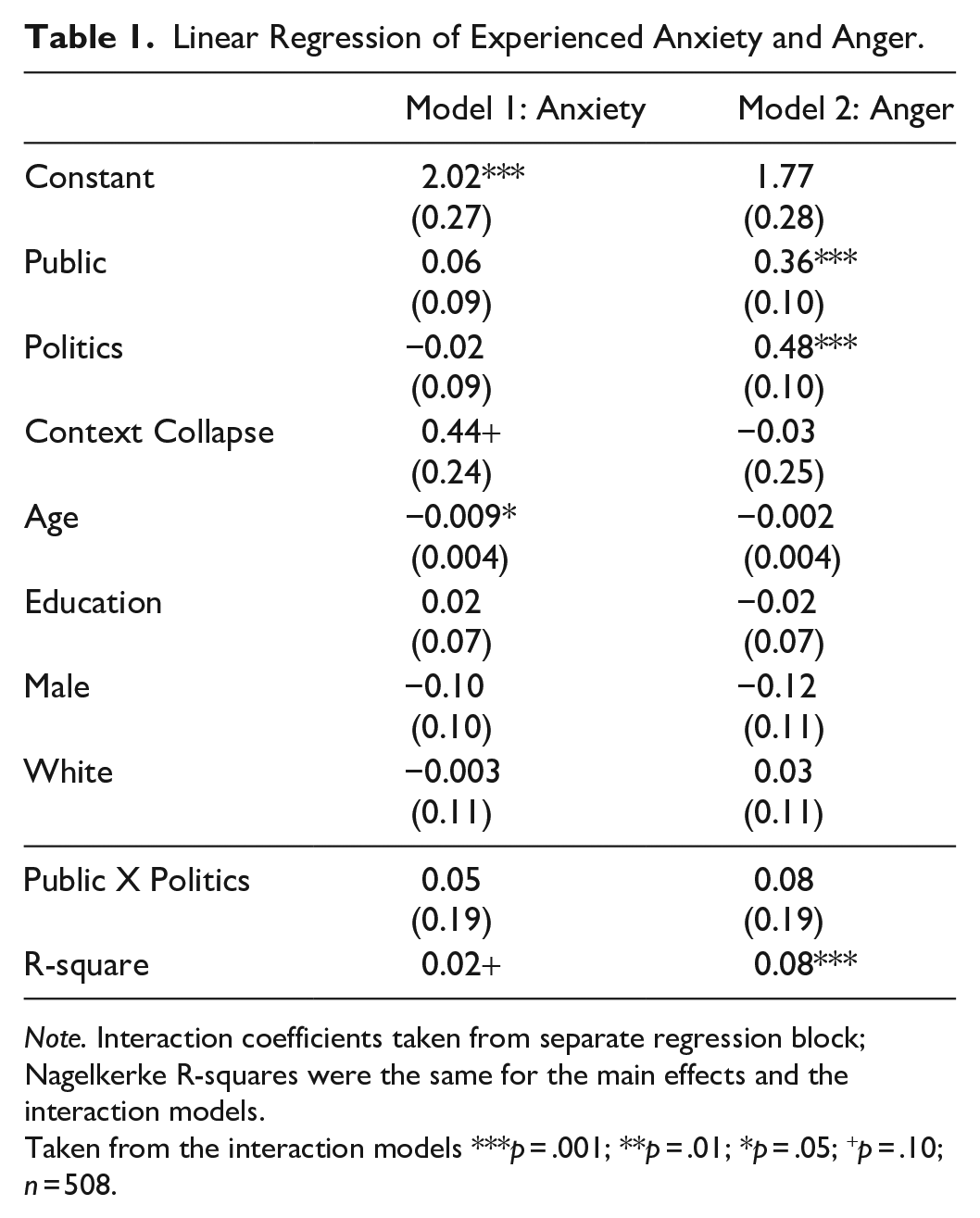
Note. Interaction coefficients taken from separate regression block; Nagelkerke R-squares were the same for the main effects and the interaction models.
Taken from the interaction models ***p = .001; **p = .01; *p = .05; +p = .10; n = 508.
To explore H2, we ran an OLS regression model with the same predictor variables, but this time predicting experienced anger. The results show that those who expressed an opinion publicly experienced significantly more anger (M = 2.21, SD = 0.07) than those who expressed an opinion privately (M = 1.85, SD = 0.07) when controlling for the topic of expression and the same controls listed above (B = .36, SE = 0.10, p < .001; see Table 1, Model 2), which offers directional evidence for our expectation in H2.
To test H3, we ran a logistic regression model predicting whether the participant expressed anxiety in the message content. Participants publicly expressing an opinion were not significantly more likely to express anxiety in their expression than those privately expressing an opinion (B = −.88, SE = 0.47, p < .10; see Table 2, Model 1), although these effects were marginal. After computing probabilities, participants were 4.6% likely to express anxiety privately on Facebook compared to 2.0% likely to express anxiety publicly. These results offer no conclusive support for H3.
Logistic Regression of Expressed Anxiety and Anger.

Note. Interaction coefficients taken from separate regression block; Nagelkerke R-squares from the interaction effects models.
Taken from interaction models; ***p = .001, **p = .01, *p = .05, +p = .10, n = 509.
To test H4, which was concerned with expressed anger, we ran a similar logistic regression model predicting whether the participant expressed anger in the message content. Participants who expressed an opinion publicly were not significantly more likely to express anger than those who expressed an opinion privately when controlling for the topic and the same variables as above (B = 0.44, SE = 0.25, p < .10; see Table 2, Model 2), although these effects were marginal. After computing probabilities, participants were 17% likely to express anger privately on Facebook compared to 23% likely to express anger publicly. These results offer no conclusive support for H4.
To test H5, or differences in both (a) experienced and (b) expressed anxiety between participants expressing an opinion about COVID-19 compared to politics in general, we return to the OLS regressions predicting experienced anxiety and controlling for the publicness of the expression. 4 In terms of experienced anxiety, there were no significant differences between those expressing an opinion about COVID-19 and those expressing an opinion about politics in general (see Table 1, Model 1). To test differences in expressed anxiety between the COVID-19 and politics conditions, we return to the logistic regression model predicting the likelihood of expressing anxiety. Participants expressing an opinion about politics in general were significantly less likely to express anxiety in their communication than those expressing an opinion about COVID-19 (B = −1.04, SE = 0.47, p < .05; see Table 2, Model 1). After computing probabilities, participants were 1.2% likely to express anxiety about politics in general on Facebook while participants were 4.7% likely to express anxiety about COVID-19. These results offer partial support for H5.
To address H6, we ran a similar OLS model to the one described above, this time predicting experienced anger and controlling for the publicness of the expression (H6a). Participants expressing an opinion about politics (M = 2.28, SD = 0.07) experienced significantly more anger (B = 0.48, SE = 0.10, p < .001) than those expressing an opinion about COVID-19 (M = 1.80, SD = 0.07; see Table 1, Model 2). To test differences in expressed anger (H6b), we ran a logistic regression model similar to that of expressed anxiety, this time predicting the likelihood of expressing anger between politics in general and COVID-19 conditions. Participants expressing an opinion about politics in general were significantly more likely to express anger in their communication than those expressing an opinion about COVID-19 (B = 1.09, SE = 0.25, p < .001; see Table 2, Model 2). Participants were 28.2% likely to express anger about politics in general, while they were only 11.8% likely to express anger about COVID-19. These results offer support for H6.
To explore RQ1, we ran the same models for H1–H6, but this time included an interaction term between the public and political conditions in a separate block predicting experienced anxiety and anger (RQ1a) and expressed anxiety and anger (RQ1b). The interaction term was not significant in either the experienced anxiety or anger models, indicating that the publicness and topic of the communication did not interact to influence participant’s experience of anger or their experience of anxiety in their communication (see Tables 1–2). When adding the interaction term into the models for expressed anxiety and anger, the interaction term was not significant for expressed anxiety but was significant for the model predicting expressed anger (B = 1.25, SE = 0.51, p < .01). This interaction is displayed in Figure 1. Probing the interaction using the emmeans package in R indicates a few significant differences between conditions. Participants expressing an opinion publicly about politics in general were significantly more likely to express anger than participants expressing an opinion privately about COVID-19 (p < .001) and participants expressing an opinion publicly about COVID-19 (p < .001). These participants were also marginally (p = .07) more likely to express anger than those expressing an opinion privately about politics in general. There was no significant difference in expressions of anger between participants expressing an opinion about COVID-19 privately or publicly.

Predicted probabilities of expressing anger interacting politics/COVID-19 and public/private conditions.
Discussion
The present study uncovered causal evidence of novel effects related to emotional social media expression about politics and COVID-19. First, public expression and general political expression prompted more experienced anger than private or COVID-19 expression, and general political expression prompted more expressed anger than COVID-19 expression. Second, the emotions people experienced and the emotions they expressed differed depending on the publicness and topic of Facebook communication, suggesting that people engage in emotion work (Fineman, 1993) on social media in ways similar to offline contexts (Buzzanell & Turner, 2003). Differences in experienced and expressed emotion between expression about politics in general and COVID-19 also suggest that individuals distinguish between these topics—and their associated norms—when expressing an opinion about them. These results hold several implications for the understanding of emotion, social media expression, and perceptions of politics and COVID-19.
First, our study offers insight into the emotions individuals felt when expressing their opinions about politics in general and COVID-19 on Facebook. Despite a lack of control over an imagined audience, participants were no more likely to feel anxious when they expressed publicly rather than privately. This finding challenges predictions from appraisal theories of emotion, which suggest that a loss of control in a situation should encourage feelings of anxiety (Lerner & Keltner, 2000). Participants did not actually post on Facebook, so the public/private divide may not have been salient enough to provoke feelings of anxiety. Yet, we are not the only researchers to have found patterns that challenge the context collapse paradigm. Studies examining news sharing, for instance, have found that higher levels of context collapse equate to more rather than less sharing of news (Beam et al., 2018). It is possible that when people express themselves publicly on social media, they do not worry about their audience diversity as much as the context collapse literature suggests. Individuals were, however, more likely to express anxiety in communication about COVID-19 than about politics in general. This makes sense, given past research pointing to COVID-19’s public association with anxiety (Dam et al., 2021; Hernandez & Colaner, 2021) and the role of anxiety as a driving factor in motivations to share accurate and inaccurate claims about COVID-19 on social media (Freiling et al., 2023). In concert with our findings, anxiety may not only play a role in the decision to share messages but in the content of the message itself.
In terms of anger, we found that political and public expression increased feelings of anger compared to COVID-19 and private expression. That expression about politics engendered anger is not surprising, given evidence that anger is increasingly associated with political figures and topics (Wahl-Jorgensen, 2019; Walter et al., 2021). That anger was felt more strongly in the public condition needs more unpacking. Historically, there has been a reticence to express anger in public discourse (Clark & Taraban, 1991; Wahl-Jorgensen, 2019). Our findings align more clearly with work demonstrating that anger can encourage public political action (e.g., Valentino et al., 2011). Here, however, it was being asked to act in public (i.e., express an opinion publicly) that prompted the feelings of anger, not the other way around.
In addition, emotional differences between expression about politics in general and COVID-19 suggest individuals do differentiate between the two, at least in their experience of and communication about these topics. Rather than considering a comparison of these topics as a test of emotions between political and non-political topics, our goal was to determine the extent to which these topics do or do not overlap regarding how people experience and express anxiety and anger. We find that the two topics were distinct: expressions of one were negatively correlated with expressions of the other, and people exhibited different emotional reactions to the two topics. These findings align with other research suggesting that politics and political partisanship may matter less than expected when looking at how people receive, give, or evaluate messages about COVID-19 (Bode & Vraga, 2021) and evidence that the politicization of scientific topics is due to a variety of elite actors (e.g., Bolsen & Druckman, 2015; Zhou et al., 2023), not just politicians.
Importantly, we found that experiences of emotion did not always match the emotions expressed in actual messages, something scholars recognize as emotion work (e.g., Buzzanell & Turner, 2003; Fineman, 1993). We find that while there were no differences in experienced anxiety between conditions, those communicating about politics in general expressed significantly less anxiety in their messages than those communicating about COVID-19. While those communicating publicly experienced more anger than those communicating privately, they were not significantly more likely than those communicating privately to actually express this anger in their message. Differences in what emotions were experienced and expressed, as emotion work research would suggest, are likely the result of differing norms between private and public contexts (Buzzanell & Turner, 2003). This divide echoes complementary research on the role of social norms (e.g., Waterloo et al., 2018) and self-presentation (Marwick & boyd, 2010) in what and how an individual expresses an opinion on social media. That individuals in this study experienced anger when communicating publicly but did not always express anger suggests that the publicness of the communication may matter not only for whether they express themselves but also for what emotions they choose to communicate in public.
One similar emotion between experience and expression was anger from those disclosing about politics in general. Consistently, those who communicated explicitly about politics experienced more anger and were significantly more likely to express it than those who communicated about COVID-19. Likewise, politics interacted with the publicness of the message to express anger. While individuals were, overall, only marginally more likely to express anger publicly, they were significantly more likely to do so when they expressed an opinion publicly about politics in general. Individuals who publicly expressed an opinion about politics in general were more than two times as likely to express anger than those who privately expressed an opinion about COVID-19. On one hand, the similarity between felt and expressed anger for the topic of general politics suggests that politics decreases a person’s willingness to be strategic in their posts. On the other hand, perhaps posting about political anger is not a threat to one’s self-image but instead, an enhancement of it, which sits in line with research on how partisans display their political identity. For instance, Berry and Sobieraj’s (2013) work on “outrage discourse” suggests that partisan mass media often use emotional ploys—like sensationalism or “belittling ridicule of opponents” (p. 7)—to elicit consumers’ attention. This may also be the case in how members of the public perform partisan identity on social media, which is now increasingly associated with anger (Wahl-Jorgensen, 2019; Walter et al., 2021). In turn, expressing anger may be a proactive form of emotion work informed by social norms of the situation or a strategic form of political self-presentation. Indeed, there is evidence that individuals who engage in what Brady et al. (2021) call “moral outrage discourse” on social media receive positive social feedback, which reinforces their likelihood of posting more outrage on their accounts in the future. In this way, expressing an opinion about politics using anger may be an advantageous communication norm for partisans—a performance of partisan identity that simultaneously considers what is rewarded on the platform and what reinforces their own partisan identity to their audience.
There are several limitations of this research. First, participants were asked to imagine they were expressing an opinion but were not asked to actually post their message. We made this decision after a pilot test in which participants were asked to upload a post to Facebook and then screenshot that post for validation. Very few adequately completed the test. This was ultimately beneficial: in overviewing the final messages, we realized that some participants would have shared misinformation if they had posted it to their accounts. This points to the ethical considerations researchers should make when choosing designs that implicate real-world communication. In addition, past research suggests that imagined scenarios, such as the one used here, can offer a reliable simulation of actual behavior (Crisp & Husnu, 2011; Warner & Villamil, 2017) and vary along similar dimensions as real contact (Harwood et al., 2017).
Second, we explore emotion work on Facebook rather than another platform. In line with past work on emotion and social media (Bazarova & Choi, 2014; Gil-Lopez et al., 2018; Vitak, 2012; Vitak et al., 2015), we chose Facebook because it offers both public and private communication options and a diverse range of social ties, both of which past research suggests can affect emotional norms on the platform (e.g., Waterloo et al., 2018). Still, future research should assess whether other platforms with similar affordances demonstrate similar patterns of emotion work across publicness and topic.
Other limitations would also be important for future research to address. Although studies of anxiety and anger have used self-reported frequency (Marcus et al., 2000) and intensity measures (Hasell & Weeks, 2016; Valentino et al., 2011), similar to the measure we employ here, it would be useful to know more detail about the duration or dimensions of the emotions through other behavioral or physiological measures (Mauss & Robinson, 2009). In addition, we compare individuals’ expression about politics in general and COVID-19, but a comparison of politics in general with more explicitly non-political topics would be a useful next step. We also use CloudResearch, an online survey platform that does not offer results that perfectly reflect the U.S. population. Finally, it is possible that tie strength plays an important role in moderating the relationship between private communication and experienced or expressed emotion (see Lin & Utz, 2015), which future research should further investigate.
Even with these limitations, this study makes several advances to the literature. Methodologically, due to proprietary data on social media platforms, it has been difficult for scholars to get a full picture of how people use and communicate on these platforms. We offer imagined expression as an approximation of communication on Facebook in which individuals make conscious decisions about what to reveal and what not to reveal to their networks. Theoretically, our results help establish the process of emotion work on social media across publicness and topic. As with research on offline emotion work, our findings suggest that people’s choice between experiencing and expressing emotion is dependent on norms inherent in the public-private divide (Buzzanell & Turner, 2003) and the topic of expression. Although our analysis does not take stock of norms present in or across these two contexts or topics, that people modified their expression suggests that norms—or their perception—do in fact, differ. That people were more likely to experience anger when expressing publicly but not significantly more likely to actually express anger unless communicating about politics suggests that public political expression on social media may overrepresent angry communication, particularly if anger is an emotional norm on the platform. We focus on Facebook, where anger is more frequently communicated than on other social platforms, but future research should address emotion work across platforms to tease out whether it is public political expression or just public political expression on Facebook that is driving these results. Overall, our findings encourage researchers to approach the study of social media and politics with an eye to emotion as both an experienced and expressed phenomenon and one that is managed depending on norms driven by the publicness and of the topic of their communication.
Supplemental Material
sj-docx-1-sms-10.1177_20563051231207853 – Supplemental material for Emotion Work on Social Media: Differences in Public and Private Emotions about Politics and COVID-19 on Facebook
Supplemental material, sj-docx-1-sms-10.1177_20563051231207853 for Emotion Work on Social Media: Differences in Public and Private Emotions about Politics and COVID-19 on Facebook by Emily Van Duyn and Ashley Muddiman in Social Media + Society
Footnotes
Declaration of Conflicting Interests
The author(s) declared no potential conflicts of interest with respect to the research, authorship, and/or publication of this article.
Funding
The author(s) received no financial support for the research, authorship, and/or publication of this article.

Supplemental Material
Supplemental material for this article is available online.
Notes
Author Biographies
References
Supplementary Material
Please find the following supplemental material available below.
For Open Access articles published under a Creative Commons License, all supplemental material carries the same license as the article it is associated with.
For non-Open Access articles published, all supplemental material carries a non-exclusive license, and permission requests for re-use of supplemental material or any part of supplemental material shall be sent directly to the copyright owner as specified in the copyright notice associated with the article.
