



Abstract
Over the past decade, there has been significant scholarly and mainstream attention to the use of digital media technologies to engage in feminist politics and activism. This article explores an example of small-scale, feminist digital activism: the #WitchTheVote hashtag on Instagram. Using a visual and discursive analysis of 75 Instagram posts and interviews with four self-identified witches active on Instagram during the summer of 2020, we argue that #WitchTheVote is an example of reflective nostalgic activism that challenges the mediated popular feminism most visible across social media attention economies. This case study demonstrates the potential for doing intersectional feminist politics online that contradicts both popular feminism and its attendant platform conventions, imagining a different kind of feminist politics that troubles visibility, attention, celebrity, large audiences, and consumption as part of contemporary digital feminism.
Over the past decade, there has been significant scholarly and mainstream attention to the use of digital media technologies to engage in feminist politics and activism (Clark-Parsons, 2022; Keller, 2015; Keller et al., 2018; Mendes et al., 2019). Much of this work has pointed to the ways that digital media, particularly the internet, has made feminism more accessible, networked, and visible, with #MeToo being held up as an exemplar of this era of “popular feminism” (Banet-Weiser, 2018). Indeed, other instances of digital feminist activism, #97percent, #CropTopDay, and #YesAllWomen, are celebrated in the mainstream press for the visibility they bring to feminist issues, indicative of what journalist Jessica Valenti (2014) called a “feminist zeitgeist.” This discursive framing often assumes that visibility is a good thing for feminism, that feminists should want to circulate their politics as part of the social media attention economy, attain retweets and likes, and widespread attention—hoping to motivate a large base of supporters. Yet, in this article, we problematize this assumption by asking, “How are feminists negotiating the norms of popular feminism online to engage in intersectional feminist politics that do not always conform to the logics of the social media attention economy?” And, what do these politics look and feel like?
To answer these questions, we explore an example of feminist digital activism that is markedly less visible than other media texts: the #WitchTheVote hashtag on Instagram. The hashtag was first used by a group of witches from Salem, Massachusetts, during the lead-up to the 2018 U.S. midterm elections when there was increased attention to electoral politics and the need to mobilize a progressive vote in response to Trump’s 2016 victory. #WitchTheVote is a cross-media initiative, including a website and podcast, that identifies and promotes “witch-worthy” political candidates: those who are progressive and social justice–oriented. The hashtag circulates primarily on Instagram, serving not only to advocate for “witch-worthy” candidates but also to encourage self-identified witches to participate in the electoral political process at the local, state/provincial, and national levels.
We came across the #WitchTheVote hashtag while studying examples of anti-Trump political action in feminized media cultures. As part of this larger research project, we followed the hashtag and the #WitchTheVote Instagram account, tracing how self-described witches articulate their feminist politics. We collected 75 purposefully selected Instagram screenshots between 2018 and 2021. We thematically coded the posts and conducted a visual and discursive analysis of each. To contextualize some of the trends we identified in our textual analysis, we interviewed four self-identified witches active on Instagram in the summer of 2020. Interviews lasted 60 to 90 min and focused on key analytic themes, including nostalgia, media technologies, feminism, politics, and witchcraft. Given the relatively small number of interviews conducted, we utilize our interview data as supplemental to our textual analysis rather than as a stand-alone data set.
Based on our analysis, we argue that #WitchTheVote is an example of reflective nostalgic activism that challenges the mediated popular feminism most visible across social media attention economies. We contend that witches do this in three ways: (1) by using reflective nostalgia as an activist expression, (2) by understanding the platform as an “everyday witchy object,” and (3) by engaging local communities. In doing so, #WitchTheVote demonstrates the potential for doing intersectional feminist politics online that negates both popular feminism and its attendant platform conventions—it imagines a different kind of feminist politics that troubles visibility, attention, celebrity, large audiences, and consumption as part of contemporary digital feminism.
In this article, we understand intersectional feminist politics as recognizing and countering the unequal distribution of power and the White male supremacy that structures the lived experiences of oppressed groups, especially Black women (Collins, 2009; Crenshaw, 1990; Steele, 2021). Guided by this conceptualization rooted in Black feminist theory, our analysis seeks to understand how #WitchTheVote critiques structural power inequalities that result from White male heteropatriarchy. This approach aims to avoid reductive understandings of intersectionality as “liberal, multicultural diversity” that are often problematically discussed as evidence of intersectionality (see Kanai, 2021).
Platformed Feminism: Designing Digital Feminist Politics
This research responds to recent theorizations of popular feminism and platform politics. Banet-Weiser (2018, p. 10) theorizes popular feminism as a mediated form of feminist politics “accessible to a large, popular audience,” which fails to disrupt capitalism or structures of inequities and is primarily White, middle-class, cis-gendered, and heteronormative. While popular feminism often acknowledges sexism, building on liberal feminist critiques of gendered exclusions in the public and corporate spheres, it embraces neoliberal principles of individualism and entrepreneurialism, suggesting that women must empower themselves to be full social actors (Banet-Weiser, 2018; Rottenberg, 2014). Popular feminism operates within what Banet-Weiser (2018, p. 23) calls an “economy of visibility” whereby visibility—not politics or political action—becomes the end goal; in other words, visual representation is the politics. She contends, As a set of practices and expressions that circulate in an economy of visibility, popular feminism is part of the larger “attention” economy, where its sheer accessibility—through shared images, “likes,” clicks, followers, retweets, and so on—is a key component of its popularity. (p. 10)
Social media platforms such as Instagram, Tumblr, Facebook, and Twitter must then be considered the central place where popular feminism is produced, circulated, and consumed. These platforms are not neutral spaces but are governed by ideological, economic, and technological logics (Gillespie, 2010; Helmond, 2015; van Dijck & Poell, 2013). These logics encourage users to create individual personal profiles (Cho, 2021), produce a significant amount of content that can be shared and ideally monetized, and develop traceable connections with other users in the form of “followers,” (Twitter, Instagram, and TikTok) or “friends,” (Facebook). According to this structuring logic, the more connections a user accumulates, the wider their content will travel, attracting more attention. This is considered a “successful” use of social media within the contemporary attention economy (Abidin, 2020; Marwick, 2015). And while this “successful” use of social media may benefit the individual user in the form of visibility or even branding opportunities, it is the social media company that is ultimately rewarded from this form of engagement, through increased platform traffic and digital content that is commodifiable for advertisers (van Dijck, 2013; Weigel, 2018).
According to this logic then, social media platforms tend to privilege certain types of content and particular forms of engagement. For example, Dean (2016, para. 37) discusses the easy circulation of visuals within the social media economy, noting that their speed of circulation defines the “flattened terrain of networked participatory media.” In this mediated context, she contends, in-depth political engagement is often foreclosed through platform logics: Networked media don’t facilitate democratic deliberation. There’s no time to consider every argument or viewpoint. . . . To circulate efficiently, an image shouldn’t be viewed, that is, contemplated and interpreted. It must be obvious, fast, with a little charge to incite people to deploy it. (Dean 2016, para. 35, 40)
While speaking specifically of visual texts, we may consider the implications of Dean’s comments across all types of digital content—the most “successful” digital content demands to be easily consumed via a glance or skim, yet effectively engaging enough to warrant a share, like, or retweet. Content that goes “viral” most often adheres to this careful balance.
We extend this idea here to consider what this means for feminist politics on social media and, in doing so, we suggest that popular feminism is predicated on a particular design of feminist politics that aligns with the logic of social media platforms discussed above. Hearn and Banet-Weiser (2020) explore this idea, writing, The multiple expressions of popular feminism, circulating rapidly across social and digital media, authorize a “sure judgment,” not about what feminism is or should be, but simply how it should be performed or visualized. Indeed, the glamour of popular feminism comprises the idea that one can “Instagram” oneself a feminist, wispy and capacious at the same time, constituted and validated by the metrics and circulatory logics of technological platforms. (pp. 9–10)
Using the concept of “glamour,” they unpack how the politics of feminism are “glammed up” for social media, often resulting in popular feminist content that can circulate widely with superficial engagement and little offense—prioritizing digital media metrics rather than deep analysis over the meanings of feminist messaging (Hearn & Banet-Weiser, 2020). In their study of feminist YouTube creators, Glatt and Banet-Weiser (2021) refer to this approach to doing feminist politics online as “transactional,” locating it within the “popular feminist economy of visibility concurrent with capitalist logics” (p. 41). They describe how this type of feminist content often receives corporate sponsorships and peddles “safe” topics that reflect the experiences of predominantly White, heterosexual, cis-gendered, and middle-class women, such as sex positivity, critiques of beauty standards, and work–life balance (see also Gill & Elias, 2014; Rottenberg, 2014; Savolainen et al., 2022).
Likewise, in her study of feminist activism on Instagram, Mahoney (2022, p. 522) contends that feminist content on the platform is contained by its visual economy, with Instagram propagating and rewarding content that “display[s] and validate[s] neoliberal ideals and constructions of femininity.” Savolainen et al. (2022) make a similar argument after interviewing feminist Instagram users and analyzing their digital content, concluding, Together with algorithmic feedback loops, users’ structurally conditioned filtering practices shape emerging feminist visibilities on Instagram, producing feminist imagery that strategically evades feminist issues that sit uneasily with the platform’s interaction order—like the need for collective feminist subjectivities, the political value of negative emotions, and internal conflicts within feminisms. (p. 567)
Savolainen et al.’s research specifically highlights “filtering,” the conscious negotiations in which feminist Instagram influencers engage to produce content that feels authentic, expresses their politics, and maintains the aspirational self and social capital of their curated profile. The result is often ambiguous performances of feminism that offer only a moderate challenge to gendered ideals and norms. Taken together, this literature suggests that social media platforms are largely designed to amplify popular feminist content according to their governing metrics while marginalizing other forms of feminist expressions, such as intersectional feminist politics that attends to structural inequities.
Within this context, we are interested in alternative possibilities for doing intersectional feminism on today’s social media platforms that are decoupled from the attention economy of popular feminism that we discuss above. While other scholars have explored how invisibility has functioned as a strategy for safely doing feminism online (see Clark-Parsons, 2022; Mendes et al., 2019), this literature is limited and often focused on avoiding misogynist backlash. Instead, we turn to #WitchTheVote as a fascinating case study that does not embrace invisibility or rejection of social media but adopts early digital practices and their affective tenors of the potential and possibility of digital media via reflective nostalgia. In doing so, we argue that #WitchTheVote offers an alternative set of politics that negates the neoliberal confines of popular feminism. The #WitchtheVote hashtag is by no means viral, with fewer than 1000 posts since 2018. Nonetheless, we contend that because it is not one of the most visible and celebrated feminist digital media campaigns, it offers an interesting case study that speaks to how ordinary users navigate platform design and attempt to engage in intersectional feminist politics that does not always conform to platform conventions. In this way, we contribute to recent research concerning “under the radar” feminist social media campaigns whose lack of mainstream visibility means they are less likely to be commercialized and, perhaps, more effective at achieving their goals (see De Benedictis & Mendes, 2023).
As part of the mediated culture of popular feminism online, it is not surprising some posts use the #WitchTheVote hashtag in ways that appear to embrace a popular feminist sensibility. Although not often linked to brand sponsorship as Glatt and Banet-Weiser’s (2021) examples discussed above, there are a limited number of #WitchTheVote posts that are well curated and aesthetically pleasing—often containing quippy feminist slogans on feminized consumer items, like cute coffee mugs, fitted tee-shirts, or accent pillows. These posts establish feminism as a visual performance that is non-disruptive and effectively cheery (Hearn & Banet-Weiser, 2020). Yet, rather than focus on this type of content, this article pays attention to posts that disrupt this convention by producing feminist content that does not circulate widely or attract large audiences, yet is explicitly intersectional, action-oriented, and community-focused. In doing so, we attempt to attend to essential critiques of online feminism’s lack of intersectionality (see Daniels, 2016; Loza, 2014; Singh, 2018), by lending insight into how feminists might better negotiate the platform politics of popular feminism to engage in more intersectional forms of feminism online.
Reflective Nostalgic Activism: Mediated Witches and the Early internet
Evans and Bussey-Chamberlain (2021) describe a “wave” of White feminist activism that draws on nostalgia for earlier feminist movements to make the case that current feminist politics, particularly online engagement with feminism through hashtag activism, fail to live up to feminism’s radical past. In their analysis, nostalgia manifests as a longing for imagined feminist politics concerned with sisterhood and grassroots organizing that ignores the internal struggles of past feminist movements. Through the reimagining of feminism’s history, a White feminist nostalgia emerges that circulates widely through media culture, disavowing intersectionality. In many ways, nostalgia is “fundamentally at odds with feminist social movements that focus energies on bringing about a future that is decidedly different from the past” (Meagher & Runyon, 2017, p. 344). Yet, other feminist scholars argue activists can recuperate nostalgia. For Eichhorn (2015), the presence of feminist nostalgia in contemporary feminist thought and cultural production manifests as an affective attachment to the potential of being a part of something revolutionary, rather than the practice of reminiscing about feminism’s imagined past.
In this article, we draw on Boym’s (2007) concept of reflective nostalgia and feminist theorizing of nostalgia (Eichhorn, 2015; Meagher & Runyon, 2017) to consider how nostalgia might work as a progressive activist practice to counter popular feminism. Boym’s foundational work on nostalgia differentiates between restorative and reflective nostalgia. Restorative nostalgia is often revisionist, leading to a reconstruction of the past rooted in longing. Evan and Bussey-Chamberlain’s (2021) White feminist nostalgia exemplifies revisionist and conservative restorative nostalgia because it serves to rewrite feminist histories. Boym (2007) offers reflective nostalgia to complicate understandings of nostalgia, stressing its potential as a productive political tool. Instead of restoring the past, reflective nostalgia critically engages with remembering as a self-aware practice ambivalent in its longing for time and place.
We employ reflective nostalgia to interrogate how time—specifically 1990s and early aughts popular culture—is used as a reflective nostalgic activist practice in #WitchTheVote. We also consider how nostalgia for a place—in this case, the place of the early 1990s and early Web 2.0 internet spaces and their attendant digital practices—informs how witches use Instagram as a platform. Reflective nostalgia offers the witches a “self-conscious form of remembering a shared past” (Meagher & Runyon, 2017, p. 351), that includes the feeling of first encountering witchcraft as resistance to patriarchal systems through popular media texts and the imagined emancipatory possibilities of connective technologies.
On their website, Witch the Vote (n.d.) references “the forces of capitalism, patriarchal greed and white supremacy” alongside the global pandemic and climate crisis as reasons witches are needed now more than ever. In a period of global destabilization marked by ongoing health, economic, and political crises, it makes sense that nostalgia for the 1990s and early 2000s is prevalent in contemporary media culture (Ewen, 2020). Our affective relationships with old media and media culture can serve as grounding mechanisms during uncertainty and change (Menke, 2017). Media nostalgia refers to a longing for past media cultures and technologies (Niemeyer, 2014). Manuel Menke (2017) differentiates mediated nostalgia from media nostalgia, arguing that in mediated nostalgia, “media serve only as mediators or portals to media-unrelated experiences from the past” (p. 630). Here, we may think about how reflective nostalgia may undergird the media and mediated nostalgic practices of #WitchTheVote on Instagram.
Witch imagery in popular culture is an example of mediated nostalgia rooted in a historical understanding of witches as political figures with an established relationship to feminist activism. Since the 1960s, the witch has been an unruly figure and threat to the patriarchy used in feminist protests (Griffin, 2006). The imagery of the witch as resistant is often shared using the #WitchTheVote hashtag to articulate the feminist politics of the past and the present. For example, in Figure 1, we observe the well-known cultural symbols associated with witches, such as a pointy witch’s hat used alongside the hashtags #HexThePatriarchy, #HexWhiteSupremacy, and #WitchTheVote to articulate a particular “mood”—to use the language from the post. While the image itself is ambiguous, pairing the imagery of the witch with the hashtags allows the poster to articulate discontentment with the patriarchy and White supremacy, and a desire to take down these institutions in “witchy” ways. On the internet, visual and audio cues help give voice to felt intensities that are hard to describe (Therieau, 2022). We are asked to read the post as an act of digital feminism drawing together the witch as a mediated historical figure and present-day feminist activism.

Witch as resistant figure.
To the witches we interviewed, the witch is a nostalgic-mediated figure who connects them to their younger selves, political awakenings, and early magic practices. All the witches we spoke to became interested in witchcraft through media culture as teens. For example, one witch described coming of age during “The Craft era,” as she called it, referencing the 1996 teen cult classic film and being “gravitationally pulled” in the library to books about witches. The Craft era our interviewee describes refers to the mediated representations of witches coinciding with backlashes against feminism in the 1990s. These representations often employed patriarchal rhetorical strategies to discipline and punish fictional witches who transgressed traditional gender norms (Godwin, 2012). The Craft was often mentioned as inspirational by the interviewees and served as an accessible introduction to witchcraft. Yet, one witch tells us that in hindsight the film “is problematic and not that good” but relatable to her as a high school student in the Chicago suburbs. Despite being critical of the film as an adult, she recognizes the impact this piece of popular culture had on shaping her politics. Here, we see nostalgia as a self-conscious remembering of the affective experience of being a part of something that feels revolutionary (Eichhorn, 2015). Instead of understanding the media texts as inherently resistant or feminist, through reflective nostalgia, feelings of relatability and teenage rebellion are framed as central to the affective experience of early encounters with witchy media and their impact on the witch’s activism.
This critical reimagining and celebration of ’90s pop culture is also apparent in the #WitchTheVote hashtag. For example, Figure 2 shows a The Craft poster photoshopped with the heads of progressive U.S. women politicians in place of the original actors. We read this image, which circulated shortly after the 2018 midterm elections, as indicative of reflective nostalgic activism whereby these progressive politicians are reimagined as witches, a “Congressional Coven” out to make social change. This reading requires the audience to understand how the witch functions discursively as resistant and the ’90s pop culture reference. This reposted image calls back to ’90s culture and the figure of the mediated witch to motivate the audience to act in the present by supporting these politicians through a “banishing spell.”

A “Congressional Coven.”
In addition to ’90s pop culture, the hashtag makes several references to ’90s riot grrrl culture, particularly ‘zines and ‘zine aesthetics. For example, in Figure 3, we see an image on the left of a handmade poster taped to a pole, a practice used by riot grrrls (and others) to advertise punk shows and concerts in the pre- and early internet years. Like ‘zines, the poster is handwritten and decorated with feminized objects like hearts, stars, and the woman symbol. This “girly” aesthetic is paired with an explicitly political call to action for witches to “take back control” from “these stupid men ‘in charge’”—a call and aesthetic that harkens back for girls to start a “grrrl riot” (Kearney, 2006). While this image circulated among witch accounts in various contexts, here it is employed as a call to run for political office. Youthful femininity is gramed as political agency in both the original poster and its remediation on Instagram. This positions #WitchTheVote as a part of a larger histroy of DIY political practices driven by young women, reinscribing riot grrrl aesthetics in the political present.

Calling all witches.
We situate these nostalgic internet practices within a broader cultural turn to what we might call the “nostalgic internet.” Here, the “nostalgic internet” is a broader trend calling back to early Web 2.0 characterized by hyper-specific online spaces, the cultivation of authentic communities, and the thrilling possibilities of new communication technologies (Yalcinkaya, 2022). This nostalgia is typically for the affective tenors of Web 2.0 and users’ relationships to the communicative possibilities of the internet. Other media scholars have also begun to identify the nostalgic internet trend in cultural discourse. For example, Miltner and Gerrard (2022) argue a “Myspace nostalgia discourse” popularized on Twitter rearticulates the early aughts social networking site through a nostalgic lens, challenging previous discursive articulations of the platform as marred by “chaotic aesthetics” and “the dominance of people of color and young women” by reframing these qualities as central to the platform’s value and worth (p. 50). According to Miltner and Gerrard (2022), part of this discourse suggests a longing for a time when social media was “fun,” more authentic—articulated as being a time before technologies of artifice such as filters—and community-oriented. Underpinning this longing is a desire for an internet decoupled from the digital capitalism characterizing the contemporary platform-based web, including data extraction, mis/dis information, and the regulation of harmful content (see Miltner & Gerrard, 2022, for more).
In the case of #WitchTheVote, the nostalgic internet is most apparent in the visual aesthetics used by the witches; here, reflective nostalgic activism is not specific to a social media platform, but rather for the affective experience of the early internet. We observed the politics and aesthetics of the nostalgic internet in many of the #WitchTheVote posts, but especially in analyzing the selfies. Within the attention economy, a “good” selfie is both aesthetically pleasing and edited to “maximize ‘likeability,’” allowing it to circulate and amass attention in the form of likes, shares, and comments (Abidin, 2016, p. 4). Instead, selfies shared using #WitchTheVote appear as they did in the early aughts (see Figure 4). Often, the device taking the selfie is visible (in this case, we see the shadow of the phone), there are shadows or even blurry visuals, and they appear to be snapped “in the moment” with awkward, non-staged backgrounds. 1 The accompanying text mirrors the nod toward supposedly more authentic online expressions, with a lengthy caption, use of shorthand digital writing (using k instead of okay in this example), and what might be described as a “stream of conscious” narrative—in this example, the user discusses her political views and positions herself as a “ragingly leftist liberal.” In short, these are not typically the aestheticized selfies most often associated with Instagram, nor do they feel as polished, optimized, or filtered as other expressions of feminist politics on the platform (Mahoney, 2022; Savolainen et al., 2022).

Selfie as resistance.
Importantly, this nostalgia for the early internet is not an uncritical celebration of the medium. The witches we interviewed were ambivalent toward the commercial uses of the internet; instead, they thought about engaging with social media as an extension of their witch practice and community, but not determining their activism. What makes #WitchTheVote an example of reflective nostalgic activism, though, is the collective nostalgic experience generated through these media texts and practices meant to inspire present political action. Their effectiveness as a political tool relies on a collective nostalgia for witches’ and feminisms’ past. The witches were interested in knowledge sharing with a small audience, rather than trying to market themselves to a broader audience or recruit new witches. Here, we see an engagement with feminist politics that feels different from other articulations of feminism on Instagram because it fails to conform to platform logics and instead embraces older ways of connecting online.
Platform as Everyday Witchy Object
Across all our interviews, witches discussed how “everyday feminized objects”—brooms, kitchen utensils, and objects from nature like stones, feathers, and herbs—have been used to facilitate witchcraft throughout history. As one witch tells us, these witchy objects are things one would have in their home anyway, so they can be hidden in plain sight—they do not “give away” one as a witch. These everyday objects are incorporated into feminized activities and rituals—cleaning, baking, and handmade arts and crafts. The emphasis is not on the materials themselves but instead on engaging with rituals that feel empowering and provide a sense of routine, stability, and purpose. While recognizing a platform like Instagram—a product of American digital capitalism whose design is informed by the logics of individualism, visibility, and metrics (Cho, 2021; Hearn & Banet-Weiser, 2020)—is an ideological object, we are suggesting that within the context of the #WitchTheVote hashtag, it is used by some witches in much the same way as some of the feminized objects previously mentioned. In fact, in a post shared using the hashtag #WitchtheVote, the internet is articulated explicitly as the “greatest book of shadows” (Figure 5). In other words, an everyday “witchy object” imbued with potential.

The greatest book of shadows.
We read the affective tenor of this post as informed by the early internet nostalgia, specifically, a cyberfeminist orientation that imagined the internet as a space of possibility, with feminist potential to “hijack the toys from the techno-cowboys” (Evans, 2014 as cited in Thrift, 2020, p. 267), and retool them for feminist gains. While there are essential critiques of these “cyber-utopian” discourses both within academia and mainstream culture, the reimagining of them within the context of this hashtag suggests not necessarily an ignorance of the inequalities embedded within internet design and logic, but instead, a desire to challenge them through reimagined possibilities of using the internet. Cyberfeminists recognized the internet was not inherently feminine or feminist; thus, they would need to invest in new feminist spaces based on their theoretically and historically informed practices (Thrift, 2020). The witches’ integration of the internet into their practices is an extension of activist use of earlier digital technologies such as feminist listservs, e-zines, chatrooms, homepages, and feminist blogs.
The platform as a witchy object is further elaborated in a HausWitch blog post titled “Tech Witch: Practices for the Age of internet” encouraging witches to rethink their digital devices as a “new kind of magic wand” (Ros, 2020, para. 4). HausWitch Home and Healing is a feminist retail store owned by one of the Witch the Vote organizers. The blog post opens with a paragraph celebrating “a shiny new era of globally accessible magic” followed by an acknowledgment of debates surrounding internet content moderation and the ethics of mass-producing digital devices. The author emphasizes the connective possibilities of technology, encouraging witches to build out digital covens and engage in anti-racist and anti-colonialist education. In the digital age, using the internet as another avenue to practice witchcraft is discursively framed as a natural extension of the tradition of witchcraft being accessible to all practitioners. The blog post calls on witches to engage in activist rituals online with the intent of destabilizing current power structures by embracing technology while still recognizing its limitations and inherent oppressions. By retooling “older” connective media such as email, which the blog connects with a sense of anxiety due to its association with capitalism, to be a source of inspiration through “inbox divination,” HausWitch encourages witches to rethink their relationship with certain media forms. One of the witches we interviewed shared a similar sentiment, referring to social media as a tool whose use was context-specific. She was aware social media could be problematic, especially concerning misinformation but appreciated it as a technology operating alongside her other practices.
We can further consider the platform as a witchy object through their use of Instagram as a spell book. Following Trump’s presidential election in 2016, witches began a monthly ritual of casting a spell to “bind” Trump, preventing him from pursuing his political agenda. Some witches used platforms such as Facebook Messenger and Twitter to connect monthly with other spell-casters at a designated time, ensuring the “mass energy of the participants” was effectively harnessed (Keller & Paulsen Mulvey, 2020). Witch the Vote’s Instagram, started in 2018, missed the “boom” of social media spells to ward off Trump covered extensively in the popular press (see Burton, 2017). Still, the #WitchTheVote hashtag was used to share rituals whose aim is to produce progressive social change well into 2021. These spells are often written out in the text of the post, suggesting the use of household objects—rather than consumer goods—to engage with rituals to provide a sense of stability and purpose during times of uncertainty. The photoshopped image of the Congressional Coven (see Figure 2) is an example of Instagram spellwork. The image’s caption provides instructions for a spell of encouragement for progressive politicians only requiring materials witches already have around their houses: a candle, paper, salt, water, and “whatever stone you already have that makes you feel very powerful (pyrite, carnelian, obsidian, a rock from your backyard, whatever)” (Witch the Vote, 2019). While the ritual includes symbolic actions such as writing out the changes witches wish to see their progressive candidates enact, it ends with a material call to action: “Come up with an action plan together, find an organization or candidate whose mission aligns with what you wrote down + donate your time and money” (Witch the Vote, 2019).
In considering these examples, we suggest that using the platform as a “witchy object” can be a form of action-oriented feminist politics that moves beyond the politics of visibility, or even what we might consider a politics of awareness. For example, though #MeToo is not the first instance of this, its swift rise to popularity on Twitter and Facebook illustrates how hashtag campaigns can function to make hidden problems visible (in the case of #MeToo, the problem being the everydayness of gendered violence). This increased visibility was productive in that it opened an “affirming public outlet for survivors” (Clark-Parsons, 2022, p. 68), and brought awareness to issues of sexual misconduct across industries, including entertainment, politics, and journalism, among others. At the same time, the campaign’s mainstream visibility led to its commercialization including branding opportunities for celebrities and corporations (Clark-Parsons, 2022). #MeToo is both “politically transformative and politically problematic” (p. 70), in part because it circulates within the economy of visibility. While it is not our intent to compare hashtag activism campaigns, #WitchTheVote’s focus on action rather than awareness of a gendered problem is evidenced in how the hashtag is also used to encourage folks to participate in other political initiatives such as town hall meetings in local communities. In this way, it differentiates itself from some of the hashtags that received significant attention, illustrating the possibilities of feminist hashtag activism that does not try to achieve mainstream visibility.
Engaging the Local: Intersectional (Internet) Possibilities
Central to the intersectional feminist politics of #WitchTheVote is its attention to the structural power dynamics shaping local communities and politics. For example, in a September 2020 post from the Witch the Vote Instagram account, the author alerts the audience to a Salem Police Department “Use of Force” virtual Town Hall (Figure 6). The post highlights the importance of attending and advocating as a first step toward “abolition and rebuilding” the local police force. A set of potential questions to ask at the town hall is also included in the post, providing the reader with orienting information and a clear directive as to how one can engage at the meeting. This post is indicative of how the hashtag reorients an intersectional feminist politics of action through/using Instagram to the Salem Police Department’s Town Hall to attend to the structural problem of police brutality as it manifests in a local context. Yet, it also connects with national conversations happening throughout 2020 about anti-Black police violence and the defunding of police forces, heightened after the police murder of George Floyd in May 2020.
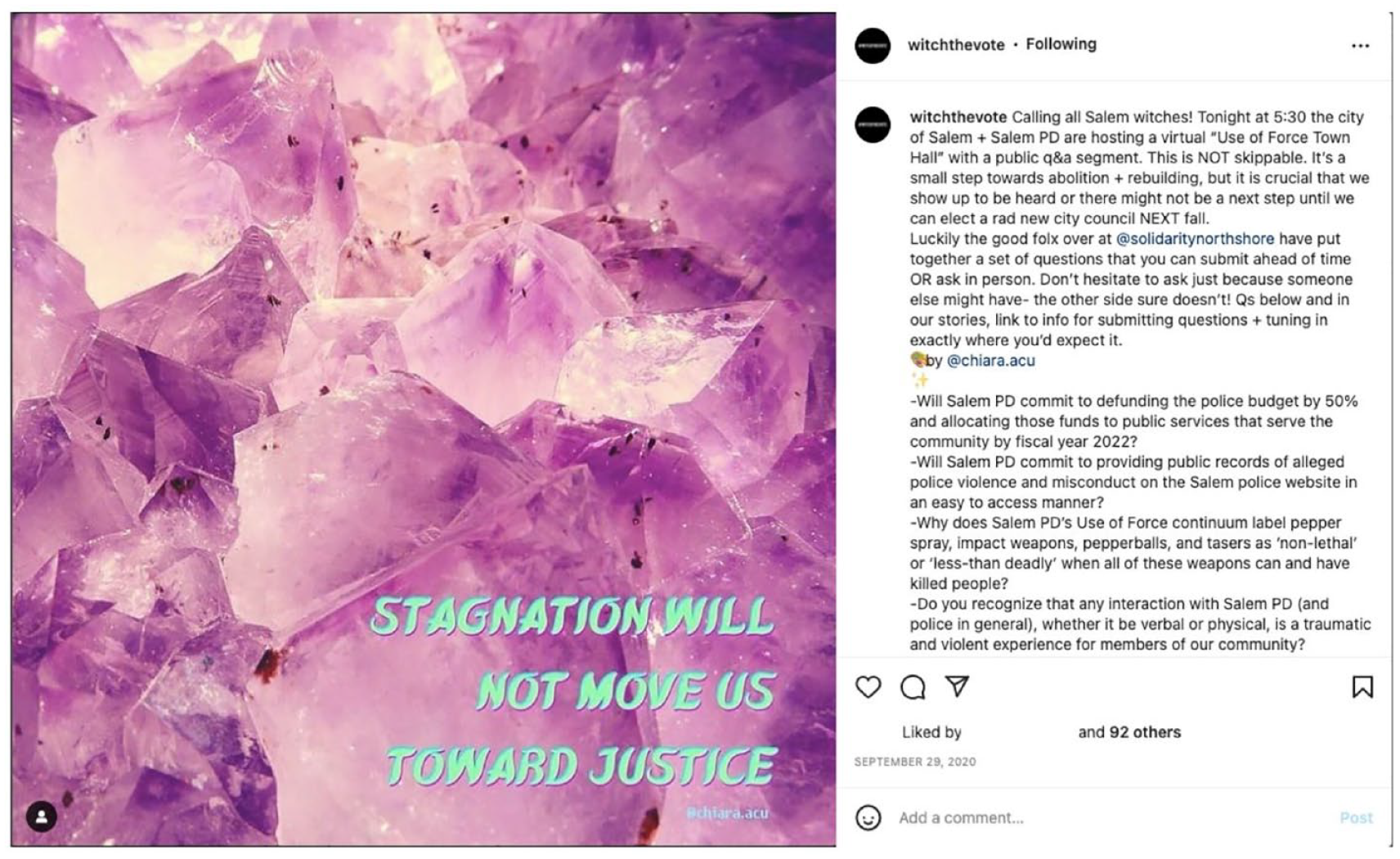
Stagnation will not lead us to justice.
While the accompanying image of what looks like amethyst crystals with the phrase, “Stagnation will not move us toward justice” relates to a reflective nostalgia for the witch and her crystals, it also can be read as nostalgia for an early internet aesthetic that dominated the internet before the emphasis on spreadability made possible by social media platforms: a focus on a specific local political event, the large amount of small written text, and the use of an image/font pairing reminiscent of early aughts photoshop design with a wavy text font. The purple and green color palettes reminded us of the early feminized internet aesthetics popular with girls and often found on their homepages. Indeed, these qualities complicate the circulate-ability of the post and may be read as a disregard for designing a feminist politics that conforms to the technical affordances of digital platforms like Instagram. In other words, we might speculate that the nostalgic witchy aesthetics are prioritized over creating content designed to travel widely across the platform. 2
Likewise, a series of posts on the Witch the Vote account through 2019 and 2020 address the affordable housing crisis in Salem and aim to organize readers around this issue. For example, an August 15, 2019, post reads, We’re here at the Joint Public Hearing of the City Council and the Planning Board putting our zoning knowledge we learned from @cristineforsalem on Monday to good use! [lightning bolt emoji] This meeting is deliberating whether in-law apartments should be allowed as formal, rentable residences. Hopefully, they’ll send this to committee so Salem can start to allow people to rent small, but totally reasonable spaces in accessory dwelling units throughout the city. This is a great part of the solution for the affordability housing crisis our city faces!
The accompanying image shows 11 people, including a mix of both younger and older adults, smiling in a selfie-style photo outside of Salem City Hall. This post not only shows how #WitchTheVote engages local issues but local issues that, we contend, do not work as popular feminist content, in part, because they contest structural power inequities. While affordable housing is no doubt a feminist issue, a problem that unevenly affects marginalized groups, including women, poor and working-class folks, racialized communities, queer people, seniors, and youth, it challenges the logic of the profitability of private property inherent to capitalism. As such, it does not neatly fold into the neoliberal capitalist frame of much popular feminist content—we might say that it is difficult to make affordable housing aesthetically pleasing in a way that meets the “parameters of [Instagram’s] visual economy” (Mahoney, 2022, p. 531).
Attention to local issues has always been important for feminists—and we can point to many examples over the past decades where feminists have focused on the local, including the feminist activism undertaken by riot grrrls through ‘zine and music making in the 1990s discussed above (Kearney, 2006). This attention to the local as a politicized space contrasts with what we understand as central to the widespread visibility and digital circulation of popular feminism—its legibility to a large—arguably, White, middle-class, cis-gendered—audience, regardless of local and national contexts. For popular feminism to “spread” (Jenkins et al., 2013) digitally, it must imagine feminism in broad, “clickable” terms that are explicitly not local, nor intersectional, and are instead reliant upon, to quote Berlant (2008), “fantasies of vague belonging” that assume a commonality among women as a social group. We see a rejection of this in #WitchTheVote through an intersectional approach that recognizes differences between women due to the uneven workings of White male heteropatriarchy, particularly concerning economic class, best demonstrated by their attention to Salem’s local politics.
This engagement with local politics shifts away from the conventions of more mainstream hashtags such as #MeToo or #BringBackOurGirls, meant to spread the word globally, across the vastness of the internet, about feminist issues. These types of campaigns have been criticized for their focus on digital solidarity, individualized action, and appropriation by White feminists. For example, #BringBackOurGirls, a campaign started by a Nigerian activist, was meant to bring awareness and condemnation to the kidnapping of thousands of schoolgirls in Nigeria. Hopkins and Louw (2020) describe the hashtag as “ultimately ephemeral and superficial,” pointing to the campaign’s popularity among (predominantly) White female celebrities from “a world over” (p. 67). For them, the hashtag was ultimately more indicative of the contemporary preoccupation with global terrorism than a united front against gender-based violence. Similarly, Maxfield (2016) argues the hashtag’s appropriation and subsequent abandonment by Western media were rooted in imperialist and racist histories. This example points to a key tension in contemporary digital feminist campaigns’ relationship with celebrity and the attention economy. Activist content meant to spread within the logics of the attention economy is intimately linked to “Westernized consumerism, economic inequality, and sexualized patriarchal culture” (Hopkins & Louw, 2020, pp. 67–68). In keeping its focus on localized issues, #WitchTheVote circumvents some of the issues large-scale digital feminist campaigns encounter.
We contend that this strategy of political localization is somewhat counterproductive to how social media platforms such as Instagram are designed. As we discuss at the start of the article, platform logics encourage us to engage in politics that are widely recognizable and vague enough to circulate across vast geographical areas. A focus on specific local contexts limits the content’s flow, as do topics such as affordable housing, which tend not to personally affect middle-class and wealthy women. This example demonstrates how Instagram can act as a “self-directed channel(s) for feminist activism” (Thrift, 2020, p. 266). The platform’s utility is that it functions as a necessary feminist communication infrastructure for Witch the Vote’s localized activism, rather than a tool that shapes their feminist practice.
Conclusion: Online Feminist Failures?
The “success” of digital activist campaigns is often articulated through the digital metrics designed into social media platforms—how many “likes” or “retweets” a post receives, or how many times a hashtag is used. These metrics become celebratory markers of not only the digital content being circulated, but we might say, using the internet/platform the “right” way (Abidin, 2020; Marwick, 2015). By these metrics, #WitchTheVote is not successful—it is not a hashtag that is frequently used for long durations, most of the posts receive only a modest number of likes and comments, and it has received no mainstream media attention. The posts shared using the hashtag often do not follow established platform conventions concerned with garnering visibility. Yet, we suggest the hashtag is emblematic of the potential for doing intersectional feminist politics online that pushes back against both popular feminism and platform conventions. It imagines a different kind of feminist politics through a reflective nostalgia for time and place that troubles visibility, attention, celebrity, large audiences, and consumption as part of contemporary feminism. #WitchTheVote is likely not the first or only digital campaign to do this, yet we think it makes a fruitful case study for thinking about the future of digital feminisms.
To say that #WitchTheVote is “unsuccessful” because of its relative obscurity would reinforce the notion that platform metrics are the ideal way to measure a digital feminist campaign’s accomplishment. In 2019, the hashtag, along with other #WitchTheVote media such as a ‘zine and podcast, was used by witches to engage local Salem residents to participate in the municipal elections, with several progressive #WitchTheVote endorsed candidates winning or successfully defending their seats. Indeed, in our interview with a #WitchTheVote organizer, she discussed how the campaign engaged Salem youth to advocate for affordable housing at a city council meeting, making “some folks very nervous to see these young people show up at city council meetings and want to talk. It is kind of unprecedented because I think that old white people are very used to having the floor.” In this sense, the hashtag has been crucial in shaping Salem’s local politics and making meaningful structural change. This localized digital feminist activism challenges the logics of other viral feminist campaigns such as #MeToo whose “shareability mean[t] scalability,” resulting in the feminized, activist labor’s exploitation for profit by platforms (Weigel, 2018).
We conclude this article by thinking about the incongruent relationship between the “success” of digital feminist politics on commercial social media platforms and local intersectional feminist organizing. Platformed popular feminism is fundamentally at odds with intersectional feminism. Platform infrastructure privileges certain voices and by extension vilifies dissent (Singh, 2018). We offer #WitchTheVote as a case study for alternative engagements with platformed feminism. #WitchTheVote reimagines feminist engagement with the internet by treating platforms as everyday objects rather than tools of visibility. This is representative of how ordinary internet users’ digital activism contributes to the necessary communicative infrastructure that enables localized and international feminist mobilization (Thrift, 2020). By focusing on smaller-scale digital feminist organizing, we can trouble the assumed futility of digital activism and provide space to imagine possibilities for intersectional feminist interventions that extend beyond popular feminist expressions.
Footnotes
Declaration of Conflicting Interests
The author(s) declared no potential conflicts of interest with respect to the research, authorship, and/or publication of this article.
Funding
The author(s) disclosed receipt of the following financial support for the research, authorship, and/or publication of this article: This study was supported by Government of Canada > Social Sciences and Humanities Research Council of Canada 430-2018-00434.
