



Abstract
In this article, we examine protest of India’s passage of the Citizenship Amendment Act (CAA) and National Registry of Citizens (NRC) which spurred instances of physical and digital protest. We study the intersections of gender, political subjectivities, and digital activism among anti-CAA-NRC activists, specifically the “Women of Shaheen Bagh.” We discuss our data collection methods, description, and analysis of the protests in the context of larger questions, including how critical, feminist researchers may engage with data tools and how forms of gendered, transnational protest are mediated and represented via individual images, texts, and videos that make up social media data. We illuminate the formation of political subjectivities in the context of transnational, digital protest movements by re-appropriating computational and data tools. This article seeks to demonstrate an interdisciplinary engagement between critical, feminist approaches to knowledge and subject formation and data science approaches to social network analysis and data visualization techniques.
Introduction
On 11 December 2019, India’s parliament passed the Citizenship Amendment Act (CAA). The passing of this act was followed by the implementation of the National Registry of Citizenship (NRC) nationwide which required individuals to demonstrate proof of citizenship status (Hameed, 2019). The NRC and CAA were preceded by the revocation of the majority Muslim state of Jammu and Kashmir’s (J&K) autonomous status (Perrigo, 2019). This move resulted in isolating and disenfranchising Kashmiri Muslim Indians. The broader passage of the CAA-NRC sparked nationwide and transnational protests among Indian citizens, diaspora communities, and allied groups in solidarity who viewed passage of the CAA-NRC as a move to exclude and marginalize Muslims (Laliwala, 2020).
In addition to the physical protests in India and abroad, forms of digital protest on platforms, including Instagram and Twitter, began to emerge. In the context of these protests, as members of a (transnational) feminist research collective, we began researching the anti-CAA-NRC protests to examine intersections of gender, political subjectivities, and activist use of digital tools—specifically focusing on a group of protestors located in the Shaheen Bagh neighborhood in Delhi, India, and also connecting with activists in Billal Bagh, Bangalore, India. Our collective was led by an established Indian diasporic US academic and includes scholars and activists living in India and in the United States with members from varying international backgrounds. While our foundational members approached the protest from a North American location and our entry point to the protest was digital, our collective’s work has been informed by long-standing connections to Indian feminist activists in India, abroad, and online. Some members of the feminist research collective engaged in this research project were also collaborators from the United States who were in India because they were visiting family over the December break. Our collective involvement in the research site was layered and included offline observation and engagement on site in Delhi and Bangalore particularly.
Drawing on and contributing to the larger body of literature on protest movements that have used social media such as Occupy Wall Street (Penney and Dadas, 2013), Arab Spring (Srinivasan, 2013; Tufekci and Wilson, 2012), Black Lives Matter, and other international and transnational protest movements (Mohammed, 2019), we focus on how activists in India have adapted and extended techniques, tactics, and strategies from these and other similar protest movements using social media. In this article, we look at the role of transnational activism through social media while drawing on our collaborative research and interviews on-site with activists, onlookers, and Indian and fellow transnational digital archivists. Our focus here is only part of a larger body of continuing research/practice in relation to gendered Indian digital activism (Bhatia and Gajjala, 2020; Subramanian, 2021).
The protests both on-site in several metropolitan areas of India and in digital spaces represented a new discursive challenge to the Hindu nationalist rhetoric of the Bharatiya Janata Party (BJP) and suggested the manifestation of a (re)emerging form of gendered political protest in India. Significantly, the on-site protests in Shaheen Bagh and the digital representation and amplification of these protests through social media served to highlight the political agency of women from a social class location (working class, historically marginalized castes, and religious minorities) who are often written off as being voiceless for a variety of reasons. What was particularly interesting is that the women emerged as visible despite not claiming leadership or relinquishing their identities as the keepers of the home. Even as college student protestors and transnational social media influencers rose to the occasion as resisters and activists, the women of Shaheen Bagh themselves emerged as the true activists by redefining the perceptions of what an activist does or looks like. Contrary to common perception that it is university students, “feminist” women or the men of a community that inspire and initiate protest movements, what seems to have happened was that the women of the community and their quiet resistance led to several others being inspired to join in the protests. A college student who was at the protest site had this to say in an interview conducted by a co-author on-site in Delhi:
The women there . . . They are from lower-income families . . . But they are out on the streets. Some of these women are daily wagers . . . if they don’t go to work even for a day, they don’t get paid for that day. They are just there . . . sitting on a dharna. With their children in their laps. They are risking so much. And what am I doing? And you know what, no matter how poor they are, when they are at the site, somehow help always arrives. (Protestor 2, 2020)
This same interviewee also goes on to note the importance of what social media influencers are doing—countering observations that discount social media outreach by young people as slacktivism or as not being “real” activism:
So, I am posting on my social media all day . . . stories, and feed, and discussing things. People say it is a waste of time, but I am like dude I am here because someone from my circle was ranting about it on social media. Where do we meet each other nowadays to discuss politics? . . . Like reading stories, being at sites to record those things, verifying the authenticity . . . they require efforts. When police attacked Jamia students at night, remember? I was up all night looking for more information. (Protestor 2, 2020)
Here, the interviewee refers to attacks on university students and attacks in Muslim majority communities in select metropolitan cities. Empathy with fellow students who were attacked and admiration of the women protestors from the community led to solidarity in the streets and in transnational digital spaces. The attacks on university campuses resulted in even seemingly apolitical or pro-BJP students getting involved. 1 They also resulted in middle-aged and older women from the community engaging in activism through their domestic-oriented ethics of care. In fact, the “Dadi of Shaheen Bagh,” one of the older women, Bilkis, was later featured on Time Magazine’s list of most influential people of 2020 (Ayyub, 2020; Lakhani, 2020). The fundamental affective power of the protest to both national and global audiences was produced through the visibility and leadership of working-class Muslim mothers, wives, and grandmothers at the protest site (Zaidi and Pani, 2020).
Visible actors in previous waves of feminist protest were often primarily middle-class, upper-caste, Indian women, and non-governmental organizations (NGOs). Women’s activism and political agency was framed around a public/private binary. Interviews conducted on-site with the women from the Shaheen Bagh community, however, reveal the contradictions around how they accessed public space. The women interviewed for our research were honest in laying out their anxieties while noting that they were at the protest site regardless. For instance, one interviewee stated,
Women can’t protest alone. The other day, when police came—they come everyday to scare us. The men formed a circle around us. I am also here because my son said I should be here. I was not ready to send her [her daughter-in-law]. She is pregnant. This is not safe. I am not happy to be here—but what should we do? (Protestor 1, 2020)
In traditional Indian media contexts, Muslim women are made visible as stereotypically oppressed by their men (Ayyub, 2020). This image is troubled through the strategy adopted by the Shaheen Bagh community–based anti-CAA protests. Even as social media influencers/activists tended to be university students or the men from the community, they too emphasized images of the women protestors from the community. Circulation of images in transnational digital space led to the formation of hashtag publics as alternatives to mainstream media. Our focus in this article is thus particularly on the transnationalized digital visibilizing of the women of Shaheen Bagh. We therefore use select anti-CAA hashtags (such as #womenofshaheenbagh) as entry points into studying what Rambukanna (2015: 29) refers to as “other publics: more or less subaltern, more or less rational, more or less critical, and almost certainly partial, affective, interested, and loud.”
Shaheen Bagh and the Indian feminist movement
In this section, we briefly note the genealogy of earlier waves of the Indian Women’s Movement (IWM). The IWM is preceded by Indian nationalist attempts to address “the women’s problem,” where the dominant caste men and some affiliated women worked to develop the “ghar/bahir” binary in order to address specific social issues such as child marriage and (upper-caste) women’s education (Chatterjee, 1989). Thus, what they considered to be the essence of the “Indian” home (ghar)—spirituality—would still be preserved in the women’s domain and women would become responsible for the preservation of traditions. In this manner, women would become resisters of British colonizers even while in the home. Yet, as later feminists observed, this was but a re-instatement of a cultural (and Brahmanical) patriarchy (Bhattacharjee, 2012; Chakravarti and Krishnaraj, 2018; Rege, 1998). Thus, the IWM that followed and became the dominant voice of feminists in India in the 1970s and 1980s was in itself top-down in the way it addressed issues around women from historically marginalized populations (including caste) and rural women (Rani, 2013: 705, 707). The move to a second wave of the IWM focused on caste, class, and labor rights issues in post-independent India (Kurian, 2018). A third wave is further defined as emerging in the 1970s and 1980s through fragmented, autonomous women’s collectives (Kurian, 2018: 20).
In the 1990s, the neoliberalization of India’s economy (Madhok, 2010; Roy, 2015: 102), and specifically, “NGO-ization” (Gilbertson, 2018: 2; Roy, 2015: 102) impacted the IWM. Neoliberalization is also related to the emergence of “Digital India” and new iterations of rights-based, digital activism (Dasgupta and DasGupta, 2018: 2). In contextualizing the Shaheen Bagh protests, we situate physical and digital activism as also occurring through an “activist neoliberal mode” (Gajjala, 2019: 13), whereby contemporary Indian feminist protests work in tandem with neoliberalization and the dynamic possibilities offered by digital technologies and platforms.
The activism of the women of Shaheen Bagh differs from previous iterations of the IWM in two ways. On the one hand, the community women were working together with community activist leaders, not with upper class, university-educated feminists who have previously tended to be front-stage as the visible activists. On the other hand, both community members and protestors who joined from outside (including but not restricted to university students) were making extensive use of social media to keep the world informed. The use of gadgets by such social media influencers is based in everyday selfie cultures of younger generations of users mobilized as a strategy for the transnationalization of the activist space (Abidin, 2016; Senft and Baym, 2015).
In her article on “From streets to web,” Subramanian (2015) describes the everydayness of social media use by her generation of feminists in India. This is a generational move toward activist and feminist consciousness raising through social media. These forms of activism are nuanced and different from the mere use of online tools for offline protest movements. They are based in the nature of “life online,” in a similar vein to what danah boyd (2014: 98) characterizes as teens’ desire to be in public and in social groups. The teens that boyd researched were interested in getting access to public spaces and to connect with peers. This reaching for publics and forming of networks online leads to “hanging out” in digital publics. Through this impulse to connect with each other and create networked publics for themselves, young Indian women have also formed feminist counter-publics online (Subramanian, 2015: 77). Yet, researchers examining transnational Indian digital cultures have noted this online living also has a dark side that includes doxxing and “gaali cultures” (Udupa, 2017).
Indian digital feminist influencers and activists thus experience digital existence as real, not something outside of their daily life that is “virtual.” Their activism is channeled through digital existence but it also draws on and shapes their offline experiences, responses, and strategies for social transformation. In fact, as we saw in the case of the list of sexual harassers in the Indian academy (the #LoSHa movement) which was generated and maintained by feminists of the age group that Subramanian has described, the lack of understanding of this interweaving of online and offline led to a clash between some older generations of feminist academics/activists and younger generations of digital feminists (Sharma, 2021; Gajjala, 2018).
Events such as the 2012 Nirbhaya physical street and social media protests and the #LoSHA online movement have thus contributed to the strategy for social media use that visibilized the women of Shaheen Bagh transnationally. Several strategies drawn from these more recent movements were remediated and deployed through online transnational digital space and through local facing digital online and offline media tools. Furthermore, it is evident that these post-2010 movements have benefited from the replication and extension of practices of amplification in social media that were developed in earlier social movements such as Occupy Wall Street and Arab Spring (Srinivasan, 2013; Tufekci and Wilson, 2012).
Interviews conducted on-site with women protestors revealed the leadership and organizational roles played by Muslim women who have previously not been identified as a significant political presence. There was an explicit rearticulation of what leadership and protests in public look like when the gendered negotiations are highlighted rather than hidden in an either/or binary or “ghar” and “bahir” (home and the world). Today, the “Women of Shaheen Bagh” are cast as inspiring, political feminist actors, their very physical presence at the protests and re-mediation on Twitter and Instagram demonstrating a representational critique against patriarchal Hindu nationalism (Bhatia and Gajjala, 2020).
While the community members of Shaheen Bagh led the charge on the ground and through their own account, @shaheenbaghoff1, their online representation also connected with the affective branding of the protests by diasporic activists supporting the movement globally. Even as the activities of digital activists remain ensconced within the neoliberalizing logics of platform technologies (Gajjala, 2019: 125), the connections between digital and physical streets from the early 2000s onward illustrate the importance of digital branding of protests and the mediation of affective images to form affective publics (Papacharissi, 2015).
Get the hammer out! breaking computational tools and tracking #shaheenbagh
We developed a multipronged approach to collecting data that included participating in efforts to archive protest art and other documentation. In our work of data collection, we also sought to preserve the digital ephemera of activism. As both physical protest and digital protest can be removed (Subramanian, 2021), destroyed, or distorted by governments and social media platforms, the collection of data allowed us to preserve and potentially circulate evidence of a transnational women’s movement as a historical event.
Although much of our activity came to an abrupt halt because of COVID-19 shelter-at-home orders in India and the surveillance and crackdowns that occurred during the quarantine times, our participation in such digital activist tactics gave us further insight into the how of digital activism (Tufekci, 2011). 2 Interviews with activists added to our understanding. Data scraping and visualization tools helped us see the transnationalized nature of the anti-CAA protests and revealed contours of the affective and political dynamics of the protest.
Our methodological process draws on critical, feminist frameworks. Our process, while developed to analyze the unique situation of the Shaheen Bagh protest, is informed by emerging perspectives from feminist data scientists and researchers working in critical data science (D’Ignazio and Klein, 2016; Murthy, 2017; Rettberg, 2020). As Rettberg (2020: 3), drawing on work by Wernimont and Losh (2018), Risam (2018), Eubanks (2011), and Noble (2018), among others, has noted in her discussion of situated data analysis,
Data does not provide us with an all-knowing, all-seeing, God’s eye view of data . . . Research on algorithmic bias shows that racial and gender biases are encoded into the datasets used for algorithmic prediction . . . Situated data analysis recognises that data is always partial and situated, and it gives scholars tools to analyse how it is situated, and what effects this may have.
This approach is further exemplified in feminist, antiracist digital humanities’ methodological models. D’Ignazio and Klein (2020) enumerate in a “Data Feminism” approach that relies on key principles that include the examining and challenging of power, the elevation of emotion and embodiment, a rethinking of binaries and hierarchies, the embracing of pluralism, and a keen focus on context and the visibilizing of labor that goes into the work. Given this situated nature of data, we describe some of our process of working with the multiple kinds of data—interviews as well as Twitter and Instagram data along with our personal experience working on the archiving.
The data scraped from social media were examined visually with the use of layouts available in the data visualization software Gephi (Bastian et al., 2009). We examined the data collected through the timeline feature on Gephi (Bruns, 2012). We then manually rearranged the spatially spread nodes and edges, referring to users and discursive connections, and increased the size of particular nodes, thus assigning value through what we learned from the qualitative interviews. We were not reading the importance of nodes based on the quantitative features alone, although we did run the Eigenvector centrality algorithm to see how the selected group of Tweets clustered into node communities. We also used filters to isolate the transnational groups and feminists clustering together based on our prior knowledge of some high-profile users (Mishra and Pal, 2020). In our analysis, we were privileging the voices of the activists who we interviewed, both on-site and transnationally. We relied on the qualitative data to reveal to us what emerged as important contextually. We used data analytic tools that allowed us to look closely at the various actors and their interlinked Tweets, thus revealing how issues were being taken up through transnational digital publics.
Juxtaposed with these spatially (re)arranged graphs and visualizations, we also mapped themes emerging from our inductive grounded theory analysis of qualitative interview data using the qualitative analysis software Atlas.ti (Charmaz, 2006). This manner of laying out and organizing the different types of data collected while situating the data in a longer ethnographic engagement within Indian digital spaces (across time—not restricted to the anti-CAA moment) allowed us to see that the transnational coalitionary formations visible on Twitter were not just momentary or isolated instances; rather, these formations came from long histories of activist groups developing connections offline. We were also able to glimpse the impact of the offline community context along with the visibility of the women of Shaheen Bagh who presented themselves as both protestors and caregivers (as they distributed tea and snacks even to the protestors who joined from outside the community). Sample figures in the next section illustrate some of our process.
Making sense of #shaheenbagh through multiple data methods
We began our data collection by immediately immersing ourselves in our digital research site. Our positionalities allowed us to initially enter as chroniclers of both the digital and physical protests and we remained heavily connected with protestors and researchers on the ground. As chroniclers, we began by following the relevant hashtags and images on Twitter and Instagram. The hashtag has taxonomical properties, organizing multimedia content to allow texts, images, and videos to become “more perceptible to potential audiences” on social media platforms (Losh, 2019: 56). In this way, we initially approached a series of hashtags, #shaheenbagh, #CAA, and #Shaheenbaghprotest as an organic and fluid classification system for protest materials curated by users that focused on two themes: first, the policy intervention of the CAA and, second, the specific protest site of Shaheen Bagh. Both anti-CAA-NRC and pro-CAA-NRC users actively used these hashtags as a means to make their posts, comments, and critiques visible and legible in a discursive digital conversation about Indian citizenship. However, our work examining these data quickly became a form of collaborative digital labor with the purpose of creating and preserving protests archives.
Our initial engagement with the anti-CAA protests was as interested social media followers in December 2019. However, our research collective facilitator/leader connected with some of the digital activists and influencers who were in India to ask what we could do for and with them. Allies of activists in India were quick to take us up on our offer and tasked us with digital archiving of the protest media and other related artifacts. Transnational and Indian diasporic allies from United Kingdom and Canada (among others) were also mobilizing plans not only to help archive evidence but also to create “trending” digital campaigns to create international awareness and call for the United Nations and other international organizations to condemn the violence against the Muslim communities and against the university student protestors. There was thus a blurring of our roles as transnational allies and as media researchers.
Each member of our collective followed hashtags connected with the protests individually, for an hour a day, and took individual screenshots or recordings of videos we witnessed as they were shared on the hashtag on Instagram and Twitter. This portion was done manually and thus mirrored the experience of social media users who entered the hashtag. This allowed us to experience how a particular hashtag became effective and affective for a protest movement. This grounded daily collection ritual allowed us to rapidly witness a set of emerging themes, including the gendered nature of the Shaheen Bagh protests and the strategic ethic of care deployed by female protestors designed to valorize the women of Shaheen Bagh to a global audience.
Activists strategically deployed both physical signs and virtual hashtags to craft a particular narrative of protest that emphasized the gendered nature of the movement as a peaceful feminist event, thereby countering BJP media narratives of the anti CAA-NRC protests as defined by Muslim anti-state violence (Singh, 2019). Looking at Figure 1 as a representative example, we see how protestors on the ground played with existing phrases and symbols—here modifying the phrase “make love not war”—a phrase used during the anti-Vietnam War protests in the United States during the 1960s (Fattig, 2010). We see on the protest placard activists urging the public to “make tea,” a practice which is couched within the context of Indian national domesticity and an activity typically performed by women (Lutgendorf, 2012). Figure 1 demonstrates the way in which activists on the ground deployed and modified transnational political phrases and symbols for nationalist causes in the contemporary global digital age (Dumitrica, 2021). Activists not only branded the protest strategically on the ground but tagged the event on digital platforms. This ensured that users from a variety of physical locations on Instagram would consume a stylized image of the Shaheen Bagh protest that evoked both gendered Indian domesticity and the historic American anti-war, counter-culture protest era of the 1960s.
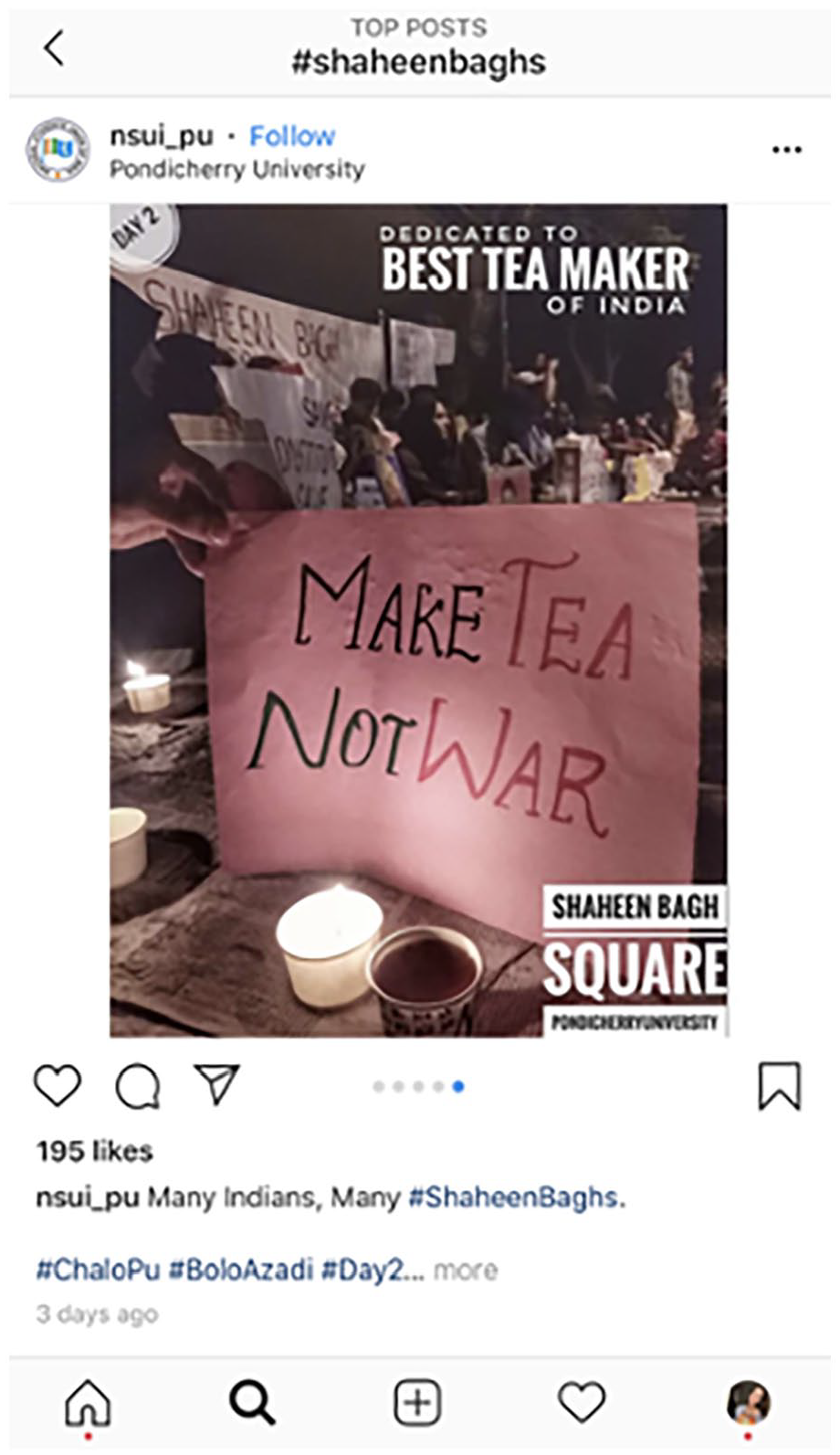
Image of concurrent protest at Pondicherry University in support of Shaheen Bagh, “Make Tea Not War.”
This immersive process provided us with a deeper cultural context for the protests and led us to deploy data tools such as the social media and text analyzer Netlytic and Gephi to scale up our vision of the protests and trace the networked connections between individual users and hashtags that formed a discursive community on Twitter. However, the value of the daily, hourly individual collection ritual—of becoming familiar with the grammar of relevant hashtags and themes posted by Instagram and Twitter users—did have limits. These included practical issues of storage of screenshots and video content as well as the potential for Tweets, Instagram posts, and videos and comments to be deleted either by the platform or individual users. Finding a way to archive platform-wide conversations was impossible without the usage of data tools.
The data visualization techniques we used were made possible initially through Netlytic (Gruzd, 2016) and Gephi to visualize social networks of Twitter users, which are designed to illustrate and thus describe the contours of digital communities (Grandjean, 2016; Gruzd and Haythornthwaite, 2013; Gruzd et al., 2017). While singular posts are important to mobilize a hashtag and a movement, it takes a sustained effort to create the viral effect that the Women of Shaheen Bagh had upon platforms and that sustained effort could not be discerned through tracking individual posts. It is here that the data analytics and visualization was taken into account along with the content and context of the hashtags that our individual collection rituals imbued us with.
In producing visualizations of the protest networks, we reproduced several types of visualizations of our data using a series of algorithmic layouts in the program Gephi (such as ForceAtlas2 followed by Label Adjust) to reveal dimensions of communicative ties between users engaging with similar hashtags. Visualizing these conversations by tracking hashtags illuminated the spatial dynamics of the protest online while also giving us insights and discussion points to take to our off-the-grid conversations with fellow transnational allies and researchers as well as with activists in India. What Gephi helped us to visualize was how the “nodes” of individual users connected to larger clusters between users. We produced visualizations from Gephi and these visualizations allowed us to create specific snapshots of clusters focused on specific Tweets with connections between users who initiated the Tweets, liked, or retweeted them. The messiness of the way in which hashtags are appropriated and counter-appropriated in attempts to hijack or attack each other’s message becomes visible (for instance, see figures and descriptions later in this article).
After producing a visualization identifying important conversational clusters, we narrowed down this expansive view to examining the hashtag #WomenofShaheenBagh, which was used primarily by anti-CAA-NRC supporters and focused specifically on images and comments about the Women of Shaheen Bagh. Then, in March 2020, on International Women’s Day, we saw that this hashtag was connecting to another hashtag, #sheinspiresus. Upon investigation regarding the hashtag, we discovered that it was a hashtag initiated by the BJP Narendra Damodardas Modi–led government in order to honor those women that they considered to be ideal women serving the Indian nation (APN Live, 2020) (see Figure 2).
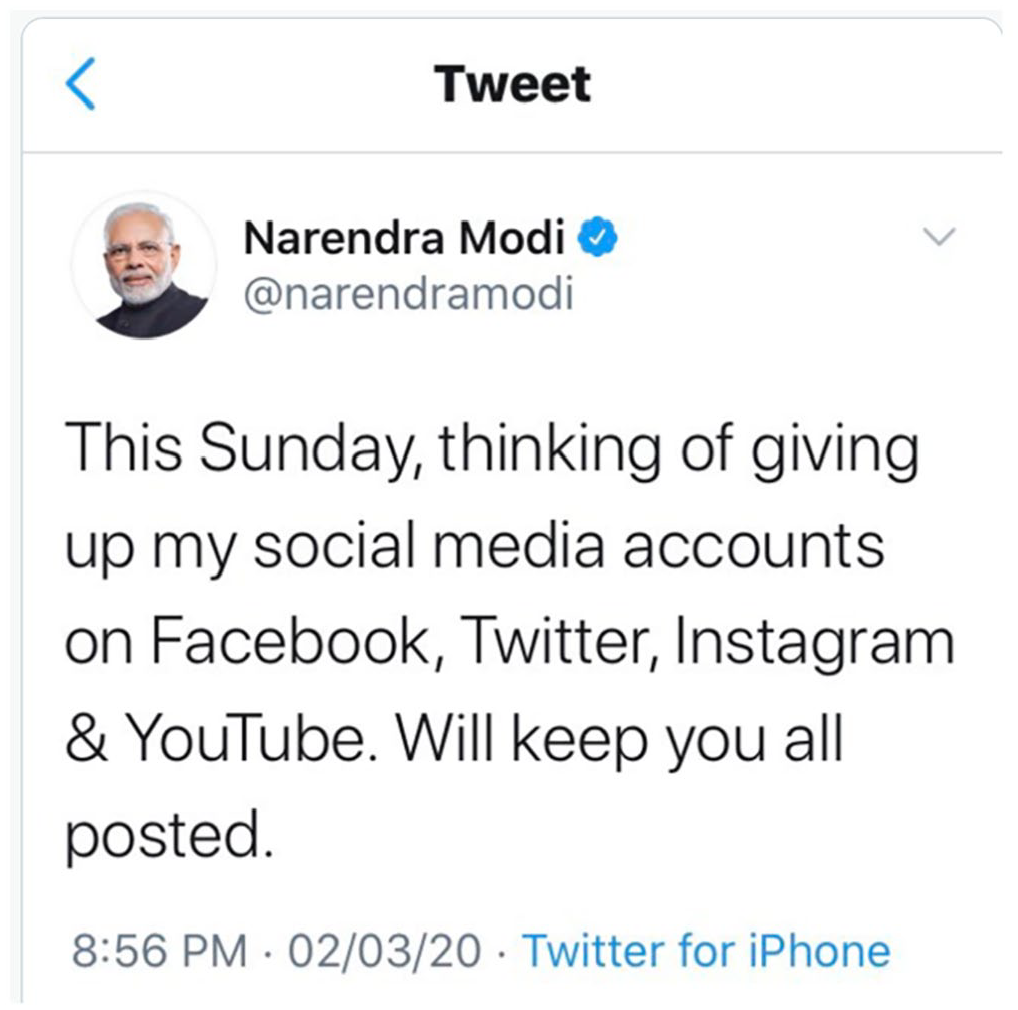
The Tweet from PM Modi that led to digital activists attempt to hijack the #sheinsspiresup.
Curious to know more about this, our research collective facilitator started up Gephi to scrape the hashtag #sheinspiresus. Tracking this hashtag on International Women’s Day and then closely examining users Tweeting on this hashtag, we were able to follow the edges (connections) in the visualization back to a few specific clusters. Our interest was caught by two clusters of Tweets connecting #womenofshaheenbagh and #sheinspiresus. As we looked more closely at the clusters, we also saw two outlier clusters—one connecting to Tweets in Bahasa Indonesia and another to a pro-Trump Twitter handle. Focusing on anti-CAA-NRC hashtags, however, we examined the Twitter handle “@SASAF-UK” (see Figure 4) and another cluster around some Bollywood actresses (see Figure 3).
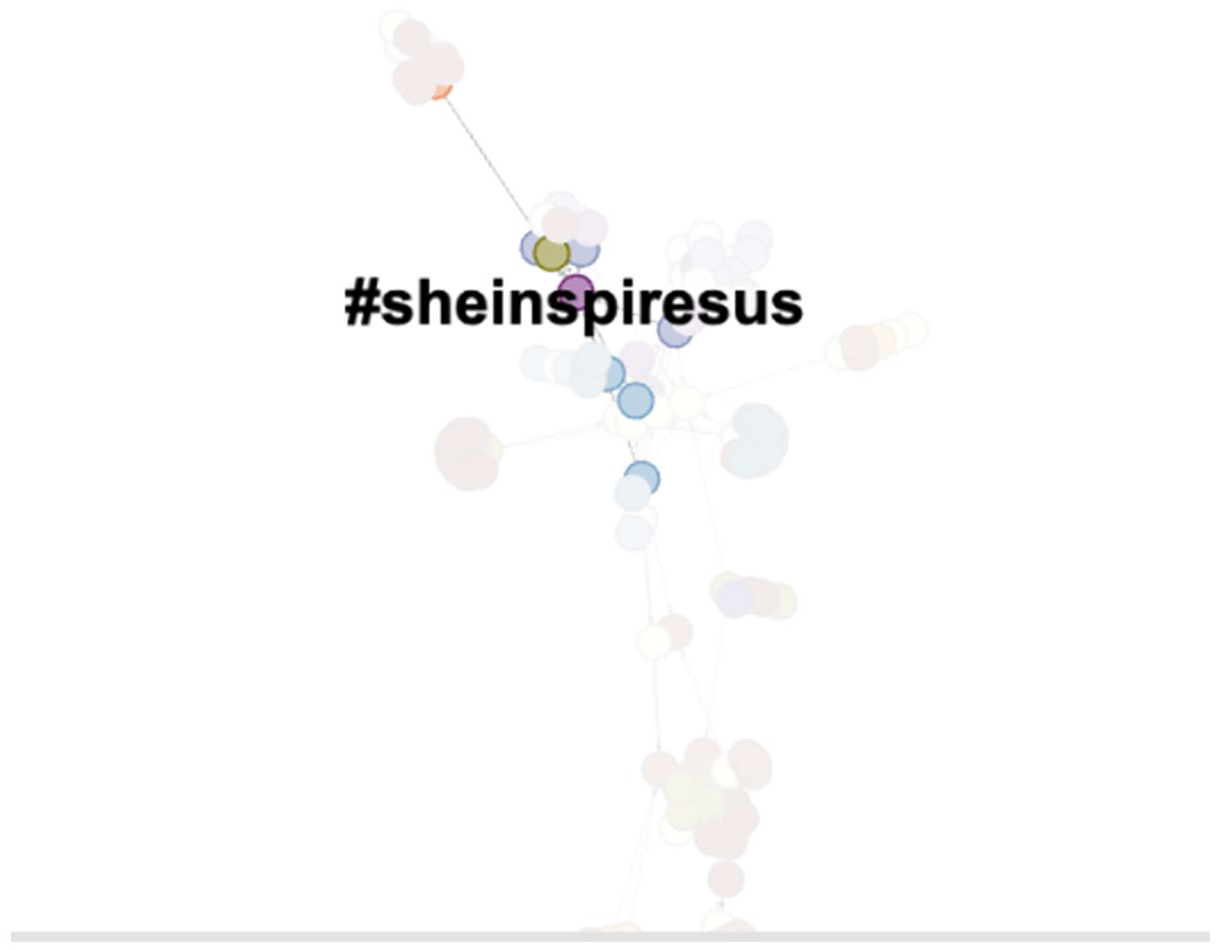
This screenshot documents our process of locating and highlighting the hashtag #sheinspiresus in a Gephi visualization after running the ForceAtlas2 layout on Twitter data that we scraped in March 2020.
We include the figures below to give the readers an idea of how we went back and forth from Gephi data visualizations to conversations with other collaborators and activists whom we invited into dialogue at various stages. Thus, for instance, we were in conversation with a colleague in the United Kingdom through the transnational networks as we worked with activists in India. We were communicating in a daily frenzy of activity through a Slack group with some colleagues, via Signal and Telegram with others and also via WhatsApp, Twitter direct messages, and email.
Figure 3 shows how we specifically located and highlighted the hashtag #sheinspiresus and then took screenshots to mark and remind us where it appears in a cluster. The actual cluster fades in the background when the cursor is centered on one text node to highlight that node, but viewers can tell its shape. However, if you look at Figure 4, one sees a screenshot of the same cluster taken to share with a co-researcher in the United Kingdom via Slack in order to continue discussion.
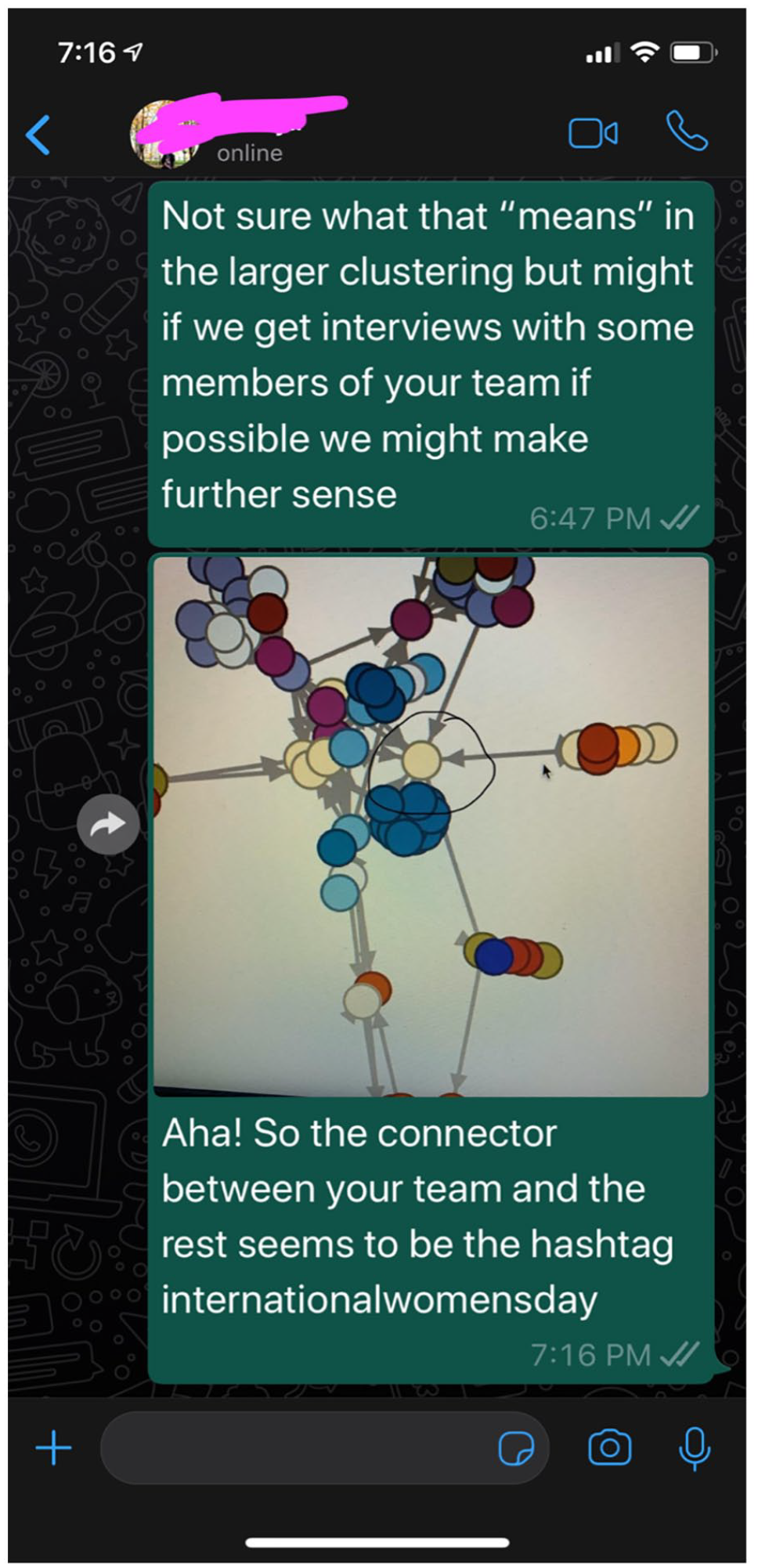
Screenshot from Gephi visualization around #sheinspireus shared via Slack with collaborator who also turned out to be a member of the transnational activist group highlighted during our Twitter scrape of the hashtags.
Our Twitter scrapes along with interviews, participant ethnographies, and Gephi visualizations became archival documents and evidence of various presences in the transnational coalitionary space.
At the same time as we were looking at the scraped data, we were also conversing with one of our collaborators and co-researchers from the United Kingdom and so we became aware that @SASAF-UK was an activist group that called itself “South Asian Students Against Fascism-UK.” We learned that this transnational activist group had been making a concerted effort to hijack the #sheinspiresus so that it connected visibly with #womenofshaheenbagh. They were trying to gather together momentum to generate a Tweet storm so that these two hashtags would connect up and trend. It appeared from looking at the data visualizations around these hashtags that some social media users (including a few activist-oriented Bollywood actresses) and activists in India had also joined this attempt. It was our iterative, cautious, and even sometimes tentative process of engaging the context and various actors that produced understandings for us. Following these edges and nodes allowed us to attach actual people to the data and connect the digital space with the groundwork of activists.
Following up on the conversations in our participant ethnographic space, we also conducted interviews with several more members of the SASAF-UK group. Our interviews revealed that this is a group that has been working with other transnational coalitions to counter Hindutva nationalist politics. A group such as this therefore emerges and forms out of a longer history and tradition of building transnational coalitions and predates digital activism. Yet, the current generation of transnational activists is clear in noting the importance of social media to their continuing work. One interviewee clearly stated that
[D]igital activism is very, very crucial. First of all it’s a contested space so I will not say that the revolution will be on social media and that’s done. That is not true. Twitter, Facebook, all of these, ya, they’re not in, they don’t care about us. Let’s just be very clear. And, expecting them to take our side and not block our material or not stop our rage is never, not going to happen. So, I think these platforms have to be used as tools . . . Ya, not only revenue, our data, they’re selling it. (laughs) Frustrating bit. It’s definitely been a contested space. (Protestor 3, 2020)
From what we observed through the scraping and visualizing of Twitter data and interviews with transnational participants in digital activism, we clearly saw that what appeared to be a predominately local, grassroots-driven effort by Muslim women within the neighborhood of Shaheen Bagh in Delhi was also being transnationalized. As such, one way in which to make sense of the Shaheen Bagh protests is as both a transnational movement visibly led by previously marginalized, political subjects and a platformed protest that seeks to subvert both the Indian state and the neoliberalizing logics of social media platforms (Basu, 2021).
SASAF-UK attempted to highlight and manage the gendered and affective dynamics of the protest by attempting to hijack the #sheinspires and connecting it with #womenofshaheenbagh. SASAF-UK utilized that same “branding” technique to push back on the Indian state’s use of social media by highlighting part of the brand that #sheinspiresus was never intended to highlight. The Shaheen Bagh protest, while centered on the affective symbols of Muslim women, is therefore relatable to earlier forms of digital Indian feminist protest that combined critical forms of informational and affective labor of diasporic activists (Losh, 2014), as well as a type of digital engagement of branding that has its roots and basis in neoliberal marketing campaigns (Gajjala, 2019: 123).
Tools such as Gephi allowed us to scale up our vision to more clearly identify connections and relations in social networks that may escape us in the process of immersive research. However, the identification of such connections and political actors was only made possible through detailed examinations of visualizations and prior cultural knowledge of activist groups such as SASAF-UK. Such individual users and conversational clusters would immediately become illegible if we had only focused on the surface-level visualization as the end product of research. A successful use of feminist theory with a mixed methods research project, as we deployed here, can help to visualize hidden networks and connections that can be overlooked in more restrictive viewpoints (Hesse-Biber, 2012).
However, despite the value of these visualizations, we also found them profoundly limited; they merely described and visualized diasporic connections; they did not illustrate why, how, and over what time period these networks grew or why these users identified either with an anti or pro-CAA-NRC position. Some users would Retweet an image, for example, in the #shaheenbagh set, a photo of Rehana Khatoun holding her newborn child while protesting at Shaheen Bagh, but often with no additional text or information, demonstrated in Figure 5.
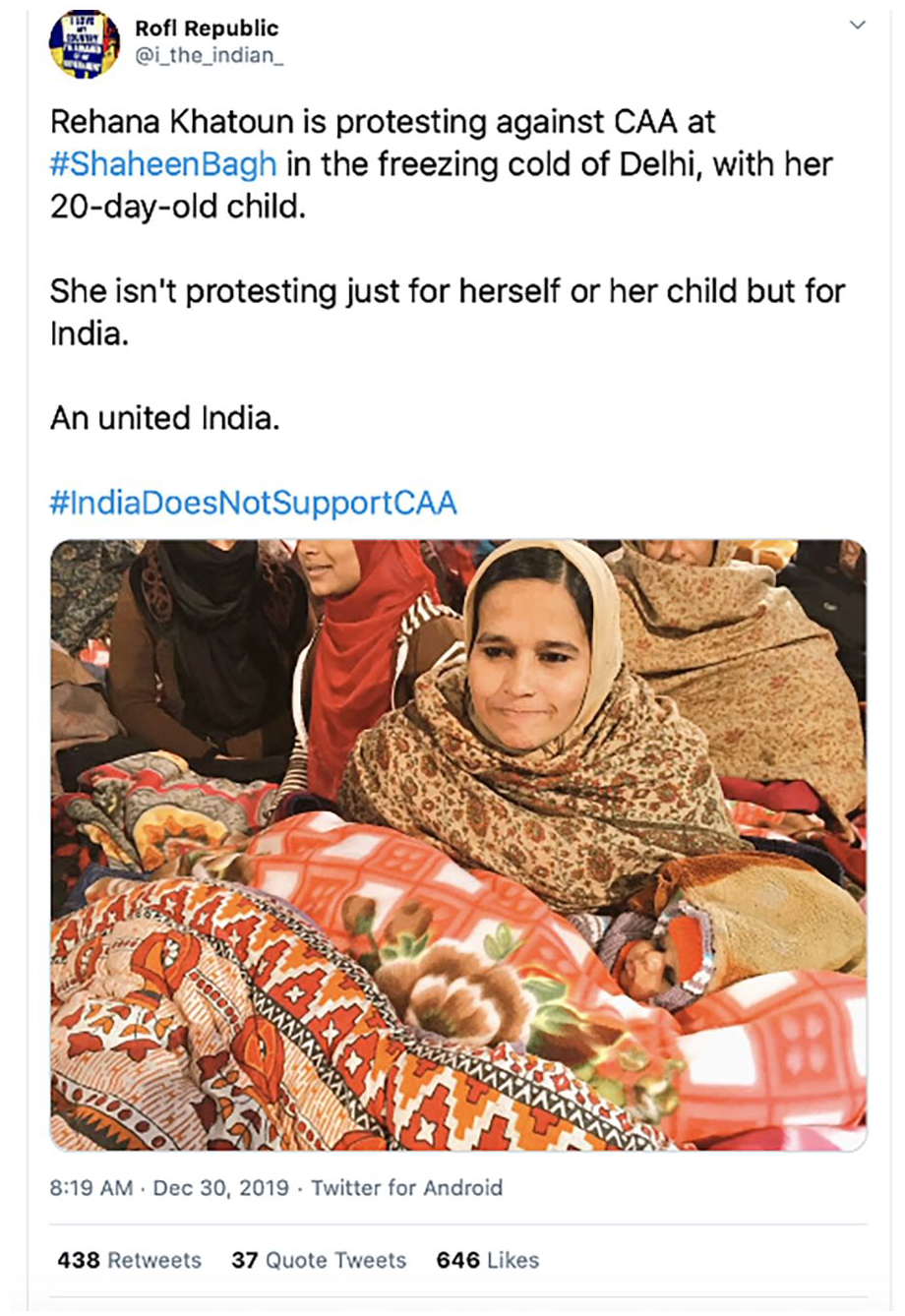
Image of Rehana Khatoun at Shaheen Bagh protest.
The image of Rehana Khatoun depicted in Figure 5 must, as feminist scholars Rosemarie Buikema and Marta Zarzycka (2012: 128) note, be examined in the context it is placed within—in this case the platformed context of Twitter and the political context of the passage of the CAA-NRC. Images such as Figure 5 reach a global and local audience with some users having significant knowledge and context of the national Indian political moment and other users merely responding affectively to the image. Khatoun’s image, of her cradling her child in the cold, garners a particular form of affect among viewers of the image—even as the image remains “polymorphous” in meaning (Keller, 2002: 8). Through usage of hashtags, anti-CAA-NRC activists are able to modify and “frame” the image to advance a particular narrative of the protest using platformed technology (Bennett and Segerberg, 2015), one dominated by peaceful, feminist protest of the women of Shaheen Bagh.
However, Raghu Karnad (2020), in discussing the media representations of the Women of Shaheen Bagh, notes that these images have different meanings for different audiences. For anti-CAA-NRC communities on Twitter, such images represented the power and visibility of a marginalized group of Indians; “[t]o other audiences, however, the visuals were troubling and suspicious. Evidence of conservative religiosity was easily painted, by hostile media, as radical Islamism—and thus, a patriotic protest as an ‘anti-national’ threat” (Karnad, 2020). Excavating the meaning and reception of images such as Rehana Khatoun could not be accomplished by merely examining the labels and hashtags. Thus, through the dynamic exercise of entering data ourselves, we quickly saw the problem of simply allowing data tools to gather, organize, and display data without engaging with the ethnographic space.
Conclusions: beyond critique to re-tooling
In this study, we have demonstrated the utility of a critical, feminist approach to data gathering. Articulating a multistep process which included a daily collection ritual, scraping of relevant hashtags, visualizing the scraped data, connecting with users offline, and cataloging, we were able to identify the transnational dimensions of the Shaheen Bagh protest. By engaging with tools such as Netlytic and Gephi, we were able to illuminate previously invisible transnational solidarity networks among anti-CAA-NRC supporters and identify how the Women of Shaheen Bagh were presented as secular, inspiring political actors in virtual contexts by diasporic Indian activists on the digital streets of Twitter and Instagram.
There are numerous challenges in re-appropriating data tools, including the prescriptive, hierarchical structuring of social media information built into data tools themselves. In addition, we must also contend with corporate and state manipulation and appropriation of data tools and digital technologies that enact both forms of economic neoliberalization of citizen data and instances of user surveillance (Dey, 2016; Gajjala, 2018; Litton, 2015). Thorat (2021: 151) has also noted the confluence of corporate and authoritarian interests among social media companies and the Indian state in suppressing progressive digital political activism and neglecting to moderate abusive speech targeting minority populations. Furthermore, right-wing pro-CAA-NRC “trolls” have also enacted campaigns of harassment targeting anti-CAA-NRC protestors, appropriating social media branding strategies for far-right Hindu-nationalist aims (Chaturvedi, 2017; Pandharipande, 2020).
It is true that the physical presence of previously invisible Muslim women pushed back against mainstream narratives of Indian Muslims as outside the national community and centered Muslim women as active, engaged citizens on a global, digital stage. Yet, it is equally possible that this remarkable work would not have gained the global visibility it did without the work of digital activism from diasporic/transnational groups. Overall, through our engagement with activists in conversation, collaboration, and through longer interviews, we were quickly able to confirm the influence and importance of transnational diasporic Indian networks.
The involvement of Indian diasporas both financially and ideologically while discursively visible and connected through Internet publics is not new. Rai (1995) and several other scholars in the 1990s (Gajjala, 2004) have indeed noted the dominance of right-wing Hindutva discourse on Internet bulletin boards of the 1990s for instance (Chopra, 2006). It is also true that although our focus in this article is in mapping a select portion of the transnational outrage against the CAA/NRC that was visible via social media publics, the pro-CAA groups also proliferated in these digital publics. These conversations were further nuanced by insights garnered from the first author’s continuing investigation into White supremacist and anti-Islam digital networks (Edwards, 2021).
As a feminist research collective, we call for the re-appropriation of data tools and the implementation of feminist methodological strategies to preserve the invaluable data that make up the #shaheehbagh protest. Our step-by-step methodological process that began with individual data collection to broad-scale scraping to individual conversations and interviews therefore hopes to serve as a model for the effectiveness of a mixed-methods project in best capturing the many moving parts of a global protest movement.
Footnotes
Acknowledgements
We would like to acknowledge the following individuals for their feedback and support during our research process in the article: Oladoyin Olubukola Abiona, Olayombo Tejumade Raji-Oyelade, Sujatha Subramanian, Riddhima Sharma, Saif Shahin, and Yanqin Lu.
Funding
The author(s) received no financial support for the research, authorship, and/or publication of this article.
