



Abstract
Prior research concerning social media use and self-esteem showed inconsistent findings. In the current research, two studies were conducted to examine the moderating role of perceived relational-closeness between social media use and self-esteem, and the underlying mediating mechanisms. In Study 1 (a quasi-experimental study), by assigning participants to the weak (reporting TikTok use intensity) or strong (reporting WeChat use intensity) relational-closeness condition, we found that using social media with weak relational-closeness harmed users’ self-esteem, while using social media with strong relational-closeness benefited users’ self-esteem. Moreover, participants in the strong relational-closeness condition reported higher social support perception and self-esteem than those in the weak relational-closeness condition. Further analyses showed that upward social comparison mediated the relationship between social media use and self-esteem in the weak relational-closeness; in the strong relational-closeness condition, upward social comparison and perceived social support both mediated the relationship between social media use and self-esteem, but perceived social support played a dominant role in the mediating effects. In Study 2 (an experimental study), we presented the same examination experiences-sharing for all participants. We found that, even exposed to the same stimuli, participants in the strong relational-closeness condition (declaring that the experiences-sharing was extracted from QQ) still reported higher social support perception and self-esteem than those participants in the weak relational-closeness condition (declaring that the experiences-sharing was extracted from Bilibili). The current research provided a possible explanation to reconcile previously inconsistent findings about social media use and self-esteem.
Keywords
Introduction
In modern society, social media has been a part of our daily lives and exerts a profound influence on individuals’ well-being (Meier et al., 2020; Valkenburg, 2022; Valkenburg et al., 2022). Social media makes individuals free from the time-and-space restrictions and more readily perceive social support from online friends (Carr et al., 2016; Li et al., 2015). Social support has been considered to elevate self-esteem, and empirical research also demonstrates the positive correlation between social media use and self-esteem (e.g., Nabi et al., 2013; Tao & Cheng, 2018). However, in contrast to such findings, other research suggests that social media use may harm individuals’ self-esteem (e.g., Jan et al., 2017; Jiang & Ngien, 2020). It is well known that individuals have an innate need, even unconsciously, to compare themselves with others to evaluate their own value (Festinger, 1954). So, it is almost inevitable that individuals compare themselves with other users when using social media. Nevertheless, on social media, individuals tend to present an idealized profile of themselves and share the most exciting parts of their lives, resulting in upward social comparison (Vogel et al., 2014). Upward social comparison, in turn, has detrimental effects on self-esteem (Alfasi, 2019; Q. Q. Liu et al., 2017).
To reconcile the previously inconsistent findings about social media use and self-esteem, the present research attempts to examine whether perceived relational-closeness on social media moderates the relationship between social media use and self-esteem. Perceived relational-closeness has been defined as the degree of relationship proximity between a person and their friends (J. Liu et al., 2016). According to this definition, individuals will perceive stronger relational-closeness from intimate friends than from casual acquaintances. For some social media platforms (e.g., WeChat), they encourage users to construct online social networks among their family members, colleagues, and friends in real life. As a result, using such social media may make users perceive strong relational-closeness, and also readily perceive social support on these platforms (Carr et al., 2016). And for some other social media platforms (e.g., TikTok), they allow users to construct online social networks among all users and these purely online friends may never meet in real life. As a consequence, using such social media may make users perceive relatively weak relational-closeness, and correspondingly, they may also perceive less social support on these platforms.
Considering that social comparison is an automatic process (Festinger, 1954), we proposed that upward social comparison would occur when individuals used social media regardless of whether it belonged to weak or strong relational-closeness social media. Although upward social comparison has been widely demonstrated to be detrimental to self-esteem (Jiang & Ngien, 2020; Midgley et al., 2021; Vogel et al., 2014), individuals’ high social support perception acquired from social media with strong relational-closeness may effectively counteract this detrimental effect on self-esteem and contribute to the elevation of self-esteem. Based on this, we speculated that perceived relational-closeness on social media would moderate the relationship between social media use and self-esteem: using social media with weak relational-closeness may harm users’ self-esteem, while using social media with strong relational-closeness may benefit users’ self-esteem.
Overall, the present research first examined the moderating role of perceived relational-closeness between social media use and self-esteem, and the mediating mechanisms behind this moderating effect. And it would provide a possible approach to reconcile the previously inconsistent findings concerning social media use and self-esteem.
Literature Review
Social Media
Ellison and Boyd (2013) have defined social media as a generic term for web-based communication platforms, which has three distinct features: (1) allowing users to create their unique content and share them with other users, (2) creating a visible network in which users can view other users sharing within the same network, and (3) providing a space allowing users to communicate with others in a continuous stream of information. According to this definition, social media includes a variety of online social networking sites and internet-based applications, such as Facebook, Instagram, Snapchat, WeChat, and TikTok. During the past two decades, social media has expanded exponentially, benefiting from the development of internet communication techniques (O’Day & Heimberg, 2021).
Self-Esteem
Self-esteem has been defined as one person’s positive or negative evaluation of the self (Stryker, 2002; Weiten, 2004). In our daily life, individuals often compare themselves with others during online and offline communications to determine whether they are better or worse than others (Leary & Baumeister, 2000; Vogel et al., 2014). To a large extent, social comparison can be regarded as a key determinant of self-esteem (Leary, 2005). According to the direction of social comparison, individuals generally make two types of social comparisons—upward and downward social comparison. The former refers to the comparison between one person and others superior to the person, and the latter refers to the comparison between one person and others inferior to the person (Wills, 1981; Wood, 1989). Concerning social comparison on social media, due to individuals’ positive self-presentation tendency, upward social comparison seemingly is more likely to occur when social media users compare themselves, sometimes unconsciously, with others appearing on social media (Jiang & Ngien, 2020). As we have mentioned in the beginning, this upward social comparison may further lead to lower self-esteem. Supporting this reasoning, empirical research demonstrates a significantly negative correlation between social media use and self-esteem, and upward social comparison plays a mediating role between them (Jan et al., 2017; Schmuck et al., 2019).
Social Media Use and Self-Esteem
To date, controversies about whether social media use will benefit or harm individuals’ self-esteem still exist. As we have documented, some literature demonstrates that social media use is negatively related to individuals’ self-esteem (Alfasi, 2019; Jiang & Ngien, 2020; Sun et al., 2020; Vogel et al., 2014). For instance, with 145 undergraduates as participants, Vogel et al. (2014) invited them to the lab to answer a series of questions relevant to social media use (Study 1). The results showed that participants with high social media use intensity tended to report lower self-esteem, suggesting a significantly negative correlation between social media use and self-esteem. Using an experimental approach, Alfasi (2019) demonstrated the causal link between social media use and self-esteem. In the study, Alfasi (2019) asked participants to browse their Facebook News Feed for 15 min (the “News Feed” condition) or browse the local National Geographic Facebook page for 15 min (the control condition). The subsequent measurements showed that participants in the News Feed condition reported lower self-esteem than participants in the control condition. About the underlying mechanism, prior literature consistently suggests that upward social comparison mediates the relationship between social media use and self-esteem—higher social media use intensity imposes greater exposure to upward social comparison, which in turn leads to lower self-esteem (Alfasi, 2019; Jan et al., 2017; Steers et al., 2014; Vogel et al., 2014).
Despite that a large body of research demonstrates the detrimental effects of social media use on self-esteem, several studies still suggest that social media use may help elevate self-esteem (Burrow & Rainone, 2017; Nabi et al., 2013; Tao & Cheng, 2018). For example, with undergraduates as participants, Tao and Cheng (2018) found that those who perceived higher social support from social network sites tended to display higher self-esteem. Similarly, in another study, with adolescents as participants, researchers found that social media users can receive positive feedback from their online friends, and this further enhanced users’ self-esteem, suggesting the positive correlation between social media use and self-esteem (Valkenburg et al., 2006). With regard to the underlying mechanism, online communications on social media are considered to help individuals more readily perceive social support from other users (Carr et al., 2016; Olson et al., 2012), which has been proven to be a protective factor of self-esteem (Goodwin et al., 2004; Marshall, 2014). In simple words, perceived social support in theory mediates the relationship between social media use and self-esteem. To date, there is little research providing direct evidence for this possible mediation path.
Social Media Use, Self-Esteem, and Perceived Relational-Closeness
With respect to the inconsistent findings between social media use and self-esteem, we proposed that participants’ perception of relational-closeness on social media may moderate the relationship between them. People generally perceive strong relationship closeness with their family members or close friends, while they commonly perceive weak closeness in their relationships with strangers or casual acquaintances (Carr et al., 2016). Meanwhile, past research suggests that individuals perceive more social support from family members or close friends than casual acquaintances, and social support further contributes to the elevation of self-esteem (Carr et al., 2016; Goodwin et al., 2004; Granovetter, 1973). This implies that although upward social comparison from social media may harm users’ self-esteem, when individuals use social media with strong relational-closeness perception, the high social support perception from such social media may counteract or even reverse the negative effects of upward social comparison on self-esteem. Therefore, the answer to whether using social media has beneficial or detrimental influences on self-esteem may be flexible, and it depends on participants’ relational-closeness perception for specific types of social media. In the following section, we will discuss this issue in a more detailed way.
As we have documented, regardless of what types of social media individuals use, they will inevitably compare themselves with other users on the platform (Festinger, 1954). However, there may be significant differences in users’ social support perception between social media with weak relational-closeness and that with strong relational-closeness—users are more likely to perceive more social support from social media with strong relational-closeness. This difference in social support perception may lead to the phenomenon that social media use has completely opposite effects on self-esteem depending on whether social media produces weak or strong relational-closeness perceptions in users. Specifically, when using social media with weak relational-closeness perception, individuals commonly make frequent upward social comparisons but perceive less social support; as a result, social media use may harm users’ self-esteem. In contrast, when using social media with strong relational-closeness perception, participants make frequent upward social comparisons on the one hand; however, on the other hand, they also perceive high social support from their close friends. In this situation, high social support perception may counteract the detrimental effects of upward social comparison on self-esteem, and social media use may ultimately benefit the elevation of self-esteem. Overall, our previous reasoning can be represented by the following four hypotheses.
Our hypotheses have received partial support. For example, Valkenburg et al. (2006) found that different types of feedback on social media had different influences on users’ self-esteem. Positive feedback on social media could enhance individuals’ self-esteem, whereas negative feedback on social media could decrease individuals’ self-esteem. And positive feedback (e.g., “like”), as a typical type of social support on social media, is obviously more likely to be derived from individuals with close relationships than from casual acquaintances, thus indicating the possible moderating role of perceived relational-closeness between social media use and self-esteem. Recent research by Sun et al. (2020) provides more direct evidence. Their study employed the questionnaire survey method to examine the relationship and the underlying mechanism between social media use and social anxiety. The results showed a significantly negative correlation between social media use and self-esteem, and social comparison mediated this relationship. However, this mediating effect was significant only in the weak relational-closeness condition, but not in the strong relational-closeness condition, thus first demonstrating the moderating role of perceived relational-closeness between social media use and self-esteem. Unfortunately, although the research by Sun et al. (2020) revealed the mediating role of upward social comparison between social media use and self-esteem in the weak relational-closeness condition, it did not further explore the mechanism acting between them in the strong relational-closeness condition.
The Current Research
Overall, although several studies provided initial support for our hypotheses, these studies did not exclusively examine the moderating role of relational-closeness perception between social media use and self-esteem. So, to date, direct evidence supporting our hypotheses is still scarce. Moreover, as we have discussed, the underlying mechanisms between social media use and self-esteem need to be further clarified. In addition, most research concerning social media use and self-esteem belongs to correlational research design, so we cannot determine the acting direction among variables.
Given the above considerations, we conducted two studies to examine the moderating effect of perceived relational-closeness between social media use and self-esteem, and the mediating mechanisms in each condition. Study 1 was a quasi-experimental study in which we applied the questionnaire method to investigate the relationship between social media use intensity and self-esteem, and the possible mediating roles of upward social comparison and perceived social support. In the weak relational-closeness condition, we asked participants to report the use intensity of a social media platform (TikTok) with weak relational-closeness perception. Correspondingly, in the strong relational-closeness condition, we asked participants to report the use intensity of a social media platform (WeChat) with strong relational-closeness perception. We also compared whether there were any differences in the key variables between the two conditions. In Study 2, we conducted a lab experiment in which we presented the same examination experiences for all participants and these stimuli were declared to be extracted from QQ (strong relational-closeness condition) or Bilibili (weak relational-closeness condition). Then, we mainly compared whether there were any differences in social comparison, perceived social support, and self-esteem between the two conditions, so that we could provide additional evidence for the hypotheses.
Study 1
In Study 1, we randomly assigned participants to the strong/weak relational-closeness condition. In the strong relational-closeness condition, we examined the relationship between WeChat use intensity and self-esteem and the possible mediating roles of upward social comparison and perceived social support. WeChat is a social software platform widely used by Chinese individuals, whose user number reached 1.268 billion in 2021 (Tencent, 2022). A typical characteristic of WeChat is that users are only allowed to share their photos or life experiences within their WeChat circle of friends. Thus, WeChat users cannot see the content shared by non-WeChat friends. In the weak relational-closeness condition, we examined the relationship between TikTok use intensity and self-esteem and the possible mediating role of upward social comparison. TikTok is another social networking software platform widely used by Chinese individuals and its user number exceeded 600 million in 2020 (Beijing Daily, 2021). However, unlike WeChat, TikTok users in general present their shared content for all TikTok users to view, including those users who are not their online friends.
To check the effectiveness of the weak/strong relational-closeness manipulation, we conducted an independent pretest (n = 43), in which we selected one item from the Intimacy Scale of Friends by Hu, Wood, Smith, and Westbrook (2004) and asked participants to successively report “Do you feel close to your WeChat (TikTok) friends most of the time” on a 10-point scale (0 = never, 10 = almost always). A paired-samples t test showed that participants perceived significantly stronger relational-closeness for WeChat than for TikTok (Ms = 6.44, 3.23), t(42) = 13.98, p < .001, d = 3.15, which suggested that it was acceptable for us to select WeChat as the strong relational-closeness social media and select TikTok as the weak relational-closeness social media.
Participants
If we examined whether social media use intensity could significantly predict self-esteem, according to the calculation of G*power 3.1, a presupposed β = 0.2 and the significance at the .05 level would require at least a sample of 262 participants (Faul et al., 2009). Because we separately invited participants to complete the survey about WeChat and TikTok, a total of 550 participants took part in this survey on the voluntary basis (275 participants in each condition). Eight participants were regarded as invalid and were excluded from the data analysis (three failing to complete the questionnaire and the other five indicating the same answer for all items). As a result, 542 participants were included in final data analysis (197 males, 345 females, Mage = 20.42, SD = 1.06, ranging from 18.92 to 23.33).
Measures
The Measure of WeChat/TikTok Use Intensity
The Chinese version of the Facebook Use Intensity Scale by Ellison, Steinfield, and Lampe (2007) was used to measure participants’ WeChat/TikTok use intensity. The Chinese version, which was modified by Qiu, Lin, Ye, and Chen (2017), included six items, and participants needed to report their agreement on a 7-point scale (1 = strongly disagree, 7 = strongly agree), with a higher value indicating higher use intensity. As done in previous research (Charoensukmongkol, 2018), the original “Facebook” was replaced by “WeChat” when the scale was used to measure participants’ WeChat use intensity, and correspondingly, “Facebook” was replaced by “TikTok” when measuring participants’ TikTok use intensity. The internal consistency coefficient of the scale was 0.80 in this study.
The Measure of Upward Social Comparison
Participants’ upward social comparison was measured by the Chinese version of the Iowa-Netherlands Comparison Orientation Measure, developed by Bai, Liu, and Liu (2013) on the basis of the original scale by Gibbons and Buunk (1999). Following previous research (Kong et al., 2021; Qiu et al., 2017), only the ability subscale was used in the current research and the occurrence of social comparison was oriented on the TikTok/WeChat platform (e.g., On WeChat, I often compare myself with others with respect to what I have accomplished in life). The scale included six items and participants needed to report their agreement with each statement on the 5-point scale (1 = strongly disagree, 5 = strongly agree) with higher scores indicating a higher social comparison tendency. The internal consistency coefficient of the scale was 0.86.
The Measure of Perceived Social Support
Following Frison and Eggermont (2015), we used the modified family subscale of the Multidimensional Scale of Perceived Social Support (Zimet et al., 1988) to assess participants’ social support perception levels when using WeChat or TikTok. The modified family subscale included five items, and each item started with the adverbial clause “When you are feeling down or in a difficult situation . . ..” All items of the scale were listed as follows: (1) “I can find help on WeChat/TikTok,” (2) “I can find the emotional help and support that I need on WeChat/TikTok,” (3) “I can talk with someone on WeChat/TikTok about my problems,” and (4) “I can find someone on WeChat/TikTok that helps me make decisions.” For each item, participants needed to give their agreement on the 5-point scale (1 = strongly disagree, 5 = strongly agree) with higher values indicating stronger social support perception. Considering that the scale has not been used in Chinese culture, we developed the Chinese version based on the original English version, and the back-translation procedure suggested by Brislin (1980) was applied to ensure the equivalence between the two versions. The Cronbach’s α of the subscale was 0.88 in this study.
The Measure of Self-Esteem
The Chinese version of the Rosenberg Self-Esteem Scale was used to assess participants’ self-esteem (Ji & Yu, 1999; Rosenberg, 1965). The scale consists of 10 items and participants needed to indicate their agreement with each statement on a 4-point scale ranging from 1 (strongly disagree) to 4 (strongly agree). It should be noted that, when participants completed the scale, they were instructed to report their subjective feelings about themselves after using WeChat/TikTok. The self-esteem score was calculated by summing scores on each item (Items 3, 5, 8, 9, and 10 were reversely scored), and higher scores indicated higher levels of self-esteem. The Cronbach’s α of the scale was 0.74.
The Measure of Demographic Information
In addition to the measures of the above key variables, we collected demographic information, including gender, age, and residential location (city/country).
Procedure
The survey was carried out in a group of 40–60. Five hundred and fifty undergraduates, recruited from two universities in Shandong Province of China-Mainland, took part in this survey on a voluntarily basis. Before filling out the questionnaire, we introduced the academic purpose of the survey to participants, and they were required to sign an informed consent before receiving the survey. After that, participants successively completed the WeChat/TikTok Use Intensity Scale, the Perceived Social Support Scale, the Social Comparison Scale, the Rosenberg Self-Esteem Scale, and the collection of demographic information. To avoid invalid responses, we reminded participants to carefully read the instructions at the beginning of each section. After completing the whole survey, participants received 10 RMB (approximately 1.5 USD) for their participation.
Results
Descriptive Statistics
SPSS 23.0 was used to sort the database and generate descriptive statistical results. The mean values of key variables in each condition were presented in Table 1, and the correlations among variables in each condition were presented in Table 2. As shown in the upper section of Table 2, in the weak relational-closeness condition, there was a significantly negative correlation between social media use and self-esteem, r = −.34, p < .01. In addition, the correlation between social media use and upward social comparison was significant, r = .5, p < .01, and the correlation between upward social comparison and self-esteem was also significant, r = −.31, p < .01. In addition, we found that gender was significantly correlated with perceived social support and self-esteem, rs = −.16, −.18, respectively, ps < .05. Further independent t tests showed that, consistent with previous research (Zeigler-Hill & Myers, 2012; Zimet et al., 1988), male participants reported higher social support perception and self-esteem, t(270)support = 2.58, p = .01, d = 0.33, t(270)self-esteem = 3.08, p = .002, d = 0.39.
The Mean Values of Key Variables in Each Condition of Study 1 (M ± SD).

Note. M = mean value; SD = standard deviation.
The Correlations Among Variables in Each Condition of Study 1.

p < .05. **p < .01.
In the lower section of Table 2, we presented the correlations among variables in the strong relational-closeness condition. Partially consistent with the pattern of results, in the weak relational-closeness condition, social media use was significantly and positively correlated with upward social comparison, r = .15, p < .05, and upward social comparison was significantly and negatively correlated with self-esteem, r = −.17, p < .01. In addition, the correlation between social media use and self-esteem was also significant, r = .36, p < .01. However, different from the pattern of results in the weak relational-closeness condition, the correlation between social media use and perceived social support in the strong relational-closeness condition was significant, r = .49, p < .01, and the correlation between perceived social support and self-esteem was also significant, r = .32, p < .01. Again, we found that there was a significant correlation between gender and self-esteem, r = −.13, p < .05, and male participants in general reported higher self-esteem than female participants, t(268) = 2.21, p = .03, d = 0.28.
The Moderating Role of Perceived Relational-Closeness Between Social Media Use and Self-Esteem
To examine whether perceived relational-closeness would moderate the effect of social media use on self-esteem, after controlling participants’ age, gender, and residence, we separately established a linear regression equation in weak and strong relational-closeness conditions. In each regression equation, the standardized self-esteem score was regressed on the standardized WeChat/TikTok use intensity. The results showed that social media use intensity significantly and negatively predicted self-esteem in the weak relational-closeness perception condition, β = −0.34, t = −4.81, p < .001, whereas social media use intensity significantly and positively predicted self-esteem in the strong relational-closeness perception condition, β = 0.36, t = 6.32, p < .001. Consistent with this pattern of results, an independent t test showed that participants in the strong relational-closeness perception condition reported slightly but significantly higher self-esteem than participants in the weak relational-closeness perception condition (Ms = 28.75, 27.34, respectively), t(540) = 3.83, p < .001, d = 0.34. These results provided initial support for Hypothesis 1 that perceived relational-closeness moderated the relationship between social media use and self-esteem.
The Mediating Mechanisms Between Social Media Use and Self-Esteem in Weak and Strong Relational-Closeness Conditions
To test Hypotheses 2 and 3, we used the bootstrapping method (http://www.afhayes.com) suggested by Hayes (2013) to examine the possible mediating roles of upward social comparison and perceived social support between social media use and self-esteem in both weak and strong relational-closeness conditions. The bootstrapping method creates a large sample from the original data by sampling with a replacement strategy (5,000 bootstrapped resamples in this study), which constructs a confidence interval (CI; 95% in this study) around the indirect effect. If the interval does not contain a zero, the indirect effect will be considered reliable (Preacher & Hayes, 2008). According to Table 3, in the weak relational-closeness condition, the mediating effect of upward social comparison was significant, 95% CI = [−0.18, −0.06], but the mediating effect of perceived social support was not significant, 95% CI = [−0.003, 0.03]. In contrast, in strong relational-closeness condition, the mediating effects of upward social comparison and perceived social support were both significant, 95% CI = [−0.09, −0.01] and [0.06, 0.21], respectively. These results provided support for Hypotheses 2 and 3 that upward social comparison mediated the relationship between social media use and self-esteem in the weak relational-closeness condition, while upward social comparison and perceived social support both mediated the relationship between social media use and self-esteem in the strong relational-closeness condition.
Direct and Indirect Effects Between Social Media Use and Self-Esteem in Weak and Strong Relational-Closeness Conditions of Study 1.
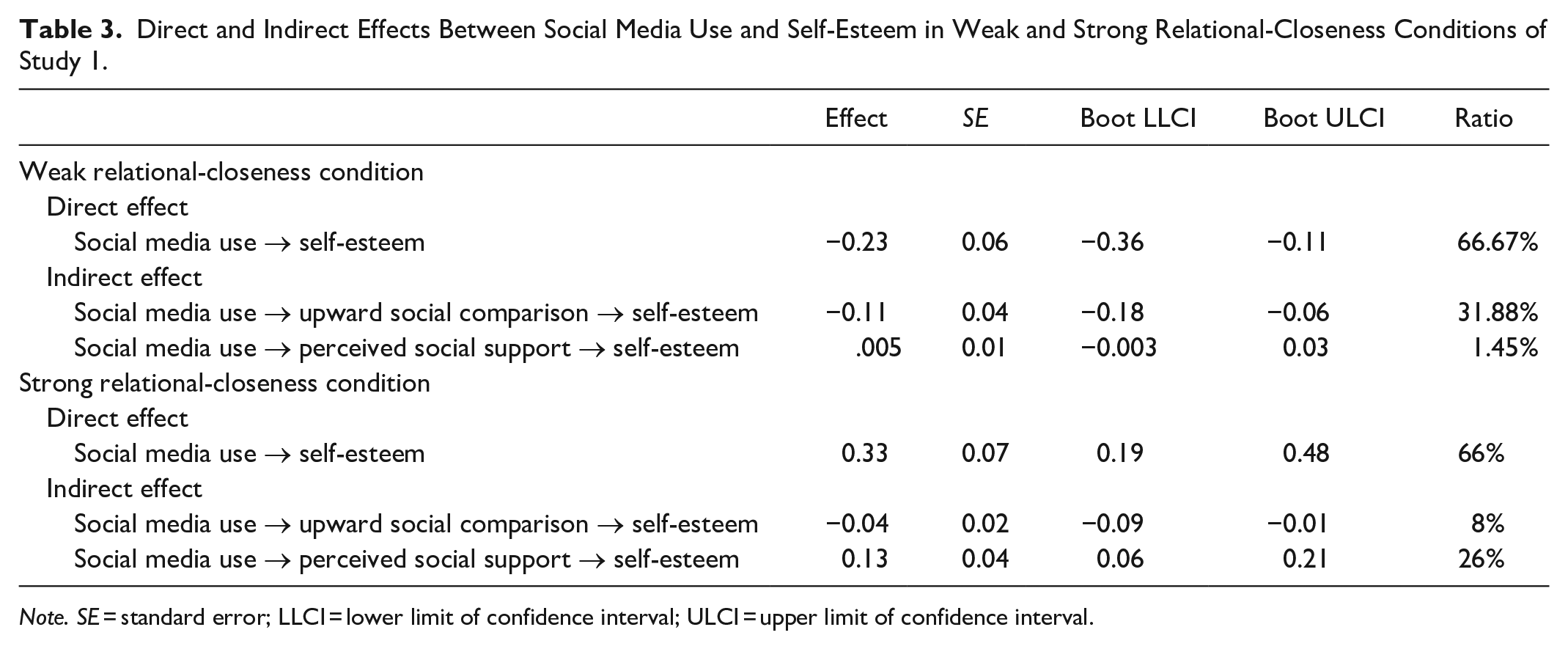
Note. SE = standard error; LLCI = lower limit of confidence interval; ULCI = upper limit of confidence interval.
The specific path coefficients among the variables were presented in Figure 1. As shown in Figure 1a, in the weak relational-closeness condition, social media use significantly and positively predicted upward social comparison, β = 0.55, p < .001, and upward social comparison further showed a significantly negative prediction on self-esteem, β = −0.21, p < .001, thus demonstrating the mediating role of upward social comparison. In contrast, the two coefficients via the mediating role of perceived social support were not significant, ps > .05. In addition, when considering the indirect effect of upward social comparison, the coefficient between social media use intensity and self-esteem was still significant, β = −0.23, p < .001.

Specific path coefficients of the mediating models were presented schematically in (a) weak and (b) strong relational-closeness conditions of Study 1.
In Figure 1b, we presented the coefficients among the variables in the strong relational-closeness condition. For the mediating role of upward social comparison between social media use and self-esteem, consistent with the pattern of results in the weak relational-closeness condition, social media use had a significantly positive prediction on upward social comparison, β = 0.14, p = .01, and upward social comparison in turn showed a significantly negative prediction on self-esteem, β = −0.29, p < .001. However, for the mediating role of perceived social support, different from the pattern of results in the weak relational-closeness perception condition, specifically, social media use had a significantly positive prediction on perceived social support, β = 0.33, p < .001, and perceived social support further had a significantly positive prediction on self-esteem, β = 0.39, p < .001, thus demonstrating the mediating role of perceived social support between social media use and self-esteem. Again, in the case that the indirect effects were taken into account, the coefficient between social media use and self-esteem was still significant, β = 0.33, p < .001.
The Comparisons of Perceived Social Support and Upward Social Comparison for the Two Conditions
To test Hypothesis 4, we successively conducted an independent t test to compare perceived social support and upward social comparison in the weak and strong relational-closeness conditions. The results showed that, consistent with our speculation, participants in the strong relational-closeness condition reported significantly higher social support perception than participants in the weak relational-closeness condition (Ms = 15.57, 9.64, respectively), t(540) = 21.31, p < .001, d = 1.83, thus providing partial support for Hypothesis 4.
However, inconsistent with Hypothesis 4, an independent t test for upward social comparison showed that participants reported more social comparisons in the strong relational-closeness condition than participants in the weak relational-closeness condition (Ms = 19.05, 17.94, respectively), t(540) = 5.40, p = .02, d = 0.21. For this unexpected finding, we will provide a detailed discussion in the subsequent Discussion section.
Additional Analyses
In addition to the above comparisons of perceived social support and upward social comparison for the weak and strong relational-closeness conditions, we also compared whether there were any differences in social media use intensity for the two conditions. An independent t test showed that participants reported higher use intensity for WeChat (social media platform with strong relational-closeness) than for TikTok (social media platform with weak relational-closeness). Considering that WeChat has a significantly larger user community than TikTok, this use intensity difference is not surprising.
Discussion
Supporting Hypothesis 1, Study 1 found that relational-closeness perception moderated the relationship between social media use and self-esteem. In concrete terms, social media use had a significantly positive prediction on self-esteem when individuals used social media with strong relational-closeness perception, while social media use had a significantly negative prediction on self-esteem when individuals used social media with weak relational-closeness perception. In addition, we also found that participants in the strong relational-closeness condition reported higher self-esteem than participants in the weak relational-closeness condition. These results suggest that whether using social media had a detrimental or beneficial effect on self-esteem depends on perceived relational-closeness on social media—using social media with weak relational-closeness perception will harm individuals’ self-esteem and using social media with strong relational-closeness perception will benefit individuals’ self-esteem.
In line with Hypothesis 2, when using social media with weak relational-closeness perception, higher social media use intensity was significantly correlated with higher upward social comparison, and this further harmed social media users’ self-esteem. Meanwhile, Study 1 showed that participants in the weak relational-closeness perception condition perceived less social support from social media and perceived social support also failed to mediate the relationship between social media use and self-esteem. This may be because when individuals use social media with weak relational-closeness perception, they actually can realize that they have less chance of transforming online interactions into face-to-face interactions, and it is unrealistic to rely on “purely” online friends to solve difficulties in real life (Sina, 2022). Due to the lack of the alleviating effect of perceived social support on the negative effect of upward social comparison on self-esteem, it is not surprising that higher social media use intensity led to lower self-esteem of users.
Supporting Hypothesis 3, Study 1 found that upward social comparison and perceived social support both mediated the relationship between social media use and self-esteem in the strong relational-closeness condition. On the one hand, higher social media use intensity was correlated with higher social comparison, and higher social comparison in turn was correlated with lower self-esteem. However, on the other hand, in the strong relational-closeness condition, those individuals with higher social media use intensity also reported higher social support perception, which was found to be significantly correlated with higher self-esteem. Moreover, on the intuitive level, perceived social support played a dominant mediating role in the relationship between social media use and self-esteem. That means, when using social media with strong relational-closeness perception, although the occurrence of upward social comparison on social media more or less harms users’ self-esteem, this detrimental effect on self-esteem to a large extent can be counteracted by perceived social support from social media, which is considered to be a typically protective factor for self-esteem (Goodwin et al., 2004; Marshall et al., 2014). In line with this reasoning, participants in the strong relational-closeness condition reported significantly higher self-esteem than those in the weak.
In Study 1, there was an unexpected finding that participants reported a higher social comparison tendency in the strong relational-closeness condition than participants in the weak relational-closeness condition. As a consequence, Hypothesis 4 was only partially supported. This unexpected finding may be because, for an individual, he or she commonly perceives more similarity with his or her online friends on WeChat than with online friends on TikTok. In concrete terms, individuals’ online friends on WeChat mainly consist of their offline friends, families, schoolmates, and teachers, and similar individuals are more likely to be regarded as reference targets to make social comparisons (Michinov & Michinov, 2001).
Interestingly, although past research has demonstrated the detrimental effect of social comparison on self-esteem, higher social comparison in the strong relational-closeness condition of Study 1 indeed did not cause lower self-esteem. We speculated that this phenomenon may be caused by two possible reasons. First, as we discussed above, in addition to social comparison, participants in the strong relational-closeness condition also perceived apparent social support from WeChat friends, which may to a large extent counteract the detrimental effects of social comparison on self-esteem. Second, due to perceiving high similarity with others on WeChat, when participants made social comparisons on WeChat, the so-called “assimilation effect” rather than the “contrast effect” may emerge (Suls et al., 2002). Prior research has demonstrated that when individuals feel psychologically close to the compared targets, they tend to highlight the similarities between them, thus generating the so-called assimilation effect—individuals tend to posit that they can do as well as others (Lockwood & Kunda, 1997; Suls et al., 2002; Tesser et al., 1988). As a consequence, the detrimental effect of upward social comparison on self-esteem was weakened.
We noticed that participants in the strong relational-closeness condition reported higher use intensity and stronger social support perception than those in the weak. According to our previous explanation, participants’ stronger relational-closeness perception should account for the difference in perceived social support. However, there was another possibility—the difference in perceived social support between the two conditions may be caused by the simple fact that most individuals use WeChat more frequently than TikTok in China-Mainland. Compared to TikTok, higher use intensity for WeChat means that the knowledge constructs relevant to WeChat are more readily retrieved in information processing (Wänke & Hansen, 2015). In this case, participants alleged that they perceived more social support from WeChat may be just because participants unconsciously gave priority to the knowledge relevant to WeChat in the process of information processing. In Study 2, we sought to rule out this possibly confounding factor.
Study 2
As we have mentioned above, an important goal of Study 2 was to eliminate the possibility that higher use intensity in the strong relational-closeness condition led to higher social support perception. To achieve this goal, in Study 2, the same stimuli, which were allegedly selected from a social media platform with weak/strong relational-closeness, were presented for participants in both conditions. Then, we compared participants’ social support perception for the two conditions. The underlying logic was that, if social media with strong relational-closeness enabled users to perceive more social support than social media with weak relational-closeness, even though we presented the same stimuli for participants, they may still perceive more social support when they realized that the stimuli were selected from social media with strong relational-closeness perception than when they realized that the stimuli were selected from social media with weak relational-closeness perception. Importantly, due to the same stimuli exposure, we can to a large extent rule out the possible explanation that the use frequency difference caused the perceived social support difference. Specific operations will be introduced in detail in the Materials section.
In addition, in Study 1, we selected WeChat (social media with strong relational-closeness perception) and TikTok (social media with weak relational-closeness perception) as two types of social media platforms and separately examined the relationship between their use intensity and self-esteem. To avoid the observed effects being associated with specific social media platforms, in Study 2, we selected QQ and Bilibili as two social media platforms in the strong and weak relational-closeness conditions. The former is a social media platform similar to WeChat, which is widely used by all age groups in China-Mainland, and the latter is a social media platform which is very popular among college students. The key difference between them is that QQ users share their content primarily with their online friends and a large percentage of these online friends are also their acquaintances, and Bilibili users often share their content with all users on this platform rather than only with their friends. Thus, QQ can be regarded as a social media platform with strong relational-closeness and Bilibili can be regarded as a social media platform with weak relational-closeness. In an independent pretest (n = 40), we asked participants to successively report “Do you feel close to your QQ (Bilibili) friends most of the time” on the 10-point scale (0 = never, 10 = almost always). The subsequent paired-samples t test showed that participants perceived significantly stronger closeness to their friends on QQ than on Bilibili (Ms = 6.95, 2.60), t(39) = 25.58, p < .001, d = 5.14, demonstrating the effectiveness of the weak/strong closeness manipulation in Study 2.
Finally, Study 1 revealed the unexpected finding that participants in the strong relational-closeness condition made more social comparisons than participants in weak relational-closeness condition. For this unexpected finding, we explained that participants perceived more similarity with users on WeChat than users on TikTok, which may cause them to make more social comparisons in the strong relational-closeness condition. Given that, the selected social media platforms in Study 2—QQ and Bilibili—were both popular among college students, which allowed them to perceive high group identity with other users on both social media platforms. In this case, we expected no significant difference in social comparison for the weak and strong relational-closeness conditions, which would provide complete support for Hypothesis 4.
Participants
We determined the sample size of Study 2 based on the calculation of G*power 3.1 (Faul et al., 2009). If we conducted independent t tests to compare upward social comparison, perceived social support, and self-esteem in the weak and strong relational-closeness conditions, we would need at least 88 participants in each condition. Thus, we finally recruited 182 undergraduates to participate in this study (82 males, 100 females, Mage = 20.89, ranging from 19.08 to 31.08, SD = 1.55).
Materials
The Presented Stimuli for Participants
In Study 2, for participants in both conditions, we aimed to present a situation in which a college student who had successfully passed the postgraduate examination and gotten into his or her dream college shared his or her exam experience. We developed this fictional experiences-sharing case based on the following considerations: First, a survey from China Central Television (2022) suggested that sharing the postgraduate entrance examination experience was a high-frequency activity for undergraduates when using social media. A social reality behind this phenomenon is that, due to the severe employment pressure in China-Mainland, a large proportion of undergraduates aim to participate in the postgraduate entrance examination to increase their chances of winning future jobs. Second and also importantly, the presented experience-sharing of the postgraduate examination provided a chance for participants to make social comparisons with the protagonist. Meanwhile, in theory, the shared examination experience also enabled participants to perceive social support to some extent, because these experiences would help them avoid detours. Given the above considerations, we created the following guidelines of the postgraduate examination with appropriately 460 Chinese characters, allegedly shared by a QQ or Bilibili user. The English version of the stimuli was provided as follows.
Hi, dear friends in front of the screen! If you are reading this postgraduate examination experience-sharing, it is likely that you are preparing for the postgraduate examination this year. Since I had the idea that I wanted to become a graduate student, over the past 2 years, I devoted almost all my energy into successfully passing the exam. Now, my dream has come true, and I can fully enjoy my graduate life at East China Normal University—a university that I have longed for. As an “experienced person,” if you like, I can provide many useful suggestions for you. But considering the length limitation, I listed the three most important suggestions as follows.
First, balance your work and rest, as what we are going through can be considered a special kind of “extreme test” of our physical and mental endurance. So, please work and rest regularly, and do not let your body collapse on the road before we reach the battlefield.
Second, show your pride and confidence. It would be helpful if you believe that confidence and ability are equally important in this battle without smoke. No matter how well you have prepared for its coming, if you lack confidence, you have been doomed to failure since entering the examination hall. So, my dear friends, please show your confidence without reservation, and dedicate yourself to this battle.
Last but not least, please be patient with yourself and your life. We cannot get everything right, and can only sometimes get what we want. If you are experiencing a setback now, don’t worry, and you just need to continue your work according to your schedule. A happy ending is ready to give you a big hug in the future.
The Measure of Upward Social Comparison
In Study 2, the scale developed by Cramer, Song, and Drent (2016) was used to measure participants’ social comparison perception when using QQ or Bilibili. The original scale is developed to assess individuals’ social comparison tendencies on Facebook, which includes three items: (1) I feel I get to compare myself to others more often while I am on Facebook, (2) I feel Facebook motivates people to compare themselves to others, and (3) I feel Facebook makes it easier to compare oneself to other people. In Study 2, the “Facebook” in the original scale was replaced by the “QQ” or “Bilibili” depending on the relational-closeness manipulation. Participants needed to indicate their agreement on the 5-point scale (1 = strongly disagree, 5 = strongly agree). Higher scores indicated stronger social comparison frequency on QQ or Bilibili. As done in Study 1, the original English version was translated into the Chinese version and the back-translation procedure proposed by Brislin (1980) was applied to ensure the equivalence between the Chinese and English versions. The internal consistency coefficient of the scale was 0.75 in the current research.
The Measure of Perceived Social Support
In Study 2, participants’ social support perception was assessed via the scale developed by Rozzell et al. (2014), which included six items and each item consisted of a pair of words with opposite meanings. The six pairs of words consisted of: Not Supportive–Supportive, Not Helpful–Helpful, Hurtful–Not Hurtful, Positive–Not Positive, Encouraging–Not Encouraging, and Not Insulting–Insulting. For each item, participants needed to report their current feelings on the 7-point scale (e.g., for the item Not Supportive–Supportive, 1 = Not Supportive, 7 = Supportive). The score of the perceived social support was calculated by summing the score on each item with the last three items being reversely coded. The Cronbach’s α of the scale was 0.83.
The Measure of Self-Esteem
As done in Study 1, the Chinese version of the Rosenberg Self-Esteem Scale was used to assess participants’ self-esteem (Ji & Yu, 1999; Rosenberg, 1965). Participants needed to report their feelings at the current time on the 4-point scale ranging from 1 (strongly disagree) to 4 (strongly agree). We calculated the score of one participant’s self-esteem by summing participant’s score on each item (Items 3, 5, 8, 9, and 10 were reversely scored), with a higher score indicating higher self-esteem. In Study 2, the Cronbach’s α of the scale was 0.81.
The Measure of Demographic Information
Besides several key variables, demographic information was also collected, including gender, age, and residential location (city/country).
Procedure
At the appointed time, participants arrived at the lab in groups of 6–8. We told them that we were interested in attitudes about using social media, and they needed to express their opinions about social media use. If participants were willing to continue the task, they signed the informed consent. Then, we presented the guideline of the postgraduate entrance exam for participants, which was declared to be extracted from QQ (strong relational-closeness condition) or Bilibili (weak relational-closeness condition). After reading the guideline, participants reported their frequency of social comparison on QQ or Bilibili. Next, they indicated their perceived social support on the 7-point scale when they read the shared guideline of the postgraduate entrance exam. After that, we instructed participants to complete the Rosenberg Self-esteem Scale, and reminded them that they should report their feelings at this moment. Finally, they reported their age, gender, and residence location. After completing all the above tasks, the participants were paid, debriefed, and guided to leave the lab.
Results
Descriptive Results
SPSS 23.0 was applied to sort the database and conduct data analysis. The mean values of social comparison, perceived social support, and self-esteem in each condition were provided in Table 4 and correlations among them were provided in Table 5. The correlation results showed that in both conditions, upward social comparison was negatively correlated with self-esteem, ps < .05, and perceived social support was positively correlated with self-esteem, ps < .05.
The Mean Values of Key Variables in Each Condition of Study 2 (M ± SD).

Note. M = mean value; SD = standard deviation.
Correlations Among Variables in Each Condition of Study 2.

p < .05. **p < .01.
Perceived Social Support and Self-Esteem in Weak and Strong Relational-Closeness Conditions
An independent t test showed that, even though the same examination experience-sharing was presented, participants in the strong relational-closeness condition perceived more social support than those in the weak relational-closeness condition, t(180) = 7.57, p < .001, d = 1.12. In addition, participants in the strong relational-closeness condition reported higher self-esteem than those in the weak relational-closeness condition, t(180) = 4.45, p < .001, d = 0.66. These results suggested that, despite the same stimuli exposure, participants in the strong relational-closeness condition still reported higher social support perception and self-esteem than participants in the weak relational-closeness condition, thus providing additional evidence for Hypotheses 1 and 4.
After controlling the effects of age, gender, and residence, we separately conducted a linear regression equation across two conditions, in which the standardized self-esteem was regressed on the standardized social support perception. The results showed that, participants’ social support perception can significantly and positively predict their self-esteem in both weak and strong relational-closeness conditions, βweak = 0.35, p = .001, βstrong = 0.20, p = .04. We also found that, when the weak/strong relational-closeness condition was transformed into the dummy variable (weak relational-closeness = 0, strong relational-closeness = 1), the relational-closeness condition can significantly predict participants’ social support perception, with stronger relational-closeness associated with higher social support perception, β = 0.49, p < .001. These results suggested that social support can function as a protective factor for self-esteem regardless of whether individuals used weak or strong relational-closeness social media. However, high social support perception was more likely to be received from social media with strong relational-closeness in comparison to social media with weak relational-closeness, thus partially supporting Hypothesis 3.
Upward Social Comparison and Self-Esteem in Weak and Strong Relational-Closeness Conditions
We performed a linear regression equation in each condition to examine the relationship between upward social comparison and self-esteem. The results showed that, upward social comparison can significantly and negatively predict self-esteem in both weak and strong relational-closeness conditions, βweak = −0.27, p = .009, βstrong = −0.23, p = .03. This result suggested that upward social comparison had a detrimental effect on self-esteem in both conditions. However, considering that participants in the strong relational-closeness condition reported significantly higher social support and self-esteem than those in the weak, the detrimental effect of upward social comparison on self-esteem can actually be counteracted by high social support perception from social media with strong relational-closeness. This result pattern was consistent with that of Study 1.
In addition, an independent t test showed no significant difference in upward social comparison for the weak and strong relational-closeness conditions, t(180) = 0.58, p = .56, d = 0.08. Combining this finding with the finding that the perceived social support was significantly higher in the strong relational-closeness condition than in the weak relational-closeness condition, Hypothesis 4 first received complete support in Study 2.
Discussion
In Study 1, by conducting a quasi-experimental study, we found that participants in the strong relational-closeness condition reported higher self-esteem than participants in the weak relational-closeness condition, and further data analysis suggested that this difference may be explained by the higher social support perception in the strong relational-closeness condition. Although we reasoned that participants’ stronger relational-closeness perception should account for the higher social support perception in the strong relational-closeness condition, it was also possible that the higher social support perception in the strong relational-closeness condition was only because most individuals used WeChat more frequently than TikTok in China-Mainland.
To rule out this possibly confounding factor, we conducted a lab experiment—Study 2, in which we presented the same examination experiences-sharing for all participants. The results showed that despite the same stimuli exposure, participants in the strong relational-closeness condition still reported higher social support perception and self-esteem than those in the weak relational-closeness condition. Besides, when the relational-closeness condition was dummy coded (0 = weak relational-closeness, 1 = strong relational-closeness), the relational-closeness condition showed a significantly positive prediction on perceived social support. These results suggested that higher social support perception played a key role in higher self-esteem in the strong relational-closeness condition, and the relational-closeness condition, but not the use intensity, could account for the differences in perceived social support in the two conditions. In addition, Study 2 found that there was significantly higher social support perception in the strong relational-closeness condition than in the weak relational-closeness condition, but there was no significant difference in the social comparison between two conditions, thus providing complete evidence for Hypothesis 4. Overall, Study 2 provided collaborating evidence for the findings of Study 1.
It was worth mentioning that, although Study 2 did not directly demonstrate the moderating role of perceived relational-closeness on the relationship between social media use and self-esteem, we found that when all participants were exposed to the same examination experiences-sharing, participants in the strong relational-closeness condition reported higher self-esteem than those in the weak relational-closeness condition. This implies that, when two individuals both use social media with the same intensity, whether social media use will benefit or harm users’ self-esteem largely depends on their relational-closeness perception during using social media. In this sense, Study 2 can indeed be considered to provide special evidence for the moderating role of perceived relational-closeness between social media use and self-esteem.
General Discussion
In the current research, two studies were conducted to examine the moderating role of perceived relational-closeness between social media use and self-esteem, and the underlying mediating mechanisms. In Study 1, by assigning participants to the weak (reporting TikTok use intensity) or strong (reporting WeChat use intensity) relational-closeness condition, we found that using social media with weak relational-closeness perception harmed users’ self-esteem, while using social media with strong relational-closeness perception benefited users’ self-esteem. Moreover, participants in the strong relational-closeness condition reported higher self-esteem than those in the weak relational-closeness condition. Further analyses showed that upward social comparison mediated the relationship between social media use and self-esteem when using social media with weak relational-closeness perception; when using social media with strong relational-closeness perception, upward social comparison and perceived social support both mediated the relationship between social media use and self-esteem, but perceived social support played a dominant role in the mediating effects. Due to only receiving partial evidence for Hypothesis 4 and the existence of a possibly confounding explanation in Study 1, we conducted Study 2, in which we presented the same examination experience-sharing for all participants in the lab. We found that participants in the strong relational-closeness condition reported higher social support perception and self-esteem than those in the weak relational-closeness condition, but there was no significant difference in social comparison frequency for the two conditions, thus providing complete evidence for Hypothesis 4. On the whole, Study 2 also provided collaborating evidence for the findings of Study 1.
The Moderating Role of Relational-Closeness Perception
As we have documented in the Introduction section, whereas a large body of research has revealed the detrimental effect of social media use on self-esteem, some other studies have revealed the beneficial effect of social media use on self-esteem (e.g., Krause et al., 2021; Q. Q. Liu et al., 2017; Steinsbekk et al., 2021). For these inconsistent findings, the current research provided a possible explanation—perceived relational-closeness may moderate the relationship between social media use and self-esteem. Specifically, if individuals use social media with weak relational-closeness perception, social media use may have a detrimental effect on their self-esteem; in contrast, if individuals use social media with strong relational-closeness perception, social media use may have a beneficial effect on their self-esteem.
Indeed, we are not the first to attempt to reconcile inconsistent findings of social media use and self-esteem (Krause et al., 2021; Steinsbekk et al., 2021; Valkenburg et al., 2006). For instance, Valkenburg et al. (2006) investigated the consequences of social media use on adolescents’ self-esteem. They found that feedback received from social media played a key role between social media use and self-esteem—positive feedback from social media enhanced adolescents’ self-esteem, while negative feedback decreased their self-esteem. Similarly, Steinsbekk et al. (2021) found that those adolescents who actively posted updates were more likely to receive positive feedback and thus showed enhanced self-esteem, whereas those adolescents who mostly viewed and responded to others’ posts showed reduced self-esteem. These moderators for the relationship between social media use and self-esteem indicate that social media use may affect individuals’ self-esteem in a more complicated and subtle way than we have ever supposed. At least, according to our findings, we need to clarify whether individuals have used social media with weak or strong relational-closeness perception if we want to assess the influences of social media use on self-esteem.
In the present research, we identified two types of social media platforms based on whether users shared their content or feelings mainly with familiar people or all users on the platform. In other words, for a social media platform, we determined whether it conveys strong or weak relational-closeness perception mainly in terms of the platform’s product positioning. However, in addition to the product positioning of a social media platform, individuals’ personality orientation may also be a possible determinant of individuals’ relational-closeness perception when using social media. For example, independent/interdependent self-construal, which is initially proposed as a culture-level variable in cross-cultural research, but has also been widely regarded as an individual-level personality variable, generally refers to the degree to which individuals view themselves as separate from others or as connected with others (Brockner et al., 2005; Kühnen & Hannover, 2000; Markus & Kitayama, 1991; Singelis, 1994). An important difference between independent and interdependent self-construal individuals is that the latter emphasizes their connections with others, and pays more attention to others’ feelings, needs, and even unexpressed thoughts than the former (Markus & Kitayama, 1991). As a result, in communication with others, interdependent self-construal individuals tend to make more efforts to maintain harmonious interpersonal relationships, because harmonious relationships are important resources for their self-esteem (Singelis, 1994).
Following the above reasoning, we speculate that interdependent self-construal individuals may be more likely to perceive strong relational-closeness than independent self-construal individuals even using the same social media platform. Because interdependent self-construal individuals are more likely to actively construct harmonious interpersonal relationships with other users. Partially supporting this speculation, Steinsbekk et al. (2021) have found that actively interacting with other users on social media could increase individuals’ self-esteem. In addition, we can also attempt to explore possibly accumulative or counteractive effects of the product positioning of a social media platform and users’ self-construal orientation on relational-closeness perception (e.g., exploring whether interdependent self-construal users will have stronger relational-closeness perception than independent self-construal users when they both use a familiar-oriented social media platform).
Social Media, Social Comparison, and Self-Esteem
Social comparison is an automatic process to a great extent (Buunk & Mussweiler, 2001; Festinger, 1954). So, in theory, social media users intentionally or unconsciously compare themselves with other users irrespective of what types of social media they use. Supporting this proposition, our research showed that participants tended to make comparisons with other users in both weak and strong relational-closeness conditions. However, the occurrence of social comparison in both conditions yielded opposite effects on self-esteem. Specifically, in weak relational-closeness condition, consistent with previous research, social comparison on social media harms individuals’ self-esteem (Chen & Lee, 2013; Jan et al., 2017). This may be because upward social comparison is inclined to occur due to the positive self-presentation on social media, which in turn enables users to conclude that they are inferior to others on social media (Jan et al., 2017; Jiang & Ngien, 2020). So, it is not surprising that participants with higher social media use intensity tended to report lower self-esteem. Compared to participants in the weak relational-closeness condition, participants in the strong relational-closeness condition reported higher self-esteem though those participants also made upward social comparisons when using social media. This may be because the high social support perception perceiving from the strong relational-closeness social media counteracted the negative effect of upward social comparison on self-esteem.
Social Media, Social Support, and Self-Esteem
The present research provided the first empirical evidence for the mediating role of perceived social support between social media use and self-esteem. Through social media, individuals can break the limitations of time and space, share their feelings, and generate content with family, friends, and acquaintances at any time (Ellison et al., 2007; Rozzell et al., 2014). Past research suggests that individuals in general have a larger social network on social media than in real life, which enables social media users to readily perceive more social support from online friends than from offline friends (Nabi et al., 2013; Olson et al., 2012). For example, Olson et al. (2012) subdivided social support into emotional, informational, and instrumental support, then examined the relationship between Facebook use and social support. The results showed that users perceived more social support from Facebook than from face-to-face friends across three types of social support. Beyond previous research, our research first demonstrates that individuals do not equally perceive social support from social media, and they tend to perceive higher social support from strong relational-closeness social media than from weak relational-closeness social media.
For the mediating role of perceived social support between social media use and self-esteem, the sociometer theory can also provide a possible explanation (Leary, 2005; Leary & Baumeister, 2000). The theory posits that self-esteem can be regarded as a sociometer—an internal monitor of the degree to which one is valued (and devalued) as a relational partner (Leary & Baumeister, 2000). Under this perspective, high self-esteem indicates that one person can be well accepted or supported by other group members, whereas low self-esteem indicates that one person may be excluded or ignored by other group members. When using social media with strong relational-closeness, individuals often receive positive comments and “likes” from online friends, which may help users form the perception that they are valued desirable people for others. As a result, using social media with strong relational-closeness finally contributes to elevating individuals’ self-esteem.
We noticed that Rozzell et al. (2014) found that individuals could receive social support from both close and nonclose relational ties on social media, which seemingly was inconsistent with our finding that participants were more likely to perceive social support on social media with strong relational-closeness perception than on social media with weak relational-closeness perception. This inconsistency, we guess, may be because Rozzell et al. (2014) asked participants to exclusively report their perceived social support on social media while we asked participants to simultaneously report perceived social comparison and social support. In the former case, it is not surprising that participants declared that they had received social support from both close and nonclose relational ties, because any forms of online interpersonal interactions, regardless of interacting with relationally close or nonclose individuals, will more or less provide messages to individuals that are perceived as supportive (Carr et al., 2016). Different from Rozzell et al.’s (2014) research, the current research required participants to simultaneously report perceived social comparison and social support on social media, which in theory enabled participants to simultaneously activate the accessibility of making social comparison and receiving social support (Higgins, 2012). Perhaps due to the contrast effect between these two constructs, participants reported higher social support perception in the strong relational-closeness condition than in the weak relational-closeness condition.
Limitations and Future Work
First, as discussed above, we determined whether a social media platform conveyed strong or weak relational-closeness perception mainly in terms of the platform’s product positioning. However, in addition to the product positioning of a social media platform, there are other determining criteria for the judgment of perceived relational-closeness (e.g., personality orientation). In future research, employing multiple determining criteria to determine the relational-closeness of a social media platform will be helpful to increase the reliability of our results. In addition, we must realize that the moderating role of perceived relational-closeness between social media use and self-esteem just provides a possible approach to reconcile inconsistent findings concerning social media use and self-esteem, rather than thoroughly solving this issue. Because whether social media use protects or harms self-esteem is susceptible to a variety of factors relevant to social media users and specific platforms (e.g., specific engagement activities on social media, Triệu et al., 2021). If possible, developing a unified theory to delineate the relationships among social media, perceived relational-closeness, and self-esteem will deepen our understanding of this issue.
Second, to increase the internal reliability of the research, we selected different social media platforms to be involved in the research. Considering that each platform has unique product positioning and features, and their market influences are also different (e.g., TikTok is more popular than Bilibili across the world), such factors can affect the generalizability of our findings to some extent. However, past research has demonstrated that different social media platforms can produce similar psychological consequences, such as lower self-esteem, social anxiety, and depression (O’Day & Heimberg, 2021). Given that, the potential limitation mentioned above indeed is not enough to threaten the reliability of our findings.
Third, due to the regulation of the Chinese government, some popular social media platforms in Western society so far have not provided their services in China-Mainland, such as Twitter, Facebook, and Instagram. Correspondingly, although several social media platforms involved in the present research are widely used in China-Mainland, they have relatively small user communities in Western society. As a consequence, we are not sure to what extent our findings can be generalized to Western society. Moreover, several prior studies have revealed some cultural differences existing in individuals’ social comparison and self-esteem (Boucher et al., 2009; Chung & Mallery, 1999). For example, compared to individuals in Western society, individuals in Chinese society have been found to make more frequent upward social comparisons, which might lead to lower self-esteem of Chinese individuals (Chung & Mallery, 1999). Given the above considerations, it may be necessary for us to conduct cross-cultural research to further assess the moderating role of perceived relational-closeness between social media use and self-esteem.
Fourth, all participants involved in the current research were college students, whose ages ranged from 18 to 31 years old. Compared to other age groups, college students often have more free time, which leads to the phenomenon that college students commonly spend more time on social media and also maintain relatively active online interactions (She et al., 2023). Moreover, some social media platforms popular among college students have been developed to a large extent exclusively for college students or youth (e.g., Bilibili). So, the single sample of college students in the present research, more or less, will limit the generalizability of our findings.
Finally, in the current research, we found that perceived social support could buffer the negative effects of social media use on self-esteem. Considering that self-esteem is an important aspect of the self-concept and a motivational source of a wide variety of cognitive and behavioral effects (Leary & Baumeister, 2000; Pyszczynski et al., 2004), we can attempt to further explore whether high social support perception will function as a buffer against a series of negative psychological and behavioral effects induced by social media use. For example, we can explore whether strong rational-closeness perception will alleviate the social anxiety induced by social media use.
Conclusion
In the current research, two studies were conducted to examine the moderating role of perceived relational-closeness between social media use and self-esteem, and the underlying mediating mechanisms. The results showed that using social media with weak relational-closeness harmed users’ self-esteem, while using social media with strong relational-closeness benefited users’ self-esteem. Further analyses showed that when using social media with weak relational-closeness, higher social media use intensity led to more upward social comparisons, which further harmed users’ self-esteem. In contrast, when using social media with strong relational-closeness, although higher social media use intensity also led to more upward social comparisons, the detrimental effect of upward social comparison on self-esteem was counteracted by high social support perception receiving from social media. As a consequence, higher social media use intensity contributed to higher self-esteem. By revealing the moderating role of perceived relational-closeness between social media use and self-esteem, the current research provided a possible explanation to reconcile the previously inconsistent findings about social media use and self-esteem.
Footnotes
Acknowledgements
The authors express sincere thanks to reviewers for their constructive suggestions.
Declaration of Conflicting Interests
The author(s) declared no potential conflicts of interest with respect to the research, authorship, and/or publication of this article.
Funding
The author(s) disclosed receipt of the following financial support for the research, authorship, and/or publication of this article: The research was supported by the project of Social Sciences of Shandong Province (No. 22DJYJ15).
Ethics Statement
The studies involving human participants were reviewed and approved by the Ethics Committee of Taishan University. The patients/participants provided their written informed consent to participate in this study.
