



Abstract
Hindutva, the core political ideology of India’s current ruling party, the Bharatiya Janata Party (BJP), seeks to transform constitutionally secular India into a Hindu Rashtra (“Hindu nation”). Although Hindutva has all of the features of right-wing extremism (RWE), it is nevertheless viewed as an insular sociopolitical phenomenon, due to the Eurocentric nature of RWE discourse. Recent theoretical and analytical research has sought to showcase the similarity between RWE and Hindutva, but empirical research on their relationship has been largely absent. To fill this gap, in our study, we collected 15 million tweets and used network analysis to identify prominent themes of RWE—including exclusionary nationalism, conspiracy theories, and anti-minority violence and hate speech—among the supporters of Hindutva and the BJP. Furthermore, in our toxicity analysis (performed to understand which themes produced higher levels of toxicity), we found that Hindi-language tweets related to conspiracy theories and anti-minority violence or hate speech were more toxic than English-language tweets. Given that the growing global presence and normalization of RWE-based ideas and movements are sources of concern for everyone invested in the idea of liberal democratic society, our research broadens the discussion on RWE to include the Indian context and invites researchers to further investigate Hindutva from the perspective of RWE.
Introduction
Although right-wing extremism (RWE) is a term accepted by most scholars, no consensus has been reached on its exact definition. Most scholars define RWE as a political ideology that consists of a combination of several features (Mudde, 2002)—in fact, at least 58—five of which are mentioned in one form or another in 26 definitions of RWE provided in the literature. These five features are nationalism, racism, xenophobia, anti-democracy, and a strong state (Mudde, 1995). For the purpose of our research, we also consider two additional features: (non-physical) violence (e.g., hate speech) against “others” (e.g., perceived enemies, feminists, the lesbian, gay, bisexual, transgender/transsexual and queer or questioning (LGBTQ) community, and/or civil society), and conspiracy theories. 1
Research on the theme of understanding the relationship between RWE and Hindutva is lacking for two reasons. The first reason is the overall lack of research on RWE outside the Western context, with the exceptions of Turkey, South Africa, Israel, Japan (Higuchi, 2018), and Indonesia (Lengkeek, 2018). The second reason is the misrepresentation of Hindutva by Western RWE scholars, who have characterized Hindutva as a type of nationalism that is primarily religious rather than ethnonationalist. For example, fascism scholar Robert Paxton wrote that “for Hindu fundamentalists, their religion is the focus of an intense attachment that secular and pluralist Indian state does not succeed in offering” (Paxton, 2007). This perspective reveals that among Western scholars, when it comes to Hindutva, the notion of religious identity takes precedence over national identity. This becomes the basis of mis-categorization of Hindutva as religious nationalism. However, the development of Hindutva as an ideology seeking to create an ethnonationalist state—Hindurashtra—clearly shows that this approach by Western scholars (exemplified in Robert Paxton’s quote) is flawed (Leidig, 2020). Moreover, it is critical to investigate Hindutva, as it is the dominant version of RWE in India—the world’s largest democracy—and the current ruling party, Bharatiya Janata Party (BJP), has adopted it as its core ideology. Needless to say, the BJP’s endorsement of RWE has and will likely continue to have far-reaching implications for India as a constitutionally secular nation.
As a political ideology, Hindutva (“Hinduness”) was first articulated by V. D. Savarkar in 1923 in Hindutva: Who is a Hindu? In that work, Savarkar emphasized that religion is not the most important aspect of Hindu identity; in his view, which was influenced by Western theories of nationalism (Leidig, 2020), Hindu identity is a combination of sacred territory, language, and race. Mussolini’s fascist Italy was the first transnational ideological inspiration for early Hindutva ideologues (Casolari, 2000), and later, when Nazism was rising in Germany in the 1930s, the same ideologues openly supported the Third Reich and the Aryan connection between Nazism and Hindutva (Goodrick-Clarke, 2000). Today, that strain of Hindutva is the core ideology of the Rashtriya Swayamsevak Sangh (RSS), the Vishva Hindu Parishad (VHP), the BJP, and other organizations, all collectively known as the Sangh Parivar (Jaffrelot, 1999).
Although the Sangh Parivar has worked nonstop since its inception to spread Hindutva at the pan-India level, it has failed to make Hindutva mainstream, due to the ideology’s limited success in various political and electoral spaces. The group’s biggest boost came in 2014, when the BJP won an absolute majority in the parliament with 282 seats and subsequently formed a government with other coalition partners, collectively known as the National Democratic Alliance (NDA); Narendra Modi, a lifelong member of the RSS and three-time chief minister of the state of Gujarat from 2001 to 2014, was chosen to be prime minister. Ever since, the Modi government has promoted a new form of authoritarianism by weakening state institutions, distorting the electoral process, making Muslims second-class citizens, and targeting minorities in official and direct ways (Jaffrelot, 2021b). Such actions have begun to turn India into an authoritarian Hindu Raj (“Hindu nation-state”), which is the ultimate objective of Hindutva ideologues (Jaffrelot, 2021a).
The BJP’s early adoption and extensive use of social media has played a critical role in this process, namely, by bringing the Hindutva project to millions upon millions of young Indians (Chakravartty & Roy, 2015; Pal et al., 2016). The expansion of social media in the 21st century and its deft usage by the BJP have altered the mediatic contexts for Hindutva. The BJP became the first major political party to systematically adopt social media strategies for electoral gain, and Modi specifically used social media to transform his image from a tainted leader accused of complicity in the 2002 Gujarat riots into a messiah of a “New India” (Udupa, 2018a). By being active in the new social media landscape, the BJP, as well as Hindutva, have reached urban educated youth—that is, the beneficiaries of neoliberal reforms 2 —in the upper and intermediary caste groups.
Consequently, the cyberbullying and trolling of people who do not identify with Hindutva (i.e., persons on the left and liberals) have increased, as has hate speech toward such people (Udupa, 2018b). Such toxic behaviors on social media platforms, which also include harassment and incivility, are of growing concern, and therefore, researchers have increasingly investigated their mechanics (Blackwell et al., 2017; Borah, 2014; Cheng et al., 2015).
Meanwhile, in several instances, social media platforms have permanently banned far-right influencers and extremist groups (such as Alex Jones, 3 Milo Yiannopoulos, 4 QAnon, Boogaloo Boys, and Oath Keepers) from using their platforms—that is, deplatforming—due to their extremist, hateful posts. 5 However, such censorship is not typically applied to Hindutva figures or influencers. As a result, insights gleaned from investigating toxic behaviors among Hindutva supporters on social media in India can inform the current discussion on content moderation policies on social media—in our case, Twitter, which we chose for its accessibility of data on the platform. 6
Along those lines, we aim to extend the discussion on toxicity and RWE, specifically to the underexamined context of Hindutva. While most research has focused on influencers or celebrities, we focus on understanding the online communication of ordinary people (i.e., the masses), as we think that RWE discourse in India flows from Hindutva influencers and ideologues down to regular people. Against this background, to uncover the extremist identity of Hindutva, we performed a network analysis to identify features and themes of RWE in Hindu nationalist discourse on Twitter, as well as a toxicity analysis to determine the linguistic toxicity of those themes. Our analyses were performed using 15 million tweets from users who liked and shared tweets posted by Hindu nationalist leaders and organizations. In our study, we sought to answer the following research questions:
RQ1: What does the Hindutva discourse on Twitter reveal about the relationship between RWE and Hindutva?
RQ2: Are there differences in toxic behavior between Hindi- and English-speaking Twitter users who support Hindutva?
The rest of the article is organized as follows. In the second section, we discuss the previous research related to RWE and Hindu nationalists and their social media discourse. In the third section, we outline our research method in three subsections: Data Collection, Hashtag Co-Occurrence Network, and Toxicity Analysis. In the fourth section, we provide short explanations of four RWE features that are the focus of this research. In the fifth section, we discuss our results in two subsections: Presence of Features of RWE in the Discourse on Hindutva, and Analyzing Toxicity in the Discourse on Hindutva on Twitter. In the sixth section, we discuss our findings, and in the seventh section, we articulate our final thoughts in the article’s conclusion.
Literature Review
Social media platforms such as Twitter, Facebook, YouTube, Instagram, Reddit, 4chan, and 8chan have empowered the extreme right to directly broadcast content globally, to niche and mainstream audiences alike (Albrecht et al., 2019). Those platforms have fundamentally influenced the spread of extreme-right communities, both online and offline, by enabling them to create a real online cultural identity (Somoano, 2022). Although classic ideas related to extreme-right ideologies (e.g., xenophobia and misogyny) persist in such online discourses, the symbolism has been updated and outfitted with new images and catchphrases that young people can more easily recognize (Miller-Idriss, 2019).
As previously mentioned, research on RWE online has persistently adopted a Western-centric view and has focused on RWE in countries in North America, Europe, and Australia. In contrast, one recent study investigated female influencers on social media in two major democracies of the Global South—India and Brazil—and identified a form of postcolonial neoliberal nationalism, in which the influencers not only reinforce gender, class, and racial hierarchies but also contribute to global far-right narratives (Leidig & Bayarri, 2022). In addition, among the recent efforts to understand Hindutva narratives on social media, Mohan (2015) called online Hindu nationalists “internet Hindus.” Such “internet Hindus” have become notorious for trolling political adversaries and celebrities opposed to Hindutva, for harassing journalists perceived to be critical of the current Modi government, for posting offensive and hateful content against Muslims and other minorities, and for spreading fake news and disinformation to propagate the Hindutva agenda (Bhat, 2021). Given all these activities of intimidation, the international media watchdog Reporters Without Borders included internet Hindus on its 2020 list of 20 digital predators, specifically predators of journalists. 7 In a recent paper, Bhatia (2022) described the productive associations between Twitter as a technological artifact and the quotidian discourse on Hindu nationalism online; according to the study’s results, Hindu nationalists use Twitter to construct an image of Hindus as tolerant, to manufacture panic among Hindus, to reimagine history through inauthentic and false content, and to legitimize and reinforce violence against minorities. In qualitative research, Srivastava (2020) sought to understand the Hindutva discourse on gender, sexuality, and caste among non-Hindu, non-upper-caste, and non-heteronormative women on Twitter. However, quantitative research elucidating the relationship between Hindutva and RWE using large-scale Twitter data has not been performed, which makes our research to the best of our knowledge a pioneering attempt in that direction.
In addition to seeking to comprehend the connection between Hindutva and RWE, we also sought to understand the toxic online behavior of the BJP and advocates of Hindutva. The literature describes toxicity as “expressing disrespect for someone by using insulting language, profanity, or name-calling; by engaging in personal attacks; and/or by employing racist, sexist, and xenophobic terms” (Kim et al., 2021). Udupa and Pohjonen (2019) showed that extreme speech on online platforms plays a key role in creating and consolidating communities of support for violent ideologies and normalizing it in everyday speech. Because hate speech and toxic behavior on social media are rampant worldwide, mainstream social media platforms have responded by updating their moderation policies and thereby deplatforming particularly outspoken right-wing influencers and groups. However, those people and groups have either moved to less-moderated platforms (e.g., Gab, Telegram, and Parler) or created their own alternate digital media (such as Truth Social, owned by Donald Trump, and FrankSocial, owned by Mike Lindell). In research investigating Gab to understand the extremist views and political leanings of its users, Lima et al. (2018) found that most Gab users were conservative White men, and they also observed a significant presence of highly toxic messaging. In another study, Rogers (2020) empirically examined whether deplatforming is effective and how deplatformed users use Telegram; the results showed that Facebook and Instagram have benefited from deplatforming users in the sense that celebrity interest in those users has declined, but Twitter and YouTube showed no such slump. More recently, in a case study of three high-profile right-wing influencers—Alex Jones, Milo Yiannopoulos, and Owen Benjamin—who were deplatformed by Twitter, researchers evaluated the effectiveness of deplatforming as a moderation strategy for Twitter (Jhaver et al., 2021); their analysis of the Twitter-wide activity of the supporters of those influencers showed that the supporters’ overall activity and toxicity declined after the influencers were deplatformed.
Method
Data Collection
To observe the discourse on Hindutva among influencers, organizations, and ordinary people, we first curated a list of 10 Twitter accounts of influential extreme-right individuals and organizations in India— that is, “seed accounts.” We included extreme-right individuals, organizations, and media in our seed account list, which we selected based on their extreme-right views, sphere of influence (in either the virtual or real world), and past actions. The selection criteria were: their radical views, frequently expressed hatred against Muslims, and a sense of Hindu superiority. 8 The list (shown in Table 1) included the accounts of Subramanian Swamy, Suresh Chavhanke, and Yati Narsinghanand Saraswati, along with the VHP and the Bajarang Dal. Next, to identify clear supporters of the seed accounts, we collected the Twitter accounts of 200 users who had liked and retweeted the most recent 200 posts from the seed accounts 9 ; this yielded 19,440 accounts. We did not include quotes or mentions, because we cannot easily tell if a quote tweet supports or opposes/debunks the original tweet, as a quote tweet could say “I agree [quoted tweet]” or “I disagree [quoted tweet].” If we wanted to filter for quote tweets that support the tweets they quote, we would have had to perform content analysis on the text outside the quote itself, and this is prone to misclassification. Therefore, to increase the classification accuracy, we did not include quote tweets for the first account-selection round. Finally, we collected the 900 most recent tweets and retweets from each of the 19,440 accounts, which yielded a total of 14.99 million tweets and retweets.
Seed Accounts.

All data were collected using the Twitter Academic API. The data collection pipeline and the summary statistics of the collected data are shown in Figures 1 and 2, respectively. In terms of type, 92% of our data were retweets; in terms of year of publication, nearly all (99%) were from 2020 to 2022 (Figure 2a); and in terms of language, 39% of the collected tweets were written in Hindi (excluding mixed-language tweets). With regard to the last point, because 50% of all tweets in India are published in English, and Hindi is only the second-most used language, 10 we found a different pattern of language use in the Twitter accounts endorsing RWE compared with those of the general public. This effect increases if we only consider original tweets (no retweets, quotes, mentions) in the language comparison. 11 By extension, the large portion of Hindi-language tweets shows that a major portion of Hindu nationalist supporters are situated in the Hindi-speaking regions in India, primarily Rajasthan, Uttar Pradesh, Madhya Pradesh, Delhi, Himachal Pradesh, Uttarakhand, Chhattisgarh, Jharkhand, Haryana, and Bihar. Finally, per the distribution of number of followers (Figure 2b), our data revealed that few of the 200 Twitter accounts had large followings, with most having between 100 and 10,000 followers. Because we wanted our results to be based on the narratives of everyday Hindu nationalists—that is, ordinary people who subscribe to Hindutva—instead of on influencer-dominated discourse, this statistic demonstrates our success in achieving our objective. Considering the 20 most frequently retweeted accounts in our dataset, 12 we find that only three of them are part of the seed accounts we designated. Thus, this bootstrapping approach of data collection improves our coverage of Hindutva discourse beyond the manually curated list of seed accounts.

Data collection pipeline.

(a) Summary statistics. (b) Distribution of accounts by number of followers.
The limitations of the Twitter API impacted our data collection process. Owing to the limit of 10 million tweets per API user per month, we could only collect the most recent 900 tweets per account. That limitation resulted in a sample of very recent tweets from highly active users, and consequently, we could not obtain all tweets representing the discourse on Hindutva since 2014. Even so, the collected data were sufficient to quantify Hindutva-related activity on Twitter in the past 2 years.
Hashtag Co-Occurrence Network
Topical diversity can be seen in the co-occurrence of hashtags on social media, which is often visualized and analyzed using networks (Xu & Sasahara, 2022). To pinpoint the kinds of concepts, issues, and topics discussed in the discourse on Hindutva, we created a co-occurrence network of the hashtags that were used at least 10 times, which yielded 44,470 hashtags. These hashtag networks helped us locate the features of RWE that were discussed in the Introduction.
To identify topics, we first removed self-loops and then applied the Louvain method of community detection (Blondel et al., 2008) to the complete network of hashtag co-occurrences, with the resolution set at 1.5 and the threshold set at 10−5. Consequently, we identified 2,804 clusters of hashtags, 45 of which contained at least 100 hashtags. For each of these clusters, we ranked the hashtags according to their representativeness, that is, their centrality in the cluster, measured as Page Rank.
For the purpose of visualization using Gephi (Bastian et al., 2009), we kept the edges for hashtags that co-occurred at least 100 times and filtered the largest component by removing isolates and small components. The result was a hashtag co-occurrence network with 2,104 nodes and 5,269 edges.
Toxicity Analysis
To probe the level of toxicity of RWE discourse spread by Hindutva users on Twitter, we used Google’s Perspective API 13 via Communalytic. 14 Perspective API is a free Google service developed by Jigsaw that uses a machine learning model trained on comments that were (manually) labeled as toxic or non-toxic. It has been widely used to study online abuse, harassment (Ali et al., 2021; Guimarães et al., 2020; Obadimu et al., 2019), and the anti-vaccine movement online (Miyazaki et al., 2022). Perspective API measures toxicity, severe toxicity, profanity, identity attack, insult, and threat in the given text. In addition to English, it also supports Hindi (among several other languages), and because 75% of our data were in English and Hindi, we used the original text when measuring toxicity and other features. Perspective API is not free of limitations, however; for instance, research has shown that posts can be tampered with to reduce their toxicity scores (Hosseini et al., 2017). Even so, it remains the most reliable tool available for calculating toxicity.
Understanding the Features of RWE
Before we move on to the results, it is important to understand the four RWE features that we sought to locate in the Hindutva social media discourse.
Exclusionary Nationalism
A key feature of RWE, exclusionary nationalism can be defined as a form of nationalism in which the object of exclusion (i.e., “them”) is any subaltern group. 15 Depending on the specific historical, geographical, and demographic characteristics, those groups’ subordinate statuses can be attributed to some intersection of ethnicity (i.e., language, race, religion, and indigeneity), class, occupation, sexuality, and/or immigrant status. Nationalist regimes work to exclude such groups by enacting laws and policies that discriminate against and de-prioritize particular groups (Singh, 2022). The concept of Hindu Rashtra and laws such as the Citizenship Amendment Act (CAA) 16 well represent exclusionary nationalism.
Conspiracy Theories
A common feature of political extremists on both the right and the left is a highly structured thinking style that aims to make sense of societal events. Such extremists primarily trust information from their in-group and ignore other sources of information (Van Prooijen et al., 2015). As recently shown by Enders and Uscinski (2021), several studies have suggested that conservatives are more likely than liberals to believe in conspiracy theories, and indeed, most recent popular conspiracy theories—QAnon (Amarasingam & Argentino, 2020), Pizzagate (Bleakley, 2023), the Great Replacement (Ekman, 2022), and that climate change is a hoax (Douglas & Sutton, 2015)—all been propagated and supported by right-wing extremists. In India, a concept similar to the Great Replacement, the हिन्दु खतरे में है (“Hindus are in danger”) narrative, is being spread by right-wing Hindus. The narrative’s adherents claim that the Muslim population is rapidly increasing and will soon outnumber and replace Hindus as the majority group in India, even though all evidence indicates otherwise (Kramer, 2021; Quraishi, 2021). In support of the theory, the Hindu right has conjured several conspiracy theories against Muslims, drawing on love jihad, Union Public Service Commission (UPSC) jihad, land jihad, and grooming jihad.
Violence and Hate Against Oppressed Groups
RWE is often associated with racism, exclusionary nationalism, xenophobia, conspiracy theories, and authoritarianism. These ideologies produce a set of “enemies” who are seen as a threat to the nation, a culture, or a race. The most common enemies are immigrants, ethnic and religious minorities, and left-wing politicians (Ravndal, 2016), along with feminists and LGBTQ individuals (Perry & Scrivens, 2018). This feature or theme is one of most visible and thus well-studied in the context of the Hindu right in India (Amarasingam et al., 2022; Anand, 2011; Basu, 2021).
Anti-Democratic Sentiment
A prevailing understanding of RWE conceptualizes it as a combination of anti-democratic attitudes and the defense of social hierarchies. Although being antidemocratic is usually narrowly described as being opposed to free and fair elections, some scholars have argued that opposition to the fundamental values of democracy—for example, human rights and civil liberties—is enough to constitute RWE (Carter, 2005). Freedom of assembly is another fundamental right that is critical to ensuring healthy, vibrant democracies, and social protests play an essential role in giving voice to issues as well as in holding institutions accountable for their actions. 17
Results
Presence of the Features of RWE in Hindutva Discourse
If the above-mentioned features are present in the Indian right-wing—Hindutva—discourse, then we can conclude that Hindutva should be categorized as an RWE ideology. To detect the features outlined above, we constructed a co-occurrence network of hashtags with at least 10 occurrences in our data (described in the third section). As a result, we identified the presence of the following topics: Hindu Rashtra (i.e., exclusionary nationalism), the Delhi riots (i.e., violence and hate against minorities), love jihad (i.e., conspiracy theories), and protests against India’s CAA and the discrediting thereof (i.e., anti-democratic sentiment). As demonstrated in the complete hashtag co-occurrence network in Figure 3, the controversy surrounding BJP’s national spokesperson Nupur Sharma’s statement against prophet Muhammad (the orange cluster), the BJP-backed film The Kashmir Files (the light-green cluster), and the Gyanwapi Mosque issue (the dark-green cluster) were some of the biggest clusters. 18 We highlighted the clusters in Figure 3 on which we focused in our research (in boxes) and show them separately in Figure 4.

Hashtag co-occurrence network, with clusters in colors following the Louvain method, node size according to Page rank, and ForceAtlas 2 layout. We manually identify topics related to RWE and name the highlighted clusters according to each topic.
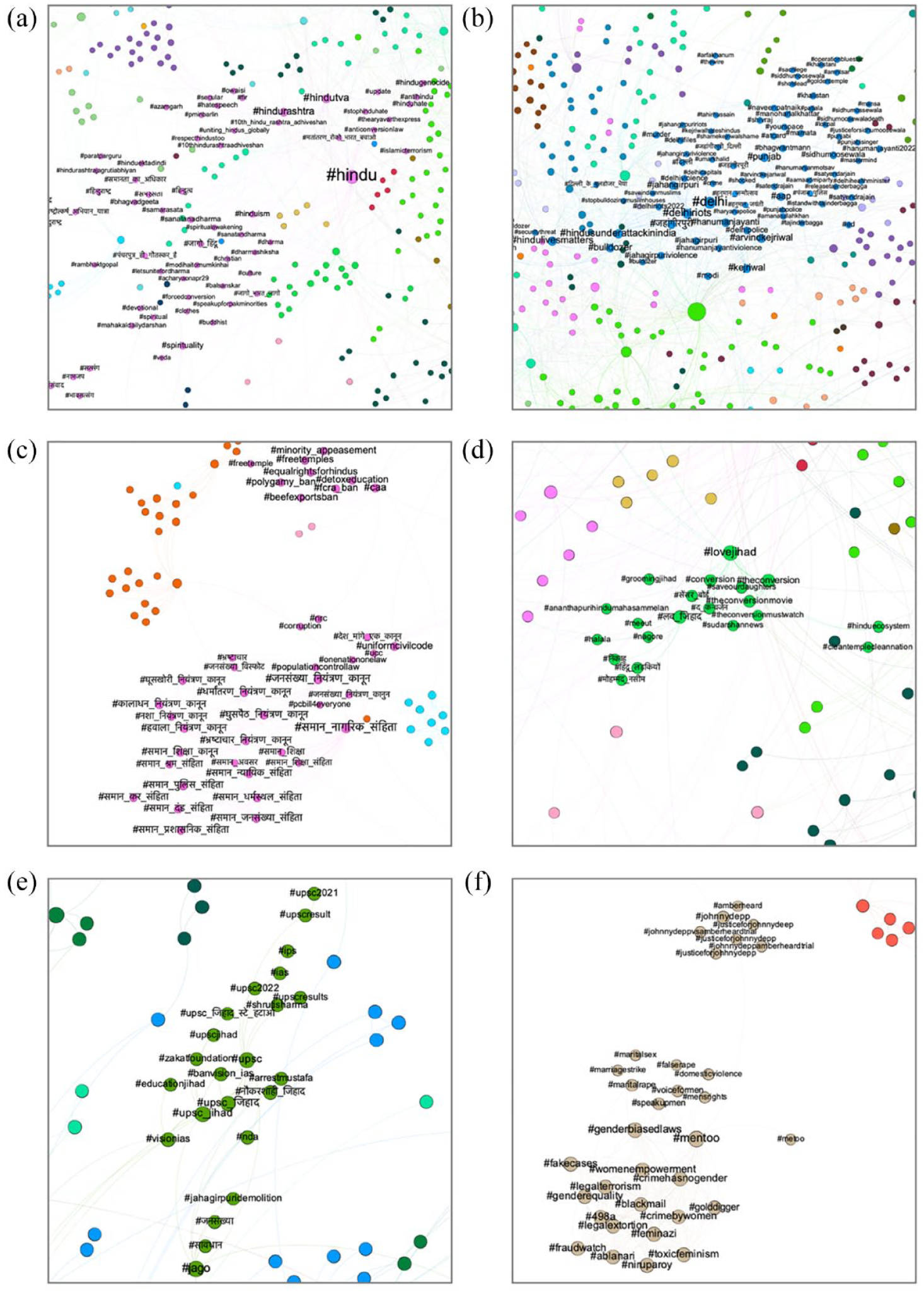
Topic-specific clusters. (a) Hindurashtra, (b) Delhi Riots, (c) CAA, (d) Love Jihad, (e) UPSC Jihad, and (f) MenToo.
Exclusionary Nationalism (i.e., Hindu Rashtra)
Turning India into a Hindu Rashtra (“Hindu Nation”) has been a core tenet of the ideology of Hindutva since its inception. According to V. D. Savarkar, a Hindu is someone who considers India to be their matrbhumi (“motherland”), pitrbhumi (“fatherland,” “the land of ancestors”), and punya bhumi (“holy land”). 19 In line with that logic, India is the land of the Hindus, whose ethnicity is Indian and whose religion is the Hindu faith, which—unlike Islam and Christianity—originated in India. Using the analogy of Nazi Germany, just as the Reich was conceptualized as the site of the authority and sovereignty emanating from people, Hindu Rashtra is a sacred nation emanating from indigenous Hindu adherents (Leidig, 2020). That dynamic makes the concept of Hindu Rashtra a form of exclusionary nationalism. The co-occurrence network of popular hashtags in our data has a Hindu Rashtra cluster (Figures 3a and 4a), with #hindu, #hindurashtra, and #hindutva among its largest nodes and #forcedconversion, #islamicterrorism, #hindugenocide, and #unifying_hindus_globally among its smaller ones. These hashtags show that supporters of Hindutva use conversion as a pretext to spread fear among Hindus and to appeal for global unity among Hindus to convert India into a Hindu Rashtra. Table 2 depicts a few “hindurashtra”-related tweets, along with their number of retweets.
Sample of Tweets Related to Exclusionary Nationalism (i.e., “hindurashtra”).

Account information has been redacted for reasons of privacy.
The first tweet in Table 2 indicates a pattern wherein Hindutva supporters find any point whatsoever in movies to claim that the movie either promotes love jihad or portrays the Hindu religion in a bad light (i.e., harms the sentiments of Hindus). This pattern has proliferated so much in the 9 years of the Modi government that almost every month we see controversies where Hindutva groups demand the banning/boycotting of a movie. The first tweet is about the Atrangi Re (2021) movie, where the subplot is about the love story between a Hindu woman and a Muslim man. Hindutva groups claim that this promotes Love Jihad, and they raised the demand for Hindu Rashtra. In the other two sample tweets, again we see #HinduRashtra. The second tweet calls for Hindu Rashtra in reference to the hijab controversy in Karnataka, where Muslim girl students were barred from school for wearing hijab. The last tweet is related to the “Dismantling Global Hindutva” conference in September 2021 that was co-sponsored by more than 45 universities, including Princeton, Stanford, and UC Berkeley and that sought to understand Hindutva and its various aspects. Hindutva groups called it “Hinduphobia,” and some even sent death threats to the organizers of this conference20, 21.
Conspiracy Theories (i.e., Love Jihad and Other Conspiracies)
Among the several conspiracy theories propagated by Hindu nationalists against Muslims, “love jihad” holds that Muslim men conspire to lure Hindu women into marrying them to alter India’s religious demographics as a part of a strategy of political takeover (Frøystad, 2021). Concepts similar to love jihad have existed since the 1920s—before India’s independence—when Arya Samaj 22 and other Hindu-revivalist bodies spearheaded a propaganda campaign that portrayed Muslim men as aggressive individuals prone to high sexual appetites, lecherous behavior, and religious fanaticism (Gupta, 2009). However, in the 2013–2014 election campaign, the BJP made love jihad one of its primary issues, which led to a massive spike in discussions about the conspiracy. Currently, several BJP-ruled states have either enacted new laws or amended existing ones to prevent the alleged love jihad, making the concept and its discussion ubiquitous (Malji & Raza, 2021).
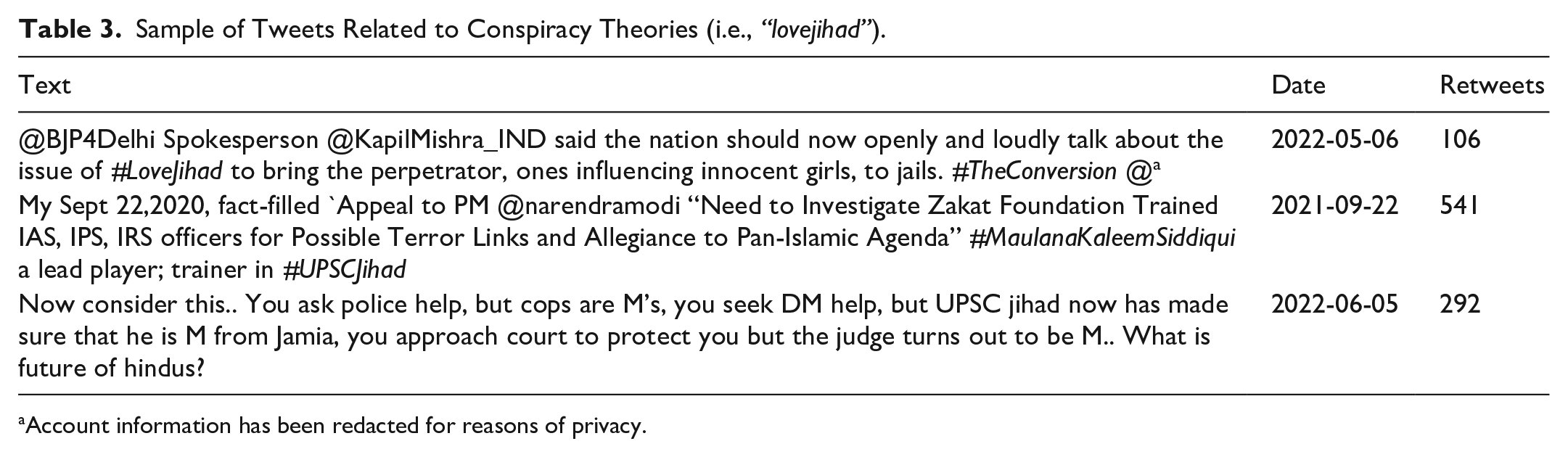
Other conspiracy theories and types of propaganda—including UPSC jihad, 23 land jihad, grooming jihad, and corona (i.e., coronavirus disease [COVID-19]) jihad—have also been propagated by Hindu nationalists and Godi Media 24 (Lapdog Media), all to identify a common “enemy” in Muslim men. 25 Our co-occurrence network (Figures 3d, 3e, 4d, and 4e) shows the clusters related to love jihad and other related conspiracy theories. The cluster related to love jihad (Figures 3d and 4d) contains hashtags such as #lovejihad, #saveourdaughters, #groomingjihad, and #halala. Several variations of #upsc_jihad and #educationjihad are visible in Figures 3e and 4e. These hashtags show that these conspiracy theories are part of Hindu nationalist discourse on Twitter. Table 3 depicts the examples of conspiracy theory-related tweets in our dataset.
Sample of Tweets Related to Conspiracy Theories (i.e., “lovejihad”).
Account information has been redacted for reasons of privacy.
The first sample tweet in Table 3 is about love jihad, in which Delhi BJP spokesperson Kapil Mishra cites a love jihad-themed movie called The Conversion (2022). This touches on another pattern visible in Hindi cinema these days (other than the above-mentioned “hurting sentiments of Hindus”), where filmmakers try to cash in on the growing polarization in Indian society by making religious-themed movies that either portray Hindus as victims or that glorify Hindus or the Hindu religion. The other two sample tweets are on the theme of UPSC jihad. The second tweet discusses the Zakat Foundation, a nongovernmental organization involved in running orphanages and charitable hospitals, as well as providing free preparation studies for various government examinations, including one of the most difficult and prestigious: the UPSC exam. When several of its students passed the UPSC exam, Hindu groups called it a conspiracy (called UPSC Jihad) by Muslims to control the Indian bureaucracy. The third tweet is about the same theme, with the user trying to warn Hindus against Muslim domination of India by presenting a scenario wherein all public officers (police, civil servants, and judges) are Muslims. The tweet is a clear example of the growing Islamophobia in India.
Violence and Hate Against Oppressed Groups (i.e., Delhi Riots and Mentoo)
Given the recent spate of riots and hate crimes in which right-wing Hindus have participated, it is no surprise that our data captures several of these topics. The cluster related to the violence in Jahangirpuri in 2022 and the demolition of Muslim homes in its aftermath26, 27 is prominent in the co-occurrence network of hashtags (Figures 3b and 4b), and it includes hashtags such as #hindulivesmatter, #hindusunderattack, #bulldozer, and #kejriwalhateshindus. Hate against girls and women is visible in Figures 3f and 4f; as shown, the Johnny Depp versus Amber Heard case (i.e., #justiceforjohnnydepp, #justiceforjohnnydeep, and #justiceforjohhnydeep) is connected with a larger cluster related to the “Men’s Right Movement” in reaction to the #MeToo movement (i.e., #mentoo, #speakupmen, #falserape, #golddigger, #feminazi, #toxicfeminism, and #fakecases). The usage of those hashtags not only involves the discrediting of the #MeToo movement but also shows Hindu nationalists’ contempt for issues related to marital rape and domestic violence (i.e., #498a and #maritalrape), as shown in Figures 3f and 4f. Table 4 depicts a few sample tweets in that category.
Sample of Tweets Related to Violence and Hate Against Minorities and Women.
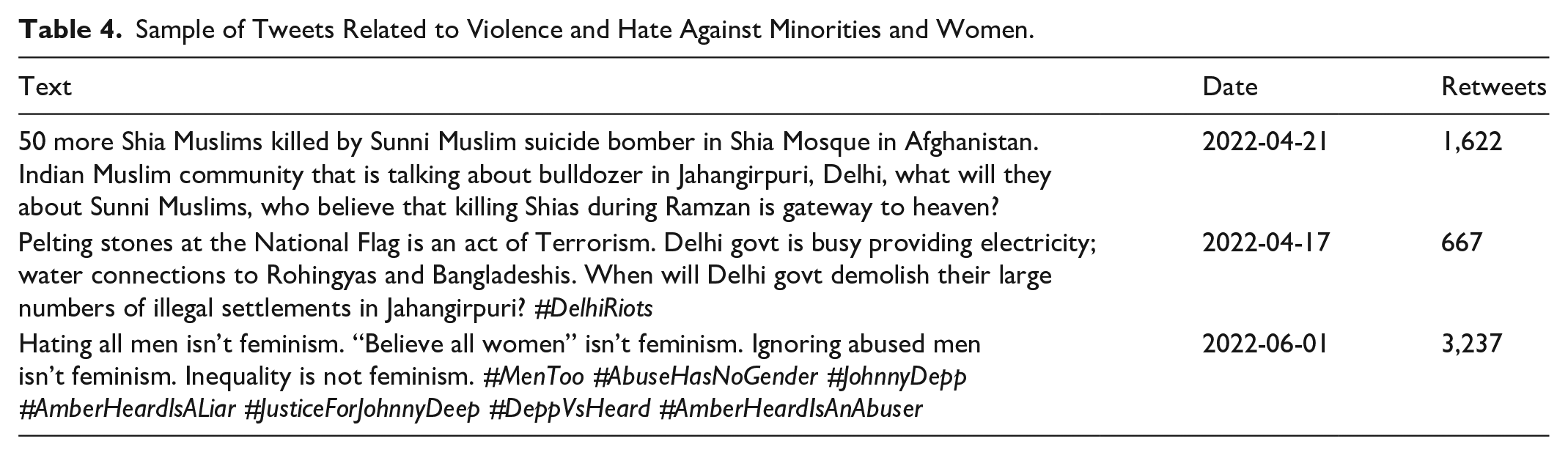
The first two tweets are related to the Delhi riots (2022). In the first tweet, the user tries to justify the illegal demolition of Muslim houses in the Jahangirpuri area by giving an example of Sunni Muslims killing Shia Muslims in Afghanistan. This kind of argument is frequently used by Hindu nationalists, in which they try to show that the conditions of Muslims in other “Islamic countries” are very bad and that Indian Muslims are very fortunate to be in India, so they should not complain about any discrimination or injustice, and if they do complain, Hindutva supporters suggest that they leave India and go to these Islamic countries (“Go to Pakistan” has become a very frequently used slogan by Hindutva supporters). In the next tweet, the user demands an action against Muslim refugees from Myanmar and Bangladesh by the Delhi government—specifically, the demolition of “illegal settlements” in Jahangirpuri. The user claims that these refugees are terrorists and that the Delhi government should not provide electricity and water to them. The last tweet falls under the theme of the Men’s Right Movement, with the Johnny Depp/Amber Heard case as the reference point. This event gave Hindutva supporters an opportunity to express their hatred against the women’s rights movement and to bombard some of the leading women’s rights activists with vile attacks. 28
Anti-Democratic Sentiment (i.e., Discrediting of CAA Protests)
In India, the CAA has created a new form of differentiation between citizens on the basis of religion that goes against the spirit of Indian secularism. Nevertheless, because it has enjoyed immense support among the people who support Hindutva and Hindu Rashtra, the CAA legislation was passed in 2019, which led to mass anti-CAA protests. Opponents of the amendment have criticized it as being exclusionary and in violation of the secular principles enshrined in India’s Constitution, 29 and they have demanded its repeal. However, because the CAA is favored by Hindu nationalists, the Hindu right-wing—including BJP leaders—have sought to discredit anti-CAA protests by calling the protesters “anti-national” 30 and “terrorists” (Amarasingam et al., 2022). In our co-occurrence network, the CAA and other related hashtags (i.e., #caa, #minority_appeasement, #polygamy_ban, and #beefexportban) form a cluster (Figures 3c and 4c), one that is connected to hashtags such as #nrc, #ucc, #uniformcivilcode, #घुसपैठ_नियंत्रण_कानून (“Infiltration Control Law”), #समान_नागरिक_संहिता (“Uniform Civil Code” [UCC]), and #populationcontrollaw, which are related to the demand for other polarizing laws, such as the UCC. However, our data does not reach back several years, which explains why the cluster in question is small and scattered and does not fully capture Hindu nationalists’ abhorrence of anti-CAA protesters and their discrediting of anti-CAA protests. Other research focused on the CAA and the subsequent protests against it have provided a detailed depiction of Hindu nationalists’ hate toward protesters (Amarasingam et al., 2022; Bhatia, 2022). Hatred toward Muslims among Hindu nationalists is so strong that they even criticize the BJP for not implementing the CAA sooner. Sample tweets in Table 5 capture their anger. 31
Sample of Tweets Showing Anti-Democratic Sentiment (i.e., UCC-Related Tweets).

The first tweet in Table 5 provides a figure (86,000 children born every day among Muslim population) indicating a high fertility rate, with no source whatsoever. The tweet then says that if Hindus want to live peacefully in India, this has to be stopped by the implementation of laws such as the UCC along with the Infiltration Control Law, the Conversion Control Law, the Corruption Control Law, and the Population Control Law. This kind of dog-whistle is extremely common among Hindutva supporters, who accuse Muslims of producing many children and suggest that if nothing is done to control their population, Muslims will soon be the majority in India. The second tweet associates Muslims with “spitting,” saying that they spit on bread, dal, water, juice, and vegetables. The tweet then continues and says that bad education and radicalism are the root of these issues, and hence, the UCC and the Uniform Education Law should be implemented. The last tweet is so dangerous that it should be removed from the platform. This tweet, which also tags PM Narendra Modi, alleges that Muslims attacked a Hindu procession in West Bengal and if laws such as the UCC, the Uniform Education Law, the Infiltration Control Law, the Black Money Control Law, and so on are not implemented, there would be a genocide in 2047 similar to what happened in 1947. The independence of British India in 1947 and the subsequent partition of India and Pakistan saw huge riots in which millions (mainly Hindus, Muslims, and Sikhs) lost their lives and millions of others became refugees. The 1947 reference alludes to that tragedy and warns that similar events will happen if nothing is done to stop Muslims. All these tweets shows a prevalence of and belief in outdated stereotypes related to Muslims among Hindutva supporters, which has resulted in such an extreme hatred that they (Hindutva supporters) openly call for Muslim genocide.
Analyzing Toxicity in Hindutva Discourse on Twitter
To comprehend the online behavior of Hindu RWE in India, we conducted a toxicity analysis. We obtained the 10 most central hashtags (see subsection “Hashtag Co-Occurance Network” of Method section) in clusters related to features of RWE, after which we filtered all tweets into sets corresponding to the hashtags identified for each cluster. We removed duplicate tweets before toxicity analysis to overcome the imbalance toward retweets, which we found in our dataset. Because a significant number of hashtags in our dataset were in English and Hindi, we considered and obtained tweets in both languages. Table 6 shows the number of tweets in each language and for each feature in our data, which included 5,478 extracted tweets in English with hashtags related to the four features of RWE and 3,370 extracted tweets in Hindi. The lists of all the hashtags are provided in the Supplementary Material.
Number of Tweets for Each Feature of Right-Wing Extremism (RWE) in English and Hindi.

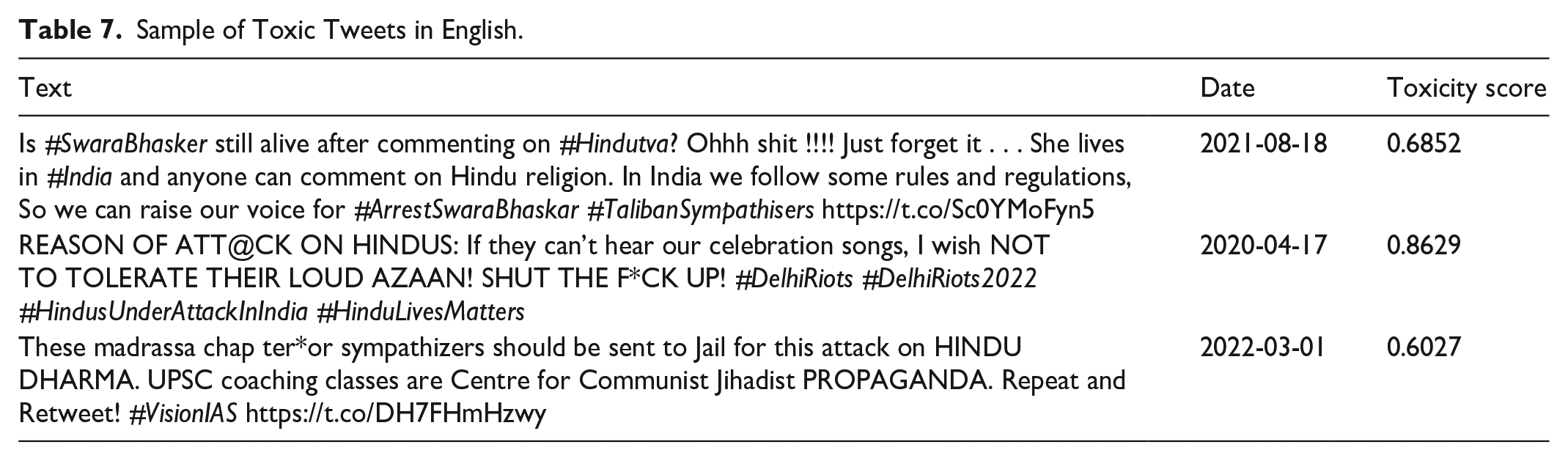
To understand whether the level of toxicity differs between the two languages, we compared the toxicity of tweets with features of RWE in both English and Hindi. Figure 5 shows that, for all tweets with the four features combined, the mean toxicity score of Hindi-language tweets representing RWE was greater than the mean toxicity score of English-language tweets. Since duplicate tweets are removed, the general discourse can be described as toxic, with no particular attention to influencers. Next, we compared those results with the results of the toxicity of randomly sampled tweets both in English (i.e., 18,000) and Hindi (i.e., 16,000)) that emerged from India during the same period as our data about Hindu nationalists originated (i.e., 2020–2022), referred to as “India General.” Although our toxicity analysis showed that Hindi-language tweets had a higher mean toxicity score than English-language ones, the distribution of toxicity scores differed. In both sets of data, a relatively high number of tweets in English had very low (i.e., almost zero) toxicity scores. There are two probable explanations for the higher mean toxicity scores in Hindi: biases of Perspective API toward Hindi (Ghosh et al., 2021) and that a large number of Hindi-speaking Twitter users post toxic, abusive, offensive tweets (Agarwal et al., 2017; Rudra et al., 2016). At time same time, we cannot rule out the impact of Twitter’s content moderation policies and Twitter’s prioritization of certain topics and languages while removing problematic content. Those circumstances in themselves represent a promising area of research, and one that was too expensive to cover in our research and that we thus leave to future research. Tables 7 and 8 show three tweets with the highest toxicity scores for all four features combined in English and Hindi, respectively.

Distributions of toxicity between English-language and Hindi-language tweets. A generic set of random tweets sampled from India during 2020–2022 is provided in contrast. Hindu nationalist tweets have higher mean toxicity scores. In both sets of data, Hindi language tweets have higher mean toxicity scores than English-language tweets.
Sample of Toxic Tweets in English.
Sample of Toxic Tweets in Hindi.

Account information has been redacted for reasons of privacy.
The first tweet in Table 7 labels Swara Bhaskar—Bollywood actress and vocal critic of Hindutva and the Modi government’s polarizing policies—as a Taliban sympathizer. The user rhetorically asks why Swara Bhaskar is still alive and suggests that it is because she lives in India and there is rule of law. As mentioned in the previous section, the reference points of Hindutva supporters are always Muslim-majority countries, especially countries with persistent civil unrest (e.g., Afghanistan). Then, the user suggests that these “Muslim sympathizers” should go and live in these countries. In India, the level of discourse has sunk so low that stating a pro-Muslim or an anti-BJP, anti-Hindutva opinion is seen as sedition. The second tweet is related to a growing practice that has been seen especially since the Modi government came to power. Hindutva groups organize a religious procession with extremely loud music and vulgar and abusive songs, and they take these processions to Muslim-majority areas or Muslim places of worship to provoke them. Hindutva group associates even possess sharp weapons during these possessions. If Muslims protest against this practice, Hindutva supporters and groups then call to ban Azaan—the Islamic call to public prayer in a mosque. The last tweet alleges that madrasas 32 and UPSC preparation centers (like the Zakat Foundation mentioned in the previous section) are terrorist-producing factories. All these tweets show that Hindutva supporters continuously target every aspect of Muslim existence, whether education or religious or cultural practices, to humiliate and discriminate against them and to make them feel like second-class citizens.
The user in the first tweet in Table 8 attacks the religious practice of Muslims praying in the open. The user calls Muslims “pigs” (a very common practice among Hindutva supporters is to call Muslims “pigs” or to use a pig emoji when referring to Muslims, due to Islam’s prohibition on eating pork) and warns Hindus that if they do not do anything to stop Muslims, their mothers and sisters will soon be converted to Islam. Again, not only are the religious practices of Islam targeted, but the pretext of religious conversion (from Hinduism to Islam) is used as a tool to scare Hindus. The next two tweets are directed against Rahul Gandhi (politician of the Indian National Congress party and prime target of BJP supporters). In one tweet, he is called a eunuch; in the other, the user uses abusive language against him and his supporters. Rahul Gandhi is seen anti-Hindu because he raised his voice against BJP’s communal politics, but he is also a target of Hindutva supporters due to his mother, Sonia Gandhi, having foreign roots (Italy).
We subsequently compared toxicity in English- and Hindi-language tweets for each feature of RWE separately, using the Mann–Whitney U test with Bonferroni correction. As Figure 6 shows, for the features “conspiracy theories” and “violence and hate,” the results were significant, revealing that Hindi-language tweets in these categories were more toxic than those in English. For the feature “anti-democratic sentiment,” it is difficult to provide a meaningful explanation, because there are very few tweets in English in that category. Finally, in the category of exclusionary nationalism, English- and Hindi-language tweets showed similar levels of toxicity. The distribution of toxicity and the results of the Mann–Whitney U test with Bonferroni correction are shown in Figure 6 respectively.
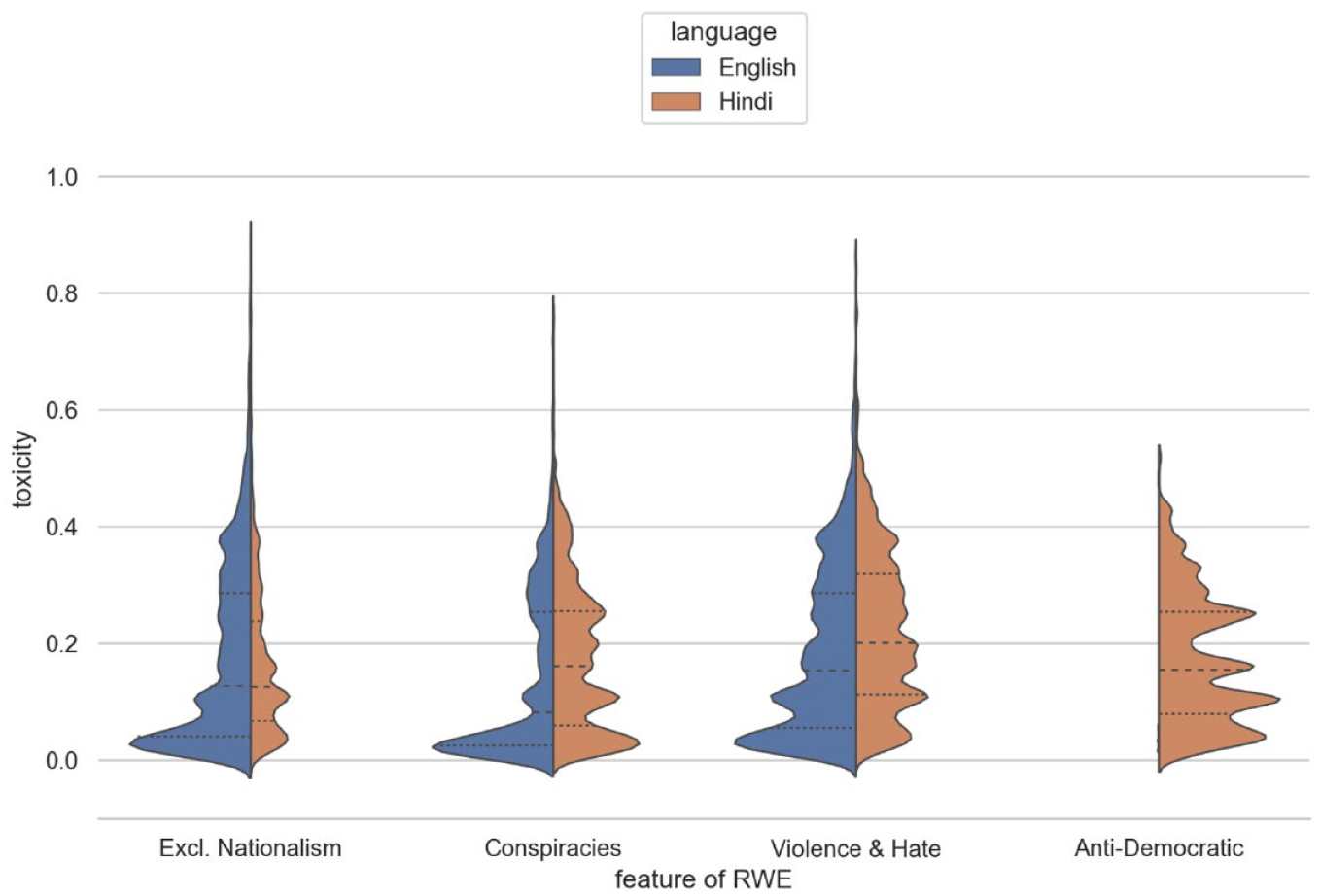
Distributions of toxicity per feature of RWE. Tweets for each feature were selected using the 10 most central hashtags from topics, indicating this particular feature of RWE. Tweets containing conspiracies, as well as violence and hate had higher mean toxicity scores in Hindi than in English. Because most hashtags in the anti-democratic CAA cluster (see Figure 4) are in Hindi language, no English-language anti-democratic data were examined.
Discussion
We started this research asking whether or not there exists a provable (through quantitative research) relationship between RWE and Hindutva. In her in-depth analysis in “Hindutva as a variant of Right-wing extremism,” Eviane Leidig (2020) indicated the existence of this relationship. However, quantitative research using social media data to explore this relationship has not been done until now. Several studies, both qualitative and quantitative, have analyzed Hindutva and the social media activities of its supporters. For example, in her analysis, Ingrid Therwath showed the online networks and activities of Hindutva organizations and activists among the Indian diaspora, revealing that Hindutva groups are mainly composed of conservative men and are close to extremist Jewish groups, with whom they share Islamophobic views (Therwath, 2012). Kiran Bhatia used a discourse analysis method to understand the Twitter activity of Hindu nationalists. Bhatia’s analysis reveals that Hindu nationalism is not manufactured solely by people and organizations in power through pre-planned media campaigns, but also by people in daily life with the support of technological affordances, interface features, and protocols (Bhatia, 2022). Similarly, Amarnath Amarasingam et al. (2022) used a descriptive analysis method to understand Hindu nationalists’ activities against Muslims (Islamophobia) on various social media platforms. All these studies are important to understanding Hindutva and Hindu nationalists’ activities on social media, but they use discourse analysis or descriptive (i.e., qualitative) methods. In terms of methodologically similar studies to ours (computational analysis of large-scale Twitter data), Saloni Dash et al. (2022) have indicated polarization and dangerous speech among Indian politicians and influencers; however, their research is not specifically focused on Hindutva. Our research uses advanced computational methods with large-scale data to show a relationship between RWE and Hindutva, which has been missing from the literature until now.
The theoretical contribution of our research lies in the validation of Eviane Leidig’s relationship between RWE and Hindutva, through large-scale quantitative data analysis. This makes our research a potential foundation in quantitative research examining two primary future study trajectories: (1) expanding the existing RWE discourse beyond its prevalent Eurocentric focus and onto a global stage and (2) developing and refining the RWE discourse to incorporate Hindutva ideology.
RQ1 of our research addressed the categorization problem. We hypothesized that if we could find essential features of RWE—namely, exclusionary nationalism, conspiracy theories, violence and hate against oppressed groups, and anti-democratic sentiments—in Hindutva discourse on Twitter, then we could designate Hindutva as an RWE ideology. To test this hypothesis, we conducted hashtag co-occurrence and community detection. Our findings clearly show that Hindutva discourse on Twitter among ordinary people in India has the above-mentioned features of RWE.
Our results reveal that in Hindutva Twitter discourse, the idea of exclusionary nationalism—in which the object of exclusion is Muslims—is present in the frequently used #HinduRashtra (section “Exclusionary Nationalism (i.e., Hindu Rashtra)”). Hindu Rashtra, the core tenet of Hindutva ideology, is inherently exclusionary, as it declares that India is the land of Hindus. The CAA is an attempt to exclude Muslim and Christian refugees from gaining citizenship. A few villages in Gujarat—a state that the BJP has governed since the 1990s, and where Narendra Modi was chief minister for 12 years between 2002 and 2014—have even declared themselves as being part of Hindu Rashtra. 33 Conspiracy theories also play an important role in creating a favorable narrative, and it is a prominent feature of RWE groups globally. Hindutva supporters frequently conjure up conspiracies against Muslims: our results show the presence of #lovejihad and #UPSCJihad (see the “Conspiracy Theories (i.e., Love Jihad and Other Conspiracies)” section). Those conspiracy theories view Muslim men marrying Hindu women (i.e., love jihad) and Muslims getting selected for the highly competitive and elite civil services (i.e., UPSC jihad) as parts of a larger conspiracy by Muslims to dominate Hindus both numerically and administratively and to create Islamic rule in India. Under the BJP’s rule, the love jihad conspiracy has been enshrined in legislative action in several states (Malji & Raza, 2021).
In terms of violence and hate against minorities, our results show several related hashtags, including #hindulivesmatter, #bulldozer, #mentoo, and #toxicfeminism (see the “Violence and Hate Against Oppressed Groups (i.e., Delhi Riots and Mentoo)” section). Among the four features that we considered in our research, Hindu-Muslim conflicts have been the most consistent, at least since the creation of India and Pakistan in August 1947. India has seen several communal riots in the distant (Kausar, 2006) and recent past, including the Delhi riots in 2020 and the Jahangirpuri violence in 2022. Furthermore, given Hindutva’s roots in “traditional” (read: patriarchal and conservative) norms, its supporters frequently perpetrate violence against women on social media to the extremes of rape and murder threats, stalking, and the nonconsensual posting of nude photos (Subramanian, 2019). The recent instances of “Bulli Bai” and “Sulli Deals”—two mobile apps hosted on Github that put Indian Muslim women up for auction—also show that Hindutva supporters are anti-women in general and specifically anti-Muslim women34, 35.
Finally, our results show the presence of talk about #caa (see the “Anti-Democratic Sentiment (i.e., Discrediting of CAA Protests)” section) in Hindutva discourse. Although our data could not sufficiently capture the discourse around the anti-CAA protest, this does not mean that anti-democratic sentiments was absent from Hindutva discourse on Twitter. Previous research (Amarasingam et al., 2022; Bhatia, 2022) and several news reports from the time have shown consistent attempts by Hindutva groups to discredit anti-CAA protests by declaring Shaheen Bagh—the protest site of anti-CAA protesters—as a den of jihadis (“terrorists”). 36 A similar discrediting of peaceful protests happened during the farmers’ protests. 37
Therefore, on the basis of our findings and subsequent detailed analysis for each of the above features, we can categorize Hindutva as an ideology of RWE. These results are significant because they extend the discussion on the categorization of Hindutva as RWE.
With RQ2, we sought to understand the online toxic behavior of Hindutva supporters as well as the differences between Hindi and English as the two most-used languages in our data and on Twitter in India. Toxicity analysis was chosen because RWE groups globally are known to use extremely toxic and abusive language on various social media platforms (Banaji & Bhat, 2022; Caiani et al., 2021; Díez-Gutiérrez et al., 2022; Müller & Schwarz, 2021). The results of the toxicity analysis reveal that Hindi-language tweets are more toxic than English-language ones (see Figure 5). These results substantiate previous research showing the usage of Hindi for offensive, abusive posts on Twitter. Our toxicity results on individual RWE features reveal that Hindi-language tweets related to conspiracy theories and to violence and hate are more toxic than English-language ones in both categories (see Figure 6). Hindi is not only the second-most used language on Twitter in India after English; it is also the first language of Hindutva supporters, the majority of whom come from the Hindi heartland of India, the base of Hindutva politics. Based on our results, we propose that social media platforms in India should not neglect Hindi-language content in content-moderation processes, because monitoring Hindi-language content is important to making such platforms less toxic.
Conclusion
As political parties and leaders that support right-wing ideologies continue to achieve success in elections worldwide, RWE is clearly on the rise globally. These electoral successes demonstrate that right-wing ideology is gaining support (i.e., acceptability) in the general population as well. Some of the world’s major democracies, including India and the United States (at least under Donald Trump), have been ruled by right-wing leaders and/or parties that openly support RWE, in a dangerous trend that warrants careful observation. Although both theoretical and empirical research on RWE is extensive, it is mostly Eurocentric. For this reason, a major RWE ideology that originated in a pre-independence India—Hindutva—has remained under-examined in the context of RWE. In light of this, our research has attempted to advance the discussion started by Leidig (2020) in her paper titled “Hindutva as a variant of right-wing extremism”; as such, it provides empirical evidence confirming the existence of prominent features of RWE in Hindu nationalists’ discourse on Twitter. The timing of our research could not be more crucial: under the Modi government, Hindutva and Hindu nationalists have been emboldened, and as a result, minorities—especially Muslims—have frequently been subjected to violence, both physical and psychological. Previous research has also shown that Facebook was used by Hindu nationalists to abuse, harass, and spread hate speech during the COVID-19 pandemic (Ghasiya & Sasahara, 2022).
Similar to other RWE ideologies, including Nazism in Germany and fascism in Italy, Hindutva and the RSS have a tainted history. However, currently, the RSS and its political wing, the BJP (along with several other organizations of Sangh Parivar) have succeeded in changing the narrative in their favor. Furthermore, it seems that they alone have the key to create a new narrative. 38 In a world in which liberal democracies face challenges from RWE parties and leaders, we show that India, the world’s largest democracy, is ruled by a Hindu nationalist party whose core ideology, Hindutva, is an RWE ideology. Consequently, India is becoming an illiberal democracy—in Christophe Jaffrelot’s words, an “ethnic democracy”—in which Muslims are treated as second-class citizens. Against this backdrop, the categorization of Hindutva as an ideology of RWE is crucial, for it stands to bring global attention to the ideology as well as diversify the existing narrative about RWE and, in turn, make it global instead of Eurocentric. From this perspective, our research findings are important, timely, and urgent.
Although discourse on RWE in a given country depends on its socioeconomic and political conditions, as well as on historical and cultural aspects, it would be interesting to understand whether common themes surface in various RWE groups; in future work, we hope to study this. A comparison of RWE groups that exist in countries such as Hungary, the United States, India, France, Turkey, and Germany would also be useful for future research. In addition, it would be valuable to analyze multiple social media platforms, to elucidate whether RWE is propagated using the same strategies on all platforms and, if not, whether different platforms are used for different RWE objectives.
Footnotes
Acknowledgements
The authors wish to express their gratitude to Professor Christophe Jaffrelot and Dr Eviane Leidig for their valuable feedback, which helped them to improve their manuscript significantly.
Declaration of Conflicting Interests
The author(s) declared no potential conflicts of interest with respect to the research, authorship, and/or publication of this article.
Funding
The author(s) disclosed receipt of the following financial support for the research, authorship, and/or publication of this article: This research was supported by JST CREST (JPMJCR20D3).
Ethical Statement
Tweets were collected using publicly available Twitter academic API, and thus complied with Twitter’s privacy policy. For privacy, all account information has been redacted from tweets quoted in this article.
