




Abstract
The growth of social media influencer marketing has created sophisticated opportunities for deceptive marketing practices to proliferate online. While sponsorship disclosures alert consumers to the commercial nature of social media content and are required in different jurisdictions around the world, many influencer ads do not incorporate disclosures that comply with applicable laws. Building on Bourdieu’s theory of field as the theoretical lens, this research examines the disconnect between formal regulation and on-the-ground influencer marketing practices in Canada by investigating the current barriers to compliant sponsorship disclosure. Using semi-structured interviews with influencer relations professionals, who play an intermediary role between brands and influencers, the research explicates the (1) algorithmic challenges (e.g., algorithmic deprioritization or shadowbanning) and (2) non-algorithmic challenges (e.g., lengthy disclosure processes) to maintaining high disclosure standards. The research identifies the strategies influencer intermediaries can use to achieve upfront and conspicuous disclosure in a social media landscape where the algorithmic determinants of success are unpredictable, and the adaptation of applicable legal frameworks is traditionally slow.
Introduction
Social media influencer marketing has grown into a billion dollar enterprise globally (Childers et al., 2019; Geyser, 2022a). While the impact of individual influencer marketing campaigns can be difficult to evaluate and quantify (Jacobson et al., 2019), influencers’ recommendations and endorsements can have a similar impact on consumers as traditional advertising (Mai et al., 2022). The growth of the industry has also created new and sophisticated opportunities for deceptive and misleading marketing practices to proliferate online. Sponsorship disclosures for both paid and non-paid (e.g., in-kind payment) collaborations have become increasingly important as formal regulators have identified disclosure breaches as a major infringement of applicable competition and consumer protection laws (Asquith & Fraser, 2020). Sponsorship disclosures can be in the form of written hashtags (e.g., #ad), standardized tools for disclosure on social media platforms (e.g., “Paid Partnership with Brand_X” banners), and/or verbal disclaimers that alert consumers to the commercial nature of social media content (Ad Standards, 2020).
Problematically, recent research suggests that over three-fourths of influencer ads on platforms like Instagram have a hidden sponsorship disclosure (Langford, 2020). These cases of inadequate disclosure have driven formal influencer marketing regulators in jurisdictions such as Canada, the United States (US), and United Kingdom (UK) to take a consumer protection approach to overseeing the industry—concerned with ensuring that consumers are not “deceived into making an unwise purchase” (Asquith & Fraser, 2020, p. 5731). In Canada, more specifically, an inquiry was conducted by the country’s main competition regulator—Competition Bureau Canada—into influencer marketing practices employed in the health and beauty, fashion, technology, and travel sectors (Competition Bureau Canada, 2019). After the industry review, Competition Bureau Canada (“the Bureau”) sent letters to about 100 brands and marketing agencies that participate in influencer marketing—underscoring the need for these firms’ marketing practices to comply with the law known as Competition Act (“the Act”). The Act is the legislation that includes laws against anti-competitive marketing practices and provides the legal justification for sponsorship disclosure in Canada. This inquiry by the Bureau came after some Canadian consumers had highlighted a need for more transparency and penalties for regulatory noncompliance in influencer marketing (Ad Standards, 2018).
Despite the intervention of various regulatory bodies resulting in targeted law enforcement and the publication of formalized disclosure guidelines, influencers are still challenged with providing disclosures that are in compliance with applicable laws (Competition Bureau Canada, 2019; Gürkaynak et al., 2018; Langford, 2020). Although many jurisdictions have guidelines for influencers and businesses, prior research concludes that there is a disconnect between regulation and everyday influencer marketing and sponsorship disclosure practices (Bladow, 2018). In addition, previous research largely attributes low compliance to the negative reaction of consumers—suggesting that influencers breach disclosure guidelines because of the possibility of critical consumer reactions to influencer content (that includes clear and upfront disclosures) resulting in the perception of a loss of authenticity (Evans et al., 2017; van Driel & Dumitrica, 2021; van Reijmersdal et al., 2016, 2020; Woodroof et al., 2020). Although this current research is important for highlighting the effect consumers have on brand disclosure practices, much of this work takes a “black box” (Pasquale, 2015) approach to influencer disclosure research by focusing mainly on the most visible causes of improper brand disclosure implementation (e.g., negative consumer attitudes). Current sponsorship disclosure research is limited by the lack of an internal interrogation of the process of securing sponsorship disclosure (Childers et al., 2019)—especially in a highly non-transparent and unpredictable social media environment (Gorwa et al., 2020; West, 2018). Moreover, research on the regulation of sponsorship disclosure demonstrates that formal regulators are largely concerned with the economic implications of disclosure, which neglects to consider other possible socio-cultural or labor-related causes of disclosure infringement that extend beyond influencers aiming to deceive consumers for financial gain (Abidin, 2021; Asquith & Fraser, 2020).
In response to these limitations, this work engages in a deeper investigation of the procedures of implementing and monitoring sponsorship disclosure and the challenges these processes may pose from a legal and regulatory compliance perspective. Using the Bureau’s influencer marketing review as a contextual backdrop, the objective is to deconstruct the factors that shift influencers toward noncompliance when producing and publishing branded social media content. To do this, the research relies on the perspectives of influencer relations professionals—also known as influencer intermediaries—who manage influencer marketing campaigns and mediate between influencers and brands (Gallagher, 2020; Stoldt et al., 2019). As intermediaries, these professionals are often responsible for monitoring disclosure implementation and advising influencers and brand clients on compliance and best practices in the industry (Bladow, 2018). Furthermore, considering the increasing professionalization of this role, influencer relations professionals are typically affiliated with the types of organizations that were targeted by the Bureau in 2019. With these considerations in mind, we ask the following:
RQ1: What are the procedural barriers to compliant sponsorship disclosure implementation in social media influencer marketing?
RQ2: How can upfront and conspicuous disclosures be achieved in social media influencer marketing?
By analyzing the opinions and industry experiences of influencer relations professionals, this work contributes to an overlooked area of influencer marketing research that focuses on the experiences and industry-driven perspectives of influencer relations practitioners (Childers et al., 2019). This approach also finds theoretical backing in Pierre Bourdieu’s sociological theory of field and subconcept of cultural intermediaries; the analytical tools we use jointly to define influencer relations professionals as intermediaries between producers of cultural products (e.g., brands) and consumers (influencers and target audiences) (Corciolani et al., 2020). By applying field theory in a new environment, we define the influencer marketing industry as the social media influencer field, where influencer intermediaries, brands, influencers, and regular consumers, coexist under sets of field rules negotiated internally (e.g., such as influencer marketing tips and tricks) or those imposed externally by overlapping fields (e.g., the regulatory field).
Literature Review
Social Media Influencer Marketing: A Brief Introduction
Social media influencer (SMI) marketing is a type of marketing that leverages the high influence of social media influencers—such as internet personalities, third-party endorsers, content creators, and celebrities—to create commercial value, increase brand awareness and recognition, build sales, and access often hard-to-reach consumers through user-generated content (Abidin, 2021; Enke & Borchers, 2019; Freberg et al., 2011; Mai et al., 2022; Martensen et al., 2018). User-generated content (UGC) is a type of digital material that is typically produced by every day and active social media users who are “outside of professional routines and platforms” (van Dijck, 2009, p. 41). Internet contributors of UGC often disseminate more everyday home-style video clips and social media content (Davies, 2011). Disseminating adverts and endorsements by way of personal and relatable UGC, such as Instagram posts or YouTube vlogs, often generates “immediate interactivity and response from followers” (Abidin, 2015, para. 43). High engagement and interactivity (e.g., comments, likes, and shares) can lead to a higher return on investment for businesses that utilize influencers in social media communications; existing research indicates that the reliability of UGC allows influencers to appear trustworthy and dependable in the eyes of consumers who view influencers as peers or friends (Bladow, 2018; Mai et al., 2022; Martensen et al., 2018). Consequently, promotional or sponsored posts mimic the visual aesthetics of an influencer’s everyday content; as such, it can be difficult for consumers to recognize advertising intention when branded content is produced to promote a paying sponsor (Gürkaynak et al., 2018).
Globally, the influencer marketing sector has become a billion dollar industry that is estimated to be worth US$16.4 billion in 2022 (Geyser, 2022b). Corporate budgets for influencer-based marketing are also increasing. Industry data show that over 75% of brand marketers plan to have an allocated budget dedicated to influencer marketing in 2022 (Geyser, 2022b). This growth has also resulted in the corporatization of influencer marketing strategies by making way for professionals who specialize in influencer relations—the process of managing relationships with influencers (Gallagher, 2020). Influencer relations professionals build relationships with influencers and function as intermediaries and liaisons between brands and influencers during collaborations (Gallagher, 2020; Stoldt et al., 2019). These professionals manage various relationships that are key to the success of an influencer marketing campaign by aiding contract development, creative direction, content creation, influencer discovery, recruitment, vetting, development of influencer payment schedules, audience research, and assessment of influencer relevance to their clients (Freberg et al., 2011; Gallagher, 2020; Stoldt et al., 2019).
Sponsorship Disclosure in Canada and the Competition Bureau’s Influencer Marketing Review
In the Canadian regulatory context, expectations for sponsorship disclosure in SMI marketing stem from a shared legal obligation for influencers and businesses to disclose any material relationships or connections that may result from a collaboration (Ad & Standards, 2019, 2020; Competition Bureau Canada, 2019, 2020b). A material connection or relationship is described by Ad Standards (2019), a Canadian advertising self-regulatory agency, as any link “between an entity providing a product or service and an endorser, reviewer, influencer, or person making a representation that may affect the weight or credibility of the representation” (para. 12). Within the Canadian context, materiality as a driver for the need for disclosure is deeply informed by applicable legislation such as the Canadian Competition Act (“the Act”). When applied to advertising and marketing, the Act necessitates disclosure as a mechanism for ensuring that the consumers are not misled or deceived by an influencer endorsement in a material manner.
In Canada, issues with noncompliant disclosures have caught the interest of the federal government, with the Competition Bureau (“the Bureau”) engaging in more targeted outreach, law enforcement, and oversight of influencer marketing. The Bureau issued letters to almost 100 brands and marketing agencies in 2019, advising these organizations to ensure that their influencer marketing practices comply with the Act (Competition Bureau Canada, 2019). The Bureau also underscored the shared nature of legal and regulatory compliance, clarifying that “businesses share a responsibility with influencers when they post advertisements on social media, as they may be liable for false or misleading content” (Competition Bureau Canada, 2019, para. 3). Regulatory agencies in countries such as the US and UK have similarly targeted noncompliant influencers and mainstream celebrities who engage in misleading or deceptive influencer marketing (Competition and Markets Authority, 2018, 2019; Federal Trade Commission, 2020).
Applying Disclosure Guidelines to Influencer Marketing Practices
In terms of applying the law in day-to-day practice, several disclosure and endorsement guides are available to marketers, brands, influencers, and the public at large. Canadian influencer marketing guidance is available through both regional and international enforcement partnerships (e.g., through relationships with the FTC or International Consumer Protection Enforcement Network) (Competition Bureau Canada, 2020a). Ad Standards annually publishes a guide on the “do’s and don’ts” of disclosure. Inspired by the Act, the agency’s “Influencer Disclosure Guidelines” document identifies best disclosure practices for most social media platforms. Ad Standards (2020) has generally recognized #ad, #sponsored, #BrandName_Ambassador, and/or #BrandName_Partner as acceptable written disclosure formats for sponsored social media content. Based on current guidelines, ambiguous disclosures like #sp, #spon, #Partner, or #Collab are insufficient for ensuring consistent ad disclosure recognition (Ad Standards, 2020). The Ad Standards’ guidelines also identify the value of disclosure timing, disclosure placement, disclosure proximity, and the effective utilization of standardized disclosure labels (e.g., “Paid Partnership with Brand X”). Verbal and written disclosure recommendations for gifted collaborations have been included in the most recent Ad Standards’ disclosure guidelines. Both the Bureau and Ad Standards have emphasized the importance of ensuring that gifted products or services are disclosed appropriately to clarify the existence of a material relationship (Ad Standards, 2020; Competition Bureau Canada, 2020b). Problematically, despite the social media influencer industry becoming increasingly formalized, there continues to be a disconnect between the enforcement of existing disclosure guidelines and day-to-day disclosure implementation on platforms.
The Causes of Improper Sponsorship Disclosure and Gaps in Current Research
Extant literature centralizes much of the challenge with securing upfront and conspicuous disclosures around the negative reactions of consumers to influencers’ sponsored content. Some scholars suggest that social media influencers engage in disclosure breaches because of a fear of generating negative consumer attitudes toward branded social media content (van Reijmersdal et al., 2016, 2020). Research on the effects of sponsorship disclosures on adults and children has shown that while transparency is beneficial for increasing consumer confidence and influencers’ credibility, disclosure language can also incite critical feelings toward sponsored content, brands, and influencers (Evans et al., 2017; van Reijmersdal et al., 2016, 2020; Woodroof et al., 2020). Integrating clear commercial messaging into influencer content has also been shown to increase perceptions that influencers are inauthentic or have “sold out” for brand sponsorships (van Driel & Dumitrica, 2021). Ensuring that influencers can maintain their commitment to authenticity and audience engagement is one of the key functions of influencer relations professionals (Stoldt et al., 2019). As such, it is unsurprising that the appearance of being inauthentic would adversely affect how influencers view and implement sponsorship disclosures. To work around the accusations of inauthenticity, some influencers attempt to balance posting sponsored content and sharing more private life experiences (van Driel & Dumitrica, 2021), but others resort to hiding or excluding disclosure to avoid criticism.
The ubiquity of inconspicuous disclosures justifies the regulatory focus on disclosure breaches in the industry, despite some scholars arguing that this approach to influencer marketing regulation is too narrow and lacks nuance. Asquith and Fraser (2020), for example, write that regulators have reduced influencer marketing to its economic implications by obsessing over the possibility of consumers being misled into an uninformed purchasing decision. Some scholars contend that this narrow regulatory approach is ineffective because it overlooks socio-cultural, political, and labor-related challenges influencers face in the industry and exclusively focuses on how governance can be achieved only through laws and regulations (Abidin, 2021; Asquith & Fraser, 2020). Narrow influencer marketing regulation ignores historical precedent demonstrating that the advertising industry has traditionally welcomed consumer protection mechanisms through increased regulation (Asquith & Fraser, 2020).
Building on the scholarly work detailed above, this research explores how and why ad transparency in newer forms of advertising and marketing (i.e., social media) is challenging—despite a historical acceptance of consumer protection related rules and regulations (Asquith & Fraser, 2020). As previously outlined, existing research attributes poor sponsorship disclosure practices to influencers’ attempts to circumvent negative consumer responses to influencer content that audiences perceive to be highly inauthentic or commercialized. This extant research is meaningful for underscoring the effect that consumer perception has on influencers’ self-presentation, self-branding, authenticity, and disclosure labor. That said, these noted causes of low disclosure outcomes offer a “black box” (Pasquale, 2015) approach to assessing sponsorship disclosure practices within influencer marketing. This means that by mainly imputing improper levels of disclosure to consumer responses to high disclosure messaging, current research obscures the internal processes of implementing disclosure and the challenges these processes pose for maintaining high levels of ad transparency. Childers et al. (2019) underscore that there is a need for further inquiry into the processes of securing proper brand disclosures. We posit that the recognition of this gap in sponsorship disclosure research, coupled with influencers’ labor in a highly non-transparent, unpredictable, and algorithmically complex social media environment (Gorwa et al., 2020; West, 2018), necessitates a closer investigation of the process of implementing disclosure on social media platforms.
Theoretical Framework
Bourdieu’s Theory of Field
Pierre Bourdieu’s theory of field is a useful theoretical device for conceptualizing the SMI marketing industry as a cultural field consisting of various social networks, actors, institutions, and power dynamics (Lareau et al., 2016). Bourdieu’s sociological field theory posits that social and cultural life is made up of a number of fields (Lareau et al., 2016). Fashion, education, journalism, music, arts, and advertising are only a few examples of domains of social life that can be viewed as fields (Warren & Dinnie, 2018). Fields are highly competitive arenas where field actors and institutions often fight for social, cultural, or economic power or capital (Bathmaker, 2015; Bourdieu & Wacquant, 1992; Warren & Dinnie, 2018; Wolf, 2007). Bourdieu adds that although these cultural domains can exist relatively autonomously, the convergence of overlapping fields can have an effect on the behavior and interaction of internal actors (Bathmaker, 2015; Lareau et al., 2016). Bourdieu’s introduction of the notion of rules in fields comes from his comparison of the field to game. When playing a game, participants typically interact under a set of rules and with an eye to commonly recognized benefits available for the successful player. In Bourdieusian thought, fields operate similarly under a set of rules of playing the game for sought-after forms of power or influence (Bathmaker, 2015; Bourdieu & Wacquant, 1992).
Bourdieu’s theory field is a meaningful tool for framing the influencer marketing industry as a social and cultural field, where various influencers, brands, influencer relations professionals, audiences, and social media platforms coexist and compete for forms of cultural (e.g., thought leadership), social (e.g., influential social networks), economic (e.g., high financial value), and technical (e.g., exceptionalism) capital or power (Abidin, 2018, 2021; Wolf, 2007). Within what we define as the SMI field, key field stakeholders negotiate rules of how best to “play the influencer marketing game,” while also weighing the effect that field intrusion, by what we call the regulatory field, has on negotiated rules and behaviors in the field. Although the regulatory field of government and self-regulatory agencies is external to the SMI field, the domains overlap at the point of applicable laws and regulatory guidelines (e.g., the Act, disclosure guidelines). Theoretically, the legal force behind the rules and regulations imposed externally by the regulatory bodies should have an effect on how SMI field actors behave internally and engage in influencer marketing practices.
The SMI Field and Cultural Intermediaries
Influencer relations professionals are the focus of this research due to their typical affiliation with the types of brands and agencies that were targeted by the Bureau in 2019 and the role they play as intermediaries who liaise between influencers and brands during collaborations (Gallagher, 2020; Stoldt et al., 2019). Defining influencer relations professionals as mediators between brands and influencers is informed by Bourdieu’s cultural intermediaries concept. According to Bourdieu, cultural intermediaries are a unique class of tastemakers and spokespersons for executives and directors looking to sell bourgeois tastes “as widely as possible” within a cultural field (Maguire & Matthews, 2010, p. 407). To simplify Bourdieu’s concept, Corciolani et al. (2020) define cultural intermediaries as “people and organizations who mediate between those who produce cultural products and those who are the target audience for these products” (p. 479). Their mediatory function between producers and consumers also enables their pedagogic role as advisers and modelers of a particular lifestyle in a field (Bourdieu & Nice, 1984; Maguire & Matthews, 2010).
In influencer marketing, intermediaries not only assist with managing and maintaining the relationships between influencers and their audiences, but also the relationships forged between influencers and sponsors. Stoldt et al. (2019) define the latter role as one of engaging a “structured flexibility framework” (p. 2). This framework is a way of defining a key competency of influencer relations practice that involves ensuring an acceptable balance between “a brand’s need to accomplish specific campaign goals with an influencer’s commitment to authenticity and audience engagement” (Stoldt et al., 2019, p. 2). To do this, influencer relations professionals adopt the same intermediary functions Bourdieu conceptualized in his original classification of the role within fields. While the power of intermediaries is often debated and questioned (Moor, 2008; Nixon & Gay, 2002), influencer relations professionals’ closeness to both brands and influencers in combination with their unique understanding of the corporate side of the industry, makes them invaluable to the process of “winning” the influencer marketing game.
Research Method
Method and Participant Rationale
A qualitative research approach is used to investigate influencer relations work through the lived experiences of influencer relations professionals actively practicing in the field (Bryman et al., 2012). Influencer relations professionals are centralized in this research over other stakeholders (e.g., influencers or clients) for four main reasons. First, as outlined in the theoretical framework, these professionals work closely with brands and influencers as intermediaries (Gallagher, 2020; Stoldt et al., 2019). Second, they are often tasked with monitoring compliance by ensuring proper disclosure implementation during collaborations (Bladow, 2018). Third, the Bureau sent advisory letters to the types of marketing agencies and brands where these professionals often practice influencer relations management. Finally, studying disclosure from the perspective of influencer relations professionals contributes to a “previously unaddressed insight into influencer marketing” (Childers et al., 2019, p. 271). As such, the perspectives of professionals whose practices would be directly impacted at a campaign management level is worthy of an in-depth analysis.
Using semi-structured interviews with 21 influencer relations professionals based in Canada, the research analyzes their day-to-day influencer relations work, awareness of applicable laws and regulations, and how they practice regulatory compliance in evolving social media environments. Semi-structured interviewing is conducive for sourcing rich and detailed textual data from the subjective experience of practitioners who are considered to be industry experts in the SMI field (Childers et al., 2019; Merrigan et al., 2012). As such, this form of qualitative data collection is favorable for a flexible line of questioning that often leads to other insightful areas of discussion and for accessing contextualized perspectives on the SMI industry and regulatory compliance.
Participant Recruitment
Following university research ethics approval, participants were recruited using email and LinkedIn. Purposive and network sampling techniques were used during the initial phase of recruitment. The purposive sampling technique entailed intentionally identifying and contacting potential participants within the relevant population (Merrigan et al., 2012). This sampling method resulted in two overarching recruitment strategies. The first strategy involved contacting relevant professionals from the 22 organizations represented in the Ad Standards’ (2019) Influencer Marketing Steering Committee. This process was coupled with using Google to source participants by searching for influencer marketing agencies in Canada. The second strategy was conducted through LinkedIn, which is the “largest professional network on the internet” (LinkedIn Help, 2022, para. 1), to distribute the recruitment flyer. To protect the identity of potential participants, interested candidates were asked to connect with the researchers over email or using LinkedIn private messaging. In addition, the LinkedIn search bar was used to source participants by typing in key search terms such as “influencer marketing,” “social media management,” “influencer marketing management,” or “influencer relations.” The search results generated through these methods were subsequently narrowed down to segment relevant professional profiles by specific job titles, locations across Canada, professional bios, and employer types.
Network or snowball sampling began after a respondent had participated in an interview. This sampling technique involved asking participants to share a digital copy of the recruitment flyer with other potential participants in their own professional circles if they felt inclined to do so (Merrigan et al., 2012). While network sampling was deployed during the recruitment phase, no new participants were recruited utilizing this technique. Out of 151 total contacts, the influencer relations professionals who participated in interviews were all directly contacted from the purposive sampling strategy.
Participant Pool
Following the informed consent process, 21 relevant influencer relations professionals participated in interviews (see the Appendix). The decision to interview around 20 participants was informed by research on purposive qualitative studies that indicates that between 10 and 40 interviews is adequate to reach data saturation (Guest et al., 2006; Hagaman & Wutich, 2017; Hansen & Machin, 2019), whereby no new information or research insights are generated (Guest et al., 2006; Hagaman & Wutich, 2017).
The participant pool was diversified by scope of influencer related work, overlapping industry experience, years of experience (specialized and/or non-specialized), location, and any noteworthy background information. The research garnered perspectives from sole proprietors and influencer relations professionals who work as independent consultants or for talent management firms, social media management and digital marketing agencies, and brands.
Data Collection and Research Instrument
As is typical with semi-structured interviews, an interview guide was used to ensure that interviews focused on salient research inquiries while also making space for probing questions on other related topics. The goal of the interviews was to gain deeply contextualized and personalized perspectives on sponsorship disclosure. Semi-structured interviewing was conducive for achieving this goal, as this data gathering approach is suitable for engaging participants in candid and confidential conversations about their “lived experiences” (Merrigan et al., 2012, p. 54). The interview guide included 16 main questions and 11 possible probing questions that were organized into 4 main sections: background, practice, awareness, and the social media environment. The background section asked brief open-ended questions about the participants’ professional backgrounds, experience, and related industry training (e.g., internships). The practice section covered the day-to-day practice of influencer relations and mediating between brand clients and influencers. The third section inquired about participants’ knowledge of Canadian laws and guidelines applicable to influencer marketing, while the final section explored how participants reflect on and practice regulatory compliance in evolving social media environments. The interview questions were developed with an eye to the research problem and contextual background, literature review, and key concepts from the theoretical framework (e.g., how the structured flexibility framework applies to everyday influencer relations practice). While we aimed to touch on all 16 main questions with each participant, the semi-structured nature of the interviews allowed conversations to either closely or loosely follow the interview guide structure. For interviews that loosely followed the interview guide structure, probing questions were helpful for inquiring further into particular insights shared by participants or specific sections of the interview guide the participants were interested in discussing. The number of interview questions and suggested duration of interviews (i.e., about 1 hr) were informed by other scholarly research that pilot-tested a semi-structured interviewing guide of 17 main questions and found 40 min (without a wrap up question or additional questions from participants) was an appropriate time commitment (Gani et al., 2020). The interviews were between 27 min and 1 hr and 31 min long, resulting in an average interview period of 54 min. After data collection, interviews were automatically transcribed using the transcription service, Temi, which generated raw verbatim transcripts with timestamps. A quality check of the transcripts was conducted against their respective audio files to ensure accuracy and to remove any identifying information (e.g., names, colleagues, clients, past or present employers, and any colleges or universities attended).
Although face-to-face, in person interviews would have been preferable for enriching the interviewing experience by allowing for more open discussion and the ability to “monitor participants’ nonverbal reactions for further meaning and nuance” (Merrigan et al., 2012, p. 111), public health restrictions due to the COVID-19 pandemic necessitated the remote interviewing of participants using the phone, Zoom audio, or Zoom video conferencing. As a positive outcome of remote interviewing, videoconferencing allowed for the replication of a face-to-face interaction in a “natural setting” where participants had control over the optimal levels of privacy and confidentiality (Bryman et al., 2012; Creswell & Poth, 2018). That said, only 14 of the participants preferred to turn on their cameras during interviews. As a result, we were not able to audit the nonverbal communication of the participants who chose to utilize the Zoom audio function or opted to connect over telephone. Additional drawbacks of remote interviewing included poor room lighting and internet connectivity (e.g., choppy audio). Although a concerted effort was made to note any moments of excitement, confidence, certainty, confusion, apprehension, or doubt in participants’ non-verbal communication, the technical issues still affected our ability to accurately receive or decode participants’ visual and auditory cues as they responded to interview questions.
Data Analysis
Textual data were analyzed using thematic coding. Thematic coding is a form of qualitative data analysis that involves organizing primary data using predetermined or emergent themes (i.e., codes) for further analysis (Bryman, 2016; Mountain & Marshall, 2019; Thomas, 2006). Extant research on qualitative studies reveals that codifying data through thematic coding facilitates the process of transitioning from data collection to data analysis (Glaser & Strauss, 1967). NVivo, a qualitative data analysis software package that is useful for organizing, managing, and analyzing qualitative data, was used to thematically codify interview transcripts in two cycles.
The first coding cycle was deductive and involved creating a start list or coding frame of predetermined or a priori coding themes (also known as nodes in NVivo) (Azungah, 2018; Given, 2008). A coding frame is a “record of the codes and criteria used to classify observations” within interview data (Given, 2008, p. 90). The start list of predetermined codes was created using the four themes that were used to develop the semi-structured interview guide. The themes were designed to discuss the participants’ (1) professional backgrounds, (2) influencer relations and disclosure practices, (3) awareness of the Bureau’s industry review, and (4) regulatory compliance efforts in an ever-evolving social media environment. This start list of codes was also constructed using key concepts from the theoretical framework and literature review. For example, thematic codes related to intermediary power or capital within the influencer-brand relationship were derived from the theoretical framework, while the assessment of participants’ level of compliance was performed against the literature review’s detailing of key disclosure guidelines. To source interview data that directly corresponded to the list of a priori codes, NVivo’s text search query tool was used to conduct direct searches for relevant pieces of textual data.
The second coding cycle was inductive and used in vivo or verbatim coding by reviewing the textual data line-by-line (Azungah, 2018; Given, 2008). The goal of in vivo coding was to capture unanticipated themes emerging directly from the gathered data and ensure that key research learnings were closely aligned with the participants’ actual contributions (Given, 2008). To do this, each interview transcript was reviewed line-by-line to highlight key phrases and fresh insights from the participants. These selections from the data were used to develop parent and child codes or subcodes that reflected key learnings emerging directly from collected data. New insights and compelling quotations collected through in vivo coding were used as examples of particular findings. The profit motive theory of shadowbanning is a notable example of a thematic code that emerged directly from the data through in vivo coding.
Both the deductive and inductive coding cycles relied on axial coding to trace relationships among open codes that were previously established through a priori and in vivo coding (Bryman et al., 2012; Corbin & Strauss, 2012; Gallicano, 2013). NVivo’s annotations and memoing functions were used to record and document the connections found between codes. Given (2008) posits that memoing allows researchers to reflect further on what they are learning as they thematically organize data. In written memos, we documented any interesting details about the interview data. The notes were also used to expand on the significance of certain insights and detail how the relevant literature corroborated or challenged those contributions.
Results
Beyond challenges posed by critical consumer responses to sponsored content, as proposed by prior research, we identify that there are various algorithmic and non-algorithmic barriers to maintaining high standards of legal compliance in influencer marketing. Influencer intermediaries underscore that the process of implementing disclosure is riddled with many algorithmic and procedural complexities that are either out of their control or do not currently allow for the level of ad transparency required by formal regulators. These challenges are exacerbated by working in digital environments where the algorithmic determinants of success are in flux and difficult to predict and the adaptation of applicable legal frameworks is traditionally slow. In the face of these barriers, we identify four strategies and principles influencer relations professionals implement to help their clients balance expeditious technological innovation and slow regulatory adaptation of disclosure guidelines.
Algorithmic Barriers to Regulatory Compliance in Influencer Marketing
In response to RQ1, the research identifies three algorithmic barriers to maintaining regulatory standards of disclosure: (1) the effect of an industry-wide profit motive theory behind influencer shadowbanning, (2) compliance issues posed by unpredictable algorithmic change, and (3) a lack of transparency about algorithmic content moderation processes that manage, rank, and organize social media content.
The Profit Motive Theory of Influencer Shadowbanning
The first algorithmic challenge stems from a recurring belief that using freely accessible disclosure formats (e.g., #ad) or standardized disclosure tools (e.g., “Paid Partnership with X”) causes algorithmic deprioritization on social media platforms. Some influencer relations professionals attribute this phenomenon to what we conceptualize as the profit motive of social media platforms: they contend that content moderation algorithms are programmed to deprioritize social media users who utilize freely available disclosure formats. Their profit motive theory further suggests that to generate high advertising revenues or profits, algorithms are designed to privilege sponsored content that is boosted by advertising on social media platforms. Consequently, users who do not pay to gain access to exclusive forms of sponsorship disclosure are “punished” through deprioritization on the platforms. Belinda, an independent talent and social media management consultant, explains: . . . there are issues with the algorithm punishing influencers . . . for using the mechanisms that are integrated into the platforms to give awareness. For example, Instagram will punish brands who post paid partnership in story handles, paid partnership in in-feed posts. And as well I think that I don’t know this and I never asked [social media platform] this when I worked with them, but I do think that there’s a detection with #ad used, that does . . . lower it in the algorithm. So, I would use it [paid partnership tool] way more if it wasn’t punished . . . I think the reason is because they want you to put ad dollars behind it.
What Belinda describes is commonly known as shadowbanning in the influencer industry. Shadowbanning is when social media platforms restrict “the visibility of some of its users, without them being aware of it” (Merrer et al., 2021, p. 1). As part of this profit motive theory, many of the interviewed influencer relations professionals are inclined to believe that the goal of generating ad revenue is an added reason behind algorithmic shadowbanning or downgrading of certain influencer content. Faye, a talent manager, indicates that her belief in the profit motive theory is derived directly from information provided by a Facebook employee: We actually got this insight from Facebook directly, that using the branded tagging tool, using ad, your content automatically gets filtered through a different algorithm altogether. Which is why a lot of creators find that their engagement slows down significantly right after they do that. It’s Instagram and Facebook’s way of forcing you to boost the content, put more money back into Facebook so that more people see it. It’s terrible. We live at the mercy of Mark Zuckerberg.
The profit motive theory has implications for how disclosure is valued and implemented. Some influencer relations professionals adjust their recommended disclosure practices to work around the possible adverse impacts of algorithmic shadowbanning—devising disclosure workarounds that are often not in compliance with regulatory guidelines. Belinda experiments with “how much you can get away without being caught” when it comes to meeting a minimum bar of disclosure. One workaround she typically suggests for influencers on Instagram is to first publish branded content with only the required in-feed hashtags and/or verbal disclosures. She then recommends editing the post after 24 hr to include the brand tagging or paid partnership tool. This way the post can garner some engagement before the paid partnership tool, she believes, causes deprioritization. Belinda’s disclosure workaround for avoiding shadowbanning illustrates that the disclosure challenge is not only having to efficiently balance the needs of brands, influencers, and regulators, but also those of platforms, which are perceived to have a direct impact on the algorithmic success of influencer content.
Beating the Algorithm and Unpredictable Algorithmic Change
The second algorithmic challenge relates to ongoing changes to how algorithms moderate sponsored content. Influencer relations professionals underscore that algorithm changes are a major source of frustration as they often occur unexpectedly. As a result, the effect of an algorithm change is often realized when it has caused a decrease in engagement, and it is too late to reverse the negative effect by adjusting the marketing strategy. Erin, an influencer relations consultant, explains that algorithm changes create a dynamic where success on social media platforms is highly contingent on the ability to “beat the algorithm”: It’s a really weird dynamic. I mean you don’t hear the influencers bellyache about it a lot, but every time there is a rejig of [the algorithm], they’ve just started to figure out how they’re to get the algorithm to work for them. The changes to the algorithm, whatever happens to be, it’s “oh, we’re changing it again,” or “we’re updating our privacy policy again,” or “we’re making it more. . .” It just seems that they put up more roadblocks for the influencers in terms of their success.
The update to platform policies can trigger algorithm changes that subsequently introduce new barriers to influencers’ ability to achieve organic reach and success on the platforms. The organic reach metric shows the number of accounts that have engaged with a post without the assistance of paid distribution tools (Digital Marketing Institute, 2015). Owing to this struggle to achieve organic reach, Erin often recommends that clients boost influencer content with some advertising money so that the sponsored post is “privileged” in the algorithm. Erin’s recommendation builds directly off of the belief that advertising revenue drives decisions about the types of sponsored content that are prioritized by algorithms. Problematically, some clients can only afford to rely on an influencer’s organic reach to meet their campaign goals. This creates an uneven playing field where brands and businesses that can invest in platform advertising services and tools find greater success with their influencer collaborations.
Influencer relations professionals suggest that ongoing changes to user experience with social media algorithms pushes influencers into a survival mode where adherence to regulatory compliance expectations works at cross purposes with what the algorithmic determinants of success on the platforms may require. This means that regulatory guidelines that outline expectations for clear and consistent sponsorship disclosures work against how algorithms may be programmed to prioritize platform boosted content over organic content that includes freely accessible forms of disclosure. This contradictory messaging often results in incomplete, ambiguous, or fabricated disclosures. For example, Jade, an influencer talent manager, states that since Instagram began requiring the use of its standardized disclosure tool for sponsored content, some of her influencers have figured out ways to “trick the algorithm” that is perceived to demote content that includes disclosure hashtags and Instagram’s paid partnership label. Some influencers use improperly formatted disclosures such as “*a*d” in place of the recommended hashtags in hopes that their sponsored content is not filtered into a deprioritizing algorithm. Hunter, an influencer relations manager, has witnessed the same reaction from influencers; they will disclose a brand sponsorship using the word “AD” without the widely recognized hashtag symbol attached. This strategy causes the disclosure to blend in with the written caption—making it difficult for the disclosure to be clear and conspicuous to consumers.
Non-Transparency About Algorithmic Content Moderation Processes
The third algorithmic challenge relates to the lack of transparency about algorithmic content moderation processes on social media platforms. While the preservation of intellectual property is often used as a justification for the “black box” that shrouds platforms’ algorithmic formulas in secrecy (Pasquale, 2015), the opacity of algorithmic content moderation processes is a contributor to disclosure breaches in the industry. Influencer relations professionals argue that non-transparency about content moderation often materializes in superficial and decontextualized justifications of why some sponsored content is subjected to algorithmic flagging, restriction, or removal. The influencer relations professionals we interviewed maintain that the opacity of these algorithmic content moderation processes often forces them and the influencers they work with to strategize ways to “beat the algorithm.”
Robin, a social media manager, discusses the superficiality of the messaging surrounding content moderation algorithms—indicating that the platforms often provide extremely abstract or surface-level explanations for certain algorithm changes. These explanations further mystify the process of maintaining high organic engagement in highly unpredictable environments. Robin explains: Because those algorithm changes . . . they don’t even mention it in that way that I’m explaining it to you. They’ll just say, “there have been changes to make consumer behavior easier to be shown.” But they don’t say, “hey, you’re not going to be shown to everyone” . . . Cause they obviously have to save their end because users will leave the platform.
As Robin suggests, messaging and language is a major problem when social media platforms communicate policy and algorithm changes to users. The language used to announce or describe new platform developments is either too convoluted (e.g., complex legal terms and conditions) or deceptively simplified. Thus, it becomes unclear how new algorithm or policy updates will materially impact user content. Robin exemplifies that incomplete messaging about the effect of algorithmic content moderation clouds the real and material effects users may experience and subsequently limits influencers’ ability to implement disclosure responsibly.
The inability for influencer relations professionals and influencers to engage in meaningful and contextualized conversations with social media platforms contributes to a general misunderstanding of why some sponsored content is flagged, deprioritized, or completely removed. It is extremely difficult to receive a detailed and contextualized clarification as to whether an ad or piece of influencer content was flagged in the algorithm because of a mechanical error or breach of a platform or legal guideline. For this reason, influencer relations professionals and influencers have to adjust their marketing and regulatory compliance practices based on guesswork and incomplete information about what triggered flagging or restriction. Hunter calls for greater transparency about how algorithms affect content that applies the varying forms of disclosure. Similarly, Keegan, a social media manager, highlights the need for more meaningful and productive two-way communication between platforms and users: It can be frustrating when your ad gets shut down and obviously there’s an AI in place that gives you that kind of rejection for one reason or another. There’s usually not a lot of context given, which is also very frustrating . . . I don’t think we’ve almost ever had an issue where it wasn’t, “Hey, sorry, our bad. You just got caught in one of the AI parameters that were not as specific” . . . I think really, we don’t have the ability with the platforms to have a conversation.
Keegan calls attention to the decontextualization of algorithmic content moderation that does not personalize the reasonings behind certain content moderation decisions and allows for regulatory noncompliance to flourish as users are not provided clear explanations for the restriction of certain pieces of branded content.
Non-Algorithmic Barriers to Regulatory Compliance in Influencer Marketing
In addition to the algorithmic barriers, the research identifies four non-algorithmic barriers to upfront disclosures in influencer marketing. The term “non-algorithmic” does not aim to divorce these challenges from the algorithmic infrastructure of social media platforms, but rather highlights the procedural complexities of implementing disclosure that extend beyond algorithmic deprioritization or shadowbanning.
The first non-algorithmic barrier is the protracted and complicated processes for gaining full access to standardized disclosure tools on social media platforms. Some influencer relations professionals argue that on platforms such as Facebook and Instagram the disclosure process can be overcomplicated by often lengthy approval pipelines to be granted access to the paid partnership disclosure feature. While it is not mandatory for brands and businesses to require that professional creator accounts request approval to tag them in sponsored content (Chacon, 2017), businesses can enable this feature to ensure that only legitimate paid influencers have access to their unique disclosure label. Jade maintains that this approval process makes disclosure implementation challenging and unnecessarily long as it could take weeks or months for influencers to be granted access to the paid partnership tool. She further describes this holding pattern as a sort of “purgatory” where there are “so many levels of bureaucracy and not everyone is on the same page.” Jade and other intermediaries highlight that these protracted processes of acquiring approval to use the disclosure labels can delay a campaign and may dissuade some influencer relations professionals and influencers from utilizing a disclosure tool that is accepted by regulators and becoming increasingly recognizable to consumers.
The second non-algorithmic barrier is related to ineffective standardized disclosure features that do not afford the utmost transparency. Cheryl, an influencer relations manager, offers an example related to Instagram’s standardized paid partnership feature not allowing for the disclosure of multiple funding partners. Influencers can work with multiple business partners on an influencer campaign; however, Instagram’s standardized disclosure tool only allows influencers to disclose partnership with one business at a time. As such, it is challenging to properly disclose influencers’ material relationships with multiple funding partners.
The third non-algorithmic barrier is posed by the release of newer features and platforms without standardized disclosure tools or the proper mechanisms for implementing clear and conspicuous disclosure. Influencers are challenged with limited functionality when new features are released on existing social media platforms. For example, Instagram Guides allow users to creatively organize and display their content in a blog style format (Sehl, 2021); however, Cheryl explains that upon release, influencers were not able to apply the platform’s paid partnership label to content published using Guides. While Guides offer influencers areas to write out their disclosures and display disclosure hashtags, the inability to use the standardized disclosure tool as a part of this feature made implementing compliant disclosure challenging. The challenge also exists on newer platforms. For example, TikTok has quickly become a leader for influencer marketing in Canada and beyond (Mai et al., 2022), yet some influencer relations professionals assert that the platform has fallen short on providing mechanisms for the implementation of conspicuous sponsorship disclosure. The platform’s signature short-form videos and short character count for captions and hashtags are noted by some professionals as major shortcomings when it comes to balancing adequate disclosure with captivating, branded content. TikTok (n.d.) has, however, released branded content tools for promotional content and paid partnerships to streamline and standardize the disclosure process on the platform.
Finally, the fourth non-algorithmic barrier is the slow adaptation of applicable laws and guidelines to technological innovations on social media platforms. Until formal regulators publish updated guidance, influencers and influencer relations professionals are left to independently interpret how best to apply existing guidelines that may not meet disclosure requirements. Xavier, a social media and marketing manager, states: Definitely I think as trends change, social media trends change so much, the way people use the platform, platforms change so much. It can definitely be hard to understand how to apply those regulatory and legal requirements. Especially if those legal requirements aren’t updated as frequently to give businesses more up-to-date and accurate examples and applications of the law.
Similarly, Abigail, a talent manager, describes this experience when discussing the launch of Instagram’s standardized disclosure tool: It gets a little confusing when they try to implement new tools that aren’t necessarily reflected in the guidelines. For a long time, people were confused about whether or not the brand partnership tool, for instance, on Instagram essentially was enough. Or if you still needed to use a #ad or was that an accepted form of disclosure? So, I think that’s where the platforms and the legislation kind of get muddy when platforms do something new. This tool, it’s really great but then Ad Standards Canada is saying, “Hey, it doesn’t stand on its own.” You must still have #ad . . . there’s a disconnect there.
Abigail and Xavier show that slow regulatory adjustment of existing rules and regulations to ever-changing social media environments often forces influencer relations professionals and influencers to navigate legal compliance without current examples of how relevant laws and guidelines apply. In addition, the disconnect between existing regulations and the creation of newer social media tools effectuates periods of confusion about how to ensure sufficient disclosure.
Strategies for Balancing Expeditious Innovation With Slow Regulatory Adaptation
To address RQ2, we identify four strategies and principles influencer relations professionals implement to help their clients balance expeditious technological innovation and slow regulatory adaptation of disclosure guidelines.
The first strategy involves setting and maintaining a general standard of upfront disclosure that can be applied to varying types of social media platforms and tools. This means always making sure that disclosures are “first and foremost” and that consumers can reasonably identify advertising intention (e.g., #ad is placed in the first and final frame of an Instagram story). Abigail operationalizes this principle by ensuring her influencers understand the impetus behind disclosure, which means that “a reasonable person has to be able to watch, take our video and Instagram story, a post, and understand right away without any doubt that it was paid for.” The approach of ensuring that sponsored content begins and ends with widely recognizable forms of disclosure is applicable to any kind of social media platform. For Jade, this means that “if you’re not sure if you should disclose, you should probably disclose, no matter what the platform is.” Approaching transparency and disclosure from a position of caution allows influencer relations professionals to minimize the risk to their teams, clients, and influencers.
The second strategy entails framing disclosure around consumer protection at the establishment of any influencer-brand campaign or relationship. For Gale, an influencer relations manager, this framing ensures influencers and clients recognize that influencer relations professionals are willing to go above and beyond to achieve ad transparency—even if content engagement and performance is negatively affected. This strategy links to how the consumer protection and legal compliance aspects of influencer marketing justify formal regulators’ stance that ad disclosure and compliance with the law are shared responsibilities among all businesses and influencers (Competition Bureau Canada, 2019).
The third strategy encourages the alignment of the application of disclosure guidelines with legal advisement. Some influencer relations professionals work closely with legal practitioners and advisors who they routinely consult to apply existing laws and guidelines. In the content vetting and approval phases of a collaboration, lawyers can act as a bridge between law and practice until updated applications of the law and regulatory guidelines are published. Pat, an influencer relations manager, explains how invaluable it was to have access to a legal team when their department ran their first TikTok campaign. As Canadian regulators had not released disclosure guidelines for TikTok, the legal department helped their team devise a disclosure strategy that was in close adherence to the most up-to-date regulatory guidelines. The strategy of working with legal professionals highlights a general trend in influencer marketing of having legal consultants vet all the legalities of an influencer-brand campaign (Gallagher, 2020).
The fourth strategy suggests adopting, what some influencer relations professionals call, a “commonsense approach” to disclosure and legal compliance. This means finding meaningful and reasonable ways of replicating already accepted forms of disclosure on newer features or platforms where the tools for disclosure are yet to be developed or improved. Influencer relations professionals reason that this approach is better than struggling to develop a specific disclosure format for a new social media feature. Sidney, a social media manager, suggests adopting established and widely accepted disclosure formats from traditional media as well, such as radio (e.g., including commercial breaks in a podcast episode) or social media platforms such as YouTube, Instagram, and Facebook, where formal regulators have provided extensive disclosure guidance. Overall, the consistent replication of already accepted forms of disclosure demonstrates a commitment to consumer protection, even if updated disclosure guidelines necessitate additional requirements later on.
Discussion
Our research identifies that disclosure breaches in the SMI field cannot be assessed in isolation from the various algorithmic and non-algorithmic challenges posed by the processes of implementing certain types of disclosure formats and standardized disclosure tools. To build on scholarly research that suggests disclosure breaches are largely due to consumers’ critical responses to content that demonstrates a clear advertising intention, our results uncover that the infringement of disclosure guidelines is not always a matter of influencers and influencer relations professionals intentionally aiming to deceive and mislead consumers. The noted algorithmic barriers to compliant sponsorship disclosure implementation indicate that influencers face threats to their algorithmic visibility and success due to (1) the potential of influencer shadowbanning for implementing disclosure formats championed by formal regulators, (2) unpredictable changes to algorithms that encourage a culture of having to “trick” or “beat” algorithmic deprioritization on platforms, and (3) a lack of transparency about how algorithms actually moderate and organize sponsored content.
The algorithmic challenges demonstrate the negative impact that unsubstantiated theories of deprioritization, non-transparency about how algorithms respond to certain types of sponsored content, and the unpredictability of algorithmic change on platforms have on compliance outcomes. The recurring profit motive theory of shadowbanning that emerges from our findings shines as a clear example. This belief that social media algorithms are programmed to demote organically sponsored content in an effort to force influencers and brands to invest in paid advertising services. Influencer relations professionals and influencers rely on this theory to justify noncompliance with disclosure guidance by either offering disclosure advice or creating new disclosure formats to “beat” or “trick” the algorithms believed to adversely affect the performance of sponsored influencer content. Belinda, for instance, shares that she proffers disclosure advice to influencers that encourages partial sponsorship disclosure when first publishing sponsored content. This advice breaches Canadian disclosure guidance that maintains that the combined implementation of disclosure hashtags and standardized disclosure tools on social media platforms is a best disclosure practice (Ad Standards, 2020). Jade and Hunter also offer examples of influencers implementing improperly formatted disclosures such as “*a*d” or just the word AD without the required hashtag symbol as a strategy of evading shadowbanning. Such disclosures infringe disclosure guidelines that prohibit sponsorship disclosures that are fabricated or unrecognizable (Ad Standards, 2020). Ad Standards (2020) has clarified that such disclosures are in violation of its guidelines and recommendations against fabricated and buried disclosures. By replacing widely accepted disclosures (e.g., #ad, #sponsored) with ambiguous and unidentifiable disclosure formats, influencers may reduce consumers’ ability to quickly recognize advertising intention in digital content (Ad Standards, 2020; Campbell & Grimm, 2019). Although the preferential treatment of social media accounts that utilize paid advertising services on platforms such as Instagram and Facebook is still disputed (Constine, 2018), influencers and influencer relations professionals appear to reason that the consequence of being “punished” through algorithmic shadowbanning for implementing disclosure formats that are recommended by formal regulators far outweighs the potential of being directly penalized by formal regulators. This platform-driven choice creates an uneven playing field where brands and influencers who can invest in paid advertising tools and services seemingly achieve better branded content performance and visibility.
Some scholars contend that folk theories about platform regulation and biased algorithms in digital environments are an issue of limited transparency from social media platforms (Suzor et al., 2019; West, 2018). As a result, users are left to rely on unsubstantiated or “non-authoritative” theories about why their content was restricted or removed without their knowledge (West, 2018, p. 4373). Many of these experiences of content moderation are based on personal experience and affect specific social media users (West, 2018). Our research supports this research by emphasizing how the lack of transparency around certain algorithmic content moderation decisions further entrenches inconclusive theories of deprioritization; theories that subsequently encourage sponsorship disclosure breaches. This current work shows that non-transparency often materializes in how platforms communicate an algorithm change or reasons for the restriction, flagging, or removal of certain social media content. Extant research on how social media users navigate content moderation on social media platforms highlights this challenge: while platforms typically provide publicly accessible documentation of their Terms of Service, policies (e.g., fair use, advertising, privacy), and community guidelines, there are various commercial moderation guidelines that are inaccessible to the public (West, 2018). From the lived experience of some participants, explanations rendered by platforms to provide clarity are often extremely surface level, convoluted, or decontextualized. Influencer relations professionals maintain that this lack of clarity mystifies the material effects of algorithms on influencer content and limits the ability to adjust compliance practices responsibly, from an informed or knowledgeable perspective. This is a common grievance about increasing dependence on predictive classifiers (i.e., algorithms) to make highly complex and contextual decisions in place of human content moderators (Gorwa et al., 2020). These algorithmic and automated processes have resulted in an incredible number of erroneous content moderation and restriction decisions (Gorwa et al., 2020). As Suzor et al. (2019) underscore, clearer and more meaningful communication from platforms can ensure that users are not conflating errors triggered by a platform’s mechanical architecture with targeted platform intervention. Various internet researchers, activists, and journalists share these concerns and have called for internet companies and social media platforms to demystify the background processes of algorithmic content moderation (Gorwa et al., 2020; Pasquale, 2015). Recent clarifications about how algorithms rank social media content based on relevance and limit content that violates platform policies, community guidelines, and Terms of Service have helped to provide some transparency; however, the increasing reliance on algorithms to decide which content is promoted and demoted has undone much of this progress by “making a famously non-transparent set of practices even more difficult to understand or audit” (Gorwa et al., 2020, p. 1). Armed with a greater understanding of how algorithms moderate certain types of sponsored content, influencer relations professionals (and influencers) could work toward dispelling misconceptions that encourage noncompliance with disclosure guidelines.
The procedural complexities of implementing upfront and conspicuous sponsorship disclosure are further solidified by what we define as the “non-algorithmic” barriers to regulatory compliance. By conceptualizing these challenges as non-algorithmic, we do not intend to discount the role that algorithms may play in exacerbating these barriers. Our aim is to highlight additional roadblocks to compliant sponsorship disclosure that emerge beyond fears of algorithmic shadowbanning or demotion. Influencer relations professionals discuss often lengthy approval pipelines to gain full access to standardized disclosure tools as a cause of disclosure breaches in the field. Professionals like Jade stress that the choice brands and businesses are given on platforms such as Instagram and Facebook to grant influencers’ approval to use their unique standardized disclosure tools can draw out the disclosure process and may cause major content publication delays. As a consequence, delayed approvals may discourage some influencers and intermediaries from consistently using disclosure hashtags in combination with standardized disclosure features as recommended by formal regulators such as Ad Standards. There are also non-algorithmic barriers that are outside the control of influencers and influencer intermediaries and are due to the design or release of standardized disclosure tools without built-in mechanisms for full disclosure and ad transparency. Cheryl illustrates this challenge using Instagram as an example and the inadequacy of the platform’s standardized paid partnership tool for disclosing multiple funding partners, while other intermediaries discuss TikTok’s short form content approach (e.g., low character counts) as another major disclosure limitation. In this case, our research reveals that some of the disclosure tools recommended by formal regulators have certain design limitations that do not allow influencers to provide complete disclosures or high levels of transparency. This work also uncovers the barriers posed by the slow regulatory adaptation of regulations to technological innovation. Prior research underscores that the speed at which advertising and marketing regulations generally adapt to newer marketing strategies is historically slow (Campbell & Grimm, 2019; Gürkaynak et al., 2018; Petty & Andrews, 2008). Consequently, field actors have to rely on existing laws and regulations “to address modern practices that, though similar, are also somewhat different” (Petty & Andrews, 2008, p. 15). This means that until formal regulators publish updated guidance, influencers and influencer relations professionals believe that they are left to independently interpret how best to apply existing guidelines—interpretations that do not always lead to sufficient levels of disclosure as per standards set by formal regulators.
Conclusion
Managerial Implications
This work has managerial implications for both influencer relations professionals and formal Canadian regulators. Although the research is largely focused on the barriers to complaint sponsorship disclosure, it also offers influencer relations professionals strategies and principles for the management of disclosure requirements in unpredictable digital working environments. By setting and maintaining a general standard of upfront disclosure through proper influencer contracting, briefing, and training, influencer relations professionals can help ensure that the “upfront is best” approach to disclosure is applied to varying types of social media content and consistently across platforms. This work also shows that the perception of the weight of applicable laws among influencers and industry professionals is also critical. As such, our research recommends that influencer relations professionals begin to frame and conceptualize sponsorship disclosure as a mechanism that not only protects consumers in the eyes of the law, but also minimizes the risk to influencers and brand clients of being directly targeted by regulators for noncompliance. This reframing may help influencers and brand clients gain a greater appreciation of shared responsibility of disclosure (Competition Bureau Canada, 2019)—even if content engagement and performance is affected. Another strategy involves working closely with legal practitioners and advisors for routine consultations on how to apply existing laws and guidelines to newer platforms or features. As we previously indicated, influencer relations professionals maintain that the slow adaptation of disclosure guidelines to the technological innovation of social media tools and features is a barrier to compliant brand disclosure. While access to legal advice is not always guaranteed or affordable, consulting legal professionals is generally supported within this industry (Gallagher, 2020; Tobin, 2019). Our study also recognizes the benefit of legal advisement, particularly during the content vetting and approval phases of a collaboration. These professionals can act as a bridge between the law and practice until regulators publish new disclosure guidance that provides more up-to-date examples of how the law must be applied. As a final recommendation, our research finds that in some cases taking a “commonsense approach” to disclosure is a reasonable way demonstrating a commitment to compliance in a continuously changing social media environment. This means finding meaningful and judicious ways of replicating already accepted forms of disclosure on to newer features or platforms where the apparatuses for disclosure are yet to be developed or improved. Even if this independent determination falls short of what regulators expect intermediaries reason that applying already accepted and well-established disclosure formats is better than struggling to figure out a specific disclosure format for a new social media feature. The adaptability of these strategies and principles in every influencer marketing and relations practice is evidenced by the fact these recommendations emerged directly from efforts the interviewed influencer relations professionals already employ in their own work with influencers.
For formal Canadian regulators, the managerial implications of this work revolve mainly around the need for a regulatory reimagining of the causes of legal and regulatory noncompliance in influencer marketing. Our research shows that there is a great detachment between how regulators envision sponsorship disclosure implementation and how influencers and industry professionals actually implement disclosure on the platforms. This detachment is not unusual in this space as other relevant scholarship on sponsorship disclosure has similarly noticed how governmental enforcement processes are often divorced from the “brands and intermediaries [that] are responsible for implementing programs to monitor their influencers’ disclosures and ensure all disclosures are clear and conspicuous” (Bladow, 2018, p. 1158). To better manage the law enforcement system within the industry, we suggest the extension of regulatory frameworks beyond their narrow focus on the economic implications of sponsorship disclosure infringements to consider the varying socio-cultural and labor-related challenges of social media labor as other scholars have previously suggested (Abidin, 2021; Asquith & Fraser, 2020). Our work supports prior calls for formal regulators to move away from narrow outreach and law enforcement structures, by demonstrating the ways social media algorithms and tools add technological complexity to the process of implementing sponsorship disclosures. While the regulatory focus on the financial implications of inadequate sponsorship disclosures is valuable for protecting the consumer interest, our work encourages formal regulators to couple this view of the necessity of disclosure with a nuanced audit of the various disclosure considerations that influencers and intermediaries make when working in digital environments where they have limited control on algorithms, their visibility, and earnings. To begin this process, we suggest that regulators: (1) rely on more nuanced metrics for evaluating disclosure breaches that encompass or consider the algorithmic and non-algorithmic barriers to compliant disclosure, and (2) participate in bi-directional stakeholder engagement with influencer relations professionals, brands, marketing agencies, and/or influencers to gain clarity on these challenges and possibly reach collaborative solutions on how to best align disclosure requirements under the law with on-the-ground processes of implementing disclosure.
Theoretical Contributions
As a theoretical contribution, this research proffers the application of Bourdieu’s field theory to a new cultural domain (i.e., the influencer marketing industry) and builds on existing explorations of the role of advertising and influencer relations professionals as cultural intermediaries (e.g., Cronin, 2004; Stoldt et al., 2019). Applying the larger theory of field to the algorithmic and non-algorithmic barriers to compliant sponsorship disclosure reveals interesting insights about the perceived influence that external field intrusion or overlap has on internal regulatory and legal compliance efforts. As previously indicated in our theoretical framework, the regulatory and SMI field’s converge at the point of laws and regulations relevant to influencer marketing. Our assumption prior to data collection (and in alignment with Bourdieu’s supposition that external field intrusion affects the internal behaviors of field agents) was that the legal force that drives sponsorship disclosure rules and guidelines would be enough to shift internal disclosure practices toward high standards of compliance. However, through our key findings (i.e., the algorithmic and non-algorithmic challenges of implementing compliant disclosure), we have discovered that simple field convergence alone is not always enough to change certain practices and behaviors within fields. Our current study reveals that the legal rules and guidelines for disclosure are often outweighed by rules imposed by another external field, such as the field of social media platforms (and associated algorithms). As evidenced by the challenges discussed in this work, the process of implementing compliant disclosure on platforms is greatly weighed against the need for algorithmic visibility in an environment where content creators have limited control on how content moderation algorithms rank certain types of content. Social media platforms have the power to impose their own “rules of the game” that greatly determine an influencer’s earnings (van Driel & Dumitrica, 2021) and are used to restrict (e.g., diminished visibility) or prioritize content (e.g., viral videos) based on certain terms and conditions (Abidin, 2021). Visibility is paramount in SMI marketing and influencers engage in significant visibility labor when curating their self-presentation to ensure that they are reaching the right audiences, at the right time (Abidin, 2016). These factors introduced by the SMI field’s overlap with the field of social media platforms illustrate that the impact of an external field is dependent on two key considerations which include (1) the convergence of external fields that are perceived to be more influential or powerful, and (2) the weighing of which imposed rules to privilege over others among actors internal to the field. In short, Bourdieu’s theory of field is a meaningful tool for deconstructing the reason why the legality of sponsorship disclosure alone has not been enough to push influencers and influencer relations professionals toward compliance.
The theoretical framework underpinning this research also highlights the influential power of influencer relations professionals as intermediaries within fields. In the SMI field, intermediaries’ unique proximity to both influencers and brands allows them to be deeply and meaningfully involved in the key phases of an influencer-brand collaboration. Moreover, these intermediaries’ pedagogical and educational roles in the SMI field can often elevate these professionals as trusted advisors to both brands and influencers. Influencer relations professionals’ closeness to the key players in an influencer campaign and status as industry experts (Childers et al., 2019; Stoldt et al., 2019) makes these professionals invaluable to the process of ensuring upfront and conspicuous disclosure in the field. The strategies for balancing expeditious technological innovation with slow regulatory adaptation that emerge directly from the lived experiences of the participants, not only corroborate the high influential power Bourdieu affords these professionals as unique tastemakers within fields (Maguire & Matthews, 2010) but also validates their value at the industry level (Brooks et al., 2021; Gallagher, 2020; Stoldt et al., 2019).
Limitations and Opportunities for Further Research
Although this study provides fresh insights on the multifaceted nature of implementing sponsorship disclosures on social media platforms, there are some limitations to the research. First, the findings cannot be generalized to a larger population of influencer relations professionals within Canada and those who practice in other legal jurisdictions due to the qualitative nature of the research methodology and a lack of a statistical evaluation of the data. As a result, it is challenging at this time to audit whether the noted challenges are unique to the Canadian influencer marketing landscape or can be traced across different markets. Second, the research is limited by the exclusion of influencers, formal regulators, and social media platform representatives to provide a more holistic assessment of current disclosure implementation processes and to assess these actors’ thoughts on the noted issues with ongoing algorithm change or theories like profit motive theory behind algorithmic shadowbanning.
The limitations of this research do, however, open up opportunities for further exploration. Specifically, future research can extend beyond the exploratory purview of this current work by building on these findings through more semi-structured interviews, focus groups, and/or surveys to examine whether our findings can be generalized to additional influencer relations professionals or additional SMI field actors. Moreover, further inquiry could focus on the perspectives of other key stakeholders to analyze if thoughts on causes of disclosure breaches in the SMI field are unique to the Canadian legal context or not. The perspectives of influencer relations professionals can be compared against those of social media representatives, legal practitioners, and/or formal regulatory agencies such as the Bureau and Ad Standards. Research with representatives from social media platforms could aid in dispelling or confirming some of the theories surrounding content moderation. In addition, this research opens up an opportunity to explore the socio-cultural challenges of social media related labor (e.g., job insecurity, financial instability) and how those hurdles may incite noncompliance as influencers and influencer relations professionals work to avoid algorithmic demotion on platforms where income, engagement, and visibility are heavily contingent on how algorithms manage and prioritize content.
Footnotes
Appendix
Appendix. Participant Profiles.
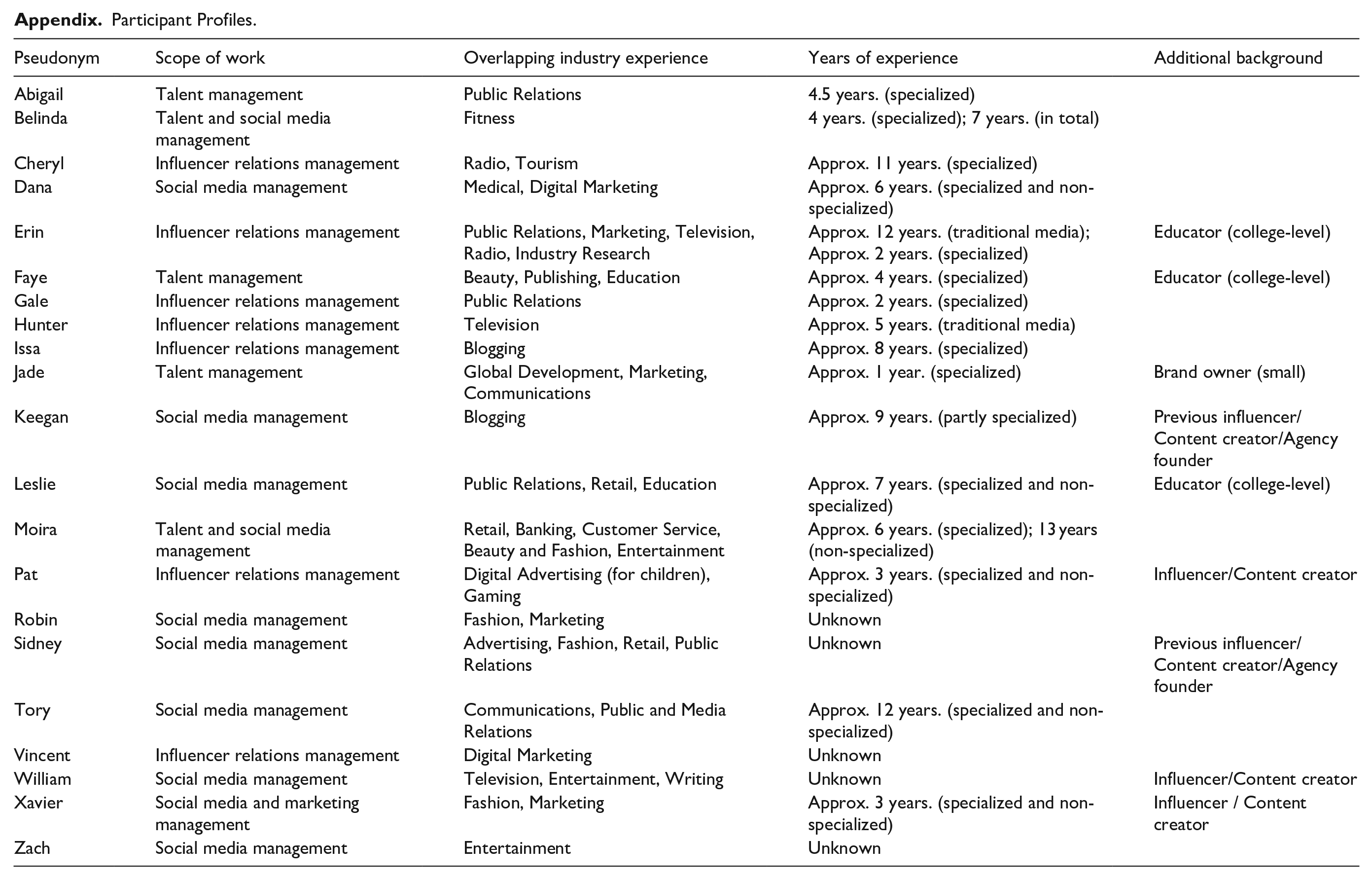
| Pseudonym | Scope of work | Overlapping industry experience | Years of experience | Additional background |
|---|---|---|---|---|
| Abigail | Talent management | Public Relations | 4.5 years. (specialized) | |
| Belinda | Talent and social media management | Fitness | 4 years. (specialized); 7 years. (in total) | |
| Cheryl | Influencer relations management | Radio, Tourism | Approx. 11 years. (specialized) | |
| Dana | Social media management | Medical, Digital Marketing | Approx. 6 years. (specialized and non-specialized) | |
| Erin | Influencer relations management | Public Relations, Marketing, Television, Radio, Industry Research | Approx. 12 years. (traditional media); Approx. 2 years. (specialized) | Educator (college-level) |
| Faye | Talent management | Beauty, Publishing, Education | Approx. 4 years. (specialized) | Educator (college-level) |
| Gale | Influencer relations management | Public Relations | Approx. 2 years. (specialized) | |
| Hunter | Influencer relations management | Television | Approx. 5 years. (traditional media) | |
| Issa | Influencer relations management | Blogging | Approx. 8 years. (specialized) | |
| Jade | Talent management | Global Development, Marketing, Communications | Approx. 1 year. (specialized) | Brand owner (small) |
| Keegan | Social media management | Blogging | Approx. 9 years. (partly specialized) | Previous influencer/Content creator/Agency founder |
| Leslie | Social media management | Public Relations, Retail, Education | Approx. 7 years. (specialized and non-specialized) | Educator (college-level) |
| Moira | Talent and social media management | Retail, Banking, Customer Service, Beauty and Fashion, Entertainment | Approx. 6 years. (specialized); 13 years (non-specialized) | |
| Pat | Influencer relations management | Digital Advertising (for children), Gaming | Approx. 3 years. (specialized and non-specialized) | Influencer/Content creator |
| Robin | Social media management | Fashion, Marketing | Unknown | |
| Sidney | Social media management | Advertising, Fashion, Retail, Public Relations | Unknown | Previous influencer/Content creator/Agency founder |
| Tory | Social media management | Communications, Public and Media Relations | Approx. 12 years. (specialized and non-specialized) | |
| Vincent | Influencer relations management | Digital Marketing | Unknown | |
| William | Social media management | Television, Entertainment, Writing | Unknown | Influencer/Content creator |
| Xavier | Social media and marketing management | Fashion, Marketing | Approx. 3 years. (specialized and non-specialized) | Influencer / Content creator |
| Zach | Social media management | Entertainment | Unknown |
Acknowledgements
The authors thank the influencer relations professionals who contributed their thoughts, words, and time to this research.
Declaration of Conflicting Interests
The author(s) declared no potential conflicts of interest with respect to the research, authorship, and/or publication of this article.
Funding
The author(s) disclosed receipt of the following financial support for the research, authorship, and/or publication of this article: This work was partially supported by a Ted Rogers School of Management Research Advancement Grant (PI: J.J.).
