



Abstract
Objective:
Social media platforms are effective tools for promoting public health and implementing impactful health interventions. This study explored social media utilization patterns among young Asian American adults and their effect on perceived family influence on lifestyle behaviors.
Methods:
The study analyzes data from Asian American young adults (aged 18–35 years) participating in an online survey in March 2021.
Results:
A total of 739 Asian Americans participated in the survey: 45.6% East Asian, 23.4% Southeast Asian, and 22.7% South Asian. Common social media platforms include Facebook Messenger (60.9%) and Instagram (57.0%). US-born Asian Americans reported higher odds of using Instagram (adjusted odds ratio [AOR]: 1.64, 95% CI: [1.09, 2.46]) than foreign-born Asian Americans. Higher acculturation was associated with lower odds of using Instagram among South Asians (AOR: .46, 95% CI: [.24, .83]) and greater odds of using Instagram among East Asians (AOR: 1.72, 95% CI: [1.09, 2.75]). Interacting with mothers using Facebook and Instagram had a higher perceived influence on one’s ability to improve sleep (AOR: 2.08, 95% CI: [1.19, 3.65]; AOR: 2.53, 95% CI: [1.15, 5.55]) and develop stress-management strategies (AOR: 1.73, 95% CI: [1.02, 2.96]; AOR: 4.05, 95% CI: [1.83, 9.49]). With one’s siblings, Facebook was associated with a lower perceived influence on avoiding risky substances (AOR: .48, 95% CI: [.23, .97]), and WhatsApp was associated with a higher perceived influence on one’s ability to develop stress-management strategies (AOR: 3.10, 95% CI: [1.26, 7.78]) and form/maintain relationships (AOR: 2.58, 95% CI: [1.02, 6.58]). No significant findings with father interactions were observed.
Conclusion:
Findings provide evidence for researchers seeking to tailor social media–based interpersonal health interventions to address the unique needs of diverse Asian American communities.
Introduction
In the United States (US), Asian Americans are the fastest-growing racial or ethnic group (Anderson, 2018). Asian Americans experience significant and complex burden of non-communicable diseases (NCDs), such as heart disease and diabetes (Hastings et al., 2015; Lee et al., 2010), which are linked with lifestyle behaviors and everyday activities pertaining to diet, exercise, sleep, stress, social relationships, and substance use (e.g., alcohol and tobacco) (Aburto et al., 2021; American College of Lifestyle Medicine, 2018; Loef & Walach, 2012). There is growing attention on the NCD burden experienced by young and US-born Asian Americans (Ali et al., 2021). Asian Americans are more likely to be diagnosed with diabetes and hypertension at a younger age than other racial or ethnic populations (Becerra, 2015; Yi et al., 2016). US-born Asian Americans (who are on average younger than foreign-born Asian Americans) report higher odds of obesity than foreign-born Asian Americans (Gong et al., 2019).
Behind the emerging NCD burden experienced by younger Asian Americans is a sociocultural context that is distinct from other US racial groups and Asian American older adults (Ali et al., 2021), yet there is a lack of exploration of these unique factors informing NCD interventions tailored for younger Asian Americans. Understanding patterns of digital technology use among this population is essential to addressing the NCD burden. Compared to other racial or ethnic groups, Asian Americans have the highest usage of smartphones (70%) (Ali et al., 2021) and frequently use social media sites such as Facebook (Charmaraman et al., 2018). Asian Americans have formed their unique digital diaspora, virtually communicating and connecting to social networks in different countries through social media platforms (Hossain & Veenstra, 2017; The Welcoming Center, 2012).
Social media may play a particularly complex role in the communication patterns of younger or US-born Asian Americans (Ali et al., 2021). One study assessing communication strategies to promote hepatitis B prevention observed that 99.8% of young Asian American adults used social media, with Facebook (89.7%) and Instagram (69.4%) being particularly popular (Alber et al., 2018), and were reliant on it for health-related information (Alber et al., 2018), highlighting the importance of social media in the health of young Asian Americans. Prior works have also found that Asian Americans rely on and use social media to seek and receive health information (Islam et al., 2016). Importantly, social media utilization patterns may differ between Asian American subgroups due to differences in social media utilization within Asia. For example, WeChat, the most widely used social media application in China, has been observed to play a crucial role in shaping the acculturation, a process that occurs when people with dissimilar cultures come in contact with one another (Gibson, 2001), of Chinese immigrants (Chen et al., 2018). Moreover, social media utilization has important social and health implications. For instance, COVID-19 misinformation on social media may affect COVID-19 vaccine decision-making for Asian Americans and their social networks including their family (Chong et al., 2022). Another study found that a higher frequency of social media use is associated with stronger bonding relationships and a higher likelihood of maintaining relationships (Hossain & Veenstra, 2017).
Within Asian American interpersonal networks, family members play a crucial role across diverse Asian American subgroups (Kou, 2003; Paik et al., 2017; Wong et al., 2011). Compared to other US populations, Asian Americans are more likely to live in interdependent, multigenerational homes, often with extended family members (Kramer et al., 2002; Paik et al., 2017). However, little is known about the influence of Asian American family interaction patterns on the health behaviors of Asian American young adults. Findings from a dyadic analysis of 433 families of different racial and ethnic groups (including Asian Americans) revealed that during health-related conversations, perceived confirmation from family members directly influenced one’s dietary and physical activity attitudes and behaviors (Baiocchi-Wagner & Talley, 2013). Overall family health climate has also been associated with changes in physical activity and diet (Niermann et al., 2015). Studies on the influence of family interaction on health among other racial or ethnic populations suggest that understanding Asian American family interaction, particularly through social media platforms, may reveal the potential of how these platforms can catalyze health behavior change in Asian American communities.
Social media has been used to promote positive changes in health behaviors (Chen & Wang, 2021). For instance, participants in an intervention uploaded pictures of their healthy meals on social media to share their progress on health behavior change (Fernandez-Luque et al., 2017). Another study incentivized participants to perform physical activity by giving them virtual awards in a Facebook group (Mendoza et al., 2017). Similarly, one intervention facilitated support for healthy lifestyle changes in young adults using Twitter for messaging and found that most participants had increased fruit/vegetable intake (92%) and decreased sweetened beverage intake (67%) (Chung et al., 2017). Through targeted messaging, social media can guide positive health behaviors and ultimately promote public health goals (Schillinger et al., 2020). The versatility of social media messaging to be customized, tailored, and engaging is a particular strength of the platform (Korda & Itani, 2013). Moreover, social media can be used to reach hard-to-reach populations (Chen & Wang, 2021; Pagkas-Bather et al., 2020; Thornber et al., 2019), and given the salience of family members within Asian American young adult social networks, integrating family members into social media-based interventions may potentially further the impact and sustainability of public health promotions on social media. However, formative research on social media utilization among Asian American families is still needed to understand this potential. For these reasons, this study aims to explore the social media utilization patterns of young Asian Americans with specific family members and their association with perceived lifestyle behavioral influence.
Methods
Recruitment Procedures
Data were collected as part of a larger cross-sectional online survey of 18- to 35-year-old Asian Americans to understand the different facets of young Asian American family interaction patterns and the influence of family members on lifestyle behaviors (see Ali et al., 2022, for more information about the study). While the larger survey examined a wide array of family interaction and lifestyle behavior-related variables, this analysis focuses on social media interaction patterns. The survey included social, interpersonal, health, and acculturation-related items and was pre-tested in 11 cognitive interviews to refine and generate additional survey items. Once the survey design was completed, participants were recruited to complete a Qualtrics-based survey in March 2021 through convenience sampling. Social media was strongly utilized given its effectiveness in recruiting young adults for research, particularly during the COVID-19 pandemic (Ali et al., 2020; Whitaker et al., 2017). Informed by methods described in past research (Ali et al., 2020), advertisements were placed on Facebook-affiliated platforms (i.e., Facebook Messenger, Instagram, and third-party platforms) targeted toward 18- to 35-year-olds living in the US, with an additional option provided by Facebook to target advertisements whose engagement metrics (e.g., pages and posts liked by users) suggested an Asian American affiliation. Participants were also recruited through email listservs and WhatsApp networks. Professional and university-based student organizations that cater to young Asian Americans also assisted in recruitment by sharing study information within their networks.
Eligible participants were screened and included self-identified Asian young adults (18- to 35-year-old) currently living in the US who interact with at least one family member that currently resides in the US via in-person, audio call, video call, or text message (including social media) regularly (including daily, weekly, monthly, or yearly interactions). Informed online consent was obtained prior to commencing the survey, and participation was entirely voluntary and did not involve monetary compensation. Study procedures were reviewed and exempted by the New York University Institutional Review Board.
Survey Measures
This study examines social media utilization patterns with specific family members. Participants were first asked to identify which of the following family members they regularly (daily, weekly, monthly, or yearly) interacted with: mother, father, sibling(s), grandparent(s), aunt(s) or uncle(s), cousin(s), niece(s) or nephew(s), or a spouse or partner. For every family member selected, participants were asked if they used any of the following social media applications to facilitate interactions (e.g., Facebook Messenger, WhatsApp, WeChat, KakaoTalk, Viber, Instagram, or Snapchat). These choices were informed by popular social media applications identified in prior research (Anderson, 2018; Landry et al., 2015; Montag et al., 2018) and during pre-test cognitive interviews. Participants could also write in any other social media applications or state they do not use social media to interact with a particular family member.
Participants were asked to rank which family member they interacted with the most; an additional set of questions was provided in relation to the family member(s) participants ranked as either first or second. As part of these questions, participants were asked to what extent they believ-ed the family member influences their ability to do the following behaviors on a scale from 1 (no influence) to 6 (large influence) or don’t know: (a) eating a healthy diet, (b) increasing physical activity, (c) improving one’s sleep, (d) forming/maintaining relationships with people, (e) developing strategies to manage stress, and (f) avoiding risky substances. These six behaviors were informed by the six components of a healthy lifestyle defined by the American College of Lifestyle Medicine (American College of Lifestyle Medicine, 2018).
In addition, participants were asked to identify their ethnicity, age, gender, educational attainment, country of birth, mother’s and father’s country of birth, and relationship status. Acculturation was also measured using the four-item Short Acculturation Scale, which was validated to assess acculturation in Asian Americans (Choi & Reed, 2011; Marin et al., 1987), resulting in a score between 4 (lowest acculturation) and 16 (highest acculturation).
Data Analysis
A total of 739 participants completed the social media module. Participants were first categorized into Asian American subgroups based on self-reported ethnicity, including East Asian (Chinese, Japanese, Korean, Taiwanese, and Hongkonger), South Asian (Asian Indian, Bangladeshi, Pakistani, Sri Lankan, and Nepali), and Southeast Asian (Burmese, Cambodian, Filipino, Hmong, Indonesian, Laotian, Malaysian, Thai, and Vietnamese). The proportion of all family members with whom participants interact using social media was also calculated. Due to the inability to meet model assumptions to appropriately conduct a linear regression with this constructed variable, a binary variable was constructed to indicate whether a participant reported using social media to interact with at least 50% of the family members they identified in the survey to get a measure of the overall pervasiveness of social media across family interaction patterns. Perceived influence variables were dichotomized into “low” (1–3) and “high” (4–6). Answers for each influence domain were summated to create an overall lifestyle behavioral influence score ranging from 1 to 36. Participants who responded with “don’t know” were recoded as “0”.
Data were analyzed to identify differences in social media utilization across Asian American subgroups and between specific family members. A series of multivariable logistic regression analyses were conducted assessing the association between social media utilization and age, gender, educational attainment, household size, birthplace, acculturation, and total types of family members interacted with in the total sample as well as among East Asians, South Asians, Southeast Asians, and those who identified being of mixed ethnicity. Sub-analyses for interaction patterns with immediate family members (mothers, fathers, and siblings) were conducted for East Asians, South Asians, and Southeast Asians. Sub-analyses for those that reported being mixed were not conducted as meaningful conclusions cannot be drawn due to this sample’s small size and heterogeneity.
Additional adjusted multivariable linear (for continuous outcomes) and logistic analyses (for categorical outcomes) were conducted to assess the odds of higher perceived influence of any family member on lifestyle behaviors (overall score and for each lifestyle domain) among those who use social media to interact with the family member, as well as specifically using Facebook, WhatsApp, and Instagram. The variables adjusted for in all analyses were informed by bivariate analyses of social media utilization patterns and past research on factors associated with social media use (Anderson, 2018) and included the aforementioned socio-demographic variables and the overall frequency of interacting with that family member (i.e., many times a day, a few times a day, a few times a week, a few times a month, and a few times a year or less).
Results
Participant Characteristics
Of the 739 respondents with data on social media utilization (Table 1), 337 (45.6%) were East Asians, 173 (23.4%) were Southeast Asians, 168 (22.7%) were South Asians, and 61 (8.2%) were of mixed ethnicity. Southeast Asian participants had a higher mean age (M: 25.9, SD: 4.9), followed by East Asian participants (M: 25.2, SD: 4.8), and South Asian participants (M: 24.0, SD: 4.8). South Asians had the highest proportion of foreign-born (35.7%) respondents and the lowest mean acculturation score (4.17). East Asians had the highest proportion of US-born (81.0%) respondents and the highest mean acculturation score (4.33).
Characteristics of Young (18- to 35-Year-Old) Asian Americans Surveyed With Data on Social Media Utilization (n = 739).

Note. Missing values for demographic variables are not shown. Statistically significant findings have been bolded.
Used to interact with any family member.
Popular Social Media Platforms
Facebook was the most popular social media application used by participants to interact with any family member (60.9%), followed by Instagram (57.0%), Snapchat (29.9%), and WhatsApp (29.4%). East Asians were significantly more likely to use WeChat (27.6%), LINE (11.3%), and KakaoTalk (9.5%) to interact with family members. South Asians were more likely to use WhatsApp (70.2%) and Snapchat (35.1%). Southeast Asians were more likely to use Facebook (79.8%) and Instagram (65.3%). Some participants (13.8%) noted using other social media applications, including Viber (3.8%), Discord (2.0%), Google Hangouts (1.9%), and Signal (1.5%).
Overall, participants reported using social media to interact with a partner (95%), sibling (93%), cousin (90%), mother (84%), father (78%), grandparent (58%), aunt/uncle (80%), and niece/nephew (69%). Facebook Messenger and WhatsApp were the most common applications participants used to interact with their mothers (29% and 22%), fathers (19% and 20%), grandparents (14% and 12%), and aunts/uncles (33% and 20%, respectively) (Figure 1). Facebook Messenger, WhatsApp, Instagram, and Snapchat were the most common applications participants used to communicate with their siblings (45%, 18%, 49%, and 26%), partners (63%, 21%, 55%, and 25%), cousins (43%, 21%, 53%, and 25%), and nieces/nephews (28%, 16%, 22%, and 11%, respectively). The use of WeChat to communicate with mother (12%), father (11%), and grandparent (10%) was also common.
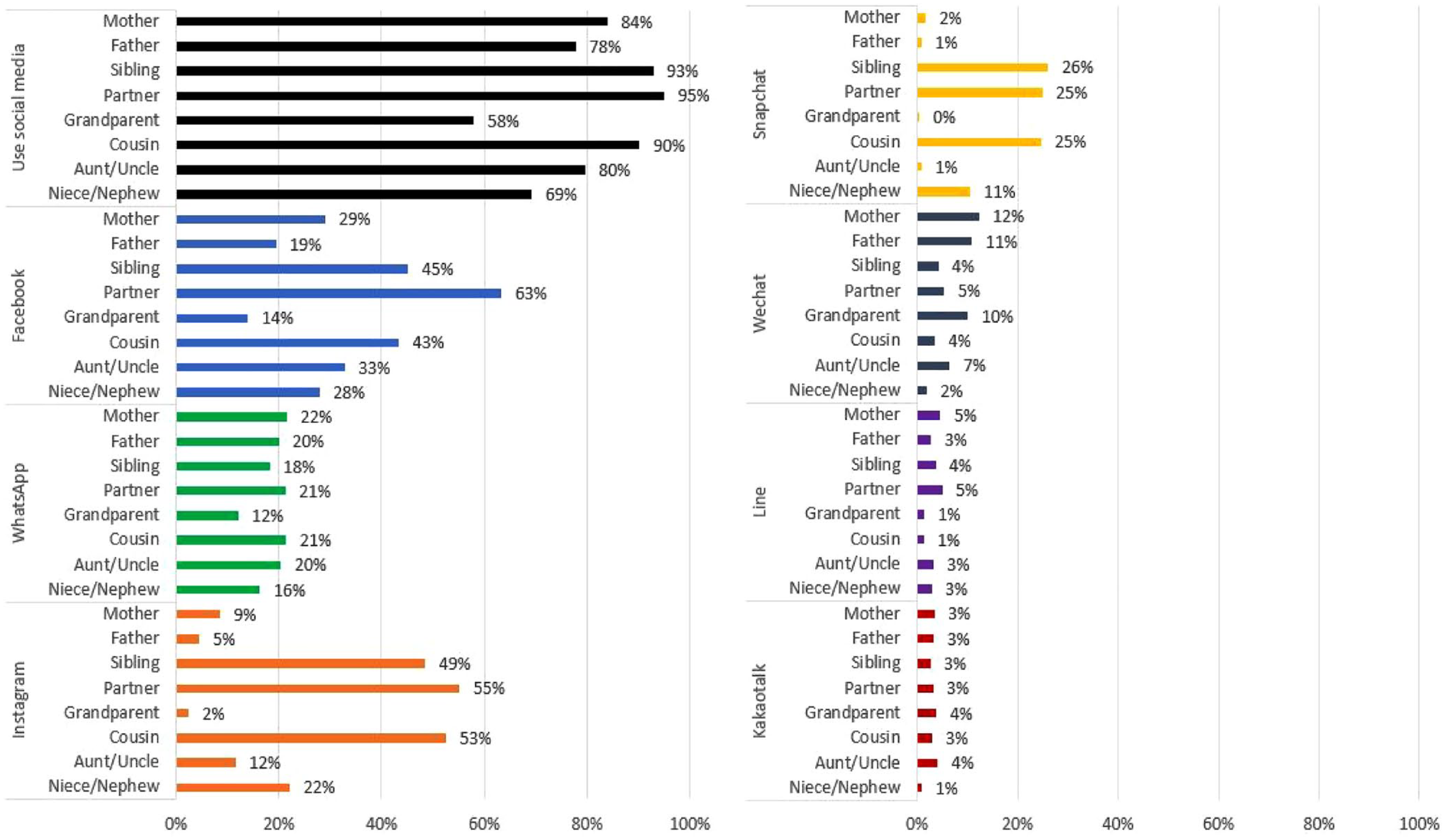
Social media applications used to interact with immediate family members of young Asian Americans (n = 739).
Social Media Use Patterns
In adjusted analyses of the total sample (Table 2), males reported lower odds of using social media (AOR: .65, 95% CI: [.42, .99]) and Instagram (AOR: .62, 95% CI: [.45, .86]). Those with a bachelor’s degree reported higher odds of using Facebook Messenger (AOR: 1.74, 95% CI: [1.12, 2.72]). Compared to married/partnered participants, those unmarried/not partnered had lower odds of using Facebook Messenger (AOR: .64, 95% CI: [.44, .93]). Compared to foreign-born participants, US-born participants had higher odds of using Instagram (AOR: 1.64, 95% CI: [1.09, 3.46]). Higher acculturation was associated with lower odds of using WhatsApp (AOR: .66, 95% CI: [.49, .88]). Higher total types of family interactions were associated with higher odds of using Facebook Messenger and Instagram (AOR: 1.18, 95% CI: [1.07, 1.31]; AOR: 1.37, 95% CI: [1.24, 1.52]).
Adjusted Odds of Using Popular Social Media Applications With Any Family Member Among Asian Americans (n = 687).

Note. AOR = adjusted odds ratio. ^Use social media with 50% or more of family members interacted with. Statistically significant findings have been bolded.
p < .05. **p < .01. ***p < .001.
When stratified by Asian American subgroups (Supplemental Files 1–3), adjusted analyses show that higher age was associated with higher odds of using WhatsApp for East Asians (AOR: 1.15, 95% CI: [1.05, 1.26]). The odds of using social media were higher among South Asians living in a household with 4+ individuals (AOR: 5.41, 95% CI: [1.01, 29.89]). Higher acculturation was associated with greater odds of using Instagram among East Asians (AOR: 1.72, 95% CI: [1.09, 2.75]). In contrast, higher acculturation was associated with lower odds of using Instagram (AOR: .46, 95% CI: [.24, .83]) and WhatsApp (AOR: .51, 95% CI: [.26, .96]) among South Asians.
Use of Social Media Apps and Perceived Family Member Influence on Lifestyle Behaviors
In adjusted analyses (Table 3), the use of Facebook and Instagram to interact with one’s mother had a higher perceived influence on one’s ability to improve sleep (AOR: 2.08, 95% CI: [1.19, 3.65]; AOR: 2.53, 95% CI: [1.15, 5.55]) and develop stress-management strategies (AOR: 1.73, 95% CI: [1.02, 2.96]; AOR: 4.05, 95% CI: [1.83, 9.49]). The use of Instagram to interact with one’s mother had a higher perceived influence on one’s ability to form/maintain relationships (AOR: 3.58, 95% CI: [1.63, 8.41]). Using Facebook to interact with one’s sibling was associated with a lower perceived influence on one’s ability to avoid risky substances (AOR: .48, 95% CI: [.23, .97]). Using WhatsApp with one’s sibling was associated with a higher perceived influence on one’s ability to develop stress-management strategies (AOR: 3.10, 95% CI: [1.26, 7.78]) and form/maintain relationships (AOR: 2.58, 95% CI: [1.02, 6.58]).
Adjusted Odds of Higher Perceived Lifestyle Behavioral Influence by Social Media Utilization (n = 678).
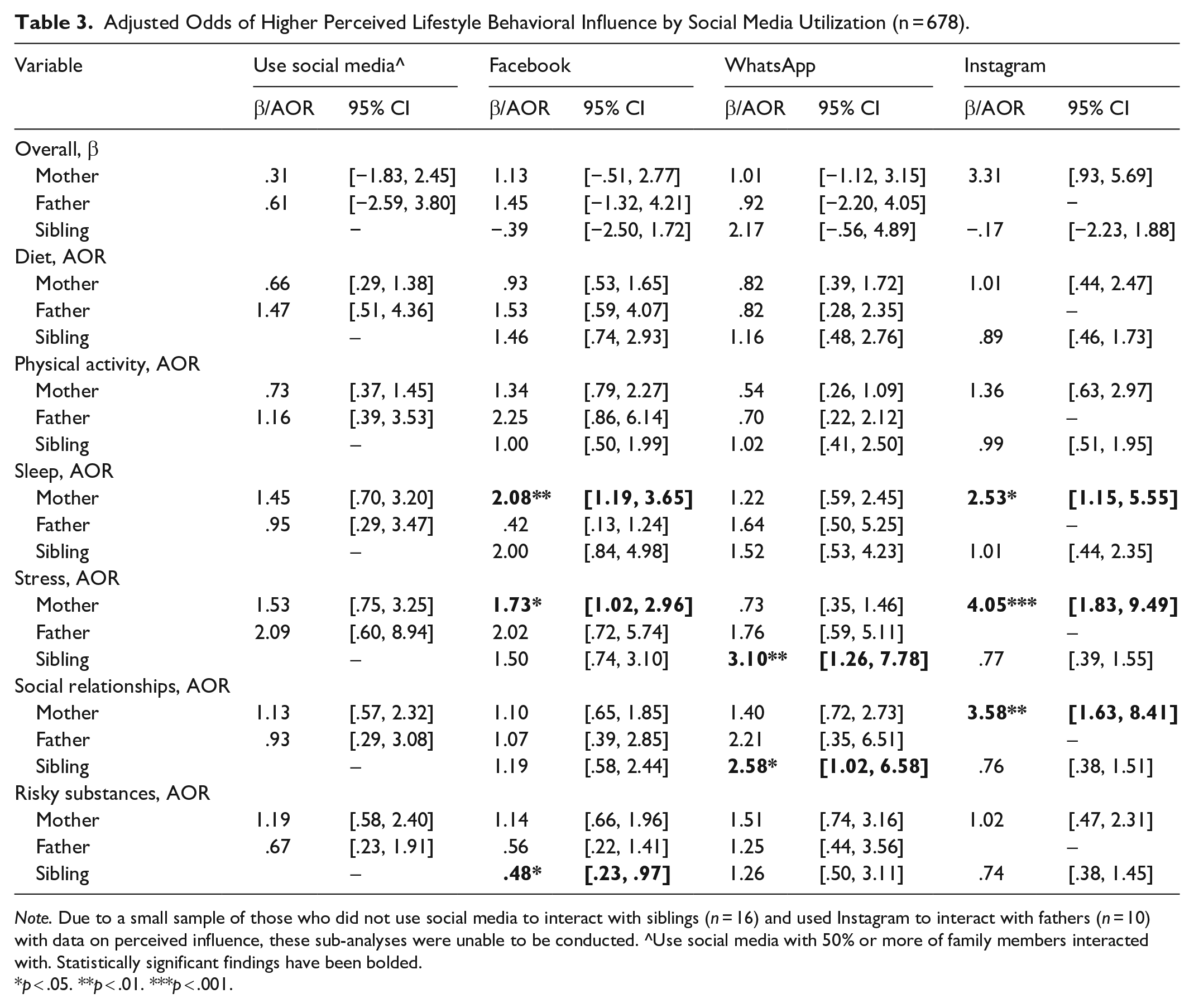
Note. Due to a small sample of those who did not use social media to interact with siblings (n = 16) and used Instagram to interact with fathers (n = 10) with data on perceived influence, these sub-analyses were unable to be conducted. ^Use social media with 50% or more of family members interacted with. Statistically significant findings have been bolded.
p < .05. **p < .01. ***p < .001.
Discussion
Overall, Facebook, WhatsApp, and Instagram were the most popular applications used by Asian American young adults to interact with their family members; however, specific platforms such as WeChat and WhatsApp were popular among East Asians and South Asians, respectively. Surveys conducted by the Pew Research Center found that 69% and 40% of US adults use Facebook and Instagram, respectively, making Facebook and Instagram two of the three most popular social media platforms among US adults (Atske, 2021). This corroborates our study findings since 60.9% and 57% of Asian American young adults reported using Facebook and Instagram, respectively. The use of each platform was significantly associated with socio-demographic background, birthplace, and acculturation. Differences in social media usage patterns between East Asian, South Asian, and Southeast Asian participants highlight the growing need to disaggregate the health and social experiences of diverse Asian American populations to more effectively address each community’s unique health needs. Similarly, differences in social media utilization patterns between family members and family members’ influence on the health behaviors of Asian American young adults suggest that disaggregating family communication patterns within Asian American households is needed to develop more targeted social media–based health interventions.
Among immediate family members, participants predominantly reported using direct-messaging applications such as Facebook Messenger or WhatsApp to interact with their parents and reported greater use of more social media platforms such as Instagram and Snapchat (in addition to Facebook Messenger) to interact with their siblings, cousins, or spouses/partners. These differences may reflect preferences to maintain privacy from parents on social media. One study observed that many Asian Americans choose to keep small online networks: one participant reported making their Facebook entirely private to avoid judgment from family members (Charmaraman et al., 2018).
Another important finding of this study was the significant yet distinct roles that acculturation and birthplace played in driving specific social media patterns across family members. With an estimated 390 and 46 million users, WhatsApp is highly popular in South Asian countries such as India and Pakistan (Rollason, 2021). It is possible that less-acculturated South Asians use WhatsApp to maintain communication with their friends and families in South Asian (SA) countries, which may explain the observed association between lower usage of WhatsApp and higher acculturation among SA participants. Conversely, some platforms were only associated with birthplace; the use of Instagram, in particular, was higher among US-born Asian Americans. Birthplace differences may be due to the different socialization experiences of foreign- and US-born Asian Americans. Inheriting and disseminating cultural norms is a crucial aspect of the socialization process, greatly affected by an individual’s family, school, peer groups, and work settings (Parke et al., 2008). Distinct from simply a contemporary experience of acculturation, the process of being born in and raised in the US may involve a more complex exposure to US cultural trends and familiarity and preference toward specific social media applications (e.g., Instagram in the US).
There were also gender-based differences in social media utilization among young Asian Americans. In particular, males were less likely to use social media applications such as Instagram to interact with their family members. Recent studies show that men check social media less often and share less personal information on social media than women (Hillsberg, 2014). While not conclusive, our study findings complement extant research by highlighting that there may be gender-based differences in social media utilization, which may influence how often one interacts with family members on social media.
The study also revealed that those who use social media applications such as Facebook, WhatsApp, and Instagram to interact with their mothers and siblings generally have a higher perceived family influence on their sleep and ability to manage stress and maintain social relationships. As one of the primary goals of social media is to communicate, using social media applications likely influences the formation and maintenance of social relationships. Indeed, social media has been shown to impact family relationships in terms of family connectedness (Tariq et al., 2022). One study found that participants used social media to interact with their siblings the most, followed by their parents (Child et al., 2015). Another study showed that social media may improve and build relationships among family members (Joo & Teng, 2017).
While social media has been shown to play a crucial role in expanding food choices among young adults and influencing attitudes toward exercise (Vaterlaus et al., 2015), using social media to interact with one’s mother, father, and siblings displayed no associations with the perceived influence of family members’ diet and physical activity, suggesting that other social media utilization patterns (e.g., with friends or broader community networks) play a bigger role in influencing these lifestyle behaviors. However, social media utilization with such family members was observed to be associated with a perceived influence on one’s ability to manage stress. This may be explained by the ubiquity of health and wellness pages that focus on mental health. A study found that inspirational and supportive topics tend to appear on mental health posts and are common on social media platforms such as Instagram (Muralidhara & Paul, 2018). It is possible that family members’ sharing of such posts with young Asian American adults drives the high perceived family influence on developing stress-management strategies.
Interestingly, young Asian American adults interacting with siblings on social media had a low perceived family influence on their ability to avoid risky substances. This could be because young Asian American adults may want to avoid discussing risky behaviors such as alcohol or drug use with their siblings. Cultural factors such as the concept of “losing face” or stigma associated with alcohol and drug use may also prevent young Asian Americans from engaging in conversations about risky substances with their family (Fong & Tsuang, 2007; Sue & Sue, 1987). The lack of such discussions may lead young Asian American adults to have a low perceived family influence on their ability to avoid risky substances. Further understanding of the influence of perceived social media and family influences on health behaviors can serve as a framework to explain the findings in this study.
While the strengths of this study were its novel disaggregation of social media interaction patterns and social media’s influence on lifestyle behaviors between a wide array of family members and Asian American subgroups, some limitations may have impacted our findings and need to be addressed in further studies. First, the study relied on a convenience sample of cross-sectional and self-reported data. Second, participants were targeted through Facebook advertisements, which could have excluded young Asian Americans who do not use social media platforms, or those who exclusively use other social media platforms (e.g., WeChat, Line, KaKao, etc.). While social media–based recruitment is particularly powerful in health research among young adults (Ali et al., 2020), scaled-up research among Asian American young adults (particularly concerning social media use) may benefit from a more comprehensive array of recruitment methods. Third, due to the variety of statistical models used for analyses, findings may result in spurious correlations. However, these findings lay the groundwork for larger and scaled-up nationally representative research on social media utilization among Asian Americans that can better unravel and corroborate these study findings. Fourth, despite the recruitment of diverse Asian Americans and analysis of subgroups, the study was not able to further disaggregate data by specific country of origin due to sample size constraints. Finally, the study explored the magnitude of perceived influence, but the directionality of this influence (i.e., negative or positive influence) could not be evaluated. Although Asian Americans with family outside the US were excluded from the analyses due to significant differences in social dynamics and implications, future research may benefit from comparing social media utilization with family members within and outside the US to further contextualize study findings.
Social media is an emerging and compelling platform for designing and implementing health interventions. As discussed previously, interventions that incorporate online social networks may be effective in changing health behaviors (Chen & Wang, 2021; Chung et al., 2017; Fernandez-Luque et al., 2017; Maher et al., 2014; Mendoza et al., 2017). Coupled with evidence that its use is associated with stronger family connectedness (Tariq et al., 2022), social media has the potential to profoundly impact the health and social dynamics within Asian American households. In addition, our finding that social media platforms such as Facebook, WhatsApp, and Instagram were associated with perceived family influence on sleeping, managing stress, or maintaining social relationships suggests that we should better leverage the modalities of different functionalities of social media platforms to inform family-based health-behavior-change interventions. Most importantly, by disaggregating Asian Americans, our study provides insight into the social media utilization patterns of young Asian American adults, showcases the heterogeneity of such patterns among different Asian American groups, and underscores how such patterns affect the perceived influence of family members on the lifestyle behaviors of young Asian American adults. Public health practitioners can use these findings to inform the development of targeted interventions or health campaigns to encourage positive health behaviors in Asian American households. Tailoring health-promotion messages for specific Asian American subgroups and leveraging the strong family connectedness within Asian American households by implementing family-based health interventions on social media are also additional avenues that researchers can further explore. Researchers may also benefit from additional qualitative and/or mixed-methods research to explore why specific social media applications are used in Asian American communities and how they impact one’s lifestyle behaviors to inform the development of targeted family-based interventions for Asian Americans.
Supplemental Material
sj-docx-1-sms-10.1177_20563051231196544 – Supplemental material for Social Media Utilization Within Asian American Families and Its Role in Healthy Lifestyle Behavioral Influence: Results From a Nationwide Survey
Supplemental material, sj-docx-1-sms-10.1177_20563051231196544 for Social Media Utilization Within Asian American Families and Its Role in Healthy Lifestyle Behavioral Influence: Results From a Nationwide Survey by Farhan M. Mohsin, Shahmir H. Ali, Stella K. Chong, Roshan S. Parikh, Ralph J. DiClemente and Lu Hu in Social Media + Society
Footnotes
Declaration of Conflicting Interest
The author(s) declared the following potential conflicts of interest with respect to the research, authorship, and/or publication of this article: L.H. reports holding stock in Tencent Holdings Limited.
Funding
The author(s) disclosed receipt of the following financial support for the research, authorship, and/or publication of this article: This study was funded by a seed grant from the NYU South Asian Health and Research Group (SAHARA).

Supplemental Material
Supplemental material for this article is available online.
Author Biographies
References
Supplementary Material
Please find the following supplemental material available below.
For Open Access articles published under a Creative Commons License, all supplemental material carries the same license as the article it is associated with.
For non-Open Access articles published, all supplemental material carries a non-exclusive license, and permission requests for re-use of supplemental material or any part of supplemental material shall be sent directly to the copyright owner as specified in the copyright notice associated with the article.
