



Abstract
Social media users have long been aware of opaque content moderation systems and how they shape platform environments. On TikTok, creators increasingly utilize algospeak to circumvent unjust content restriction, meaning, they change or invent words to prevent TikTok’s content moderation algorithm from banning their video (e.g., “le$bean” for “lesbian”). We interviewed 19 TikTok creators about their motivations and practices of using algospeak in relation to their experience with TikTok’s content moderation. Participants largely anticipated how TikTok’s algorithm would read their videos, and used algospeak to evade unjustified content moderation while simultaneously ensuring target audiences can still find their videos. We identify non-contextuality, randomness, inaccuracy, and bias against marginalized communities as major issues regarding freedom of expression, equality of subjects, and support for communities of interest. Using algospeak, we argue for a need to improve contextually informed content moderation to valorize marginalized and tabooed audiovisual content on social media.
Introduction
User communication in online environments has been shown to entail spoken and written linguistic effects based on the characteristics of a platform and the user community, leading to the adaptation and creation of forms of netspeak (Bucher & Helmond, 2018; Crystal, 2001; McCulloch, 2020). As yet another form of netspeak, algospeak is commonly understood as abbreviating, misspelling, or substituting specific words, for example, “seggs” for “sex” (Curtis, 2022; Delkic, 2022) or “clock app” for “TikTok,” when creating a social media post with the particular goal to circumvent a platform’s content moderation systems (Levine, 2022). The analysis of such communicative user strategies aims at exploring how people adapt technology and platform environments to their personal needs in various contexts of usage. While algospeak exists as a linguistic phenomenon on many social media platforms, it is largely connected to TikTok (Lorenz, 2022), its characteristics as an audiovisual platform, and its algorithmic content moderation. Examining algospeak on TikTok allows for observing users’ cognitive processes and skills to better understand social and cultural factors, such as motivation, experience, or enjoyment, in social media interaction and participation.
From a sociolinguistic perspective, algospeak can resemble orthographic, lexical, and phonetic variations of standard language; however, these are commonly motivated by geographical (Grieve et al., 2019; Tatman, 2015), socio-cultural (Ilbury, 2020), or political (Shoemark et al., 2017) influences on users’ online identities to signal and retain community membership (Stewart et al., 2017). In the context of computer-mediated language, algospeak is related to similar linguistic phenomena in mobile and Internet-based communication which, however, involve different motivations and intentions:
• Textspeak, Chatspeak, or SMS-language removes vowels, capitalization, spacing, and so on that are not necessary to understand a message, motivated by the formerly limited number of characters in SMS, and the required multiple pressing of a key to generate a letter (Drouin & Davis, 2009); likewise, Digitalk refers to manipulations of standard written language in online communication, such as Instant Messengers (Turner et al., 2014);
• Leetspeak (or l337) replaces letters with numbers or adds suffixes to words as a form of playful encryption that is easy to read (Perea et al., 2008); Leetspeak originates in bulletin boards and online gaming as ironic language variation to mock new users (Blashki & Nichol, 2005) but has since become Internet mainstream; similarly, Chanspeak was popularized on the 4chan imageboard as sub-community related misspelling and simplifying of words (Nascimento et al., 2019);
• LOLspeak (or LOLcat) humorously uses incorrect grammar and spelling as language plays, primarily in cat memes on social media (Fiorentini, 2013); likewise, DoggoLingo is a joyful idiom in dog memes to mimic how dogs would talk in human imagination (Punske & Butler, 2019).
All these phenomena modify written communication in networked and platform communities in a way that community members would be able to easily create, read, and decipher these linguistic variations. They foremost relate to online group membership and to users’ online identities and presentation of the self in social media contexts (Herring & Kapidzic, 2015; Lee, 2014; Seargeant & Tagg, 2014). In contrast, algospeak is at first not meant for establishing identity or community membership through linguistic modification, but rather is used as a communicative practice in reaction to experiencing content moderation on a platform. Although algospeak may in fact function to define social media communities and membership, and though it may as well adopt existing linguistic practices, like Leetspeak or LOLspeak, it significantly differs in its primary intention to use language to circumvent especially algorithmic content moderation.
Content moderation comprises mechanisms to govern community activities and to screen the content users generate to facilitate cooperation and to prevent harm and abuse (Grimmelmann, 2015). Content moderation heavily relies on manual content assessment toward community guidelines (Seering, 2020) and on platform users who flag content they regard as violating guidelines (Crawford & Gillespie, 2016). Concerning forms of netspeak, such content moderation practices are necessary because linguistic variations or coded language are frequently used with bad intention to avoid algorithmic detection, for example, by political extremists to spread hate (Ben-David & Fernández, 2016; Bhat & Klein, 2020), to advocate controversial health information, for example, in pro-eating disorder communities (Chancellor et al., 2016), or as forms of online harassment, hate speech, and threat (Freed et al., 2018).
TikTok evolved into a main social media outlet for teenagers and young adults (Statista, 2023a) to negotiate and present their online identity around video creation and sharing, video-based interaction, and to form content-based communities of interest (Bhandari & Bimo, 2022; Burns-Stanning, 2020; Karizat et al., 2021; Klug, 2020; Simpson & Semaan, 2021). Users largely value TikTok for its uncannily accurate, yet, compared to other platforms, highly responsive recommendation algorithm (Taylor & Choi, 2022), which is subject to common folk theories about how and why TikTok selects, pushes, and restricts videos from appearing on “for you” pages (Karizat et al., 2021; Klug et al., 2021). Such algorithmic literacy among users is an important factor to predict user behavior and to make sense of user attitudes (Oeldorf-Hirsch & Neubaum, 2021), for example, to better understand how users make practical use of algorithms (Cotter, 2022), or how their experiences shape their perceptions of digital realities (Liao & Tyson, 2021). Algorithmic literacy likewise informs TikTok users’ understandings of and experiences with the platform’s content moderation system, which quite often relies on user reporting of content (Zeng & Kaye, 2022) but is mainly composed of human content moderators and artificial intelligence (AI), which involves automated decision-making and machine learning but is often colloquially called algorithms or bots (Grandinetti, 2021).
On TikTok, any content posted will first pass through TikTok’s algorithms and will be reviewed by human moderators if potential community guidelines violations are identified (TikTok, n.d., 2021). The number of videos removed by automation on TikTok increased from 2020 to 2022 (Statista, 2023c), with minor safety, illegal activities, and adult nudity being the main reasons for removal of content (Statista, 2023b). Despite apparently careful content moderation, TikTok is known for having previously restricted content visibility for lesbian, gay, bisexual, trans, queer (LGBTQ+), disabled, and obese users without present guideline violations (Zeng & Kaye, 2022). Such incidents largely make TikTok’s content moderation system appear as inconsistent and inaccessible to users and researchers alike (Malik, 2021).
Social media users have long been aware of opaque content moderation systems and how they shape platform environments. To our knowledge, this is the first article to analyze the characteristics and the usage of algospeak as a unique social media phenomenon. We take a qualitative social and behavioral approach by conducting user interviews to explore interactions between TikTok users and the platform’s content moderation system. Our goal is to understand users’ motivations and practices of using algospeak in relation to their experiences with TikTok’s content moderation. We examine algospeak as a user strategy on TikTok to prevent the platform from unjust restriction in the creation of mostly tabooed, stigmatized, or unwanted yet benign video content that does not violate TikTok’s community guidelines, for example, videos related to sex education, LGBTQ+ activism, and mental health. Our study addresses communicative and linguistic aspects of usability on social media platforms in relation to online expression, self-presentation, and user-generated content in general. As a written form, algospeak on TikTok can be used in any text in video, that is, text on screen, video captions, and hashtags when creating and posting a video. Our study is guided by the questions of how and why TikTok creators use algospeak, to what extent creators’ understandings of content moderation on TikTok influence their use of algospeak, and what role algospeak plays in creators’ freedom of expression on TikTok.
Background and Related Work
Computer-mediated communication depends on platforms and channels, and incorporates aspects of written and spoken language alike (Herring & Androutsopoulos, 2015). Research by now mainly focuses on user-centered and sociolinguistic perspectives to examine the interplay of technology and language practices in social and cultural contexts online (Androutsopoulos, 2006). Human-Computer Interaction research on sociolinguistic perspectives frequently applies quantitative approaches and natural language processing to analyze various aspects of online and social media communication. For example, prior studies build classification models to contextualize out-of-vocabulary terms on Twitter (Maity et al., 2016), analyze language selection regarding social capital of bilingual Twitter users (S. Kim et al., 2014), examine language switching as user strategy in search engine usage (Wang & Komlodi, 2018), or perform rhetorical analysis of commenting on political Facebook posts to understand users’ perception of partisan messages (Rho et al., 2018). Some mixed-method studies analyze manipulative rhetorics in factoid online articles (Tian et al., 2022), or interpret lexical markers of minority stress experience in LGBTQ+ communities on Reddit (Saha et al., 2019). Qualitative approaches focus on, for example, examining narration and expression of grief and the role of sociotechnical features on TikTok (Eriksson Krutröck, 2021), analyzing potential misunderstandings when using animated graphics interchange formats (GIFs) in nonverbal social media communication (Jiang et al., 2018), or showing how LOLspeak is important for humorous communication in gendered interaction during Hackathons (Brooke, 2022).
The field of netspeak has been extensively studied throughout the emergence of online communication and social media platforms (Baron, 2003; Crystal, 2001, 2011; McCulloch, 2020). Recent studies that focus on social media communication, users, and identity and community show, for example, that lexical changes and survival of lexical innovations in social media communication can be attributed to community network structures (Zhu & Jurgens, 2021), or how authors utilize skin-toned emojis in posts for self-expression and identity management (Robertson et al., 2021). Bhandari and Armstrong’s (2019) analysis of Reddit communities finds that high affinity terms are used to signal community loyalty while also hindering new users from entering a community.
Likewise, research takes perspectives on how language and linguistic variations, such as leetspeak, are used to avoid censorship through creating noisy text (Cho & Kim, 2021), or how users substitute emojis for toxic language to evade algorithmic detection of problematic content (J. Kim et al., 2022). Gerrard (2018) identifies not using hashtags with pro-eating disorder content as an evasion strategy to make content moderation obsolete.
Only few studies specifically address sociolinguistics and language use on TikTok. Cervi et al. (2021) observe that communicative patterns, language, and emojis that are generic to TikTok are adapted into political communication on the platform; Vázquez-Herrero et al. (2022) equally find this for news presentations on TikTok. Some other studies examine the ways TikTok users utilize language in content creation to define their identities regarding communities of interest (Darvin, 2022; Simpson & Semaan, 2021), or analyze how LGBTQ+ slang is taken out of context and adapted into TikTok mainstream (Benitez, 2022). In particular, qualitative interview studies analyze how LGBTQ+ TikTokers domesticate the algorithm to manage their digital selves (Simpson et al., 2022), examine authenticity and self-presentation on TikTok within social support spaces (Barta & Andalibi, 2021), or describe motivations and creative practices in utilizing TikTok as a platform for social activism communities (Le Compte & Klug, 2021). Karizat et al. (2021) introduce the Identity Strainer Theory, which, based on users’ observation of the content they receive on their “for you” pages, describes the user assumption that their TikTok content is being actively suppressed, filtered, or banned by the platform’s algorithmic system.
Social media platforms generally apply various content moderation strategies with questionable effects. For example, deplatformization seems effective to stem toxic communication (Jhaver et al., 2021), while limiting access to toxic communities slowed down new member recruitment but did not affect established toxic communication within the community (Chandrasekharan et al., 2022). Content removal may effectively restore platform guideline compliance, yet it does not appear to affect overall platform behavior (Srinivasan et al., 2019). One solution might be a collaborative content moderation between AI and humans (Lai et al., 2022), mainly because AI-based content moderation on social media appears promising only from a technological perspective (Gillespie, 2020) but remains intransparent (Suzor et al., 2019), hard to understand, and largely unable to capture communicative context on the user side (Gorwa et al., 2020).
While the ways of communicating content moderation decisions back to users seem to depend on the type of platform (Thach et al., 2022), shadowbanning (Are, 2022), or reducing visibility of unwanted content (Gillespie, 2022) appear as popular practices on social media platforms. It has been demonstrated that content moderation decisions can influence users’ social and cultural norms (Gillespie, 2018; Pilipets & Paasonen, 2022), and that social media users tend to develop “algorithmic imaginaries” (Bucher, 2017) and folk theories (DeVito et al., 2017; Lomborg & Kapsch, 2020; Savolainen, 2022) to make sense of algorithmic content moderation. In contrast, platforms usually provide dubious explanations for assumed shadowbanning (Le Merrer et al., 2021) which often leads users to blame human content moderators for platform intransparency, missing communication channels, and ultimately for content restrictions or bans (Myers West, 2018).
Research on users’ understandings of and experiences with consequences of content moderation shows that users are more likely to understand content removal as fair when they are familiar with the community guidelines or when they receive explanations (Jhaver et al., 2019), yet unjust or unexplained banning of content can result in users leaving a platform (Chang & Danescu-Niculescu-Mizil, 2019). Interestingly, Vaccaro et al. (2020) find that, when given a feature to contest algorithmic decisions, users tended to question the automated content moderation system as unfair. One reason might be the perceived lack of standardization in human and AI moderation processes (Juneja et al., 2020). However, it is more crucial that while social media platforms generally enforce guidelines to remove apparent content violations, such as hate speech, they also disproportionately restrict and ban content by creators of marginalized identities, such as Black and LGBTQ+ users (Haimson et al., 2021)—a practice that was a main part of TikTok’s algorithmic infrastructure (Rauchberg, 2022). For TikTok, Zeng and Kaye (2022) demonstrate that questionable content visibility based on algorithmic content moderation left creators confused and vulnerable to platform arbitrariness. Duffy and Meisner (2023) show that experiencing algorithmic invisibility motivated marginalized and stigmatized users to develop strategies to circumvent possible interventions.
Method
The goal of our interview study was to examine algospeak as a unique sociolinguistic phenomenon on social media platforms. For this, we specifically wanted to talk with TikTok users who demonstrated experience using algospeak when creating and sharing videos. We followed a qualitative research process (Flick, 2008) to analyze the creation and sharing of video content on TikTok as a way to interpret user data that emerges from everyday settings (Jensen, 2013). We first compiled a list of algospeak terms, and then used these terms to search for potential participants to ensure that we would talk to video creators who used algospeak in its intended meaning on TikTok.
Example Sampling and Participant Recruitment
In June 2022, we compiled a list of 70 commonly known algospeak examples by reviewing relevant social media news articles (e.g., Cheong, 2022; Huyghe, 2022; Lorenz, 2022), and posts on Twitter, Reddit, and TikTok in which users signified a potential use of algospeak by using a nonstandard word or emoji instead of a common word (see Table 1). We then searched each of the 70 algospeak examples in the “Videos” tab of the TikTok app, and scrolled through the results until we identified at most 10 videos that used the algospeak term in text on screen, captions, hashtags, and auto-generated captions (see Figure 1). We excluded videos that used a word or emoji only in the literal meaning, such as mentioning “cornucopia” in reference to literal cornucopias and not as algospeak for “homophobia” (see Figure 2). We also excluded videos that displayed graphic nudity, violence, crime, or extremism to protect the wellbeing of researchers and potential participants. For example, we did not select a video that used the snowflake emoji ( ) as algospeak to depict cocaine consumption. Three of the algospeak examples (“kermit sewer slide,” “ouid,” “sewer slide”) did not return results when searched on TikTok, but displayed messages with community guidelines reminders or crisis hotline numbers from the app (see Figure 3).
This is the List of Algospeak Examples We Compiled From Websites and Social Media in Preparation for Recruiting Participants.


This is an example for a video that was included in the list; it uses the algospeak “unalive” to reference suicide awareness.
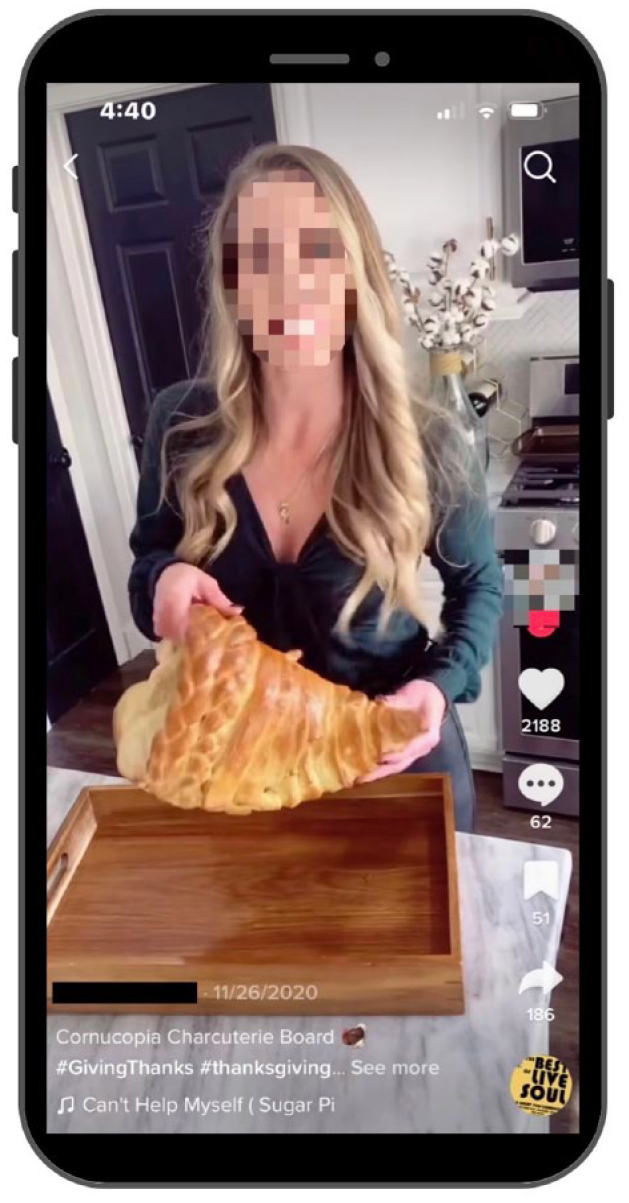
This is an example for a video that was not included; it uses the algospeak term “cornucopia” in a literal sense.

This is an example of an algospeak term (“kermit sewer slide”) that did not result in a list of videos, but provided a Helpline as the algospeak term refers to suicide.
We used the list of video examples to identify the creators of the videos as potential interview participants who used algospeak at least once on TikTok. We messaged creators who included their Instagram username in their TikTok profile through their Instagram profile, since TikTok does not permit direct messaging unless accounts are following each other. We messaged 198 creators and scheduled 19 interviews (9.6% participation rate) with TikTok creators in the United States (15), the United Kingdom (2), and Canada (2). The 19 participants were aged 19–32, and 73.7% identified as female which reflects the global gender distribution of TikTok users (Statista, 2023a). In addition, 16 participants identified as White, one as Black, one as Asian, and one as biracial (Black and White). As of July 2022, they had between 14k and 554.1k followers, had posted between 44 and 1.9k TikTok videos, and had in total received between 67.4k and 35.7m likes for their videos (see Table 2).
This Table Shows the Demographic Information for Participants (as of July 2022), Which Algospeak Term was Used to Recruit Participants, and Which Theme Participants Primarily Address in their Videos on TikTok. Participants Used a Great Variety of Algospeak Terms to Create Benign Videos on Subjects that Apparently were in Some Way Restricted by TikTok.

Data Collection
We conducted 19 qualitative semi-structured interviews (Longhurst, 2003) with TikTok creators in June and July 2022. The purpose of the interviews was to learn about creators’ motivations of and experiences with using algospeak on TikTok. For the interviews, we provided participants with the following definition of algospeak: code words, phrases, and emojis that creators have been adopting to talk about certain topics instead of using the actual terms. Interview questions were designed to better understand participants’ general motivations for and routines of using algospeak, and specifically to examine if and how their understandings of TikTok’s content moderation system influenced their use of algospeak. For example, we asked participants “What influences your decision to use algospeak?” In case participants mentioned content moderation as an influencing factor, we followed up with more specific questions, such as “How much does your experience with the TikTok algorithm play a role in your decision to use algospeak?” We also questioned participants about the ways in which algospeak influenced their self-expression on TikTok. Each of the interviews was conducted and recorded by one of two trained researchers after obtaining the participant’s consent. The interviews lasted between 20 min and 41 min with an average duration of 30 min per interview. All interviews were anonymized and transcribed using an online transcription service.
Data Analysis
The interview data were analyzed by three trained researchers following a qualitative open coding process (Roulston, 2014). In order to retain their roles of unbiased researchers throughout the research process, all three researchers continually reflected on their own biographical, educational, and socio-cultural backgrounds, and stayed conscious of their gender, racial, and sexual identities as White cisgender males and females in relation to the identity-based subjects that participants discussed. All three researchers recognize that their personal backgrounds and identities are limitations that may have affected the research process. Each researcher coded the first interview, then all three researchers met to compare and discuss the naming and application of each others’ codes (Campbell et al., 2013). In this first step of the coding process, we found a high level of agreement between all researchers regarding the identification of relevant interview segments and the creation and application of codes. This process of finding agreement ensured validity and reliability of the results that emerged in the qualitative coding across all coders (McDonald et al., 2019). We subsequently created a code book as a reference guide for the coding of the remaining interviews which were divided equally between the researchers. Each researcher used the code book accordingly to apply existing codes or added new codes if necessary (Benaquisto, 2008). Throughout the process, codes were grouped into categories based on similarities between codes to further organize the data and to designate central ideas that emerged through the coding process. For example, the codes “using algospeak in hashtags” and “using algospeak in auto-generated captions” were organized into the category “practical use of algospeak.” After the coding process, all three researchers met again to review and revise the final code list. In this, 38 codes that were only applied three times or fewer were revisited for coding rigor. Of these, 23 codes were merged into 10 new and more comprehensive codes, and 15 codes were merged with existing and more frequently applied similar codes. Overall, the coding process resulted in 197 codes across the following 10 categories: definition of algospeak, motivations for using algospeak, practical use of algospeak, effects of algospeak, opinions on algospeak, opinions on content moderation, experiences with content moderation consequences, understandings of content moderation, relationship with TikTok as a platform, and video creation topics.
Results
In general, we find participants either adopted algospeak after seeing it on TikTok, or invented their own algospeak in order to avoid consequences for posting about topics they had previously felt were secretly unwanted but were not explicitly violating TikTok’s community guidelines. Participants largely anticipated how TikTok’s algorithm would read their video content, and used algospeak to primarily evade unjustified algorithmic content moderation while also making sure that target audiences could still find their videos and understand the video’s context. Participants’ experiences suggest non-contextuality, randomness, inaccuracy, and biases against marginalized communities are major issues regarding freedom of expression, equality of subjects, and support for communities of interest on TikTok.
Effects of Content Moderation Understandings on Algospeak Use
User Understandings of and Reactions to Content Moderation Procedures
Participants shared many experiences and practices that led them to assume how TikTok assigned consequences to unwanted videos. Many participants (P01–P04, P07, P10, P11, P14, P18) learned about TikTok’s opaque content moderation system when applying trial-and-error strategies to see which subjects they could post about without consequences. Some analyzed the community guidelines (P10, P12, P15, P17) or looked to other TikTok creators (P01, P08, P13, P18) to find out which benign topics were non-publicly restricted by the app. Based on such experiences, participants developed tentative understandings of what video content is unwanted on TikTok, and used algospeak accordingly to alter videos that they felt might trigger consequences. We generally find that participants’ perceptions of which parts of their video TikTok observed informed which parts of the video they applied algospeak to.
Experiences With Unwanted Content on TikTok
When we asked participants what video content they thought TikTok does not want on its platform, they mentioned videos related to violence (P07, P09, P14, P15, P17–P19), controversial events or beliefs (P03, P05, P09, P13, P16, P17, P19), and depictions of or references to sexual activities (P03, P08, P10, P17, P18). We can see a causal relationship between these understandings and the algospeak participants used on TikTok. For example, P15, who creates comedy videos, noticed that videos dealing with anything related to death or violence were moderated. They described that pointing a fork toward an outlet or talking about “unaliving” oneself is algospeak they used to discuss “suicide.” Likewise P17, who observed that videos involving controversial social or political topics were unwanted on TikTok, explained that creators in the community would, for example, use “shmortions” for “abortions” to discuss the 2022 overturning of Roe v. Wade. In addition, from their experience as sex education creator, P16 realized that all references to sexuality or sexual activities were heavily moderated which is why they would use the corn emoji ( I constantly had my videos taken down, and I wasn’t filtering anything. [. . .] and then I realized I need to sort of put a cap on it and try to work my way around it [. . .] I’ve just had to obviously change the words slightly. ) to share their thoughts on “porn.” All participants were experienced TikTok users but the opacity in the platform’s content moderation procedures often meant that they were merely “speculating” (P02) about what the app censored. For example, P19 openly talked abortion rights from a LGBTQ+ perspective in their videos and was surprised to see that others felt the need to use algospeak to discuss Roe v. Wade, saying, “I was like, you really think that they’re checking that?” In any case, to their knowledge most participants (P01, P04–P14, P16–P19) concluded that TikTok looked for keywords in text on screen, video captions, and hashtags to identify unwanted video content. For example, P02, who frequently use the algospeak “shmex” for “sex” in their pole dancing videos, felt that TikTok kept a non-public “list of unapproved words,” and explained that this belief came from personal experience with content moderation: “I referenced a sex toy in a video by its name [. . .] They were like, ‘Nope, we’ve deleted the audio [. . .] we got rid of it cuz you said a word’.” P18 described similar experiences when saying benign words such as “horny” in simple videos about various daily life subjects:
Such encounters gradually shaped participants’ beliefs about content limitations and bans that would otherwise go unnoticed in the background and led them to replace particular words with algospeak: “when discussing anything of an adult topic, like sexual relationships, things of that nature, I have leaned on keywords to replace what I’m actually discussing” (P02). This strategy of swapping out trigger words demonstrates that participants primarily started to utilize algospeak as single-word replacements such as “awetistic” for “autistic” (P01), before moving on to more complex variations. Overall, these examples demonstrate that uncertainty regarding which subjects TikTok censors leads to differing assumptions of when algospeak is truly necessary to evade content moderation and subsequently to different practices of applying algospeak.
Variations of Using Algospeak
All participants assessed the details of videos they had previously restricted to infer that TikTok’s content moderation mainly scrutinized written text. This encouraged them to use algospeak mostly in text rather than in spoken language (“I usually can get away with saying the actual word, but when it comes to any kind of text in the video, I do have to use algospeak” [P05]). Several participants (P01, P03, P05, P06, P08, P09, P12, P14, P16, P17) mentioned using written algospeak in more than one part of their video content as precaution. For example, when creating LGBTQ+ videos, P19 described how they would apply algospeak terms in text on video and also in the video captions: “[. . .] onscreen text [and] I would put it in the caption too [. . .] It’s gonna be the algorithm watching it. It’s gonna pay attention to both.” Such multiple use of written algospeak illustrates a common strategy among all participants in reaction to their perception of TikTok’s content moderation system as a watchful entity. It further informed participants’ adaptation of algospeak beyond just written language.
Many participants (P02, P04, P08, P10, P11, P16, P18) also suspected that TikTok moderates video content based on audio scanning, meaning the identification of spoken language in videos. For example, P02 described several instances when creating pole dancing videos in which their audio was restricted because of sex- or sexuality-related language: “I said ‘dildo’ in a video and they’re like, ‘Nope’. And they cut, they just deleted the entire audio.” Interestingly, some participants reacted to their suspicion of audio scanning by saying algospeak terms out loud in their videos. P08, a sex educator, had their videos taken down numerous times because of benign language which prompted them to instead encourage viewers to use condoms by saying, “Hey, use these rubber bands on your eggplant.” Such strategies of verbalizing algospeak or emojis aimed at “dodging this little community guidelines bot” (P08) that they believed was wrongly inspecting their audio for violations. Another sex education creator (P16) followed another common strategy and whispered words like “vulva” to prevent incurring verbally triggered consequences. They explained their strategy through their observation that TikTok’s algorithmic content moderation would sometimes even pick up on spoken algospeak: “Sometimes I’ll whisper words because I’ve noticed even verbally saying things, TikTok will pick up on them.” These advanced practices demonstrate creative ways of modifying spoken language as variants of algospeak to accommodate unjust content moderation of benign yet stigmatized video content.
Some participants (P02, P07, P12, P17, P18) even described instances in which they assumed that TikTok also wrongfully moderates unwanted visual components of videos on daily life subjects like books or business coaching. In order to avoid such unexplainable restrictions, participants explained they would add algospeak into the captions of videos that they thought would be mistakenly banned for their visual content, or directly as text-on-screen to certain visual elements of a video. Participants indicated that adding written algospeak to such visual elements would prevent the video from being taken down. P12, a creator of comedy videos, said, “If you show yourself wearing a revealing outfit, it’ll get suppressed or even banned for nudity. So if you say ‘fake body’, they don’t count it” (P12). P18 who created videos on random everyday subjects followed the same strategy explaining, “obviously if you say it’s a fake body, then they can’t really take that down.” These examples show how adding algospeak (“fake body”) to harmless videos of people in sparse clothing helped to counteract the content moderation’s mistake of interpreting them as being nude. It demonstrates how participants used algospeak as a necessary way to provide clarification and contextualization to TikTok’s algorithmic content moderation. Moreover, it shows the inevitability of using algospeak to clarify visual content that might be misinterpreted because using clear word referents, for example “no nudity,” would again wrongfully trigger content moderation. Such use of written algospeak further demonstrates that participants trusted algorithmic content moderation on TikTok to consider semantic relations between a video’s text and image, and thus to understand that no violation exists when they add clarifying algospeak to their videos.
User Experiences with and Identification of Algorithmic Content Moderation Flaws
The majority of participants described how their perceptions of how accurately TikTok’s human and AI content moderation identified unwanted video content informed their decision to use algospeak. Based on previous instances in which their videos were restricted, many participants (P02, P05–P07, P09–P14, P17, P19) considered that other users would report videos “out of spite” (P07) without present violations. In addition, some participants (P07, P09, P11–P13, P17) suggested that human content moderators would simply restrict videos that users or AI had previously reported or marked. However, almost all participants (P01, P02, P05–P19) seemed capable of differing between human and AI content moderation and suspected that AI is the main agent that their videos must appease. All participants were certain that TikTok had a pre-posting period during which AI determined whether a video would be allowed for upload or not. This encouraged participants to use algospeak as a means to circumvent possible faulty AI pre-checking and ensure their videos would pass this first stage of content moderation. As a result, participants named four main algorithmic content moderation flaws that they experienced and that influenced their uses of algospeak on TikTok: non-contextuality, randomness, inaccuracy, and bias against marginalized communities.
Non-contextuality
Overall, participants experienced content moderation on a great variety of videos and subjects. Most participants (P02, P05, P07, P09, P10, P12, P16–P18) explained this with their observation that TikTok’s AI content moderation system does not consider the contextual meanings of single words or phrases when identifying unwanted video content. Some participants (P05, P07, P09, P16) described particular instances, for example, P09, who created educational videos about sexual assault, recounted several uses of algospeak in response to algorithmic non-contextuality: “I’d written out the word ‘harassment’, and it was flagged as a video for harassment or bullying and the video got taken down, whereas it survives on TikTok with me kind of censoring the word ‘harassment’.” Another of their videos got banned “obviously completely out of context, they took the video down cuz I said ‘Nazi’.” These examples demonstrate participants’ struggle with AI not understanding their contextual use of a word in a video and hence incorrectly interpreting it as community guidelines violation, or as P09 described it: “You said Nazi, so I think that you are rooting for the Nazis.” We find that all participants critically evaluated the fact that TikTok’s algorithmic content moderation often identified words detached from their contextual meanings and in turn assigned unjust consequences. This realization demonstrates participants’ algorithmic literacy, and motivated them to replace innocuous terms with algospeak in order to compensate for TikTok’s failure to accurately capture the context and, hence, prevent the unreasonable banning of a video. P05 described this strategy for creating race-related videos in which they would use words like “white,” but rather thought “maybe I should try the algospeak version of that word.” Even in non-racial contexts, TikTok banned some videos in which P05 mentioned (skin) colors, leading them to realize that “If I were to say, ‘my favorite color is white’, I’d still have to use some sort of algospeak.” We find that participants rightly anticipated high chances of non-contextuality in TikTok’s algorithmic content moderation and therefore felt almost obligated to replace potentially triggering words like “white” with algospeak, such as “yt” (P05) in order to evade wrongful consequences.
Randomness
Most participants (P06–P08, P10–P12, P14–P19) also observed that TikTok’s algorithmic content moderation was often random and did not provide any apparent reason for incurred consequences. For example, P11 perceived content moderation as “luck of the draw,” since they had several of their social commentary videos taken down but were not able to match the restrictions to any of the details of their videos. In a few instances, such random banning seemed completely arbitrary and almost laughable, as P06 described, I made a joke about going to the Chicago bean and flicking it. [. . .] it wasn’t like anything explicit was written or anything like that, but my video got taken down. And I thought that was hilarious, but also ridiculous.
One explanation could be that P06 primarily created LGBTQ+ videos which in our findings seem to generally have a higher chance of receiving unjust restrictions. However, more participants (P10, P14, P16, P17) shared similar experiences with completely different videos and described how it led them to “play it safe” (P16), and use algospeak even when their video content would not violate, for example, adult nudity guidelines. For example, P14 had received several random unjust violations for benign daily life videos and concluded, “random things can just set off the censor, which is why you see people putting things in their captions like ‘fake body’.” In regards to receiving an arbitrary minor safety violation, they said, “some of the videos that I’ve had restricted for minor safety, it makes no sense. There’s no skin showing, there’s no minors in the video [. . .] it wasn’t even a sensitive topic.” This shows how creators of various video subjects adopt algospeak in order to evade a moderation system that they believe does not follow a logical procedure. By using algospeak strategically, they feel that they can outmaneuver the system’s disorderly decision-making and safely post videos that do not violate the community guidelines.
Inaccuracy
From consuming videos on TikTok, the majority of participants (P01, P02, P05, P06, P08–P19) also suspected that TikTok’s content moderation system does not consistently assign consequences to videos that actually violate community guidelines. P17, for example, observed discrepancies regarding explicit content: “I see a lot of sex workers on TikTok live streaming, which is insane that they’re getting away with that.” They added that such inaccuracy engendered a double standard in TikTok’s content moderation, and other participants agreed that “[. . .] more good content like educational, safe, health content is being repressed than the actual harmful content being taken down” (P08). This shows how participants perceived TikTok’s distribution of consequences as unjust, foremost concerning videos that deal with sex education, gender queer themes, and race-related subjects. We see that all participants who created sex education content experienced inaccurate banning which made them question moderation practices: “I’ve seen hate speech and actual explicit media that I’m like, ‘How is this not taken down?’ But my diagram of a vulva was” (P16). P02 described similar inaccuracies between their pole dancing content and sexually explicit videos: I was standing in eight-inch heels in a T-shirt with shorts, but I was holding onto a pole, and it got taken down immediately for being sexually explicit [. . .] versus I see videos of people, typically women in bikinis, like very, very small bikinis, but that somehow exists under the radar.
P05 observed the same issues when creating social commentary videos about race-related subjects: “Somebody using the N-word in a very derogatory way, 9 times out of 10 that video will stay up. But whenever people speak on that issue without using said word, our videos get taken down.” We find that seeing such inaccurate content restrictions when consuming TikTok videos increased participants’ awareness of covert algorithmic content moderation which in turn motivated them to adopt algospeak as an evasion tactic. P16 explained this as “when I’m doing my closed captioning for a vulva and words like that, I always have to algospeak them.” For talking about race, P02 said, “you have to use some sort of algospeak. So, for example, when it comes to the word ‘Black,’ I use ‘Bl@ck’.” Overall, these experiences with unjust consequences motivated participants to share benign video content more covertly by utilizing algospeak to avoid being affected by the observed inaccurate moderation of content on TikTok.
Bias Against Marginalized Communities
Some participants (P01–P03, P05–P07, P11, P12, P19) experienced TikTok’s content moderation procedures as biased against marginalized communities that they supported or personally identified with, including the LGBTQ+, Black, and disability communities. Participants who created LGBTQ+ videos experienced, for example, rather unreasonable restrictions, such as blocking videos that have the word “lesbian” in it as “[. . .] not safe for children,” (P12), or censoring and shadowbanning of videos in which they used the term “lesbian”: I made a video [. . .] I just said the word “lesbian” [. . .] that was taken down once or it just was [. . .] you know, if you’ve been shadowbanned, if there’s just a “0” on your video, and you’re not getting any views. (P06)
P07 witnessed numerous occurrences of content moderation consequences when watching other users’ LGBTQ+ content, saying, “Videos I find sometimes just during Pride Month, sometimes weird things will happen with videos like that.” In addition, P12 observed that funny videos by a creator they followed “got taken down [. . .]. And it felt almost like either somebody was directly targeting her, or she was being suppressed for being a Black lesbian.” This led, especially participants who identified with marginalized communities, to believe that “TikTok is secretly quite homophobic, or not even secretly” (P07) which then informed the way they would use algospeak as a response to their experiences. For example, as a result of TikTok banning their comedy videos that dealt with LGBTQ+ subjects, P12 used the algospeak “le$bean,” and P07 spelled “queer” with “three’s instead of e’s” (as “qu33r,” the authors) in BookTok videos to prevent consequences for “queer language.” In addition, P05 who posted social commentary videos on TikTok said, I made a video about LGBTQ+ issues [. . .] All I can think of is that I said “gay” and “trans,” and TikTok shadowbanned that video 10 times. And it wasn’t until the 11th time that they finally put it on the For You Page and didn’t mess with it. And I had to use a lot of algospeak in that video.
As a result of experiencing these restrictions for their innocuous videos, participants who identified with the LGBTQ+ community concluded that TikTok might fundamentally restrict the visibility of any of their videos. Such impressions further motivated participants to adapt algospeak as a general way “[for] marginalized people to talk about issues that regular people already were getting to talk about” (P11). This shows how algospeak served as a means to regain visibility and to counteract algorithmic content moderation that participants felt was biased against them because of their identity and identification with marginalized communities.
Impact of Algospeak on TikTok’s Content Moderation
We also asked participants if and in which way they thought algospeak could influence or even change algorithmic content moderation on TikTok. Participants largely viewed algospeak as an effective evasion tactic, but observed that TikTok would evolve its content moderation system in response to it and therefore compel creators to become more creative with their use of algospeak to continue to prevent consequences.
TikTok Adapts to Algospeak
All participants observed far less issues when they used algospeak instead of wording they identified as potential reason for previous restrictions. Most participants (P01, P03–P06, P08, P10, P11, P13–P16, P18, P19) considered algospeak to be effective in preventing consequences on TikTok, saying, for example, that it is “the number one reason why a lot of my videos haven’t been taken down” (P07); however, they also expressed that algospeak often is a hit or miss. According to P05, for subjects like social commentaries, algospeak use is “90 percent effective, but there is that 10 percent of times where TikTok can catch onto what you’re saying.” In addition, many participants (P01, P02, P04, P05, P08, P09, P10, P14–P18) noticed that over time, the TikTok algorithm is learning and understanding the intended meaning behind algospeak, and therefore of moderating videos accordingly. P08 experienced this when posting sex education videos saying, “the little community guidelines bot is gonna keep following you, and it’ll eventually be like, ‘Oh, you’ve been using seggs a lot [. . .] I recognize this. This means sex’.” Such experiences suggest that in order to keep evading unjust consequences creators must draw upon their algorithmic literacy and adapt their algospeak in response to TikTok’s continuously improving algorithmic content moderation system. Moreover, affected communities of interest need to constantly negotiate new or revised algospeak in order to secure communication structures and mutual understanding.
Varying Effectiveness of Algospeak
Participants used algospeak for all kinds of subjects and types of videos, and some felt that certain forms of algospeak were more effective at circumventing unjust content moderation than others. We find that when participants used entirely new words such as “unalive,” it proved to be more effective at evading content moderation than just editing, for example, the spelling or orthography of unwanted words like “suicide” (see Figure 4). For example, on creating sexual assault awareness videos, P14 noted, “I would say for sure algospeak in which you’re changing the words like ‘unalive’ is completely different, works better than putting the word in punctuation.” Moreover, many creators of sex education videos realized that TikTok’s algorithmic content moderation easily figured out Leetspeak whereas new words were more difficult to comprehend: “if you put s3x, TikTok can figure out that you’re trying to say sex [. . .] so now people have to say ‘seggs’” (P05). We can see that participants carefully evaluated the algospeak they used and eventually used different algospeak or invented new terms to improve its effectiveness. Some participants pointed out that some algospeak terms had gotten popular on TikTok in general and had spread outside the original community which made them obvious to TikTok’s content moderation system: “explicit algospeak, unalive, le dollar bean [. . .] actual words, I think that that is not far off from just getting added and lumped into other words they don’t want to hear” (P02). As a result, especially many variations of written algospeak had become ubiquitous and easier for TikTok’s content moderation system to find and censor videos that contain it, hence making these algospeak terms less effective in evading unjust consequences.

This is an example for a lexical variation (“g@y”) as algospeak for “gay” to comment on LGBTQ+ hate.
Expanding the Definition of Algospeak
The fact that some written algospeak became ineffective over time inspired participants to create “unique and novel” (P19) forms of algospeak which they believed would be more difficult for TikTok to moderate. For example, using emojis (see Figure 5) which P05 described as a more impactful form than written text that allowed them to comment on social events. Likewise, P02 believed TikTok’s content moderation system could not recognize gestures as readily as words, saying, “rather than coming up with different keywords, it became a game of omission for me [. . .] Like sometimes people, you know, bend wrists to indicate you’re part of the queer community.” These examples further demonstrate users’ advanced algorithmic literacy and the creative ways in which they would extend and innovate algospeak beyond textual elements into skillful visual and audiovisual variations. These constantly improving user practices indicate that algospeak is more than the simple replacement of words. Therefore, the existing definition of algospeak needs to be enhanced, and algospeak needs to be understood as code words and linguistic variations, visual and multimodal communication, and audiovisual coherences in social media interaction.

This is an example for the extended algospeak forms of using emojis () and gestures (bend wrist) to replace the written word “gay.”
Conclusion
The results of our interview study demonstrate that using algospeak on TikTok is largely a result of users observing and experiencing its algorithmic content moderation as being non-contextual, random, inaccurate, or biased and therefore unjust. Participants used algospeak primarily to circumvent what they perceived to be faulty content moderation of benign subjects, to prevent what they perceived as undeserved and irrational consequences, and ultimately to achieve and ensure adequate freedom of speech and equality on TikTok.
Our analysis illustrates how recurring experiences of receiving unjust content moderation leads to increased and improved use of algospeak. Participants first utilized algospeak to substitute or change text-on-screen, video captions, or hashtags that they anticipated as possibly inciting algorithmic content moderation. When they later observed that TikTok’s content moderation algorithm appeared to learn the semantic referent behind algospeak terms and subsequently restricted it, they extended algospeak into using emojis, making gestures, or whispering or miming certain words. This progression of improving textual, visual, and audiovisual variants of algospeak is a creative user practice to work against unjust content restrictions that requires advanced algorithmic literacy and profound skills.
TikTok relies especially on machine learning and algorithmic detection to review and moderate uploaded videos (TikTok, n.d.), and foremost to automatically remove videos that are identified as community guideline violations (TikTok, 2021). However, our analysis demonstrates that TikTok’s algorithmic content moderation is not capable of understanding the particular contexts in which participants discussed benign subjects. By default, this poses unjust restrictions to a large number of TikTok users who are talking about benign subjects like sex education, sexualities and gender identities, ethnicity, or social and political activism without violating community guidelines. Rather, TikTok’s algorithmic content moderation system further traces, restricts, and suppresses user communication about unwanted themes, even when they are mentioned in harmless contexts. Algospeak appeared to be the main way for TikTok users to deal with this discrepancy of community guidelines, content moderation, and video creation. However, we find that TikTok’s content moderation algorithm seems to learn algospeak and instead of taking into account the still benign context, it subsequently censors learned algospeak terms and limits their effectiveness for affected users. As an act of platform governance, this further hampers users’ communicative needs and freedom of speech to address relevant social, cultural, and political subjects on the platform. In addition to previous research that found TikTok’s content moderation system to be inconsistent and inaccessible to users (Malik, 2022), we show that such non-contextuality, randomness, inaccuracy, and biases also negatively affect users’ attitudes toward platform mechanisms, such as content moderation or algorithms, in general.
It would greatly improve user experience and usability on TikTok if automated content moderation were able to consider platform-internal contexts such as the ones we analyze in this study. Algospeak was largely applied by creators who belong to marginalized communities, such as LGBTQ+, or within communities of interest that address harmless yet unwanted subjects, such as sex education to evade further restraints from the platform. This shows that TikTok’s general claim that their algorithms monitor and evaluate user behavior to optimize the user experience is not true for users who create videos about covertly unwanted subjects. In this regard, our analysis also provides further insights regarding restricted content visibility on TikTok (Zeng & Kaye, 2022), and confirms that TikTok creators of niche communities show sufficient digital skills and algorithmic literacy to manage their digital selves (Barta & Andibili, 2021; Simpson et al., 2022). In addition, considering communicative contexts might additionally help to counteract any malicious use of algospeak or similar practices.
Based on analyzing algospeak as a holistic communication phenomenon, we enhance the definition of algospeak from code words and linguistic variations to visual communication, multimodal communication, and audiovisual coherences. Compared to other forms of netspeak, like Chatspeak, Leetspeak, or LOLspeak, algospeak is a community-based means of communication that exceeds playfulness, encryption, or adaptation to platform features and environments to specifically combat experienced non-contextuality, randomness, inaccuracy, and bias against marginalized communities in algorithmic content moderation.
Future research could examine additional socio-technological perspectives, such as implications of algospeak for governance on social media platforms beyond TikTok, for example, similar linguistic adaptations to algorithmic content moderation on YouTube or Instagram. Socio-cultural research could further investigate the relationship between marginalized communities and algospeak, and take a non-Western perspective on TikTok and algospeak, for example, by analyzing user communication practices and content moderation in the context of political censorship and civic engagement. Based on our refined definition of algospeak, sociolinguistic approaches can study the effectiveness of different forms of algospeak (e.g., words versus gestures), or perform a language analysis of word-form algospeak and analyze what motivates users to adopt different variations of it.
Footnotes
Declaration of Conflicting Interests
The author(s) declared no potential conflicts of interest with respect to the research, authorship, and/or publication of this article.
Funding
The author(s) received no financial support for the research, authorship, and/or publication of this article.
