



Abstract
On November 2, 2020, the Austrian capital Vienna experienced the worst terrorist attack in decades: A self-proclaimed Islamist gunman killed four people and injured 23 others. The attack triggered an extremely strong media response, especially in the so-called social media. This article focuses on the days and weeks following the terrorist attack on Twitter as well as its first anniversary and the question of how collective memories formed within a very short time through the jointly negotiated remembrance of the terrorist attack by social media users around the world. The study also shows how the Vienna attack was incorporated into other pre-existing collective memories of other terrorist attacks and how it created memory waves spanning the whole globe. Within the first 48 hr, the narratives that should dominate the debate and the memory of the attack for the coming weeks took shape. The attack in Vienna was primarily reflected in places where comparable attacks had occurred in recent years and became a narrative part of other political or ideological conflicts.
Introduction
On November 2, 2020, the Austrian capital of Vienna experienced its worst terrorist attack in decades: a self-proclaimed Islamist terrorist killed a total of four people and injured 23, most of them seriously (Konzett et al., 2020). Until this attack, Austria had been considered the proverbial “Island of the Blessed’’ and had not experienced an attack of comparable severity since the 1990s. The event triggered an extremely vast coverage on social media, where users uploaded videos, pictures, and text messages of the events in Vienna’s first district practically as they happened. The focus of this article, however, is not just the live coverage of the attack but also the days and weeks after the attack as well as its first anniversary. We will answer the question of how collective memory of the attack quickly established itself on social media during this time and how users incorporated the attack into other pre-existing collective memories. There is a striking difference in national and international reactions on social media to the Vienna terrorist attack, whereas in Austria, in the absence of a comparable national event in the collective Austrian memory, an independent memory space was able to form, internationally the attack became part of already existing collective memories of other terrorist attacks. The central narratives of newly emerging collective memories are already shaped in the first days of the debate on Twitter directly after the incident—this is where the epistemes emerge within which the memory of the event is negotiated. The Vienna attack is very well suited for such an analysis, as it illustrates numerous different levels and forms of memory processes in social media: New collective memories are produced as well as existing ones re-actualized. In examining this process, we are guided by the following key research questions: How do terrorist attacks create transnational memory waves across several countries? How are hashtags repurposed in new political and social contexts and thereby connect old memory discourses with current discourses? How are terrorist attacks used to push ideologically motivated memory discourses on social media?
Theoretical Background
Terrorist attacks, like other acute crises, lead to “information holes,” which are then in turn filled by the public through the sharing of news and information in real time (Krutrök & Lindgren, 2018, p. 1; Lin et al., 2016, p. 627). People use social media for various reasons, for example, to form networks for assistance (Onorati et al., 2016), but also precisely for a process of collective sense making during and especially after traumatic events such as terrorist attacks. (Fischer-Preßler et al., 2019; Heverin & Zach, 2012; Maitlis & Christianson, 2014) Building on Eriksson (2016), we understand collective trauma as the result of and the collective response to a traumatic event. In the collective processing of the experience, a discursive way of dealing with it is worked out and a feeling of communality can arise, through which a community of destiny emerges that legitimizes itself through the shared sorrow. Twitter, in particular, provides a very useful space for these negotiation processes, as users can mediate their feelings, fears, worries, and also their anger there and form their own discourses away from the classic mass media interacting directly with content (posts, videos, and photos) posted by public and private accounts. Through this joint information work, people create a wealth of content from which, through the constant repetition of shared narratives, collective memories form and carry on even after the acute crisis is over (Birch, 1994). These collective memories are thereby products of conscious choices and decisions: Contents are selected as worth remembering and retained, while others are not remembered and thus forgotten. They are a socio-political construct that is created discursively (Neiger et al., 2011). In social media, people discuss these contents practically in real time since they are in constant, more or less direct contact with each other. This has already been shown by studies of comparable terrorist attacks (Bruns & Hanush, 2017; Zeitler, 2018). The separation proposed by Jan and Aleida Assmann into communicative and cultural or functional and storage memory, which refers primarily to their temporal horizon and degree of institutionalization, is therefore becoming more and more blurred (Assmann, 2007, 2011). Schudson (2014, p. 85) argues for using these terms interchangeably. In this regard, it is important to keep in mind that both Jan and Aleida Assmann initially further developed the concept of “collective memory” first postulated by Halbwachs (2020) to describe either very distant or at least strongly institutionalized collective memories: Jan Assmann on the forms of collective remembrance processes in ancient Egyptian civilizations, Aleida Assmann on remembrance of the Shoah and dealing with the Nazi era in Germany. However, the “connective turn” (Hoskins, 2011) of the digital age requires a rethinking of the analytical concept of collective memory that takes into account the hyperconnectivity of the 21st century. In this context, Hoskins (2017) uses the term “memory of the multitude,” in which elites or experts no longer determine what is remembered and how, but countless individual memories collide in different forms of media. Hoskins therefore also speculates about an end to collective memory. Here, however, we want to counter that despite the immense democratization of the memory process, collective narratives are formed, which in turn form collective memories.
The attacks in Paris in 2015 are an archetypal example. Very shortly after the first attack, collectively negotiated hashtags were established on Twitter and Facebook under which people shared messages about the events in Paris (Bruns & Hanush, 2017). These eventually culminated in the collective hashtag #prayforparis, which subsumed a wide variety of messages ranging from pure news and sympathy to conspiracy theories (Zeitler, 2018). Together with the iconographic fusion of the Eiffel Tower with the peace sign by artist Jean Jullien, also posted on Twitter, the hashtag, like #jesuischarlie a few months earlier after the attack on the satirical magazine Charlie Hebdo, acquired a meme-like character and was used millions of times (Giaxoglou, 2018). The specific collective memory of the terrorist attacks in Paris, which emerged in the hours, days, and weeks after the event, is also characterized by its broad, participatory nature due to its birth in social media (Zeitler, 2018). In their study of the Charlie Hebdo attack, Smyrnaios and Ratinaud (2017) have pointed out that even a singular event such as a terrorist attack can lead to extremely heterogeneous discussions and reactions. Hashtags represent the connecting bracket and enable the emergence of “ad hoc publics” (Bruns & Burgess, 2015; Bruns et al., 2016). Building on Rambukkana (Bruns & Burgess, 2015, p. 30), hashtags in this context can be understood as “nodes of continued context” that on the one hand enable people to participate publicly in current debates and be seen to do so but, on the other hand, also open up new contexts and discourses.
As Krutrök and Lindgren (2018) have shown in an analysis of hashtag co-occurrences, recent terrorist attacks are often put into context with past ones. These are thus reactualized and discursively incorporated into new patterns of meaning. In contrast to our study, however, the analysis deals less with the dynamics of collective memories. It is a primary characteristic of collective memories that groups use their contents to construct their own identity and thus demarcate themselves from others (Roediger & Abel, 2015). Especially, traumatic experiences such as economic crises, military defeats, natural disasters, or terrorist attacks are predestined lieu de mémoire for collective narratives and group identity (Nora, 1989; Olick, 1999). These collective memories have a very low tolerance for ambiguity (Wertsch & Roediger, 2008). Contradictions are avoided to tell a cohesive, congruent story about the past and new events that are merged into fitting patterns of meaning. The common memory of collectively experienced traumas—such as the terrorist attacks in Paris, Nice, or Mumbai—is kept alive or retold by referring to the current attack in Vienna in our specific case. In the process, the event is incorporated into already existing narrative frameworks and functionalized as reassurance for one’s own group and its collective memories.
Methods
In our analysis, we used a mixture of qualitative and quantitative methods as a blended reading (Lemke & Wiedemann, 2016, p. 21) and different forms of network analysis (Conover et al., 2011; Newman, 2018; Scott, 2013; Wang et al., 2016). We decided to choose Twitter since the debate surrounding the event was quite fervent and global in this social network (as we will show in the results). Indeed, it has been used by private accounts to share media in real time as well as by official accounts belonging to the authorities, politicians, and journalists to share reliable and important information.
Dataset
We used Twitter Search API (Twitter Developer Platform, 2021) and we downloaded all the tweets (including retweets) posted between November 2 and 22, 2020 that contain at least one of the following hashtags (chosen after a qualitative analysis):
#wienterror
#prayforvienna
#viennaterrorattack
#viennaattack
#0211w
#wienattack
#viennashooting
#wirsindwien
#wienliebe
#austriaterrorattack
#schleichdiduoaschloch
#schleichdichduoaschloch
#schleichdiduorschloch
We did not collect the stream of Tweets, but we ran a crawling in April 2021, about 5 months after the event. This can imply some content had been canceled or removed, as we will discuss later. We obtained almost 248,000 tweets (including 177,000 retweets) that involved more than 133,000 users. After preprocessing, we selected only the fields that are interesting for our analysis: for each tweet, we noted the tweet ID, the conversation ID (which is useful when we have to deal with retweets, quotes, or replies), the text itself, a list of hashtags, the author ID, the author username, the number of retweets, the number of likes, the number of quotes, Boolean indicators for retweets, quotes or replies, the retweeted tweet ID, a list of mentioned users, the date, the language, and a Boolean variable to represent tweets containing media such as photos or videos; for each user, we noted the user ID, the username, the number of followers and friends, the Boolean indicator for verified accounts (1) and the location. As we will show in the results, the debate was highly active in 48 hr following the terrorist attack and then lasted for a few days more with less intensity. The absolute majority of the debate took place in either English or German:
Locations
Among the 133,000 Twitter accounts involved, ~48,000 users filled the location field. We obtained the location (coordinates) for ~16,000 users, meaning more than 96,000 tweets and retweets with coordinates. Users can manually add the location themselves to their Twitter account. It can also be an invented place or written in different languages, in which case it is not totally reliable information. Nevertheless, we can add string preprocessing and use tools to transform at least some of these manual locations into formal ones (usually a small percentage, in our case 12%). We used TAGME (Ferragina & Scaiella, 2010), an entity-linking tool that finds entities in a text and provides a link to the corresponding (English) Wikipedia webpage. In our case, the text is the short string inserted by the user to describe its location. If a name of a town, city, or state appeared in it, TAGME extracted the information and then we used Wikipedia API to retrieve geographical coordinates. Finally, we built maps (see the section titled “Findings and Discussion”) using the free online version of CartoDB (2). Even if this spatial information is available only for a limited portion of our dataset, it is still interesting to analyze the spatial distribution of the tweets because of the high magnitude of the dataset.
Networks
When we have to deal with relational data, and especially information-spreading data, the natural technique is to represent them using a network paradigm where there are entities (nodes) that are connected by links that symbolize the type of relation. Twitter data in particular is interesting to analyze in this way since each post can be re-shared by other users (retweet), so we can analyze the information cascades and look for important nodes in the information-spreading process. Similarly, we can explore the relations given by the mentions of users in our tweets. In addition to this, we then studied a co-occurrences network to focus on hashtags that often appeared together in the same post.
Hashtag Co-occurrences Network
In this network, each node is a hashtag and has an attribute “magnitude” that measures its frequency in the tweets; there is a link if the two hashtags and appear together in at least one tweet (an attribute “weight” associated with the link corresponds to the number of co-occurrences among the two hashtags).
We obtained a network with more than 11,300 nodes and 210,000 links, but as most of the hashtags have small magnitudes, we decided to remove “noise” to extract meaningful information: We deleted nodes with a small magnitude and edges with a small weight, meaning that we only kept hashtags that appeared more than 50 times and co-occurrences links with a weight higher than 10. In this way, we significantly reduced the data to a core network of 238 nodes and 2,509 links. We ran the Louvain community detection algorithm (Blondel et al., 2008) and found six communities that we will discuss in the following section.
Qualitative Analysis
For our qualitative analysis, we combined different approaches to discourse analysis: linguistic approaches (Fairclough, 2003; van Dijk, 2015; Wodak, 2004), critical discourse/dispositive analysis (Keller, 2011), and historical discourse analysis (Landwehr, 2010, 2018; Sarasin, 2001). These approaches share the same theoretical foundation and allow for individual solutions for our specific source material. The basis for our qualitative analysis is the individual communities from the hashtag Co-occurrences Networks. These are different strands of discourse in which specific topics were addressed. As a result, the Vienna terrorist attack was woven into different webs of meaning and sometimes constructed narratively in completely different ways. In our analysis, we deconstructed this narrative and, in part, highly ideological utilization of the event along central keywords and traced the processes of this different interpretation. The examples published in this article are representative in that they are statements with a particularly broad reach: They are those tweets within these communities that have been shared and liked most frequently. These are hegemonic and discourse-shaping statements within the individual strands. We assume that the most shared tweets are particularly powerful and meaningful statements within the different strands of discourse. Therefore, we have analyzed them in detail in this article and published them as screenshots. To protect users, we have anonymized nonverified private accounts. To do this, we followed the ethical guidelines of the Association of Internet Research (AOIR).3
Reproducibility
All the quantitative analysis was done in R and Python. The codes and the complete results can be found in the GitHub repository (4) created for this project. The dataset that forms the basis for the qualitative analysis is also in this repository.
Findings and Discussion
Creating a New Memory—Austria
The whole debate surrounding the event lasted for 2 weeks, but most of the tweets appeared in the first 48 hr after the attack. Already in these first 48 hr, the central narratives and also the central hashtags were established, and those epistemes were created within which the discussions would unfold in the coming weeks and months but also on the first anniversary of the event. The narratives on the attack in Vienna which would become the narratives of the collective memories of the attack were shaped in the first days after the attack. Twitter users created central commemorative elements to shape the memory of the attack even outside of Twitter. This can be taken as an indication of the extremely fast pace at which Twitter operates and the speed with which collective memories are created there but also the significance of social media for the creation of collective memories per se. It is striking that a completely new collective memory has formed in Austria, whose narratives determine the memory of the terrorist attack of 2 November. At least in social media, there was no significant reference to past terrorist attacks in Austria. Although this was the first Islamist attack in this form, there was a wave of right-wing extremist terrorist attacks in the 1990s that also claimed several lives. In the 1970s and 1980s, Austria also experienced several serious attacks on the OPEC and Israeli and Jewish targets, with numerous fatalities (Riegler, 2010). These were hardly mentioned—despite a geographical proximity to the site of the November 2 attack.
Although other hashtags such as #viennaattack #prayforvienna or #0211w are more frequent—as the quantitative and network analyses show—it was above all the hashtag #schleichdiduoaschloch that persisted the longest and attracted the most attention outside the various Twitter communities. The hashtag is in Viennese dialect and can be roughly translated as “Get lost, you asshole,” which also explains why this hashtag can be observed practically exclusively in German-language tweets and here in particular among users who can be located in Austria. The origin of this hashtag allegedly lies in a video showing the terrorist during the attack, in which a local resident shouts these words at him from an open window. We use the term “allegedly” because we cannot verify the claim—although there are numerous videos from the night of the crime, there are no publicly still accessible videos in which this exact sentence can be heard. In all the articles examined that refer to this saying, an ominous cell phone video is cited as the source, but it is never linked and cannot be found online. In an almost ideal-typical way, “#schleichdiduoaschloch” thus represents a memory-political myth, the origin of which cannot be traced and does not have to correspond to the historical “truth,” yet which nonetheless has memory-political significance. It is a story that became history and which remains connected to the event, since in many ways it has become a crystallization point of collectively shared narratives and memories. Whether this saying is fictional or factual is irrelevant to its meaning as a lieu de mémoire (Nora, 1989). It was mainly “ordinary,” nonofficial accounts of regular users who posted under this hashtag. In their tweets, they verbalized and mediatized their own view of the terrorist attack, their own experiences, their fears, their worries, and—with a timely distance—especially their memories. The importance of social media, especially in the formation and joint negotiation of collective memory, can be seen in the fact that it was “#schleichdiduoaschloch” which made its way out of Twitter and into traditional media. Like the hashtag #jesuischarlie after the attack on the satirical magazine Charlie Hebdo in Paris (Browning, 2018) or the Manchester bee after the attack on a concert in Manchester (Merrill & Lindgren, 2021), #schleichdiduoaschloch took on a meme-like character: it was printed on T-shirts, sprayed as graffiti in several areas of Vienna, and hung on banners. Twitter is thus clearly the place where one of the most central memorial contents in remembrance of the terrorist attack in Vienna was created.
The German newspaper taz used the sentence as a lead story (Misik, 2020)—as did numerous Austrian daily newspapers—and several television and radio reports focused on it. In the qualitative analysis of both the tweets and this content in traditional mass media, it becomes clear that “#schleichdiduoaschloch” in particular was strongly associated with local notions of identity; it was portrayed as something that is especially typical of Vienna and the almost stoic grumpiness of its inhabitants. It formed a common and unifying narrative that served as a cipher for those people who felt particularly affected by the terrorist attack—primarily through sheer geographical proximity. This also becomes evident when you look at the hashtags with which it was frequently combined: The hashtags “#wienliebe” and “#meinwien” stand out particularly strongly. Traditionally, these hashtags are used in social media to articulate love and affection for the city of Vienna, sometimes with a satirical background: Tweets with this hashtag often depict images of the city, endearing anecdotes, but also humorous stories that are also considered precisely typical of the Austrian federal capital. In the days and weeks following the terrorist attack on November 2, this identity-specific component was invoked even more strongly than before to serve as a common narrative in times of serious crisis and often deep insecurity. While the major, official accounts that had posted under other hashtags quickly went back to business as usual and turned their attention to other topics, “#schleichdiduoaschloch,” “#wienliebe,” “#meinwien” and its associated networks remained active in the weeks following the attack (Figure 1).

Example of the interweaving of identity-specific images of Vienna with the processing of the terrorist attack by a private account. As this is a private, unverified account, we have removed the name and Twitter handle.
The use of the hashtag “#schleichdiduoaschloch” was also frequently accompanied by the resolute demand not to mention the name of the terrorist and thus deny him the personal fame he might have hoped for. This intention is strongly reminiscent of the approach of New Zealand Prime Minister Jacinda Ardern who, after the Christchurch attack, vowed in her speech to Parliament never to mention the name of the far-right terrorist responsible for it. This refusal to use the terrorist’s name was also observed by numerous media outlets in New Zealand (Bell et al., 2021). This approach is not only in line with the recommendations of psychologists, who have long been calling for terrorists and other mass murderers to be given as little publicity as possible (Lankford & Madfis, 2018), but is also extremely intriguing from the perspective of remembrance policy. After all, it not only means that a conscious decision is being made about how a particular event should be remembered, but this is also communicated quite openly.
Despite the strong resentment against Islam and the Muslim population in Austria (Aschauer, 2020) and that right-wing parties with their antimigration policies are traditionally very strong there (Rossell Hayes & Dudek, 2020), it is a little surprising that Islamophobia and anti-Muslim hate-speech only play a rather subordinate role within the Austrian discourse, at least on Twitter. With the exception of the Twitter postings of right-wing politicians, that did not gain much popularity, the majority of the debate was dominated by narratives of cohesion and tolerance. Positive stories, such as those of young migrants who came to the aid of injured police officers at the risk of their lives, were much more prominent. Lindenmayr et al. (2021) were able to show in a study of hate-speech on Twitter in the context of the attack on November 2 that Islamophobia and anti-Muslim sentiment also played a central role, but they focused their analysis on English-language tweets. Here, we can again see a significant difference between the international and the Austrian handling of the terrorist attack. Our thesis that the central narratives of the memory of the terrorist attack in Vienna were already shaped in the first days after the event is also confirmed insofar as Islamophobic sentiments can also not be identified on the anniversary of the attack. The conscious decision to “forget” the name of the assassin has also borne fruit in that it has been completely omitted from the anniversaries.
In the days after the anniversary of the attack, November 2, 2021, and the days after, we repeated our data crawl using the same hashtags with a slightly different time span: we considered indeed some days before and after the event, to get the maximum number of tweets. Moreover, since we noticed that particularly wide-reaching accounts also used the hashtag #w0211, we also included it in the search. The total number of tweets—namely 1,391—is significantly lower than on the day of the attack itself and the days and weeks immediately following it. If we look at the tweets it becomes very clear that the discussion surrounding—and above all, the remembrance of—this day takes place practically exclusively in Austria alone. This clearly shows how quickly the fast-moving world of Twitter has continued to turn and how comparatively minor the significance of the Vienna attack actually was from an international perspective but also the collective remembrance of the terrorist attack focused—unsurprisingly—primarily on the victims. At the same time, a common, diverse, and tolerant Vienna was also evoked. This can be exemplified by this tweet from the Vienna police, which also includes a video in which different people living in Vienna express their commemoration but also their love for the Austrian capital (Figure 2).

Tweet from the Vienna police on November 2, 2021, focusing primarily on the victims of the attack. Translation: One year ago at 20:00:47, the first emergency call from Schwedenplatz reached us. What remained were 23 injured, some seriously, and four people killed. Today we remember the victims. Vienna is a place for all people. Hate must never prevail over tolerance, freedom, and love.
In addition to narratives of remembrance, the discussion surrounding the anniversary itself also focused strongly on questions of political responsibility for the terrorist attack and its investigation. Here also, it was primarily large, mainly journalistic accounts that dominated the discourse (Figure 3).
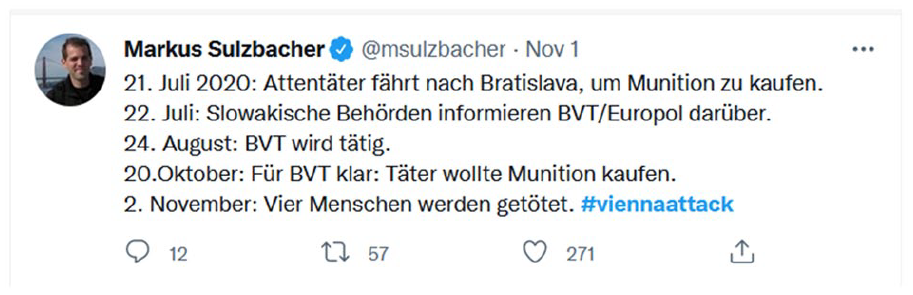
Tweet from an Austrian journalist dated November 1, 2021—this addresses an alleged political and police failure in the build-up to the attack. Translation: July 21, 2020: Attacker travels to Bratislava to buy ammunition. July 22: Slovak authorities inform BVT/Europol. August 24: BVT takes action. October 20: It is clear to the BVT that the attacker wanted to buy ammunition. November 2: Four people are killed.
Ritualizing Existing Memories—The International Debate
We were able to extract the geolocation of 12% of the tweets and to produce maps (see Figure 4) of this global discussion.

Geographical distribution of geolocated tweets: A world map to show that there was a global discussion and a focused map on Europe which also highlights language-related clusters.
The reaction to the terrorist attack in Vienna on Twitter was a global phenomenon, with tweets in practically all regions of the world and a particularly strong concentration in Europe and India. The terrorist attack in Vienna was used to revoke the memories of past terrorist attacks in other regions of the world and was thus used to create new contexts of meaning and reactualize already existing memories of past terrorist attacks. Therefore, it is striking that centers can be observed in places where terrorist attacks have been carried out in recent years: Berlin, Nice, London, Paris, Brussels, Barcelona, and Mumbai. In these places, the users’ emotional connection to the events in Vienna seems to be particularly strong. The attack in Vienna is embedded in local narratives as a triggering event that reactualizes the memories of past events. This has already been shown by Eriksson Krutrök and Lindgren (2018) in a comprehensive study on a total of 12 different terrorist attacks between 2015 and 2017 through hashtag co-occurrences—especially how new terrorist attacks can lead to a new discursive understanding of past attacks. Our study also demonstrates how strongly the collective memory of past terrorist attacks can shape the interpretation of current terrorist attacks.
This is particularly evident when we look at the large cluster of tweets in India. The very strong reaction to the terrorist attack in Vienna, some 6,000 km away, may seem surprising at first glance, but it becomes more understandable when we look at this very connection to local narratives and collective memories. Several accounts with a very large number of followers drew parallels between the attack in Vienna on November 2, 2020, and the one in Mumbai on November 26, 2008. The fact that they did this in English and not in Hindi suggests that they also targeted an international audience. This can be exemplified by a tweet from the Indian author Shefali Vaidya (see Figure 5). In her tweet, which was shared over 1,300 times and liked 6,400 times, she draws a comparison between the images from Vienna and those from Mumbai 12 years earlier by pointing out how similarly the terrorist in Vienna was dressed to the sole survivor of the terrorists in Mumbai. The prominence and especially the wide reach of her tweet are an indicator of how familiar the images of the Mumbai terrorist attack still are in the collective memory of her audience and how to present this memory still is.

Example of linking the attack in Vienna with the one in Mumbai.
The terrorist attack in Vienna is used in this example, as in many others, to commemorate the terrorist attack in Mumbai in 2008, but also to take a decidedly political stance. Islam itself and Pakistan in particular are often criticized and directly linked to terrorism. This narrative alludes to an Islamophobic polarization of social media in India in recent years, which has already been analyzed in numerous other studies (Ghasiya & Sasahara, 2022; Jose, 2021; Mahapatra & Plagemann, 2019). Also, the narrative that the so-called refugee crisis of 2015 was used to take the blame for subsequent terrorist attacks, which has been propagated in Europe (and especially in right-wing extremist circles), is a recurring motif in this Indian debate (Figure 6). The discussion has been exemplified by this equally wide-reaching tweet from Indian athlete Surendra Poonia, which also contains misinformation about the number of attackers:

Example of Islamophobic and xenophobic narratives in this cluster.
In this respect, the debate in India differs significantly from that in Austria. While in Austria a new collective memory has emerged that has been constructed without anti-Islamic narratives, the reaction in India is marked by references to the terrorist attack in Mumbai and strongly politically influenced anti-Islamic resentment.
Hashtag Co-Occurrences and Other Clusters of Meaning
This effort to connect the attack in Vienna through hashtags that were already trending at that time with other terrorist attacks and other events and phenomena becomes even clearer when we look at the hashtag co-occurrences network. However, there are not only references to past terrorist attacks but also to simultaneous political phenomena. While general topics such as the US election, the conflict between Armenia and Azerbaijan or COVID-19 are events that are strongly related to the present, collective memory contents become visible above all in relation to past terrorist attacks such as the one in Nice or—on a metalevel—the Turkish president’s (alleged) support of ISIS.
We built a network based on co-occurrences of hashtags, and decided to select only hashtags that appear at least 50 times and co-occur at least 10 times in the dataset to focus on the giant component of the network. Thereby ensuring reasonable thresholds to remove much-undesired noise: we obtained a graph with 238 nodes and 2,500 links and after running a community detection algorithm, we found six communities: in Figure 7 we provide a visualization of the central part of the network, highlighting with labels the top 10 hubs (highest degree nodes) of each community, according to the color assigned in the community detection.

Hashtag co-occurrences network and its partition in communities (partial plot).
The combination of using different hashtags, as exemplified in our co-occurrences network, creates new discourse spaces and generates new contexts. The terrorist attack in Vienna is once again integrated into other patterns of meaning. Furthermore, the attention caused by it—after all, the hashtags used were trending at this point—is utilized for creating and perpetuating different narratives.
The identified communities can offer a good proxy for topic modeling of Twitter debate in this case, since the hashtags clusters define the most important threads of our dataset: a global discussion about the attack (community 1, 96 nodes), a local debate involving mostly German-speaking users (community 2, 60 nodes), a more general discussion involving hot topics in the same time period as United States elections or COVID-19 (community 3, 32 nodes), and three other smaller threads involving Turkey (community 4, 23 nodes), Armenia (community 5, 22 nodes), and Pakistan (community 6, 5 nodes).
The co-articulation of hashtags represents a discursive practice to forge connections between different spaces of meaning, which can also give rise to new contexts while creating new meanings. As Moa Eriksson Krutrök and Lindgren (2018) have shown, this also happens when dealing with and reporting on terrorist attacks in the form of tweets by combining the hashtags of recent terrorist attacks with the hashtags of older terrorist attacks. As already mentioned, numerous references to previous terrorist attacks can also be found in our study; this also happens in part through the association and use of hashtags from past terrorist attacks but can often only be proven through a content-related, qualitative analysis of the tweets. As can be seen in communities 4, 5, and 6, the combination with hashtags takes place in a larger context.
In community 4, the Vienna attack is linked to similar attacks, especially in France, and the blame is placed on Turkish President Recep Tayyip Erdoğan. In this context, reference is often made to Erdoğan’s (alleged) proximity to Islamic State (ISIS) and calls for tougher action against Turkey. Thus, a discursively created connection between the attack in Vienna and a larger context is made, and connections are established where none would be found without this positioning. There is clearly a political reinterpretation of the attack under already existing ideological predispositions. This can be exemplified by the tweet with the widest reach in this cluster. This tweet is the most shared tweet in our analysis, which comes from a private account and does not contain pure information about the terrorist attack but places it in a broader context. It is at the beginning of a longer thread in which these accusations are repeated and substantiated several times and also uploads a video of a speech by Erdogan in which he directly threatens Europe (Figure 8).
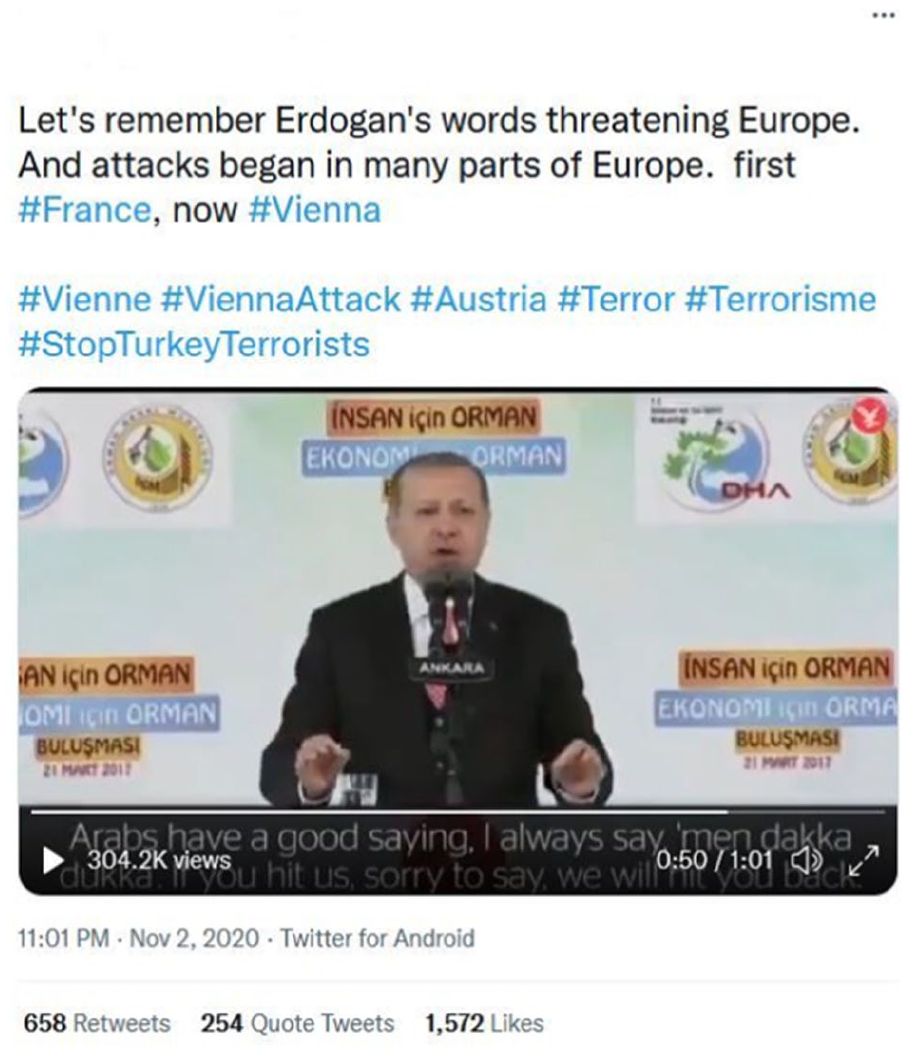
The tweet with the widest reach in community 4. As this is a private, unverified account, we have removed the name and Twitter handle.
Also in this community therefore, a connection to the terrorist attack in Mumbai twelve years earlier is drawn and the Vienna attack is placed in a global, but above all European context. In addition to the focus on Turkish President Recep Tayyip Erdoğan, however, the religious component of the attacks is also addressed, as is similar in community 6. Anti-Muslim and anti-Islamic polemics appear almost exclusively in communities 4, 5, and 6, that is, those clusters in which the strongest ideological appropriation of the attack in Vienna takes place. Here, the current event is placed in (contemporary) historical contexts and already existing collective memories to re-actualize them.
Conclusion
Our study has shown that the terrorist attack in Vienna on November 2, 2020, evoked different reactions of remembrance on Twitter. On the one hand, it has created new collective memories; on the other hand, it has been placed in different cultural and interdiscursive contexts and used to re-actualize already existing collective memories. Internationally, a current terrorist attack is integrated into already existing collective memories of other, comparable terrorist attacks and was interpreted within the discourses of memory of these attacks. Therefore, the Vienna attack also caused a great deal of attention in places where comparable attacks had occurred in the past: Madrid, Paris, Nice, Mumbai, or Brussels. It is used for a re-actualization of already established collective memories and the new event is integrated into the pre-existing narratives and interpreted accordingly. This becomes particularly clear in the example of India: even more than in France or Spain, Indian users ideologically charged the Viennese event with a strong Islamophobic connotation and a vehement opposition to Pakistan. By combining new hashtags—like the one on the Vienna attack—with old hashtags that remind people of past attacks, memory networks with a strong connection to the present are created. These can be functionalized to reassure one’s own identity and role as a community of destiny. People also use the trending hashtags to use the attention of the Vienna terrorist attack for political agitation: For example, to draw public awareness to the war between Armenia and Azerbaijan, the presidential election in the USA or the conflict between Turkey and the Kurds. However, it is not just the use of hashtags; the integration of the Viennese attack into the remembrance of previous attacks also takes place on a narrative level—as we were able to prove with our qualitative analysis.
In Austria, the situation is very different. Here, a completely new collective memory has emerged on the assault of November 2. Surprisingly, this is mainly characterized by positive narratives of community and a commemoration of the victims; Islamophobic or xenophobic content can only be observed in absolutely isolated cases and plays an absolutely subordinate role within the various Austrian networks due to the low reach. They can only be found at all with a very precise, qualitative search. This could be due to the demographic composition of the Austrian Twitter community, but further studies would be necessary. As our further analysis also shows, deleted content is a problem that should not be underestimated when working with social media data. The methods we use do not allow us to analyze these deleted tweets—as is often the case in historiography; however, we cannot know what we do not have sources for.
The subject of further studies could be how the terrorist attack in Vienna is remembered with increasing temporal distance and whether a reference to the attack of November 2, 2020, will be made in the event of other similar terrorist attacks in the future. As our research has shown, on the anniversaries of the terrorist attack, the remembrance took place practically exclusively in Austria. The focus was primarily on commemorating the victims on the one hand, and on the central question of political responsibility on the other. The assassin himself was not mentioned by name at all—here, the deliberate memory policy of not remembering his name may have been successful.
Footnotes
Declaration of Conflicting Interests
The author(s) declared no potential conflicts of interest with respect to the research, authorship, and/or publication of this article.
Funding
The author(s) received no financial support for the research, authorship, and/or publication of this article.
