



Abstract
As social media become increasingly important for science communication, scientists are grappling with their new role on these platforms. While some have called for the increased presence and training of scientists on social media, others prefer to leverage the influence of social media influencers for science communication. This study explores the effects of source identity (scientist or influencer) and self-disclosure type (personal or professional) on perceptions of authenticity and expertise, as well as parasocial interactions. In an online between-subjects experiment (N = 1579), participants rated scientists on Twitter as more authentic and qualified than influencers, and rated Twitter profiles with professional self-disclosure as more qualified than profiles with personal self-disclosure. Subsequently, participants indicated stronger parasocial interactions, higher information-seeking intentions, and higher prosocial intentions. Anti-intellectualism was found to moderate these relationships. These findings suggest that scientists can employ certain strategies as they seek to establish themselves and reach wider audiences on social media platforms.
Keywords
Introduction
In late 2017, a call for action appeared in a letter published in Science: “Scientists need social media influencers” (Galetti & Costa-Pereira, 2017). The letter argued that influencers were particularly well-positioned to leverage their power to promote scientific issues, since most scientists themselves are not appropriately trained to communicate with the public. Less than a month later, another equally laconic call appeared, again in Science: “Social media: More scientists need” (Mojarad, 2017). The author challenged the notions raised in the first letter, pointing out the potential dangers of having non-expert influencers speak on scientific issues and instead calling for increased training for scientists to do so themselves.
While the two letters prompted an ongoing conversation among the scientific community that continues today, both implicitly acknowledge three key points regarding the role of scientists on social media. First, social media platforms are a vital site for science communication, allowing scientific messages to be promoted and discussed in a public arena. Second, scientists should be actively involved in managing this process in some way. And finally, influencers are an important group on these platforms who can either assist or harm this process; at the very least, their influence reaches a wide and diverse audience, subsets of which might be uniquely difficult for scientists themselves to reach.
Together, these three points suggest the following questions to consider: What are the strategies and mechanisms that have allowed influencers to form such powerful relationships with their followers? How might they be applicable to scientists’ and science communicators’ strategic messaging on social media? And finally, how do audiences respond to scientific messages from influencers and scientists? Are there particular circumstances in which one source may be better than the other? These questions serve as the motivations behind this study, as they help to provide more nuances to these ongoing conversations. Similarly, they may help science communicators leverage useful strategies for reaching wider and more diverse audiences and more effectively collaborate with groups like influencers for targeted messaging.
Already, we see scientists are using social media platforms such as Twitter to inform the public about their research and various scientific issues (Cheplygina et al., 2020; J.-S. M. Lee, 2019). Their presence on these platforms signals an opportunity to directly engage, in an unfiltered and interactive manner, with large swaths of the public. Notably, though, these scientists are not using social media to only engage in intentional science communication. Rather, they use them like everyone else: to share their daily experiences and personal interests, comment on current social and political events, and offer critiques shaped by their own backgrounds as a way to reflect their identities, personalities, beliefs, and values (Jünger & Fähnrich, 2020; Murthy, 2012). In other words, these scientists are engaging in different forms of self-disclosure, a strategy frequently employed by influencers (e.g., S. S. Lee & Johnson, 2022; Leite & Baptista, 2021), to share the “behind-the-scenes” of a scientist and to form relationships with their own followers.
As such, this study seeks to examine the effects of source identity (e.g., is the person posting the scientific information a scientist or an influencer?) and self-disclosure types. Specifically, we focus on (a) how audiences might differentially perceive various content from these two sources in terms of authenticity and expertise, (b) how that may influence the (parasocial) relationships that audiences form, and (c) how those perceptions and relationships affect prosocial intentions in the context of two scientific issues (environment and health). Broadly, we focus on these variables (authenticity, expertise, and parasocial interactions [PSI]) due to their roles in how people form relationships with (online) sources and how they process the information they receive from these sources. Understanding these processes is important for evaluating strategic and science communication as situated within a social media context; that is, are there effects on individuals’ attitudes and behaviors (specifically, their information-seeking and prosocial intentions) when consuming scientific information on social media? In addition, we consider anti-intellectualism as an important moderator of these relationships to investigate whether a certain subset of the population (e.g., individuals who inherently do not trust experts) might be more receptive toward certain self-disclosure types or sources on social media.
Therefore, this study examines a moderated mediation model such that source identity and self-disclosure type influence the parallel mediators of authenticity and expertise, which are then predicted to positively impact the serial mediator of PSI, which is ultimately expected to positively influence information-seeking and prosocial intentions. Altogether, this interdisciplinary study integrates theoretical insights from research on influencers, marketing, and science, political, and computer-mediated communication to offer a more nuanced perspective on how scientists might approach their public communication on social media platforms.
Literature Review
First, it is useful to situate this study within the larger conversations surrounding “science communication” and its conceptualization(s). We draw upon newer models of science communication (Bubela et al., 2009; Fischhoff & Scheufele, 2013) to view science communication as a multidirectional, multistakeholder dialogue, debate, and engagement with issues that are in some way related to science, scientific institutions, or the scientific epistemology. That this study focuses on source identity and self-disclosure reflects a recognition that social media allow for both traditional and non-traditional actors to share different types of scientific information, and that audiences can engage with this information in accordance with their other beliefs.
Next, we review the effects of source identity and self-disclosure, drawing from a growing body of work that has examined similar questions in the realm of influencers and celebrities. Afterward, we summarize and discuss literature that forms the foundation for the key concepts in this study and propose our hypotheses and research questions.
Source Identity
As social media and other digital platforms are increasingly positioned as more interactive channels for science communication (Liang et al., 2014), one important consideration is the diversification of who can communicate about scientific topics. That is, anyone can ostensibly share (scientific) information and opinions on these platforms, which can be re-shared and spread to large segments of the population (Cheng et al., 2014). Still, the identity of the source matters: After all, aspects such as their expertise have the potential to influence how people evaluate and respond to messages (Petty & Cacioppo, 1984). Here, we focus on two prominent groups who do communicate scientific issues on social media platforms—influencers and scientists—and discuss their roles and influence in these spaces.
Influencers have risen as a formidable force on social media, with brands and companies increasingly collaborating with these sources to leverage their relationships with their followers (Jin et al., 2019; Nouri, 2018). Here, we employ Freberg et al.’s (2011) definition of social media influencers—“independent third party endorsers who shape audience attitudes through blogs, tweets, and the use of other social media.” Influencers are also noted for their significant number of followers, who follow them for their content production and interactions (Enke & Borchers, 2019). Because of this large following, and the relationship cultivated with their followers, influencers can, in essence, act as opinion leaders (Borchers, 2019). We note that this conceptualization is intentionally broader, as we are interested in this group of individuals who, despite not being associated with any scientific, media or political institution, can still influence their audience’s (scientific) attitudes and behaviors. As such, we also exclude the requirement for influencers to monetize their content in this study.
While research on influencers has predominantly examined their role in marketing and brand advertising contexts, an emerging focus has explored their participation in the social and political discourse on social media platforms (e.g., Naderer, 2023). Of particular interest is the rise of the “eco-influencer” or “sustainability influencer,” whose content seeks to promote sustainable lifestyle choices and social change as well as educate their followers (Yalcin et al., 2021). Similarly, we have seen a surge of influencers in the health and wellness domain, who work to provide their followers with the necessary information to empower them and impact their health attitudes and behaviors (Thompson, 2022). These influencers rely on a combination of their own experiences, research, and personal values to do so (Cornelio et al., 2021). Thus, we focus on influencers as one important source due to (a) their rising influence in science-related domains and (b) their ability to establish and manage unique relationships with their followers.
In a sense, scientists are influencers as well—that is, influencers with direct scientific expertise who are affiliated with scientific institutions—under this particular conceptualization. Of course, audiences may not recognize scientists as traditional “influencers,” but scientists have certainly carved out a space of their own on social media platforms. Twitter is particularly unique, as nearly 300,000 scientists were on that platform alone at the height of its popularity (Costas et al., 2020). Their potential impact certainly rivals that of some influencers: A 2018 analysis found that once scientists exceed 1,000 followers, they are often followed by educational organizations, members of the media, public audiences with otherwise no scientific expertise and/or education, and even policymakers (Côté & Darling, 2018). So too, scientists have turned to platforms like TikTok and Instagram, two increasingly popular platforms among teenagers and young adults in the United States, to share not only their research but their personal experiences both within and outside science.
Because of both scientists’ and influencers’ prominence in these spaces, we choose to look at their presence on Twitter. Next, we provide a brief overview of one prevalent strategy that both sources—whether intentionally or not—employ in their communication with the public: self-disclosure.
Self-Disclosure
Self-disclosure is broadly defined as the act of revealing information about oneself to others (Archer, 1980; Derlega et al., 2008). Already, research has shown that both scientists and influencers could—and do—engage in different types of self-disclosure on Twitter: professional self-disclosure (PFSD) and personal self-disclosure (PSD) (Kim & Song, 2016; Zhang & Lu, 2022). In the context of this study, we define PFSD as the sharing of either professional experiences and research related to a scientist’s career or blog and podcast-related content related to an influencer’s interests. Since PFSD arguably manifests differently for influencers and scientists due to their respective backgrounds, we include this distinction in our conceptualization. However, we do not include this difference for PSD, which we define as the sharing of personal interests, hobbies, and other non-science-related information, since such information is unrelated to a source’s scientific experiences.
These two types of self-disclosure are important for influencers both as a self-branding technique and to develop interpersonal relationships with their followers (Altman & Taylor, 1973; Gannon & Prothero, 2016). As Murthy (2012) noted, “[it is] an important tool to say ‘look at me’ or ‘I exist’” (p. 1062). A number of studies have already highlighted the role of influencers’ or celebrities’ self-disclosure on key interpersonal relationship variables as well as attitudes and behavioral intentions.
While scientists may not use social media solely for the same purpose, research has shown that scientists still do engage in self-disclosure on platforms like Twitter. A 2015 survey of over 600 scholars found that 42% reported using the same Twitter account for tweeting both professional and personal information (Bowman, 2015). The profiles of popular scientists such as @ravenscimaven (a microbiologist with 135k followers) or @starstrickenSF (an astrophysicist with 135k followers) similarly show that these scientists, like influencers, are sharing personal information about their lives and interests alongside their research, careers, and other scientific messages. However, research remains inconclusive as to whether PFSD or PSD might be most appropriate in the context of science communication. As such, we examine these two self-disclosure types, alongside source identity, in the context of how they might influence relevant interpersonal variables and processes. Next, we provide an overview of these factors.
Authenticity, Expertise, and PSI
Crucial to the success of influencers—and communicators broadly—is the cultivation of perceived authenticity and expertise, which drives these relationships that allow for persuasion to occur (Hendry et al., 2022). Authenticity, in particular, has been posited as an important factor in advertising and marketing (Pöyry et al., 2019). Defined as “the feeling and practice of being true to one’s self or others” (Vannini & Franzese, 2008, p. 1621), authenticity has been shown to increase the effectiveness and credibility of messages (Brown et al., 2003). Notably, Abidin (2018) argues that authenticity is “more of a performative ecology and parasocial strategy with its own bona fide genre and self-presentation elements” (p. 91); that is, authenticity is about perception and performance.
Another important factor is the establishment of expertise. Source expertise broadly refers to whether a source is viewed as competent and capable of providing correct claims (Pornpitakpan, 2004). Perceptions of the source’s expertise often serve as a “mental shortcut” that can be used to evaluate various messages, especially if an individual holds no a priori attitude about the topic and lacks the opportunities and resources to form one (Kumkale et al., 2010; Petty et al., 2002). For example, research has shown that levels of source expertise can influence perceptions of online health information (Eastin, 2001) and induce stronger agreements with the position advocated for within a message (Swartz, 1984).
Both authenticity and expertise can prompt PSI with the source, our third factor of interest (Hendry et al., 2022). PSI arises from the “illusion of a face-to-face relationship with a performer,” otherwise known as an imagined “intimacy at a distance” (Horton & Wohl, 1956, p. 215). A number of mechanisms have been posited to explain the formation of PSI on social media, such as social presence, perceived similarity, authenticity, and the presence of personal information (Kim & Song, 2016; Liu et al., 2019). Past work has also found that PSI is an important underlying mechanism for why influencers are effective product endorsers (for a review, see Hudders et al., 2021) and can explain attitudes toward various sources (e.g., Carrington, 2021).
We chose to examine these three factors—authenticity, expertise, and PSI—not only because they are theoretically important constructs in strategic communication and persuasion broadly, but also because they are uniquely relevant to the particular context of this study. On one hand, influencers purposefully construct and express authenticity in their content to establish PSI with their audiences (Hund, 2019). To do so, they employ different strategies such as self-disclosure, message-sidedness, and interactivity (Jun & Yi, 2020; S. S. Lee & Johnson, 2022). On the other hand, scientists who use social media with the goal of sharing research and other scientific information may not as intentionally focus on constructing authenticity or building PSI. More so, scientists on social media may still suffer from general biases and stereotypes of scientists: They are often seen as competent but cold (Fiske & Dupree, 2014). That is, while influencers rely on their perceived authenticity and relationships with their followers for persuasion, scientists may have to first counter these biases and/or rely more heavily on another factor: their expertise. Scientists’ expertise is also distinct from that of influencers: While the latter’s is established through both their sharing of expertise (e.g., keeping up with the latest research and trends) and their personal experiences (Hendry et al., 2022), their expertise is often not subjected to the rigor of traditional, scientific expertise. Thus, we propose the following hypothesis:
Similarly, these factors may also manifest differently depending on the type of self-disclosure. A 2021 study showed that an influencer’s intimate self-disclosure (which resembles PSD) can strengthen consumers’ attitudes toward a brand, as mediated through PSI (Leite & Baptista, 2021). So too, PSD is an oft-used strategy to increase perceptions of a source’s authenticity (Gannon & Prothero, 2016). On the other hand, PFSD may be more likely to increase perceptions of expertise. For example, when candidates self-disclose information related to their campaign or the political experience (i.e., a form of PFSD), voters may see them as more competent in that particular issue, but not necessarily more authentic (Coffé & Theiss-Morse, 2016; Rosh & Offermann, 2013). As such, we propose,
All told, both source identity and self-disclosure types have the potential to differentially impact authenticity, expertise, and PSI. So too, we may expect source identity and self-disclosure types to interact with each other. For example, since audiences may already be familiar with influencers’ use of PSD but not necessarily scientists’ (and vice versa for PFSD), we may find different effects on these three factors. But to date, no work has examined any potential interaction effects between self-disclosure type and source identity. Thus, we ask,
Persuasive Outcomes
In this study, we are interested in two specific downstream outcomes: information-seeking and prosocial intentions. The former is the extent to which an individual is likely to seek out more information about the scientific topics within the source’s messages. Information-seeking intention is an important variable in that increased information-seeking, like science curiosity, can promote learning and counter politically motivated reasoning of certain scientific issues (Kahan et al., 2017). The latter refers to prosocial behavioral intentions related to the particular scientific context of the messages. Specifically, this study examines two contexts: environmental and health-related issues. We chose these two contexts due to the prevalence of both scientists and influencers in each domain and their relevance to the general public (Byrne et al., 2017; Cornelio et al., 2021). While the contexts themselves could certainly influence these persuasive outcomes (e.g., the health context may be particularly relevant given the Covid-19 pandemic), we are more interested in the broader patterns and relationships that transcend specific contexts to increase the generalizability of our findings.
Already, a myriad of research in the influencer marketing and persuasion domain has shown that authenticity, expertise, and PSI do indeed impact how individuals respond to messages, some of which we briefly discuss in the previous sections. Specifically, sources who are seen as authentic and experts are capable of influencing audiences’ decision-making process (Hudders et al., 2021). Similarly, PSI with influencers can strongly predict purchase intentions (Masuda et al., 2022); so, too, PSI with eco-influencers can increase social media users’ own environmental activism (Knupfer et al., 2023). Therefore, there is reason to believe that these three factors will be positively associated with both persuasive outcomes. Taken together, the literature suggests that perceptions of authenticity and expertise can both lead to PSI, which can in turn lead to our two persuasive outcomes. So, we propose the following sequential paths:
Anti-Intellectualism
The final component of our model considers a potential moderator, to identify one subset of the population to which these mechanisms might be particularly germane. Specifically, we look at anti-intellectualism as a unique moderator that might influence how different audiences might respond to source identity and self-disclosure types. We draw our conceptualization of anti-intellectualism from recent research in the realm of political communication. Broadly, anti-intellectualism indicates a “general skepticism of science and expert opinion” (Oliver & Rahn, 2016, p. 198). Individuals with higher anti-intellectualism are suspicious of scientific expertise and knowledge and defer rather to common wisdom and folk knowledge. More so, anti-intellectualism is correlated with conservatism and endorsement of conspiracy theories, indicating to some extent an ideological character as well (Barker et al., 2022; Oliver & Rahn, 2016).
Thus, these individuals may be more likely to view scientists in a negative light (e.g., less authentic, less competent), making them a particularly hard subpopulation for scientists and typical science communicators to reach. But, influencers might be one potential source for which individuals with high anti-intellectualism might actually view more positively. A digital ethnographic case study of a health influencer found that the influencer often situated her health knowledge and expertise within her own personal experiences (Hendry et al., 2022). In addition, unlike scientists, influencers are not directly involved in institutional science and research; therefore, they may seem more relatable to individuals with high anti-intellectualism. Already, some public organizations have turned toward influencers to communicate scientific issues such as Covid-19, and their success indicates that certain subpopulations do exist that respond more positively to influencers instead of traditional science communication actors (Pöyry et al., 2022). How anti-intellectualism might influence the relationships between self-disclosure type and our outcome variables is also unclear, as research has not examined such questions in an experimental context. As discussed earlier, the presence of PSD and the centering of personal experiences might be more appealing to individuals with high anti-intellectualism. PFSD, on the contrary, may not be as effective, since PFSD explicitly highlights the source’s research and work, potentially reinforcing perceptions of the source as someone who thinks they know more than the general public. Still, given the lack of experimental evidence thus far, we ask as a research question,
In addition to the above-stated hypotheses and research questions, we also explore whether source identity and self-disclosure types may have any total effects on information-seeking or prosocial intentions, and whether such effects may be moderated by anti-intellectualism. The conceptual framework for this study is shown in Figure 1.

Conceptual framework.
Methods
Participants
The present experiment employed a 2 (source identity: scientist or influencer) × 2 (self-disclosure type: PFSD or PSD) × 2 (context: environment or health) between-subjects factorial design. We recruited 1,600 U.S. participants in September 2022 through the online participant recruitment platform Prolific (Palan & Schitter, 2018), and retained 1,579 after excluding those who failed to answer the two attention check questions correctly. The average age of the remaining participants was 37.5 (SD = 12.8) years. Almost half of the sample (49.3%) were female, 48.8% were male, and 1.6% were nonbinary or did not indicate their gender. The majority of the participants were White (73%), followed by African American (10%), Asian (7%), Hispanic or Latine (7%), and 3% of participants who identified as “other.” Half of the participants had received either a bachelor’s degree (40%) or a master’s degree (11%). More than half of the participants reported using Twitter at least several times a week (57%), and 37% reported that they follow at least one scientist on Twitter.
Experimental Design
Upon consenting to the experiment, participants were randomly assigned to one of the eight conditions. Prior to viewing the Twitter profile, they read a short paragraph describing the source (Olivia Myers); the purpose was to ensure that the audiences were aware of the source’s identity as either a scientist or an influencer. Next, they were shown the Twitter profile for the source. While the profile picture was held constant, the username and Twitter bio were manipulated depending on the source and scientific context.
Each profile contained eight tweets that were divided as follows: three tweets for the self-disclosure manipulation, three informative tweets for the scientific context manipulation, and two additional persuasive scientific tweets. For the self-disclosure manipulation, participants were exposed to either three PFSD or PSD tweets. Depending on the source identity, the PFSD tweets consisted of information about either a scientist’s academic and research background, experience, or career plans or an influencer’s blog and podcast content, work, and other accomplishments. The PSD tweets referred to the source’s personal interests and relationships and did not vary by source identity. Finally, as stated earlier, the final manipulation was the scientific context (either environmental or health-related issues). The order of the tweets was fully randomized to avoid potential confounds due to the particular viewing order (see Online Appendix A for a sample profile as well as the full stimuli used across each condition).
Prior to exposure to the stimuli, participants responded to questions assessing individual characteristics, including anti-intellectualism. After exposure, participants answered a series of questions assessing their responses toward the stimuli and attitudes toward the source of the tweets. All measures employed in the study are included in Table 1.
Measures Employed in the Study.
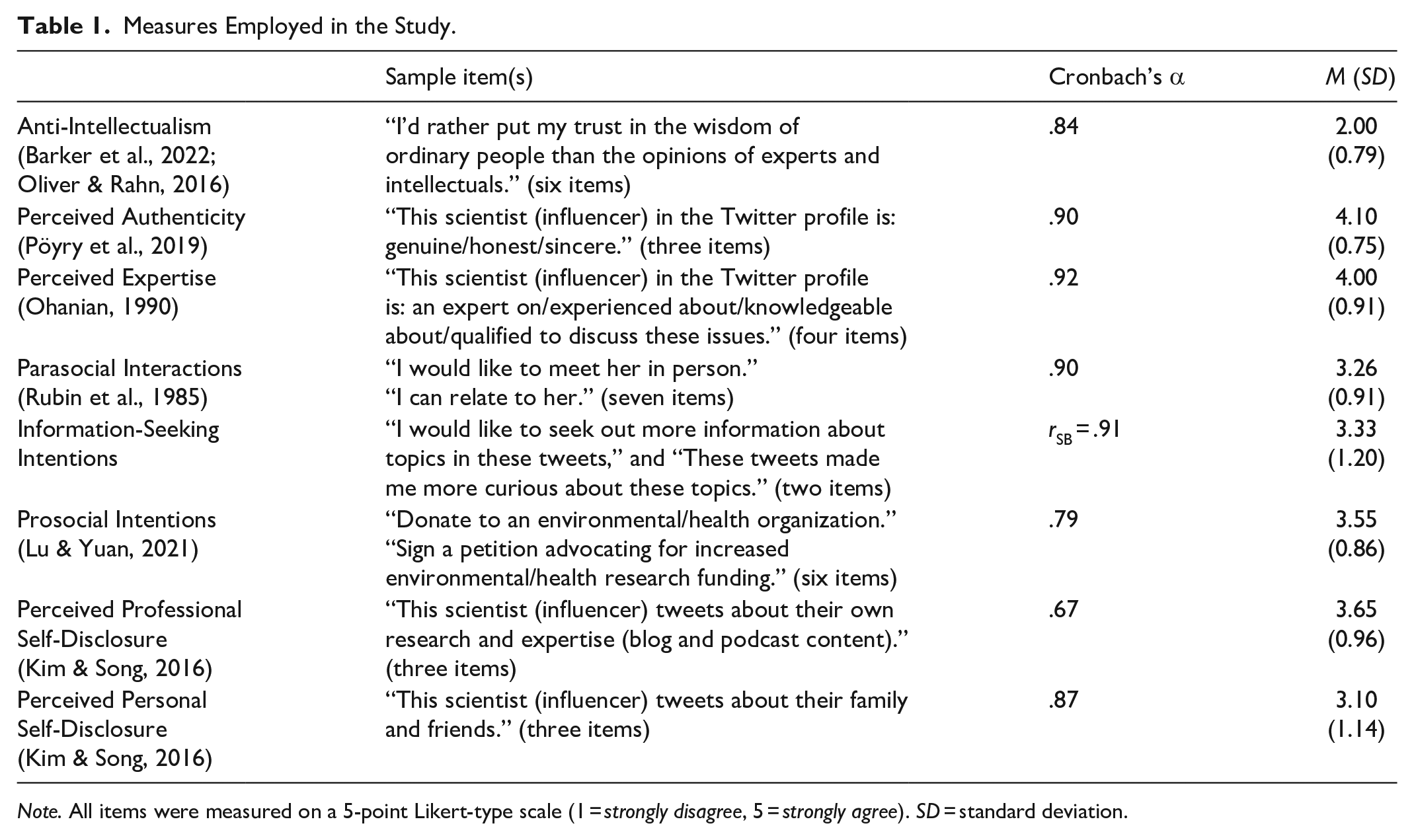
Note. All items were measured on a 5-point Likert-type scale (1 = strongly disagree, 5 = strongly agree). SD = standard deviation.
Results
Induction Checks
We performed two independent-sample t tests to examine our manipulation of the self-disclosure types on perceived PFSD and perceived PSD of the stimuli. Participants in the PFSD condition perceived the Twitter profiles as higher in perceived PFSD (M = 4.13, SD = 0.72) than the profiles without PFSD (M = 3.20, SD = 0.93), t(1577) = –22.10, p < .001. Similarly, participants in the PSD condition perceived the Twitter profiles as higher in perceived PSD (M = 3.91, SD = 0.66) than the profiles without PSD (M = 2.24, SD = 0.90), t(1577) = –42.40, p < .001. As such, the t tests indicated successful manipulations of the PFSD and PSD experimental conditions.
Hypotheses Tests
First, we employed a series of three-way analysis of variance (ANOVA) to test the effects of the experimental conditions (source identity, self-disclosure, and context) and their two-way and three-way interactions on all of our outcome variables—perceptions of the source as (a) authentic and (b) an expert, (c) intentions to engage in PSI, (d) information-seeking intentions, and (e) prosocial intentions (Table 2). We found significant main effects of source identity on perceived authenticity, F(1, 1579) = 53.82, p < .001,
Main Effects of Experimental Manipulations on All Variables.

Note. Numbers, except for those in the last row, are mean differences based on estimated marginal means and standard errors (in parentheses). SD = self-disclosure; PSD: personal self-disclosure.
p < .01. ***p < .001.
We also found significant main effects of self-disclosure type on perceived expertise, F(1, 1579) = 39.07, p < .001,
Next, we used Hayes’s (2018) PROCESS 4.0 macro for IBM SPSS Statistics for our moderated mediation analyses, with 95% confidence intervals (CIs) based on 5,000 bootstrapped samples. We created three categorical variables to represent each of the three manipulations, where the reference groups were the “scientist” condition for source (scientist = –1, influencer = 1), “professional” for self-disclosure type (professional = –1, personal = 1), and “environment” for scientific context (environment = –1, health = 1). We employed a customized model following the pathway in Figure 1. Specifically, we employed two parallel mediators (authenticity and expertise) as the first part of the sequential mediation model, PSI as the subsequent mediator, information-seeking and prosocial intentions as our outcome variables, and anti-intellectualism as the moderator.
Our final research question sought to examine the moderation effects of anti-intellectualism on the relationships between source identity, as well as self-disclosure, and authenticity, expertise, PSI, and our persuasive outcomes (see Table 3). First, we found that anti-intellectualism had a significant main effect on perceived authenticity, F(1, 1579) = 5.92, p < .001,
Effects Moderated by Anti-Intellectualism.

Note. Only conditional effects for significant interactions are shown. (Low = M – 1SD; Med. = mean; High = M + 1SD). Reference group is the “scientist” condition for source, “professional self-disclosure” for self-disclosure, and “environment” for the scientific context. SE = standard error; CI = confidence interval.
Anti-intellectualism was also a significant moderator between self-disclosure type and perceived expertise (b = –0.05, SE = 0.02, p = .04), as well as PSI (b = –0.05, SE = 0.02, p = .02). Generally, the presence of PSD (as compared with PFSD) led to a lower perception of expertise and higher PSIs. However, for individuals with higher anti-intellectualism (compared with those with lower anti-intellectualism), the differences between the two self-disclosure types were larger for perceived expertise but smaller for PSI. We did not find any moderation effects between self-disclosure type and authenticity, information-seeking intentions, or prosocial intentions. Online Appendix B shows the plots of the moderation effects.
We also found that perceived authenticity led to increased PSI (b = 0.64, SE = 0.03, p < .001) but not information-seeking intentions (b = 0.02, SE = 0.03, p = .57) or prosocial intentions (b = 0.03, SE = 0.04, p = .38). Perceived expertise led to increased PSI (b = 0.24, SE = 0.03, p < .001), information-seeking intentions (b = 0.35, SE = 0.03, p < .001), and prosocial intentions (b = 0.06, SE = 0.03, p = .04). Finally, PSI led to increased information-seeking intentions (b = 0.63, SE = 0.03, p < .001) and prosocial intentions (b = 0.39, SE = 0.04, p = .38). Finally, we did not find any interaction effects between source identity, self-disclosure type, and anti-intellectualism. Figure 2 depicts the constructed model with the direct, unmoderated pathways with unstandardized coefficients.

Full constructed model showing only the direct, unmoderated pathways with unstandardized coefficients (see below tables for conditional effects of moderation by anti-intellectualism). Non-significant paths are not shown, as well as the significant positive paths from anti-intellectualism to all subsequent variables.
Finally, we examined the conditional indirect effects for both the source identity and self-disclosure manipulations, as moderated by anti-intellectualism (Tables 4 and 5). Specifically, the source identity indirectly influenced information-seeking intentions through expertise (index of moderated mediation = 0.05, SE = 0.01, 95% CI = [0.03, 0.07]), as well as authenticity → PSI (index of moderated mediation = 0.03, SE = 0.01, 95% CI = [0.00, 0.05]), and expertise → PSI (index of moderated mediation = 0.02, SE = 0.01, 95% CI = [0.01, 0.03]). Similarly, the source identity also indirectly influenced prosocial intentions through expertise (index of moderated mediation = 0.01, SE = 0.01, 95% CI = [0.00, 0.02]), as well as authenticity → PSI (index of moderated mediation = 0.02, SE = 0.01, 95% CI = [0.00, 0.03]), and expertise → PSI (index of moderated mediation = 0.01, SE = 0.00, 95% CI = [0.01, 0.02]). Self-disclosure type indirectly influenced information-seeking intentions through PSI (index of moderated mediation = –0.03, SE = 0.01, 95% CI = [–0.06, –0.01]). Similarly, self-disclosure type also indirectly influenced prosocial intentions through PSI (index of moderated mediation = –0.02, SE = 0.01, 95% CI = [–0.04, –0.00]). Data for this study, as well as the code for the model, can be found at https://osf.io/yd5g2/?view_only=9114455b83494eebb55f6051db88fa4a.
Indirect Effects Moderated by Anti-Intellectualism for Information-Seeking Intentions.
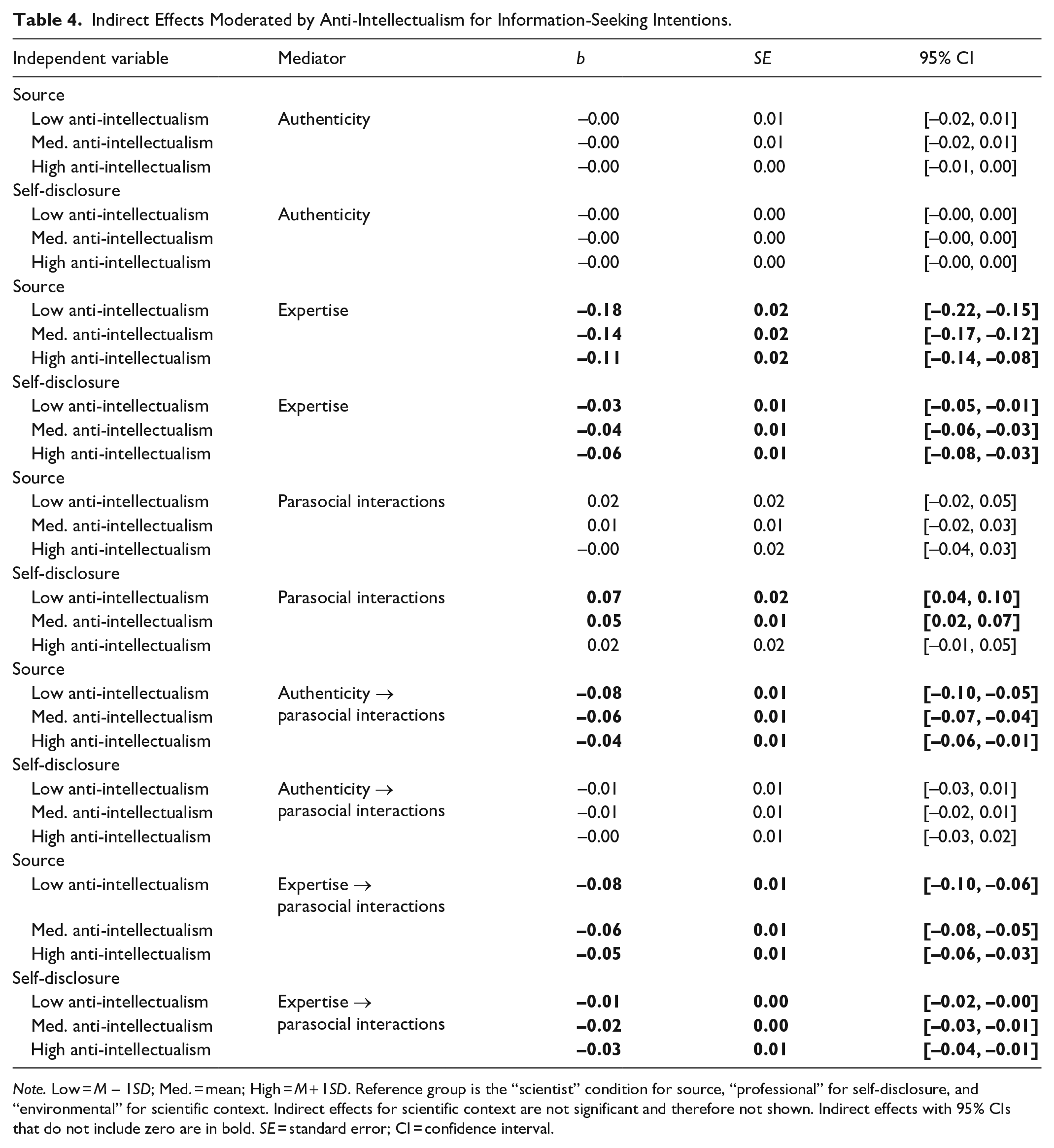
Note. Low = M – 1SD; Med. = mean; High = M + 1SD. Reference group is the “scientist” condition for source, “professional” for self-disclosure, and “environmental” for scientific context. Indirect effects for scientific context are not significant and therefore not shown. Indirect effects with 95% CIs that do not include zero are in bold. SE = standard error; CI = confidence interval.
Indirect Effects Moderated by Anti-Intellectualism for Prosocial Intentions.

Note. Low = M – 1SD; Med. = mean; High = M + 1SD. Reference group is the “scientist” condition for source, “professional” for self-disclosure, and “environmental” for scientific context. Indirect effects for scientific context are not significant and therefore not shown. Indirect effects with 95% CIs that do not include zero are in bold. SE = standard error; CI = confidence interval.
Discussion
As social media become increasingly important for science communication, scientists are grappling with their new role in these spaces. While some have called for the increased presence and training of scientists on social media, others prefer to leverage the influence of another group: social media influencers (Galetti & Costa-Pereira, 2017; Mojarad, 2017). Admittedly, no other group has quite as effectively navigated the world of persuasion and strategic communication on social media as have influencers. They are, after all, coined “influencers” due to the influence they have established among their followers through various strategies. But can scientists too employ these strategies as they carve out their own space on these platforms? This study sought to provide an initial examination of that question, revealing that (a) concepts such as authenticity, expertise, and PSI can also influence how audiences respond to scientists and scientific messages; (b) PFSD may be a useful strategy for scientists to employ on Twitter; and (c) for certain subpopulations, such as individuals with high anti-intellectualism, influencers have the potential be a more appropriate source.
First, we found that the identity of the source can significantly influence how people respond to both the source and the content of the message. Notably, scientists were perceived as higher in authenticity and expertise than influencers, and audiences indicated higher intentions to engage in PSI with scientists compared with influencers. These results are interesting in that they show scientists, with their direct expertise and affiliation with scientific institutions, still hold a dominant influence on scientific issues such as those related to the environment and health. That is, scientists have the potential to be just as effective influencers on social media. Second, concepts like authenticity and PSI, which have been heavily explored in the influencer and celebrity marketing literature, are not exclusive to the traditional influencer alone. Scientists can similarly leverage strategies that seek to influence these variables, which have proved to be a hallmark for how influencers remain such persuasive sources for their audiences.
Our results also suggested that the type of self-disclosure similarly can impact source perceptions. Interestingly, while PSD did not increase the authenticity of the source, it did decrease their expertise compared with the presence of PFSD. Of course, while this finding does not necessarily imply that sources should engage in only PFSD instead of PSD, it does warrant further examination into why this difference exists. One potential explanation may lie in the unique context of this study: science communication on Twitter. Since the content was situated in a heavily scientific context (e.g., at least five out of the eight tweets in both the influencer’s and the scientist’s profile covered scientific issues and topics), perhaps the presence of PSD felt out of place to the audience, who then rated the source as lower in expertise. However, this does raise important questions about how PSD might broadly impact perceptions of any science communicator on social media, scientists and influencers alike. Next, the moderated serial multiple mediation analyses revealed a number of notable findings regarding the role of authenticity, expertise, PSI, and anti-intellectualism. First, both authenticity and expertise influenced PSI, such that higher perceptions of authenticity and expertise led to increased PSI. Then, as PSI increased, so too did information-seeking and prosocial intentions.
Finally, we also found anti-intellectualism to be an important moderator of the aforementioned relationships. The results showed that regardless of anti-intellectualism levels, scientists were still perceived as higher in authenticity and expertise than influencers, although these differences did decrease for individuals with higher anti-intellectualism. However, influencers actually were more effective for eliciting prosocial intentions at all three levels of anti-intellectualism, but again, the differences decreased among individuals with higher anti-intellectualism. This finding is noteworthy, in that prosocial intentions directly relate to (intended) behaviors that are ostensibly “influenced” by the source. Similarly, anti-intellectualism also moderated the relationships between self-disclosure and our outcomes of interest: While PFSD (compared with PSD) led to increased perceptions of expertise, PSD (compared with PFSD) led to increased PSI.
As contemporary science communication ecologies increasingly facilitate multidirectional and multistakeholder communication (Peters et al., 2014), the findings may provide insight into how scientists, particularly those on social media, might interact, engage, and manage their relationships with public audiences. For example, the results emphasized the role of PSI as a key mechanism in science communication as it occurs on social media platforms. Like Peters et al. (2014) note, “new infrastructures allow nearly instantaneous access to information and make it easier for communicators . . . to directly address a broad audience” (p. 749). In addition, both PFSD and PSD strategies helped to elicit such PSI. This finding emphasizes, as Zhang and Lu (2022) point out, “the need to consider a more holistic approach to science communication as it occurs on social media,” particularly the fact that how people receive “scientific messages (on social media) is now impacted by other [content,] or at least by the impressions formed from those other tweets (which may not even be related to the strategic message itself)” (p. 14). Overall, we advocate for the centering of the relationships between scientists and the public audience. Social media offer a unique opportunity to develop these relationships, and the nature of these relationships subsequently can have important implications. Such a perspective mirrors science communication theories that have moved beyond an information-deficit model (Sturgis & Allum, 2004), and highlights the need to more explicitly consider how audiences feel toward the scientists and the nature of their relationships. So, too, when non-scientists and other stakeholders can also participate in this age of “science communication 2.0” (Peters et al., 2014), our findings show that audiences do respond differently to stakeholders with different levels of scientific expertise and associations with scientific institutions. These responses subsequently hold important implications for how they perceive scientific information on social media.
But equally, these findings warrant a consideration of the ethical challenges of persuasive and strategic science communication. That is, might this type of “influencing” (or, “self-presentation” of science, as Peters et al., 2014 note) be at odds with the deliberative ideals and fundamental norms of science and science communication? One point to consider is the often inextricably linked nature of the personal and the professional on social media: Scientists may cultivate these relationships through their sharing of personal information, unrelated to science, and then use these platforms to also share persuasive scientific messages (Zhang & Lu, 2022). That these processes are occurring in the same space raises ethical and normative considerations of how scientists might navigate social media broadly, but does that mean they shouldn’t happen at all? Certainly, while questions of such scope cannot be addressed in full here, we do point to Nisbet’s (2009) guiding principles on the ethics of using frames in science policy—that they should promote dialogue and commonality, emphasize the underlying values, be transparent, and not target certain populations. We believe these principles similarly apply—that scientists on social media should seek to be transparent and accurate in their messaging, and encourage and practice engagement with the public in meaningful ways—as they communicate with audiences on social media.
Altogether, where do the findings of this study leave us in the broader debate about the role of scientists in social media and influencers in science communication? We hope to contribute a more nuanced perspective to this conversation by highlighting a few final considerations. First, scientists and science communication scholars can learn from and leverage certain strategies that influencers often employ in their communication with their followers. Both scientists and influencers are opinion leaders; still, the way that influencers express authenticity, highlight their expertise, and cultivate PSI can be useful for scientists to establish meaningful relationships with their own followers on social media. Then, we identified a subset of the population for which source identity may become particularly pertinent. Individuals with higher anti-intellectualism can react differently to the same scientific information from an influencer than from a scientist, compared to those with lower anti-intellectualism. With the rise of anti-intellectual discourse on Twitter, even before Elon Musk’s takeover of Twitter, that has sought to antagonize and delegitimize scientists and their motivations (Chen et al., 2023), scientists may face increased difficulty reaching and addressing these populations. Will influencers serve as effective sources in these situations, where anti-intellectualism might even transcend beyond the identity of the source? Or will influencers become an even more viable option in these circumstances as they are not as directly tied to scientific institutions and expertise? While we do not have a conclusive answer, these recent trends certainly render worthwhile further consideration of scientists’ and (science) influencers’ roles in science communication on social media.
Limitations and Future Directions
Notwithstanding the contributions of this study, we note a few limitations. First, our sample was drawn from a non-representative sample of U.S. Prolific users, which limits the generalizability of this study. In particular, our users indicated higher education attainment than the general U.S. population (U.S. Census Bureau, 2022), which may impact, for example, their overall anti-intellectualism as well as their responses toward scientific content. In addition, we note the results may be unique to a U.S. context, as the United States often represents a special case with respect to public opinion on various scientific issues (Poushter et al., 2021). Second, because the sources in the profiles were not real, these results may not entirely resemble a real-world situation in which audiences have already developed a parasocial relationship with either a scientist or an influencer. While this was intentional in order to avoid confounds due to preexisting attitudes toward the sources, future studies could consider employing actual scientists and influencers to examine how these concepts and relationships manifest when audiences have known the source for an extended period, and whether anti-intellectualism may have stronger effects on these relationships. We also opted for a woman scientist/influencer, as reports show that influencers are predominately women (“Influencer Marketing Report,” 2023); however, women are generally seen as less likely to be authority figures or experts, which may further influence how audiences perceive their scientific messages or react to them as sources broadly (Banchefsky et al., 2016; King, 2021). Third, it is important to note that the mean level of anti-intellectualism within our sample was relatively low. Our findings, then, should be further replicated among samples with more individuals with higher levels of anti-intellectualism.
Next, it would be interesting to replicate these findings with different scientific contexts. We examined environmental and health contexts but chose to avoid explicitly polarized issues (i.e., referring to climate change or Covid-19) in order to minimize the effects of strong, prior beliefs. Still, it is often precisely these more polarized domains in which persuasion and attitude change are necessary to combat misinformation. Relatedly, the influencers in this study were meant to mimic eco-influencers who seek to elicit prosocial actions from their followers (Cornelio et al., 2021; Knupfer et al., 2023). However, we have seen a drastic increase in the number of alternative health influencers, who use the same strategies as those discussed here to promote misinformation, conspiracy theories, and anti-institutional-science rhetoric (Baker, 2022). How might scientists compare with these types of influencers, and could they still leverage these tactics to combat such misinformation? These are questions that remain to be answered in future studies.
Supplemental Material
sj-docx-1-sms-10.1177_20563051231180623 – Supplemental material for Scientists as Influencers: The Role of Source Identity, Self-Disclosure, and Anti-Intellectualism in Science Communication on Social Media
Supplemental material, sj-docx-1-sms-10.1177_20563051231180623 for Scientists as Influencers: The Role of Source Identity, Self-Disclosure, and Anti-Intellectualism in Science Communication on Social Media by Annie Li Zhang and Hang Lu in Social Media + Society
Footnotes
Declaration of Conflicting Interests
The author(s) declared no potential conflicts of interest with respect to the research, authorship, and/or publication of this article.
Funding
The author(s) received no financial support for the research, authorship, and/or publication of this article.

Supplemental Material
Supplemental material for this article is available online.
Author Biographies
References
Supplementary Material
Please find the following supplemental material available below.
For Open Access articles published under a Creative Commons License, all supplemental material carries the same license as the article it is associated with.
For non-Open Access articles published, all supplemental material carries a non-exclusive license, and permission requests for re-use of supplemental material or any part of supplemental material shall be sent directly to the copyright owner as specified in the copyright notice associated with the article.
