



Abstract
Ratioing describes when a reply earns more likes than an original post on social media. They also offer influencers opportunities to convert audience attention into political actions capable of temporarily shaping online discourse. Ratios are then one of many influencer-driven strategies that leverage platform features and affordances to direct audiences to specific actions that amplify the influencer’s content in the crowded social media entertainment market. Hasan Piker is one of the most popular political influencers on Twitch, which he uses as a base to organize and direct his audience into coordinated actions across multiple platforms. Piker reigns on Twitch, but has significantly less Twitter followers than all of his targets, meaning the ratio strategy prompts targeted actions that simultaneously increase his visibility. This article uses three case studies to highlight ratioing as a strategy for eliciting political participation, such as when Piker ratioed rivaling political influencers, a US Senator, and a famous rapper.
Keywords
As legislators scramble to integrate the latest social platform into their campaigning efforts (Gillespie, 2017), a rising class of political influencers implement strategies to amplify their reach in a crowded media environment (Lewis, 2020). On Twitter, a ratio describes whenever a tweet receives more replies or retweets than likes, implying that the person being ratioed has said something outlandish (Merriam-Webster, n.d.). Ratios are common on Twitter and frequently occur randomly or accidentally, meaning there is no guarantee a reply will ratio the original post. However, there have been multiple occasions when political influencers leveraged their vibrant and active audiences to intentionally ratio posts from their rivals. These strategies for manipulating attention rely on complicated assemblages of technical features and social affordances but are important to investigate as platforms and content creators become increasingly important spaces for political discourse and participation in the United States.
Hasan “HasanAbi” Piker is a political influencer who uses ratios against his rivals to blend entertainment and political rhetoric into one audacious performance. Piker is from the United States and, at the time of writing, has more than 2 million followers on the live-streaming platform and is the 13th most-viewed streamer on Twitch (Scullion, 2021). He is largely recognized as the most prominent political influencer on the platform (Lorenz, 2020). Piker’s ratios occur when his replies attract more engagement than the original tweet, making Piker’s response more visible than the original post. The original post can still be accidentally ratioed by earning more replies than likes, but Piker’s ratios are specifically intentional by calling his followers for their support. Ratios exemplify how political influencers capitalize on platform features and affordances to direct audiences to amplify their opinions across platforms.
When Piker ratios influencers, politicians, and celebrities, it encourages audiences to engage with his replies en masse to extend the reach of his political opinions. One example was “Ballgate” (Hale, 2021) when Piker challenged Nicki Minaj’s claims that an acquaintance experienced severe genital swelling due to the COVID-19 vaccine. Piker crafted his replies to Minaj during his livestreams, calling his followers to like the reply enough to ratio the original post (Figure 1). This may seem trivial, but it escalated and prompted official responses from the Trinidadian and US governments (Zeleny et al., 2021), all of which Piker integrated into his content. These ratios show how political influencers can manipulate visibility across platforms by coordinating audience participation to accomplish specific tasks.
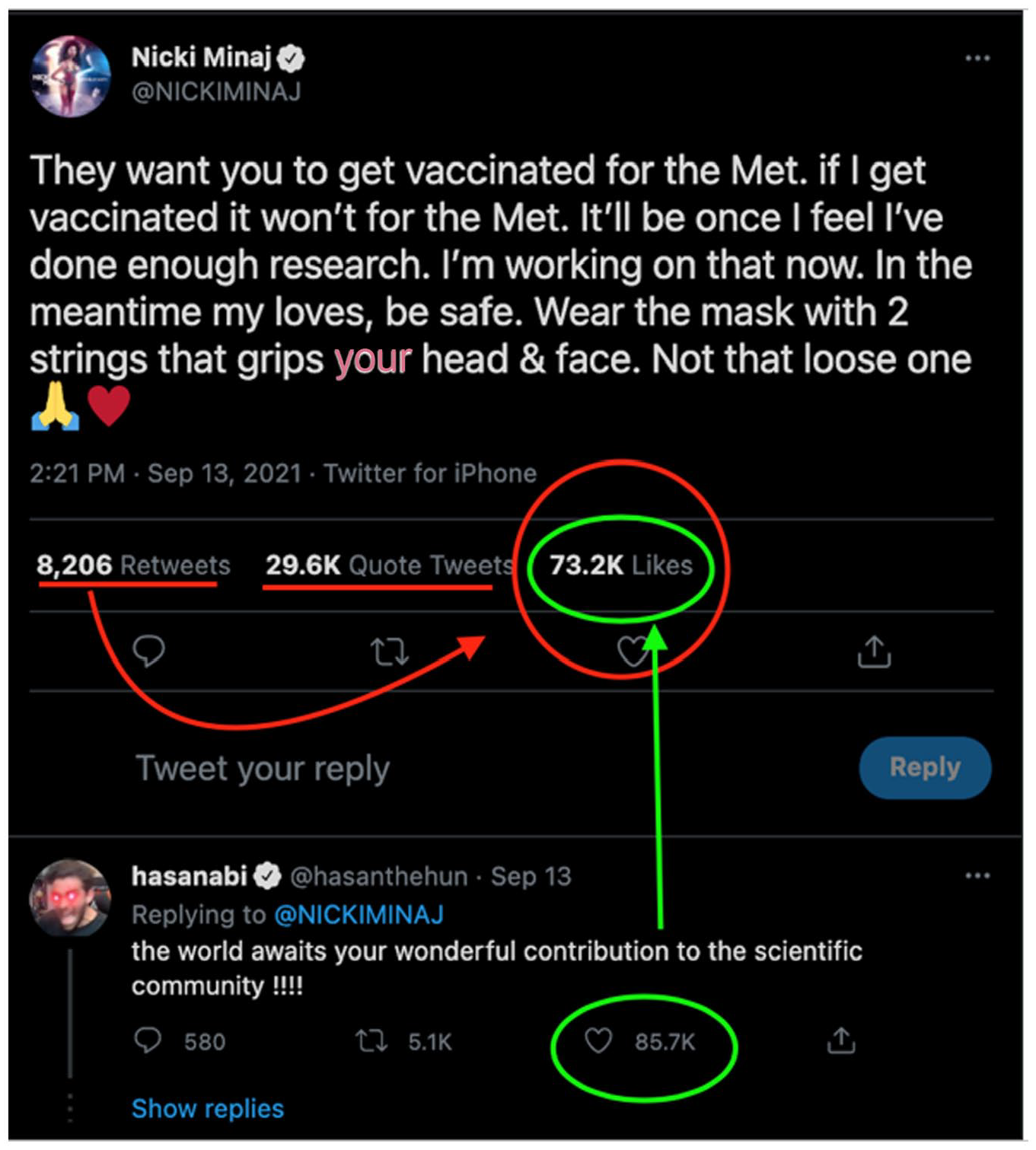
Piker ratios Minaj for spreading COVID-19 misinformation. The red lines point to Minaj’s original metrics, whereas the green lines clarify that Piker’s reply earned more likes, representing a successful ratio.
Piker’s stream is full of profanity and scathing critiques that reveal his biases—“people came to me because they wanted to hear a point of view—and maybe not a manicured point of view either, but an honest point of view” (Lorenz, 2020). Ratios entertain his followers, which simultaneously encourages their political participation on Twitch, Twitter, and other platforms. The flood of likes, comments, and retweets needed to execute the strategy suggest a fleeting moment of collective triumph over their targets. Ratios are highly performative and informal measures of popularity and are incapable of legislative or judicial reforms, but they foster broader political discourse across interrelated platforms like TikTok, Discord, and Reddit.
Piker’s ratioing certainly is a form of lighthearted “shitposting” (Phillips, 2015; Winkie, 2021) with humorous, trollish, vulgar, and shocking underpinnings. Since identity is constantly performed and understood in terms of perceived authenticity (Banet-Weiser, 2012, 2021), these outbursts are crass but central components of Piker’s brand as a political commentator online. Using ratios as a form of criticism against conservative influencers and Republican elected officials are noteworthy examples of Piker’s ability to blend progressive discourse with entertainment. Ratioing is an ideological device that Piker, consciously or not, uses to normalize calls for social justice within the US media where “the concept of fighting for social justice [has been turned] into something negative” (Lorenz, 2020).
This article contributes new evidence of influencers employing specific features and affordances to amplify their content across multiple platforms with audience engagement with three separate but interrelated case studies of Piker’s successful ratios. These cases focus only on one US-based streamer, but our findings carry important implications for scholars studying platforms, content creators, and political influencers in what Cunningham and Craig (2019) describe as social media entertainment (SME). Ratios can be studied from various academic disciplines, which would rightfully inform the methods and analysis of the project. Political communication, media studies, sociologists, and many other disciplines would likely find various aspects of ratioing interesting and would result in different analyses. This interdisciplinary interest in strategic ratios should be pursued, but we must clarify that we conceived and approached this project largely from a media studies perspective, and are interested in how entrepreneurial influencers circulate their political discourse in both SME and legacy media industries.
Literature Review
To understand ratioing as a novel strategy for encouraging multi-platform political participation, we first describe SME where these actions occur. Then we explore research on influencers who cultivate celebrity in part by performing an identity that audiences believe is authentic (Banet-Weiser, 2012), which ultimately helps Piker shape political discourse online. Next, we review a sample of scholarship of online harassment and discrimination in online communities to distinguish Piker’s ratios from more malicious forms of harassment. The last section situates influencer politics on Twitch and Twitter within a larger history of novel forms of political participation on social media.
SME Industry
Cunningham and Craig (2019) define SME as “an emerging proto-industry fueled by professionalizing, previously amateur content creators using new entertainment and communicative formats” (p. 5). SME is unique to previous creative industries largely because of tensions between platform providers like Amazon or Google and legacy media conglomerates like Disney and Viacom. Technological platforms encourage users to create and distribute content across global and regional markets (Burgess & Green, 2018; Poell et al., 2021) and have reorganized and ins some instances have transformed how media industries allow content to circulate (Lobato, 2019). Conversely, legacy media companies control Intellectual Property and copyrights to monetize audiences’ limited access to content (Cunningham and Craig, 2019).
Piker operates between these tensions by introducing humorous and often incendiary commentary into his broadcasts while reacting to topical news that transforms breaking news stories on cable news into novel and monetized entertainment in SME. In this aspect, Piker and other political influencers who rely on secondary videos and stories are “contingent” on interoperable platform policies that deem their creative output permissible (Nieborg & Poell, 2018). Political entertainment plays a significant role in representing communities and ideologies in SME, with the potential to foster “a culture of citizenship [as effectively] as it is of shaping and supporting a culture of consumption” (Jones, 2010, p. 13). Understanding the constraints of the SME offers a foundation to better understand how influencers monetize their celebrity by convincing audiences of their authenticity.
Political Influencers and Performed Authenticity
Internet celebrities (Abidin, 2018), micro-celebrities (Marwick, 2015), and influencers (Arnesson, 2023; Glatt, 2021) intentionally use social media content for self-promotion and consumption by online audiences (Khamis et al., 2017; Marwick, 2015). These savvy social media producers professionalized their creative output by cultivating audiences and fostering community through extensive emotional and relational investment (Baym, 2018). Influencers strengthen their communities by performing an identity that audiences are likely to perceive as authentic and trustworthy (Banet-Weiser, 2012, 2021; Khamis et al., 2017). Piker’s ratios are not just a strategy for manipulating audience engagement but also important performances proving his credibility as a political commentator.
Creators and influencers endure precarious and hypercompetitive conditions to remain visible in the SME (Abidin, 2018; Glatt, 2021) with no guarantee of success (Duffy, 2018). Under these grueling conditions, creators develop methods to “game” or manipulate a platform’s algorithmic ranking (O’Meara, 2019; Petre et al., 2019), by amplifying their content’s visibility in the crowded SME (Bishop, 2019; Cotter, 2019; Cunningham & Craig, 2019; Duffy & Meisner, 2022). These tactics mirror Twitter’s own technocultural construction where the most relevant material is spotlighted and moderated by the platform’s algorithm (van Dijck, 2013). 1 Therefore, Piker’s success on Twitch depends in part on his ability to convince his audience he’s a bona fide “progressive political commentator” (Lorenz, 2020) with entertainment like ratioing.
Increasingly part of SME, political influencers specifically combine self-branding strategies (Abidin, 2018; Marwick, 2015) with their ideological beliefs. Conservative, environmentalist, and other progressive influencers all incorporate values, identities, and policies into their content and personal brands to cultivate support and attention from their followers (Abidin, 2019a, 2019b; Joosse & Brydges, 2018; Lewis, 2020; Maly, 2020; Wood, 2021). However, this perceived authenticity with audiences is part of their growing appeal for politicians and activists to reach new audiences (Henke, 2021), like when US Congress members Ilhan Omar and Alexandria Ocasio-Cortez played games with Piker and other Twitch influencers on their own profiles to more than 435,000 concurrent viewers (Limbong, 2020).
In interviews (Lorenz, 2020; Winkie, 2021), Piker credited his upbringing in the United States and Turkey and his job at The Young Turks for shaping his progressive opinions that contributed to his success as a political commentator. Ratios invite audiences to participate in a collective moment of ideological triumph in which Piker “personif[ies] and promot[es] a lifestyle that is inspirational, aspirational, and deeply ideological” (Arnesson, 2023). Arnesson’s argument that influencers leverage their perceived authenticity and relatability to promote specific ideologies is an apt description for Piker who “proposes not only ushering socialism closer to the center but making it fashionable” to his audience” (Winkie, 2021). Piker identifies as a political commentator, so ratios, blunt commentary, and biting humor are all strategies he implements to remain visible and relevant in the SME.
Networked Harassment, Toxicity on Twitch, & Ratioing as Multi-Platform Discourse
Twitch functions as a nexus point of gaming and popular culture fandoms, meaning that harassment and toxic behavior ranges from slurs, “doxxing” that reveals identifying information and “swatting” that calls in false accusations of violence to trigger violent police intervention at the target’s home (Collins & Tenbarge, 2022), are all common occurrences. Relational power imbalances in online communities lead to frequent attacks against perceived newcomers (Salter & Blodgett, 2017; Taylor, 2018) while disproportionately targeting women and marginalized BIPOC and LGBTQ + people with hate speech and death threats (Cote, 2020; Marwick, 2021; Scott, 2019). Streamers, fans, and scholars continually advocate for companies to deliver more robust solutions to foster safer and more equitable platforms (Consalvo, 2018; Ruberg, 2021; Zolides, 2021). These features offer social affordances for targeted harassment on and off Twitch; streamers can be subjected to vitriol on Twitch, Twitter, Reddit, and other platforms simultaneously. Harassment in the SME is becoming increasingly dangerous, like when the hate site KiwiFarms coordinated assaults and death threats against transgender streamers on Twitch, other social media platforms, as well as offline (Collins & Tenbarge, 2022). While Twitch banned many of these users for their off-platform harassment, the company permits some forms of off-platform harassment like Twitter ratios because Piker has never been banned for them.
Twitch’s policies forbid hateful and targeted harassment or “hate raids” (Twitch, n.d.-c) but note “satirical content is acceptable if it uses elements such as irony, exaggeration, or ridicule to expose and critique abusive behaviors” (Twitch, n.d.-c). This wording permits Piker’s ratios even if it mirrors Marwick’s (2021) “morally motivated networked harassment” where users justify harassing anyone who violated network norms. Ratios’ permissibility is complicated by Twitch’s “raid” feature which prompts streamers to share their audience with another channel, underscoring how Twitch directs and organizes audience attention on it and other platforms. Ratioing is then a strategy influencers use to spread ideology by converting audience attention into political action across multiple SME platforms.
Social Media, Political Participation, and Live Streaming
Political communication scholars frequently study how social media enabled novel forms of political participation to occur within the politically dissonant US media ecosystem. Initial scholarship theorized that these social networks functioned as echo chambers and filter bubbles (Pariser, 2011) capable of amplifying specific political ideologies to a targeted audience, such as when Occupy Wall Street protesters used live-streaming services to encourage protest as a form of political participation (Calhoun, 2013; Juris, 2012). In the United States, conservatives, the alt-right, and QAnon also implement strategies to manipulate social media platforms to advance their political agenda both online and offline (Bolla Tripodi, 2022; Morelock & Narita, 2022). Social media has been a catalyst for political participation in younger generations (Abidin, 2020; Milkman, 2017).
Twitch caters primarily to younger audiences of 18 to 34 (Twitch, n.d.-a), and has become an important space for leftist politics (Henke, 2021), whereas right-wing influencers have traditionally been more prominent on YouTube, Facebook, and Google (Bolla Tripodi, 2022; Lewis, 2020). Piker identifies as a “progressive political commentator” (Lorenz, 2020), but his success as one of the most followed streamer on Twitch suggests his blend of material analysis, class solidarity, and scathing humor is within the limits of Twitch’s community guideline agreements (Twitch, n.d.-b). This explains in part why progressive commentators have, as of this writing, been more common on Twitch than right-wing figures who “risk being banned for espousing their more bigoted views” (Henke, 2021).
During his live streams, Piker frequently plays content from rivaling right-wing influencers Ben Shapiro and Stephen Crowder who are more popular on Facebook and YouTube (Bolla Tripodi, 2022). This multi-platform cycle of antagonism will be discussed at length later, but it is important to understand that Twitch’s policies and features benefit some, but not all political ideologies. While Twitch’s policies may provide an advantage for progressive streamers, political influencers across the ideological spectrum are organizing communities and spreading ideologies on every platform in the SME. Examples like these inspired the following guiding questions that drove our analysis:
How do influencers implement ratioing as a form of political participation?
What are the implications for online political engagement more broadly?
Method
The authors constructed three “heuristic case studies” (George & Bennett, 2005) for a multi-case study analysis of ratioing as a form of platformed political participation. These cases were considered “data outcroppings” (Luker, 2009) representative of a Twitch influencer ratioing other public figures. We have researched Twitch streamers the past 5 years, including how streamers maintain their audiences during live performances (Harris, 2019), as well as Twitch’s monetary offerings (Partin, 2020). These experiences shape our understanding and deep familiarity with Twitch, but our formal research on Piker’s Twitch channel began in 2019 with previous projects.
Our familiarity with Piker’s channel initially drew our attention to ratioing as a form of political participation. Ratioing is sporadic and does not occur every day, but when Piker does, it is documented by fan screenshots and video clips (Ostonox, 2021). Journalists have increasingly reported on Twitch streamers who achieved ratios on Twitter (Lorenz, 2022), but the most reliable way to learn about Piker’s ratio posts is by following his Twitter account @hasanthehun. We selected our three cases by closely following Piker’s content from 2020 to 2022.
We used Twitter’s advanced search features to locate ratio tweets where @hasanthehun used “ratio” directed toward @benshapiro, @scrowder, @tedcruz, and @nickiminaj. In addition, we included tweets from these accounts the day before, the day of, and the day after for additional context. Finally, we drew from tweets, recorded clips from Twitch, and ancillary YouTube videos to curate a sample that showcases multi-platform ratioing as a “social phenomenon of interest” (Petre et al., 2019) regarding political influencers in SME. These cases are narrowly focused and not an exhaustive summary of all forms of political participation on Twitch, but the methodological configuration is well suited for our “exploratory, interpretive or descriptive” goals for this qualitative analysis (Harrison et al., 2017).
In each case, we identified who was ratioed by whom, how the ratio serves as a form of political participation, and consider the broader consequences of political discourse on social media. Collectively, these cases highlight ratioing as a political influencer-driven strategy for coordinating targeted political participation by directing audiences to promote a specific narrative that generates social and monetary capital for Piker. The events that led to a ratio in each of the case studies are briefly described below, followed by an analysis.
The first case study uses screenshots of Piker ratioing conservative influencers Steven Crowder and Ben Shapiro for their reactions to Derek Chauvin’s murder conviction. As one Twitch’s most vocal progressives, Piker is frequently lambasted by conservatives like Crowder and Shapiro. As influencers who must produce daily content, Piker, Shapiro, and Crowder constantly monitor and reply to each other’s content in a process called “reacting.” Because Piker, Shapiro, and Crowder are all prominent political influencers, they are effectively forced to react to each other’s content in an endless loop of ideological rebukes and criticism that the authors describe as the cycle of antagonism. On April 20, 2021, both Crowder and Shapiro tweeted their contempt over police officer Derek Chauvin’s murder conviction for the death of George Floyd during a routine arrest, allowing Piker to ratio both in rapid succession. This incident characterizes how ratioing is a strategy Piker uses against rivaling influencers in a cycle of antagonism.
Our second case study focuses on Piker’s ratios against the Republican US Senator Ted Cruz, underscoring how collaboration with his Chat allows Piker to challenge a prominent politician. When Piker orchestrates this process against the Senator he entices his followers into distinctly political speech across multiple platforms. Senator Cruz has significantly more followers on Twitter than Piker does (5.2 million and 1.2 million respectively, Figure 2), meaning coordinated ratioing helps political influencers “punch above their weight” and ratio people with more followers on Twitter while publicly resisting the Senator’s popularity to Twitch viewers.

Table outlining follower counts across Twitter, YouTube, and Twitch.
The third case study focuses on Piker’s involvement with Nicki Minaj’s “Ballgate” controversy (13–15 September 2021) when she alleged that COVID-19 vaccines caused swollen genitalia. Piker ratioed one of Minaj’s false claims on Twitter, triggering a brief argument between Piker and Minaj. Eventually, her fans, known as “Barbz,” retaliated against Piker (Hale, 2021), which he also broadcasted on Twitch, allowing his Chat to view and participate in his responses to Minaj. “Ballgate” is an absurdly potent example of how celebrities and political influencers manipulate a platform’s social affordances and technical features to co-construct narratives that their followers amplify throughout SME.
Analysis
Ratioing Conservative Influencers
Police officer Derek Chauvin killed George Floyd on 25 May 2020, and was later convicted of murder on 20 April 2021. This trial was one of the most visible instances of police brutality in recent US history and was heavily protested. Political influencers cover and react to breaking news stories for a living, as such many tweeted about this verdict. Therefore, when Piker ratios conservative influencers Steven Crowder and Ben Shapiro over their pro-police discourse, it exemplifies how political influencers engage in ideological skirmishes in a constant cycle of antagonism that layers on top of breaking news stories and existing sociopolitical struggles.
Crowder is a conservative political influencer whose inflammatory remarks and bigoted confrontations attract audience attention (Howard, 2021; Rai, 2021). Initially, Crowder directly rebukes Martin Luther King III calls for police reform with a quote tweet. Piker’s ratioing response, “if cops are quitting because they can’t murder with their bare hands, why are you upset?” (Figure 3) counters Crowder’s insensitivity. Piker’s reply earned 52.4K likes whereas Crowder’s original tweet earned only 5.1K likes (Figure 3). Crowder triggers this cycle of antagonism by using features like direct tag labels and quote tweets to target King, highlighting how platform features render political discourse in SME into popularity contests.

Piker ratios Crowder’s Tweet about Chauvin’s murder conviction.
Shapiro is a prolific US conservative political influencer. His podcast series and publication Daily Wire are among the most popular content on Spotify and Facebook, and he frequently appears on Fox News (Parks, 2021). Like Crowder, Shapiro targets profiles with significantly less followers, demonstrating how the strategy can frame political discourse through intimidation. However, the amplification strategies political influencers use require myriad technical features like searching, algorithmic curation, direct tagging, quote-tweeting, and others to function (Bishop, 2019; Cotter, 2019; Duffy & Meisner, 2022; Glatt, 2021). Piker often asks his Chat to like his ratio tweet, demonstrating how the live modality and synchronous audience pair well together. Similarly, a dedicated chatroom offers Piker advantages because he can use Twitch Chat to orchestrate a flood of engagement on Twitter to take advantage of algorithms that prioritize content that quickly accumulates likes. As such, Piker’s 176K likes against Shapiro’s 14K likes frame him as a “winner” (Figure 4). Therefore, these ratios characterize influencer-driven political discourse as a constant cycle of antagonism where popularity and engagement shape political discourse across SME like ideological skirmishes. Ratios have no tangible effect on an influencer’s career, so Piker, Shapiro, and Crowder are likely to continue this cycle.

Piker ratios Shapiro over the Chauvin murder conviction.
Ratioing Senator Cruz
Ratioing rivaling creators highlights how Piker and his audiences skirmish with other political influencers. However, when the same strategy is directed at sitting US Senators, it reveals how effective the strategy is in inciting targeted actions from both asynchronous and synchronous audiences. The fact that influencers like Piker, with 2.2 M Twitch followers and 1.2 M Twitter followers, can execute ratios against a US Senator with 5.2 M Twitter followers (Figure 2) points to the importance of Twitch’s live broadcast for organizing and amplifying their message across multiple platforms.
On 12 August 2021, Sen. Cruz quoted-tweeted Dream, another popular Twitch influencer, claiming his daughters told him to wish the streamer a happy birthday (Figure 5). VODs confirmed Piker was live when Chat informed him of the Senator’s tweet, leading to many caps-locked calls to “RATIO HIM” (Figure 6). Figure 6 shows red arrows that show the interaction between Piker and his Chat as an initial source of engagement to ensure that Piker’s replies are visible on Twitter long enough for asynchronous fans to find without prompting from his broadcast. Therefore, ratioing offers a way for influencers to manipulate the platform via live and static fan engagement across Twitch and Twitter simultaneously.

Piker ratios Sen. Cruz for sending birthday greetings to another Twitch streamer.
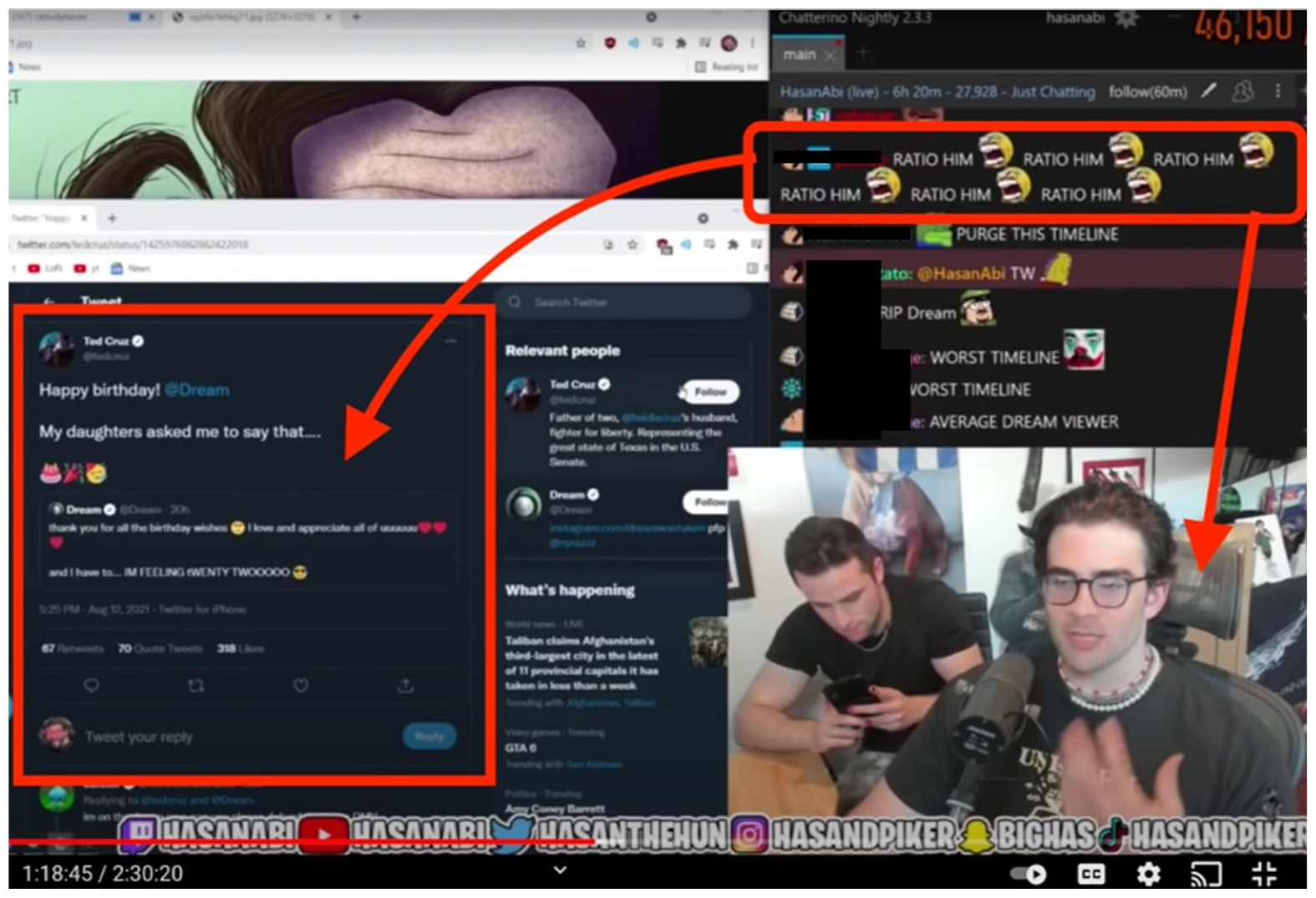
Red arrows show how Twitch Chat encourages Piker to ratio Sen. Cruz in real time.
Although ratioing US politicians is a relatively rare, and new, phenomenon, it speaks to how influencers like Piker can use the technique to entice his audience to momentarily challenge the Senator’s public image on Twitter and Twitch. Piker uses Twitch’s live modality and chatroom feature to coordinate his community’s attempts (Figure 6) to ostracize the Senator from Twitch’s primarily younger audience of 18- to 34-year-olds (Twitch, n.d.-a). Although ratioing has no effect on Sen. Cruz’s career as a legislator, the strategy brands him as an outsider to Piker’s millions of followers at a time when politicians are increasingly experimenting with it to raise awareness for their campaigns and voter registration (Grayson, 2020).
Ratioing Nicki Minaj
Our final case distinguishes Piker’s Chat from mere audiences by actively negotiating Piker’s reply to Minaj during his broadcast. Minaj’s decision to directly tag and reply to Piker effectively marked him as a target for Minaj’s devout fans, “Barbz,” allowing Minaj to retaliate with a ratio of her own. The exchange between Minaj, Piker, and their fans clarifies that ratioing is not a linear or stable process, but a constant struggle for clout and visibility constrained by platform logics.
Fan-produced videos captured Piker’s initial conversation with his Chat to determine if ratioing was feasible against Minaj’s millions of Twitter followers (Ostonox, 2021). Piker’s Chat encouraged his reply “the world awaits your wonderful contribution to the scientific community” and contributed 85.7K likes compared to Minaj’s 73.2K likes (Figure 1); causing a successful ratio and a brief moment of victory. Two days later, the drama intensified when Minaj tweeted a clip of Fox News’ Tucker Carlson praising the rapper for doing her own research. Piker continues this cycle of antagonism by tweeting to Minaj that Carlson is a “white nationalist” who “doesn’t like black and brown immigrants” (Figure 7). The same figure shows that Minaj successfully ratios Piker during their exchange, undermining that any victories achieved through the strategy are constantly negotiated. However, fan-recorded clips show that initially Piker planned a different reply, “I’m telling you, tucker carlson wouldn’t even let you on the bus (unless he can use you as a talking point)- but here you are reducing it to simple party disagreements” (Figure 8). While Piker never sent that “bus” tweet, his Chat actively rebuked him, opting instead for a draft about Tucker Carlson’s hypocritical vaccination status (Ostonox, 2021).

Minaj ratios Piker’s “white nationalist” post in retaliation.

Piker’s Chat reminds him that this joke would likely be offensive and add further controversy.
In these videos, Piker argues with his Chat about the merits and consequences of this particular tweet he initially believed would help him “win” the argument. However, as seen in the top-right corner of Figure 8, members of Piker’s Chat urged the streamer to reconsider with frantic messages like “DONT SEND IT DUMBASS,” “THATS WAY TOO FAR HASAN,” or “HASAN DONT.” Chat’s contestation challenges the logic that streamers are in complete control over their audience, reiterating that ratioing requires consensus from Chat to succeed. Piker’s eventual decision to placate his Chat with the edited version, “tucker carlson is not only vaccinated but doesn’t like black and brown immigrants coming into the country. this isn’t about parties– there are plenty of racist democrats too” (Figure 8). The tweet emphasizes how political discourse on Twitch is co-constructed between streamers and their Chat through Piker’s willingness to cede some editorial control to his synchronous followers on Twitch.
“Ballgate” represents an admittedly crass example of how political influencers in the SME blur the boundaries between political and entertainment discourses. On one level, the controversy demonstrates how ratioing is constantly contested by rivaling fan communities. Minaj’s successful ratio against Piker signals that ratioing is commonly a way for celebrities to exert their clout over one another and is not inherently political in itself. However, what makes Piker’s ratioing a political strategy is that he orchestrates audience attention to amplify his commentary’s visibility across multiple platforms. Ratioing then serves as a collaborative form of political participation as influencers and their followers attempt to frame the political discourse in SME.
Discussion
Ratioing is most commonly expressed through features like direct reply or quote-tweet that allow influencers to directly and publicly confront their rivals. All three cases confirmed the strategy used Piker’s live stream to orchestrate engagement that ensured his visibility in a crowded SME landscape. Furthermore, Piker’s 1.2 M followers on Twitter were the smallest audience of anyone in the sample (at the time of writing), signaling the strategy’s ability to amplify Piker’s messages across Twitch and Twitter with the combined support from synchronous and asynchronous audiences.
The first set of ratios against Crowder and Shapiro situates the strategy in a cycle of antagonism that reduces political discourse into popularity contests. Those against Cruz depict the importance of using live streaming and chatrooms to coordinate responses that mark Cruz as an outsider to Twitch’s community. Finally, the exchange with Minaj demonstrates that ratios are in constant flux and dependent on fan participation. Collectively, these cases answer the first guiding question “how do influencers implement ratioing as a form of political participation” by unpacking how Piker uses the strategy to ensure his content is viewed across the crowded SME. However, to answer our final guiding question, “what are the implications for online political engagement more broadly” requires framing the remaining discussion around streamers, platforms, and audiences.
Streamers
All three case studies confirmed the strategy’s effectiveness in transforming controversies into narratives that invite audiences to participate directly in political performance. Ratioing represents a collaborative amplification that extends Piker’s reach and his audience outside of Twitch, ultimately driving them to spread his political discourse throughout the SME. In this capacity, ratioing organizes Piker and his collective audiences into a coherent voice through Twitch’s combined live modality and interactive Chat.
Our first case uses Piker’s ratios against conservative influencers Crowder and Shapiro regarding their reactions to Chauvin’s murder conviction. While these ratios may encourage Shapiro or Crowder to abandon that particular Twitter thread to avoid further embarrassment, both produce popular media content across podcasts, YouTube channels, and Facebook which allow them to retreat from the Twitter ratio while maintaining their status on their preferred platforms. In this capacity, ratios are opportunities for Piker to continue sparring in the cycle of antagonism. There are no real winners or losers, but ratios are important performances that signal Piker’s commitment to creating content as a “progressive political commentator” (Lorenz, 2020). Therefore, these ratios are extensions of Piker’s beliefs and an ideological boundary-marking strategy (Arnesson, 2023) on platforms that reduce political discourse to popularity contests.
The second case study focuses on Piker’s ratios against Senator Cruz to highlight how the strategy effectively combines asynchronous and synchronous audience engagement. In both cases, Piker’s ratios against the Senator bolster Piker’s popularity with no tangible effect on Sen. Cruz’s career. However, these ratios function as ideological “victories” because Piker is able to reliably use asynchronous and synchronous forms of fan engagement to reliably insert himself into political discourse on social media. In other words, if Piker wasn’t livestreaming his intentions on Twitch, he may not attract as much support from his fans. The coordinated synchronous and asynchronous audiences enable Piker to effectively “punch above the belt” and amplify his voice over his targets.
Piker’s ratios were uncontested in the first two cases, but the third case study underscores how ratios are expressed numerically, so Minaj and her 26.2 M Twitter followers easily ratioed Piker in retaliation. It is interesting that Piker is comfortable ratioing conservative pundits and politicians but hesitates against Minaj. This may be because Minaj also has a masterful use of the platforms and directed her fan base in a manner that Shapiro, Crowder, and Senator Cruz did not, which exceeded Piker’s own abilities. This shows that ratioing is neither linear nor stable, highlighting the important role that audiences play in circulating political discourse on platforms.
While the ratios against Crowder and Shapiro show how the strategy structures ideological skirmishes, they fail to capture Chat’s active role in negotiating Piker’s efforts. VODs from the second and third cases depict Chat either calling for Piker to initiate the strategy or even rephrase his tweets to avoid further controversy. These videos capture the collaborative back-and-forth relationship between Piker and his synchronous Chat. Despite the fact that this is Piker’s channel, he relies on their participation for success. The reciprocation between Piker and his Chat is critical for fostering a supportive and organized community capable of mobilizing against their targets.
The second and third cases offer examples of Piker ceding some editorial authority to Chat to successfully ratio his targets. As seen through the Minaj case, the synchronous Twitch audience objected to Piker’s phrasing to avoid further controversy. Metrics tracker Sulygnome estimates that from 2021 through 2022, Piker averaged about 27.5K concurrent viewers on Twitch (Hasanabi Summary Stats, 2022), meaning most of his audience consumes his content asynchronously and risks missing out on participating. While Piker’s asynchronous audiences can still like his tweets after the initial drama has passed, their participation would not have the same impact on Piker’s behavior during his livestream.
Platforms
Although Twitch has temporarily banned Piker twice for claiming “that America deserved 9/11” (Grayson, 2019) and for referring to a user as a “cracker” (Jackson & Gault, 2021), the platform has never punished Piker for using their service to ratio targets. While the company could potentially intervene, their Terms and Service agreement contains no direct policies about political speech. Although Piker’s ratios are a form of targeted harassment (Marwick, 2021), Twitch’s tacit approval of multi-platform ratios tacitly allows this influencer-driven tactic to shape political discourse in the SME. Thus, Twitch not only functions as a central point for Piker’s political tweets but ultimately also brings both him and the company revenue.
Piker’s ratios unintentionally illuminate some of Twitch’s policies for regulating political discourse. While many platforms tend to treat themselves as apolitical intermediaries, their specific technical makeup and political economy deeply affect the nature of the speech disseminated online (e.g., van Dijck, 2013). This stance entails long-term consequences, as seen through the controversial Facebook Files that revealed many of the company’s political motivations on multiple topics such as body image and widening the potential user base (Hagey et al., 2021). Piker’s ratios lay bare some of Twitch and Twitter’s accepted politics, like gaming or manipulating Twitter’s algorithm with extra likes from live viewers. In other words, Piker simultaneously pushes an ideological agenda while encouraging his audience to make political actions on platforms that benefit Piker.
Audiences
Ratioing invites Piker’s audiences to participate in circulating his ideological content throughout SME. The fact that Piker’s ratios take place on both Twitch and Twitter means that his followers can either participate in Piker’s Twitch Chat or on his reply tweet. Whether audiences watch Piker orchestrate the ratio live on Twitch, or if they happen upon his tweets, is irrelevant, because both forms of participation contribute to the ratio. Piker may have millions of followers on both Twitch and Twitter, but metric website SullyGnome (Hasanabi Summary Stats, 2022) suggests his average concurrent viewership during the time of writing was just over 27,000. While this is a rough estimate, it confirms that Piker’s ratios depend on both synchronous audiences on Twitch and asynchronous audiences on Twitter.
Chatters are synchronous audience members who can collectively pressure Piker to edit his tweets as well as provide the initial momentum for Piker’s asynchronous followers to like and reply to Piker’s Tweet. Regardless of the modality that audiences use to participate in Piker’s ratios, the strategy blends political participation with entertainment. Such hybrid models reiterate arguments about using social media as political participation as a form of “slacktivism” potentially in lieu of direct actions. Not only has this notion been contested (Christensen, 2011; Lane & Dal Cin, 2018), but changing public discourse in and of itself can be meaningful. Gitlin (2012) for instance, noted the impact of Occupy Wall Street was ultimately discursive that brought notions of the “99%” into the public imagination. Thus, the relatively simple act of ratioing points to long-lasting discursive changes as influencers blurs the boundaries between political coverage and entertainment. This becomes increasingly important as political discourse in SME continues to be used to organize, in some instances weaponize, collective action.
Limitations and Conclusion
This article narrowly focused on US streamers, political discourses, and platforms; therefore, these results may not be generalizable to political influencers and platforms from other regions. Our cases demonstrate how ratioing was used to amplify Piker’s reach; they cannot speak for the gamut of political speech and participation on Twitch. Furthermore, while analyzing publicly available videos and tweets allowed us to answer our guiding questions, future research should consider different methods like participant observation, surveys, or interviews to incorporate additional audience (and streamer) perspectives to the important issue of political discourse in SME. It is worth reiterating that this article analyzes one type of influencer-driven political participation, and should not be conflated with community-driven and grassroots political movements like Black Lives Matter.
Piker used ratios to skirmish against conservative influencers in a cycle of antagonism, marked a sitting Senator as a Twitch outsider, and combatted COVID-19 misinformation from a rapper with millions more Twitter followers. These cases exemplify ratioing as a playful practice akin to “slacktivism” (Christensen, 2011; Lane & Dal Cin, 2018) and unlikely to affect legislation or elections directly. Ratioing should be understood as one iteration in a longer tradition of evolving forms of political participation with social media (Gillespie, 2017) among US progressives like the Occupy Wallstreet movement (Calhoun, 2013; Gitlin, 2012; Juris, 2012), and the alt right (Bolla Tripodi, 2022; Lewis, 2020). Ratioing is incapable of enacting specific legislation, but also a meaningful example of how influencers innovate strategies for audience mobilization on platforms that political scholars, organizers, and candidates should continue investigating. This study prioritized how the streamer initiated ratios, but future studies on political influencers should gather data from fans with surveys or interviews to unpack how audiences feel about the political influencers they follow.
Finally, ratioing has proven to be an innovative strategy for influencers to insert themselves into mainstream political media. Piker performs many of the same functions as a news anchor or political commentator but more importantly, interprets political discourse for his fans. Similarly, both Twitch and mainstream news outlets profit off the popularity of their on-screen talent. Both political commentators and Twitch streamers are financially dependent on audience attention, but Twitch’s chatroom and other interactive features allow political influencers like Piker to stay in constant communication with his followers during his stream. Whereas commentators and pundits generally avoid direct audience interaction during their broadcasts. Piker’s popularity ultimately amplifies his perspective across both traditional and social media; simultaneously reinforcing the political broadcast media industry’s tendency to appeal to distinctly partisan audiences. While there is evidence that progressive politics are becoming the most popular on Twitch (Henke, 2021), influencers like Piker counterbalance conservative influencers on other platforms (Bolla Tripodi, 2022). This suggests that platforms will continue becoming central spaces to do politics and that at their specific features, policies, and even business models will ultimately shape the kinds of politics participation that influencers can encourage.
Footnotes
Declaration of Conflicting Interests
The author(s) declared no potential conflicts of interest with respect to the research, authorship, and/or publication of this article.
Funding
The author(s) received no financial support for the research, authorship, and/or publication of this article.
