



Abstract
One of the early democratic promises of social networking sites concerned their potential to break down barriers between elites and citizens and facilitate two-way online interactions. More pessimist views have emphasized how inequality is present online as it is offline, with little interaction between those in power and the public taking place. This article expands these debates using online interactions in the small state of Iceland as a case study, with survey data (N = 1,264) and elite interviews (N = 93). First, Iceland is an ideal case to examine in relation to the pessimist perspective, with more interactions and less distance found there between elites and the public than in larger democracies usually studied. Second, the Icelandic case illustrates limitations with studying public aspects of online engagement. Research on the internet and social media commonly focuses on publicly available data and therefore does not examine the more private online interactions that can take place. I show that this can be especially problematic in small states like Iceland, where much of the engagement between elites and the public happens through Facebook Messenger and other more private settings. Based on my findings, I illustrate that it is helpful to use a public–private dichotomy framework to understand different types of political interactions in Iceland, other small states, and more widely. I refer to this as a “two-level online sphere.” The first level is the public version of the communication and the second level is the more private avenue.
Keywords
Introduction
The democratic potential of the internet has commonly been discussed in terms of techno-optimism and pessimism (Davis, 2019). On the optimist side, debates have routinely focused on how social networking sites have broken down barriers between politicians and citizens and led to possibilities of two-way interaction that can increase democratic accountability and facilitate public participation in politics (Theocharis et al., 2016). A more pessimist argument against the internet enhancing democracy is often made in relation to inequalities. Research has shown that it is the more educated and well-off individuals who are more likely to use the internet for political activities, access to the internet is much higher in richer countries than in the developing world, and there are digital divides within western democracies (e.g., Fenton, 2016; Fuchs, 2014). It is difficult to argue that the internet enhances democracy if people do not have access to it. Moreover, studies on politicians’ behavior on social networking sites problematize the optimist narrative since some have shown that politicians interact infrequently with other users and often adopt a one-way “broadcast style” (e.g., Graham et al., 2013; Jackson & Lilleker, 2011). Research has revealed that politicians commonly replicate traditional campaign modes online and limit engagement with the public (Stier et al., 2018). Put simply, many studies have illustrated continued top-down communication and little online interaction between politicians and citizens.
The research presented in this article expands the previously outlined debates in two ways by using online interactions in Iceland as a case study. First, Iceland is an ideal and interesting case to examine in relation to the more pessimist perspective. It is difficult to argue that a digital divide exists in Iceland, as the society is highly educated, it is more equal than the larger western democracies usually studied, political engagement is high, and internet usage is virtually 100%—the highest in Europe (Statista, 2022). Furthermore, with a population of below 400,000 inhabitants, the country is very small, and, there is much more closeness between elites and the public than found in more populous states (Ólafsson, 2020). In other words, Iceland is to an extent the opposite of the larger democracies commonly studied. Offline structures and relationships between elites and citizens are not unequal and distant, but rather much more equal and close.
Second, the Icelandic case illustrates limitations with studying public aspects of online engagement. Research on the internet and social media in relation to political communication commonly focuses on publicly available digital trace data and therefore misses the more semi-public and private engagements that take place (Dennis, 2019). I show that this can be especially problematic in Iceland and other small states. Based on my findings, I argue that it is helpful to use an online public–private dichotomy framework to understand different types of political engagement in small states like Iceland. I refer to this as a “two-level online sphere.” This expands our knowledge of political communication dynamics in small states, which have so far been scarcely researched. My intervention is guided by two overall research questions:
Research Question 1 (RQ1). What defines interactions between political elites and the public on social media in Iceland?
Research Question 2 (RQ2). To what extent do these interactions differ from what existing political communication studies in larger democracies have shown us?
The first section of the article outlines the relevant literature on the internet, democracy and engagement. Following this, the mixed methods data collection is introduced before moving onto the results which are presented in three parts. The first part outlines top-level general findings concerning political debates on social media in Iceland. The second part focuses on findings concerning public online interactions between elites and the public, mostly on Facebook. Finally, the more private interactions between elites and the public are explored. My results illustrate that social media is perceived to have facilitated online interactions between elites and the public in Iceland. The findings suggest that many of these interactions take place behind “closed digital doors” on Messenger. I illustrate that there is a performative dimension on the first level (the public level) of the two-level online sphere, while there appear to be different types of communicative norms on the second level (the private level). Private communication between elites and citizens through messaging apps is clearly an important component of online political communication in Iceland and warrants further investigation in other small states and more generally.
Democracy and the Internet: Broadcast Style or Two-Way Interaction?
Social networking sites are claimed to break down barriers between politicians and citizens, making it much easier for politicians to communicate directly with the public (Bruns & Highfield, 2013; Larsson, 2016). This can be seen to enhance democracy. Politicians can inform the public about their work and people can communicate their thoughts and concerns to their elected representatives on a regular basis. As Theocharis and colleagues (2016) point out, from a normative point of view, engaging in dialogue has been seen as one of the most desirable and revolutionary aspects of the internet. This has been contrasted to the broadcasting style of legacy media. One of the causes for citizen’s disconnection from politics is the view that they have no say in political affairs because there is little dialogue with politicians. “The possibility of two-way interaction between citizens and political actors is, thus, seen as a major step towards re-establishing democratic accountability and facilitating public participation” (Theocharis et al., 2016, p. 1011). In recent years, there has been much focus on what is wrong with digital spaces, including research examining the spread of false information, online addiction, misogyny and racism, and the collection and usage of data from users. As Masullo and colleagues (2022) point out, while there are many negative sides to social media, scholars must also critically engage with what is desirable. This can include social media facilitating a dynamic where the public is heard and interacts with those in power.
Online interactions do not necessarily need to be in-depth debates about politics to be seen as normatively desirable. Even basic forms of “direct reciprocity,” that is a direct reply to a comment online (Wright et al., 2020), can result in citizens and politicians exchanging ideas about topics, drawing attention to certain issues, and so forth. Other citizens who are not taking part can see the reciprocity and participate and learn through their observations. This can therefore lead to the public feeling to some extent closer to politicians and decision-making processes. Tenenboim (2022) links interaction with the term engagement and points out that there is no consensus on the meaning of online engagement. As he illustrates, online interaction can be described as modes of engagement, with engagement encompassing online behavior such as sharing, commenting, or reacting. In the study presented here, the focus is on examining any type of interaction that results in online engagement between elites and the public, whether it be active engagement or observed by others. As Picone and colleagues (2019) point out, even small acts of engagement are important and can on the aggregate level become powerful political acts.
The argument that two-way online interaction can open up democratic discussion between politicians and citizens can be linked to the equalization hypothesis. This implies that the existing power elites’ dominance has been maintained by their easier access to the top-down legacy media. The hypothesis is that the internet has allowed political actors, including new and smaller political parties, to bypass the traditional media and speak to voters in a more direct manner (Lilleker et al., 2011). In other words, it levels the playing field and increases engagement. The techno-optimist argument, often linked to possibilities of increased democratic engagement, has been criticized for being naïve and for not taking into account the structures of “actually existing democracies” (Fraser, 1992). The argument against the internet being a democratic enhancer is commonly discussed in relation to inequalities. This can be associated with the normalization hypothesis, which focuses on how “patterns of socioeconomic and political relationships on-line come to resemble those of the real world” (Margolis et al., 1999, p. 26). Simply put, existing power relations are present online in a similar way as they are offline.
As Fenton (2016) states: “We would be wise to remember that the wider social contexts in which networks are formed and exist have a political architecture that predates the internet” (p. 166). Research has, for example, shown that those who are more educated and of a higher social class are more likely to be politically active online than those less educated and from a lower social class. Also, political interest and offline engagement with political issues has been shown to be linked to more political activity and information seeking online (Blank & Groselj, 2014; Boulianne, 2015; Gustafsson, 2012). Furthermore, access to the internet is much higher in richer countries than in the developing world, and there are also digital divides within rich western democracies (Fuchs, 2014). In other words, inequalities offline are also present when it comes to the online environment.
The internet has the potential to increase communication between politicians and citizens, but what does research on this actually reveal? Many studies on Twitter have found that politicians interact infrequently with other users. Politicians are quite conservative and some tend to adopt a one-way “broadcast style” (Graham et al., 2013; Jackson & Lilleker, 2011; Jungherr, 2016). Much of the overall social media and digital research has revealed a status quo in online campaigning since “politicians mostly replicated traditional messages and campaign modes on their Web presences while limiting engagement with users” (Stier et al., 2018, p. 51). This therefore, again, suggests a much stronger case for the normalization hypothesis as opposed to the democratic two-way argument. Research has shown that a few politicians draw most of the attention on social media, while the majority draws very little attention (Nielsen & Vaccari, 2013).
There is not much evidence of Twitter being an enabling device for dialogue between citizens (Jungherr, 2016). Studies have shown that it is often simply an echo chamber for political elites (Larsson & Moe, 2013), and politicians mainly engage with other politicians, journalists, and activists (Bruns & Highfield, 2013). And Nielsen and Vaccari (2013) found in their study on Facebook that the kind of direct candidate-to-voter communication that many academics studying digital politics have highlighted as possible is not something that actually happens on a large scale. Studies have shown that interactions on social media are often very uncivil, with elected officials commonly being threatened and misogynistic abuse repeatedly arising (e.g., Einarsdóttir & Ólafsson, 2022; Southern & Harmer, 2021). This might therefore lead politicians to refrain from engaging in dialogue with the public online. Other studies have shown that interaction between candidates and voters might be evolving on social media and becoming more two-way and inclusive (often depending on the affordances of different social media platforms), with more research on this needed (e.g., Boulianne & Larsson, 2023; Larsson & Skogerbø, 2018).
Much of the existing social media research relies on digital trace data (Jungherr, 2016), which should not come as a surprise. As Dennis (2019) highlights, social media research commonly “emphasises publicly observable interactions” (p. 180). This leads to blind spots in existing research, as will be illustrated subsequently. Another limitation of many studies focused on social media and politics is that they are quantitative studies conducted around elections (Stier et al., 2018). What takes place between elections? And what do more in-depth qualitative studies add to the picture? Gustafsson (2015) interviewed Swedish politicians about their social media routines outside of election periods and found that many Swedish parliamentarians have Facebook profiles with a mix of old classmates, friends, and family, as well as political contacts, journalists, and citizens in general. Gustafsson discusses the differences between the United States and Sweden and points out that the Facebook strategy of politicians in the larger country seems to be more professionalized than of those in Sweden. The Facebook behavior of politicians needs to be studied by taking into account the different structures these actors operate in. This can, again, be linked to the normalization argument. Other studies have highlighted that the political context and the culture of digital media use in certain countries have been shown to influence how politicians use social media (Graham et al., 2016).
What do we find when looking at the structures, political context and culture of digital media use in Iceland? In contrast to the literature that highlights socio-economic structures potentially inhibiting the internet’s democratic potential, Iceland is an ideal case to illustrate if the internet can enhance democracy and contribute to the creation of an online space where elites engage in dialogue with the public. Access to the internet is virtually 100% in the country, equality is comparatively high, the population is highly educated, and the smallness of the society results in much less fragmentation and distance between social groups than found in larger societies (Ólafsson, 2020). Offline structures and relationships are not unequal and distant, but rather much more equal and close. If we follow the “offline and online structures are similar” line (the normalization hypothesis), which has been dominant in much of the research outlined earlier, it can therefore be argued that if there is a particular case where the internet can truly work as a sphere for political engagement between elites and the public based on possibilities for participation and access, then Iceland is it.
Iceland as a Case Study: Methods and Data Collection
The small states of the world are routinely overlooked in research on media and politics, as is the question of size as a variable. Even though the comparative approach is more established in political science than in studies of media and political communication (de Vreese, 2017), the smallest countries are likewise largely excluded there. As Veenendaal and Corbett (2015) emphasize, it is striking that almost all publications employ a cut-off point resulting in the elimination of these states. “The assumption is implicit: Small states do not matter” (Veenendaal and Corbett, 2015, p. 528). If small states are similar to larger states regarding political arrangements, then researchers waste valuable data by not including them. And if small states differ from larger states politically, then we miss out on the insights these diverse, extreme, or most different cases offer.
There is a growing body of research that can be labeled “small state studies” (Randma-Liiv & Sarapuu, 2019), where researchers attempt to comprehend the uniqueness of small states. As Sarapuu (2010) sums up, small states have been shown to have special characteristics and particular behavioral “patterns the more one goes down the scale (size of population being the criterion)” (p. 33). Research shows that population influences the inner workings of small states mainly through two mechanisms: first, through the limited availability of resources, mostly human capital; and second, through a particular type of social ecology. It has been highlighted that small states are characterized by a high degree of interpersonal relations. As Farrugia (1993) illustrates, states with a small number of inhabitants tend to develop closely integrated societies containing an intricate network of personal relationships. People know each other (or know someone who knows someone whose service they need), so ministers, parliamentarians, journalists, and others are easily reachable. When examining small states here, the idea is not to adopt a particular cut-off point regarding population size. Instead, there is evidence for a continuum of size, in which these mechanisms become more apparent the smaller the population becomes, regardless of other traits of the state (Sarapuu, 2010).
The present study uses Iceland as a case study of a small state to expand existing research from larger states that focuses on online interactions between politicians and the public. By doing this, it not only adds research on a small state to our knowledge base, but also to our understanding of the Nordic countries. Iceland is routinely overlooked when examining media and politics in the Nordic region and it is much smaller in population than the other four Nordic states, with below 400,000 inhabitants (Jóhannsdóttir & Ólafsson, 2018). It is important to stress that we must be careful not to simply see small states as being the same as small or local communities within larger states. There are substantial differences between the two. As Ott (2000) illustrates, one of the key differences concerns mobility. The increased opportunity of mobility within larger states can prevent the formation of the same sort of intensely close socio-cultural environment as in smaller states. This close environment can deepen even further through a shared language and national history. Also, politics and journalism on the national level in small states concern issues focused on the entire country that often receive much more attention in the media than local issues. In addition, citizens in local communities in large states are often far away from the national media and political power centers. It is therefore difficult to see national level political reporting and interactions between elites and the public in small states as fully comparable to local and municipal settings in larger states. This is not to say that studying the effects of the size variable in small states cannot help shed a light on some aspects in small communities in larger states, such as concerning resource constraints.
Answers from 93 semi-structured interviews with Icelandic politicians and journalists conducted between October 2016 and February 2022 are used to examine how they perceive social networking sites to have affected interactions between elites and the public in Iceland. The focus was on data collection during a “routine period,” not linked to a specific event, like a general election or referendum campaign. Despite the importance of the more mundane periods and “typical” news days (during which many important political decisions are made), there is less empirical research available on politics and media that examines routine times when no key event or incident of major significance takes place (Cushion, 2012). One of the strengths of the study is therefore that it adds to this less researched area of study, and, moreover, it does so through an extended period of over 5 years, with in-depth interviews.
I interviewed 25 of the 63 sitting members of parliament (MPs) from all political parties represented in the Icelandic parliament in the 2016–2017 term. This included five of the 11 government ministers. A purposive sample (Robson, 2011) was chosen that mirrored party representation in the parliament. I also interviewed 25 journalists from the main media outlets in Iceland in 2016 and 2017. The criteria for being included in the sample was being employed at the time as journalists and sometimes covering political issues. Political journalists were included in my sample since they interact frequently with politicians (Davis, 2010) and the public in online political communication (Ólafsson, 2020), and their addition therefore offers additional insights into political elite–public interactions than if I had solely interviewed politicians. As shown subsequently, blurred boundaries between media and political elites and the public in Iceland expand our understanding of political online interactions. I conducted 43 additional interviews with Icelandic journalists between 2020 and 2022 for two international research projects (the Media for Democracy Monitor and the Worlds of Journalism Study) and was able to gauge if any changes were noticeable in the answers compared to the 2016–2017 period.
All interviews were conducted in Icelandic and were recorded and transcribed in full by myself. I have anonymized and translated answers to English. Most interviews were around 1-hr long, with the shortest being 50 min and the longest being 2 hr. I coded the interviews using the open coding approach and the software NVivo to identify key themes. Answers from a representative survey are used to compare public perceptions to those of journalists and politicians. The survey was administered through the Social Science Research Institute (SSRI) at the University of Iceland. It was sent to 2,000 respondents through email on 30 May 2017, and a total of 1,264 people answered the survey, with a response rate of 63%. Respondents were chosen from an online panel consisting of Icelandic residents aged 18 and above who have agreed to participate in the SSRI’s online surveys. Panel members are recruited by telephone interviews with random samples from the Icelandic National Register and care is given to rebalancing when needed.
The questionnaire, which was linked to a research project on power and democracy in Iceland, consisted of 25 questions, most of them with answers on a five-point Likert-type scale. I devised the questions in the survey in Icelandic and have translated them to English. The questions and statements in the survey were devised to explore to what extent the public agreed or disagreed with the journalists and politicians I interviewed. Put simply, this involved studying the same phenomena using different sources (groups) and different methods, which is often defined in terms of data triangulation. The purpose of triangulation is not necessarily to cross-validate data, but simply to capture different dimensions of the same phenomena and thereby increase the depth of knowledge about it (Patton, 1999), as is the case here. The questions from the survey included in the analysis focus on how the Icelandic public perceives political online interactions in Iceland, to what extent people participate in them, and how they interact with political elites.
Debates and Interactions on Social Media in Iceland
Over 90% of Icelandic adults use Facebook regularly and it is by far the most popular social media platform in Iceland (Gallup, 2021). It should therefore not come as a surprise that Facebook was dominant in the interview answers. It was perceived to be the most important social media platform and commonly used by interviewees as an example of social media overall. This was the case both with journalists and politicians.
It was almost a unanimous assessment in the interviews that Facebook has “opened up” the political discussion in Iceland. As one journalist (interview 5) put it: “Whoever wants to can now basically say what they want on Facebook about any matter they are interested in.” The spread of news and information is perceived to be much more instantaneous than it was. As another journalist (interview 35) said: “Political stories change and evolve much quicker than they did before social media.” Almost everyone uses Facebook and if a particular story or political debate gains traction, it will become dominant in the discourse very quickly.
Respondents in the survey were asked to what extent they notice debates about Icelandic politics on social media. The aim was to gauge how much people are in fact seeing political content. It has been noted that despite the democratic enhancement potential of the internet and social media, most people actually use the internet for entertainment purposes rather than engaging with politics (e.g., Anderson & Caumont, 2014). It was, therefore, important to establish a baseline to see to what extent people notice political debates in Iceland, before examining people’s participation in them.
As Figure 1 shows, 1 40% of respondents said that they notice the debates either very or fairly much, while another 40% said that they notice them fairly or very little. Following this, the survey switched emphasis from noticing debates to participating in them. The threshold of participation here was quite low, since the examples used were simply of sharing a news report on politics or writing comments. As shown in Figure 1, 6% of respondents claim to participate very or fairly much in debates concerning Icelandic politics on social media. This small number cannot be explained by a lack of access, since virtually 100% of the population has access to the internet and over 90% uses social media regularly as mentioned earlier. Respondents were also asked about interest in politics, with 48% answering that they were very or fairly interested in politics, but as illustrated, only 6% participate in online political debates very or fairly much. These results were corroborated in a majority of the interviews with both politicians and journalists as they perceive members of the public who participate in these debates to be a small group. Many female interviewees stated in relation to this that men were much more likely to participate in them.
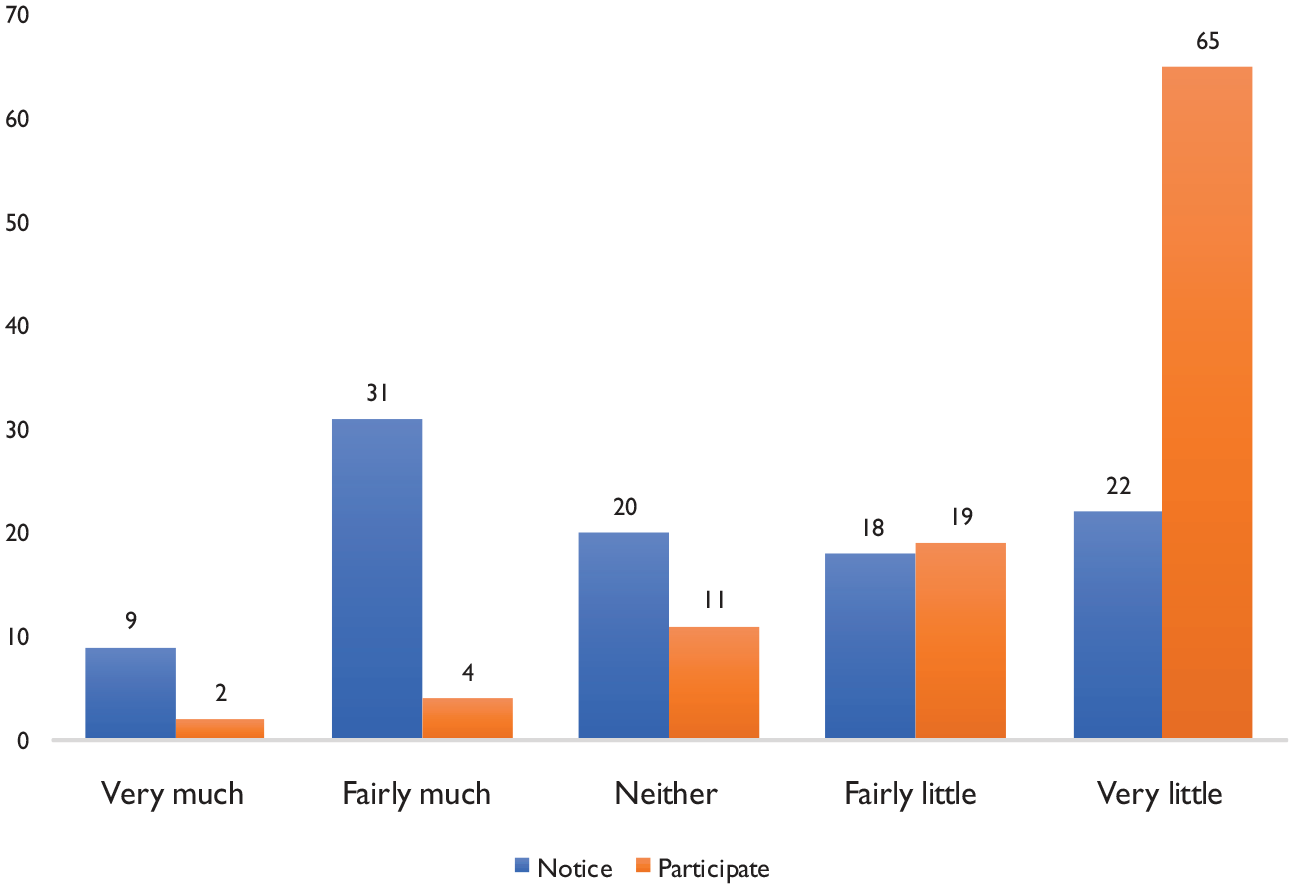
The extent to which respondents notice and participate in political debates on social media (%). Respondents were asked the following questions: How much or how little do you notice debates concerning Icelandic politics on social media (e.g., Facebook and Twitter)? How much or how little do you participate in debates concerning Icelandic politics on social media (e.g., by writing comments or sharing political news reports)?
Survey respondents were subsequently asked if social media has contributed to people being more or less informed about politics. As Figure 2 shows, around 51% said that social media has made people more informed about politics. Only 14% of respondents said that social media has made people less informed. This is interesting since interviewees were much more negative in relation to information on social media compared to the survey respondents, with over two-thirds of interviewees discussing social media as a culprit in making people less informed. Put simply, elites were more negative compared to the public in this regard. Moreover, in the interviews conducted later on (during 2020–2022), the negativity was even more prevalent than in the earlier elite interviews (conducted in 2016–2017). This is not surprising given, for example, the increased focus on the spread of false information on social media in recent years.

Whether social media has contributed to people being more or less informed about politics (%). Respondents were asked the following question: On the whole, do you think that social media has contributed to people being more or less informed about politics in Iceland than before?
In relation to the negative aspects, many of the politicians interviewed perceived the debates on social media to be quite or very unconstructive and stated that people with opposing views are often mainly talking at each other rather than engaging in debates. In the survey, respondents were asked whether they thought that social media had contributed to constructive or unconstructive debates about politics.
As shown in Figure 3, close to a third (32%) of respondents perceived social media to have contributed to constructive debates, while a slightly larger percentage, or 38%, thought it contributed to unconstructive debates. The public was somewhat more positive than the interviewees here (the unconstructive theme was more dominant in the interviews), although more respondents also perceived the debates on social media as more unconstructive than constructive.

Perceptions on debates about politics on social media (%). Respondents were asked the following question: Do you think that social media has, in general, contributed to constructive or unconstructive debates about politics in Iceland?
As outlined previously, demographic variables have been shown to be linked to internet usage in relation to politics, as is interest in politics. To examine the Icelandic case more specifically with regard to this, Table 1 presents linear regression models which were estimated for each of the four dependent variables (outlined in Figures 1 –3), using five demographic (gender, age, income, residence, and education) variables and two attitudinal (left/right, interest in politics) variables.
Linear Regression Models for Demographic and Attitudinal Variables.
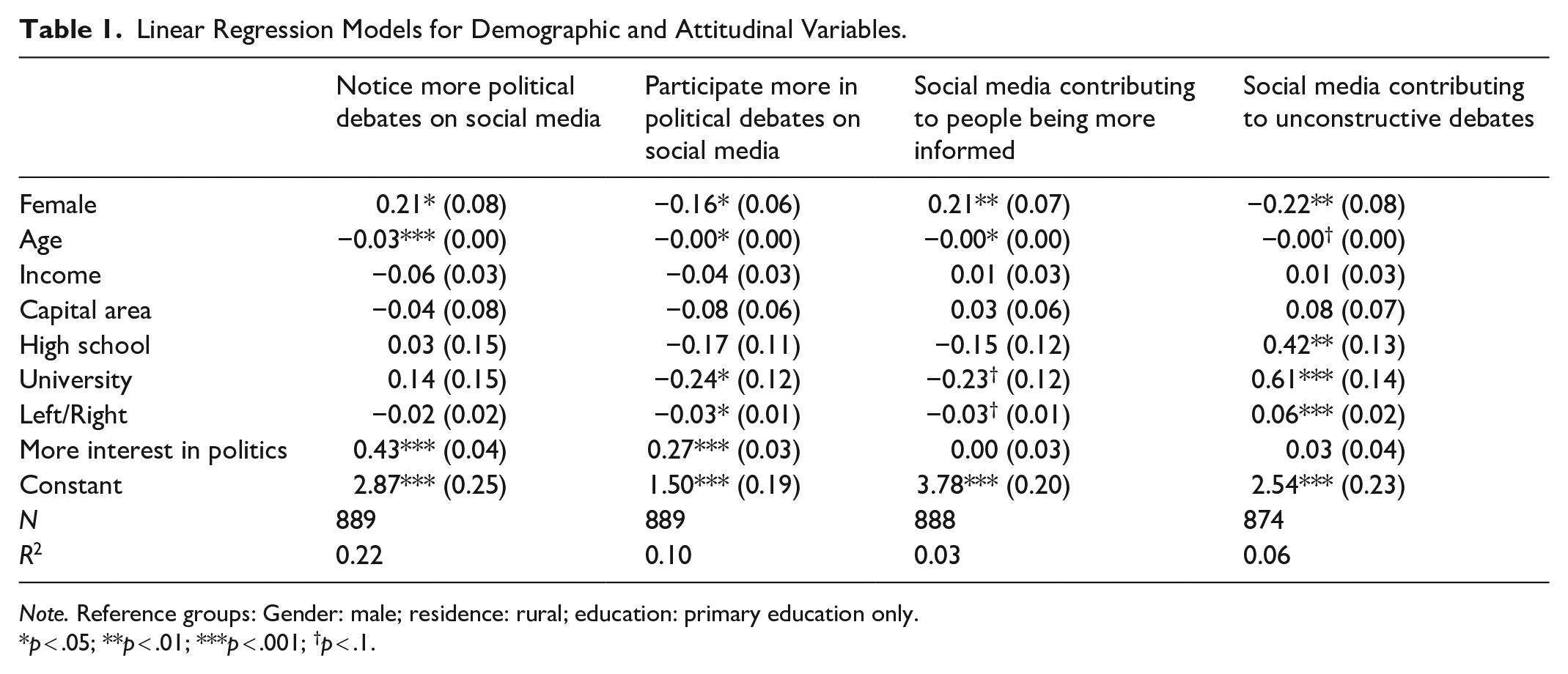
Note. Reference groups: Gender: male; residence: rural; education: primary education only.
p < .05; **p < .01; ***p < .001; †p < .1.
Gender was a significant predictor of responses for each of the four variables on social media and political debate items, even when controlling for other variables. Female respondents were more likely to notice political debates on social media and to perceive people as being more informed through social media use. However, male respondents were more likely to answer that social media usage led to unconstructive debates and that they participated in the debates. Other studies have also shown men being more politically active online compared to women (e.g., Wright et al., 2020) and these findings are also in line with the interviewee answers previously outlined, where men were perceived to be more dominant in the discussion on social media.
The regression analyses furthermore identified age as an important variable in explaining the variance of the dependent variables. Younger participants were on average likelier to notice and participate in political debates more than older ones, which does not come as a surprise since younger people are in general more active on social media (e.g., Newman et al., 2017). Younger participants were also on average more likely to say that social media makes people more informed about politics. There were no significant differences concerning income or residency. Those with a university degree were on average more likely to perceive social media usage contributing to unconstructive debates and less likely to participate in political debates on social media. These are interesting findings since other studies have shown that those who are more well-off and educated are more active in online political discussions (e.g., Fenton, 2016).
There were also significant differences concerning political attitudes. Those who are more right wing were on average less likely to participate in political debates on social media and more likely to perceive social media contributing to unconstructive debates. Unsurprisingly, those respondents who have more interest in politics were more likely to notice and participate in political debates on social media than those with less interest, as other studies have shown (e.g., Boulianne, 2015). However, interestingly, interest in politics did not have a significant effect on views toward the effects of social media on informing the public and contributing to unconstructive debates. So overall, we see that the Icelandic public seems to share similarities with some existing studies concerning gender, age, and political interest, while other findings from the research literature concerning education and income are not replicated in Iceland.
Social Media Usage and Interactions in Public
According to most of the journalists interviewed, it has become increasingly common for Icelandic politicians to post status updates on Facebook, often on their personal profiles, and sometimes, they subsequently refuse to answer questions from journalists and the public related to the issue they posted about. Many journalists had a negative view of this. As one journalist (interview 8) stated: “What has perhaps annoyed us is that some politicians seem to view Facebook posts as replacements for interviews.” Many of the journalists stated that their newsrooms are struggling with how to deal with this development. The consensus among the journalists is that if the status is deemed newsworthy, the journalists mention what is discussed in it, and, if the politician refuses to be interviewed, then this is mentioned in the news reports as well. This, however, does not necessarily apply to the biggest online news sites in Iceland. Those pages will simply publish the status once it is out in the open since they depend on constant web traffic throughout the day and this is a quick and easy way to cover politics and get “clicks” (Ólafsson, 2021).
While journalists perceive politicians to have a clear strategy for their Facebook usage, this is not the perception that one comes away with after talking to Icelandic politicians. Over two-thirds of those interviewed discussed that they are struggling with how to use Facebook and have found it very difficult to separate their professional and more personal identities. Several of the politicians mentioned that they created a professional Facebook page that was intended to mainly focus on work related topics. Anyone who is interested in following that page can simply “like” it and get updates on their Facebook news feed. Most of the politicians also have a personal profile page (with a limit of 5,000 “friends”—and possibilities for other people to “follow”) and this tends to become the main site they use for everything and is therefore somewhat “messy.” On these profiles, the politicians discuss their work-related material, but also communicate jokingly with their friends, share pictures of their children, and so forth. During the interviews, the politicians would often show me these profiles and illustrate many dilemmas they are facing, such as if they should accept invites to events for other to see, if they should accept friend requests from people they do not know well and so on. All of the politicians active on Facebook mentioned that they are aware that journalists and others are monitoring their online behavior. “Everybody is following everybody” since “everybody knows everybody” in this small country. As one politician (interview 16) put it: Yes, obviously everyone is on Facebook. And everyone uses computers and you know everyone knows everyone or someone knows someone who knows you, and then everyone is just in your face. It is obviously not like that if you live in the United Kingdom or some nation with millions of inhabitants.
This echoes sociological themes of intense small state ecology and multiple role relationships (Benedict, 1966). It has been shown that small states are characterized by a high degree of interpersonal relations. As Farrugia (1993) illustrates, states with a small number of inhabitants tend to develop closely integrated societies containing an intricate network of personal relationships. My interviewees highlighted that Icelandic politicians and journalists are constantly running into each other in all sorts of settings outside of the work environment. This was seen to be replicated to some extent online on Facebook, through the news feed and various events, photos being shared, membership in Facebook groups, and so on.
Most of the Icelandic politicians interviewed said that Facebook adds to their already hectic work schedule. They are constantly getting notifications about events they are invited to (and are expected to attend), as well as being “tagged” in posts where members of the public are raising specific issues and want input or answers. Over a third of the politicians mentioned that they often get ideas from the public on Facebook. They then use these ideas in their work in parliament, for example, to ask government ministers about specific issues that are on the minds of their Facebook friends. As one politician (interview 42) said: Sometimes when I come home after a long day in the parliament I open Facebook and I see something like 50 notifications of things that are relevant to my work and many people are expecting an answer. This can be very draining but can also give me ideas, so it helps, but it is very time consuming.
The politicians who brought this up often discussed this in relation to the short chains of command in Iceland. Icelanders are used to being able to easily reach people offline, including politicians, so they expect politicians online to respond to them. In relation to this, the absence of small states from research on social media and politics is not just evident by them not being there, but also in various underlying assumptions made by authors studying online interactions between politicians and the public. For example, Tromble (2018) states that citizens do not necessarily expect a response from politicians on social media when reacting to their posts. She argues that this is because people “are used to top-down communication, and though they may desire reciprocity-even believe it warranted-they are unlikely to expect it from politicians” (Tromble, 2018, p. 681).
The Icelandic case differs and points to two-way interactions online between politicians and citizens. As stated earlier, one of the most well-documented causes for citizens’ disconnection from politics is the view that they have no say in political affairs because there is little dialogue and discussion with politicians. The possibility of two-way interaction between citizens and politicians online is seen as helping with democratic accountability. This type of two-way online interaction does take place in Iceland, but this was usually explained by my interviewees in relation to Iceland’s smallness, not specifically the democratic enhancement of the internet. That is, people are used to being in close proximity to politicians offline, so the same applies online.
The perceptions of Icelandic politicians appear to be somewhat more similar to local politicians in the Nordic countries as opposed to those on the national stage there. A study of Norwegian local politicians found that Facebook was by far more popular than the more “elite” Twitter that politicians on the national stage commonly use (Larsson & Skogerbø, 2018, p. 225). The study found that social media usage needs to be understood in the context of the already established communication and media channels. Results from the study indicate that “two-way communicative efforts (such as communication with citizens or interest groups) were ranked as highly important” (p. 231). As is the case with other political communication research from Iceland, findings from the local level in the Nordic countries seem to echo some of the findings from the national level in Iceland, which can be linked to the small size of the country when compared to the other four Nordic states (Ólafsson, 2020). Icelandic politicians view Facebook as more important than Twitter, and two-way communication is viewed as very important in some instances. And this two-way communication is seen as even more important in the more private setting on Facebook Messenger.
Social Media Usage and Interactions in Private
Up until recently, political communication scholars have focused heavily on social networking sites, with less emphasis placed on researching private messaging apps. These apps, like Messenger and WhatsApp, have been drawing some scholarly attention when it comes to citizen engagement and interactions (Rossini et al., 2021; Valeriani & Vaccari, 2018) but there is a lack of attention when it comes to examining interactions between elites and citizens on there. These apps are different from social networking sites in the sense that they are “private” because by design they “are not broadly visible nor accessible to those outside of conversations” (Rossini et al., 2021, p. 2431). According to the Reuters Digital News Report, WhatsApp and Facebook Messenger were by far the most popular messaging apps in the 36 countries included in the study in 2017. 2 WhatsApp was slightly more popular overall (40% vs. 36%), but in the four Nordic countries that participate in the study (Iceland is excluded from the study), Messenger was far more popular than WhatsApp. My interviews suggest that the same is true of Iceland. This is backed up in a recent Gallup (2021) survey that shows that 87% of Icelanders use Messenger, while 22% use WhatsApp.
What my interviews with politicians and journalists revealed is that Facebook Messenger is a dominant political communication channel in Iceland. As one of the journalists summed it up (interview 48): “One of the best kept secrets of journalism in Iceland is that most of the communication with politicians takes place on Facebook Messenger.” And, importantly, the public is heavily involved in two-way interactions with politicians and journalists on there. Journalists and politicians mentioned that they also use text messages, other apps like Signal, and the phone when communicating with each other, but Messenger is used very often. A majority of the journalists said that they rely heavily on this type of communication with politicians. It is a very convenient way to book interviews, and also, if they need some specific information for a news report, the whole exchange or interview might take place on Messenger.
The themes that were linked to the private two-way online interactions on Messenger concerned constant connectivity and immediacy. Here, private communication is focused on discussions that take place between two (or only a few) individuals on messaging apps. The interviewees were not discussing messaging groups with numerous participants or information that can be observed in news feeds. Many interviewees highlighted that you can “always” be reached through Messenger. Unless you specifically change the privacy settings, people can see when you are online, when you were last online, and when you saw their message. If you have not seen the message, the other person might get the impression that you are ignoring it. Many noted how Messenger is different than email, text messages, and the phone, because people can see when you are online, they can see when you see the messages, and they expect a response straight away. Also, you cannot easily “hide” on Messenger. People do not need your phone number (like with WhatsApp or Signal) or email address to contact you. They can simply look you up on Facebook and send you a message on Messenger there.
Politicians echoed what the journalists said. Messenger is heavily used, both for booking interviews and also to exchange information with journalists. What was much more dominant in the interviews with the politicians than with the journalists was the emphasis that they also placed on the private messages they receive from the public. Most politicians mentioned that members of the public routinely message them. As one of the younger politicians (interview 28) said: Here in Iceland I often find that people expect politicians, including ministers, to answer private messages that are sent to them informally on Facebook Messenger. I find this again and again to be the case. People are used to having lots of access to Icelandic politicians and they therefore feel the same way online. They expect to have access.
A majority of the politicians said that they do not necessarily answer all messages, since some of them are from people simply “telling them off” and not really looking for a response, which can be related to the uncivil aspects of online discussions previously outlined. When they do answer, the messages are often from people looking for assistance concerning some difficult issues that are “stuck in the system” or to ask them about a particular matter they are working on. The politicians sometimes answer questions directly or refer people to someone else. It became clear in the answers that many politicians are somewhat unsure about how to deal with these messages. They are contacted in a private setting, a “space” owned by a private company, with no official record of the discussion having taken place. Sometimes, the politicians simply receive information that they can use in their work but interviewees also mentioned being contacted about more official matters that they were unsure about how to deal with. Usually they tried to point people to more official channels.
How common are these private interactions? How connected is the public to Icelandic politicians online? According to the survey administered for my study, 22% of Icelanders have “liked” or “followed” an Icelandic politician on Facebook and the same number applies to a political party. Much fewer followed a politician on Twitter (6%), Snapchat (3%), or Instagram (2%). The 2017 Reuters Digital News Report found that around a third of Americans (35%), a quarter of Spanish (25%), a fifth of Irish (23%), Australians (20%), and British (18%), and a tenth of Germans (11%) followed a politician or party directly on some social media platform. It is furthermore highlighted in the report that direct online communication between politicians and individuals remains a minority activity (Newman et al., 2017). Iceland has not been part of the Reuters Institute study, but my survey shows that Iceland is close to Spain, Ireland, and Austria when it comes to following politicians on social media. Simply examining these numbers and to not dig deeper would, however, result in a limited assessment.
As highlighted, much of the online political activity in Iceland takes place on personal profiles, where people can request to be “friends” with politicians. This needs to be understood in relation to Iceland’s small state ecology. To revert back to the normalization hypothesis, it suggests that patterns offline will be similar to those online. Since Iceland is so small, there are commonly close connections between members of the public and politicians, which can be linked to the small state sociology literature and multiple role relationships (Benedict, 1966) that highlight how relationships are close, and public and private roles can easily become blurred in small states. In the survey, respondents were asked if they are friends with a politician in real life. When referring to politicians in the survey, it was explicitly mentioned that this only referred to one of the 63 current members of parliament in Iceland. Over 1 out of 10 (13%) respondents said that they have at least one friend who is a politician and 27% said that they have at least one acquaintance who is a politician. Furthermore, 5% of respondents said that they are closely related to a politician.
Because of these close relations, it should not come as a surprise if the public interacts with politicians quite extensively. According to the survey results, 17% of respondents had one politician as a Facebook friend. This is not through some “liked” professional page, but instead they were friends through their personal profile. Even more people, 20%, had two to five politicians as friends on Facebook. Five percent of the population had 6–15 politicians as Facebook friends, and 3% of respondents had more than 15 politicians as Facebook friends. So, based on these answers from the representative sample, just under half of the Icelandic population (45%), had at least one of the 63 members of parliament as a friend on Facebook when the survey was sent out in 2017. These are substantially higher numbers than the “follow” or “like” numbers previously mentioned, both in Iceland and in an international comparison. These online “friendships” are not necessarily linked to the fact that people are interested in following what the politician is doing politically, but instead, they can exist because of some offline connection. As several politicians mentioned, everything on their Facebook profiles becomes “mixed up.” Boundaries between the personal and professional are blurred and this creates much confusion for the politicians when determining how to use social media.
Respondents were, moreover, asked about their activity on Facebook in the last 12 months as it relates to politicians. A quarter (25%) said they had “liked” at least one status that a politician has written, 11% had commented on a status that a politician had written and 8% sent a politician a private message on Messenger in the 12 months before the survey was sent out. These numbers highlight that a somewhat large group of people does in fact interact with politicians on Facebook, both publicly and privately. This confirms the perception from most of the interviews conducted with politicians.
Over 80% of the politicians I interviewed provided me with numerous examples of people messaging them about particular topics, such as welfare issues, immigration, refugees, the health care system and various human rights issues. As they told me, people are actively involved on Facebook and Facebook Messenger and politicians receive feedback on their work, encouragement and criticism. And as most interviewees expressed, the feeling is usually that the public expects a response from these exchanges. In general, politicians often found these more private interactions very helpful and they said that the more uncivil tone was more common in the public arenas on social media, although it was also to be found in the more private settings, but to a lesser extent.
These results, focusing on the more private online behavior, illustrate an important avenue for further studies on social media usage in small states. In their comparative democracy study of the 39 states in the world with below 1 million inhabitants, Corbett and Veenendaal (2018) mention briefly that their research highlighted perceptions of more public two-way interactions on social media than research has shown in larger states. The findings here seem to echo this to an extent; however, what my findings additionally show is that much of the two-way interaction takes place in private settings.
My study reveals that online political communication on Facebook in Iceland can be defined as a “two-level online sphere.” The first level is the public version of the communication and the second level is the more private avenue. As shown, to some extent, the more public version echoes findings from larger states previously outlined. Politicians are perceived to engage routinely in one-way broadcast style communication, and not engaging with the public and journalists. This is not to say that two-way interactions do not take place on this level. They do, but according to the interviews, they are often to correct misunderstandings or to get ideas, rather than engaging in discussions.
The second level highlights that much two-way interaction takes place more privately on Messenger. There, interviews are conducted, discussions take place between journalists and politicians, and members of the public routinely engage with politicians and expect a response. It is clear, as relates to Iceland, that public and private roles become blurred in the more public settings on social media, but, moreover, that a different type of public and private dichotomy is clearly present online. There is a performative dimension in the first level (public), while there appear to be different types of communicative norms in the second level (private). Put simply, we cannot fully appreciate the political communication interactions within the Facebook (Meta) architecture by solely examining the public content. Much of the interaction takes place in more private settings.
Conclusion
It has been shown that offline structures in society can affect online environments. In contrast to the existing literature that highlights socio-economic structures possibly inhibiting the internet’s democratic potential, it can be argued that the small and informal society in Iceland is an ideal case to illustrate whether the internet enables and encourages interactive discussions between elites and the public; especially as it is difficult to argue that much of a digital divide exists in the country.
This article illustrates to a certain extent that the internet is perceived to have facilitated democratic discussions where elites and the public can (and do) interact in two-way discussions. The findings suggest that much interaction takes place behind “closed digital doors” on Messenger, and that the public actively participates in private interactions with political elites. This type of private communication between elites and citizens through messaging apps is clearly an important component of online political communication in Iceland and warrants further investigation, particularly in other small states that are often left out in political communication research. This study is limited in that it only measures perceived interactions through surveys and interviews in one country. Future studies of other small (and larger) states should also focus on examining the actual interactions (where possible) to add more layers to the findings. This will undoubtedly be difficult in some cases, where privacy and private settings are an issue. Another limitation concerns the fact that when the survey was conducted, there was little focus on other social media networks in Iceland - Facebook was very dominant. Almost all interviewees when discussing social media in general would mainly be referring to Facebook and several questions in the survey were focused on Facebook as a result. In the years since, other platforms have become more popular in Iceland (but Facebook is still the most popular) and it would be interesting to conduct another survey in Iceland in the near future where different affordances could be explored with regard to social media platforms and politics.
According to answers from the survey, only a small minority of the general public (6%) actively participates in public political debates online in Iceland. Overall, the survey respondents were more positive toward social media debates compared to the elite interviewees. And in the most recent interviews conducted (in 2020–2022), the attitude toward social media seemed to have become more negative. It will be curious to explore if these changes in attitudes continue to develop along these lines in Iceland, both with regard to elite perceptions and also the general public. As outlined in the article, Iceland is a small state and there are, of course, limitations in how some of the findings here can be applied to larger democracies. In relation to this, it is worth noting, however, that it is common for research from large and medium-sized western democracies to be seen to be universally applicable. I invite scholars to engage with the findings here and see how they can apply elsewhere.
The Icelandic case is probably as ideal a case as possible to test the democratic enhancing possibilities of the internet. It should be easy for people to talk directly to their representatives, and vice versa, since the state is so small, and people are close. The reality, however, is not quite like this. In the more public settings, there are perceptions of top-down broadcast style behavior, in addition to limited two-way interaction. And much of the two-way interaction that does take place is in fact not taking place publicly, but rather on the second level in the private online sphere on Facebook Messenger. With the Icelandic case, people have access to the online community, are close to elites, and are living in a comparatively equal society. Therefore, the so-called digital divide or socio-economic structural inequality cannot explain why people are not engaging more in online political debates in public in Iceland. The answer lies elsewhere.
Footnotes
Acknowledgements
I thank Aeron Davis, Hafsteinn Birgir Einarsson and the reviewers for their helpful feedback. I would also like to thank participants in the political communication workshop at the NoPSA congress in 2021 for a very useful discussion on the topic of the research presented here.
Declaration of Conflicting Interests
The author(s) declared no potential conflicts of interest with respect to the research, authorship, and/or publication of this article.
Funding
The author(s) disclosed receipt of the following financial support for the research, authorship, and/or publication of this article: The Icelandic Research Fund, grants number 218058 and 207250.
