



Abstract
Recent studies demonstrate how violence, social media, and protest intertwine. This article complements this body of knowledge and indicates how social media enables new modes of small-scale protest events and how it is being used by right-wing and middle-class groups to influence urban politics. The article conceptualizes local-digital activism as a particular form of protest that is based on a hybrid framework of action that entangles physical actions in public space with virtual acts of dissent, creating embodied digital activism in specific locales. The key arguments are threefold: (1) local–digital activism initiates a particular framework of action that is embedded in digital culture and can be used by different ideological groups. (2) The approach to place in this type of dissent is central and manifold, with physical and virtual spaces codefining one another. (3) Triggering violent encounters and using violent representations in place is strategic and intentional, a means to expand visibility on digital platforms. Empirically the article analyses two groups in South Tel Aviv, presenting their protest strategies and tactical use of place, digitization, violence, and the body in creating the iconography of the “other in the place.” The study is based on geographic and ethnographic work, in-depth interviews (N = 24) with various actors, and social media content analysis (videos = 72, posts = 210). The final discussion addresses the characteristics of local-digital activism and its role in urban political struggles and offers paths for future research.
Over the last decade, increasing attention has been given to the interrelations between social media, violence, and protest. Scholars have shown how social media serves to expose violence, on the one hand (Ashuri & Pinchevski, 2010; Mirzoeff, 2011; Reading, 2009), and triggers intergroup violence in physical spheres, on the other (Gallacher et al., 2021; Jost et al., 2018). Representations of violence on social media also play a crucial role in increasing visibility (Fuchs, 2012; Gallacher et al., 2021; Milan, 2015; Mirzoeff, 2011; Neumayer & Rossi, 2018; Poell & van Dijck, 2015), having become both “attention-arresting” visual acts of political discourse (Ward, 2020) and tools for enhancing political power. Addressing this emerging dynamic, many studies have focused on large-scale protest events and violent encounters with police or between opposing groups. In contrast, this article focuses on small-scale protests where activists use various practices to influence locality and urban politics. The representation of violence, not “violence” itself, plays a major role in this type of action and serves as a means to shape the narrative of a place and trigger change. Moreover, due to its centrality in activists’ campaigns, the representation of violence is often elaborated and deployed in three manifold ways: (1) documenting existing violence, (2) provoking actions that trigger violence, and (3) using the violence of representation through digital means. Specifically, this type of action comprises the tight, intersecting use of locale (i.e., place) and social media (i.e., network) to create what we term in this paper local–digital activism. Local–digital activism, often led by 1–10 activists, is a hybrid framework of action that entangles physical actions in public space with virtual acts of dissent, creating embodied digital activism in specific locales.
This conceptualization of local–digital activism is closely related to the literature on embodied digital activism and digital witnessing (Andén-Papadopoulos, 2014; Blaagaard & Roslyng, 2022a, 2022b; Mirzoeff, 2011; Richardson, 2022). However, such research has focused mainly on how liberal movements use digital tools to expose and reject the violence of oppressive power. This article investigates right-wing and middle-class groups who use similar tactics, but against marginalized populations. The first targets asylum seekers, migrant workers, and refugees, while the others target individuals in distress (i.e., drug-addicted or homeless persons and sex workers). Our analysis therefore demonstrates how two focal groups who seek to displace another group from their neighborhood develop digital-spatial practices with the intent to not only expose the violent reality in their neighborhood but also use it to trigger violence and expand the violence of representation. Conceptualizing this phenomenon in this article, we explore the following key questions: What tools and tactics are used by right-wing and middle-class activists to advocate their ideology? How do activists use place, digitization, violence, and body as means to produce new iconographies? What are the political implications of this local–digital activism? The arguments in this article are threefold. First, local–digital activism initiates a particular framework of action that is embedded in digital culture and the possibilities that digitization offers. This framework is tactical and lacks inherent meaning; thus, it can be used by different ideological groups. Second, the approach to place in this type of dissent is central and manifold; it is a territory, a gathering place, and a representation that often plays a key role in struggles. Third, triggering violent encounters and using violent representations in place are strategic and intentional—means of expanding visibility and engagement on digital platforms. Such uses of representations of violence in place as a means to promote political agendas while harming vulnerable groups marks a change in activism worldwide.
To demonstrate these arguments, we analyze two groups of activists in South Tel Aviv (STA), Israel. The first, the South Liberation Front, is a group of local activists associated with the nationalist parties in the Israeli Parliament who oppose the presence of asylum seekers and migrant workers and call for their deportation. The second is South Tel Aviv Needs a Fix, a group of middle-class residents who have settled in STA as a result of the accelerated urban regeneration processes in the area. They demand law enforcement and the elimination of “unwanted phenomena” (i.e., drug trafficking, homelessness, and prostitution) from their neighborhoods. Both groups act against vulnerable and underprivileged groups and do not represent all local residents or municipality perceptions, yet they continue to gain power and influence. Both groups also use similar practices despite their ideological, class, and moral differences. Moreover, the middle-class group has adopted some of the nationalist group’s strategies, indicating the spread of right-wing protest approaches among other political groups.
To analyze the focal protest practices, we used three datasets: (a) geographic and ethnographic work conducted between November 2017 and February 2020; (b) in-depth interviews (N = 24) with various actors in STA; and (c) online ethnography and content analysis of social media pages, profiles, and groups, that is, videos (N = 72), images, posts, and group discussions (N = 210).
In the next section, we review the literature on place, digitization, violence, and the body in the context of protests and offer a conceptual framework that links them. Using this framework, we show how this triangle plays a crucial role in contemporary local–digital activism, contributing to changes in place and politics.
Place, Digitization, Violence, and Body in Contemporary Activism
Public spaces, as symbols of power, have always been significant places for dissent (Edelman, 1996). Protesters use public spaces to communicate their grievances by disrupting an agreed-upon social-spatial order (Hatuka, 2018). Thus, the place chosen for the action of dissent is crucial and reveals the ways in which actors pragmatically and symbolically perceive their ability to effect change (Hatuka, 2018). Decisions regarding the location of a protest must therefore consider the protesters’ power to communicate their claims and challenge authorities by manipulating and appropriating spatial forms and symbols (Yuen, 2018). Hence, even in the digital age, geography and the physicality of place remain crucial for realizing change (AlSayyad & Guvenc, 2015; Daphi, 2017; Ghaziani, 2021; Jalili, 2022; Miller, 2016; Willems, 2019).
Indeed, digitization has expanded the tactics of dissent and thereby the repertoire of protest as a whole. It has also created a different pace for protest events: “The speed, reliability, scale and low cost of digital networks are what enable the great scope and reach of contemporary activism” (Joyce, 2010, p. viii). Furthermore, digitization has created a broader spectrum of actions, including large-scale physical protests, small-scale events, and online events. The latter, also called digital activism, includes all instances of social and political campaigning practices, from “clicktivism to hacktivism,” offering a hierarchy of political participation (George & Leidner, 2019). This sea change in contemporary protests is associated with social networks, which offer a new platform for activism, create alternative communication spheres, and enhance self-representation (Andén-Papadopoulos, 2014; Gerbaudo & Treré, 2015; Mirzoeff, 2011). Social media’s dramatic influence on activism is due to its multiple advantages: reduced communication costs, expanded audiences, enhanced participation, and emotional affect (Papacharissi, 2014), and increased speed and dissemination of information and images (Jost et al., 2018; Zeitzoff, 2017). Certainly, in parallel to the civic empowerment provided by technological devices is growing awareness of the influence, limitations, and intervention of technology and social media—a “mediator” that both shapes and limits activists’ action where algorithms and hashtags dictate the visibility of images (Neumayer & Rossi, 2018) and prioritize certain forms of content, driven primarily by the business models of social network corporations (Poell & van Dijck, 2015).
Furthermore, digital activism and traditional activism are not binary; instead, publicness is constituted across different spaces—both mediated and physical—that mutually shape each other (Willems 2019, p. 1192). Digitization does not exclude the role of the body in a physical place; rather, it contributes to the initiation of new forms of protest events (Treré, 2018). Furthermore, through these digital expressions, both activist bodies and places are discursively produced. Digital means, such as smartphones or wearable technology devices, allow people to challenge their representation and power in society, to elevate themselves from object to subject (Richardson, 2018, 2022). For example, Blaagaard and Roslyng (2022b) describe how the presence of bodies and certain bodily gestures that informed the BLM campaign became a type of hashtag in public spaces designed to subjugate both the vulnerable bodies of African Americans and the meaning of being human. They claim that this “embodiedness is central to the practices, the claims involved, and the potential political–juridical outcomes of activism” (Blaagaard & Roslyng, 2022a, p. 72). Thus, there is a threefold argument: (1) digitization has expanded the tactics of dissent and thereby the repertoire of protest as a whole; (2) through digital expressions, both activist bodies and places are discursively produced; and (3) representations play a major role in this discursive process due to the rapid dissemination of information and images. Following this rationale and given the prime role of representation, the key question is what role violence plays in the contemporary form of protest and whether digital tools change how it is conceived and used.
Clearly, violence, protest, and social media intersect in contradictory ways. On the one hand, social media enables us to object to and expose institutional violence and document acts of violence by those who hold power (e.g., police officers); on the other hand, social media can become a sphere that fosters violence and spreads and circulates violent memes, hate speech and extremist ideologies. These two phenomena emerge or proliferate via social media’s preference for violent spectacles (Poell & van Dijck, 2015). Scholars viewing social media as a platform for exposing and rejecting violence argue that it allows institutional and political violence to be documented with novel speed and scale (Ashuri & Pinchevski, 2009, 2010; Reading, 2009). Camera phones facilitate digital witnessing that sometimes disrupts “official” narratives (Andén-Papadopoulos, 2014). Photography is the power to make visible (Frosh, 2001); thus, the spread and immediacy of photography have extended “representational power” to new publics and individuals (Andén-Papadopoulos, 2014). Moreover, the democratization of surveillance technologies and social media has enabled collective, coordinated acts of surveillance or countersurveillance (Wood & Thompson, 2018). In addition, digital witnessing from a “citizen’s perspective creates a unique record, one that represents not only the camera’s facticity but the body’s reality” (Bock, 2016, p. 14). Smartphone videography of police brutality has become akin to serving as an embedded professional journalist in a war zone who risks life and limb to deliver the narrative intimacy of combat (Richardson, 2022, p. 603). Others call this “flesh witnessing” to describe the practice of jeopardizing oneself to document political unrest or violent repression while embodying both victims and witnesses (Richardson, 2022, p. 603).
Many scholars have highlighted the other side of social media, identifying it as a sphere that fosters violence, contributing to the spread and mainstreamization of extremist ideologies (Askanius & Keller, 2021; Daniels, 2018; DeCook, 2018). The ungoverned infrastructure of the internet provides and cultivates hate cultures (Ganesh, 2018). Researchers of the far right have claimed that social media is one of the most prominent tactical innovations supporting their recent success (Caiani & Kröll, 2015 in Trillò & Shifman, 2021). The use of violence (both symbolic and physical) thus pervades the alt-right group ideologies expressed and spread through internet memes (DeCook, 2018). Some white supremacist group memes contain iconographic representations of death and dying (Askanius & Keller, 2021), while others spread violent images and ideologies, even calling for violent actions (Rostami & Askanius, 2021). Memes serve disenfranchised groups that hold unpopular opinions on topics such as race, gender, or other political issues via “politically incorrect” humor, irony, and ambiguity (Askanius & Keller, 2021) as well as outgroup antagonism (DeCook, 2018; Trillò & Shifman, 2021). Digital platforms are used by the alt-right to construct a collective identity, to bolster political ideology, and for recruitment and reinforcement. This demonstrates how digital spaces are “ripe for exploitation” by extremist ideological groups (DeCook, 2018, p. 486).
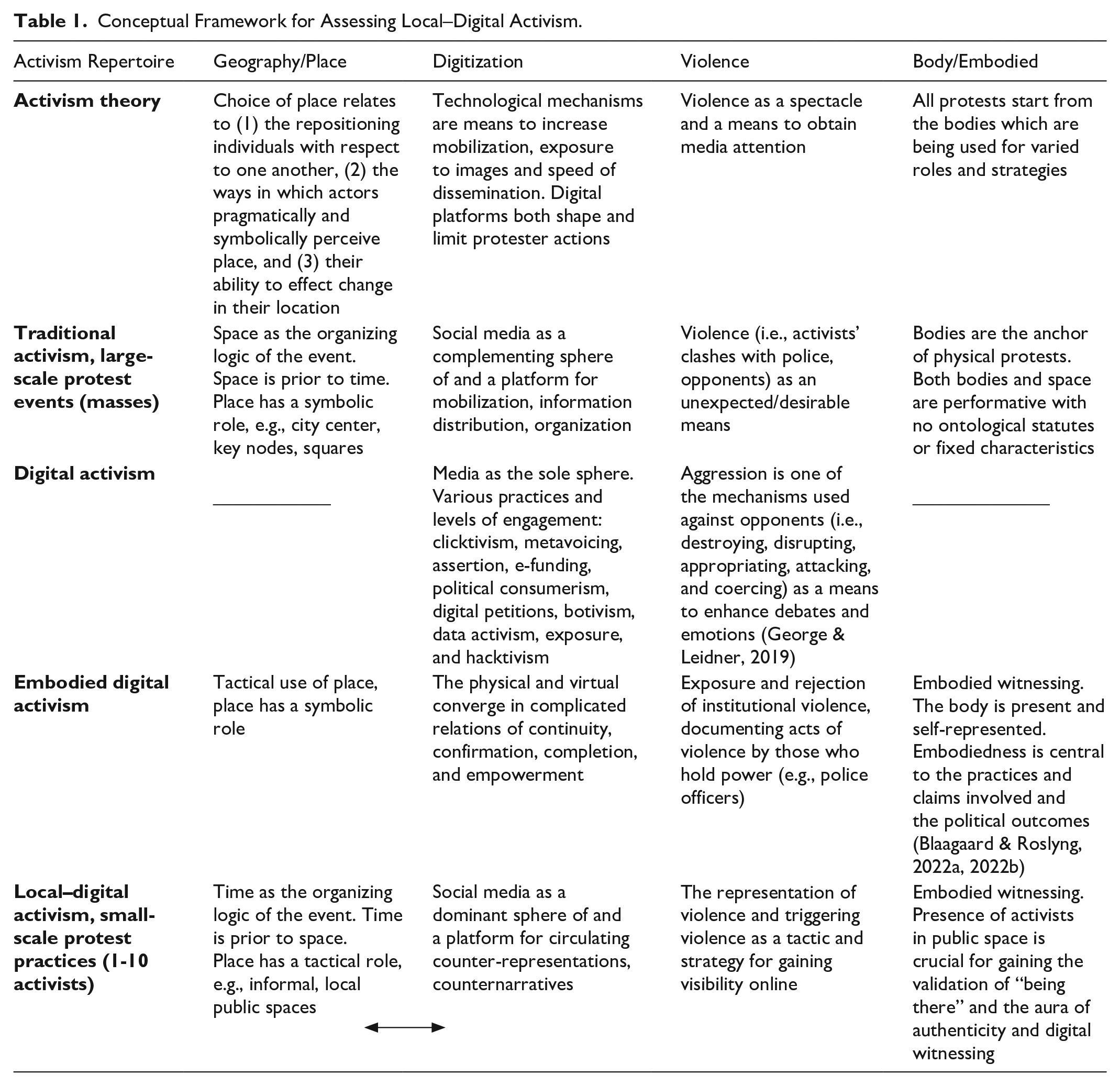
In summary, in the digital era, place, digitization, violence, and body are four key components which shape contemporary activism and contribute to a varied protest repertoires. From large-scale protest events to digital activism. In large-scale events, place is the organizing logic; it plays a symbolic role that is often applied in city centers, main urban nodes, or public squares. Social media is viewed as a complementary sphere and platform for mobilization, organization, and information distribution (Jost et al., 2018). Violence is often considered undesirable by both police and activists (Newburn, 2012). Digital activism ranges from practices in which physical place plays no role and protest is concentrated in the virtual sphere to other forms of embodied digital activism in which the physical and virtual converge in complicated relations of continuity, confirmation, completion, and empowerment. These practices of embodied digital activism have been explored mainly in the context of global and liberal movements (e.g., Blaagaard & Roslyng, 2022a, 2022b; Richardson, 2022). In contrast, in this article, we explore how similar practices are used (1) in small-scale local urban struggles and (2) by varied ideological groups (Table 1).
Conceptual Framework for Assessing Local–Digital Activism.
Empirical Context and Methodology
STA is an inclusive name for five neighborhoods (Neve Sha’anan, Florentine, Shapira, Kiryat Shalom, and Hatikva) that have historically been viewed as the backyard of the city and defined as disadvantaged. The north–south polarization in the city of Tel Aviv–Jaffa also has ethnic, socioeconomic and spatial dimensions rooted in its history of urban development (Cohen, 2015; Hatuka, 2010; Margalit & Vertes, 2015; Marom, 2014). STA suffers from crime concentration (Weisburd & Amram, 2014), physical and social deterioration, and urban inequality (Schnell & Benjamini, 2005). This polarization has been further enhanced in the digital age (Hatuka & Zur, 2019).
In recent decades, STA has been associated with ongoing conflicts involving the migrant workers and asylum seekers who have settled there (Hatuka & Wijler, 2021). Approximately 33,500 asylum seekers and other undocumented people live in STA MESILA (2021). In the absence of state assistance for migrants in terms of housing, welfare, and employment (Yacobi, 2011; Yaron et al., 2013), civic society nongovernmental organizations (NGOs) have been established to assist and fulfill humanitarian, legal, and social needs (Kfir & Kemp, 2016). However, these groups’ arrival in the neighborhood has provoked opposition from locally born residents (Cohen & Margalit, 2015; Hochman, 2015). Any discussion of asylum seekers, immigration in Israel, and migrant policy cannot be separated from either the Israeli conceptualization of the nation-state as an ethnic democracy (Yiftachel, 2006) or the Israeli–Palestinian conflict. Israel has adopted policies that “almost categorically deny any possibility of immigration to Palestinians and citizens of several other countries” while supporting Jewish immigrants, mainly through the Law of Return (Kritzman-Amir, 2009, p. 604; Yaron et al., 2013, p. 145). Following the increase in asylum seekers entering Israel through the Egyptian border beginning in 2006, Israeli governmental institutions began labeling members of this population “infiltrators” to invoke the “Prevention of Infiltration Law” enacted in the 1950s to prevent Palestinian refugees from “infiltrating” Israel. Moreover, STA is a central area in the city for homelessness, drug trafficking, and street prostitution. A total of 40% of the homeless population in Israel is centered in Tel Aviv, with Neve Sha’anan concentrating the most complex population of drug-addicted and homeless persons (Zur, 2023).
Two key activist groups act in STA. The South Liberation Front (SLF) is a group of local activists who oppose the presence of asylum seekers and migrant workers and call for their deportation. This antimigrant group holds a nationalist view and seeks to preserve the Jewish character of the neighborhood and the state (Mizrachi, 2016). Their struggle began around 2009–2010, and in 2015, they started to operate as the SLF, engaging in a new form of protest. The second group, STA Needs a Fix, is a group of middle-class residents who have settled in STA as a result of accelerated urban regeneration processes. The activities of this group started in 2019 with a focus on the provision of stricter law enforcement and a demand to displace drug trafficking, homelessness, and prostitution. Accordingly, each of these groups frames its focal problem in space according to its opposition to a different “undesirable” population in STA. Both groups render the area a “violent space,” yet each frames the perpetrators, victims, and those responsible for the existence of violence differently. While the SLF promotes a racial narrative that connects violence with migrants and asylum seekers from Africa, STA Needs a Fix connects violence with populations in distress (i.e., homeless or drug-addicted persons and sex workers). In opposition to these groups, some other groups of activists and organizations struggle for human rights and the acceptance of asylum seekers. They conduct mostly large-scale protest events in the city center or other symbolic places rather than in the local arena (to read more about this, see Hatuka & Wijler, 2021). Nevertheless, the high visibility and influence of the SLF and STA Needs a Fix are related to the particularly sophisticated tactics of struggle they have developed.
Methodologically, this research is based on three datasets. (a) Geographic and ethnographic work was conducted between November 2017 and February 2020—following the focal activists amid their various activities, protests, and public events in public spaces. (b) In-depth interviews (N = 24) were conducted with various actors who were chosen and contacted through social media based on their online prominence as activists in the various struggles taking place in STA or through the snowball method. All of them live or have lived in STA and perceive themselves as activists in the struggle for the character of the neighborhood. They comprise antimigrant activists (6), promigrant activists (6), asylum seekers (4), and quality-of-life activists (2). The activists were asked about their agenda and ideology, their perception of the neighborhood struggles, their protest practices (implications, rationales, and outcomes), cooperation with their partners, and interaction with the groups they oppose. In addition, interviews were conducted with sex workers and homeless individuals (6) who live on the streets of STA to learn how they experience and perceive residents’ struggles. These interviewees were contacted through the Elam organization’s harm reduction center for youth in distress with the organization’s consent. They were all over the age of 18 and gave their consent to participate in an interview on the topic of violence in Neve Shanan’s public space. (c) Online ethnography (Airoldi, 2018; Caliandro, 2018) and content analysis were performed on social media pages, profiles, and groups dedicated to struggles in STA from November 2017 to February 2020. The content included videos (N = 72), images, posts and group discussions (N = 210) of the STA Needs a Fix Facebook group and the public profiles of “Sheffi Paz,” the leader of the SLF, and “Otef Tahana Merkazit.” Ethics were key in how we gathered the information for this research. The materials drawn from social media came from pages and profiles that are publicly accessible to followers. Regarding STA Needs a Fix, we received the consent of its administrator to use and refer to the visual materials and themes discussed on the group’s page. Moreover, for the illustrations (Figures 1 and 2), we chose posts in which the faces of the unwillingly photographed are least visible and added black circles to avoid further harm.

Examples from social media of local–digital activism conducted by the South Liberation Front.

Examples from social media of local–digital activism conducted by STA Needs a Fix.
Local–Digital Activism in STA: Using Place, Playing With Digitization, and Triggering Violence
Generally, both focal groups use geography as their departure point for organizing dissent, encompassing hybrid digital and spatial acts. The groups lead long-term struggles with no budget or resources; thus, they need to maintain continuous inexpensive yet effective actions. Both groups present graphic, violent, provocative images on social media that are designed to attract attention and increase visibility. However, each group applies a distinct strategy that stems from its agenda, the profiles of its participants, and the digital capabilities of its members. The SLF, the antimigrant group, operates in a rather hierarchical manner with a leader who designs its activities online and in public spaces; these activists are mainly veterans and lower-class residents with limited digital skills. The local conflict is defined as an ethnic and political struggle between opposing collectives (i.e., veteran Israeli residents vs. immigrants). With few activists, they produce a visual image of “the few versus the many” that feeds the fear of losing the Jewish majority in the neighborhood. Since the majority of asylum seekers are from Africa (Sudan and Eritrea), these images of young black men versus a white minority perpetuate racial stereotypes and stimulate primal fears rooted in a colonial tradition (de Hart, 2017; Pasamonik, 2019; Schenk, 2018). The second group, STA Needs a Fix, consists of young middle-class individuals with strong digital skills. Their actions are inclined toward digital activism, with more people creating content. Although their conflict is based on class, they perceive themselves as individuals cooperating in an ad hoc struggle to improve their quality of life.
The following findings present each group’s protest practices in three major categories—place, digitization, and violence—that illustrate how each group tactically employs them according to its agenda. In the analysis below, we have adapted and renamed each of these major categories using the in vivo language of the interviewees.
South Liberation Front
“Demonstrating Presence” in Place
The struggle is framed as an ethnic–spatial struggle; immigration is viewed as a hostile takeover of the “neighborhood,” community, personal home, and national homeland. As described by a 50-year-old antimigrant activist woman, We lost our personal safety in this neighborhood. Today, when you come to public spaces in STA, they aren’t yours . . . . There are always brawls and violence, [ever] since they [the asylum seekers from Africa] arrived here.
Activism includes the following: (1) documenting places and disseminating portrayals of the “takeover” of immigrants on social media and (2) performing counteroppositions during events, gatherings or protests led by asylum seekers or promigrant activists. For example, they stand in front of the entrance to a community center, neighborhood cafe, or foreigners’ church with megaphones, cameras, and, occasionally, music and posters. Despite being a small group of activists, they try to dominate, disrupt, and dictate the events of the opposing group. Their actions, which target public spaces where asylum seekers gather (i.e., gardens, parks, and commercial streets), are filmed and distributed on social media. These representations play a major role in how they sow fear and incite rage to foster their message of becoming a minority on their homeland’s streets.
Through the various names of their Facebook pages, they frame STA as a war zone using terminology related to the Israeli–Palestinian conflict. For example, they use the name “central station envelope,” referring to the “Gaza envelope,” that is, the Israeli area that borders the Gaza Strip and is targeted by rockets from Gaza. The association is intended to position them as victims of violence and STA as an arena of national struggle. Contrarily, their group’s name, the South Liberation Front, is associated with the “Palestine Liberation Front” (PLF), which fights the Israeli occupation. This apparent association with the occupied and oppressed Palestinian people is intended to provoke left-wing activists who side with the oppressed (i.e., the Palestinians) in the Israeli–Palestinian conflict and on the issue of immigration supposedly support the occupying side, that is, the asylum seekers who have conquered the neighborhood at the expense of the oppressed Israeli residents.
Digitization and the “Mosquito” Strategy
“We are not lions,” explained a 32-year-old antimigrant activist, referring to the group’s size and lack of resources. “We have to be a mosquito. However, sometimes, a mosquito can keep you from sleeping the whole night.” This “mosquito” strategy refers to a sequence of many bothersome actions that attract public attention. “Field activities” include between 2 and 6 activists who arrive at a gathering place of asylum seekers equipped with camera phones, megaphones, and Israeli flags. Their use of place and violence is instrumentally designed to create a spectacle that will be disseminated on social media. The activists use this strategy in three different key ways: confrontation, trolling, and disruption. (1) Confrontation: A few activists visit the main streets of the neighborhood with camera phones and provoke asylum seekers and/or promigrant activists. The more extravagant the photography and invasion of others’ personal space, the more heated the arguments become. The intention to “represent the violent reality” of the asylum seekers on the streets becomes a trigger for intergroup violence. Between 2016 and 2021, the group uploaded more than 1000 “confrontation videos” to its leader’s Facebook page. An activist described the group’s leader logic behind this tactic: It is better to do one little provocative action in front of a single Sudanese migrant or a leftist. It goes online and then boom! Tomorrow, I’m on my way to a Knesset [Israeli parliament] committee.
(2) Trolling: A deliberate act of prodding with the intent of provoking an emotional reaction that compels individuals to engage in a fight or argument on online message boards. SLF activists use this practice against promigrant activists, arriving at public events with cameras and megaphones to ambush the opposing activists, track them and constantly film them. Such videos are uploaded to social media, where trolling continues in the virtual sphere. Online trolling extends to wider audiences, and the violation of privacy and negation of self-representation are intensified. (3) Disruption: Attending public events held by opposing groups for the purpose of creating a counteraction. Holding a megaphone in one hand and a camera phone in the other, the disrupter presents a counternarrative and interrupts the original plan of the event. Such actions are filmed, edited, and then published online.
Documenting Violence and “Inciting Confrontation.”
Activists focus on documenting brawls, evidence of stabbings, and mass fights among asylum seekers. Their goal is to expose the daily violence of asylum seekers, which they claim is denied and hidden. However, their practices of confrontation, trolling, and disruption trigger violent encounters and are perceived by others as racist, troubling, and violent. Activists admit to triggering conflict and violence intentionally; as one of the activists explained, You come to them [to the asylum seekers] with a camera. They hate cameras. Sometimes, you go out at night and take pictures. [. . .] Then, they ask, what are you filming? And then, it starts. [. . .] I mean, the intention was to incite confrontation.
This quotation highlights the interface between violence and social media. The spectacle of violence on social media has increased this nationalist group’s visibility. The majority of the conflicts in these videos center on the right to photograph; the camera, representational power, and violation of personal space and privacy have become sources of disputes between SFL activists and asylum seekers or promigrant activists, catalyzing violent reactions. This form of action has successfully intimidated promigrant activists and asylum seekers, who have modified their activities to avoid filmed encounters in public spaces, as the interviewees claimed. Hence, forced representation functions as another form of violence in space that gives the perpetrators dominance in the virtual and physical spaces.
STA Needs a Fix
Place and “Reporting” From the Site
This struggle involves actions at the neighborhood scale with a focus on documenting and representing street life in STA. As one of the leaders explained, Every morning, I go out to do a round of reports. I take photos, blur any faces, and upload them to Facebook. I have to show these pictures; otherwise, people who don’t live here wouldn’t have a clue.
These images portray physical spaces, that is, streets, courtyards, public gardens, backyards, empty lots, and abandoned buildings, with a focus on antisocial behavior and marginal populations (drug-addicted or homeless persons and sex workers). The aim is to present the “dark” side and stimulate rage toward the authorities over disorder and neglect. Their representations intentionally overlook the renewed spaces, buildings, cafes, and shops that have been built during the regeneration of STA. Similar actions, often led by one individual, include taking photographs, placing surveillance cameras, driving surveillance cars, and streaming on Facebook Live. In contrast, in the digital sphere, they operate as a group, running an “army” of activists who nudge politicians with WhatsApp messages, support each other on Facebook, send visual materials to group administrators, and so on. These actions seek to position STA in relation to the more affluent areas of the city and to underscore the uneven distribution of resources and unequal law enforcement throughout the city of Tel Aviv.
Digitization and “Changing STA From the Armchair.”
Fighting for safety, security, and the eviction of “nonnormative” populations and activities (i.e., drug trafficking, homelessness, and prostitution), they have formed their own digital–spatial practices: countersurveillance, trolling, and framing. (1) Countersurveillance: Documenting, photographing, and monitoring the authorities’ actions in space. For instance, they have created an open-source digital map of crime and hot spots in the neighborhood, that is, drug stations, prostitution spots, homeless clusters, and drug-use areas. All residents can add information and pictures to the map based on their everyday experiences. Using local knowledge and the wisdom of crowds, the group tries to prove and represent the intensity and visibility of the crimes and hazards in the neighborhood. (2) Daily photographed reports: Online documentation of people engaged in substance abuse (e.g., injecting themselves, “diving,” being publicly inebriated, and/or lying on sidewalks, gardens, or courtyards), homeless people, garbage, and neglect. Activists place CCTV cameras on cars and in private apartments and stream their feeds on Facebook Live as alternative measures to authorities’ antitransparent surveillance practices. The authorities’ control over the surveillance of space is thus challenged. By establishing their own surveillance schemes, they disseminate alternative representations of space and monitor the authorities’ actions. As explained by an activist, We connected homes, balconies and businesses with cameras that will record the streets for 24 hours and broadcast on Facebook Live 24/7. [. . .] Now, no one could say “We don’t know, or it doesn’t exist.”
(2) Trolling practices in the physical and virtual spheres nudge politicians and policy-makers with the aim of amplifying the group’s collective voice. Examples include mass-texting politicians in an orchestrated manner (using WhatsApp); targeting public events, conferences, and online discussions and groups where they can interrupt and convey their message; and amplifying their visibility by reinforcing and repeating their message (George & Leidner, 2019). (3) Framing involves visual campaigns and memes based on images captured in public spaces to reframe and represent STA according to the activists’ agendas.
Violence and Shaming
Activists refer to two forms of violence in the area: (1) the violence that accompanies drug trafficking and use, prostitution, and homelessness and (2) the violence of the authorities who allow, tolerate or ignore these issues and forsake the normative residents who live among them. To represent this violence, they produce visual campaigns on social media that contain graphic images of people in difficult situations, for example, injecting themselves, “diving,” being injured, being in distress, or sleeping on the streets. These people are photographed, and their pictures are posted online without their permission. Ethical discussions have arisen among the group members about the privacy and morality of these acts exposing and shaming vulnerable people in precarious times. The Facebook group administrators have thus determined an ethical code, that is, blurring the faces of photographed individuals. However, these homeless persons and sex workers do not consider this an improvement, as one 29-year-old trans sex worker explained, I say this to the new residents who are doing all this shaming, who come and photograph people on the streets . . . taking pictures of homeless or when someone is on the nod [. . .] Why hurt him? He cannot shoot you back; he cannot say yes or no. [. . .] I never take pictures of myself during prostitution or when I sleep on the streets. I upload a story on Instagram only after I put on my makeup and look all pretty.
Differences and Similarities in Each Group’s Local–Digital Activism Repertoire
SFL and STA Needs a Fix activists differ in many ways. First, the SFL, as an antimigrant group, works collectively in public space to produce racial and political images of intergroup conflict. Its small number of activists is an advantage, as it helps them convey their message of becoming a racial minority in their own neighborhood and portray themselves as victims of immigration. They create a sense of urgency by representing their struggle as existential—for preserving Jewish national identity. Their use of public space is conscious, tactical and symbolic, designed to mark ownership and concretize a broader political struggle. Moreover, their methods are designed to maximize attention with minimal resources; they have learned that violent spectacles with few participants circulating on social media can be more productive than mobilizing vast populations in large-scale protests. On the other hand, STA Needs a Fix has developed a model of aggregated acts of individuals. They try to involve as many residents as possible to emphasize the growing “normative” community in the neighborhood. They operate collectively on social media and individually in public spaces. Their strategy is based on a multiplicity of individual acts orchestrated by leaders. They offer activism that is performed casually—“on the way home” or “from the armchair”—and gains meaning from the accumulation of individual acts.
Nevertheless, both groups use the aesthetics of bearing witness, of “being there” on the streets, perceiving themselves as taking a risk for the sake of documenting an unseen violent reality. They create an embodied iconography of “the other,” for example, Black immigrant, masses of asylum seekers occupying public space, “bent” homeless people dragging themselves and drugged dysfunctional bodies. Such iconography is not “the other” alone but “the other in the place.” These iconographies always lack compassion, documenting “the others” as having “nonbelonging” bodies that disrupt and burden life in the neighborhood. Place is significant because these groups do not see themselves within a national campaign against the other but as a local campaign (which, at least in the SFL, has national implications). In this respect, both could be viewed as a digital, sophisticated evolution of the “Not in My Backyard” approach (Bernstein & Bennett, 2013; Hubbard, 2006).
In terms of activist embodiment, the focal groups differ. The SFL activist body is present and vocal. These nationalist activists confront, argue, and shout. Their iconography emphasizes the activist body—its direct physical confrontation with opponents—to reflect their eagerness to “fight” for their (national) home against the “invaders” at any cost. Moreover, their present body in public space is intended to symbolize their fearlessness, sense of ownership, and dominance therein. In contrast, the activist body in STA Needs a Fix remains invisible. These activists present themselves as “observers” who view, from a safe distance, a reality they are not a part of, creating an iconography of the normative resident gaze.
Furthermore, both groups use
Indeed, they have succeeded in their aims; they have utilized social media for the benefit of conveying their messages, created impact, achieved visibility, and influenced public discourse. Each of these groups has become a significant political force that has reached the highest tables of decision-makers at the municipal and national levels.
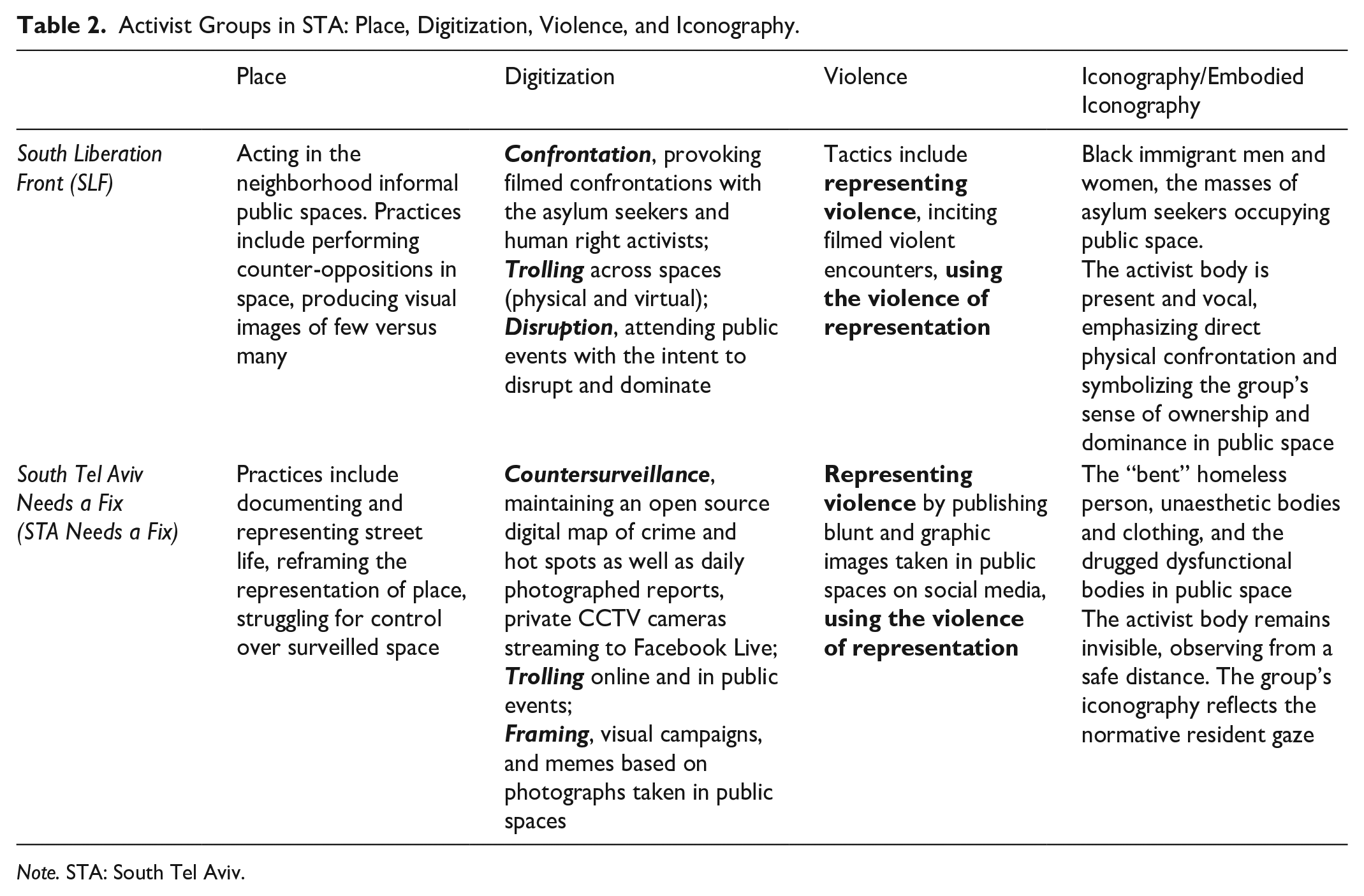
Table 2 summarizes the key practices and perceptions of the focal activists concerning place, digitization, violence, and iconography.
Activist Groups in STA: Place, Digitization, Violence, and Iconography.
Note. STA: South Tel Aviv.
Local–Digital Activism as a New Mode of Political Struggle?
Local–digital activism, as a tactical framework for action, is based on five key elements. (1) Attachment to place: Place matters, both as the object of struggle and as a key player in the narratives and representations of protest. This type of activism entails a small group of activists, even individuals who act in public space, filming, documenting, and livestreaming. (2) Digital practices repertoire: Practices include meme-making, videography, mass messaging, trolling, and livestreaming on social media. (3) Distressing gaze: The camera has a symbolic role, signifying the larger audiences online and the representational power held by the activists. (4) Displayed embodiment and iconography: The presence of activists in public space is crucial for gaining the validation of “being there” and the aura of authenticity associated with digital witnessing.
In addition to these elements, in local–digital activism, duration matters. This method of action is based on duration and consists of multiple actions on a monthly, weekly, or even daily basis, targeting both the general public and the authorities. The framework of action is based on the “mosquito” method, which helps keep the struggle in the public eye, changing the discourse while producing new representations that support the group’s message and becoming an ongoing, constant nuisance to authorities and politicians. This type of framework is not based on the scale but on the sequence of events—their tempo and timing. These types of actions are thus time–space events, with time preceding space. In addition, in local–digital activism, space is discursive and manifold, with physical and virtual space codefining one another. Instead of trying to define the direction of influence between these different spaces, in local–digital activism, spaces are mutually constructed. The digital–spatial practices of protest exploit the distinct qualities that each space offers: the publicity, immediacy, and transparency of social networks and the concrete reality and materiality of public spaces. For example, activists gain dominance in the physical public space by trolling and shaming opponent activists in the digital space, driving them to avoid activities in public space. In addition, the representation of space reconstructs and assembles physical, symbolic, discursive, and surveilled spaces. Last, in local–digital activism, the use of violence is strategic and intentional. Competition for visibility on social media encourages violent practices. Producing spectacles of violence attracts public and media attention, increases visibility on social media, sparks public debate, fosters the dominance of public and virtual space, and triggers rage and engagement among online audiences. It evokes emotional responses from both sides, whether supporters or opponents.
This study also sheds light on how violence, digitization, and protest interrelate in three ways: (1) the representation of violence—the use of social media to circulate images of violence, unobserved violent realities, and violent encounters (Mirzoeff, 2011; Reading, 2009); (2) the violence of representation—the use of digital means as a form of violence, a trigger that incites violence through forced photography, forced representation, invasion of privacy, shaming, and trolling, where representational power (Frosh, 2001) becomes a central capital in an intergroup conflict that is used against opponents and/or disadvantaged populations; and (3) the violence over representation—competition between opposing groups over narratives, visibility and attention incites violence across spaces. This new “wild zone of representation” has become a key battlefield in contemporary political struggles (Andén-Papadopoulos, 2014, p. 755). The ability of small groups to be heard in the digital age increases the competition between them and may thus direct protest toward more violent spheres. This produces new power relations in space, new forms of violence, and vulnerability.
Nevertheless, the key question remains: what cause does local-digital activism serve? Clearly, digital devices have become a novel weapon for activists to claim human universal rights, expose injustices and empower the underprivileged (Richardson, 2018). However, our results indicate that similar practices can be used by other groups (right-wing and middle-class activists) to pursue disparate values and act against disadvantaged groups. The values embedded in the iconography are produced through the distinct use of space, body, and social media. Digital practices are used to “reveal the truth” and present embodied witnessing, thus challenging the perception of power relations in space. The focal groups use these tactics to position themselves as “victims” of immigration and disorder. Hence, representational power in the digital age and the ability to “bear witness” are used by various groups to spread counterhegemonic discourses, including offensive and violent narratives that incite hate. In this sense, local–digital activism, as a tactic, raises questions about the legitimacy of this type of activism: Is using representational power against disadvantaged groups and private individuals—rather than public officials (e.g., police officers, soldiers, politicians, and even businesspeople)—a legitimate method of protest? Should this tactic be called activism or violence? Pushing the boundaries of the legitimacy of activism is intentional, particularly by the activists themselves, as the leader of the right-wing group claimed (Glazer, 2016). Such actions represent the intent to challenge liberal politics and, in any case, to increase visibility and draw attention to their struggle.
The phenomenon of local–digital activism is still in its infancy and requires further examination regarding its impact, consequences, and ethics as follows. (1) Impact on governance—how do urban authorities, police, elected officials, and governments perceive this mode of action? What are the impacts of continual trolling at public events and online, of personal messaging, of monitoring authorities’ actions in public space, and of constant criticism on social media? Does this type of activism change citizen–government relations? (2) The digital divide and social struggles—local activism relies significantly on digital tools; hence, digitally skilled individuals can translate their digital capital into political power (Schradie, 2018) that is also used to harm others. In heterogeneous environments, these skew power further toward the digitally affluent at the expense of those who are not (Zur, 2023). Therefore, digital skills should be explored—do class and socioeconomic factors influence activism and participation? How do they influence cities’ future politics and dynamics? (3) Impact on the political geography of a city—how does this form of activism influence political struggles over time? How does it contribute to instability and social dynamics in neighborhoods? Does this type of activism inherently involve violence, or can it be performed ethically by groups with diverse ideological agendas?
Finally, local–digital activism is an accumulative process of dissent. Under this mode, the volume, obstinacy, and persistence of a struggle and the ability to maintain it over time are crucial. This new path for civil engagement is gradually changing the politics of place and enhancing the competition among varied groups in cities worldwide.
Footnotes
Declaration of Conflicting Interests
The author(s) declared no potential conflicts of interest with respect to the research, authorship, and/or publication of this article.
Funding
The author(s) received no financial support for the research, authorship, and/or publication of this article.
