



Abstract
Research increasingly shows how speakers and learners of minority languages exploit online spaces to forge communication networks and create and consume content in languages that are otherwise marginalized from central societal domains. While the connectivity afforded by internet technologies is imperative to computer-mediated communication, culturally authentic content and expressions of identity are central to meaning-making processes that may influence online participation (or not) in a particular language. We examine participation in two Twitter campaigns for the Irish language—both conceived to increase the visibility of Irish online but with drastically different outcomes. Using the Twitter interface to conduct a content analysis of tweets bearing the respective campaign hashtags, we reveal the discretionary approach to online engagement exhibited by minority-language users and explicate some of the social and communicative practices that contributed to the success of one campaign over the other, bolstered by a comprehensive campaign infrastructure and semantically enticing features.
This article examines Twitter hashtag campaigns for the promotion of the Irish language. Irish or Gaeilge, although the first official language of the Republic of Ireland, is a minority language in public life. This study builds on the body of research that investigates how internet technologies and computer-mediated communication can support the formation of online communities, thereby enhancing minority-language usage (e.g., Cunliffe & Herring, 2005). The potential for individuals to create and share content, which introduces new ways of being social (Castells, 2007), is considered particularly relevant. Cunliffe and Herring (2005) argue, for example, that by participating in these media, minority-language users: “ . . . have the potential to be active shapers of this technology, able to create their own tools, adapt existing tools to the local needs and create culturally authentic, indigenous content (p. 132).”
This observation has become almost self-evident as minority-language speakers and learners adopt social media in their everyday practices (Cunliffe, 2019). Research examines whether the use of social media can facilitate communication in and revitalization of minority languages (e.g., Cunliffe et al., 2013; McMonagle, 2019; Ní Bhroin, 2015; Stern, 2017). Specific tools, such as the Indigenous Tweets directory, have been created to support users of such languages to identify and connect with others (Scannell, 2007, 2013). Focused studies investigate the habits of minority-language users online (e.g., Nguyen et al., 2021; Reershemius, 2017), their motivations (e.g., Ní Bhroin, 2013), the platforms themselves and the effects of their (language) policies (e.g., Lenihan, 2014), and the use of technical features, such as hashtags, in language promotion (e.g., McMonagle et al., 2019).
Hashtags, through the combination of the hash (#) character and a keyword, are signifiers that are consciously applied by social media users to draw attention, promote, and inform (boyd et al., 2010; Page, 2012). Through the sharing of content via such metalinguistic markers, participants may forge “ambient affiliations” without direct interaction (Zappavigna, 2011, 2015). Such affiliation may lead to communication in languages that are otherwise excluded or limited in central societal domains. Targeted campaigns have been shown to boost minority-language usage on Twitter—for example, the PraatMarFrysk campaign for Frisian in the Netherlands (de Graaf et al., 2015; McMonagle et al., 2019).
McMonagle et al. (2019) have further found that Irish-language users apply hashtags to promote Irish not just within Ireland, but internationally. The language is indeed significant to Irish identities outside of Ireland (McMonagle, 2012b; Ó Conchubhair, 2008). Targeted hashtag campaigns for its international promotion have been organized on Twitter, yet with rather different outcomes: the campaign for Irish as part of the International Social Media Day for Small Languages (ISMDSL) in 2017 generated just 47 tweets, while the Trasna na dTonnta campaign in 2018 generated more than 10,000 tweets. The campaigns had similar aims and approaches, both seeking to gain global visibility for Irish by encouraging speakers and learners to connect on social media via the respective hashtag(s): #EDL2017 #Gaeilge for ISMDSL (Praat mar Frysk, 2017); #TrasnanadTonnta for Trasna na dTonnta (Ireland Canada University Foundation [ICUF], 2017). Yet the dramatically different results indicate that participation cannot merely rely on the technological affordances of social media alone. Rather, “affiliation” within and to these hashtag-defined spaces also motivates engagement. Indeed, previous research highlights the individual and contextual factors, such as emotions, that play an important role in influencing language use (Walsh, 2019). We thereby aim to decipher the affiliative dynamics and meaning-making processes that may have motivated participation in one campaign but not the other.
In line with research investigating new social movements in the 1970s and 1980s, Gerbaudo and Treré (2015) maintain that symbolic and cultural aspects of the expression of collective identity are inherent to protest communication, and therefore contribute to the establishment, development, and decline of social movements. This has also been found in campaigns for the establishment of minority-language media, especially television, as new social movements (Hourigan, 2004). As social life moves to virtual spaces, far from enter a state of “collapse,” users re-configure collaborative action based on contexts of shared social norms (Szabla & Blommaert, 2020). For diasporic communities, the deterritorialized spaces of social media offer particular affordances for cultural enactment and continuity in uniquely constructed transnational spaces (Christiansen, 2017; De Fina, 2016). Transcending time and space in virtual networks allows them to semiotically signal their identity and belonging in the co-creation of transnational chronotopes (Bakhtin, 1981; Blommaert, 2018; Christiansen, 2017, 2019). Focusing on the content of interactions in social media, De Fina (2022) argues that chronotopic analysis allows for the emergence of different understandings of time and space in the development of communicative practice, and of the configuration and negotiation of identities in these practices. She maintains that identities are projected and performed through the sharing of the same and similar semiotic resources. While our analysis of the two campaigns mentioned above cannot ignore the technological aspects of social media—ultimately, they enable connectivity—an examination of the social and culturally authentic aspects of (language) identity, as well as the resulting metrics, may uncover reasons for the differing levels of success. After all, a language is unlikely to be maintained without an engaged community (Fishman et al., 1966). And while traditional media may lend a sense of community to the groups that they address (Cormack, 2007, p. 54), how that sense is produced and reproduced on social media relies on the practices of users who affiliate in co-constructed chronotopes.
Given the possibilities of social media for minority languages and their users, and the discrepant outcomes of the selected campaigns, we ask the following research question: Which social and communicative practices influence the success of Twitter campaigns for the promotion of Irish internationally? This is a wholly exploratory study that surmises that a range of factors—contextual, infrastructural, personal—motivates users (or not). Moreover, how those factors come together in meaningful ways, in which affiliation is experienced and reinforced in a virtual transnational context, shape campaign participation.
In the next section, we outline the vitality and sociolinguistics of the Irish language as well as policies and campaigns for its maintenance and revitalization. Much has been written on all of these aspects (e.g., Mac Giolla Chríost, 2004; Nic Pháidín & Ó Cearnaigh, 2008; Ó Riagáin, 1997; Walsh, 2012). We provide background information pertinent to this study. Following this, we describe the two Twitter campaigns selected for examination. We then proceed to detail our methods, a content analysis of tweets bearing the respective campaign hahstags, and findings. The paper concludes with a discussion of our resulting interpretations, limitations, and suggestions.
The Irish Language (Gaeilge)
The story of the Irish language is described as “a glass both half-empty and half-full” (Nic Pháidín & Ó Cearnaigh, 2008, p. viii). By the time that Ireland had gained independence from the United Kingdom in 1921, a dramatic shift from Irish to English had occurred among the general population (FitzGerald, 1984). The emigration of speakers to Britain and the so-called “New World” further compounded language decline in Ireland (e.g., McMonagle, 2012a). Yet the new Irish Free State retained an ideological commitment to “the national language.” Irish was later declared the first official language in the 1937 constitution (Dáil Éireann, 1937). Today, Irish is thus visible in bilingual street signage, is taught as a compulsory subject in primary and secondary schools for approximately 30–40 minutes per day, is present in broadcast media, and is recognized as the predominant vernacular of specially designated districts known as Gaeltachtaí. These sparsely populated, rural areas could initially maintain the language in localized social networks (Ó Riagáin, 2008). Yet English, the second official language of the Republic of Ireland, dominates commercial activity, media, governance, and public communication in general. Irish was more recently made an official language of the European Union (EU).
In Northern Ireland, Irish gained recognition via the Belfast/Good Friday Agreement of 1998 (Government of the United Kingdom of Great Britain and Northern Ireland and the Government of Ireland, 1998). Speakers and supporters of Irish then campaigned for official status, eventually achieved in the Identity and Language Act of 2022 (UK Parliament, 2022). Support for, indifference and opposition to the language in Northern Ireland can generally be traced along the cleavages of ethnopolitical conflict there (McMonagle & McDermott, 2014).
Research on attitudes to Irish in the Republic of Ireland since the 1970s shows a strong and positive relationship between ethnocultural identity and support for policy (Mac Gréil & Rhatigan, 2009; Ó Riagáin, 1997). Grassroots interest in the language led, for example, to a burgeoning Irish-immersion sector in education (Ó Baoill, 2007; Ó Duibhir, 2018). However, such support does not always translate to actual usage. Census data from 2016 indicate that ca. 74,000 persons in the Republic of Ireland claim to speak Irish daily and outside of the classroom (Central Statistics Office, 2017, p. 66). Even the Gaeltachtaí have seen language decline with around 25% of the population there using the language daily (Ó Giollagáin & Charlton, 2015) and with indications that intergenerational transmission is less than robust (Smith-Christmas & Ruiséal, 2022). Cronin (2005) pointed out that many daily speakers now live outside Gaeltacht areas, categorizing them an “invisible tribe” that is not readily reached by official language policy.
Neither personal identification nor a high degree of official status for Irish has led to “normalised” or maintained usage across life domains (Lo Bianco, 2012). Despite compulsory status in mainstream schooling, and a growing immersion sector, the Irish government has identified the continuing need to create “links to out-of school usage” as part of “youth culture” as one way to expand Irish as a community language (Government of Ireland, 2010; see also Ó Riagáin et al., 2008). While the education system plays a central role in the revitalization of Irish, it is a complex and debated role that cannot possibly be covered within the scope of the present study (see Ó Ceallaigh & Ní Dhonnabhain, 2017). Of significance to this study, however, is the fact that most people who attend(ed) school in Ireland will have some knowledge of Irish.
Campaigns and campaigning organizations are an essential aspect of Ireland’s language policy and are run at community level and in connection with other cultural activities (sport, dance, music) to encourage the use and learning of Irish. The most well known is perhaps the Seachtain na Gaeilge (Irish language week) festival, which has taken place annually since 1902. Given the affordances of new media to create content and forge communication networks, online spaces were quickly adapted by speakers and learners of Irish, with Delap (2008, p. 162) noting, “although the interactivity of the internet opens up many possibilities for the Irish language, content rather than technology must still be the master in this brave new world of choice.” Indeed, transnational users adopt the interactive affordances of social media to create online content to a degree beyond the relatively small community of everyday speakers counted in the Irish national census: at the time of writing, around 48 million tweets have been posted in Irish (Indigenous Tweets, n.d.). This volume suggests that tweeters are not necessarily everyday speakers and include those of varying language abilities. This discretionary approach to linguistic participation is a distinctive feature of the so-called “performance era” for minority-language media, which sees multiple autonomous agents engage with different formats in fluid and hybrid ways (Kelly-Holmes & Atkinson, 2017; Pietikäinen & Kelly-Holmes, 2011). We analyze such engagement in the campaigns outlined in the next section.
Twitter Campaigns to Promote Gaeilge
International Social Media Day for Small Languages—#EDL2017 #Gaeilge
The ISMDSL was organized on 26 September 2017 as part of the European Day of Languages (EDL). The EDL takes place annually on 26 September. Inaugurated by the Council of Europe, it aims to highlight Europe’s linguistic diversity and the importance of language learning (Council of Europe, n.d.). On this day, language and cultural organizations promote their “own” languages as part of a multilingual Europe, while educational institutions advocate language learning. With the rise of internet-based communication and social media platforms, multimodal materials in different languages can be disseminated with relative ease. On 26 September 2017, #coeEDL2017, #EDL2017, and #EuropeanDayOfLanguages2017 were applied across different platforms.
The Frisian-language organization, afûk, encouraged users of minority languages to also use #EDL2017 along with the hashtag of their own language (e.g., #Frysk, #Cymraeg, #Català) on Facebook, Instagram, and Twitter. For users of Irish, participation in the ISMDSL implied applying #EDL2017 and #Gaeilge.
The stated aims of the ISMDSL were listed on the respective website as follows:
to celebrate our languages
to make our languages more visible on social media
to make people aware about the existence and added value of our languages
to encourage people to use their language on social media
to show that we are all connected to each other (Praat Mar Frysk, 2017).
The campaign website indicates that organizations representing the different minority languages of Europe had been contacted in advance to support the ISMDSL, including an urban cultural organization in Ireland “with a special emphasis on the Irish language” (Praat mar Frysk, 2017).
#EDL2017 #Gaeilge generated 47 tweets on 26 September 2017.
Trasna na dTonnta—#TrasnanadTonnta
Trasna na dTonnta, meaning “across the waves,” is a traditional Irish song about a traveler who is happy to return to Ireland from abroad. It is taught to primary school children and would thus be familiar to most people who attend(ed) school in Ireland. This hashtag campaign was initiated by the Ireland Canada University Foundation (ICUF) to connect those with an interest in Irish to use the language on Twitter. This campaign, according to the respective website, is described as a “global Irish language initiative,” in which users of all language abilities were invited to tweet in Irish using #TrasnanadTonnta between 22 and 26 January 2018, the aim being to “connect” those with an interest in Irish around the world (ICUF, 2017).
#TrasnanadTonnta generated 10,663 tweets during its 5-day campaign period. The website for #TrasnanadTonnta lists several significant contributors to the campaign (ICUF, 2018). As this list was compiled following the 2018 campaign, it is unclear at what stage the respective contributors became involved, yet clearly a degree of coordination occurred prior to the campaign week. Acknowledged contributors included Irish-language teaching assistants in North America, a language organization in Ireland, politicians and policymakers, Twitter accounts that tweet about Ireland, Irish embassies and consulates, and “Campaign Ambassadors” around the world (ICUF, 2018).
#TrasnanadTonnta has taken place annually since 2017. We examine the 2018 campaign given its temporal proximity to the ISMDSL.
In summary, both campaigns aimed to increase the visibility and usage of Irish in an international context, highlighting that strong language proficiency was not necessary for participation. While Trasna na dTonnta was solely dedicated to Irish, the ISMDSL sought to promote the various autochthonous minority languages of Europe. Notably, neither campaign was initiated by an Irish-language promotional body; nonetheless, the respective campaign organizers have an interest in language promotion (albeit in different ways), and so presumably could draw on contact and follower networks.
Methods
Using the Twitter interface, we conducted manual searches for the respective hashtags shortly after the campaigns: for #EDL2017 #Gaeilge on 6 October 2017 and for #Trasnanadtonnta on 21 February 2018. Given the vast difference in the volume of tweets posted under each campaign (47 vs. 10,663), we included only the “top” tweets for each day of the Trasna na dTonnta campaign (n = 260) for analysis in this exploratory study. “Top” tweets are selected by the Twitter algorithm due to inter alia their popularity. The analyzed tweets may therefore be presumed to have contributed to the success of this campaign.
We manually recorded, coded, and analyzed all tweets posted in #EDL2017 #Gaeilge (n = 47) and the “top” tweets for each day of the #TrasnanadTonnta campaign (n = 260) using Excel. The sample size allowed us to (1) examine how the aims of the campaigns were met (or not), and (2) to explore the settings and practices that promote the use of a minority language on social media (or not).
To meet the first objective, we adopted the coding book from McMonagle et al.’s (2019) content analysis of minority-language hashtags on Twitter. By piloting a sample of tweets (n = 47 for ISMDSL, n = 50 for Trasna na dTonnta), we revised the coding book to better reflect our sample content and study objectives. Two coders (the authors) agreed on revisions to the respective codes, based on their individual reviews of the pilot sample. Coding categories adopted from McMonagle et al. included the following: “Agents” (who was tweeting), “language” (in which language(s) they were tweeting), “topic” (the topical content of the tweets), and “other hashtags” applied alongside the respective campaign hashtags. We added coding categories relating to “interactivity” (i.e., @tweets, like, retweets, replies), multimodality, as well as a specific focus on “place” as a sub-topic and “embassies/diplomatic missions” as campaign agents (see Appendix).
Following a double-coding of the sample and inter-coder comparative analysis, we could draw some cautious conclusions about the respective campaign outcomes. To meet the second objective, we interpreted our findings against the body of literature outlined in our introduction to this study.
Research ethical guidelines of the Association of Internet Researchers (Franzke et al., 2020) and the Norwegian Research Ethics Committees (NESH, 2022) were followed.
Findings
Campaign Configuration and Outcomes
By reviewing the respective campaign aims, as cited above, we could ensure their comparability: the campaigns targeted similar users for similar purposes, were international in scope, sought to encourage users of varying language proficiency, and occurred relatively closely in time. Differences that may have influenced participation could also be identified. While the respective campaign durations might question comparability (one vs. five days), one campaign was clearly more successful than the other, and this study aims to identify possible reasons for that difference.
Regarding campaign organization, there was a clear difference in the hashtags employed. Many different hashtags were used alongside #EDL2017 (e.g., #Gaeilge, #Kernewek, #Brezhoneg) in ISMDSL as it focused on many languages. Trasna na dTonnta, on the other hand, focused on the Irish language only and used a single hashtag. Furthermore, while the hashtag in the ISMDSL campaign was language specific (i.e., #Gaeilge), and is also applied in a general sense outside of this campaign (McMonagle et al., 2019), the other hashtag (#TrasnanadTonnta) bears cultural significance as the title of a song about migration, being both semantically relevant to the campaign aims and to transnational tweeters.
Interactivity
Mirroring differences in overall levels of participation in the campaigns, we observed differences in interactivity. Generally, tweets were “liked” more often than “retweeted” (#EDL2017 #Gaeilge average: 7 likes, 5 retweets; #TrasnanadTonnta average: 16 likes, 8 retweets). Generally, the higher the number of likes, the higher the number of retweets. Users were less likely to use the “@” function and the “reply” function was used least of all.
Figures 1 and 2 depict the most “liked” and “retweeted” tweets in each sample, highlighting the different levels of interaction with both campaigns. The top #TrasnanadTonnta tweet received 791 likes and 338 retweets; it generated 15 replies. The top #EDL2017 #Gaeilge tweet was liked 59 times and retweeted 33 times; it did not receive any replies. Neither campaign stipulated the type of content to be tweeted, the focus being on connectivity and language visibility (ICUF, 2017; Praat mar Frysk, 2017). Yet, as our findings will indicate, the social and semiotic features of tweets captured in Figures 1 and 2—including agents, language, content, other hashtags—broadly characterize the emergence and establishment of campaign chronotopes, indicating that the drastically different outcomes resulted from factors additional to connectivity and visibility. We explicate these findings in the following sections.

Newfoundland is the only place outside of Ireland that has an indigenous Irish language name- Talamh an Éisc, named by the many Irish fishermen who landed there in the 18th century. #TrasnaNadTonnta

BORE DA (Good morning) #Kernewek #Gàidhlig #Cymraeg #Gaeilge #Brezhoneg #Gaelg #EDL2017
Agents—Who Applied These Hashtags?
Following McMonagle et al. (2019), we sought to establish who had participated in the campaigns. Tweet originators were coded according to information in their Twitter biographies. They were generally categorized as organizations (language promotional, governmental, educational, commercial, etc.) or as individuals (political, public, private). No personal information was stored for data collection or coding.
Within our sample, we note a stark difference in the types of agents in each campaign: for #EDL2017 #Gaeilge many more organizations (63%) than individuals (37%) participated, whereas for #TrasnanadTonnta the opposite was the case with 62% individuals versus 38% organizations. Next, we outline the types of participating organizations and individuals.
#EDL2017 #Gaeilge
Organizations tweeting #Gaeilge as part of the ISMDSL campaign were overly represented as “other” (Figure 3).

Organizations tweeting #EDL2017 #Gaeilge.
We interpret “language promotion organizations” to specifically promote Irish. This clarification is necessary as most organizations that were coded “other” are indeed language promotion organizations but working in other language contexts, such as Cornish, Frisian, or Welsh. Given the European scope of the ISMDSL, many of these organizations tweeted #Gaeilge alongside other minority-language hashtags. Figure 2, for example, depicts a tweet by a Welsh-language organization in which hashtags for the six Celtic languages are included.
The coding distinction between language promotion organizations for Irish and “other” languages is essential to our study that examines just the promotion of Irish on social media. We also surmise that agent types played a significant role in the sense of affiliation experienced by users, contributing to the outcomes of the campaigns. For example, tweets issued by Irish-language promotion organizations generated most interaction and were liked on average 13 times, compared with a sample average of 7; and retweeted on average 7 times, compared with a sample average of 5.
Our analysis also reveals that tweets originating from individual accounts came from private individuals. No identifiable public or political individuals tweeted as part of the ISMDSL for Irish.
#TrasnanadTonnta
Many different organizations tweeted #TrasnanadTonnta between 22 and 26 January 2018 (Figure 4), with language-promotion and media organizations, as well as diplomatic missions/embassies, playing a significant part. The former was added as a sub-category in the pilot coding phase as it showed strong presence (22%) in the #TrasnanadTonnta sample. The tweet depicted in Figure 1 was posted by an Irish embassy.

Organizations tweeting #TrasnanadTonnta.
Language promotion organizations were highest represented in the sample. Strikingly, the majority (81%) were located outside of Ireland. Irish-language organizations within Ireland were also active in the campaign (e.g., Figure 5), but to a lesser degree. They are highlighted here, not just because they represent the largest cohort of tweeters, but because, taken together, they fulfill the worldwide aims of the campaign.

Tá #TrasnaNadTonnta BEO. Scaip an scéal go Gaeil ar fud an domhain. Let’s get #Gaeilge spoken worldwide as part of #Gaeilge2018
Government organizations generated the highest levels of interactivity in this sample, with an average of 67 likes and 33 retweets—this despite the relatively small number of overall tweets from these agents, indicating a significant impact on the campaign. Diplomatic missions and embassies attracted on average 58 likes and 22 retweets.
With organizations comprising 38% of agents, many more individuals were tweeting #TrasnanadTonnta in this sample. Not dissimilar to the ISMDSL campaign for Irish, around 99% of these were private individuals. Interactivity generated by tweets from individuals was significantly lower than those of organizations and below the campaign average.
Language(s) Used in Tweets
As both campaigns aimed to increase the use of Irish (for ISMDSL among other languages) on social media, it was important to establish the number of tweets composed in Irish. Given the minority status of Irish in relation to English, we also predicted tweets in English (e.g., Figure 1). As digital technologies grant opportunities for code-switching (Androutsopoulos, 2013), and users of Irish online have been shown to switch between Irish and English (Lynn & Scannell, 2019), bilingual and mixed-language tweets were also coded. Considering the European and international emphases of the respective campaigns, we also anticipated languages other than Irish or English.
We coded tweets composed in “Irish only” and “English only.” Those coded “bilingual” presented the same content in Irish plus one other language. “Mixed” tweets accounted for different content presented in Irish together with another language or languages, or multiple languages without Irish.
#EDL2017 #Gaeilge
Around half (24) of the #EDL2017 #Gaeilge tweets were composed in Irish only. Other single-language tweets were found in English (3), Asturian (2), Welsh (2), Extramaduran (1), and Galego (1). Irish was also used alongside English (4), Frisian (3), Cornish (2), and Scottish Gaelic (1), in bilingual and mixed formats. One tweet used Irish along with Asturian, Basque, Frisian, Gaelic, and Maltese (Figure 6). Although three tweets applied #Gaeilge, they contained no Irish; two were composed in Welsh and English, one in Cornish and English.

#Euskara Zer moduz? #Frysk Hoe giet mei jo? #Gàdhlig Ciamar a tha thui? #Gaeilge Conas atá tú? #Asturianu Cómo tas? #Malti Kif int? #EDL2017
Multilingual and bilingual tweets containing English, and tweets in English only, generated most likes and retweets. As illustrated in Figure 2, a bilingual tweet in Welsh and English generated most likes (59) and retweets (33). Irish-language, bilingual, and mixed-language (with Irish) tweets generated significantly less interaction than the average. As such, the campaign for #EDL2017 #Gaeilge saw little interactivity around the use of Irish.
#TrasnanadTonnta
Of the 260 analyzed tweets for #TrasnanadTonnta, single-language content was found in Irish (93) and English (65) only. A total of 99 tweets were composed in Irish and English, either bilingually or in a mixed format. Just two tweets contained other languages (Chinese, French), while one tweet contained no language (Figure 7).

Original tweet language in #TrasnanadTonnta sample.
The use of Irish as calculated here applies only to the “top” tweets of the #TrasnanadTonnta campaign. A more extensive examination might therefore result in different findings for language use. However, these “top” tweets, based upon inter alia their popularity, do indicate that tweets composed entirely or partly in Irish gained considerable response relative to the overall campaign. Yet tweets in English generated above-average levels of interactivity: 25 likes, 13 retweets. Bilingual Irish/English tweets followed (23 likes, 10 retweets), with bilingual English/Irish tweets averaging 17 likes and 8 retweets. Mixed-language tweets generated less interaction. These results indicate a significant impact of English and bilingual communication in #TrasnanadTonnta.
Around three-quarters of tweets in each campaign used Irish, either alone or together with another language or languages. While this figure can be understood to partly fulfill the aim of each campaign that users tweet in Irish, it must be viewed cautiously and critically. Given the small number of ISMDSL tweets for #Gaeilge, the use of Irish in this particular campaign did not make a substantial contribution to the general use of Irish online. Furthermore, tweets composed in Irish in the #TrasnanadTonnta campaign generated less interaction than bilingual or English-only tweets (10 likes, 4 retweets).
Topics
“Topics” refer to the themes coded in the sample data. As tweets could refer to more than one topic, we counted the overall number of topics for each tweet. First- and second-level codes were used to compare topics at a general level and to clarify semantic content more precisely (McMonagle et al., 2019). For example, the “top” tweet in the #TrasnanadTonnta campaign (Figure 1) included three topics: “promoting the language,” “place,” and “history.”
Altogether, we coded 64 topics in the #EDL2017 #Gaeilge tweets and 612 topics for #TrasnanadTonnta. This difference can be partly attributed to the varying sample sizes. In both samples, the topics “language,” “promotion,” and “social” were most prominent. In this section, we present and compare the distribution of tweets according to the most prominent topics and associated sub-topics. We also coded for topics such as “education,” “history,” “nature/environment,” “news/politics/current affairs,” and “culture/sport/celebrities” (as per McMonagle et al., 2019). As less than 1% of the overall sample addressed these topics, they are less significant to our analysis.
Finally, we address two meaningful topics identified in #TrasnanadTonnta tweets that were not present in the ISMDSL campaign for Irish: “place” and “technology.” They are interpreted, and therefore highlighted, here as aiding the success of #TrasnanadTonnta. Figure 8 provides an overview of the distribution of first-level codes for each campaign.

Distribution of first-level codes for each campaign.
Prominent Topics in Both Campaigns
“Language” was most prominent in both campaigns, with more than half of all #EDL2017 #Gaeilge and 75% of #TrasnanadTonnta tweets referencing this topic. This is a broad topic, necessitating sub-category codes, such as “learning and teaching language,” “language policy,” “promoting language,” “metalanguage,” and “teaching or expanding the language via Twitter” (Figure 9). Via sub-coding, we identified some notable differences between the campaigns. In the #EDL2017 sample, there was a relatively strong emphasis on language activism and language policy (7 and 6 tweets, respectively), mainly in reference to the movement for Irish-language legislation in Northern Ireland (e.g., Figure 10). These tweets generated the same level of interactivity as the campaign average in terms of likes and slightly less than average in terms of retweets.

Distribution of “language” sub-topics for each campaign.

“Language policy” tweet from #EDL2017 #Gaeilge.
A total of 114 tweets in the #TrasnanadTonnta campaign referred to “promoting the language.” These tweets generated the most interactivity (average 24 likes, 10 retweets) and mostly focused on promoting the “language in use” (88) and “promoting the language internationally” (24) (Figure 11).

Tweet promoting Irish internationally.
“Promotional content” was also relatively prominent in both campaigns, with 12 #EDL2017 #Gaeilge and 140 #TrasnanadTonnta tweets coded for this topic. Promotional content referred to events, a service or product. An important difference between the campaigns was identified: most of the #TrasnanadTonnta tweets focused on promoting the campaign itself (102). These tweets were liked on average 17 times, slightly above the campaign average, and were retweeted at the same rate as the campaign average (8). These tweets therefore served to enhance the impact and visibility of the campaign on Twitter. By contrast, in the #EDL2017 campaign, there was a greater focus on promoting other events (7 tweets), products and services (3) than on the campaign itself (2).
“Social” tweets, a broad category referring to inter alia personal updates or humor addressed to a diffuse audience, were common in both campaigns, and somewhat more prominent in #EDL2017 (almost half of all tweets) than in the #TrasnanadTonnta sample (about one-third of sample tweets). Most of these tweets were not addressed to any specific account but indicated sociality on the Twitter platform or among language users. They did not generate significant interactivity.
Prominent Topics in #TrasnanadTonnta
“Place” was added to the code book for #TrasnanadTonnta as it emerged as a significant theme in the pilot phase (Figures 1, 11 and 12). In the analyzed tweets, place was coded 91 times as users stated their location, place of residence or identified with a particular place. As parallel patterns emerged showing the transnational nature of the campaign—not only in the campaign aims, but also in the agents (e.g., embassies and organizations outside of Ireland) and analogue topics (e.g., promoting the language internationally)—‘place’ was coded as “Ireland” (11) or as “international” (80). The semiotics of the hashtag itself, meaning “across the waves,” undoubtedly appealed to tweeters outside of Ireland who engaged in communicative practices that could be categorized as “performances of the self” as part of the collective (Papacharissi, 2012). Figure 13 depicts the international locations referenced in #TrasnanadTonnta tweets and coded as “place.”

Tweet referencing “place” in #TrasnanadTonnta.

Places outside of Ireland referenced in #TrasnanadTonnta sample.
Notably, most places mentioned are those to which Irish people have traditionally emigrated: Canada, the United States, the United Kingdom, and Australia. Canada is over-represented with 33 mentions (e.g., Figure 1), most likely as the campaign originated there. Tweets referring to Canada (and Australia) also generated above-average levels of interactivity. Yet other international locations also featured, showing the contemporary use of Irish online in a global context (e.g., Figures 11 and 12). Tweets referring to places less typically associated with the Irish diaspora generated high interactivity, for example, those mentioning places in South America were liked on average 55 times and retweeted 15 times, indicating a sense of affiliation within this co-created transnational space whose virtual boundaries also transcend traditional narratives of emigration.
Finally, “technology” was also a significant topic in #TrasnanadTonnta (47 tweets). Such tweets mentioned social media (33), software/apps (9), and general aspects of technology (5). Content often referred to the use of technology to promote Irish, with some underscoring Twitter to connect with other speakers, including via the campaign. These tweets also generated significant interactivity, being liked and retweeted more often than the campaign average.
Other Hashtags
We examined the other hashtags appearing alongside the respective campaign hashtags. As hashtags are employed to “rally” (Zappavigna, 2014, p. 149)—that effect not least indicated by successful hashtag campaigns—coding for other hashtags could provide additional insights into how users semiotically align their Twitter activities as language promoters.
Of the 47 #EDL2017 #Gaeilge tweets, 33 applied other hashtags, most of which were hashtags of other minority (especially Celtic) languages in Europe and therefore part of the ISMDSL (e.g., Figures 2 and 6). The European Day of Languages was rendered into Irish as a hashtag (#LáNadTeangachaEorpacha) four times. Other, singular hashtags show the limits of interpreting the semiotic significance of digital objects in social media—for instance, one private individual tweeted #tweet2learn alongside #EDL2017 #Gaeilge. Whether the user is referring to their own learning or to other’s cannot be ascertained. In any case, the singular hashtags in this sample were so varied (e.g., #craftbeer, #TEDx), they are unlikely to have impacted the campaign. We did detect, however, an attempt to link the ISMDSL with a campaign for legislation for Irish in Northern Ireland: #AchtAnois (translation: #ActNow) was tweeted 5 times (Figure 10).
Around half of the #TrasnanadTonnta sample tweets contained other hashtags, the most frequently applied of which was #Gaeilge2018 (56), referring to 2018 as the year of the Irish language (Bliain na Gaeilge; #BliannaGaeilge appeared 14 times), a year-long festival to mark 125 years of the Irish language revival (Conradh na Gaeilge, 2017). Followers of this hashtag (an umbrella tag for various activities relating to Irish) were likely exposed to #TrasnanadTonnta (a specific marker to encourage the global use of Irish) and vice versa. We surmise that interest in both hashtags could be partly generated by mutual reinforcement. The second most frequently applied other hashtag was #Gaeilge (45)—a general hashtag that marks tweets in and about Irish (McMonagle et al., 2019). While McMonagle et al. (2019) note that minority-language hashtags are often accompanied by the name of the language in the majority language, #Irish was tweeted only 10 times in the present sample. Still, #Irish was the fourth most applied other hashtag, signaling that many other singular hashtags also appeared. While the significance of many of them cannot be determined due to the social nature of the platform (e.g., #amour, #dowhatyoudo), a cluster depicting place-names emerged as both singular hashtags (e.g., #Ceanada [translation: #Canada], #Vegas, #LakeMichigan, #AlbainNua [translation: #NovaScotia]) and collocational hashtags (e.g., #TorontoLovesGaeilge, #GaeilgeMontreal).
Our analysis of other hashtags corresponds to our findings thus far, with certain communicative patterns detected in both campaigns. First, promotional organizations for languages other than Irish were most active in the #EDL2017 campaign for #Gaeilge, indicating both their presence and support for other languages by tweeting relevant hashtags. Second, #TrasnanadTonnta appears to have benefited from larger campaigns promoting and celebrating Irish. Moreover, its semiotic appeal to a diasporic Irish identity encouraged some participants to tag their locations worldwide.
Multimodality
The primary mode coded in this study is language—language as medium (i.e., the language(s) of tweets) and discourse (i.e., topics and other hashtags). Given the multimodal affordances of social media, we coded for other modalities included by agents in their campaign messages (Androutsopoulos, 2010). As well as coding images, photos, hyperlinks, and videos, we also coded the language(s) visible in these modalities. Emoji were coded separately as non-language modalities.
Around 55% of all sample tweets contained a modality other than text. Images and photos dominated these modalities, followed by hyperlinks. The embedding of hyperlinks in tweets usually presents an associated image. The “modal ensembles” (Kress, 2010) in the study sample were therefore highly visual. Irish was the dominant visible language in #EDL2017 ensembles (appearing 15 times), while English appeared relatively more frequently in #TrasnanadTonnta added modalities (appearing 52 times with more than half of those being English only). The dominance of English can be attributed to the tweeting of newspaper articles about the campaign.
Emoji—visual symbols or pictograms—are employed by social media users to convey content, meaning, or emotions to lend context or expression to their messages and micro-posts (Bai et al., 2019). Their use in text messaging has been shown to facilitate social connectedness and identity expressiveness between users (Hsieh & Tseng, 2017). Given that both campaigns relied on digital connectedness and considering the expressions of self that emerged in relation to #TrasnanadTonnta, we also examined the use of emoji.
A quantitative reading indicates that emoji had little impact on either campaign as they were used relatively infrequently: just three times in #EDL2017 #Gaeilge and in 36 #TrasnanadTonnta tweets. All three in the former depicted Ireland’s national flag, the green, white, and orange tricolor. This was also the most applied emoji in the #TrasnanadTonnta sample, appearing 10 times. The second most frequent was the globe emoji (8; also alongside the Irish flag). Of the small number of tweets that contained emoji, users tended to opt for object or nonface emoji over so-called smileys (see Riordan, 2017). As well as the Irish flag and globe, nonface emoji included other national flags (Australia, Brazil, Canada, New Zealand, Turkey), hearts, waves (presumably to represent the hashtag), and shamrocks (a symbol traditionally associated with Ireland and Irishness).
Discussion
We investigated the social and communicative practices that influence the success of Twitter campaigns for the promotion of Irish internationally. Our research question was motivated by the drastically different outcomes of the ISMDSL campaign for Irish in 2017, which generated a total of 47 tweets, and the Trasna na dTonnta campaign of 2018, which generated 10,663 tweets. The campaigns had similar aims and targeted a similar pool of users who were encouraged to tweet in Irish using the respective hashtag(s). For Trasna na dTonnta we found that campaign infrastructure and the content of multimodal tweets, in a mutually reinforcing way, co-created a campaign chronotope. The campaign name and hashtag, the title of a song meaning “across the waves,” could create “ambient affiliation” between social actors collectively enacting a transnational Irish identity, but are otherwise unknown to one another (Zappavigna, 2011). These actors, through the circulation of related and additional semiotic resources, such as other hashtags, emoji, or mentions of “place,” contributed to the emergence of the chronotope (De Fina, 2022), which reinforced the aim of the campaign to “connect” those with an interest in Irish (ICUF, 2017).
The #TrasnanadTonnta chronotope provided a culturally meaningful space for Twitter users that #EDL2017 #Gaeilge, which was part of a larger and more disparate campaign, not least reflected in the “other hashtags” analyzed, did not achieve. This is apparent in our analysis of agents: Irish embassies and diplomatic missions, as well as language promotional organizations outside of Ireland, participated in #TrasnanadTonnta but were not involved in #EDL2017 for #Gaeilge. The presence of these social actors in #TrasnanadTonnta also contributed to achieving the aims of the campaign by promoting the language in a global context and lending it legitimacy. Although Nic Giolla Mhichíl et al. (2018) found that “micro-implementers” drive Irish-language activity in the Twittersphere, our analysis highlights the impact of communications at a macro-level on transnational campaign success.
The aim of language visibility was partly fulfilled with around three-quarters of tweets in both campaigns containing Irish, either alone or alongside other languages. Tweets using English, whether alone, bilingual, or mixed with other languages, generated most interactivity. This finding corresponds to the sociolinguistics of Irish as well as the recognition that “support must be sought and maintained primarily in English” (Nic Pháidín & Ó Cearnaigh, 2008, viii). The ISMDSL campaign was considerably more multilingual than #TrasnanadTonnta as it promoted various other languages. How and whether this, or a single-language focus, impacted participation remains unclear; however, we suggest that, given the emergence of an identifiable campaign chronotope, a unique and meaningful hashtag inspired expressions of transnational identity that generated greater participation in Trasna na dTonnta.
“Language” was the most prominent topic in both samples, albeit with differing emphases. The #EDL2017 campaign for Irish highlighted language activism and policy, while #TrasnanadTonnta participants tweeted, often reflexively, about the language in use. These users also tweeted about the campaign itself, thus drawing attention to the respective hashtag. Agents in #TrasnanadTonnta further indicated their locations around the world, rendering “place” an important topic in this sample, which also generated significant interactivity and emerged as a key feature of this campaign chronotope.
Our study reveals some of the social and communicative practices that may influence participation in minority-language campaigns on Twitter. We conclude that the semantically and pragmatically meaningful hashtag, #TrasnanadTonnta, guided content creation by relevant social actors that indexed a sense of personal identity and community affiliation (Christiansen, 2019; Papacharissi, 2012; Scott, 2015; Zappavigna, 2011). This is, however, a cautious conclusion as our study bears some limitations. We focused on “top” tweets only for #TrasnanadTonnta. Further research could examine the entire corpus of these tweets to determine the precise role of the key aspects we have identified. Additional research could also explore the relative impact of campaigns which aim to promote multiple languages, such as the ISMDSL. Another and general limitation in social media research is interpreting the “sociality” of user posts and engagement. More qualitative and mixed-method research might identify why different actors engage with such campaigns (or not).
We have shown that social media campaigns that emphasize meaningful aspects of shared cultural identity may be more likely to attract high levels of engagement. This confirms Cunliffe and Herring’s (2005) prediction of users becoming shapers of the technology in computer-mediated communication. Although we focus on just Irish, Nic Pháidín, and Ó Cearnaigh (2008, p. vii) claim that this language is “also a point of reference for a growing international body of work which addresses language decline and survival globally” (Nic Pháidín & Ó Cearnaigh, 2008, p. vii). This has resonance at time of writing, in 2022, as the International Decade of Indigenous Languages (UNESCO, n.d.) begins, during which production capability and digital activism have been identified as key to language revitalization (UNESCO, 2019, 2021). Again, however, we must be cautious as each indigenous language occupies a unique historical, political, and sociolinguistic context; online participation in a given language may therefore occur for different reasons and with different consequences (e.g., Chew, 2021). While interaction with a hashtag reflects a significant achievement in terms of campaign coordination and implementation, as well as a strong sense of identification with the aims of the campaign, how and whether this contributes to language maintenance and revitalization in a more general sense is unclear. Alongside those possibilities, we maintain that policy support, social change, and community commitment are still required to promote the use of minoritized languages, including Irish, in everyday life, both online and offline.
Footnotes
Appendix
Coding List (Adapted From McMonagle et al., 2019).
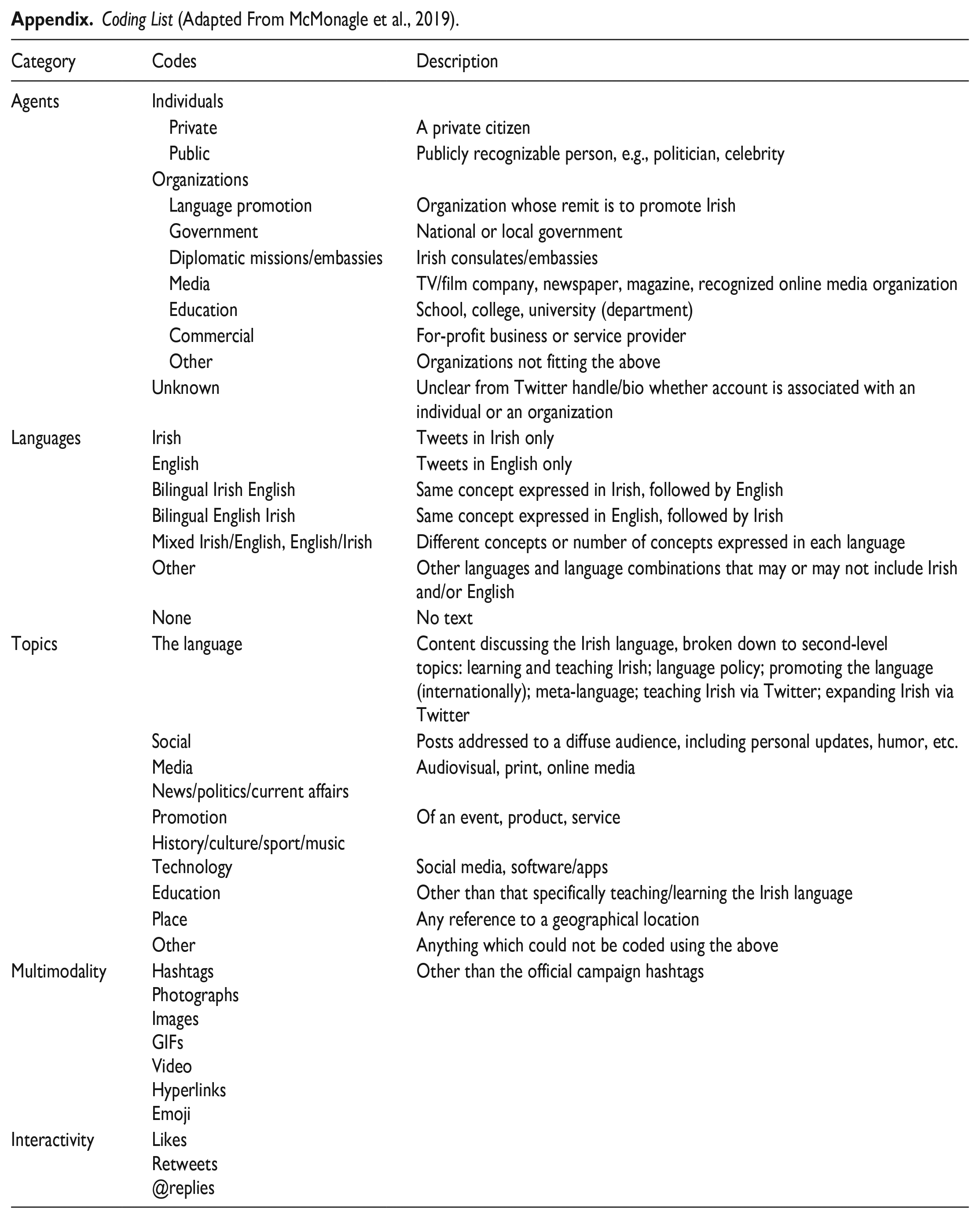
| Category | Codes | Description |
|---|---|---|
| Agents | Individuals | |
| Private | A private citizen | |
| Public | Publicly recognizable person, e.g., politician, celebrity | |
| Organizations | ||
| Language promotion | Organization whose remit is to promote Irish | |
| Government | National or local government | |
| Diplomatic missions/embassies | Irish consulates/embassies | |
| Media | TV/film company, newspaper, magazine, recognized online media organization | |
| Education | School, college, university (department) | |
| Commercial | For-profit business or service provider | |
| Other | Organizations not fitting the above | |
| Unknown | Unclear from Twitter handle/bio whether account is associated with an individual or an organization | |
| Languages | Irish | Tweets in Irish only |
| English | Tweets in English only | |
| Bilingual Irish English | Same concept expressed in Irish, followed by English | |
| Bilingual English Irish | Same concept expressed in English, followed by Irish | |
| Mixed Irish/English, English/Irish | Different concepts or number of concepts expressed in each language | |
| Other | Other languages and language combinations that may or may not include Irish and/or English | |
| None | No text | |
| Topics | The language | Content discussing the Irish language, broken down to second-level topics: learning and teaching Irish; language policy; promoting the language (internationally); meta-language; teaching Irish via Twitter; expanding Irish via Twitter |
| Social | Posts addressed to a diffuse audience, including personal updates, humor, etc. | |
| Media |
Audiovisual, print, online media | |
| Promotion | Of an event, product, service | |
| History/culture/sport/music |
||
| Education | Other than that specifically teaching/learning the Irish language | |
| Place | Any reference to a geographical location | |
| Other | Anything which could not be coded using the above | |
| Multimodality | Hashtags |
Other than the official campaign hashtags |
| Interactivity | Likes |
Declaration of Conflicting Interests
The author(s) declared no potential conflicts of interest with respect to the research, authorship, and/or publication of this article.
Funding
The author(s) received no financial support for the research, authorship, and/or publication of this article.
