



Abstract
Commercial image banks powerfully shape the cultural meanings of social media, especially when circulated as “fact” in the news media. To this end, we report a social semiotic analysis that documents the representational, compositional, and interpersonal framing of social media in a corpus of 600 stock photographs top-sliced from three global image banks. This core analysis is complemented with reference to (a) keywords used to categorize photos in image banks, and (b) two indicative samples of photos reproduced in international English-language news reports. We find that a visual “regime of truth” is produced in stock photography (and then circulated by the news media) that is gendered, affectively flattened, and “corporatized.” Social media are also depicted in ways that are disembedded and largely asocial or desocialized. We interpret these findings in terms of visual and media ideologies, and vis-à-vis scholarly perspectives on “connectivity” and “sociality” in digital communication/culture.
Introduction: When “Social Media” Make the News
This article makes an empirical-critical contribution from social semiotics (explained below) and concerns the way social media are visually depicted—or pictured—by commercial image banks. These image banks nowadays source the news media with much of its imagery. In taking this social semiotic approach, we do not seek to discuss practices of social media use, but rather to document how other people or other institutions may themselves be assessing social media. As a critical methodology, social semiotics invites us to examine these other assessments, especially when their reach is large-scale, widespread, or otherwise influential. In this sense, our contribution shifts attention from governmental politics—the focus of much social media research—to that of cultural politics. 1 Following Nash (2001), we understand cultural politics to entail a more Foucauldian perspective on power and societal control, much of which emerges at the level of banal, everyday social practices and discursive actions. Our central contention is that commercial image banks—together with the news media—produce a visual “regime of truth” (Foucault, 1994/2000) about social media and that this is something worth documenting.
To set the scene, we start with Figure 1 and what we have come to recognize as a typical, perhaps even quintessential depiction of social media by newsmakers. Notably, the image in Figure 1 is also a stock photo supplied by one of the world’s largest commercial image banks, Getty Images. As we say, newspapers and other news media outlets increasingly source their images this way, with fewer and fewer newsmakers relying on their own in-house photography. This, we will argue, has important implications for how “the facts” about social media are framed and circulated.
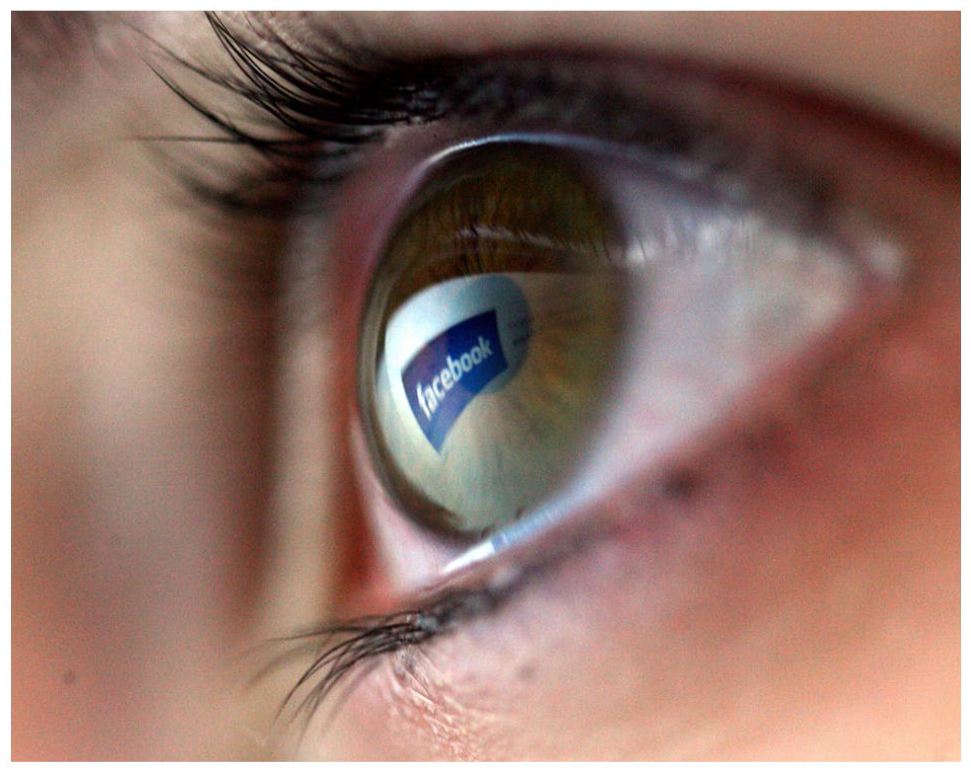
Picturing social media in the news—a typical example.
In Figure 1, we see a globally recognized social media brand, Facebook, reflected in the eye of a viewer or user. This photo is a largely abstracted representation: we do not know who the person is or what they look like, nor do we know where they are or who they are with; we certainly have no real sense of what they might be doing on/with Facebook. This image is in fact an example of what social semioticians would characterize as a conceptual image (Kress & van Leeuwen, 1996, p. 59): a stylized expression of a general idea or feeling (a “timeless essence”) rather than a depiction of a specific event or detailed story. In Figure 1, we find a single commercial provider (Facebook) metonymically deployed to represent all social media platforms. The image itself in turn comes to stand for the general idea of “social media” rather than its specific uses and/or contexts of use. This is not to say that the image is devoid of meaning; indeed, we sense at least one meaning potential: social media fills the eye, consumes our vision, and penetrates the mind. Without verbal anchoring (cf. Barthes, 1972), the image, however, offers little in the way of immediate social context or interactional narrative.
During the course of our data generation for the current study, we came across the very same image from Figure 1 being used for visually encapsulating various different news stories. In 2013, for example, it was used for a story about how social media “can even be more addictive than cigarettes and alcohol”; in 2015, about teachers who have “long complained of cyber-bullying”; in 2016, about students’ apparent obsession with online images; in 2018, about the damaging effects of Facebook on democracy and society; and then, both in 2021, about the establishment of a British watchdog to curb “Big Tech” and about moves in the United States to tighten federal laws concerning children’s online privacy. By no means the only instance in 2022, the image was also deployed in a local British newspaper story headlined: “Plymouth creep thrown back into jail for harassing ex-partners”—an event that was, once again, in fact only tangentially about Facebook.
The commercial success of a stock photograph hinges precisely on its being generic enough to be used multiple times; this is where the profits lie for image banks. Furthermore, and while the selection of images in news stories is usually not one made by journalists themselves, the choice of an image can sometimes be quite pointed and with a clear connection to the main story. At other times, however, images appear to be chosen quite randomly and for largely cosmetic or dramatic purposes, having little or no apparent relevance to the news report itself. At least this is how things seem until one starts to look more carefully, more systematically, and on a much bigger, more extensive scale. With this in mind, the current study seeks to document and understand the subtle (or not so subtle) role visual communication plays in shaping cultural discourses about social media and/or digital media more generally.
From a critical standpoint, our study is intended to draw attention to some of the power-laden ways the visualization of social media occurs, which often end up devaluing the lived experiences, relational uses, and creative applications of social media. Of course, the reverse may also be true: commercial visions of social media—the kind that often make their way into newspapers—can also obscure or erase altogether the more sinister, troubling uses and ramifications of social media. Regardless, our primary concern is with the agenda-setting—or, at least, agenda-shaping—role of major international image banks in the news media’s visual regimes. This brings us to a short conceptual framing of our study and its methodological grounding; to this end, we explain the role social semiotics plays in our approach to collecting and analyzing visual and multimodal data, but also how social semiotics informs our broader critical engagement with both social media and stock photography.
Conceptual Framing: Social Semiotics, Social Media, Stock Photography
The current study is broadly located in the field of digital discourse studies, orienting to critical scholarship which focuses specifically on digital meta-discourse (see Thurlow, 2018, for an overview). What this means is that we are less interested in linguistic and communicative practices in social media contexts and more interested in the language and communication used to talk or write about social media. Even more specifically, we examine the way in which social media users’ real or presumed practices are talked about or written about. While the current study pursues this general approach, we turn our attention now to the visual meta-discourse about social media—in other words, examining how social media and social media practices are “pictured” or visualized. 2 This new direction follows closely in the footsteps of an earlier study of ours (Thurlow et al., 2020), which examined the visualization of young people’s digital media practices. As before, our primary methodology for approaching and analyzing this visual meta-discourse is that of social semiotics.
As a framework closely aligned with the broader approach of critical discourse analysis, social semiotics focuses on what Caldas-Coulthard and van Leeuwen (2003) define as “the processes and products of discourse” (p. 3), with a particular emphasis on revealing and questioning the ways of knowing that underlie both the practices and outcomes of sign-making. We chose social semiotics over other methods because it encourages scholars to consider how meaning-making practices are situated in larger social contexts. In doing so, and unlike traditional semiotics and other forms of textual analysis, social semiotics focuses on “how people make signs in the context of interpersonal and institutional power relations to achieve specific aims” (MODE, 2012, para. 1). With its origins in Systemic Functional Linguistics (Halliday, 1978), social semiotics considers all sign-making as being developed to perform specific actions, or “semiotic work” (Hodge & Kress, 1988). It is in this sense that a social semiotic approach aims not so much to examine the representational “content” of images (although this of course matters), but rather to consider the relationship between the ways in which the key semiotic resources of these images are chosen and used, and their implications for the often-unequal ways in which people come to see and know the world.
As Aiello (2020) argues, social semiotics extends Barthes’ unfinished critical agenda by mobilizing “an appropriate method of detailed analysis” (Barthes, 1972, p. 9) for generating empirically grounded perspectives on power-laden semiotic practices in specific cultural and institutional contexts. On this basis, social semiotic analyses ideally (a) document the different semiotic resources or design tactics used, (b) explain their communicative functions and/or cultural origins, and (c) address the political/ideological ramifications of their collective and sedimented deployment. This is the framework or procedure that informs the current study. In short, we connect an appraisal of the main semiotic resources and design tactics used in a fairly large dataset of stock images to the way in which these choices feed and thereby shape news media discourse about social media. This approach thus enables us to link texts with contexts and, ultimately, semiotic production with social action.
By analyzing the “semiotic work” of stock imagery in this systematic manner, we hope to build evidence for highlighting the increasingly dominant, transversal ways in which social media are visualized. To our knowledge, this is the first time that social semioticians like us have turned their attention to social media as a cultural thematic; it is, we think, also the first time that some social media scholars might have stopped to think about the power of images in producing and shaping cultural discourses about social media. This, as we say, is an intervention we ourselves have already started making (Thurlow, 2017; Thurlow et al., 2020). Ultimately, one of the major aims of social semiotics is to surface often hidden or normalized semiotic practices with the possibility that these practices might be transformed or at least problematized. As Van Leeuwen (2005) suggests, the hope is that these critical interventions might spur semiotic innovation, which in turn can engender social change. This is the methodology that underwrites and structures our critical approach to social media.
Critical Approaches to Social Media
Broadly speaking, we take social media to refer to digital networking technologies that started emerging in the early 2000s, built on the technical and ideological architecture of the so-called Web 2.0 (Stevenson, 2018). The term social media thus comprises a range of different platforms, apps, and services, any one of which “can encompass thousands of different functions, communities and practices” (Burgess et al., 2018, p. 2). Given this, it is not surprising that social media are commonly understood to blur boundaries between personal, institutional, and commercial contexts while also reconfiguring what is actually meant by “social.” Social media have thus undoubtedly enabled new forms of sociality by, for example, increasing people’s ability to exchange, share, and connect with others. At the same time, though, they have also given rise to certain kinds of “pseudo-sociality” (Thurlow, 2013), whereby public and institutional agents (e.g., politicians, celebrities, corporations) deploy social media for strategic ends—for performing their ordinariness and/or in-touch-ness. Relatedly, scholars like Papacharissi (2016; cf. also Bouvier & Rasmussen, 2022, pp. 10–13) note in particular the affective nature of social media, which facilitates ambient feelings of connection but not necessarily collective action.
Critical scholarship on the rhetorics of social media is key for our social semiotic analysis. In particular, and following the lead of Van Dijck (2013), we note how the “social” in social media simultaneously encodes a sense of both human connectedness and automated connectivity. This is a distinction often deliberately conflated by the owners and champions of social media platforms. In this vein, John (2017) likewise shows how the term “sharing”—which he sees as a constitutive concept of social media—today refers to both communal practices of sharing and the sharing of user data. As he points out, social media corporations frequently emphasize the former while doing the latter. It is in this way that scholars observe how communication often goes hand-in-hand with commercialization. For Herman (2013), this inseparability of making meaning and money making is what ultimately renders social media “a commercial enterprise that seeks to ‘monetize’ our communicative sociality” (p. 31). For all their claims to neutrality, democracy, and human connection, social media companies seem less interested in strengthening relationships and more in maximizing uptake and thus profit.
Other scholarship on social media addresses this conflation of the social and technological aspects of social media through the lens of “platformization” (Helmond, 2015; Nieborg & Poell, 2018). Here, attention is paid to the shift from social networking sites to social media platforms and the rise of the platform as the dominant economic, technological, and cultural model for social media. As Gillespie (2010) has previously shown, “platform” is another term that entails multiple connotations and that can thus mean different things to different parties; computationally, for instance, a platform is “something to build upon and innovate from,” while politically, it is “a place from which to speak and be heard” (p. 352). It is in this way that social media constitutes an amalgamation of technical infrastructure, political economy, and cultural practice (cf. Burgess et al., 2018), all while operating under the guise of an egalitarian or at least non-hierarchical organization. And this is central for our own understanding of the way cultural discourses are framed and circulated in the contexts of everyday life.
Critical Approaches to Stock Photography
In recent years, scholars in the social sciences have become increasingly interested in stock photography, both as an object of study in its own right and also as a source of evidence for research on societal issues. In her work on Getty Images, for example, Aiello and colleagues (e.g., Aiello & Woodhouse, 2016) have demonstrated how stock photography collections can and ought to be examined as “datasets” (cf. Rogers, 2021), insofar as they belong to the same particular, though often overlooked, global genre which, in turn, materializes broader visual ideologies about, for example, identity, difference, and diversity.
In much the same way, the images we examine in the current study are part of what Rose (2010) would define as a “visual economy”; in other words, a set of “social relations, practices and institutions” (p. 62) grounded in what Frosh (2003) has previously described as “an industrialized system of image production” (p. 3) set apart by a process of progressive financial consolidation around a handful of corporate giants, such as Getty Images and Shutterstock, which dominate the global market for stock imagery. 3
It is by virtue of their high volume, wide circulation, and frequent usage that the photos delivered by commercial image banks have increasingly become the visual backbone of much public discourse, particularly in and through the news media (cf. Aiello et al., 2022; Thurlow et al., 2020) as well as in other areas of everyday life (Aiello, 2022). The cultural influence of stock photography derives from the structural ability of a few leading image banks to effectively produce what Machin (2004) characterizes as the “world’s visual language.” In the same vein, Aiello (2022) speaks of the way stock photography functions as “ambient imagery” and Frosh (2020) writes about it as a “fluctuating visual environment” (p. 201), which fosters “aggregated, absent-minded sociality” (pp. 189–190). Generic visuals like stock photos work through a process of symbolic reiteration, insofar as they are largely unremarkable images to which people may not pay particular attention but which, on the contrary, mobilize visual resources that people systematically see being repeated and repurposed across different images and media outlets over time (Aiello et al., 2022). What is perhaps even more important is that oftentimes the same types of visual resources if not the very same images are also used and reused across a diverse range of news media stories, to the extent that we can at times even find the same image being used to support two diametrically opposed arguments (see Thurlow et al., 2020).
The tension between everyday experiential encounters with stock photos and their larger ideological power is precisely what interests us in the current study. Stock images promote particular—and sometimes skewed—ways of seeing, which are also part of a much broader set of social relations. Our focus here is not the contexts of production, distribution, and uptake that structure stock photography (see Aiello et al., 2022, for more on this), but rather the way these images work semiotically as they are circulated in the public arena of the (news) media. To be clear, we do not hold image banks solely responsible for clichéd or stereotypical ways of seeing; photographers and media agents making/using stock photos are necessarily also implicated. Nonetheless, we do contend that image banks are particularly powerful in directly and indirectly shaping the (news) media’s visual ideologies precisely because of how image banks source and distribute stock photography. First, and as Aiello (2016) has shown, image banks rely almost entirely on freelance photographers who are compelled to reproduce the visual tropes desired (and remunerated) by image banks; second, image banks rely largely on royalty-free licensing models, which encourage media organizations to reuse the same photos.
Ultimately, it is for these reasons that we believe it is important to (a) interrogate the semiotic “work” that image banks do as producers of dominant visual ideologies, and (b) document the way in which social media—and ostensibly the social worlds they support and instantiate—are visualized or pictured in the relatively high-status context of news media. For this, we are obliged to consider first how this visual meta-discourse emerges in the handful of global corporations—commercial images banks—which supply the news media with so many of their images. With this in mind, and given the current critical perspectives on social media, our study is organized around the following questions:
How are social media typically depicted in stock photography (and then circulated by the news media)?
What types of people and social settings are represented, and what types of sociality are encoded (or not)?
What does stock photography (and news-media imagery) reveal about the visual ideologies and media ideologies at work in framing social media?
Current Study: Picturing Social Media in Stock Photography
The empirical bedrock of our article is a social semiotic analysis of 600 stock photos drawn, in equal measure, from three of the major international image banks: Alamy, Shutterstock, and Getty Images. 4 These three image banks were not selected randomly but on the basis of an indicative news media search used to establish and later illustrate the real-world uptake of stock photography. For this initial step, we used Google News for generating two datasets. The first dataset comes from a January 2014 to September 2015 search using the term social media, which generated 221 distinct news stories all concerned directly and explicitly with social media. For comparative purposes, we also conducted a more recent search using the same search term between January and April 2022; this generated 93 distinct news stories.
Our two news media datasets included only English-language results; as such, most of our material came from the United States and the United Kingdom, with just a handful of sources from other Anglophone or non-Anglophone countries. The datasets included many well-circulated British newspapers (e.g., The Guardian, BBC, The Telegraph), several US-American state and local newspapers, a small number of nation-wide newspapers from other countries, and a handful of “parent advice” and “business-and-tech-trends” news portals. Our analysis of these materials did not distinguish specific types of paper or specific sections in newspapers. All other search parameters were left in their default setting: searching “the web,” “all news,” and “sorted by relevance.” To limit “filter bubble” (Pariser, 2011) biases, we used private browsing mode for all of our searches. While this choice mitigates some biases (e.g., cookies are not stored), there are still other factors that will have structured our searches such as IP-linked location. Given our focus on visual representations, we excluded news stories that had either no images or only thumbnail images. We also excluded news stories that were only tangentially related to our topic. Finally, in our second news media search, we excluded 12 initial items that were focused only on the February 2022 launch of Truth Social.
We will return to some of the findings of these indicative news media searches later, but it was the initial search (2014/2015) that enabled us to identify the three dominant image banks being used for sourcing images for picturing social media. 5 In our first search, we found image banks sourcing 61% of the source-identifiable images in our dataset; of these, the three most commonly used were Getty Images (21%), Shutterstock (14%), and Alamy (10%). By comparison, in our 2022 search, we found image banks sourcing 70% of the news media images, with Getty Images (39%) and Shutterstock (18%) still very prevalent. (Alamy appeared less often, while Adobe Stock has seemingly become more popular.) It was on the basis of the first news media search that we created our main corpus of stock photos, all of which were downloaded over a 24-hr period in early October 2015.
We are mindful that, in the age of fast scholarship, a stock photography corpus that was first generated in 2015 may seem dated to some; however, this is not the case. First, it is our expert view that image banks do not turn over their stock quickly, and that stock photography’s key visual resources are typically aimed at infusing images with a timeless aesthetic, which for commercial purposes also translates into a “long shelf life.” Along the same lines, Trillò et al. (2021) have observed how visual motifs employed by Instagram users were “less affected by specific events than one might expect” (p. 894); images remained stable and consistent over time, even in the wake of the COVID-19 pandemic. Second, we point to our 2022 news media sample, which confirms how similar, if not identical, stock photos were still being used (as with the one shown in Figure 1).
Overall, this persistence of photos/imagery is in and of itself a significant finding that reinforces our claim that the visual ideologies of stock photography are reiterated and sedimented in the media and more generally. This finding becomes even more significant in light of major changes in the cultural trajectory of social media platforms over the past decade. Where the early to mid-2010s was a time of growth and enthusiasm for the communicative possibilities of social media (Sujon, 2021), the 2020s has seen much greater suspicion, mistrust, and cynicism directed at large corporate platforms (Anderson, 2020). Despite these significant changes, however, the kinds of stock photos used in the news media for depicting social media remain largely unchanged; in this sense, the gap between stock photography’s visual ideologies and the “reality” of social media appears to have widened even further.
In scraping photos from the three major image banks, we ran searches for social media, selecting only “creative” images and choosing the filtering option “most popular.” For each search result, we archived the image and recorded its unique ID (the code identifying the image). We limited our corpus to the first 200 photos returned by each image bank, leaving us with an overall corpus of 600 photos. This decision to use a top-sliced sample was made partly for logistical purposes but also knowing we would be working with the “most popular” images. Finally, we also pulled into a separate dataset the 46,000 keywords used to categorize the 200 photos selected and downloaded from Getty Images. We did not feel the need to do the same with the other image bank photos because our interest in keywords was only secondary to the main social semiotic analysis; however, these keywords add an illustrative multimodal dimension to our analysis, as we will show.
In keeping with the core principles and practices of social semiotics, our analysis is mostly a qualitative one; we will say more about this shortly. We did, however, also undertake a partially quantitative examination of our stock photography corpus to establish a descriptive overview of our visual evidence (see Thurlow et al., 2020 for the kind of systematic, multi-coder content-analytic procedure used). To this end, we start by offering the montage of images in Figure 2, which gives an impression of how social media were typically depicted. As it happens, these particular examples have been deliberately drawn from the first news media dataset; as such, we have typical photos sourced from major commercial image banks and circulated further afield.

Montage of typical news-media images sourced from major image banks (Photos: Shutterstock, reproduced with permission).
Something which we hope is immediately noticeable in Figure 2 is just how few people are depicted. Indeed, in our stock photography corpus, 47% of all images showed no people. When people were shown it was often very particular kinds of people. In this regard, 39% of stock photos showed only/mostly women; half as many photos showed only/mostly men. This over-representation of women is something detected in Thurlow et al. (2020), where we used a different stock photography dataset for documenting the visualization of young people’s digital media practices. There are commercial reasons why image banks favor photos of women (see Aiello & Woodhouse, 2016), but their over-representation nonetheless warps the visual regime of truth about social media; it also reinscribes longstanding cultural narratives or ideologies about sociality and communication being woman’s work (cf. Cameron, 2000). In terms of social categorization, we found similar biases with regard to age and ethnicity in much the same way that Thurlow et al. (2020) did; there is also a strong tendency for stock photos to reproduce a decidedly middle-class and urban vision of technology users. The point is that stock photography produces human geography for social media which largely erases the kind of social-cultural variability that evidently exists in practice. 6 We will leave these matters for now, though, because we want to focus on a more fine-grained social semiotic analysis of stock photography.
Social semiotic analyses are often organized by attending to the three communicative metafunctions identified in the foundational work of systemic functional linguistics (Halliday, 1978; see above). These metafunctions are considered to be a definitive meaning-making property of all semiotic systems. Labeled slightly differently by social semioticians, the metafunctions surface the (a) representational, (b) compositional, and (c) interpersonal meanings at work in any visual texts (see Van Leeuwen, 2005, for more details). To this end, our content-analytic treatment of the corpus was specifically organized around coding for both photographic content (i.e., representational meanings) and photographic design or layout (i.e., compositional meanings); we likewise coded photos for any affective connections (i.e., interpersonal meanings) established between represented participants in the images, and those established between represented participants and so-called viewing participants—that is, people seeing or looking at the images. In more operational terms, the kinds of features we identified in our codebook were as follows: for representational meanings, corporate icons, network graphics, settings, people’s gender, age and ethnicity; for compositional meanings, image type (i.e., graphic or photo), salience of technology, location (in the image) of technology and people; and for interpersonal meanings, facial expression, gaze, and use of technology.
Along these lines, and in addition to the brief remarks just made about social categorization biases, we present four other prevalent (and telling) meanings produced in stock photography depictions of social media—one additional representational meaning, one interpersonal meaning, and two compositional meanings. Although the specific semiotic tactics used to produce these meanings were enumerated in the initial content analysis of the corpus, our analytic objective here favors a more qualitative close reading of images to demonstrate the kind of social semiotic processes at work in stock photography.
Representational Meaning—Corporatization
We have already signaled some of the representational meanings at work in our corpus (i.e., the gender-bias); there is, though, one other important representational meaning that we find both striking and telling. As we say, nearly half of all the stock photos in our corpus showed no people. Instead, what we do find are brands and corporations figuring very prominently; take, for example, the graphic representations of Facebook’s thumbs-up icon in Figure 3a to d.

Selection of corporatization photos.
This tendency to “corporatize” the depiction of social media is echoed in the way in which the stock photos in our Getty Images sample were tagged. (As with the images, we relied on broadly content-analytic procedures for surfacing patterns in the keyword corpus.) These keywords are essential to the architecture of image banks (Ilan, 2017; Wallace, 2010), allowing customers to search quickly and easily for images but also structuring or funneling these searches. Keywords make it possible to return the images that are algorithmically deemed most relevant to the search terms entered. Beyond this, customers can also add a range of different filters for technical (e.g., color, resolution, photographer) and compositional (e.g., orientation, close-ups) specifications. A range of basic content-related filters are always available too, such as number of people, age, or ethnicity. A selection like ethnicity is, of course, unavoidably ideological. 7 This can work in other arguably less problematic but no-less ideological ways too.
From the 46,000 keywords used for tagging the 200 Getty Images photos in our main corpus, we noticed how the corporatization of photos is underscored. So, for example, 20% of the images were tagged specifically with Facebook, another 8% with Twitter, 3% with Instagram, and a handful with LinkedIn. This handful of dominant corporate brands are effectively privileged as metonymic markers for social media—not just the diverse world of apps and platforms but also their diverse uses and users. We also found our keyword dataset skewed in similarly commercial ways, with almost a third of the Getty Images stock photos being tagged with business itself, 12% with businessman, and 8% with businesswoman. Tentatively, we suggest that the visual and verbal framing of social media in stock photography exposes how image banks prioritize corporate settings and uses over social settings. For us, this is one of the ways that the visual regime produced by image banks tends to erase ordinary users of social media. By the same token, the otherwise diverse relational and communicative uses of social media are also obscured, all of which have the added effect of diminishing the social dimensions of social media. It is in this way that the entanglement of visual ideologies and media ideologies starts to become apparent. In other words, stock photos not only reproduce particular visions of social life—where, for example, some people matter, others less so—but they also encode wider cultural beliefs about the “communicative possibilities and the material limitations” (Gershon, 2010, p. 283) of different media. We return to this matter in more detail below.
Interpersonal Meaning—Affective Flattening
In Figure 4a to c, we offer four more quintessential examples of stock photography drawn from our main corpus. These are instances where, as in some 53% of our corpus, photos did in fact depict people. To start with, we call attention to the first two photos (Figure 4a and b), where we see how people are very often shown on their own, smiling at their computers or smartphones. This was quite common in our corpus where, of the photos depicting a face, 70% showed people smiling, 30% showed an ostensibly “neutral” facial expression, and less than 1% (to be precise, 1 image) showed a person with a clearly negative facial expression. Once again, the keywords used for tagging stock photos reflect the same affective bias: keywords such as smiling, enjoyment, happiness, cheerful, and happy were used abundantly, while sadness, unhappy, and angry occurred very rarely.

Selection of “affective flattening” photos.
As with the gendering of stock photography (see above), there are undoubtedly commercial imperatives at work here, not least because image banks depend heavily on sales to advertisers who, in turn, are looking to promote a vision of happy consumers. Notwithstanding these structural issues, the consequence is that image banks end up privileging a vision of social media that is solidly upbeat and emotionally uncomplicated. While social media have been noted for their affective nature (Papacharissi, 2016), our main contention is that what is happening in our stock photography corpus is effectively a form of affective flattening. This aspect of the overall visual regime inevitably also has wider ramifications when the photos circulate in, say, news reports (see Thurlow et al., 2020). Ultimately, this kind of affective flattening of/around social media is at the very least skewed, at worst problematic when such a uniformly positive vision evidently runs contrary to some people’s lived experiences with/through social media (see, for example, Craig et al., 2020; Valkenburg et al., 2021)—especially, it has to be said, the kind of young women over-represented in stock photography. Here, we might also point to the other kinds of conflictual intercourse highlighted by studies of political discourse in social media contexts (e.g., Kaiser et al., 2022; Kim et al., 2021).
Exemplified by Figure 4c, there was one other interpersonal meaning at work in our corpus; although this is something we have commented on previously (Thurlow et al., 2020) it is worth noting here too. Across the corpus, the vision of social media is one that depicts a relational disconnect. As in the example here, we find represented participants (i.e., those shown in the images) almost always disconnected from each other. Seldom, if ever, do we see what people are actually doing with social media, not least because the screen itself remains hidden from view. These are, of course, narrative details which image banks would find troublesome because setting and other contextual specificities undermine the reuse/resale potential of a photo. Ultimately, however, we sense these seemingly harmless design choices reinscribing a “together alone” (cf. Turkle, 2011) media ideology; in other words, social media are depicted as isolating people from each other and as effectively desocializing people. There are also more subtle, compositional ways in which this potentially pessimistic or one-sided vision of social media emerges. In this regard, and turning from interpersonal meanings to compositional meanings, we turn to issues of design and layout where the rhetoric of social disconnect is underscored in two different but related ways.
Compositional Meaning—Desocialization (Machine Over Users)
A striking feature of stock photographs representing social media is that the technology itself very often appears to be more central than any people or any communicative uses of the technology. In fact, and as exemplified, the images in our corpus showed devices (most often smartphones) as very salient—as having what social semioticians call high information value (Kress & van Leeuwen, 1996; Van Leeuwen, 2005). The placement of different elements in an image endows them with specific significance or importance for the viewer. In this current case, one way in which this was done is quite literally by focusing on the device (against a blurred background, as in Figure 5a) or by positioning it at the center (Figure 5b) or in the middle (Figure 5c) of the image.

Selection of “desocialization” photos—machine over user.
We see a similar emphasis on technology-as-device rather than technology-as-social-resource reflected also in the keywords used to tag and therefore pinpoint the meaning of the photos. It is no accident, we think, that technology was the third most frequent keyword in our dataset, more or less on a par with communication (used for tagging 76% of the images) and connection (66% of the images). This multimodal (i.e., verbal and visual) prioritization of machine over users is again something we have documented in two previous studies (Thurlow, 2017; Thurlow et al., 2020). As before, our contention is that these compositional meanings produce a vision of social media which is somewhat paradoxically asocial or desocialized. To make the point just a little stronger, we turn to our final analytic move and another way in which sociality appears to often be eclipsed or at least obscured in stock photography.
Compositional Meaning—Desocialization (Connectivity Over Connectedness)
A large proportion (44%) of the photos in our corpus were not actually photos per se but rather illustrations or graphic images. One of the most common instances of this more graphical style is exemplified in Figure 6a to d. These kinds of “network structures” accounted for a quarter of our overall stock photography corpus. While they did sometimes show people and hint at social relations, social relationships are rendered largely abstract. These are highly stylized, generic depictions of social interaction where the substance, nature, or content of interactions is oblique. This points to an aspect of social media to which Van Dijck (2013) calls attention: the common but problematic conflation of connectivity with connectedness; the first is a matter of technological affordances, the second a matter of social relationships. This issue was also mirrored verbally in our keyword dataset where the ambiguous connection figured very prominently—as indicated before, this is the second most used keyword in our corpus.

Selection of “desocialization” photos—connectivity over connection.
The confusion between connectivity and connectedness is a matter of more than just semantics. In writing about what he calls “pseudo-sociality,” Thurlow (2013) notes how businesses or politicians often capitalize on the connective affordances of digital/social media as a strategy for performing a sense of their being in touch with wider publics and/or positioning themselves as being in direct, personal relationships with their customers or voters. And as Portmann (2020) demonstrates, confusing the boundary in this way on a platform like Instagram can be an effective but quite deceptive marketing tactic. Ultimately, we are struck by the way stock photography visually reproduces the belief that the connective affordances of social media are necessarily akin or equivalent to its relational uses and opportunities. By the same token, it is also insufficient—and no doubt inaccurate—to reduce social media to social networking.
Returning to the News: Stock Photos in Circulation
Before turning to a general discussion and conclusion, we want briefly to return to our starting point: the news media as a major site for the uptake and circulation of stock photography. In this regard, we call attention once more to the photo in Figure 1 as well as the montage of photos in Figure 2; these are all examples of typical stock photos reproduced in news media reports. As we also explained, stock photos are intended to be reused often; as such, it is possible to find the same photo being deployed by numerous news outlets and even several times by the same outlet.
With this in mind, and as our final example, the stock photos in Figure 7 nicely illustrate this core logic of stock photography and how photos are taken up in the news media. These particular photos are also akin to the compositionally desocialized, device-centered examples shown in Figure 5b and c. All from 2022, the photos in Figure 7 are, respectively, headlined or captioned as follows: “Social media sharing: how much is too much?”; “Social media is a tactical space for the Russian-Ukrainian war . . .”; and “Some content creators are combating the dark side of social media platforms.” First, these three stock photos are typical of the way in which technology and connectivity, rather than sociality and connectedness, are often centered in the visual framing of social media. Second, these photos are also characteristically dependent on an unnecessarily gendered portrayal of hyper-individualized uses of social media linked to no other context, activity, or relationship. The desocialized quality of these images is also reinforced by the obvious disconnect between what they portray and the events and issues they are called to illustrate—from the war in Ukraine to the “dark side” of social media platforms.

One common visual motif from our 2022 news media dataset (Photos: Shutterstock, reproduced with permission).
There is, as we have noted before (Thurlow et al., 2020), no neat extrapolation to be made between the visual ideologies created and promoted by commercial image banks and the ones then apparently (re)produced in the news media. Although most newsmakers rely on image banks, not everything from image banks is necessarily taken up by the news media. Regardless, the point we make is that news media images play a key and sometimes contradictory role in framing reports about social media. We also want simply to present first-hand evidence for the nature of stock photography and its influential role in feeding the news media with their imagery. The significance of image banks is that they do source so many of the images that backdrop our lives—from advertisements to magazines and newspapers, to university websites and brochures. In short, then, we think the representation of social media in stock photography is worth looking at because (a) no-one else has thought to do so before, and (b) these images have such a wide reach and agenda-shaping impact. This brings us to a general discussion and conclusion.
General Discussion and Conclusion: Desocializing Social Media
Our main objective with this article has been to document the way in which social media are visually depicted and framed by commercial image banks. Nowadays, as Machin (2004) observes, a handful of dominant image banks effectively produces a globalizing “visual language” with a vision of the world that is often prestructured along formulaic, clichéd, and consumer-driven lines. Importantly, it is this same visual language that plays an increasingly central role in illustrating and framing news media reports about, in this case, social media. In organizing our study of stock photography, we have relied on the principles and analytic procedures of social semiotics; analytically speaking, this enables us to pin-point how stock photos “work” but also, critically speaking, to consider the way image banks (and, in turn, newsmakers) metadiscursively frame social media. In this sense, we have been keen to surface the cultural politics of these everyday but influential representational practices. Our central contention is that a particular—and particularly skewed—“regime of truth” (Foucault, 1994/2000) about social media is produced, one which reinscribes certain visual ideologies as well as certain media ideologies.
In thinking about visual ideologies, we orient to Hall’s (1982) well-known definition of ideology as, “the power to signify events in a particular way” (p. 69). In these terms, and as a major mechanism of representation, global image banks end up visualizing social media in ways that appear natural, neutral, or normal. In our current study, the most obvious example of this was the over-representation of women and girls in stock-photographic depictions of social media (cf. also Thurlow et al., 2020). These highly gendered and, specifically, “feminized” depictions of social media cannot be ascribed solely to consumer-led appraisals of the types of imagery likely to sell widely; they are in fact integral to image banks’ increasingly significant role in defining an overarching visual politics of gender across a wide variety of media and communication genres (Aiello & Woodhouse, 2016).
While our current study shows how social/digital media practices are gendered in particular ways by corporations like Getty Images, Alamy, and Shutterstock, these corporations in turn privilege other corporations. This, as we have shown, surfaces another important visual ideology at work in stock photography: the tendency to represent social media with reference to corporate entities and brand marks. It is in this way, we suggest, that the social-interactional worlds supported by social media end up being reduced to little more than an app or a platform. This is significant because it intersects with current scholarly discussions about the cultural politics of platforms.
The growing field of platform studies (see Plantin et al., 2016) draws attention to the infrastructure of social media platforms: the software and hardware that, despite being “at the core of every major social media system” are always “out of sight and thus out of mind” for those who use social media (Vaidhyanathan, 2018, pp. 216–217). It is the control over these infrastructures that affords social media owners practical, political, and ideological power. Hunsinger (2013) thus speaks of an “electronic leviathan” (p. 6) that operates through invisible standardization and normalization. Within this sociotechnical system, deliberately designed ignorance and invisibility make it difficult to “opt out,” not least because social media provide a key ecosystem that grants people access to family, friends, and communities (Hunsinger, 2013; see also Van Dijck, 2013). As Van Dijck (2013) summarizes, social media platforms—and their owners—have thus “become central forces in the construction of sociality” (p. 23), shaping not only when, how, or with whom people can be social, but also what may count as “social” in the first place. The same link between the infrastructural affordances of social media and the kinds of social organization enabled is the focus of Zulli et al.’s (2020) analysis, where they demonstrate how technical features like typology centralization and the transparency of software systems do dictate—or at least shape—the type/degree of sociality made possible. The question of sociality is one that has surfaced in our own study, although in somewhat different but no less ideological ways.
It is precisely the intersection of visual ideologies with media ideologies (Gershon, 2010) which concerns us in the current study; this is where we see the sociality of social media being repeatedly framed in particular ways—whether this sociality expresses itself in offline/material forms or online/immaterial forms. By attending specifically to interpersonal and compositional meanings, for example, we have shown how stock photography typically iconizes or fetishizes the machinery of social media (e.g., phones and tablets) at the expense of its users and social/communicative uses, which generally remain vague or obscure. We noted also how screens hidden from view conceal even mediated social exchanges. In Gershon’s (2010) terms, image banks’ visualization of social media uniformly privileges the materiality rather than sociality of digital media. This is achieved semiotically through the depiction of social media in largely decontextualized and interactionally disembedded ways. We likewise see social media being depicted in the hands (often quite literally) of isolated or otherwise socially disconnected users. Ultimately, and much like Thurlow et al. (2020), we find that digital media, and specifically social media, are effectively desocialized—rendered paradoxically asocial or nonsocial.
We do want to clarify our use of “desocialized” here because it is a term occupied in very different ways. Specifically, the term can be used—in both popular and some scholarly writing (e.g., Turkle, 2011; Zhong, 2021)—to advance an argument about the deleterious impact of digital/social media on people’s interpersonal communication or social connectedness. This is certainly not what we intend. In a paper that technically predates social media, Robins and Webster (1999) use the term “desocialize” to critique the way technology is sometimes treated analytically or conceptually in isolation of its social settings and cultural uses. Although this is not the stance we ourselves take, the same tendency to socially disembed or decontextualize social media is indeed what seems to underpin the visual regime produced by image banks. As we say, stock photographs consistently spectacularize the devices supporting social media rather than their actual, variable uses and especially the complex social-interactional contexts of their use. This vision of social media is underscored also by concealing from viewers the screens themselves and, therefore, any sense of what users might actually be doing with their devices—be it social, antisocial, or otherwise.
Questions about the extent and kind of sociality produced in the contexts of digital media have of course been an enduring concern for cultural and communication studies. In his foundational statement on the matter, for example, Castells (1996/2009) documented how digital media were undoubtedly helping to reconfigure traditional/local social bonds. Importantly, however, he noted that these changes were not necessarily or only deleterious. Others have remained more pessimistic. In writing about social networking, Miller (2008) relies heavily on earlier statements about sociality by scholars like Wittel (2001) and Manovich (2001). Here, “network sociality” is set in opposition to—and negatively impacting upon—community as something understood to be more stable, coherent, and embedded. Digital communication, argues Wittel, is necessarily (sic) more informational than relational. Miller (2008) himself, meanwhile, sees the rise of what he calls phatic media, which is to say, “communication without content” (p. 398). Herein, we think, lies the bias also of stock photography: it too ends up reinscribing much the same kind of “flattening” rhetoric promoted by scholars like Wittel (2001), Miller (2008) and Turkle (2011). Whether or not this desiccated view of social media may indeed represent a lived experience for some (or even many), it still runs contra to research that paints a somewhat more nuanced, textured picture of social media. In this regard, we might think of the complex effects of social media on young people’s self-esteem (e.g., Valkenburg et al., 2021) or the inherent sociability in many young people’s social media use (e.g., Wong, 2020). Ultimately, image banks and, by implication, the news media seem to obscure or erase many of the complexities of social media, promoting instead a vision that is largely two-dimensional and persistently desocialized.
Footnotes
Acknowledgements
The authors are greatly indebted to the University of Bern students Olfa Benaziza, Olivia Droz-dit-Busset, Josiah Glausen, and Meret Hunziker, who, along with Lara, worked with Crispin as part of a Visualizing New Media research cluster in Autumn 2015. They are also grateful to Justyna Rokosz for her help with generating the second news media dataset. Finally, they thank their anonymous reviewers for their very constructive feedback.
Declaration of Conflicting Interests
The author(s) declared no potential conflicts of interest with respect to the research, authorship, and/or publication of this article.
Funding
The author(s) received no financial support for the research, authorship, and/or publication of this article.
