



Abstract
This study investigated how social media use, specifically exposure to and posting of sexualized and party-related content on social media and interpretations of that content as sexual consent communication, related to college students’ intentions to engage in sexual consent communication. A national sample of U.S. college students (N = 954) completed the relevant measures in an online survey. Results indicated that the more college students reported exposure to sexualized and party-related content on social media, the more likely they were to report posting similar content and believe in harmful consent myths (i.e., that a person’s sexual consent can be assumed by looking at their social media profiles). Posting sexualized and party-related content on social media was also related to lesser intentions to engage in consent communication. These findings provide evidence for the importance of considering social media use in how college students understand sexual consent communication that may be used to inform future sexual consent education on college campuses.
Keywords
Sexual assault is a serious concern for colleges and universities in the United States. Nearly a quarter of women (20%–25%) and 6%–8% of men are sexually assaulted during their time in college (Cantor et al., 2019; Muehlenhard et al., 2017). Despite copious research on sexual assault prevention programs as well as numerous campaigns promoting affirmative consent on college campuses throughout the United States, the rates of sexual assault on college campuses have remained unchanged for the past two decades (Armstrong et al., 2006; Cantor et al., 2019; Krebs et al., 2007; Muehlenhard et al., 2017). Scholars and university officials have argued that to improve sexual violence prevention initiatives and thus, reduce the sexual assault rates on college campuses, it is vital to understand the contextual factors that may affect sexual consent communication between college students (Jozkowski & Willis, 2020; Muehlenhard et al., 2016; Ortiz, 2019).
One of these important contextual factors is social media. In a survey conducted by Pew Research Center in 2021, 90% of college-aged adults reported using at least one social media site regularly (Auxier & Anderson, 2021). While social networking sites are used for a variety of reasons, researchers have found that college-aged adults often use them to maintain and/or facilitate sexual partnerships (Duggan, 2013; Fox et al., 2013; Fox & Warber, 2013; Freitas, 2013; Holloway et al., 2014; Moreno et al., 2009). Unlike meeting someone at a bar or party and spending time getting to know them and their preferences, the self-disclosing nature of social networking sites allows people to quickly learn about one another and their preferences by the contents of their online profile alone (Rhoads, 2016). Thus, social networking sites may help individuals facilitate sexual partnerships in part because people may believe that by looking at another person’s social media profiles, they can infer their personal and sexual interests, desires, or willingness (Rhoads, 2016). Such beliefs are referred to as “social media consent myths,” which are defined as an individual endorsing the belief that a person’s sexual consent can be determined (or assumed) by looking at the content on their social media profiles (Rhoads, 2016).
Social media consent myths originated in 2016, when Rhoads created the Social Media Consent Myths Scale to assess common false beliefs regarding sexual consent in an effort to modernize and improve sexual assault prevention education. Social media consent myths are conceptually related to the sexual double standard and rape myths (Rhoads, 2016). The sexual double standard posits that there are different standards of sexual promiscuity for women and men (Crawford & Popp, 2003). For example, women are often shamed for being sexually promiscuous whereas for men such behavior is rewarded (Crawford & Popp, 2003). On a related spectrum, rape myths are false beliefs used to shift the blame from perpetrators of sexual violence to victims (Payne et al., 1999; Suarez & Gadalla, 2010). Social media consent myths are therefore comprised of sexual stereotypes about women and men as well as false beliefs about how sexual consent can be or should be interpreted (Rhoads, 2016).
Scholars have found that sexual consent negotiations typically begin in social settings such as bars or house parties (Jozkowski et al., 2018; Jozkowski & Willis, 2020; Muehlenhard et al., 2016). Within these social settings, college students, particularly college men, may rely on behaviors or cues, such as if a person is wearing tight or revealing clothing (Abbey et al., 2000; Farris et al., 2008), consuming alcohol, making eye contact, flirting, or being friendly as indicators of consent to sexual activity (Beres, 2010; Hickman & Muehlenhard, 1999; Jozkowski et al., 2018; Jozkowski & Willis, 2020). These behaviors or cues that college students use to interpret an individual’s sexual willingness are not a new phenomenon. Indeed, research has consistently shown that young adults, particularly young women, who dress in revealing or provocative clothing and/or consume alcohol are seen as more uninhibited and sexual compared with young adults who do not dress in revealing or provocative clothing and appear nonintoxicated (Abbey et al., 2000; Farris et al., 2008). These assumptions about women are troubling given that college students are more likely to justify sexual assault and rape depending on the circumstances such as whether the victim was drinking alcohol or wearing revealing clothing (Abbey et al., 2000; Farris et al., 2008; Grubb & Turner, 2012). Furthermore, studies have found that on average 50% of sexual assaults on college campuses involve alcohol consumption by the victim and/or the perpetrator (Abbey, 2002; Baum & Klaus, 2005; Cantor et al., 2019; Lawyer et al., 2010; Tadros et al., 2018; Zinzow & Thompson, 2015). Therefore, in an image driven environment like social media, Rhoads (2016) argued that college students could interpret sexualized (e.g., pictures of an individual wearing tight or revealing clothing) and/or party-related content (images of an individual drinking alcohol or pictures at a bar or party) on a person’s social media profiles as indicators of their consent to sexual activity.
Despite this claim, we know relatively little about the role social networking sites play in a college student’s perceptions of sexual health behaviors. To address this gap in literature, this study investigated how social media use, specifically exposure to and posting of sexualized and party-related content on social networking sites and interpretations of that content as sexual consent communication, relates to college students’ intentions to engage in sexual consent communication. The findings from this study can enhance our understanding of how to correct and address misconceptions about sexual consent communication which can be used to inform sexual violence prevention education on college campuses.
Exposure to Sexualized and Party-Related Content on Social Media
Research has shown that sexualized and party-related content remains a prominent part of a college student’s social media environment (Beullens & Schepers, 2013; Daniels, 2016; Davis, 2018; Erevik et al., 2018; Geusens & Beullens, 2021; Hall et al., 2012; Ramsey & Horan, 2018; Ruckel & Hill, 2017). For example, in a content analysis using a random sample of 500 publicly available social media profiles from users who were 18 years of age, Moreno et al. (2009) found that 37% of users had referenced alcohol use and over a quarter (27.6%) of users referenced sex and/or disclosed engaging in sexual activity. In another study that used a convenience sample of 100 publicly available Facebook profiles from young adults, Sarabia and Estévez (2016) found that 60% of users shared sexy or erotic selfies. The authors also noted that most (63.3%) of the sexy or erotic selfies were found on women’s Facebook profiles (Sarabia and Estévez, 2016). Similarly, Yockey et al. (2019) analyzed how women’s and men’s sexualities were depicted on a Snapchat account targeted toward university students. Their study reviewed 394 screenshots or “snaps” over three months and found that 86.6% of the sexualized snaps featured women only (Yockey et al., 2019). Close to half (40.1%) of the snaps depicted individuals who were semi-nude and were often accompanied by comments referring to specific body parts on display, and a few (6.1%) of the sexualized snaps contained images of alcohol (Yockey et al., 2019). Overall, several studies have found that sexualized photos on social networking sites receive a greater number of “likes” compared with nonsexualized photos (e.g., Bell et al., 2018; Ramsey & Horan, 2018; Van Ouytsel et al., 2020; Yan et al., 2022). Taken together, frequent exposure to sexualized and/or party-related content on social networking sites and the attention it garners in the form of “likes” or comments may encourage college students to post similar content (i.e., self-sexualizing content).
A growing body of literature has found substantial correlations between social media use and internalized sexualization (Fardouly et al., 2018; Feltman & Szymanski, 2018; Lamp et al., 2019; Perloff, 2014; Plieger et al., 2021; Ruckel & Hill, 2017; Trekels et al., 2018; Vandenbosch & Eggermont, 2012). Internalized sexualization (or self-sexualization) refers to willingly engaging in behavior that draws sexualized attention to oneself (Choi & DeLong, 2019; Erchull & Liss, 2014). Objectification theory offers an explanation as to how college students’ exposure to sexualized and party-related content on social media could be linked to their self-sexualizing behaviors on social media. Objectification theory posits that girls and women are socialized to view and treat themselves as objects to be evaluated based on their appearance (Bevens et al., 2018; Fredrickson & Roberts, 1997; Moradi & Huang, 2008). Thus, self-sexualization is one form of objectification (Calogero, 2012). While previous literature has concentrated on female self-sexualization, recent research suggests that male self-sexualization is on the rise especially on social networking sites (e.g., Awais et al., 2020; Baumgartner et al., 2015; Trekels et al., 2018).
Objectification theorists assert that repeated exposure to sexually objectifying content could lead to increased levels of self-sexualization (Calogero, 2012; Fredrickson & Roberts, 1997; Ward et al., 2018; Zurbriggen et al., 2007). This is because sexually objectifying experiences accumulate over time, and eventually, they may lead an individual to internalize the sexual objectification, where to a varying degree, they treat and evaluate themselves as sexual objects (Calogero, 2012; Fredrickson & Roberts, 1997; Zurbriggen et al., 2007). Given college students habitual use of social networking sites that are user-generated, highly personalized, and often feature sexualized or party-related photos of young adults that garner attention in the form of “likes” or comments, college students may feel inclined to post similar content. The first hypothesis was thus proposed:
Hypothesis 1 (H1). The more college students report exposure to sexualized and party-related content on social media, the more they will report posting similar content (i.e., self-sexualizing content) on social media.
A few studies have found that individuals who view sexualized or party-related content on social media often form certain assumptions about a person’s offline sexual behavior, especially when judging young women (Laws et al., 2018; Sarabia & Estévez, 2016; van Oosten et al., 2017; Young & Jordan, 2013). For example, Laws et al. (2018) conducted 200 interviews with young adults (aged 18–25 years) to understand how participants in the study judged women’s and men’s drinking behaviors based on looking at fictitious pictures of intoxicated college-aged adults on social media. The authors discovered that women who post written text or pictures of themselves engaging in heavy drinking on social media (e.g., Instagram, Snapchat, and Facebook) were viewed as “trashy” or out of control, whereas men who post written text or pictures of themselves engaging in heavy drinking on social media were seen as simply maintaining their masculinity (Laws et al., 2018). In a different study, Sarabia and Estévez (2016) found that Facebook users were more likely to make assumptions (e.g., in the form of Facebook comments) about a woman’s sexuality based on the erotic or sexy selfie she posted on her Facebook page compared with a man who posted a similarly erotic or sexy selfie on his Facebook page. Their study also found that social media users often commented on a woman’s sexy selfie more than a man’s. The authors argued that public comments about a woman’s sexuality may lead people to assume women who post sexy selfies are promiscuous (Sarabia and Estévez, 2016). Part of these assumptions may stem from social media perpetuating unrealistic social norms.
Since social networking sites are interactive and user-generated, individuals may believe that content posted on these sites is an “authentic” representation of reality. From this perspective, college students who have frequent exposure to sexualized and party-related content on social media may believe that these messages, in aggregate, represent people’s offline sexual attitudes and behaviors, such as being promiscuous, willing to consume alcohol or party, and/or willing to engage in casual sex. Previous research has found that college students’ sexual attitudes or beliefs are often influenced by the frequency in which they see and/or believe their peers engage in certain sexual behaviors (Brandhorst et al., 2012; Stinson, 2010; van Oosten et al., 2017). One study, for example, found that college students who viewed sexually suggestive Facebook photos (of what appeared to be people of their peer group) were more likely to believe that their peers engaged in risky sexual health behaviors, including unprotected sexual intercourse and sex with strangers (Young & Jordan, 2013). Therefore, the more college students see sexualized and party-related content in their news or story feeds, the more it may reinforce assumptions about women’s and men’s sexual consent. The second hypothesis was thus proposed:
Hypothesis 2 (H2). The more college students report exposure to sexualized and party-related content on social media, the more they will report believing in social media consent myths.
Generating Self-Sexualizing Content and Believing in Consent Myths
College students who engage in self-sexualizing behaviors on social media may also be prone to endorsing harmful consent myths about women and men. Indeed, several studies have found a relationship between self-sexualization and sexist beliefs (e.g., Calogero, 2013; Harsey & Zurbriggen, 2021; Plieger et al., 2021; Ward, 2016). This relationship can be explained, at least in part, by the “circle of objectification” such that the more an individual sexually objectifies themselves, the more likely they are to also see others, especially women, as sexual objects (Bevens et al., 2018; Strelan & Hargreaves, 2005). Engaging in self-sexualizing behaviors and endorsing sexist beliefs are both forms of oppression. Specifically, self-sexualization is a form of internalized oppression in which an individual evaluates themselves as a collection of body parts that are available to be consumed by others (Fredrickson & Roberts, 1997; Moradi & Huang, 2008), while sexist beliefs refer to attitudes and behaviors that reinforce gender inequality (Swim & Campbell, 2003). Although men are more likely to endorse sexist beliefs, research has found that both genders can adhere to common sexist ideologies such as blaming a sexual violence victim for their assault (Hackman et al., 2017; R. M. Hayes et al., 2013; Rollero & Tartaglia, 2019; Russell & Oswald, 2016). Engaging in self-sexualizing behaviors and perceiving others as sexual objects may therefore negatively affect an individual’s perceptions of sexual autonomy, and as a result, they may have a greater likelihood of endorsing harmful consent myths. The third hypothesis was thus proposed:
Hypothesis 3 (H3). The more college students report posting self-sexualizing content on social media, the more they will report believing in social media consent myths.
Objectification theorists have contended that individuals who engage in self-sexualizing behaviors usually have less sexually assertive attitudes (Franz et al., 2015; Ward et al., 2018; Ward, 2016). Sexual consent communication is a form of sexual assertiveness, where an individual willing and explicitly communicates their agreement (without the use of force or coercion) to engage in sexual activity with all parties involved (Kelley et al., 2016; Ortiz, 2019; Shafer et al., 2018; Willis & Jozkowski, 2019). Individuals who are hyperaware of their physical appearance may have a harder time expressing their internal feelings such as their preference to (or not to) engage in sexual activity (Franz et al., 2016). In other words, the more individuals view their bodies from an observer’s point of view, the more they will come to see their sexuality as subject to the will of others (Franz et al., 2016; Fredrickson & Roberts, 1997; Tolman, 2002; Ward et al., 2018). Individuals who engage in self-sexualizing behaviors may also be prone to putting other people’s desires before their own, which over an extended period, could weaken or dimmish their sexual assertiveness (Franz et al., 2016; Manago et al., 2015; Tolman, 2002). Therefore, posting self-sexualizing content online may normalize viewing and/or treating oneself as a sexual object offline including putting other people’s sexual needs and desires before their own. The fourth hypothesis was thus proposed:
Hypothesis 4 (H4). The more college students report posting self-sexualizing content on social media, the lower their intentions will be to engage in explicit, verbal sexual consent communication with a sexual partner.
Exposure to Sexualized and Party-Related Content on Social Media and Consent Intentions
Repeatedly seeing sexualized or party-related images of women and men on social media may encourage college students to believe that people are sexually permissive (or can be viewed as sex objects). One study, for example, found that when teenagers were exposed to sexualized content on social media, they reported a greater willingness to engage in risky sexual health behaviors offline as a result of their online perceptions of peer norms about casual sex (van Oosten et al., 2017). Other researchers have contended that frequent exposure to sexualized content on social media can reinforce permissive sexual norms (Doornwaard et al., 2014; Moreno et al., 2012; Yockey et al., 2019). It also seems likely that in an online environment, exposure to sexualized and/or party-related content may foster a distorted or disconnected view of sexual consent “communication,” where an individual can assume someone’s likelihood of engaging in sexual activity through the lens of their own sexual desires. Individuals who endorse these harmful myths may be less likely to engage in explicit, verbal sexual consent communication because engaging in such behavior directly contradicts their beliefs that a person’s consent can be implied or assumed based on certain contextual factors, such as the contents on their social media profiles. The fifth hypothesis was thus proposed:
Hypothesis 5 (H5). The more college students report believing in social media consent myths, the lower their intentions will be to engage in explicit, verbal sexual consent communication with a sexual partner.
Taken together, posting self-sexualizing content, and believing in social media consent myths may help explain the relationship between exposure to sexualized and party-related content and intentions to engage in explicit, verbal sexual consent communication with a sexual partner. Frequently seeing others as a collection of their body parts that are evaluated by others in the form of “likes” and/or comments on social media may affect college students’ perceptions of self-worth, such that they may assume that a person’s value comes from their ability to attract sexualized attention from others. These demeaning assumptions about others are the root of social media consent myths. Therefore, the relationship between exposure to sexualized and party-related content on social media and behavioral intentions to engage in consent communication may be explained by the degree in which college students embrace the cycle of objectification. The sixth hypothesis was thus proposed:
Hypothesis 6 (H6). Posting self-sexualizing content on social media and believing in social media consent myths will mediate the relationship between reported exposure to sexualized and party-related content on social media and intentions to engage in explicit, verbal sexual consent communication with a sexual partner (see Figure 1).

Proposed moderated serial mediation conceptual model with posting self-sexualizing content on social media and believing in social media consent myths mediating the relationship between exposure to sexualized and party-related content on social media and intentions to engage in sexual consent communication, moderated by a participant’s gender identity.
It is less clear, however, whether the relationship between exposure to sexualized and party-related content on social media and posting self-sexualizing content on social media is the same for college women and men. Research has found that women and men use social media for different purposes. For example, some studies have found that women tend to use social networking sites to maintain existing social relationships while men tend to use them to develop new relationships (Hargittai & Hsieh, 2010; Teppers et al., 2014). If men are more likely to use social networking sites to seek out new relationships, then they may be more likely to post self-sexualizing content to attract a new sexual partner. Indeed, one found that it is common for men to post sexually alluring pictures of themselves on social networking sites (Manago et al., 2008). Another study discovered that the more time college men spend in the overall “cultural milieu” of Facebook, the more likely they were to perceive themselves as sexual objects (Manago et al., 2015). Frequent exposure to sexualized and party-related content on social media may therefore affect college men differently than college women such that it may reinforce men’s beliefs that posting similar content is one way to attract sexual attention from others and/or convey their interest in engaging in sexual activity. Therefore, it is possible that the relationship between exposure to sexualized and party-related content on social media and posting self-sexualizing content on social media could be stronger for college men compared with college women.
It is also possible for the relationship to be reversed, meaning it could be stronger for college women and weaker for college men. A few studies have found that women are more likely than men to engage in self-sexualizing behaviors such as posting flirty, provocative, or revealing (e.g., semi-nude) pictures of themselves on social media (Daniels & Zurbriggen, 2016; Daniels, 2016; Manago et al., 2008; Ramsey & Horan, 2018; Smolak et al., 2014). If college women are more likely to engage in self-sexualizing behaviors, then they may be more cognizant of sexualized and/or party-related content on social media compared with college men. In other words, posting flirty, provocative, or party-related content on social media may change the way women interpret sexualized and party-related content on social media, such that it may be more pronounced or memorable compared with other content on social media. Up to this point, it is unclear whether the relationship between exposure to sexualized and party-related content on social media and posting self-sexualizing content on social media is stronger, weaker, or the same for college women and men. The following research question was thus posed:
Research Question 1 (RQ1). Does a college student’s gender identity moderate the relationship between exposure to sexualized and party-related content on social media and posting self-sexualizing content on social media?
Method
Participants
Participants were 954 undergraduate college students in the United States between the ages of 18 and 36 (M = 20.53, SD = 2.28). The overall sample of this study compared favorably to the 2019 nationally representative survey conducted by the National Center for Education Statistics (NCES, 2020). Less than 5% of participants identified as either agender, genderqueer, nonbinary, trans, transgender, or nonbinary transmasculine. Unfortunately, these 54 participants were removed from the data analysis because of inadequate sample size to allow for statistical analysis of these participants as a unique gender identity group. The final data set (N = 954) included 56.4% of participants who identified as female and 43.6% who identified as male.
Most participants identified their sexual orientation as heterosexual or straight (76.8%), followed by bisexual (14%), pansexual (2.8%), gay (2.3%), lesbian (1.6%), or asexual (1.7%). The most common race or ethnicity with which participants identified was White or Caucasian (50.1%), followed by Spanish, Hispanic, or Latino/a (19.9%), Black or African American (18.9%), Asian or Asian American (18%), American Indian or Alaska Native (1.6%), or Native Hawaiian or Pacific Islander (0.6%). Participants in this study were active social media users. On average participants spent 3-4 hours per day on social networking sites. Most participants used the social media platform TikTok (28.9%), followed closely by Instagram (21.7%), YouTube (18.1%), Snapchat (12.2%), Facebook (7.2%), Twitter (4.9%), Discord (3.1%), and Reddit (1.9%), and less than 1% said they used WhatsApp, WeChat, Pinterest, Twitch, Wattpad, or Tumblr.
Procedures
Participants of this study were recruited to complete the study’s online questionnaire by Qualtrics and received monetary compensation for their participation. To ensure the validity and usability of the data, there were three attention check questions randomly placed in the survey and each attention check question gave participants five answer choices to select, with only one correct answer for each. Qualtrics automatically disqualified any participant who did not answer all three attention check questions correctly. Therefore, the results presented here only include participants (N = 954) who answered all three attention check questions correctly. The study’s procedures were approved by the Institutional Review Board office at the university prior to data collection.
Measures
In an effort to maintain reliability and validity across what college students’ saw, what they posted, and what they believed, we measured each concept using Rhoads (2016) Social Media Consent Myths (SMCM) Scale. Specifically, for each concept (e.g., exposure, posting, and beliefs) we used the content from the items of the SMCM scale and the response options from established research measuring frequency of exposure to sexualized content (refer to Bleakley et al., 2008; Brown et al., 2006; Slater, 2004), to create the current scales.
Exposure to Sexualized and Party-Related Content on Social Media
Participants’ exposure to sexualized and party-related content was measured using 11 items for content posted by women and 11 items for content posted by men adapted from Rhoads’ (2016) SMCM Scale for women and men. Each scale item included a statement about sexualized and party-related content posted by women or men on social media. The adapted scale measured how frequently participants saw sexualized and party-related content posted by women and men on social media, such as “women/men posting pictures wearing minimal clothing,” and “women/men posting pictures of themselves drinking alcohol.” Participants were asked, “In the past week, how often did you see the following on the social media site you use the most” on a scale from 1 = Never to 5 = Several times a day. The 11 items about exposure to sexualized and party-related content posted by women on social media were averaged together to create the variable exposure to women’s content (M = 3.13, SD = 1.06, Cronbach’s α = .94), and 11 items were averaged together to create the variable exposure to men’s content (M = 2.61, SD = 1.07, Cronbach’s α = .94).
Posting Self-Sexualizing Content on Social Media
Participants’ posting self-sexualizing content on social media was measured using 12 items adapted from Rhoads (2016) SMCM Scale. The adapted scale measured how frequently participants posted sexualized and party-related content on the social media site they used most. Participants were asked, “In the past week, how often have you done the following on the social media site you use the most?” on a scale from 1 = Never to 5 = Several times a day (M = 1.37, SD = .68, Cronbach’s α = .95). Sample items included “posted pictures of yourself drinking alcohol,” “posted pictures of your cleavage,” or “posted pictures of your abs.”
Believing in Social Media Consent Myths
Participants’ belief in social media consent myths was measured using 11 items about women and 11 items about men, adapted from Rhoads’s (2016) SMCM Scale for women and men. The scale measured how strongly people endorsed the myth that sexual consent can be assumed by looking at the content on a person’s social media profiles (Rhoads, 2016). Participants were asked to indicate their level of agreement with statements like the items above used to measure exposure, such that they were asked to indicate when “thinking about women in general” or “thinking about men in general” how much they agreed or disagreed that certain types of content posted by men or women on social media indicate that they “are more likely to give consent to sexual activity,” on a scale from 1 = Strongly disagree and 5 = Strongly agree. Sample items included “women/men who post pictures wearing minimal clothing on social media are more likely to give consent to sexual activity” and “women/men who post pictures of themselves drinking alcohol are more likely to give consent to sexual activity.” The 11 items for social media consent myths about women were averaged together to create the variable SMCM about women (M = 2.85, SD = .99, Cronbach’s α = .96). The 11 items for social media myths about men were averaged together to create the variable SMCM about men (M = 3.06, SD = .88, Cronbach’s α = .94).
Intentions to Engage in Explicit, Verbal Sexual Consent Communication with a Sexual Partner
Participants’ intentions to engage in verbal consent communication with a sexual partner were measured using 10 items adapted from Hust et al.’s (2014) Sexual Consent Behavior Intentions Scale. The scale measured participants’ intentions to engage in verbal sexual consent communication with their partner (Hust et al., 2014). Participants were asked, “How likely would you be to do the following” and were provided with a list of 10 statements relating to sexual consent communication on a scale from 1 = Very unlikely to 5 = Very likely (M = 4.40, SD = .68, Cronbach’s α = .89). Sample items included “I would ask my partner for consent before engaging in sexual activity” and “I would verbally confirm that my partner consents before engaging in sexual activity.”
Control Variables
Control variables included sociodemographic variables such as sexual orientation and race/ethnicity. Previous studies have found that conceptualizations of sexual consent may differ depending on these individual characteristics (e.g., Marcantonio et al., 2022; Marg, 2020; Muehlenhard et al., 2016, 2017); therefore, they were treated as control variables to reduce confounding effects. The amount of time participants spent on social media sites per day was also included as a control variable.
Data Analyses
Prior to our testing our hypotheses and answering our research question we checked the reliability of measures, examined the distributions of individual variables, and identified any outliers in the data set using SPSS version 28. This resulted in two outliers being removed from the data set because their self-reported ages (40 and 47) did not reflect the population of interest (i.e., closer in range to traditional-aged college students). We then ran descriptive statistics including skewness and kurtosis for all variables. Next, we ran bivariate correlations between the main study variables and all other relevant variables in the study (see Table 1 for bivariate correlations). Bivariate correlations also helped to determine the variables that were used as control variables in the main analyses. As mentioned above, previous literature was also used as a guide for determining the control variables in the main analyses.
Bivariate Correlations of the Main Study Variables.

Note. SMCM: social media consent myths; SM: social media.
p < .05; **p < .01.
To test the hypotheses (H1–H6) and answer the study’s research question (RQ1), a moderated serial mediation model analysis was conducted using Hayes 2020 PROCESS macro for SPSS (see Figure 1). PROCESS model number 83 was used for the analysis. PROCESS includes a bootstrapping procedure in which 95% confidence intervals (CIs) and 5,000 bootstrapping resamples were used to approximate the sampling distribution and improve the accuracy of confidence limits, such that variables are considered significant when the confidence intervals do not include zero (refer to A. F. Hayes, 2013; Preacher & Hayes, 2008).
Since the exposure variable and the myth variable were separated based on a scale for women and a scale for men, two moderated serial mediation model analyses were conducted. The models were labeled and organized as follows: Model 1: The Women’s Model (which included exposure to content posted by women and SMCM about women) and Model 2: The Men’s Model (which included exposure to content posted by men and SMCM about men).
For each model, a participant’s gender identity was entered as the moderating variable on the path between the independent variable, exposure to sexualized and party-related content on social media (either posted by women or men), and the first mediating variable, self-sexualization on social media. Two serial mediating variables, self-sexualization on social media, and belief in social media consent myths (about women or men) were entered in between the independent and dependent variable, intentions to engage sexual consent communication with a sexual partner. Participants’ sexual orientation, race/ethnicity, and the amount of time spent on social networking sites per day were included as control variables.
Results
Model 1: The Women’s Model
H1 proposed that the more college students report exposure to sexualized and party-related content on social media, the more they will report posting similar content (i.e., self-sexualizing content) on social media. Results from the women’s model indicated that the relationship between these variables was statistically significant in the predicted direction (β = .18, t = 5.94, p < .001, 95% CI = [.118, .234]). H1 was thus supported.
H2 proposed that the more college students report exposure to sexualized and party-related content on social media, the more they will report believing in social media consent myths. Results from the women’s model indicated that the relationship between these variables was statistically significant in the predicted direction, (β = .18, t = 5.85, p < .001, 95% CI = [.117, .236]). H2 was thus supported.
H3 proposed that the more college students report posting self-sexualizing content on social media, the more they will report believing in social media consent myths. Results from the women’s model indicated that the relationship between these variables was statistically significant in the predicted direction, (β = .22, t = 4.74, p < .001, 95% CI = [.129, .312]). H3 was thus supported.
H4 proposed that the more college students report posting self-sexualizing content on social media, the lower their intentions will be to engage in explicit, verbal sexual consent communication with a sexual partner. Results from the women’s model indicated that the relationship between these variables was statistically significant in the predicted direction (β = −.16, t = −4.75, p < .001, 95% CI = [−.225, −.094]). H4 was thus supported.
H5 proposed that the more college students report believing in social media consent myths, the lower their intentions will be to engage in explicit, verbal sexual consent communication with a sexual partner. Results from the women’s model indicated that the relationship between these variables was not significant, (β = −.04, t = −1.56, p = .12, 95% CI = [−.081, .009]). H5 was not supported.
H6 proposed that posting self-sexualizing content on social media and believing in social media consent myths would mediate the relationship between reported exposure to sexualized and party-related content on social media and intentions to engage in explicit, verbal sexual consent communication with a sexual partner. Results from the women’s model indicated that the direct effect of X, exposure to sexualized and party-related content posted by women on Y, and intentions to engage in consent communication was significant (E = .05, t = 2.25, p = .02, 95% CI = [.006, .092]). In addition, the indirect effect of X on Y through the first mediating variable, posting self-sexualizing content on social media, was significant for male participants (E = −.028, 95% CI = [−.045, −.015]) and female participants (E = −.036, 95% CI = −.052, −.021]). The indirect effect of X on Y through the second mediating variable, believing in social media consent myths, was not statistically significant (E = −.006, 95% CI = [−.015, .001]). H6 was thus partially supported.
RQ1 asked whether a participant’s gender identity moderate the relationship between their exposure to sexualized and party-related content on social media and posting self-sexualizing content on social media. Results from the women’s content model indicated that the interaction between a participant’s gender identity and their exposure to sexualized and party-related content posted by women on social media was not statistically significant (β = .05, t = 1.28, p = .20, 95% CI = [−.028, .130]). Therefore, in the women’s model, a participant’s gender identity did not moderate the relationship between their exposure to sexualized and party-related content on social media posted by women and posting self-sexualizing content on social media (see Figure 2).

The women’s model with posting self-sexualizing content and believing in social media consent myths about women mediating the relationship between exposure to sexualized and party-related content posted by women and intentions to engage in sexual consent communication moderated by a participant’s gender identity.
Model 2: The Men’s Model
H1 in the men’s model was supported. Results indicated that the more college students reported exposure to sexualized and party-related content on social media, the more they reported posting similar content (i.e., self-sexualizing content) on social media (β = .34, t = 11.49, p < .001, 95% CI = [.282, .398]).
H2 in the men’s model was supported. Results indicated that the more college students reported exposure to sexualized and party-related content on social media, the more they reported believing in social media consent myths (β = .12, t = 4.23, p < .001, 95% CI = [.065, .179]).
H3 in the men’s model was supported. Results indicated that the more college students reported posting self-sexualizing content on social media, they more they reported believing in social media consent myths (β = .15, t = 3.37, p = .001, 95% CI = [.062, .237]).
H4 in the men’s model was supported. Results indicated that the more college students reported posting self-sexualizing content on social media, the lower their intentions were to engage in explicit, verbal sexual consent communication with a sexual partner (β = −.17, t = −4.96, p < .001, 95% CI = [−.240, −.104]).
H5 in the men’s model was not supported. Results indicated that believing in social media consent myths did not have a statically significant relationship with college students’ lower intentions to engage in explicit, verbal sexual consent communication with a sexual partner (β = .05, t = 2.11, p = .03, 95% CI = [.004, .103]).
H6 in the men’s model was partially supported. Results indicated that the direct effect of X, exposure to sexualized and party-related content posted by men on social media on Y, and intentions to engage in consent communication was not statistically significant (E = .021, t = .934, p = .35, 95% CI = [−.023, .065]). The indirect effect of X on Y through the first mediating variable, posting self-sexualizing content on social media was significant for male participants (E = −.059, 95% CI = [−.086, −.034]) and female participants (E = −.038, 95% CI = [−.058, −.022]). The indirect effect of X on Y through the second mediating variable, believing in social media consent myths about men, was not statistically significant (E = .006, 95% CI = [.000, .016]).
RQ1 in the men’s model revealed that the interaction between a participant’s gender identity and their exposure to sexualized and party-related content posted by men on social media was significant (β = −.12, t = −3.06, p = .002, 95% CI = [−.193, −.042]). The relationship between exposure to sexualized and party-related content posted by men and posting self-sexualizing content on social media was slightly stronger for male participants (E = .34, t = 11.49, p < .001, 95% CI = [.282, .398]) compared with female participants (E = .22, t = 8.95, p < .001, 95% CI = [.174, .272]) in the study. Therefore, to answer RQ1, in the men’s model, a college student’s gender identity moderated the relationship between exposure to sexualized and party-related content on social media posted by men and posting self-sexualizing content on social media (see Figure 3).
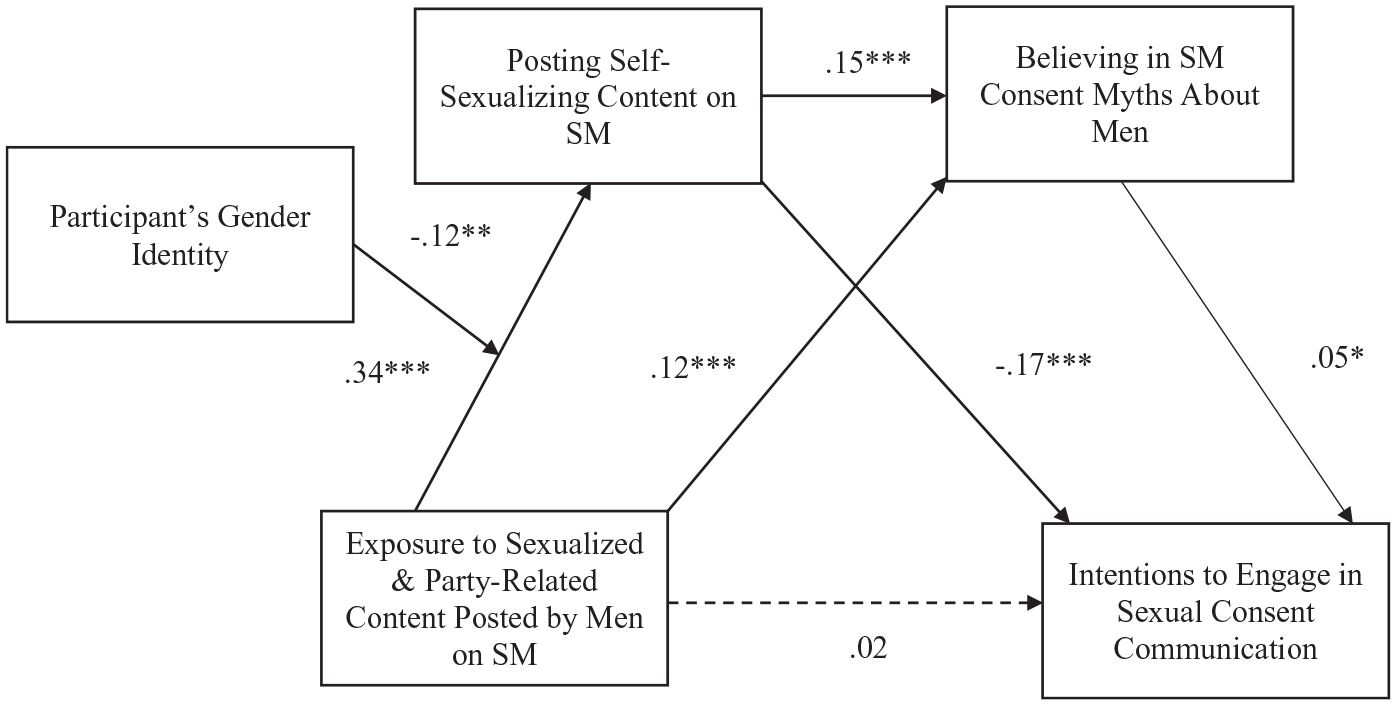
The men’s model with posting self-sexualizing content and believing in social media consent myths about men mediating the relationship between exposure to sexualized and party-related content posted by men and intentions to engage in sexual consent communication moderated by a participant’s gender identity.
Discussion
The purpose of this study was to examine how social media use, specifically exposure to and posting of sexualized and party-related content on social media and interpretations of that content as sexual consent communication, related to college students’ intentions to engage in sexual consent communication. As predicted, this study found that the more college women and men reported exposure to sexualized and party-related content on social media the more likely they were to post self-sexualizing content and believe in social media consent myths. A greater likelihood to post self-sexualizing content on social media was also associated with lesser intentions to engage in sexual consent communication. This study is one of the first to show how college students’ online behaviors are related to their offline intentions to engage in healthy sexual behaviors. Previous studies have focused on understanding women’s motivations for posting self-sexualizing photos on social media (Ramsey & Horan, 2018), the relationship between adolescents’ exposure to sexualized content posted by others on social media and their willingness to engage risk behavior (i.e., casual sex) (van Oosten et al., 2017), or the influence of social media use on perceptions of healthy relationships including one’s ability to recognize a consensual sexual relationship (Baldwin-White & Gower, 2021). This study extends this line of inquiry by considering how exposure to sexualized and party-related content as well as generating self-sexualizing content on social media relates to college students’ intentions to engage in sexual consent communication with a sexual partner.
Besides our main findings, we also found that a college student’s gender identity moderated the relationship between their exposure to sexualized and party-related content posted by men and their frequency of posting self-sexualizing content on social networking sites. This relationship was slightly stronger for college men than college women, meaning college men who were frequently exposed to sexualized and party-related content posted by other men were more likely to post self-sexualizing content. Surprisingly, we did not find a significant interaction between a college student’s gender identity, their exposure to sexualized and party-related content posted by women, and their likelihood to post self-sexualizing content. In other words, the relationship between exposure to sexualized content posted by women and frequency of posting self-sexualizing content was the same for college women and men. These findings provide important new insights for research on social media use and sexual health behaviors.
The results presented here are generally consistent with the findings from previous studies (e.g., Baldwin-White & Gower, 2021; Davis, 2018; van Oosten et al., 2016), and extend this line of research by examining how repeated exposure to sexualized and party-related content on social media can perpetuate permissive sexual health beliefs and self-sexualizing behaviors. These results align with the tenets of objectification theory (Fredrickson & Roberts, 1997). An image centric environment like social media may reinforce a cycle of self-sexualization among college women and men. Specifically, for individuals who have higher levels internalized sexualization, repeatedly seeing pictures or written text that emphasize body parts and/or the consumption of alcohol on social media may strengthen their beliefs that one’s value comes from their sexual appeal. These beliefs may be reaffirmed based on the number of likes, comments, and/or shares the pictures or written text receive on social media. Thus, it is not so much about the specific sexualized and party-related content on social media, per se, but rather, what these messages, in aggregate, communicate to college students about their self-worth and ability to be sexual decision makers. Regular exposure to these types of messages may therefore encourage college students to prioritize their sexual appeal (over their sexual assertiveness) and believe that having others perceive you as sexually desirable is a worthwhile goal (Aubrey et al., 2017).
Wanting to appear sexually desirable and/or available on social media may help explain why college men who had frequent exposure to sexualized and party-related content posted by other men were more likely to post self-sexualizing content on social networking sites compared with college women. Previous research has found that men are more likely than women to use social networking sites to form new relationships and/or ask someone out (Duggan, 2013; Muscanell & Guadagno, 2012). Posting sexualized and party-related content on social networking sites may be one of the methods that men use to attract a potential sexual partner.
Moreover, several studies have established that men commonly overestimate women’s sexual interest (Abbey, 1982; Farris et al., 2008; Frith & Kitzinger, 1997; Muehlenhard et al., 2016), based on these existing findings, it is possible that men may misconstrue the frequency in which they see this type of content as an indicator that others are interested in seeing more of it. Indeed, several social networking sites such as Instagram, TikTok, YouTube, and Snapchat, for example, feature influencers coaching men on how to use social media for dating, including what image to use as a profile picture that “gets women’s attention and gets you a date IRL” (Artisan, 2019). Therefore, the more men see sexualized and party-related content posted by other men, the more it reinforces that posting this type of content will be rewarded. Researchers have argued that since men have not been reduced to sex objects to the same degree that women have, men may enjoy engaging in self-sexualizing behaviors more freely than women because men do not experience the same consequences that women do for engaging in such behavior (Visser et al., 2014). However, this study found that regardless of a college student’s gender identity, frequently seeing sexualized and party-related content on social networking sites not only increases one’s likelihood of posting similar content but also strengthens their beliefs in harmful consent myths.
The results of this study along with others (refer to Daniels, 2016, 2020; Daniels & Zurbriggen, 2016) demonstrates that the more exposure college students have to sexually objectifying images of women and men on social media, the more likely they are to endorse sexual stereotypes about women and men (i.e., consent myths). Believing in social media consent myths about women and men, however, did not diminish a college student’s intentions to engage in consent communication with a sexual partner. Rather, more frequent exposure to sexualized and party-related content and a greater tendency to express oneself as a sexual object is associated with college students’ intentions to engage in healthy sexual behaviors (i.e., sexual consent communication). These findings generally support the conclusions drawn from a previous study which found that among a sample of all women, posting sexualized photos on social media is associated with less confidence to communicate sexual feelings and desires in offline encounters (Ramsey & Horan, 2018).
Posting self-sexualizing content on social media may therefore be viewed as an act where a college student sees their body as a source of pleasure for others (Hall et al., 2012). It appears that regardless of an individual’s gender identity, engaging in self-sexualizing behaviors on social networking sites may encourage individuals to view their body as a vessel for another person’s sexual pleasure and to put others’ sexual needs and desires above their own. The internalization of an observer’s gaze may also undermine one’s ability to navigate their own sexual desires or willingness and/or respond to unwanted sexual advances in offline encounters (Franz et al., 2016). These findings also offer practical implications for sexual violence prevention educators to consider when designing sexual violence prevention messages or campaigns.
Practical Implications
This study found that a college student’s social media environment is associated with their perceptions of healthy sexual behaviors, specifically sexual consent communication. With this insight, colleges and universities may want to focus their sexual violence prevention efforts not only in the form of physical posters or flyers posted across their campus but also interactive messages or videos on social media sites. Most college students in the current study reported using image or video-centered social media sites such as TikTok, Instagram, or Snapchat. Colleges and universities should consider developing interactive messages or short videos on these sites that correct harmful beliefs and behaviors including engaging self-sexualization or believing in social media consent myths.
Although this study is one of the first to specifically examine how social media use related to college students’ intentions to engage in sexual consent communication, the findings presented here provide further evidence that college students often rely on stereotypical or false beliefs to interpret sexual consent communication. For college students who endorse these harmful stereotypes, an image centric environment like social media may reinforce seeing others as sexual objects (or a collection of their sexualized photos) because a lack of face-to-face interaction could facilitate the dehumanization of others, especially women. These assumptions or expectations that originate online could impact offline sexual encounters between college students. For instance, if a college student sees their peers posting sexualized and party-related content on social media, it could affect how they treat their peers in real life, such that they may expect their peers to be promiscuous, ready to consume alcohol or party, and/or willing to engage in casual sex. Therefore, colleges and universities may also want to consider designing sexual violence prevention messages that address the dichotomy between online interactions and offline expectations.
While many colleges and universities inform their students about the definition of affirmative sexual consent as well as how and when to engage in consent communication (Muehlenhard et al., 2016; Ortiz, 2019), messages that address the relationship between perceptions of self-worth and sexual consent communication are less common. Colleges and universities should consider creating a “sex positive culture” on their campus by helping college students understand the importance of sexual efficacy including self-esteem, advocacy, and decision-making. This type of approach not only serves as a prevention method that encourages sexual communication between partners but also creates an environment both online and offline that prioritizes a positive relationship between self-and-body image.
Limitations and Directions for Future Research
Although the findings presented here enhanced our understanding of how college students’ social media use relates to their intentions to engage in sexual health behaviors, limitations of this study must be considered. Due to the cross-sectional nature of the survey data, we cannot establish causality between the variables and thus the proposed moderated serial mediation analyses were driven by theoretical justification and previous literature. However, our use of a large, national sample of college students provides statistical power for our analyses and confidence in our results. Another limitation of this study was its measures. Exposure to sexualized and party-related measured participants perceived exposure to such content on social networking sites. Perceptions of sexualized and party-related content may differ depending on an individual’s cultural background; therefore, future studies would benefit by conducting multiple measures of exposure to sexualized and party-related content on social media. It is also important to note that this study measured college students’ intentions to engage in sexual consent communication with a sexual partner, rather than actual behavior. Future studies could ask college students about their past behaviors relating to sexual consent communication (using both qualitative and quantitative components) to capture a more realistic and/or accurate representation of consent behaviors.
Although it was outside of the scope of this research, this study did not measure whether college students were exposed to social media content posted by their friends, professional influencers, or other nonpeer sources. Previous research has found that college students’ sexual attitudes and beliefs are often shaped by their perceptions of their peer’s sexual behaviors (Brandhorst et al., 2012; van Oosten et al., 2017). Future research should build on the present study by examining whether college students’ exposure to sexualized and party-related content posted by their peers or close friends influences their likelihood of engaging self-sexualization as well as their related sexual consent norms, attitudes, and intentions.
Conclusion
In sum, this study identified how a college student’s social media use is related to their intentions to engage in sexual consent communication by considering the roles that generating self-sexualizing content and believing in social media consent myths played in this relationship. The findings presented here provide empirical support for further examination of how social media use may influence perceptions of sexual health behaviors. For example, future studies should consider manipulating sexualized and party-related content on social media to assess the specific attributes (clothing, alcohol, or number of likes or comments) that influence assumptions about sexual consent communication. Sexual violence remains a prevalent issue on college campuses across the United States, thus it is essential to continue identifying and investigating contextual factors, such as social media, that have the potential to influence college students’ sexual consent attitudes, beliefs, and behaviors.
Footnotes
Declaration of Conflicting Interests
The author(s) declared no potential conflicts of interest with respect to the research, authorship, and/or publication of this article.
Funding
The author(s) disclosed receipt of the following financial support for the research, authorship, and/or publication of this article: This study was supported by the Summer Research Fellowship at Syracuse University.
