



Abstract
The study aimed to examine variables that could contribute to the awareness of online gendered violence (OGV). For this, an online survey was used. First, we assessed whether sexism and violence justification affect awareness of gender-based cyberviolence. Second, this effect was evaluated considering the smartphone usage. Third, we studied differences in awareness of OGV according to gender, digital generation, and academic field of study. Fourth, we tested for multiple associations of attitudinal variables, smartphone usage, and sociodemographic variables with OGV. The study involved 453 young adults from the Andalucia region, Spain (Mage = 21.9, SD = 2.15; 64% women). The results showed that, with more sexist attitudes and normalization of violence, the limits regarding what constitute gender-based violence in digital media are more permissive (less awareness). Regarding smartphone use, when it became problematic, desensitization to cyberviolence against women and sexual and gender minorities increased. Multiple correspondence analysis revealed an observer profile, that is, a woman studying for a humanistic or healthcare career who does not believe in psychosocial sex differences, or that violence as a reaction is justified, and also does not support biological fatalism of sexism and violence. This observer also has high awareness of the cyber-behaviors that constitute OGV. In conclusion, this study provides key data for psychoeducational strategies aiming to increase awareness of gender-based cyberviolence.
Introduction
Digital technologies can replicate and perpetuate existing social inequalities, leading to the expression of diverse forms of violence, including ones based on gender. The mechanisms underlying the initiation and maintenance of this violence in the offline world are well established. Cultural and social norms related to gender roles and stereotypes create a framework about how to be and how to behave according to the binary division of sex (Carli & Bukatko, 2000). This paradigm of social knowledge promotes sexism. Other negative attitudes toward sexual and gender minorities also stem from a patriarchal social structure, in which there are specific expectations regarding the proper roles of men and women. According to this structure, when a person or social group breaks with the dominant binary gender concept, they attract negative attitudes. Moreover, this gender-based violence, as an expression of sexist attitudes and gender inequality, can take several forms (e.g., psychological, physical, or sexual abuse), frequently targeting women and non-heteronormative people (Capezza, 2007).
Online and communication technologies are also used to cause, facilitate, or threaten violence, and this is not a gender-neutral phenomenon, since girls and women are targeted disproportionately and in specific ways (e.g., sexist hate speech, trolling, stalking). Other social groups, such as LGBTIQ+ (lesbian, gay, bisexual, trans, intersex and queer) people, are affected by online gendered violence (OGV; Jones, 2020). As with gender-based violence in the offline context, digital violence is rooted in inequalities and unequal power relations between women and men, and is shaped by intersecting inequalities. Moreover, online spaces are catalyzing new types of crime, indicating that misogynistic online content is spreading leading to the normalization of abuse (Mogensen & Rand, 2020).
The variables associated with this so-called “violence 2.0” seem to be related to legitimization and normalization of violence, anonymity, and various other culture-specific factors (Van Der Wilk, 2018). Most studies in this field focus on the victims and survivors or perpetrators (Yudes-Gómez et al., 2018). Although it is still an emerging area of research, the role of cyberbystanders as passive acceptors or active critics of such violence has been analyzed (Polanco-Levicán et al., 2021). However, to understand what drives the behavior of observers of OGV, it is necessary to first determine the extent to which they are aware that what they have observed constitutes acts of violence.
As we are being immersed more and more in the online world, it is essential to understand processes that have traditionally been studied in offline life, such as variables related to awareness of OGV (awareness-OGV). The present study aimed to contribute to the scarce previous research concerning the variables that could explain awareness-OGV, namely, sexist attitudes and violence justification, smartphone usage and certain sociodemographic variables (gender, age, and field of study).
Sexism and Violence Justification in the Digital Realm
Previous literature has revealed the roles of sexism and violence justification in digital violence (Linares et al., 2021; Sánchez-Hernández et al., 2020). The findings mainly pertain to the couple relationship, and focus on the roles of victim and perpetrator. Studies have revealed that the interaction between acceptance of the abuse and benevolent sexism predicted being the victim of specific forms of aggression (Fernández-Antelo et al., 2020). Results regarding the perpetrator showed that hostile sexism and romantic jealousy influence cyberbullying against women in dating relationships (Martínez-Pecino & Durán, 2019; Rodríguez-Domínguez et al., 2018).
A more incipient line of studies establishes factors that predict or explain cyberbystanders’ behavior. Orue et al. (2021) found that the more adolescents justified violence, the more they reinforced the aggressor as cyberbystanders. Another survey of 1,468 adolescents found that more than a third of the participants who witnessed cyberviolence against girls and women did not intervene (Rebollo-Catalan & Mayor-Buzon, 2020).
Research on sexism and violence justification contribution to awareness of gender-based violence has focused on face-to-face interactions; however, the findings could serve as a framework to understand the role of sexism and violence justification in online behaviors. The evidence indicates that individuals with more sexist attitudes are more accepting of violence as a legitimate approach to problem-solving in interpersonal interactions (Díaz-Aguado, 2002; Díaz-Aguado et al., 2013). A study involving 51 countries and 72,730 respondents found that sexism and acceptance of violence in social interactions were positively related to acceptance of intimate partner violence (Herrero et al., 2017). These empirical evidences suggest that individuals with sexist attitudes are more accepting of violence in both general social and couple relationships than non-sexist individuals, and this could be the same in digital spaces.
Digitalization and Awareness-OGV: Smartphones’ Contribution
The violence perpetrated against women and other groups through technology has distinct characteristics. Research has revealed that the online space has led to new forms of control and surveillance that can intensify the impact of offline abuse. Moreover, this violence is viewed by many as insignificant because it occurs in digital spaces; when the same behaviors take place in a face-to-face context, people detect them more easily and are more condemnatory in their assessments (Sánchez-Hernández et al., 2020). Several forms of gender-based violence perpetrated on social networks are still not viewed as forms of violence by the wider public. Online abuse is minimized because of the mistaken belief that it is not as harmful as abuse occurring in the offline world (Dunn, 2020).
It seems that the ability to recognize when cyberbullying is occurring to others depends on the conceptualization of such violence. Sheanoda et al. (2021) recently found that young people consider some cyber-behaviors as cyberbullying when they perceive them as aggressive, intentional, persistent, and power imbalance. When this awareness occurs, young people may be able to more easily identify a “victim” at the center of the experience, as well as to detect that what is occurring is bullying or OGV.
Moreover, overexposure to online discrimination and violence serves to normalize it. Desensitization to violence is a well-established effect of exposure thereto. It reduces negative emotional, cognitive, and physiological responses to violence by promoting the idea that violence is inevitable and unremarkable. In turn, emotional and cognitive desensitization decrease the likelihood of censoring violence; this has been observed in the context of digital media portrayals of violence against women (Lomba et al., 2021). As a route to understanding this overexposure, the smartphone can be considered as the most useful device; it has opened doors to the virtual world. The penetration of the smartphone into daily life, especially among young people, is so extensive that it has transitioned from being a simple “container” to a device with a meaning of its own that helps shape individual and group identity (Pedrero et al., 2012).
Gender and Age Differences in the Roles Played in Digital Spaces
Gender differences are found in both the likelihood of perpetration and the likelihood of being a victim of violence in digital spaces. Both men and women perpetrate cyber dating abuse against their partner to some degree; however, the specific behaviors seem to differ. While women engaged in more controlling acts, men used more direct aggression (Linares et al., 2021).
In adolescent studies of cyberbystanders’ reactions to cyberbullying, boys scored higher in terms of violence justification and pro-aggressive attitudes than girls (Orue et al., 2021). When gender differences in specific forms of violence against women were analyzed, the results showed moderate differences; while girls were more active in terms of helping the victim, both girls and boys normalized and even justified the violent behavior (Rebollo-Catalan & Mayor-Buzon, 2020).
Although studies on gender differences in awareness-OGV are lacking, the abovementioned research, together with the solid conclusions drawn in the offline context, led us to consider some key ideas. In several studies, women were more aware of, and better at detecting negative attitudes, discrimination, and violence against diverse social groups. Moreover, women tend to be less prejudiced than men toward outgroups such as sexual minorities (León & Aizpurúa, 2020). In addition, regarding perspectives on intergroup relations, as members of a low-status group women show greater ability to detect ingroup vulnerability (Matschke & Sassenberg, 2010). From an experiential perspective, the probability of being aware of what constitutes violence increases when one is the target of such violence, or has observed it in others (Pratto & Stewart, 2012).
Regarding age, studies mainly focused on cohorts with more digital experience, as Millennials (born between 1981 and 1999) and Generation Z (born between 2000 and 2012) (Liu et al., 2014). Being born and growing up in an “always on” technological environment dramatically affects youth behaviors, attitudes, and lifestyles. Specifically, age is associated with the type of smartphone usage, where Generation Z shows the heaviest use of technology and more problematic usage patterns. Furthermore, although members of Generation Z show least sexist attitudes than previous generations, such as Millennials, they tend to show more risky online behaviors and attitudes with respect to gender violence, based on their experience as both victims and perpetrators (Rubio-Laborda et al., 2021).
A study that compared gender violence between the online and face-to-face contexts determined that 90% of young people believe that more of this type of violence is perpetrated online. However, most of these youths reported being the observers of digital violent behaviors; few of them declared that they had been a victim or perpetrator (Donoso-Vázquez et al., 2018). It seems that there is some awareness of the magnitude of violence exercised through digital spaces, but few people identify themselves as victims or perpetrators. Regarding age differences among observers, the results are heterogeneous; while some authors found that older age predicted fewer pro-aggressive bystander behaviors (Orue et al., 2021), others found the opposite (Schultze-Krumbholz et al., 2018; Van Cleemput et al., 2014), or an insignificant relationship between age and cyberbystanders’ reaction (Yudes-Gómez et al., 2018).
Contribution of the Education Field and Training in Awareness-OGV
Most studies on the effects of training on gender violence and education pertained to their potential to reduce negative attitudes. This background can promote understanding of the mechanisms underlying the awareness of gender violence in digital environments. Prejudice self-regulation models (e.g., Devine et al., 2002; Monteith et al., 2010) propose that increasing awareness of the discrepancy between biased behaviors toward individuals or social groups and desirable egalitarian behaviors is key to prevent negative attitudes. This self-regulatory mechanism based on awareness should reduce discriminatory behaviors and promote detection of such behaviors. One strategy used to make people aware of their biased attitudes (e.g., sexist, homophobic) is to provide education and training on the functions of negative attitudes, equality, gender-based violence, and so on (Paluck et al., 2021).
Academic study and specific training on gender equality issues, gender, and sexual diversity, produce different results. Some authors found that people receiving such training are more likely to oppose sexist attitudes (Cepeda-González, 2018; Rodríguez-Burbano et al., 2021). However, in other studies effects were seen only in women (Becker & Swim, 2011), or reinforced subtle or benevolent forms of prejudice (Eldridge et al., 2006). Other studies reported differences according to educational level; more specifically, a low educational level has been related to greater prejudice toward sexual and gender minorities (Norton & Herek, 2012). An Australian survey of 2,500 students found that attending schools with a critical approach overall (and specifically on gender and technology) greatly reduced online bullying related to gender and sexuality (Jones, 2020).
In any case, intentional changes in behavior due to education and training are preceded by an increase in awareness of one’s internal processes and the desired egalitarian behavior. Therefore, in cases where equality training is effective in adjusting behavior, an increase in awareness would also occur; in turn, this would allow for the detection of negative attitudes and violence perpetrated by others (Devine et al., 2002).
Objectives and Hypothesis
Our first goal was to analyze whether awareness-OGV differs according to the degree of sexism and violence justification. We expected that more sexist participants with higher levels of violence justification would be less aware as to which cyber-behaviors represent OGV. The second goal was to test for differences in OGV according to the smartphone usage. We expected that more problematic use (high time investment, craving or interference with daily life) would reduce awareness-OGV. As previous studies report, youths seem to be less aware about gender-based violence in the online context, and that overexposure to online discrimination contributes to its normalization. Third, we aimed to analyze differences in awareness-OGV according to gender, age, and academic field of study. It was expected that women (who tend to show low levels of prejudice), older participants (who are less exposed to gendered-violence normalization in digital spaces), and those studying for a degree related to human care (who are exposed to academic content and courses related to equality) would be more aware of OGV. Fourth, we aimed to find the multiple associations of the variables to understand the complex combination of the attitudinal variables, smartphone usage, and sociodemographic variables around awareness-OGV.
Method
Design
A non-experimental analytical cross-sectional study was carried out; questionnaires were used to collect the data. To recruit a sample representative of the target population (young-adult users of social networks and the Internet), a purposive sampling technique was used. Two inclusion criteria were established for participation in the study: being a regular user of the Internet and social media through a smartphone, and being born after 1981.
Participants
The study enrolled 453 young adults from the Andalucía region of Spain; 98 were Spanish and 2% were Hispanic. The age ranged from 18 to 27 years (M = 21.9, SD = 2.15); 290 identified themselves as women (64%) and 163 as men (36%). Regarding the participants’ sexual orientation, 84.6% self-identified as heterosexual, 9.8% as bisexual, 4.9% as gay or lesbian, 0.4% as asexual, and 0.4% as demisexual. Regarding educational level, 94.2% of the participants were undergraduates taking the following degree courses: Social and Legal Sciences, 41.3% (Law or Business Administration and Management); Education Sciences, 20.6% (Early Childhood Education or Primary Education); Human and Health Sciences, 22.2% (Psychology, Social Work, or Nursing); and Engineering/Natural Sciences, 10.1% (Computer Engineering or Environmental Sciences). The remaining 5.7% were studying for a bachelor’s degree or were enrolled on an advanced professional training course. Regarding smartphone use habits, 75.1% of the participants regularly used only one messaging app, while 22.5% used two and 2.4% used three. In terms of social network app use, most participants used four (22.5%) or five (25.7%); fewer used three (19%) or six (12.6%). The daily average smartphone use data showed that 15.5% of the participants used their device for between 1 and 2 hr a day, while 58% used it for between 3 and 5 hr, 14.2% for between 6 and 7 hr, and 12.3% for 8 hr or more.
Instruments
Awareness-OGV
The Gender Violence Questionnaire 2.0 (GVQ2.0; Donoso-Vázquez et al., 2014) contains four dimensions; for our study, only Dimension 2 was used (“Awareness of gender violence 2.0”), as the others specifically focus on digital attitudes and behaviors in couple relationships. Dimension 2 comprises 12 items, scored using a response scale ranging from 1 (not at all violent) to 5 (very violent). It obtains information on awareness of the cyber-behaviors that constitute expressions of gender-based violence against women and sexual and gender minorities (e.g., messing with gay or transgender people, insulting women for being unattractive or provocative, or for having had several relationships, or sharing and commenting on pictures portraying women as sexual objects). Participants must indicate the degree to which the online behaviors evaluated are violent. The minimum total score is 12 and the maximum is 60; lower scores indicate greater acceptance and normalization of violence. The Cronbach’s alpha (α) reliability value was .85.
Sexism and Violence Justification
The Questionnaire of Attitudes toward Gender and Violence (QAGV; Díaz-Aguado, 2002) comprises 47 statements grouped into four factors, as follows. Factor 1: sexist beliefs about psychosocial differences and justification of violence as a reaction (28 items); Factor 2: beliefs about the biological fatalism of sexism and violence (8 items); Factor 3: conceptualization of domestic violence as a private and unavoidable problem (8 items); and Factor 4: assessment of women’s access to paid work outside the home, and to positions of power and responsibility (3 items). Responses are made on a 7-point Likert-type scale, ranging from 1 (totally disagree) to 7 (totally agree). Once items 10, 17, 25, 36, and 42 have been reverse-scored, higher scores on the first three factors indicate more sexist attitudes and greater acceptance of violence. For the fourth factor, higher scores indicate more positive assessments. The Cronbach’s α value of the questionnaire was .85; the individual values for Factors 1–4 were .92, .72. 69, and .62, respectively.
Smartphone Use
Dependence and Addiction to Smartphone Scale-short version (DASS-18; García-Domingo et al., 2020) consists of 18 items with 5-point Likert-type response options ranging from 1 (totally disagree) to 5 (totally agree). This unidimensional instrument measures the time spent using smartphones and their apps, as well as anxiety and interference in daily life. Once item 7 has been reverse-scored, higher mean scores indicate a greater degree of dependence on the mobile phone, including its messaging and social media apps. The Cronbach’s α internal consistency value was calculated as .89.
Sociodemographic Data
An ad hoc questionnaire was designed to collect information about the following variables: gender, age, sexual orientation, academic field of study, and smartphone use habits (number of messaging and social network apps used and hours of daily use).
Procedure
The data analyzed in this study were part of a larger regional Andalusian project (“Pacto de Estado contra la Violencia de Género,” 2019–2020). A unified online survey was conducted to collect the data. It was spread and answered online through Google Form, being all the responses directly registered in Excel. The survey could be answered by using any device (smartphone or other) with an Internet connection, with an average time of response of 30 min. Participants were contacted through the teachers responsible for the individual subjects. The survey contained the counterbalanced versions of the questionnaires, with application of the D’Amato algorithm. Participants were informed during an initial screening session of the study objectives and methodology, and of their rights (e.g., the voluntary nature of participation, freedom to withdraw and anonymity). Access to the next part of the study was only granted if they checked the option “Yes, I consent to participate.” Regarding ethical considerations, the research was approved by the Ethics Committee for Research with Humans of the University of Jaén, and no minors participated. The data were anonymized in accordance with Organic Law 3/2018, passed on 5 December, pertaining to the protection of personal data and guarantee of digital rights.
Data Analysis
First, interrelations among awareness-OGV, sexist attitudes and violence justification, and smartphone usage were analyzed using Pearson’s bivariate correlation coefficient. Means/sum scores, standard deviations, and minimum and maximum values were also calculated as descriptive statistics.
Second, the effects of sexist attitudes and violence justification, and of smartphone usage on awareness-OGV were analyzed (Hypotheses 1 and 2). For the scores on the four dimensions of sexist attitudes and violence justification, as well as smartphone usage, interquartile range data were generated. Subsequently, a t-test was used to test for significant differences in awareness-OGV between low and high sexism-violence justification and smartphone usage groups. Interaction effects of sexism and violence justification*smartphone usage on awareness-OGV were estimated using two-way ANOVA. To adjust for type I error, the Bonferroni correction was applied.
Third, the effects of gender, age, and academic field of study on awareness-OGV were analyzed (Hypothesis 3). To study the effect of age, participants were classified into two digital cohorts: Generation Z (18–21 years old) and Millennials (22–27 years old). T-tests were used to analyze two-level variables (gender identification: women, men; age: Generation Z, Millennials), while ANOVA was used for analysis of the academic field of study (human health, education, engineering, social-juridical, and bachelor’s). Post hoc comparisons of variables exhibiting homogeneity of variance were performed using the Tukey test, due to its versatility and ability to control for type I error. To determine whether the homogeneity of variance assumption was met, the Games–Howell test was used.
To characterize the underlying structure of all variables together, multiple correspondence analysis (MCA) was performed. MCA is useful for analyzing relational space and discrete units of analysis (categorical variables), and a multiplicity of relationships. In our study, there were three categorical variables (digital cohort, gender, and academic field of study) and three continuous variables (a total of six dimensions). Hours of smartphone use per day and the number of social network apps used were also included in the analysis, to obtain information about information and communications technology (ICT) use habits. Analysis of variables according to the levels over which the scores are distributed (low, medium, high) enhances understanding of how they operate. To transform each quantitative variable into a new categorical variable, the interquartile range was used.
Results
Descriptive Analyses
The results showed a significant negative relationship between awareness-OGV and the following three dimensions of sexism and violence justification (descriptive data and correlations are shown in Table 1): D1. Sexist beliefs about psychosocial gender differences and justification of violence as a reaction (sexism-violence justification); D2. Beliefs about the biological fatalism of sexism and violence (sexism-violence as biological); and D3. Conceptualization of gender-based violence as a private and unavoidable problem (GV-private&inevitable). However, no relationship was found with attitudes regarding women’s access to paid work outside the home, and to positions of power and responsibility (women-power-independency). These results imply that, with higher levels of sexism and normalization of violence, awareness of gender-based cyberviolence decreases. Smartphone usage and awareness-OGV were positively related. As use of the device becomes problematic, the lack of awareness of this type of violent expression through digital spaces increased.
Descriptive Data and Correlations Among Awareness of OGV, Sexist Attitudes and Justification of Violence, and Smartphone Usage.

OGV: online gendered violence.
The correlation is significant at the .05 level (bilateral).
The correlation is significant at the .01 level (bilateral).
Simple and Interaction Effects
Mean values for sexism and violence justification, and for smartphone usage, showed differences. Participants scoring higher on the following dimensions were less aware that certain behaviors (e.g., messing with gay or transgender people, or sharing and commenting on pictures of women as sexual objects) constitute expressions of online gender-based violence: (1) sexist beliefs and violence justification as a reaction, t = 5.55, p < .001, Mlow = 58.2, Mhigh = 53.9; (2) beliefs about the biological fatalism of sexism and violence, t = 5.18, p < .001, Mlow = 58.0, Mhigh = 53.6; (3) Conceptualization of domestic violence as a private and unavoidable problem, t = 2.71, p = .006, Mlow = 57.4, Mhigh = 55.2; and (4) negative opinions of women’s access to paid work outside the home, and to positions of power and responsibility, t = −2.08, p = .040, Mlow = 55.8, Mhigh = 57.4. Moreover, participants with problematic smartphone use showed less awareness-OGV, t = 2.46, p < .015, Mlow = 57.3, Mhigh = 55.2.
The interaction between problematic smartphone use (high scores on the DASS-18) and medium or high levels of sexism (D1. Sexism-violence justification; D2. Sexism-violence as biological; D3. GVprivate&inevitable) was relevant to awareness-OGV (Figures 1 to 3). Among the three levels of sexism, more problematic use (e.g., craving and interference with daily life) had the most significant impact on awareness-OGV. In all cases, lower levels of sexism and violence justification resulted in greater awareness of such violence (see Figure 1 for interactions and statistics).

Interaction effect of sexism and violence justification*smartphone use on awareness of OGV.

Interaction effect of sexism and violence as biological*smartphone use on awareness of OGV.

Interaction effect of GV-private&inevitable*smartphone use on awareness of OGV.
Differences in awareness regarding the sexist attitudes and beliefs that justify violence were smaller in participants with non-problematic use (low and medium levels). Specifically, in the dimensions of sexism and violence justification, as well as sexism and biological violence, those scoring highly in these dimensions of sexism showed less awareness-OGV (see Figures 2 and 3 for interactions and statistics).
The dimension of sexism pertaining to women’s access to paid work outside the home, and to positions of power and responsibility, was not significant in any of the analyses.
Effects of Gender, Age, and Academic Field on Awareness-OGV
Regarding gender, men showed more sexist beliefs about psychosocial gender differences and justification for violence as a reaction (D1), t = 5.76, p < .001, Mmen = 48.1, SD = 2.3, Mwomen = 37.7, SD = 7.01, as well as the biological fatalism of sexism and violence (D2), t = 3.98, p < .001, Mmen = 23.7, SD = 9.36, Mwomen = 19.3 SD = 7.61, and were more likely to conceptualize domestic violence as a private and unavoidable problem (D3), t = -3.18, p = .002, Mmen = 16.3, SD = 5.87, Mwomen = 14.1, SD = 4.04. Women were more likely to perceive online behaviors such as insulting messing with gay or transgender people, insulting women for being unattractive, or sharing and commenting on pictures of women as sexual objects as violence, t = −3.87, p < .001, Mmen = 55.0, SD = 5.44, Mwomen = 57.5, SD = 3.70. Only D4 of the QAGV showed no significant gender difference, p > .005.
In the analysis by age, members of Generation Z showed less awareness of gender-based cyberviolence compared with Millennials, t = 1.92, p = .05, MZ = 57.0, SD = 4.12, MMillennials = 55.9, SD = 5.25. There were no differences in sexism and violence justification or smartphone use, p > .005.
The analysis of academic field of study produced some statistically significant results. Participants studying for degrees in engineering and natural science showed significantly less awareness of gender-based cyberviolence than participants studying for degrees related to education, F = 3.09, p = .017, Mengin-natur = 54.9, SD = 5.98, Meducation = 58, SD = 3.67. Participants taking engineering and natural science degrees held more sexist beliefs about psychosocial gender differences and justification for violence as a reaction (D1) compared with those studying others fields, F = 4.62, p < .001, Mengin-natur = 47.0, SD = 19.7, Msoc-jur = 41.5, SD = 19.4; Meducation = 34.7, SD = 7.95, Mhuman health = 33.6, SD = 13.8. Students of engineering and natural science degrees also scored higher than the others in terms of the biological fatalism of sexism and violence (D2), F = 10.3, p < .001, F = 4.62, p < .001, Mengin-natur = 27.1, SD = 12.5, Msoc-jur = 22.0, SD = 6.39; Meducation = 18.0, SD = 7.80, Mhuman health = 17.4, SD = 7.93, Mbachelor = 26.3, SD = 7.98.
Multiple Associations Among Variables and Awareness-OGV
The MCA model capturing the category distribution in the two dimensions showed high reliability; the α value for D1 was .70, and that for D2 was .42. These values are in the optimal range for this type of analysis. Especially, D1 explained 40.46% of the variance in the interactions among the variables; for D2, the proportion was 38.82%. This indicates high inertia of the variable groupings when defining the distribution of points in factorial space. Regarding the degree of discrimination of the variables in the different dimensions, those that were most saturated in D1 were sexist beliefs about psychosocial gender differences and justification for violence as a reaction (.605), beliefs about the biological fatalism of sexism and violence (.430), participants’ gender (.419), and awareness-OGV (.317). In D2, age (.209), smartphone use (.152), and social network apps (.291) were more saturated. The rest of the variables displayed low or moderate levels of saturation.
The interrelationships of the categories show three patterns (Figure 4). First, participants with high awareness-OGV tended to be (1) women (2) pursuing humanistic or healthcare careers (3) who do not hold sexist beliefs about psychosocial gender differences or believe that violence is justified as a reaction, (4) and also do not support biological fatalism of sexism and violence. Taken together, due to their proximity and degree of discrimination in the different dimensions, these variables constitute the profile of a specific type of cyberobserver. The opposite side of the plane is characterized by participants with low awareness about OGV. In the same quadrant, the following groups were identified: (1) participants who spend 6–8 hr per day using a smartphone (nearby) and, somewhat further away, (2) engineering degree students and others. In the center of the plane, participants with moderate levels of awareness were grouped with those showing moderate levels of sexism.
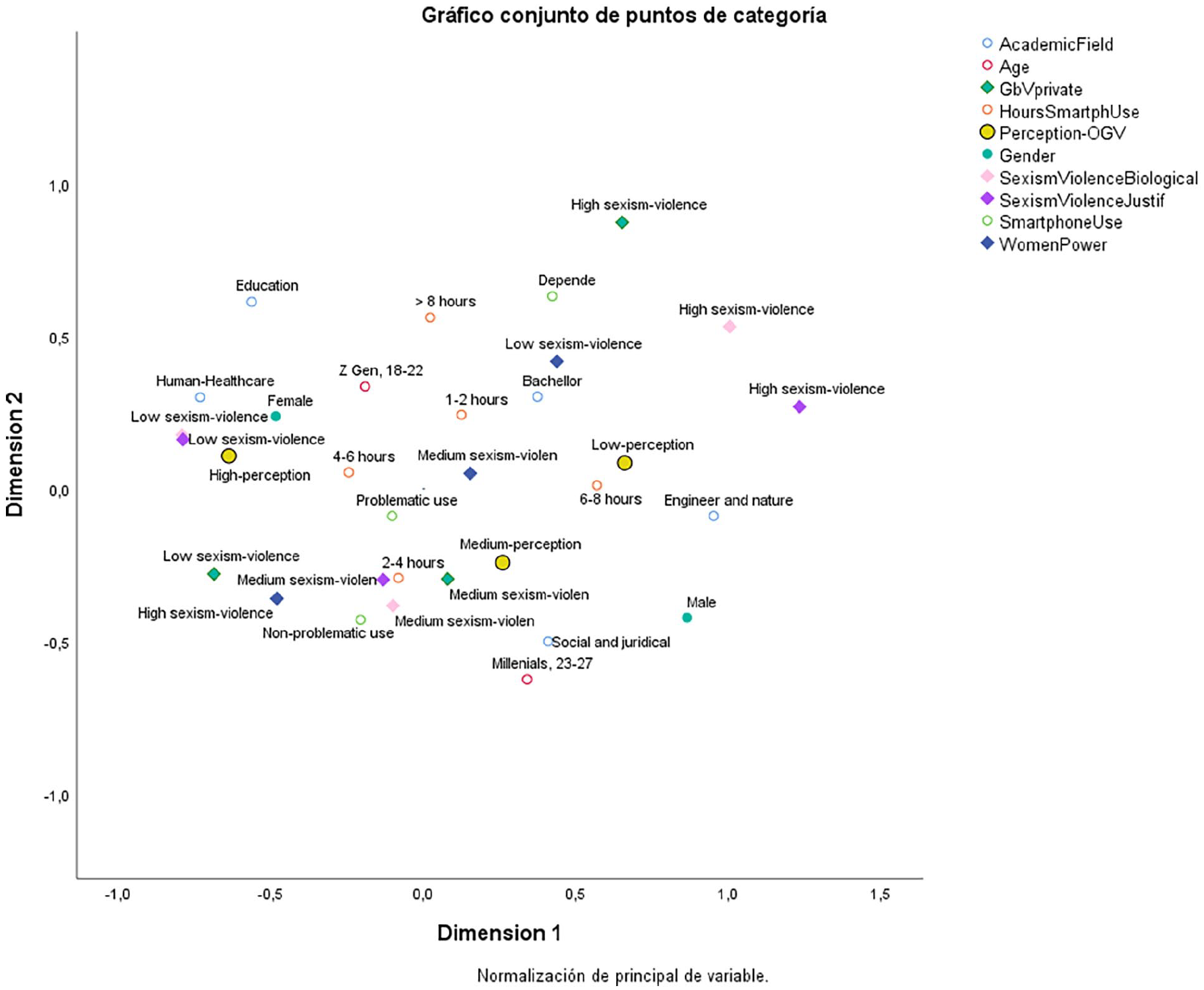
Interrelationships among the categories of all variables.
Other subcategories, such as men, the two digital generations (Generation Z and Millennials), and even the types of smartphone use (non-problematic, problematic and dependent) showed weaker associations with awareness-OGV.
Discussion
In the study we explored the contributions of attitudes (sexism and violence justification), smartphone use, and other related variables (gender, age, and academic field) to awareness-OGV.
Regarding sexist attitudes and violence justification, correlation analysis showed that belief in psychological gender differences and the biological fatalism of sexism, as well as that violence is justified (can be useful and inevitable) and gender-based violence is a private and unavoidable problem (Factors 1–3 of QAGV), was associated with less awareness-OGV. In addition, comparison of means indicated that participants with lower levels of sexism and violence justification (for all factors except Factor 4) were more aware of what constitutes gender-based violence in digital media. The MCA revealed a profile of persons clearly aware of gendered violence in the online world, who did not consider the stereotypes of women and men to be valid, did not justify violence, and did not consider sexism and violence to be inevitable.
As in the offline world, the mechanisms behind the low awareness of inequalities and violence against women, and sexual and gender minorities, seen online are rooted in patriarchal and heteronormative social and cultural norms (Capezza, 2007). In the digital age, where social inequalities based on gender are replicated and new expressions of violence have emerged (trolling, stalking, and sexting), having sexist attitudes and supporting the traditional idea that violence is a legitimate response makes it difficult to determine which cyberbehaviors are forms of gender-based violence. In line with other research, these variables may explain the acceptance/normalization, and even perpetration, of such cyber behaviors (Linares et al., 2021; Van Der Wilk, 2018).
Our findings revealed a complex relationship between smartphone usage and awareness-OGV. Correlation analysis and comparison of means indicated that, when the use of the device becomes problematic, awareness of these violent expressions decreases. We observed that youths with higher problematic use (e.g., more time invested, more interference and craving) were less aware of gender-based cyberviolence. However, when all variables were included in the MCA, smartphone use was not associated with the degree of awareness-OGV.
According to our results, although not in a decisive way, more problematic smartphone users tended to have greater difficulty recognizing OGV. Although previous studies have shown a relationship between dependence on social networks and overt violence (Martínez-Ferrer & Moreno, 2017), or more specifically, between problematic smartphone use and the development and expression of violent behaviors through the Internet (Choi et al., 2017), the link between dependence on smartphone and gender-based violence awareness has been not clearly established. The scarcity of results on this topic indicates that violence in the offline is more easily detected than that occurring in the online world (Sánchez-Hernández et al., 2020). This may be due to misinterpretation by observers, who consider that these online behaviors are less harmful to the victims (Dunn, 2020), and therefore tend to go unnoticed. Another explanation could be overexposure to gender-based cyberviolence. Studies have shown how platforms such as Twitter and Facebook frequently contain comments and images that can be considered as violence against women and those with certain sexual orientations; sexual violence is also prevalent in social media, and occurs on and through instant communication apps (Vyawahare & Chatterjee, 2020). Being constantly immersed in social networks, sharing messages, and surfing the Internet considerably increases the probability of observing OGV, which may reduce the emission of necessary signals such as negative emotions and cognitions (Galán-Jiménez et al., 2019) to activate awareness of its occurrence. In line with our results, greater exposure to, and a more problematic relationship with, smartphones would increase desensitization and normalization, such that awareness of this type of violence would be reduced.
Our findings regarding the interaction between sexism and smartphone use improve understanding of their role in observer awareness. Being more sexist and justifying violence seem to decrease awareness-OGV in those with problematic smartphone use. The convergence of risk factors, that is, biased attitudes in the context of problematic use of the smartphone, would lead to difficulty in distinguishing behaviors in digital spaces that constitute acts of gender violence.
With respect to sociodemographic variables, men showed less awareness-OGV than women. As gender differences were only found in sexism and violence justification (and not in smartphone use), the lack of awareness exhibited by men could be due to their higher scores for these attitudes. Previous studies found that men have more sexist attitudes than women (León & Aizpurúa, 2020) and consider violence useful to resolve some problems (Díaz-Aguado et al., 2013). Moreover, women are disproportionately targeted by online violence and suffer serious consequences as a result. From an experiential perspective, it is possible that the women in this study had been victims of hateful, discriminatory, or violent behavior based on their gender. This experience would facilitate the detection of similar behaviors perpetrated against other women, or against other vulnerable groups such as sexual and gender minorities (Pratto & Stewart, 2012).
Our analysis by age revealed that Generation Z were less aware of violent behaviors in digital spaces than Millennials. According to our results, this difference cannot be explained through sexism and violence justification, or smartphone use, as they did not show significant differences. Although other authors find that Generation Z uses technology to a greater extent, has more problems related to that use, and are less sexist (Rubio-Laborda et al., 2021), it seems that other mechanisms could be influencing the level of awareness of gender-based cyberviolence.
Finally, statistically significant results were seen according to the field of study. Participants undertaking degrees in engineering and natural science were less aware of OGV; these participants also had more sexist beliefs about psychosocial gender differences and violence as a justified reaction, as well as about the biological fatalism of sexism and violence. Since these degrees, compared with “humanistic” ones, do not usually have modules or units focused on gender and equity, not only in terms of statistics and processes but also gender stereotypes and gender violence training, it seems logical that these students would be less aware about gender-based violence and have more sexist beliefs. This result complements other research showing that specific training/education on sexism/gender violence is effective to increase awareness and uncover biases in behaviors toward certain social groups (Cepeda-González, 2018; Devine et al., 2002). In a recent study with a large sample of high-school students, it was found that humanities and health courses inserted in a critical educational context have an impact on online violence reduction (Jones, 2020). These results, together with those found in our study, offer new emphases in showing the importance of education around gender and health/wellbeing and cyberviolence.
To complete the reflection and discussion of our results, other variables could be considered. As Sheanoda et al. (2021) found regarding the misunderstanding around the term of cyberbullying, the low awareness shown by some of our participants was due to the confusion about what online gender-based violence is. Also considering the conceptualization, these authors concluded that some types of behaviors were more frequently considered as cyberviolence (e.g., making comments; name calling/hate speech; sending messages’ sharing photos/videos; sexual violence; and spreading rumors), however, others were less perceived as such (making threats; swearing; exclusion). It is possible, following these results, that in our study the type of behavior against women and LGBTIQ+ people observed in digital scenarios determines the ease or difficulty of considering it as violence. Specifically, those online expressions that are not perceived as real, that is, that cannot be reflected in life face-to-face, go unnoticed or are minimized by young people. Finally, as the conceptualization of what gender-based violence is, and the awareness of the problem as context-dependent, it would be possible to find other results in different countries with different levels of perception about equality, women’s rights, and gender violence.
Limitations
Some limitations of this study must be considered. First, a purposive sampling method was used, and the sample was relatively homogeneous; this reduces the generalizability and representativeness of the findings. However, the disadvantages of purposive sampling can be lessened depending on the theoretical and empirical framework, and objectives and nature of the study (Sharma, 2017). Second, we did not consider the participants’ potentially diverse gender identification. We asked them about gender instead of sex, which allowed us to adopt an inclusive perspective, that is, to include cisgender and transgender participants. However, there are other several ways in which people may experience and manifest their gender identity that cannot be captured by the dichotomous men/male and women/female categories. Third, as the factor used in this study (taken from the QAGV; Díaz-Aguado, 2002) to assess awareness of gender violence online, is one-dimensional, it was not possible to determine whether the participants were specifically evaluating discriminatory, biased, and violent expressions toward women, or toward sexual and gender minorities. Thus, whether awareness varies depending on whether participants are considering a gay male, gay female, heterosexual female, and so on, could not be inferred. Finally, although the DASS-18 provides information on smartphone usage, a deeper knowledge on participants’ habits could bring a better scenario for the reader to understand these results.
Conclusion
The results of our study provided new evidences on a topic of emerging interest. Based on the few existing antecedents specifically on awareness of online gender violence and the role of the variables studied, our results represent important progress. As we mentioned, most of the previous results refer to the offline world, the role as online victims or perpetrators, and the role as cyberbystanders.
According to our results, we can conclude that widespread use of smartphones and social networks has impacted communication and socialization dynamics, decreasing awareness of behaviors and comments on social networks that would easily be detected and censored in face-to-face interpersonal interactions. This lack of awareness, which is a necessary cognitive state to activate any motivated egalitarian response, reduces the possibility of reacting against OGV. Specialized psychoeducational interventions using ICTs as a tool are required to reduce sexism and other negative attitudes. The present study focused on observer awareness, and highlighted the importance of promoting skillful smartphone use among youths, specifically reducing dependency on use (in terms of less time, anxiety, and interference with daily life) and increasing critical thinking about content that are seen and shared. In addition, specialized training regarding gender equality, critical education, and the adequate conceptualization of what online gender violence is (types of behavior, characteristics, scope, etc.) would promote detection of cyber expressions of violence and sexism, as well as critical attitudes toward them. In closing, it is essential to train young people to be aware and critical of cyber expressions of violence and sexism, and to devise strategies aimed at controlling and abolishing violent and sexist behaviors.
Footnotes
Declaration of Conflicting Interests
The author(s) declared no potential conflicts of interest with respect to the research, authorship, and/or publication of this article.
Funding
The author(s) disclosed receipt of the following financial support for the research, authorship, and/or publication of this article: The results presented in this study were part of a larger regional Andalusian project funded by “Pacto de Estado contra la Violencia de Género” (2019–2020).
