



Abstract
The early hopes of the internet as a technology of “liberation” have turned into a reinforcing spiral of control, innovation, resistance, and counter-innovation between authoritarian governments and those that seek to bypass censorship and digital repression. This spiral reflects that even the most robust censorship mechanisms are vulnerable to circumvention, which has become a key concept for illustrating the contemporary online communication experience of citizens. Yet, the scholarship examining the underlying motivations and what influences individuals to employ censorship circumvention technologies (CCTs) in authoritarian contexts remains underdeveloped. We present a theoretical model of how state-sponsored political identity and attitudes about media freedom influence motivated resistance to censorship in the case of using CCTs to access social media and other forms of online content in the networked authoritarian context of Iran. Employing a web-based survey of internet users (N = 807), we test this theoretical model across a range of censored online content types. Our findings show that regime ideology in Iran indirectly influences CCT use through biasing perceptions of media freedom and how people respond to it in the form of motivated resistance. We discuss theoretical and policy-related implications for resilience to censorship of social media and online content in networked authoritarian contexts.
Introduction
Authoritarian governments have a long history of employing censorship on the pretext of protecting citizens from inappropriate content that may allegedly offend societal values, threaten national security, and/or incite social or political unrest. The rise of the internet and social media platforms initially promised ordinary citizens easier access to alternative content and open spaces for deliberation in these settings beyond the immediate reach of governments. At the same time, the governments’ recognition of how these new platforms challenged political power gave rise their adaptation of repressive tactics to the changing information environments (Earl et al., 2022). Online censorship allows authoritarian governments to influence issue salience for the public, disseminate pro-government narratives, and monitor dissent when necessary. However, instead of giving the upper hand to the censors, it often leads to an evolving “cat-and-mouse” game involving innovation, resistance, counter-innovation, and so on, between authoritarian governments and those that seek to bypass censorship and repression (Deibert et al., 2019).
Although authoritarian governments often employ a mix of increasingly sophisticated censorship tactics (e.g., removing a tweet versus demonizing the act of tweeting) belonging to different “generations of control” (Deibert & Rohozinski, 2010), restricting access to content and social media platforms through a variety of technical means (e.g., blocking internet protocols [IPs], removing uniform resource locators [URLs], manipulating domain name systems [DNSs], etc.) is still a preferred strategy. In response, censorship circumvention technologies (CCTs) allow internet users to bypass online censorship mechanisms by offering alternative means to access banned content and platforms (Callahan et al., 2011; H. Roberts et al., 2011). Popular censorship circumvention waves, whether motivated by entertainment or activism, occur in different settings, such as the record-breaking Twitter traffic in Turkey after being blocked by the Turkish government in 2014 (Nabi, 2014), Russians’ use of virtual private networks (VPNs) to access Facebook, Instagram, and Twitter after the Russian government blocked access following the invasion of Ukraine (Fung, 2022), and the unprecedented surge in CCT use in Iran following the ban on Instagram and Telegram in 2018 (Kargar & McManamen, 2018).
Using CCTs is becoming a mundane component of everyday social media practice under authoritarianism as even the most robust censorship mechanisms are vulnerable to circumvention (Hobbs & Roberts, 2018). To this, Iran, as one of the lowest ranked countries in terms of internet freedom in the world, constitutes an apt example with heavy digital censorship on one hand and the popularity of circumvention practices on the other (Freedom House, 2020; Reporters Without Borders (RSF), 2020). The Iranian state is known to actively undermine mechanisms of accountability for which the internet has both introduced a new battleground for the state and also provided venues for citizens’ access to alternative information and narratives (Alimardani & Michaelsen, 2021). Rooted primarily in the state’s Islamic and anti-West political foundations (Michaelsen, 2018), Iran’s networked authoritarianism provides an interesting context for focusing on the psychological processes that influence individuals to bypass censorship via CCTs considering the limited number of studies that directly and systematically focus on the matter.
Addressing this research gap, we examine internet users’ experience in Iran, a prime example of networked authoritarianism where citizens have to deal with high levels of digital censorship across a range of political and non-political content (Akbari & Gabdulhakov, 2019; MacKinnon, 2011). We synthesize previous scholarship on motivated resistance to censorship (MRC), state-sponsored political identities (e.g., ethnic nationalism, religion), as well as media attitudes and behaviors across different authoritarian settings to present a theoretical model of CCT use in Iran. Employing a web-based survey of internet users (N = 807), we test our serial mediation model across a range of censored online content types and demonstrate how adherence to regime ideology in Iran indirectly influences CCT use through biasing perceptions and attitudes about media freedom and how people react to censorship in the shape of motivated resistance. By incorporating the peculiarities of Iran as a study context into the growing debate on CCT use, our findings contribute to understanding the psychological factors that influence the judgment of ordinary internet users about the use of anti-censorship tools when navigating censored information environments in networked authoritarian settings.
Bypassing Censorship in Networked Authoritarian Contexts
Authoritarian regimes resort to repressive measures when their legitimacy is threatened (Davenport, 2007; Stern & Hassid, 2012), and their low tolerance toward being challenged often results in heavy censorship in the media (Geddes & Zaller, 1989; Kendall-Taylor et al., 2020). Information sources that offer alternatives to regime-controlled media (e.g., the internet and foreign media outlets) allow exposure to narratives that challenge those of the regime, and often become easy targets for authoritarian governments (Rød & Weidmann, 2015). Not surprisingly, regime-sanctioned media engage in policy legitimization using frames consistent with that of authoritarian rule when communicating restrictions on alternative sources (Wijermars, 2021). Likewise, as previous research suggests, alternative media use can result in citizens reaching more accurate assessments about their authoritarian regimes as well as greater exposure to democratic alternatives elsewhere by way of “mirror-holding” and “window-opening” processes, respectively (e.g., Bailard, 2014; Nisbet et al., 2012; Stoycheff et al., 2020; Stoycheff & Nisbet, 2014).
In competing with these information alternatives, one of the most common censorship strategies authoritarian governments use is making information-seeking and diffusion more difficult (i.e., introducing friction to individuals’ online communication), but not entirely impossible (M. E. Roberts, 2018). This type of censorship is known to result in either chilling effects in the form of self-censorship (e.g., Huang, 2015; Pan & Siegel, 2020) or motivating individuals to exhibit resistance via circumvention behavior (Behrouzian et al., 2016). CCTs provide citizens with alternative pathways for mitigating regime-sponsored online censorship as long as the censorship is recognizable by citizens, access to content is demanded, and there are available tools to evade restrictions (M. E. Roberts, 2020). Although specific CCTs may have limited effectiveness given potential government reactions (e.g., banning access to CCTs, toughening or widening restrictions), CCT use in the short run serve as a means for resisting regimes’ authoritarian practices affecting both offline and online information environments (Al-Saqaf, 2016; Deibert et al., 2019). So then, who uses these tools in what capacity and with which motivations in the face of networked authoritarianism?
Aggressive censorship not only bounces the everyday internet use to be redefined (e.g., accessing banned content for merely entertainment purposes) but also the dissatisfied individuals into updating their activism repertoires (Poell, 2014), as scholars have observed in different information environments. Focusing on China as their primary study context, the following studies provide empirical evidence from the most sophisticated censorship mechanism, that is, the Great Firewall, which, too, does not always suffice to stop the dissemination of key information and accessibility of online services. Using a nationally representative sample, Shen and Zhang (2018) suggest that being young, educated as well as holding anti-censorship attitudes, having low trust in national news media and strong motivation for alternative information-seeking, opinion expression, and social networking are all associated with being a CCT user in China. Likewise, Mou et al.’s (2014) online survey demonstrates that not supporting the Communist party, having low political trust, and high motivation for online information-seeking and connecting with others increase the frequency of bypassing behavior.
In line with the findings on motivations behind using these tools, Yang and Liu (2014) find that circumvention in mainland China is mostly for accessing information and socializing, whereas S. Zhao et al. (2013) highlight the importance of a sense of civil society, human rights, democracy, and political participation as revealed by their analysis of college students’ CCT use. In addition, while Y. Zhao and Lin (2019) discuss the effectiveness of a seemingly simple act like forwarding as a circumvention technique in China, Wu and Mai (2019) demonstrate how the Great Firewall shapes the lived experiences of censorship on alternative social media platforms via analyzing how users discuss censorship and Hobbs and Roberts (2018) show how evading sudden online censorship may exhibit a “gateway effect” on initially apolitical internet users eventually introducing them to politically mobilizing content.
Moving forward with qualitative evidence from settings other than China, Lokot’s (2018) ethnographic observations on Russian activists’ social media use reveal that CCT use has become their default modus operandi similar to interviewed Iranian activists seeing circumvention as one of their key strategies of resisting repression (Honari, 2018). This is also in line with Parks and Mukherjee’s (2017) in-depth interviews highlighting the importance of various circumvention techniques in supporting the ongoing free speech struggle about sensitive issues not only for activists but also for ordinary citizens in Zambia. Moreover, Daffalla et al.’s (2021) interviews with political activists in Sudan shows that although the low-tech nature of activists’ circumvention tactics makes them vulnerable to risks of sanctions, their defensive strategies have been sufficient to strengthen the protest movement in 2019.
Motivated Resistance
One of the material outcomes of government censorship efforts is placing a “tax-like” burden on those who wish to access uncensored versions of the withheld information or banned social media platforms by increasing the costs (e.g., time, effort, resources) needed to access it (M. E. Roberts, 2020). Thus, simply having the ability or knowledge to use CCTs is a necessary but not sufficient condition to circumvent censorship as one also needs to have the necessary motivation to do so (M. E. Roberts, 2020). The scholarship about circumvention shows a great deal of heterogeneity in motivations and uses depending on individual attributes and context (M. E. Roberts, 2020). For example, online influencers in Zambia may be motivated by anonymity (Parks & Mukherjee, 2017), while political activists in Sudan are driven by contentious politics (Daffalla et al., 2021). At the same time, many of these studies have limitations in that they employ small N qualitative interviews or ethnographic observations, focus on specific segments of internet users rather than a more general online population, or do not include non-users of CCTs in their study design.
That said, at the psychological level, along with being aware of such restrictions in the first place (Pan & Siegel, 2020) and having the means and availability to bypass censorship (M. E. Roberts, 2018), the quantitative social-psychological scholarship explicating mental processes influencing a large population of ordinary internet users to engage or not in this “tax evasion” has been scant. To contribute to this literature, we draw upon the concept of MRC (Behrouzian et al., 2016) as a psychological factor that explains, at least in part, why some internet users employ CCTs to access censored context in a networked authoritarian regime, and why others do not. First explored in the Turkish context, MRC provides a conceptual framework for individuals’ motivations and efforts to mitigate threats to media freedom and predicts the use of alternative sources of information. It is based on the psychological theory of reactance that focuses on individuals’ motivations for re-establishing lost freedoms, so that, they can satisfy their externally endangered needs (i.e., loss of access to information) (Brehm, 1972). Individuals with high MRC resist the actual or potential threats posed to their freedom to access information and become more likely to seek means to bypass media censorship, such as turning to the internet and social media for political information (Behrouzian et al., 2016). However, given that information and social media may not always be readily available depending on the type of content, the timing of activity, and so on in authoritarian contexts, we argue that online information-seeking and social media use as mitigation strategies are likely to involve CCT use to bypass temporary or permanent online restrictions. MRC, therefore, is a relevant concept for understanding why some internet and social media users employ CCTs for accessing banned online content and social media platforms.
The questions one should ask at this point are from where and under what conditions MRC emerges and leads individuals to use CCTs for accessing information in authoritarian contexts. We propose three factors that directly and indirectly influence MRC in an authoritarian context: regime ideology, perceived supply of free media, and demand for media freedom. Lacking democratic pluralism and mechanisms, authoritarian regimes construct state-sponsored political identities that legitimize their control over society (Razi, 1990; Soest & Grauvogel, 2017; Wojcieszak et al., 2019). These regime ideologies are based on identities organic to a country or culture that are co-opted by authoritarian elites to legitimize their rule and define the political cleavage between those who support the regime and those who are critical of or oppose it (Soest & Grauvogel, 2017; Wojcieszak et al., 2019). For example, while ethnic nationalism serves as a legitimizing identity for regimes in Russia (Kolsto & Blakkisrud, 2017) and Turkey (Yilmaz et al., 2020), in other countries, like Iran or Saudi Arabia, state-sponsored religion provides the basis for regime ideology that sustains authoritarian rule (Razi, 1990; Wojcieszak et al., 2019). In turn, ample evidence shows that these state-sponsored ethnic and religious identities influence media-related behaviors (e.g., Behrouzian et al., 2016; Bou-Hamad & Yehya, 2020; Nisbet & Meyers, 2010; Wojcieszak et al., 2019), which we see as crucial in understanding the nuanced differences between the varieties of networked authoritarianism experiences (Howells & Henry, 2021).
The other two factors are associated with perceptions of media freedom—specifically to what extent citizens believe governments restrict their access to trusted, accurate, comprehensive, and fair information, and how much media freedom citizens demand from their governments (Nisbet & Stoycheff, 2013; Tsfati & Cappella, 2003). In other words, the perceived supply of free media is the biased, subjective evaluation of how media freedom an individual enjoys in their country, while demand for free media is the amount of value and import individuals place on having access to free and open information (Behrouzian et al., 2016; Nisbet & Stoycheff, 2013). Both of these constructs are strong predictors of MRC (Behrouzian et al., 2016). Individuals who want or value media freedom “react” against perceived restrictions on their agency to access information or media content they desire.
Overall, media behaviors in authoritarian contexts are fundamentally different than in democratic ones as citizens often need to deliberately put extra effort into their everyday media practices if they want access to more than the state-sanctioned information sources (Wojcieszak et al., 2019). In other words, in non-free media contexts, individuals may not only navigate high-choice information environments but also need to choose between getting along with or getting around government censorship. Accordingly, attitudes about the existing social and political order become incredibly important, as outlined by system-justification theory (e.g., Jost & van der Toorn, 2011). For example, to what extent a regime is viewed as democratic, fair, and open drives media selectivity and increases reliance on regime-sanctioned media sources. For example, Wojcieszak et al. (2019) find that greater strength of system-justifying attitudes in Iran increases reliance on regime-controlled media at the expense of either regime-independent or foreign media. Likewise, it is people’s perception rather than the institutional reality that explains how much media freedom is desired (Nisbet & Stoycheff, 2013).
The mechanism by which these system-justifying attitudes drive media selection is called motivated reasoning. According to this perspective, individuals’ behaviors and information processing are driven by their directional motivations for reaching conclusions that validate their strongly held values, beliefs, or attitudes (Kunda, 1990). Often examined within the selective exposure framework, such biased judgment and information processing applies to a wide range of contexts, and results in individuals’ attraction to pro-attitudinal information sources (Stroud, 2011). Accordingly, we assert that individuals who perceive a greater supply of media freedom in authoritarian regimes and those who demand low levels of media freedom are less likely to experience MRC as they believe their freedom to information and content is not impinged and are rather satisfied with relying upon regime-controlled media sources.
However, perceptions of media freedom are not unbiased, and here again motivated reasoning plays a role as regime ideologies may indirectly influence MRC and the use of CCTs. For instance, individuals who strongly adhere to a regime ideology may be biased in the regime’s favor in how they evaluate the supply of media freedom they enjoy. This will, in turn, influence the degree to which individuals experience MRC and are motivated to use CCTs when content is restricted. In addition, those strongly adhering to regime ideology may not desire greater media freedom in general as they may see restrictions on individuals’ agency to access online content to be legitimate, and thus, experience low levels of MRC.
Putting it all together, we propose a serial mediation model of direct and indirect linkages between factors that may influence the use of CCTs by everyday internet users in authoritarian contexts (see Figure 1). Likewise, we suggest that how much an individual adheres to regime ideology is associated with their perceived supply of free media and demand for media freedom, which, in turn, affects whether individuals experience MRC that drives CCT use.

Theoretical model.
Evading internet Restrictions in Iran
As an electoral autocracy (Boese & Lindberg, 2022) with high levels of government censorship of the internet, ranked 14th highest out of 179 rated countries (Coppedge et al., 2022), Iran is an optimal case in which to apply and expand the MRC theoretical framework to understanding drivers of CCT use in a highly censored, authoritarian context. While the state is already adept at sabotaging the overall accountability of traditional media as one of its key authoritarian practices prioritizing compatibility with Islam and anti-West sentiments (Alimardani & Michaelsen, 2021), internet has become a strategic battleground for the stability of the theocratic regime (Michaelsen, 2018). The state’s online censorship mechanism involves a variety of preventive, interceptive, and reactive measures including the banning of popular applications, DNS redirecting, broadband speed limitations, connection throttling, and arresting online activists (Small Media Foundation, 2018; Ververis et al., 2020). Despite these efforts, however, millions of people continue to use CCTs in Iran, where the blocking of online content is becoming increasingly targeted and strategic (Deibert et al., 2019; Tai & Fu, 2020). For example, when the messaging application Telegram, which has more than 40 million active users in Iran, was banned in May 2018, it did not take long before the overall use in Iran reached pre-ban levels due to the wide availability of CCTs (Center for Human Rights in Iran, 2018). Similarly, during a temporary shutdown in 2017, about three-quarters of Iranian Telegram users could still access the application via VPNs available to most internet users.
The VPN market in Iran is estimated to be worth US$21 million a year with some VPNs being supported and/or promoted by foreign governments, foundations, and companies (Alimardani, 2021). While VPNs are currently not illegal to use in Iran, the parliament introduced a bill, whose official ratification is temporarily annulled, proposing not only criminalizing the distribution and use of circumvention tools but also giving the control of the internet to the armed forces (Isfahani, 2021). Known as the “Protection Bill,” this attempt to aggravate online censorship in Iran aims to purify the Iranian cyberspace via locally produced content that is congruent with “Iranian-Islamic values,” introduces government-controlled VPNs to replace the planned-to-be-banned circumvention tools and punish those who violate the article by up to 2 years in prison and/or a fine (“Iran: Parliament’s Protection Bill,” 2021).
In terms of political identity, Iran is an institutional theocracy with Islam providing a hegemonizing, state-sponsored political identity permeating most social and political life while sustaining and legitimizing the government’s authoritarian rule (Tezcür & Azadarmaki, 2008; Wojcieszak et al., 2019). In turn, this political identity is a key factor influencing system-justifying attitudes, such as how much media freedom citizens think they are supplied with and driving selective exposure to regime-controlled media over alternative non-regime sources (Wojcieszak et al., 2019). That is to say, those that strongly adhere to the state-sponsored religious-political identity are more likely to accept regime censorship and rely on regime-approved information sources that confirm their worldview. In contrast, Iranians who do not strongly embrace the state-sponsored, religion-based political ideology tend to exhibit a more pessimistic view on the availability of trusted, fair, comprehensive, and accurate information, and a greater motivation to access sources that counter pro-regime narratives and/or offer otherwise withheld or manipulated information. Likewise, considering the centrality of Islam for the Iranian state’s raison d’être as well as particular actions targeted at media control (Alimardani & Michaelsen, 2021), we stress the importance of citizens’ adherence to the regime ideology when unpacking the motivations behind resisting the networked authoritarian government’s censorship efforts.
Study Hypotheses
Applying our theoretical framework, we hypothesize that regime ideology drives circumvention behaviors in Iran, but is mediated by system-justifying beliefs about the supply of, and demand for, media freedom and MRC (H1). Within this serial mediated pathway, we furthermore hypothesize that regime ideology is negatively associated with demand for media freedom (H2) and positively associated with the perceived supply of free media (H3). Moving forward, consistent with previous scholarship on MRC, which was previously tested in the networked authoritarian context of Turkey (Behrouzian et al., 2016), we expect demand for media freedom to have a positive relationship with MRC (H4) and perceived supply of free media to have a negative relationship with the same variable (H5). In turn, we expect the degree to which citizens experience MRC to be associated with a greater likelihood of CCT use to access censored or banned online content (H6).
Methods
Data Collection and Measures
The data were collected from a self-administered online survey in Iran and conducted in Persian during March and April 2017. Respondents, who were adults over the age of 18, were recruited through the commercial survey firm IranPoll, using their probability-based online panel (see https://www.iranpoll.com/panel) with eligibility quotas based on age, sex, educational attainment, and region to be representative of the online Iranian population. The study was reviewed by an American university’s Institutional Review Board (IRB) and was determined to pose a limited risk to participants. The questionnaire was translated by a native Persian-speaking scholar, back-translated by native-speaking Persians, reviewed by IranPoll for language and terminology, and pilot tested on an initial sample of 50 respondents before fully entering the field. Speedsters and those who missed the quality checks embedded in the survey were not included in the final data set that had 807 valid respondents. Table 1 shows the descriptive statistics for all of the variables included in the analysis.
Descriptive statistics.
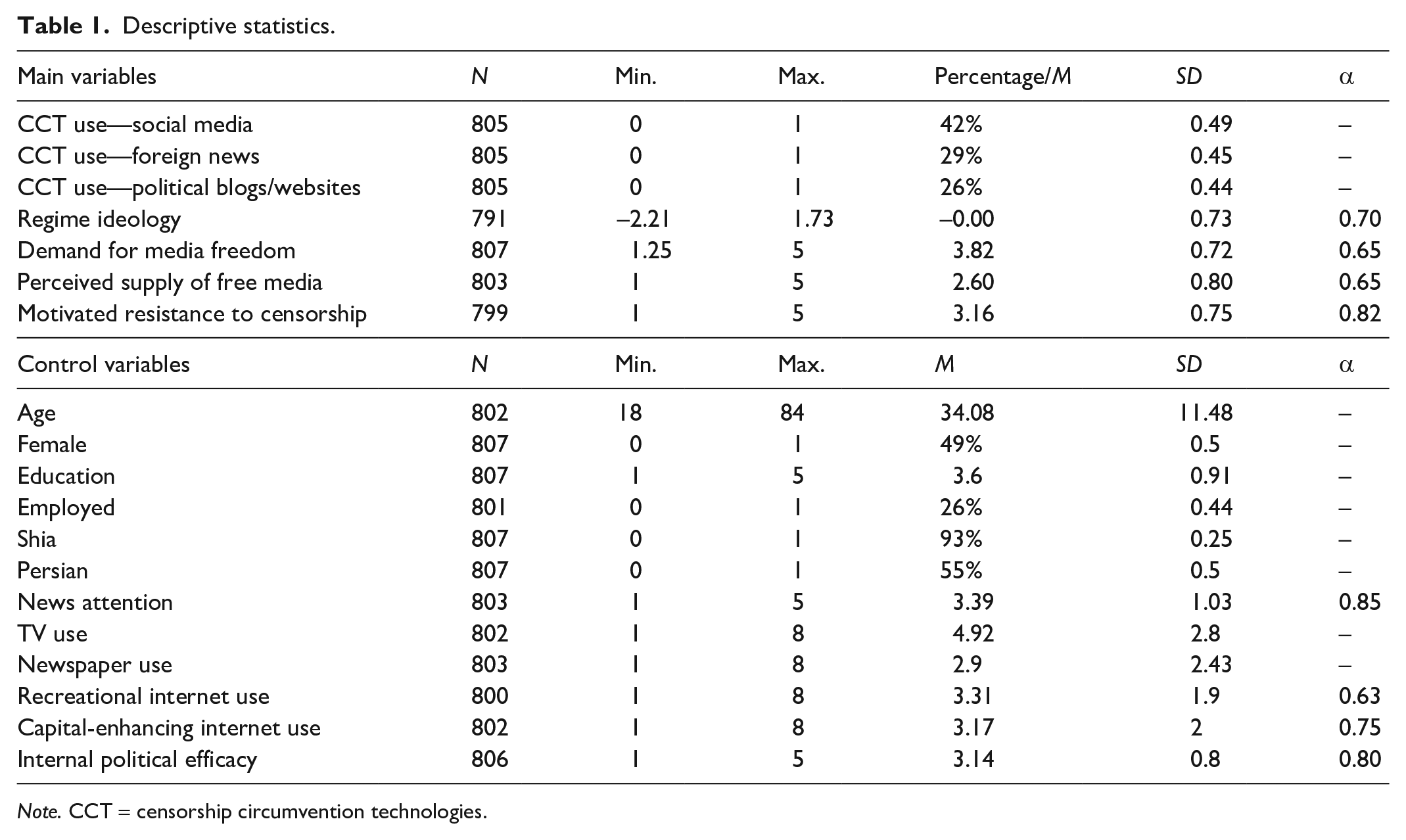
Note. CCT = censorship circumvention technologies.
Main Variables
The primary focal variables we used to test our proposed model were regime ideology, demand for media freedom, perceived media freedom supply, MRC, and CCT use. We measured regime ideology by combining four items that tap into the religious and political dimensions of the construct (see Karakoç & Sarıgil, 2020; Tezcür & Azadarmaki, 2008). For the religious component of regime ideology underlying Iran’s theocratic state, we employed two survey items measuring praying frequency and subjective piety. The first asked how often respondents engage in salat/namaz or dua (i.e., prayer, 1 = daily, 7 = never, reverse coded) and the second asked how religious they are independent of how frequently they engage in salat/namaz or dua (1 = not religious at all, 7 = very religious). In addition, we coded non-Muslims as “never” and “not at all religious,” respectively. For the political dimension of regime ideology, we gathered information on respondents’ identification with the traditionalist, conservative political movement, called Principlists in Iran that strongly supports Iran’s repressive theocratic system of government. Respondents were asked to report their favorability toward Principlists on an 11-point scale (0 = very unfavorable, 5 = neutral, 10 = very favorable) and to characterize their own political leanings on also an 11-point scale (0 = very reformist, 5 = moderate, 10 = very principlist). We then standardized and averaged responses to these four items into a single measure, with higher scores indicating greater regime ideology.
Demand for media freedom was assessed by averaging the amount of agreement or disagreement with 4-point Likert-type scale (1 = strongly agree, 5 = strongly disagree) statements about how the media in Iran should function. We measured the perceived supply of free media measure in a similar fashion by combining respondents’ self-reported agreement with four statements about the level of media freedom supply in Iran measured on the same 5-point scale (see Supplemental Appendix for full item wording). The responses were averaged with higher scores indicating a greater supply of free media as perceived by respondents.
We measured MRC by employing an eight-item scale previously used by Behrouzian et al. (2016), who adapted the items from previous studies measuring reactance. The items assess both the cognitive and affective dimensions of the construct. Respondents were asked on a 5-point Likert-type scale how much they agreed or disagreed with statements about their experience with the domestic news media in Iran, such as “When accurate information is not available in the government-controlled news media I get angry,” and “Most government-controlled news media try to make me think a certain way” (see Appendix).
For our dependent variable, we constructed three separate dichotomous measures (1 = CCT user, 0 = non-user) for using CCTs to access (a) blocked social media platforms, (b) blocked foreign news websites, and (c) blocked political blogs or websites. Our survey had two separate items of CCT use. These measures were derived by first asking respondents if they had ever used any form of circumvention technologies to access online content. If they replied affirmative, we then asked them the frequency of use for each type of content.
For analysis, however, we decided to dichotomous our indicators of CCT use for each type of content with “non-users” coded as “0” and any those who responded they CCTs to access the content, regardless of frequency, as “1.” The reason for this coding is two-fold. First, from a measurement and analytical perspective, the distribution of survey responses best fits a binomial distribution due to the low percentage of respondents who stated they used any form of CCTs to access each type of content (e.g., only 25.7% say they use CCTs to access foreign news). Second, conceptually, given the inconsistency and selectivity of the Iranian governments’ digital repression practices (Kawerau et al., 2022) and individuals’ often contextual decision to use CCTs in such settings (S. Zhao et al., 2013), modeling who has used CCTs to access content at least once versus never better fits the sporadic nature of CCT use in authoritarian environments.
Control Variables
Replicating previous research on MRC and media use in Iran (Behrouzian et al., 2016; Wojcieszak et al., 2019), we included several control variables as covariates in our analysis. The socio-demographic controls include age, educational attainment (measured on a 5-point scale ranging from 1 = no formal schooling, 5 = having completed two or more years of graduate study) as well as dummy codes used for being female, employed, as well as self-identifying as being Persian and as Shi’a.
We measured news media use by asking how frequently respondents follow political news through (a) Iranian TV channels and (b) Iranian newspapers (both including online versions) each measured on an 8-point scale (1 = never, 8 = everyday). To assess the types and frequency of online behavior, we created two separate measures for capital-enhancing and recreational internet use (Stoycheff et al., 2020). We averaged respondents’ frequency of using the internet for (a) reading news from foreign news websites/media outlets, (b) reading Iranian news media websites, and (c) reading entries/opinions on an Iranian political blog or website to construct the capital-enhancing internet use measure, and (a) playing games online, (b) downloading or viewing videos, movies, or TV shows, and (c) downloading or listening to music to construct the recreational internet use measure.
To control for attention to news, we averaged responses to the items asking how closely the respondents follow news and information about (a) Iranian politics in general, (b) international issues or events, and (c) upcoming Iranian presidential election, measured on a 5-point scale (1 = not at all closely, 5 = extremely closely). Finally, we measured internal political efficacy using Niemi, Craig and Mattei’s (1991) four-item scale.
Results
We test our hypotheses through ordinary least squares (OLS) regression models predicting demand for media freedom, perceived supply of free media and MRC (Table 2), as well as three logistic regression models predicting CCT use for each of our dependent variables (see Table 3). Employing Model 80 in Hayes’ (2017) SPSS PROCESS macro, we also investigate our full proposed model. We first test each step of the proposed serial mediation (H2H6), and then, we test the overall indirect effects of regime ideology on CCT use through perceived supply/demand for media freedom and MRC (H1).
OLS regressions predicting demand for media freedom, perceived supply of free media, and motivated resistance to censorship.

Note. Robust standard errors in parentheses.
p < .05. **p < .01. ***p < .001.
Multivariate logistic regression predicting using CCTs to access blocked social media platforms, foreign news websites, and political blogs and websites.

Note. Robust standard errors in parentheses. CCT = censorship circumvention technology.
p < .05. **p < .01. ***p < .001.
The first hypothesized steps of the serial mediation model propose that regime ideology is negatively associated with demand for media freedom (H2) and positively associated with the perceived supply of free media (H3). Confirming our expectation, our results demonstrate a negative relationship between compatibility with Iran’s regime ideology and demand for free media (b = –.19, p < .001), with age, education, Persian, attention to news, frequent recreational internet use, and internal political efficacy as the other significant predictors (see Model 1). Likewise, we also find support for the hypothesized positive relationship between regime ideology and the perceived supply of media freedom (b = .16, p < .001). In addition, we see that being a female and recreational use of the internet predict perceiving a lower supply of media freedom while capital-enhancing internet use is associated with a greater perceived supply (see Model 2).
Our next set of hypotheses posited that the perceived supply of free media (H5) would be negatively associated with MRC while demand for free media (H4) would be positively associated with the concept, which our results support (b = –.14, p < .001, b = –.39, p < .001 and b = .31, p < .001, respectively). We also find that having high internal political efficacy, too, results in greater MRC (see Model 3).
H6 suggested a positive relationship between MRC and being a CCT user. We test this hypothesis with separate multivariate logistic regressions across our three online content types (see Table 3). The results reveal that MRC, along with low adherence to regime ideology, being male, and infrequent TV use consistently increases the odds of using CCTs across all three types of online content, confirming H6.
Beyond the common predictors, we also observe some variation in how our control variables are associated with CCT use across the types of content domains. While internal political efficacy and capital-enhancing internet use increase the odds of using CCTs to access blocked foreign news websites and political blogs/websites, education is a significant predictor of for using CCTs to access blocked foreign news websites and social media websites. In addition, whereas being non-Shia is only associated with CCT use to access foreign news websites, a finding consistent with scholarship on media choice in Iran, recreational internet use and news attention increase only the odds of using CCTs to access blocked social media websites.
Our last set of analyses returns to our first hypothesis positing an overall significant indirect effect of regime ideology on CCT use, through demand for media freedom, perceived supply of free media, and MRC. Given our theoretical model, the PROCESS macro’s bootstrapping function allows us to estimate the size of regime ideology’s indirect effect through two tiers of mediators when predicting CCT use—the first tier consisting of demand for media freedom and perceived supply of free media and the second tier consisting of MRC. The models, run separately for each content domain, yield two significant parallel serial mediation pathways with respondents’ regime ideology exhibiting a negative indirect effect through both first- and second-tier mediators across our dependent variables. Namely, regime ideology significantly decreases the odds of using CCTs by first influencing either the demand for media freedom or the perceived supply of free media, our first-tier mediators, which in turn influence MRC, our second-tier mediator. Computed for 1,000 bootstrapped samples and the 95% confidence interval, this negative indirect effect of compatibility with regime ideology measured in log odds is significant using CCTs to access blocked social media (b = –.04, 95% confidence interval [CI] = [–.08, –.02]), foreign news websites (b = –.02, 95% CI = [–.05, –.00]), and political news websites and blogs (log odds = –.03, 95% CI = [–.07, –.01]).
Discussion
While most discourse about censorship circumvention revolve around the competition between those who censor online content and those who wish to access it freely, our study highlights that social-psychological factors are crucial for understanding why some people use CCTs and others do not across different types of online content. Grounded in theories of reactance and motivated reasoning and taking into account localized manifestation of regime ideology, our theoretical framework provides a basis for understanding the cognitive processes and motivations influencing citizens’ use of CCTs that may be applied to a wide range of networked authoritarian country contexts, online content, and social media platforms.
When authoritarian states explicitly censor online content that interrupts users’ habits and makes them aware of the censorship taking place, this may motivate some internet and social media users to employ CCTs to bypass restrictions and access it. However, underlying psychological mechanisms that lead to this behavior have not been well explicated to date. Our model provides a major contribution by identifying one such possible mechanism and explaining why some internet and social media users may use CCTs to bypass state censorship of online content and platforms while others do not. It also shows how MRC is the intermediary linkage between regime ideology and system-justifying beliefs (e.g., evaluations of media freedom) in networked authoritarian contexts and CCT use.
More broadly, although what we call regime ideology in the case of Iran may involve other sources of authoritarian legitimacy in other contexts (Glasius, 2018), our findings contribute to the expanding literature on authoritarian governance of information environments by offering a theoretical mechanism for understanding the psychology of resilience to censorship more generally. Authoritarian governments are increasingly adopting their repressive tactics to contemporary communication settings by resorting to “porous censorship” of online information and social media platforms, where their restrictions are often permeable to citizen resilience, often by illegal means (M. E. Roberts, 2018). This permeability usually results in a small segment of the “activated” publics consisting of the tech-savvy, the politically interested that are aware of online censorship and media disruption in authoritarian contexts to become successful in resisting government censorship of online content through the use of CCTs. The remaining majority who are not aware of government censorship, support it, or who are not motivated to take action to bypass it, fall within the authoritarian regime’s content bubble of censored content and strategic distraction through co-opting a variety of online platforms and content (King et al., 2017; M. E. Roberts, 2018; Sanovich et al., 2018).
This study is not free from limitations. First of all, as we rely on self-report data on CCT use, it is possible that some respondents may have been reluctant to disclose their censorship evasion practices. After all, it is often ambiguous when and under what conditions CCT use may be sanctioned. For instance, while distributing or training internet or social media users to employ CCTs is illegal, the actual use of CCTs is not in Iran. However, considering that circumventing online censorship is a form of resistance to authoritarian government’s repressive practices, such uncertainty associated with CCT use may have resulted in fewer respondents openly sharing their CCT experience.
There are some measurement and data limitations as well. Though the survey sample was a probability-based panel of Iranian internet users, there may be subtle differences between those who volunteer to participate in an online panel and those who do not that are not accounted for by demographic covariates in the analysis. Our anonymous online survey asked respondents about CCT use that is not illegal but is highly discouraged by authorities, and thus, there is the possibility of some degree of respondent self-censorship or preference falsification. However, the scholarship on asking sensitive questions in general, and in Iran specifically, shows that anonymous surveys like the one we conducted—whether online or from street-level intercepts—typically produce less biased results and more accurate estimates of sensitive behaviors than other data collection methodologies, such as in-person interviews, household surveys, and group settings (Borrill et al., 2012; Haghdoost et al., 2013). Thus, our data collection methodology is likely one of the most optimal approaches for gathering accurate estimates of CCT use in Iran. Nevertheless, due to the survey’s cross-section design, we cannot make overly strong causal claims as there is a possibility that some of the relationships within our model are recursive or self-reinforcing. Future research employing longitudinal survey panel designs to examine our model’s constructs over time would allow maximum external validity while being able to make stronger causal claims as to the pathways of influence we have outlined in this study.
Moreover, although we are able to differentiate between the domains of content for which respondents employ CCTs, we lack information on the specific content individuals are accessing. Censorship during political crises or heightened citizen awareness about a popular social media platform being banned, for instance, may result in CCTs being used by wider than usual groups of internet users. Thus, studies focusing on specific censorship practices or periods could reveal additional mechanisms for cases of episodic increases in CCT use. In addition, although we did not ask about respondents’ efficacy for seeking out entertainment-related information, based on the reliability between the items tapping efficacy across different types of content, we make an assumption that our measure applied to seeking a variety of content, including entertainment.
We also recognize that the way we construct our CCT use measures warrants further consideration, given we use dichotomous dependent variables and restrict the types we examine to entertainment, social media, and politics-related content/platforms in the general sense. Our results should be interpreted with caution as our proposed theoretical model helps us understand who ends up becoming a CCT user in the Iranian context regardless of the reason, timing, and duration of censorship as well as the internet users’ frequency of turning to these tools and the specific techniques used.
Our study has several implications for policy and practice when it comes to promoting the circumvention of online censorship in repressive environments. Public policy aimed at online censorship has focused on supporting the development of new CCTs and making them widely available, as exampled by the US government’s Open Technology Fund (OTF). Though the availability of reliable CCTs and knowledge of their availability are necessary for citizens to bypass online censorship—our study highlights that these factors by themselves are not sufficient conditions for widespread use of CCTs in repressive environments. In the classic sense of behavior change (e.g., Kemm & Close, 1995), MRC provides the attitudinal link between knowledge (e.g., awareness of CCTs, awareness of censorship) and behavior (use of CCTs).
Our study, thus, provides some insight into how the development and availability of CCTs need to be paired with extensive communication and outreach strategies targeting affected populations as a means to influence their perceptions of how their media freedom is being restricted, which in turn leads to greater MRC and consequently CCT use. The challenge, however, as our study also highlights is that citizens’ awareness and beliefs about online censorship and media freedom are often biased with individuals either over-estimating the amount of media freedom they actually enjoy (e.g., Nisbet & Stoycheff, 2013) or actively supporting the government’s online censorship as it comports with their pre-existing values, identities, or beliefs (e.g., Nisbet et al., 2017). This means the effectiveness of purely educational approaches to influencing citizens’ evaluations of media freedom and MRC may be mitigated by motivated reasoning and other cognitive biases. Instead, we suggest that policy actors and internet freedom advocates focus on developing and widely disseminating targeted strategic, persuasive communications—designed to align with pre-existing identities, values, and identities that may reduce biased processing of information paired with efficacy information—if CCT use is going to spread beyond narrow slices of “activated publics” in repressive environments.
Supplemental Material
sj-docx-1-sms-10.1177_20563051221137738 – Supplemental material for Walking Through Firewalls: Circumventing Censorship of Social Media and Online Content in a Networked Authoritarian Context
Supplemental material, sj-docx-1-sms-10.1177_20563051221137738 for Walking Through Firewalls: Circumventing Censorship of Social Media and Online Content in a Networked Authoritarian Context by Aysenur Dal and Erik C. Nisbet in Social Media + Society
Footnotes
Declaration of conflicting interests
The author(s) declared no potential conflicts of interest with respect to the research, authorship, and/or publication of this article.
Funding
The author(s) received no financial support for the research, authorship, and/or publication of this article.

Supplemental material
Supplemental material for this article is available online.
Author biographies
References
Supplementary Material
Please find the following supplemental material available below.
For Open Access articles published under a Creative Commons License, all supplemental material carries the same license as the article it is associated with.
For non-Open Access articles published, all supplemental material carries a non-exclusive license, and permission requests for re-use of supplemental material or any part of supplemental material shall be sent directly to the copyright owner as specified in the copyright notice associated with the article.
