




Abstract
The rise of highly curated networks is a pivotal dimension of social media history, yet its diverse origins remain overlooked. Here, two inductive studies investigated the case of Path: a platform (2010–2019) designed around so-called “Dunbar’s Numbers” and core networks (i.e., close friends). Study 1 conducted manual and automated text analyses using App Store archives via the Wayback Machine to evaluate changes in the industry presentation over time. Analyses showed how Path placed consistent emphasis on its ability to reinforce close ties and provide a curation-centered version of authenticity. Study 2 analyzed how users and commenters discussed Path over the same period via topic modeling of a Twitter corpus, revealing the centrality of rise-and-fall narratives to conversation about the platform. Together, the studies displayed how Path’s growth foretold changes in the social media ecosystem and how online conversation diverged from industry logics. To conclude, we discuss how Path’s history parallels theories on personal network changes, including the importance of user-driven versus algorithm-driven curation. To that end, we showcase the potential (and challenges) of using digital traces to uncover the evolution of platforms from the perspectives of different stakeholders.
Keywords
In retrospect, the entrance of the mobile-first app Path into the social media landscape in late 2010 is easy to overlook. There are not Path icons dotting our homepages or storefronts, as seen today in the United States with Facebook, Twitter, Instagram, Snapchat, or Pinterest. At the same time, a range of perspectives have now echoed the need to look beyond the most mainstream social platforms (Gehl, 2015; Lampinen, 2016; Ledbetter, 2017; McLelland et al., 2017; Rains & Brunner, 2015), as well as adopt methodological approaches that are likely to reveal long-term insights into the evolution of human communication and social media (e.g., Bayer, Triệu, et al., 2020; Fox & McEwan, 2017; Yang & Clark, 2015). The current pair of studies follows such calls through a digital excavation of Path, also known as “The Personal Network.”
In line with Myspace and Vine, Path can be viewed as a fruitful case study within the history of mundane sharing on social media (Ankerson, 2015b; Humphreys, 2018; Miltner & Gerrard, 2022). In its early years, the app developed a significant userbase totaling 50 million users (largely outside of the U.S.). The mobile platform was initially heralded as a new innovator in Silicon Valley and pursued by Google as a potential acquisition—only to produce an assortment of news stories documenting its downfall (e.g., Russell, 2018). Here, through two inductive studies, we retrace the rise and fall of Path by drawing on web archives (Study 1: Wayback Machine) and social traces (Study 2: Twitter API). Most centrally, we track Path’s self-proclaimed aim to develop a social platform for core networks (i.e., close friends and family), and link its history to theoretical perspectives on personal network changes. Path thereby offers a dual lens on the trajectories of social media and human sociability: two key themes within the fast-growing archives of Internet history (Fortunati, 2017). To conclude, we discuss how Path represents a distinctive case in the evolution of personal network curation—that is, how people and/or platforms reinforce certain relationships.
Design by Dunbar’s Number(s)
Rarely does a social scientific theory directly inform the development of a new communication technology. Path was an exception. Surprisingly, the stated rationale for part of its design came from Dunbar and colleagues’ research about human network structure and the “social-brain hypothesis.” 1 Under this framework with anthropological roots, often abridged to Dunbar’s Number(s), humans are cognitively limited, as well as motivationally and temporally limited, in the number of relationships they can feasibly maintain (Dunbar, 2014; Sutcliffe et al., 2012). Although “150” has become the banner number, the full framework specifies a number of network layers based on numerical limits pertaining to personal network size, going from 5 to 15 to 50 to 150 to 500 to 1,500. Each layer, in turn, comes with different degrees of support and interaction that are theorized to occur on average (Dunbar, 2018). In addition to influencing studies on social network sites (SNSs) from early on (e.g., Tufekci, 2008), Dunbar and colleagues’ work took on new meaning with the launch of Path. The social app—founded by an early Facebook employee who quit to start the platform—embraced Dunbar’s Numbers by specifying a key constraint on the size of its users’ networks. Whereas users on Facebook could have up to 5,000 “friends,” users on Path were allowed just 50 in its original version. Path thus launched with a pointed critique of the limitless platforms of Facebook and Twitter.
Path stressed that its objective was to support the intimate relationships in users’ lives, with an explicit emphasis on “close friends and family.” As displayed prominently in the first line of its original App Store description, “Path is the personal network. A place to be yourself and share life with close friends” (see Figure 1). The design of Path offered features for consolidating the strongest ties—and excluding the weakest links—of personal networks. This branding implicitly suggested that the dominant social media of the time (e.g., Facebook) did not provide an adequate space to support and interact with close relationships (i.e., one’s core network). Over its history, the platform would leverage a plethora of phrases (e.g., “private network,” “inner circle,” “ones you love,” “people you know best”) to market this space, or envisioned social “niche” (Dimmick et al., 2011; Humphreys et al., 2018). Yet given its demise, it remains less clear how users responded to this imagined social space.

Example archival observations collected via the Internet Archive. The images reflect partial screen captures of the Apple App Store pages for Path (top), Instagram (middle), and Snapchat (bottom). Each screenshot is the first recorded entry found for the respective platform.
Path and Social Media History
Perhaps more so than any other social platform to gain momentum thus far, Path presented itself as a way to prioritize and personalize one’s core network. Nevertheless, Path’s “friend” limits are reminiscent of MySpace’s early “Top 8” box seen in its early stage, along with Snapchat’s “Best Friends” icon and Instagram’s “Close Friends” list seen in current interfaces (as of 2022). These connections to generalizable features in the media ecosystem illuminate what makes the forgotten platform a valuable case study (see Maiorescu-Murphy, 2020). Echoing more recent perspectives (Bayer, Triệu, et al., 2020; Boczkowski et al., 2018; Zhao et al., 2016), we take an ecological approach by examining how Path was compared and contrasted with other defining platforms of the cultural moment. In particular, we concentrate on Instagram and Snapchat as potential competitors and fellow mobile-first platforms, while also considering Facebook and Twitter as leaders of the social media ecosystem. Such comparisons are especially germane because emerging social media often define themselves in relation to older platforms, regularly claiming to enable a more “authentic” social experience to potential users (Salisbury & Pooley, 2017). As of writing, this cycle is being repeated with the rise of BeReal, which claims to provide a space for “your friends for real” that is “not another social network” in its app store page.
From a wider vantage point, Path epitomized the mobile turn in the history of online communication (Brügger, 2018; Campbell, 2020; Fortunati, 2017) and reflected each of the social platforms above during its decade in the app store. As shown in Figure 1, even the special focus on intimate ties can be seen in an early screenshot of Snapchat—that is, in the year following Path’s arrival. In the time since, research has documented how Snapchat became a space for close and romantic relationships (Bayer et al., 2016; Utz et al., 2015). Prior work has also identified an assortment of reasons that people (un)friend, (un)follow, and (un)block others (e.g., John & Agbarya, 2021; Ouwerkerk & Johnson, 2016), indicating the importance of features for shaping one’s network in the social media ecosystem today. As such, we set out to determine whether Path’s focus on core networks changed over its life cycle, and how its rise-and-fall trajectory helps to unearth this critical period of social media history.
Overview of Studies
The ascension of “The Personal Network” app raises questions about (1) how platforms construct niches for certain network ties, such as Path’s envisioned niche for core ties, and (2) how users respond to these industry aims. In line with work on the social imaginaries of mobile media and the Internet (e.g., Campbell et al., 2021; Goggin, 2014), we suggest that how platforms such as Path promote and potentiate social spaces may be as influential as the perceptions of their users. However, the two vantage points are seldom considered together when assessing the social and historical implications of social media. This lack of joint attention is significant because the views of industry stakeholders and lay users are likely to diverge from one another, especially during pivotal periods. Taking an “anomaly” case study approach (Maiorescu-Murphy, 2020), we conducted two inductive studies to uncover the rise and fall of Path from both views, along with links to theories of personal network changes. Importantly, our studies centered on the history of Path in the United States given that the platform evolved differently in other cultural contexts (e.g., Indonesia).
To do so, we collect two sources of digital traces about Path: (1) App Store screenshots of Path’s description via Internet Archive and (2) naturalistic conversation about Path via Twitter. Together, the two datasets allow us to capture multiple views on the trajectory of Path, as well as investigate the utility of web archives and public tweets for studying social media history. In Study 1, we investigate how Path presented itself to users in the United States throughout its lifespan from 2010 to 2017 using archival “Wayback Machine” data. By collecting official public-facing copy and branding language, we evaluate the extent that the app built its identity around core ties over the course of its history (RQ1). In addition, we sought to identify other themes that made up its appeal to users in addition to—or in place of—the core network focus (RQ2). In Study 2, we attempt to delineate user perceptions by collecting Twitter conversation about Path in the United States across the same 7-year period. In doing so, we explore whether English-speaking users and commentators imagined (or ignored) the network focus and identify other topics that users made salient in their natural conversation (RQ3). Our joint focus on industry and user perspectives thus resulted in three research questions:
RQ1. How did Path’s original focus on core networks change over time?
RQ2. What other themes did Path highlight in its description to potential users?
RQ3. What topics did Path users and commmenters focus on when discussing the platform?
Study 1
Method
All analysis code, output, non-sensitive data, and Online Supplemental Materials (OSM) are available via the Open Science Framework (OSF). 2 Following prior work on Internet histories (Ankerson, 2015a; Arora et al., 2016; Mackinnon, 2022), Study 1 analyses were conducted using Wayback webpage records made publicly available by the Internet Archive (www.archive.org). After initially investigating the historical records associated with Path’s official homepage (i.e., www.path.com), we shifted the focus to the unique URL associated with the Path app via the Apple App Store. 3 This was done for two reasons. First, the App Store page is what potential users were more likely to see when deciding whether to adopt or update Path. Soon after its launch, Path was featured in most popular subsection within the Social Networking category of the App Store (along with numerous forgotten apps). 4 Second, the high consistency in formatting on the App Store page—that is, a quick summary description followed by an outline of app features—allows for clearer comparisons of focal themes over time. Importantly, we focused on the Apple App Store in the United States given our focus on the trajectory of Path in the U.S. context. Thus, all text from the app description was presented in English.
Sample and Procedure
The set of screenshots (N = 34) analyzed were selected across a 7-year period starting when Path premiered (November, 2010). Most App Store archives comprised three sections: (a) summary description (a couple of short sentences, up to a paragraph), (b) specific features (presented in a formatted list), and (c) application details (a few sentences stating device compatibility, links to the company website, and a version number with changes listed). Investigation of the Wayback records revealed that the Path App Store page was crawled on most but not all months during the 7-year period—a common challenge when dealing with Wayback data (Ankerson, 2015a). Due to the frequency of missing data, one screenshot was selected for every 2-month period (if available). If multiple screenshots were recorded during a given 2-month period, we selected the date closest to the middle of the time range. 5 The average number of days between observations was 74.59 (SD = 35.95), with 9 of the 43 bimonthly periods producing missing data.
We took a three-stage approach to evaluate the themes and changes in Path over time. First, a global thematic analysis was conducted to identify the range in themes on the App Store page, along with the defining keywords associated with each theme, across the 7-year period. Second, two human raters were trained to code the Wayback screenshots based on the keyword dictionary constructed in the first stage. Third, we augmented the human coding procedure with an automated phrase matching technique.
Theme Identification
A multi-step process was taken to prepare for the textual content analysis. Taking an inductive approach, we identified possible themes by evaluating a sample record of Path’s App Store page from each month. This resulted in the identification of 18 discrete themes. Second, following discussion of the emergent themes between two authors, the 18 themes were aggregated into 12 distinct categories, which were labeled as following: network, aesthetics, spontaneity, authenticity, lifelogging, expression, privacy, simplicity, cost, chat, integration, and reputation. Notably, the network theme captured Path’s original focus on core network ties such as friends and family (RQ1). Next, relevant keywords contained in either the summary description or features list were assigned to the appropriate theme category. For complete lists of words associated with each category and coding guidelines, see Table S2 in OSM.
Coding Process
Analysis of the 12 categories was performed in two ways: 1) manual coding by trained human raters and 2) phrase matching based on the automated counting of the category dictionaries (see OSM). The distinct features were identified by bullet points or line breaks (or dashes in a few cases). The third section of the pages (including compatibility, version number, etc.) was excluded from analysis, as well as the use of testimonials during a brief period in 2013–2014.
Two raters evaluated all 34 screenshots and determined whether each category was noted within the (a) summary paragraphs (dichotomous), and identified the number of items mentioning each category within the (b) feature lists (count). Hence, the coding of both summary paragraphs and specific features was binary as either containing the theme (1) or not (0), and each feature could only count once toward each theme. For the summary paragraphs, reliability analyses used percent agreement given significant skewness in the coding of some categories. Summary paragraph analyses showed that most categories exhibited very high consistency and all categories received >77% agreement across raters. In addition, as a robustness check, we conducted reliability analyses using the Brennan–Prediger approach to account for chance agreement (Brennan & Prediger, 1981) via the irrCAC package in R. For the feature lists, analyses utilized Krippendorff’s α (Krippendorff, 2004) via the irr package in R and revealed that all categories were once again reliable (see Table S2 in OSM for a full summary).
Results
Our analyses were organized by the two main sections of the App Store page: summary paragraphs and feature lists. Globally, we found that most of our inductively generated themes were mentioned in the summary paragraphs regularly or semi-regularly. Most significantly, network (97.06%), authenticity (94.12%), and simplicity (88.24%) were the three most common themes across the dataset. A second group of themes appeared in about two-thirds of all summary paragraphs: aesthetics (70.59%), privacy (64.71%), and lifelogging (58.82%). The remaining themes appeared periodically or temporarily in the summary paragraphs (spontaneity: 38.24%; integration: 25.00%; reputation: 25.00%; cost: 17.65%; chat: 11.76%; expression: 0.00%), suggesting they served a limited purpose or were viewed as less central to Path’s top-level platform brand and public-facing identity (see Table S2 in OSM).
The remainder of analyses for Study 1 focused on the feature lists, with each feature serving as the unit of an observation. Feature lists allow Path to state the key functions of the application, highlight different ways to engage with the app, and differentiate the app from other apps. Overall, results displayed substantial variation in how the platform chose to present itself to potential users. The number of features per observation ranged from 0 to 14 (M = 7.46, SD = 3.83). Although the vast majority of the observations included features, the precise number varied considerably across the collection period, with 2012 displaying the fewest features (M = 3.50) and the following year rapidly jumping to the highest number of features (M = 12.25). Broadly, Path began by focusing on a handful of features in 2011, switched to a more minimalist branding in 2012, highlighted a dozen or more features from 2013 to 2015, and largely stabilized from 2016 to 2017. As such, there was a noticeable uptick in all theoretical themes in 2013. See Table S1 in OSM for a summary of year-by-year changes. At the theme level, analyses of the feature lists demonstrated significant variation in the occurrence of our 12 themes. Notably, authenticity (M = 4.79, SD = 2.39) and spontaneity (M = 3.13, SD = 1.63) were the most frequently mentioned themes, while reputation was the least frequent theme with 0 mentions (M = 0.00, SD = 0.00). See Table S3 in OSM for descriptives of all themes.
Next, we examined the change in theme mentions over time. To account for the variability in feature counts, we focused on the change in themes using proportional measures—that is, the percentage of features on a given date referencing each theme. Analyses revealed that the network theme (RQ1) started and ended as the third most frequent category, remaining a consistent focal area across Path’s history (with some fluctuations, as suggested by the lower mean). In terms of other themes (RQ2), analyses reaffirmed that authenticity and spontaneity were the most frequently mentioned themes, with over 80% of features referencing an authenticity-linked keyword at the height in 2016. Likewise, lifelogging, expression, and aesthetics received consistent attention from Path’s emergence through the end of our data collection period. There was also clear growth in the trend lines for integration (in 2012), privacy (in 2013), and simplicity (in 2014). By contrast, the final three themes of cost, chat, and (to a lesser extent) reputation were introduced during the period of increased feature specification, only to be largely marginalized by the end of 2014. These themes confirmed that Path attempted a number of secondary pitches in its pursuit of users, but did not commit to all of them equally. As displayed in Figure 2, the human and automated scores displayed very similar results, providing convergent validity for the textual coding scheme. 6

Proportion of features coded for each topic over time. Lines of best fit were estimated using loess regression with a smoothing parameter of 40%. Observations with zero features are treated as missing.
Discussion
We began Study 1 with the aim of investigating how Path’s original focus on core network ties changed over time (RQ1). Our archival data showed that the network theme was almost universally mentioned in the summary paragraphs and started off as third most prevalent within the feature lists. However, Path’s focus on network keywords in the feature lists dropped off over the first 2 years before gradually rising in 2013 and 2016. The core network theme remained central to Path’s top-level branding (via the summary paragraphs) even as other themes received more attention at the feature level. This consistency suggests that Path attempted to keep its emphasis on close ties intact while also stressing other themes and testing new features along the way. The consistent role of the network theme was visible in the wide array of terms that Path used to describe this focus over its history (see Table S2 in OSM).
At the same time, we found considerable evidence that Path focused on other themes (RQ2) to an equal or greater extent over the course of its life cycle. Perhaps most importantly, the authenticity theme received the most consistent attention in our App Store dataset, appearing in the vast majority of summary paragraphs and specific features at all timepoints. As such, we replicate prior work on the centrality of authenticity claims among platform branding (Salisbury & Pooley, 2017). By comparison, the simplicity theme was treated in a similar manner to the network theme; that is, almost all summary paragraphs highlight Path’s simple design (i.e., user experience) despite receiving fewer mentions in the feature lists. More broadly, the focus on simplicity, as well as aesthetics and lifelogging (see Rhee et al., 2021), confirmed the resemblance to Instagram, which defined itself as a “simple life-sharing app” focused on photos from the beginning (see Figure 1). Similarly, the prevalence of spontaneity (especially at the feature level), in addition to the close relationship focus via the network theme, solidified the secondary connection to Snapchat (see Bayer et al., 2016).
Some themes were shown to fluctuate based on updates to the Path app and developments in the fast-moving ecosystem. In particular, integration, expression, and privacy started off comparatively infrequent, but grew into the most referenced themes over time. The rise in integration shows Path’s attempts to maintain a userbase without forcing users to abandon dominant competitors (e.g., Facebook, Twitter). The growth of expression reflects the increased focus on reactions, which are now visible across the social media ecosystem (e.g., Facebook, Twitter, iMessage, Signal). As such, Path increasingly presented integration and expression as central capabilities, but did not make them essential to the overall brand. Finally, the expanding focus on privacy reflected concerns around user privacy—perhaps in response to a controversy (and eventual fines) caused by Path itself (Federal Trade Commission, 2013).
Other themes received minimal attention in both components of the app store page (chat, reputation, cost). Here, the mixed messaging associated with the chat theme is noteworthy. Path developed a new component of the platform that signaled the growing convergence of social media and messaging apps (e.g., Facebook Messenger, WhatsApp), yet refrained from making this theme central. Of relevance, messaging later became a significant element of both Snapchat and Instagram. On the contrary, scattered attention on reputation and cost likely reflect the challenges of competing in a saturated and cost-free industry. It is difficult for a start-up to make money without users, and it is difficult to charge a userbase when there are free alternatives (with more of their friends). As such, Path experimented with a “freemium” model in which users could pay for extra services. Ultimately, such novel features were unsuccessful at shifting Path’s trajectory, but they foretold themes that continue to materialize in the social media ecosystem today.
Altogether, Study 1 illustrated how a rising platform positioned, and repositioned, itself as it sought to gain users and build engagement around the idea of close-knit personal networks. The presentation of Path’s platform identity was relatively dynamic, especially in the earlier years. The wide-ranging themes that Path sought to convey—including network intimacy, authentic expression, simple experience, spontaneous moments, and artistic design—indicates an effort to triangulate a social niche in a crowded ecosystem that privileges daily and monthly active users as measures of success. The nature and timing of these changes suggests that Path altered its official identity to distinguish itself and capitalize on broader socio-technical trends. Next, we expound upon our results by collecting data from a parallel perspective on Path’s history: how users and commenters discussed the platform on Twitter.
Study 2
Method
Study 2 utilized a large-scale Twitter corpus to explore Path’s role in social media history and the topics surfaced via the Wayback data. We used Crimson Hexagon to query the Twitter API for tweets pertaining to Path between 3 November 2010 and 31 December 2017. In line with the first study, our data collection centered on the conversation among English-speaking users and commenters in the United States. We filtered out retweets so as not to skew the dataset toward viral posts and non-representative views. We also attempted to filter out URLs to minimize spam and avoid skewing the corpus to news content (vs. user perspectives).
Our query involved four main steps involving Boolean logic (see OSM for complete query text): (1) identify Path-specific tweets; (2) exclude retweets and tweets from the official Path accounts on Twitter; (3) exclude noise tweets that listed out multiple apps/platforms while keeping tweets that made direct comparisons related to Path; and (4) exclude noise tweets that used the word “path” in irrelevant ways (e.g., “career path”). In sum, our data collection process attempted to gather tweets about “Path” while excluding tweets using other intentions of the term “path,” remove retweets and instances where the author is Path or Path’s support team, and exclude non-English tweets and those originating outside the United States. This query procedure returned N = 74,338 tweets from N = 38,383 unique users, with Path receiving the most attention among at the start of 2012 (see Figure S2 in OSM).
Data Cleaning
We applied several cleaning processes to the corpus using the stringr package in R to prepare the data for topic modeling. These cleaning processes were intended to remove stop words and fix problems in the corpus related to imperfect processing of the query rules via Crimson Hexagon, including the removal of overlooked retweets and tweets with URLs (see OSM). At the end of the data cleaning process, we were left with a corpus of N = 42,863 tweets from N = 24,166 unique users between 3 November 2010 and 31 December 2017.
Structural Topic Model
We then estimated a structural topic model (STM) over the Twitter corpus using the stm package in R. Using the procedure outlined by Lee and Mimno (2014) to search for an adequate number of topics to model (see Figure S3 in OSM), we estimated a final topic model with k = 75 topics procedure. Whereas supervised topic models use a subset of documents interpreted by a researcher to fit a larger corpus, STMs necessitate an inductive approach. STM models fit the entire corpus at once, making it incumbent upon the researcher to interpret the results. Following RQ3, we had few preconceptions about the natural discourse of Path users and commenters on Twitter beyond the themes identified in Study 1.
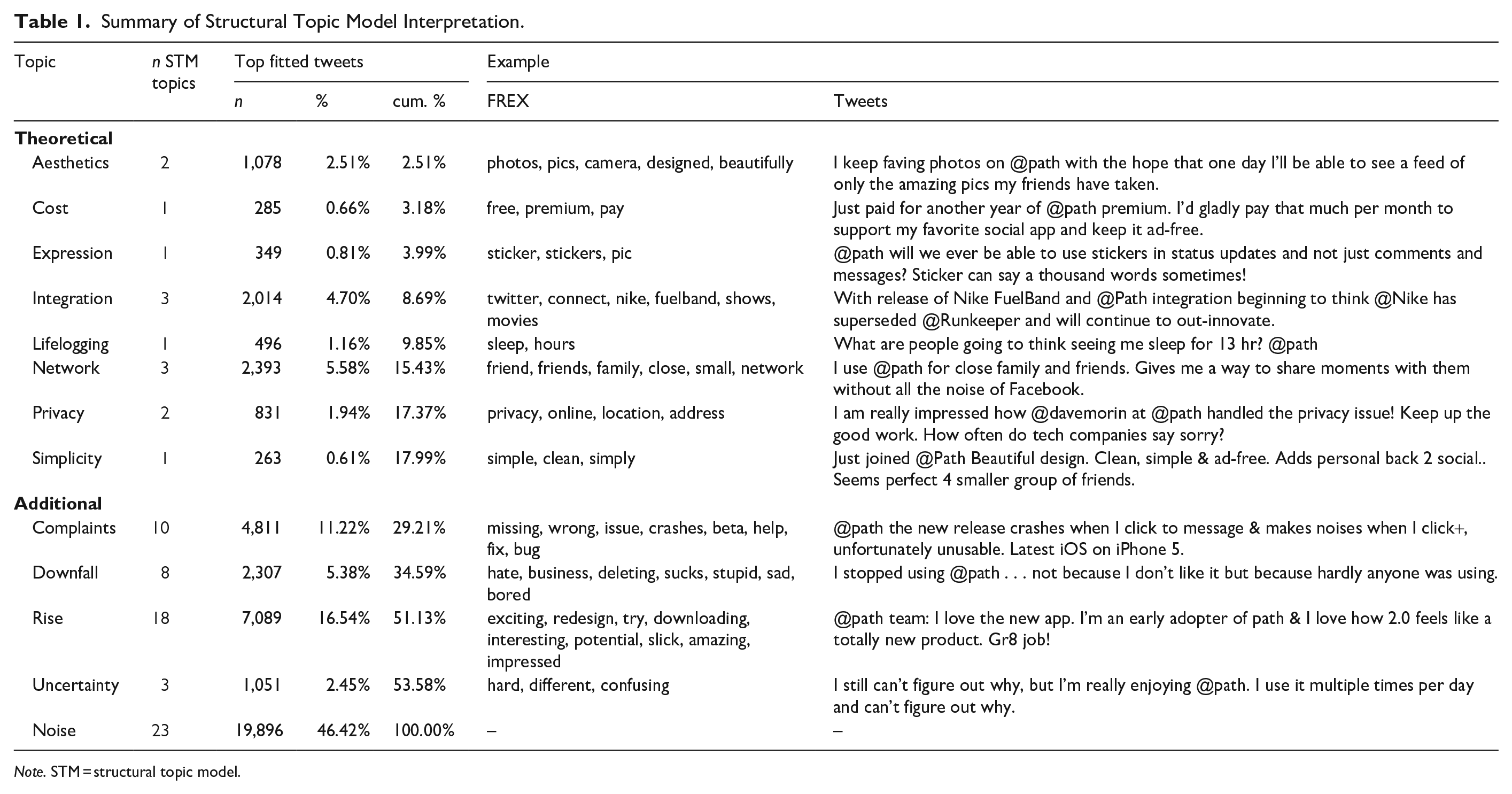
To interpret the results of the STM, we began by printing out a list of the top 7 FREX words and 10 example tweets for each of the 75 topics. FREX words are frequently occurring—and relatively exclusive—words in a group of documents (i.e., tweets). The example tweets were extracted with the goal of providing the most representative—that is, best fitting—tweets linked to the given topic. Two of the authors independently attempted to fit each topic to one or more of the theoretical categories identified in Study 1. After the initial identification round, the two authors then conferred on their topic interpretations. When there was disagreement on a topic category, they discussed the list of example tweets to reach a consensus about the topic. The full process for selecting examples is specified in the OSM. Using the example tweets, we were able to identify new topics beyond the categories discovered in Study 1. These additional researcher-identified categories include complaints, uncertainty, rise, and downfall. The latter two categories refer to the life cycle of the application; for example, a “rise” tweet might talk about how there is a new app rising within the App Store or the perception that many users are adopting it. Conversely, a “downfall” tweet might discuss how few users are on the platform anymore or that the user is switching back to a different platform. When no clear linkage between the FREX words and the a priori categories existed, and no additional theme was identified from the example tweets (and agreed upon by the first two authors), a topic was recorded as “noise.”
Results
Topic Prevalence
The results of the interpretation step are presented in Table 1. The researchers identified 14 STM topics that conformed to one of the 12 theory-informed themes identified in Study 1. Specifically, the STM topics mapped onto aesthetics, cost, expression, integration, lifelogging, network, privacy, and simplicity. Approximately 18% of the Twitter corpus had one of these topics as its top fit. Of the eight topics that were observed in both the Wayback and Twitter datasets, network was the most prevalent (5.58%), followed closely by integration (4.70%). The researchers were unable to find an STM topic that clearly corresponded to the authenticity, chat, reputation, or spontaneity categories. While the absence of chat and reputation is expected given their relative absence from Path’s own app description (see Figure 2), the lack of discussion pertaining to authenticity and spontaneity was more surprising due their frequency in the Wayback data.
Summary of Structural Topic Model Interpretation.
Note. STM = structural topic model.
An additional 36% of the corpus was classified using one of the four additional topics identified by the researchers: bugs and technical difficulties (i.e., complaints), hesitation and/or confusion about the app (i.e., uncertainty), rise, and downfall. Of those additional topics, rise—representing 18 STM topics and 7,089 top-fitted tweets—was the most frequently discussed on Twitter. Tweets in this topic might reference how great Path is, how it was treading new ground in the social media ecosystem, or how exciting redesigns of the app were after the initial launch. Significantly, our noise category represented 46% of the data we collected. This large section of the corpus included both topics which were incoherent to the researchers and unrelated to the Path application (see OSM).
To evaluate how naturalistic conversation changed over Path’s life cycle, we plotted the topic fit scores for each category in a similar manner to Study 1 trends (see Figure S4 in OSM). Most notably, results revealed that the network topic began as one of the most common, but steadily declined until it was surpassed by the integration topic in late 2015. Likewise, conversation related to aesthetics (e.g., perceptions of the interface) started at a frequent level, yet attenuated significantly in under 2 years. By contrast, the other theoretical topics and the newly identified additional topics were relatively consistent throughout the 7-year sampling frame. Finally, we used vector autoregression to test whether Path’s official copy in the App Store was predictive of Twitter conversation (and vice versa) among the 12 theoretical topics. However, we found minimal evidence of direct connections between the Wayback and Twitter topic trends (perhaps due to measurement limitations; see OSM).
Network Analysis
Another technique for interpreting the output of a topic model is to perform network analyses on the resulting metrics (Walter & Ophir, 2019). When applied to topic model networks, we can see which sets of topics tend to correlate and group together. The fitted values of a STM conform to a matrix of values with each row indicating a document (tweet), each column pertaining to one of the 75 topics, and the values representing the proportion of a document that discussed that topic. Using this matrix of fit scores, we created a correlation matrix at the level of topic, where each value corresponds to the extent that two topics coincide with each other on the same set of documents. To aid in the interpretation of the topic correlations, we combined the column values for the researcher-identified topics and created a separate correlation matrix containing the higher-order topic categories (Theoretical: aesthetics, cost, expression, integration, lifelogging, network, privacy, and simplicity; Additional: complaints, uncertainty, rise, and downfall; and noise).
We used the igraph package in R to perform the network analyses of our STM topics. Using eigenvector centrality—an established measure of both how important a node is in a weighted network and how well-connected that node is to other, centrally located nodes—we determined that the additional and noise topics tended to be more central in the network compared to the topics identified in Study 1. The rise topic was most central (1.00), followed by complaints (0.97), integration (0.86), noise (0.84), downfall (0.77), and uncertainty (0.68). The seven remaining theoretical topics follow: aesthetics (0.67), privacy (0.55), network (0.49), lifelogging (0.34), expression (0.33), simplicity (0.27), and cost (0.23). We interpret the substantially lower centrality scores of the theory-informed topics to mean that the concepts underlying those topics are more distinct. In other words, we find comparatively less overlap in the words used to describe the topics generated from Wayback (e.g., simplicity, cost) than those used to describe the newly identified topics (see Figure 3, Panel a).

Weighted network of topic category correlations across tweets. Edge thickness and darkness indicate the strength of correlation between topic categories. Node colors in Panel (a) indicate the type of category. Node colors and colored backgrounds in Panel (b) indicate community membership using Spinglass community detection. Results using alternative approaches to community detection are presented in the accompanying R Markdown document on OSF. The network of higher-order topic categories is presented in Panel (a). The theoretical, additional, and noise categories are distinguished by different node colors, while the strength of the aggregated correlations between categories is represented by both darker and thicker edges. In this graph, the noise and additional topics occupy more central positions in the network—the connections among them tended to be stronger compared to those connecting the theoretical topics. The strongest tie (i.e., the topics which co-occurred most frequently in the Twitter corpus) is between the rise and complaints categories at 0.40, while the weakest tie is the one between cost and network topics with a correlation of just 0.001.
Finally, we performed a community detection analysis to identify the connections between groups of topics that are often expressed in the same tweets (see Figure 3, Panel (b)). We utilized Spinglass for community detection given its versatility for fully connected and weighed networks, and lack of theoretical assumptions about nodes/edges; for comparison, two alternative approaches are described in the OSM and reported in our analysis code on OSF. This analysis revealed three communities in the network of topics, with considerable overlap between the broader theoretical and additional meta-categories. The most structurally distinct community is constructed of four theoretical topics (aesthetics, expression, integration, and lifelogging) along with the rise topic. This community reflected the ways in which Path’s rise was related to user perceptions of an appealing interface and novel features for expressing oneself, as suggested by the rise category being strongly correlated with aesthetics and integration. The second community contains two theoretical topics and two additional topics: cost, privacy, downfall, and uncertainty. The ambivalence of users toward Path seen in the uncertainty topic suggests that mixed reactions among users were a negative sign for long-term growth, and the inclusion of cost and privacy affirmed how fiscal and data privacy concerns were central to Path’s trajectory (and eventual demise). The final community contains the noise category, the complaints topic, and two theoretical topics: network and simplicity. Although less coherent than the other communities, the strong correlations between the noise, complaints, and network topics may be due to their increased prevalence relative to other topics, along with the manifold ways that the “network” keywords were used on Twitter. Altogether, the community analyses showed how some of the topics identified in Study 1—but not all (e.g., authenticity)—were embedded in the broader rise-and-fall narratives voiced by Path users and commenters.
General Discussion
This article began with a series of points about what Path was not—that is, neither a popular platform of today nor a precise precursor of tomorrow. Following previous case studies of overlooked media, we explored the obstacles faced by a social platform during the critical shift toward smartphones. Although our Wayback and Twitter datasets preclude us from knowing the specific causes of Path’s downfall or their direct links to users’ experiences, our studies provide a rare window into the interwoven evolution of social media during the 2010s. By surfacing the topics that emerged on the official app store page and open Twitter discussions, we indexed how the platform and its users (along with cynics) envisioned an emergent social space. The case of Path thus exposes how new niches were discovered, duplicated, and distinguished from one another in the lead-up to the contemporary ecosystem. While the most distinctive niche that Path trademarked—“The Personal Network”—did not last, its primary themes (e.g., authenticity) and secondary features (e.g., reactions) are visible in other platforms today. Indeed, as discussed below, the core question of how people use technologies to consolidate their closest ties continues to churn in the literatures on social media and personal networks.
Platform Versus User Perspectives
Study 1 showed that Path’s messaging placed a substantial amount of emphasis on core networks and close relationships. The network topic received almost universal attention in the App Store summaries, though it was referenced less frequently in the feature lists. As signaled by the assortment of network-related terms used in their official copy, we find evidence that core networks acted as a defining dimension of Path from start to end. Yet the web archives revealed even greater attention was placed on authenticity. To some extent, each social platform has sought to convey its own branded form of authenticity; for instance, Snapchat has been interpreted as “spontaneous authenticity,” echoing the connection between Path and Snapchat observed in our analysis (cf. Banet-Weiser, 2012; Salisbury & Pooley, 2017). In Path’s case, the critiqued inauthenticity of Facebook and Twitter also seemed to guide its identity (and branding) toward a sort of “curatorial” authenticity: a close-knit space curated by you. This resonates with perspectives on social media influencers whose “porous authenticity” (Abidin, 2018) is achieved by persistently alluding to more genuine “real lives.” Examining the web archives for traces of Path’s positioning offers a vital view into the transition from user-curated to algorithm-curated social media feeds that we see (and are sometimes roiled by) today.
Study 2 then provided insights into the themes being discussed by Path users and commenters during the same 7-year period. Among the 12 theory-informed categories, we surfaced the most tweets and distinct topics related to the network and integration categories. The prevalence of the network topic may be due to the distinctive, high-level focus on intimate networks. Separately, the wide conversation captured by integration likely corresponds to the other well-known media (e.g., Twitter, Nike wearables) added as features later on in Path’s life cycle. Beyond these topics, the Twitter conversation also reflected a number of other topics extracted during Study 1: aesthetics, simplicity, cost, expression, lifelogging, and privacy. Absent from the Twitter conversation, however, was clear evidence of reputation, chat, authenticity, and spontaneity. While the former two exclusions are not surprising given their minimal coverage in the app store descriptions, the lack of identifiable topics tied to authenticity and spontaneity is notable. This may reflect the possibility that, even for Path enthusiasts, tweeting about the “authenticity” or “spontaneity” of a platform may feel inauthentic and/or premeditated.
Outside of the topics identified in the first study, Study 2 also revealed a number of discrete topics that garnered even greater attention among tweeters. In particular, we identified a plethora of topics that captured the rise, uncertainty, and downfall of Path—beyond the many tweets concerning technical complaints and bugs. The ubiquity of rise-and-fall discussion on Twitter articulated how technology narratives, such as the death of particular media (Natale, 2016), guide the ways in which individuals make sense of new communication technologies. From predicting its virality in the early years to lamenting its lifelessness in later years, Path users and haters were preoccupied with the trajectory of “The Personal Network.” Affirming this point, our network analysis unpacked how the Twitter discussions around the rise and downfall—as well as complaints tied to both—were central in the dataset. The tweets most associated with the “network” topic illustrated how some users imagined what Path should be—and what a “network” should be—in ways that deviated from the company vision (see example tweets in OSM). Together, our two studies show how both industry and user views can contribute to the narratives that define emerging media and personal relationships.
Beyond the narrative appeal of platform deaths, the question of which platform prospers matters insofar as it informs the historical dynamics of communication technologies (Dahlberg, 2015; Fortunati, 2017; Hogan & Quan-Haase, 2010; Mackinnon, 2022; McLelland et al., 2017; Yang & Clark, 2015). Aside from the overlooked attention to core networks and intimate ties, our studies reaffirmed key trends and revealed new turns in the history of social media. In a number of ways, the themes identified in the Wayback archives and Twitter conversation reflected the changing tides of the social media ecosystem. Path encompassed the focus on artistry and simplicity that would come to define Instagram, as well as the spontaneity and privacy that would come to embody Snapchat. The observed overlap between Path and these two platforms, at least in their early forms, supports the potential of chronicling the long-term evolution of social media from the perspective of media niches (Dimmick et al., 2011). Moreover, the perceived potential of Path among some users raises questions about other periods and populations in which the platform might have left a deeper imprint. Future work should thus consider whether the above currents occur uniformly across the global media ecosystem (McLelland et al., 2017), especially given the more lasting success of Path in other cultures (e.g., Indonesia).
Methodological Implications and Limitations
Our studies reinforce the value in merging historical and computational approaches for studying social media, along with the merit of “failed platform” case studies. Future research can expand upon our approach to historicize a wider spectrum of platforms. We also confirm that computational methods need not draw on enormous corpora of records to reveal insights into communication history, especially given the risks of bigger data (Diesner, 2015). Rather than generate the largest dataset of screenshots or tweets at our disposal, we undertook an inductive process and focused on a targeted corpus most relevant to our RQs. Our studies illustrate, albeit imperfectly, how computational techniques (e.g., unsupervised topic modeling) can be informed by preceding analyses and enriched by inductive interpretation. Looking forward, studies can thus pursue theoretical generalizability (Davis & Love, 2019) even when facing datasets that lack empirical generalizability (e.g., noisy Twitter corpuses).
Despite these contributions, there were notable limitations evident with our two datasets that warrant consideration. First, the Wayback dataset focused exclusively on the Apple App Store, which may not match the precise descriptions shown for Android users. For example, one of our observations from the Apple App store contained references to a Nike activity tracker that was not available at the same time on the Google Play Store (though a sample of other matched dates we tested did not reveal any other discrepancies). Other sources of historical data (e.g., app reviews, technical updates, news coverage) may be useful for broader inquiries into social media history given the known imperfections of web archives and the Wayback Machine specifically (Ankerson, 2015a). Second, our naturalistic Twitter corpus included substantial noise and lacked generalizability to the full spectrum Path users (especially since most long-term users lived outside of the United States). In addition, our topic analysis approach was unable to quantify how users perceived specific features or events that may have shaped the rise and fall of Path. Future research may benefit from adopting more supervised approaches to topic analysis, as well as using convergent data sources to cross-validate measures and models.
Path and Personal Network Theories
While our findings do not clarify the causes of Path’s fall, both studies affirmed the importance of core networks and intimate ties to the platform identity. Path’s features may have changed regularly during its life course, but its original focus on building a more “personal” social network remained to the end. Nonetheless, Path eventually removed the primary technical feature associated with Dunbar’s Numbers, cutting the direct connection to the social network theory. Notably, Dunbar and colleagues’ research suggests that people are cognitively limited in the number of meaningful relationships they can sustain—whether or not a social media start-up brands these mental restraints as features (see Dunbar, 2016; Pollet et al., 2011). From this “social brain” perspective, users have cognitive, motivational, and temporal constraints on how many relationships they can reinforce with or without Path (Dunbar, 2012).
However, other key perspectives—in particular, network privatism and networked individualism—converge on the notion that social technologies can in fact impact which types of relationships are reinforced, thus affecting the structure of personal networks over time. The central argument of network privatism hinges on the idea that mobile phones might facilitate a socially inward focus toward core ties at the expense of weaker ties. This hypothesis emerged from an array of mobile researchers in the pre-smartphone period (Campbell, 2020). In brief, such perspectives focus on the extent that individuals might redirect their attention toward the relationships who matter most (or are most cognitively salient; see Kobayashi & Boase, 2014). Importantly, the hypothesis also assumes that people have a finite amount of time to apportion across their ties (Kobayashi & Boase, 2014). Yet empirical evidence concerning the privatism idea has been mixed (Campbell, 2015). The lack of clear support for network privatism may be due to mobile media producing an “added layer” of connectivity to close ties, rather than subtracting attention from weak ties (Campbell, 2020; see also Humphreys, 2018).
On the contrary, research on networked individualism emerged from a broader focus on the Internet and computer-mediated communication in addition to mobile phones (Wellman et al., 2006). The perspective asserts that people can now construct networks that circumvent traditional temporal and spatial boundaries, thereby allowing them to distribute social resources in a nimble manner (Hampton & Chen, 2021; Rainie & Wellman, 2012; Wellman et al., 2006). According to this view, increased network customization has produced more distinguishable, and diverse, networks than in the past. Rainie and Wellman (2012) summarize: “This is the era of free agents and the spirit of personal agency” (p. 19). In line with the above perspectives, networked individuals are also assumed to have limitations in the resources they can distribute toward their ties (Rainie and Wellman, 2012). Moreover, while some studies suggest that adult friendship networks are becoming larger (Wang & Wellman, 2010), empirical evidence remain contested and subject to steep methodological obstacles (Brashears & Brashears, 2015; Hampton & Chen, 2021).
Collectively, the latter two perspectives suggest that personal networks are more connected and customized today as a function of mobile and online media (Miyata et al., 2007; Wellman et al., 2019). As opposed to Dunbar’s Number, the latter theories specify a significant role of media effects in determining the shape of personal networks. Still, all three perspectives stress that people are limited in the amount of energy they can exert toward their ties. The rise of Path, therefore, highlights the question of whether social media change how people attend to—or think about (Bayer, Lewis, et al., 2020)—certain types of ties. And this question is especially pertinent as algorithmic recommendation systems (Seaver, 2019) and “nudges” (Wu et al., 2020) are deployed to shape user behavior and channel network attention.
Path as User-Driven Curation
One way of considering how platforms such as Path influence network attention is from the standpoint of curation: how particular ties are prioritized and arranged via social media (Davis, 2017; Hogan & Quan-Haase, 2010). Going beyond the increased availability of others offered by mobile and online affordances, curation covers the catalog of emergent tools that afford possibilities for network customization, categorization, reflection, and automation (Bayer & Hofstra, 2020; Davis, 2017). In addition to the well-known curation features on established platforms (e.g., follow/unfollow; Ouwerkerk & Johnson, 2016) or theorized to occur in the distant future (e.g., Rainie & Wellman, 2012), a surge of tech start-ups aim to help individuals organize their social worlds (Tiffany, 2019). Although emergent media are not the first tools to assist in network selection and organization (cf., address books), curation perspectives allow for recentering the question of network changes on the mechanisms of relationship prioritization. More broadly, this emphasis on enhanced control via online networks echoes theoretical frameworks related to interactivity (Sundar et al., 2015) and selective exposure (Knobloch-Westerwick et al., 2015). Although we were unable to extract specific user experiences in our studies (e.g., how users responded to network-relevant features), the centrality of curated networks to Path’s image was visible in both the Wayback and Twitter records.
Path’s emphasis on Dunbar’s Numbers provides a prototypical case of user-led curation in action. The “private network” branding denotes how the platform presented itself as a model for curating a close-knit niche: an app-based approach to network privatism. Path built this curatorial brand on what could be described as the most fundamental form of network curation: the act of “friending.” By tasking users to choose which people mattered most in their lives (up to 50 originally), the platform represented a tool for reinforcing a select set of close relationships and discounting weaker links. Path thereby acted as an exemplar case of agentic curation (Davis, 2017), such that users were encouraged to think about the people that matter most (“designed with your close friends in mind”). By selecting an exclusive set of key friendships, users could prioritize those contacts in their social media streams and smartphones (“control every friend,” “filter your feed,” “filter your notifications”). Path’s focus on agentic curation can be contrasted with third-party curators (Davis, 2017), or curation processes driven by the technology itself (and/or other human actors). Whereas scholarly discussion of platform and algorithm dominance is inspired in no small part by diminishing user agency, Path represents a reminder that a crucial chapter in social media history concerns the role of user-led curation.
More generally, the rise and fall of Path highlights the importance of how people organize their social circles (whether or not they match Dunbar’s Numbers). Wellman and colleagues (2019) assert that individuals are increasingly “maneuvering through multiple, partial personal networks and groups” (p. 2), as personal goals for one’s relationships are decentralized. This propensity for compartmental networks, however, represented another obstacle to Path’s version of curation. Sometimes our friends can fit under one online roof, but space quickly becomes crowded as various contexts “collapse” (Marwick & Boyd, 2014). But Path did not develop clear features for offloading or organizing the demands of relationship maintenance across circles. In this way, Path was more of an idea—a shared expectation for a social niche—as opposed to a set of tools for reinforcing one’s intimate ties. By contrast, the winds of the social media ecosystem may have gone in the other direction: segmenting relationships into different platforms (Hampton & Chen, 2021).
While ultimately fleeting, Path’s attempt to prioritize core ties remains relevant to ongoing questions tied to personal network changes and curation. Each of the frameworks above assumes that people have limited social energy to allocate at a given time, whether or not a platform allows for an infinite number of “friends.” Operating from this assumption, Path presented a direct call for network privatism by asserting the value of attending to fewer, closer ties. However, Path ran into a range of social, technical, and financial hurdles that came with design by Dunbar’s Numbers—eventually removing the main constraints on the number of friends. Looking back, the capacity to curate personal networks through limited lists bring to mind Facebook’s Friend Lists (originally known as groups) and Google+’s Circles. Hence, Path foreshadowed ongoing challenges and developments linked to personal network curation on other platforms, as seen today in Instagram’s “Close Friends” list feature (as of 2022).
Conclusion
The case of Path provides a prism for observing how social platforms changed amid the smartphone turn, while also underlining the overlooked role of user-driven curation in social media history. In the process, our studies showed how rising media are challenged to construct distinctive spaces and, simultaneously, capitalize on industrywide developments. Path’s projected image (Internet Archive; Study 1) and public commentary (Twitter; Study 2) displayed the liminal nature of “authentic” social spaces, as emergent platforms are repeatedly reimagined by companies and users alike. Path refracted many of the currents that came to drive and define the evolution of social media, including curation, authenticity, spontaneity, integration, and privacy. In turn, the remnants of Path can be seen through the “close friend” and “reaction” features incorporated into other platforms today, even if the number 150 remains a component of social network theory and not one of design.
Footnotes
Acknowledgements
The authors thank Michael Hall and Kyle Myers for their assistance while collecting data for the project.
Declaration of Conflicting Interests
The authors declared no potential conflicts of interest with respect to the research, authorship, and/or publication of this article.
Funding
The author(s) received no financial support for the research, authorship, and/or publication of this article.
